|
FAQs about Marine Crab Identification
12
Related Articles: Crabs,
Hermit
Crabs,
Related FAQs: SW Crab Identification 1,
SW Crab ID 2, SW Crab ID 3, SW Crab ID 4, SW Crab ID 6, Marine Crab ID 7, Marine Crab ID 8, Marine Crab ID 9, Marine Crab ID 10, Marine Crab ID 11, Marine Crab ID 12, SW Crab ID 13, SW Crab ID 14, SW Crab ID 15, SW Crab ID 16, SW Crab ID 17, SW Crab ID 18,
SW Crab ID 19,
SW Crab ID 20,
SW Crab ID 21,
SW Crab ID
22,
& Marine Invertebrate
identification, Marine
Crabs 1, Marine
Crabs 2, Marine
Crabs 3, Marine Crabs
4, & Crab
Behavior, Marine Crab
Selection, Marine Crab
Compatibility, Marine Crab
Systems, Marine Crab
Feeding, Marine Crab
Reproduction, Marine Crab
Disease, Micro-Crustaceans, Amphipods, Copepods, Mysids, Hermit
Crabs, Shrimps,
Cleaner
Shrimps, Banded
Coral Shrimp,
Mantis Shrimp,
Anemone Eating Shrimp, Crustacean Identification,
Crustacean Selection,
Crustacean Behavior,
Crustacean
Compatibility, Crustacean Systems, Crustacean Feeding, Crustacean Disease, Crustacean
Reproduction,
|
|
|
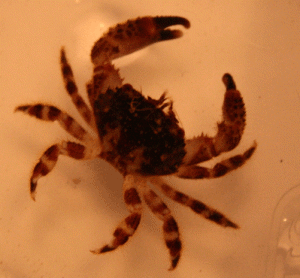
My crabinator, ID, comp...
12/12/08
Hello, I sent this four or five days ago. I just want to be sure
you all got it? Can you please let me know.
Thanks,
Poma
<Hi Poma,
Mich here. I apologize for the delay. I have been crazy-busy
preparing/flying across country for the holidays. Please see my
answer below.
Cheers,
Mich>
My Crabinator... Your responsibility
Hey Crew!
<Hey Poma!>
I love you guys!
<All you need is love!>
I met Mich back in Atlanta (I hope you remember me?),
<How could I forget?>
watched Scott's talk on biotope aquariums and loved it!
<Most excellent!>
Anyway, I have noticed that you have a knack for id's
Mich.
<I do enjoy these types of questions.>
I was wondering if you could help me out with my new crab.
<I will try.>
I found it a few days back at the beech.
<Beech, birch and maple. All begins with A.>
Could not resist the little bugger,
<I would not prescribe to the "resistance is futile"
mentality here.>
brought it home and put the little bugger in my tank.
<Mmm, this is most unwise. In general I recommend that people
know about the animals care requirements BEFORE actually assuming
responsibility for their care. When we bring an animal into our
world we become the provider for all of the needs for this life.
It is a weighty responsibility and should not be taken lightly.
I'm not trying to be critical here, just want to use this as
a teaching opportunity.>
Anyway, my tank:
45 gallon
2X 150 MH 14000K
2X 39 W actinic T5
2X MaxiJet 1200 returns
CPR Overflow
CPR Backpack skimmer in sump (thing is awesome!)
2X MaxiJet 900 in display
phosphate reactor
¼ hp chiller
250w heater
Eheim auto feeder
#60 or so of live rock, the Fuji type
<Heehee! Climbing mountains or picking apples?>
Fish:
two maroon clowns, a mated pair
mandarin goby
Copperband butterfly
3 blue damsels
2 Firefish
angler-new, yay!
<Please watch! My devour your other livestock!>
I want to add a Humu trigger,
<I wouldn't.>
but I think my tank is nearing max.
<I am in agreement with you.>
Inverts:
two sand sifting stars for cleanup
<I'm not a fan. They will decimate your live sand and then
slowly starve to death.>
15 hermits
15 snails
xenia X a zillion
<Heehee! Love it!>
a blue clam
Water:
Ca-400
KH- 8
Ammo:0
Nitrites: 0
Nitrates: finally under control, down to 20!
<I'm surprised you've struggled with all your
Xenia.>
Anyways, I don't know if I should keep this crab.
<From what part of the world did you collect this crab?
I'm wondering if it might be a temperate species. Now that it
has been in your system you should not release it back into your
natural waterways as you could potentially introduce a foreign
pathogen or invasive life>
If I can, what does it eat?
<It does look like a true crab and as such is likely to be an
opportunistic omnivore... meaning watch your livestock.>
How do I take care of the thing.
<Again, it is always best to ask this question and know the
answer before accepting the responsibility for care.>
If I can't keep it, what do I do with it and can you at least
tell me exactly what it is, I would really, really like to
know.
<Unfortunately I can not tell much from you photo. I would
move the crab to your sump as long as there is nothing there
which it could hurt or hurt it. Most crabs, unlike me, aren't
terribly picky eaters. So bits of meaty foods should work. I
would put a little rubble rock in your sump so the crab has some
shelter.
Thanks a million, you people live rock!!!!!!!
<Heehee!>
Poma
<Cheers,
Mich>
|
 |
|
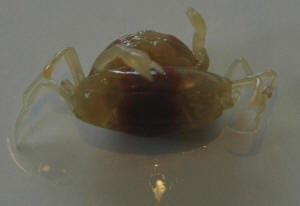
Interesting Crab Found in My Lunch: Oyster Crab -
11/15/08 Hey Crew. <Hi Andy> I bought some Blue
Point Oysters today and, upon opening one up, found the attached
crab in the oyster. <Neat> I've seen these before, but
this one was alive. I took a few shots of it and thought I'd
share. I have no idea what kind of crab it is, but I thought it
was interesting. Blue Points are from the Long Island Sound in
New York. Enjoy. <Thanks! It's very likely Pinnotheres
ostreum, a type of pea crab, sometimes called an oyster crab.
They're commensals that live in the mantle cavity of bivalves
and are supposedly brownish-green in color, although they turn
red when cooked (like lobsters and other crustaceans). Please
Google the above scientific name and/or �oyster
crab� for more information regarding these neat
little creatures: http://wetwebmedia.com/Googlesearch.htm >
Andy <Take care, Lynn>
|
 |
| Re: Interesting Crab Found in My Lunch:
Oyster Crab - 11/17/08 Thanks, Lynn. <It was a
pleasure, Andy.> Yep, from my searches, it does appear to be a
Pea Crab. Looked exactly like the picture here:
http://www.dnr.sc.gov/marine/sertc/images/photo%20gallery/Zaops%20ostreum%20in%20oyster.jpg
<Yes, they're odd but at the same time neat looking little
creatures. By the way, I was looking around for more information
today on this crab and found that the species name I gave you
(Pinnotheres ostreum) has been reclassified as Zaops ostreum.
Pinnotheres is considered a synonym but Zaops is the currently
accepted genus.> Not that it matters, but I noticed that when
you posted my query on WWM, the pictures weren't attached.
<Yes, and I apologize for that. I'm not sure what
happened.> Take care, and thanks again/as always. Andy
<You're very welcome. Take care, Lynn> |
Weird flat spider thing 10/17/08 Guys, the
information on this site is outstanding. My uncle was a Nat Geo marine
photographer, and he seems to of passed the fascination on to me. I
trolled your site but can't find what I'm looking for. Hope you
can give me some clues to research <OK.> I just got home and the
light timer hadn't been working...... which is another story. I got
some awesome live rock from Queensland with a huge amount of life forms
in it. All sorts of worms, crabs, tiny star fish, different slugs,
crazy looking fungus and sponges, things that squirt stuff.... too much
to mention. Anyway, enough boasting. I turned the lights on and there
was this huge dark coloured flat creature with a centre piece, maybe
1.5inch to 2inch with between 6 - 8 hairy legs coming from the centre,
that got thinner towards the ends. I guess the total diameter of the
creature was about 6 - 8inch. It's ran away quickly a bit like an
Octopus might. <Hmm... without a photo, obviously difficult to out a
name to this.> Any ideas? <Do review the genus Percnon,
particularly Percnon gibbesi, a very common "stowaway" in
reef tanks. It's very flattened, has long legs, and up to a point
is amphibious. It's an invasive species, and has recently appeared
in the Mediterranean.> Many thanks <Cheers, Neale.>
Mystery coralline-eating crab -- 10/10/08
Hi there!
<Howsit Juli?>
Thanks for working to educate us newbies!
We have had a 50 gallon saltwater aquarium set up for about 6 months
now with live sand, live rock, 2 ocellaris clowns, a Longnose Hawkfish,
and a royal gramma Basslet. We also added an assortment of hermit
crabs, snails, and a cleaner shrimp before realizing that the crabs
were probably not the best idea.
<Surprised the Hawk has not consumed most all the crustaceans
here>
However, the ones we purchased (red-legged, dwarf yellow tip, dwarf
blue leg) are small and do not seem to be causing issues as of yet. Our
last purchase a couple months ago were two pieces of live rock with
mushroom corals attached... and apparently, a "cling on"...
while looking after the lights went out one night, we discovered a
small (maybe 1/2 inch?) hairy crab lurking under one of the rocks! I
searched the site and found an obscure reference to one bearing
similarities
(http://photos1.blogger.com/photoInclude/hello/252/1727/640/DeadCrab.jpg )
but it's not an exact match.
<Mmm, the shape overall, the darkened tips of the claws... a member
of the family Xanthidae... Mud crab/s... predaceous>
Over several nights, I observed this crab moving sand
around underneath the mushroom rock and several adjacent ones and it
only appears to be eating coralline algae.
<Mmm, and likely more>
I have witnessed this behavior, where it breaks a chunk of rock off
with one of its claws (they are the same size) and sends grains of rock
flying. The carapace itself appears to be purplish coralline in color
and the legs are whitish, bumpy and fuzzy.
<Beautiful. Good description>
Its eye stalks are black and so far, the thing is only active after the
lights go out. Sorry I couldn't get a pic, this little guy is
definitely camera shy. If you can give any ideas or direction, we would
greatly appreciate your help!
<Mmm, nothing more than a cursive review of our Crab ID FAQs:
http://www.wetwebmedia.com/swcrabidfaqs.htm
and the many in the series linked above... This one... not a
worry/problem until it's eating, destroying too much... at which
point, you might want to bait/trap and remove it to elsewhere. Bob
Fenner>
Re: Mystery coralline-eating crab
10/11/08
Bob,
Thanks so much! After searching under Xanthidae/mud crab, I most
definitely think it's in that family. We are planning to upgrade to
a 120 gallon tank in the next few months, so will be perfect timing to
remove this guy and send him back to the LFS.
Regards,
Juli
<Ah good. Cheers, BobF>
|
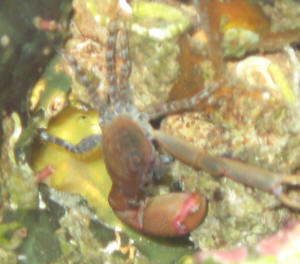
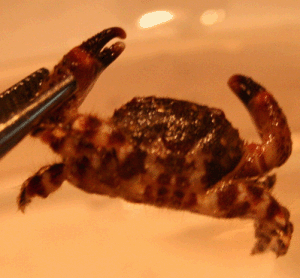
Hitchhiker Crab ID: Need More Information --
10/8/08
Hello,
<Hi there!>
I wondered if you could identify this crab?
<I hope so! That's an interesting little crab you've
got there. Is there any way you could get a photo showing the
entire top of the crab/carapace and all legs (as detailed as
possible)? I need a bit more information to help narrow down the
possibilities. Also, do you know where the crab came
from?>
Thank you in advance~
<You're very welcome. --Lynn>
|
 |
Re: Hitchhiker Crab ID: Need More
Information -- 10/8/08
<Hello again>
No sorry, that's the most I have ever seen of him.
<Well, I can sure understand. I have a crab that likes to play
hide and seek with me as well. I know what species it is, but
I've never been able to get a good photo of it. Your success is
a testament to your patience and skills with a camera!>
He usually just sticks the smaller of the two arms out and picks
stuff of the rocks.
<Yep, it's one of those 'form follows function'
things. That's a perfect little claw for delicate picking. The
other claw looks capable of taking on larger items, or it could be
mainly used in defense/dominance displays, attracting a mate, or a
combination of all of the above. I just don't know.>
I will try to take some more pictures tonight.
<Thanks! If you can, I sure would appreciate it. I really need
to see the overall shape of the top of the carapace (looking
straight down on it) and to confirm the number of walking legs on
each side (are there 3 or 4?). One thing for sure is that it
definitely is an interesting little thing. There aren't all
that many fully marine crabs (if yours is indeed a fully marine
species) that have claws of such different size like that. You see
it regularly in land and fiddler crabs, but not so much
otherwise.>
I haven't confirmed yet, but I think I may have two or more
now... I'm not sure where he came from, he was in my live rock
when I got it. The live rock I used came into my local fish store
when a customer traded it in for store credit. I'm assuming he
had it in an established tank for some time but it could have also
crawled into my LR while it was in the store.
<Yep, at this point it could have come from just about anywhere.
That sort of thing happens all the time. No worries though,
we'll see what we can figure out! Take care, -Lynn> |
|
Crab ID: Xanthid - 10/3/08
Dear crew (particularly Lynn!) --
<Hi there Jonathan, what can I do for you today?>
Just pulled out yet another hitchhiker crab from my live
rock.
<Neat!>
Granted, this is old live rock that I've had for a while, so
I'm a bit angry that there are still crabs coming out of
it!
<It happens. Crabs are good at hiding and many are nocturnal
so it's easy for the small ones to go unnoticed.>
Oh well, it's better than everything being dead.
<Absolutely!>
Found this guy when I saw his arm come swinging out of his hole
at a blue gudgeon goby of mine,
<Uh-oh!>
so I think I caught him at the right time!
<Yepper>
I believe, from the black claws and shape, that he's a
Xanthid crab of some sorts.
<I agree. It does indeed look like a Xanthid of some sort. I
took a close look at the photos you sent and saw little hairs on
the crab's legs. Unfortunately, that doesn't narrow the
choices down greatly, but with the hairs and the shape of the
claws and carapace, it could be something in the genus
Chlorodiella. Here's an example:
http://www.flmnh.ufl.edu/reefs/guamimg/crustacea/xanthidae/Pages/Image7.html
>
He's been banished to the refugium along with a gorilla crab
I found not that long ago, so they can be cuddle buddies.
<Sounds good.>
Attached are a few photos.
<Thanks!>
Thanks,
Jonathan
<You're very welcome. Take care, -Lynn>
Re: Crab ID: Xanthid - 10/4/08
<Hi there, Jon!>
That, to me, is 100% the crab, Lynn.
<Yay! I'm not 100% sure, but it's at least fairly
close. The problem with these guys is that the differences can be
very slight between one genus/species and another. It can be
anything from the number of spines on the side of the carapace to
subtle differences in the claws, etc. You really need to have the
specimen right in front of you to see all the pertinent little
details. From what I could see in the photos, Chlorodiella looked
the closest overall. The species in this genus have the same
rather flattened 'face' area, wide-spaced eyes, as well
as the same general (blunt-ish) claws and carapace shape (with
spines). What I haven't seen in this genus is a species with
spines on its claw arms like I see in yours. Unfortunately, there
aren't available photos for every species of crab, and new
species are always coming up, so I just can't be
sure.>
I believe you hit the nail right on the head. The pictures are a
bit dark mainly since I didn't bother to color correct for a
snapshot of a crab, but the markings and everything on that crab
in your example seems to be "it"!
<Yep, it's close, anyway! Bottom line is that it's
definitely a Xanthid of some sort.>
Are Chlorodiella crabs usually pretty destructive in reef tanks
(I would guess they are by the site of how big my boy was!)?
<That I don't know. I've looked around, but can't
find any information regarding their diet. Since most crabs are
omnivorous though and Xanthids tend to be carnivorous, you can
bet that the larger these crabs get, the more threat they pose to
fish, etc -- not to mention the possibility of one rearranging
your rockwork! You did a good thing getting him out of
there!>
Thanks again for the ID.
- Jon
<It was my pleasure, Jon. Have a great weekend! --Lynn>
Re: Crab ID: Xanthid -- 10/5/08
One further question, Lynn...
<Fire away, Jon :)>
Who are you taking in a fight: Gorilla crab VS Chlorodiella
crab?
<Heheeee! Discounting the obvious home tank advantage for the
Gorilla, I think it's going to come down to weight class. I
have a feeling that the newcomer (the Chlorodiella in the striped
trunks) is probably a bit smaller/lighter than the resident
Gorilla crab, so the advantage goes to the larger/heavier
opponent. If, however, they're both in the same weight class,
the odds change. Both Xanthids would have similar reaches, reflex
speeds, and fancy footwork potential, so as long as both are
healthy and not in the middle of a molt, the odds would be fairly
even. The good news is that if one looses an appendage in the
'Rumble in the Refugium', it'll grow back within a
couple of molts!>
I think I need to videotape this and put it on Pay-Per-View.
Could generate more ratings than Kimbo Slice!
<Ahhh, if only!>
- Jon
<Enjoy! --Lynn>
|
 |
|
|

