|
FAQs on Sponge Identification
10
Related Articles: Sponges in Marine
Aquariums
Related FAQs: Sponge ID
1, Sponge ID 2, Sponge ID 3, Sponge ID 4, Sponge
ID 5, Sponge ID 6, Sponge ID 7, Sponge ID
8, Sponge ID 9, Sponge ID 11, Sponge ID 12, Sponge ID 13, Sponge ID 14, Sponge ID 15, Sponge ID 16, Sponge ID 17, Sponge ID 18,
Sponge ID 19, Sponge
ID 20, Sponge ID 21, & Sponges 1, Sponges
2, Sponges 3, Sponge Selection, Sponge Compatibility, Sponge Systems, Sponge Feeding, Sponge Disease, Sponge Reproduction,
|
|
|
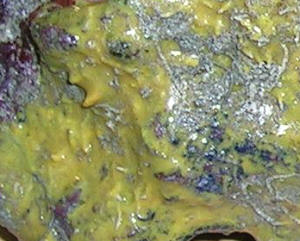
Is this a sponge? 11/19/08 Hello Bob,
<Mich here in Bob's stead> I'm in desperate need of
your help to identify a nuisance substance which has infested my
live rock and killed several corals. <Mmm, more likely the
symptom of a problem rather than the problem in and of it's
self.> More importantly, how to get rid of it or what eats it.
<This is likely the root of your problem.> I have been
battling this stuff for a few years now in my 240 gallon reef
tank. <Sponges are not inherently bad.> Last summer I gave
up the fight and had to destroy a lot of live rock. <Mmm, most
unwise.> To my disappointment, last week I noticed another
infected rock. <Is not "infected", is a natural part
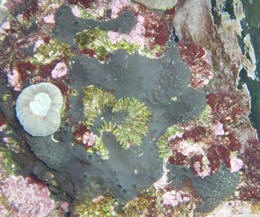
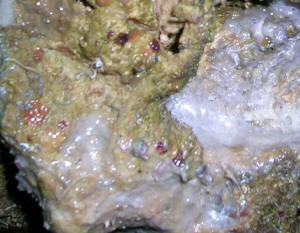
of the reef system.> There are three different forms of this
stuff: Black, white and yellow. <And likely many more forms in
most established reef systems.> All three grow like a skin
covering the rock. <Yes.> The yellow and white are slimy
and smooth to the touch. The most common and most difficult to
kill is the black. The black actually looks like it could be a
sponge because it has very tiny holes. <All your photos show
sponges.> When I cut into it, the inners are a white gooey
substance. <Heee! That just sounds nasty ;) > It feels and
cuts like flesh. <And nastier!> It is very difficult to
remove from the rock. <Yes.> It will kill my corals.
<Unlikely, there are some types that are harmful to corals
such as boring sponges, but most won't. It does look like you
might have some photosynthetic sponges growing, if you find they
are impeding the growth of the coral then you should trim the
sponge back.> It infects the base of the coral (Acro, Galaxy)
and in turn the coral starts to die. <Mmm, if there is open
skeleton the sponge may grow there or around the live rock, but
it is rare for sponge to kill coral.> I had to frag several
corals to salvage them. <I'm surprised you had to go to
this length. Simply lifting the coral out of the tank and
exposing the sponge to air often kills sponges, but then you
should remove as much of the sponge as you can so as it decays it
doesn't pollute the tank. But again, I highly doubt the
sponge is the root cause of your problem.> I have tried to
kill this stuff by leaving the rocks out to dry, removal with a
small knife, using a dental pick and brushing the infected areas
with a tooth brush soaking in vinegar. Also tried soaking the
infected areas with Lugol's iodine. To my surprise, this
stuff survives and comes back in the same places. <It is
normal and natural for sponge to be present in your system,
particular in the darker recesses.> I suspect it has bored
into the rock. My last resort was boiling the rocks in a large
pot on the BBQ for 15 minutes, then using the pressure washer to
scrub rocks. <Oh my! That's like killing spiders with hand
grenades. You're killing something potentially beneficial and
doing a lot of collateral damage.> I thought I had cleared my
tank of this stuff, until I noticed another infected rock the
other day. Can you help? <I hope. Excessive sponge growth can
be a sign of excess nutrients, but I'm not sure you even have
excessive sponge growth. Your photos show what looks like normal
sponge growth to me. Excessive sponge growth is typically
associated with excessive nutrients. I am curious as to your
husbandry. I have included several articles that you may find
beneficial below. http://www.wetwebmedia.com/sponges.htm
http://www.wetwebmedia.com/liverock1.htm
http://www.wetwebmedia.com/scottsh2ochgart.htm
http://www.wetwebmedia.com/water.htm
http://www.wetwebmedia.com/watrqualmar.htm
http://www.wetwebmedia.com/marine/maintenance/marineMaint.htm
http://www.wetwebmedia.com/toxictk.htm > Thanks, Greg from
Ontario, Canada <Welcome,
Mich from Gouldsboro, Pennsylvania >
|
  Yep.
RMF Yep.
RMF |
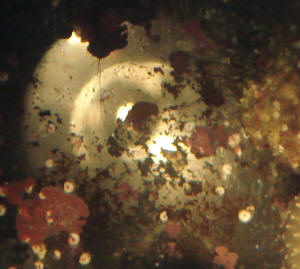
Live Rock Sponge? Syconoid -- 10/27/08 Hey
crew, <Hi there Ian, Lynn here this evening.> Could you
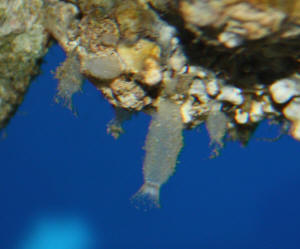
please identify what is shown in the attached picture? <Sure
thing. They're Syconoid sponges -- extremely common, harmless,
beneficial little filter feeders. Nice photo, by the way!> It
looks like some kind of sponge, however, I could not find anything
like it on the website to confirm. <There are several FAQ's
with photos/more information at this link:
http://www.wetwebmedia.com/spgidf7.htm . Also try entering the term
Syconoid in our Google search engine:
http://www.wetwebmedia.com/WWMAdminSubWebIndex/question_page.htm
> I have around 12 -15 of these in my tank and the all are on
the underside of my live rock. <Typical> Water parameters
are: salinity - 1.024, ph - 8.4, ammonia - 0, nitrites - 0, temp -
77. Ian
<You're very welcome. Take care, -Lynn> |
 <<nice pic! -Sara M.>> <<nice pic! -Sara M.>> |
|
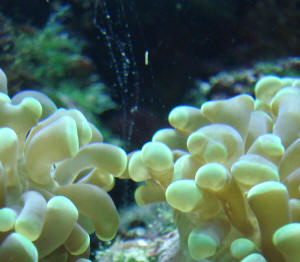
Critter Ids -- 10/09/08 Good Afternoon,
<Good morning.> I have just a few questions that I cant
seem to find an answer to. First all the pertinent info, the tank
is 90 gal with 2-250w 14k HQI bulbs and 4 65w actinic CF. with a
30 gal sump. The water parameters are as follows. Salinity-1.024,
Ammonia-0, Nitrate-0, Nitrite-0, Phosphate-0, Alk-8, Cal-480,
Temp 77 day 75 night. Okay here are the questions I recently
re-arranged some rock to provide better water circulation and I
found this weird spiky egg looking thing. It is approx.
2'' in a egg shape. Its kind of hard to see the little
spikes in the pic but they are there. <A sponge. See here:
http://www.wetwebmedia.com/spongeidfaq2.htm and the other
FAQs.> The other "thing" in question is this little
tube like worm growing on the side of my hammer coral. It appears
to be a pinkish tube with a black worm inside. It sends out a
long string of mucus which traps stuff then sucks it back in. I
read the other post on this but there were no pics. The pic that
I have is not the best as I would have to disassemble quite a bit
to get a great pic of it but if you look in between the two heads
you will see the little black creature with the two
"pincher's?" and the mucus trail. <A Vermetid
snail (worm snail, a sessile gastropod). Another harmless animal,
only in few cases with thousands of individuals they apparently
somewhat irritated corals with their mucus nets See
http://www.wetwebmedia.com/snailidfaq7.htm and do a WWM/Net
search on Vermetid.> Just curious if either of these little
creatures are anything to be worried about? <Absolutely
harmless. Enjoy them.> Thxs, Kris. <Welcome. Marco.>
<<Spot on, as usual Marco. RMF>>
|
 |
|
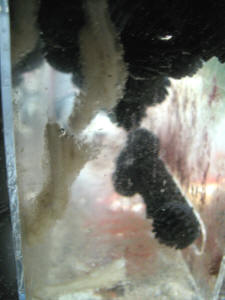
Unknown organism 9/19/08 Hello
Crew, <Peter> Hope everyone is well.? I am attaching? two
pictures of an organism that has shown up in my in the 1st
chamber (which houses my protein skimmer) and 3rd chamber (return
pump) of my refugium.? Currently there are about 19 of these
organisms throughout these two chambers and it seems like they
are multiplying quickly.? One of them is even inside the protein
skimmer.? No signs of any in my main tank or refugium chamber.
Please help me identify it. Thank you in advance Peter <Mmm,
these are sponges... see here:
http://wetwebmedia.com/spongeidfaqs.htm and the linked files in
the sequence above... Not harmful, actually of use. Bob
Fenner>
|
 |
|
Re: Unknown organism
9/20/08 Hi Bob...Thanks for the response. Would you
suggest feeding some of the sponges to my Imperator angelfish?
Thanks again Peter <Worth trying. BobF>
|
Unknown critter ID, Porifera
8/9/08 Hi, <Hello, Mich with you tonight.> I've been
reading this site for months.. it's great. <Thanks! Glad you
like it!> Now I need some help. <Alrighty!> My tank is two
weeks old. <VERY new!> Ammonia has been trending downward for
6 days and is now at less than .25ppm. The tank has 192W of PC
lighting (96W 10k, and 96W dual actinic) running 7 hours per day.
The tank is doing great, I've got new growth in macroalgae,
feather worms, breeding snails, etc. The live rock is from Tampa
Bay Saltwater, so call it Caribbean rock. <Ok.> I've got
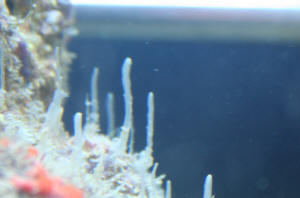
these things growing on it. (see pic) They are thin, translucent,
white stalks. They have gone from nonexistent to 1 to 2 inches tall
in about a week. It appears to have small polyps on them, but
that's not really verified. Is this a juvenile gorgonian
colony? <Nope. Is a sponge, likely growing rapidly due to high
nutrient content in the water. Is a harmless filter feeder. Just
enjoy it. More here: http://www.wetwebmedia.com/sponges.htm and
related links in blue.> Thanks
<Welcome,
Mich> |
|
|
|
|

