|
FAQs on Sponge Identification
8
Related Articles: Sponges in Marine
Aquariums
Related FAQs: Sponge ID
1, Sponge ID 2, Sponge ID 3, Sponge ID 4, Sponge
ID 5, Sponge ID 6, Sponge ID 7, Sponge ID
9, Sponge ID 10, Sponge ID 11, Sponge ID 12, Sponge ID 13, Sponge ID 14, Sponge ID 15, Sponge ID 16, Sponge ID 17, Sponge ID 18,
Sponge ID 19, Sponge
ID 20, Sponge ID 21, & Sponges 1, Sponges
2, Sponges 3, Sponge Selection, Sponge Compatibility, Sponge Systems, Sponge Feeding, Sponge Disease, Sponge Reproduction,
|
|
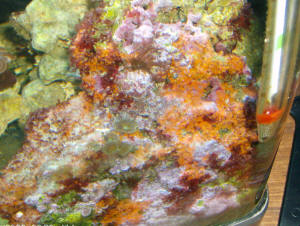
| Re: Purple coral alga... overcome with...
sponges! 3/17/08 Thanks for the quick reply.
I'm attaching some pictures of the alga I was asking about. You
say more info will help. Tank is a 24 gal NanoCube w/3 peppermint
shrimp, 6 hermit crabs, 1 clown fish. <Looks very nice... I do
think you have sponges here... Read on WWM re... Bob Fenner, who
wonders what might be a connection twixt your family name and that
of the Avocado, Persica americana...> |
|
|
| Sponge IDs... 03/15/2008 Good
day! Can you help me identify these sponges? i found them on
intertidal zone, in a seagrass community. Thank you. <Mmm, nope!
I suggest you try finding, looking through a reference work or two
that deals with Poriferans in the geographical area these were
extracted. Bob Fenner> |
|
 .JPG)
|
|
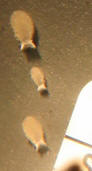
Polyps of some sort in my sump? (sponge ID) 3/14/08
Crew - At some point I hope to have a refugium in my sump. For
now there is no light, just a rock beside a bag of activated
charcoal where my refugium may be one day. However, I have a new
development in the past couple of weeks, and while I like to see
new life, I have no idea what's going on here. Suddenly these
little critters are all over my sump. Would you please identify
and tell me if they are a positive or negative life form to have
in the sump? <They are harmless Syconoid sponges.
http://www.wetwebmedia.com/spgidf6.htm> I don't know if I
should clean them out or rejoice that they exist. <It's
your call. There's no need to clean them out if they're
not bothering you.> Pics are attached. Thanks for any help, as
always. Regards <De nada, Sara M.>
Re: Polyps of some sort in my sump? Wonderful! Thanks
for the ID. Looks like my nutrient levels have risen to support
these. I'll check to see if my skimmer pump filter is clogged
since I have noticed reduced skimmate the past week - just before
these little guys arrived. <Well, in many ways, they are
little filters themselves. ;-) They usually come in boom and bust
cycles. People seem to get them in droves all of a sudden, but
then they don't last.> Joel
<Best,
Sara M.>
|
|
|
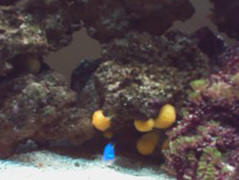
| ID and removal of yellow cave-dwelling balls
02/19/2008 Hello, <<G'morning. Andrew today>>
We bought an existing marine reef aquarium, 45 gallon long, without
knowing what we were getting into. Fortunately, with great help
from the wet web media forum [and Bob's seminal book], it has
been a thrilling roller-coaster ride of discovery and success.
Maybe too much so. <<Sounds like a wonderful journey your
embarking on>> Starting out with pretty much all the wrong
equipment [and a nitrate reading of 100 ppm], it is nice to say
that at the end of two months everything and everybody seems
extremely healthy [purple mushroom corals are at 5" diameter,
one Domino damsel is possibly over 4" in length, chemistry
great, lots of exciting stories, etc]. <<Great news>>
Everything is healthy . and growing. So much so that we now may
have a problem with an unidentified yellow ball something [sponge?]
that likes to grow in caves or reduced light areas [and propagate].
Original there were3 attached under one rock in a cave like
setting. That cave now has six and there are at least 4 other
locations with these yellow fellows. <<Yes, these are
sponges, harmless filter feeders and will come and go, depending on
nutrient levels. More info can be found here
http://www.wetwebmedia.com/sponges.htm >> The problem is one
of the original yellow balls has gotten so big that it is
threatening to dislodge some rock from a crack it 'grew
into'. The question is safe removal. If you know what these
are, can you provide advice on the proper way to harvest them. If
the one can be saved, great. If not, can it be removed without harm
to the other occupants of the habitat? <<Removing it is not a
problem and it will not effect the others near by. Safely remove
with a scalpel blade or other sharp bladed instrument and attach to
a rock with some fishing line>> Knowing the great level of
support all of you provide it is easy to imagine how busy you must
be. I apologize for adding to the work load with this question.
Hope it is not an 'easy' simple thing that could have
[should have] been figured out. Please be assured that what you do
does make a difference. Dana C. Andrews, B.S. <<Your
questions are most welcome, so, no apology is needed. Thanks. A
Nixon>> |
|
 Zee spongee! Zee spongee!
|
20gal Nano Reef/Sponge ID 11/21/2008 Good
day Scott V/WWM Crew, <Hello Adriel, Mich here.> Thanks
for all your help!!! <On behalf of Bob and the crew, you are
welcome.> I have a couple more questions. I've enclosed
a picture of a sponge (I don't know what kind it is) just
purchased recently. <Very few sponges can be positively
identified without examining the internal skeletal structures.
Sponges like yours are typically quite challenging to keep
alive.> The sponge is the only livestock (apart from a
purple tang from my 150gal FO). <Oh, I'm hoping you
don't plan on keeping the Purple Tang in the 20 gallon for
anything other than temporary quarantine.> I was wondering
if the sponge would be better off in a separate 25 gal that
houses only Tubastrea? <The problem with sponges is, they
can die and take out the other inhabitants of the tank with
them.> Is any light required at all? <Not typically.>
Would placing it in a well lit sump/refugium (150w MH 5200k) of
a FOWLR be a better option? <Better be placed in the dark in
a high nutrient environment, again, sponges are often very
difficult to keep sustained in the home aquarium.> Thanks
for any help that you can offer, <Hope this is helpful.>
Adriel <Mich>
|
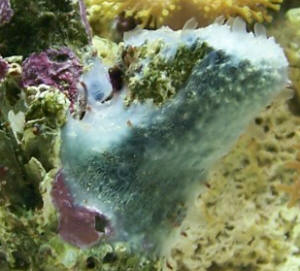
Bluish gray fuzzy ,cotton candy, web looking, is it fungus,
bacteria or sponge? 2/8/08 Hello crew
member's of WWM <Bridget> I am kind of new to having a
reef tank less than a year and really need your expertise! Could
you please help me? <Yes, and will> My husband's buddy
has this stuff in "groups" on his live rock all over
his tank. originally they thought it was copepod eggs or
something, so he gave my husband a couple rocks with it on it as
we are planning on getting a scooter blenny or a mandarin goby in
the next few months and thought the extra copepods would be good
for them since our tank that is less then a year old . Well as
soon as he brought it home, I thought it looked suspicious and
starting searching the inter-web for it. I couldn't find it
anywhere which leads me to wonder what did he just stick in our
tank? <A sponge> The suspicious "stuff" is kind
of bluish gray, looks kind of like a cotton candy or a web of
some sort, may even be slimy, has little white dots which look to
be eggs, almost like it is a cocoon. and if you look close it has
translucent "slimy looking" holes that almost look like
volcanoes where something emerged from it, <These are
"osculae"... "little mouths"... excurrent
pores/openings...> This "stuff" is kind of weird and
worries me that it is in our tank I want him to take it out but
he wont until I prove to him it might harm our other corals.
<I would leave in> I put a pic on a different web site
asking what this was The people that responded said a blue sponge
<This is so> But I still am not to sure of this. I know
there are over 9000 different species of sponges and I have
looked at hundreds and hundreds of pictures off the web and none
are similar enough to say yeah that is it. <Are adaptive,
polymorphous species... taking various forms depending on
"current conditions"... of light, current, foods...>
So I was wondering do you think it might be a sponge as well? If
so what kind it might be? is it good or bad? <Please read
here: http://wetwebmedia.com/sponges.htm> I have read that
sponges die as soon as they hit the air <Mmm, not all> and
we have exposed them to air as we thought they might be copepod
cocoons (are there even copepod cocoons or do they just lay their
eggs in the substrate?) <Are not Copepods, cocoons...
don't lay eggs thus...> and they are still alive and doing
well. I have attached a few pictures Thank you in advanced for
your time and input It is much appreciated Sincerely Bridget
<Bob Fenner, who urges you to focus your curious mind, keep
investigating, sharing...>
Re: Bluish gray fuzzy ,cotton candy, web
looking, is it fungus, bacteria or sponge? 2/9/08 Ahhhhh
Thank you Bob Now I can sleep at night not having night mares
that something is going to take over our tank.. lol Your time and
wisdom is much appreciated Sincerely Bridget <Heeeee! Wish I
had more of the first and any of the last. Cheers! BobF>
|
|
Nice
photo, specimen, sys. RMF
|
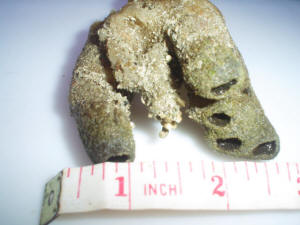
Strange Growths On Live Rock, sponge ID
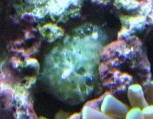
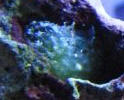
-01/30/08 Hello Again Crew! I'll jump right to my question.
I've been attempting to gain some insight into what it is
that's taken up residence in my live rock. <sponge> I
have likely have three (that I can see anyway) of these strange
growths in the impressions in the live rock. I have sent along a
picture as well for you to have a look at. The best way to describe
these are as follows: 1) They look like cocoons for lack of a
better way to describe it. I'd say like a dust ball as a
different way to describe it also. 2) While it's somewhat grey,
it does distinctly have a pale greenish hue to the structure. 3) It
has three or more holes in it that looks as though something has
burrowed in, or burrowed out of it. 4) All are approximately the
size of a pinky finger tip and smaller. <Sponge, maybe Syconoid
sponges.> I have never seen anything coming or going from these
structures, nor have I ever witnessed any tentacles coming from it
either day or night. The rock didn't come with these on them
(at least not in the locations where they are at present). So they
have developed in the time I have had the rock. Could it be the
birthplace of some form of worm? Or of some other critter? My
searching for answers has met with little result to this point so
I'm hoping all that knowledge over there may have encountered
this at some point along the way! <Indeed, many, many times...
these little sponges are almost ubiquitous among diverse, well
maintained reef tanks-- and even among many that are not.
http://www.wetwebmedia.com/spongefaq3.htm> Many thanks in
advance. You're all doing wonderful work. <Gracias>
Kevin
Sara M.> |
|
  Oh yeah.
RMF. Oh yeah.
RMF.
|
|
ID Please: Cirrhilabrus exquisitus and Syconoid
Sponges -- 1/28/08 <Hi there!> Can someone please tell
me what these are in the attached photos from my reef tank? They
look like some sort of egg sacs, and if they are sacs of some
creature that I don't want in my tank, then I would just as
soon remove them now. If they are something I would like, then
obviously I would keep them. <No worries with these, you can
keep them. They're harmless, filter feeding sponges in the
genus Sycon, also called Syconoid sponges. For more
information/photos, please see the FAQ's at this link (and
related links above): http://www.wetwebmedia.com/spgidf7.htm >
For your info, I have: 1 Naso Tang 1 Foxface Tang 4 clownfish 2
black clowns 1 Snowflake eel 1 Fu Manchu lion 1 yellow angel 1
electric flame scallop <Very difficult to keep.> numerous
snails two tiny hermits that stowed away with the snails some
Chromis that disappeared (lion food?) 2 Wrasse (type unknown,
will attach pic also). <Looks like the Fairy Wrasse
Cirrhilabrus exquisitus, commonly called the Exquisite Wrasse.
Considering all those colors, I'd say that it's a very
apt name! By the way, color can vary depending on place of
origin, whether it's male or female, etc. Here's a photo
of one for comparison (and lookee there, it's Bob's
photo!).
http://wetwebfotos.com/media/medium/1/600_Cirrhilabrus_exquisitusAQ.tif.jpg
More information on this genus:
http://www.wetwebmedia.com/marine/fishes/wrasses/cirrhilabrus/index.htm
> Thank you.
<You're very welcome! Take care. -- Lynn>
|
|
.jpg) .jpg) 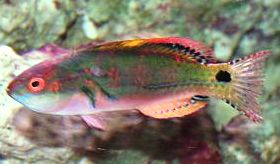
|
|
|

