Become a Sponsor

 
Home
Information Pages:
Marine Aquarium
Articles/ FAQs
(enter words you'd like highlighted in this page)
Freshwater Aquarium
Articles/ FAQs
Planted Aquarium
Articles/ FAQs
Brackish Systems
Articles/ FAQs
Popular Pages:
Features:
Daily FAQs
FW Daily FAQs
SW Pix of the Day
FW Pix of the Day
Conscientious Aquarist Magazine
New On WWM
Helpful Links
Hobbyist Forum bb.WetWebMedia
Ask the WWM Crew a Question
Calendars
Search Feature
Admin Index
Cover Images


FAQs on Sponge Identification 11

Related Articles: Sponges in Marine Aquariums

Related FAQs: Sponge ID 1, Sponge ID 2, Sponge ID 3, Sponge ID 4, Sponge ID 5, Sponge ID 6,Sponge ID 7, Sponge ID 8, Sponge ID 9, Sponge ID 10, & Sponges 1Sponges 2Sponges 3, Sponge Selection, Sponge Compatibility, Sponge Systems, Sponge Feeding, Sponge Disease, Sponge Reproduction

sponge or tunicate? 11/8/2009
Dearest Crew,
I was wondering if you could help me with an ID I cannot make very confidently based on what I have seen after searching your site (please see attached pictures). I would have bet these were sponges, just because they have a texture just like a sponge would have. On the other hand, they tend to have 1-2 holes per mass (see red arrows in
picture), and I have seen pictures of tunicates that "could" look this way. What would be your opinion? Any ideas about taxonomic ID?
as always, eternally grateful to you for this service to reef nuts like me,
Vivian
<Am almost certain these are Syconoid sponges. Please search WWM with this name or peruse the Sponge ID subFAQs files:
http://wetwebmedia.com/SpongePIX/SpongeIDF11.htm
and the linked files above. These are no problem. Bob Fenner>

White Spherical creature: Likely Syconoid Sponges: Hitchhiker\Sponge ID 11/2/2009
Hello,
<Hi Lori.>
Lately I have noticed a white dime sized sphere with 2 tubes sticking out of it on the underside of a piece of live rock.
<Sort of looks like a cotton ball or the end of a Q-Tip?<
The live rock has been in the tank for about 6 months. It seems to shrink when the lighting gets dim. Can you tell me what this is?
<Pictures are always helpful, but based upon your description, it is likely a Syconoid sponge - a harmless hitchhiker. You can read about them by following the links on this page
http://www.google.com/custom?hl=en&sitesearch=www.WetWebMedia.com&ei=SQPvSuK
vNsG0tgfr-6A6&sa=X&oi=spell&resnum=0&ct=result&cd=1&q=syconoid+sponges&spell
=1 >
Lori
<MikeV>

Re: White Spherical creature: Likely Syconoid Sponges: Hitchhiker\Sponge ID 11/3/2009
<Hi Lori.>
That looks just like it. Is it harmful? Do I need to do something to get
rid of it?
<No, they are fine. and will pass with time. have a read here:
http://www.google.com/custom?hl=en&sitesearch=www.WetWebMedia.com&ei=SQPvSuK
vNsG0tgfr-6A6&sa=X&oi=spell&resnum=0&ct=result&cd=1&q=syconoid+sponges&spell
=1 >
<MikeV>

Purple rope sponge... ID, no pic    10/7/09
Hi,
I love your site guys very informative and helpful. I work at Exotic Aquatics in Balt., Md and regularly use your site for help or just to check my own knowledge!
I have what I believe to be a small purple rope sponge. It is maybe eight or nine inches long and three or four in diameter; attached to a small branch of live rock with rope like pieces growing out of it and extending I to the water various lengths to 6".
I can't find much info on these as aquarium specimens and need some general care and maintenance info. Am I possibly misidentifying this sponge?
<Mmmm, could you send along an image or two?>
Does he eat particulate matter from the water like other sponges?
<Due to the color you mention, this is likely a non-photosynthetic species>
How and what is the best way to feed? And is there any way to know/detect his status and health?
<For a store... likely just non-decomposition>
Lastly, is be possibly toxic and maybe not a good aquarium animal at all?
<Odds are that this specimen is non-toxic>
Thanks for your help guys.
Dave Phelps
Balt., Md
<Please send along a well-resolved pic of size. Bob Fenner>

Re: Purple sponge, ID... more  10/7/2009
Here's a pic of that sponge. This is the best i could get; its at a strange angle to the glass.
One thing, I might have mislead you a little bit: he is no longer at the store but in my home reef tank now; that's why I was concerned with feeding. But in here it should be very similar as my aquarium is well established and running for 3+ years. Thanks again for your help.
Dave Phelps
Balto., Md
<This might be an Aplysina cauliformis... but such identifications are difficult w/o sampling the colony for structural elements... Do you know the ocean of origin? BobF>

Sponge I.D. 9/28/09
Hi Crew,
Have a sponge id I'm hoping you guys can confirm or help with a kick in the right direction. I know they're hard to id due to the 1000's of species, but after scouring databases and WWM, I believe this to be Spirastrella vagabunda.
<Mmm... I don't think so, but...>
I have thought this from their first appearance on the new live rock, but they have spread to 50% of the live rock(colonies approximately the size of quarters and dimes) in a 55 gallon aquarium in less than 3 weeks. I wasn't aware of this species reproducing at such high rates.
Hopefully the pictures aren't absolutely horrible. I'm an avid diver and aquarist.... but a HORRIBLE photographer. Any help would be appreciated.
Thank you.
--
~ Glenn
<Your pix show definitely some sort of sponge, but also I think an encrusting algae... Definitive ID to at least Class... could be done with a simple microscope and reference. Bob Fenner>

Re: Sponge I.D., control  9/29/2009
Mr. Fenner,
Thank you for the quick response. I have "Systema Porifera: A Guide to the Classification of Sponges"
<!? Wow:
http://www.amazon.com/Systema-Porifera-Guide-Classification-Sponges/dp/0306472600
Have you a 'scope?>
and a couple of pocket reef guides by Ned DeLoach, but have found nothing that really identifies the sponge beyond class, Spheciospongia. My concern is that the rate of growth I am seeing  is an indication that this is an unwanted organism in my systems.
<A subjective evaluation... but do agree with you concerning overgrowth... Can be undesirable>
Any opinion there?
<Rock removal and careful scrubbing... or more extreme... bleaching, rinsing, air-drying>
The 55 gallon containing my new spongy critters is only used for qt of rock and seeding rock. Thank you again.
Glenn Fritz
<Oh... bleached rock can be reinoculated with some new placed about... BobF>

Florida Sponge ID 9/10/09
Greetings resident fish (and hopefully sponge) expert
<No sponge expert except when using one for washing walls.>
I just received a livestock order from an online company. In the order, they replaced the sponge I ordered with the one shown in the photo. The customer service gal said she spent 3 hours trying to find out what it
was but couldn't find anything. She did say it came from off the Florida coast though. I've done some searching myself, including the WWM site and can't find anything either. If you can identify it, I'd be very
appreciative.
<Looks like a specie of Agelas found in Florida waters. Sponge brittle stars (Ophiothrix suensonii )
are often found living inside this sponge. Bob and other crew members dive these waters and may have a more accurate ID.>
<<Might be a small A. clathrodes. RMF>>
Thanks in advance.
<You're welcome. James (Salty Dog)>
Michael

Re: Sponge question   8/19/09
Hi Bob (and friends),
<Yo!>
Thanks for the info and good advice. Looks like I have some hard work ahead of me.
<Mmm, not so hard>
I did watch this sponge's health in the store and waited several weeks before buying it to make sure it did not suffer in transport or have air exposure, so at least that is something. I just have a couple more quick questions, if in addition to the ultra min F, I also spray the sponge with the liquid left over from when I thaw enriched brine shrimp, do you think this would help?
<I do>
I have also read on the web that stirring up the sand bed can help is this true?
<Can help, yes>
I have spent a fair amount of time trying to ID this sponge, but can't seem to do better than ascertaining its a fan sponge, I have attached a picture of it, do you have any suggestions?
<Mmm, yes: try here:
http://www.spongeguide.org>
Thanks very much, I really would like this sponge to do well, I'd hate to think I condemned it. Are there any types of photosynthetic sponges you would recommend that are hardy enough to do well under compact fluorescents?
<Yes... posted: http://wetwebmedia.com/spongeselfaqs.htm>
To answer your question about reading your pages, I really can't say for the total (its a LOT), but I can say at least 4 hours in the last two days lol
Best fishes,
Alex
<And you. BobF>

coral... Mmm, no    7/30/09
I believe I found some (possibly live) orange coral that washed up on the beach in Hilton Head Island, South Carolina, and was wondering what to do with it. Should I put it back in the sea and hope it reattaches? Is it already a lost cause? Is it preservable outside of an aquarium?
<... I'd leave it, not preserveable... stinky...>
It is orange, very spongy to the touch,
<Oh! Is likely a sponge, Poriferan... Use your search tool for the area, this name>
and looks like Elkhorn coral (I actually know nothing about coral, but did some Googling.)
Thank you for any insight you could provide, I certainly don't want to damage this if it can survive, but It sure wasn't going to do very well washed up by the dunes.
- Jess
<Not easily kept... likely azooxanthellate... Read here:
http://wetwebmedia.com/sponges.htm
and the various FAQs files on husbandry above. Bob Fenner>

Thick Brown Tubes Growing From Live Rock 6/17/09
Hello,
<Hi there>
Your site has been a wealth of information, thank you so much. It's been a good 12 years since I maintained a small 20 gallon reef aquarium in CA where I did water changes with sea water and enjoyed all the surprises that came along with it oftentimes. This year, as I embark on setting up a reef tank once again, I find there is so much more knowledge about reef systems and it's wonderful. I am having so much fun reading all the information online and learning so much.
<Great!>
I have an identification inquiry about some thick brown tubes that have grown from a piece of live rock covered with Star Polyps in my reef system.
<Are sponges of some sort... a burrowing variety/species... Not harmful>
Any input is greatly appreciated, thank you!
<Welcome. Bob Fenner>

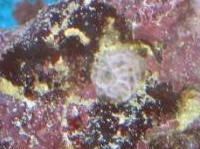
Sponge Identification: Syconoid Sponges. 6/3/2009
Hello everyone,
<Hi Nathan.>
I have a identification problem that I cant find anywhere. These things have shown up in my tank in the past 2 weeks. Could you help identify what they are, or send me in the direction that would help.
<Sure, they are Syconoid sponges. Sign of a nice stable system. They will come and go as the nutrient levels in your tank change.>
I have been doing SW for about 10 yrs and just started to get into coral.
I haven't added anything new in the tank for over two months. So this is really got me.
,they have been in the rock, just waiting for the opportunity to grow.>
The first picture is a normal zoom of the items. They are the white things right in the middle of the picture. I'm not even really sure how to describe it. The second picture is of the larger one in picture one, zoomed in.
Thanks a bunch ahead of time. If you need anymore info on the tank, please let me know.
<Do check this page out - lots of entries for them:
http://www.google.com/custom?hl=en&cof=&sitesearch=www.WetWebMedia.com&q=Syc
onoid+sponges&btnG=Search >
Thanks
Nathan
<MikeV>

Clam/Sponge ID Question 6/1/09
Hi Crew,
<Hello Andrea>
Sorry if this question is already being worked on. I sent it yesterday and was surprised I haven't received an answer since I usually get one in a matter of hours, so I'm worried maybe it got lost among the many you get
every day.
<Not lost, weekends can slow responses.>
I usually try not to abuse the great service you provide on your site, but I really could use some help with this one.
Today at the LFS I saw some beautiful, bright red-orange sponges for sale. There were a few of them, all anchored to a what looked like clam or oyster shells. They were labeled as "sponge on clam". I asked one of the employees about them: light, current, feeding requirements etc... and also if the clams themselves were alive, and he said "probably not." He went ahead and moved them and they did not seem to react in any way. One of the sponge/clam combos had some nice coralline algae on it, so I decided to bring that one home. I acclimated it and introduced it as instructed, without letting the sponge be exposed to any air.
After lights out, however, I saw what looked like a bristle star on the sponge, and when I tried to get a closer look the clam moved!! It was slightly open, and my shadow caused it to shut close, so it's alive!! And
not only is it alive, there is also a smaller one attached to it's back which also reacts to the light.
I was not expecting to this new addition, and after searching through the web the only similar thing I have found is the Thorny Oyster, which appears to be very hard to keep. I really would not want to risk such a big (4 inches diameter) mollusk dying and possibly polluting my system, but the colors on it are so beautiful, and it is interesting to watch it open and close.
So, what exactly is it, and how do I take care of it? Also, what type of sponge is it exactly?
I am attaching a couple of pics. On the close up you could see the serrated edges, almost like teeth on the smaller clam/oyster/cool thingamajig.
<The thingamajig you have appears to be a species of clam and I'm sorry I cannot identify it. Bob or another crew member may input here. They are filter filters and require daily additions of phytoplankton to survive.
The sponge you have appears to be a specie of Ruffled Sponge (Teichaxinella), and are difficult to keep long term. They are filter feeders feeding on dissolved organic matter and bacteria. I'd try to return
both.>
Thank you for your help!
<You're welcome. James (Salty Dog)>
-Andrea

Sponge ID: Looks like a sponge..? Yep - It's a sponge. 5/4/2009
<Hi>
Can you help me identify these nodules? Yellow on left and white ball on right. I have searched and the best I can come up with is a sponge.
<The yellow one is definitely a sponge. The white one is difficult to make out.>
It does have a spongy feel.
<You can read more about sponges and their care here,
http://www.wetwebmedia.com/sponges.htm.>
Thank you for such a wonderful site.
<Our pleasure.>
<Mike>

Id of green growth, sponge? – 05/03/09
WWM Crew,
<Tom>
Attached is a picture of green growth that was hidden behind Ricordeas when I purchased the rock. You can see it in front of the twin spot goby (first pic). I assume it is a sponge,
<Indeed it is>
but wanted your help to make sure it is safe for my 34 gal reef. It has grown over an inch in the past 2 months (second pic). Also notice the small Ricordea, on the right and about a third of the
way up the green growth, it has a cats face.
Thanks for your help,
And remember, I'm never too busy for your referrals!
Tom Peters
<Ahh! And this growth is testament to your good care here. Bob Fenner>

Critter ID  4/19/09
Good day,
<Jerry>
I come to you once again looking for help in identifying a marine critter.
This individual was a freebie from someone that I purchased a number of frags from. The gent told me that he thought it was some kind of sponge, but he didn't know what genus nor did he know anything about its care.
It's been in his tank for about 6 months with no special handling or feeding.
<You likely have "good reef conditions", as this looks to be either a sponge or Ascidian growing over/on another sponge... both of which are filter feeders>
I've scoured the web and your site, but can't seem to find anything that even remotely resembles this beast.
<Two species here>
The piece that I have is a frag from a much larger organism that resembled fingers. My section is about 4 inches long. Any help would be greatly appreciated.
Thanks and cheers.
Jerry
<Maybe a read here: http://wetwebmedia.com/spongeidfaqs.htm
the linked files above, and Sea Squirts coverage.
Bob Fenner>

Re: Critter ID 4/19/09
Bob,
Thanks for the quick reply.
<Thank you for this follow-up Jerry>
I did some more digging, and it seems as though this beast is described in the UK as a Candy Cane Sponge (Axinella damicornis) with encrusting Parazoanthus axinellae. In Canada it's known as White Line Sponge,
(Trikentrion flabelliforme).
<I see>
In case you're interested here's a link to a discussion on the organisms.
http://www.defineyourreef.frihost.net/forums/viewtopic.php?f=9&t=35
As always, thank you so much for your assistance and dedication to the hobby.
Jerry
<Thank you again. Will append our prev. corr.. Cheers, BobF> 

Can you help id this coral?    3/23/09
Hi we are having trouble identifying a coral that we were given.
<I hope you don't take this the wrong way, but I would ask you why you accepted this "coral"? You don't know what it is, so how do you have any hope of providing provide appropriate care? This is irresponsible. I am urging you to be a conscientious aquarist.>
Hopefully you can help us out.
<Is hard to tell from the picture, it could be a gorgonian, which can require very demanding care, but I believe you have a dying tree sponge, perhaps a Ptilocaulis species, which could very well take out the other
inhabitants of your tank.>
Any help is greatly appreciated.
<Sorry I don't have better news for you. Mich><<Well done Mich... a Poriferan. RMF>>

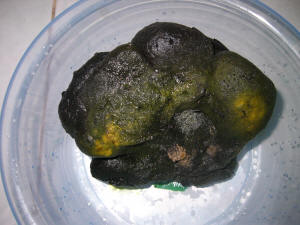
Black Sponge- ID Not Possible 03/01/09
I recently purchased this piece of liverock from our LFS that is just teaming with life.
<Wonderful.>
Aside from arriving with feather dusters, spaghetti worms, and Zoanthids, there is what the people at the LFS said was a sponge.
<Does look like it.>
I have been looking online to see what kind of sponge this is,
<Most are impossible to identify without microscopic analysis of internal structures.>
and if it is safe for my reef tank, but I have not seen any positive matches.
<Most are a natural part of reef life and I would not be terribly concerned about any that naturally grow on your live rock, in the same vain I would never purchase a sponge from a LFS as most do not survive in captivity and
often take out other tank residents in their process of dying.>
It started off as one piece, but within one weeks time has split completely.
<Could signal excess nutrients in the system. You may want to re-evaluate your feeding routine.>
Any suggestions to what it is?
<Heehee! A black sponge!
Cheers,
Mich>

Mystery stuff growing in my established marine tank – 02/01/09
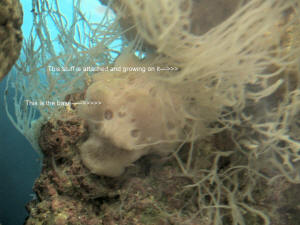
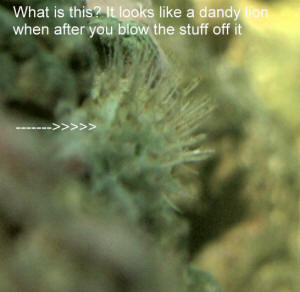
Hi, I tried to search through all I could at your sight and didn't come across anything I could find that would describe what this is in my tank. I attached 3 pictures, 2 of the one and 1 of the other. Here is what I have:
1.This white, almost leather looking stuff that has LONG stringy, root looking things growing all off it and around it. Doesn't seem to move. I took really great pictures so someone could help. I have this same white or off white leather looking globs on other rocks but the stringy stuff isn't growing there...all is gathered in the area you see in the picture.
<This is a sponge... a Poriferan... See WWM re... not deleterious>
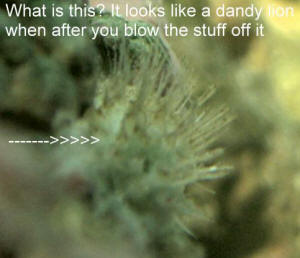
2.The second question is this cotton ball looking growth, it actually reminds me of a dandy lion after you blow the stuff off of it. Its round in shape with short spike things all around it. Doesn't move either. The rock in the tank has been in my tank for years and these things are just now showing up. I can't think of any reason for the changes at all.
<Mmm, how large is this? It looks like an Urchin of some sort... may not move much... also not harmful...>
Any help to point me in the right direction would be awesome! Thanks! Leann
<Enjoy them! The sponge can be "cut back", the "Urchin" removed entirely if they bother you. Bob Fenner>

Re: Mystery stuff growing in my established marine tank 2/1/09
Thanks! As far as size to the cotton ball, spiky looking things I sent a picture of, its about the size of a paint ball....it doesn't ever move, I re-attached the picture just in case you still didn't have it. Are there growths on tanks that look like that?

FWIW, I think it's just a sponge... - Sara M.

<Mmm, yes... Am changing my guess to another Sponge. BobF>

Maybe a sponge? 01/18/09
Hello, I saw this thing growing in my 55gal reef tank about a month ago.
Appears to be some kind of sponge, but I was hoping to get an opinion. It's light gray and has a soft/spongy texture. Has a very strange pattern and a distinct hole in the middle of it. It's about the size of a nickel. Any ideas?
<If there's only one main hole, yes, I'd say it's likely a sponge. If there are two holes, then it might be a tunicate.>
Thanks so much,
Tiffany
<De nada,
Sara M.>

Is it a sponge?  12/16/08
Hi Crew,
<Hello Peg.>
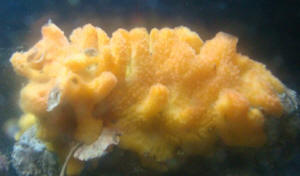
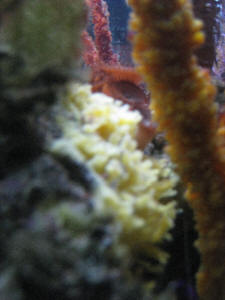
I have read all of your postings on sponges, but have not seen this yellow critter that is growing on my live rock either in the article pictures or sponge ID FAQs. I think it's a sponge, although I can't see any mouths. It kind of looks and feels like yellow stringy cottage cheese and it is spreading. I tried to get the best close-up I could.
<From description and picture I think this is a sponge. Sponges come in many shapes, can be soft or solid, hey… they are entire phylum. Their osculum (mouth) is not always as obvious as shown in morphological sketches, but I guess when you look exactly at your sponge, each of the small longitudinal structures I see on the picture might possess a small one on the top.>
Thank you for your help. Your site has helped me prevent and solve many problems with my reef tanks. Peg
<Thank you for your kind words. Marco.>
Is

Re: Is it a sponge? From 12/15/08 01/20/09
Hi Crew and Marco again,
<Hello Peg.>
I found this sponge photo on http://www.wetwebmedia.com/spongesysfaqs.htm , posted just prior to 8/16/05, and it looks exactly like mine (OK, this is a closer, clearer pix than mine), so you were right, Marco, it is a sponge. (If you look long enough on WetWebMedia you'll find what you're looking for, just maybe not in the place you think it should be!)
<Hmm, you found it on the page about sponge systems, I think that's quite an adequate place.>
So makes sense because my sponge is growing on live rock from FL. Also this sponge pix is from near my hometown of Wabasso, FL, next to Sebastian, FL. I learned to dive in the Sebastian Inlet as a young kidlet. Anyway just thought I'd do a follow-up when I found this photo! Thanks for all your hard work! Peg
<Thank you for your kind update and the pictures. Marco.>

Hi, Sponge ID   12/4/08
<Hello Alma>
Good Day!!
I am Maria Alma Quiao, a graduate student of Iligan Institute of Technology- Mindanao State University, Iligan City, Philippines.
I am amazed to find a website like yours that showcase the marine riches. I came to be interested in your site since I am in study on marine sponges. If it would be possible of you can look up the sponge attach to this message. We really need your help.
That would mean so much if somehow you can do preliminary identification of such sponge, if possible...just something to start with on this research journey. The pictures came from the same sponge. Hoping for your help.
Thank you so much.
<Other than to concur with you that this is indeed a sponge, I cannot identify it to even family level. I would look about on the Net a bit more, seek out a University level investigator, perhaps a professor/lecturer who deals directly in Poriferan taxonomy here. Bob Fenner>

20gal Nano Reef/Sponge ID 11/21/2008
Good day Scott V/WWM Crew,
<Hello Adriel, Mich here.>
Thanks for all your help!!!
<On behalf of Bob and the crew, you are welcome.>
I have a couple more questions. I've enclosed a picture of a sponge (I don't know what kind it is) just purchased recently.
<Very few sponges can be positively identified without examining the internal skeletal structures. Sponges like yours are typically quite challenging to keep alive.>
The sponge is the only livestock (apart from a purple tang from my 150gal FO).
<Oh, I'm hoping you don't plan on keeping the Purple Tang in the 20 gallon for anything other than temporary quarantine.>
I was wondering if the sponge would be better off in a separate 25 gal that houses only Tubastrea?
<The problem with sponges is, they can die and take out the other inhabitants of the tank with them.>
Is any light required at all?
<Not typically.>
Would placing it in a well lit sump/refugium (150w MH 5200k) of a FOWLR be a better option?
<Better be placed in the dark in a high nutrient environment, again, sponges are often very difficult to keep sustained in the home aquarium.>
Thanks for any help that you can offer,
<Hope this is helpful.>
Adriel
<Mich>


Featured Sponsors:
Google
 
Web www.WetWebMedia.com