|
Related FAQs: Agariciids, SPS
Corals, Stony/True Coral, Coral System Set-Up, Coral System Lighting, Stony Coral Identification, Stony Coral Selection, Coral Placement, Foods/Feeding/Nutrition, Disease/Health, Propagation, Growing Reef Corals, Stony Coral Behavior, Stony Coral Behavior, SPS Identification, SPS Behavior, SPS
Compatibility, SPS Selection,
SPS Systems, SPS Feeding, SPS
Disease, SPS
Reproduction,
Related Articles: True or Stony Corals, Order
Scleractinia, Dyed Corals,
/The Best Livestock For Your Reef Aquarium:
Cactus, Elephant Skin, Plate,
Lettuce Corals of the Family Agariciidae, pt. 1
To:
Part
2, Part 3,
Part 4, Part 5,
|
|
| Bob Fenner |
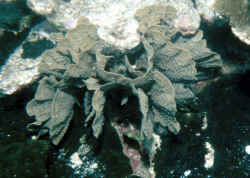
Agaricia tenuifolia
|
Family Agariciidae, Gray 1847. All utilize endosymbiotic
algae, all colonial. Individual coral polyp skeletons have poorly
formed walls, prominent/thickened septo-costae, are immersed in their
larger skeletal mass, randomly oriented, spaced, often resembling
rough, wrinkled skin. Six living genera.
Genus Agaricia Lamarck 1801. Species are mostly thin vertical
plates (sometimes horizontal). Only found in the Atlantic
Bigger PIX:
The images in this table are linked
to large (desktop size) copies. Click on "framed" images
to go to the larger size. |
|
|
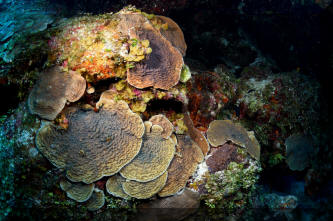
| Agaricia agaricites (Linnaeus 1758). Form complex
relatively thick layers of connected bifacial fronds. Upright or
encrusting/horizontal. |
|
Bigger PIX:
The images in this table are
linked to large (desktop size) copies. Click on "framed"
images to go to the larger size. |
%20MD.JPG)
MD.JPG)
|
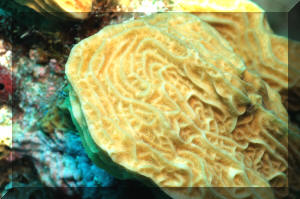
| Agaricia agaricites forma agaricites (Linnaeus 1758).
Encrusting colonies of discontinuous reticulated patterns of ridges and
valleys. Roatan 2019. |
%20MD.JPG)
|
Bigger PIX:
The images in this table are linked
to large (desktop size) copies. Click on "framed" images
to go to the larger size. |
|
%20MD.JPG)
%20MD.JPG)
|
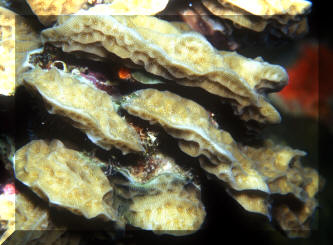
| Agaricia agaricites forma carinata
(Linnaeus 1758). Form thick plates of connected bifacial fronds.
Upright. A colony in Cozumel 2017. |
%20MD.JPG)
|
| Agaricia agaricites forma danai (Linnaeus 1758). Form
complex relatively thick layers of connected bifacial fronds.
Upright or encrusting/horizontal. Often with algae growing at base. One "forma danai" in Bonaire. |
|
| Agaricia agaricites forma purpurea (Linnaeus 1758).
Encrusting flat colonies of parallel, continuous
valleys and high ridges.
Key Largo 2014.
|
MD.JPG)
|
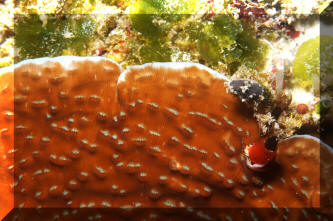
| Leptoseris (formerly Agaricia) cucullata, Sunray Lettuce Coral.
Saucers/plates w/ distinctive (ray like the sun) septal lines running to the
edge. Ridges and valley discontinuous. Corallites are tucked into ridges like no other member of the genus.
Tropical W. Atlantic. Here in Cozumel 2016 |
|
Bigger PIX:
The images in this table are linked
to large (desktop size) copies. Click on "framed" images
to go to the larger size. |
|
|
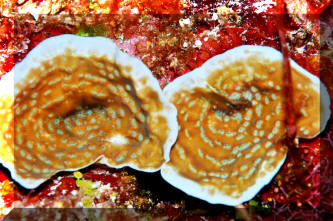
| Agaricia fragilis, Fragile Saucer Coral. Thin
bowl-like colonies; concentric valleys of uneven width. Browns, tans, to
greenish and purple. Tropical W. Atlantic. Here in Roatan 2016. |
|
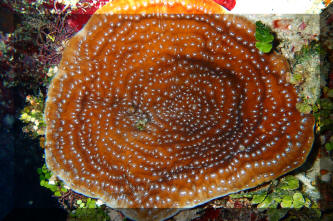
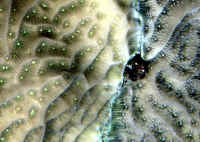
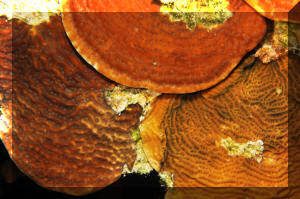
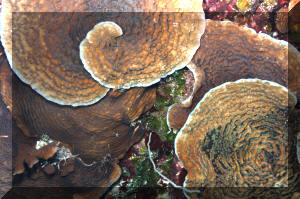
| Agaricia grahamae, Graham's Sheet Coral.
Looks like thin sheets to thick plates, often as piled up shingles
on a sloping reef. Distinctive polyps appear star-like in valleys. Septa and
valleys are
equal in size (Lamarck's are dissimilar in thickness and height). Bahamas
pix. Second pick, Graham's on left, Lamarck's on right for
comparison. |
|
Bigger PIX:
The images in this table are
linked to large (desktop size) copies. Click on "framed"
images to go to the larger size. |
%20MD.JPG) |
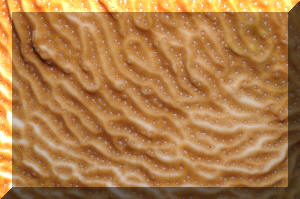
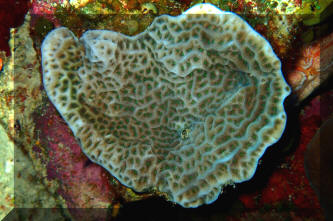
| Agaricia humilis, Low Relief Lettuce Coral. Colonies
3-5"; more/less circular, lumpy, high density corallites arranged in
reticulated patterns. No long valleys or two-faced lobes. Di pic in Bonaire
2016 |
|
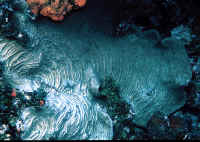
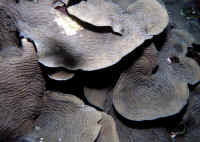
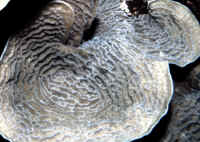
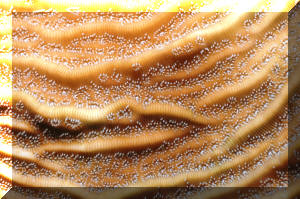
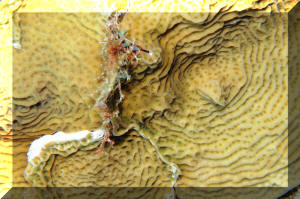
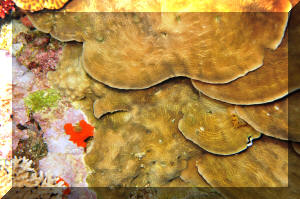
| Agaricia lamarcki Milne Edwards & Haime
1851, Lamarck's Sheet Coral. Colonies are flat one-faced plates
arranged in whorls. Bright white polyps. Dissimilar septa size and wider spacing
compared with A. grahamae. Usually brown rust in color
with whitish mouths. Belize images. |
|
Bigger PIX:
The images in this table are
linked to large (desktop size) copies. Click on "framed"
images to go to the larger size. |
 |
To:
Part
2, Part 3,
Part 4, Part 5,
|
|


%20MD.JPG)
%20danai%20COZ23%20MD.JPG)
%20MD.JPG)
%20MD.JPG)