|
|
| Home | Marine Aquariums |
Freshwater Aquariums |
Planted Aquariums |
Brackish Systems |
Ponds,
lakes & fountains |
Turtles & Amphibians |
Aquatic Business |
Aquatic Science |
Ask the WWM Crew a Question |
| Please visit our Sponsors | ||||
Calcite test... for Ca reactor f'/FB Calcium Reactor Valve Hi Bob, <You got JasonC this time,
howdy...> I have a K2R Calcium Reactor that is currently being fed
from my main display tank via gravity flow. The effluent from the
reactor flows into my sump, again, via gravity flow through a 5/8"
vinyl tube. <ok> The effluent recommendation from the
manufacturer is around 100 ml/minute for my 300 gallon display tank.
<A quick word here... these should both be adjusted for your system
- is different for everyone. Use the manufacturer's suggestions as
a baseline and test very frequently.> However, when I set the output
valve to give me this flow, it works for a few days and continues to
clog. The flow stops completely and requires that I open the valve
fully and then reset the flow rate every few days. <Not an uncommon
problem at all, so much so that I need to check the very same valve on
this morning's maintenance march.> Originally, I fed the calcium
reactor from a tee off of a small powerhead submerged at the top of my
main tank, but this small amount of extra water flow caused the water
to go right through the reactor (as opposed to being recirculated in
the reactor via the reactor's circ pump...) <That doesn't
sound correct at all - perhaps a design flaw in the K2R? Water
shouldn't be able to flow out any faster than permitted by the
outflow valve. Everything in the reactor should continue to
recirculate.> Because of this, I needed to adjust the CO2 such that
the output effluent was around 6.5 in order to get my alkalinity up to
400. This achieved the correct alkalinity but caused excess CO2 in the
main tank followed by hair and other algae problems. <This can be
addressed by letting the effluent run out into your skimmer... the foam
fractionation process will blow out the excess CO2.> Is there a
better way to plumb, place, adjust or feed the calcium reactor that
would cut down on output valve clogs and maintain the correct flow
rate? <Hmmm... is a good question. I've tried them all, and I
prefer a dedicated pump over a T-fitting in the return pump over a
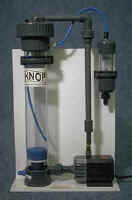
siphon feed. That being said, I just received a new Knop reactor
who's tubing is set up specifically for a siphon. In addition,
there are problems with T-fittings regarding line pressure. So...
I'd say that each solution depends most on your installation and
manufacturer. I'm going to try the siphon on this new reactor
because the manufacturer is recommending that I do it this way. I would
suggest you do the same unless it just isn't working at all. As for
the clogging of the effluent valve, several online retailers carry an
external pinch valve which will accomplish the same task, but won't
get clogged by accumulating salts. You might want to give that a
try.> Thanks! Charles T. Spyropulos <Cheers, J -- > Calcium Reactor Ignore that last email. <too late.> I
saw the powered solenoid on the regulator a few minutes after that.
<ok.> Anyhow, now there are two methods to 'control' the
reactor. Some advocate measuring the affluent and controlling the
solenoid to output a ph of 6.5-6.7. <I would not recommend this
method.> Others have the pH probe in the sump and measure that way,
but I'm not sure if you keep it there, whether the reactor will
actually work. <Yes it will... if you've read my FAQ, then you
know that the 'issue' here is that the low pH of the effluent
of the reactor can drag the pH of your tank down, and anything below
8.2 pH isn't really desirable in the main display.> Isn't it
possible for the reactor to keep running and raise the alk quite high,
but the pH never rises to stop the reactor from running ? <Only if
you set it up incorrectly. You should be able to adjust the controller
so that it will shut off the CO2 solenoid when the pH in the main
system goes too low.> The main reason is that if you have a nice
controller, why in the world would you want the pH reading to be
reading 6.5. You would want it to report on the actual pH in the tank
in the displays, rather than the effluent ? <I'm not sure I
follow...> Thanks, Jim <Again, if you haven't, please read
that URL... I do think it will answer your questions. Cheers, J --
> RO Water Top off & Calcium Reactors Bob, <Steven Pro in this morning.> I top off my tank with water directly from my RO unit on an automatic system utilizing a solenoid. Do you have any advice on how to keep up with buffering as adding it has created spikes due to the automatic replenishing of fresh water and the fact that I only buffer weekly. Any advice. <This is really not a good idea. While it maybe convenient, it is always best to hold and aerate any demineralized water for 24 hours. This maximized dissolved oxygen and off gases excess CO2. It is the CO2 that is messing around with your alkalinity.> I also was considering purchasing a calcium reactor from Lifereef. Have you heard of their products. Any comments. <Have not used there products. Do solicit comments form other hobbyists on the message boards. I know of two very friendly boards; ours at http://wetwebfotos.com/talk/index.jsp and a friend's at http://www.thesea.org/forum/default.asp You may also wish to inquire at both reefs.org and ReefCentral.> Thanks, Liz <You are welcome. -Steven Pro> Calcium Reactor Questions Sorry to bother you again today, promise my last question. <no worries> A friend of mine is upgrading his Reef to a nice 180+. he is going with a calcium reactor, and has peaked my interest. I read your site but have a question. He has been told that even with a calcium reactor he will still need to drip Kalkwasser. <arguable, but I personally agree that there is great benefits to this> I thought the whole point of getting the reactor was to be able to stop this time consuming practice. <nope... but that is a common misconception among American aquarists. Europeans have known/promoted Calc Reactors as Alkalinity boosters (carbonates) not calcium boosters, although they do some of both. Even Daniel Knop of Knop reactors has said that Kalkwasser supplementation is helpful to reactors (among other things, it indirectly supports alkalinity while providing free calcium). And Kalkwasser is not time-consuming at all.. you just haven't been shown an effective application. Please do review my comments in the WWM archives on dosing with Kalk slurries (easy mix with cold water, dosed at night in one fast shot at measures that spike pH not more than .1-.2 This was detailed at length in my book as well http://www.wetwebmedia.com/bkcoralprop.htm> What are your thoughts. I guess one more question should we go with single or dual chamber reactors. Our feeling is the dual systems are more efficient. <The duals are MUCH more efficient and I strongly recommend that second chamber for pH stability among other things.> Thanks Larry <best regards, Anthony Calfo> John Guest SpeedFit fitting <Greetings... > Hello friends, I'm curious if any of you are familiar with this John Guest SpeedFit fitting? <I am. It is a brand name and unique type of fitting for small tubing that does not require a collet or retaining nut - hence the name, speed-fit.> I have a calcium reactor and was looking into changing out my ETSS skimmer for an AquaC EV-120, and noticed this fitting called the John Guest. <Is just a place to plug the effluent [output] tubing of the reactor into the skimmer. You could as easily use this for an ozone input. The large quantity of air in the skimmer would help blow off the excess CO2.> I also have seen an item called a calcium reactor pressure adapter to fit the John Guest fitting. <I am not familiar with this piece/part.> How does all this work? What is the difference in these items versus using an inline pump or gravity fed line to the reactor? <The way you feed the reactor shouldn't affect the passage through a JG SpeedFit fitting. As an aside, I'm on the side of inline plumbing or a dedicated pump to feed the reactor. I'm not a fan of siphons for this purpose.> I'm just guessing that is what this is, a type of method to feed aquarium water to your reactor. <see the above comments - let me know if it's not clear.> Any information on these items would help me a lot in choosing the right skimmer. Thanks, Paul <Well - this SpeedFit connection should not be the single reason you buy a new skimmer. The presence of this fitting doesn't make a calcium reactor work better or worse... it's just a way of dealing with excess C02 if that is a problem for you, and in fact it may never be. I'm a big fan of the AquaC line of skimmers and believe you would be quite pleased with the results - JG SpeedFit or not. Cheers, J -- > Skimmers & Calcium Reactors I am in the process of setting up a 180 reef tank and need to get a new skimmer. The skimmer I currently have makes use of an external air pump and bubble stone, which I don't think will be anywhere near good enough for my new system. After reading through all your FAQ's and articles on skimmers, I've narrowed it down to 2 choices, the ETSS Evolution 750 ($344 w/pump) and the Berlin Classic ($169 w/pump). It seems that both of these skimmers will handle my tank easily, and from what I have read both do a good job. Is the extra $175 for the ETSS really worth it? <I would not recommend either. There are far better choices, namely Euro-Reef and Aqua-C.> Am I correct that both these skimmers will work GREAT with my 180? <I would say marginal.> Are there any maintenance issues that should effect my decision? <The Euro-Reef is incredibly easy to clean.> The same goes for calcium reactors. There are many good ones out there, all with good reviews, but there is a $70 price difference on the 2 that I am leaning towards, the Knop C ($249) and the K2R ($419). Any preference for the 180g? <Both come with Eheim pumps. The K2R is a good bit larger, capable of holding more media, which means it will go longer before needing opened and added to. Either will serve you well.> Any advice is greatly appreciated. Will <You are welcome. -Steven Pro> Re: Calcium Reactors in Australia (and expensive chillers!) Hi Bob, I have placed an order for the Dupla reactor and now keenly await its arrival. A piece of information that I thought you might find of interest and perhaps Diana as well. I asked the supplier of the reactor about the availability of Korallith media. He informed me that he had tried to access it but Australian quarantine forbids its importation (do not know on what basis, now making further enquiries). Could not see how it Ca reactor media would pose a risk, but our country has some pretty tight restrictions. <Me neither... will forward to Di and Ralf and Daniel in Germany> I have another question for you, this time about chillers. I am planning to install a chiller on my tank before this summer season. Our average maximum temps for about half of the year sit at around 35oC. Not the ideal climate to live in for a mini-reef enthusiast. In the past I have air-conditioned the room but relying on an air conditioner (on a timer) for 14 hours a day 6 months a year is a bit much. With a chiller I should be able to reduce this significantly to just the hottest part of the day and the middle summer months. Having the two units together when we are away is also a better fail safe. <Sounds like a good plan> I have been trying to do some research on brands but have been able to find out little about the models available in Australia. My options in Australia are - Teco Chiller/ RA680 will cool 800L by 10 degrees C below ambient room temp. Cost $2020 complete with thermostat. Italian Made (I think). <Yes, a good unit> - Sfiligoi Chiller Big Flite will cool 750L by 15 degrees C below ambient room temp. Cost $2100 complete with thermostat. Italian Made. <Also an allegedly well-made unit> - Resun 0.6 hp chiller will cool 750L by 12 degrees C below ambient room temp. Cost not sure but assuming $1800-$2000 complete with thermostat. Asian Made. <Don't know about this product> - Aquasonic Aqualogic chiller 1/3 hp will cool 700L by 7-8oC below ambient room temp. Cost approximately $2000 complete with thermostat. <Yikes... even with the improvement recently in the Austr. dollar?> All units come with a 12 month guarantee. My question is which one?????? My system holds about 700 litre and has Halide lighting (another source of heat). My preference at this stage is for the Sfiligoi Chiller Big Flite due to its cost vs. cooling capacity. These units are normally $2600 but the agent in Australia has a winter special at the moment for $2100. The components in contact with water in this unit is 316 stainless steel which I am told is completely safe for marine aquaria (not sure about this anti-corrosion claim). The Teco which would be my second choice at this stage has platinum (I think) components but has a less cooling capacity than the Big Flite. <I agree with your choices> I have not been able to find much information on any of these brands apart from manufacturer specifications that all claim their unit is the biggest and best for aquarium use (how could they claim anything else?). Teco are common in Australia and apparently reliable. I have been told by one dealer that Resun were junk (he is selling other brand of course). I think Aqua medic may have a brand available but the cost is much higher than all the other units and only have same cooling capacity. So I am at a loss as to which one? It is a lot of cash to shell out but given our climate, the value of my livestock and the expense of running an air conditioner and fan which is only a stop gap measure (tank still goes up and down by 3 degrees in summer 25.5-28.5oC) and if the timer or air conditioner ever failed (real possibility) I would lose the whole tank. I tried a couple of DIY projects using an old freezer and then a fridge both were ineffective. <Agreed... not worth the time, trouble in your sort of setting (draw down, volume, type of system> However I don't want to buy a brand that is junk or will die within a couple of years. Which brand do you suggest? Is the Big Flite any good. I look forward to your comments. It is really fantastic that you make your experience available to fellow hobbyists. Much appreciated. Cheers Paul Grundy <Paul, do try the various chatforums in your part of the world, get a take on the actual experiences of end-users/consumers. Ours: http://wetwebfotos.com/talk/ won't likely have folks with experience with these makes/models, but worth a try. Bob Fenner> [SDMAS] Calcium Reactor Workshop Signup (Southern California) <Thanks much John. Will post on WWM. Hope to see you soon. Bob Fenner> CALCIUM REACTOR WORKSHOP Now is the time!! Please sign up for the workshop if you plan on building a reactor! On July 20 at John Foster's house in the Hollywood Hills, MASLAC and SCMAS will host a calcium reactor building workshop followed by a BBQ. You do not need to build a reactor to attend. You can feel free to be an observer or just come for the BBQ! One word of caution: If you do plan on building a reactor someday, DO IT NOW. We are getting great prices, there will be many people there to help those that want it, and we will have all the pieces cut and purchased for you. To do this on your own "someday" will likely be harder and cost more!! If you can't make the workshop but would like to make a reactor, sign up and pay so I can buy your parts and we will work out assembly at another time. I will only be buying the parts once. The Complete reactor (everything except CO2 tank and reg) will cost $110 (there maybe a slight refund if parts come in cheaper) (clear water filter cylinder $22, Mag 3 pump $40, misc. plumbing and supplies $48) Plus for those who need it: A special deal on the CO2 tank, regulator, solenoid and needle valve $154 (5lb tank $69, Regulator Combo $85) If you get both you have a complete setup ready to turn on when you get home!! Operating instructions will be included. To sign up: 1. E-mail me now drjohnf@att.net stating what you are buying, or that you will be an observer only. 2. By June 28th send me a check for the amount of your purchase. Send to: John Foster 2801 Pelham Place Los Angeles, CA 90068 Attn: Calcium Reactor Thanks, a map to my house is attached and a schematic of the completed reactor is attached. If you are using mapquest, it will show you the correct location but give you a terrible route from Beachwood Drive. Use my map from Beachwood to my house. John Foster Calcium Reactor Media hi bob, <Howdy> hope you're doing well. all is fine in my set-up, though started wondering abt. my calc reactor, recently -- I have an Aquamedic calc reactor (large, for up to 250 gallon tanks), still using the original media it came with. I've been using it for abt. 7 months. when do you think is the best time to replace the media? abt. 6 mo.? is Korallith a brand you'd recommend? thanks! <Mmm, I wouldn't "just" change out the media on a timely basis... that is, just for the sake of it... I trust you're testing for calcium and alkalinity. I would switch or augment the media when these become limited. Brands, products do vary quite a bit. I encourage you to check with actual end-users, like through chatforums (ours: http://wetwebfotos.com/talk/) and experiment with a few yourself to see what gets you where you want to go with the least cost, most ease. Bob Fenner, whose wife does distribute Knop Products in N. America., just a timely admission> - Javier Calcium reactor FOWLR Is running a calcium reactor for a fish only tank (with liverock) a bad idea ? What are the drawbacks ? <No. The benefits, high, stable pH, calcium and alkalinity are tangible for all living marine systems> I know it is almost a pre-req for reef tanks with the calcium that they draw, but is there any downside if you don't have a large user of calcium ? I'm mainly interested in using it to control ph/alk, rather than dosing/buffering. Thanks <Not really downsides other than upfront costs of acquiring the gear. If your situation (checked by water testing) doesn't call for much adjustment other than regular maintenance (as in gravel vacuuming, water changes... you might get by w/o... Stocking rates, feeding, use/non-use of live rock... many other factors might contribute to yes/no question of reasonableness of calcium reactor use/augmentation. Bob Fenner> Jim Re: Calcium Reactor Brands In Australia Thanks Bob, I would be interested in what Di could find out about shipping Knop products to Australia. Our weak dollar against your U.S dollar though may be a killer on that option. <I understand... was visiting QLD a good part of 3/02... a bargain.> Warranties are the only other concern although if it is run by an Eheim pump that should not be a major problem as there are many Eheim dealers in Australia. <Great products> Have previously checked out the DIY projects at Oz reef. This to is an option, however, I live in a small outback town and accessing all of the bits and pieces can be problematic and at the end of the day the Dupla reactor would only be about $150 more for something that is compact and guaranteed to work (some home projects do not always go the way you first planned). The Dupla model here is $490AUD and the matching regulator is $180. <That IS a bargain... as you likely know, Dupla's line is NOT cheap at all...> I look forward to hearing what Di can come up with Cheers Paul Grundy <Real good. Will cc her here as well. Bob Fenner> Calcium Reactor Brands In Australia Hi Bob, I am in the
market for a calcium reactor after being convinced by all of the
material that I have read (mostly on your site). I have a 700L reef
system which has been running now for three years and I am tired of
pouring endless dollars into buffers and calcium additives. I have had
good results with these additives (I use the SeaChem range), but the
cost and frequent dosing is becoming a real drawback. <Am in total
agreement, understanding here> The tank is jam packed with live rock
and is host to a couple of Centropyge dwarf angels (coral beauty and
bicolor), a regal tang, a yellow Hawaiian tang (boy are they hard to
come by and expensive in Australia), a cardinal and a trio of Chromis
damsels. In terms of corals I have a range of soft corals such as
various mushrooms, leathers etc, as well as some hard corals such as
Lobophyllia, divisas and E. jardinei. I have been running a plenum on
the system now for two years with notable improvements to stock growth
and quality. My calc is approx 400ppm and hardness of 1.5-2.5 meq/l ( I
constantly battle with keeping it up). <Sounds very nice...
excepting the low dKH> In Australia the range of calc reactors is
very limited and most LFS's now little about there use. The only
models that I have been able to find are an Aquamedic closed system
reactor, Korallin C 1501 reactor (most expensive in Aus and available
by mail order) and a Dupla reactor (both the Aquamedic and Dupla are
the same price). I am really at a loss as to which one would best suit
my system. I do not have many hard corals but hope to move into this
area down the track when the reactor is up and running well. My
thoughts after looking at the units is that the Dupla may be to small,
but I guess this may depend on the way it is run and the biological
load in the tank. My preference at this stage would be the Aquamedic
model. It has a reasonable sized reactor chamber and it is reasonably
priced. However, I have not been able to find out very much about any
of these reactors and would like to make a informed purchasing decision
even if it means buying a dearer model. I have not been able to find
anyone that supplies Knop products in Australia. Which reactor would
you recommend and do either of the three brands have particular short
comings that I should be aware of? <Of the three, I'd go with
the Dupla... but am interested in finding out what might be involved in
"casting your net" a bit further, maybe having a Knop unit
(the new one with the Eheim hobby pump inside the reactor chamber is my
fave choice for your size, type system). Will cc Di (distributor for
Daniel and Ralf Schmidt in N. America) and ask that she follow up with
ideas on tariffs, shipping costs to Australia> I am also another
ozone convertee. Put an ozone unit on the tank 12 months ago with a
Redox controller and things have never looked back. <Good move>
Ditched my U.V sterilizer as it seemed to do very little, compared to
the ozone I could not see much benefit when faced with continuing bulb
and sterilizer maintenance. 6 months later surprise, surprise not
having the sterilizer on has made no difference to the well being of
the tank. Thanks for your most informative site, I look forward to your
reply. Paul Grundy <Thanks for writing. Do also consider the DIY
route (Know of "Oz Reef" site?:
http://www.ozreef.org/). Do make it known how your efforts go at securing
and installing the reactor. Bob Fenner> Reactor and pH I forgot to mention that I have 5-6 inch of Sugar size Aragamax, which should all solve my low PH problem, but like I said after the addition of second chamber and adding Kalkwasser it has been low 7.8 night, and 8.0 day. <ahhh...my apologies! Reading mail too fast today. Looking back I see your mention indeed. Thank you> A friend recommended to do weekly water change and addition of B-Ionic. will this solve my problem with low PH? <the liquid two-part should not be necessary, quite frankly. Lets try a simple experiment with a sample of aquarium water to address any question or concern about lingering carbonic acid/off-gassing CO2/oxygen saturation. Test the pH (and O2 if you like) of a fresh sample of water and then again after 12 hours of aeration. If the pH rises more than a little (0.2+) then we do indeed have a problem with off gassing the CO2 (perhaps not too much CO2 just a need for better off-gassing). I have strong reservations about using excessive buffer or two-part supplements in addition to the reactor for fear of skewing the Ca/ALK dynamic. Kindly, Anthony> pH and Lime Reactor, second chamber Hi WWM Crew I had problem of low Ph, I had the same problem I been using K2R and added another canister of K2R with CaribSea aragonite to hopefully increase my PH to 8.1 but it has been 7.8-8.0, ideally the PH should be 8.2-8.4 am I correct. <agreed or even a whisker higher> Recently I also been adding Kalkwasser to the fresh water for evaporation, but has not change, LFS recommends adding super DKH to increase PH, I'm afraid it might messed up the Ca/Alk biomineralization. <partly agreed, although I like using Kalkwasser with the reactor...many benefits to it> I don't think I'm over injecting CO2 since it has been at 3psi, which the manufacturer recommendation, effluent output is at 6.8 of PH, DKH is 3.5, Ca at 450 ppm, oxygen saturation at 420, could this be an indication of not injecting enough co2 to increase PH, but DKH/Ca is fine and don't want to make it worst. My SPS are flourishing fine. Bi-weekly water change of 15%. <no worries my friend... a very simple and incredibly effective solution lies in adding a second inline chamber of Aragonitic material after the primary reactor. Does wonders for the systems and will probably temper the weak pH you are experiencing. Not hard to DIY either...many plans on the net abroad. Best regards, Anthony> Calcium reactor output Dear Crew, The first thing to do is thank you for such an informative site, I've spent many hours getting good information. Here's my question, I run a 65 imperial gallon reef tank, overflowing with Fijian live rock, good skimming with metal halides and marine actinics, I have a good mixture of hard and soft corals along with dwarf angels and 1 Flagfin all of the tank readings are good, ph at 8.2 during photoperiod ammonia and nitrate are 0, phosphate at 0, I use ROWAphos in an external canister filter to capture phosphates which then feeds through a UV sterilizer before going into my chiller unit, water temp is constant at 78f, I use ozone in my skimmer which is controlled to give Redox at 350 I also have a Knop model c reactor which I fill with CaribSea arm media, (great stuff) I changed the media about 6 weeks ago since then I can't get the dKH to go above 7degrees (German) and the calcium is at 370, prior to this media change I was running at dKH 11.2 and calcium was at 470, my co2 bubble count is 13 a minute and effluent is at 6 drops per minute, the CaribSea packing states that a reactor ph of 7.5 is sufficient whereas the Knop site states that a reactor ph of 6.5 will give the best results, any ideas guys? Many thanks Paul <Sounds like a very nice system... I encourage you to either experiment with lowering the pH effluent to about 6.8 or going back or switching reactor media to return to higher dKH and calcium concentrations. I do want to admit to the fact that my wife (Diana) distributes Knop Products in North America. Bob Fenner> Calcium Reactor Dear Bob & Co., In my quest for the ultimate 135 gal Reef system I have decided to upgrade my hardware to include a calcium reactor. However as we hobbyists know, cost can spin out of control. To save money I bought an unused reactor that looks to be a K2R knock-off (DIY). In a side by side comparison, physically they look exact. To compliment the reactor I purchased a Pinpoint Ph controller, a M-3 regulator with solenoid, and a 5lb CO2 canister. My problem is that with the purchase of the reactor, I am without manuals. After reading your Q&A sections on CRs, I quickly learned that the CO2 bubble rate should drop the PH of the water in the reactor to 6.8, while keeping a PH of above 8.0 in the main tank...My question is with the use of the solenoid and controller. Assuming I adjust my bubble rate to reach this 6.8 PH value in the reactor, then put the monitor in the sump to measure the display tank PH. Do I set the PH controller to shut off the solenoid when the tank PH drops below 8? <Could, yes> Do I control tank PH through the flow rate from the reactor? <In a manner of speaking, yes... Please see below> I'm a little confused regarding parameters and how to control them using the reactor, solenoid and PH controller. Do I plug the solenoid into the high limit or low limit on the controller? Can you please enlighten me? <You could. Best to go very slow here... in establishing the use of your reactor and system together. DO keep a log book of your initial chemical measures (esp. pH, calcium and alkalinity), your adjustments to your drip rate, pH of effluent, bubble-counter... And determine what's "about right" per your gear, the reactant (media you're melting down), and biota. You will soon know what works here. Bob Fenner> Sincerely, Dennis DSB and reactor media Hi, Mr. Calfo, Here I am again. The following questions is bothering me a lot. <No worries, my friend...> 1. Why is it a bad idea to mix some larger coarser grade sand into a 6+ inches DSB? <Various grains of sand permit or deny diffusive action (osmosis, saturation or diffusion, etc). So a bed of coarse sand only will allow better penetration of oxygen rich water (which you do not want for efficient denitrification) by virtue of the large angular shapes of the sand media and the larger spaces between grains. It also traps more detritus but does encourage more amphipods. Fine sand, on the contrary encourages more microfauna (bacteria, tiny worms, copepods) and is better suited for the establishment of a larger colony (because of the increased surface area of the smaller grain sized) of denitrifying bacteria. When all is said and done... we don't need course sand for amphipods because they will grow anywhere else easily (live rock, sump, refugium) and the trapping of detritus can be a nightmare to keep up with and in the typically poor current displays of so many aquarists leads to the crash of a sand bed unfairly blamed on DSB methodology. You want sugar fine sand if you are gunning for denitrification and it really needs to be as deep as possible (solid 3" minimum but over 5" is much better)> 2. I just bought some calcium reactor media by Dupla. The media looks like some crushed coral and shells, and I am sure they are. I have also checked out the calcium reactor media by CaribSea, and it too looks like crushed coral, but it is claimed to be aragonite. Why??? <Not all shell/calcareous media is aragonite. About 20% of the beaches in the Caribbean are said to be composed of aragonite... the rest are calcite. Just a different form of calcium carbonate but a big difference nonetheless. I have seen some studies about reactor media... not the least of which are reports from the notable aquarist/author/manufacturer Daniel Knop. Avoid shell and crushed coral at all costs. They are least effective and most likely to impart undesirable elements. Champion Lighting and Supply have an excellent bulk calcium reactor media that is outstanding. Do look into it. Let them know I suggested it if you like.> 3. Since aragonite and crushed coral look so much alike, how can we tell one from the other by their appearances? Is aragonite crushed SPS coral? <We aquarists cannot tell visually. It is a molecular difference. The notable advantage is that it dissolves easily and at a higher pH. Calcite is tough to dissolve. We must trust the word and reputation of the vendor along with the experience of fellow aquarists. Many of my friends swear by the bulk media at Champion.> Sorry to bother you. Thank you for your time. <No bother my friend, always a pleasure.> Sincerely Samuel Calcium reactor Bob: <Steven Pro this morning.>
Recently I set up a large calcium reactor on my relatively small 60
gal. reef tank. After running the reactor initially (day and night),
the tank "crashed" and most of the inverts such as snails,
starfish, shrimp, etc., died. <Sorry to hear it. Have you identified
the reason behind the crash?> The die off caused an obvious water
problem with the level of organic material from the decaying animals.
Subsequently, an algae, or what I thought was an algae bloom occurred.
I am more apt to say that the reddish brown, small stringy (1-2 mm
long) material (that has coated the live rock and corals) are
dinoflagellates, although I have never had an outbreak before. I
scrubbed some of the rock, and although some came off, it left the rock
a rusty color. The corals in the tank survived the alleged pH crash
from the reactor set-up (although this "crash" is unconfirmed
since I electronically monitor the pH), <I do not understand this
statement. If you monitor the pH electronically, then you should be
able to confirm the pH drop which caused the tank crash.> but none
of them look very good since I added the reactor and this bloom
occurred. My pH normally is between 7.9 (night) and 8.1. I am working
to increase it. <Work harder. A pH below 8.2 is unacceptable for
corals and is a sign of poor husbandry practices.> Of course, I have
shut off the reactor until I can resolve this problem. <Always best
to have all of your water parameters in line before starting a reactor
and then monitor very closely for the first few weeks.> 1-2 weeks
after this bloom, I started the reactor again (slowly and while
monitoring the tank closely). I then did a 25% water change in the
tank. The next day after the water change, the bloom came back even
stronger (I measured phosphates at 0 in the R/O water used). At the
same time I kept the reactor running 24 hours. Could this bloom be
caused (or supported) by the reactor material I am using. <Possibly
by contaminants in the media and by excess CO2 in water.> I am using
Carib Sea aragonite in the reactor, and not the more expensive reactor
material. Could some leachates in this material cause or support this
bloom? <Possibly> My protein skimmer is skimming like crazy a
very dark skimmate even after the 25% water change. It is strange but
somehow I feel this may be related to the aragonite used in the
reactor, based on how the bloom came back even stronger after the water
change, but while the reactor was still running. Could this substrate
have leached toxic substances that could have killed the inverts, or is
this reaching? <Sounds like reaching to me.> The phosphate levels
in the tank measure 0 from the most recent test. <Test kits only
measure inorganic phosphate, not organic phosphate, so there could be
phosphate that is undetected by your kit.> Tim <I would turn off
the reactor for now. Get everything squared away and then reattempt its
use. -Steven Pro> Calcium Reactor.... Hi Bob, I have an under-sized Knop Calc reactor for my new 300 gallon reef tank. I used to use it on a 135 tank. I want to purchase a new reactor. On your WetWebMedia site you indicate that Knop and K2R reactors will be supplanted. New models or better manufacturer?? I would like to get a reactor soon, but want to get the right one as they are costly. <Don't know re the status of K2R, but Knop has just come up with a new model... and they do have larger sizes already. I would look to the "next size up". Bob Fenner> Thank you for your time. --- Dave Mart Calcium Reactor Placement Hey there Bob, Hope your day is going well. Had a question about calc reactor setup (I have an Aquamedic closed system, note to self btw, fittings have to be tight or you'll be leaking all over the place -- a lesson learned the hard way). <Yes... I like this company's skimmers much more...> I have no sump; seeing that this might be a problem for getting the effluent back into the tank, I purchased a Rio 800 to draw water out of the tank and into the reactor, which is below the tank. that's fine, except that the effluent doesn't get enough pressure to get back up the few feet into my tank (if I hold the effluent line lower by a foot, it starts working). <Hmm> I think I have two options: 1.) find a ridiculous stand to place my reactor beside my tank, so that the effluent doesn't have to pump as high or 2.) upgrade to a Rio 1100 or 1400. I'd rather do the second, but I wonder if this would cause too much water pressure into the reactor. <Me too and no, should be fine> would this affect performance in any way, if the effluent still drips out fairly slowly? <Measure effluent pH... and concentrations of calcium, alkaline reserve... ad adjust valving, CO2 respectively> I know calc reactors aren't meant to be run this way (I haven't read anywhere about setting up calc reactors like I do); does it make a difference? thanks bob! <Mmm, not an unusual arrangement here... would use a sump... oh, see you mention this below> - Javier, who should have invested in a sump (and a stand with enough room to fit it) <Be chatting, Bob Fenner> pH/Reactor Advice II Hi Steve: It turns out that the brand new pH test kit that I bought with an expiration date of 2005 was defective! I mean this kit was brand spanking new. Absolutely amazing. My pH was most likely around 8.1 all along knowing what I know now. It is now around 8.2 mornings/8.4 evenings because I started to add buffer to correct my false low pH before I figured out what was going on. There's a lesson there for me and anyone else reading this. Just by coincidence, FFExpress is having a sale on pH meters -- very cheap compared to $1,500 in livestock. Sorry to bother you, and elated to know that my tank is doing much, much better than I first feared. <No bother at all. Glad to hear things are OK. Do remember to get the reagents to calibrate the pH meter if you get one.> As for the Ca reactor, I need to play with it some more to get a better handle how it performs and its sensitivity. It's only been two weeks. I was just trying to see if I could get any additional input from you while trying to dial it in. <Now rereading your first query, you seem to be pretty close at 20 bubbles per minute. A little more tinkering and you should be set.> I will never use the Chemi-clean again. Felt very funny/leery using it the first time because it goes against everything you guys preach. Cyanobacteria came back anyways, probably because I only used a half dose of the stuff originally. Either that or the stuff is snake oil. <Probably the half dosage. Most of these Cyano killers are erythromycin and it will kill Cyanobacteria as well as some other things and turn your tank a funky color a lot of times. But does nothing to stop it from coming back later.> Very small bloom right now. Will try to correct with reduced lighting, water changes, good feeding practices, perhaps macro-algae... <A good course of action except for the reduced lighting. Your corals need their light.> Thanks again for your ear and your wonderful service. Jim <Do not hesitate to write again. -Steven Pro> Calcium reactor FAQ Here's my final augment for now. Got jammed down by some stuff here at the house, but back in action. I'll make the changes to the online version. I'll whip out my bio today during lunch and forward that along. Enjoy. <Hey, you shcumby, where's the boeuf? No attachment here! Bob F> Cheers. Helps to actually attach the attachment It's already going this way today... <Wunderbar. Will fashion a cover ltr. to Sue.S today and off it goes to FAMA (Fenner's Aquarium Magazine in America) and future stardom and bucks for you. Bob F><<Ran in FAMA, as well as posted on WWM... RMF>> Calc Reactors Hi Bob, <Author/friend Anthony Calfo in your service> I met you a couple of years ago at a marine conference in Ann Arbor, Mi. (Weber Inn). <Hmmmm...perhaps I'll have the same pleasure. I'm one of the speakers this year (March 23rd) same place and conference> You may remember the conference by a gentleman exclaiming the benefits of magic mud. Never bought into that idea. <I agree essentially> You did mention to me that you highly recommended a calcium reactor. <very much agreed! In fact, I like a second media chamber in-line to boost the pH of the effluent, etc> Well now a couple of years later I am looking into the idea. Before I purchase one though, I thought I would seek out the advice of an expert. I am looking at the Knop C and Precision Marine 422. Any thoughts on which one you might prefer? <merits to both indeed and fans of both abound. I personally don't have a strong brand preference.> Thanks in advance for any info, <if you haven't done so already, please read over the new bit from WWM crew member Jason C. at http://www.wetwebmedia.com/calcreactors.htm > Brian V. Grant <kind regards, Anthony Calfo> Alkalinity and pH Control Bob: <Steven today.> Recently I purchased a large calcium reactor secondhand from a local marine store (MTC Pro-Cal). I set it up on my 58 gal. reef (small in size compared to the reactor's capabilities!). I had it running for a couple days with very low input into the tank in order to avoid a sharp change in pH. However, within a couple days I noticed that most of my soft corals had closed up, with one torch coral looking like the tips had been burnt off! I also noticed a dead shrimp and some snails that were not moving, starfish with holes (lesions) in them, and mucus sloughing off the corals. My purple Montipora bleached out in a day. I am afraid I have done irreparable damage to the tank inhabitants. The catch is, I cannot determine the exact cause. The fish have not been affected. I did a partial water change with little improvement to the inhabitants. At the same time that I started the reactor I also added a product called "Stop Parasite", because of an Ich outbreak. The manufacturer says this product is completely safe for reef aquariums, and it can be added directly to the aquarium. I only added one dose (less than 1 teaspoon) and stopped because of the reaction of the corals. [By the way, would a UV sterilizer be the best method for eradicating Ich?] I placed activated carbon back into the sump. In any case, because these two things occurred simultaneously, I am having difficulty assessing which one caused the problem. I have a pH monitor on the tank. I noticed the pH range to be between 7.9-8.2 (could have been a time I didn't noticed a dramatic drop, but I have been adding more buffer in the hope to preclude a swing in pH). I just measured the alkalinity in the tank and it seems to be good (4.0 meq/L or 11.2 dKH). Could a dramatic increase in alkalinity cause this type of reaction of the invertebrates? The alkalinity in the tank before I set up the reactor was around 2.0 - 2.5 meq/L. As a note, I haven't calibrated the pH meter since I bought it (I know, a bonehead move). I will do so shortly. <Your information about pH is completely useless when measuring with an uncalibrated machine. It is utterly impossible for me to say if the readings are accurate, significantly lower, or higher than the numbers you gave.> Do you know anything about this "Stop Parasite" product that is supposed to be so safe in reef systems? Aside from purchasing a UV sterilizer (another expensive purchase), I have tried unsuccessfully to get rid of Ich in my tank. Could a dramatic swing in alkalinity cause an "acid-like" reaction where the corals and other invertebrates appear "burned"? <I do not know which caused the problems in your tank. Whenever first hooking up a calcium reactor it is imperative that you watch the calcium, alkalinity, and pH very closely for the first several weeks until you have the unit dialed in correctly. Secondly, I would not use any Ich medication on a reef tank. It is much better to quarantine all new arrivals prior to putting them into your main display. Unless, the Ich broke out and you have not added any new fish for several months. Then you may have even more problems.> Thanks for your response. Tim <With more and accurate information, perhaps I can be of more assistance. -Steven Pro> Calcium Reactor Supplementation? hey bob, still fiddling around with my calc reactor; random, perhaps silly question. if ph only below 7 is acidic, above 7 is basic, does that mean the effluent ph has to be below 7 to be dissolving the media in the calc reactor? <Mmm, actually no... the pH only needs be below the pH of the substrate being "melted"... However, I believe what you may be asking is best responded to as: there is an ideal pH for rates of dissolution that doesn't waste CO2, provides about right resultant pH, alkalinity, biomineral content...> i have an AquaMedic, and would like to keep my effluent closer to 7-7.1, so that my ph is higher than just 7.9-8.0. will i still get substantial benefits at this effluent ph? <Yes... as you will find> thanks. (FYI: I'm still using the hydrocarbonate included with the unit). thanks! Javier <A good idea... I would use some Kalkwasser (calcium hydroxide) and calcium chloride in most applications/types of set-ups as well. Bob Fenner> Calcium Reactor FAQ Hmm... was able to "hack into"
my network at home and scarf this document, which I then massaged
during lunch. You may think it doesn't need the editors touch, but
I do. Let me know what you think. <You tell me: http://www.wetwebmedia.com/calcreactors.htm
have placed on WWM, listed on "what's new", and put in
marine index under set-up. Be chatting. Bob F> J -- Calcium Reactors Hello to the WWM crew, <Greetings Josie,
JasonC here, your resident calcium reactor guinea pig.> <Hey, and
Di (the apparently generous) charged WWM for her ads cost for your test
gear... so get cracking!> I am writing to ask about calcium
reactors. I went through your web site and found only Q&A about the
subject. Now don't get me wrong there is much to learn from reading
them, but if you have no basic knowledge of how they work (mechanics,
the CO2, and how it uses it's media) the Q&A leaves a huge gap.
<Fair enough. Would you believe, I'm actually working right now
on preparing this type of documentation, having just installed a Knop
type-C reactor. You are absolutely correct about the information that
isn't there, and I'm going to try and fix that right quick.>
I am wondering if you have any information written about these devices
besides the Q&A? Do you know of a book or web site that would help
me? Or could you explain the process? <I'm hoping to turn in my
material for editing by the end of the week. Would you like a sneak
preview? As far as an explanation of the process, put your chemistry
hat on and I'll send you what I have done so far. Actually, it can
be a chemistry do-rag, I'm hoping to be able to explain chemistry
to non-chemists.> <To heckola with "previews"...;
"We don't need no stinking advert.s"; just post that
sonofagun> I feel like I am asking a lot here and I know how
everyone on your site works so hard. It's just that I have found no
other site that explains the workings of such equipment in a language I
can understand. I need no quick response. :) <Regardless, I'll
try to be quick - inquiring minds want to know... oh, that's
someone else ;-) In any case, I will put some finishing touches on the
work that I have and send it on.> Thanks in advance! Josie <You
are quite welcome. Cheers, J -- > <So, where is? Posted? Linkola?
Bob F, not working hard for sure, but long> Calcium Reactor Woes Hi there guys, whoever is helping today. <Anthony here in your service... > Here is my dilemma with my calcium reactor. I have a 45g reef tank, with 1 175w metal halide, 2 28w actinics and one custom SeaLife PowerQuad with 96 watts, which brings me to about 7 watts per gallon. I have some pieces of Acropora and other hard coral, a few softies and 4 clams. I was getting tired of dosing part a + b of whatever calcium so I bought a K2R reactor with Carib sea arm media. After about 1 week I build a nice second reactor to bring the pH back up a little before the effluent drips int a small container that overflows into my sump. I keep my effluent at pH6.8 via controller. My dKH is way off the chart, around 22dkh. <whoa!> In the effluent it was around 45 at first, <Biggie-sized Whoa!> Then I started to set the effluent to more flow instead of dripping it, <hmmmm?> and the effluent dKH came down to around 30, still no change in dKH in my tank. <too much bled in at fist and unused> Calcium in my tank does not seem to rise because of high dKH. It is only around 250 to 280 at best. <indeed, the calc/alk ratio is skewed> effluent calc is around 300 to 350. I am at a loss here and want to know what else I could do. I don't want to dose anything, but I do dose calcium to keep the levels up a bit. My questions are, how do I get the dKH lower, I did water changes and top off with ro/di water, <Agreed... dilute the dKH with a large water change but follow up with a slower drip through the reactors...any flow described as a stream rather than a drip is too fast. Also, you may use Calcium Chloride (liquid calcium/turbo calcium dry) briefly to get your calcium up to a more traditional level (after the water change and drip adjustment...even 350-400 would eb great at this point.> but I don't know what else I could do. The system has been running for about 4 weeks and no improvement in calcium. I have to say, my corals look great though, my clams seem happy, not me though, I want the calc up to 450, the dKH to 12. <simultaneous high end levels of calcium and alkalinity are not realistic for most systems...in gross terms they can even be mutually exclusive (causing crystalline precipitate "snowstorms" of which you are at dangerous risk with your high dKH> am I getting impatient too soon or are there any tricks. <quite frankly, you either didn't get good directions with your reactor or you didn't follow them. You streamed too much carbonate into your system and it will take some serious dilution to get it down. Imagine if your dKH was 24 and you did a 25% water change... even with demineralized water (dangerous!!!) you would only bring it down to 18 dKH, and so on... It will take time and dilution. The effluent water should exit at the rate of a drip and not a very fast one at that> Magnesium is around 1350. I know I can't keep the dKH that high for long, but I don't know what else to do. I appreciate all your help and I am glad that Bob has great friend that are willing to share their knowledge with us. Please tell Bob I said hi and I am still waiting for him to come to Los Angeles to get his free haircut (he knows what I am talking about, hahaha). And if you guys are in town same offer to you, the least I can do. <Wonderful<smile>...and thank you!> By the way, I will probably go to Interzoo in may, since I have to go see my parents and friends anyway, and that's where I grew up for 25 years, in Nurnberg. My parents live about 2 minutes away from the convention centre. I hope to meet you guys there, I'll owe you a few beers for all the good advice. SASCHA <Bob, indeed will be going... but alas, Steve and I will be back here helping to run the site. But not for a lack of gracious invitation by Bob. I will look forward to sharing some food and intoxicating libations in LA with you. Kind regards, Anthony> Ph/alkalinity Hello & (Thank You!) to the tag team answering Bobs fish tank e-mail questions, many of us greatly appreciate this effort. <Appreciate it... hehe, we're grateful that folks are tolerating it <smile>. Seriously...thank you. Anthony> My question is about Ph. I started running a calcium reactor about 8 weeks ago and had the effluent ph set at 6.8 (after reading Bobs faq's on this topic). My tank ph always hovered around 8.2, never below 8.0 or above 8.25. <indeed... a nice piece of equipment and your pH needed to be a bit higher> I'm still wondering, after reading the stored FAQs on this topic, how I can raise the ph to be in a more acceptable level. My dKH now, after refilling the reactor with Carib sea ARM and some old coral skeletons on top is 20 dKH in the tank. <whoa!!! Please retest your alkalinity with another test kit. You are in a very dire straight (no... not the band Dire Straights, although now I have "Sultans of Swing" in my head which is not likely to leave anytime soon) if this is even accurate! Natural seawater is 6-7 dKH, but most reefs fare better at 7-10 dKH (Sprung/Delbeek) and SPS dominant tanks can even be a bit higher (towards 12 dKH). You are in serious risk of precipitating free calcium from the severe imbalance of carbonate in your system (like a reverse snowstorm from the common crystalline carbonate precipitation from Kalkwasser abuse). If this happens, you just might kill most of the living creatures in your tank within 24 hours of a precipitous event. But do not make a knee jerk reaction either... back off of the reactor (what is your bubble count on the effluent?) and do some small but frequent water changes until you get down towards 12 dKH. It isn't easy to maintain high free calcium concurrently, but at nearly 400 ppm you have managed to do so and are at great risk for it> I've slowed the drip rate from the reactor to bring this high dKH down. <brother...this has to be monitored closely from go for the first couple of weeks until you get it tweaked> Calcium by the way is at 396. Before the Calc. reactor the DKH was always around 14 but the ph was 8.0-8.2. <agreed...something had to be done with the pH> The tank has been up and running 6 months and the specs are; 110 gal with 30 gals in the sump. The main tank has about 115 lbs of live rock and about 2" of aragonite "sea floor" from Carib sea. <see other posts or write back but a 2" substrate is problematic in the long run... not deep enough for anoxic activity (denitrification) but too deep for aerobic activity. The rule is 1/2 inch or less or three inches or more... never in between> In the sump I have ~ 30 gals of water with ~ 15 lbs live rock, 20 lbs of a pre packaged live sand and 3lbs of Red Gracilaria,) "Tang Heaven" algae. <cool> I run a Turbo flotor 1000 Multi and inject ozone for an ORP in the main tank of 340 - 400. <nice...and reasonable> I change 5 gals of water every week that is aged using RO water and Tropic Marin salt mix. <hmmmm perhaps the source of your original low pH problems: did you aerate the R/O water for 12-24 hours before buffering it (mixed completely) and then later salting it. If not, you wasted buffers in the salt mix by not off-gassing or neutralizing carbonic acid from R/O water... and your 2" sand bed is hardly a significant buffer> I add 10mg of Seachem iodide every other day <very good> The livestock in the tank is; 2 juvenile false perc clowns, 2 fire fish, 2 juvenile Heniochus, 1 juvenile Hippo tang (2"), 1 yellow tang(2"), 1 small bubble tip Anenome, 1 serpent star, 1 long spined urchin and 2 nice sized corals; elegance and hammer. with 3 small frags of Acro. The water parameters are: ammon=0, nitrite=0, nitrate is non detectable using Fastest, 0 phosphates, dKH =20, Calcium= 396, Temp 77 degrees. <I'm not a high temp fan... but you could come up a bit higher...78-82F> I feel as though the alkalinity is sufficient enough to hold my ph to a desired level but getting it the desired level is the problem for me. <yes...above comments> I always feel I'm too generous with the food but the fish go nuts, acting as though they are starving to death. Only one looks thin, a "heiney" but not sickly. <honestly...feed small portions freq and as much as you can without causing nuisance algae and nitrates> the poly filter I have around the over flow pipe shows no sign of excess food and is changed weekly. Sorry for the length of this e-mail but I wanted to give you the full picture so you be well informed before offering your much respected advice. Any help would be greatly appreciated. <you have your work cut out for you, my friend. Anthony> And Steve's Reply to the above question... Hello & (Thank You!) to the tag team answering Bobs fish tank e-mail questions, many of us greatly appreciate this effort. My question is about Ph. I started running a calcium reactor about 8 weeks ago and had the effluent ph set at 6.8 (after reading Bobs faq's on this topic). My tank ph always hovered around 8.2, never below 8.0 or above 8.25. I'm still wondering, after reading the stored FAQs on this topic, how I can raise the ph to be in a more acceptable level. My dKH now, after refilling the reactor with Carib sea ARM and some old coral skeletons on top is 20 dKH in the tank. <This is pretty high, about twice as high as it should be.> I've slowed the drip rate from the reactor to bring this high dKH down. Calcium by the way is at 396. Before the Calc. reactor the DKH was always around 14 but the ph was 8.0-8.2. The tank has been up and running 6 months and the specs are; 110 gal with 30 gals in the sump. The main tank has about 115 lbs of live rock and about 2" of aragonite "sea floor" from Carib sea. In the sump I have ~ 30 gals of water with ~ 15 lbs live rock, 20 lbs of a pre packaged live sand and 3lbs of Red Gracilaria,) "Tang Heaven" algae. I run a Turbo flotor 1000 Multi and inject ozone for an ORP in the main tank of 340 - 400. I change 5 gals of water every week that is aged using RO water and Tropic Marin salt mix. I add 10mg of Seachem iodide every other day The livestock in the tank is; 2 juvenile false perc clowns, 2 fire fish, 2 juvenile Heniochus, 1 juvenile Hippo tang (2"), 1 yellow tang(2"), 1 small bubble tip Anenome, 1 serpent star, 1 long spined urchin and 2 nice sized corals; elegance and hammer. with 3 small frags of Acro. The water parameters are: ammon=0, nitrite=0, nitrate is non detectable using Fastest, 0 phosphates, dKH =20, Calcium= 396, Temp 77 degrees. I feel as though the alkalinity is sufficient enough to hold my ph to a desired level but getting it the desired level is the problem for me. I always feel I'm too generous with the food but the fish go nuts, acting as though they are starving to death. Only one looks thin, a "heiney" but not sickly. the poly filter I have around the over flow pipe shows no sign of excess food and is changed weekly. Sorry for the length of this e-mail but I wanted to give you the full picture so you be well informed before offering your much respected advice. Any help would be greatly appreciated. <It is not unusual for people to experience lower pH levels when using calcium reactors due to excess carbon dioxide in the display tank. Dial your reactor back to allow your alkalinity to come down to an acceptable level. At the same time, add calcium only products to keep your calcium level when it is. You are going to have to monitor your conditions closely. Once you have both where you want them, slowly increase the CO2 to maintain these levels. Hopefully, then you will no longer have excess CO2 in your display. Also, look up the excellent writings of Craig Bingman on the topics of calcium, alkalinity, reactors, and Kalkwasser. -Steven Pro> New Calcium Reactor Bob, <You reached Steven Pro today.> I just set up a MARS DIY calcium reactor with a Ph controller. It's been up for 48 hours and my KH has shot up to 15. 13 yesterday 15 today. The calcium has always been low, less than 300, and does not seem to be climbing like I was hoping it should/would. The controller starts the CO2 at a Ph of 6.60, inside the reactor, and brings it down to 6.35 before shutting off. Will the calcium and KH come into line over time with the reactor or should I give it some additive assistance? And, how are the proper levels maintained with the reactor? <It is best to have your alkalinity and calcium levels at the proper levels or in the proper proportions to one another and then maintain them with the calcium reactor.> What would you recommend for the settings on the controller? The tank is 135 gal, lightly stocked with a drip rate of 2gph from the reactor. <You are going to have to play around with the reactor settings and closely monitor the pH, calcium, and alkalinity until you have everything properly adjusted. -Steven Pro> As always any assistance is appreciated. Thanks, Jim Calcium Reactor Plumbing Hi Bob Thank you for your previous help and hoping that you can assist me again. I have searched the web about calcium reactors and have enlightened myself to some degree, but I still have a very basic question. How do you plumb these out of a sump? Branch it off of a T from your return? Separate whole drilled for CA Reactor pump? Please help and thank you in advance. Mike <The best arrangement in my opinion and experience is simply to arrange plumbing "over the side" of the sump for both the intake and return of the reactor... all real units are equipped with their own pumping/circulation mechanism. Bob Fenner> Calcium reactor and aquarium pH Dear Mr. Fenner, I have
gone through the FAQ's of wetwebmedia and could not find and answer
to my specific problem. <Okay... not surprising... many lifetimes
more material to be placed> I have a 75 gal reef with LPS,
soft, and a SPS coral and a few fish and other inverts. I installed a
Korallin 1501 calcium reactor a few months ago. With a rate of 16
bubbles per minute and a effluent rate of 40 drops/min my effluent pH
is 6.35 and my tank has stabilized with an alkalinity of 3.28-3.35 and
calcium 420. My pH has lowered however and runs at 8.15 during the day
and reaches a low of 7.89 at night (previously it was 8.3 during the
day). I have noticed that my tank substrate aragonite) has been
dissolving and I have recently replaced several pounds of it. I am not
using any other Ca/alkalinity additives. The animals seem to be doing
well and growing. <The most important criterion> Do I need to
worry about the pH and its swings? <Not much... would be nice,
better if feeder stock melted more readily... all else being equal...
and pH was higher, in-tank substrate not going away so quickly...>
Should I try to push up my alkalinity and if so how? Will increasing
bubble & effluent rate further depress the pH? Should I use some
sort of additive? <I would first try simple additions of baking
soda... a teaspoon per ten gallons... about once a week, blended in
with system water, poured about the surface> Want do you recommend
for Ca reactor substrate? I am using Super Calc Gold now and previously
Korallith with similar results? <Would keep experimenting... your
reactor may improve by some tweaking... are you able to show,
accumulate some gas in the upper part of the contact chamber? Perhaps
by tilting the unit? Mmm, there are better designs.> Thank you for
your response. Your web site has been extremely helpful for the last
few years since I started reef keeping. <Ah, glad to hear my efforts
are of service. Bob Fenner> Sean |
|

|
Features: |
|
| Featured Sponsors: |