|
FAQs about Caulerpa Algae
Identification
Related Articles: Caulerpas by Bob Fenner, A closer look at Caulerpa
- Common aquarium species and their care by Adam Jenkins,
Embracing Biodiversity,
Green Algae By Mark E. Evans, Green
Algae, Avoiding
Algae Problems in Marine
System, Algae
Control, Marine Maintenance,
Nutrient Control and Export,
Marine Scavengers, Snails, Hermit
Crabs, Mithrax/Emerald
Green Crabs, Sea Urchins, Blennies, Algae
Filters, Ctenochaetus/Bristle Mouth
Tangs, Zebrasoma/Sailfin Tangs,
Skimmers, Skimmer Selection, Marine Algae, Coralline Algae, Green Algae, Brown
Algae, Blue-Green
"Algae"/(Cyanobacteria), Diatoms, Brown
Algae,
Related FAQs: Caulerpa
Algae 1, Caulerpa 2, Caulerpa 3, Caulerpa 4, Caulerpa 5, Caulerpa Behavior, Caulerpa Compatibility/Control, Caulerpa Selection, Caulerpa Systems, Caulerpa Nutrition, Caulerpa Disease, Caulerpa Reproduction/Propagation,
Other Green Algae, Refugiums, Green Algae Control 1, Marine Algae ID 1, Marine Algae ID 2, Marine Algae Control FAQs II, Marine Algaecide Use, Nutrient Limitation, Marine Algae Eaters, Culturing Macro-Algae; Controlling: BGA/Cyano, Red/Encrusting Algae, Green Algae, Brown/Diatom Algae,
|
|
 |
New Print and
eBook on Amazon
Marine Aquarium Algae Control
by Robert (Bob) Fenner
|
|
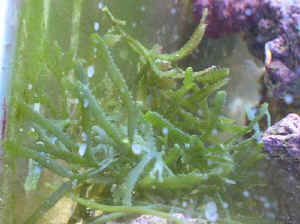
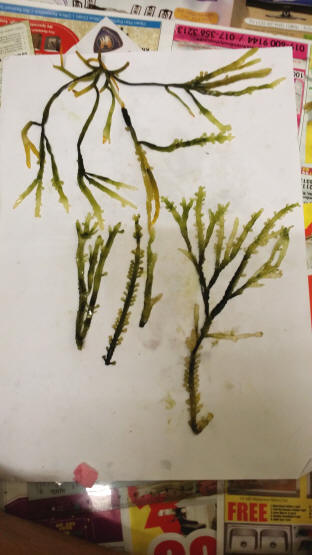
identification of Caulerpa sp.
11/3/13
hi,
sorry to disturb you..
<Not a disturbance>
i would like you to confirm about my identification on Caulerpa sp...
i scared that I'm doing it wrong..
since you are expert with this, i hope you will help me..
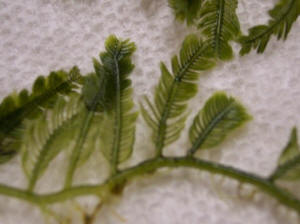
i think the first picture is Caulerpa racemosa..is it right??
<The second sent here; yes>
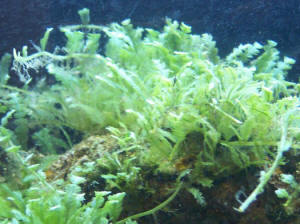
but I'm not sure on the second picture. That species kind confusing me..
<The other? May be C. freycineti... Do you know where the specimen
originated? Was it brought in with live rock from the Red Sea? Bob
Fenner>
thanks for your help sir..
[image: Inline image 1]
[image: Inline image 2]
sincerely,
loloy
|
.jpg)
.jpg)
|
Re: identification of Caulerpa sp.
11/4/13
Thanks for your fast reply sir,
No sir,
The specimens are from blue lagoon, port Dickson, negeri Sembilan,
Malaysia.
Is it all that Caulerpa from the same species? ?
<No>
What species are they?
<Time to send you to Hans Baensch, Marine Atlas V. 1. Don't send Megs of
files to us. B>
|
 |
|
|
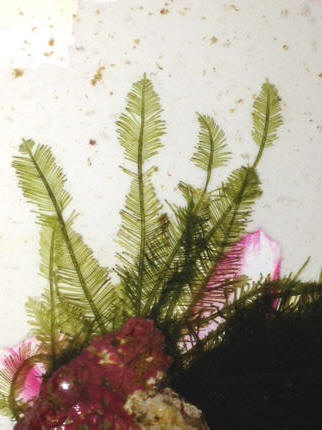
What species of macro algae is this?
8/14/13
Hi :)
Would you be able to identify this species of macro algae?
<Mmm, looks much like Caulerpa taxifolia... or a small, fine version of
some member of that genus. Have just reviewed the excellent coverage in
Baensch, Mar. Atlas v. 1, and this is my best guess>
Cheers
Ranjith
<And you, Bob Fenner>
|
 |
Re: What species of macro algae is this?
8/14/13
Hi Bob
Thanks for the super fast response.
Ok to have this as THE only plant life in a small refugium?
<Mmm, do see/read on WWM re the genus. BobF>
Cheers
Ranjith
Re: What species of macro algae is this?
8/15/13
Will do that
Thanks Bob
Cheers
Ranjith
<And you, B> |
|
Algae Question Identification, and control
3/22/13
Hi there.
<Hi David. Jordan with you today.>
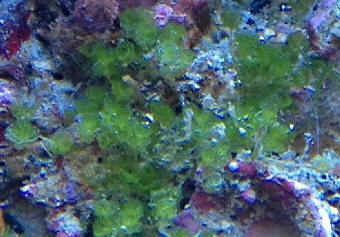
Wondering if anyone there knows what type of algae I have in this
picture and what the best clean up crew suggestion for it is.
<Appears to be Caulerpa verticillata. I have read reports of some species of
Tangs and Rabbitfish eating it but they are few and far between. I would
recommend manual removal. Remove the rock and scrub with a stiff brush. Be
sure to remove all of the algae, including all rhizoids/rhizomes, and rinse
with clean saltwater before adding back to tank. This will likely take
multiple attempts before it is successfully eradicated. Hydrogen
peroxide dips will kill it, but the dip will kill all other life as well.>
I have set up a new tank and just finished my cycle with Florida
live rock and this stuff is starting to grow out of control.
<That is what Caulerpa does.>
I am ready to add my cleanup crew but need to know what will conquer
this stuff the best. I appreciate any help! I have
included some pictures below. Thanks!
<Quite welcome.>
David Rudman
<<Well done Jordan. BobF>>
|
Re: Algae Question Identification
3/22/13
Thanks Bob!
David Rudman
<Welcome David. BobF>
Re: Algae Question Identification 3/22/13
Jordan said Caulerpa verticillata. Which do you think is more
likely the match?
<I believe his is correct. B>
Re: Algae Question Identification 3/22/13
Just Googled pictures. It definitely is Caulerpa verticillata.
<Ah yes>
David Rudman
|
|
Unknown Saltwater Plant???
6/20/12
Hi,
<Afternoon Bill>
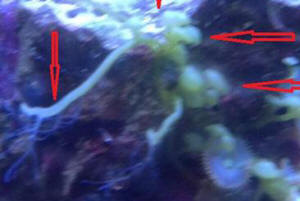
I noticed this specimen growing in my Reef Tank about 3 Days ago....
I believe that it is a plant of some sort.....
<Yep.>
I have no idea what it is, where it came from, or obviously if it is a
positive thing or should I remove it as quickly as possible.....
<A very small piece likely hitch-hiked in.>
I know that the pic is not the best, but I have included one.....
Any ideas???
<Appears to be a species of Caulerpa. I am fairly certain it is C.
racemosa based on the circular fronds and rhizoids; a more defined
picture would eliminate any doubt.>
BTW - The tank has been up for 2.5 Years... 50 Gallon Sea
Clear System II.... SG is 1.025, Zero for Nitrates, and unable to
get a reading for Phosphates.... Water Temp has been a little high
at 78.9 F....
I have not introduced any new inhabitants for at least 3 Months, or Live
Rock for approx. 9 Months.... No Refugium.... Protein
Skimmer, External Rena Filter XP4, and Power Heads
for moderate flow
Any help would be appreciated.... Any ideas???
<I would remove it but that's your call. Read more on Caulerpa--
http://www.wetwebmedia.com/ca/volume_6/volume_6_4/caulerpa.html
http://www.wetwebmedia.com/caulerpaalg.htm >
Thanks!!!
<Quite welcome.>
Bill
<Jordan>
|
 |
Re: Unknown Saltwater Plant???
6/20/12
Hi Jordan,
<Hello Bill>
Just wanted to Thank-you for the quick response....
<Anytime>
I will yank the offender ASAP....
<Sounds like a plan, be sure to remove all of the rhizoid.>
Tks!!!
Bill
<Jordan> |
Algae ID: Caulerpa sp. 10/1/2009
Hi guys (and gals) I have a green macro growing out of control,
<Hmm.... sounds like a Caulerpa.>
at first I thought mermaids wineglass, but not convinced. This is
bright green, grows like a vine and has thousands of "cups" I
can not find a picture on web ANYWHERE but wondering if you have any
idea.
<Look here http://www.wetwebmedia.com/caulerpaalg.htm for Caulerpa
peltata.>
<You can also look here for a close up:
http://api.ning.com/files/v*bTl9ZsrMcql751ccK2IyP6B57kyhUIwQwU5daFD2uj0jyWqG
*oE55VjNHz6P4r/PlantaeChlorophytaChlorophyceaeCaulerpalesCaulerpaceaeCaulerpapeltataIMG_0066.jpg >
It looks ok, but just wondering if you know what it is, and if it's
a good thing?
,Caulerpas can grow out of control if not managed. Read the linked
pages at the top of this page for more information:
http://www.wetwebmedia.com/caulerpaalg.htm >
Let me know if you want a picture I can take!
<Always best to include a picture if you are requesting a ID of
something, but do have a look at the linked pages and see if that is
it.>
Ren (Sydney, Australia)
<MikeV (Melbourne, Florida)
|
A few IDs... learning... 9/1/2009
Hello all,
I went to the LFS earlier today and got a hefty piece of LR among
other things.
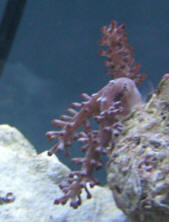
One of the other things I bought was a frag of some sort of
coral. I was hoping I could get an ID on it:
http://i79.photobucket.com/albums/j152/rogutaan/Aquatic%20Mysteries/Frag.jpg
<? See WWM re Soft Coral IDs>
There was a huge sale so I decided to see if my system can keep
corals.
<? What sort of approach to life-keeping is this?>
Even the employee wasn't sure what it was.
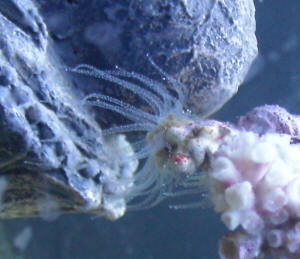
Next question is, what are these jelly blob things that are on my
LR?
http://i79.photobucket.com/albums/j152/rogutaan/Aquatic%20Mysteries/JellyBlob.jpg
<... single polyped stony corals... Maybe
Caryophylliids>
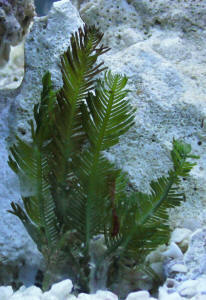
Lastly, Caulerpa. I have some Caulerpa, I haven't had any
problems with it, but I'm mostly positive its Caulerpa
toxifolia:
http://i79.photobucket.com/albums/j152/rogutaan/Aquatic%20Mysteries/CaulerpaSps.jpg
<Mis-spelled, but yes...>
If it is, should I get it out now?
<Please... use WWM for these general questions. Your answers
and much pertinent information is archived...>
It hasn't done anything as of yet, but its probably a ticking
time bomb...
Here's a different piece of a Caulerpa, not sure what the
spp. is though:
http://i79.photobucket.com/albums/j152/rogutaan/Aquatic%20Mysteries/CaulerpaSp2.jpg?t=1251776731
<See here: http://wetwebmedia.com/caulerpaalg.htm>
The tank is a 55 Gal with maybe 4 or 5 stalks of the Caulerpa, if
that means anything...
Thanks for your time.
<Thank you for learning/using the search tool and indices. Bob
Fenner>
|
 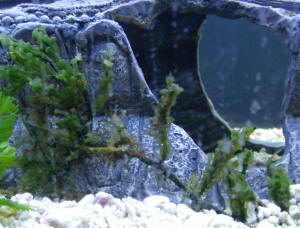 |
|
Is this a Caulerpa Sp.? 08/24/09
Hi Crew.
<Hi Carlos.>
Thanks for all your past help, the tank is doing great coming up
on 3 years.
<I'm glad to hear.>
I recently purchased some Chaeto to restock my refugium. After a
few weeks I noted this other algae/plant growing along with it.
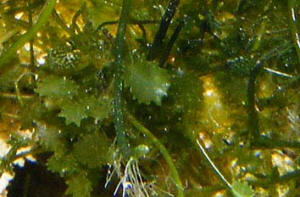
Actually it is outgrowing it. It has these long leaves which have
a bit of a saw-tooth edge to them. It grows along the walls and
tends to anchor itself to anything. It grows quite quickly and I
keep pruning it back. Any ideas what this could be?
<A serrated form of Caulerpa brachypus (citing from 'The
Genus Caulerpa from Central Visayas, Philippines' by Menez
& Calumpong: 'erect foliar branches proliferous
occasionally, ligulate, 5-40 mm long, 2-4 mm wide, with serrate
margins or almost entire in a few specimens, irregularly
disposed, 2-15 mm distance apart on upper side of
stolon.''¦ Better don't let it get into your
display tank.>
I have looked in several books and online and can't seem to
find a match.
<Many do not have clear serrations as they are noted in the
original descriptions, maybe this is why you did not find a
match.>
Thanks for your help. Cheers Carlos
<Welcome. Marco.>
|
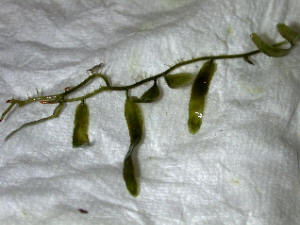 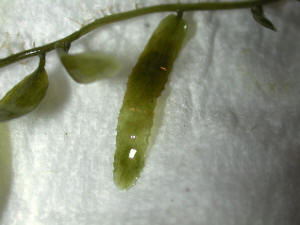 |
Macro identification -08/05/08 I think
this type of macro algae is Saw Blade Caulerpa <'tis so...
as far as I can tell from the photo provided.> but I am not
sure. I was hoping that you could help me out by identifying what
kind of macro algae this is. <Best,
Sara M.> |
|
|
| Macro Algae, Caulerpa ID, contr.
2/15/08 Love your web site - have used it many times. However I
am at a loss. Attached are two photos of some macro algae that
continues to grow no matter what I have tried. So I was wondering,
do you know of anything that will eat this stuff? Thanks for your
help. Jeffrey Baxter <Is a species of Caulerpa... Please read
here: http://wetwebmedia.com/marine/maintenance/index.htm scroll
down to the tray on Algae... read re the Caulerpaceae family, the
Division of Greens, their Compatibility/Control... Bob
Fenner> |
|
|
Caulerpa control in a 46gal tank -- 1/2/08
Happy New Year! I found a picture of the Caulerpa that I am having
problems with on your site and still am not sure of the exact ID
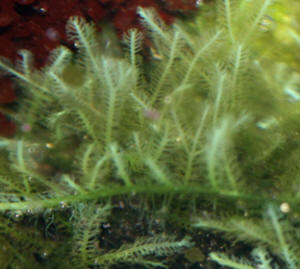
(file is attached). <Looks like C. sertularoides or C.
taxifolia...> Other than manual removal requiring removing most
of my rockwork (about 30 pounds of LR) what would be a good
biological control for a tank of my size. <Please read here:
http://wetwebmedia.com/caulerpacomp2.htm and the linked files
above> Stocking includes: Fish: 2 false Perc. clowns, 1 green
Chromis, 1 blenny that looks like Salarias fasciatus from your
section on blennies. Inverts: 1 sand sifting starfish (sandbed is
about 3"), some blue and red legged hermit crabs, 1 Mithrax
crab, and a mix of snails as well as some polyps. My last
parameters were a Sp. Gravity of 1.025, pH 8.3 Ammonia 0.25ppm
Nitrite 0ppm Nitrate 0ppm Ca 300ppm <A bit low> Phosphate
0ppm (last tested 3 weeks ago). <Nutrients listed and more are
likely being absorbed...> Temperature stays between 78 and 82
degrees. Water changes of 3 gal a week with RO from LFS.
<I'd get, use your own> Equipment includes a remora pro
Mag 3 which replaced a SeaClone 100 last week, <Much better>
a penguin 350 and penguin 200 without BioWheel and for lighting a
current nova extreme T5HO with actinics on for 10 hours and 10000K
lights for 8 hours on a timer. I am trying to keep it relatively
simple, but nothing seems to be putting a dent in this algae and I
am at a loss. Ronde
<Get reading... Bob Fenner> |
|
|
| Caulerpa ID Hi Bob <Alois> I was wondering if you
can help, I am trying to id this Caulerpa, it is imposable. maybe
you can help. It was found in new Zealand in a aquarium.
http://www.reefcentral.com/forums/showthread.php?s=&threadid=1270658
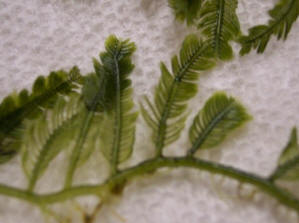
regards Alois <Looks like C. verticillata to me... from the flat
lamina and bifurcated tips... Is a Caribbean form I believe.
BobF> |
|
|
Re: Caulerpa ID, ongoing poor English HI Bob, Thanks
for the reply I had a look, its not C. verticillata Does
not look like it in any of the photos I looked up. regards
Alois <... Please... fix your English before sending
messages... And look at Hans Baensch Marine Atlas v. 1.
RMF>
Re: Caulerpa ID Thanks for the email Bob.
<Welcome> Here is a close up attached. <Ahh, thank
you for this. Am more convinced this is Caulerpa
verticillata> I will have to find the book you mentioned
as I don't have it Regards <BobF>
Re: Caulerpa ID 12/19/07 Hi
Bob, <Alois> Sorry I did not mention any book as that
is what you referred me too. I have been looking on the Net
and found that Caulerpa webbiana Montagne could also be a
possibility as I am in New Zealand and Caulerpa webbiana
Montagne is found here <Well... the genus has quite a
range of "morphological types" by species... a
high flexibility in expression determined by local
conditions... I am still in favor of the C. verticillata
ID... it could be a transplant. BobF> Regards
Alois
|
|
|
|
Algae ID - Caulerpa Taxifolia
3/19/07 Evening Crew! <Hi Jeff! Mich
with you this afternoon.> Not to duplicate, but I sent this and
my system crashed so I don't know if it went through or not.
<Is here now.> So.....I have attached three pics of an algae
growing quite well in my tank. <I see them.> I can only ID it
as a Caulerpa, just not sure what variety. It resembles
C. taxifolia, but I need a positive ID from
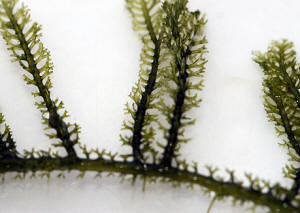
you....hopefully! <Does appear so.> If it is
taxifolia, do I need to get it out ASAP? <Yep at the very least
isolated in the sump with lighting 24 hours per day to prevent if
from sexually reproducing. More here and the links in
blue: http://www.wetwebmedia.com/caulerpaalg.htm> Thanks for
you help!
Jeff
<Welcome! Mich> |
Algae ID - Caulerpa Taxifolia
3/19/07 Good evening Crew! <Hi Jeff, Mich
here.> I sent some pics yesterday and I am concerned that I may
have crashed your server as I have not had a response yet. <Our
server has been down, but not your doing.> I have down sized
them and hopefully you can see them. I know this is a form of
Caulerpa, just not sure what variety. <Yes, your ID appears to
be correct.> I do want to get is out of the tank if it is not
beneficial. <It's not that it's not beneficial, is an
excellent nutrient exporter, just can have some unwelcome
consequences.> I plan to add a refugium with Chaetomorpha within
a month or so and am guessing this will need to be gone by then.
<I personally would choose the Chaetomorpha.> Thanks again
for your help!
Jeff |
|
|
Caulerpa prolifera - 09/08/06 I'm looking for Caulerpa
for my sump (to use with Miracle Mud). Just wondering if
Prolifera is the same stuff. I have prolifera growing in the
main tank. <<Prolifera is likely the most common species of
Caulerpa available>> Thanks, James <<Regards, EricR>>
Caulerpa Invasion - 02/18/06 Dear crew member, <<EricR
here>> I have a nuisance algae in my tank which (after searching
this site and Algaebase) I believe is Caulerpa nummularia - there is
also a photo of it on your site, under the heading Marine Algae ID
9. The email is entitled Algae ID 12/17/05. It is
the photo on the bottom left. <<Yes, I see it.>> The thing
is, there doesn't seem to be an abundance of information about it
out there - or at least, with my amateur research skills, I can't
find it. <<Hmm...a Google search re seems to bring up quite a few
"hits"...though only working through them will determine if
there is any useful information.>> What I do know is that it
spreads like bird flu and seems impossible, short of a tank tear-down,
to eradicate. <<All the Caulerpa species can be very difficult to
remove once entrenched.>> Do you think a tang species might eat
it? <<Maybe...but I think a Foxface would be a better
choice.>> I don't know if it's toxic or
not. Any help you can give me would be greatly appreciated.
<<Have a look here, I think you'll find it of
interest: http://reefshow.com/html/modules.php?name=AvantGo&file=print&sid=144
>> Thanks, Melinda <<Regards, EricR>>
Algae identification and removal 02-05-06 Hi,
<Hello> I have a large amount of what appears to be Caulerpa
growing in my tank. Today while fumbling through your archives I
read that some Caulerpa can give off toxins, which surprised me.
<All algae can actually> So I looked through all your algae
identification pages, and I found nothing. <Surprising> A
close match is Caulerpa racemosa, but I don't think that is it.
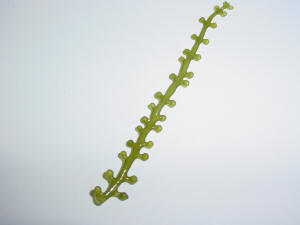
<Is what this looks like to me> I will be attaching a picture
of it. Just in case it did not go through, which it may very well
not, I will give a quick description. As all Caulerpa it is based
on a vine. On the vine "bubbles" shoot out along the
vine. Unlike Caulerpa racemosa, there are two bubbles on opposite
sides of the vine, then go up 1/2cm the vine and there are two more
"bubbles" on opposite sides of the vine and this
continues. So my questions are what is this? And is it a danger to
my tank? <In large (relative) quantity, possibly> By the way
my yellow tang will not touch it, this leads to my theory of it
being undesirable. If I need to remove it what is the best way to
do it. Remove it all at once? <If you want> Or remove it over
the period of a few days due to the possibility of releasing
excessive toxins into the water? <Oh! If you want to remove it
entirely, try to take it out all in one go... along with a water
change, use of carbon...> Sorry for the lengthy question? <No
worries. Bob Fenner>
Thanks much,
Jed |
|
|
| Re: Caulerpa query 2/24/06 Hi Bob,
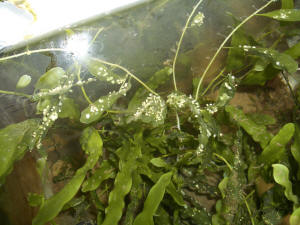
<David> I an trying to resend a pic of the Caulerpa and also
of the unidentified algae. <Got them... both appear to be
Caulerpa spp.> I am one of those who seen to have a problem
getting queries through with attachments so we'll see what
happens. I have searched WWM for an ID on the second
algae to no avail. Thanks David <The second may be C.
pinnata... See the Net or Baensch V. 1 Marine Atlas, p. 302...
perhaps C. flagelliformis in its "small" stage.
Bob Fenner> |
|
 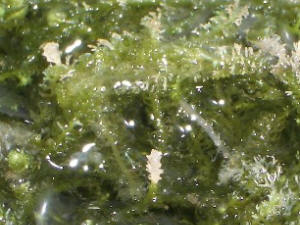
|
|
Macro algae ID confirmation 1/28/04 Hey, I
just got some macro algae from where I used to work the people
there told me that it was illegal to sell because it was taking
over the reefs, or something to that effect, <This is not
accurate. Some Caulerpa species are illegal to possess
in California because they are non-native and have been found
growing in local waters. The same Caulerpas have been
found in the Mediterranean and in Australia. Some
folks have argued that these Caulerpas have taken over habitat
and displaced native species. Others have argued that
the Caulerpa only invades areas that have been badly damaged by
pollution, and that its presence actually helps control the
pollution and creates new habitat for other
critters. They also assert that once the pollution is
controlled by the Caulerpa, it dies back paving the way for
native species to re-establish themselves. In any
case, the type you have is not one of the illegals, and even if
it was, there is no Caulerpa Gestapo going door to door looking
for secret stashes. As with any marine organism,
please do dispose of any excess responsibly. Please do
not put it down drains or into the ocean. Letting it
dry out in your garden, compost pile or back yard or putting it
in the trash are all fine.> so he just gave me a handful some
people have told me that it is just razor Caulerpa , but I want
to be positive enclosed is a picture of the algae, and I hope
that you can make a positive id btw....if you need a
better picture, just let me know <The pic is
fine. This is what is commonly called "razor
Caulerpa". I would recommend strongly AGAINST
allowing this to become established in a display
aquarium. Not many Caulerpas are very palatable to
fish, and this is among the least so, making it very hard to
control. I have not found any fish that will eat
it. In terms of utility in refugia, I would consider
this Caulerpa to be average in terms of growth rate and tendency
to "go sexual" or
crash. HTH. Adam>
|
|
|
Caulerpaceae Greetings Bob, I must commend you and the others
for putting together such a extensive and informative site. I have
recently read your article GREEN ALGAE OF THE FAMILY CAULERPACEAE. In
the first paragraph you mention that Caulerpa has the largest (I assume
by volume) cell in the algae order. I am under the impression that this
excludes Chara the freshwater algae. Correct me if I am wrong. Thanks,
<I do think (and this is not an original assessment... as are likely
any!) that Caulerpa are the largest single cell organisms (even more
than ostrich eggs) in the world including (have removed a bunch of the
green algae genus) Chara.> Devoted fan of your work Nathan LaVoy
B.S. Biology <Be chatting, Bob Fenner>
First question is about Caulerpa. What is this and what is it
used for. My assumption is that it absorbs some nitrates. Is it a
good thing to add to a tank? <Caulerpa is a large genus of Green
Algae, found in shallow waters throughout the tropical seas. They do
absorb nitrates, phosphates, more... and make oxygen, release other
chemicals of benefit to captive systems... All good things for your
tank> Second - I just purchased a long tentacled anemone because the
maroon gold striped clown I wanted was firmly attached to him. Any
information you can give me to give this guy (the anemone) the best
chance possible for survival would be greatly appreciated. I only have
regular fluorescent lighting right now, but have a 250 watt metal
halide retrofit kit on the way (should be here within the week). Also,
are there any additives that would help (I use Kent Coral-Vite)?
<Hmm, don't know if I'm following you here... the animal is
photosynthetic... needs more light... now... no additives... some folks
purposely feed the large anemones found in symbioses with
Clownfishes... others rely on the fish feeding their anemone and
incidental foods blowing into the anemone...> tank stats: 55 gallon
tank 1 30 watt daylight fluorescent (PowerGlo) 1 15 watt daylight
fluorescent (PowerGlo) 1 15 watt blue actinic 1 250 watt metal halide
w/6700k bulb on the way) 1 Emperor 400 (carbon media removed and bio
beads added to extra media basket) 1 Emperor 280 (also modified as
above) 1 20" venturi skimmer (purchased from FFExpress) ~20 to
25lbs of Marshall Island live rock. I hate killing things, let me know
if this is sufficient. Thanks!!!!! >> I would "look, before
you leap/purchase" going forward... these anemones aren't easy
to maintain... and can cause real problems if they die suddenly, get
sucked up against an intake.... Bob Fenner
Mexican Caulerpas I was wondering if you could help me.
We have recently noticed some green algae growing in our 75 gallon
reef tank. This algae appears to be almost feather looking. It
only grows in certain areas of the tank. Is this normal?
<Yes, and yes... Algae, as in life "happens" where there
are propitious to allowable conditions... a good sign really> If not
what can I do to permanently remove it. <Permanently? Nothing... But
much can be done to help control it> I was told that this was
Mexican Caulerpas and it was a good thing to have. I would like to
get any information you can on this. Also will this stuff need to
be controlled??? If so is there some kind of fish or something
that will eat it?? Thanks for any help you may offer. Debbie
<Please read through the materials constantly being added to on the
topics of Marine Algae, Caulerpas (there's a pic of mexicana there
if memory serves), Algae Control... and related FAQs files. Bob
Fenner>
Bubble Algae? Bob, I have a type of algae that started
growing out of my live sand and I am trying to make a determination as
to what it is. It has small pearl shaped green bubbles growing on a
stalk that is also green and what looks like roots coming off of the
stalk. I did some research on your site and the web and found a
Caulerpa that is close to it (grape Caulerpa), however, there are still
some differences in the way the pictures of the grape Caulerpa I have
found on the web look when compared to what's in my tank. The
bubbles growing on the stalk do not strand up like some of the grape
pictures I have seen. Approximately every half an inch on the stalk,
there is a spot where there is a small limb with three or four bubbles
attached. Could this actually be Valonia or something similar and
should I remove it? <Could be... and there is tremendous variation
in these species with varying conditions (light, nutrient, current...)
in captivity... Removal? I would leave it unless it's growing too
much, unattractive to you> The only thing I have found about Valonia
is that it usually grows in clumps or as a single bubble, but not on
stalks like other macro-algae. <Usually, yes> I actually
didn't have much concern over the matter until today at lunch I
noticed a small clump of three bubbles attached to a piece of live rock
for the first time. I immediately removed the piece of rock and the
bubbles from it. Again I wasn't sure if this was actually bubble
algae either since the coloration of the algae on the rock was similar
to that which is growing on the stalk. Also, from what I have seen,
most Valonia appears to be a deep green (almost metallic) color. This
algae is more of a true green and not as deep and shiny as the pictures
I have seen. Any ideas? <Lots... but not much about this
situation... as I say/state, no reason to be overly concerned... you
can add Mithrax Crabs... physically remove this material at a later
date if it proves to be too vigorous. Bob Fenner> Thanks for your
help, Chad
Re: Bubble Algae? Thanks for your help. I managed to get a
couple of pictures of the algae in question. I thought that might help
with the identification. Right now it doesn't appear to be growing
at what I would consider an alarming rate, but I think it will require
some pruning soon. Other than the clump of bubbles I found on that
piece of rock yesterday I haven't seen any indication that it is
spreading anywhere the vine is not present. <Ah, good news to
report... this is almost undoubtedly a stand of Caulerpa racemosa... we
have images of this species on the "Caulerpa Algae" sections
on our website: www.WetWebMedia.com... can be easily
"pinched" at whatever point you want to contain it and
removed... a beneficial species. Bob Fenner>
Re: Bubble Algae? Whew!!!!!! Thank you very much!
<You're welcome my friend. Bob Fenner>
Can you identify this ? My local fish store said they could
not make it out. My new Naso Tang won't touch it, but I think
it's kinda cool any way. Thanks in advance for any insight you can
give me as to it's nature. You are a great friend to the hobby and
this hobbyist. <Hmm, a species of Caulerpa... likely C. taxifolia.
See this part of our site, images:
http://wetwebmedia.com/caulerpaalg.htm Bob Fenner>
Tumble weed algae Hi Bob, I removed the bio balls from my
wet/dry and replaced with live rock and tumble weed algae, want to
reduce nitrates, currently at 25PPM, can't seem to get lower then
this. I have about 25 lbs of live rock in my 54 gal FO tank. <More
rock will help... as would a deeper, finer substrate... but is there a
concern at 25 ppm of nitrates?> Is tumble weed algae considered
macro algae, it is multiplying quite well in my sump, I have a light
going 24 hours on the sump. When and how much live rock or algae do I
need to get the nitrates to go lower then 25PPM ? <Ummm, is this a
Caulerpa species? Please see:
http://www.wetwebmedia.com/caulerpaalg.htm ... try trotting around the
links if not there. Bob Fenner> Thanks Fred
Re: Tumble weed algae Thanks for getting back so fast, I will
add more live rock, after checking your link the algae looks most like
Caulerpa serrulata, my LFS called it tumble weed, it was not attached
to a rock, you could hold a ball of it in your hand, it has a tight
curly, dark green appearance to it. <Sounds like it> I did buy
your book "The Conscious Marine Aquarist", it is great
resource, I used it to set up my system, I came across your web site my
accident, glad I did. <Me too> It seems my LFS will answer direct
questions if you know what to ask, but really doesn't really
promote the hobby or inquire about any problems one may be having. For
the most part your on your own, if I hadn't come across your site,
I would probably would have lost all my fish by now. <Mmm... what is
it about human nature and our interest... the enlightened seem to be
able to anticipate what is needed... to make known what needs to be. I
am glad we have met> I love the hobby, I thrive on the challenge to
keep the fish healthy and happy, this hobby is not for a person who
does not want to invest the time to learn about Marine fishes or deal
with the costs involved. <You are correct my friend> Thanks for
being there for all of us. <Thank you for sharing. Bob Fenner>
Fred
Caulerpa identification <<CKB00[1].jpg> a labeled,
apparently proprietary image, i.e., not ours to reproduce/use>
Greetings, could you possibly identify this particular type of
Caulerpa, and its origin? thank you! Blanca&Stace <Mmm, not a
Caulerpa species... but a rhodophyte. Please take a read through
WetWebMedia.com re Red Algae under the Marine Index. Bob Fenner>
|
|
New Print and
eBook on Amazon
Marine Aquarium Algae Control
by Robert (Bob) Fenner
|
|
|

