|
|
| Home | Marine Aquariums |
Freshwater Aquariums |
Planted Aquariums |
Brackish Systems |
Ponds,
lakes & fountains |
Turtles & Amphibians |
Aquatic Business |
Aquatic Science |
Ask the WWM Crew a Question |
| Please visit our Sponsors | ||||
|
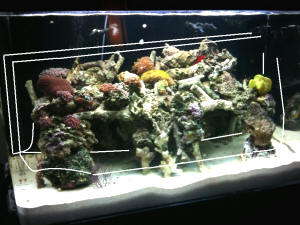
Glass tank and wave maker
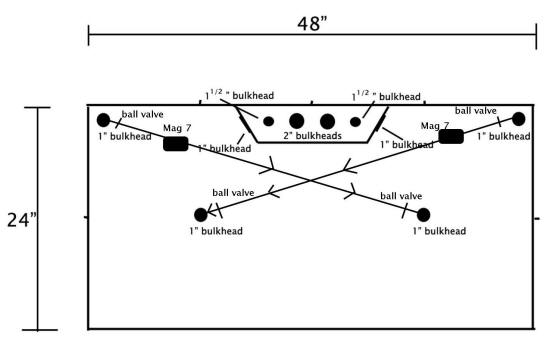
3/21/20
pH Control in Multi-tank System 10/9/14Hi Crew, I have a unique tank scenario which is somewhat predictably creating some unique problems. I have a store with about a 2000 gallon system and 55 variously sized tanks. Most are planted with lighting and substrates appropriate to the species stocked in each tank. The tanks all drain through filter socks into a 275 gallon sump, then through a couple 55 gallon barrels filled with Seachem Matrix, and consequently into another 275 gallon sump which holds our heaters and settles the water a bit before being pumped through TMC UV sterilizers back into all the tanks at about 6000-8000gph (back pressured by 55 ball valves at different adjustments so it's hard to calculate). <No other... mechanical/cartridge filtration? I'd likely add this> The way the system is set up, water changes can only be done in about 50 gallon increments at a time so I have them on a schedule to change twice daily for a total of 100 gallons per day. I was still accumulating nitrates and phosphates so I've recently upped that to 200 gallons a day and have yet to test the success of that change, but my question is on a different matter. <Actually related... i.e.; by increasing your alkalinity you will very likely reduce (as in the chemical term) a good deal of your NO3 and HPO4> Our water from the tap gets filtered via carbon and comes into the system with a high pH of around 8.0. This was resulting in some nasty strains of algae and I think stress on some fish that have been struggling in this new system (Cardinal Tetras, Blue Rams, some others). So I put added a new source supply of RO water which the system uses to perform top-off and water change when the pH is above 7.2. At first glance, I thought the new system was working great. Within a couple weeks my pH had dropped to stable 7.2 and I'd say the system was using about 50/50 RO and tap to maintain that balance. However, I'm looking for better plant growth so that I can supply customers with plant cuttings from some more difficult species in their submerged form. So I thought about adding co2 (we are currently regularly using Flourish Excel but its not really cutting the mustard). <Again; likely at least partly related to a dearth of Calcium and Carbonate> So I took some measurements of co2 by measuring dkH and pH in tanks with various plant loads. To my surprise the pH in all my stock tanks was 7.8+. I have been racking my brain trying to figure out how this is possible given that I'm turning over the water 2 to 4 times per hour in each tank. I'll also note that the co2 is much higher in the sump than it is in the stock tanks which is sort of predictable, but still surprising to me given the rate of turnover. I have a couple theories none of which I'm all that convinced are the culprit. A. The sump is in a basement which might have higher levels of co2 in the atmosphere than on the main floor where the doors to the outside are constantly opening and closing, and thereby suppressing the pH in the sump? <Mmm; not much suppression here> B. The plants are photosynthesizing so rapidly that the pH can't drop? <Possibly, but...> C. Some mechanism in the substrate (detritus?), is breaking down at rapid enough rate to keep the pH high despite the turnover? <The substrate/s themselves? Do you have much in the way of natural gravel, rock in these systems? A bit of Ozone/O3 produced by the Vectron/TMC UVs might be elevating the pH a smidgen> Any other tests I can run? <Mmm; I'd first and foremost be "testing the testers"... your kit/s it/themselves. I'd like to know separately what the GH and KH is here> Is this a problem that may work itself out over time? <Ah yes... the excess alkalinity should "be reduced" in time... unless you're inadvertently adding more than is being consumed by reductive processes here> Would injecting co2 be advisable? <Mmm; yes... given all else is "fine"... IF it were my shop (we had three sets... I spent 14 years on the floor LFS); I'd be checking for ferrous ion as well... a common issue with chlorotic, otherwise poorly aquatic plants in captivity> I worry about safety with the pH controller in the sump ( likely to remain there) when the pH is so different between tank and sump. Also if the pH can be so different, it seems safe to assume that my tanks with less plants may accumulate co2 whilst my original theory was that the co2 would be either gassing off as the water flowed through the socks and not accumulate and though I'd waste a lot of co2, I'd still be making it available for plants that desired it. Thanks for your time, any other input beyond my specific questions is also welcome, Matt <Do you purposely add any source of alkaline earths, alkalinity here (other than the mixed RO/tap water)? Bob Fenner> Re: pH Control in Multi-tank System 10/10/14 Hi Bob, Great to have your assistance. <Glad to help... enjoy the modern "Sherlock" series and doing my own bit of it petfish wise on the Net as well> Re: mechanical filtration. I just have the socks but they do get changed daily. The bio filter additionally has a large 6" thick coiled mesh filter as are used in pond filters. I also have a large carbon canister that runs separately as needed. Anything else you'd suggest? <Likely the 9 or more micron cartridge filters to help remove more of the muck/mulm... but, if you're happy with your water clarity... no biggie. The cartridges are a pain admittedly; requiring at least two sets, almost daily attention; more pumping, expense. And won't take out all pathogenic disease (even down to 1 micron)> I did some more extensive testing and clearly have some issues but not the ones I originally thought. I'm blaming my pH conundrum on my pH pen which is calibrated but has a hard time reading the tank water. It instantly picks up 7.0 or 10.0 calibration solution accurately, but then won't read tank water without a battle, usually reading it around 7.8, but occasionally it reads closer to my Neptune probe which is more consistent with other testing methods and also calibrated. So I think your first suggestion, testing the tester, turned out to be the issue. Though, why it tests so sporadically in our system but tests the calibration fluid spot on every time I don't know. <Artifactual... I'd get a cheapy Milwaukee... or just go back to colorimetric assay> I tested sump and a sample tank separately and found them identical in all tests. Re: Alkalinity not adding anything at present. <I might well do so... again, the base reactions that will reduce the nutrients require these> PO4- >5ppm (I'm not sure to what degree, as I ran out of reagent after running it through the colorimeter diluted in half and it maxes at 2.5ppm)(.4ppm in my tap water) NO3- 16ppm K- 750ppm (with RedSea pro test kit for reef tanks, not sure if translates to FW as this number appears a bit fishy, but maybe with the out of control phosphates, I'm getting potassium too?) <Maybe...> Hardness <1 dGH Carbonate Hardness 2dKh Ca - Undetectable (using red sea pro titration) <Trouble... again, see the SeaChem line (real products... and miscible w/ all else you've got going): http://www.seachem.com/Products/product_pages/ReefBuffer.html yes; though these are labeled/for "reefs"> Based on what I'm seeing this is my action plan. 1. Increase my water changes further (at least short term) to get the phosphates under control <Look into Lanthanum use here... once a week, pulsed> 2. Implement some preventative phosphate measure through manual detritus removal, reduced feeding 3. Begin supplementing iron to improve plant growth (and in turn hopefully further reducing phosphates) 4. Add co2 via the sump and test alkalinity (assuming here that as the pH drops the system will utilize tap water more frequently giving my co2 some dKH to convert) Does this seem sound? Anything else you might advise? Matt Johnson <Just these for now. We'll be chatting. Bob Fenner> Re: pH Control in Multi-tank System 10/10/14 Is the reef buffer vs. the alkalinity buffer from their plant or AquaVitro line preferred for any reason? I'm guessing either can be employed with success but curious as to your specific suggestion. <Mmm; the reef product is a bit different (has more carbonate) and is cheaper in volume, per use...> What is the best method for evaluating the quantity to dose? <This may seem a bit wanky (because it is), but I'd mix in an ounce or two in some water and toss it in your sump... How to relate this... the two gentlemen that were kind to be my master teachers (when I was getting my H.S. teaching credential) for chem. and physics would ask for a "pinch" or "smidgen" of creamer, sugar when I made them coffee and tea... they penned tens of millions of copies of science texts...> Am I shooting for a target dKH? <A few units... again; try the ounce or two per day for now...> What will be the impact on pH and should I adjust dose to minimize that impact? <You may see a small run up in pH (a tenth of a point or so) initially, but it will "be gone" in a few hours> I'm intrigued by the Lanthanum and looking forward to testing it out. <Is a/the "magic ingredient" in commercial ap.s for eliminating HPO4 issues... cheap, reliable and safe> Thanks again, Matt <BobF> SCWD in a box; SW circ. design 3/8/14 Setting up a 65 gallon. Moving from a 37. Mostly SW pb plan
11/21/13 "Flow" In A Reef Tank (Gyre gets “my” vote) – 06/18/13 pump flow, SW. circ. in/out of the system
3/23/13 Re: low pH, and link to JakeA's article on circ.
8/11/12 Flow 2/6/12 pump and overflow, Circ. des.
2/5/12 Powerheads and Controller/Water flow 1/30/12 Re: Laminar Flow'¦Maligned and Misunderstood? --
01/22/12 Re: New 5x2x2 Braceless Reef Tank Plumbing
1/9/12 Laminar Flow'¦Maligned and Misunderstood? --
11/05/11 Powerheads, sm. reef 1/10/11 Reef Water Flow (try a 'Gyre' system) --
11/11/10
150 Gallon Oceanic/Circulation 8/18/10
Tank Setup'¦System Configuration/Flow, Inadequate
Factory Throughputs, Etc. -- 05/11/10 Re: Water changes in a troubled reef tank
3/3/10 Re: Water changes in a troubled reef tank
3/4/10 Water Flow for a 150 Gallon Reef Tank --
01/21/10 Re: Circulation Advice (Detritus Accumulation), &
Aiptasia chem. f' -- 01/22/10 Attn: Scott regarding Flow Design for new reef
11/3/09 Saltwater dynamic movement by gyres or 5x - 20x Flow or
airlifts 10/8/09
Finishing touches on refugiums, pipefish, and holes oh my...3/7/09 Hello Bob, Scott, Eric, or whomever is there... <Scott V. with you this go round.> After probably reading this 100 times a day, I must also say you guys/gals are great!!!? <Happy the site has helped you!> A job well done and don't pay one bit of attention to my wife being jealous or disliking you...;]!? <Uh oh.> I can only begin to guess the time given by the whole crew for newbies like us!!!? After many countless hours of studying WWM am going to make my first purchase in two weeks....MY TANK...Yaaayy!!!? <Congrats.> I would like to ask a few specific questions if I may, so I can take the leap!? First off, Im purchasing a custom 72/75 gallon tank, I was going to have {2} 3" holes drilled for 2" bulkheads and a single 2 3/8" hole for a 1.5" bulkhead. The guy building the tank for me said that those sizes were for sch 40 and that they were junk. Instead he said I would need for them to be sch 80 or they would end up cracking or wearing out. Said every customer who had em...had problems. <There is no need for schedule 80 in aquarium applications, the pressures involved come nowhere near warranting this. I personally have thousands of customers out there using sch 40 with no issues...the fact that he has makes me wonder what is being done wrong.> He also said instead of 3/8" glass I need 1/4" for the size holes im having drilled. Do you feel I need the sch 80 bulkheads?? <Nope.> Would you agree with him on the glass as well?? <If I am reading this correctly, to go thinner? No, 3/8 minimum for this tank.> Reason I ask is im sure with those upgrades there's an extra buck in there somewhere for him. <Possibly.> I was thinking all the holes on back wall, the 2 inch bhs near the top by the corners and the 1.5 inch bh near the center at top. Would it be better to have these clustered together rather than spread apart like that?? <No real difference, put them where you want them.> The 1.5 will be for the closed loop, is it ok to be at the same level as the 2"s?? <I would place it lower to keep it from drawing in air/air bubbles near the top.> Speaking of closed loop...hehe...will my outputs {swiveling els/LocLine} need to be the same length to provide even circulation?? <Nope.> I'd planned on one or two being longer to reach middle tank level. <Will be fine.> Sorry for being so sporadic, I feel im so close to actually putting my plan in gear that I've gotten a little nervous...; [ ! I'm wondering how noisy 750-1000 gph will be coming through a 40-55 gallon sump?? Can you weigh in?? <This can easily be managed. You may have to play around with the baffling a bit, see: http://www.wetwebmedia.com/ca/volume_3/cav3i1/Baffles/bafflesart.htm, this technique works great.> When I hear about not maximizing flow capacity to save on noise etc, does that mean just having a smaller pump than what the overflow holes can actually handle?? <Part of it, ideally you will flow the overflows at 1/2 or less than what they can handle, this way you will have a backup should one fail.> Ok last two ?s... I'll be using flex pipe for my plumbing, I will need to put a valve on line going to the refugium to control flow. <OK, but if (just incase) you are drawing this off of an overflow line you will want to have a T before the valve leads to the refugium. This way when you choke the valve a bit the overflow line has a bleed off, still has its full flow capacity.> For that and connections to bulkheads and pumps, will I need to form some kind of hard pvc union for the flex to clamp on?? Does that make sense?? <Hmm, yes, plastic hose barbs. If you wish to use flexible material to plumb do also consider the flexible PVC, sold as SpaFlex in many hardware stores. This piping is forgiving, flexes, and can be solvent welded into PVC fittings just like regular PVC. You do need a PVC solvent rated for flexible PVC, but if you read the fine print on many solvents out there they are actually rated for flex.> Ok last one! For the refugium, I'll have to make it a display refugium or the wife will go crazy {she doesn't have the slightest interest in my "obsession"} so I plan on having a 55 gallon set up beside and below the display. I will going for a DSB for NNR, and LR with Chaeto for a good pod population. It would be awesome for a pipefish/seahorse or two to reside in there!? Given the refugium setup would that be ok for syngnathids?? <It could work, sure.> Also do you feel they will demolish the whole pod population?? <This is the concern with adding these, ideally a refugium provides the pods a place to grow without impediments like being eaten!> Whew. For some reason I feel a lot better now...hehe. By the way, can anyone tell me how I can get my CMA, RI and BOCP autographed ; ]? <We will see what Bob has to say here, but one way would be to meet him at a trade show/club meet sometime. They are worthwhile to attend for many reasons.> <<Agreed Scott... and rather than mailing books about... the much better way to meet us, other folks of similar interests. RMF>> Thanks again for the wealth of knowledge you so greatly pass out. By the way I kinda get bummed out when I have completed the entire section of whatever im studying at the time, I mean c'mon, you couldn't have made the refdesfaqs go to 20 instead of 13....totally just kidding!? <All the sections are constantly growing!> Thanks again, J J <Welcome, have fun.> Re: Finishing touches on refugiums, pipefish, and holes oh my...3/9/09 Thank you Scott for your reply! <My immense pleasure!> Got Mr Fenner's comment as well... <Ahh, good.> I live in Louisville, KY, If there were ever a venue near, I would gladly be there. It would be greatly beneficial to me, as seeing knowledge is easier than reading it sometime ya know! <There will be in time, I am sure'¦.keep an eye out!> It'd be sweet to meet my "idols" too ; ] ! I'd like to ask a couple follow up questions if I may? <Sure, but I do assure you, there are no 'idols' here LOL.> Thank you for clarifying I can go with sch 40 bulkheads <Indeed you can!> and I didn't catch it the first time but I believed I mistyped, I meant to say 1/2" on the glass. <Oh good, that is what I had hoped.> 1/4" would make no sense would it hehe! <Nope, the 3/8' can do, but thicker is better here.> I'm thinking of having it built somewhere else but I want to know what is the "norm" wherever I go. <I would at least get a quote from another builder.> I confirmed that with the sch 80 size holes and thicker pane, price is due to increase! Ugh. <No doubt!> He tried to sell me under the whole " you get what you pay for" ! <You do indeed to a point, but there is no reason for Sch 80, unless he is actually doing the install and something wrong here.> Know of any reputable online custom tank companies or any near KY? <Glasscages.com, I have not personally dealt with them'¦but all I have talked to says the product is functional and nice for the money, just not top notch finish work. They are out of Tennessee I believe.> Ok Mr Scott, if it makes no difference where I have the holes drilled as long as the closed loop is placed lower, can I put all three holes in the same overflow box? <Sure you can, I do this all the time! Just keep the holes reasonably spaced out, the general rule is one hole diameter away from the next hole.> I thought of just using just screened 90's turned towards the top of the tank to adjust water level. <Be aware that this can be loud, ideally you will want the elbow facing down to keep things quiet. This will make for a lower water level without a box.> If I don't I'll use the overflow box so I figured I'd ask. Knowing what gph the {2} 2" bh's are capable of....what size {plug a brand too} pump would you recommend to not maximize flow but still be efficient and quiet? Probably about 4-5' head. <The two 2' bulkheads can flow about 2400 gph combined, you were planning in the neighborhood of 700-1000 gph, so this leaves you with plenty of redundancy here. I would personally look at the Eheim line for the return pump, likely a 1262. For you closed loop the Reeflo line is hard to be for efficiency and noise. Since you are at the planning stage still, do reconsider the use of powerheads over the closed loop, it can save you big bucks on your power bill!> Thank you for linking Josh's article, it will come in handy no doubt! <It is.> I will be using one overflow to the refugium, should the "bleed" side of the tee just be going back draining into the sump? <Yep, just give it a place to go.> Do you know of something, article or diagram what have you, that illustrates/explains the hose barb connection for the flex pipe or spa flex you had mentioned? <Just something like these for vinyl tubing: http://www.flexpvc.com/cart/agora.cgi?product=PVC-Barb-Fittings-Slip-Spigot> And just to be sure, flex pipe and flexible pvc are 2 different things? <We may very well be talking about the same thing'¦but flexible PVC needs no hose barbs, it solvent welds into PVC fittings just as normal pipe does.> Sorry for the ignorance! I think if I continue with the plan of pipefish in the refugium, I'll divide it in half so the pods have some protection, that will still give them roughly 25 gallons a piece, does that sound ok? <It would be cramped for the fish in my opinion.> My wife thinks I might as well be working for you guys with the amount of time I spend on WWM, heee :}. <In time maybe you will!> Thank you once again and it would truly be a pleasure to meet you or Bob at a show! <Yes, do come out to one when you get the chance, there are many people to meet!> Without WWM in general, many of our enjoyments wouldn't exist! Maybe one day everyone will venture near the bluegrass and let Bob know to have his pen ready if so : } !!! <I am sure he will!> Scott, thanks and have a great night! JJ <Welcome, talk soon.><<Am ever more anxious to see ScottV out on the petfish talk circuit... RMF>> Re: Finishing touches on refugiums, pipefish, and holes oh my... 3/10/09Hey Scott, Man, I really have to thank you once again! <Welcome JJ.> Do you guys ever get tired of hearing all the nice stuff people have to say about you? Haha just kidding! Every response you give, opens up 10 other questions ; ]. I think I have them narrowed down if you don't mind another barrage? <Shoot.> I will be on the lookout for any nearby shows, etc. I also think you and the crew ARE role models in the saltwater world! I'm going to use sch 40 for price and convenience, thanks again! <Pretty much the standard for aquarium use.> I'll have you know that with the next estimate, I'll be inquiring on 1/2" glass! Wouldn't you know the "guy" I've been referring to is the "guy" from Glasscages! I liked a type of glass he can upgrade you to that nobody else I've seen has offered. <Other shops do offer it also, but I do have to admit the price that GlassCages offers the Starphire at is amazing.> I'm the type of guy who will ask a question at the LFS I already know the answer to. This way you can kind of rate the info you are getting, you know, deciphering a "bs"er from a straight talker!?! <Yes, an educated consumer!> Another estimate is definitely in the works! Ok as far as hole placement, I figured one in each corner would be better for structural integrity?.?. <Marginally.> If I were to put them all in one corner, a hole size apart, a hole size across and down from the edges, would the smaller hole be ok a couple inches down in the middle of them [ kinda like the holes in a bowling ball?]? With them all in the same box? <Yes, but you do not want the closed loop intake inside the box unless you are putting it through the box. That is you don't want your closed loop drawing water from inside the overflow. You will be riddled with microbubbles in the best of cases.> To clarify the 90's for "overflows"... I would need them to be like a {n} instead of a {u}, where water is sort of rising up in the tube to fill and fall instead of falling in, kind of sucking? <Yes, good description.> Would that insist of the curve of the pipe actually out of the water like Dursos? <It may a bit, not much.> I'm picturing a 90 pointed up directly out of the BH then a straight pipe with a upside down U on the end? Gosh I hope that makes sense! <It does'¦If I may be a bit self serving here. Do take a look at my company, Glass-Holes.com. We have boxes that have all of this built into the box. It keeps it quiet, slim in the tank and looks good.> I want them to be as quiet as possible! Do you think a box would make it quieter and if so and I go with the box do I just use screens on the bulkheads? <That will be just as noisy as the upward pointing elbow'¦.and very restrictive on the drain.> I will take a breath soon! <LOL, you are fine.> When you said the Reeflo was hard to "be" for being quiet and efficient, did you mean hard to "beat" ; ]? Just wondering. <Oh yes, sorry, for sure beat!> Ok, on to your powerhead comment...whew. I actually had thought before, that since it was only a 75 gallon display that powerheads might be more economical and efficient, needless to say easier too. There are definitely some pros...one less hole I need to have drilled, LESS PLUMBING STRESS {on me and the tank}, and you say cheaper on the power bill! <Way cheaper'¦my Dart pump used to cost me $35 a month to run, while swapping to some powerheads (the MJ mod type to be exact) cost me a bit over $4 to run and provided more flow. The Dart is a first rate pump, I just wanted to be sure you knew the power cost advantage. Most do not realize that pumps are where the electricity is spent. One may have 400 watts in lighting and 300 watts in pumping, but the pumps run 24/7!> Plus they would be quieter than the CL right? <Generally.> I was reading on Steven Pro's powerhead analysis and thought the Tunze 6080's were pumps that could be used for closed loops, those are powerheads huh [I noticed the Eheim you mentioned for sump return was on the list]? If so, they produce the gph fairly cheap it seems, especially if the comparison is correct. <Hmmm, these do, but that particular article is a bit outdated now, there are far better choices on the market now. The Koralias, MJ mod kits, Tunze nanos all come to mind.> There are a few concerns that arise as well. Please confirm/deny ; ]. I was thinking 1000gph roughly thru the sump as I stated but also thought of roughly 700gph thru the closed loop, do you think I can achieve that thru {2} powerheads in the display, with it being cheaper on the bill and having no real heat issues? <Oh yes, a couple of the powerheads listed above and you are there.> I'll be using 6-8 60 watt t5 bulbs and don't want to use a chiller! <Well there are no guarantees, it is greatly dependant on your ambient temperature and evaporative cooling. But to also realize that external pumps used for closed loops impart some heat too.> I wouldn't want more than 2 pHs in there with the return from the sump that I'll be teeing into two LocLines. I was worried about heat generation but too much clutter takes away from eye pleasure IMO. Man, using a couple powerheads would make plumbing a lil easier on me and the tank could be up and running quicker! <PH do have their pluses'¦.but if you find them unsightly the closed loop is nice too.> The plumbing is the only thing that gets me down a little bit sometimes haha. So if it were your tank would you go with the 2 powerheads and the sump return split into two loclines over the closed loop? <That is exactly what I am working on setting up right now my friend!> If so, what's a good powerhead to go with? Hydor or Tunze? <Either are fine choices.> Guess I'll be reading that section tonight...I really never did because of the CL plan. Ok with the piping, would it be better to go with "flexible pvc" for plumbing ease? <I like it, especially for overflow drain lines, it keeps things quite a bit quieter re water noise inside the line.> And should I use a smear of silicone instead of using a solvent? <Silicone on threaded fittings so you can remove them down the road if need be, solvent bond all the slip fittings.> The reason being if something needed to come apart it wouldn't be permanent. As far as the split refugium, thanks to you I scrapped it. I think either I'll have it all combined and suffer the pod loss, or just set up another tank devoted to syngnathids! <Really the best way.> Don't want them to "suffer" for my pleasure. Sorry once again for writing a novel but I can say I honestly have a clue now! <No problem, good!> Thanks for the vital help you have given. Trust me it will be put to good use. It would be an honor and I would love to "give back" for all I've taken from this site...everything I know has come directly from all the info on Wet Web Media. I don't have enough hands on experience to be of great assistance to the newbies like myself. It would be a great excuse for me to use on the wife, then she couldn't gripe for all the late nighters on WWM ;] Scott thanks a million. Have a good one!!! JJ <Very welcome JJ, and thank you from myself and the rest of the crew for such high praise!> Re: Yellow Coris Dies/Tank Panel
Deflection... Now: Circ. plan for a 125 2/23/09
Hello Scott
V., <Hello again Matthew.> I am about to plumb a 125 gallon
softie tank 60x20x24high, 2 internal overflow towers 1.5" bulkhead
drains each. I was curious to know how you would go about plumbing this
tank and what kind of main pumps you would use. It will be housing all
soft corals maybe a capricornis or 2, some clams, 2x400 watt lights +
1/3hp chiller. I was just curious to see what idea you would come up
with to create enough flow in the tank without having to add unsightly
powerheads. <Well if you are asking for a specific model, my go to
for this size tank is the Eheim 1262'¦.but don't plan on
all the flow through your sump. It becomes too much to manage at a
point, noisy and uses more power. You have to pump the water up! If you
do not want powerheads do consider a closed loop too.> I have a good
idea with what I want to do but your input may help me here. The main
thing is, i don't want to go above 1500 gph in the refugium as i
have discovered any flow less than that works well for
Caulerpas...anything higher disturbs them a lot. <1500 gph will be
your total limit through two 1.5' bulkheads anyhow.> Another
question, I will be adding sand to the tank. In my experience I've
had some troubles getting truly "living" sand...i used bagged
and shelf stored "live" sand with poor results, the fine sand
would get extremely packed with detritus and never stay clean like
I've seen in some other tanks. I'm looking for the sand you can
turn over and over and hardly unsettles at all....the stuff that is
pure and healthy and active most importantly... not some claimed
preservative biolive crap. <Heee, most of the 'live sand'
sold out there is just the junk you mention'¦..I really would
not worry about it. Just used cheapo dry sand. The little critters in
the sand will populate off your live rock.> Anyhow.. maybe the guys
at SDC might have some or know where to get some... Thanks again for
your time, Matthew
Setting Up Plumbing on a Large Reef Tank -- 07/25/08 Hello all,
<<Greetings Larry>> I've just taken delivery on a used
540 gallon tank (8' x 3' x 3'). <<Very nice>>
It is drilled in back with two 2" bulkheads in the top corners
(about 2" from the top), four 1" bulkheads evenly spaced
between the 2" bulkheads, and five 1" bulkheads evenly spaced
around 6" from the bottom. <<Wow'¦lots to work with
here'¦excellent>> When I get it set up, it will be
primarily stocked with LPS from the Faviidae and Caryophyllidae
families. I plan to have flow at a rate of about 10 times volume per
hour (5400 gallons per hour). Do you think that will be an appropriate
turnover for the system? <<I'm a big proponent of heavy and
vigorous flow Larry'¦ Some may disagree, but I would plan on
at least twice this volume of flow. In tanks of size such as this, the
5400gph you are planning will be disappointing'¦and deficient
for the overall best health of your corals/system>> I expect to
get about 3700 gph flow from my existing pair of Tunze 6000s unless I
alternate them with the 7095 controller, which would reduce the flow
rate. <<As the owner of an eight-foot long reef tank myself, and
outfitted with seven Tunze Stream pumps of differing
models'¦these pumps will have trouble providing sufficient
flow along the entire length'¦best to run them opposing each
other and together on the controller set to 'Pulse' for maximum
effect/water movement in this large tank, in my opinion>> I would
like to feed by sump about 600 gph as this is the flow rate required by
my protein skimmer. <<That's fine'¦though you
certainly have the overflows to go a bit more with any
problem'¦how 'bout 1200gph?>> The remainder of the
flow I would like to get via closed-loop(s). <<You have the
throughputs!>> I'm stuck in figuring out how to tie all of
the bulkheads together appropriately to achieve my circulation goals.
<<I would 'tee' the deeper intakes to one or more likely
two external closed-loop pumps>> The prior owner used the corner
2" bulkheads as feeds to his sump and the four 1" bulkheads
along the top as returns from the sump. If I did that, I don't
think that I will get sufficient flow from the remaining bulkheads to
generate the volume that I desire. <<Not true necessarily. The
hydro-dynamics of a closed-loop are much different than those of a
gravity drain. If you have a 2000gph pump with a 1' intake port,
then you only need one 1' bulkhead to supply the pump. Granted,
using bigger or multiple supply bulkheads will reduce the
'force' of the water flow at the intake if this is a
concern>> I am considering running the 2" bulkheads to the
sump, building a return that goes over the back instead of through the
existing bulkheads. <<okay>> That would leave me nine
1" bulkheads for closed-loops. <<More than
sufficient>> I could then run two closed-loops, each fed by two
of the bulkheads along the top of the tanks and returning by two of the
bulkheads along the bottom of the tank. <<This is
okay'¦as long as the upper bulkheads are deep enough to not
become 'exposed' by fluctuating water levels'¦and will
certainly make keeping the intakes clean/open much easier than if they
are deep or buried within the rockwork>> I would either close off
the fifth bulkhead along the bottom or split one of the returns three
ways instead of two. <<Okay>> Is this a reasonable/viable
plan? <<It is>> Am I off base or missing something?
<<Perhaps only in your perception of how many bulkheads are
'required' to feed the closed-loop pump. But as
stated'¦more bulkheads will mean less suction force per
bulkhead and less chance of 'trapping ' livestock against the
intake>> Also, do you have any recommendations for pumps that
would be appropriate for running the circulation? <<Ah
yes'¦ Large Iwaki pumps for the closed-loops and an Eheim
submersible for the sump return. Dolphin and Sequence pumps would give
higher flow rates for the closed-loops, but you would need to increase
the size of the intake bulkheads in the tank to match that of the
chosen pump model. Though you 'might' be able to keep from
starving the pumps by utilizing more than one intake per pump as you
have planned>> I could use my Iwaki MD-100 for the sump, but it
generates much more flow than I am planning for the sump and has high
energy consumption. <<Would work for one of the
closed-loops>> I would prefer something more efficient than the
Iwaki. <<All things considered (quality, longevity)'¦a
difficult task>> Thanks for your help! Larry <<Larry, if
this tank is going to be positioned in/near a frequently used family
living space you may well find the closed-loops and their associated
pumps to be too much noise. If this is the case, you may want to
consider spending the money re on more and bigger Tunze Stream pumps to
provide for the flow in the tank'¦energy consumption will be a
fraction of as well. Regards, EricR>> Water Circulation (Flow) For a 180g Marine 'Softie' Tank '¦In Malta!- 07/05/08 Hi, <<Hello>> I am Anthony from Malta. <<Greetings Anthony'¦Eric from South Carolina here (though currently visiting in Nebraska)>> I have a 700 l marine reef tank with mainly soft corals and polyps and I wish to upgrade the tank's circulation as it is a bit sluggish. <<Common to most hobbyists' tanks I feel'¦ I am a big proponent for heavy and vigorous water circulation in most marine systems. It does so much good, yet is seemingly often overlooked'¦or maybe just underestimated>> The rocks in my tank are forming a slope from the bottom to the top. Can you please guide me on how many powerheads I have to use, the positioning and the model? I wish to use the Hydor Koralia. <<These are a good choice'¦ For this size tank I would recommend the largest model, the Koralia 4. I would use as minimum of four units (more smaller units may be needed depending on the rockwork, to avoid areas of very low flow), positioning two at each end and facing the units opposite to create some random turbulent flow>> Thanks in advance for your help and for your great website, Anthony <<Happy to share. Eric Russell>> P.S. Sorry to write this e-mail again but I forgot to enter the tank's dimension. It is 6 feet by 2feet by 2feet. Thanks again. <<Ah yes'¦ in this country this is a standard and popular offering of 180gal U.S.'¦a very nice size for such displays. Regards, EricR>> Airlifts? 4/23/08 Good morning! I am doing research of airlifts for water circulation in large 4'x18'x2'deep tanks for coral propagation. <Oh, Dick Perrin uses this water-movement mechanism in his facility... Tropicorium > I have scoured the internet and WWM and have not found any places that show the functionality of a large scale airlift system. <Mmm, there's a bunch... in the engineering end for destratification systems for lakes, ponds... but you'll have to make a trip to a large (college) library> I know that many people have used them on systems similar to this. Thank you for your time. Andrew Lawing <Maybe a call or email to Aquatic Ecosystems... or Argent Chemicals (the first for general reference, glass airstones... the second for their large collection of in-print materials. Bob Fenner> Flow Question... design, pump sel. 01/18/2008 Hey guys, <<Hello, Andrew here>> Just wanted to bounce something off of ya, I have done a tremendous amount of research on the matter but wanted a second SANE opinion before I take the plunge. I have two 300 gal Rubbermaids plumbed in my system (yep retail), flow comes from the sump via a Sequence Hammerhead. In each 300 I have 2 Tunze 6100 streams, but recently I noticed detritus build up in the bottom. I am trying to make this as bullet proof as I can, so here is the question, I know some commercial facilities use airlift tubes, however, I think in my situation I am best to roll with closed loops, specifically powered by a Sequence Dart or Hammerhead (possibly even eliminate the streams). <<This is the best option yes>> At this point Im thinking I mind as well spring for the Hammerhead and be sure I have more than enough pump, as from what I have read, sps tanks should turn over as much as possible, ideally 60x. Just looking for a sanity check <<Sanity check granted. Your plan will be fine. SPS do require a very fast amount of flow, some even go a lot higher than your stated 60 x water circulation. Good luck and I hope it does well>> Thanks, Tom <<Thanks for the questions, A Nixon>> Reef Circulation Question 12/28/07 Good Day Crew, <Hello Eric.> (I'm sorry if a similar question came through just now, but my email system "crashed" right before the email went off and I'm not sure if you got it..) Thank you (to everyone) for a truly beneficial service. I read almost every night, sometimes for hours at a time. My reef tank would not be even close to what it is now without this site. (It's now my 'Healthy Obsession'). I would also have no idea what an Aqua C Remora is (Excellent Product by the way). <Very nice to hear of your success.> My question is as follows: I am looking to improve my circulation. I currently have a 55 gallon (standard 4ft length) Reef which consists mostly of Polyps and moderate flow requiring Corals. I have three Powerheads, the skimmer, and a Whisper 60 Filter (changed and cleaned often to prevent build up). -My first PH is a MaxiJet 1200 which is located on the left side wall, facing center. -My second PH is an AquaClear 70, located on the right side wall, also facing center. -The third is a MaxiJet 600 with a rotating deflector attachment. This is facing 'front and center' The problem with this setup is that the MJ 1200 vastly overpowers the other two, and the stream is such that it creates a high level of Laminar flow. (The AC 70 is old, and although it has been cleaned thoroughly, is very weak, only producing about ¼ of what it's supposed to. <OK> I have a few options. The first is that I could ditch the powerheads (most anyway) and add an Ocean Runner PH2500 (650 gph) which I have that's not being used, and attach that to a PVC pipe system, where I could run it along the top of the aquarium. I could drill/etc. holes in the pipe so it would spray downward. I could add a few other powerheads for supplemental flow, but this should be fine, correct? <This could work, by the time you add the plumbing to the pump you will likely have less flow than what is currently in your tank.> I figure if you don't include the skimmer and filter, it's still over 10x per hour of circulation. <It is surprising how much the plumbing will reduce the flow of the pump, perhaps even in half with a spray bar.> Another option would be to keep the existing powerheads except for the AC 70 and replace that with another MJ 1200, and put these toward the top of the aquarium. <Yes.> Out of those two, which is the best? <For my time and money, adding another MJ1200 is what I would do.> Also, if you have any suggestion that I'm not thinking of, I would love to hear it. I have been reading a ton, and discussing it with fellow reef enthusiasts who seem to think the first idea is better than the second. <More and more reefers are getting away from powerheads and going to closed loops. If you don't mind the look of the powerheads they give you a more adjustable flow pattern and are cheaper to run. It is a matter of personal preference. I own the particular Ocean Runner pump you have and love it. But, the two MJ1200's will definitely outflow the pump.> Once again, Thank you for the help. Eric <Welcome, I hope this helps you decide, Scott V.> Flow... Reef circ. 9/4/07 I am running a 120g 48x24x24 reef tank, with about 150lbs of Live Rock. I am looking at 3 maxi-get 1200 powerheads which have 295gph each, and a controller for it, with 2 rotating in opposites and a third on a separate timer. Along with my 800gph from my little giant should that be enough flow? <It totally depends on the arrangement of the tank and what kinds of coral you want to keep. It's probably sufficient for corals that need less flow, but probably not enough for Acropora types. But again, it will depend on the arrangement of the pumps and the rock. Keep the live rock off of the walls of the tank to maximize flow (that will help). Best, Sara M.> Re: Flow, reef, circ. 9/5/07 Yes the rock is positioned at least 5-6" away from the glass at all times. <excellent> The complication in the tank is that there are two overflows ( not corner placed) so there is sort of a challenge to stop dead space between the two overflows and the rock, since the effective distance from the outer edge of the overflow to the rock at times is small around 2". I picked up a Tunze 1200gph powerhead, I like the output it is very strong but very broad, so it makes alot of water movement without putting any super high movement areas in front of it. <Ah yes, these are great. I also have one and I absolutely love it.> Would two of those Tunze 1200gph powerhead seem reasonable for the tank, they would be aimed from the two upper back corners down towards the center of the front of the tank where they would collide and create turbulence... <This sounds like a good idea to me. Another nice thing about the Tunzes is that the flow is so bulky that you don't get as much turbulence when you point them at the same spot. But turbulence is ok (actually preferred for some corals) so long as it doesn't constantly cause sand storms.> with possibly one or two of my old 250gph powerheads hidden in between the two overflows to prevent a dead space in that area? <Sounds like a plan... when it comes to water flow, more is almost always better than less. Seriously, short of putting a fire hose in your tank, it would be quite difficult to have too much flow.> Thanks again for your continued patience with me <no bother at all :) > Josh <Best, Sara M.>
How to Protect an Anemone from a Powerhead -- 8/19/07 Hello! <Hello, Brenda here> I have two Hydor Koralia Powerheads in my tank and had a gorgeous anemone that is no longer with us as I came home one night and he got caught up in the powerhead. <Ouch!> Needless to say, it was a VERY SAD night. I definitely want to get another anemone and today I wrapped the powerhead with some fiberglass screen. However, I noticed that the flow of water has greatly diminished. My question is do you have any suggestions as to how I can remedy this? Is there some other tactic to prevent this from happening again without buying another powerhead? <Not without decreasing your flow.> If I do need to buy another powerhead, what would you recommend? <First, I don't recommend the use of powerheads with anemones. The Hydor Koralia is a difficult powerhead to cover. A powerhead that comes with a pre-filter sponge would help, but is not 100% safe. I have seen an anemone loose some tentacles when it got too close to the sponge. Many have been successful using needle point canvas around their intakes. You can cut this to any shape you want, and tie the sections together with fishing line. Again, this method is not 100% safe. It is important that the canvas is not directly located on the intake, but kept a few inches away. If kept too close, the anemone can still get pulled through the canvas. There is more information with pictures located here. http://www.karensroseanemones.com/coverpowerheads.htm Hopefully, someday we will see a powerhead manufactured that is 100% safe for our anemones.> Thank you! You all are phenomenal!!! <You're Welcome! I hope this helps! Brenda> Noisy Powerheads, Wavemakers 3-13-07 Dear Crew, <Hi Guys.> As always, thanks for your help! <Of course.> We have a 72G reef tank (see photo). <Neat.> For circulation we are running 3 MaxiJet 1200 power heads linked to a Red Sea Wavemaster Pro. This set up creates lots of turbulent circulation. <Yes.> However, we notice that the power heads make a noise when they turn on as part of the Wavemaster timing sequence. We hear this and the fish jump. <Mmm...yes, the constant stopping and starting of the impeller, especially over time can lead to diminished efficiency. Furthermore when is the last time the pumps were taken out and cleaned?> Is this sound normal? <If they are old or in need of a cleaning yes. I would take them out and disassemble the intake grate...check it for debris as well as clean the impeller area. If there is calcareous algae build up, remove it.> Is this bad for the fish? <If the noise is sufficient enough to lead to stress, it's not a good thing.> Is there a better way to achieve circulation? <Personally I like closed loop systems better as they can be designed to be more aesthetically appealing and not impart heat into the display area.> Thanks in advance for your help. <Anytime.> Jan & Ellen <AJ.> Pump & Stocking Advice; skimmer op., reef stkg., circ., spray-on foam inside backgrd.s - 02/21/07 Dear Crew, <Scott> I sent the basics of this email on Saturday and didn't receive a reply, so I thought I'd send it again. If you received it previously, I apologize. <I don't recall seeing this. Thanks for re-sending> Thanks again for this forum. I can't tell you how invaluable your advice has been. You offer great advice that saves hobbyists a lot of grief and heartache, not to mention $. Unfortunately I got overly excited when I saw what I thought was a great sump/refugium. I ordered it prior to measuring it and prior to receiving my Euro Reef RS-180, which I can't wait to set up. The front compartment is too small for the skimmer. I am going to attempt to modify it, however, if I can't I may be forced to house the skimmer in the final compartment which is where I housed it when my 150 gallon reef was set up 8 years ago but times have certainly changed since then. <Not that big of a deal...> How much of an added benefit due you feel there is to housing the skimmer in the 1st compartment versus with the return? <A few (single digit) percent> I sincerely appreciate your passion and responsiveness. I'm establishing a 180 gallon reef which will house Acropora, Galaxea (I need to provide room for growth and to account for their 'stingers'), <Oh yes> a torch, a yellow Sarco, zoos, and another group of soft corals such as polyps or Ricordea. I'll also have Tridacna clams. My fish choices are: Pr of BT Triggerfish (or Sargassum Triggers) (1) Sohal Tang (my preference, but also considering Powder Blue, Palette, or Purple) <The Sohal will be "king" here if placed> (1) 6-Line Wrasse Small school of Chrysiptera (Flavipinnis, Hemicyanea, Caeruleolineata, Cymatilis, or Chromis (Scotti or Viridis)...as these seem to be among the least aggressive (1)Yellow Assessor (1) Pseudochromis Fridmani (1) Oblique-lined Dottyback (Cypho Purpurascens) Pr of Clowns (Undecided on type) (1) Flame Angel (Unsure if this is a good choice due to the clams) <Likely okay in a setting of this size, type> (2) Shrimp Gobies (preferably Amblyeleotris Yanoi or Stonogobiops Yasha, but welcome recommendations based on the other inhabitants) with commensurate shrimp <Mmm, your triggers may consume the shrimp... best to place these ahead of the Balistids> (1) Mandarin (last fish WELL after the tank is established) <Mmm, may likely starve... hopefully can be moved to the refugium...> I will be including a school of either Scott's Fairy Wrasses (1 male -- 3/4 females) or school of Anthias (preferably Pseudanthias Bimaculatus, Fasciatus, Rubrizonatus, or Squamipinnis, '¦.recommendations? <Any of these, or even two species would work... one male...> What are your thoughts/concerns about including both the Anthias and the harem of the Scott's? <Can be done in a six foot long system...> If I were to go that route, what fish, if any, would you eliminate? <Mmm, none stick out from what is listed> The last thing I want to do is overcrowd the tank. If I go with the Anthias, I will still be adding a male Scott's. I would appreciate your recommendations. The tank details are: 180 gallon acrylic w/ 60 gallon sump w/refugium Euro Reef RS-180 Skimmer I am contemplating adding a Calcium Reactor at a later date. <A worthwhile piece of gear> 3 MH (I don't remember the wattage'¦ still have the ballasts from a 150 reef I ran 8 years ago) and 2 Actinics (aesthetics) <I see> I haven't decided on the pump yet. I'm leaning towards an Iwaki 70RLT (1500 gph @ 4' head) or 100RLT 2000 gph @ 4' head), although I am reconsidering the Dolphin line as well. I need to determine what the drainage (gph) of my overflows is in order to choose the correct pump (the calculator on reefcentral.com (I believe) can help me determine the drainage flow rate. <Roughly, yes> I have one additional question concerning the Iwakis. Although the Japanese motors are preferred, it appears that the better choice in wet/dry return pumps is the RLXT which is only available up to the 40RLXT. Is there a significant difference in the RLXT versus RLT models? <Not IMO> I believe that I'm better off running a larger RLT than (2) smaller RLXTs. <Agreed> My preference would be a single larger pump (with a 2nd as an emergency back-up). I am also planning on installing a Turbelle Stream Pump on both sides of the tank pointed towards the center front. <Nice units> I also have the option of running a single unit on the center overflow (5' x 16'). If I did this, what would be the best direction to direct the flow? <The two... at either end... perhaps with Tunze's timer...> I guess the more turnover, the better, so I expect that the better option would be (2) streams, one on each end of the tank. <Yes> My LFS has been spraying black expanding foam on their tanks. It looks great in their 180 display. The overflows are hidden by this foam and it creates a nice 'wall'. <Mmm... am concerned about this material in the long haul...> They've also attached frags to it. Although it looks great, I have long-term concerns about the product's safety. <Me too> Apparently Foster & Smith were the first to offer it for aquatic use, but they didn't recommend it for saltwater use when I called them. They stated it was created for pond use. I know that Julian Sprung has mentioned the use of similar products in Europe for years, but he was unsure of the long term effects of its use as well. Are you aware of these products? <Am... and I expect to see Jule's "Completely revisited and revised" opinion/spiel here as well... I wouldn't use it> Thanks once again for your expert advice. Having this wealth of experience a mouse click away is invaluable. Scott <Glad to share, proffer my input. Bob Fenner> Equipment question... lack of understanding of fluid dynamics, practical plumbing, transit volume, flow rate issues, SW 02/17/07 Hello, <Hi there> I recently purchased a new Sedra <I tried to talk the Macare's out of this line... and back into Eheims for their Euro skimmers...> 20000 pump and after a little adjustment in hose size finally got it on and powered up. Come to find it out it was way to powerful and sucked the sump dry. <Mmm, mis-matched for the volume/s here> No problem i exchanged it for a pump with about half the power 1017 GPH. I go to install this one and perfect fit all appears to be normal. Well my return from the pre filter apparently is not brining water fast enough and the new pump as well basically after an hour or so sucks the sump dry. What do you suggest I do? <... read... till you understand the basics of fluid science here... Do a better job of planning your plumbing, transit volume, flow-rate...> I was thinking of buying another filter with an additional hose running to the sump thus creating 2x as much water flow. If my terminology is wrong please excuse it, I am trying to learn as I go. I have a 170 gallon Fish only tank with Live rock. The pump i have now is old and at best pumps 500 GPH. I also have two Flow master powerheads rated at 295 GPH. I know the turnover of water in the tank should be 8-10 times the tank capacity. which on the low end of 8 would be 1360gph and the high end 1700.The existing filter is an over the back box with a prefilter that drains to a "box" with another giant circle filter and bio balls then obviously the pump return the water to the tank. It has worked for a long time, I am just afraid it is going to give out some time and I want to prevent that before it happens. I guess basically I want to know if there is a good way of improving the water flow to the sump without investing in another prefilter thing. Your help is greatly appreciated Brian <Please read here: http://www.wetwebmedia.com/marsetupindex2.htm scroll down... see the pretty blue words? Read the topics you're deficient in. Bob Fenner> Re: Sump and Return Pump Questions 2/14/07 Thanks for your prompt response. I have a couple of additional questions. I'm not great at math, so I would like to know if there is a way to determine how many gallons will drain from the (2) 1 1/2" overflows versus how much flow I will get from an Iwaki 100RLT (or one of the quieter models you mentioned....what pump would you recommend?). <Mmm, there are useful approximations... much can/does affect such... issues of added plumbing, horizontal runs in particular... There is a semi-useful "calculator" posted on Reefcentral.com... In practical applications, providing for excess... occlusion... is wise. Our collective evaluations of pump choice are posted... here: http://www.wetwebmedia.com/marsetupindex2.htm Do you see the links?> How much of a turnover would you recommend? <... also posted...> I will be creating the reef with walls on the ends and an open swimming area in the middle. Would I be better with 4 returns versus 2? <More than less> I will drain each overflow separately. Concerning the refugium in the sump, would you recommend that I place a piece of Plexiglas with a few holes in it so reduce the flow rate through the refugium? <Actually another bypass arrangement would be better... again...> Do you have any additional suggestions? <Heeeee! You're not joking I take it... sorry, just struck me as humorous> Would you recommend any wavemaking devices? <Mmm, no... more gimmick than of use in most (small) hobbyist set-ups> I would prefer not to add powerheads because I used to have a 150 gallon reef and every time I used a powerhead, it would run for a day or two, then the motor would burn up. <There are better quality units... Look into Tunze here...> I sincerely appreciate your feedback. I would much rather get things right PRIOR to establishing the tank. It will be much easier to do things right the first time than to correct them later. Thanks again. <Am in total agreement... Read... the Net, books, perhaps conferring with other hobbyists... a club? A guru there? BobF> Scott Wavemaker + Powerheads 1/25/07 Evening fellas, <Hey Jason.> Jason Here. I spoke with Justin in the past few weeks or so on a variety of different things about my 37 gal. saltwater tank with 380 GPH with head loss from the filter included. On the terms of extra water movement in the tank Justin recommended a couple maxi-jet 900's or 1200's. <They are reliable and a good bang-for-the-buck.> Well in my continuous search of information on the subject I ran across the listing on Dr.FosterSmith for a package deal on 3 maxi's and the natural wave system. <I am familiar with it.> Now for the question. <No problem.> Should I spring for the 3+1 deal or just pick up a few of the powerheads on their own. I don't know if the wavemaker is worth getting the bundle for but I'll include the link so you can see what I'm looking at and talking about. I appreciate the help guys. This link is the bundle: http://www.drsfostersmith.com/Product/Prod_Display.cfm?pcatid=12061&N=2004+113040 and this link are the powerheads alone: http://www.drsfostersmith.com/Product/Prod_Display.cfm?pcatid=4609&N=2004+113040 <These type of wavemakers make a nice aesthetic appeal but as far as it's performance vs. the powerheads by themselves there is not much to be gained, just as much...if not more....random water flow can be achieved by having the powerheads opposite each other running continuously.> Best Regards, <To you as well.> Jason <**AJ**> Lose Those Powerheads! 1/19/07 Hey Crew, <Hi Christian, Pufferpunk here> I am looking to eliminate the need for powerheads in my 75 gallon saltwater tank. To do so I would have to increase (or replace) my return pump but in doing so wouldn't I cause the tank to overflow because of too much water going in and not enough water going to the sump via the overflow? I have heard all the negative responses about powerheads and believe the risk is not worth the reward. <I've got the perfect solution for you. I have a Sea Swirl attached to my return & it gives fantastic flow to every inch of my tank. I have the output directed in opposite directions. (I do have small powerheads behind my rock though.) They come in 3/4" & 1". See: http://www.marinedepot.com/md_viewItem.asp?idproduct=AU1115 As far as your concern about the overflow, you'd be surprised how much flow it can handle. I have an extremely strong pump on my 90g & the overflow has no problems keeping up. ~PP> Sincerely, Christian Powerhead Setup for 86g 1/16/07 Hello, I am planning an 86g Fiji Biotope tank. This will have a Bubble-Tip Anemone, a pair of maroon clowns, and maybe some hard corals. There will be approx. 100 lbs of liverock. The tank is 48"L x 16"W x 26"T. What water flow setup(s) would be best for this situation? <Mmm... this sized, shaped system... the area mimicked... the powerheads set up high, on the back sides, facing/crossing toward the middle... perhaps a smaller unit blowing through, along the bottom back of the LR. Bob Fenner> Acrylic Aquariums 1/14/07... circ. I appreciate your response there. There are so many things and questions running through my head and I just thought hmm I think some outside influence might help here. <Absolutely, glad to be of service.> Anyhow, so back to the pumps. The closed loop system for me wouldn't be as optimal. I'm inclined to use power heads but I read all about them adding too much extra heat and this and that. <Likely of little concern here> As of right now my sump doesn't sit under the aquarium so much as next to it. (I wish I had thought about that before I purchased the stand) As for the head on the return I'd say there's probably 4 feet plus of tubing on the way from the sump pump to the aquarium, how much does that take off my GPH if it's at 748gph at 0 head? <Head loss is calculated with not only the length of the run, but more importantly the distance vertically from the pump to the return. See the calculator here for more help: http://www.reefs.org/pumps/> And since I'll most likely have to spring for the power heads in tank, can you recommend anything? Nothing too powerful but enough to create the proper flow within the tank. I forgot to mention the object is to create a reef setting. Thank you in advance. Jason <I think a couple of MaxiJet 900's or 1200's will likely serve your tank well, with a minimal of heat addition. The 1200's will provide a bit more flow, but at a higher electricity usage (and subsequently, likely more heat production). The 900's should be fine here. -JustinN> Increasing Water flow in Marine Aquaria'¦Options 6/14/06 Hi, <Who goes there? I mean hi'¦..> First, thanks in advance for any assistance that you can offer. <Mmm'¦you're welcome in advanced.> I have been asked to take over maintenance of a marine aquarium in a doctor's office. <Ooh the service business!> There are some problems with the hardware setup that I can deal with. All of the plumbing is on one side of the aquarium, in the wall. It not easily accessible and I am working on getting that changed. <Yes the ease of maintenance and efficiency is by far the most important thing with 'business' or 'serviced' tanks in my opinion.> My biggest concern is the fact that the water circulation is on only one side of the aquarium. <Time to improve that!> The algae was been uncontrollable for them. <Probably nutrient problems here not to mention the water circulation issues'¦.I'm willing to bet those light bulbs are old too?> I have put additional powerheads in the aquarium which seems to control the algae. <Effective though in my opinion not pretty, aesthetically, in a doctors office.> The part of the tank that has little of no water circulation is my biggest concern. I have placed a power head on that side but I don't think it is enough because nothing grows on that side. The fish and invertebrates even avoid it. <Time for a more drastic change like pair of Tunze streams or even better for this application a Closed Loop Manifold System.> I was wondering if a wave maker would help. <A wavemaker put on the current powerheads will make the powerheads create more aesthetically pleasing and turbulent flow but will not increase ('help') with the lack of water flow by any means.> I have also been considering more power heads but, it is on display and I would like to keep it appealing. I would be grateful for any suggestions you could make. <See the above suggestions.> Regards, Fawn Curtis <Good luck, Adam J.> Re: Increasing Water Flow in Marine Aquaria 06/14/2006 Hi, <Hello.> Thanks for your reply. <Anytime.> I will research, Tunze streams and Closed Loop Manifold System since I don't know about them. <Great.> Just to clarify, I am not in the aquarium maintenance business. <Oh 'okay.> I'm just a patient who suffered near fatal brain injury. <Sorry to hear that, but glad you are here exchanging emails with me today!> I have been successful with my own aquariums. Wet Web Media and the Conscientious Aquarist have been awesome resources. <Thank for the kind words.> Thank you very much. <No problem.> Best Regards, <To you as well.> Fawn Curtis <Adam Jackson.> Circulation In An 8-Foot Tank - 05/26/05 Hey Crew, Ben Here <<Hey Ben...EricR here.>> I'm an Aussie boy and trying to set up a large 8 foot show tank that will be setup in a show room. <<Well maybe I'll be able to help. I have an 8 foot show tank in my showroom (my living room).>> I know, my dream come true. <<Mine too <G>.>> I was hoping I could get some advice on what the best way circulation would be on this considering that I can drill holes in the outer glass pieces. I was going to use a 4 foot (1/4 trickle, 3/4 refuge) for my filtration with the overflow/s (should I have 1 centre or two in the centres) of the tank. Will that be enough filtration? <<Mmm, not sure what you mean here. If you are talking overflows I would drill for two 2" drains and use one to feed the sump, the other to feed a closed loop.>> I have 5 powerheads if the flow isn't enough which would be good to mix up the flow but don't really look all that good. Considering that this system will house many corals, I don't want to skimp out of good flow. Your thoughts. <<Agreed...and regular powerheads will have a hard time providing good random-turbulent flow in a tank this size. Do look in to a closed-loop flow system: http://www.wetwebmedia.com/pbretfaqs.htm>> I hope to ask some more questions later to you guys. Cheers heaps Ben <<I/we look forward to your queries. Regards, EricR>> Quest. regarding Lighting and flow design 4/6/04 Just a quick hello to you all.... <how you doin'? > Have bought some of your books...Coral Propagation....Aquarium corals...would gladly buy more if you can suggest some others...one can never have to much information when it concerns healthy coral... <agreed... and Eric's book named above is one of my absolute faves. Also, do look at Fabricius and Alderslade's 2001 "Soft Corals and Sea fans". This and many other unique books can be found at www.seachallengers.com > You guys do an excellent job ,Thanks for everything..<a labor of love... but thank you for your regards, my friend> I am stuck with lighting and circulation decisions for my new 120 Gal display, 65 Gal sump set up.. My problem is I love large polyp stonies as well as Mushrooms and Polyps and Xenia and Basically a lot of softs.... <all good... reasonably close in requirements> But I also have a developing attraction to some SPS. <Arghhh... a recipe for quite a challenge to coral health and water quality in the long run. Please (!) do resist mixing such unnatural groups if you want optimal success my friend> Here is my Idea , please tell me if you think this could work. Tank is 48"L X 24"D X 24"H. Sump is 36 " L X 22 " W X 18 " H and will house a Reef Devil Deluxe and also a Turboflotor 1000 fed by Dual 1 1/2 " O.D. Durso overflows through 50 micron bags. <I frankly do not have much regard for either of these skimmers performance. Or rather, the Turboflotor can be made to work well with frequent tuning/babysitting or modification... but neither out of the box is consistent or reliable IMO for their price. There are much better skimmer values out there - see our archives for feedback on skimmers> Overflow box in tank is 17 " long by 6 " deep centered in tank. After the skimmers there is a refugium for live sand and live rock only. Then baffles, heater etc. then return portion of sump which has 1/5 hp chiller fed through bulkheads and returned to same portion of sump. Return pumps are 2 dolphin 1200's used external at 1200 GPH at 24' of head, 3/4 " outlet. One pump runs the left side of the tank and one the right side, hard piped up through overflow box. All 3/4 plumping, each one teed in overflow box to return to each corner of the tank, two outlets each pump. one outlet on each is piped down and under sand bed to lower front corners of the tank pointing up and towards center of overflow box with a 45 elbow.. (hole drilled to break siphon, in case of power out) The other is located at top rear corner of each side. Questions are as follows.....Can I satisfy such corals stated above by utilizing a lighting fixture that accommodates on one side a 175 Watt Metal Halide 10 k and on the other side a 250 watt Metal Halide 6500 K and 2 4' VHO Actinics front and back <the fluorescents serve little or no useful purpose for the corals (especially if they are more than 3" off the surface of the water), but do keep/enjoy them for aesthetics. The MH lamp suggestions are fine for a wide range of corals, allelopathy aside> to keep a large mix of SPS , LPS and possibly a Clam as well as the polyps mushrooms and few softies that I love? <it will work short to mid term... perhaps even several years with adequate water changes and ozone/heavy carbon to temper the excess allelopathy from unnatural corals stimulated in unnatural mixes. Still... I'd never advise such a large mix, rather focus on one group and enjoy (if you can) a teaser piece or two of the others> Question number 2 is....Will this pump set up be sufficient as far as water flow is concerned?<it sin the ballpark. Fine for softies... light for stonies. Try to get closer to 20X turnover per hour> Everything is bought and installed except for the lighting...Pumps can be changed if you suggest something other than the ones I have....No water Sand or rock yet but will have 6 " LS and about 80 LBS. LR in display and 40 LBS of LR and 4" LS in sump...Any help would be greatly appreciated....(as always :) ) Tank and sump was built by World Class Aquariums in Brooklyn NY....If this gets posted and anyone reads it and lives in NYC metro area.. great place to shop...!!! <good to hear... and if you make it out to Long Island... do check out Country Critters for rarities. The prices are dear, but the selection is one of the best around> Tank with 6" splash guards, Sump, overflow box ,standpipes and all plumbing ,bulkheads, made to my specifications only 900 $( Their livestock is pretty well maintained and a huge selection as well. Sure beats the puny overflows in an AGA Tank as well as Oceanic. Not to knock those companies but if you can get a custom tank for the same price...well why not... <yes.. agreed. Thank you for sharing!> Thanks for helping guys... Anthony Pastorelli NYC Fireman Bayside Queens... <best regards, Anthony> Powerhead v. closed loop? 4/28/04 Hey Wet Web Crew! I wanted to get your advice on my set-up, which is close to completion. 120g 48x24x24 with plans for FOWLR and some hardy inverts, possibly upgrading to full reef in the future. I have a single trapezoid overflow with 1.5in bulkhead drain and three 0.5in returns run off of two Sedra 9000s (1800 gph total at 0 head) --- I figure I may be getting 1000gph when all is said and done. <may be too low flow for messy/larger fishes and most inverts... and really is too low to go reef. 10-20X turnover is bare minimum. Paletta (2004) cites (and I agree) with reef tanks having flow as high as 37X and the average among tanks he measured was 17X> Now for my question, how would you go about achieving more flow? <Ooops... you were ahead of me! My apologies> Simplest probably would be to place a Tunze or maxi-jets in the corners, <Tunze streamers, Tunze or Gemini top-mounts I love too... traditional powerheads I'd strongly encourage you to avoid> but I know this produces more heat in the tank. <among other problems... inefficiency, unsightliness, poor lifespan, increased number of units needed (versus one Tunze), increased shock hazard to you, increased noise to fishes, etc)> I could also go with a closed loop and drill a couple more drains in the lower corners and have them return to a SeaSwirl up top; <not bad> could also just drill two more holes in the back upper corners as returns. Would it be worth the extra trouble to go with the closed loop? <yes... and do consider my return pump driven top-mounted closed loop manifold idea/suggestion (see article posted on this site... find with google search tool using that term and/or my name)> Also, (noob question here) is there a problem with small/weak fish getting sucked into the drain screens? Thx! Tom <slight problem yes... more so with gastropods and other motile inverts. Do avoid excessive powerheads for this reason too... cage-guard others/any with coarse media that blocks animals but does not clog easily. Anthony> Circulation problems Adam! It's me again! One of my 3 SEIO 620 pumps died today -after a mere 3 months of operation. I just gave it a proper burial, and would like to do the same to the other 2 by the end of this year. These two are over 6 months old... First, I don't think with the swivel nozzle they were putting out anywhere near the claimed 620 gph output -about half that sounds reasonable. Second they vibrate a lot. I have a bunch of dead spots in the rear corners of the aquarium with this scheme... My goal is to eliminate dead spots that are inherent with 2 power heads -very poor circulation just under the power heads... Plus I don't want noisy ugly powerheads anymore. I seem to have two choices. Choice A: A pair of Tunze Turbelles stream pumps at either end of the aquarium, each rated at 1600gph. Sounds good on paper, but I may still have dead spots under the pumps and they will still be unsightly. << Yes, but dead spots aren't bad as long as you have a high volume flow and the surface of the water is moving. >> Choice B: Manifold return with a 900gph Eheim pump - Maybe two of them in parallel -they cost about the same as the Turbelles. The problem here is that I have a 72G bow front tank and since they don't sell curved PVC pipes at Home depot, I won't have a closed loop! ...just an 'E' shaped manifold with the tubes running along the back and sides and one under the center brace! And the total circulation numbers will still be a lot less than the Tunze, especially since the Eheims will have a 5-3 foot head to work against. At this point they are down to 750 gph. << This is only partially true. They have that 5 feet to work against, but they also have 5 feet of water above pushing down with positive force. They lose (if built properly like a closed loop) very little pushing power. I think a closed loop system is the way to go. You don't need curved pipe, just build it like you would for any other tank. >> Occupants are 1 Kole tang, 1 Ocellaris clown, 1 Fridmani Pseudo chromis, 2 Lysmata Amboinensis, 1 small xenia (in QT) and 1 Capnella (in QT), plus live rock critters.... No additions are planned, except maybe more Xenia if this one grows. What do you think? As always, I'm grateful for your assistance. << I would check out some online diagrams and search for closed loop info. I think you'll be happy you did so. >> Narayan PS: If you are ever in the Rhode Island area, please feel free to call 401-886-XXXX... << Will do. Thanks >> << Blundell >> Circulation problems continued.... Thanks Adam! My only concern with dead spots is that crap accumulates there, Cyano grows there and just below the surface the sand is black and smells like H2S. << Well it isn't bad for detritus to accumulate, nor for some Cyano to grow. But the H2S is usually a bad sign. So I'm surprised by that. >> With good flow all three don't happen. BTW, I'm replacing the Remora with a Remora Pro. Hope this helps with the Cyano without skimming too much. I want some dissolved organics for the desirable algae and coral. << Yes, it is good though to remove much of the nutrient load. Having everything suspended (since you don't have dead spots) allows for good skimming action. I'd also consider a filter sock. I don't use one, but it may help here. >> Narayan << Blundell >> Water Movement 10/-3/03 I read the article on how to have proper water movement, but I'm unsure if my setup will do the job. I have a 50 gal.(36 x 15 x 20) aquarium with an AquaClear 300, and two Eheim powerheads, each pushing 176 gph. I have a 652 gph of total water movement, but the placement is my concern. I have the AquaClear in the left-middle on top. One powerhead is in the upper left hand corner pushing to the lower right, and I have the other powerhead in the lower-right, pushing straight back to the other powerhead. I think the AquaClear 300 is pushing too much water for the powerhead next to is for it to have any effect. Should I move it lower? I just want to make sure I do this right, since it's very important once I have my corals involved in the picture. You guys are all awesome! Thank you in advance! <I wish I could help you, mate... but we have no way of answering this question. Pump placement is not about a standardized local (upper left, forward right, etc)... it is entirely case by case as influence by the individual rockscape you have designed. You simply need to adjust all such devices until you get a convergence that creates random turbulent water flow in the tank with few spots for detritus to accumulate. Very much and eyeball adjustment process. Best regards, Anthony> Carlson Surge Device - 2/23/04 Hey Pauly, this link is no good>>> http://www.breedersregistry.gen.ca.us/Reprints/MFM/v11_aug96/simple_surge.htm <Try now: http://www.breeders-registry.gen.ca.us/Reprints/MFM/v11_aug96/simple_surge.htm Needed the dash! Who woulda thunk?? Paulo> 5 gallon circulation alternatives Which of the four alternatives do you like best? Any other alternatives? Sump flow rate goal? <Not an issue.> Total flow rate goal? <This is the requirement that is important, as it is in the main tank we need the circulation/water movement.> I am setting up a 75 gallon AGA reef ready with 30 gal sump, TurboFlotor 1000. <Cool! Not our fave skimmer, but acceptable. Look at Euro-reef and Aqua-C, much more efficient.> The overflow is good for 600gph or less I believe. I am trying to find the best alternative to increase total circulation to acceptable level for mixed reef tank. With 4x96w PC SPS or clams are unlikely. I have purchased an Iwaki MD30RLT (510 gph) not the higher flow RXLT (ok, so my first mistake). I plan on trying one of the new Squid wave makers, may be my second mistake. <You need at least 750 gph up to 1500 depending on inhabitants. Plan on more and turn it down if needed, use pump flow charts and factor in a healthy pump size increase to get the desired flow. Also use larger pipe throughout, you won't be disappointed.> - Alt1 Use one predrilled hole for return line and the larger one for drain to sump and add powerheads in tank. Looks bad, failure issues, heat, looks bad. <Yep, looks bad, works bad.> - Alt 2 Drill additional return holes in side for closed loop systems. Tank is in basement already so trip back to the glass shop (if I can find one) not appealing. <Or in bottom. Depends on if glass is tempered on the sides or not. Sandblasting works. A good choice with obvious considerations for you as stated. Best for desired flow, depending on flow rate allowed in option 4.> - Alt 3 Amiracle or DIY hang on to feed the closed loop system. Of course I got a reef ready so I did not have to use a hang-on. <Un-reliable in power outages, require powerheads to resolve siphon loss when power comes on. You have better options.> - Alt 4 Use both predrilled holes as outlets and plumb returns over the top. Might still not be enough flow and I am not sure how the overflow would react to a larger flood over the top. <A good option depending on flow rate. You don't give me the pipe size for these, so go to one of the WetWebMedia.com sponsors like Foster and Smith, and look at add-on overflow boxes and the passive flow rate they get from various size plumbing. Yours will do the same, but be conservative and assume the flow will be a hair less. Add both flow rates together (for both pipes as drains) to see if it approaches what you need (anywhere from 1000-1500 GPH combined would be great). I think the overflow will handle it fine, do check out Durso set-ups and venting to increase flow and reduce noise. Plumbing the returns with a manifold and inlets over the top is not difficult and can be kept out of sight. Again, go much larger on plumbing then you think you need. Some pumps with 1" outlets only get full flow delivery with up to 2" pipe. Plan accordingly and use valves to reduce flow if needed. Have fun with your new system! Craig> Water flow and carbon use 3/11/03 Dear Anthony: Thanks for the prompt reply. <Always, welcome> The powerhead (211 GPH) is approx. 1.0' & at a 45 degree angle from the gorgonian. Water params: ------------- 0-5ppm NO3, 0-5ppm NO4, 0ppm NH4, 8.2 - 8.4 PH, 78-80 F TEMP., 4.0 meq ALK,1.025 SPG, 380ppm CA. NO ACTIVATED CARBON. WATER CHANGES: 15% WEEKLY. LIGHT: 2X 55W PC (1 x 10,000K actinic, 1 x 7700K white) <With only 15% water changes weekly, you really need to use carbon regularly to have any chance at maintaining water clarity for optimal light penetration. You might consider an additional power head to oppose the first one to create random turbulent water flow... laminar is harmful or at least not helpful to most corals. All else looks very fine to me :) Anthony > Added circulation Hi All, I have a 75 gallon reef in which I have supplemented water movement with the addition of a single powerful PRO4 powerhead near the surface. For the most part, I can tell I have enough current by the waving of my xenia, gorgonians and other soft corals. However, near one side of my tank I have some button polyps that are barely swaying and particulate matter just seems to slowly float by in that area. I even have some spots where debris likes to settle on the live rock and brown Cyanobacteria often grows on my cabbage coral and gorgonian. I tried moving the filter outputs around, but this compromised surface turbulence. Should I add more current? I am concerned with the aesthetic implications of doing so, or adding too much current! Should I have so much current that my polyps are vigorously swaying? If they're not swaying should I be concerned? <Sounds like you need more circulation and perhaps a look into improving nutrient export/maintenance. I would add the powerhead to pay particular attention to the low flow area. Gauge success in placement by the results from your inhabitants and whether the Cyano returns.> I know this maybe kind of a silly question, but I am on a quest to learn for optimal conditions in my reef and the last time I added a new power head, my mushrooms started flopping around and did not open up all the way. Not to mention my gorgonian looked like it was in a hurricane storm. <The Gorgonian probably wasn't affected but the mushrooms did! Place the powerhead according to your inhabitants and their needs.> Thoughts as always much appreciated. Regards, Steve Bihari <Cheers, Craig> - Water flow and circulation for 150G FO - Hi All, <And hello to you, JasonC here...> I am converting a 150G soft coral reef tank to 150G FOWLR tank. I have a lot of fish in there but I am in transition in finding new homes for the small reef fishes. Also adding the new ones as I go. I know that water flow should be high in reef tanks but how much should I keep in a fish -only system? <I'd keep things equally high...> Is there something like 5x or 10x like thing about fish-only systems. <10x is good to shoot for.> Here are my new fish that will reside in the tank: - Harlequin Tusk - Emperor Angel (Bad call on my part. Needs to go back to LFS) <Would be fine in a 150.> - Picasso Trigger - Pyramid Angel - Rabbitfish (double-black mark one) I have kept some mushrooms, toad stools and softies like colts to give a little better aquascape but please let me know if you think that some of these have no chance in there. <Nah... sounds like a good list to me.> Any suggestions on keeping some cleanup crew or inverts. <Get them in there first.> Shrimp are of course a snack for the tusk. <Eventually, yes...> Any alternatives? <To a cleaner shrimp? Neon gobies - likewise, get them in there first.> Have heard about UV sterilizers a lot. Do you think having a UV in there is something I should consider. <Sure, for about two minutes and then forget about it.> Regards, Razi Burney <Cheers, J -- > FOWLR Circulation set-up Hello WWM Crew! I need some help for my 125-gallon (72"x18"x18") FOWLR potential set-up. I have an acrylic tank with 1 corner overflow. The overflow has a 1" bulkhead attached, with a hose going down to a wet/dry. I havea Mag Drive 9.5 in the wet/dry as a return pump, which delivers 800 gph with a 4' head. From some of your feedback to other aquarists, it sounds like that Iprobably could only get 300 gph through that overflow bulkhead. So it appears that my return pump will be too much for one overflow to handle. Am I correct in this conclusion? What would happen with this scenario? <It will overflow onto your floor! I wouldn't do that! A 1" drain will theoretically drain approx. 600 gph. so you need another drain/overflow, larger bulkhead drain in the current set-up, (provided the skimmer box could handle 600 gph), or a smaller pump w/valve (designed for something closer to 600 gph) to control flow rate. This depends on fish load and if 600 gph is acceptable for filtration as overall circulation will be closed loop as below. For figuring drains and skimmer box sizes Reef Central has a nifty drain calculator in the left menu bar, check it out if that's the way you choose to go.> And if my conclusion is correct, would you recommend adding another overflow (with a 1" bulkhead) to the other corner? I've found a site where I can purchase a pre-fab 2-sided overflow. Would you recommended this? And how easy/difficult is it to install into my tank? <Not difficult, depending on how "handy" you are. Or have an acrylic shop match the one you have and glue it in place. Either way, you need to either go lower flow for filtration or more drain.> I will then need to install another input bulkhead into my wet/dry (CPR CR1000--rated at 150g). Again, would there be any negative ramifications from this modification? <Not likely.> Furthermore, I am planning to drill holes and install bulkheads at the back of the aquarium to run a close-loop circulation system. My plan is to install 3 1" bulkheads near the bottom of the tank: one on the left side, another in the middle, and then one on the right side. The one in the middle will take the incoming water to a pump, maybe an Iwaki 40RXLT, and then from the pump to a PVC T that will distribute the water to the two side bulkheads. What are your opinions about this plan? Do I face any problems because all 3 bulkheads are to be installed near the bottom of the tank (i.e. water pressure too much)? <No particular problems with this at all. Do properly size pipe for both pump intake and manifold. Better to oversize one size to get full performance from pump. Use valves to control/adjust flow as needed. Make sure the intake is properly shielded.> I appreciate your feedback. Your site has been very helpful to me and other aquarists in this exciting hobby! Regards, Ed <Glad to hear it Ed! Have fun....and don't forget to QT fish first! Craig> Circulation Dilemma <Hey There! Ryan with you> First let me commend you guys on a great site with loads of information, I never feel like I will get to the end of it! <A wealth of knowledge! I use it everyday as well> My New - Future Reef Setup: CSL retrofit 48" 2x 175wt MH / 2x 65wt PC actinic 150g Perfecto 48"x24"x30" WxDxH tank viewable from both sides, but in wall Natures Miracle Pink Samoa Sand Amiracle XL Mudd Sump in basement (approx 35g?) (proposed) not placed yet: Kent Marine Bio Sediment 20 lbs Nature Miracle Live Sand 40 lbs 1400 gph 1pc Overflow w/ 2 outlets, plumbed with 2x Lee's 1" ID vinyl hose to basement sump. <Sounds sweet so far> Currently 1- 3/4" ID Lee's return from sump using Supreme Mag Drive 24 1" output reduced to 3/4" pumping from basement approx 14' high/head. Ends in a piece of U shaped PVC with some Loc Line flex hose into tank. There is also an extra 1" ID vinyl hose from tank to basement as a spare. <Skimmer?> All the hoses are new and in floor/wall behind sheetrock, and more hoses cannot be very easily added (although nothing is impossible). <I understand> There are no powerheads currently. <Remedy this> My question is this enough circulation for my tank if not, what can I do to upgrade? My thoughts: I can return the pump or get another pump and put it on the 1" spare back to the tank, however I am not sure the 2- 1" ID hoses can take the flow since I read a 1.5" hose has a max flow of 600 gph. Which I am to assume I have max 800 gph at most. Although I fear in the 1 or 2 turns in the wall behind the sheetrock, there may be some tight spots where I cannot guarantee 1" each. <Pump should be fine- What you really need is a few powerheads aimed at each other for some sporadic water movement. This will be of benefit to most marine aquaria.> I have been reading through the FAQs and it seems like the Iwaki's are highly regarded as well as Gorman Rupp pumps? <Both a fine product> If I am to target a 10x changeover/hour that should mean about 150+35?=185x10=1800 gph at 14' head. <10-20 is recommended, you're on the lower end of the scale. This is more reason to increase circulation in the tank itself> The Iwaki MD70RLT (1170gph) + MD 100RLT(1740) seem to be in this range. Now my only worry is getting the water back down to the sump, as well as the 3/4" return back to tank. <Tinkering is the best part!> Is the answer to get my remaining circulation from a closed loop? If so how much would you allot to each system? <I think you'll be fine as long as you can add some good circulation to the tank. You may even want to direct the water upwards in an effort to keep the surface agitated. Page 123 of Anthony and Bob's new book may be helpful in making your decision. Best of luck! Ryan> What should I do? Thanks so much in advance, Alex Wu Circulation Dilemma Revisited Ryan, <Here!> So is the answer to continue to use the existing setup that is only pushing a 2.7x turn per hour? <Sorry if I was unclear- You need to be at 10x for a reef.> If I look at the flow chart ( http://www.pond-o-mania.com/mag-drivestats.html) for the Mag Drive 24 at 14' head it's only pushing about 500 gph on my 150g+35g=185g setup, that's 2.7x turns per hour a far cry from the 1850gph for 10x. Therefore I should change my pumps to the Iwaki MD70RLT or the MD100RLT BUT will the water accumulate in the tank faster than it can come down the 2- 1" inner diameter vinyl hoses back to the sump?? It seems I can only move about 800gph back to the sump. <750 gph should be adequate with lots of circulation in the tank itself> Therefore should I target around 750gph (4x turnover) and then make up the rest in the tank with powerheads (for the remaining 6-16x turnover to add up to overall 10x-20x turnover)? <Yes, exactly> If that's the case then I wanted to use SCWD's and loc line attached to the powerheads and hide everything in the LR, does that sound right? <Yes, sounds great.> Your other comment regarding a skimmer, I was under the impression that a Mud filter/refugium with Caulerpa didn't require a skimmer (detrimental?) Otherwise I have a currently running FOWLR system with a venturi skimmer that I am going to rip down and move all the LR and inhabitants over to this new house. <Actually, I was simply inquiring if you were planning on using a skimmer or not. Many people have had success in skimmerless systems, especially when using Mud Filtration. I'm just not one of them!> Thanks again, <Sure! Sorry for the confusion> Alex Wu Overflowing With Questions I am building a reef tank and have
a question about overflow box location and drain hole size. My proposed
reef tank will be 84Lx24wx26(or 28)H. The sump/refugium will be located
in the basement and the reef tank on the main floor. <A great set
up!> I want to have just one overflow located at the back center of
the tank; rather than one at each end. The single middle overflow would
increase the viewing areas at the sides. <There are ways to do
this...> First: Is there any problems with having just one middle
overflow with that size tank? It concerns me because all the
manufactures build corner overflows at each end/corner. <Although it
certainly can be done with one overflow, I think that two would be a
little better. Another idea, which Anthony Calfo touches on in his
"Book of Coral Propagation (BTW- Just get this book- it's
awesome, and you'll love it!) is to construct an overflow that runs
the length of the aquarium, built near the top of the tank, with holes
drilled directly into the walls of the tank. In essence, what you will
have is a small shelf, which can be a neat place to place frags, etc.
This is definitely a radical idea, but will efficiently pull water from
the top of the water column in an efficient manner.> Second: How
large should the drain hole be in the bottom of the tank? <Depends
on the size of the pump and its flow. Larger (1-1/2" or more) is
generally better, IMO> Should I drill one large hole or two side by
side? How big? I will be using a Durso stand pipe to eliminate noise. I
want to eliminate the chance that the drain does not plug and overflow
the tank. Plus I am concerned one large hole may not be enough when
using a stand pipe. <Agreed- one overflow is probably not enough.
I'd definitely use two, maybe more, depending on the pump
size/water flow that you are shooting for. Durso standpipes work well,
too!> Third: Do you find 28" high reef tanks too tall? I plan
to use MH and VHO combo lights. Thanks for your help. Greg <I
don't think that the tank is too tall. I tend to favor wider,
shallow tanks for ease of maintenance, light penetration, and
aquascaping possibilities, but tall tanks work well, too, particularly
if you are using a deep sand bed, creating extensive, tall aquascaping
features, etc. Your lighting scheme should work; again- the suitability
is largely based upon the types of animals that you will be keeping,
and the wattage of the bulbs. Many, many possibilities. Have fun! Scott
F.> Water flow and other questions Bob, Anthony, Steven, you've all been a big help so far answering my questions as well as the countless others. <<Must be why it's in my bucket now... JasonC here at your service.>> Thanks! I have a 72g reef in its 4th month. I am noticing red Cyano on my DSB in the corners where I assume the water flow is lowest. I have backed off on feeding (roughly 1 cube frozen mysis or krill every other day -- the active consumers are 2 Perculas, 2 Chromis, 1 Banggai cardinal, and 1 scooter blenny, and 1 peppermint shrimp) and recently added a fresh shipment of Nerites, Strombus, mini Turbos, bristleworms, micro hermits, and sand bed clams from IPSF (to the preexisting population of Turbos, Trochus, Cerith, and red hermits) in the hopes that some increased activity in the sand might help. I am also thinking of altering my water flow, and I have a few questions for you. <<Shoot...>> This is an Oceanic RR bowfront with the return (Eheim 1060) in the upper left rear corner, aimed at the right side glass. At the upper right rear is a MJ 1200 opposing the return and alternating 40 seconds on and 40 seconds off (Natural Wave) <<I think I would leave this one on full time... the opposing flows will be plenty random.>> Both upper left and right front corners also have MJ 1200s connected to the Natural Wave, aimed along the front glass and alternating every 20 seconds. The flow is nice and turbulent for the most part and, at any given time, is theoretically between 900 and 1200 gph. In the past I have tried aiming the PHs slightly downward but it ends up creating sand drifts across the DSB. Is there a way around this? <<Put down a layer of heavy, more coarse substrate.>> Should 1 or more PHs be moved lower in the tank? <<I wouldn't.>> Should I disconnect the wave maker, or upgrade to a more powerful return pump? Or is the Cyano just a stage that will pass? <<A little of both, but I think by manipulation of the powerheads, you will eventually land on the magic placement combination. You just want to avoid those laminar flows.>> FYI, water specs: 80 degrees, SG 1.026, ph 8.20, Alk 3.4 meq/l, Ca 420 ppm, Iodine 0.06 mg/l, Mg 1380 mg/l, NO3 2.5 mg/l, PO4 0.03 mg/l. Tank is skimmed with AquaC EV-120. Could lighting be an issue? Bulbs are all new, 2x175w 10000K MH (10 hrs) + 130w 7100K PC (12 hrs). I realize that this is a complicated question and I hope I was descriptive enough for you to visualize. <<No worries.>> As always, I really appreciate you advice and all of the great information on the site. Thanks again! <<You are quite welcome.>> Ed Marshall, Austin, Texas <<Cheers, J -- >> New tank circulation dispute, please help settle! Hi Anthony
I hope you are all well at WWM. <very well my friend... cheers from
across the pond!> I have a problem with ordering a new tank because
the FS owner doesn't agree with what I am asking for in the way of
circulation. <hmmm... that's interesting...heehee. Is he the
anti-capitalist?> What he is recommending is 4 1/2 * the volume
<weak... bordering on dangerous for corals> and then make up the
rest with some sort of wave making arrangement that then costs another
300+ pounds sterling (464+ US Dollars). <wow... he's either a
crook or incompetent or both <G>. Wait a minute... maybe he's
brilliant... a wavemaker is a lot more expensive to sell you than a
single recirculating pump <G>! Wave makers for larger tanks in
particular are poor choices for creating water movement and way
overpriced by any standard. Tell him that I said, his "mother was
a hamster... and his father smelled of elderberries!". Lets hope
he is a Monty Python fan too :) And then tell him to read this article:
http://www.wetwebmedia.com/circmarart.htm > I have told him that you
recommend trying to get at least 10* the tanks capacity through the
sump. (After reading your article on Circulation) <awesome> and
that I would like my tank to be able to accommodate at least this
through put. Am I misunderstanding you here? you do say 10*Vol through
the sump instead of powerheads don't you? <absolutely. I'm
specifically saying to avoid powerheads if at all possible. They are
junk technology but a necessary evil for some. A single large pump on
the sump running a teed manifold (nozzles) topside (like described in
the article) is perhaps one of the very best ways to provide water
flow. Some aquarists that don't want high flow through their pump
drill 2 holes in the main display for a closed loop in the tank run by
a second external pump. The two holes can be placed anywhere and simply
are plumbed together with a pump inline. This second pump never needs
primed and is fairly low maintenance (do have shut offs and quick
disconnects on either side though for removal and pump cleaning without
draining the tank). There is much chat on the big message boards by the
advanced aquarists on this strategy. I like it just fine. External
pumps are longer lasting, cooler running, more energy efficient, and
aesthetically discreet and hidden altogether... everything that
powerheads are not> I suggested he might look at your site , I am
including his response below enclosed in this type of brackets {{ }}
and would really appreciate your comments on the content so that I can
feel better able to answer his objections or tell him the suggested
resolutions. <indeed our pleasure> He makes it seem like I'm
asking for something ridiculously over the top and that I'm asking
for excessive noise. <then you are talking to a man that hasn't
seen or done it successfully before <G>. Do share your plan or
sketch with us here before you commit to pumps and holes, etc. Better
yet... do you have a fax number we could exchange faxes at? I can send
you a sketch that way> The tank size is 5ft*2ft*2ft and will hold
125 Imperial Gallons (150 US gals approx.). Could you tell me what you
would have drilled in this tank and the through put you think is
reasonable for me to ask for! <absolutely... if AMP master pumps are
available... do consider. Else, a Japanese made Iwaki in the 6000 liter
per hour range would be excellent (just avoid the dual pump/400
series... they are the only noisy ones in the bunch). The size of the
holes to be drilled is up to you, my friend. Just check the bulkhead
specs for flow tolerances. We want to exceed the pumps maximum capacity
as you can imagine. If you want to do that with 5 holes for 25mm pipe,
or just 2 or three larger holes (40 mm)... that is up to you. Somewhat
of a personally preference here. Am I correct in recalling that you
have my Book of Coral Propagation as well? If so, look at the
illustrations in the early part of the book for modifying an overflow
for a long drawn discreet shelf (page 42/43... and if you don't
have it... I'll figure out a way to e-mail it <G>)This is
tremendously quiet and drastically improves the quality of overflowing
surface water. If you prefer to have the floor drilled instead, look at
the illustration on the next page and modify that with a Durso
standpipe... see here for instructions:
(http://www.rl180reef.com/pages/standpipe/standpipe_menu.htm)> Maybe
suggest a pump that could achieve it for me. LFS response: {{after our
discussion of last week, I read the articles within wetwebmedia.com and
whilst they are of some interest I must say some of the information is
very misleading, as it does not specify whether the information is in
regard to trickle filters or natural reefs in most circumstances. To
give you some idea of the impracticality of flowing 2,500 gallons per
hour through the sump, your aquarium would require a minimum of 4* 40
mm return pipes to sump to cope with 11,000 ltrs, this would therefore
require 4 overflow boxes. The noise would be unbearable. <this is
the first problem... standing overflows (as opposed to having the back
wall drilled with the internal overflow shelf... rather silent) are
inherently noisy if they are not fitted with a Durso modification or
like design. At any rate... sure, just drilling 4 holes in the floor of
the aquarium is very noisy... but we're talking about professional
installations here instead.> please follow this link to the site of
a very experienced hobbyist
http://website.lineone.net/~espsrg/circulation_.htmi look forward to
hearing your reply. Danny}} I followed this link and got the impression
that this aquarist was in agreement about lots of flow through but not
through a DSB which I wanted to have in the sump. How would/should I
handle this. <ahhh... agreed. The DSB in the sump is an issue.
Strong flow will make this challenging. There are in fact advantages to
upstream refugiums rather than downstream/under sump... do consider (no
plankton shear however small that may be, it becomes an aesthetic focal
point... perhaps keep jellyfish or mangrove trees or something exotic
in there that cannot be in the reef proper, etc). But yes... I missed
the DSB in the sump bit. If its important to you... you'll have to
compromise and get flow through other means like a closed loop pump in
the display and a smaller sump pump, or top-mounted pumps (Gemini,
Tunze Turbelle)> I hope you don't mind me burdening you with
this <no burden at all! It is our pleasure and duty to help> but
as I am having the tank and stand made to order I want to get it right
and this chap is starting to worry me with his insistence about
unbearable noise. <understood and agreed. Jenny, let me suggest that
you find a few local aquarists to visit and see their tanks in
operation with this style. Just post an open query on reefcentral.com
stating you are a UK reefer from so-and-so and you're looking for a
shared opinion from another local. Its a huge message board with a lot
of nice folks. Seeing systems with Durso overflows and /or closed loop,
2-pump reefs will put your mind at ease and also guide you to make the
very best pump and hole choices. Do you know of any local aquarium
societies for like fellowship? Tell you what... I'm going to e-mail
my book distributor there in the UK and see if he can help direct you
locally> Is there a minimum number of baffles/dividers needed to
reduce noise or something else that needs doing? <nope... the
baffles will not likely help.> Many thanks for your valued advice
Many thanks Jenny <And let me say again in parting, if there is a
fax number that I could send you a sketch too... I will draw up a
design specifically for your tank size. Else I will need to get the
sketch scanned by a friend and try to e-mail it to you. Have you had a
chance to glance at this illustration?:
http://www.wetwebmedia.com/plumbingmarart.htm it has some fundamental
elements (some not all of use to you). Best regards, Anthony> Jenny
Nunley Overflows Can you gave me any information on the Stockman overflow I have been told it works better than the Durso. RGibson <Cheers, Ralph! How the heck are you my friend? You've caught me in town and on e-mail for once <G>. I have been traveling so much... a great time, but I'm getting behind on phone calls and friends. Regarding the Stockman overflow... I have no personal experience with it at all. As usual, we'll post this for responses. Best regards, Anthony> Film on Top of Water what to do about film on top of water I have two return pumps and three power heads connected to a wave maker for water circulation still have this film on top of water can find no information any where James mills <You should re-aim some of your returns or powerheads for surface agitation. Also, take a look at your overflow. This should be effectively skimming water from the surface and eliminating this scum layer. -Steven Pro> Cycling pumps off at night time Hello all. Last time I wrote, Bob was the only one answering questions (it's been a while). You have grown a bunch! I have a question regarding a pump in my system. I have a 125 FOWLR. I have one pump that runs full time returning water from the sump. I have another on a closed loop. The pump on the closed loop is on a timer that comes on in the a.m. a little after the actinics come on, and goes off before the lights go out at night. So the fish get more vigorous water movement during the day, and it's softer at night. Is it safe to have the closed loop pump cycle off at night, considering the water stays in the plumbing for it overnight with no movement? I know that stagnant water can cause problems, and was wondering if it applies in a situation like this. Or would you recommend just letting it run all the time, even if it doesn't cause a problem? <From your questions, I believe you are most concerned about the stagnant water inside the plumbing giving you problems. I would not think that could be too much of a problem over 12 hours, but I have another concern. Your circulation and therefore gas exchange is weakest when your system needs it the most, at night with CO2 production at its highest. For that reason, I would run both pumps 24/7.> Thanks a bunch! Jason <You are welcome a bunch! -Steven Pro> Pumps Bob- Do you recommend installing a pump in the back/bottom of the tank to circulate the water behind the reef? Thank you, Rob >> Yes I do... as we will no doubt agree, there are very few, "well-circulated" systems... especially compared with any part of the "wild"... Many benefits to moving the water around there... no drawbacks. Bob Fenner Powerhead Placement One more question.......I am ordering the compact lighting that you suggested, but what about the power head placement, as I have already set up the live rock , etc. how can I cause the wave motion to create a cleaning cycle toward the back bottom of the tank? Once again Connie >> Good question... my fave placement is two to three or more (depending on size of the system, volume/flow rate of the powerheads) two towards the lower front middle of the tank from the upper back corners... But, the more the merrier (you can quote me, gladly) in the way of water movers... and I would place another small pump scooting/shooting across the back of your live rock... Bob Fenner Surge Device I was tinkering with the idea of building a surge device/wavemaker. I remember talking to you before about the "toilet bowl" device. Do you have plans for it on your web site or are there plans on another DIY type web site? Thanks, Steven Pro >> Hmm, do think there are some plans on one of the old, but still available archives of Aquarium Frontiers Online... Bob Fenner Reef Aquarium Question (ref.s and wavemakers) Hi Bob, I was wondering if you might answer a few quick questions regarding reef aquariums for me. <I'll try>I feel like I've cut my teeth on a FOWLR tank, and now I'd like to try out a reef. Can you recommend any books that will get me started? I'm looking for information such as coral compatibility, placement, care, etc. I have your book already, so any supplemental literature that you can recommend would be most welcome. <Thank you for asking... I do agree with your approach. Do definitely get/read through volumes 1 and 2 of The Modern Coral Reef Aquarium by Sven Fossa and Alf Nilsen (some other folks would refer you to the same sorts of re-works by Delbeek and Sprung here in the US), and if you'd like a nice complementary reference, as many of the Baensch Marine Atlases (starting with number one) as you can handle... These are offered by FFExpress.com and a few of the other mail-order/internet book and pet-fish suppliers> Secondly, what equipment is essential to running a successful reef? Here's what I have: 180 gal aquarium w/ 200# LR, 50 gal. Berlin sump, skimmer, calcium reactor, 6 X 96W power compact lights (2 actinic and 4 daylight). Can you let me know if I'm missing anything that is a must have? <Maybe some pumps for aeration, circulation, powering it all... many other possibilities exist depending on the type of system, your desires (culture for instance)... take a long read through the set-up parts and FAQs posted on the www.wetwebmedia.com site> Finally, I'd like to get your opinion regarding circulation. My return pump will be a Dolphin 3000 (3000 gph) split out to two Sea Swirls, which will be placed on either side of the center brace. For additional circulation, my initial plan was to have a 1200 gph pump at each end of the tank, set up for closed loop circulation, with the returns coming out a few inches above my substrate via plumbing through the Oceanic overflow boxes. These pumps would be run via a wavemaker. However, I came across a sinusoidal valve designed by Robert Michaelson which looks like it would be a more efficient way to achieve circulation which seems like it would be more natural. (pic's attached). This valve is run with one pump, and gives varying degrees of output at each end (e.g. when as output A approaches 100% open, output B approaches 0%, then back the other way, cycling once a minute), not the simple on/off function like a wavemaker. Do you have any experience with either type of circulation system? <Only the former... but this other design is intriguing> Sorry to ask so many questions, but the most important thing I learned from the fish only experience was to learn as much as possible, and do everything right from the beginning. Thanks in advance for your help. <Agreed, and you're certainly welcome. Bob Fenner> Best Regards, DanReef Aquarium Circulation/pump Question Bob, Thanks for your help. If it's not too much trouble, could you expound a bit more on your response to my question regarding circulation? You mention that you have experience with the closed loop circulation that I described. Was it a good experience or a disaster? <Good> I've heard that return pumps have been known to fail when run via a wavemaker, and I'm trying to find out about other's experiences. <In my experience, more so than in other applications... the variable load, numerous times on/off really wear on the small units... A good idea to investigate brands and the opinions of real users ahead of actual purchase... for large-enough systems, fractional low head pumps for other applications are more desirable than many of the small, and excess heat-generating models/brands sold in the pet-fish interest...> Thanks Again, Dan <You're welcome. Bob Fenner> Lighting and water flow Hi Bob. I am setting up a 38 gallon tank that I received used. It will house marine fish and live rock. I am not too interested in invertebrates at the moment. The tank dimensions are 48"L x 10"W x 18"H. The tank has an integrated filter area in the back, which I will place mud and macroalgae, but the aforementioned dimensions correspond to the main compartment of the tank where the fish will live. <Okay> For lighting of the main part of the tank, I am considering a 2x55W PC set-up with the bulbs arranged end to end in a hood. After recently returning from a honeymoon in Tahiti, where my wife and I did a lot of great snorkeling, I am interested in reproducing the lighting conditions of a shallow reef environment. What Kelvin rating of bulbs would you use for such an effect? Also, while I said that I wouldn't be too interested in invertebrates, would this lighting set-up support one sea anemone in the tank (for a clownfish to play in)? <Have been there... and this set-up should do> For water flow, there is a return bulkhead located at the top right side of the back of the tank. A Rio pump cycles the tank at about 400 gallons per hour. How would you direct the flow of water from that bulkhead (e.g., would you split the return and if so, in which directions)? Also, would you add a power head at another location in the tank, like the bottom, for additional water flow/circulation? <Yes to having at least one more powerhead/mini pump... and crossing the flows... please read over the FAQs section of the www.wetwebmedia.com site under the marine index for my "aiming" input> Thank you in advance for any helpful comments. I've really appreciated all of your help in the past. Bruce G. <Glad to be here. Bob Fenner> W/D Hey Bob, Once again I want to thank you for all of your help, but I have another question to ask you. Okay here goes, so are you saying that the Mag Drive 350 will be enough power for the 72 Gallon tank alone. Without the power heads. Or do you think the Mag drive 500 will be better for this tank. Some people think the Mag Drive 500 will be to powerful for the 72 gallon tank, then overflow the wet/dry and other say that the more power the better. Thank you so much for the Knowledge that you have provided for all of us because it is very much needed. Thanks again. <This one pump is fine for all the filtration and circulation, aeration purposes for your 72... a bit of planning, cutting and solventing plumbing-wise here... with ball valves in place for the alternate discharges for fine tuning... Likely no added powerheads, submersible pumps needed. Bob Fenner> Circulation <Lorenzo Gonzalez 'playing-Bob' who's in another hemisphere right now> For a 72 gallon bow-front tank, what would be the proper circulation using two powerheads? I want to have sufficient circulation without tossing my inhabitants throughout the tank. Would two powerheads at 270 gph be too much? Thanks for the help. <270gph (total/combined) is not necessarily overkill for a 72g system. I like to place the powerheads facing each other, but slightly offset, on opposite ends of the tank - to create as much random turbulence as possible. -Lorenzo> Re: dazed & confused (from the new WWNews Chatforum.) Hi Lorenzo---sorry to bother you through your regular e-mail but want to ask a few ?'s and don't want to take over the chat forum plus you helped me when Bob was away over initial question of powerheads. I did a lot of reading about BGA late last night and this a.m. Based on all I read...decided that anything new that was red needed to go whether or not neighbors felt some areas were macro due to small bubbles forming (?) Anyways...neighbor let me borrow his Rio2100 in case we liked the idea of it being ready to go as opposed to mag7 husband bought last night that he wants to have 3-4 pipes off of it to circulate in different directions. I'm liking the Rio (yes, I read on WWM about some having problems) as it's on the side of my center overflow ...hits the side and comes across to the front. Can see/feel current travels the full 6'...don't know where the best placement is for my 2 -270 Hagen's...but am thinking one on the opposite back end at a different height? I know it's hard to visualize but due you have a feeling about the rio2100 vs. the mag7 (700gph)though I don't know how much power it will have left with several pipes off of it. I spent the day brushing...vacuuming and removed some dried sea whips I had for decor which may have caused a problem due to small particles of the tang's seaweed select rinsed out. Feel I have plenty of "competition" with a 1' square area of Caulerpa...lighting is definitely enough watts (280) running 11 hours a day. I see on FAQ's re: BGA that Bob recommends adding baking soda every day to help the problem. (2 tests show phosphates at 0) Any thoughts you can pass on would be great. (Saw in one of your FAQ's that you referred to being in "Detroit's rust belt"...born and raised here and haven't heard that one?) Thanks so much---know you're very busy with the forum---BarbaraT Powerhead placement: Mag7: Macroalgae:... Hmm, I'll hit your 'mini-topics' one at a time, sorry if it seems terse(?)... :-) Powerhead placement: Laminar currents are generally considered bad (hence the proliferation of 'wavemaker' devices) so you can avoid them by arranging your pumps such that -opposing- streams are just offset/overlapping, to create as much randomized turbulence as possible, with perhaps a vaguely circular overall current, in either the horizontal or vertical plane (doesn't matter, especially if your tank has a square cross-section). Mag7: Considered a premium pump by many folks, but not exactly the 'Rolls-Royce' of pumps. Still this thing might pump water through a 25' hose and out of your basement. Don't worry about the piping your hubby is scheming of - it'll be fine, especially after it's disguised by the eventual layer of coralline it will attract. What does BGA look like: It's mushy to the fingernail, sticks tenaciously to rocks and especially gravel/sand, frequently coming up in ugly mats. Generates the 02 bubbles you're witnessing. Red/pink/purple Coralline, on the other hand, is hard like bathtub lime-deposit, and will barely scrape off glass with a finger nail. Usually appears in little, expanding/joining spots and dots on everything, heater, filters, powerheads, glass, rocks. Just scrape it off the glass/acrylic (at least the viewing panels) early, before it becomes too attached. Quality of RIO pumps: Never had a problem, 'cept the stupid suction cups wear out, and the pump falls into the tank and blows sand everywhere. We have at least 10 of them, in active service. Keep hearing about everyone else's problems though'. <Mucho... a great deal due to "user failure/neglect" assuredly> Macroalgae: Any algae that forms a distinctly 'plant-like' structure. BGA (bad), diatoms (bad), and coralline (good) do not qualify. Bubble/pearl (bad), Caulerpa (very good), and Halimeda (calcareous), and kelp a little big) are all examples of 'macros'. Rust-belt: (Michigan, Pennsylvania) I'm not from here at all, been here only 2.5 years now. Don't quite remember where I first heard the term, but note that when we lived in Kansas/Missouri for a year, very few locals referred to it as the 'Bible Belt'... but I sure did... :-) Note too that 280 watts over a 135g is pretty much minimal wattage for a marine tank these days. I know Bob recommends the 2-4 watts/gallon, but I find 2watts/gallon extremely dim. Our 60g has 220watts, and the 35 has 96watts - both are power compacts, which are startlingly bright at rated wattages, both tanks receive 12 hours/day. The only thing you lose with the lower wattage is the ability to do things like clams, anemones, stony corals, and some soft corals. Mushrooms and Xeniids prefer lower light, like yours. Regarding mailing me directly: I don't mind at all - but I do feel the forum misses out on the resultant discourse! Obviously I get a LOT less mail than Bob, so my responses can be a little more detailed. And as far as being 'busy with the forum' - you don't think that's my job, do you? :-) That's just for fun! Wish I could spend more time on it... <You will my friend> Where in Detroit/Michigan/Ohio are you? (saw you made the trip to Tropicorium) Best regards, Lorenzo p.s. Cc'd to Bob, in case he has a chance to cast his Zwie Pfennig into the pot... <I'll gladly do anything other than go through, scan and place Pond images... Agree with most all you've stated so eloquently... Are you ready for another stint as the FAQs mastah? Will post there. Be chatting. Bob Fenner> Circulation & locations Greetings Bob, First thank you very much on the information regarding pump and sump size. Next question as I work towards setting up my 5 gal <50?> reef tank concerns water movement, specifically placement of the return from the sump and location of my power heads. The return from the sump will be at 725 gph. Is that too much flow (your recommendation of 10:1)? <Not too much> And, at least in my feeble brain, location of the return line should be coordinated with the placement of the power heads. As for power heads, I have a rotating power head, a Power Sweep 228 and a 400 gph Penguin. With this plethora of information on water circulation, what would be your suggestion for placement of these three water movement devices. <At angles to each, crossing over corner to front, along the back... no real "dead space" afforded.> Again, I do sincerely appreciate your help and knowledge. David Hacker <Be chatting my friend. Bob Fenner> Sea Swirls and powerheads together? Good morning again, Mr.
Fenner! I'm taking advantage here of your kindness but I am a bit
troubled here. <Let's help to settle you then> I had decided
to install 2 3/4 in. Sea Swirls in my future 90 AGA (48x18x24) tank, to
be established in some months from now. <Nice units> However, I
have always been worried about circulation in the deeper zones in the
tank as Sea Swirls primarily circulate water in the top. <You are
correct> Although this would certainly help my SPS, I am worried
than lack of circulation (if any) would create dead spots in deeper
zones. The tank will have a DSB of 5 o 6 inches. Do you recommend
adding a couple of powerheads to encourage water movement in these
areas or the SS would be enough? <I think your idea is good... to
add some other powerheads in the lower regions... if your substrate is
fine in grade over the top of this region, perhaps pointed at oblique
angles toward the mid to upper water. There are even small submersible
pumps (my favorite ones by Aquarium Systems) that can be placed, aimed
along the back to move water in/through the live rock areas. Bob
Fenner> Thank you, Mary. Water Flow Balancing Dear Mr. Fenner: Thank you for giving me the opportunity to ask you a question regarding my system. I, as well as everyone else that emails you, really enjoy the web site and the wealth of information it provides. I have your book (CMA) and have read through it and use it as a helpful reference. I am setting up a new tank and have placed the substrate (about 1" of aragonite) and filled the tank with water to test for flow and leaks as you recommend. I have no fish or live rock in the tank yet. <Okay> The set up that I have is a 165 gal (72"l x 24"w x 22"h) with two CPR C90 overflows flowing into a 10gal sump. <Yikes... not a very large sump... have you tested for what might happen if the power goes off?> The raw water is pulled from this chamber by an Iwaki RLT 55 pump to an ETS Evolution 750 skimmer sitting in another 10gal sump. (These sumps are side by side with a connector bulkhead for additional capacity in case the power goes off). <Oh! Still wouldn't fill them up very high... and would test.> The skimmed water is pulled chamber number 2 by an Iwaki RLT 40 pump to a wet/dry filter. The water is then pulled from the wet/dry by another Iwaki RLT 55 pump to a Ocean Clear 325 cartridge filter and then to two pvc return spray bars back in the main tank. <Lots of gear> I let the substrate settle for about a week to reduce cloudiness and then fired the whole system up. There was still minor cloudiness in the water at initial start up but within 3-4 hours the water was so clear that at times it didn't look like there was any water in the tank. However, the problem is that the water levels in the chambers never seem to balance out. The level in one goes up while another may go down. The reason I have this set up is so that all the water will receive all phases of water treatment. <I understand... and would easily double the size of these sumps...> I have ball valves on the overflow lines as well as after every pump so that is how I can vary the water flow but it never seems to stabilize. <It won't my friend... this is part of "the universe"... best not to fight it (we won't win)... but to count of gravity (it always lets me down...> So many set ups show the skimmer in the same sump that receives the raw water and then mixed water is sent to the return line or the wet/dry. That seemed inefficient to me, i.e. not all the water was getting all the treatments. <Can be done... but not always the best/better strategy... in point of view of your present situation, definitely not a good idea> Bottom line question, have I made this set up too complicated or do you think by minute adjustments it could possibly balance out? <If going with the two tied-together sumps would double the volume, plus... With large through hulls connecting the two... Not ever likely to "balance out"... do not count on this> I don't want to be constantly fiddling with the valves to balance the flow. Any suggestions would be greatly appreciated, even if it means rethinking the filtration system. Thank you again for the site and the opportunity to approach you with my quandary. Steve Morvay <No worries my friend. A pleasure. Bob Fenner> Circulation and Jawfish Dear Mr. Fenner: Have been doing
research for 125 gallon reef project in planning stages. <Ah,
good> Questions on circulation: In a tank setup like a peninsula
with only one short side facing a wall and two long and other short
free for viewing, what configuration, number, and type of powerheads
anchored along the back short wall would be advisable? <Maybe two,
three... one at the top "back" corner, the other one or two
at the bottom opposite or both corners... Intent is complete
circulation, top, bottom and between.> Strength and positioning of
outflow needed also helpful. <Look to the larger Hagen or Aquarium
Systems units here. About best quality, highest flows available. Please
read through the "Marine Circulation" FAQs posted on our site
as well: http://wetwebmedia.com/circmarfaqs.htm> Worried about dead
spots in this type of setup. Also, do you prefer wavemakers,
oscillators, pulsers, or other type of water movers? <Mmm, a general
"it depends" here... by and large in fish only set-ups,
simple uni-directional units are fine, better> Am overwhelmed with
choices; everyone has horror story about some brand of powerhead, pump,
or other device. <The two brands, manufacturers mentioned are
excellent... Do ask other actual users if you're concerned...
perhaps through the bulletin boards, chatrooms. Ours:
http://talk.wetwebfotos.com/ Very nice, knowledgeable, practiced folks
there> Unrelated question: Have been in love with Jawfish since
twelve years old and viewing at a public aquarium in Pittsburgh (I
think--twelve a long time ago). WetWeb has only sad tales to tell of
them in a home aquarium. <Really? Will have to write some positive
ones myself. Kept, and seen many gorgeous displays of Opistognathids
over the years> Am I destined to failure along those routes? Any
secrets to share (besides no brittle stars)? <Mixed substrates,
complete covers, not too many over-competitive tankmates... Really, a
generally aquarium-hardy family of fishes. Bob Fenner> Thank you for
your time, |
|

|
Features: |
|
| Featured Sponsors: |