|
|
| Home | Marine Aquariums |
Freshwater Aquariums |
Planted Aquariums |
Brackish Systems |
Ponds,
lakes & fountains |
Turtles & Amphibians |
Aquatic Business |
Aquatic Science |
Ask the WWM Crew a Question |
| Please visit our Sponsors | ||||
Open Loops & Closed Loops
(Flow Rates) 07/23/11 Closed-LoopA Better Way to Strain? 02/23/10 Dual Return Manifolds 1/21/10
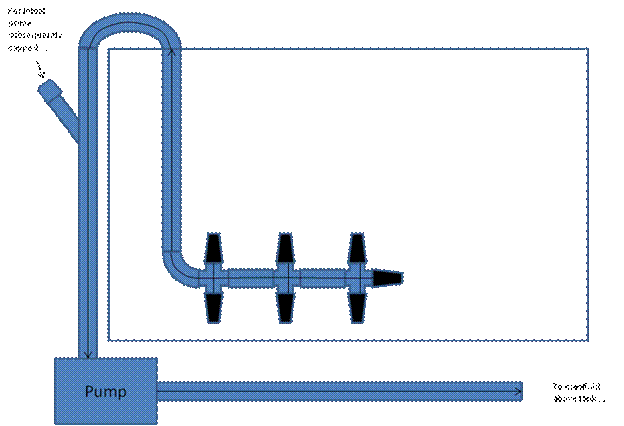
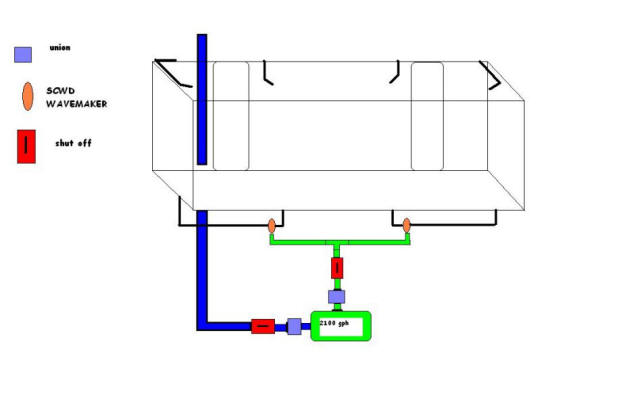
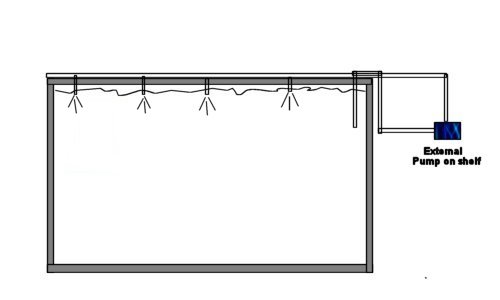
Closed Loop System 10/9/09 Closed Loop information, Return Manifold from Sump 12/31/08 Team, Happy Holidays and New Year. <Thank you and right back at!> Have not written in a while and hope everyone is well. <Tis here.> I have read several very good threads but would like input if you would be so kind. I inherited a 75g AGA standard system with a single 600gph, off center left MegaFlow. Nice tank, not very excited about the circulation possibilities. I am not a novice to CLS but not a master either. Bottom line, the tank is older, have checked with All Glass and the bottom and back appears to be tempered (also used the cheap polarized sun glass method :) ). <Surprising to me, glad you checked!> My favorite CLS option sans many powerheads is as follows (and I so love the remarks you all do in parens after comments :). Tear it up! <OK!> Intake: Utilizing the sump only, with check valve, unions for maintenance and ball valve some control in case of installing a larger pump. <Well, one issue already, the check valve. I know many will disagree with this stand, but they are completely worthless in marine aquaria IMO. The reason being they cannot be counted on to work, an little obstruction will keep the valve open.> Pump: More than likely a 1000-ish GPH like an Eheim MS or Quiet One 4000HH. Return: Four, 2 per side, slightly varied depth but no more than 4" down with loc line. Each side fed by a 3/4" SCWD. My plan is to then use loc line for positioning. On the end of each loc line feed, I will install 3/4" eductors to enhance flow while not overpowering the overflow. I also am toying with the idea of installing small ball valves on each individual run if I can get them to mount properly in an accessible fashion; I have plumbed myself in trouble several times - its no good to plan ahead when you can't reach things easily. <Agreed.> Basically, I am hoping with the eductors to augment the return flow so your opinion on the presumed flows is appreciated. <Sure.> - Example, a 980gph HH pump that has an initial rise of 4' would make the output roughly 850gph (it will be nearly a straight shot up actually less than 4'. - Installation of SCWD at the same height as CLS (basically) to reduce to 700gph appx. Each side of the SCWD having an outflow of appx 700gph, then factoring in roughly 1% loss per each linear foot of PVC (roughly 5'), overestimating 5% loss per right angle (max of 4) would equate to a 25% loss of pressure (and I think that's overestimating) leaving appx. 525gph. <A reasonable estimation.> If I can tune the two outputs on each side to effectively reach around 200gph, then adding a factor of 3 for the eductor, that would be a total side to side flow of 1200gph on each SCWD switch while still only draining 400 gph in the Megaflow (which should be about right for a Berlin or pseudo refugium so nutrients can actually process versus passing the bacteria by like fast food :) ). <But more than the 1 can truly handle. I do assume you will be using the ¾ throughput as a drain also, so you can handle the flow. But this does leave you with no margin for error/safety in the overflow system.> And yes, will be tapping the returns on the loc line branch about 1" below Megaflow teeth in case of check valve issue - large sump can handle an additional 10g or so on top of normal capacity. <Better to rely purely on sump capacity as you mention. Skip the check valve, if you have sufficient room in your sump there is no need for them at all, they only diminish flow from your pump.> Am I succumbing to wishful thinking or are my assumptions reasonable? I value your thoughts. <I will take another possibly unpopular stand re the eductors. These merely take a flow, pinch it down to a higher velocity and then force this high velocity flow into mixing with the surrounding water. This does cause more water to move directly out of the fitting, but I think it is misleading to consumers to say it triples the flow. It does, depending on perspective. Really for the amount of flow you will be able run through the overflow you will only want a single ¾ return or dual ½ returns. Four ¾ outputs here will give you next to no velocity out of each line to play with, direct your flow. If you want to keep away from powerheads you will need to employ a true closed loop (not from the sump), with an over the top intake much like those used by canister filters.> Take good care! Happy New Year! <Welcome, good New Year to you too! Scott V.> Re: Closed Loop information, Return Manifold from Sump 12/31/08 Scott, Awesome, thanks. <Pleasure to help out.> A couple of things. Check valves, I hear ya, never used them, I will consider your comments. MegaFlow throughput is supposed to be 600gph. I am not quite sure, guess I will have to measure it with a flow meter perhaps <Yeah, 600 gph is the spiel, 300 is the reality.> Actually an over the wall CLS is not out of the question, however after reading several of the threads, even some of the WWW staff don't like it or didn't seem to. <They are not choice #1. They do require priming at the get go and anytime air is introduced into the line. Put it lower in the tank and you should only have to prime it the first time unless you drain the tank for some reason.> If I were to do it, for space between cabinet and tank, it would have to be max of 3/4". <May need multiple intakes depending on the flow you end up with.> I would even considering calling Paul in Canada at Oceans Motions and getting a 4 way Squirt and using something like a Reeflo or similar low wattage 1200-1500gph pump. <A nice way to go.> Or just 2 SCWD one on each side. Interesting, that way i could make the return more of a spray bar / surface agitator / back of tank circulation system. Very similar to drilled closed loops I have seen. My only worry is in the intake - what is the best recommendation for not having critters or gunk captured in the piping intake? <Just a simple PVC screen.> The benefit of having it from the sump return is that the water is pretty much polished before it gets to the pump. I would imagine similar to slip screen plumbing but I would probably do one intake on each side of the overflow in gray PVC as to minimize sight and have less chance of clog or mishap. I am a bit worried about how to secure the piping runs - with a tight canopy and no ledge... super Velcro? <I actually use the little peel and stick zip tie mounts found at the hardware stores. The things stick like crazy to just about anything. Just stick it and then zip tie your plumbing in place.> Anyway, the only drawback really is external pump space and any minor leaking - I guess I could use a couple of high powered submersibles also and plop in the sump. <One reason to go with submersibles, but with proper plumbing it really is not a concern.> Perhaps even some of that nifty flex PVC. <Good stuff, can be a lifesaver.> I also had not considered until just this moment the impact from dual 250w halides about 9" from the PVC - wonder if that will impact heat :). <Will be fine.> HNY Bill <Happy New Year to you too! Have fun, Scott V.>
Questions On My Closed-Loop System 03/08/08 To WWM, <<Hello anonymous seeker of assistance>> I am setting up a closed-loop system inside my new tank. The tank is a 150gal acrylic size is 60x24x24. I have two 1 ½?drilled in the bottom tank outside of the overflow box. I have ordered three 1 ½?strainers. Two of which will be installed in my stand-offs in the overflow boxes. I also ordered a Sequence ReeFlo Snapper pump for this closed-loop system. After further study I now wish I had ordered a Dart model instead. <<Mmm, yesfor the $30 difference in purchase price, the additional 1200gph would have proven most useful hereespecially considering these pumps are rated for low head pressures>> This pump minus any head pressure is rated at 2400gph. Ok here is were I need your advise/help. I am hoping to add a T as soon as I enter tank and reduce fittings down to 1 PVC pipe. I will be making a loop from a 1/3 of the way in on each side of the tank. This loop will start from rear of tank to front (viewing) side back to rear joining back in with inlet T. I have also ordered enough loc-line tubing to make 6-¾ ports which I will tee-off of. <Hmm, okay The ¾ ports, or outlets, will require about 650gph of flow per outlet to be of use (provide a useful force of flow). Using this figure, you need a pump that can deliver 3900gph AFTER headloss. Even if you reduce the outlets to ½ (about 350gph needed per), that still leaves you with a requirement for 2100gph after headlossand likely still more than the Snapper can supply>> I have decided to place 4 ports in rear and 2 in front. I am hoping this will create a lot of the turbulence I will need for my corals. <<Sounds fine, but>> I also will be burying the 1 lines in sand with only the loc-line coming out of. <<This too should be okay>> On the input side I will create a little riser and then use a 1 ½ strainer to protect my wild life. Here are my two questions : 1) Is 6-¾ ports too many with my selected pump? <<Indeedas stated. You will likely have to reduce this by halfor go with 5-½ outletseither of which could still give you good water movement (its not always about the number of outlets)>> 2) Is having just 1-1½ inlet with 1 strainer on intake going to be rough on my critters or should I also T it off inside tank and then use 2 strainers? <<Most motile critters will know to keep clearthough some weak swimmers or soft-bodied sessile organisms may get sucked-up. Doubling the intake (with either a Tee or Wye fitting) will reduce the suction at the individual inlets and may prevent possible issues re>> Please note: critique what I have listed and if any additional current needed in tank will have to come from power heads. Not including approximate 600-800gph thru refuge/sump. <<With a properly designed closed-loop (i.e. outlets sized for amount of flow provided), a couple-thousand gph should be fine. Though I would suggest using a larger-than-needed pump with a gate-valve plumbed on the output side to allow some flexibility for expansion and/or eventual loss of flow due to organic buildup within the plumbing>> Thank you. <<Happy to assist. EricR>>
Closed loop concerns. RMF Too 7/25/07 Hi, I am setting up an SPS grow tank with an old 75g. I want to use a closed loop system with five return to the main tank and one feeding a 55g fuge. <... where will the water be drawn to feed these? Oh, I see this below... Will the pump in the 'fuge be able to keep up with the added water discharged via the closed loop there?> I will be using a return pump pushing about 3000 gph. My questions are, would I restrict flow if I used 3/4" returns? and, I plan on using two 2" drains from the 75g, would this be enough? Thank you for your help, James. <The plumbing sizes ought to work out here... but am lost as to your logic for discharge into the fuge. I would NOT add the discharge there... unless this is part of the general circulation pattern... with the refugium higher than the main/display tank, your relying on gravity to return the water to the main tank. BobF> Re: Closed loop concerns. 8/26/07 Sorry, I should have been more clear. The 55g fuge will be above the 75g grow tank, gravity feeding into the display. <Ahhh! I see... good> I will be using a 40 breeder as the sump. I do not like to combine the sump and refugium, I have found many advantages to placing the fuge above the display. <Yes... we're in agreement on both> So the setup will be three tanks stacked on top of each other, the 55g mud filter/refugium on top, then the 75g grow tank in the middle, followed by the 40 breeder on the bottom. I will be using a 400w MH on the 75g and two 150w MH's on the 55g. The pump located in the 40g will push five returns to the 75g and one to the 55g all 3/4". The 55g will drain through a 1 1/2" bulkhead to the 75g, then the whole system will drain via two 2" drains to the 40g. <Mmmm, these two 2" lines will NOT accommodate 3k gallons of gravity flow per hour... I'd devise some sort of stop-gap/failsafe measure/s here... a third, higher placed overflow of size... perhaps a horizontal "box" arrangement (on the 75)... electronic/water detection switch/solenoid to turn the pump down/off should there be trouble (as in overflow)...> Any recommendations would be greatly appreciated, I am writing because I value your opinions, and have learned more than I ever thought possible from your site. Thank you, James. <A pleasure to share. BobF> Closed Loop on 75 Gal. Hi there crew! <Afternoon Dave> My question is about a 75 Gal tank I'm setting up. I plan to have FOWLR, with some soft and LPS corals. <I think FOWLR will shortly be substituted with Reef by the soundsheee!> I bought the tank used from a guy with SPS corals, and it has been drilled in 5 spots, and is reef ready right rear overflow with two 1" drains). I have a RIO 3100 for a return from the sump (this uses one of the five drilled bulkheads). I also have a GEN X PCX40, and a Coralife external pump both rated around 1000 gph w/ no head loss. I understand that this will be lower as I'm using 3/4" PVC. I've plumbed these using two bulkheads each (one supply, and one return for each pump) I want to run both of these for closed loop pumps, but during my freshwater leak test, I noticed that these pumps "suck" water so hard through their respective feed bulkheads, I'm afraid it'll eat all my livestock. I know I could use an elbow with a strainer, but do you think this is still too much flow without a box (overflow type) in front of the bulkhead? <This does sound quite an odd set-up. Are all the holes 3/4"? If so then I can only presume that they were all used as returns and non intakes, as you probably realise the intake should be larger than the return. Hmmm.. I would contact the previous owner RE how he had it set-up. It is possible that he had a strainer device coming over the tank to take water to a pump and then returned it through the 4 3/4" using possibly an OceansMotions device. You could go ahead with the configuration you are using and just add strainers but I am presuming they are all base drills (on the bottom of the tank) so this may not be practical. BobF if you could chime in with your thoughts><<Sounds good. RMF>> Thank You in advance, Dave. <Thank you and hope we can find the best solution, would definitely contact the previous owner though, Olly> How many holes should be drilled in bottom of tank for a CL? Marine System Plumbing...A Need For Understanding - 04/26/07 I am ordering a 180-gal tank from GlassCages.com. I want to do a closed-loop system similar to Naka's 180 tank on RC. <<And this is...?>> I am pretty much a newbie to reef tanks and started my 55-gal in October. <<Moving up fast, eh?>> I don't think I understand about the closed-loop system too much except that it could eliminate circulation pumps in the main tank and I want to do that. <<Indeed>> Right now I have a 27-gal refugium and a corner-drilled overflow. Also a plenum and two Maxi-Jets to help circulation in the main tank. My question is that I need a diagram of how a closed-loop would look and work. <<Easy enough...have a good look here, and do look/read among the indices in blue at the top of the pages: http://www.wetwebmedia.com/pbh2oret.htm >> With the new tank I want to move the 'fuge and/or sump, chiller, skimmer, denitrifier, etc. to the garage and have the plumbing go in the crawl space to the garage about 10 feet away. <<Ahh, nice...will help dealing with that big and noisy pump you'll need to effectively power the closed-loop>> I just don't understand how many holes I should have drilled in the bottom of the tank to accomplish this and good circulation? Which of the holes are drains and which outlets? <<...? You don't need to drill holes in the bottom of your tank to install a closed-loop mate. Please refer to the diagram at the link provided>> I'm not going to use sand in my new tank. How does one keep any livestock from getting caught up in the drain outlets? <<Through the use of bulkhead screens/overflow boxes/etc.>> Thank you very much for any help you can give me. Georgia Sumner <<Georgia...before proceeding any further, I very much recommend you to spend a while reading/learning/comprehending the vast amount of information we have on plumbing marine systems. Start with this article (http://www.wetwebmedia.com/plumbingmarart.htm), and yes...follow the links in blue at the top of the pages. I'm here to help...so once you gain a better understanding of what is involved and what you want/need to do, feel free to write back to me to discuss further if you wish. Regards, Eric Russell>> Closed-Loop Nightmare...Its In the Design 05/03/07 Thank you in advance for your help. <<Im happy to assist>> I'm frustrated and don't know how to proceed. <<Oh?>> I have been building a 120-gallon reef tank and have done another fresh water test and cant seem to fix the problem. I have a horizontal internal overflow that runs nearly the length of the back of the tank, with 4 1.5 inch drains and 2 1 inch returns. <<Sounds very nice>> 2 of the 1.5 inch drains go to my sump and refugium. The other 2 1.5 inch drains come together with a wye to a 2 inch pipe that goes directly to my Reeflo Dart pump and back to a closed-loop manifold. <<Mmm, I think I know where this is going...>> The return pipe from the Dart starts off as a 1.5 inch and then is reduced to a 1 inch as it gets near the bulkhead. From the bulkhead it is reduced again to a 3/4 inch pipe around the tank with 6 1/2 inch returns. <<Sounds like a good design for the return manifold>> When I just have the one pump on to my sump and refugium, everything works perfect. Good flow, quiet, and no tiny air bubbles. Perfect. <<Indeed>> However, when I turn on the Dart pump for the closed-loop, all hell breaks loose. <<Ah yes>> LOUD would be an understatement. <<Im sure>> Not the pump, the water flow. (this is in my bedroom, so quiet was the goal) The water flowing through the gutter guard and over my overflow is like a faucet on high with so much flow going through it. <<Yep...just what I would expect>> Since the flow is so high its causing lots of bubbles in the overflow with it looks and sound like they are getting sucked down the drain, causing millions of tiny bubbles to come through the returns and every so often it sounds like the pump "stops" for a second, like it cavitates, the water flow stops and then instantly continues. <<Yes...from all the entrained air>> This is going to be a Acro tank, so I need the flow, but how can I control/stop the noise and bubbles. <<I do have a suggestion>> I've taken this thing apart too many times and almost done with this. I dont think I can cut or glue any more PVC. <<Mmm...but will likely be necessary to rectify>> Any help would be greatly appreciated. <<Well Brian as you have noted, the high flow rate caused by the closed-loop being plumbed through the overflow is causing a massive rush of water in to the overflow chamber creating an abundance of turbulence and noise...and maybe...is also partly due to the overflow not being sized to handle this much flow. Since this is a horizontal overflow, the option of using a modified standpipe to quiet things down/reduce bubbles is unlikely unless the design is deep enough to allow such. That leaves you with plumbing the closed-loop outside the overflow chamber. I think your best option is to drill the tank at some point below the horizontal overflow and install the throughput(s) to feed the pump for the closed-loop...and yes, will probably mean more cutting and solvent welding of PVC pipe>> Thank you, Brian <<Regards, EricR>> Re: Closed-Loop Nightmare...Its In the Design 05/03/07 Thanks Eric for your quick reply. <<Quite welcome Brian>> What you are saying makes sense. However, do you see any other way? <<Not short of reducing the amount of flow, at least not just "off-hand" Im afraid (sometimes theres just nothing like being there). Perhaps a perusal of our plumbing FAQs would prove beneficial. But if you are adamant about not drilling the tank I would recommend some experimentation with compact variations of the Durso or Stockman standpipe designs. Heres a link to a standpipe modified for use in a siphon overflow box that may be of help: http://www.aquariumlife.net/projects/diy-overflow/74.asp. The challenge is to raise the internal water level of the overflow such that there is very little drop to create turbulence/bubbles within the box. Noise may be more difficult to ameliorate as you are pushing/pulling more than 3000 gph through the closed-loop and just the sound of the water traveling through the piping may be too much for a bedroom installation...though you could try some of the insulation foam tubes meant to insulate outdoor/under-house water pipes to see if these help muffle the noise. When I installed my large system in my living room, noise suppression was a major consideration in conjunction with the high water flow requirement...to which I turned to the Tunze Stream pumps for my solution>> I do not want to drill another hole in my tank; I figured 6 would be enough. <<Mmm, yes...I suspected this would be your response even as I wrote the earlier suggestion>> I had it made to order and shipped to me. There is only 1 local fish store, and they don't do that kind of work. <<If the tanks back panel was not tempered after drilling, and you are a bit handy, it really is not all that difficult to do yourself. In fact, if there is an aquarium club (fresh/salt/reef/whatever) in your area theres a good likelihood there is someone in the club who has drilled tanks that may be able/willing to assist you>> I ran my design past Bob Fenner before I had it custom made and Bob said it sounded like a good design, thats why I had the CL holes drilled in the overflow. Here is the original email: <<I see this...and am certain the advice given was in earnest based on what was understood/perceived at the time. If Bob has any other (better) suggestions/alternatives, Im sure he will add them to this post when it is placed on the Dailies page. If I can be of further assistance you know where to find me. Eric Russell>> <Indeed... the pumping through the proposed lines is greater than I imagined would be employed. RMF>
Closed-Loop Manifold Design Review (Anthony Calfo) 03/06/07 Dear Anthony / WWM crew, <<EricR here...Im afraid Antoine has moved on to other enterprises and no longer fields queries here...but hopefully I can be of assistance to you...>> Im in the process of setting up a 45-gallon tank that is 24X24 and 18 high. I have a center back overflow, which due to a miscommunication now only has a 1 drain and a ¾ return as opposed to a 1.5 drain and ¾ return that Id hoped for. <<Mmm, indeed unfortunate...but still a workable configuration>> This tank is intended for Frogspawn and Candy Cane corals only, so Im shooting for about 500gph flow through the 1 drain and a 15 gallon sump. <<Is possible...but I always recommend about 300-350 gph maximum flow through a 1 gravity to simplify plumbing hassles (noise, et al)>> Ive narrowed my pump choices to either an Iwaki 20RLXT that will flow 450gph or a Gorman Rupp GRI 510 that will flow 550gph according to Reef Centrals flow calculator. <<Hmm, not the manufacturers stated flow rates...Ill assume this is the flow rate you have figured based on your plumbing configuration then. Both are good pumps...with the GRI being pressure-rated and this particular Iwaki model not. I think considering your 1 drain, I would opt for the Iwaki...and do be sure to plumb a gate-valve on the output side of the pump to temper flow as/if necessary>> The top opening of the tank is 17X16 and Im planning to have either 6 or 8 outlets from a ¾ manifold running along the perimeter of the opening. <<On a separate pump/closed-loop I hope? Eight outlets from a ¾ manifold will require at least 4800 gph after head-loss (based on 600 gph per outlet to achieve meaningful flow)...and way too much for this tank as well. With the return pumps you have listed, you are limited to two ½ nozzles at most...and even then I dont think the flow from each nozzle will be vigorous>> a) Do I have too may outlets? <<Yes indeed>> Im not sure how to balance flow per outlet with number of outlets. Would I be better off with 4 outlets? <<Not really...the 1 drain on this tank can not handle the flow required to power a multi-nozzle return manifold. If your goal is to keep powerheads out of this tank then your best option...in my opinion...is to plumb a separate closed-loop, or go with the two 1/2 nozzles as I previously suggested. Which, considering your stocking plan, would likely be just fine>> b) According to Reef Centrals flow calculator, changing the 90-degree bends to 45-degree bends has an insignificant effect on flow rate!!!??? Doesnt make sense? <<Mmm...their calculator also says you can flush 600 gph down that 1 gravity drain [grin]. I guess it depends on your definition of insignificant...but I definitely think easing the turns in the plumbing helps>> c) Im planning on using an Aqua Silencer standpipe and I cant decide between the 1 version and the 1.5 version with an adapter to fit my 1 bulkhead <<These devices generally work better if slightly larger than the plumbing lines...I would use the 1.5 device if it will fit your overflow box>> d) Is 550gph too much for my tank given the size and livestock? <<Not in my opinion>> Thank you for your help, Narayan Raja <<A pleasure to assist. Eric Russell>> Re: Closed-Loop Manifold Design Review (Anthony Calfo) 03/07/07 Thanks Eric! <<Quite welcome Narayan>> But I was hoping for at least 3 nozzles, min of 450gph and no powerheads in the tank. <<I understand...but at this flow rate you will be sorely disappointed with the output from three nozzles>> I have room to enlarge my drain bulkhead to a 1.25" size, but there is no such thing that I could find in schedule-40 bulkhead fittings unfortunately. Is there such a thing...? <<Have a look at USPLASTIC.COM...they do have 1.25 bulkhead fittings>> Having a second pump and a closed-loop is complicated since my stand will have very little room left after the sump, pump and ballast. <<I see>> I forgot to mention one little detail -the 4" DSB which will reduce the tank water volume to 31 gallons + sump and it is for the DSB primarily that I'm concerned about having adequate flow... Sorry. <<No worries mate...and a valid concern re the DSB. Perhaps you wont have a choice about adding a powerhead or two...>> Thank You, Narayan Raja <<Always welcome. EricR>> Return Manifold and Pump Size? - 03/03/07 Hello to all and thanks in advance, <<Howdyand youre welcome>> In an effort to rid me tank of annoying power heads and lower temps I am building a closed-loop water return manifold in my 55 gal tank (48l x 12w x 20h). <<Ok>> The tank is un-drilled so until I move out of this limiting apartment and upgrade I am sumpless (I refuse to use an overflow box with J or U tube because I would like my security deposit back when I leave). <<Heeindeed!>> I am building the system out of ¾ in. PVC tubing and fittings, and going down to ½ in. at the 45 degree elbows coming out of the Ts. There will be 10 outlets (4 on the front and back and 1 on each side) with at least 3 or 4 of these being plugged up to allow for changes in flow when needed later on. <<Ahgood idea>> The pump is either going to be directly behind the tank for 0 head or on the floor below with 53 in. of head pressure needed. 1- I am trying to find out what size pump would be needed for something like this. I am thinking in the 1200 to 1500 GPH range. <<Figure at least 250 gph per ½ nozzle, plus another 20% for the eventual bio-film buildup in the manifold piping and this means you need a pump that will provide a minimum of 1800gph after head-loss (This is assuming only six of the ten nozzles will be open at any one timeotherwise calculate as necessary)>> 2- Do you think this will be adequate or overkill? <<Will need to be a bit more in my opinion. But do be sure to plumb a gate-valve on the output side of the pump to temper flow if needed>> The tank houses 4 damsels and a blue spotted sharp nose puffer (I know he is not reef safe but he is oh so cute and has yet to even looked twice at any of the corals <<yet>>), various inverts and some corals (whose numbers seem to be increasingahh the addiction) 3- Also in purchasing the pump should I be purchasing one rated for pressure or one for free flowing circulation? <<I would consider a pressure-rated pump for the closed-loopthough a large enough non pressure-rated pump will work>> I am looking at the Japanese Iwaki pumps for more than one reason, choices are: the MD40RLXT which is a circulating pump rated at 1,200 GPH, and either the MD55RLT for pressure rated at 1,080 GPH or MD70RLT 1,500 GPH. What do you think of these choices? <<All great pumps but The 70RLT should work if youre willing to cap off a one or two more nozzles than originally planned, but I think you would be better off getting the 100RLT for your planned configuration>> 4- Considering heat transfer and electrical usage do you think it is worth my time to also be looking at MAG drive pumps? <<The Japanese motored Iwaki pumps are fairly economical to run and also surprisingly cool in my experience and would be my preference here>> I wont be having any other pumps running except the MAG 3 drive that is on my AquaC Remora Pro protein skimmer. I would rather not be paying an arm and leg each month to run the tank, but I also dont want to make soup of my tank with super high temps, especially come summer time. <<Understood. Dont discount the effectiveness of evaporative coolinginstall a couple fans to blow across the surface of the tank to help keep water temperatures down>> Once again thank you, Randy <<Happy to share. EricR>> Plumbing/closed loop question 2/6/07 Thank you in advance for your input. I've been reading this site for weeks straight and I have learned a great deal, along with a pounding headache <I don't like this> and a little more confusion. Every expert gives a little bit of a twist on the same ideas based on their preferences. <Oh, a matter of your selecting the "wheat from chaff"...> I'm getting ready to order my new tank. it will be a 125 gal 4x2x2 tank with mostly SPS corals. I keep debating on the size and number of overflows. <Mmm, likely 2, likely of 1 1/2" nominal ID> I wanting 20x at minimum flow (2500 gph) in the tank by way of returns from sump and closed loop. <Maybe three then...> I do not want any powerheads in the tank like my 70g. I also do not want to make the mistake of not putting the correct number or size of overflows in the tank. I'm leaning towards the vertical califlo overflows at the top. My 2nd major issue is that due to lack of floor space, this tank will be in my bedroom, so I need to keep noise to a minimum. <Then avoid the verticals...> I was thinking 4 1.5" drains. 3 going to the sump and one going directly to a pump for the closed loop. <More than one... I'd make this two/three and two to the sump> For my returns having drilled 2 1 inch returns. One from the pump in the sump split into two and one to tie into the closed loop. <... I would NOT tie these together. Run them back independently> Am I on the right path? <Nope... how will the water know which way to go?> I haven't drilled the tank yet, so any configuration is possible, just looking for the best in your opinion. <Is posted on WWM> From what I've read it seems that one pump inside the sump and external pump for the closed loop seem to be the most popular, or would you recommend to external pumps, remembering the low noise is key for the bedroom. <I like external pumps of good quality... less money to run, less waste heat... and better ones are quite quiet> One of my concerns is that even a verily large pump like the MD55RLT Japanese Motored Iwaki Water Pump only pumps 1080 gph with a 4ft head. Assuming 1/2 outlets on closed loop needing approx 300 gph each that would only be approx 3 openings when i need more like 6 or 8. <Then...> How in the heck can I get enough water flow without going to a monster of a pump which would surely be very loud for a bedroom. Also, if I go with a larger pump, wouldn't i need a larger than a 1.5 inch bulkhead? <I would not... perhaps two pumps of this size... Or settling on the one...> Any help would be greatly appreciated. Thanks again, Brian <Bob Fenner> Re: plumbing/closed loop question 2/7/07 Well Mr. Fenner, thank you for the quick response, but I think the pounding headache had the best of me when I typed some of the info. I had it in my head, it just came out wrong. Sorry <No worries... am/was just concerned re your health> I meant to saw califlo horizontal overflow, not vertical, running across the top/back, which would provide more surface skimming and less noise. Is that better? <Mmm, noise-wise, clarity-wise, yes> Also, i misstated the returns, I wasn't planning on tying the sump and closed loop together. Let me clarify. <Please do> I'm looking at 4 1.5 inch drains drilled into the tank inside the internal horizontal overflow. Two of the drains to go to the sump and have one pump return it to the 1 one inch bulkhead in that same horizontal overflow and then use your standard loc line to disperse into tank. The other 2 1.5 inch drains coming out of the horizontal overflow being T together and going directly to a pump and back to the closed loop. Does this sound any better? <Ah, yes. Much> Also on the closed loop return, do you suggest coming over the back of the tank or could a drill another 1" bulkhead into that same internal horizontal overflow box and start my closed loop from there. <Mmm, well... if you're already drilling... I'd make these through-puts rather than over-the-top lines. Bob Fenner>
Using A Manifold With An Eheim Canister Filter 1/10/07 Hi crew! <Hello Laura.> I read through the info on the Goodbye Powerheads article and was wondering if this manifold idea would work if I built it and ran it out from the return on my Eheim 2028 canister filter (rather than having to add another pump to my already crowded 55 gal. reef tank). What do you think? <Laura, the Eheim pump that is incorporated into the filter will more than likely not develop enough pressure to use a manifold with it. The Eheims usually come with a spray bar option, and this is what I would use.> And also, does this manifold really allow a tank to flourish without the use of all these powerheads? <It does help to eliminate dead spots in the system, and yes, can take the place of several powerheads if the pump is sized correctly. Do search our site on this subject for more info.> I will admit I am a bit skeptical, but I'd love to give it a try if I can eliminate them! Thanks so much for this wonderful site and your expert advice! <You're welcome, and thank you for writing us. James (Salty Dog)> Laura Closed-Loop Or Not? 01/03/07 Greetings to all, and a Happy New Year. <<Howdy Bill...Happy New Year>> After a long delay, I finally have my new tank and stand in position. <<Neat!>> It is an All Glass 180 gallon with the Mega Flow system. <<A misnomer if there ever was one...>> When all is done it will be a Reef tank. <<cool>> I used a Dremel, and cut out the 'teeth' on the overflows, and siliconed black plastic gutter guard in its place. Converted the drain pipes to Dursos and upped the returns to 1 instead of 3/4". <<All good>> My 'plan' it so use 2 pumps for the returns, with one pump running for 5 to 6 hours, then the other coming on for the same duration creating a left then right flow. <<Interesting...and possibly a long enough interval so as to not greatly foreshorten the life of the pumps>> I'm at a stand still in my plumbing process though--my questions are--do I want to add a closed-loop, or hang a Tunze in the middle of the back, pointing towards the front. <<Mmm...the closed-loop will offer greater flow options...but the quality, efficiency, and ease of installation of the Tunze is hard to ignore>> If I do a closed-loop, I'm thinking of placing it on the tank bottom with the outlets sticking up just out of the substrate--which would be best in your opinion ?? <<Cant say Ive ever seen/heard of this but the idea of it is intriguing. Assumably the force/flow of water would prevent any blockages from occurring...just be sure to install the manifold and pump as a true closed-loop (will require drilling the tank) to preclude draining the tank empty in the event of a power outage. As to which is best (Tunze or closed-loop) that will depend on the needs/particulars of your tank, the size/location of the closed-loop pump vs. the Tunze pump, and your sense of aesthetics. Using my own situation as an example...I was unable to employ a pump with enough flow to run a closed-loop for my tank (375g...predominantly Acroporids) and still stand to be in the same room (in-wall design...no basement/fish room), so I opted for the Tunze Stream pumps to get the volume of flow I was looking for yet still be able to hold a conversation without yelling, watch the telly, etc. An added bonus is the power savings...the Tunze pumps really are power misers. The downside is the look of these rather large pumps in the tank>> I have searched your site and can't find what seems to be the preferred circulation method. <<Ah yes, all a matter of opinion, likes/dislikes...not exactly comparing apples to apples here. My preferred method (the Tunze pumps) may not be the same for the next person.>> Once I get this figured out, I'll place my order for my Live Rock, and begin the cycling process. I have my RO/DI set up and running, 100gpd, and it is being stored in 2 96-gallon Rubbermaid trash cans, one feeding the other. The tank will drain into a 40-gallon breeder, that will be the refugium, and that will gravity drain into the sump, my old 90-gallon Cichlid tank, (these are in the basement, behind the wall where the display tank is). I also have my lighting ready to go when needed too. What are your thoughts ??? <<The description sounds fine. I especially like the refugium draining via gravity to the sump (is what mine does), but be sure to have this drain directly to the return pump chamber to preclude excessive loss of beneficial organisms to the skimmer (you will employ a skimmer I hope). As for going with a closed-loop or the Tunze pump...that decision is yours. Both methods can/do work well with proper application/design/placement. Is one better than the other? Not really...they both have their place...more often than not it comes down to what is the most practical...in my humble opinion>> Thanking you in advance for your time, Bill Fletcher <<A pleasure to share. Eric Russell>> Closed-Loop Confusion (Maybe Just Me...ER) 11/27/06 Hello crew, <<Hello Brandon>> I have read the works of Anthony Calfo posted on WetWebMedia and have found them very enlightening. <<Indeed>> They have inspired me to throw out my power heads and go for a closed-loop water flow system using an "exterior" pump. <<Cool!>> I have a question or two (or four) that I wanted to direct to you, I hope you do not mind. <<Not a bit...shoot>> To run my water flow system in my 55 Gallon, I will be using a Mag 9.5 pump located in the sump. Since my overflow box will not support that high of water output (I flooded my living room the first time I tried) I have decided to run it in a closed system. <<For my own clarification...do you mean you will use the MAG 9.5 pump for the closed-loop, and a smaller pump for the sump?>> I will be running 3/4" PVC pipe from the main tank to the refuge which will hold the 9.5 and then pump it up 3/4" tubing back up to the tank. <<Things are still a bit muddy here...first you mention a sump, and now you mention a refugium...is the refugium a separate vessel from the sump? I am following Anthony's example on setting up PVC pipe at the top of the tank with 5-8 output points (3 on the front 2 on each side and maybe 2-3 in the back for further expansion.) <<This is too many outlets for the size pump you will be using. To assure adequate velocity at the nozzles, you should figure one ½ nozzle for every 250 gph of flow, or one ¾ nozzle for every 350 gph of flow...calculating the usable flow after head loss. With the MAG 9.5, Im guessing youll only have enough flow for two or three 1/2 nozzles, maybe two 3/4 nozzles. Its my opinion you will need a bigger pump>> My questions to you are this: 1) Will a 9.5 pump be able to produce enough flow to these 5-8 output points? <<Not even close>> 2) Would the system still work if I ran 2 PVC tubes down each back corner of the tank with an output? I figure this would eliminate any dead spots and give me some laminar flow around the aquascaping. <<About all you can expect with this pump>> 3) Should I scale down the fittings at each point from 3/4" to 1/2" to create greater pressure? <<This will help...but you will still only be able to utilize three nozzles at most on the return manifold>> Or do I run the risk of creating too much back pressure for the 9.5 and risk ruining the pump? <<Not at all. These magnetic pumps are designed to work/function fine with backpressure. Just be aware the MagDrive pumps are not pressure rated and will lose flow-rate with increased back pressure>> 4) What do you suggest that I cover the uptake tube with to prevent any livestock from being sucked away to a fast death but that will not limit the uptake water flow? (Again remember that I can not run the pump off the sump water due to the slow rate of flow in the overflow box.) <<The screens used for bulkhead fittings work nicely here>> I am "new" to plumbing so I am feeling this out as I go along. Any suggestions or help would be a great help. <<Do make sure you are comfortable with/understand the hydrodynamics of a closed-loop before proceeding (write back for further clarification/explanation if need be)...and use my recommendations for sizing your pump/pipe/number of nozzles>> Have a great Holiday weekend, Brandon Gray <<And to you in kind. Eric Russell>> Closed-Loop Manifold Design - 03/06/06 Hi- <<Hello>> I'm researching my first Aquarium (will be reef with an emphasis on SPS, LPS and Clams and eventually a few fish). <<Okay>> I find WetWebMedia invaluable. <<Thanks...me too!>> I'm pretty settled on a 90 gallon tank and a 22 gallon sump with about 110 lb. of LR and a 4 inch oolithic <<or maybe oolitic>> sand bed. Would like to shoot for 14-15 times water flow and have definitely decided on the Water Return Manifold shown in Anthony Calfo's article. <<Ahh...excellent>> I am a bit confused however, and hope you can straighten me out. <<Uh oh...be careful what you ask for <grin>.>> The article states "...we need a dedicated supply of water here. Obey the manufacturer's recommendations for line size." Is Anthony referring to the pump manufacturer's recommendations for line size? <<Yes>> Would that be different from the pump outlet size? <<Unless otherwise stated by the manufacturer, you are usually safe to match your pipe size the inlet/outlet sizes.>> I am considering using an Iwaki MD70RLT and the outlet is one inch. <<Matching pipe to outlet size is fine for these pumps.>> I like his ideas for finessing the flow with valves and nozzles, especially since my reef will change significantly as the corals grow. <<Indeed>> He mentions using "Flexible Ball-Socket Joint Tubing." and that it can be connected to PVC. Is that Loc Line? <<Yep>> Anthony goes on to write "home aquariums of a couple of hundred gallons or less will likely use 1" or 3/4" pipe". <<Mmm...or even 1/2" to maximize water velocity.>> Loc-Line's largest parts are 3/4 inch and there are no T connectors available in 3/4 inch. There are plenty of valves and Nozzles available in 3/4. So what I'm really asking is can a Iwaki MD70RLT with a 1" outlet be used to deliver water to my tank though 3/4" Loc-Line hose and can the hose be T-d with PVC? <<Yes it can. Likely you will need to bush the outlets down to 3/4" (or even 1/2") anyway to provide enough water velocity.>> And most importantly will it do the necessary job. <<Yes...if you have done all your homework and configured it correctly <G>.>> Thank you for your patience. Ed <<A pleasure to assist Ed. Regards, EricR>> Return Manifolds/Horizontal Overflow...Closed-Loop Design - 07/30/06 WWM crew, <<Hello John>> Thank you for the wonderful website and wonderful dedication to this hobby/passion! <<A collective effort...quite welcome>> I am researching designs for a new tank. From reading Mr. Calfo's Book of Coral Propagation and WWM, I very much like Mr. Calfo's ideas of a return manifold and an internal horizontal overflow. <<Ah, yes...am familiar with this design>> Maybe I am just dense, anyway I am having difficultly visualizing how the two techniques would work together along the back wall of the aquarium. <<Well, let's see if I can help>> Would one just not have return nozzles on the back wall, if so it seems as if this would make the goal of random turbulent water flow more difficult? Could you please enlighten me? <<Mmm...the nozzles can be wherever you want them. No need to follow Antoines example to the letter. You can position a couple nozzles at each back corner and; using ell fittings that are "not" cemented on, swivel these as needed to direct flow. And do keep in mind here...using a return manifold in this manner (fed through the sump with a gravity overflow), you will very likely not be able to push enough water to drive more than a couple/few nozzles with any real velocity. In my opinion, the return manifold is better suited to a closed-loop installation if the desire is for vigorous random-turbulent flow>> Also I was wondering your thoughts on connecting a SCWD to two halves of a manifold return (i.e.- the manifold would not be a single closed-loop; it would be two halves). <<Is doable. But re my previous comment, this is not truly a "closed-loop" system if you are using the gravity overflow/sump in-line with the manifold>> I was thinking that this might assist in creating a wave/surge action in the tank. <<Possibly...if this is a rather small tank and you use a pump that maximizes the SCWD's capacity>> One FAQ seem to suggest that the single closed-loop would be better with or without a SCWD. Your thoughts? <<A "continuous" single loop would render the SCWD a moot point as all the nozzles would still be in play, the SCWD would only be changing the direction from which the water enters the loop>> Finally, I am researching tanks and manufacturers. If I implement the above ideas, I will need to have the back wall of the tank drilled (not the floor obviously). <<For Anthony's full-length weir design, yes>> I can not seem to find any manufacturers who will drill the back wall. <<Hmm...may have to resort to a "custom" builder>> Does this have to be a custom job at a glass company or a DIY job for those of brave heart? Suggestions? <<Maybe order the tank through your LFS and have "them" customize it for you. Another thought is to go to the hobby forums (e.g.- RC, reefs.org) and post a query there re tank manufacturers willing to drill the back of the tank>> Thank you! John Bullard <<Quite welcome. Eric Russell>> Closed-Loop Design/Stocking a 120 FOWLR - 09/22/06 Eric, Randy here again. <<Hey Randy!>> Well, I'm making progress on the 120 FOWLR project w/55 fuge/sump and have a few more questions. <<Okay>> I read on WWM almost every night and get lots of info, but unsure on a few things. <<Let's see if I can help "clear things up">> First, regarding my 120. I went ahead and had it drilled with 4 1-1/2" bulkheads. <<Excellent>> 2 1-1/2's will feed my 55 sump/fuge. I plan on using a MAG 9.5 that I have for the return w/4-5" of head. Does the 9.5 sound like it will be enough for the sump flow (before you say I need more flow, please read further about my closed loop flow)? <<No worries my friend...will be fine as the "return" pump>> Second, this is where I need your help. BTW: I have read a lot on the closed-loops and Anthony's article on the closed-loop. I see that there are many different ways. <<Indeed>> My plan for the closed-loop is: The other 2 1-1/2" bulkheads I plan to "T" together and run into my Iwaki WMD30RXLT. It will be mounted so it will only have 1 or 2' of head. <<Ok>> -From the 1" output on the Iwaki, what is best? -Should I run it into one closed-loop above the tank that will have 6 to 8 1" overhead "T's" with 3/4" flex? -Should I run it into one dead-end loop (I know, then it's not a loop) above the tank that will have 6 to 8 1" overhead "T's" with 3/4" flex? -Should I run either a closed-loop or a dead end perimeter with 6-8 outputs? -Should the above tank manifold be 3/4" or 1" with the Iwaki 30RXLT pump? -Is the Iwaki WMD30RXLT a good choice and fit for this loop idea? -Is there a better design idea with my 2 1-1/2" for the loop flow? <<Okay Randy, the first option is best/the most simple but I think I need to make something clear here. The size a and number of "outlets" on the closed-loop determine the size of the pump required...and vise-versa>> With 6 to 8 3/4" outlets you will need a pump with a terminal output after head loss of at least 4,800 gallons per hour to produce enough "velocity" at each outlet to be useful. Even if you reduce the outlet size to 1/2" you will still need about 2,800 gph. With the pump you have now, you're looking at a closed-loop with a maximum of "two" 1/2" outlets (three "might" work, but I don't think you have "quite" enough flow re). You need to figure about 350 gph per 1/2" nozzle/outlet, and 650-700 gph per 3/4" nozzle. With two 1 1/2" bulkheads installed, you have the option of using two smaller pumps and plumbing separate closed-loops to each half of the tank>> And last, I'm thinking ahead about stocking. Here are my thoughts and ideas I have also read some on this as of lately at WWM. I will have about 100-120 lbs of LR in there. Also, I have a 4.5" reef safe wrasse that I will add first. He is in my 46 reef now. I don't know what type he is but he is light green completely with several pinkish lines running horizontally across his face and body, all the way thru his tail. <<Do have a look through our articles on wrasse...especially the genus Halichoeres>> I want to add shrimp to the reef tank but they will be lunch with him around. <<Not necessarily, depends much on the species/individual personalities. I have several wrasse species in my reef that cohabitate quite well with my cleaner and blood shrimp. One thing to keep in mind when adding shrimp to "any" reef tank is to not just "drop them in" as you do food items but rather gently "place" them low in the rockwork where they can find refuge>> I would like a large angel. Is there one that I can sustain long term in the 4'x2'x2' 120 tank? (please say yes, I love the angels but have limited wall space). I am thinking of the Annularis, French, Koran?? I need something beautiful, hardy and obviously, not to large. Any thoughts. Can you suggest one? Price is almost, a main concern besides longevity (Inland Chicago area). I know, I'm not asking for much! <<The Pomacanthus annularis would be a fine choice...the other two get too large for this tank in my opinion>> I would like to add with the angel of choice, a dwarf flame angel, a yellow-eye Kole tang, a yellow tang, a sailfin tang or convict tang (I think that these are all different genera??). <<Mmm, three different genera (Ctenochaetus, Zebrasoma, and Acanthurus)...the yellow and sailfin tangs are of the same genera>> Should I only go with one tang? <<Exclude the sailfin altogether (gets too large here)...I think you could get by with a Kole tang and a Yellow tang...or the Convict tang on its own>> A Foxface, and a butterfly (I don't know much about them, what do you recommend?) <<Several good choices, check out this article for best picks: http://www.wetwebmedia.com/BFsBestWrst.htm>> Can I add one or two tomato clowns or maroons clowns? <<Mmm, maybe...but pretty much "full-up" mate. You need consider adult sizes of the fishes already selected>> I like the dogfaces but I read that they can emit a toxin?? <<Indeed...but again, your pushing/exceeding limits here>> I think the triggers are too aggressive, maybe a clown trigger?? <<Only of you want this to ultimately be the only macro-organism in this tank... There are trigger species that would be suitable, but your past adding any of these at this point>> I don't want to stock it to the limit. <<Is about what you've done>> You kind of see the direction that I am going, what do you recommend? <<Have stated re>> Also, I know that the tangs and the Foxface pose a threat, but I would like to be able to stick my arm in the tank if needed without to much concern. <<Have both in my tank...remain vigilant and you won't have a problem>> I know that the Foxface will usually hide unless cornered. <<Will become "accustomed", even curious to your presence...but not likely to be an aggressive/overt threat>> No eels, lions, poisonous puffers! etc. etc etc... <<Hee! No room for them!>> Thanks yet again for your time, help and devotion to our hobby. <<Is my pleasure to share>> WWM has become a one-stop-shopping reference tool for me, I love this site! INFO, INFO, INFO!!! Thanks, Randy <<Be chatting my friend. EricR>> Closed-Loop Design 10/16/06 Hi Bob, <<EricR here today>> I have a 72x28x18 reef tank, planning to keep SPS. Was thinking of having a closed-loop system with a Dart Supreme 3600 gal/hr. <<Sounds good>> What are your suggestions for the plumbing? I mean , where do you think I should position the outlet and the inlets? I was thinking of having the inlet at the back panel, about 1/3 the way from the bottom and the outlets at the sides of the tank, with one of them slightly lower than the other !! I will appreciate your opinion. Thank you, Ramy <<This could work fine, or you could fashion a return manifold for the outlets. Check out this article by Anthony Calfo re ( http://www.wetwebmedia.com/pbh2oret.htm) and be sure to read among the linked files at the top of the page. Regards, EricR>>
Goodbye power heads (re post) 2/27/04 Hi Anthony or other helpful crew member, <whassup?> Some time ago I wrote you about setting up a "goodbye power head" system. I have a standard 75 gal non drilled reef on a regular stand. I was going to use a over the back siphon as input to the pump and then run it back up as in your design. <yeeeeeikkes. Siphon overflows are no part of any system I would/did/will ever recommend. They are patently risky in the long term at best. DO reconsider. If you cannot drill the tank, I'd rather see you go sumpless than use a siphon overflow> I am ready to "make it so" but have a few more questions. 1) On the intake, should I plumb it like a external Durso with a cap on the pvc so the pump can be primed? I am thinking it will always stay primed even if the power goes out or am I missing something? <missing much my friend... there are many things that can and will break this siphon over time: accumulated microbubbles from sump pump, skimmer effluent, O2 production off corals and plants by day, etc)> 2) Should I use a pressure rated pump or a volume? <not sure here without knowing/seeing the plumbing. Still I suspect it will not be that complex and as such either pump will work. I'd opt for pressure rated> 3) Would 1/2" pipe for the return be ok? as 3/4 just stands out around the tank to much. <Likely fine here... will require some experimentation> 4) What GPH would you recommend at around 4' head and 4 90 elbows. I was thinking around 800gph or so. <too low here my friend... opt for 20X for better results (10-20X is minimum and some of the best tanks have near 40X diffused). Find a pump that delivers 1500-2000 gph at the head you will apply>> Can you recommend a brand or model? I have shallow pockets! <good things are seldom cheap and cheap things are seldom good, bud. For how large this overall investment is (many thousands of dollars through the first few years)... saving $50-100 on a cheaper pump is not worth it. Buy quality made to last like Iwaki and enjoy is 3-5X longer than the cheap pumps. Opt for Japanese made Iwaki (better built)> Thanks to all the crew for the great service you provide to all of us! <thanks kindly, Anthony> Closed Loop Options Hello, <Hi there, Scott F. your Crew Member tonight> I've been reading all of your FAQs on circulation. One question I have is concerning closed loop circulation. I have a glass aquarium and so cannot drill bulkheads. What is the best way to set up a closed loop circulation. It is a 50 gallon tank, which currently has a mag 7 pumping 500 gal/hr from the sump and another pump that is pumping around 300 gal/hr from the sump. I want to add an Eheim 1262 which pumps about 900 gal/hr but don't want to have to pump it with a 4 ft head nor deal with all the extra water going into the sump. Additionally, with the 4ft head the pump looses 200 gal/hr. Do you have any recommendations for the intake pipe and how it should be configured? Thanks, Brent <Well, Brent, if it were me- I'd keep it simple and not do a closed loop at all. I'd opt for top-mounted external pumps, such as Tunze Turbelles or Aquarium Product Geminis. The put our massive flow (up to 1,000+ gph), impart virtually no heat to the aquarium, and use miniscule amounts of electricity (as little as 15-20 watts!). And, best of all- they require no drilling or supplemental plumbing connections! If you can handle the aesthetics (and cost!), internal Tunze Stream powerheads are the way to go. The simply move huge amounts of water with great flow, are controllable, and are of the highest quality! Check these ideas out! Good luck! Regards, Scott F.> Sump and Closed Loop Manifold 3/2/05 Bob, I have read thru countless Q&A's on wetwebmedia.com, but still I can't figure out the best way to set up my new tank plumbing. Hopefully you can help. <Adam here today. Thanks for looking through the FAQ's first. I hope I can help!> I have a standard 75 gal rectangular aquarium and I want to set up the closed loop manifold system (No powerheads!). My glass has not been drilled yet, so we have flexibility here. My tank is going to be a reef tank with soft corals, fish, and inverts, but I would also like to design for some future flexibility if I decide to add more advanced corals later on. I need some guidelines for my system setup....Please help! 1) What GPH range do I need going through the sump? <If your sump is just a sump (no refugium or sand), then the range can be from zero to infinity. The limits are really determined by what your drains can handle.> 2) What GPH range do I need going through the closed loop manifold? <For reef tanks, I generally recommend at least 10x the tank volume, so at least 750gph.> 3) What bulkheads overflow sizes would you suggest for me? I was thinking (2)-1.5"s for the sump and (1)- 2" for the closed loop. Or, would (1) 2" bulkhead work for the sump? <The number and size of drains depends on the flow through your sump. A single 1.5" drain will handle about 750gph. For the closed loop, you want to make sure that you distribute the "suction" of the inlet widely enough not to suck up fishies! For a 750gph flow, a single 1.5" inlet with a large strainer should be sufficient.> 4) I still haven't found a site that tells me the max GPH for the range of bulkheads...can you help a little more with that? <We get that question so much, I may go make a WWM page! For drains, I would guess about 300,750,1000 gph for 1", 1.5" ,2" bulkheads. I would make a similar suggestion for closed loops as long as a large strainer is applied.> 5) How many outlets do you recommend for the closed loop? Is 3-4 enough? <At 1/2" each, that is probably too many unless you provide more flow. If you use too many, the flow will be too slow to be effective.> 6) What GPH range per closed loop manifold outlet do you generally shoot for? <This again depends on the size. For 1/2" outlets, I would try to get about 300gph each.> Thanks in advance for your help. -Cody <Best Regards! Adam> Re: New 75G tank setup: Sump and Closed Loop Manifold <Don't know where Adam's gone off to, so am responding> Thank you for your quick answers to my setup questions. After reading through your answers, I now have a few more questions about the same setup (75Gal): My local reef guy can drill holes up to 1.5" bulkheads. So I plan to use 2 holes for the overflow (sump) and 1 hole for the closed loop manifold (all holes being 1.5" bulkheads). <Okay... the return does not have to be this big... just the size of the plumbing/fitting from the pump discharge... likely no more than 1" diameter> 1) If I do include a refugium in my sump, then what should my GPH (in the sump) be and why would it be different than not having a refugium? <Good question... how to state this... it's actually better to have the flow here "running in parallel" rather than series... that is, to have a much slower (a few, like a handful) turnovers per hour in the refugium itself> 2) If I try for 750 GPH through my closed loop manifold, and each one 1/2 inch outlet should have about 300GPH, then I am basically only going to have 2 outlets (returns) in my closed loop manifold (375 GPH per outlet)...is that correct? <Mmm, the math looks about right... but I would make more discharge points here> 3) If so, then would it just be better to split the flow with piping instead of plumbing a closed loop manifold? <If all you were hoping to do is discharge the water from two points, yes> 4) Assuming I have 750GPH in my sump and have 750GPH through my closed loop...both will be split into 2 returns each for a total of 4. Is 4 returns of 375GPH each enough to cause a sufficient turbulence in my 75G tank without the use of any power heads? (assuming I use modular piping and nozzles to accelerate the flow) <Yes> 5) Any other corrections / or comments about my suggested setup would be appreciated. 6) I have read in other Q&A's that you only want to run overflows at half their possible flow rate to cut down on noise. Is this true? <Mmm, practically speaking this is not a real concern... as you will find> 7) I assume since there will be no air introduced in a closed loop, I would probably be able to max out the flow through the bulkhead, and not use the "half" rule talked about in question #6...Is that correct? <Yes> 8) What are the best all-around pumps (brand) in your opinion that combine reasonable cost, low noise, and reliability? (please consider my proposed setup in pump selection) <Please read here: http://www.wetwebmedia.com/pumpselmar.htm and the linked files above... You will find there is some sort of consensus re manufacturers, the rationale for such... Bob Fenner> Closed loop and sump questions Greeting & Salutations, < Good morning. > I just read a couple of articles Anthony has written about closed loop systems and water flow and would like to ask your opinion on a couple of items.< Go right ahead. > a) If I use a an external canister filter e.g. Rena Filstar XP2 (I will also use it for chemical filtration) and "extend" the return outlet across the perimeter of the tank using elbows would I have effectively created a manifold closed loop system. < Yep, you would have. The only downside I can see is that it will be quite weak. You would be better with a large pump. > b) After much deliberation I have decided to create a separate refugium which will have a gravity fed outlet into the sump. I have 2 options of getting water to the refugium a) have a small pump to feed it from the sump. b) Attach a Y piece to my hang on overflow box and a attach 2 flexible hoses, one the sump and the other to the refugium. I am leaning towards option a due to flow rate. What is your preference? < Tough question. First I would make sure they new refugium can handle a very large overflow. If you "T" off your return line it is possible a lot of the water flow will go to the refugium. Okay as for the two options, they both seem fine to me. I would probably prefer to not add another pump in the refugium system. I would rather T off the return line. If you do add a pump I would add another pump in the sump to the main tank. > c) One of my wet dry filters will be converted into a sump for my tank. Will I get extra denitrification capabilities if I place some live rock in the bio chamber area? < Absolutely. This is a very good idea. > Can I grow macro-algae without a substrate - creating a second mini refugium (I know I can get algae on the rocks) < Without substrate? Well with some Chaetomorpha you may be able to, but substrate would certainly help. > d) Do you know when Anthony & Bob's new book will be out and where I can order it? < I do not know. I'm thinking October and I'll bet Amazon will have it. > e) I plan to incorporate an auto top-off system. Should my reservoir be filled with RO/DI water or saltwater? < RO/DI water!!! > f) I looked through the FAQs and even though there is much on addressing noise issues I could not find any advice for softening the noise in the sump after the a wet dry filter has been converted into a sump/refugium and the drip plate has been removed - I still would like use the filter covers. Any advice on this or please point me to the right link. < Hmmmm, not sure. If you can extend your return line all the way down into the sump water (so it doesn't splash down) you shouldn't have any noise problems. > Finally, I have spent a lot of time reading the FAQs and it seems that - especially in regards to a FOWLR- weekly cleaning/maintenance, weekly water changes and patience e.g. using quarantine tanks, proper acclimation/cycling/curing etc. can get me around using most water additives/supplements and commercial substrates and avoid most of the issues being discussed. I believe in the KISS (Keep It Simple Stupid) methodology. Now, I know reef systems are a different animal- or am I simply missing the boat i.e. the complexity of this wonderful hobby (and expense)? <To me, a reef tank is much easier to keep and far less trouble than a FOWLR tank. The filtration issues and stress to the fish are just not as important in my opinion. So I don't think I would ever set up another FOWLR tank. > Thanks with much admiration < Good luck. > < Blundell > Closed loop and Return Manifold Good day, <And to you> I have spend the last 2 days reading through your articles and FAQs on return manifolds and closed loops and I'm a little overwhelmed by all the information available. English is not my first language and some of the terms is a little hard for me to comprehend, so I was hoping you would be willing to assist me with something that you have probably assisted many many other people already. <I will try> I'm in the process of planning my new reef tank of approximately 150 gallons and would like to design a closed loop manifold for water movement/circulation. The tank is not built yet, so I can decide now how many holes to drill and where. I'm having difficulties understanding the design of the inlet to the closed loop. If I understand correctly, I can either use an "over the side" pipe into the tank or a drilled holed in the tank for this. In both cases the pump will 'suck' water from the tank via the inlet and pump it back via the return manifold (correct ?). <Yes, correct> In both cases I need to use a 'strainer', which is almost like a little filter on the end of the inlet to prevent the pump from sucking in fish. Which one of these two methods would you prefer ? <Either will work> If I understand the drilled method correctly, this is simply a hole 2-4inches below the water surface that is connected to a pvc pipe on the outside, which immediately turns 90 degrees downward to go to the pump below (is this what they call a bulkhead?). <One name, yes... also known as a through-hull fitting, gas jacket fitting...> Is one advantage with the drilled method perhaps that the pump does not have to be primed ? <Yes> If you don't mind, there is one last question - my return pump for the closed loop will probably be at ground level, which means it will have to pump the water upwards around 5-6feet, which means that even if I have a pump that can do 3000Gallons/Hour, it will probably only do about half of that or something, so I probably need to have two of the closed loops installed if I want to turn the water over 20times, one for each side of the tank? <Actually, with the lines filled, there is little head pressure loss> I feel really guilty sending you these questions, because I can just imagine how many questions like this you have to deal with on a daily basis, but at the moment I feel that my head is going to explode after 10 hours of reading FAQs. Words like 'bulkhead' is not the kind of thing I'm exposed to here in South Africa very often :-) <No worries... A friend who has lived with us a dozen years is from Swaziland... I grew up in the Philippines and Japan... lots of cross-cultural experience> Thanks in advance Chris <Welcome my jabulani. Bob Fenner> - Planning Stages and Questions, Questions, Questions - Good morning everyone! Thank you for such a great resource. Too great! My head is about to explode from information overload. Anyway, I'm planning a reef tank / Palau biotope for my office. I inherited a 95 gallon corner hex tank. I've attached a diagram of the tank from above. I read Mr. Calfo's article on a closed loop manifold and have decided that is the way I want to go. (my design for that is the grey part in the attached image). After reading a lot, I changed my pump choice for the closed loop system from a Iwaki WMD20RLXT (540 gph) to a WMD40RLXT (1200 gph). Seems like a lot, but hey, more is better, right? <In the case of circulation, yes.> So, my questions... Due to the non-standard shape of the tank, I've designed 8 outlets. I initially decided on 3/4" PVC, but think I should go with 1". Too many outlets? <I don't think so.> Correct diameter pipe? <3/4" might be better around the rim of the tank as should keep pressure consistent across the nozzles. Would still plumb up to the manifold with 1". Would encourage you to experiment with freshwater before filling with salt. This would allow you to swap out sizes if 3/4" doesn't work.> Also, lighting. I'm planning on a few fish (big list, trying to whittle it down), soft corals and mushrooms. Since the aquarium is 24" deep, I am thinking I need MHs (although I really don't want to). <For soft corals and mushrooms, you don't need metal halides.> The problem is how to arrange the lights in the built in hood for the best coverage. Is one 24" fixture perpendicular to the display area enough? <Yes, should be fine.> (assuming several lamps, adequate intensity, etc.) What about the back half of the tank? <Are you going to be viewing this area?> I could probably put in a small fixture that runs perpendicular to the main fixture in the back half of the tank. <You could, would not harm anything if you did.> Any ideas? <Sounds fine to me.> Also, June IMAC in Chicago. I live there. This is an invitation to dinner for any of the WWM crew that's going to be there. <I will not be attending IMAC but this will be posted on the dailies so if crew members see it, they may take you up on it.> I'm sure you will be very busy here but if you happen to have some spare time and desire a good meal... You guys do a great job and deserve to be rewarded as often as possible by the people who use your site every day! Especially after reading a recent e-mail from a not very pleasant person who didn't like the help he received. What a jerk! <Happens - cannot please 100% of people 100% of the time.> Complaining about a free service that does everything above and beyond. I dare that reader to find a pay service / store / person that can do any better. Thanks for everything. Rich <Cheers, J -- > Closed Loop W/Manifold Plumbing Design - 08/13/05 Hello crew, <<Evening>> I'm doing an open top 180G (6'x2'x2'). I want to do a CL with a manifold under the DSB. I have the tank drilled for two 1.5" bulkheads for this CL. As for pumps, I'm considering one of the Reeflo models (Dart, Barracuda or Hammerhead). I know we can't get into exact head loss calc.s etc. but hopefully you can help me based on your experience. I want to be able to have SPS and any other high flow critter I'm interested in. <<okie dokie>> While considering my CL question below, keep in mind that I want to try to get about 800-1000 gph from my sump return running through two Penductors (which supposedly should equate to approx. 3000-4000 gph they say although I'm a little skeptical of this number). <<As am I. Have seen these (on a 180), just not convinced the flow is increased by this large a volume.>> So starting with a 1.5" bulkhead into the tank I could tee to a 1" loop or keep it 1.5". I think I have plenty of room in the DSB to do a 1.5" manifold if it will be better. <<Not much (if any) advantage to keeping the 1 1/2" diameter here...would plumb 1" just to save on PVC costs/ease of handling if nothing else.>> My main question though is how many nozzles (size and diameter) to run off the loop. They will have some LocLine to allow direction adjustment. Assuming approx. 4' head loss a Dart would do about 2900 gph for 160 watts, a Barracuda would do about 3900 gph at 315 watts, and a Hammerhead would do about 5500 gph at about 370 watts. I don't want to have too few CL nozzles and have them act like jet streams, but I don't want to have a forest of nozzles sticking out of my sand either! I appreciate any advice you can give me... <<Nozzle size/quantity will depend on the pump you choose. You have some figuring/deciding to do here mate. Decide how many nozzles you want...figure 350 gph per 1/2" nozzle and 550 gph per 3/4" nozzle...divide these figures in to the flow rates for the three pumps...whichever figure comes closest to the number of nozzles you want...wallah! Thanks, Randy <<Regards, EricR>> Get That Jet Stream - 08/13/05 Can you PLEASE correct my spelling of "get stream" to "jet stream" in the last paragraph of my previous email if you put it on your FAQ pages? LOL If you can that would be nice, if not, oh well, I'll just have to look like a goofball... -Thanks! Randy <<No worries my friend...took care of it. Funny how the brain works/reads/disconnects sometimes, eh? EricR>> Closed Loop W/Manifold Plumbing Design II - 08/14/05 Thanks for the advice to assume 350 gph per 1/2" nozzle and 550 gph per 3/4" nozzle for my CL manifold. Would you care to estimate a rough head loss number for a system like this? Is 4ft reasonable or is there a rough number per nozzle I can assume? Thanks and have a great evening, Randy <<Aside from the actual vertical run, I would add a foot of head for each 90-degree elbow, a foot of head for every ten feet of horizontal run, and for good measure throw in another foot of head for the nozzles (combined)...yep, eats up flow rates in a hurry. Do buy enough material to build a couple different configurations if necessary and test these for desired performance before making a permanent installation. EricR>> Closed Loop Manifold 11/18/05 Hi crew, how's it going? <Pretty good> First off, thanks for all of the valuable information you guys provide. It's truly mind-boggling how much knowledge you all have. As most people who post questions to your site, I have read through a great deal FAQ's questions before deciding to post. Also, after reading through Anthony Calfo's article, I became interested in setting up a return manifold in the future. I'm sure my questions will be very similar to others who have posted, but I want to be on the safe side before I even get started. I sort of have an idea of how I want to approach creating the closed loop manifold system. First of all, I'm interested in setting up a 125 gallon reef tank with soft and stony corals. The dimensions would be 72" Long X 18" Wide X 20" Deep. I plan to use a 60 gallon aquarium that I have laying around as the sump (It'll only be enough water to fill the main display and maybe half of the sump). I want to use a CPR CS150 hang on overflow box, which has a flow rate of 1600 gph (the only reason I'm considering using this overflow is because I currently have a CPR CS50 overflow for my 40 gallon reef tank. It's been up an running for about 2 years and I have not had any problems. Not even close. <Mmm, okay... but one (semi-final) suggestion to have the new tank drilled instead!> I consider it very reliable). For the manifold, I want to have it connected to the return pump from the sump. The pump I'm thinking about using is the submersible Mag-drive 36 which runs 3600 gph at 0' (I've also had good success with using a submersible pump for my return with my 40 gallon. I also like how quiet submersible pumps are). <Yes... though issues of waste heat, potential for electrical difficulties still make me a bigger fan of immersed> So I did some calculations for the manifold based on what I've read on the FAQ's. Assuming that I will have a maximum height of 5' of vertical plumbing, the slow rate of the Mag becomes 3050 gph. Then I added the following addition feet for head lost: 5' loss for (5) 90 degree elbow bends, 1.5' loss for 15' of total horizontal plumbing, and another 1' loss for the combined nozzles. So now I'm at a total of 12.5' of head loss, which for the Mag 36 comes to 1850 gph. <About right> So now I've divided this 1850 gph by the 300 gph that you guys recommend for each nozzle at 1/2". This gives me the (6) nozzles. I was thinking of having 3/4" PVC for the entire return line and the (6) 1/2" nozzles (adjustable of course). I want to have the nozzles located similar to the attached picture, looking from the top. <Okay> In addition, I plan to use my current Rio Pump (750 gph) to circulate water behind the Live Rock, halfway down the tank at the back wall. Of course there will be a hole drilled at the top of this line in case of pump failure. Based on all of this information, do you guys feel that I would have adequate circulation for a 125 gallon reef tank with this set up? <Mmm, yes> I appreciate any knowledge you can shed on this situation. My apologies for such a long post. And thanks again for this service. Cue J <Thank you for writing, sharing. Bob Fenner> Closed loop design input sought 10/28/05 Hi All, <Chris> Could you just give my plan for a closed loop style manifold for my sump return the once over with comments and suggestions in your usual fine style. <Could> Tunze recirculation pump from sump (Master Recirculation Pump (1073.030) , this has a 1" (25mm) output so I was planning a 1" pipe (hard) from this to a bulkhead in the base of the tank (inside weir area) sized for the 1" to pass through. At water level in the main tank the feed pipe will be split to run around the tank and T'd down to ¾" at this point, the manifold will run in a loop all around the inside top of the tank. I was thinking of fitting reducing Tee's to the outlets to reduce outlets to ½" with ½" 45deg's added for flow adjustment. <Likely the best route to go> The specs for the pump indicate about 500 GPH (2000lph) at a 1.5 meter head (static head will be less but I have allowed a little for bends etc) which is the 10x turnover I am aiming for the Ecosystem sump. <You don't want to run all this flow over/through the mud/sump portion> Regarding the closed loop would 4 ½" outlets seem appropriate here? (about 125gph per outlet? But with lowered 45 deg nozzle size to provide good flow) I was hoping for more outlets so I could direct against each other to provide random flow, Tank by the way will be a 24" cube (about 50 US gallon/200 litres) with soft corals, fish etc - nothing too challenging yet. <Likely will be fine> Will I still be looking at about 500gph/2000lph actual output? <Mmm, likely 400 gph will be closer> Does this sound workable or should I be concerned about lack of flow/current here? <I think this will be fine for the shape, size system, types of livestock you intend> An in tank pump with outlets in the back corners could be considered in addition - or indeed any other solution is a possibility as I haven't even ordered the tank yet let alone pumps etc!! Cheers Chris <And to you. Bob Fenner> RETURN MANIFOLD, 9/16/03 Hi Anthony (crew), <cheers, bub> Thanks to all of you for such a great site! <truly our pleasure, and thanks for saying so :) > I just read Anthony's article on "Goodbye Powerheads" and wondered if my adaptation will work. I do not have a sump system and was thinking of just putting a PVC intake a few inches below the water line (with a strainer/filter) and then over the top of the back glass and down to a Mag drive type of pump and then a return line back up, just like in the article. Would this work? <yep... very well. The Supreme Mag-drives state they can be used externally, and do not impart as much heat to the water as when submerged. They are also energy efficient and reasonably good (enough) for working against head [little here... no worries]> Do these type of pumps have a enough suction to bring the water up and over the back or will there need to be siphon maintained? <neither... with an inlet sufficiently below the running water line, the pump will be gravity fed and self prime (if kept clean... service quarterly or better) after interruptions of power> I'm concerned with power outages and if the pump would prime back up? <no worries... this will work just like a sump pump tapped below the running water level of a sump> I would much rather have one quality pump and the manifold rather than 4 or more powerheads in the tank. <agreed my friend> Thank you for your assistance. <best regards, Anthony> Closed-loop circulation Hello, all! <Chad> I started a 75G FOWLR aquarium. It's started, cycled, and is now home to all my fish friends; a yellow-tailed damsel and a tomato clown. It has about 90 lbs live rock and 4-5" of aragonite sugar-sized substrate. Problem is that the water circulation flat-out sucks. Dangerously so. The only circulation comes from an Eheim 2026. (~250GPH) <Yikes, not much> In a week I should have the D&D Marine Terminator driven by a Pentair Quiet One 3000, which I _think_ should add an extra 250GPH. Then, finally, I've ordered an Eheim 1262, which at 5 feet, should boost another 500GPH for a total of 1000. Is that about right for a FOWLR? Too much/too little? <About right> But, here's my main problem: I don't know how I'm going to rig up this Eheim 1262 pump. I like the idea of closed loop circulation, but, it would be very difficult to work around the intake/return of the Eheim 2026 and the D&D Terminator. So, what's the trick? make the "loop" smaller as to leave more space around the perimeter of the tank? Or, can I, without a sump, hack out some sort of plumbing contraption such that all of my devices share a common intake and return? <They could share common intakes, discharges... but I would not do this... for the sake of efficiency as well as the ultimate probability of wanting, having to take one pump/filter off-line> The tank does not have a sump, nor is it drilled, and it's glass. <All can/could be arranged "over the top" with rigid and flexible tubing (connectors)... Eheim makes a bunch of these... and they're great, though pricey. Some of the online etailers (I think MarineDepot and Dr.s Foster & Smith (.coms) carry these> Also, I'm curious as to how I'd feed the water to the 1262. It's intake is 25/34MM, which is 1". I've not seen any 1" "intake strainers," only 5/8". What's the best way to get water to the pump? <See the Eheim site, the etailers I list... there are connectors made, available for this... factory made> An finally, is, in my case, a closed circulation system even the best way to harness the extra circulation potential of the 1262? Thanks so very much as always! - Chad <IMO/E, yes. Bob Fenner> - Tank Modifications, Follow-up - Thanks for the prompt
response. <My pleasure.> Just one point of clarification.
<Sure.> I meant to say that I would be using the shelf design as
outlined in the book. My concern was is it possible to drill the holes
needed centered on the back wall, 2" down from the top and
sufficient distance from one another, and have this shelf built to span
only what was needed to cover those drains (I.E. 12" - 16" of
shelf covering the drains along the back wall)? <Should work fine,
yes.> Then I would have space at either side of the shelf for
returns, be it Sea Swirls or whatever. What do you think? <Yup,
makes sense and will allow for the Sea Swirls.> Lastly, how far down
from the bottom of the bulkheads can I end the shelf? <Likely right
below the bottom of the flange.> In other words, if my drains are
cut at 2" - 4" at center and the bulkhead bottoms are at
3" - 5", can I end the shelf just below the bulks? <I
think so, sure.> Will this hamper water volume/flow in any way?
<It may, but the beauty of silicone is that you can remove, re-glue
if necessary. You are going to do a full set of leak tests before you
fill with saltwater, yes?> Thanks so much for al of your help!!
<Again, my pleasure.> P.S. Do you know any tank drillers in
Northern NJ? <I don't - you should check on some of the forums,
I'm sure you'll find someone in your area capable of doing
this.> Thanks again!! <Cheers, J -- >
- Closed Loop Plumbing, sans image - Hi Guys, <Hello, JasonC here...> Attached is a rather silly bitmap (Paint sucks) depicting my plans for a closed loop circulation system for a 75 gallon reef tank I'm planning. <I hate to say it, but for whatever reason the image didn't make it here in a form that I can open... perhaps the Internet goblins got it.> The pump will be an Iwaki WMD40RXLT rated at 1200 gph at 4' of head. I should get a few more gph since I'll be using it at about 2.5 ' of head. But with all the plumbing..... The PVC all around will be 1", modified at the tees to 0.75" to accommodate the flares and SCWD's. <I'm not sure what an SCWD is?!> The outlets will be setup at different angles. What are your thoughts on this arrangement? <Without the image and a little more explanation, I'm afraid I don't have many thoughts...> Also, will 2 SCWD's be sufficient (at ~$50 each) to randomize/break up the flow? <Are these like Sea Swirls?> Thanks for your input, you guys are great! Mike <Please do try again, perhaps send yourself a copy first to make sure the image is making it through. Cheers, J -- > Closed loop system I am in the process of building a 1" PVC loop with ¼ tees that have 90 degree swivels(10 of these) that will mount on top of my 180 gallon reef tank. I plan on using a external pump some where in the 2000 gph range with a ball valve to control flow (any suggestions on type?). <Iwasaki's are popular> This pump will need to take the water directly from the main tank since my overflows are all ready maxed and the return from the sump is pumped back into main display. I would like to hide the intake that will be used to draw the water for the external pump (also protect my livestock from the intake). Would it be possible in your opinion to place the intake in one of the overflow boxes? <Ideal as long as the box itself can handle the flow.> Or would the water be pulled out faster than it would be replaced. <Depends on flow *now* and how big the box is, what it's designed for.> My other thought is to some how build a protective box around the intake and hide it with rock? Your thoughts and opinions are always helpful and are appreciated. <You could do that or perhaps split the intake between two overflow boxes? Complicates plumbing a bit, but might be better for box capacity. The other choice is larger overflows....not much help, huh?> Thanks, Mike Winston <Hope this is useful! Craig>
Closing The Loop! Top o' the day WWM crew! <Good morning to you! Scott F. with you today!> Anthony, after kicking back & checking/contemplating the plumbing design pictured on my new 75g/70g sump, and reading the Book of Coral Propagation, in your experience, would the pipe going up the center/back of the tank be more useful by "completing" the loop, siliconing the PVC under the lip behind the trim, with a few flexible, ball socket outputs in the loop and running it on a separate pump (Mag 7)? <First of all, I must say that I like your work! Very nicely executed! As a fan of Anthony's idea of the manifold, my advice is to complete the loop! It's such a cool idea, and a lot easier to construct than many of the other circulation ideas of seen discussed... Go for it!> As it is, a Mag 12 is intended to flow up from sump, thru the 1.5"id into the three way, two SCWD wavemakers & the 1/2" adjustable input, up the back of tank. I wanted an effective circulation in tank, with current behind the future aquascape. <It will be!> It seems it would be easy to complete the loop that I didn't realize I was starting to begin with, or would you leave it as is? Well wishes for the entire crew. Thanks, as always, Stormbringer <Once again- I'd close the loop! You've done some great planning and great execution, so just finish it off and you're perfect! Good luck! Regards, Scott F.>
Closed Loop 7/22/03 Okay, now that I understand the principles involved, I think I want to make a closed loop work. I figure I'll need to run a siphon over the edge (can hide it in the rocks) to supply the pump as the two 3/4" bulkheads will not handle the extra flow necessary which I figure is about 2,000GPH (shooting for 3,200GPH total). <I do not/will not recommend an over the tank siphon for any reason/application. They are archaic and prone to fail in time. In this case... at the expense of burning out your pump of it should lose prime. Closed loops as stated before are tapped into the tank. Literally tapped - two drilled holes... shut-offs coming off that... then quick disconnects... then the pump in between. All for convenient pump cleaning or replacement without draining the tank later. Do visit the message boards for perspective from many others that have tried this. A common strategy with SPS keepers> If I want the siphon to handle the total flow, what size do I need? 1.5"? 2"? What kind of strainer should I have on the business end? <the pump has an inlet and outlet size/tolerance. Simply follow the pump/mfg specs. And I prefer a coarse foam block on the intake if it will be serviced regularly... better/safer would be a sturdy filter cage like we use on pond pumps for leaf litter> One thing I have going for me is that I can run a manifold above the perimeter of the tank just about any way I want to. I know there are unlimited options in tweaking this sort of thing but where should I start? three 1" outlets? Four or five 3/4" outlets? <depends on the pump again... my friend. You are putting the cart before the horse. That said... 6 outlets on a four foot tank are in the ball park with 3/4 or 1" pipe> Should I bother with Sea-Swirls? <they are fantastic... just pricey> My tank is 69X24X24 so I estimate the net volume (minus two corner overflows) at 164 gallons. Thanks for your patience and also your books which I found after I have made a couple of mistakes but in time to help me correct them. George <slow down and enjoy the journey, bud :) its a beautiful hobby. I would strongly suggest you take some road trips to regional aquarium societies and stores to spy their aquariums and plumbing to put this all in perspective. E-mail can only do so much. Best regards, Anthony> Many Manifold Questions... Dear Crew, <Scott F. your Crew member today> Reading through your plumbing articles and FAQs has inspired me to redo my reef plumbing. I especially love the closed loop manifold and am thinking I need to mosey on down to the local hardware store to start picking up some PVC. <Great idea, fun to plan and build, and really useful!> I have a couple of questions before I mosey, though. <Sure..> I have an in-sump Mag 9.5 whose return line is upgraded to a 1" flex hose. The return line travels five feet to the top of the tank and will connect to a 3/4" pvc closed loop manifold. Question one: Wouldn't 8-45 degree angles in each corner rather than four 90 degree angles help to prevent the water return pressure from reducing in the manifold? <Good question, and I suppose the answer really depends on the outlets' distance from the pump. On the other hand, you want a fairly sizeable number of outlets for maximum water dispersion/circulation, so it may be better to go with the greater number of outlets at lower pressure...You may have to experiment a bit before the manifold is installed...> Question two: I plan on having six outlet Tee's, one in each corner between the 45 degree angles, one in the center of each long side. The tank is 36"LX18"X18". What I haven't been able to determine searching through the plumbing/manifold FAQs is what size should the flexi ball socket tubing for the outlets be, 3/4" or 1/2". I'd like to get the best flow possible coming out of the outlets-not too weak, not too restricted. <Agreed...If it were me, I'd go for the 3/4"> Thanks again for all the help you folks have given me and fellow aquarists. Chris <Always a pleasure! Good luck and have fun! Regards, Scott F> |
|
|||||||||||||||||||||||||||||

|
Features: |
|
| Featured Sponsors: |
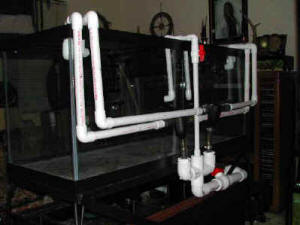 Over the top or through the panel/s
works for me.
Over the top or through the panel/s
works for me.