|
|
| Home | Marine Aquariums |
Freshwater Aquariums |
Planted Aquariums |
Brackish Systems |
Ponds,
lakes & fountains |
Turtles & Amphibians |
Aquatic Business |
Aquatic Science |
Ask the WWM Crew a Question |
| Please visit our Sponsors | ||||
|
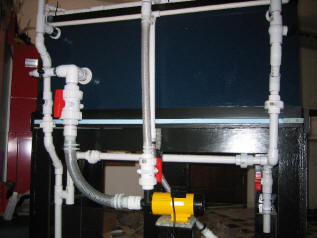
Closed loop... pb issue; cavitation from
too large pump, too small pb
8/11/14 Closed-Loop Manifold Troubles (Sometimes its All About the Nozzles) 07/14/08 Hi there to whom may answer to this mail and may I thank you for your valuable time in doing so it is greatly appreciated. <<Eric here a pleasure to assist>> I have nearly finished my latest project which is a 95"l x 36"h x 30"d acrylic tank <<Ah, some 440+ gallons (US)very nice>> with a 50"l x 24"h x 30"d sump <<Another 155 gallons (US)excellent!>> and a 36" x 12" x12" refugium <<Mmm, only 22g herewhats up with that! [grin]>> and a custom designed pre-sump filtration unit which is 12"l x 6"h x30"d. <<Pre-sump filtration? Interesting>> All the fittings have been glued to the base of the tank with standpipes within. I have 3 main overflows to the pre-filter which are all 2" schedule 80 fittings which follow suit in to the sump without any reductions in size. <<No wimpy undersized drains for youexcellent>>>> The return pump is a Tunze Master Electronic 1073.09 rated at 8,300l/h. <<Nice piece of gearand that relates to about 2180gphfor us colonials>> On the return side I have kept the 1 1/2" fitting from the pump then 'teed' off to 2 x 1 1/2" standpipes in the tank that are again 'teed' at the top and are reduced into a 1" outlet with a grate glued on the end so I have a total of 4 1" nozzles at the very top of the tank and slightly above the main drain level. <<Okay, so about 500gph per nozzle then (assuming a balanced flow)not much force from a 1 nozzle. This fine for simple water return, but you will need to supplement with some vigorous water flow using another method(s)>> I have tested this only by means of filling the sump and switching the pump on and to find that it works ok, needless to say that it drains the sump pretty quick and the flow out of the nozzles is pretty fierce, <<Really? Have you checked all four nozzles? 500gph from a 1 nozzle is certainly not fierce. Perhaps most of the flow/force is being channeled to one or two nozzles>> however I have not filled the tank entirely yet and am wondering if I have enough flow through the 2" standpipes to accommodate the pump. <<Should be fine Each 2 drain gives you about 1200gph of gravity flow rate, so three of them should handle your return pump just fine. And with a lot less noise and aggravation than if you had not supersized these drains>> What's making me ask this question now is that my main problem is of a second system namely a closed-loop which is annoying the living daylights out of me. <<Oh?>> This consists of a second Tunze Master Electronic 1073.09 as the heart of the circulation. <<Okay>> What I have done so far is place 2 x 1 1/2" pipes about 18"long so they sit about halfway in the tank <<Mmmis this coming up and over the top of the tank? Not the best, if so>> which then come together into the pump, there are 2 90deg. elbows, 1 equal 'T' and equal lengths of pipe connecting the standpipes, and then they drop 17" via a double union valve and another 90deg elbow into the pump. On the outlet side I have used the same return configuration under the tank, inside I have placed 2 x 8"standpipes which are then teed and reduced down to 4 x 1" nozzles on either pipe, so all in all there are 8 1" nozzles. <<Too many and too large for much useful/forceful flow here. Even if you were to bush these down to ½ nozzles, you still need 350gph per nozzle to get some vigorous flow going from the nozzlesand that what would mean a pump that provides at least 2800gph, likely more with friction/headloss. Considering the size of your tank and the size of the pump, I would recommend a maximum of five ½ nozzles for this closed-loop>> I did start with 12 nozzles but when I tried it hardly anything came out of them so I blocked off 4 and then tried again but still to no avail. <<Indeedper my previous comments (and a common mistake)>> I am not sure now what the best course of action to take is as I don't really want to block off anymore jets as they are hopefully going to make my 4 Tunze Streams redundant. <<Mmm, nopedepends on the size but, it would take a handful of the Master Electric pumps to equal the flow/benefit of the four Stream pumpsand at a greater cost in electricity and heat output>> I think the problem is with the inlet side of the pump as I think it is being starved of water through the 1 1/2" pipes. <<No, a true closed-loop does not have the same hydro-dynamic limitations as a gravity drain system. As long as you have matched the inlet port on the pump and are flooding the pump (i.e. the pump is not trying to pull water up to it) it is not being starved. The problem is with the size and number of outlets/nozzles, I assure you>> If so what would be easiest way of increasing the flow without drilling any more holes in the tank? <<Match the size and number of nozzles on the closed-loop to the flow rate of the pump used. Figure a minimum of 350gph for a ½ nozzleor a minimum of 650gph for a ¾ nozzlewith a bit more flow for each for even better results>> Many thanks, Jason from nice and wet Wales in the UK <<Happy to help matedo let me know if any of this is unclear. Regards, EricR from hot and sticky South Carolina (though I did live for 3 ½ years in pretty nice and wet East Anglia)>> Mis-Balanced Overflows/Closed-Loop 07/02/07 Hello! <<Howdy>> I have a RIO 2100 that was in my Miracle wet-dry that I replaced with a Mag 7. <<Okay>> I went to put the RIO back in the wet dry/sump, (no bio balls) and the water overflowed in my tank. <<This was in a addition to the Mag-Drive pump?overwhelmed the overflow drain>> Ok I shut it off went out bought an intake hose and box cause I figured there wasn't enough water to the sump. <<Siphon overflows, eh? Always a good idea to have more than one>> So I set up the extra intake for the sump and now the sump over flows. <<Something doesnt make sense here. It doesnt matter how many overflow drains you have on the tank, the total volume drained to the sump wont exceed the volume of water being pushed to the tank by the return pumps. With the pumps off, the sump should hold the transient water volume without overflowing (if not, the working water height in the sump is too high, the overflow boxes in the tank are positioned too low, or likely a combination of the two). This is the static water level within the sump. When you turn the pumps on, the water level in the sump should fall until enough water is pumped to the tank overflows to drain back down to the sump at the same rate it is being pumped. At this point the water level in the sump is at its working height. If this is too low (i.e. the pumps are sucking air/causing bubbles), merely adding more water to the sump will cause the sump to overflow when the pumps are off. You will need to experiment with the height of the skimmer boxes in the display tank to allow you to add more water to the sump to keep the pumps adequately submerged, but not overflow same when the pumps are off. You dont mention the dimensions of your sump, but another possibility here is that this vessel is merely too shallow for its intended purpose>> All I want is to get rid of the dumb power head in the tank and use my RIO 2100 to pump from a closed-loop to circulate. <<Mmm, do you understand what a closed-loop really is? Please read here and among the links in blue: http://www.wetwebmedia.com/pbretfaq3.htm>> Please help. <<Am trying>> It's a 54 corner so I have limited room underneath but I even tried to use a bucket for the loop with pump to no avail. <<Understood, but what you are trying to achieve (closed-loop) will likely not be possible utilizing a siphon overflow>> Thanks <<Welcome. EricR>> Closed-Loop Nightmare...Its In the Design
05/03/07 Thank you in advance for your help. <<Im happy to
assist>> I'm frustrated and don't know how to proceed.
<<Oh?>> I have been building a 120-gallon reef tank and
have done another fresh water test and cant seem to fix the
problem. I have a horizontal internal overflow that runs
nearly the length of the back of the tank, with 4 1.5 inch drains and 2
1 inch returns. <<Sounds very nice>> 2 of the 1.5 inch
drains go to my sump and refugium. The other 2 1.5 inch
drains come together with a wye to a 2 inch pipe that goes directly to
my Reeflo Dart pump and back to a closed-loop manifold. <<Mmm, I
think I know where this is going...>> The return pipe from the
Dart starts off as a 1.5 inch and then is reduced to a 1 inch as it
gets near the bulkhead. From the bulkhead it is reduced
again to a 3/4 inch pipe around the tank with 6 1/2 inch returns.
<<Sounds like a good design for the return manifold>> When
I just have the one pump on to my sump and refugium, everything works
perfect. Good flow, quiet, and no tiny air
bubbles. Perfect. <<Indeed>> However, when I
turn on the Dart pump for the closed-loop, all hell breaks loose.
<<Ah yes>> LOUD would be an understatement. <<Im
sure>> Not the pump, the water flow. (this is in my bedroom, so
quiet was the goal) The water flowing through the gutter
guard and over my overflow is like a faucet on high with so much flow
going through it. <<Yep...just what I would expect>> Since
the flow is so high its causing lots of bubbles in the overflow with it
looks and sound like they are getting sucked down the drain, causing
millions of tiny bubbles to come through the returns and every so often
it sounds like the pump "stops" for a second, like it
cavitates, the water flow stops and then instantly continues.
<<Yes...from all the entrained air>> This is going to be a
Acro tank, so I need the flow, but how can I control/stop the noise and
bubbles. <<I do have a suggestion>> I've taken this
thing apart too many times and almost done with this. I dont
think I can cut or glue any more PVC. <<Mmm...but will likely be
necessary to rectify>> Any help would be greatly appreciated.
<<Well Brian as you have noted, the high flow rate caused by the
closed-loop being plumbed through the overflow is causing a massive
rush of water in to the overflow chamber creating an abundance of
turbulence and noise...and maybe...is also partly due to the overflow
not being sized to handle this much flow. Since this is a
horizontal overflow, the option of using a modified standpipe to quiet
things down/reduce bubbles is unlikely unless the design is deep enough
to allow such. That leaves you with plumbing the closed-loop
outside the overflow chamber. I think your best option is to
drill the tank at some point below the horizontal overflow and install
the throughput(s) to feed the pump for the closed-loop...and yes, will
probably mean more cutting and solvent welding of PVC pipe>>
Thank you, Brian <<Regards, EricR>>
Drain Size and Noise...(Understand?...Soon Grasshopper) - 06/17/05 Ah. Now I understand. How much noise will there be with two 1.5" drains to the sump? <<If you're turning 1500 gph?...the larger diameter will help with air entrainment/flushing, but I think it would still be quite noisy. You're still processing/dropping a lot of water in to your sump. My suggestion would be to use just one of those 750 gph pumps for sump return.>> So there shouldn't be any noise associated with my closed loop system if I have a 1" gravity drain (hole at bottom of tank) that leads DIRECTLY to the 1200 gph pump, and little or no need for "dialing back" the return with a gate valve? (Will still have a gate valve on the return just in case) <<Don't think of the return for the closed loop as a gravity drain...it's not...it is the pump "intake" for the closed-loop. And no, you wont need to dial back the pump. That's the beauty of the closed-loop...you're pumping "in" exactly what you're pumping "out.">> K <<Do a key-word search of the WWM site for "closed-loop"...lot's more info for your edification. Regards, Eric R.>> Water Flow/Outlet Size And Closed Loops - 09/04/05 Hello Again, <<Howdy>> So happy you guys are there! <<And happy to be here!>> I just tested my system and am not happy with my return water flow. <<uh oh>> I have a Mag 36 in the sump returning water to the tank by 1" line thru back upper drilled hole in tank, this then goes to 3/4" loop around the top of tank and completes a loop. <<ok>> I have 7 'T' outlets on this loop. Only the first outlet gets any good flow, the rest slowly get less as it goes around the loop. I have about 10 ft. of head, even with that I should have 1800 gph. Did I hook it up wrong. I have 3 1.5" outputs going to sump with horizontal skimmer box, the flow seems to be there because the outflows are working good. <<I have no doubt the flow "volume" is there...the problem is in the application. To have sufficient "force" to be effective, a 3/4" outlet on a closed-loop requires from 600-700 gph of flow...conversely, a 1/2" outlet requires only about 300 gph. Assuming your flow calculation is correct, you only have enough flow for three 3/4" outlets...at best. To keep from having to cap off the majority of your outlets, use reducer bushings to reduce the outlets to 1/2" and employ a maximum of 5 or 6 outlets.>> Thank you in advance, Dan P <<Regards, EricR>> Manifold Flow...Why so Weak? - 09/26/05 Hi crew, <<Evening>> Can you give me some assistance with my manifold problem? <<Shall try>> Setup is: 60x24x24 display, 48x24x20 sump with 2 x 1.5" overflows from display into skimmer/heater chamber, middle chamber is a fuge and final chamber is the return pump which is an Aquamedic 6500. My guess is the two overflows will give me approximately 1000gph <<A reasonable volume to handle efficiently, yes.>>, the return pump is around 1400gph and the head is approximately 4 feet to my closed loop manifold. The manifold is all in 1" pvc pipe with 10 outlets. I put too many in so that I could play around. <<smart>> Only problem is that closing off certain outlets does not make an awful difference to my manifold flow, it's strong at the pump end and weak at the other. <<This is likely due to the outlets being too large. Try adding reducer bushings to bring the outlets down to 3/4" or even 1/2" to increase resistance/velocity. Also, be aware that you need about 300-350 gph per 1/2" nozzle for effective flow. That means if your estimating 1000 gph from your pump (after head, plumbing turns, etc.), you only have enough flow for THREE outlets.>> The return pump comes in at the back left corner of the manifold, Would moving the pump to the centre of the manifold make any difference? <<Little...if any.>> I guess if I reduce the outlets to say 0.5" this should help. <<I think it would, yes...as well as drastically reducing the number of outlets as previously outlined.>> Can you give me some advice please. I'm at work and should be working but I just seem to be mulling over the manifold flow problem. Cheers DaveG (UK) <<No need to fret mate, reduce the outlets as you have surmised, and consider the possibility of getting a bigger/more powerful pump. Regards, EricR>> - Return Manifold Problems - Terima kasih! (thank you in
Malay). <My pleasure.> Just discovered a problem with the
manifold return design (per your website recommendation), that the
return water is quite weak (powered buy a 4880 l/hour return pump). I
made 7 output/nozzles in the manifold return. Shall I reduce the number
of nozzles? <Hmm... probably only part of the problem... could also
be there are too many 90 degree turns in the entire piece of plumbing
and/or your pump does not do well under pressure.> I plan to cut it
down to half-manifold, is it ok? <I'm sure it will be.> Or
any way to improve the output pressure by not changing the pump?
<Hard to say exactly... certainly any place there is a 90, there
will be a reduction in flow... I'd eliminate as many as
possible.> Another problem with manifold is that it is just emerge
under the surface of water level, that it will mostly blow near the
surface area (even with 45% angle point down) rather than the bottom
level that see no blowing effect. Is it possible that we connect a
longer pvc pipe to T-join to point further down? <Sure... if you
want, although I'd use a powerhead or two to get additional
circulation within the tank.> A quick question on vacuuming the sand
bed... how to prevent the tiny sand(1mm-2mm grain size) of being sucked
up when vacuuming? <Cover it with a thin layer of heavier, larger
crushed coral. That and don't vacuum so aggressively.> Thanks,
your valuable input is truly appreciated. Best rgds, PJ
<Cheers, J -- > Closed return manifold bubbles 9/29/03 Ok, I understand that micro bubbles are from the pump eating air or small leaks in the pipe joins. Where would large bubbles come from in a closed manifold? All of the tees are blowing 1-5mm bubbles into the water column of my tank. The tee to nozzle join is sealed with silicone and I have double checked all of the other plumbing joints. Dave Lockwood <there are a couple of possibilities... the most likely being a venturi like action from outlets placed just slightly above the water surface (or half submerged). If instead your outlets are all submerged but you are still getting bubbles... there is clearly a leak in the plumbing somewhere that is aspirating air (pinhole in fittings, pump housing, etc). Do consider. Best regards, Anthony> Bubbles 1/1/04 I have a 72 RR Oceanic bowfront, and an Iwaki MD40RLT for the return. The problem I am running into is that the return is producing bubbles everywhere in the tank and clouding it up. I temporarily switched to an Iwaki MD20RLT from another tank with no problems whatsoever in this same setup, and using the same tubing. The sump is an Oceanic Model 1. There are no leaks, as I have checked everywhere and used Petroleum jelly where possible, and I also have used a sponge prefilter to attempt to reduce any other bubbles. However, neither of these methods have worked. Is this pump too strong for the return drain of the tank, and therefore producing these bubbles? I am using 6 feet of head total. Any advice is much appreciated. <Hi Brian. Adam here. I would suspect that one of two things is happening. Either your drains are producing a lot of bubbles that are being sucked into the pump or the inlet of the pump is vortexing (looks like a whirlpool above the pump inlet). Try placing a downward facing elbow on the pump inlet inside the sump or increasing the depth of the sump. You could also try placing a valve on the outlet of the pump and slowly decreasing the flow until the problem goes away. An Iwaki 40 is a lot of pump for a 72! HTH. Adam> Microbubbles...Big Trouble! Hello <Hi there! Scott F. with you today!> I recently added a downstream refugium to my sump for my 75 gal reef ready tank. I realize I need to remove the mechanical filter items like all of my sponges so that beneficial copepods & such can pass through to my display tank. I mainly used these sponges in the past to keep out the micro bubbles from entering my display tank. I also added 2 baffles and one bubbles trap which is about 2 inches off the bottom of my sump and 2 inches above the water level in my sump. This helped but I am still getting a ton of micro bubbles in the display. What can I do correct this? <A couple of thoughts here: First, I'd search your plumbing for the obvious...any loose seals or connections that are not 100% airtight. Even the smaller break in seal can admit air, which causes microbubbles. Another step that works is to employ large chunks of live rock (which is quite porous) to help "catch" some of the stray bubbles, or you can use a dense growth of prolific and beneficial macroalgae, such as Chaetomorpha, which forms a dense, yet permeable matrix, allowing some microfauna through, but perhaps trapping bubbles in the process.> I have tried adjusting the pvc pipe where the water enters the sump so it is below the water level, above the water level and I even tried drilling a couple of holes in the pvc pipe to let out air before in dumps into the sump but I continue to get a lot of bubbles. I should mention , when the water comes from the display tank, it comes down & enters pool hose which links directly to some pvc pipe in my sump. The pool hose dips in the middle (from the wait of the water) where it suspended in the air and then rises about 4 inches because the hose needs to connect to the pvc connection on my sump. This pool hose is constantly shaky from the force of water flowing thru it but also it gurgles & hick-ups quite a bit. I think this is from to much air getting caught in it. <Sounds like it...Exactly> I am just not sure why this is happening. I hope I am explaining myself clearly. Do you think this is the cause of my problem? <A very good possibility> Do I need to find a way level off the hose (eliminate the dip) to make the water not rise & essentially flow smoother? I am not sure if this will eliminate the gurgling/air in the hose or not. <I think that this adjustment is certainly worth the experiment on your part...try it and see> I also have a question about mushrooms. I recently purchased a mushroom rock that has about 10-15 mushrooms on it. How can I transfer these mushrooms to my main rock in the display tank. Is it best to break this rock into several small pieces & glue them to the rock in the display tank? <If you don't want them all on one rock-yes> I don't think I should pry them off the rock they are currently attached to. <No, you shouldn't> Is there better way to get them transferred/attached to the large piece of rock in my tank? Please let me know- thanks for your time -Anj <I like the idea of carefully chipping off small pieces of rock on which the 'shrooms are attached, then carefully gluing the rock in place where you want them on your reefscape. Good luck! Regards, Scott F.> Micro bubbles from closed loop 10/7/03 Dear Reefers, <I prefer it in brownies instead, if you must know. Mmmmm... brownies> Firstly a big thank you to Anthony and Robert ( not to mention Messrs Gonzalez ) <ahhh, Messr. and Madame Gonzalez <G>.> for penning Reef Invertebrates. I have just finished reading, and it is a 5 star book with no equal in its field. <an outstanding compliment taken with thanks. Please do tell a friend :)> Please help me with a problem relating to micro bubbles. I am nearly there with my set up but have hit a dead stop again and am running out of steam. <microbubbles are a common problem... if you have the energy, it has be writ about at great length in the archives here at wetwebmedia.com> I have a 90 US Gal tank with a 7" square corner overflow box, bottom drilled to take one 1" and one 3/4" connector. The 1" drains a modified ( to optimize siphon effect) Durso which comfortably balances an Aquamedic Ocean Runner 6500 ( i.e. 1,670 USG/h nominal - excellent pump) from the second of 2 daisy chained sumps. The return is via 1" hose teeing to a 1/2" pipe work loop round the top of the tank with 8 x 1/2" mid water nozzles and 2 bottom spray bars. This all works very well, but there is not quite enough turbulence. In your pbfaq9mar.htm - item headed Closed Loop System - you advise in response to a question " Would it be possible to place the intake [for a closed loop circulation pump] in the overflow box" answer "< Ideal as long as the box itself can handle the flow>". I have therefore followed this advice and plumbed the 3/4" overflow box connector ( with a short stub and inlet screen inside box ) via 1" hose to a Dupla Turbo 5A pump ( 82w, 620 USG/h nominal, 2600 rpm, 14 feet max head ) and fed this into the other end of the same return loop. <interesting/good> This now provides the necessary turbulence/circulation, as far as I can tell. However, the Dupla is creating micro bubbles - so I have come to a dead stop again. <understood... the (overflow) well is too shallow and we need to baffle the bubbles. It could be as simple as installing an inline coarse prefilter (like a tube cartridge with a foam block) and only need to compromise with the additional servicing (monthly/quarterly?) of this media> The Dupla is the source as I can hear the characteristic snapping sound from the impeller housing, and no it's not venturi effect. <understood> Unfortunately, the overflow box is black glass, so I cannot see whether bubbles are being sucked down into the inlet. <seems likely... else it is an aspirating breach (pinhole) on the pump housing or intake plumbing (unlikely)> The overflow seems to work fine and I have tried adjusting the Durso to bring the box water level up to the tank level and avoid bubbles being created, and I have covered the outlet with a 2" dia pipe and cap, to draw water from nearer the bottom, but with no effect. Is it possible to pull bubble free water from the bottom of my overflow box handling this flow rate? <yes... as described above with a coarse prefilter... Or... you can even plumb the prefilter on the outflow side of it all (in a place that is easier to service)> The Dupla only has a 3/4" inlet connector. I have used 1" hose (4 feet) to connect to the box outlet, with one 90 degree bend. Which is the more likely cause of the bubbles, the pump cavitating, or bubbles entering from the overflow box? <in this case... I'll put my money on overflow influx> If the former is it worth trying a restriction valve on the return hose from the Dupla? <an inexpensive option to try indeed... use a gate valve if you do> If the latter, is it practical to make an in line vessel to vent any bubbles without losing the head - i.e. by venting at tank level? <complicated... some flow will be lost indeed as per above res> If neither is possible, do I have to run the 3/4" outlet into the sump and use a second sump outlet to feed the Dupla? <not ideal> This would mean pumping against a 4 foot head, which I was specifically trying to avoid by using a closed loop. Given the choice, is pumping against a 4 foot head more or less efficient than restricting the output in a closed loop? <I cannot say without seeing/working with it> Finally, in general is there a better way to set up a circulation loop using an external pump to enhance flow/turbulence but at the same time avoiding micro bubbles or risk to the inhabitants from intakes? Many thanks, Eric Brightwell FZSL <the simple closed loop manifold works well and easily with properly sized sumps. The problem for most aquarists is that their sumps, overflows and refugiums alike are grossly undersized. Public aquariums for all of their success with fish longevity can ascribe much of it to stability in the standard of having as much water behind the scenes as on display. Does this mean that aquarists need a 100 gall sump for their 100 gallon tank - no. But it does mean that a 20 gallon sump is too small/turbulent. In this case, your problem is not that your overflow box is too small/turbulent (or rather... it is a by-product of the real problem... which is that the sump is not large enough and/or the drilled overflow holes are not large/numerous enough to handle a single and proper large return pump to single power the manifold. It sounds like the modifications you'll need to make here though are minor. No worries! Anthony> Closed return manifold bubbles 9/29/03 Ok, I understand that
micro bubbles are from the pump eating air or small leaks in the pipe
joins. Where would large bubbles come from in a closed manifold? All of
the tees are blowing 1-5mm bubbles into the water column of my tank.
The tee to nozzle join is sealed with silicone and I have double
checked all of the other plumbing joints. Dave Lockwood <there are a
couple of possibilities... the most likely being a venturi like action
from outlets placed just slightly above the water surface (or half
submerged). If instead your outlets are all submerged but you are still
getting bubbles... there is clearly a leak in the plumbing somewhere
that is aspirating air (pinhole in fittings, pump housing, etc). Do
consider. Best regards, Anthony> |
|
|||||||||

|
Features: |
|
| Featured Sponsors: |
 Look to your livestock (every time you are
about) for first and fast information re your system health.
UW scene...
some soft corals, hydrozoans, Ascidian... what have you.
Wakatobi pix.
Look to your livestock (every time you are
about) for first and fast information re your system health.
UW scene...
some soft corals, hydrozoans, Ascidian... what have you.
Wakatobi pix.