|
| |
|
Related FAQs: Halichoeres Wrasses,
Halichoeres 2,
Halichoeres
Identification, Halichoeres Behavior,
Halichoeres Compatibility,
Halichoeres Selection,
Halichoeres Systems, Halichoeres Feeding,
Halichoeres Disease,
Halichoeres Reproduction,
Wrasses, Wrasse
Selection, Wrasse Behavior, Wrasse Compatibility, Wrasse
Feeding, Wrasse Diseases,
Related Articles: Halichoeres N-Z, The Diversity of Wrasses, Family
Labridae, Cook Islands Wrasses,
/The Best Livestock for A Marine Aquarium
Genus Halichoeres A-M
To:
Halichoeres N-Z
|

|
|
By Bob Fenner |
Halichoeres ornatissimus
|
Seems like all large families have one, super-size catch-all genus. For
the Butterflyfishes, its Chaetodon, and for the wrasses, its the genus
Halichoeres. Burgess et al. (1990) list forty-seven species and there are more
(sixty two currently). Confusing
the matter is the typical morass of double and treble invalid classification of the same
species as more than such on the basis of sexual and developmental differences (which can
be quite striking with some). Many of the members of this genus are good looking,
peaceful, and stay relatively small. Germinal to their keeping is selecting initially
healthy specimens, providing a sand bed for digging and diving, and assuring their getting
their share of the food.
| Halichoeres argus (Bloch & Schneider 1801), the
Argus Wrasse. Indo-west Pacific. To almost five inches in length. This
juvenile in Fiji. |
|
| Halichoeres bivittatus (Bloch 1791), the Slippery Dick Wrasse (2), is a standard item
offered out of the tropical western Atlantic and an anomaly to me. This fish is neither
really very attractive or relatively hardy in captivity. To almost nine inches
in length. Bahamas, Cozumel, St. Thomas pix of juvenile and initial phase
individuals below. Terminal/male phase at right in Bonaire. |
 |
|
Halichoeres chierchiae Di Caporiacco 1948, the Wounded Wrasse (2) is a newer introduction to
the hobby from the tropical eastern Pacific that is gaining popularity. To eight inches
over-all length. Here's a near full-size male in captivity and a three inch
female off Mexico's Cabo San Lucas.
|
 
|
| Halichoeres chloropterus (Bloch 1791), the Pastel
Green Wrasse. Indo-Australia; Philippines to the GBR. To nearly eight
inches in length. One off of Pulau Redang, Malaysia, another in a reef
tank in Toronto. |
 
|
|
Halichoeres chrysus Randall 1981 (1), is a fish of two "good" and one bad
common name. It should be called the Golden or Canary Wrasse for its bright bold
sun-yellow color, but is most often listed as the Yellow Coris Wrasse (Arggghhh!, it is
not a Coris genus member of course). This is an exemplary aquarium species that is
suitable for peaceful fish-only and reef systems. To a mere 4 inches or so total length.
Aquarium juv. (and adult below) & S. Sulawesi photos. Eastern Indian Ocean distribution.
http://fishbase.sinica.edu.tw/Summary/speciesSummary.php?ID=4855&genusname=Halichoeres&speciesname=chrysus
|


|
| Halichoeres cosmetus Randall & Smith 1982, the Adorned
Wrasse. |
|
| Halichoeres cyanocephalus (Bloch 1791), the
Yellowcheek Wrasse. West Atlantic. To six inches in length. This terminal
phase individual off of Cozumel. And a nice supermale sent in by JonP...
below |

|
| Halichoeres dispilus (Gunther 1864), the Chameleon
Wrasse. Tropical Eastern Pacific; Sea of Cortez to Peru, including the
Galapagos. Solitary to small (three to five) numbers in a "traveling,
feeding" group. Pick organisms out of the substrate. To ten inches in
length. At right a male and female from Cabo San Lucas area, Mexico's Baja. Below,
initial phase, early male and terminal male in the Galapagos. |
 
|
| Halichoeres garnoti (Valenciennes 1839), the Yellowhead Wrasse (1) is another new choice out
of the tropical western Atlantic. To about seven inches long. More and more
available in the trade, and a beauty. At right a terminal phase individual in
Cozumel. Below are images of juvenile, initial
and terminal phase/male individuals. Second in Cozumel, all others Bahamas. |
| Halichoeres hartzfeldii (Bleeker 1852), Hartzfeld's
Wrasse. Western Pacific; Indonesia to S. Japan. To 18 cm. Usually
found over sand, mud or rubble in haremic groups of one male, a few
females. N. Sulawesi pix. |
 
|
| Halichoeres iridis Randall & Smith 1982, the Iris
Wrasse. Western Indian Ocean. To four and a half inches in length. A
recent, prized import into the aquarium interest. Captive image. |

|
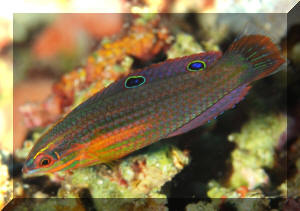
| Halichoeres kallochroma Bleeker 1853. To nine cm.
Similar to Thailand (to Indo.?) H. leucurus... this one off of N. Sulawesi. |

|
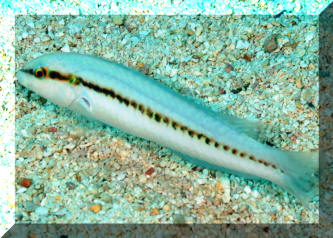
| Halichoeres leucurus (Walbaum 1792), the Greyhead
Wrasse. Western Pacific; Philippines to New Guinea, Indonesia, Micronesia.
To a bit over five inches total length. A female off N. Sulawesi. male off
of Gili Air, Lombok, Indonesia. |
  |
| Halichoeres maculipinna (Muller & Troschel 1848),
the Clown Wrasse. West Atlantic; Carolina to Brazil. To 18 cm. Juv. phase
in Turks. Initial
phase individual off of Cozumel and St. Thomas. |
| Halichoeres margaritaceus (Valenciennes 1839), the
Pink-belly Wrasse. Indo-Pacific. To five inches in length. Fiji and
aquarium images. |
 
|
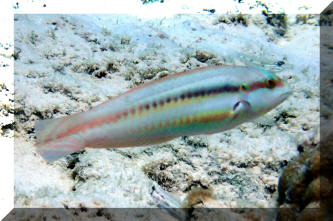
| Halichoeres marginatus Ruppell 1835, the Dusky
Wrasse. Indo-Pacific, including the Red Sea, out to Hawai'i and the
Tuamotus. To seven inches in length. Aquarium, Australian, Fiji images. |
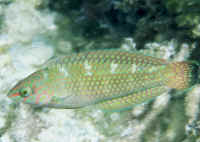
| Halichoeres melanochir Fowler & Bean 1928.
Western Pacific; Philippines to northwest Australia. To almost seven
inches in length. This female off of Pulau Redang, Malaysia. |

|
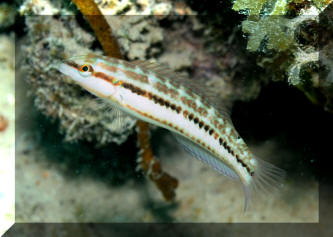
| Halichoeres melanurus (Bleeker 1851), the Tail-spot
Wrasse. West central Pacific. To five inches. An occasional import out of
Fiji. Initial phase in Fiji, terminal off Heron Island, Australia's GBR. |
 
|
| Halichoeres melasmapomus Randall 1981, the Cheekspot
Wrasse. Indo-West Pacific. To ten inches total length. Occasionally shows
up in our interest, often sold as a "miscellaneous" wrasse. This
juvenile photographed in the Cook Islands. |

|
To:
Halichoeres N-Z
| |
|