|
|
| Home | Marine Aquariums |
Freshwater Aquariums |
Planted Aquariums |
Brackish Systems |
Ponds,
lakes & fountains |
Turtles & Amphibians |
Aquatic Business |
Aquatic Science |
Ask the WWM Crew a Question |
| Please visit our Sponsors | ||||
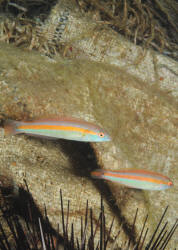
Golden Wrasse (Halichoeres chrysus), sys. req.
12/24/12 Christmas Wrasse...Neat Fish And I Want To Keep Him Happy! -- 06/03/08 I recently purchased a large Christmas Wrasse. <<A beautiful fish>> He's active and has a voracious appetite in the QT tank. I have two sizeable systems and am hoping you can tell me where you think he might be happier. <<Okay'¦I'm happy to proffer my opinion>> I have a very well established 900 gallon reef with about 400 lbs of rock, a 5-inch substrate base and a multitude of both coral and fish. The tank contains several scissor fish, a flame hawk, dogface puffer (I know, but he's sooo cute!. and FYI eats Aiptasia!) <<That's excellent re the Aiptasia, though it is likely sampling other organisms as well'¦but this may be of small consequence in this large system>> 2 chalk bass, 4 tangs, 3 clowns, 3 Anthias, a mystery wrasse, a scooter, 3 mandarins, a blue spot Jawfish, snowflake eel, a pair of cardinals, a magnificent Foxface, one blue chromis, one miniature lion, 6 blue eyed cardinals, one Humu Humu trigger, <<Mmm'¦you 'do' like taking chances with your corals>> a marine Betta. and a large cleaning crew. <<Sounds like a neat display'¦is certainly an interesting collection of 'reef' fishes>> My other display tank is somewhat smaller. It's a 400 gallon fish only tank with about 5-inches of sand but little rock. The tank is a Kreisal which I had originally set up for jellies. <<Oh?>> While I can adjust the flow, I'm stuck with a 9 ft tank that's 4+ ft high but only about 18 inches deep. At the moment there's one personifer, <<Mmm'¦might get a bit large'¦considering the shallow depth of the tank>> one scribbled rabbit, one Kole yellow eyed tang, 4 Pseudochromis, 12 pajama cardinals and several large starfish. The activity level of the Christmas Wrasse may upset the dynamic of the large tank, but I'm concerned that he may not have enough hiding places, cruising space and sand depth in the smaller one. I'd appreciate your thoughts... <<Actually Pamela, given the wrasse's potential size and aggressive nature I don't feel that either tank is 'ideal' for this fish (the first being that it is a reef tank'¦and the second with its odd dimensions)'¦but of the two, I'm thinking the smaller tank is the better choice with less chance for 'collateral' damage, given its inhabitants versus those in the reef tank. The 5-inch sand bed should prove adequate (unless this fish is 'really' large), and the minimal rockwork should not be a problem as this fish likes to cruise above the rock/substrate and is not 'shy' once acclimated. I should think the 9-foot length and 4-foot height should give the wrasse plenty of 'room to roam' for now. But, do be mindful the smaller fishes in this (any) system will likely be in jeopardy>> and FYI your site is simply the very best out there. Pamela <<We appreciate the kind words. Cheers, EricR>> Re: Adding a fish to my tank... - 11/13/06 Thanks for your reply! I looked up the canary wrasse and found that they will bury themselves in the sand when sleeping or fighting. Unfortunately, my tank has a bare bottom (no substrate), which I've chosen to promote circulation across the tank bottom and to prevent the buildup of detritus that could raise nitrate levels in the tank. So, I'd be afraid that he may be stressed if the rockwork doesn't provide ample cover for him in his first days getting established in the tank. <Mmm, providing a tray of soft, fine, roundish substrate in a glass or plastic container can/will work for such livestock> I've tried Banggai cardinals in this tank as well and, unfortunately, one was killed almost immediately by my angel, one lasted about a day, and the third went back to the store. So, they're not quite strong enough to keep this company. I do love wrasses and have looked at several others, including the fairy wrasses and flasher wrasses. Do you have any suggestions for these? <Yes... posted on WWM> I've also looked as some Basslets, including the Dottybacks. <Actually... Serranus are Serranids... Dotties in/of another family (Pseudochromidae)... closely related though> They're aggressive, but he would be going into the tank last and would have plenty of rockwork to establish his own territory. The only question that I have is whether or one would pick on the shrimp. Is that a likelihood? <Not likely> Thanks much! Deb <Mmmm, much more posted, searchable on our root web... a few tens of thousands of folks visiting daily... Bob Fenner> Halichoeres chrysus I would like to purchase a Halichoeres chrysus (yellow wrasse) for my 55g, however, I do not have sand substrate but crushed coral that is fairly course. Does this species "need" sand to survive? <Yes... you might be able to make a "bed" for this fish in a tray of a few inches depth made of glass or plastic...> I do have about 10 lbs of extra aragonite reef sand laying around that is extra from another tank. If I put a few heaps along the back wall or under some LR structures, would this suffice? <Needs to be deep enough for this fish to "get all the way under"> My only fear with this method is that the sand will simply fall through the "cracks" so to say of my 3-4" inches of courser substrate. Have you seen this method used, or have you any other suggestions? Thanks for the time. <Many wholesalers just use Tupperware or equivalent with fine coral sand... Bob Fenner> CJM Going Bananas For A Canary Wrasse! Thank you so very much Scott. <Always a pleasure to help!> I've done some looking on the web, and apparently they are a hard to keep fish?? How much truth does this hold (Canary Wrasse I'm talking about here). <To be quite honest, I have found these to be very easy to care for. They eat just about everything, and are quite active.> Is there anything I have to look out for.. need to do/change anything special that they require. Anything at all? <I'd just provide them with clean water, lots of rock, and a sand bed to bury themselves in at night. Quarantine them like any other fish, and provide a variety of foods to keep them healthy. If you are adding more than one, I'd put 'em all in at the same time for best results...Fun additions to any community tank! You'll love 'em!> :)cheers Thank you SO much for you help so far! Cheers Garth <No problem, Garth! Have fun with your new system! Regards, Scott F.> Going Bananas For A Canary Wrasse! (Pt.2) Thanks Scott. <Glad I could help!> I have about a 1.5" crushed shell grit base. Pieces being around 2-4mm in size. Will that be ok? <Well, I'd consider mixing in some finer sand with this material. The ideal stuff would be oolithic aragonite in the "sugar fine" size. Your present substrate would work, but I'd consider the finer stuff.> I have seen local dealers with this base used with the (as they call them banana wrasse) canary wrasse. But was after a professional opinion......... as said before I don't trust any LFS's. <Well, these wrasses are quite adaptable, but I'd opt for something finer and softer, just to be on the safe side. If the LFS has been keeping them in the more coarse material without incident, then it is certainly worth a shot...> A BIG CHEERS FROM DOWN UNDER <And a high five from the Northern Hemisphere! Send us some big waves soon, okay? Think you can do that? :) Regards, Scott F.> --Garth-- Substrate Material For A Canary Wrasse I have read that a canary wrasse required a sandy bottom to hide in if needed. I have crushed coral and Puka shells. Should I not get this fish? James Hall <Good question, James. I've kept these guys in both fine and coarse substrates, and they seem to find a place to sleep or hide in regardless of substrate type, IME. As long as you have rocks with good nooks and crannies for the wrasse to retreat to when he feels the need, you should be fine. While we're on the subject of substrates with this fish, these fishes display an unusual behavior that can confuse the unwary hobbyist into thinking that his or her wrasse is sick: They tend to dive towards the substrate and dislodge some grains of material with their snouts. This looks for all the world like the fish is "scratching" itself to relieve a parasitic itch, but it is simply a normal "hunting" behavior, in which the wrasse is trying to unearth worms or other benthic creatures for a tasty treat. Just another wacky behavior by these very cool fish! Regards, Scott F> Case of the Missing Yellow Wrasse...last seen in an uncycled newly set up tank (7-25-04) We just started our salt water tank yesterday and everything seems to be going well. We left for a little while and when we returned our yellow wrasse was gone. < Am I understanding this correctly....you started a Marine Aquarium yesterday and placed a yellow wrasse in the tank the same day? I hope I have misunderstood something here. If this is so someone gave you some very bad advice. > I heard that they bury themselves under the gravel, but how long do they usually stay there? Yes they do, they also hide in rock work and jump. That fish could be anywhere. > How long is it before it is unsafe? In terms of hiding I have seen wrasses disappear for a week to emerge just fine. However in an uncycled tank the fish is not safe at all. If the tank has not been cycled as I am understanding from what you have written you should find the fish remove it from the tank and return it to the shop that sold it to you as soon as possible. It will not survive the cycling process. > What should I do? <Biological filtration needs to be established prior to the addition of fish. This is accomplished by what we call cycling your tank. Please read the following articles ... Biological Filtration http://www.wetwebmedia.com/marine/setup/filtration/biological/biofiltr.htm Establishing Biological Cycling, Filtration in Marine Systems http://www.wetwebmedia.com/estbiofiltmar.htm and the related FAQs > I appreciate any information that you can give me. Thank you. < Your welcome, best of luck with your new tank, Leslie > |
|

|
Features: |
|
| Featured Sponsors: |