|
FAQs on Wrasses of the Genus Halichoeres
2
Related Articles: Halichoeres Wrasses,
Related FAQs: Halichoeres 1, Halichoeres Identification, Halichoeres Behavior, Halichoeres Compatibility, Halichoeres Selection, Halichoeres Systems, Halichoeres Feeding, Halichoeres Disease, Halichoeres Reproduction, Wrasses, Wrasse Selection, Wrasse Behavior, Wrasse Compatibility, Wrasse Feeding, Wrasse Diseases,
|
|
Established H. melanurus and new H. melasmapomus; stkg., comp.
9/14/18
Hi there! I have a long time established 4 foot long 80 gallon reef tank....I
have an established male Halichoeres melanurus, he is about 3 inches. I was
wondering if I could add a Halichoeres melasmapomus?
<Mmm; maybe. The genus does mix in the wild, but... a 4 foot long world of
eighty gallons isn't much space; room to move>
Would there be aggression issues from the melanurus?
<Possibly; I'd go w/ one decidedly larger or smaller if trying this>
Would this size tank work for the melasmapomus? My long time residents include
all Wrasses. One
pair of Macropharyngodon bipartitus, a pair of Macropharyngodon meleagris, and a
Macropharyngodon moyeri. Thanks so much for your help! You are all great! I am
also a huge fan of Mr. Fenner! I have most of his books!!
<Am a huge fan of Labrids as well Steph... As long as you have space to separate
them should there be overt trouble, I'd likely go ahead w/ this mix; OR add one
or more female/initial phase H. melanurus! Bob Fenner>
Re: Established H. Melanurus and new H. melasmapomus
9/14/18
Thanks so much for getting back to me so quickly! I also have another thought.
My LFS just called me to say he got in another M. Moyeri.
Instead of trying the H. Melasmapomus, do you think I might be able to pair my
current M. Moyeri? Thanks again!
<I do give better odds w/ this Leopard Wrasse choice. BobF>
Re: Established H. Melanurus and new H. melasmapomus
9/14/18
Sounds great! Thank you so much! Do you think a Labrids book might be in
the works from you???
<Oh Steph! I have maybe a third of the pix I'd like to show/use. Am sure friends
in the field would lend me theirs for publication... You do have the works by
Rudie Kuiter, Helmut Debelius, Scott Michael?
Are you a Facebook user? Do ask Lemon Tyk to become a friend; and you'll
encounter other wrasse investigators.>
I have both editions of your Conscientious Marine
Aquarist book. They have helped me for years! ��
<Ahh! Are you a dive traveler? Friend me on FB as well, and I'll add you to the
FB Scuba Diving Friends page and what it has to offer. Cheers, BobF>
Re: Established H. melanurus and new H. melasmapomus 9/14/18
Hi!! Yes the Wrasse book I have the Scott Michael one! Very informative!
Yes we are avid divers.....we are going to Cozumel in a few weeks!
<Oh! A fave dive island. DO check out (and book if you haven't made reservations
as yet) Iberostar (a resort to the south near the best diving); and the onsite
dive service: Dressel Divers. Have stayed, used them several times. Very nice
experience>
I can't
wait! Years ago before I had a reef tank, we were on a dive trip to Cozumel and
saw blue headed Wrasses! They were so friendly and not afraid of us. I was in
love with Wrasses after that.
<Ah ha!>
My highlight last year was seeing Caribbean Reef Squid. My husband has gotten
pretty good at taking
video and pictures under water.
<A fun skill for sure>
So we have pictures framed all over the house....he he! I will for sure go onto
Facebook! I would love to get your Wrasse book! If you need pictures of blue
headed Wrasses I have plenty of those! LOL!
Steph
<Cheers! BobF>
Re: Established H. Melanurus and new H. melasmapomus 9/14/18
Thanks for that info! I know of the Iberostar on Cozumel! I haven't booked a
hotel yet! I am checking them out now, and it looks like they have rooms
available!!! ��
<The whole co. is a great value IMO/E; have stayed w/ their newer property in
PV, Playa Mita as well. NOT a lot of diving possibilities there though. WOULD
like to find someone/folks who want to haul out to one of their Cuba prop.s. Oh,
do check the price on CheapCaribbean.com as well as direct>
The first time I was in Mexico, and the first time I saw the ocean was in 1986.
I was 12 years old. We flew into Cancun and then drove to Akamul, we spent 10
days there at this mom and pop hotel right on the beach, the rooms were right on
the sand.
<Ah yes; have done the drive all the way down to Chetumal; VERY nice still, but
not a fan of the build up that is Playa (del Carmen)>
No pool, no TV, no AC. I loved it! Swam with Sea Turtles, snorkeled in unspoiled
lagoons, it was great. I loved the culture, the people, and the ocean there. I
have been going back almost every year. Thanks for taking the time to help me
and give me excellent information about the Iberostar on Cozumel!
Steph
<Very glad to share w/ you. BobF>
Re new H. melasmapomus; beh.
Hi there! I had sent a email several weeks ago about the compatibility
of a H. melanurus and a H. melasmapomus. I decided to get the H.
Melasmapomus. He has been in my tank for two weeks today. He comes out
of the sand every morning and stays out only 10 minutes or so.
<A good start>
No aggression from any fish in my tank. He comes out at basically the
same time every morning, so I make sure and have Mysis thawed and ready
to go.
<Ah, good>
He eats really well, and then goes back into the sand. I stare at the
tank for the 10 minutes or so he is out, and he is ignored by all of my
fish, which consist of several Leopard Wrasses. Will this behavior
continue, and do you think he will eventually get comfortable to come
out for longer periods?
<Almost assuredly this fish will become more evident over time. Likely
out most of the time w/in a month or two.>
I have never had a fish do this. Thank for any thoughts and info! I
really appreciate it!
<Certainly welcome. Bob Fenner>
|
Halichoeres trispilus 11/21/07 Hi Bob,
<Peggy> I was sent a Halichoeres trispilus (didn't
order it), and I'm having trouble finding any information on
it. I presume it's not reef-safe and feeds on inverts based
on the very minimal info I've found. Can you provide some
insight to this fish please? <I wish I did know... this is
indeed a rarity amongst this super-genus... I did read on
Fishbase re... 9 cm. long... I suspect as you state that this is
an easier-going member of this usually placid genus... Sort of
like the "Yellow Coris" (H. chrysus)... I further
speculate that its husbandry is similar to all Halichoeres.
Please read here re: http://wetwebmedia.com/halichoeres.htm and
the linked files above> Many thanks. Peggy <Welcome! Bob
Fenner>
Re: Halichoeres trispilus 11/21/07 Hi Bob,
<Peg> Many thanks for your response. I had already been to
WWM and scoured the pages for info on this fish, and also the
information on fish base. It is strikingly similar to the H.
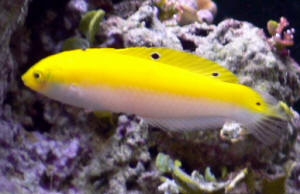
chrysus but is half white (entire bottom) and half lemon yellow
(entire top) and has 4 black spots from caudal area through
dorsal. I introduced this fish to a 125-gallon show tank with
mostly peaceful fish (there is a Six-Line) that also has a nice
deep sandbed. I haven't seen him yet this morning, but he did
only enter the tank at approximately 8:00 p.m. last night. I pray
he's ok. I take it very personally when I lose a fish.
<Ahh!> It doesn't happen very often. Will let you know
how or if he fares! <Thank you> One of my peeves is
receiving fish I didn't order, especially those that are
either rare and not much is known about their care or they're
predatory in nature. <Ah, yes... A VERY poor practice in our
trade. NOT one common amongst what I term the "A"
players... the best of our industry. No one should make
"free" unordered animals, NOR make summary
substitutions... In turn, such suppliers SHOULD contact their
collectors, transhippers... and DEMAND that non-ordered life NOT
be sent, indeed, NOT collected. Pardon my rancor here, please>
I know my vendor meant well, however, sending me this beautiful
fish. They take extremely good care of their fish and provide my
store with magnificent specimens. <Ahh, good> Thanks again
Bob, and do enjoy your turkey dinner! Peggy <Thank you my
friend. Peace and good life to you and yours. Bob Fenner>
Re: Halichoeres trispilus 11/21/07 You sound like me
when I open boxes of fish and find something I didn't order!
I rant and rave all over the store about having gotten something
I didn't order. I have limited fish space because everything
I do is reef-oriented, so I'm VERY careful about what I
order. I NEVER order anything that won't fare well in
captivity, and I think perhaps I turn customers away because of
it because I just tell them it's irresponsible and some
don't like it. I also ALWAYS put NO SUBSTITUTIONS on my order
forms. It's infrequent that I get them, for which I'm
thankful. I suspect this was my rep thinking he was sending this
fish to a place he knew would do its best to care for it. <I
see... am sure both you and I "wish" (as in "if
wishes were fishes we'd all have full tanks)... that such
issues could/would be better communicated... Perhaps in a better
universe> Many thanks again for your prompt response Bob. I
must again remark on what a downright nice individual you are.
You are a blessing to the entire industry and all hobbyists.
Peggy <Thank you my friend. BobF>
|
Re: Halichoeres trispilus 11/21/07 Oh joy Bob! The
H. trispilus is out and about and swimming famously and
picking at the rock in the 125! <It looks to be a very
nice specimen indeed> He's sturdier than I thought
in that he's taken a few shots from the Yellow Tang but
simply dashes out of the way and goes right back to his
business. He's a splendid fish! I've attached a
couple pretty good pics of him for you. Also, I have an
Australian Scott's Fairy Wrasse that I brought in to
add to my 180 display (I did order this one), and he is
finally out and about as well. What a relief. I've
coveted this fish for ages and finally decided to bite the
financial bullet and bring one in for display. He's
stunning. When he gets more comfortable and shows himself
more readily, I'll send a pic. <Thank you for
this> Off to scrub mix containers. Sounds fun
doesn't it? Actually, I love every minute of it. :O)
Peggy www.all-reef.com <Will post the pix with credit to
you Peggy. Thank you, BobF>
Re: Halichoeres trispilus 11/23/07
Hi Bob, <Peggy> In looking at the H. trispilus shown
on WWM, there surely is a marked difference in the color
morph. Do you think the fish I received is actually the
trispilus? I know color morphs vary from different
geographical areas, etc., but would it be this diverse?
Just curious and thought you may know. Hope you are
enjoying your holiday! Peggy www.all-reef.com <Thank you
my friend. You've seen the graphics et al. on the
general Net (Google images) and Fishbase.org for this
species? Your pic does concern me... for its resemblance to
an aberrant or cross twixt H. chrysus... and? And the
stated distribution of this fish. VERY few organisms are
collected in these areas that make their way into U.S.
markets... And I see you are located in MN... Is
possible... but... BobF>
Re: Halichoeres trispilus 11/23/07
I'm inclined to think it's a hybrid of the H.
chrysus judging by what I've seen of the trispilus
info. I guess I'll never know for sure unless someone
else comes up with something similar and it was in fact
collected in the likely area, etc. It is surely a beautiful
fish, and I'm not disappointed. I love them all. He
won't be for sale so there's no concern there.
He's for display only and makes a wonderful addition.
Many thanks Bob. Let me know if you happen to learn
anything contrary to our latest discussion.
www.all-reef.com
<Will do. BobF, now out in HI>
|
|
|
|
Can you ID the wrasse in the attached photo? -
05/29/06 < I will try my best! > I've looked at your
site and I think its a Coris venusta but its hard to tell. < It
closely resembles a Halichoeres melanurus male, but I have been
wrong before! > Also, when I put this three inch wrasse with a
big mouth in the tank a month ago my coral goby disappeared, do you
think the wrasse ate him? < I seriously doubt it. Not that it
couldn't happen. I would expect the wrasse to eat anything
small, but more along the lines of crustaceans and worms. >
Thanks
Matt
< You are very welcome
RichardB > |
| Wrasse ID - 05/29/06 Hi <Hello there> Can
you ID the wrasse in the attached photo? I've looked at your
site and I think its a Coris venusta but its hard to tell. Also,
when I put this three inch wrasse with a big mouth in the tank a
month ago my coral goby disappeared, do you think the wrasse ate
him? Thanks Matt <Is a Halichoeres species, see here: http://wetwebmedia.com/halichoeres.htm
and yes, could have consumed the Gobiodon. Bob Fenner> |
|
|
Radiant wrasse, Bailey's pod show 1/18/06 Dear WWM
Crew, <Belinda> :) It is with a heavy heart I tell you I found
our beautiful radiant wrasse dead in the tank today. My
guess is he died a day or so ago. I am not sure why as he
had been coming out regularly and was eating. Although he did not stay
out all day he was coming out almost every day. I did notice
that when we saw him out last he was swimming sort of humped, with a
humped back and I was afraid something might be wrong. Any
ideas? <Not a great answer, but "cumulative stress"
likely> I really hate it as we have a yellow wrasse that really
liked him. At least I think it is a yellow wrasse - it is
yellow on top white on bottom, with pretty green horizontal lines at
his head and tail. <Likely Halichoeres chrysus...> We
would really like to get another one or similar for him because he
became really excited and would try to get him to swim with him
constantly. Looking on www.liveaquaria.com site it looks like they have
a yellow wrasse, a neon wrasse, a Hoeven's wrasse, and of radiant
wrasse that looks in the same family as our yellow and white wrasse.
<See fishbase.org or WWM with the scientific names...> Do you
have a suggestion as to which might be a better friend? <Many
choices> We have tried to pair up as much as
possible. Our sailfin tang and bicolor Rabbitfish seemed to
have really hit it off and constantly swim around together. Also have
you ever consider doing a radio talk show called "aquarium
talk" - something like "car talk" :) <Yes... is done
by two (quite) old friends, Nevin and Tom Bailey... and of all things,
they live in the same town (San Diego). I should contact them to see if
they have a spot. Bob Fenner> Thanks so much, Belinda
Has This Wrasse Passed? - 12/12/05 Hello all:
<<Howdy>> Happy Holidays to the scholars of the deep!
<<Mmm, more like "students"...but thank you.>>
One week ago, I acquired a H. hortulanus and introduced it into the
display tank after performing the precautionary acclimation procedures.
<<No quarantine eh...>> The lights were turned off upon
introduction. The wrasse immediately swam to one of my live
rock stacks and has not appeared since. <<Not atypical
behavior.>> I realize that these wrasses bury themselves in the
substrate, but I would think that I would have seen it after one week.
<<One might think so, but I have a Macropharyngodon meleagris
that has stayed buried/out of sight for more than a week at a time on
more than one occasion...only to pop up again and resume
browsing/hunting as normal.>> I was discussing this with a fellow
aquarist and he volunteered the following hypothesis that he had read
in some periodical. The theory is that since these wrasses
bury themselves so deeply within the substrate, they penetrate into the
anaerobic portion and consequently are consumed by the bacteria and/or
waste materials in the substrate. <<Um...if this were true, would
they not be extinct in the wild? Do you not think there are
anaerobic bacteria on/in a reef/the reef floor? I don't
think is your issue.>> I would appreciate your feedback, as if
this is the case, then my days of purchasing Halichoeres wrasses are
over. Thanks, Mitch <<Fear not Mitch, the Halichoeres
genus are quite hardy (and personable) for the most part. If
the wrasse was not doomed from the start (poor
collection/transport/handling) then it could pop up
soon. Though do be aware, your specimen will grow to be a
bruiser at 12 inches. Regards, EricR>>
Wrestling With A Wrasse! 9/22/05 I am considering
getting a Radiant Wrasse to combat a problem with the Montipora
Nudibranchs. I've heard many reports of great success
with these wrasses, and they are gorgeous fish. <Yes they are! I
love Halichoeres species, and the H. iridis is one of my very
favorites! They are a bit touchy, however, and I have known several
people who have not been as lucky as I while acclimating them. Take it
really slow and be sure to quarantine them carefully.> Only thing
is, I worry about my cleaner shrimp (2) and my jumbo Tongan Nassarius
snails in particular, and the other snails and hermit crabs in
general. What is your experience with these fish and their
behavior towards these animals? Thanks, Joel <Well, Joel,
these guys have relatively small mouths, but they can and do pick on
small snails. In fact, I've had other Halichoeres wrasses (H.
melanurus, in particular) that have taken an almost sadistic dislike of
snails, literally bashing them out of their shells before dispatching
them! Generally, these guys are well behaved, but smaller shrimp,
fanworms, and snails are potential snack items if the fish feels so
inclined! I certainly feel that the potential risk is worth it for
their utility and sheer beauty, but you'll have to make the final
call. Good luck with this wonderful fish! Regards, Scott F.>
Weird unexplained wrasse problem! 9/19/05 Hi WWM crew!
<Samuel> I have used you archives many times in the past and they
have never failed me, thanks for that! <Welcome> This time, I
have found a few cases similar to mine but none were resolved or
followed up!!! (uh-oh) I have a wrasse (Halichoeres melanurus) I think
it is also called a Tailspot wrasse? <Yes, one common name> I
have had it for 18 months or so and someone else had it prior to that
for a year. I have never had any problems with it but recently
introduced a bicolour angel straight into my tank after my quarantine
tank sprung a leak after only a week of the angels quarantine. The
angel is great (if a little shy and reluctant to take food amongst
other fish) But my wrasse has several problems. It seems to have its
mouth permanently half open and constantly head butts the front glass
with its mouth (no visible damage yet!) But I have seen it quite a few
times spontaneously shaking quite violently - one time for a few
seconds (very distressing for me and him!) <Not good> It has also
had some unusual swimming patterns - up and down up and down in the
same spot. It is eating as piggishly as ever and still buries at night.
There are no visible signs of disease or parasite within 4 - 5 days of
the behaviour. My only thought is some internal parasite but I thought
they usually affected appetite! AHH Help me please! Thanks so much
crew! <Much more likely a degenerative condition born of nutritional
deficiency... I would quickly start supplementing its foods by soaking
in a prep. like Zoe, Selcon... Bob Fenner> New slippery dick
wrasse 9/12/05 We just picked up a juvenile slippery dick
wrasse yesterday and put him in our quarantine tank (after a two hour
acclimation period). He immediately went to the bottom and
was laying on his side breathing heavily but not gasping. <Not
atypical... this is a very active species, that in shipping, runs out
of oxygen easily> He would go upright but then slowly sag to the
side again. He eventually made his way into one of the pvc
pipes where he spent the night. He is still there this morning, still
on his side and still breathing rather heavily but not
gasping. Should we be worried about this
behavior? I know they like to bury themselves in the sand
but had not heard about them lying on their sides like this. Thanks for
your help, Sally <Need to be moved expediently, packed with oxygen
(which also exerts an anesthetic effect)... in the dark... acclimated
quickly... Hopefully yours will make a full recovery. Bob
Fenner>
Hiding Christmas wrasse 9/5/05 Hello Everyone,
<Hello> I bought
a Christmas Wrasse on Friday. They had just gotten there
shipment in an hour ago from Hawaii. When I saw him he
looked really healthy and active. I bought him and put him
in my 55gal. tank as my last fish. He swam around for about
15-20 minutes I went away from the tank for a few minutes
and when I came back he was gone. I do have 25lbs. of live
rock so there are places to hide. I have checked around
the tank and I know that he didn't jump. The tank is
covered with crushed coral over an undergravel filter. The
crushed coral is about 1cm. in diameter with lots of
small shells in it. This is the third day of hiding. I
haven't seen him since about 8pm.EST on Friday. I
don't have any overly aggressive fish. When I put him in
none of the fish were really bothering him other than
the usual new tankmate curiosity. Thanks for your help
<It's disturbing to hear from someone that purchases a fish
without knowing all the requirements. Wrasses like to burrow
in the sand at night, not crushed coral, it's a little rough on the
skin. Please search "wrasses" on the WWM and read.
James (Salty Dog)>
Re: Hiding Christmas wrasse 9/7/05 I usually do lots of
research on a fish before buying it. But I had a hard time
finding any information on it. I did know that it is reasonably easy
to keep and gets about 6". I completely forgot most
wrasses like to bury themselves. Mainly because I have a
blueheaded wrasse and he doesn't bury himself.
Do you know if sand would work with an
undergravel filter? <No, if you have live rock the UG
isn't needed. They are also potential nitrate factories
if not cleaned regularly.> I was wondering if it would clog it. I
still have not seen the wrasse. Is it normal for new
additions to hide for this long? <Very possible. Try
keeping the lights off for a few days, it aids in their ability to
adapt. Also, please reply to the original message in the
future so we know where to direct the mail. James
(Salty Dog)> thanks for your help <You're
welcome>
Checkerboard wrasse? 7/7/05 Hello, just have a quick
question. I have the opportunity to purchase a checkerboard
wrasse, I was wondering if it was reef safe, mostly coral
and clam safe. < Yep, sounds safe to me. It may pick at
some small inverts but overall a very safe fish. > The wrasse is 4
inches long right now and would be goin into a 135 gallon with 150
pounds of live rock. are they finicky feeders? < I don't believe
so. Having lots of quality live rock will certainly help,
and really any balanced foods will be fine. > and I have a 2 inch
six line will this be a problem? < Should not be a problem in a tank
that size. > I understand the wrasse gets to 12 " and I'm
under stocked on fish right now. < So far I think you would be
fine. If it ever gets that big you can get rid of
it later, but that would be years down the road. > <<I'd
rate Halichoeres wrasses as "medium" in the reef safe
category... RMF>> thanks a lot Tristan
< Blundell >
Stocking A Super Reef Tank (Cont'.) Hi Scott, I'm so
excited! Today I added 3 Canary Wrasses to the tank.
<Awesome! Great fish that can really add some color, personality,
and excitement to a tank!> The LFS ordered them in. All
ate at the store and were swimming out in the
open. Apparently 3 more were hiding in the
sand. I brought the outgoing ones home, gave them a 5 minute
fresh water dip and put them into the tank. The dip is good procedure,
but do try quarantine next time...> To my surprise, they all simply
started swimming in the water column. They never hid in the
sand or the rocks. So far, 5 hours later, none of the fish
seems bothered by the change. The new wrasses are eating off
the rock and ate some homemade fish food. <Great to
hear. They really are a pretty perfect reef fish. At night, they may
bury themselves in the substrate for protection, but they will
typically remain out in the open all day.> They're a beautiful
addition and seem very gentle. It was the perfect
suggestion. <I'm really glad you like them! They'll just
become more and more attractive and outgoing as they settle in.>
Thank you! Next fish is a Lyretail Anthias when a nice one
shows up at the LFS. Nancy <Keep me posted, Nancy! Good
luck! Regards, Scott F.>
|
|

