|
FAQs on Banner Butterflyfishes
Identification
Related Articles: Heniochus Butterflyfishes,
Related FAQs:
Banner
Butterflyfishes, Heniochus Behavior, Heniochus Compatibility, Heniochus Selection, Heniochus Systems, Heniochus Feeding, Heniochus Disease, Heniochus Reproduction, Chaetodonts:
Butterflyfish Identification, Butterflyfish Behavior, Butterflyfish Compatibility, Butterflyfish Selection, Butterflyfish Systems, Butterflyfish
Foods/Feeding/Nutrition, Butterflyfish Disease,
Butterflyfish
Reproduction,
A pair of H. intermedius in the Red Sea.
|
.JPG)
|
 |
Butterflyfishes for Marine Aquariums
Diversity, Selection & Care
New eBook on Amazon: Available
here
New Print Book on Create Space: Available
here
by Robert (Bob) Fenner |
|
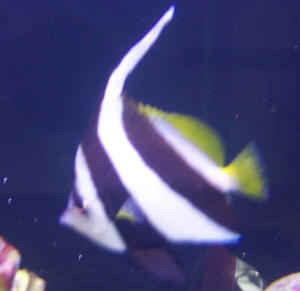
Fish ID Question 5/23/13
Hi,
I love your website.
I have what I thought was a Heniochus diphreutes in my
tank,
<Mmm; yes>
I had initially believed it would be reef safe.
<Not always...>
He is very peaceful when it comes to his fellow fish in the tank, but he
is nipping a lot when it comes to corals (there is damage). The
corals he favors are Palys, candy cane, and Duncan. He is very
well fed, so I don't believe his nipping is out of frantic hunger. I
have attached a picture for your input (please let me know if the
picture is a good enough quality). Is he a H. diphreutes or is he
a H. acuminatus?
<Appears to be the former... little mouth, rounded "breast"...>
I am having a lot of trouble distinguishing between the two.
<See WWM, other places re... easy to distinguish seen side by side>
It may be time for this guy to find a new fish only home, which is a
shame because he is truly awesome to watch.
Thank you
AD
<Thank you for sharing. Bob Fenner>
|
 |
Neale and Bob on Heniochus acuminatus
4/29/13
Hello Bob,
So tell me, why is Heniochus acuminatus called the "Poor Man's Moorish
Idol".
<Less money...>>
> Is it not the "Wise Man's Moorish Idol"?
<Ahh! My fave name (Deutschen) translates from Wimpelfisch... as in the
tall feather in some hats>
> I was under the impression Moorish Idols did poorly in aquaria.
<Oh yes... and the ones that live are quarrelsome>
> Cheers, Neale
<And you, B>
Heniochus ID/Copyrighted Photos Query 11/1/09
Dearest Crew and Bob,
<Howdy Jillian>
Again, thanks so much for providing WWM. This is truly enjoyable
resource and there are always new things to discover on it!
<And to add!>
I was not able to find much pertaining to my question so here goes.
I am very interested in the Heniochus butterflies, specifically the
diphreutes and acuminatus species. I have researched the
similarities/differences between the two extensively (body and snout
shape, stripes and markings) but have little "hands-on"
experience with them. You can do all the reading in the world but
without seeing the two next to each other in the same tank, it's
difficult to differentiate.
<Yes>
I have found a photo on the web that I believe shows the two species in
the same system but have not attached because I am not the owner. I
know that copyrighted photos are NOT to be published without owner
consent and wanted to ask if it was ok to request an species
identification from you for my
own education without posting on the site. If so, I will attach in
another email.
<Sounds fine. Please do re-mention that this pic is not yours and
I/we will avoid posting it>
Lastly, thanks again for all of the wonderful photos that have been
posted and archived, especially the dailies! This is a wonderful
educational resource!
Jillian
<A pleasure to share. Bob Fenner>
Re: Heniochus ID/Copyrighted Photos Query (RMF should have
asked for the URL to refer!) 11/1/09
Bob,
<J>
Thanks so much for your time and world-class expertise!
<Welcome!>
I have attached the Heniochus photo. To clarify, this is not my own
personal photo and do not have permission from the owner to
publish.
<Understood>
I believe that all pictured butterflies are Heniochus acuminatus with
the exception of the one at the top left, this one being A. diphreutes.
The shorter body length, shorter snout, and rear black stripe that
extends all
of the way down (I think) indicates this. Also, regarding the white
space between the rear black stripe and the yellow, the area appears to
be comparatively reduced. The eye stripe also appears to be blacker,
masking the eye more.
<Mmm, I think these are all H. acuminatus>
Are these traits indicative of Heniochus diphreutes? I would greatly
value your expert opinion. I may very well be incorrect on this
identification.
<H. diphreutes has a much more "rounded, attenuated" mouth
appearance.
There are other diagnostic features listed by Gerald Allen in his Bfly
books...>
Thank you!!
Jillian
<Again, welcome. BobF>
Re: Heniochus ID/Copyrighted Photos Query
11/14/09
Dear Bob,
<Jill>
Thank you so much for your reply and I apologize for my tardiness in
responding.
<No worries>
In an ongoing attempt to understand the differences between Heniochus
diphreutes and Heniochus acuminatus, I have done more research but
still feel like one must have "hands on" experience with the
two.
<Agreed. I have seen both species sold as t'other repeatedly;
even mis-identified in bound volumes>
One follow up questions if you would be so kind: do you believe that
the photos posted on Wikipedia,
http://en.wikipedia.org/wiki/Heniochus_acuminatus
<I do agree with what is stated here, the IDs of the photos>
http://en.wikipedia.org/wiki/Heniochus_diphreutes
<And agree with these as well>
for the two are the true species stated?
<Yes>
I noticed that the acuminatus seems to have a somewhat large mouth
while the diphreutes is a little harder to discern.
<Yes. Really only easy to tell if both are on/at hand... alive... or
for morphological comparison, dead. To paraphrase from the Allen's
and Steene's last Butterfly and Angel book (1998), for H.
acuminatus, "Nearly identical to H. diphreutes, which has more
rounded breast, less protruding snout, and its second black band ends
at corner of the anal fin (ends just behind corner in H.
acuminatus)>
Upon you recommendation, I have ordered Gerald Allen's book. Thank
you so much!
Jillian
<Am sure you will enjoy, benefit from its perusal. Cheers!
BobF>
Re: Heniochus ID/Copyrighted Photos Query
11/14/09
Dear Bob,
<Precious Jillian>
Thank you so much! I do think that I'm beginning to understand. The
contour of the breast and mouth seems to be the most obvious factor in
identifying Henis.
<Ah, yes>
I do hope that I will be able to identify them when purchasing. I may
also decide to order from Liveaquaria.com if they are able/willing to
discern the two.
<Am sure the folks at this excellent company will do so. H.
diphreutes is actually rarely imported... due to the abundance of its
look alike in closer collection areas to the U.S.>
Lastly, thank you so much for the amazing daily photos! You really do
have
an amazing eye (am assuming that you took most of these!). Thank
you!
<Welcome dear. BobF>
Heniochus Butterflies Hi Guys- First of all, I want to say
GREAT job on the book. I received my autographed copy a
couple of weeks ago. It was well worth the wait.
<Thank you for your kind words> Second, I am in the process of
trying to obtain a couple of Heniochus Diphreutes. My LFS
has a couple of beautiful 2 1/2" Heniochus' that arrived last
week that are in quarantine. Unfortunately, the LFS cannot
be sure whether the fish are H. Diphreutes or H.
acuminatus. Since I plan to introduce these fish into my
reef tank, it is important that I get the H. Diphreutes. Can
you recommend a way to differentiate between the two fish? <Mmm,
easier to do with both species in front of you. Please see here:
http://www.wetwebmedia.com/heniochu.htm
where both are presented... with the most common differences noted
(size of mouth and "chest" area> Also, how important is it
for H. Diphreutes to be in a "school". They are
going into a lightly stocked 135G tank (2 ocellaris, yellow tang, royal
Gramma, C. solorensis), but I imagine more than one butterfly will eat
up the living space pretty rapidly. <They do show best kept in a
couple... Bob Fenner> Thanks, Bret Packard
Heniochus identification Hi Crew,
This one's been on the chat forum for a
week with no takers, so I thought I'd see if y'all (southern,
non genderized version of 'you guys') could help.
I'm 3 months new to the hobby and trying to
build toward a reef tank by learning the basics with a few fish that
won't have to be gotten rid of as I add more invert's over
time. LFS has some nice Bannerfish that
they've labeled as 'Heniochus butterflies',
which they obviously are. Sixty-four dollar question is are they H.
diphreutes or H. acuminatus. My readings have convinced me to avoid
acuminatus (Longfin), and likewise that diphreutes (schooling
Bannerfish) should be more 'reef-safe'. <Mmm, six of one...
Mostly the trade sees H. acuminatus... though diphreutes does come to
us via Hawai'i occasionally...> I've read what I can find on
differential ID between the two and am aware of the points made by
Scott Michael. Unfortunately without both species to compare
simultaneously I just can't be sure which species these fish really
are. Any suggestions? <Side by side these two are unmistakable...
but not having both, hard to discern by description. H. diphreutes
really has a "little mouth" is my best discriminating
factor... though the banding color differences are noted on WWM>
Thanks in advance for your consideration and
for all the fantastic support "y'all" provide the hobby.
Your website and books have already provided tremendous assistance even
in my short time in the hobby. Keep up the great work! Florida Boy
<Glad to find we've been of service. Bob Fenner>
|
|
Butterflyfishes for Marine Aquariums
Diversity, Selection & Care
New eBook on Amazon: Available
here
New Print Book on Create Space: Available
here
by Robert (Bob) Fenner |

