|
|
| Home | Marine Aquariums |
Freshwater Aquariums |
Planted Aquariums |
Brackish Systems |
Ponds,
lakes & fountains |
Turtles & Amphibians |
Aquatic Business |
Aquatic Science |
Ask the WWM Crew a Question |
| Please visit our Sponsors | ||||
Identifying parasite or bacterial infection
11/10/15
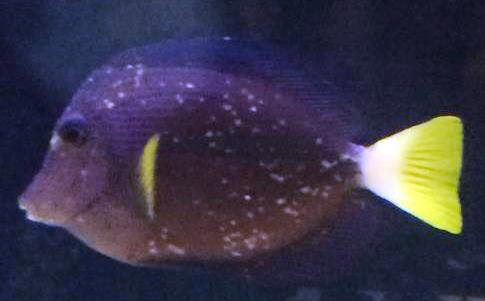
Red rimmed mouth on a Tang Hey Bob I have a Sailfin Tang with a red rimmed bloody looking) mouth. He also is showing faded color (Like nighttime colors). I assume the color is do too stress. <Yes... not good all the way around> And assume the red mouth is the cause. <Hmm, "per accidens" perhaps... that is not the ultimate cause... that would be what resulted in the red mouth condition...> I've looked up every disease reference I can (book and online) and have not found a disease that seems to be what the Sailfin has. I know it could be from fighting or slamming into rocks/tank sides. <This is the most likely possibility> However with close observation I am not seeing any of these behaviors. There is a 3 week new Asfur Angel in the tank (A 90gal FOWLR) and the tang and the angel tussled on the first day. However they seemed to be getting along fine after the first day. No obvious attacks. The other inhabitants of the tank are smaller and less likely to be the culprit (Tomato clown, algae blenny, Juv shy hamlet, small yellow tail damsels). <Well... the reddening is due to either physical trauma and/or bacterial or other microbial involvement... and "curable" through good husbandry, time going by... hopefully this specimen is still feeding...> My water tests out with no measurable nitrates, nitrites, ammonia, etc. I do have a UV filter and protein skimmer, as well as a canister filled with bio-filter media. I water change 10gals every 2 weeks. No other fish has any sign of disease and all, including the tang, are eating great. I feed a mix of frozen angel food, a homemade frozen "Selcon soaked prime reef with Nori", and a "veggie" frozen commercial fish food. I have grape Caulerpa, hair algae and a small amount of feather Caulerpa growing in the tank. <Sounds fine> So, my question is: what does he possible have, and what do I do about it? Sorry, I wrote you a book! I am going to get one of the fish conditioners that increase slime coat and dose the tank to maybe prevent any secondary infections. Thanks Rich <My take is about all summed up above... something triggered a trauma and infection to the mouth of this fish... no dip/bath, addition to the water, physical manipulation will aid it in recovery... do as you relate here... keeping the environment optimized and stable and hopefully this problem will resolve. Bob Fenner> Yellow Tang Turning Red. Why???? hi, I am new to this hobby,
6 months and unfortunately have not heard of you. but the great people
at ReefCentral message board told me to ask you this question. Here is
the thread to what has been said I would appreciate it if you can take
a look at it and tell me what you think:
www.reefcentral.com/vbulletin/showthread.php?threadid=20967 <Hmm,
many good suggestions offered here... on the why's of your Yellow
Tang being "reddish"... Do agree that this sort of
"petecchial" markings are often directly related to poor
water quality, nutritional deficiencies, possible bacterial problems
internally... and the suggested choices for improvement: pre-mixing and
storing your new synthetic seawater, improving diet.... I would do both
of these, suggest you soak Nori, other human-intended algae in a
vitamin preparation like Selcon... ahead of offering... Possibly add a
Cleaner organism as well... Please do read over the "Yellow
Tang", "Environmental Disease",
"Foods/Feeding/Nutrition" sections and FAQs on our website:
www.WetWebMedia.com for background, and hopefully something's there
will jog your memory/observations as to primary causes.> thank you
very much and I hope to learn about you and info from you thanks again
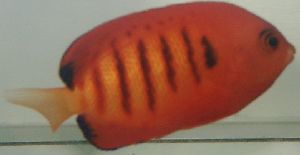
Brian a.k.a. stars360 <Bob Fenner> Ich/Bacterial Infection Bob, What is the best way to treat for a bacterial infection on multiple fish in a FOWLR system? <Hmm, best? If necessary, to add specific antibiotic/s to the animals' feeds... in addition to manipulation of the physical environment... And of course: first checking all aspects of water quality, possibly adjusting... using ozone, UV... to reduce overall microbial populations...> I need to treat them in the tank as the fish (Foxface and regal tang) barely get along in a 75 g tank let alone a 10 g q tank. They both came down with Ich as well but I have that under control with a temp of 84, salinity of 1.017, two 40% water changes a week apart, and a cleaner wrasse who eats VibraGro as well as Ich. Anyway, I cannot seem to get rid of the cloudy eyes that are typical of a bacterial infection. <This condition is environmental in etiology... not bacterial...> LFS suggested replacing carbon, soaking food with quarter capsule of Furacyn for two weeks, and constantly checking Ammonia levels. What do you think of this approach? <Agree with all but the Furacyn...> Both of these fish look great except for the eyes. These two fish eat like horses and show no signs of rapid breathing or sluggishness. The other fish in the tank (mated Percula clown pair, yellow Coris wrasse, and potter's angel) look great as well. Please let me know you views on suggested treatment and if you can offer a better alternative. <I would not worry about the clouded eyes per se... and would replace these specimens all in the main tank... the eyes will cure on their own over a period of weeks to a couple of months. Bob Fenner> Regards, Tyson Help -- what kind of fish disease is this? Mr. Fenner, Yesterday evening when I came home from work, I found my Threadfin (Auriga) Butterflyfish has something strange -- the 'root' part of both of its pectoral fins (the joint between the fin and the body) is very [b]red[/b]. I've had this fish for about a year. It is swimming and eating as usual. This occurred overnight. What is this? What should I do about it? <Very likely an indication of infectious activity (bacteria) from a physical trauma (if one sided... if both pectoral bases affected would be inclined otherwise). I would do your best to keep the system optimized and stable, and supplement this fish's foods with a vitamin and iodide preparation (such are made/sold for the purpose, or you can make your own). Please read over the "Tank Troubleshooting" and especially "Three Sets of Factors That Determine Livestock Health" sections and beyond on our site starting here: http://wetwebmedia.com/mardisease.htm Bob Fenner> Thanks, Jason Re: Help -- what kind of fish disease is this? The red is on BOTH sides. uniform around the joint. like you said, it doesn't look like physical injury. What others could this be? <Sorry about the mis-read. Would look into water quality first/foremost here. This and most Butterflyfishes are often the first fish livestock to show the affects of something/s anomalous. Bob Fenner> thanks, Jason Bacterial Problems in a Reef? Hi Bob, <Steven Pro in this evening.> I've been throughout the site and, as a person new to marine aquariums, have found it very helpful over the past few months. <Glad to hear it.> I keep a 60 gallon reef tank and 10 gallon quarantine/medicating tank. <Good for you on the quarantine/hospital tank.> Over the past week we've been one-by-one losing our fish to various bacterial-type diseases. Here's the sequence: 1. Existing happily in our 60 gallon reef were a Kole Tang, Royal Dottyback, two False Clowns, a Pajama Cardinal, and various invertebrates. Existing happily after recovery from Ich in our 10 gallon quarantine were three Green Chromis. Two of them were to live there permanently to keep the biological filter alive. It's a simple undergravel filter system with two powerheads running it. <Far better ways to setup a quarantine tank are outline under the FAQ files.> 2. We purchased a Lyretail Anthias and a coral beauty, did a Methylene blue dip, and put them in the quarantine tank. The quarantine tank already had about 0.20mg/L copper running as part of treatment of Ich that the Green Chromis developed shortly after purchase a week prior. That same day, we purchased 1/2 ounce of live brine to feed our fish. <I did want to point out that the minute you put any new fish into your quarantine tank, their quarantine time period starts all over. Also, that is an awful lot of fish to put into a 10 gallon tank.> 3. The live-brine were fed to both tanks. Three days since step #2, the Kole Tang quickly sank to the bottom of the 60 gallon reef and hours later died. <Ok. Not really a symptom of any disease. Possible contamination of some sort, but just a guess.> 4. Three days after that, the Lyretail Anthias in the 10 gallon for quarantine developed Popeye symptoms. <Most often associated with physical damage.> I purchased antibiotic water treatment tablets and started treating the 10 gallon tank. Knowing this would kill the biological filter, <FYI, copper is pretty hard on your biological filter, too.> I needed to relieve the overcrowding in the 10 gallon tank. Since the Coral Beauty was acting and looking healthy and it had been a week, I moved it to the 60 gallon tank. <A bad idea.> 5. A day later, the Royal Dottyback in the 60 gallon tank developed ulcer-looking red spots near its tail and stopped eating. <Sounds bacterial in nature, but caused by what, I do not know.> We moved it to the 10 gallon quarantine tank. 6. A day later (Sunday), the Coral Beauty now in the 60 gallon tank developed Popeye symptoms and we moved it to back to the 10 gallon tank. The seemingly healthy two Green Chromis were moved to the 60 gallon tank to relieve overcrowding. <If this were communicable, you definitely moved it around. Please read up on proper quarantine procedures.> 7. A day later (Monday), the Royal Dottyback died and the Coral Beauty was sideways on the bottom breathing heavily. I euthanize it. 8. Today (Tuesday) the Lyretail Anthias looked so near death that I had to euthanize it. Both False Percula Clownfish died. In the 60 gallon tank, our Pajama Cardinal is showing a little clouding in one eye, but is still eating and the three Green Chromis all seem happy. <I think you have some sort of contamination. I hate to say it as it is usually what you guess once you rule everything else out, but your symptoms are very peculiar.> Water quality in the 60 gallon reef has been fantastic throughout this...0 ammonia, nitrites, nitrates, pH 8.3, S.G. 1.024. Water quality in the 10 gallon has been marginal...0 ammonia, pH 7.9, copper and antibiotics present in the water. Now the questions... 1. Both tanks developed bacteria-like diseases in the fish before any exchanges between the tanks occurred. The only things the tank share is food and new saltwater made for water changes. Is it possible the live brine delivered the lethal bacteria? <Nope> Alternatively, could the membrane in my R.O. system used to make saltwater have developed a lethal bacteria? <No, but a bad membrane or improperly maintained system could have introduced something.> 2. I assume we now have a deadly bacteria in both tanks. I've read that the bacteria will continue to live in both tanks, even if all the fish are removed. <No on both accounts.> Since invertebrates and live rock will be killed by antibiotics, how do I get rid of deadly bacteria in a reef tank? <Highly unlikely you developed some sort of killer bacteria. Much more likely some sort of water quality/husbandry issue or perhaps a parasitic infection went unnoticed.> Thanks for any help. Mark Belding <Several water changes are in order. Also, the use of a PolyFilter may show something. For the future, follow proper quarantine procedures and when you do have troubles they will be contained to the quarantine tank. -Steven Pro> Angel injury (reddish opercular spine, bacterial involvement?) I have a 7" angel (Goldflake) that appears to have injured itself. I gently caught it and placed it in a 55 gallon for now and am watching it. It looks like on one side, it has injured the 'spine' on the lower side of the cheek. you know, the one that only angels have, but butterflies don't. <Yes, almost all> It appears to have a shade of pink on that side in there. Not that large an area though, so I'm not sure if its from the injury itself, or if there is an infection of some sort. <Very common... likely due to a physical trauma... running/swimming into something in the tank, net damage, collateral shipping if the animal is newer.> I only noticed it when it was no longer eating after two days. Anyhow, after putting it in the 55, its just swimming back and forth (not too fast, not too slow) and that's when I noticed the spine injury. Anyhow, should I just watch it or should I put an anti-biotic in there. Or perhaps a light anti-biotic like Melafix ? <Not an antibiotic product... I would try to boost the animal's health nutritionally, add a cleaner organism... at this point.> I know that these bacterial infections can work quickly, but not sure if it'll recover without antibiotics or not. Also, how apparent is a bacterial infection ? is it just a vague light pink redness or is it pretty obvious and just red underneath the skin ? I see only a light pink in the area and not sure if its just from the injury or what. Thanks for any help. Jim <Only way to judge is through culture and staining, microscopic observation... Outside the realm of pet-fishing by and large in terms of use/applicability... Sometimes, while already manipulating such animals (not worth re-netting damage, stress), a topical anti-microbial can be applied (like with a Q-tip (tm)) onto the affected area... Bob Fenner> Tank wipe out. Hi, I hope you can help me with this. I have a 130L setup which had been running fine for 3 months (seeded filter, etc.) All water tests fine over the last couple of months. 3 days after introducing a Dwarf Angel (Eibli) this fish became poorly with depressed appetite, cloudy eyes and ragged fins. It died shortly after despite treatment for bacterial infection. Over the next 3 days all the other fish became sick also with the same symptoms. Dwarf Lionfish, Dragon Wrasse, and P. Clown. The clown was the last to die and the Cleaner shrimp went straight to the body and eagerly appeared to pick at the body and under the gill flaps. As I said all water tests were fine and my inverts, Colonial Anemone and Leather coral, have shown no signs of stress at all. Have you Guys got any ideas what has gone wrong, and will I need to strip and disinfect the tank? <hemorrhagic Septicemia is commonly introduced through dwarf angels and cleans out a system within three days. Simply runs its course. Do search pictures and info on the web on this pathogenic condition if it looks similar. Please also review the need for quarantining all new fish in a QT tank for 4 weeks prior to entry in a display to prevent such losses. In the meantime, do a large water change, add a PolyFilter and leave the tank empty for 2-4 weeks before adding a single test animal. Best regards, Anthony> Thanks for your help. Dave. Flesh eating bacteria??? 8/9/05 The other day, I noticed what looked like a fin nip on my pyramid angel (didn't pay too much mind but watched to see who the culprit was). I went to work and when I came home, I noticed the area was almost 3x the size of the "nipped" area and the fish was panting heavily. Over the next 4-6 hours, I could literally watch the area become grey and fleshy and disintegrate away right in front of my eyes. I put the fish in quarantine where it died about 1 hour later. What in the world did I witness? <A rapid necrosis caused by...?> Today I noticed the Red Sea Chevron had it too and I immediately removed him but within hours, the area was 3-4 times the size and once again grey and fleshy and I know that within the next few hours he will be gone also. Both fish came from the same store and were purchased together but now I need to know what I'm up against so I do not lose my whole tank. Please help!!! Thanks, Jeffrey <... very frightening... but it reads like a super-aggressive infection of Mycobacterium marinum, or other bacteria... I would definitely not put your hands in the tank w/o using waterproof gloves... and would try weakening the pathogen by lowering your specific gravity (quickly if you only have fish livestock). You might want to save, bring a freshly dead specimen to a veterinarian that specializes in such diseases, fishes... or a college for examination. BobF> Making The Right Diagnosis Hello Crew! <Hi there! Scott F.
with you today!> I did find articles about this subject on your
site, but not specifically about Naso Tangs. I have a 75G saltwater
that has been perfect for two-plus years. About a month ago
I added a Naso Tang. He seemed very happy, but a week after
being added, he was briefly "caught" by my large hermit crab
(who's never caught anything before). <Yikes!> He managed to
get away quickly. I checked him out and all seemed
well. Now about 10 days after that incident, both eyes are
very cloudy. One of the eyes has some of the cloudy material
peeling away slightly. Really looks ugly. He
sometimes goes to the bottom of the tank and props himself against a
rock -- I think because he can't see. He tries to eat,
but can't see his way around much. <I don't know if this is
the result of "collateral damage" caused by injury, or some
type of other problem.> I have a gallon of Melafix that I used on
another tank. But, I'm not sure its the right stuff for
this and not clear how long to medicate. <I'm glad that
you're holding back on medicating until you make a positive ID as
to what it is you're fighting! Do check on the WWM disease FAQs on
parasitic illnesses, and see if you're dealing with something
similar. That's my hunch...> I had a QT until recently (my son
uses it as his tank for now, long story). So, what do I do
folks? Habitants: Red legged crab two Yellowtail Damsels one small
clown An aggressive wrasse (but he leaves the Tang alone) Thanks so
much! Steve Johnston <Well, Steve- Cloudy eyes and listlessness are
symptoms of the parasitic disease Amyloodinium (Marine Velvet), which
can be deadly if left untreated, not to mention, highly contagious...Do
check on those Parasitic Disease FAQs on the WWM site to verify if this
is what you're dealing with, and then begin treatment in a separate
tank with an appropriate medication (usually copper sulfate or
formalin-based meds, if you're dealing with Amyloodinium) ASAP.
With quick diagnosis and rapid intervention, you can defeat this
disease...Get to it! Good luck! Regards, Scott F.> |
|

|
Features: |
|
| Featured Sponsors: |