|
FAQs about Yellow-Eye, Kole Tangs,
Compatibility
Related Articles: Kole Tangs, Ctenochaetus,
Related FAQs: Kole Tangs 1, Kole
Tangs 2, & Kole Identification,
Kole Behavior, Kole Selection, Kole
Systems, Kole Feeding, Kole Disease, Kole
Reproduction, & Ctenochaetus
Tangs 1, Ctenochaetus Tangs
2, & Ctenochaetus
Identification, Ctenochaetus
Behavior, Ctenochaetus
Compatibility, Ctenochaetus
Selection, Ctenochaetus
Systems, Ctenochaetus Feeding,
Ctenochaetus Disease, Ctenochaetus Reproduction, &
Surgeons In General, Tang ID, Selection, Tang Behavior, Compatibility, Systems, Feeding, Disease,
|
|
Surgeonfishes: Tangs for Marine Aquariums
Diversity, Selection & Care
New eBook on Amazon: Available
here
New Print Book on Create Space: Available
here
by Robert (Bob) Fenner |
 |
Kole Tang vs. Mimic Tang – 12/09/14
Dear Wet Web Crew,
<<Hey DC…Eric here>>
I am in the process of slowly stocking my 200 gallon reef tank. I
currently have a yellow tang, Kole tang, tiny hippo tang, a pair of
ocellaris clowns, a radiant wrasse and pink margin fairy wrasse. All are
quite healthy and get along reasonably well.
<<Okay>>
My newest attempted addition is an Acanthurus chronixis, just starting
to turn from his half black angel mimic phase.
<<Neat!>>
It's a beautiful golden brown and perhaps the Kole tang is jealous of
his beauty because he was instantly on the mimic tang with tail
beatings.
<<Does happen…though I have kept as many as five Tangs from ‘four
different genera’ in a system somewhat larger than yours. And I
currently have ‘seven’ Zebrasoma flavescens in my 375g reef display that
have been ‘getting along’ for the past 6-7 months. Many factors play in
to having success here, such as method/order of introduction,
differences in size (or lack of) of the individuals, their individual
personalities…and a good measure of luck. Something else I think can
make a big difference re aggressiveness is how well the fishes are fed
on a daily basis>>
I put the mimic in an acclimation box attached to the side of the tank
and kept him there three days. After what appeared to be disinterest by
the Kole, I let him out only to have the tail beatings begin again. He
is once again in the acclimation box.
<<Mmm…perhaps it might work better to reverse roles here and put the
aggressor in “time out” for a while>>
How long can I keep him in the box?
<<Reference my comment just previous>>
How long before I give this up as a lost cause?
<<Up to you…but if the aggression isn’t causing any real physical damage
(i.e. – more show than fight), you may want to put the Mimic in the tank
for a day or two to gauge if things are going to settle down>>
Final question, would it pay to put the Kole in the box and let the
mimic out
<<This is what I would try. The Kole is ‘established,’ it can be
beneficial to remove that advantage though still no guarantee>>
and if so for what length of time?
<<Seven to ten days should do to give the Mimic time to settle in and
become ‘comfortable’ (assuming the Yellow Tang doesn’t take up the fight
in the Kole’s absence)…and better in my opinion if you can place the
Kole in a separate system “out of sight” during this time. It may turn
out these two individuals will never get along, but I think you are
doing what you need to do to try to make it work>>
Thanks in advance for your always excellent advice.
Regards,
DC
<<Happy to share…EricR>>
Re: Kole Tang vs. Mimic Tang – 12/10/14
Thanks for the input...
<<Quite welcome>>
I will switch them out tomorrow and see how it goes (I have a 24 gallon
quarantine set up but I think it might be too small for the Kole....he's about 5
inches long....I could put him in there instead of the acclimation box if you
think it's OK...the QT is fully cycled for years with live rock, live sand and a
pile of xenias)...
<<The 24g tank will work just fine for the short period the tang will be in
there >>
Thanks again, DC
<<And again, quite welcome… EricR>>
|
Maroon Clownfish injured after being stuck in
rocks 3/7/12
Hello All,
<Kath>
First, a little background on my system: I have a 8 year
old female Maroon Clownfish in an established 55 gallon SPS/LPS
reef with a 30 gallon sump/refugium.
<La Regina... the Queen>
My parameters are as follows:
Temp: 78
Ph: 8.3
SG: 1.026
NO2: 0.0 ppm
NO3: 0.0 ppm
NH3: 0.0 ppm
PO4: 0.0 ppm
<How are these last two rendered thus?>
Alk: 10 dKH
Ca: 440 ppm
Mag: 1300 ppm
Other occupants in the tank as follows:
2 - 3 year old male Maroon Clownfish
Midas Blenny
Six-Line Wrasse
Kole Tang
<Mmm>
Mandarin Dragonet
2 Cleaner Shrimp, 2 Peppermint Shrimp
Long Tentacle Anemone (Hosting both Clownfish)
Multiple snails and Red Tip Hermits
With the exception of the Tang, all have been living together for
months and getting along fine. I introduced the Tang about
two weeks ago. At the time I placed the Tang in the tank,
I had a Jewel Damsel that harassed the Tang
relentlessly.
<As they will>
That same day, I removed the Damsel and, in the process,
rearranged the rockwork. Thereafter, the Tang found a nice
niche between two rocks where he could hide. It's big
enough for him to turn around in, but not really big enough for
the large female Maroon to squeeze into. Since the Tang was
added to the tank and the Damsel removed, there has been no
aggression between the remaining occupants.
Last night, the female Maroon managed to follow the Tang into his
rock cave. I saw her in there with the Tang, and they
seemed to be getting along fine.
<Ah, no>
I'm fairly certain she could not figure out how to get
out of the tight spot she was in, as she did not come out to
sleep with the male Maroon in their anemone where she normally
does.
When I looked in on them this morning, the female Maroon was
ragged looking, and scraped up, with scales missing on her side,
rough patches of skin, and ragged fins. I'm guessing
she probably wound up scraping against the rocks last night
trying to get out, although I suppose it's possible the Tang
may have acted aggressively over her occupying his space.
<Oh yes. Have been spiked by this Ctenochaetus (a fave food
fish item of spearfishers in its range)... Very painful>
In any case, is there anything I can do to help her heal?
<Just the usual good care... water quality, nutrition>
She refused to eat this morning, but was still swimming
around. She was hanging out on the opposite side of the
tank from her anemone, which is also slightly unusual.
Obviously, maintaining water quality is important, but is there
anything else I can do?
<Patience>
Thank you very much for your time and assistance,
Kathleen
<IF you have another established system of size... and great
skill w/ nets (plural), I'd move the Kole. Bob
Fenner>
Re: Maroon Clownfish injured after being stuck in
rocks –
3/7/12
I just ran home from work to check on her. I wanted to make
sure she wasn't being harassed or further injured by
anything. The Kole Tang has left her alone as far as I can
tell. She has settled near her anemone and her mate
again. The Tang seems to understand her territory, and
avoids the area.
Based on her injuries, it seems as though she was scraping
against the rocks quite a bit, as there are significant abrasions
on her right side. Her left side is less affected.
I test using Elos test kits, although my phosphate kit is
API. I doubt the 0 level of phosphate simply because I do
have some amount of algae growth off and on, but that was the
reading I got from the kit.
<Mmm>
I know that the Tangs can be aggressive at times, but this Kole
Tang appears fairly mild-mannered. Even when the Damsel was
attacking him (at less than half his size), he never did fight
back, just tried to get away. I have not yet seen either
the Tang or Maroon chasing each other or anyone else in the
tank.
<... really not enough room for both of these fishes
here>
I doubt I could get at the Kole to remove him as he stays hidden
much of the time. There is substantial rockwork in my
tank. I'm fairly certain moving rock around to get him
out would just cause more stress to everyone. Since
he's not actively pursuing the Maroon, I'm not certain
he's a serious threat at the moment, but I will definitely
keep an eye on him.
<Good>
I'm planning a water change once I get home from work.
I'm sad to see one of my critters injured and just wanted to
be sure I was doing all I can. I do appreciate your
help.
I've attached a photo of my Maroon's worst
injuries. There are some algae marks and scratches on the
tank glass, but I think you can get the general idea.
Thank you again,
Kathleen
<Welcome. BobF>
|
|
|
Best Tank for a Kole Tang and Eibli Angel
1/7/11
Dear Crew,
<Sheila>
I recently purchased a 3" Kole Tang and an Eibli Angel from a
fellow reefer. They are in a quarantine with live rock right now. In
your opinion, which placement would be best for each fish?
1. A 180 gallon reef with 30 gallon sump refugium, about 120 pounds of
liverock, and a deep sand bed. The system contains the following fish:
Regal Tang, One-Spot Foxface, pair of Ocellaris Clowns, Coral Beauty,
Flame Angel, Tailspot Blenny, Bicolor Blenny, Pink-Spotted Goby, and a
Mandarin.
<I'd place the Centropyge here... but not the Tang... too likely
it will face conflicts w/ the present Surgeon and Rabbitfish>
2. A 90 gallon clownfish anemone tank with about 75 pounds of liverock,
a 15 gallon sump refugium, and a deep sand bed. It will contain a pair
of Black Ocellaris, a pair of Perculas, a pair of Pink Skunks and a few
BTA's. I haven't purchased any of the Clowns yet, so I could
leave out a pair if you think both fish would be better placed here and
if you think the tank would be overstocked with the eight fish.
<And the Tang here>
Thanks for all your help both with my own personal questions and
through what I learn from reading about other people's
experiences.
Sheila
<Certainly welcome. Bob Fenner>
|
Odd Kole Tang Issue 3/13/10
<Hi Spencer>
I have had this Kole for a bit over six months now and he has
been awesome.
<A great fish!>
Eating every type of food I offer (Mysis, Formula One, and
Formula Two).
<Try to lean more towards the veggie end of these if you can..
maybe skip the F1 and swap for some New Life Spectrum>
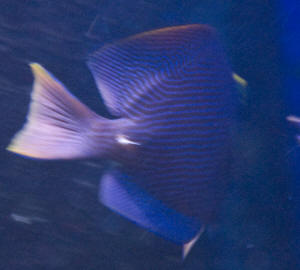
Today I noticed this really bizarre spike or bone sticking out
from its caudal peduncle region, right before the caudal fin.
<I see this>
It protrudes out about 1/2 a centimetre on both sides as if the
fish has been punctured through.
There is no red area around the wound,
<It's not a wound>
or any type of puss seeping. In fact, it appears as if this is
causing the fish no harm at all.
<It is not>
He ate like a hound dog this morning. I have taken a few pictures
and they are jpegs attached in .zip form. What could this
possibly be?
<This is clearly seen in these photos. Ever wondered why these
are called 'Surgeon Fish'? This is the 'scalpel'
that all Surgeons have, and is one of the identifiers that help
place each species into a genus. This Ctenochaetus species has a
single retractable scalpel on each side of the caudal peduncle.
For some reason this fish has it's scalpel in 'out'
mode.
Why? Maybe as a defence/ offence showing to another fish in the
system>.
My system is a 90g assorted reef with a 40g sump and about 90lbs
of LR. I do a 30g water change every two weeks, and maintain good
water parameters. He shares his home with: (2) Percs, Hippo Tang,
Potters Wrasse, Mandarin, Chalk Bass, Algae Blenny
<This one....>
, and an assortment of shrimp, crabs and snails.
Thanks
<No worries..>
Spencer Hall
<Simon><<Is an injury to the one "tang"...
I see there is a follow up... RMF>>
|
 |
Kole Tank Oddity 3/13/10
Scratch that fellas, I did some more reading and found it (
http://www.wetwebmedia.com/besttgsreefs.htm), thanks again.
<Too late Spencer I just finished replying!>
Spencer
<Simon><<No treatment per se... Ctenochaetus are part
of the Acanthurids that can exsert or retract their caudal
peduncle spines (as opposed to the genus Naso for instance, where
they are always "out"). This may or not heal on its own
accord. RMF>>
Re: Kole Tank Oddity... not a good "sharer"
with AEBs, same eco-niche
3/14/10
Thanks Simon.
<No problem Spencer>
I appreciate the response. It makes sense because he always seems
to be going after the Blenny and he's a pretty big
Blenny.
<Yes, these fishes are not compatible>
I am assuming this is because they share a natural food
source?
<Yes, 'niche'>
Although, I have <read?> a lot about the Kole and they are
mainly detritivores?
<They will eat algaes as well, and do graze the same places as
the Salarias/ Atrosalarias Blennies>
(sorry to be asking question inside statements)
<No worries!>
Thanks again
Spencer
<Simon>
|
Kole Tang I'm looking into purchasing a Kole Tang
that's about 3" long. At the present time, I've already
got a Hepatus Tang in the tank that's about the same size. I've
seen conflicting reports on how well these two fish will get along in a
75 gallon tank. Please give me your opinion. <Should be fine... both
not terribly aggressive species... good size difference... My opinions
on the family, genera, species are posted here:
http://www.wetwebmedia.com/tangs,.htm and the links beyond> It's
also possible that I could get a 2 1/2" Kole instead. <Go with
the larger one. Bob Fenner> Thanks, Larry Breit
Kole Tang Placement, Care Mr. Fenner, I love your CMA and
have learned more from it than from any other single source. I'm
new to the hobby, and have had my 55 gallon running for ~10 weeks.
It's F/O, with a medium Kole, a medium Pacific Blue, a small
Gold-Striped Maroon Clown, a blue damsel, and a common cleaner shrimp.
T=79-80F, SG=1.021, NH3=0, NO2- =0, NO3- = 10-15. My Kole was my second
fish, so has been here for 5-6 weeks. About a week ago he put his barbs
out, and I have not seen them retracted since. He swims frantically,
and spends a lot of time sideswiping the glass. I can hear his barbs
clink outside the aquarium, but he shows no aggression towards other
fish. This started about 10 days after the arrival of the clownfish,
but what worries me is that he has recently damaged his face, and now
he looks somewhat like a burn victim. Is this a fish that has had
enough of captivity? <Hmm, perhaps this specimen has... the species
itself are excellent generally. A couple of things re Ctenochaetus:
http://wetwebmedia.com/ctenocha.htm I would place the genus later in
new systems... only after a system has been running a few to several
months... and do you have live rock in this system? I would definitely
place this to improve water quality and provide sufficient forage for
your Kole: http://wetwebmedia.com/liverock1.htm> Is there anything I
can do? Thanks VERY much, John Sanders <Please do read through our
site, place the live rock, and try to be patient. Bob Fenner>
Kole tang Hi Bob, I wrote to you earlier today asking about
protein skimmers for our 46ga. bow front. Now I will get into why we
decided we should get one. I'll recap our setup:
<Good> Magnum 350 canister filter, approx. 10 lbs live
rock, Blue Damsel, Percula Clown, Yellow tang, and a Kole tang. We also
have 3 hermit crabs, and 4 turbo snails. The PH is at 8.1-8.2. Not sure
any other levels. We have recently been taking our water to the LFS and
getting it tested. They say that the water is fine as far as nitrates
and nitrites. <Would invest in my own test kits... some values
change with time, moving the samples... What to do if store is
closed?> Everyone in the tank seems to doing great except our newest
addition, the Kole tang. We've had him for three weeks. The first
couple of days, there was some tension between the yellow and
Kole. <Very typical> After that they were friends, eating
from the clip of food, and swimming around just fine. Then, gradually,
the Kole looked like some of the skin was coming off of his nose area.
I thought maybe he rubbed a rock the wrong way. But as each day went
by, the area started getting bigger. Now, along with the nose area, he
is getting pea-sized brown spots all over his body. And it seems that a
'layer of skin' (for lack of better words) is coming off of his
eyes, and they look cloudy. All of his fins are full and healthy
looking. He has a big appetite, and isn't shy. Sometimes when he is
still, he will start to twitch and then swim aimlessly, jerking as he
swims. <I see> His diet includes marine flakes, frozen brine
shrimp, green marine algae (seaweed), and the brown algae in the tank.
Our LFS gave us some Maracyn to use in the tank. He explained that it
was made for fresh water, but worked fine in salt. Not knowing what
else to do, we used it in our tank, and it hasn't helped. <No...
not bacterial in origin.> I searched WWM for an explanation, but
haven't come up with anything yet. If you can help, please let me
know. Thanks, Jason <The major "cause" in this erosive
condition is likely nutritional, and principally having to do with
iodine... or co-factors related to its uptake/utilization. I encourage
you to supplement these fishes foods with a vitamin preparation that
includes "iodine" (soak it a few minutes before offering),
and consider growing some Caulerpa (a genus of Green macroalgae) in
your tank, a sump... for a more natural source of this element. This
will work, but may take weeks to months to reverse the effects... the
general description of "environmental disease" you describe
so well for this Ctenochaetus strigosus is "HLLE", Head and
Lateral Line Erosion... There are materials, FAQs about this condition
posted on the www.WetWebMedia.com site now that you know the name. Bob
Fenner>
Re: Starting again Mike, Took your advice and added some
hermits etc. (no Kole yet ... mixed views in my LFS, some people say
no, they are very aggressive with other tangs, other people say the
opposite!). Pulled out loads of Caulerpa, tank looks good. Signs of it
beginning to grow back but I'm cutting the food down to see if the
tangs etc will have a go at the fronds as they start to emerge. Thanks
for the advice ... good stuff as ever. Brian <Brian, I am glad to
hear that everything is starting to work out. Kole tangs can
be aggressive sometimes but, I have found that generally they are
not. Remember, there is more than one way to keep a reef
tank and that there are many different opinions out
there. Happy to hear all is getting better. MikeB>
Surgeonfishes: Tangs for Marine Aquariums
Diversity, Selection & Care
New eBook on Amazon: Available
here
New Print Book on Create Space: Available
here
by Robert (Bob) Fenner |
|
|
|

