|
FAQs about Sea Star Identification
2
Related Articles: Sea
Stars, Brittle Stars,
Asterina Stars,
An Introduction to the
Echinoderms: The Sea Stars, Sea Urchins, Sea Cucumbers and
More... By James W. Fatherree, M.Sc.
Related FAQs: Sea
Star ID 1, Sea Star ID 3,
Sea Star ID 4, Seastar ID 5, Seastar ID 6 & CC Star Identification,
Linckia Identification,
Sandsifting Star
ID, & Sea
Stars 1, Sea Stars 2, Sea Stars 3, Sea
Stars 4, Sea Stars 5, Brittle Stars, Seastar Selection, Seastar Compatibility, Seastar Systems, Seastar Behavior, Seastar Feeding, Seastar Reproduction, Seastar Disease, Asterina
Stars, Chocolate Chip Stars,
Crown of Thorns Stars,
Fromia Stars,
Linckia Stars, Linckia Stars 2, Sand-Sifting Stars,
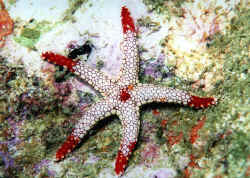
Variable but "variations on a
theme" the genus Fromia are gorgeous. Here
Fromia monilis.
|
|
| Identifying Seastars (5/3/04)
Dear WWM crew, <Steve Allen this evening> Thanks
so much for all you do for the hobby. Without you guys, I would
have abandoned the hobby- but instead I have a beautiful, enjoyable
aquarium. <Glad to hear.> I was wondering if you know of any
good resources for identifying seastars. <This is a toughie. Do
a Google search to see what you can come up with. About the bet
source I'm aware of in the hobby literature is volume 4 of
"The Modern Coral Reef Aquarium" by Nilsen & Foss?
Expensive, though.> I really enjoy them <me too>, but have
two with no identities. <Many do not yet have species names
because there are so many different ones.> I'm sending the
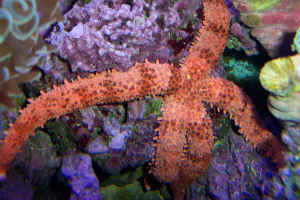
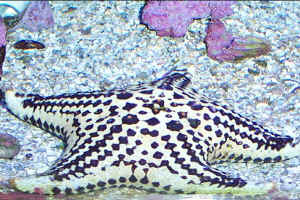
pics, hoping that perhaps you can ID them. The reddish star is
about a foot across, the yellow one about 4 inches. <I'm not
sure on the "yellow" one. I have one in my tank and it
was sold to me as a Batik Star from the Indo-Pacific. I have never
been able to name it. I do know that it is probably not reef safe.
I got lucky on the red one. It is almost certainly a Mithrodia,
though not certain of exact species. These are discussed on pp
287-8 in the aforementioned book. Can attain diameter of up to 40cm
and probably not reef safe.> Thanks so much, and
I'm sending you guys a donation <much appreciated> - I
want you to stay around forever! thanks, Tom L <A
pleasure> |
 |
 |
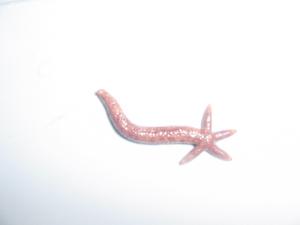
| Hi! The Sea Star is Giving you the
finger! >Hi. >>Hello Bernd, Marina today.
How are you doing? >I'm Bernd from Honduras. I
received a live rock from a shallow reef here and on it was a tiny
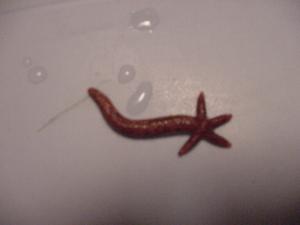
sea star. Brown, diameter the size of a nickel. No bumps or spines
on the back. 5 legs, one of them about 2" long and thicker
than the others. It looks like the star of Bethlehem. What is it
and is it reef tank compatible? >>I can't say for
sure what it is, but appears to be related to Linckia spp. At this
point all I can say is it doesn't *appear* harmful, but I
can't be sure. >Also in the rock lives an animal that
throws long white thread like strings all over the tank. They can
be 20" long. It moves inside the rock because the threads are
sometimes coming out one hole, the next time another hole. Does it
belong to the family of tube snails? >>My apologies,
but again, I can only guess, and the name's escaping me
completely! I want to say "Terebellid", a worm that sends
out threads that catches detritus, but I'd hate for you to rely
on that. However, I doubt it's harmful. >I have those,
but their threads are gossamer compared to the new animal's.
Thank You and sorry to always keep You bothering. Bernd
>>You're welcome, and never a bother. Marina |
|
|
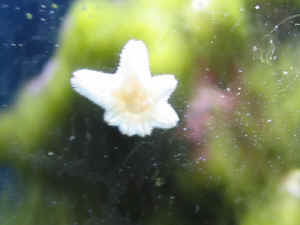
| Asterina Stars (4/10/04) Hi Wetweb media
crew !! <Steve Allen here.> I have an animals in
my reef tank, who seams to be a kind of starfish. It is going out
at night. One month ago I had 2 of them and now there like more
than 8 of them. I have attached 3 picture of these animals. The
diameter of it, is 1/2 inch. I would like to know if you can say
what it is and if it's a good thing to have or if it is a pest?
Thank you very much for your help <These are Asterina stars.
They don't get much bigger than 1/2" and are not harmful
(probably helpful), but can occasionally proliferate to plague
proportions. Search WWM for info. Of interest to me is
the fact that these stars are seldom fully-formed. You rarely see
one with 5 full legs.> |
| Some strange starfish
Hi Wetweb media crew !!
I have an animals in my reef tank, who seams to be a kind of starfish. It is going out at night.
One month ago I had 2 of them and now there like more than 8 of them. I have attached 3 picture of these animals.
The diameter of it, is 1/2 inch. I would like to know if you can say what it is and if it's a good thing to have or if it is a pest ?
Thank you very much for your help
<Go to the WWM homepage and plug in the term
"Asterina" in the Google search tool at the bottom. Bob
Fenner> |
|
|
|
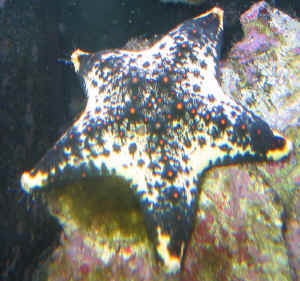
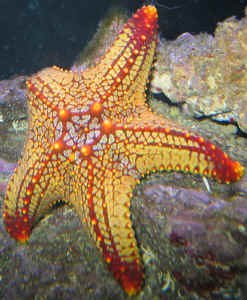
Sea Star ID For a Crewmate Greetings Crewmates! I
was wondering if anyone can help me ID these seastars. I am
convinced that the one labeled as such is a Pentaceraster, but am
uncertain as to the specific species. I have no clue as to the
one labeled "Mystery Star." Any thoughts? Do you know
of a good source for Seastar ID. Thanks, Steve Allen.
<Hey Steve, where are the pix? Bob> <<These
appear to be Oreastrids, Knobby Seastars... not generally hardy
in aquariums. All can "look them up" in Humann's
reef guides dealing with the Caribbean, tropical West Atlantic.
Bob Fenner>
|
 |
 |
|
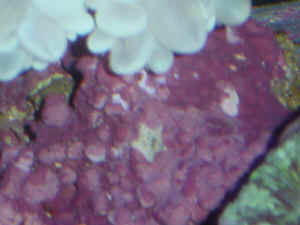
Identification of Starfish Hello, I recently found a
new creature that popped up! It is a starfish of some
kind. I want to make sure that it is not a type of starfish that
can threaten my corals. I did have a couple of sand
sifting starfish in the tank at one time. This one
just looks different sort of like a chocolate chip starfish, and
I know that those are not good for my reef tank. Please take look
at the pics. #1 Just a view of my reef tank #2 A picture of the
starfish without the flash #3 A picture of the starfish with
flash Thanks for your help!!! <Asterina sp. Please put this
name in the Google Search tool on the homepage (WetWebMedia.com)
and read on! Bob Fenner>
|
|
|
- ID & Care Requirements - Well it
happened again. <It did?> I went into BigAl's' store
and bought a fish, a plant and a starfish... without having much
clue what they were. First, lets talk about the starfish...
<It's a Fromia.> (Please see attached picture) It's
orange, it's skin looks like a cross between a velvet surface
and a snake skin :-) I was told that it was reef safe and that it
would feed on the algae that is present on the aquarium sides.
After about 3 days, the edges of the starfish rays seem to start
deteriorating... My questions: a) I've never had a starfish...
my tank is matured with fish, hard and soft corals, snails, cleaner
shrimp and hermit and scarlet crabs. Any special care I should keep
in mind? <Very low nitrates, otherwise clean water...> b)
Will it really stay on the glass and eat algae? Is it really reef
safe? <Yes it will eat algae, which may lead to it spending some
time on the glass. Yes, it is reef safe.> c) Why are the rays
deteriorating? <Either an undiscovered issue when purchased or
perhaps issues with your current husbandry.> OK, now, lets talk
about the plant... I've tried so hard to identify it, but I
can't... Hopefully you can help me about identification and
care of this plant. <It's commonly called a Shaving Brush a
Penicillus species.> Is it beneficial in a reef tank? <Not
detrimental.> (Nutrient export? Food for tangs? Will it grow
fast?) <Not useful as nutrient export unless you export it. I
don't think the tangs will eat it. Hard to predict how well it
will grow - a lot of dependencies.> Now, for the final question
and purchase. I've bought a cleaner wrasse. I was told that it
will keep my fish Ich free forever... After I got hope and read
about it, it seems that those fish are really hard to keep? Why?
<They tend to starve - if they eat only parasites, what's
left to eat when all the parasites are gone?> What are their
special requirements? <Life in the ocean.> What food should I
provide? <Try everything you've got.> Will it feed on
Kent's Zooplex? <Not familiar with this product, so I
can't predict.> Huge thanks guys,
Luke
<Cheers, J -- > |
|
|
Sea star ID Astropecten articulatus 6/3/03 Anyone out there
have a clue about the species of this Star? <looks like Astropecten
articulatus, as best I can tell from the long-view. The so-called
"Beaded Sea Star"> I have a small starfish from the
Central Florida Atlantic Coast area and I have no idea what type it may
be. It's a five pointed star and has light orange to beige coloring
on the underside and edges of its legs and purple on top. It's
small, maybe 3 inches from leg tip to leg tip. Any ideas where I might
find species photos online? <use the scientific
name provided here to do a google.com search... many pics to be seen.
Also see page 363 of Humann's "Reef Creatures". This sea
star is reef safe but difficult to keep alive for more than a year.
Most starve to death slowly. They need enormous and deep sand beds. 4-6
feet square and 6" deep minimum in a mature tank. Quite beautiful
to see though!> Thanks ever so, Laura Lea <with kind regards,
Anthony>
| - Mini-star dangerous? - Hello All, First I
want to thank all of the WWM crew for their tireless efforts to
make the WWM what I consider to be one of the best sources for
practical advice on marine aquaria I have come across in the
"whole year" I have been involved in the hobby (read that
obsessed). <Haha, that's good to hear!> Thank You!!! I
have also just received "Reef Invertebrates" By Anthony
and Robert, wonderful work and very much appreciated. <Will pass
along!> Now for one of many questions, Attached is an amateur
photo of the underside of one of several critters I have recently
noticed in my 55 Gal. Reef. This animal is approx. 3/8" across
and appears to be akin to some sort of starfish when viewed from
above. They are somewhat active and I have observed them on my
Tridacnid clam shell and some of the LPS coral bases but have not
observed any damage done. Any help with ID would be greatly
appreciated as I have scoured your site as well as a good part of
the net with no success other than continued education.
<That's a tiny sea star of the genus Asterina. Most of these
critters are simply harmless algae and bacteria feeders, but some
have been seen chowing SPS tissue. They are quite common in reef
tanks, so don't be alarmed unless you see them cruising over on
of your Acros. They reproduce by dropping legs, which explains
the odd and highly variable shape!> As of yet I have had some
wonderful success with my tank and am involved in propagating LPS
and SPS corals, I have 120 lbs LR in a 55G show tank, 1-2" Med
aragonite base, overflow to a wet dry with protein skimmer in sump,
I have a 10G refugium loaded w/ copepods and all kinds of macro
algae which along with the live rock I attribute to the successful
existence of 2 fat and happy Dragonets 1 mandarin and 1
psychedelic, <Good to hear of fat and happy dragonets, I hear
too much of the other extreme...> I was about 6 months into a FO
set up when one of my vendors sold me the contents of his reef tank
and thrust me into this wonderful world where I have been
scrambling to learn as much as I can trying to keep everything
alive with only a minor fatality of SPS along the way.
<Sometimes that happens, don't let it get you down. Happy
fraggin'! -Kevin> Thanks again for all your work and advice.
Best Regards, Jim |
|
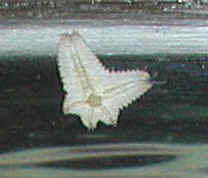
Nardoa or Fromia? 08/09/03 <Hey there, hi there, ho there
yourself Todd. PF here with you today.> Hey, there, hi there, ho
there, As there are about a million various sea stars in the sea, I
have been unable to figure out what species this beauty I picked up
recently is. Any ideas? <No, unfortunately I don't recognize the
species either. In the future Todd, please research the animal before
purchase. Trust me, I know it's hard to say no to an interesting
animal in the store, but for its and your sake do so in the future.>
Either a Fromia or Nardoa of some sort? In any case, I'm
afraid it's not getting the food it needs in my smaller tank with
plenty of live rock and sand, but no corals (20 gallon) and would like
to move it to my larger tank (50 gallon), but unsure of it's
reef-safe-ness (is that a word?). Any thoughts? I
really don't know what to feed it despite looking over your
FAQ's since it seems totally uninterested in the bits of meaty
foods I place on it's legs waving in the water from time to
time. And this thing NEVER goes to the bottom to look for
food. It has come down from the glass maybe 3 or 4 times in the last 2
months I've had it. Y'all are the best, and I
figured you'd know what to do. Thanks for all the help, direct and
indirect. You remain inspirations. Todd <Well, my guess
is it's eating something after dark or slowly starving to death.
You might want to see if a local university or college's biology
department could help you ID this animal. As for food, something to try
may be a live clam, you can get them at the seafood department of many
grocery stores, or at a specialist seafood shop. Acclimate it slowly to
the water, and temp, use a drip method. I used to do this when I had an
O. scyllarus mantis shrimp, they'd live for a few weeks (before the
mantis ate them). I'm not aware of any herbivorous stars, but maybe
try a small piece of Nori on the off chance that this is what it eats.
As I said before, in the future, please research then buy. Best of
luck, PF>
Re: Sea stars ID 1/8/07 I forgot to
mention in my last email that I have at least 25 of these in the
crushed coral substrate. There were 12 against the front
glass that I could see, and the rest I saw were throughout the tank
with their arms above the substrate. Thanks again Eric <Where is
your previous correspondence, Eric? When Bob cleans up and posts the
Daily Q&A, one of the first things that is stripped and thus lost
to oblivion is original email addresses. This is why we respond
directly to your email long before the questions are posted on the
website, as it allows us to respond to all directly, without risking
anyone's personal information. In future responses, please include
your previous correspondence for our sanity. Thanks, JustinN>
<<I'll say! W/o this and/or the previous subject/title... and
that being descriptive... it is near impossible to find/place follow-up
queries, responses as well. RMF>>
|
|

