|
|
| Home | Marine Aquariums |
Freshwater Aquariums |
Planted Aquariums |
Brackish Systems |
Ponds,
lakes & fountains |
Turtles & Amphibians |
Aquatic Business |
Aquatic Science |
Ask the WWM Crew a Question |
| Please visit our Sponsors | ||||
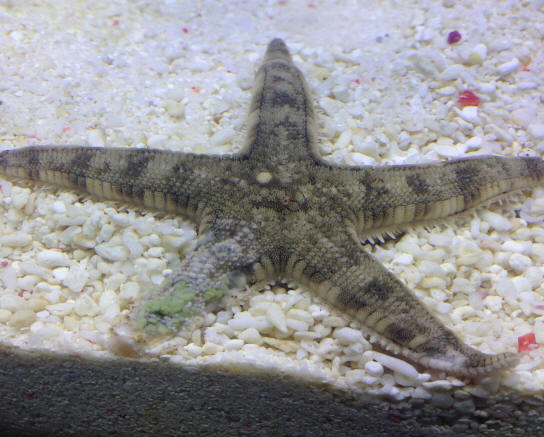
Sand-sifting Star transport 4/25/11 Sand sifting star and nano tank -11/17/2007 These are probably really stupid questions and I fear this one may make your "funkiest query of the day!" <Just hope Bob is too busy... ;-)><<As usual. RMF>> Please refer to me the archives if I missed something in searching. You guys/gals have answered lots of questions for us over the last four months as we have upgraded our 90 to a 240. We are STILL in process of doing the upgrade and I have yet another question. We have a sand sifting star in the 90 with a DSB. <Ugh> We have only just over an inch of sand in the 240 gallon and then a DSB in the fuge. Despite their great reputation for starving and decimating the sandbed, s/he has actually grown over the past year and seems to be ok. <Unfortunately, many marine animals can take a very long time to starve to death. If yours is growing, then I suppose it's not starving... yet. However, I suspect your sand bed has suffered dearly. And once it can no longer maintain the star fish (an inevitability), it will slowly die.> Does the star stand a chance in the 240 without a DSB assuming the tank has several months to establish fauna in the sandbed before the star makes the switch from the 90? <Sure, it would probably live longer. But again, you're just delaying the inevitable. And what of your poor sand bed?!"> Okay, on to the stupid part...my husband is the reefer and I merely stare at the pretty fish and read your FAQs, but I am trying to do an informed Christmas present. (Hope he isn't reading the FAQs today!) I want to get him a nano tank for a shrimp/goby combo. Due to the instability in this volume, I was hoping he could just plumb it in line with his main tank <good idea> since he already has lines going everywhere under the floor because the sump and fuge are in a different room from the main tank. Plus, he loves such DIY projects. Is this reasonable? <I don't see why not. In fact, I frequently recommend this to people who want to keep a nano tank and already have a more "regular sized" system.> If so, would one of the 24 gallon Nano Cubes be an option, or is it impossible to modify their set up? <I've never had a nano-cube, but from what I hear, I don't think they're so easy to set up this way (because of the hood mostly I think). How would you get the plumbing in/under the hood?> Surely you can at least add a sump and/or fuge to the setup??? <Of course you can.> Is there a different brand you would recommend over the Nano Cube? <Again, I'm sorry I've never personally had one of these. But if it were me, I'd simply go buy a small glass tank and proceed as if it were just another remote sump or refugium (as you put it). However, I'd do a little more of your own research on the Cube. It might work just as well, I honestly couldn't tell you for sure. I'd only wonder about how you'd get around the top of it.> Thanks for any information and I apologize if I missed answers in the archives. Your time is always appreciated! Michele <De nada, Sara M.> Stocking a Large Fish-Only Marine....Comments on Sand Sifting Star As Well 5/18/07 Good morning Fishy Folks, <Hi David.> I sent an email about a week ago, but realize you're very busy answering questions and doing whatever it is you do... <It is true most of are busy, however typically we respond within 24 hours. If in the future you don't get a response within that time, please resend due to the load/age of our system/server we do miss some e-mails. Furthermore we get loads of spam each day and it's possible your email could have been accidentally deleted. I apologize for the delay but at least you got through now!> Figured I'd rephrase and shorten my question for you, as I am still curious to know the answer... <No worries.> This would be a stocking question: <Okay.> My system right now: 200gallon fish / starfish tank 55gallon sump with liverock filtration 210lbs of liverock in main tank creating a large centre island leaving about 8 - 12" perimeter between glass and rockwork. 3" fine sandbed Tunze Protein Skimmer (love it, almost as much as my Aqua Remora-C on my 90gallon) Pump and Tunze Streams circulate water about 30/hr. <Sounds good thus far.> 1 18" Snowflake Moray 1 Foxface 5" 1 Yellow Tang 5" 1 Royal Dottyback 2 Bannerfish <I don't see any issues here with the bio-load: tank size.> 3 sandsifting stars <I do see an issue here; Sand Sifting Stars (Astropecten polycanthus); They are predatory, and it is a problem, but probably not the way you are thinking of. They won't be munching on sessile invertebrates and crustaceans...won't bother a fish...unlike choc-chip-stars and green brittle stars. What's on the menu for these guys is all of the microfauna and micro-crustaceans in your tank; making your DSB pretty much devoid of life. And it's not a gradual slide either, this will happen within weeks. Not only that but there are challenges when it comes to the animal itself. As I said above most will decimate the microfauna population and then after that the seastar itself will slowly wane and eventually starve. A single sand-sifting star in all honesty, needs about a 36"x36" surface area with no rockwork w/ a DSB of 8"+ and a large fishless refugium to survive long term. There has been experimentation to get them to take captive fair...I've even participated in this but most of the time these animals only survive 6 months to a year in captivity. This is another creature that should be placed into the "Best left in the wild", category http://www.wetwebmedia.com/sndsftstrfaqs.htm Here are the FAQ's we don't have an article yet on them...> and 1 brown banded serpent star and 1 Harlequin Tusk fish (4") about to be introduced from quarantine tank <Watch him around the inverts.> I want to ensure that I don't overstock and I find from reading FAQ's that some people like to jam their tanks with as much as possible. <Unfortunately yes.> At the moment, my tank still looks fairly empty as the Moray remains hidden most of the time unless feeding, but I do realize the Bannerfish can reach about 10" each and the Tuskfish about 10-14"?? <Relatively accurate on both cases for captive specimens.> I'd rather remain a tad on the light side to prevent fighting over food. <...And nutrient issues, psychological issues....fighting too....> Speaking of which, my god those Bannerfish are gutsy critters trying to steal scallops and shrimp from my eel's mouth. I can't even hang a feeder clip without them trying to steal it from my hand... thankfully they don't have teeth. <I have similar experiences with one of my surgeons...> My stocking wishes are as follows: Option #1 One of the larger angelfish up to 15" full grown (perhaps an Emperor?) <Could work, though healthy specimens are often difficult to obtain. I wouldn't get a large adult go for a mid-sized specimen in the 4-5" range. I would wait a while too, after the addition of the harlequin at least a few months (3-6).> Option #2 One of the larger angelfish up to 15" full grown (perhaps an Emperor?) as well as a small slender fish, like a different type of wrasse or blenny? Or would the Dottyback fight with it because of the similarity in size? <Could but, the size of your tank would help cut down on this.> I've already had to move the Dottyback out of my 90gallon tank because it would attack anything new... but I think in my 200gallon tank he's kept in check by the bigger fish and no one seems to bother him at all. Furthermore, I would take the Dottyback back to the store if you are deciding against one of the options below because of having this smaller fish in the tank. <Well the risk is present but you won't know until you try. If your unwilling to take that risk remove the specimen beforehand.> Option #3 A smaller angelfish like a Flame Angel and a Regal Tang <The latter is quite prone to crypt/ich I would go with a lengthy QT prior to addition if you go this route.> Option #4 A smaller angelfish like a Flame Angel, Regal Tang, and another smaller fish <Same comments as above.> Option #5 Perhaps one of the more... hahaha... peaceful(?) Triggers or a Dogface Puffer? <The puffer I would say no, considering the animals you already have, as for trigger it would have to be one of the more reclusive planktivores like a blue-throat.> Perhaps you could provide some comments on each option why or why not you like the option??? <I have ^^^.> Is there another fish or type of fish that would make a good addition that perhaps I have overlooked? <I like the idea of a tank/surgeon though I would pick a different specimen, perhaps something in the Zebrasoma genus...though not a yellow because of the Foxface.> I love getting suggestions on unique additions... <I have a very strong bias for Genicanthus angels personally, and I don't see them in display all too often.> On a last note, in your opinion would you think I'll eventually run into issues with my Dottyback as it is already bite size to my Moray and would likely become bite size to my Harlequin Tuskfish within a year or so? <Harlequins and the Snowflake are more prone to attacking inverts not fish, but as with anything in this hobby....no guarantees.> Certainly with a larger puffer or trigger? <Well I already nixed the puffer idea and gave specific guidelines re: the trigger ^^^.> Thanks again for all your help over the years... <Anytime.> David B. <Adam J.> Sand-sifting Starfish... dying 5/12/07 Hey
<Hello! Mich here.> Have a problem... <OK.> Got
a sand sifting star fish from the LFS about two weeks ago.
<Mmm, these typically don't do well in captivity, often dying
from starvation.> He has a hole in his back now!?
<Uh-oh, not good!> Whitish greenish stuff is coming out of
it! <Yikes!> He has been acting normal until this
morning, still alive but not very active. What is wrong with
him? <Sounds like he's dying.> Is there anything I can do?
<It is likely too late. I'm
sorry. Mich> Sand Sifting Starfish 4/14/07 Hello Crew, <Hi Graham> Thanks for all your info, your site has really helped me out many a time. <Glad it has helped you.> My question is this. Before I found your site, I set up my 100 gallon reef tank. It's the 5 foot long version with about 100 pounds of LR and a one and half to two inch sand bed. I was told to put in a sand sifting star which now I know was probably not a good idea. <Twas a good idea.> But I have had it for two and a half years now and seems fine. All of my water parameters are fine except nitrates which are about 3 to 10 ppm. <Not bad.> I am thinking that removing the star would be beneficial <How?> to my tank and introducing a few pounds of new live sand. As it stands now, I do not vacuum my sand bed and don't have a problem with Cyano. It is stocked pretty light with 2 torch corals, a leather, some mushrooms, a flower pot and a hammer coral. My fish are Three Striped Damsels (my old roommate put in while I was away-not my roommate anymore), <If someone put those in my tank, I'd, I'd, never mind.> a Yellow Watchman Goby, <May want to get a Pistol Shrimp for this guy, interesting behavior.> Engineer Goby, changing Juvenile Emperor Angel, and a Maroon Goldstripe Clown. I also have a pretty decent clean up crew, about 15-20 turbo snails, 2 Peppermint Shrimp, 2 cleaner shrimp, and several Nassarius Snails. I have a 20 gallon fuge and tons of flow in my tank with a Mag 24 and a closed "circuit" external Iwaki pump that feeds my UV sterilizer and chiller. Should I remove this star and trade it in for something else? <Why on earth would you want to do that? Very helpful critter in keeping the sand bed stirred.> Will I have to start vacuuming my sand bed? <Yes, unless it is teeming with other critters.> Thank you for all of your help you guys are great. <You're welcome. James (Salty Dog)> Graham Question... Very interesting observations of the effects of adding an Archaster/Sifting Star 3/29/07 Hi Crew! <Rowan> Hello, hoping you can help me. I haven't seen specifically this answer in your archives, so maybe it's a new one. <Many "to go"> We recently added a Sand-Sifting Starfish to our 120 Gallon tank. Our testing levels were all within parameters (ammonia=0, nitrites=0, nitrates=0, PH=8.1, etc) just prior to adding "him", but almost immediately (within a hour or two) we noticed something funny was going on in the tank as the soft corals started to emit some "waste/chemicals" starting with the coral on the one side of the tank and working it's way towards the right. <Ah...> Almost reminding me of a "wave" at a baseball game if you can imagine. Our fish seemed more "irritated" than usual (i.e. the tank "bully" our Zebrasoma was bullying without any cause to ALL inhabitants, <Good observations> which is not normally the case also normally rather peaceful fish like our Blue/Green Chromis' nipped at some larger species of fish (like our Tomato Clown) which is again, highly unusual). So, since it was such a drastic change, checked water parameters again only to find the nitrates soared from a reading of zero, to a reading of 60 or more ppm! <Mmmm> So, obviously a water change was in order. This morning, I tested for all parameters again: ammonia-0; nitrite=0; and nitrate=80+. Remembering what I had read thru one of your threads, it had been suggested in such a scenario to check the water source (RO/DI water) before the tank to be sure that the test kit was still "good". The source water is a zero for nitrates. So, noticing again that I will need to change some more water out when I get home from work, I bring you to my question. Is it possible that the reason for such a drastic spike was caused by the only new addition to our tank, a sand-sifting starfish which we acquired to help stir up the aragonite bed? <Yes, possible... Probable> Vacuuming has never seemed to help very much with the amount of detritus at the bottom of our gravel, there is always more! Is the detritus on the bottom being stirred into the environment creating a nitrate haven that even my skimmer cannot keep up with? <Also a probable source> Plus, once I've gotten the parameters in check again, should the system "settle in" again? <Hopefully yes> I do have a well fed aquarium, but as we've never encountered this problem before, and have no Cyano or other visibly "bad" algae and our fish do seem to gobble it all food offered down, although we've always noticed a brown colouration to our aragonite gravel bed under our purple coralline layer. <Not to worry re this... actually beneficial> Any help is much appreciated! Love your site which is more valuable than any collection of books/advise from LFS, Heather Allan <Thank you for your kind words... and valuable, careful observations... I do think the Star was involved directly in chemically stirring the cnidarians in your system... by its chemical presence as well as the stirring of the substrate. And I suspect all will re-settle here in short order. Bob Fenner>
Sand sifting star rotting leg...PLEASE HELP!!! 9/16/06 HI, <Hello> have a 55 gal. tank, 70+ lbs live rock, 4+ inches of sand coral mix a few blue leg crabs and turbo snails. The reason I write is my sand sifting sea star is starting to, well, come apart. His leg became white & finally, I guess, rotted off in about a 24 hour span of time. <Very bad...> He is new to my tank. It's a tank I bought recently & relocated (water & all) after they sold the fish out of it. It was set up for about 3 years. My salinity & PH & everything else was absolutely perfect. I bought this star at the local pet shop & the guy running it told me to acclimate for 15 min... I had never heard of such, so I was going to go longer like I had read in the past online (2-3 hrs). but the bag sprung a leak after I got home & he only got about 45 min. Is this the problem or do you suspect something else? <This animal is almost assuredly dead by now, or soon...> How long before he regenerates - if he can... The leg turned white & began to burst at the edges & then appear to rot off about 24 hrs after introduction to the tank & the process of loosing the leg took about 24 hrs more before it was completely gone. He moves about the tank but has a gross stump with fingery brown stuff hanging out of it.. Suggestions and info about the how it happened, why it happened & what now appreciated greatly. Should I return him or wait it out or what? <Return? Please read here: http://www.wetwebmedia.com/sndsftstrfaqs.htm and the linked files above, particularly on Asteroid Disease/Health. Bob Fenner> Best, Brian Steward Archaster typicus, sys., dis. 8/13/06 Hello WWM: Thank you for posting this life saving web site! <Welcome> I was "sold" a rather small Sand Crawler Starfish for my 20 gal. <Yikes... too small to sustain a specimen of this species food-wise> I was shocked to see the tips of this poor invertebrate decaying. Thanks to your FAQ section, I immediately ran out and purchased a turkey baster (sorry no syringes available) and loaded it up with "Mysis" frozen shrimp. Injected the thawed mixture, under the sand, near the starfish. What are the odds of survival if I continue this process through perpetuity?? Feeling guilty in Fishers, IN. <Better than without your careful, compassionate input here. Do keep close tabs on your water quality. I wish you life. Bob Fenner> Re: Archaster typicus-addendum It's "Mysis" shrimp, not "Mysis". Sorry about the miscue on the food. <No worries, understood> Data on tank: 20 Gallons-Hexagon Rena Canister filtration Aquarium Systems skimmer Blue Damsel Purple and Yellow Damsel Cardinal Fish Small live rock All fish healthy: Brine, Bloodworm and Mysis diet. Help save "Star" the Starfish (my 10 yr. old named him/her/it)! <Bob Fenner> Archaster Star corrosion, Aiptasia removal success 4/20/06 Hi there! I was looking for information on why my sand sifter star seems to be losing the tips of his legs (29 gallon tank, has been set up for 20 months with one complete disassembly to move it downstairs). <Too small a space for this species... not enough room for endogenous food production> I finally found the information on your site, along with the information that I have too small a tank - and I really appreciate how you answer all those emails. You have also in the past had great information on getting rid of Aiptasia anemones (I managed to get over 72 of them in my tank - that was just what I could count!). I ended up removing the various shrimps from my tank, added 4 peppermint shrimps, and later 2 Berghia nudibranchs (although once they disappear in your live rock tank, it is impossible to find them again). The last few tenacious anemones I was able to get rid of by either covering them with a thick Kalkwasser paste (just thin enough to squeeze out of a syringe needle tip) of injecting them with lemon juice (I eventually went with this because I thought it was slightly less dangerous to the tank). I have finally gotten rid of all the Aiptasia, and so my corals are very happy...will be resolving my Sandsifter problem soon I hope. Thanks again for all your help, Kerstin DeRolf:-) <Bob Fenner> Re: Sand Sifting Star, Archaster typicus fell apart! Resurrected! 4/25/06 I was cleaning out my email and stumbled on this! I thought to myself "Maybe I should follow up with Bob, Anthony and Crew. They probably don't get enough good news!" <We don't> It seems that whatever did the first one in (I still say it was a Mithrax crab that has since passed on; I'm guessing of old age, I'd had him for about 3yrs) has passed on. The remaining Archaster typicus, the one that had the pinched tip in a later email (I was worried about him as well; not sure if Anthony will recall that, probably not with the volume you guys get! :)) recovered completely and still skitters around my tank 2+ years later. <Antoine's no longer about these parts> I figure with all the dreadful requests for help you guys get, an organism thriving instead would be something you'd like to hear about. :) Bob, Anthony (et al), thanks so much. You folks provide an invaluable resource to all aquatic hobbyists of all skill levels. Jeff <Thanks for this. Bob Fenner> |
|

|
Features: |
|
| Featured Sponsors: |