|
|
| Home | Marine Aquariums |
Freshwater Aquariums |
Planted Aquariums |
Brackish Systems |
Ponds,
lakes & fountains |
Turtles & Amphibians |
Aquatic Business |
Aquatic Science |
Ask the WWM Crew a Question |
| Please visit our Sponsors | ||||
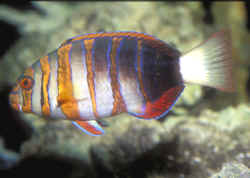
Harlequin Tusk; hlth., comp.
10/14/14 Large Australian Harlequin Tuskfish
Question 1/15/11 Rising nitrite after fish addition- lighting ? Tusk in a too small world... with a Carpet Anemone? 8/2/07 Dear WWM Crew, <Scott> I stumbled across a copy of The Conscientious Marine Aquarist and read about my recent Harlequin Tusk purchase before doing so and was very impressed with the accurate description of this fish thus far, excellent job Mr. Fenner! <Danke> I have recently introduced this Indonesian Harlequin Tusk and since its' addition, the tank has been going through a small cycle. I am pretty sure it is due more to my trying to get the tusk to eat, which he is doing quite well now, (subsequently overfeeding with frozen krill/mysis shrimp and shrimp pellets, leaving behind organic detritus) than the actual addition of the new fish. The tusk has been in for 5 days now. Prior to the addition NH4, NO2, NO3 were all at 0. On day 4 NH4 was 0 and NO2 and NO3 were slightly raised at .1 and 2.5 respectively. Today (Day 5) NH4 is around 0 (.1 at the most) NO2 has risen slightly to .2 and NO3 is still at 2.5 ppm. The tank is an established (1.5 yrs) 65gallon <Mmm, the Tusk needs more room> with a 20 gallon sump (wet/dry with bio balls trickle), a 65gal Coralife SuperSkimmer (that actually pulls a descent amount everyday), an estimated 80 lbs of live rock by now, and a 15W Aqua UV sterilizer. The fish are not showing any signs of stress, but wanting to ward off any trouble I did a 5 gallon water change and rinsed out the filter media in the old water before I dumped it, then put the same media back in. I did not want to replace the media for the risk of losing bacterial breakdown capability which is what I need to work. (was rinsing it at all even a good idea?) <Likely not a problem... given the amount of LR, the refugium...> I halted feeding accept for the tusk to which I only fed him/her one krill today. <Good> I want to know if there is anything more that I can/should be doing to aid in the quick reduction of this cycle? <Patience really...> Will turning off the lights help reduce anything? The tank will probably drop a degree over the next day with the lights off, is this beneficial? <Mmm, no. I would turn the lights back on, cycle them regularly> As a side note how long should my carpet anemone <!? I would NOT keep a carpet in this small volume... If it should be "upset" it will take your fishes out in short fashion> go without lighting if this course of action is recommended? Thank you for your advice on this matter. All the best, Scott <Please read here: http://wetwebmedia.com/carpetanemones.htm and here: http://wetwebmedia.com/marine/fishes/wrasses/Choerodon/faciata.htm and the linked files above... I'd move the Carpet elsewhere pronto... be looking for a much larger home for the Choerodon... Bob Fenner> - Harlequin Tusk Hunger Strike - I have a 120 gallon tank with excellent filtration and with a banana wrasse, harlequin tusk, yellow tang, volitans lionfish, orange roughy, maroon clown, large spotted grouper. My fish seemed to be all happy together until I started to notice my banana wrasse chasing my tusk. I have had my harlequin tusk since October and he has been doing extremely well with all my fish but now for some reason he has completely stopped eating. I have tested my water and it test okay. I have tried to feed the tusk live food and it is not interested at all in anything. My banana wrasse just started to chase my tusk around recently but they seem to leave each other alone for the most part. What is wrong with my tusk? Why is it not eating? I don't understand, the fish does not show any apparent disease or infection. What should I do to get him to eat again.. Please respond soon. Thank you very much for your time. <It's difficult to say exactly why your tusk has chosen to stop eating, but it is possible the aggression from the other wrasse has something to do with it. The item I've found that tusks find irresistible is whole shell fish - the most convenient is the TMC whole cockle, which are easily opened and dropped in the tank. The only problem is getting past the other fish and to the tusk directly - especially if the banana wrasse decides he doesn't want the tusk to have that food. Do keep in mind that a tusk fish in good health can go several weeks without eating so you've got some time to work this out. Short of removing this fish to a separate tank where it can keep to itself, you might want to try rearranging the rock work to break up territories. I wish I had a concrete answer for you but unless all the fish you list are all small, your fish are actually socially crowded and it's not easy for these problems to sort themselves out without the loss of a fish or two. On the reef, the tusk would simply swim far enough away to the point where the banana wrasse gives up chase - in your tank, this is not an option. Cheers, J -- > - Harlequin Tusk Hey Bob, how are you? <Well... I'm not Bob, but I'm doing well, thanks for asking.> I just had sort of a stupid question about the Harlequin Tuskfish. <Not a stupid question at all. The only stupid questions are the ones that remain un-asked.> I am looking for a more outgoing wrasse with color and was wondering how this fish is in regards to having a good amount of personality after acclimated? <Ok.> I have read on WWM and in your book that your favorite wrasse is Coris gaimard because of high intelligence, swimming pattern, and tons of personality etc. Can the Harlequin be compared to this particular wrasse as far as personality? <Probably not... the harlequin tusk does have a personality, but it's a little more retiring and wary, not an entirely outgoing fish.> My tank is far to small to keep the Gaimard. <Then it's too small for a Tuskfish.> If not, which other wrasse or similar have like personalities that I could fit into a 75g FOWLR with sand bottom? <How about one of the Pseudocheilinus wrasses? They are very interesting fish.> Just to give an example of the type of fish I currently have in my tank with interesting behavior and great personality are: Humu Humu trigger and dogface puffer. I want to match these fish with a third with like personality or at least similar. <Well... you're going to run out of room for even these personalities so you may want to consider a larger tank so that you could have a Coris... would be a good mix with these fish.> Thanks Bob <Cheers, J -- > - Harlequin Tusk, Follow-up - Ok thanks for replying. <My pleasure.> All other fish in saltwater don't do it for me and prefer interesting personality rather than color and average personality. I've tried everything else in the last three years and realize triggers, wrasse, and puffers are my favorite and suit me the best. Considering I'm only going to have a total of three fish in my 75gal, do you think I could get by with a Humu Humu trigger and Coris Gaimard, and get rid of the puffer? <Really... over the long haul, this tank is too small for any one of the above let alone two or three.> Then there will only be a total of two fish in the tank. Lastly, I know some of the Coris wrasses need a substrate they can dig in, would a gravel bed instead of a sand bed be sufficient? <It's my observation that this behavior is exhibited mostly by juveniles, but if you want to promote it, you will most certainly need a proper sand bed.> Thanks again <Cheers, J -- > - Sick Tuskfish - Hi WWM crew, <Hi.> Let me start off by saying that the site is a great resource of info. that has helped me grasp a better understanding of our hobby. My question today concerns my Australian Tusk. About one month ago I heard some splashing in the tank (55 gal FOWLR - tankmates are stars & stripes puffer, 2 damsels). I soon discovered that the tusk had made a leap of freedom and was laying on the ground. He looked fine after putting him back in the tank, but the next morning he had a pop-eye. At the time of the incident I was having a difficult time controlling nitrates (40-50ppm). I QT'd the tusk in a 20gal tank, 0 amm 0 nitrite, 0 nitrate, temp @ 80 w/ a salinity @ 1.021 & pH @ 8.0. I treated the tank w/Epsom salt, but it didn't make a difference (1 tablespoon per 5 gals). After three weeks (w/o eating), he began to develop some fin-rot. I treated the tank for 1 week w/ Maracyn-2, which has helped w/ the fin-rot, but the eye has not improved! He is now beginning to eat a little food now (krill soaked in garlic supp.), but I'm worried that his eye may never heal. <This is quite possible I'm sorry to say.> This has affected his swimming and eating habits as well. I'm cycling a 140 gal tank which will be his new home, but I'd like to take care of him before placing in the new tank. Suggestions?? <You're on the right track. Patience, excellent water quality, and a quiet place to convalesce are the best things you can do for this tusk... could take months for this problem to abate, if at all.> Thanks, -Andrew <Cheers, J -- > - Should I Get a Harlequin Tusk? - I have a 120 gallon Oceanic tank, ~5 in. of live sand, ~100 lbs live rock with 30 gallon Oceanic sump, Aqua C 180 skimmer, and 36W UV sterilizer. I change ~20 gallons of water every two weeks using a Python. I presently have an 8 in. volitans lion, a 5 in. clown trigger, a 4 in. Fiji blue- dot puffer, a 3.5 in. tomato clown and a snowflake moray ~15 in. Is my tank maxed out? <Very close to it... I like to keep things within balance rather than on the precipice of a cliff... so yes, you're about there.> I have been thinking of adding a harlequin tusk to my tank-should I do this? <Think given the fact that he'd be the last man in, and that the clown trigger will eventually become meaner, the tusk may have a hard time in this mix.> If I did get a Harlequin-what size would be best to add to my tank? <Larger than anyone else, which would certainly push your tank over the limit.> I'm mostly worried about my trigger and have considered adding a new fish at night while at the same time rearranging my live rock to give them something to worry about besides the newcomer. <Don't know that this would be enough... they're smart enough to notice the difference when they wake up.> Janine F. <Cheers, J -- > - Harlequin Tusk Questions - Hello - I just got a new Tuskfish this week (shipped in the mail from California) and am absolutely paranoid about its well-being! <Understood.> I wanted to ask what type of behavior I should be worried about, even at this early stage of acclimation. He is eating well, and swimming around. <Sounds good so far.> Do they sleep during the day? <They chill out... will repose for a while in a quiet spot, but I don't think they take naps during the day.> I have also noticed some surface skimming and what looks to be rock scratching. Is there a behavior that isn't scratching, but just a kind of "rock-skimming"? <With these fish, yes... sometimes, but do make certain it doesn't escalate to something else.> It looks like he's not even touching the rock when he does this. I do have lots of hiding places, and he's been utilizing a certain cave. My salinity is also in the 1.025 area. Is this ok? <Sounds good so far. Cheers, J -- > - Tusk with Cloudy Eye - Hello Crew: I had a question regarding my Tusk. One of its eyes has been cloudy for over two months now. During this time I have dipped the fish numerous times (fresh water, quick cure, and Paraguard...). The fish does not display any flaws in its body/color, besides the eye. In addition, I treated the tank with Maracyn (1 week treatment) for my Look down who had a bacterial infection. Throughout this time, I did not notice any improvement in the fish's eye. I was thinking a copper treatment might be a good bet but am reluctant since a have a zebra moray (Been told they are sensitive to copper). In addition, the fish has been behaving totally fine and has had a hearty appetite throughout the duration of this. What do you suggest, besides an eye patch? Hehe... I would greatly appreciate any recommendations or suggestions! <I'd work singularly on water quality. Your Maracyn treatment of the tank may have had an effect on the biological filter so you should be testing for the various nitrogen compounds. Cloudy eyes are not necessarily an indication of a disease per se, but more often a reaction to something amiss in the water. If you don't already, I'd step up to weekly water changes of at lest 5%. I'd avoid the copper as your Tuskfish has its own set of sensitivities to the stuff - can go blind - and I'm sure this is not what you want. Think quite possibly all the stress of the dips and the Maracyn treatment have postponed the healing of this eye. Do give it some more time and concentrate on your water quality.> Cheers, Dan V. <Cheers, J -- > - Mystery Tuskfish Death - Hello WWM crew, I bought a 4-5 inch Harlequin Tuskfish two days ago. It was in a 180 gallon tank with a large maroon clown and a black volitans lionfish. All the parameters are excellent. When I first put him in the tank he was doing great swimming around and he even ate that day. I thought this was strange because Tuskfish aren't suppose to be so active right after being introduced. <Not always a good indicator - is always individual variation.> The next day he was still doing great he ate some krill and was swimming around well. He was a healthy specimen. I said good night to him and the next day I went to say good morning and he was upside down on a rock. <Very sad, sorry for your loss.> There is absolutely no signs of disease and when he was living his breathing patterns were fine. Please help me figure out why he died or if there is something about my setup bad for Tuskfish because I would like to get another one. <Well... I'd be talking to the store where you got the fish. Typically, Tuskfish are pretty durable and they rarely just "drop dead". That being said, it's quite possible this specimen was collected using cyanide or similar harmful compound which would have accelerated its death. If this fish was from the Indo-Pacific, then the likelihood of cyanide collection is higher than it should be. I'd spend some time talking to your LFS, explain to them your system, husbandry, and the fact that this fish just dropped - see if they can help you out on the next one. In the future, put a hold/deposit on the fish - let the store keep it for a week or two before you take it home; this will transfer the risk onto the store who has better means for dealing with the loss than you will. Also you might want to pony up the extra bucks for an Australian Tuskfish which are caught with barbless hook, they way they should be.> Thanks, Louis <Cheers, J -- > Popping crustaceans, crowded Tuskfish Hi Was hoping you could help me out with a couple of questions. 1) I have been hearing a popping noise coming from my tank. Its a bit different to the clicking noise that I have experienced before. I have managed to get a look at part of it and I thought it may have looked like a shrimp. I am basing that on its little pinchers (not sure of the technical name) at the front. But it was also kind of spider looking. Perhaps there are a few things crawling around. <... likely either an alpheid or mantis shrimp> Last night I noticed something strange lying in the substrate. It looked like a brown cigarette butt. I thought that this could have been the shrimp shedding? <Could be> When I woke up this morning it had disappeared. So I assume it was eaten. Does this sound like a pistol or mantis shrimp? <Either, neither...> I was told that a pistol shrimp can "stun" fish with its noises. <Mmm, not its noise... but its powerful claw> I have a harlequin tusk fish in a live rock only tank. Should I try to take this "shrimp" out or is it okay to leave it. I assume if it is a mantis then I should take it out? <Please read re these organisms... Linked here: http://www.wetwebmedia.com/marind5_5.htm> 2) As I mentioned before I have a Harlequin Tusk in a live rock only tank with a skimmer and sump (bio balls). The tank is around 50 gallons and the fish is probably around 6 inches. I would like to add some more fish - like something really small maybe a few Chromis or something with very small bio load. What would u recommend? Obviously I don't want them to get eaten - although I have heard the harlequin isn't too aggressive despite its fangs ;) <Isn't aggressive, but this is a small, too small world for this species> 3) How much should I be feeding the Harlequin? At the moment he gets about 2/3 of a cube a day. About 1/3 in the morning and 1/3 at night. I mix it up a bit with brine shrimp and some marine frozen food which has vitamins and other stuff that is meant to be good. <Please look up and read re the species on WetWebMedia.com> Thanks for your help.. much appreciated!! Regards Simon <Help yourself. Bob Fenner> Re: Harlequin Tusk Hi Bob, Thanks for the pointers. With regards to the Harlequin Tusk Fish - I was told by the store that it would be suitable for the tank which I had. I wasn't sure myself and so I got a second opinion from another store which agreed that it could be housed in my tank. Given your comment that my tank is too small (which coming from you, I'm sure would be more discerning) What do you think I should now do? <Mmm, plan on either trading the fish in when it is obviously mal-affected, or plan on getting a larger system> Is the stress (on the fish) of taking him out and transporting him back worth it? Or should I just leave him in there as the only fish in the tank ? <Up to you> I've had him in there for about a month and he appears to be quite settled. Thanks Simon <This is a great aquarium species... Have you seen this piece: http://www.wetwebmedia.com/marine/fishes/wrasses/choerodon/faciata.htm and the Related FAQs? Bob Fenner> - Sick Tuskfish? - Hi, I have an Australian Harlequin and something's wrong with it. I've had it for several months, and just the other day I heard some splashing going on in the tank. I looked over and it was my Harlequin. After his "spasm" of splashes, he swam around the tank (kind of in an unusual way) and now he's been sitting in the corner for the past 2-3 days. He's not eating - but he is still breathing! His left fin looks a little torn as well as his tail. He's not known for having problems with the other tankmates (Huma trigger, Niger trigger, Puffer, Pinktail trigger). Also, one of his top tusk looks like it's been broke. <Well... it sure sounds like someone in your tank has hassled this fish. Would try to keep a better eye on things to see who the antagonist might be - with all those triggers around there's very likely to be trouble. When I kept triggers, they never liked my Tuskfish. How big is this tank anyway?> My water levels are fine (0 nitrites, 0 ammonia, 20 nitrates - usual level). Do you have any idea what may be wrong and what I can try to do to bring him back around? <You may need to isolate this fish to help him convalesce... get calm away from those triggers. In the meanwhile, do try to spend a lot of time watching the tank to see who the trouble maker is. It's hard to imagine with a tank full of smart fish that someone isn't getting out of line...> Thanks, Donna <Cheers, J -- > Sick Harlequin? Thank you for your response. Actually, I think what happened is the Harlequin and the Puffer were going after the same piece of food and Harlequin bit the Puffer (he now has a scar on his back; that probably explains the broken tusk). Not only that, my Harlequin has a Popeye now. He's still alive and slowly coming back around. I guess I'll just have to wait out the poison that may have gotten into the Harlequin from the Puffer. I've had these fish for almost a year and the only two who mess with each other are the Niger and Pinktail triggers. Thanks again for responding! <Welcome. Bob Fenner> - Stressed Tusk - Dear Bob, I live in the Detroit Area of Michigan. During the summer like right now the temperature can reach the 90s-most people don't believe this. Well... a few days ago my thermostat on my air conditioner burned out. Yes it was the first "scorcher" of the season 90 degrees. My tank temperature rose to 86 degrees. It then fell back to 80-82 degrees at night. Of course this abrupt change in temperature did not help my fish. The next day my display tank was covered in ich. My tusk was lying at the bottom covered in ich. So I gave him a 30 second dip (I know very sensitive). I also treated the display with Malachite Green. <Uggg... this was a mistake - a very potent chemical that has the potential to destroy your biological filter.> This was two days ago. So far the temperature has remained stable at 80 degrees. All other water parameters are fine. <Keep your eye on those basic parameters... the malachite green may yet cause some problems.> The rest of the infected fish are eating and looking better. Although there is no more ich on the tusk he still is at the bottom not eating. Will this wear off or is he doomed? <Hard to predict - these are generally hardy fish but don't respond well to environmental stress. Keep some large water changes ready to go and be prepared to use them. The best thing you can do at this point is to try and keep the water quality in excellent shape.> Thanks for the reply Sam <Cheers, J -- > - Tusk Problems - Hey again... I recently purchased a Harlequin Tusk from my LFS. A week has passed in QT, and he is adjusting well. Eats everything I throw in the tank, and although he hid for the first couple of days... he comes out and cruises quite often, getting a good look at me... and in turn letting me get a good look at him. All is well except for one thing. His mouth gapes. It seems almost as if he can't close it. I tried to see if he had any patches on his mouth to indicate any disease, but he doesn't. The rest of him looks fine, and he seems to be breathing at a normal rate. No scratching or anything else going on... I was just wondering what could be causing the gaping, and if this is normal. <Not really typical - could be for any number of reasons... perhaps a genetic defect. As long as it eats well, it doesn't sound like this will impair him and he'll likely do just fine.> I looked at some pics of other Tusks on the web... they all have their mouths closed. Please let me know if this is cause for concern. <As long as it eats, I wouldn't be too worried. Typically these fish are caught with a barbless hook and this could have caused some damage to its mouth parts which may heal. Would give it time.> Also, my tomato clown came down with what I think is fin and tail rot. His fins first seemed tattered, and it got progressively worse before I could catch him. He had a white patch on his tail, and he seemed to have lost all of his tail fin. I FW dipped him, and the patch fell off. I currently have him in a 5 gallon bucket and am treating with SW Maracyn. He's still eating and swimming, that tough bugger. He's survived a battle with Ich as well. I want to keep him alive as I have become quite attached, I've had him for 2 years. What else can I do to speed his recovery? <Be patient, these things take time - wouldn't mix anything with the Maracyn but just make sure the water quality is tip-top.> Also in the main tank is a bicolor blenny and a yellow tail damsel who show no signs of any illness. Should I be worried that they will contract whatever the clown has? <Not necessarily.> At first I thought it was fungus, but have read that tail rot is a bacterial infection. <Agreed.> tank parameters are all 0, except nitrates are around 15 ppm. PH is 8.2, temp 78 degrees. I do 10% water changes once a week. What did I do wrong for my clown baby to get sick? <Hard to say.> I feed a good diet, formula 1 and 2, prime reef, pygmy angel formula, two different kinds of pellets, 3 different kinds of flakes, frozen krill and prawn....I think my fish eat better than I do!! Any advice would be greatly appreciated. I want to get both my Harlequin and my clown better, so that eventually they can become buddies. <Be patient - it sounds like you are doing the right things.> Thanks. Karina <Cheers, J -- >
- Snoop Tusky Tusk - Hey guys and gals!! I've been perusing your Harlequin Tusk FAQ's, but all the reading has led me to more questions than anything! So please bear with me. My LFS currently has a 2 inch Harlequin on hold for me, for $60. <Such funny fish when they're this size... almost all eyeball.> Supposedly it came from Australia, and they've had him for 3 weeks. <Hmm... I'm always dubious of small tusks coming from Australia - they almost always ship large ones, but there are exceptions. Look for deep red on the trailing edge of the tail, this is a good clue - also, the price... unless you are in LA, $60 is a bargain for an Australian tusk.> He looks well fed....though I have not asked them to feed it for me while I was there. <Make sure you do before you buy it.> He was in the tank with a snowflake eel, a huge yellow tang, and a hogfish of some kind. It is the most timid of the bunch so far with the tang occasionally rubbing up against it. <In general, these aren't really outgoing fish... very shy and dubious of those creatures on the other side of the glass.> I observed it's behavior for about half an hour before I asked the guy to hold him for a couple of days. My questions are as follows: The fish was swimming with a purpose it seemed. He was cruising restlessly up and down the glass, and would lift his nose out of the surface and spit water. Now I read on your FAQ's that this behavior is usually not a good sign. Any idea as to what it could mean? <The spitting thing I've never figured out, and it may not be all bad. The cruising is pretty normal for holding systems where there are few placed to hide.> Stress from his inhabitants maybe? <And that as well.> He looks otherwise healthy, aside from his swimming pattern... clear eyes, no spots, no torn fins, no lesions. <Sounds good.> Also, my tank is a 55 gallon, 60lbs live rock, with current residents being a bi color blenny, and a very pugnacious tomato clown. Realistically, how long could I keep him in there before he outgrew it? <Six months to a year, tops... but more cruising room is always good, even for a two inch tusk.> I am currently setting aside money from each paycheck towards a 180 gallon, but that probably won't happen for another 6mos to a year. <Make sure you do this.> I have 2 cleaner shrimp in house too....which from what I've read, I'm assuming I have to find a new home for them? <Yes, or sacrifice them to the tusk... they will coexist for a little while, but not forever.> Or could I naively assume that they are currently too big for the Tusk to chomp on? <Nope... nice, soft-shelled snack.> One last question... current QT tank is a puny 15 gallons. I doubt he'd be comfy in there, but at the moment that is all I have. <Will be fine for two weeks.> Any advice would be greatly appreciated!! <Find him some good foods - make sure it's eating before you take it home - and keep the water in quarantine clean.> Thanks for everything. Karina P.S. Though I love my LFS dearly, as they have always been good to me....they have a new guy that was only there a week when I put my tusk on hold.......and I asked HIM how long I could keep the tusk in a 55....what do you think he said? "Don't feed him every day....and he won't grow as much." GASP!! I almost reported him, but oh well.....he'd been there only a week after all. Tisk, Tisk. <Cheers, J -- > - Tuskfish with Lockjaw? - We have had our Tuskfish for several months in 125gal tank along with a pink tail trigger and a Cuban hogfish. The Tuskfish is about 8'' long. About a week ago he stopped eating and started hiding, the fish comes out at feeding time and looks like he can't open his mouth. Having had a puffer that finally died from a locked jaw I am wondering if Tuskfish are prone to this as well, or is something else going on? <Doubt this is the problem. Puffer "lockjaw" as you call it, is really due to the fact that their teeth grow constantly, and need a source of roughage that will keep their teeth worn down. In absence of shelled mollusks and crustaceans, the puffer's teeth grow together until they are no longer able to open their mouths. Tuskfish do not have the same type of dentition so will not have this problem, but are prone to hunger strikes... often based on mood, social pressure [over-crowding or harassment], water quality, or all of the above. Just stick with the fish, they can go at the very least a couple of weeks without food. I would also check that this fish is actually able to see... there is a known condition with these fish losing their eyesight from copper overdoses, so do make sure this fish still responds to visual stimuli.> We have checked the water and it is as it should be. <Do keep in mind that there can be other issues with water quality that will not show up on any hobbyist test kit.> I am fond of this fish and hate the thought of losing him. I even offered up live ghost shrimp, the other fish loved it but the harlequin ate nothing. Please help and thank you for whatever you can suggest. <Stick with it.> Myke <Cheers, J -- > -Acrobatic Hogfish- Hi, I know some fish like the chalk bass will swim upside down. My Yellow Candy Hogfish at times sometimes seems like he is performing for me (like the Sea World Dolphins) <Have you tried riding it like they do dolphins? Muhahhaa... >and either rolls totally over like a dog or flips up his belly and then rolls back upright. I know wrasses "stand." Is this just a fish swimming enjoying his home? He is eating fine. <No worries here, he's just being a hogfish. What a life! -Kevin> Michelle - Lazy Harlequin Tusk - Hey there guys, I had a question about my Harlequin Tuskfish. <Ok.> I have had him for probably a good six months and he's been doing great! But, lately he is just really lazy. At first he would just sit in places and hardly move. Now, he hides in the rocks all day and hasn't come out for the past day or two. It just seems strange to me that his activity would suddenly change. This all happened after I had introduced a copperband into the tank. My Achilles tang (fairly new fish as well) didn't like it too much, so it kinda stressed it out so much, that the copperband got parasites. Well, the copperband died, my blue tang was infected (pulled out of it though), and some other fish were scratching for a little while. The harlequin has not shown any signs at all. No spots or scratching. He breathes fine, no red gills. Could it be that perhaps the Achilles Tang has disturbed the social hierarchy in the 150? <Probably not - tusk fish actually spend a good deal of their time chilling out, waiting for a good reason to come out - usually food. During their first several months in the tank, they tend to pace back and forth more but once they feel comfortable, and find a place they can hide, they will do the latter most often.> pH is stable, ammonia and nitrite down, nitrates slightly high, but no other fish is reacting strangely. Now he isn't eating. <Also not entirely abnormal, but something you should keep an eye on.> Should I be too worried, or just try to sit his little "fit" out? <I'd sit it out for a little while.> Thanks for any help guys. You are real lifesavers!!! Al <Cheers, J -- > - Tusk Time? - Hello, I have recently lost a Green Leaf Coris Wrasse due to flight out of tank....I will be covering the tank with egg crate to ensure this does not happen again. <Sorry to hear of this... is unfortunately all too common.> Due to the fact that this is a rare fish, I have only seen once within 3 years (this is not a green Coris wrasse), I am thinking about a replacement as either a Harlequin Tusk or Red Coris Wrasse. I want to check compatibility and have already received conflicting information from local fish stores. Here is what is in the 180 FOWLR currently: Sohal Tang 6" Blue Face Angel 5" Xmas Wrasse 3.5" Purple Tang Flame Angel Lemon Peel Blue Devil Damsel Pink Pseudochromis I want to make sure the wrasse I get is compatible with the Xmas wrasse and the other fish as well... I was told by an LFS that Tusk fish can be aggressive, I have always read to the contrary and have only been concerned about housing them with little fish... what is your opinion on Harlequin Tusk? <Well, the fact that I have one tattooed on my leg might tell you something... I'm a huge fan of these fish and all in all they aren't really aggressive in terms of what is possible in the various aquarium fish. Tusk fish can get grumpy from time to time, but little ever comes from their actions. What is important is that they can have a cave of their own, and that other fish don't pick on it. They can, when obtained in larger sizes be trouble for small fish, but if you get one not much larger than your Christmas Wrasse, you should be ok.> Nikki <Cheers, J -- > - Tuskfish - Hi, first of id like to say you guys have a really really helpful website ! :D Now for the questions, iv got a 66G FOWLR tank, occupants are currently a 11 inch snowflake moray & a 3inch lion. I am thinking of getting a tusk fish & was wondering if it would be ok in my tank? <I wouldn't add anything more to this system.> I'm aware that my system will be too small for the lion when its fully grown & might even trade him in soon. <How about a larger tank?> The reason for wanting the tusk fish was that my tank really lacks colour! <There are other, small and colorful fish that don't grow to a foot long. Would encourage you to keep looking.> if you could suggest another type of fish that has bright colours & will work well in my tank, that'd be great! <Spend more time on Wet Web Media - many articles and photos there to help you decide.> I was thinking either a dwarf angel or the tusk but I'm not sure. <Would likely become lunch for the eel - I'd be saving my money for the larger tank.> please help ! thanks for your time. <Cheers, J -- > - Harlequin Tusk Eye Spots - I have just noticed on my harlequin tusk, that he has a spot on his bottom part of his tail and I tried looking up some stuff to see if it was what I thought, but do they get a fake eye spot on there tail? <Not that I am aware of - the more common place is on the anal fin and at the back of the dorsal fin, but these go away as they mature.> cause that is what it looks like. just wanted to make sure it wasn't anything bad <Probably not - there's always room for genetic variation and mutation. Could be you have a very unique Tuskfish.> thanks Angie <Cheers, J -- > Let's Play Squish the Tuskie >I've had a Tusk in my tank for about 18 months that I bought as a 1 inch juvenile. for the majority of that time I've been fighting a losing battle with extremely bad Cyanobacteria outbreaks in my tank resulting in some pretty aggressive cleaning. At long last my battle seems finally over (I added a much more powerful skimmer, a couple of power heads, used different salt and a sifter goby). All this time the fish has been (some what happy) in the tank how its hasn't really grown a great deal (he's probably about 4-5 inches now). He also still seems to have juvenile markings (the 3 spots) and very faint adult colouring. He shares a 45 gallon (UK) tank with a 4 inch star/strips puffer and the goby. I use to have a Regal/Hippo tang as well however he spent most of his time bullying the tusk (not excessively). He's now gone! >>Oh my goodness! No wonder it's not growing! I don't mean to yell, but you have a very badly overstocked tank for the ultimate adult sizes of all these fish. The Tuskie won't grow without good room to swim about.. Oh my, so much here. Please, reassess what animals you can have in such a small system. I can't offer you a method by which to gain adult coloration for this fish in a tank this size, I'm afraid. >Will he remain like this for the rest of his life (I.e. its too late) or will he eventually colour change. I had been feeding him brine shrimp since I got him but have recently (over 2/3 months) changed his feed to be krill shrimps and mussel which does seem to have made a difference to his appearance. >>Brine shrimp is incredibly nutritionally deficit, and unfortunately, while filling his belly, you've effectively been starving him. He MAY pull out with a big change in his living conditions (a system double that size would really be more in order here - but we can double check with Jason C on this, Tuskies are his "thing"). I'm very glad you've changed up his feed, but you will also need to add more variety AND nutrition. If you can find it there in the UK, get some Selcon supplement right quick, and begin soaking all the fishes' food in it. Again, however, I implore you to reassess the animals you have in that tank, or seriously consider getting the group into a system closer to 100+ gallons for their longevity, present health, and good mental status. >Also is there anyway to tell his origin? >>No, not without knowing the shippers and suppliers. If you're asking whether or not he may hail from Indonesia or thereabouts, my guess is that he's likely an Aussie fish or he wouldn't have lasted this long. >thanks, Bobby B >>You're welcome, Bobby. I'm sorry I haven't got better news for you, but I am very glad you're asking. Marina Wrasse Compatibility Hello helpers of fish lovers. <Hey there! Fellow fish-lover Scott F. here tonight> I am setting up a 150 gallon FOWLR tank and wanted to make it an aggressive species tank. I was wondering if it was possible to put a Green Bird Wrasse (or any other Wrasse like a Thalassoma or Halichoeres) with a Harlequin Tusk fish in my tank? <Possible, yes, but not recommended. Both of these wrasses have somewhat "strong" personalities, and there would be a certain amount of battling at any given time. Also, they both reach impressive sizes, and a 150 would be too small to accommodate both for anything close to a natural life span, IMO.> I have read a few things about only one Wrasse per tank, but with a 150, is there a way to do 2? <Well, you could go with multiple Fairy Wrasses, Halichoeres species, Macropharyngodon (Leopard) species, etc. But I would avoid mixing the species that you are contemplating> Which would be the best combo of these, which would be least likely to work out? <One or the other, IMO. Start with a small one, and you'll have a beautiful specimen of either in a couple of years> If possible, which would you introduce first? Thank you Brendgol Majewski <Well, Brendgol- I'd choose the one you like best. Good luck! Regards, Scott F> - Tuskfish Questions - Hello there, I'm writing to you about one quick question. I own a Harlequin Tuskfish, and he's getting along pretty well but lately he's been on top of the tank. He keeps bopping in and out of the aquarium and spits some water out of his mouth, now is this usual or does he have a problem. <I've seen Tuskfish do this before, but it's not generally a good sign.> Also time and time sometime he gets ick on the top of his body, I know that is stress but is it all part of the stress that he looks like he wants to jump out of the tank. <If you know this is due to stress, why not try and reduce the stress?> And I don't know if I should take him out for a while, or what do you think the problem is. <Again, I'd look to the tank for clues - do you have good aeration? A protein skimmer perhaps? Do tell more about your tank.> Might it be the temp. what should it be set on. <Between 75 and 78 degrees F.> I would appreciate a little info or is there a book I can purchase with info that can explain on how to maintain fish or to notice some symptoms so I know how to treat the aquarium. <I would recommend two things - first, the book Conscientious Marine Aquarist is a good reference book. Likewise, there is a web site, http://www.wetwebmedia.com where there are many articles and questions/answers archived there for you to read. Much information in both places for your perusal.> Thank you a dear reader; Noel Balbuena. <Cheers, J -- > - Tusk Issues - Hey there again, <Hey.> I have a question about a harlequin tusk. I've had it about three weeks and I still haven't viewed it eating. <These fish can go quite a while without eating.> I have all my water parameters up to par and all, plus I always have a mussel, clam or squid in there for it to eat. I also feed Mysis and brine to my other fish but he never seems interested. The tusk swims around a lot and doesn't seem stressed or ill, and it was at the LFS for a month and was eating supposedly squid. Another part of my question I guess would be should I return it? <For the reasons you list? I wouldn't... the store will likely only give you half the original price, if that.> I'm having a slight ich problem, only one of my fish shows signs once in awhile, like two or three spots, but I'm about to treat with hyposalinity anyway. <In my opinion, hyposalinity in an of itself will cure little to nothing - it needs to be part of a system of treatment, quarantine, copper, etc.> Also the tusk isn't from Australia, which I prefer to have. But I have noticed that one of guys who replies to emails says he has a tusk that isn't from Australia (Ian I believe). <Could also be me, I have a non-Australian tusk.> And I'm wondering why he opted to get a specimen that wasn't if they are supposed to have better coloration and be more hardier? <Not necessarily less hardy, certainly different colorations, but for me it had to do with size. I wanted a smaller tusk to start with [less than four inches] and Australian tusks rarely come in that size. Since that time, I've seen them at the wholesalers, but now that I have the fish, I'm going to keep it. For me they are pets, and I can't just ditch them when they lose their appeal or I see something I'd rather have.> The reasons I would want to return the tusk is because 1.) he isn't eating 2.) I'm about to have to treat my fish anyway 3.) if the Australians are that much better, i guess the downside to this though would be about $30 extra and having to mail order it but all things considered what should i do? <I can't help you with this. I would keep the fish... you need to make your own decision.> Thanks once again Brandon <Cheers, J -- > - Choerodon pricey-ata - Hi WWM team, you guys helped me when I setup my 90 gallon about 8 months back (aqua c skimmer, 90lbs live rock, and, just started a refugium). All is great. Now, I want to get a choerodon fasciata but man these things are expensive (even more so in New York City). My current stock is: 1. 2 maroon clownfish (Premnas biaculeatus?) 2. 1 Zebrasoma flavescens 3. chocolate chip star 4. green brittle (I love this guy even though he can be very mean but I keep him well fed) Do you advise that I add the tusk to round out my system? <I'm a big fan of Tuskfish so it's hard for me to say no - but in general, your tank could fit one of these, no problem.> I know the yellow tangs are territorial. <Doubt a tusk would have much to fear from a yellow tang.> There are at least 2 hiding places, maybe even 3 depending on how picky they are so there shouldn't be a lack of "living spots." I've heard that the tangs will purposely "bully" some fish, regardless of if the new comer is in the tangs spot. Is this true? <Sometimes.> If so, is it just temporary until they get used to each other? <Think the Tuskfish is bulky and toothy enough to perhaps convince the tang he's not worth bothering with. Additionally, tangs are most often aggressive to other tangs and sometimes fish who compete for the same foods - that wouldn't include a Tuskfish.> I'm a bit worried because the tang as been the boss for 12 months (4 in a smaller tank and 8 in the larger 90). <I'm sure all will be well in a couple of weeks to a month.> I've read your site and see that other readers have HT and YT in the same tank but at $200 I feel better getting your opinion on the above. <At $200 I'd shop around - the typical Tuskfish in the Northeast shouldn't be more than $79 - $99 for a small to medium sized Indo-Pacific specimen - perhaps $50 to $75 more for an Australian one. Unless this fish is huge, it is over-priced.> Thanks so much! Mark <Cheers, J -- > - Assasi Trigger or Harlequin Tusk? Hawkfish-venomous? - First of all thanks for your time. I have 2 quick questions. First I am having trouble deciding on getting either a Assasi Triggerfish or a Harlequin Tusk. They are both on the higher side of the price range, but they are both beautiful creatures. In your opinion what is the better fish (personality, coloration, hardiness, easy feeding, social ability) for the money? <Depends on what else is going to live in the tank. The triggerfish will likely have more personality, is certainly smarter, but will grow large enough to consume many other occupants in the tank. The Tuskfish will top out at about a foot, perhaps a little less, but is a striking and interesting addition to any tank. Could still consume smaller fish in the tank, but it is less likely to become a terror.> Second, today I purchased my first hawkfish at my LFS. The owner told me that hawkfish are venomous. <Not to my knowledge.> This is the first time I have ever heard this. Is it true? <Don't think so, have heard this stated before, but have not seen any documentation. Hawkfish certainly don't behave like they are venomous.> Once again thanks for your time. <Cheers, J -- > - Australian Tuskfish - I currently have a 180 gallon tank with Live Rock. I was reading an article on your website and it said Harlequin Tusks (Australia) are long lived. How long do they live? <I'm not sure anyone knows for certain, but I'd guess at least 20 years.> I was also wondering how well do they acclimate to home aquariums? <Overall pretty well. Most that I've kept are quite boisterous on arrival, but tend to calm down once they accept their new circumstances. This seems to vary from individual to individual.> Are they a challenge to start feeding? <Not really... we're talking about a fish that really likes to eat, although most are caught with a barbless hook and line so their mouth can be sore on arrival and would be a reason for them to refuse food.> My local LFS said he would only buy the Harlequin Tusk from Australia because the other ones don't live long and aren't that hardy. Is this true? <I wouldn't agree with that statement entirely. On the average, Harlequin Tuskfish from Australia come in larger, more colorful, and captured with proper technique. For quite a while the only other source was the Philippines where cyanide capture was the norm - no animal caught this way is going to be healthy or live for very long. These days it seems more of these fish are coming out of Indonesia where they seem to be much more aware of the impact cyanide has. You may still see some individuals that have been nuked, but it seems less common now-a-days. My current Tuskfish is from Indo and is quite healthy.> I also heard that you need a DSB for wrasses because they like to bury themselves at night, do I need this for the Harlequin Tusk? <No, Harlequin tusks do not seem to exhibit this behaviour.> I am very interested in getting this beautiful fish, but before I buy this pricey fish I would like to have all the info I can find, so if there is anything else I should know could you fill me in? <Well... given the size of your tank, and seeming willingness of your local fish store to procure one, I'd go with an Australian tusk as they are quite colorful. Just keep in mind that most Australian tusks come in at about six to eight inches.> Thank You for your time <Cheers, J -- > - Ich and New Tuskfish - I've read everything on Tuskfish and ich on your site, and would love to get your thoughts on my dilemma - I got a new harlequin Tuskfish, apparently very healthy and ick free, and introduced him without quarantine, may I burn in hell forever, ill never do that again...had trouble sleeping last night I was so bothered by what happened (ok I may have over-reacted)... My conditions are: 75 gallon fish only live rock (110 lbs liverock, some live sand) - 2 dwarf lions, 1 maroon clown, 1 Tuskfish, 1 Sailfin tang, 1 clown trigger - 77degrees, 1.023 salinity, ph 8.1, nitrate 2ppm, ammonia and nitrite zero, alkalinity 4mg/ml (cant remember the alk unit, but not dKH) - protein skimming, hang on filtering <My friend, your tank is full... you may need to do something besides hang on filtration for these mess makers.> A day after the Tuskfish arrived, I noticed that he had what looked like light ick on his tail... I know he didn't have it 24 hours previous b/c I looked really closely when he was in the shipping bag when I bought him... I freaked out because I don't want him infecting all my other fish... right now he is in my 10g quarantine/hospital tank (where he should have started), with a sponge filter, a few lbs of live rock, and some charcoal. All the other fish are chugging away like normal in my main tank. I emailed my question in last night, but have since studied your Tuskfish section and am a bit more confused... My questions are: - Should I treat the Tuskfish in the hospital tank with Copper, give him a FW dip, or what? <I'd start with the dip - if you do get to the point where copper is necessary, you'll need to remove that live rock.> Should I let him just chill and relax for a few weeks to see if he kicks it on his own? <Well... a few spots on a fin are really nothing to be super concerned about. I'd leave the fish in quarantine for now - as you observed, this is where you should have started - and keep the fish under observation. My prediction is that this won't get any worse.> - Is it OK to leave the liverock in the hospital tank during copper? <No. Will absorb copper and hamper your ability to get a proper therapeutic dose. Do use caution when using copper around Tuskfish - they are known to develop blindness from copper overdoses.> Thought it might help with ammonia... <Address the ammonia with daily large water changes with new water.> - After the hospital, does that liverock get tossed, or is it safe to reintroduce to the main tank? <As long as you don't dose it with copper.> - Does the copper get removed by the charcoal, and therefore should I remove the charcoal? <Yes and yes.> - Are Tuskfish hypersensitive to copper if dosed and tested for properly (saw some mentions of that in your site)? <I wouldn't say 'hyper'-sensitive, but will go blind if exposed to too much copper or for too long.> What are my non-copper ick treatment on Tuskfish options? <Formalin and malachite green mix.> - If I don't treat him at all, just let him wait, when do I know he is safe to reintroduce? <A couple of weeks to a month.> Thanks so much! You guys are my saviors... Noah <Cheers, J -- > - Harlequin Tusk and Seastars - I have a harlequin tusk and I would like to replace my crushed coral with live sand. The only thing is that the sand needs to be shifted. Can I put sand shifting stars and or other stars in with the harlequin? <I think the harlequin tusk would be fine with these seastars, but I'm not really a fan of them as they can deplete the live part of a live sand bed - the sand-sifting stars that is.> I have put hermit crab in with him before but one by one he picks them off. <Different case - these are easy food-prey for a Tuskfish. Seastars don't really make for good eating unless you're a harlequin shrimp.> What could I put in the tank that would shift the sand and not get eaten? <How about a goatfish?> The harlequin is a wrasse so will he shift the sand enough himself? <Uhh... probably not at all. Harlequin Tuskfish aren't really buriers - they might flip over large pieces of substrate looking for food but that's about it. > Thank you very much, Andy <Cheers, J -- > - Harlequin Tusk Food Preferences - One more thing. . . I just read that they need live crustaceans for survival. Is this true? <I hope not, otherwise mine is doomed.> I really hesitate feeding anything live due to diseases. What are your thoughts? <There are other good reasons to not feed live foods, but most importantly in this case, you just don't need to. Tuskfish will greedily accept just about any meaty seafood - squid, clams, shrimp, crabs, Mysis shrimp, fish... all are fair game and really what you should be feeding these fish. Skip the brine shrimp. No worries.> Thanks. <Cheers, J -- > - Harlequin Tuskfish with Problems - I just purchased a Harlequin Tuskfish 2 days ago. When I first got him home much to my surprise I noticed a tiny white spot on his anal fin. I called the pet store and they said that it was probably from moving stress and it would go away so I have just been keeping an eye on it. Then this morning (two days after) I go to check on him and his left eye has become puffy and clouded and he is laying behind a piece of coral breathing heavily, but his right eye looks normal. I freaked out and immediately called the pet store and they asked me what the salinity was. I have it at between 1.024-1.025 and he said it was WAY too high so I removed some water and am doing a drip of freshwater into the system. <I disagree... 1.024 - 1.025 is actually ideal - is what the salinity of the ocean is.> The Tuskfish is the only fish in a 55 gallon with crushed coral substrate and some live rock. Stats on the tank are: salinity 1.024-1.025 (but I am lowering it now to get it to 1.022) pH - 8.0 ammonia - 0 nitrite - 0 nitrate - 40 ppm (I have had the tank up 2.5 months with 15-20 gallon water changes 1X per week and am now doing them every two days to lower the nitrates) phosphate - 0 alkalinity ~ 2.2 Is there anything else I can do? <I'd give it some time, and work on your patience. I know it's stressful to see these issues with your fish, but I can give you reasonable assurances that it will work out all right. First the spot on the tail is not really abnormal - these fish often have the odd spot or two on their tail or pectoral fins - in fact, I bet if I go look at my Tuskfish right now, it will have a spot or two. Nothing really to be worried about. As for the swollen eye, this is a condition called pop-eye and is typically the result of bumping into something... the result is swelling of the eye. You can add a little Epsom salts to the tank which will help the fish deal with the swelling, but it will take many days to a week or so for that to remedy itself. As long as the fish is on its own in that tank, I'm sure it will be fine.> I am panicking and don't want to lose this beautiful fish. <Don't panic.> Please tell me if there is anything else I can do. <Breathe deeply... relax.> Thank you Vivian <Cheers, J -- > - Harlequin Tuskfish with Problems, Follow-up - Jason, <Hi.> Sorry to bother you again but I have just one more question. What about the fact that he doesn't really want to move and is laying on the bottom against a piece of live rock breathing heavily. Because of this heavy breathing I thought it was something more than Popeye. <Oh... well, you didn't mention that before ;-) > I lowered temp to 78 and salinity to 1.022 to get more oxygen in the water and there is a Skilter and 2 BioWheels on the tank and there are two pumps pumping air into the under gravel filter which add a little more oxygen hopefully. <Oh, for certain.> He is still eating some though if I put some good food right in front of his face like some squid. And about Epsom salts, how much should I add and is it safe with live rock in the tank? <One teaspoon per five gallons.> Anything else I can do to help with his breathing? <Give it some time - these fish are typically caught with a barbless hook and line so when they show up at the wholesaler and eventually your house, they are WILD! with perhaps more exclamation points than that - they are quite freaked out, and take several weeks to come down from all the excitement. I think your fish will come around too, but will take some time. I'd leave the lights off on the tank and just make sure it is eating - squid is a great choice along with some clams or other meaty seafood.> Thank you SOOO much for your help, I really want to save my little guy <Me too.> Vivian <Cheers, J -- > - Harlequin Tusk - What do you Think? - What's your opinion of the Harlequin? <I love 'em - one of my favorite fish.> I would like to add a wrasse to my 200 gallon system that already houses a Naso (7"), maroon clown (2"), yellow tang (2"), Maculosus angelfish (5"), and a blue throat triggerfish (5"). I love the Harlequin's but are they hardy <Yes.> and will they do well with the existing tankmates? <Yes, I think so.> Thanks for your advice and opinion. <Cheers, J -- > - Harlequin Tusk - What do you Think? Follow-up - Thanks for your help. <My pleasure.> I was thinking of getting one from Australia in the 3-4 inch range. <From my limited experience, I've never seen an Australian Tuskfish come in less than six inches - they seem to catch them big out there... but the colors are a real pay off, these fish are much more striking than their Indo-Pacific counterparts.> Sound ok with you? <Sure.> Thanks again. I appreciate you all! <Cheers, J -- > - Tuskfish - Our local fish dealer has a beautiful harlequin tusk fish about 3 inch. long I have a 135 gallon tank with live rock and some soft coral (2 fingers and 1 hammer) Is this fish compatible the books I have don't say. <Should be fine - they are known to flip things over looking for food, but they don't 'eat' corals if that is your concern. Cheers, J -- > - Tuskfish Distress - <Hello, JasonC here...> Hi crew of WWM, I sincerely thank you for your past assistance, you guys are priceless to me. Well now I am confronting a new ordeal. I've just recently bought a 5 inch unknown origin harlequin tusk 5 days ago and he's been laying down (as if he's dead) and breathing heavily all the time. When I bought it, I noticed that it was already breathing heavily (but swimming around), but I configured that it was normal since he had just been shipped. <Hmm... really should have left it at the store a little while, just after shipping. These fish are caught in the wild with a barbless hook, so they tend to be pretty annoyed when first shipped. Even after getting the fish from the store, you should be quarantine this fish for at least two weeks before placement in the main system. These fish need time to adjust to captivity and in the main display can be too stressful.> But when I brought it home into my 180 gallon tank, he swam for a while, ate a bit, got chased by my powder blue tang for a while, and laid himself down in a corner ever since. He is still breathing heavily as before and since he hasn't been moving around, he couldn't of ate. I know that harlequin tusks tends to rebel at first and hide themselves for weeks when they are first introduced, but my concern is that my harlequin is laying down as if dead all the time and breathes rapidly. <I'd be concerned too, but again... you may have selected compromised live stock... hard to tell for certain at this time. Would do all I could to help ease the stress for the fish - leave lights off, etc.> My water parameters seems to be fine. I currently have two medium size tangs, two angels, a Cuban hogfish, a puffer, a copperband, and two damsel in my 180 gal. Could you please explain what his problem here? It appears that this problems will most likely spell doom for my tusk, but could there be any hope that it will survive? <There is always hope...> I know that like fine wine, patience in this hobby is the key, but assurance is a better stress reliever and that is why I am seeking your help. <Work on the patience thing.> Thank you and sorry for the lengthiness. -PHT- <Cheers, J -- > - Harlequin Tusk Behavior - <Good morning, JasonC here...> I have had the fish about two weeks, so I'm not used to the behavior that he may normally show. The fish sometimes swims with the flickering of his fins and he will turn his head left to right in a jerking motion almost. <That's not abnormal...> I looked all over the fish and I see nothing, he is eating fine also. <Ok.> He will scratch around the tank from time to time, but I heard this is normal with tusks. <It is normal for many wrasses, but shouldn't be constant... or even regular for that matter.> I have medicated the tank with copper safe about a week ago just in case something was wrong with the fish. <I would hold off on the copper unless you are certain there is a parasitic problem.> None of the other fish seem to have the same problem. Can u please help me out? <Just be patient. Very often these fish are rather wild [as in crazy] when first brought in and take a while to adjust to captive life - this includes trying to challenge its reflection in the glass, and other behaviors which may be a bit disconcerting. If it is eating, then the odds are in your favor. Give it some time - at least a month to settle in.> Thanks Jason <Cheers, J -- > - Harlequin Tuskfish Dilemma! - <Hello, JasonC here at your service...> Well, i have 3 possible theories for my Harlequin Tuskfish's (Big Momma Kamayeness as i call her) odd behavior as of late. It started about a week ago when i noticed her being active @ night time and sleeping in her cave during the lighted hours. I'm not sure if she's eaten in the last 3 days or not...i haven't seen her eat, but yet she's still fat n' plump. Anywho, this is how she's acting now and its freaking the heck out of me cause she's my baby. She swims only in the upper 4 or 5 inches of the tank...mostly skimming the surface. She doesn't smack into walls or nothing but i can literally reach in and pet her and she doesn't react (which isn't normal in her case) <Oh... that isn't a good sign, very possible your fish is probably blind - knowing what [little] I do about these fish, it would be the rare occasion to be able to pet one with its consent.> She shows no parasite infection and all my other fish and inverts are doing fine. My tang and majestic angel are sound as a pound and Big Momma is usually one tough cookie so its odd that she's the only one stressing. <Indeed.> Here are my levels: Tank size: 90 gallon Ph: 8.3 Salinity: 1.022 Temp: 79 Ammonia: 0 Nitrate: 0 Nitrite: 0.07 Now, i do have a small nitrite reading but its not even a whole PPM yet and i just started my first round of 20% water changes till the problem is corrected. And i don't think this would be a problem for her since she's been OD'd on copper before and been in a much worse QT tank with high nitrates and ammonia problems before w/out a hitch. <I wouldn't sweat that amount of nitrites, but do continue with your planned water changes. On the other hand, OD'ing on copper isn't really good news - Tuskfish are copper-sensitive and have been found to go blind from too much exposure to copper. Does the timing of the copper treatment and the blindness coincide?> So here is my other two hypothesis of problems. I have read somewhere that the Tuskfish can suffer from improper collecting and shipping... could this be a cyanide reaction? <Doubtful...> I've had her for about 8 months now and this is the first time she's acted up on me. <If cyanide was a problem here, more likely the fish would have dropped dead by now.> 2nd one is that i might have some stray voltage in my tank. <Possible, but not as probable...> I replaced my heater which i was suspecting of malfunction yesterday...and its still too early i assume to notice results. So how would i go about figuring out if i have a voltage problem or not? Can you actually feel being shocked in the water? <I can if I'm standing barefoot in the basement, but I think everyone's sensitivity to this is different.> Is there a way to test certain equipment like pumps and what not to see what might be going on? Could it be getting some voltage from my lights? I'm using PCs and there is nothing but wood touching the tank, but could voltage still be transferred from them? <From the PC's? No. If your tank equipment is plugged into a GFCI outlet, then 'stray' voltage would cause the GFCI breaker to trip, so I wouldn't really give this much concern.> Well, as always, any suggestions will be taken in w/ a warm heart. I should have the nitrite back down to 0 in a matter of days. Thanks again. <Well... there are some other possibilities. Blindness in fish can also be caused by nutritional problems - often parasite related where the parasite is out-competing the fish's digestive system for certain nutrients. Usually in these cases the blindness is reversible. As I mentioned before, there is also the known sensitivity in Tuskfish to copper, and this may be the more likely cause and unfortunately not reversible. You can probably get a better idea by closely watching the fish's eyes, which are normally very active - shifting to see all that is going on around it - if the eyes aren't moving, then likely it cannot see. Having a blind fish is not the end of the world for you or the fish, but will require some specialized attention. If the fish is settling down in one consistent spot, then use a feeding stick to place its favorite foods right in front of its nose when it is in its resting place and try to feed it that way - clams, shrimp, and squid should do the trick. Work with the fish and it will get the hang of things.> oh, i am also going to start using garlic juice again to stimulate her appetite. She used to be such a pig! <Do also keep up hope and efforts - these fish also have mood swings and can go several weeks without eating. Keep up the close observation and hopefully things will turn out for the best.> Thanks again! <Cheers, J -- > - Harlequin Tuskfish Dilemma! Follow-up - oh, and one other thing....if perhaps she might be blind from malnutrition...what do you suggest to reverse that? She's been on a steady diet of high protein krill and Mysis and occasionally takes in some of my angel's food. Any suggestions will be appreciated. <They like most any meaty food, but it is also wise to try and get some green things in there. My Tuskfish eats krill, squid, clams, Mysis, and pygmy angel formula. I also like Spirulina formula although it is not as easy to find. I go for the 'kitchen-sink' approach.> :D -=-Pat-=- <Cheers, J -- > - Re: Harlequin Tuskfish Dilemma! - Hey, thanks for all the advice. <My pleasure.> As to respond to your questions of blindness, i don't think its the case. Her eyes still dart all over the place in normal Tuskfish fashion and the whole OD'ing on copper thing happened the first month i had her, and she's been in a copper free world for 7 months now. <Ok... sounds better.> I'm moving her to my QT tank just to see her reactions and perhaps there was something else afoot in my other tank. <Good plan.> Could it have been possible chemical poisoning from some other creature? <Possible, but not likely.> Perhaps my mandarin goby was spouting out things? <Doubt it.> A few of my other fish started showing signs of stress today so i moved them to my 2nd QT tank for proper treatment. <This is probably more because you've been more present in the system in the last couple of days - petting the tusk, what not.> Perhaps an anemone was releasing some sort of chemical. (i know, Tuskfish and inverts...but i had just reason cause my main reef tank sprung a crack so i had no other choice) <I would be less concerned about Tuskfish and anemones than Tuskfish and shrimp. Even so, the anemone is a more likely source of pollution in your system than the mandarin.> I did pull out a Long Tentacle today cause it was struggling, perhaps it started poisoning my tank? <Perhaps.> Well, thanks again! -=-Pat-=- <Cheers, J -- > Adding A Tuskfish To The Mix Hi there!! <Helloooo! Scott F. on the late-night shift with you!> I currently have a 75 gallon tank and will be upgrading to a 260 gallon DIY tank.. tank and components are built .. I was using a wet/dry and skimmer.. going to DSB, live rock and skimmer(s) I currently have a Juvenile Emperor angel, a Long Longnose butterfly, a volitans lion (all in the 3.5 -4" range) and my newest addition (and great find) a blue ribbon eel (yes he eats and is thriving after 2 weeks. although I had to devise an isolation method for his food.. an acrylic tube with a "trap" at the end that contains his food.. crawls right in and grabs his food, and is protected from all the other aggressive feeders in the tank.. took him 3 days to figure it out). <Ingenious idea! Glad that he's eating well...That's half the battle, IMO!> I am moving everything to the larger aquarium. I would like to add a harlequin Tuskfish to my little family if possible.. what are your thoughts? <I think that the Harlequin Tuskfish is an amazing fish, if given the proper tank conditions. It can be a rather aggressive fish, once it settles in. However, in a reasonably competitive environment, such as yours, this fish can settle in nicely and do very well. Keep in mind that the Tuskfish can get a bit feisty once it establishes itself, and will harass new fishes for a while...In the long run, it should be fine in this sized tank, but I don't think you'd be able to add any more fishes at that point-the tank is going to be pretty well stocked at this point...> I would be using hermits and brittle stars as scavengers, thought of a spiny lobster.. but afraid of the havoc he could cause with the eel. <I'm thinking that you'd want to avoid the lobster. The snails- and the hermit crabs will become expensive snacks for the Tuskfish.. Would the Tuskfish max out the capacity of a tank this size? If not, what other fish would you recommend as compatible with my particular mix? A Radiata lion maybe? I am super excited about this new step.. but also want the fish to be healthy and happy. <I think that the Tuskfish can work fine in this tank, as would other larger wrasses, such as the Coris family..> Frank <Enjoy the tank, Frank- I'm sure that it will be fine! Regards, Scott F> The Happy Harlequin? (Keeping A Harlequin Tuskfish Healthy) Hi Scott, how are you doing, hope you're doing great. <I sure am, thanks! Hope all is well for you, too!> Here's the thing, yesterday I bought a Harlequin Tuskfish, and it's a beautiful fish. About 5", and I started noticing something weird in my fish. It didn't fight me when I was going to catch it to put it in my tank. <I hope you meant "quarantine tank", right? Remember, always quarantine new fishes for at least 3 weeks before releasing them into your display tank. It's a practice that will pay real dividends down the line, in terms of averted disasters from disease and other potential problems....Just a friendly reminder!> So I put it in, and it started great, swimming around, It didn't hide, just swimming but some times bumping in to the acrylic of the tank or other ornaments. When I feed him, he started like smelling the food, and taking bites at the food but not accurate shots, that is when I realize that something wasn't right with it's eyes, so I started reading some of the articles on the wetwebmedia, and notice that these fish go blind very easy. <They do seem unusually susceptible to various eye maladies; either as a primary infection, or as a secondary result from another illness...Good observation> It's eyes look normal, and He moves the eyes like physically nothing is wrong, but what do you recommend? Should I take it back, or you think there's gonna be any future problems, or as long it is eating everything is going to be ok????. <Well, I'd have to sort of generalize here, without having actually seen the fish "in action". In my opinion, if there are no outward signs of trauma or infection, and if the fish is eating well (as you may see me state quite often on WWM, "A fish that eats is a fish that lives..." I really believe that.), and seems in otherwise good health, would not be overly concerned. I'd try to focus on two things to make this fish happy and healthy for the log run: First, I'd provided the best quality and variety of foods available, and I'd enrich them with additives like Selcon or Vita Chem for maximum nutritional value (poor nutrition has been implicated in some instances of fish blindness). Second, I'd keep the water quality in the tank as high as possible, through regular water changes, heavy protein skimming, and liberal use and replacement of chemical filtration media, such as activated carbon or Poly Filter.> please reply these message to know what to do, because I all ready got in love with these fish, and its tiny thank mates seem to love him. I don't want to see the fish suffer in the future, and it's not a cheap investment, so if there's some kind of treatment please advice me. Or, if its temporary blindness, or maybe it's not totally blind but it's about to go? <Well, again- there is no guarantee that the fish is not becoming blind. However, if you intervene with some of the steps outlined above, you're doing as good as can be done for this, or any fish in your care. I know that with your genuine compassion and care for this fish, he/she will be just fine in the long run. Hang in there! Thank you for your advice. <My pleasure! Thank you for stopping by- and Good luck! Regards, Scott F> - Spots on Harlequin Tusk - <Greetings, JasonC here...> Dear WWM crew, I have a Harlequin Tusk (Tigger), I have had him since 11-22-02. I quarantined him for two weeks with no problems, and added him to my 240 gallon tank with 70 pounds live rock. Currently Tigger is the only fish in the tank, mainly because a few weeks ago I noticed some spots on Tigger's pectoral fins, the spots did not appear to bother him, he was not scratching or darting about the tank, and had no abnormal breathing. His colors look good and he has a very healthy appetite. Tigger still has spots on his pectoral fins, although now I have noticed some spots on his body as well, still they do not seem to bother him. I have a VHS tape of the spots, and I would truly appreciate it if I could send it to you to view, I am hopeful you will be able to determine what these spots are, or if they are harmful to my tank and/ or Tigger. <Just by your description alone, this is probably a very mild case of ich, but these fish are very durable and capable of dealing with this on their own. I have a Harlequin tusk myself and it's not at all uncommon to see a spot on the fins every so often. I wouldn't bother with sending the tape.> Tigger has been in this tank by himself for quite some time, and I am wanting to add new fish, however I am reluctant to do so until I have some idea of what these spots are, and some direction to take. <Keep up the quarantine protocols. If you can, try to keep the fish in quarantine for a little longer, but no longer than is practical for you and the fish.> Your help would be greatly appreciated. Thank You, Jen Marshall <Cheers, J -- > Harlequin Tusk ,Thalassoma Lunare, Butterfly and Emperor/Queen Angel Hi again Anthony, Thanks for your reply even if it wasn't what I wanted to hear! The reason I picked the Harlequin was because I read at WWM that to quote "most everything leaves a harlequin tusk alone and vice versa" so I thought I was reasonably safe with this <generally true... but beyond tank size issues, mixing two wrasse species (tusk and lunare) is quite risky just like mixing tangs or angels. More often than not there is serious compatibility issues> and they had a lovely one at the LFS! <a gorgeous fish indeed> They also said it would be fine with my existing wrasse and as I hadn't heard back from you then (I think you were lecturing) I bought it and it is now in my QT! <wow... bummer. Hmm... what to do. Since you do have a QT, you can chance the mix after QT, and be prepared to pull them if they scrap. This may mean tearing the rockscape down. No guarantee that the victim will service the stress of it all either. I'm also thinking in the long run.. lunare wrasses have a well deserved reputation for turning out to be satanic once sexually mature. Now I must decide what to do with him! Also I find that the "pearl" butterfly I was asking about is actually a Redback butterfly >according to Bob's book ,what can you tell me about this, is it timid like the pearl or could I get that ? <too timid indeed. In fact, there are very few butterflies that have a prayer with this crowd of active feeders even if they are not aggressive. A Raccoon butterfly may be one of the few with a chance> regarding the Emperor or Queen are you saying never OR just never with this tank size? <I hate to say it... but they are all really dreadful mixes for the long run. These angels are as aggressive or more so than the lunare wrasse after a year or two. And we need to plan for the long run since these fishes live well over 10 years. Its like planning for space with a puppy: no great Danes when living in an apartment. I see this fish dominating a 300 or 400 gallon aquarium in the 5 year plan. Indeed... I have seen quite a few in my lifetime do this very thing. For aggression and your present tank size... no angels in my opinion> I didn't strike very lucky with this list did I? Thanks again - Jenny <alas, no my friend. You have picked many wonderfully hardy fishes... but too many attitudes and too great a size even for the new tank. Best regards, Anthony> Treating Tuskfish I have an 80 gallon saltwater tank. I have an emperor angel, blue tang, and a Tuskfish the one that looks like a tiger, and a dwarf lion fish. My reason for writing this to you is I recently treated my tank with copper treatment because my emperor had ick and the blue tang has a skin disease. The emperor is better now but the blue tang is about the same. Now my tusk fish has not be normal at all. Its like he's blind he runs into things all the time and sits up in the corner or the bottom corner of my tank. I've done a couple of partial water changes because a lady at PetCo told me that my copper level should be around .3 to treat these diseases the box says it should be between .15-.20 . I'm thinking that the high level of copper is the thing to blame for my tusk. He's been like that for a week and he's still living. Please help, I don't want to lose this beautiful $80.00 fish. <Hi Nathan, Yes, this can happen sometimes with copper and certain fish. Nate, please do get your Tusk fish out of copper treated water and then surf on over to WetWebMedia.com scroll to the google search at the bottom of the page and type in quarantine, copper, and parasites. There is a ton of free info there to help you. Follow the directions and suggestions there for using and testing for copper, a quarantine tank, etc. In the meantime, a dark copper free tank for the Tusk, raise temp to 82-83, make him comfortable until his sight gets better. All else being okay they usually recover sight. You will need to continue copper for the others but buy and use the correct test for the type of copper you are using. More info on WetWebMedia.com. Craig> Harlequin Tuskfish Found Dead Hey guys, I hope everything is going well for you! <<Greetings, I things are going better...>> Last night I noticed my Harlequin Tuskfish laying on its side, breathing rapidly, and this morning he was dead. I was wondering what might have killed this hardy beast. He was an aggressive eater and an occupant in my 180 for 6-9 months. During this time, he was a great fish, always out and about. <<I'm sorry to hear of your loss.>> He was about 5-6" in length. The tank conditions are normal and stable. Temp is at 80, no ammonia or nitrites, nitrate test reads at 15 (needs a water change). System as a 1/2 HP chiller, commercial Biowheel, Ocean Clear filter, 35 watt UV sterilizer, Berlin protein skimmer. When I found him, his gill coverings wide open, but the gills themselves were flat/closed. No discoloration on the body that I could see. No bite marks, or signs of fungus/ick. Could it be that this fish was cyanide caught? I've heard that fish caught in this fashion can live 3-6 months and then die. <<And that would be my guess too... unfortunately, many of these specimens caught in/around the Philippines are caught with cyanide. You might want to ask the people you bought it from where they got it, and insist on getting the replacement from a more reputable source. You might also consider spending the extra money on an Australian specimen - these are caught with bait and a barbless hook, the way they are supposed to. Sadly, capture with cyanide does more than leave you with a dead fish, it also takes a terrible toll on the reef where the fish was taken from.>> I'm asking because I would like to get another one (they're great fish), but first want to make sure that I didn't kill this one. <<I doubt it, like you said - all other things being equal, these are very hardy fish, and not likely to just drop dead unless they were compromised during capture, which sounds like it was the case here. Again, very sorry about your loss.>> Thanks, Craig <<Cheers, J -- >> ***Need help with my Harlequin Tusk*** Hi, <<Hello to you.>> I just received a Harlequin from my wholesaler and even when he was in the bag he seemed like something was wrong. He was vertical instead of horizontal and looked like her was biting the top of the water. I put him into my tank (had no other fish in it) and he swam over to a corner. I looked at him later and he was almost on his side. Then about an hour later her was on the other side of the tank mostly leaning on a piece of coral but some of him was on the bottom. Is there anything I can do to help him out? <<Not at the moment...>> I have never had a Harlequin before and I don't know if he is alright or what. <<These fish react poorly to being caught and shipped... they'd rather be back home. That being said, after two or three weeks, they usually get over it and get back to doing fishy kinds of things. Until then, vertical posture, resting on things, not eating are all part of the protest you can expect from your tusk. Most important is to get this fish eating, and second most important is to make sure it's not being hassled - you did quarantine this fish, yes?>> Thank you very much, Andy <<Cheers, J -- >> Copperband butterfly, tusk & pinecone. Hi Bob/Jason C, <<And hello to you.>> All is going excellent with my tank and the tusk. Pinecone still does not want to eat, at least I never saw him eating but the live feeder shrimp and fish and being reduced everyday. I am assuming that the pinecone is eating them. The only other fish in that 55qt tank is a female maroon clown and should not be able to eat 8 feeder shrimp and 10 feeder live fish. Right ? <<I wouldn't think so.>> Pinecone is not going to be placed in the main tank (reef) for at least another 2 weeks per your advise in other posts and mine that I read always. Main tank (150G with 150lb LR) has 4 damsels, a lot of corals and tusk. I saw a nice copperband butterfly and am interested in this beauty. Is he reef safe. <<They "can be" but are also known to perish for lack of proper food.>> I have brains, polyps, mushrooms, elegance, gorgonians, leathers, flowerpot, torch, feather dusters, finger corals, red chili coral, pink carnation and others like colt in the tank. <<You do know that the carnation and flowerpot corals are almost impossible to keep in captivity? Some people have limited success, and none without a specific regimen dedicated to those particular species.>> I know he is difficult to feed and needs proper acclimation and quarantine. Can he be placed in a reef tank like mine with an Aussie tusk and pinecone? Tusk and pinecone should not bother him but to what extent will be cause coral destruction if any. Do you think it is safe to put him in a reef tank? <<There is no way to guarantee something like this, but of all the Butterflies available, the Copperband is one of the few that has a decent "reef-safe" success rate.>> Will not proceed unless advised by you. Many thanks, Razi Burney <<Cheers, J -- >> Harlequin Tuskfish Aloha <<And aloha to you.>> I am interested in the Harlequin Tuskfish but am getting some very diverse opinions about tankmates/size of tank. <<Ok.>> I am about to purchase a 90 gal and will have it as a Fish Only tank without live rock. I would to buy some but Hawaii cant do it. Any ways I want to put some of my other fish in with him (niger trigger, Picasso trigger, Singapore angel, flame hawk, flame angel, blue spot Toby). <<That would be a very full tank - more loaded than I would prefer.>> Just was wondering who would be the best to put in with him or should I just skip the Tusk and put the other fish in the 90? <<Well, Harlequin Tuskfish can grow up to about a foot or so, so a 90 isn't really going to make it in the long term. These are pretty tough fish, but won't do well if over-crowded.>> thanks and I love the CMA. Darren <<Cheers, J -- >> Harlequin Tusk & Pinecone Fish Hi, Many thanks for as always quick & professional advise. You guys are great and are helping me and others a great deal. I am sure that several fish must be thankful too. <<Glad to hear...>> I am thinking about adding a Pineapple/Pinecone fish to my tank that already has tusk. I was unable to get the fish family for pinecone/pineapple <<I think there are two that get imported with any regularity, Monocentrus japonicus and Cleidopus gloriamaris.>> and its compatibility on the web and from your database. Can you please provide some info on this and advise if this is a good fish to have. <<Bob rates these as a 3 on the 1 to 3 scale, 3 being 'poor to non-survivor'.>> I have been told that he is a peaceful fish and is easy to care for. <<Is true that these are peaceful, not so true about their captive care... many problems with rough handling in capture, transport to your LFS.>> Not sure about him till I hear from the tusk expert as my tusk is the most important in my tank. Will not put the pinecone in the tank if he is not a good choice. <<Well, certainly this would be a fine tankmate for the tusk... but, you may find yourself well challenged to keep the pinecone fish.>> Looking for some colorful, tusk compatible reef-safe fish. Having a difficult time making the correct choice. Please help if possible. <<Really, just about anything can live with a tusk except another tusk. I would avoid puffers, triggers, and the like, but there are many, many other choices.>> I will not be getting another cleaner ever per your advise. Will get a goby instead. Thanks for letting me know about that and it does make sense to leave them in the natural reef systems. <<Fair enough.>> Regards, Razi Burney <<Cheers, J -- >> Re: Tuskfish <<Greetings, JasonC here...>> |
|

|
Features: |
|
| Featured Sponsors: |