|
FAQs on Anemones of the
Caribbean/West Atlantic Identification 1
Related Articles: Anemones,
Anemones of
the Tropical West Atlantic, Colored/Dyed Anemones,
Related FAQs: Atlantic
Anemones 1, Atlantic Anemones 2,
Condylactis,
TWA
Anemone Behavior, TWA Anemone
Compatibility, TWA Anemone
Selection, TWA Anemone
Systems, TWA Anemone
Feeding, TWA Anemone
Disease, TWA Anemone
Reproduction, Anemones, Anemones 2,
Clownfishes & Anemones,
Anemone
Lighting, Anemone
Reproduction, Anemone
Identification, Anemone
Selection, Anemone Behavior,
Anemone
Health, Anemone
Placement, Anemone
Feeding,
FAQs by Genus: Actinoporus, Arachnanthus, Bartholomea, Condylactis
(see below), Epicystis, Lebrunia, Sticholdactyla helianthus, Viatrix, Others/Unknowns,
|
|
 |
New Print and
eBook on Amazon:
Anemone Success
Doing what it takes to keep Anemones healthy long-term
by Robert (Bob) Fenner
|
|
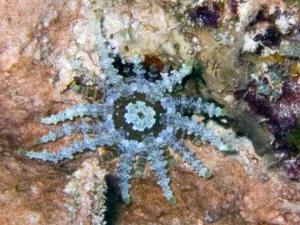
Please help identify 11/13/11
Recently I acquired some live rock that I'm guessing an
anemone came in.
It retreats into the hole in the rock when I tried to remove it.
I have searched every search engine I can think of. Black/steel
grey with short white tentacles. From the east Florida
coast.
<Mmm, interesting>
I have been slowly building a 50g tall tank. 60lbs live rock. 1
1/2" combo sand live crushed coral bed. All parameters test
ok. 3 (mean) yellow tail damsels, 3 turbo snails, 2 peppermint
shrimp, a few unwanted crabs, 1 Kenya tree, a few mushrooms, some
tiny crazy unexciting worms.
<From the behavior I am guessing this is a somewhat aberrant
Telmatactis americana... sans the club-like tips at the end of
its tentacles. Do take a look on WWM over the next few days...
where Anemone ID's are archived (the last FAQs file in
number) as I'm hopeful some other/s will chime in w/ further
information. Cheers, Bob Fenner>
|
|
|
|
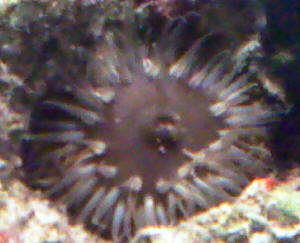
ID help request - possibly a rock flower
anemone? 9/3/11
I bought some live rock from the Gulf, (Florida) and despite
having spent almost a year reading tons of books, articles and
forum postings, thinking I was ready to handle whatever
hitchhiker that I may acquire, I got a hitchhiker I can't ID.
I've asked for help on some forums and the feeling is either
a Mushroom or a Rock Flower Anemone. I was thinking if it were a
mushroom, it'd be a Ricordea but I'm thinking it's
more likely it's an anemone.
<Mmm, appears to be a Lebrunia species... Read here:
http://wetwebmedia.com/marine/inverts/cnidaria/anthozoa/twaanemones.htm>
I wish to provide it the best environment I can and feed it what
it needs, but haven't been able to find much on if it
requires light, how much, what to feed it (it's really
small).
I've attached a few pictures of the little guy to help in
IDing it. It's in a hole in the rock and if something
upsets/startles it, it retracts entirely from view within the
rock. The edges can fold up and seem to be tipped with tiny
stubby tentacles. It also has bumps/tentacles in the middle part
of the disk. It's about the size of a dime or maybe a penny
at best. Originally I didn't notice him and had that part of
the rock towards the side of the tank, but after I saw him, I
turned the rock around so it faces into the tank and gets light.
I didn't face it up towards the light, as I figured it would
possibly shock the critter. I also thought it might give me a
clue as to its needs given how it reacted, shying away into or
stretching out towards the light to see if I needed to move the
rock again.
I tried cutting up a piece of shrimp and offering a teeny piece
to it, but that turned out to be problematic. It shied away from
the offering, but I'm not sure if that's because the
piece stuck too firmly onto the stick or because it didn't
care for it. I'm hoping it's been eating some of the many
pods in the tank, because occasionally I see it curl up parts of
itself.
The rest of the critter I've seen briefly when it stretched
out a bit for a moment, it seems to be a long brownish stalk
inside its rock cave. It tends to be smaller/deflated at night
and more open during the day. From the pictures, you can see
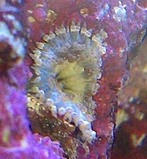
it's a yellow center and yellowish tan edges and tan-ish in
the middle. The early pictures I had of it seemed more colorful,
but I'm not sure if that's a trick of light when I
photographed or if its actually becoming more brownish.
There's a little red crab in the rock I've not seen much
of, but the critter doesn't seem to mind the crab. In fact, a
couple of times I've seen the crab peeking out from
underneath it, looking almost like the crab was wearing a frilly
hat.
Could you please help?
- Barb
<See the linked files above as well. Bob Fenner>
|
 |
Re: ID help request - possibly a rock
flower anemone? 9/3/11
Thank you so much for the quick reply. I'd looked at that page
before and would have never guessed Lebrunia from the pictures
I've seen, especially since its tentacles are so short and
stubby!
Thank you very much for your help and especial thanks for all the
information you've provided for the hobby. I love reading your
work, it's very inspiring!
- Barb
<Ahh, thank you. BobF> |
|
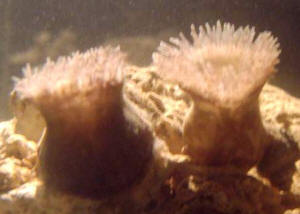
anemone ID, FLA, washed-up... and Centropyge eye
issue 8/31/11
Hello!
<Hi there>
Nick here.
<Bob here>
Have a couple of questions. First off, your site is stellar and
it's a great service you're doing for fish
everywhere.
<Glad to help>
Recently 'rescued' an established aquarium and in the
process of getting it re-set up. It had been a little neglected -
it came with plenty of live rock and live sand, but It had very
little crab, shrimp, snail or other 'cleaning crew' life.
Plus, trucking it 50 miles mixed things up a bit. I kept all the
water I could and worked backwards in setting it up, wet live
sand first then about 1 week later the live rock which had been
in giant aquarium water plastic tubs. It's been cycling for
2-3 weeks now and Nitrite, Nitrate, Ammonia are all virtually
nil....
I was at the beach this weekend here in Florida, and Hurricane
Irene had whipped up a pretty wild swell which left flotsam mats
scattered up and down St. Augustine beach. In looking through
them, I came across a bunch of white legged hermit crabs, sally
lightfoot crabs, sea Cukes and some weird white/tan balls which
turned out to be anemones. Figured I would bring them home as
they were just dying on the beach there.
<An experiment!>
The anemones are chillin' in a shallow 10g until I know if
they're safe to go in the big 95 gallon. Can you help me ID
these and determine if they're safe for the tank? The big
tank is stable now and there's 2 damsels and a scarlet
hawkfish. I also have a yellow and regal tang and a coral beauty
in a 10 gallon quarantine tank waiting to go in to the big tank
one at a time.
Thanks! Pictures attached.
<Look to be "rock anemones" from there... Aiptasia
pallida, perhaps Epicystis crucifer; a bit strung out
(understandably)>
Finally, the Coral Beauty has developed pretty severe pop-eye in
one eye.
Not sure if this happened at the old place, during transit, or in
the quarantine tank, or if it is related to water quality since
they're all jammed in the small tank while the big one cycles
(even though they're getting at least 1 water change a week).
Been reading a lot that isn't too helpful, a la "just
wait, it'll go away on its own"
<Often the best approach>
It seems to have been getting worse and I'd hate to see him
lose an eye.
I've been feeding the quarantine tank antibacteria medicated
food (by Jungle) but not sure if that stuff is really helpful or
not.
<Most antibiotic use in/w marines is of limited to no
value>
Suggestions? If all goes well with the hawkfish, I'll
probably move the Tangs over later this week and early next and
then would be able to add whatever to the water to help the
Beauty.
Thanks!
<Read on WWM re marine fish eye issues.
http://www.wetwebmedia.com/Popeyecures.htm
and the linked files above. Bob Fenner>
|
|
|
|
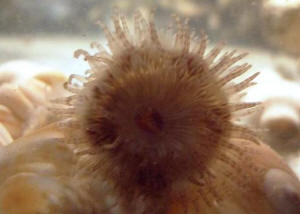
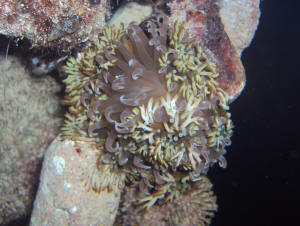
anemone identification 9/17/10
<...15 megs in pix...>
I came across an anemone I have never seen before. Found it under
a rock 7 miles off shore. Anyone have any idea what it may
be?
<... offshore from where?>
It seams to like shrimp pieces (like most anemones) It reacts to
a flashlight being shown on it. (shrinks up) It has small patches
of fork shaped arms all over it and also has long curled arms
everywhere. I cant find a pattern to the way its arms are laid
out. I'm very confused. lol!
Thanks,
Ed Johnston
<Oh! I take it from your addy that you're in Key West... I
think this is an "aberrant" Lebrunia danae. Bob
Fenner>
|
 |
|
Re: anemone identification
9/18/10
You are correct! I researched the name and came up with some
great pics that match. Thanks a lot!
Ed
<Welcome Ed. BobF>
|
|
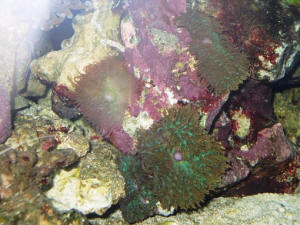
Anemone ID 2/7/10
Hello
<Hi there Zoe>
I bought some live rock yesterday - had quite a deep hollow in
one side - I thought there were some mushrooms in there but
couldn't really see as they were all shriveled when out of
the water. I put the lr into a holding tank and this morning have
found 4 anemones?
<Mmm, yes... appear to be Stichodactyla helianthus, the Sun
Anemone.>
have moved out of the hollow onto the front. They are all at
least 1inch x 1 inch - the tentacles extend less than 1cm - they
are quite flat, almost like a mushroom. I have had a look at the
ID pages and couldn't see much resembling them. I wondered
whether you could ID them for me and suggest whether its a good
idea to keep them or not. I have a 500l tank with a 100l sump, 3
x 54w T5s with reflectors (soon to be 4). Lots of soft
corals.
<These are very "sting-y"...>
I have attached a picture and hope I have given you enough
information.
Thanks for your time
Zoe
<Please see here on WWM:
http://wetwebmedia.com/marine/inverts/cnidaria/anthozoa/twaanemones.htm
and on the Net re their husbandry. Bob Fenner>
|
 |
|
Re: Anemone ID, Helianthus
2/13/10
Thank you for time and your reply. I have tried to do some
research about the Sun Anemone and can't find too much.
<Not much about as far as I'm aware. This is not a
"traded species" of any volume, and is entirely
"too stingy" for common use>
Am a little concerned as the information I found states that they
will eat small fish (I have a couple of very small fish such as a
yellow goby, neon goby, clowns) - does this mean they aren't
safe to keep in the tank?
<Correct>
Also some of the other information says that they have a very
powerful sting - this has confused me a little because my shrimps
often walk over them / stand on them and don't react as if
they have been stung.
<These animals are indeed almost immune>
I suppose I just really want some reassurance that my fish will
be safe with them rather than me needing to give them away - what
are your thoughts?
<I would trade them to someone with a biotopic TWA shallow
water habitat.
BobF>
Thanks again for your time
|
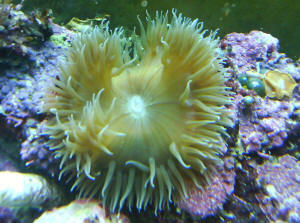
| Anemone ID, Epicystis crucifer -- 1/18/08 Hi
there! <Hello, Brenda here!> I was wondering if you could
help me identify this anemone. <Sure can!> I've searched
and searched, on your website to, which is really awesome and
helpful. Thanks guys! <You're welcome!> I just can't
seem to find this one. <It is an Epicystis crucifer. It is
commonly referred to as a Rock Anemone, and/or a Flower Anemone.
More information found here:
http://www.wetwebmedia.com/marine/inverts/cnidaria/anthozoa/atl_anemfaqs.htm
> I've had him for little over a year now and everything was
going great, until he started moving. I don't know why or if he
could harm any of the others. <Do you mean other anemones? Mixed
species of anemones do not do well together long term.> For now
everything has gone fine, but I want to be sure. Help please.
<You're welcome! Brenda> |
|
|
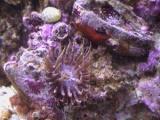
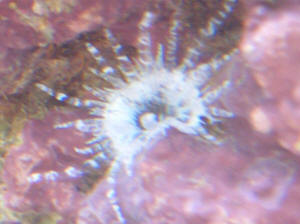
| Unidentified Anemone Hi, I recently bought
100 lbs. of live rock from Harbor Aquatics for my 125 gallon.
(Previously cycled with live sand) In one of the caves lives a
strange anemone that nobody can seem to identify. (attached)
<not a bad picture but a bit dark. Still...> I was under the
impression that anemones like strong light, <not all by
any stretch of the imagination... many nearly or clearly
aposymbiotic (require organismal and absorptive feeding for
life)> but this guy only came out of the cave once at night, and
when the lights came on in the morning, it went back into the cave.
Can you tell me what kind of anemone it is, and what is the best
way to care for it? Thanks <Not clear to me what species it is
but definitely resembles many of the tiny Atlantic cave dwellers
known to be weakly photosynthetic or not at all. Do feed at least
weekly with finely shredded meats of marine origin. Enjoy!
Anthony> Jonathan Steere |
 |
 |
DomRep Sea Anemone Identification 10/5/05 Hi!
<Hello Uli> I found you website http://www.wetwebmedia.com/marine/inverts/cnidaria/anthozoa/twaanemones.htm
looking for help. I need to identify an anemone. Please find jpgs
attached. I could not yet find it anywhere! By the way: I was not
the photographer, "it" was not touched to see a reaction,
all we have is the photo shot in the Dominican Republic. Any idea?
<Appears to be an Actinodendron species. Mr. Fenner
may have some input here. James (Salty Dog)>
<<I concur. RMF>> Thanks a
lot! <You're welcome> Uli
Biologist
Germany |
|
|
| Can you ID this anemone (Found in the Florida Keys)
10/21/05 Hi, I found this anemone in the Florida Keys about six
months ago. I brought it with a tiny that inhabited in it. The
shrimp has disappeared and I was wondering if any clown would go
into an Atlantic anemone <Some learn to get along with
Condylactis species... but not likely this one... appears to be a
Stichodactyla helianthus... Please see here:
http://wetwebmedia.com/marine/inverts/cnidaria/anthozoa/twaanemones.htm>
anyway I would still like to know what I have. It is about 8"
in dia. yellow in color 1/2" tentacles that are very sticky.
Please help. I have attached a picture. <Bob Fenner> |
|

|
Atlantic Carpet Anemone Possibly? Hello Robert, I purchased
what I thought was a Stichodactyla gigantea. I now believe it is a
Stichodactyla helianthus. <Mmm, an Atlantic Carpet
Anemone...> It is yellow in color and the 'base' is very
light yellowish tan to white... a real pretty specimen. If I did
purchase the helianthus variety, how should I care for it? Placement?
Lighting requirements? How can I know for sure it is a helianthus and
not a gigantea. <These are very different animals... S. helianthus
is pictured, described here: http://www.wetwebmedia.com/twaanemones.htm
Their tentacles are green, brown... never seen one with a yellow/white
base... and this species is much smaller... 4-6 inches in diameter
max.> I've read a lot about the care of the carpet anemones but
I have never seen any info. about this particular anemone. Any response
would be great. <S. gigantea is found here on our site: http://www.wetwebmedia.com/anemones.htm
Its "face is deeply folded, tentacles much longer... Care for both
about the same. Bob Fenner> Terry Teutsch
Anemone ID Hi Steve <Anthony with the follow up>
I wrote to you about the black spot on my deceased yellow tangs . Well
since their demise I purchased a Fireball Angel , half orange and half
blue horizontally . I had the fish for three days and it died . The pet
shop had the fish for a month prior with no problems . I will give you
a run down of my tested parameters after the death . PH - 8.31 at 7:00
PM Nitrite - 0 Nitrate - < 10ppm CA - 480 ppm "a little
high" Temp - 78 Salinity - 1.024 Alkalinity - 3.5 meg/L Borate -
1.5 meg/L Carbonate - 2.0 meg/l Magnesium - 1300 ppm The tank has no
other fish inhabitants other than two blue Chromis . I also have 110
lbs of live rock . The rock has many mushroom corals and feather
dusters , I also noticed a small anemone , not a aphasia , the base is
red and the tentacles are white . Any idea on I.D.? <it
reminds me of some Atlantic/Gulf species... is your rock aquacultured
Atlantic in origin?> Also I have about a dozen large snails and a
dozen large blue leg hermits . I refuse to purchase any more fish,
because soon I will be known as Dr. Death . Any help would be
appreciated . Richard <do keep and medicate all new fish in a
quarantine tank for 4 weeks before adding them to your display. Even
though the pet store had the fish for a month... was it in a system
that never had a new fish added to it? Or cold there have been a new
shipment of fish that were added to that system within two weeks prior
and could have carried a disease that didn't express itself yet. No
exceptions to the quarantine rule! All new fish QT in your home
regardless before adding to the display. Best regards, Anthony
Calfo>
Antler Anemone? ID - 2/23/03 Hi Anthony, Been out of the
country on a dive vacation or would have gotten back to you sooner :)
<no worries... I'm still out of my mind> They came with a
green tree from friend a local university that works with fish breeding
and coral propagation. There's probably a variety of
stuff in their holding tanks but as far as I know don't import
anything. <and they probably QT strictly (seriously) as educated
academics/scientists... something we all need to do without fail as
aquarists> After being away, the critters that are visible have
noticeably grown but are still in the bottom third of the
tank. In the past 2 weeks, some others from the local reefer
group and RC have suggested Lebrunia which I guess gives me more
concern for my stupid clowns. <Lebrunia/Antler anemones
seems very hard to believe for a number of reasons like (Atlantic
distribution, Pacific vehicle you've cited, its proclivity for
sitting in the open on the reef, etc). Very doubtful... but possible.
See our WWM pics of this species here:
http://www.wetwebmedia.com/marine/inverts/cnidaria/anthozoa/twaanemones.htm
> I don't know if these pictures are any better... <much
better .... its just hard to be certain when they are this small>
Right now, the stalks are thicker and the polyps are much more fully
extended (all slightly larger than quarter now). I can send
you the full size images for future use if you want.
<that would be wonderful... please do! If high-res, perhaps we can
sneak them into the next book <G>. In the meantime, do try to
notice if there is a very dramatic change with this anemone at night. A
Lebrunia will not retract like a typical anemone but put out large and
exaggerated feeding tentacles. Please let us know :) Do feed these
little buggers well at any rate. They are cute whatever they are (at
least until we ID them <VBG>)> Anyways any advice on keeping
both these and livestock (2 clowns and 1 cherub angel) healthy would be
great. Thanks again. Aven
<best regards,
|
|

