|
Related FAQs: Caribbean Anemones, Atlantic Anemones
2, Condylactis,
Tropical West Atlantic
(TWA) Anemone Identification, TWA Anemone Behavior,
TWA Anemone
Compatibility, TWA
Anemone Selection, TWA Anemone Systems,
TWA Anemone Feeding,
TWA Anemone Disease,
TWA Anemone
Reproduction,
Anemones, Anemones 2,
Anemones &
Clownfishes, Aiptasia,
Anemone
Identification, Anemone
Selection, Anemone
Behavior, Anemone Health,
Anemone Placement,
Anemone Reproduction,
Anemone
Lighting, Anemone Feeding,
FAQs by Genus: Actinoporus, Arachnanthus, Bartholomea, Condylactis (see below),
Epicystis, Lebrunia, Sticholdactyla
helianthus, Viatrix,
Others/Unknowns,
Related Articles: Condylactis Anemones,
Anemones, Invertebrates, Stinging-Celled Animals, Clownfishes, Aiptasia/Glass Anemones,
Coldwater Anemones,
Colored/Dyed
Anemones,
/Diversity of Aquatic Life
Series
Anemones
of the Tropical West
Atlantic
|

|
|
By Bob Fenner
|
Lebrunia coralligens
|
 |
New Print and
eBook on Amazon:
Anemone Success
Doing what it takes to keep Anemones healthy long-term
by Robert (Bob) Fenner
|
Almost "local" to Americans, these are the Actinarians of
that occur off the coast of Florida on down to the coast of Brazil.
Unfortunately, only a couple of species (and 99% only one of these!) of
Condylactis make it directly into pet-fish markets... a few others as
occasional "contaminants" on live rock. This is a great pity,
as the area offers several outstandingly beautiful and hardy Anemone
species... some with breathtakingly gorgeous symbiotic fish and shrimp
species.
| Actinoporus elegans, the Elegant Anemone.
7-9 inches in diameter. Distinctive knobbed tentacles or a flat
oral disc. Uncommon, found in coral rubble and sand areas. Symbionts include the Spotted Cleaner and Squat
Anemone Shrimps, and Banded Clinging Crab. |
No pic
|
|
Actinostella flosculifera
(Le Sueur, 1817), Sand Anemone... C. W. Atlantic. Here in Bonaire 2019.
|
%20MD.JPG) |
| Alicia mirabilis, Berried Anemone. Usually clumped
up by day, looking like a cauliflower somewhat; expanding usually only at
night... here semi-opened, (and a close-up crop below) in Curacao 2015. |
|
Genus Bartholomea:
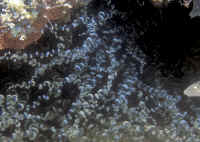
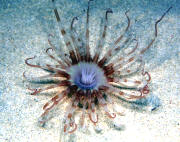
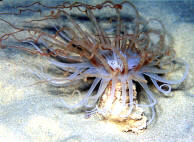
| Bartholomea annulata, (one of) the Corkscrew
Anemone/s. 4-7 inches across. Has numerous long, thin, pointed
tentacles that are transparent, with internal whitish corkscrew
markings. Often found in discarded shells. Able to retract quickly.
Red Snapping Shrimp and Pederson's Cleaning Shrimp are
symbionts. Cozumel photograph. |
|
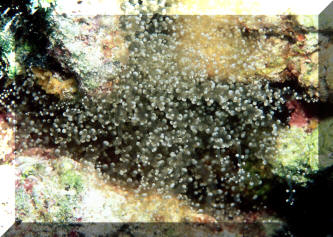
| Bartholomea cf. lucida, the Knobby Anemone.
Similar to B. annulata, with translucent, tapering, thin
tentacles, but smaller (up to 4 1/2" across) and having
nematocyst-bearing knobs instead of corkscrew markings. Close up at
right and below: Bahamas photos of Knobby Anemones and
Pederson's Cleaning Shrimp, Periclimenes pedersoni. Bahamas pic. |
|
Bigger PIX:
The images in this table are linked to large
(desktop size) copies. Click on "framed" images to go to
the larger size. |
|
%20MD.JPG)
|
Genus
Condylactis (and symbionts):
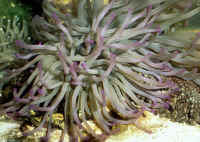
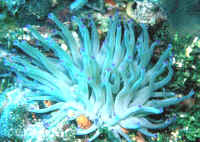
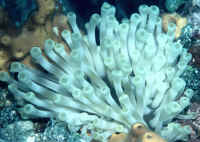
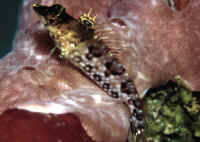
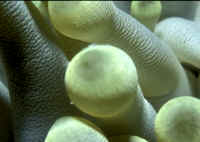
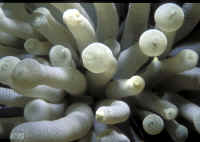
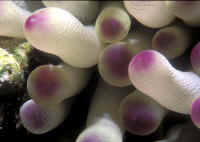
| Condylactis gigantea, the Giant Anemone.
Largest species in the range (6-12 inches in diameter when
extended). White body and tentacles. The latter bear enlarged tips
typically of a contrasting color, though they may be white. Right:
In an aquarium Below: Bahamas pix including one of this species
handful of symbionts (a Diamond Blenny, Malacoctenus bohlkei
bottom right), others include Pederson's, the Squat Anemone
Shrimp (below middle) and the Spotted Cleaner Shrimp, and Banded
Clinging Crab. |
| Captive specimens tend to lose the
"bulbiness" of their tentacles ends. At right and below
Condylactis gigantea in an aquarium and in Cozumel... Wish
we were drifting northward on Santa Rosa Reef right now! |
|
|
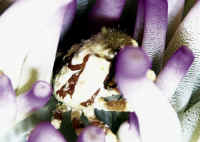
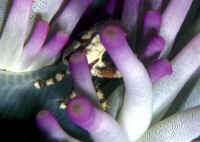
| And here's a C. gigantea with its
commensal crab, the Banded Clinging Crab, Mithrax
cinctimanus in residence. Cozumel pix. |
|
| The Spotted Cleaner Shrimp, Periclimenes
yucantanicus in its host anemone, Condylactis gigantea off of
Cozumel. 3/4-1 in. overall. Also found in association with other
tropical West Atlantic anemones. |

|
Bigger PIX:
The images in this table are
linked to large (desktop size) copies. Click on "framed"
images to go to the larger size. |
%20MD.jpg) |
| You may see/find the name Condylactis passiflora, the (Florida)
Pink-Tipped Anemone. This is a junior synonym for C. gigantea. |
Genus Epicystis/Phymanthus:
Genus Lebrunia:
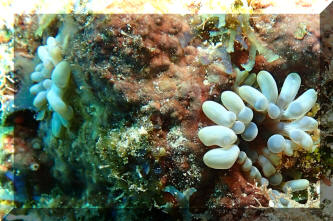
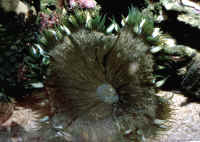
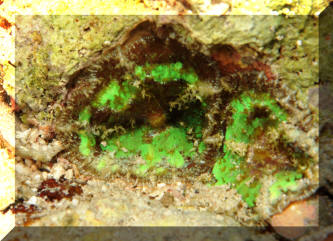
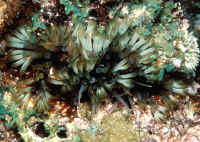
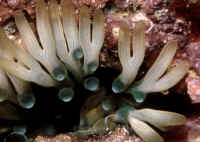
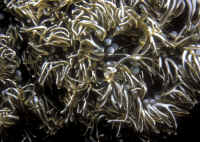
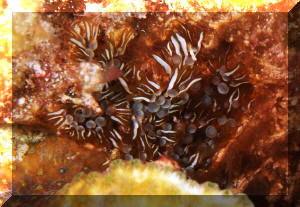
Lebrunia coralligens, the Hidden Anemone.
Uncommon, hidden in cracks from which long pseudotentacles extend
with roundish, differently colored tips. Brown to bluish in color.
True tentacles are long, unbranched. DiF Roatan 2017.
Below in the Bahamas.
Toxic to the touch. |
|
Bigger PIX:
The images in this table are linked to large
(desktop size) copies. Click on "framed" images to go to
the larger size. |
|
.JPG)
%20MD.JPG)
|
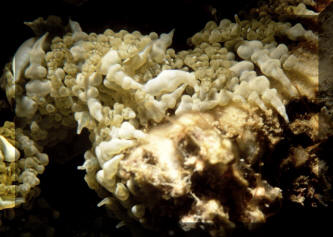
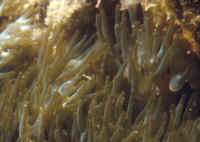
| Lebrunia neglecta (nee danae)
(Duchassaing &
Michelotti, 1860), the Branching Anemone. Has
finger like and stubby, branching "pseudotentacles" (true, longer
tentacles are usually only extended at night). Typically brownish
to gray in color, a few bluish to green. Common in the tropical
West Atlantic. Able to quickly withdraw into its closed space. Will
easily sting other livestock, aquarists, divers exposed skin. Belize
close-up, Cozumel and St. Thomas U.S.V.I. images. |
Genus Stichodactyla:
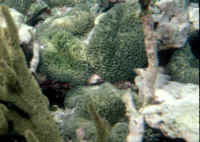
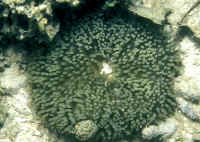
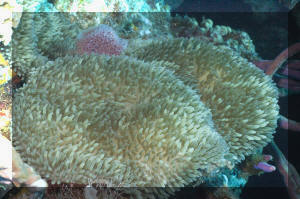
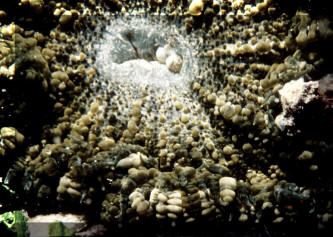
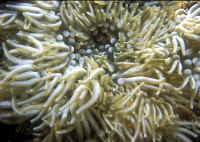
| Stichodactyla helianthus, the Sun Anemone.
With hundreds of small, thick tentacles it's easy to mistake
this species as a Corallimorpharian. Sometimes very common in
shallow back reefs. Symbionts include the Squat Anemone Shrimp and
Banded Clinging Crab. A strong stinger! Belize and St. Thomas
images. |
|
Bigger PIX:
The images in this table are
linked to large (desktop size) copies. Click on "framed"
images to go to the larger size. |
%20MD.JPG)
 |
Genus Viatrix:
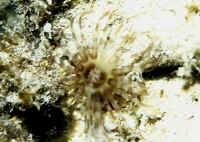
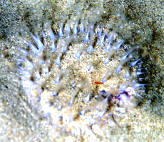
| Viatrix globulifera, Turtle Grass Anemone.
Tropical West Atlantic. 1/4-3/4" diameter. This one in the
shallows off Playa los Glorias Hotel in Cozumel. |
|
Other Species:
Yes there are several other Actinarians that hail from the tropical
West Atlantic. Most are small, obscure... found on Sponges, Turtle
Grass, and/or rare. There's even a (pest) species of Glass Anemone
(Aiptasia tagetes), sigh. None are regularly
found/collected for the ornamental aquatics interest. For folks with a
penchant for the rare, buying, culturing fresh live rock from the area
can be a viable avenue for securing specimens.
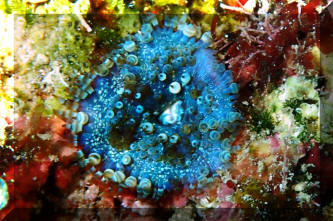
| Lightbulb Anemone. An undescribed species; here in Roatan
2016. Large, bulbous tentacles w/ pointed tips. TiffB pic
Recently described anemone species
2/26/20
Hi!
<Ana>
Just wanted to let you know that the "lightbulb anemone" you mention on this
page (http://www.wetwebmedia.com/SWPOTD1326.htm ) as an undescribed species,
seems to have been described recently in this paper as *Bellactis
caeruleus*:
https://www.researchgate.net/publication/287647075_A_survey_on_
Anthozoa_and_its_habitats_along_
the_Northwest_African_coast_and_some_islands_new_records_
descriptions_of_new_taxa_and_
biogeographical_ecological_and_taxonomical_comments_Part_I
Regards,
Ana Carolina Hernández
<I thank you for your identification help. Bob Fenner>
|
|
Bigger PIX:
The images in this table are linked
to large (desktop size) copies. Click on "framed" images
to go to the larger size. |
|
%20MD.JPG)
|
Bibliography/Further Reading:
Humann, Paul 1992. Reef Creature Identification, Florida, Caribbean,
Bahamas. New World Publications, Inch. Jacksonville, Florida.
320pp.
Kenney, William R. 1986. The Atlantic Frilled Anemone. FAMA
6/86.
Straughan, Robert P.L. 1960. The Florida Sea Anemones. TFH 4/60.
|
|


MD.JPG)
%20MD.JPG)
%20MD.JPG)
/Thor/Thor_amboinensisCOZ2.jpg)
%20MD.JPG)
%20MD.JPG)
%20MD.JPG)
%20MD.JPG)