|
Related FAQs: Water
Changes for Marine Systems, Water Changes for Marine Systems
2, Water Top-Off
Systems, Water
Changes 3, & FAQs on Water Changes: Rationale, Gear/Tools, Frequency/Amount, Techniques, Automation, Trouble/shooting, & RO/DI & Distilled Water 1,
Evaporation/Water
Make-Up,
Related Articles: Marine Water Change, The Perfect Water Change Regimen?
by Scott Fellman, Nutrient Control and
Export, Captive Seawater Quality,
Marine Maintenance,
Treating Tapwater for Marine Aquarium
Use, Synthetic
Seawater/Preparation/Use, Nitrates in Marine
Systems,
Water
Changes/Ex-changes
|
Picture on website not coming up 5/21/05 http://www.wetwebmedia.com/watchgantart.htm
the pictures are not coming up? Fantastic article though.
Would like to see the pictures if that is possible.
<Hmmm... my apologies. I'm wondering if I forgot to
send pics along to Bob? I'm flying out shortly for an
industry/hobby show... be back next week. I'll make a
reminder to follow up with this (dig and find the pics
meant for it and/or others). Thanks for the notice.
Anthony>
|
|
By Anthony Calfo
|
|
|
|
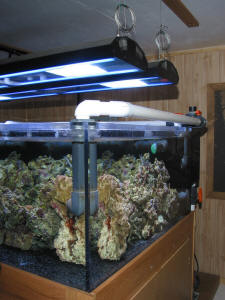
photo caption: "Do not underestimate the need
for superb water clarity. The expense of buying and operating
specialized reef lights can be considerable... and discolored
water reduces the penetration of light in to the aquarium.
Photo by Anthony Calfo" |
In the present state of the
hobby, maintaining a successful reef aquarium can be rather easy.
With a reasonable, if not comparatively modest, investment of
time and money, anyone can enjoy a healthy display of hardy and
beautiful reef creatures. Yet after enough time spent in the
hobby with a successful tank, you might still see other
extraordinary tanks that make you wonder, What are they doing
different? And you might hear stories of challenging species
living many years beyond the norm in systems that seem to be the
same as your in hardware and husbandry. But is the difference
simply luck or good fortune? Almost certainly not - especially in
the case of species longevity, which requires deliberate effort
and consistent husbandry that stands the test of time. To sum it
up in a word, the difference is finesse. Uniquely
successful aquarists tend to have an arsenal of good habits that
is thoughtful, tidy, and appears to be not very different than
the norm, yet cumulatively sets them apart distinctly from the
masses.
In this article series, I intend to cover
some key tips and tricks to better reef-keeping techniques
that will quickly and noticeably improve the success of your
aquarium. I often like to refer to such tidbits as things you
though you knew. Many suggested improvements will not surprise
you, and most I expect will make good sense and perhaps be
familiar. But its easy to otherwise forget such good habits and
get into a routine that becomes a bad rut. Indeed, we all tend to
lead busy lives. However, skipping a monthly water change,
for example (that might only take 30 minutes or so), seems to be
quite remiss when companion dogs and cats require far more
daily maintenance and attention. Do keep it all in
perspective and be diligent about putting in extra effort for
good aquarium husbandry, particularly when it requires so very
little time. It will pay dividends in happiness for you and
better health for your aquarium.
The first and single-most stimulating thing
you can do for aquarium vigor is to improve water quality; do
more frequent water changes. It is completely lost on me why
so many aquarists resist doing regular and hearty water
exchanges. The benefits are quickly apparent, the cost of doing
it is rather inexpensive, and the cost of not doing it is
equally motivating (poor livestock health or premature death). In
the US, the old rule of thumb is to exchange approximately 20 -
25% of the system water per month. Yet this guideline was
established decades ago with aquariums that were necessarily
understocked for the limitations of technology at the time, and
an inability to keep many animals per tank. A four feet, or one
meter, long aquarium in the 1970s or 1980s could only house, for
example, a Zebrasoma tang, pair of clownfish, some damsels
and perhaps a small wrasse presuming the undergravel or box
filters were maintained well! To think of the coarse media used
for bio-filtration (sintered glass, crushed dolomite,
non-carbonate gravel, etc.) is no wonder why tanks had to be
stocked lightly. As such, modest water change schedules were
tolerable for the typically lighter bio-loads.
In todays aquariums, however, the amount of
biomass banked in live rock and live substrates (sponge, algae,
worms, bivalves), plus the increased availability and use of
fishes is far greater than decades past by a scale of magnitude.
Thus, antiquated rules of thumb on water change schedules are
dubious if even useful. Regardless of what decade one keeps
fishes in, however, heavy bio-loads simply require more
aggressive processing of organics. While we still cannot
quantitatively assay all undesirable elements of aged aquarium
water (and remove them) while measuring and supplementing all
known (missing) desirable elements (or the rate at which they are
removed), we can still keep an even keel on water quality by
dilution. Its an old adage, but, The Solution to Pollution is
Dilution. Live by these words and you will enjoy greater success
in the hobby! Regular and frequent water exchanges dilute known
and unknown nasties while replenishing known and unknown
desirable elements to aquarium water.
|
|
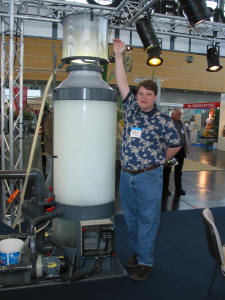
photo caption: "Quality filters and nutrient
export products like protein skimmers can relieve some of the
burden on water quality. But none can wholly replace the need
for regular water changes. Photo by Anthony Calfo" |
The size of water change needed per tank
varies not only on bio-load, but on several prominent aspects of
husbandry, all focusing on nutrient export. More aggressive
protein skimming, carbon and chemical filter media use, and
vegetable or animal filtration (filter feeders and macroalgae
refugiums, e.g..) can alleviate some of the burden on water
quality and reduce some of the need for larger water changes. But
we cannot avoid water exchanges altogether. Do consider that even
with a 50% monthly water change, 50% of the undesirables, and
depleted desirables, are still left behind. And those unfavorable
halves accumulate and amplify month after month. This is the
impetus, in fact, for aquarists with smaller marine aquaria to do
50%+ water changes weekly. They are largely spared the need for
protein skimmers, dependence on heavy chemical filter media
use/exchanges, and the alchemy of estimating how much of which
magic elixirs (supplements) must be added. Best of all, it is all
done at a very modest expense of mere tens of dollars per year in
extra synthetic sea salt.
Although it may sound remarkable at first to
do such large water changes, it is not unnatural by any stretch
of the imagination. Is there any better example of the power of
dilution than the ocean itself? If you spend any time at all on
living reef, you will be astounded to see how much water is
exchanged in a moment: millions of gallons of water in flux
within sight. Add to that the fact that so many popular reef
creatures are intertidal, and we have a good argument to start
with for the tolerance of reef creatures to hearty water
changes.
There comes a point, admittedly, where large
water changes are not cost-effective in light of the alternatives
(supplementation and aggressive skimming, ozone, carbon use,
etc.). Larger aquaria themselves by nature are more dilute for
their volume (generally less weight of fish per gallon of water)
than smaller tanks where overfeeding and overstocking will
concentrate in and cripple water quality faster. So instead of
doing 50% or larger exchanges, you might only need 10 20%
weekly water exchanges. This is, in fact, what I recommend
most folks start with, and ramp up if needed. The point of the
matter all is that smaller and more frequent water changes are
better than doing the task monthly or less often.
|
|
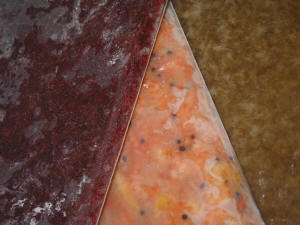
photo caption: "Frozen foods are some of the
most nutritious fare to offer reef fish and invertebrates.
But take care to feed these foods properly! Always drain and
discard the thawed pack juice, otherwise it accumulates and
can be considerable fuel for nuisance organisms to grow from.
Photo by Anthony Calfo" |
Under the best of circumstances, water
quality in the aquarium after one month typically strays
unfavorably downward in pH. It certainly increases in dissolved
organics. Water clarity from discoloration becomes darker,
however inconspicuous that might be to the naked eye during
casual daily inspection. In heavily stocked reef displays
allelopathic compounds (chemical warfare) between corals, plants
and algae amplify. Phosphorous and nitrogenous compounds
inevitably accumulate too. The list of challenges to water
quality goes on. Now instead of allowing these dynamics to
crescendo before reducing them abruptly with a large monthly (or
less often) water change, the smaller, more frequent water
changes will dull the peaks and valleys of such swings in water
quality to minimize the stress on the tanks inhabitants.
You dont even have to do larger total
(volume) amounts of water exchange on tanks with a light bioload.
Instead of doing, say, 20% per month on a lightly stocked large
display you might do 5% per week. Monitor aspects of water
quality in the interim to insure that the modest exchanges are
enough though (look to see that nitrates are not increasing for
starters). Informal experiments have been done to compare if
larger monthly water exchanges were better for water quality on
testable parameters like nitrate than smaller weekly exchanges.
In such trials where the same total volume was exchanged either
way, the larger monthly water changes actually had a slight edge
on the smaller weekly events. What the statistics do not reflect,
however, is the stress of exposing livestock to greater extremes
of water quality for longer periods of time by monthly water
changes. Greater studies on allelopathic competition in time will
undoubtedly, in my opinion, underscore the need for better
attention to water quality in marine aquaria. It reminds me of
the mantra that good and bad things alike should happen slowly in
aquaria; small, frequent water changes support this wisdom.
Water quality issues not only affect
livestock directly, but play a role in hardware applications as
well. Its no secret that lighting issues are some of the most
actively discussed and hotly contested topics in the aquarium
hobby. How ironic is it then to see aquarists spend many hundreds
of dollars on lighting hardware and operation (replacement lamps,
electricity, etc.), only to ignore the fact that poor water
clarity (color) is severely handicapping the delivery of quality
light to photosynthetic reef corals and invertebrates?!? Please
dont just take my word for it though; take the time to notice the
difference in color between new synthetic seawater versus aged
water from the tank when compared side by side in clean white
plastic buckets. To make matters worse, the difference need not
be great to have a significant effect (reduction) of light in the
water. A tinge of color can reduce the penetration of light at
depth dramatically. For clarifying issues like this, the use of a
lux or PAR meter for measurements of light is, well. illuminating
(pardon the pun)! If you cannot afford such instruments, look to
the local aquarium club; many reef clubs will hold a small
fundraiser where each member contributes a few dollars for the
group to purchase and share a light meter (decent models can be
bought for $150-300, typically Apogee brand has been popular with
aquarists). The benefits of using a PAR meter are many.
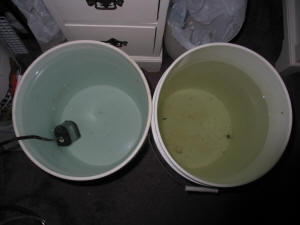 |
photo caption: "Even with monthly partial
water exchanges, aquarium water can become noticeably
discolored. Even a slight discoloration significantly reduces
the penetration of light at depth! Photo by Anthony
Calfo" |
Beyond the measure of useful light (to
photosynthetic creatures), a light meter can give a revealing
indication as to when lamps have exceeded their useful lifespan.
With a baseline measurement of new bulbs, you can track the
degradation of light quality over time. It really is surprising
to see how so many lamps lose considerable PAR value after as
little as 10 months (hence the oft-cited yearly lamp replacement
recommendations).
Another great use for such meters is to take
readings in the tank for corals that are being sold or traded.
Similarly, known readings from coral suppliers will help you find
optimal places in your tank for new specimens. The stress of
acclimation to such new light is reduced by such efforts. You can
also get a concise appreciation for how significant even a small
amount of dust, salt creep or debris on lamps, lenses or canopies
can be. With regards for how expensive electricity is too, its a
money saving lesson that also improves the amount and quality of
light that reaches precious reef creatures. While the purchase of
a light meter is a not-insignificant expense, the savings on
operational expense and lighting hardware alone may recoup the
cost in the short term. And for the value of typical reef systems
overall it is a small investment that provides invaluable
benefits to the care of photosynthetic livestock.
In closing, some words should be said about
doing a proper water change. Mixing up synthetic seawater is very
easy and safe for doing large water changes if you follow some
simple guidelines. As with all incoming water, whether for
evaporation top-off or salted for exchanges, be sure to aerate
and slowly warm new water for at least one day in advance. Using
untreated tap water can be bad for several reasons. First of all,
the dissolved oxygen coming out of mains is low in dissolved
oxygen, which can be quite a shock for aquarium livestock. All
tap water needs to be aerated to reach equilibrium or saturation
with the atmosphere of the room that the aquarium is kept in. It
also needs to
be heated slowly over hours or a couple of
days to match the systems temperature. It can be dangerous to
heat water quickly and use it right afterwards in the aquarium!
When pouring oxygen-poor hot water into oxygen-rich cool water,
there is the risk of driving oxygen off/out of solution and even
causing oxygen/air embolisms in fishes much like divers that get
the bends from nitrogen. It should also go without saying that
the salinity of new water should be adjusted to match the
salinity of aged/out-going water. While plastic hydrometers are
handy and durable, please keep an extra hydrometer made of glass
or a refractometer on hand to check the accuracy of plastic
handheld hydrometers periodically. And finally, you should not
underestimate the caustic nature of newly mixed seawater.
Chemical reactions in dissolving synthetic sea salt mixes take
time to complete. To temper the harshness of newly mixed seawater
as well as insure thorough dissolution, mix freshly salted water
for some hours up to one day in advance of use in the aquarium.
Follow these suggestions and you will be on your way to finessing
your own successful marine aquarium!
with kind regards, Anthony Calfo - March
2005
|

