|
FAQs About Turtle Systems: Lighting,
UV
Related Articles: Turtles, Amphibians, Red Eared Slider Care,
The Care and Keeping
of the Red Eared Slider,
Trachemys scripta
elegans by Darrel Barton,
Related FAQs: Turtle Systems 1, Turtle Systems 2, & Further
Subdivided FAQs on Turtle Systems: Turtle Enclosures, Turtle System Filtration, Turtle System Heating, Turtle Substrates & Decor, Aquatic Turtle Basking Areas, Turtle System Maintenance, Overwintering Environments, RES Systems, & Turtles 1, Turtles
2, Red Ear Sliders, Turtle Identification, Turtle Behavior, Turtle Compatibility, Turtle Selection, Turtle Feeding, Turtle Disease, Turtle Reproduction, & by Species:
Cooters/Mud Turtles, Softshells, Snapping Turtles, Mata Matas, Tortoises, & Amphibians, Other Reptiles,
|
|
|
Red infrared basking light for turtles
4/30/15
Hello!
<Hiya - Darrel here>
I was here before when my African side neck turtle was acting strange, and she
is doing great thanks to your advice!
<Happy to hear that>
I now have a question about lighting. I recently upgraded my tank to a 75
gallon, and so I needed a new basking bulb because the one on my 40 gallon
wasn't keeping the basking area at the desired temperature. By recommendation
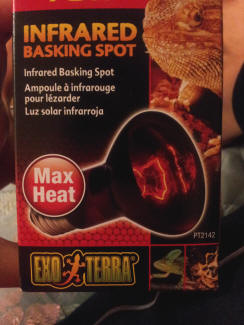
from the staff at my local pet store, I bought an Exo Terra Infrared basking
spot bulb which also produces red light. I've been using
for a week, and my turtle seems fine with it. However, I lot of people have told
me that red infrared will injure their eyes, and they can become blind. Is this
true?
<nope. He sun produces plenty of that wavelength and the world is not filled
with blind turtles or frogs or anything else.>
<That said, the purpose for infrared is to produce heat using a light that
doesn't disturb the animals at night. In other words we use red bulbs when we're
trying to heat the animals while they sleep. A bulb that goes on in the morning
and out in the evening doesn't need to be red.>
Should I go buy a new bulb immediately? I definitely do not want to hurt my
little buddy.
Also, she does have a uvb light as well. I keep both on on a 12 hour cycle.
I attached a picture of the bulb I purchased. Thank you for your help! I
love your website, you give great advice!
<Thank you - we try. The Pay Off to Bob and the rest of us crew members is
people like you who TAKE the advice and make better lives for our wet friends.
Keep up the good work>
|
 |
Red Eared Slider Turtle Lighting Question
11/30/13
Hi again, I have a question about turtle lighting. I have an
aquarium hood that can hold 2 bulbs. Is it ok to use a GE 6500K
daylight spectrum bulb for UVB light (assuming the wattage is the same)
along with a generic incandescent bulb for UVA light/basking heat?
<UV-B is the 100% essential thing for turtles. So yes, you do need one
of those for turtles kept indoors, and absolutely do not economise on
buying a UV-B bulb. Any trivial saving you might make in this regard
will be massively overwhelmed by the problems (including expense)
accrued by issues such as Metabolic Bone Disease caused directly by
insufficient UV-B. Do not, Do Not, DO NOT confuse sunshine-mimicking
"daylight" bulbs sold for artists and other household uses with
bulbs/tubes designed for reptiles.
While some "daylight" bulbs produce UV-B as part of their spectrum, they
do not produce very much of it, and are far inferior to properly
designed ones intended for reptiles. UV-A is somewhat less essential,
though I would direct you to this excellent summary of heating/lighting
as to why you don't want to ignore it completely when keeping day-active
reptiles:
http://www.anapsid.org/liteheat.html
Some UV-B bulbs will produce adequate UV-A as well, so check, and
purchase accordingly. In the second fitting you could install a plain
vanilla incandescent bulb (which produce more heat than light) if you
wanted -- but do remember that while cheap to buy, they're extremely
expensive to run, so hardly worth using if you're only saving a few
dollars.>
The ReptiSun bulbs are twice as expensive and I wanted to know if its
possible to use these other bulbs instead.
<The Reptisun UV-B ones you mention are excellent and highly
recommended.
Over the months, years you own your turtle, good quality tubes/lights
will more than pay for themselves in healthcare savings. Your local
reptile retailer may well be able to suggest less expensive equivalents,
but certainly look for ones designed expressly for reptile enclosures
and offering substantial UV-B (and at least some UV-A) for long-term
success.
Skip anything sold for artists, black lighting, households, fish tanks,
etc.>
Thanks for your response!
-Matt
<Hope this helps. Have bcc'ed Darrel, who'll surely jump in if I've
missed something. Cheers, Neale.>
Light For RES Turtle -
12/19/2012
Hi! Vyushti here! I just got a light for my turtle Pluto. It's not a
UVB/UVA light but it gives off heat. The company is called Roxin,
its sold
all over the country. Its 30cm and 6W. Is this sufficient enough? And
how long should I keep it on?
Thanks!!
<By itself, no, it isn't adequate. You do need a source of UV-B.
Assuming your turtle lives indoors, it will need a UV-B light. These are
inexpensive and widely sold. Lack of UV-B is a very, VERY common reason
for deformities and premature deaths. Cheers, Neale.>
Re: Light For RES Turtle -
12/19/2012
Hi Neale! So how long should I keep this light on? By the way we take
Pluto in the sun for around an hour everyday and provide him with boiled
and crushed vitamin D.
<Boiling vitamin D (or any other vitamin) will destroy it, so that's not
a good idea. If your turtle can have 2-3 hours of sunshine most days of
the year, he should be okay without the UV-B light. Do bear in mind
day-active reptiles like turtles will bask for many hours per day. Glass
stops UV-B from the Sun, which is why putting the vivarium next to a
window won't work. You do need a UV-B light if the turtle mostly lives
indoors. In any case, have a read of this excellent page over at
RedEarSlider.com:
http://www.redearslider.com/index_lighting_basking.html
There's no real magic to providing the right lighting. You can
combination UV-B and heat lamps, and these are really useful if you want
to minimise on expense and hardware. See here, in the section about
"UV-B Heat Lamps (Self-Ballasted Mercury Vapor)" about two-thirds the
way down.
http://www.tortoisetrust.org/articles/lighting.html
Heat and UV-B lamps should be on about 12 hours per day. Cheers, Neale.>
Re: Light For RES Turtle 12/24/12
Thanks Neale, though I still haven't gotten my real question answered.
The light is a 6 Watt bulb which is 30 cm long. How long should I keep
it on and should it be on at night?
<UV-B lights should be kept on for about the same time as the heat lamp;
i.ee., around 12 hours per day. Cheers, Neale.>
Red-Eared Slider question re compact UVB bulb & slight
pinkish hue to skin - 11/05/2012
Thanks for all your great work. You're a wonderful, trusted resource for
me and helped me in the past when my turtle had eaten a whole pantload
of plastic decorative plants.
<And thank you too, there are few things we like better than adoring
fans.!! Darrel here with you (actually WITH you - I'm in Torrance, too)>
This is Lucy's lighting/basking setup. She had a long 18" fluorescent
bulb but I gave that fixture away recently, thinking the double deep
dome thing would be more "handy." So far I like it and it's on a timer,
everything is good, basking temp is good, etc. My only question is
whether she is getting ENOUGH UVB from the compact fluorescent Repti-Sun
5.0 Tropical bulb, as it doesn't cover much surface area. She does
normally bask RIGHT UNDER it.
<She's getting plenty of UVB with that bulb>
You can see the UVB bulb on the right on this picture. Her Turtle Tuff
heat bulb is on the left. The dome lamp is a "reflector" lamp. (It's a
90-gallon tank.)
Earlier this year Lucy was laying about 6-8 eggs every 3-4 weeks for
MONTHS. Since I upgraded from a 55-gallon tank to the 90-galloner about
9-10 weeks ago, she has not laid any eggs. Perhaps she is no longer
stressed out.
<Or finally out of eggs.>
I have read a lot about the link to eye problems and it seems that was
more in the past and more when people positioned the bulbs so that the
critters were looking right at them, rather than the bulb being directly
above the critter. My concern is more with whether these kinds of bulbs
provide enough UVB, since they cover a relatively small surface area
(unlike the tube kinds).
<Yes, but the positioning and the focus, rather than the diffusion of a
florescent makes up the difference>
I hope you can see this pic:
https://www.facebook.com/photo.php?fbid=3789772304124&set=a.1034600866560.2006474.1271604094&type=1&theater
<I think its fine>
Also, of late I've sometimes noticed a very slight pinkish hue to her
skin when she's basking...the skin nearest her shell. Is that normal?
<Normal? No. But not a reason to panic. It CAN be sunburn from too much
UV - back the bulb UP about 2 inches and wait a month.>
Thank you SOOOOO much,
Linda Abbott
Torrance, CA
<Yer welcome, Linda - do us a favor? When you hit the lottery … remember
the 'donate' button on the top of our home page. Every little bit helps>
Re: Identify turtle type and am
I doing this right? UV, nutr. 6-10-11
Thanks so much for your response!
<No charge!>
The bulb is a 75watt UVA UVB bulb.
<OK - make sure of that. Make sure you have a good quality bulb from
a reputable company that sells reptile lighting and remember to change
it as recommended. Most UV products stop giving off useable light LONG
before they physically burn out>
<Also, UV through glass or even window screen is nearly useless, as
is UV light from more than 10-12 inches away>
I turned off the heater since I do not in fact live north of the arctic
circle, but instead the armpit of hell aka Houston.
<I spend a week in Amarillo one night. I'm TOLD that you have
yourself a fine state there, but my experience has been a bit
skewed>
As far as the outside enclosure, it's about 5" deep so he
can't crawl out and I've rigged a top out of a window screen
over the top.
<Window screen is actually DESIGNED to shield from UV rays. Better
is to get some 1 inch Hardware Cloth from a local hardware or building
supply store>
Also I've half covered it with some plywood so he has a space in
the shade. Since it is so brutally hot here, should I only put him out
in early morn or late afternoon or is direct light better?
<Just avoid the 11-2 time frame and you'll be fine>
I got some vitamin A drops since even though I don't think he has
any eye issues; it worries me to read all the comments on your site
about bulging eyes. Aren't the eyes inherently bulging?
<Not unless you squeeze him too hard>
Anyway, I probably ought to cut back on his food as he begs all the
time and I'm feeding him 2-3 turtle sticks a day. Also got a
cuttlebone but I'm not sure how long it should stay in the
water.
<Unless he's a parrot, a cuttlebone, calcium block, etc. does no
good at all. Turtles get their calcium in their diet. In order to get
enough calcium in the water he drinks, you'd need to make a plaster
soup.>
<I'm not AGAINST Vitamin supplements but I like to remind people
that their purpose is to compensate for a deficiency in their diet.
Cure the diet - no deficiency!!>
<ReptoMin food sticks are a completely balanced diet for water
turtles. So is a decent quality, low fat Koi pellet (same ingredients
as ReptoMin, just cheaper). Toss in (literally!) an earthworm once a
month and your dietary problems are solved.>
<Well, ok, maybe not so much YOU but the turtle's diet problems
are solved>
Thanks again for your help, this site is such a useful tool!
<Unlike my brother-in-law who is a useless tool>
Sent from my iPad.
<^Bragging>
700 Responses!!
5/22/11
Hi my names Sophia
<Hiya - I'm Darrel>
<Guess what???>
<This is my SEVEN HUNDREDTH LETTER on the WWM crew!!!!!>
<Imagine that!! 700 people have written in and had the fortune to
get ME as their letter-answer-person!! 700 people!!>
<700 times I've given people advice on turtles, fish, aquariums.
Illnesses, investments, relationships and car repair. The law of large
numbers says that I must have been right at least a few of those
times!!! LOL>
<Then again, every time I get proud of answering 700 letters over 4
years, I remember that Bob Fenner and Neale Monks answer that many
every month>
<Anyway enough about me!>
I have a red ear slider that is 4 1/2 inches wide and
5 1/2 inches long. He lives in a 100 gallon tank and has a great
basking shore. We have a heating lamp,
<Great. The temp under the lamp should be between
88 and 93 degrees>
-- the water is in great temp,
<Should be between 68 and 73 degrees - normal room
temperature>
and he is right by the window so the sun is always shinning down on
him.
<Well, there's a problem. UV/B radiation, the kind that reptiles
need for good skin and bone health, does not easily pass through glass
- or even window screens. By the time that sunlight passes through the
window glass and then the tank glass, I'm afraid that almost all
the healthful UV/B radiation has been filtered out.>
<There are two ways to go here. Companies like ZooMed make UV/B
bulbs that screw into normal lamp sockets, just like his heating lamp.
You can count one right next to his heat lamp. There are also
florescent bulbs that produce a bit more of the same UV/B and mount
lengthwise across the tank. These are generally a bit more beneficial,
but more expensive as well.>
My dad knows more about this than I, and my mom doesn't want to go
to a vet so you are my only resource please help me!
<Yes, a trip to the vet is expensive, especially when we have such
general symptoms>
My red ear slider turtle seems to have some type of white clear slime
all in his shell that floats out when he is in the water. Also his skin
is bulging out of his hind legs and a little on his tail. What is wrong
with him? Does he need some type of surgery?
<No surgery, Sophia.>
<We have two separate things here. The floating white slime sounds
like the beginning of a fungal infection. This is easy and inexpensive
to treat. I'll tell you how to do it a little later.>
<The bulges are more concerning but then without seeming him or
knowing more detail, there is also less I can help you with. Bulges can
be a sign of edema, which is swelling of the soft tissue. That's
very serious, but then again it's not usually general either. Edema
usually presents as ALL the soft tissue looking bloated. If he's
being over-fed, his soft tissue would look um ... pudgy every time he
retracts - back AND front. In any case, we need to treat what we see
and correct any conditions that are not optimum>
<Here's a link to basic care. I covers UV lighting and diet.
Make sure you read and completely understand both topics (as well as
the rest of it) and do further research here on WWM (Google search box
on the bottom of the home page - check "search WWM") to get
more information>
http://www.wetwebmedia.com/FWSubWebIndex/RESCareBarton.htm
<Now as far as the slime and the bulges, I'm going to start with
the basics. He needs to be kept warm and DRY for a few weeks -- and
treated for a fungal infection exactly as described in this
article:>
http://www.wetwebmedia.com/FWSubWebIndex/treating%20RES%20Dis%20DarrelB.htm
<If you're Dad knows more about these things, you might ask him
to scan the articles, too. They're short and hopefully to the
point>
<During this time, see that he (the turtle, not your dad) gets some
direct sunlight EVERY day. That means taking him outside for a walk.
Let him sit on the grass or sidewalk under direct sun. Hell want to
walk around you cant take your eyes off of him for a second (you'd
be amazed how fast these guys can be when we're not looking!) so
you may need to follow him, or keep bringing him back from wherever he
wanders. You can put him in a box that he can't crawl out of, but
you still can't leave him alone. If you can, I'd like him to
get 15 minutes of sunlight, twice a day, while he's in
treatment.>
<Meanwhile, fix the UB/B problem in the tank, read the articles,
attend to whatever's wrong - and see how he does.>
<Write back if you need more help><<Congrats Darrel.
B>>
RES care India
4/23/2011
Hey,
<Hiya - Darrel here>
I have two 8 months old RES. I reside in India where temps are between
40 degree Celsius (summers) and 20 degree Celsius winters.
<Ah - Metric temperatures!! That's 104 Degree Summers and 68
degree Winters for those of you still in The Old Dominion>
It is difficult to get uvb bulbs here.
<I've heard that. Still - it is well worth your while to
try>
You guys have already got many mails on that.
<Yep>
I just want to know can I do without it if every day I place them under
direct sunlight from 8:30 A.M to 9:30 A.M and provide them adequate
vitamin d3 in their food.
<Yes>
They do stay in the sun for 20 min max after which they start feeling
hot and move over to shaded area. When they do this I place them in
their feeding bowl and feed them. After they have cooled enough I place
them again in direct sunlight area for another 20 min.s or so. After
which I quickly put them back in their main tank.
<VERY nice care, Ruchika - and more than adequate. Just remember
that they can cook so quickly in the sun make sure you don't ignore
them even for a few minutes.>
<They do have a BASKING light in their main tank, correct (a heat
generator) so that the can thermo-regulate during the rest of the
day?>
<Other than that, your care is more than adequate and will keep them
healthy.>
Regards
Ruchika
RES hatchling question
9/13/10
Dear Crew
<Hiya - Darrel here>
If I leave the UVB and basking light on for 24 hours once in a while
will they be okay????
<Yep - they'll be just fine. The amount of UV-B light they get
isn't enough to hurt them even if left on 24/7 >
Thank you!
<yer welcome!>
uv lighting 9/3/10
Goot Marnin- Query/ do plant lights carry enough U. V. light
spectrum for aqua plants and captive reptiles/amphibians?
<No. Note that not all reptiles need UV-B light, and I don't
think any amphibians need it. Among reptiles, anything nocturnal will
usually get by without UV-B light, though there's some evidence
even nocturnal reptiles such as night geckos will bask occasionally,
and that in the vivarium providing at least some UV-B can improve their
health. With that said though, it's the day-active species that
bask in the Sun that need UV-B -- i.e., tortoises, turtles, iguanas,
anoles, monitors, boas, etc.>
I have called as many of the providers and manufacturers of grow light
and plant lights that I could locate and receive the same answer from
each.
<Indeed?>
"Well, it says right here.!" Hey, I can read the label and
there is nothing written either way. They all are very nice folks to
visit with, however they will not or can't give me a straight
answer. .Reptile U.V.
bulbs in the local fish and reptile houses start around 60.00 dollars
each, a wee bit pricey for a bulb that will run out of juice in a month
or so.
<Should last 6-12 months depending on the brand.>
Plant bulbs run around five dollars each.
<Not here in England they don't.>
These bulbs also phase out after thirty or so days.
<Again, should last about 12 months.>
I realize we get what we pay for, however, I am rather frugal, (tight),
and I am looking for that extra penny to put back for feed and
such.
<Fool's economy. Lack of UV-B is one of the PRIME reasons
reptiles get ill.>
Spending 60.00 versus 5.00 makes a big difference in the old pocket
book.
On the other hand keeping my aqua beasties, aqua plants and reptiles
happy is my main concern. Any help would be appreciated. Danke, Bob
<You really do need tubes designed for reptiles. What we call UV
light is actually a range of wavelengths, and reptiles need a specific
band of wavelengths, known as UV-B, as well as a certain intensity.
Cigarette
lighters and furnaces both produce flames, but they're used for
totally different things. Same here. You can get some excellent lights
that combine heat with UV-B, and these are good value purchases.
Cheers, Neale.>
Is the UV-B bulb a substitute for
sunlight? Turtle Sys., lambda... to do: split up/sub-FAQs: tank,
filtration, maint... 10/10/09
<Yes. Turtles (and many other day-active reptiles) need UV-B light
to synthesis Vitamin D. While it is *technically possible* to
administer Vitamin D, e.g., via food or injections, this is something
only done under lab conditions. The average person cannot judge the
amount of Vitamin D needed, and if you provide too much or too little,
the turtle will get sick, for example, Metabolic Bone Disease. By
providing a UV-B light, the turtle will choose when to bask, and it
will manufacturer all the Vitamin D it needs.>
What if I let my turtle bask only in sunlight and never under the
bulb?
<If your turtle is *outdoors* for something like six hours per day,
every day, then it will not need a UV-B basking lamp. It will get
enough UV-B from the sunshine. Obviously, this isn't viable if you
live somewhere in the temperate zone (e.g., the US or Europe) because
except for the summer, it will be far too cold for your turtle to be
put outside. Because glass stops UV-B, putting the vivarium next to a
window is hopeless, and will NOT be a suitable alternative. If your
turtle lives indoors, then it MUST have a source of UV-B. This will be
explained in any book on reptiles, and is extremely well supported by
hobbyist experience as well as science. There's a nice site at the
link below all about UV-B and why reptiles need it:
http://www.uvguide.co.uk/index.htm
Because UV-B is comparatively inexpensive to provide, it shouldn't
really be a discussion point. A combination metal halide UV-B/heat lamp
is one convenient option. See for example the discussion here:
http://redearslider.com/light_sources.html
If you can't afford the cost of a UV-B lamp, then you probably
can't afford to keep a pet reptile anyway. Similarly, if adding a
UV-B lamp sounds like a lot of effort, then keeping a reptile will be
too much effort as well.>
My turtle species is Kachuga smithii.
<Cheers, Neale.>
UVB light 07/23/09
Hi crew! It's me again, Felix from Malaysia XD
<Hiya Felix, Darrel here is Los Angeles!>
I have 3 Red Ear Sliders, I got everything except UVB light, it's
super hard to get it here, just wanna ask, those full spectrum
fluorescent light for fish tank, do they give UVB? I saw a lot, like
those that kill germ, those for aquarium plants... I plan to keep them
outside under the sun, but they're still small, their shell less
than 2.5 inches long... Any better idea
<Natural sunlight is by far the very best and only UV the turtles
need, Felix. That is IF they can get it directly -- it can't be
filtered through glass of any kind and even screen the size of window
screen or mosquito netting. Also, if they are outside, make sure that
they have shade where they can get away from the sun -- and lastly,
that there is enough water that the sunshine doesn't make the water
too hot. Remember, a small tub of water left in the summer sun will
easily reach 120 degrees and that can kill your little friends.>
<Inside the house, they really should have a dedicated UV bulb, but
on the other hand I have used full spectrum bulbs myself for many
years. The Vita Lite by Duro is a full spectrum bulb that I used for
many years and should
be easy to get since they have many uses. Just remember that the
effective range of the UV declines significantly beyond 8 to 10 inches
and place the bulb accordingly>
Yellow Bellied Slider, sys,
fdg. 10/6/08
Hi Crew,
<Hiya Cherie, Darrel here this afternoon>
I have a young (5 months) yellow bellied slider that I house indoors,
in a 15 gal. tank. Recently he has been acting very restless. He has
always been an active little guy, he loves to climb anything as high as
he can, and because of this I made him a long ladder/hill with a
basking site on top, so that he can see out the window that his tank
sits next too. I have been searching online for possible reasons for
his sudden restless behavior (scratching at the tank, pacing back and
forth), and have found that if turtles are not getting enough UV light,
they sometimes try to go looking for it. I don't have a lot of
money, (although I am willing to spend whatever I can to make sure my
turtle is healthy), and when I was buying supplies for him I was told
by the pet store owner that a plant light from home depot would provide
the right amount of UV light, and is a lot cheaper than the expensive
lights sold at places like Petco. So, I bought the plant light, and
have been using it for 3 months, do turtles require more intense UV
light as they are growing?
<Not higher intensity as they grow. Remember UV A & B comes
naturally from the sun and (hopefully) the sun doesn't get more
intense as they grow. What's important is that they need the right
kind of UV and most Plant-Gro bulbs don't have the right spectrum.
While I appreciate the Pet Store guy's logic .. and yes I'm
going to say this -- It's better than NO UV light, it's not
optimum for him and I urge you to save up if you have to and buy a more
specific light for him. Normally I don't endorse products by brand
in this column because there are many good products out there, Google
is your friend, and I want people to do their research and learn. That
said I'll tell you that back when I started, I used Vita-Lite by
Duro Test because they were the only UV Bulb supplier that actually
published their scientific research rather than just "trust me
it's a reptile bulb." I did a quick search online and found an
18" Vita-lite fluorescent for around $15 that fit's in a $9
fixture from Home Depot or Lowes.>
I have been feeding him Gammarus (aquatic shrimp), along with water
plants, and lettuce, and he has been eating more, but I assume that is
because he is growing. I try feeding him when he is restless, but it
only calms him down about 1/2 the time. I also tried giving him toys,
but he doesn't show much interest in them. Is he sick, bored, or
other? Does a plant light really supply enough UVB light?
<If he's eating and active ... swims and basks, we'll assume
he's not sick. Please read the attached link and check your care
against the article.>
<The next thing is diet. The pet store will have Repto-Min sticks.
They're good but a bit expensive. HOWEVER ... on the same shelf at
the bottom will be commercial Koi pellets that contain the exact same
food for mush less money. Plants are good, lettuce & shrimp ... no.
Actually ... NO! Switch him to the Koi pellets as the staple and a
weekly or every other week treat of an night crawler earthworm (also
available at the pet store.)>
Thanks so much for your help!
<Make these changes over the next month and then please write back,
OK?>
Cherie
Florida Soft Shelled care, and turtle
sys. period 8/30/08
Dear Crew
<Hiya Tina - Darrel here today>
I am going to do my best and keep this short...
<Let's see how you do>
A few weeks ago my boyfriend surprised me with two baby turtles from
the reptile show that he had gone to, 1 Florida Soft Shelled
<Trionyx ferox!! one of my all time favorite turtles>
and a Spiny Soft Shelled
<Trionyx spinifer - virtually identical care & needs in every
respect>
We are reptile people and have had many snakes and lizards over the
years, some of which we bred, so the turtles are a new venture for
us!
<Welcome to a bigger world, Tina. At the risk of hurting the
feelings of my 4 iguanas, turtles and tortoises are my favorite
reptiles. While not possessing the intelligence or personality of the
iguanids, chelonians are fun, active, personable and generally fun to
be around ... come to think of it .. that also describes my last
girlfriend. Hmmmm>
They are in a tank together right now and seem to be getting along just
fine.
<Soft shell turtles are not particularly social, Tina. In the wild,
they tend to live singly like the snappers, mud & musk turtles as
opposed to the Emydids (Sliders, cooters, etc). They can be housed
together and usually will get along fine as long as there is enough
room for them to get away from each other when they need to. Make sure
you feed them separately as well. Try to entice them each to a
different corner of the tank at feeding time so they don't even
APPEAR to have to compete for food.>
The tank air is at about 80 to 85 degrees normally and the water ranges
from 72 in the early morning (before the lights turn on) and 76 by time
the lights turn off for the night. They have been eating a pellet food
that he got from the breeder and occasional frozen brine shrimp (which
the Florida loves!)
<Not bad. I use a high quality Koi Pellet for all my aquatic turtles
and I "treat" them with an occasional earthworm (night
crawlers which your local tropical fish store should carry) Brine
shrimp are OK, but there is very little nutritional value and the
uneaten shrimp foul your water ... which is an important consideration.
Pellet food and one worm per week per turtle is more than enough. The
worms will keep in the fridge for about a week and then you can dump
the rest in your garden, which does wonders for the plants.>
I have a filter and I am attempting to grow vegetation in the tank
presently.
<Item #1 and Item # VERY important, Tina. Our soft shells require
MUCH higher water quality than almost any other kind of turtle.
We're talking almost tropical fish-tank water quality. Crystal
clear and charcoal filtered. Skin/shell infections are serious
conditions for the Trionyx and VERY difficult to treat... so keep it
clean>
<**********General Note to Turtle Keepers Everywhere********>
<Please, abandon ALL hope of having a mature biological filter
system for your turtles the way you do for your fish tanks. Chelonian
dietary needs, combined with a fairly primitive digestive system
(aquatic turtles, at least) provide such a high output of .. um ... raw
materials for the biofilter that it has virtually NO hope of catching
up and keeping pace. Change the water regularly, siphon the bottom
every time you change, add lots of activated charcoal to the filter and
change it regularly.
<Thanks for listening>
I noticed today that the Florida has a white tint to his shell and I am
growing concerned, Why would this happen and is it dangerous to him. I
would like to know what to do to fix this problem now so that I can
keep him for a long time to come. Please let me know if you have a clue
as to what it may be. It doesn't appear to be filmy, just
white-ish.
<Difficult to say Tina, for a number of reasons. First, fungal
infections down IN the skin (as opposed to on the surface) will appear
whitish yet not slimy. Second,. as T. ferox matures and loses that dark
shell with the beautiful orange band, one of the first things that
happens is that the shell starts to "fade" by looking
slightly whitish. My suggestion for the moment is that you attend to
the water quality issues and then make sure that the tank lighting
provides UVA and UVB and then see that he (both of them actually) get
plenty of natural sunlight. 15 to 20 minutes a day of direct sunlight.
Now that doesn't mean COOK them of course. Put them in a box with
side high enough that they can't climb and place that box where
sunlight can hit the bottom directly and then cover half the top so
that there is shade. Even if they choose the shade, the unfiltered
light that reflects around the inside on the box is still "direct
enough" to be beneficial.>
<Here are some tips on keeping the Trionyx family: they DO bask just
like the rest of the water turtles and they NEED the UV light, same as
the others. Being somewhat shy about it, they do it carefully and away
from eyes (often in the weeds, reeds or tall grasses) in the wild. As
they grow, they spend much of their time buried in the sand where they
only need stick out their long snorkel-like neck to breathe. Now this
is the part that people miss, when the water is shallow enough that
they can be UNDER the sand and still stick their heads out of the
water, a LOT of that hot Florida sunshine is reaching them.>
<This brings up another tip: In every instance where I keep soft
shelled turtles, I have shallow water with small grained sand as least
3 times deeper than their shell so that they can engage in this natural
behavior. Sometimes that can be as simple as a small clear plastic
shoebox filled with sand and set inside a bigger "normal"
aquarium atop some rocks so that it's 1 inch under the
surface.>
Sincerely,
Tina
<Check the water quality issues, Tina. Provide the daily sunshine
and write us back in 14 days -- Darrel>
|
UV Lighting for Reptiles: A new problem with high UVB output
fluorescent compact lamps and tubes? 7/15/08 Hi Neale
Christine over this way. I just wanted to thank you for all you
help answering all my questions. Also I just came across this on
the internet and thought you may find it interesting. I think
this is what is wrong with my turtles. I think everyone needs to
read this link and not use the UVB lights. Thanks again Christine
http://www.uvguide.co.uk/phototherapyphosphor-cases.htm <Hello
Christine. This is one of those situations where humans tend to
be bad at judging risk. The same way we feel happy in cars (which
have an abysmal safety record) yet nervous in aeroplanes (the
safest way to travel). This report sites a few (twenty) cases of
reptiles getting sick from one particular brand of UV-B lamp. Yet
the numbers of captive reptiles in bad health because of lack of
UV-B must run into the thousands if not millions because so many
people are too cheap/too ignorant to buy these essential pieces
of equipment. The laboratory work is beyond debate on this:
without access to UV-B, reptiles cannot process Vitamin D
correctly. See here: http://www.anapsid.org/gehrman2.html My
worry with the article like the one you've drawn my attention
to is that some people will read the article and decide NOT to
use UV-B lights at all. Some of those folks out of genuine
concern, others because they're cheap and can now rationalise
away the need to buy a UV-B lamp. At most what that article is
saying is that one specific brand of UV-B lamp, the ZooMed
ReptiSun 10.0, has been correlated by some pet owners to
observable health problems. However, as someone who teaches
biology including statistical methods, let me make this
completely clear: the authors of that web page have demonstrated
no statistically significant effect at all. We do not know how
many people also use ZooMed ReptiSun 10.0 and have perfectly
healthy reptiles for example. If each sick reptiles are only one
in a thousand healthy reptiles, then the effect is not
significant. Moreover, simply because two things happen one after
the other (the reptiles get sick after the new UV-B lights were
installed) it does not mean the two things were actually
connected ("post hoc ergo propter hoc"). These reptiles
could be getting sick for other reasons, e.g., the fact the UV-B
lamps used before the new ones were installed were weak, and so
the reptiles had already started to develop a UV-B deficiency,
but only later did the symptoms become visible. Or these pet
owners could be using these high-power UV-B lamps in a way not
recommended by the manufacturer, e.g., in a standard fitting that
places them too close to the animal. In short, while an
interesting and perhaps worrying article, reptile keepers should
be fully aware that even if one particular brand of UV-B lamps
may have faults or may be easier to use incorrectly, UV-B lamps
remain essential parts of the kit and must be used. Cheers,
Neale.>
Re: UV Lighting for Reptiles: A new problem with high UVB
output fluorescent compact lamps and tubes? -07/18/08
Neale, Thanks for your reply. I will absolutely continue to use
the UVB light, as you said it is vital for my turtles to live as
with all other reptiles. I just think that these companies that
manufacture these lights should be more careful and let the
consumer know the effects this could have on all reptiles if not
used properly. People grow to love their reptiles and for
something to happen to them is devastating. Without the knowledge
and time of helpful people as yourself that we could rely on,
some of us (especially me) would never know what to do to keep
our reptiles safe and happy. Thanks once again Christine
<Hello Christine. I think you've hit the nail on the head.
Researching potential equipment purchases is just as important as
finding about a pet animal before you buy it. Some brands and
models may well be better than others, and discussing purchases
on the various pet-keeping forums is always worthwhile. As you
express clearly, owners can develop a real bond with reptile and
amphibian pets, even if it isn't always clear that those
animals take much interest in us! My main worry in the
reptile-keeping side of the hobby is that so many people,
especially children, buy these animals without doing any kind of
research at all because they are "cool". Only later do
they realise that in many ways reptiles are very demanding and
expensive animals to keep. Cheers, Neale.>
|
UV Eh? UV Bee? - 10/07/2007 Hey,
<Hiya - Darrel here> Do you know any brand or place I can buy a
UVB bulb that is 50-75 watt? Also, what is the average price for a UVB
bulb. Thanks for your help. <Hmmm. We're not, generally, in the
business of being personal shoppers, Chris. It's not that we
don't want to help, but our job is to get information out there so
that you can more intelligently decide BETWEEN all the vendors and
suppliers out there.> <I split my shopping between on-line
sources and traditional "brick and mortar" local stores. My
reasoning is that if you and I and everyone else buy ALL of our
expensive goods and services from online sources, then the local retail
Pet/Fish/Reptile store that we really NEED for a Sunday afternoon
emergency won't be there anymore. In a way, the profit that they
make from the sales of filters, heaters and lamps is part of how they
can "afford" to have the livestock available too. Now, with
that having been said, UV lights are something that I've always
purchased On-line. It's an area where I feel that usually the
store's selection is too small and I see too many "new and
revolutionary" brands of lights --but no literature or
documentation of any sort to back up their claims. For years I
exclusively used Vita-Lite fluorescent bulbs from DuroTest (because I
could access real, scientific literature on their bulbs) and had
nothing but good results. Lately I've been using Repti-Sun Compact
Fluorescent from my friends over at Zoo Med and have no complaints.>
<The thing to keep in mind is that UV rays do not travel very far
before they diffuse and lose potential and for this reason they need to
be quite close to the animals for them to benefit. This is why I've
always used linear fluorescent (long tubes) -- I can get the entire
bulb within inches of the turtles without worrying about burning
them.> By the way, your website is really good and I learned a lot
from reading your replies. <Thank you so much> Thanks once again.
<No charge!>
A TwoFer! Turtle sys/UV light
and RES fdg. 10/04/07 <What we have here is a TWO-FER! One
question comes in and even before we can answer, another follows the
first one> Hey guys, <Hiya John - Darrel here> I was just
wondering, in the wild how do turtles and other reptiles get UVB and uv
rays on a cloudy day. Does UVB and uv rays still pass through the
clouds. If so, is it okay to leave my red eared slider outside on a
cloudy day. Thanks for all your help. <There is some UV on cloudy
days, but the simple answer is that some days they don't get some.
It's no big deal. We stress the importance of UV for two reasons 1)
They need it for LONG TERM health and 2) We encourage all pet keepers
to be habitual about things -- in other words we want you to put your
lights on timers and UB bulbs above your tanks, etc. rather than
relying on you to remember (or forget) to take the turtle out for some
sun. With that said ... if your UV bulb burns out and it will take a
week to get another one, don't break into a cold sweat about it --
as long as they've had some recently and will have it back in a
week, or so .. they'll be just fine without it for a while.> *
<Part Two!> Hey guys, <Hiya again!> I was just wondering,
do baby red eared slider, under about 2 inch, need a varied diet or can
I just feed them commercial stix, just until they get bigger though.
<I feed mine Koi pellets from birth to breeding age. If the Sticks
you mention are Repto-min brand, they're the same thing - just in
stick form and a lot more expensive. They're a fine basic diet for
their whole lives, John (see below)> Thanks for all your help I
really appreciate it. By the way, your website is great, I learned a
lot about my pets and how to take care of them. You guys are doing a
great job! <That's always nice to hear! We all try really hard.
Well .. all except ONE of us (he knows who he is!)>
<http://www.wetwebmedia.com/FWSubWebIndex/RESCareBarton.htm>
Yellow bellied turtle, UK... Sys. 07/26/07 Hi
<Hi right back! -- Darrel here> We have 2 yellow bellied turtles
and they have started to get white patches on the top of their shell.
The water temp is 27 degrees and the basking light temp when on is 30
degrees. <Well, it's a good thing that your email address tells
us that you're across the pond (as we say) in Britain, otherwise
you'd be having frozen turtles.> <Come to think of it, Across
THE POND is a pretty good pun for a fish & water web site, huh?>
<For us yanks, as they call us, who don't read Celsius, their
water temp is 80.6 and their air/basking temp is 86 degrees> We also
have 2 fluorescent strip lights which we keep on all the time, we feed
them in a different tank to keep the water clean in the main tank, we
have a floating basking area we have a Fluval 2 plus water filter in
the tank, we feed them on dry shrimp and occasionally blood worms and
live worms as a treat. Could you tell me why and how they are getting
these white patches and what we can do to prevent this happening?
<For one thing, you're certainly making a good effort! Feeding
in a separate tank is a neat way, but very laborious one .. so
congratulations on your efforts. The white patches sound like fungus
and my guess would be that with the water being HOT (should be around
73f) and the air being COOL (should be around 92f) you've
accidentally set up a perfect growing environment for shell fungus. Not
to worry, easy to fix! Search this web site (see the search bar below
on the main page and put in "Darrel" and "fungus")
and you can see what I've written before.
www.wetwebmedia.com/FWSubWebIndex/turtlefdgfaqs.htm
www.wetwebmedia.com/FWSubWebIndex/turtshelrotfaq2.htm
www.wetwebmedia.com/FWSubWebIndex/rescompfaqs.htm There are just three
-- and there's more. In fact, I'm now a bit depressed that I
talk about fungus as much as I apparently do.> Could you also tell
me anything else we can do to keep them happy, and how long should we
keep the basking light on for and how long can we keep the UVA and UVB
fluorescent strip lights on for? <Sounds like you're doing very
well. I'd have both lights on for around 12 hours a day, but
turtles are VERY forgiving about that: If the light sources are
shorter, they'll just bask more during the "on" hours.
The only thing I'd do is increase the temperature difference
between water and land.> They both feed ok and swim about without
any probs. <Here's a link with all MY basics:
http://www.wetwebmedia.com/FWSubWebIndex/RESCareBarton.htm Other than
THAT .... I think you're doing GREAT!> thanks tink <Hmm,
yesterday I was called Putzakitty .. and today Tink.
Hmmmmm>
Pig Nosed River
Turtle Questions, sys. 4/16/07 Hello guys, I hope you
can bear with me and try to answer my questions, I am really sorry I
have so many questions and taking up your precious time. Really
appreciate your help and time and efforts! Thank you in advance! My pig
nose turtle has been really restless for the past month, swimming from
one end to the other in the tank and flapping water furiously but
stopped once I go over or pat it on its head. Last time it (I am still
not sure of its gender, I know a long tail and long nails at front
flippers should indicate a he but I am not sure how long exactly is
considered long enough.) used to calm down after I fed it but food
doesnt work anymore so I really dont know what my turtle is asking for
now. I have seen similar questions posted in the forum but the replies
did not directly explain this behaviour. I have varied the diet but it
didnt help. I have kept the turtle for years and this hasnt happened
before. Theres no hiding place for my turtle and I will try to get one
because its difficult to find a cave-like structure big and light
enough for the glass tank. My turtle is about 22cm from head to tail
and 17cm in width.. Do you know how old it is?. < They grow very
slowly and no literature is available on the growth rate of this
turtle.> When I bought it, I believed it was just a hatchling, no
bigger than about 10cm from head to tail. And is it also 80F for the
water temperature for Pignose turtle? < That sounds like it is in
the range for this species.> Can you tell me how many Celsius degree
is 80F? <Around 27 C.> Should the basking area be higher in
temperature? < Generally the basking areas are always higher so the
animal can increase its body temp to fight disease and to aid in
digestion.> And aside from the basking light, do I also need another
lamp for the tank? < You need heat and another lamp to provide the
proper lighting spectrum for vitamin development.> Are these two
kinds of lamps different? < Usually yes although some lamps can
provide both heat and some UV radiation.> And should I keep the
lights on during the day and off at night? < Yes.> I also dont
have a basking area for it, because the water level of the tank is
about three quarter full and I have no idea how to build a basking area
so high above the water. If I keep the water level lower, will it
deprive my turtle in terms of swimming space? < Yes try and build a
shelf on which the turtle can get out on. ZooMed makes a Turtle Dock
for just such a situation but it is not big enough for a turtle like
yours.> If I put it out in a tub for basking, is half an hour
enough? < Only the turtle itself knows how long it needs to
bask.> It doesnt really get a lot of direct sunlight because I stay
in a flat and have no garden or porches or anything in kind. Do I need
to add a bit of water in the tub? < This is a very aquatic turtle
that in the wild would spend hours swimming around in a big river. If
you are going to confine it to a tube then I would still and try to
provide as much swimming are as possible.> So sorry I have so many
questions. I hope you can answer to them all. So sorry to take up so
much of your time and efforts, really appreciate any help given!..
Thank you soo soo much! Lost and frantic owner, Jaz Singapore < This
is a very rare turtle and I believe on some CITES lists too. Very
scarce and very expensive in the U.S. The cool thing about these
turtles is they look and act like ocean sea turtles but are found in
fresh water instead. They get pretty big for a pet turtle. The shell
can get up to almost 20 inches and they can weigh up to 35 lbs. There
is very little known about these turtles and literature is scarce.
Since they get soo big and are very aquatic I would try and give them
as much swimming space as possible. They may come out to bask
occasionally but I don't think they will use a basking spot very
often. Some people in the US that are fortunate enough to have this
turtle have told me that they are totally aquatic and don't require
a basking spot. But I would still provide UVB and UVA over the basking
site to cover my bases. The basking site should still be around 85 to
90 F. The water temp should be around 80 F. The diet may need to be
modified for minerals that it may not be getting. Try adding a few
vitamins to the food to see if that helps settle him
down.-Chuck>
Basking Light For
Turtle - 4/8/07 Hi, I have a 1 and a half inch long yellow
bellied slider. We have a 60 watt basking spot lamp. I don't know
if it's UVA or UVB. Anyway, how long do I keep it
on? How does he sleep if it's on all
night? Please get back to me ASAP.
Thank-you, Emily < You should have a lamp for
heat. It should heat the basking site up to at least 85 F. The other
lamp should provide both UVB and UVA. Check the writing on the lamp and
look it up on the internet to see what you got. They should both be on
during normal daylight hours, about 10-12 hours every
day.-Chuck>
Turtles Need The
Right Light 1/3/07 Hi , I need some help about the
set-up of terrapin tank. From this website and several others
, I found out that basking spot is needed for terrapin but
currently I didn't have any UVB or UVA light installed. I recently
have 3 small terrapin in a rather small tank, approximately 25cm by
40cm, and I wanted to ask whether is UVB and UVA really necessary ?
< Absolutely! This lighting prevents shell problems and helps the
turtle develop normally.> Because from some other website , they say
that placing your tank near natural sunlight is sufficient. <UVB and
UVA is somewhat filtered out by glass. To make sure they get what they
need it is best to actually purchase the correct lighting they
require.> My question is, is it true that by placing the tank at
natural sun light sufficient for the terrapin ? <Depends on many
factors. Duration and intensity of the light are the big ones. The sun
moves through out the year. What may work today may not work in a few
weeks when then sun changes its angles for the seasons.> If it is
sufficient, should the tank be placed under direct sunlight or just a
spot whereby there is sun light? I hope you do get what I mean because
my command of English isn't very good. < The hours off
illumination should match the outdoor daylight hours. Longer in the
summer and shorter in the winter. If you keep you turtles indoors where
it is warm and limit there basking hours to the short winter time
exposures they will have problems. Turtle can live for 40+ years with
proper care. I would recommend that you invest the small sum required
to give these little guys a chance at a long health life.> Also like
several of the people here , I have 1 terrapin that's less active
and closes its eyes for a longer duration compared to the other 2
turtles. When I hold it , it will open its eyes and clearly its not
swollen and look visually infection free. It mixes around with the
other 2 terrapins and also eats normally. Is it ok ? < When I pick
up a healthy turtle, it should retract into its shell for a moment and
then extend its legs and attempt to get away. Staying retracted in its
shell for an extended time does not sound healthy.> Is my tank too
small for them? They are about 3 cm (1"+) in length? < Your
tank is fine for them at the moment, but you will need a bigger tank in
about a year if you follow my recommendations.> I hope you could
reply as soon as possible as I love them a lot and I don't want
them to pass away like their friends and other terrapin I got from
those shops. < Spend a little money to get the right equipment a
they will reward you with years of entertainment.> Is it true that
they recognize their owner in time? <They are really smart. After
awhile they realize who is the one feeding them and soon they will be
begging every time they see you.-Chuck>
Keeping Turtles In The Dark 2/13/06 I know
I am supposed to get a UVA/UVB light and a heat lamp for the basking
area, but at night when I go to sleep, should I turn off both, or just
the UVA/UVB light? < Turn off all the lights at night.> Also, I
have been given advice to get a water heater that transfers heat from a
pad underneath the tank. Will that work ok, or should I put
the heat source directly in the water? <Follow the manufacturers
directions and use the product as it is intended. If the pad is not
intended for use under an aquarium then do not use it.> One more
question. As far as thermometers go, can I stick them on the
inside of the glass tank, or will that give me an inaccurate reading of
the real temperature of the water and the air? < Follow the
directions on the package of the thermometer for best
results.-Chuck> thinks Dan
Turtle Questions - 2/4/2006 Do turtles need a
shaded spot? <They should have an area under the water out of the
direct light. On land they do not need one.> I just bought a
29gal long tank, 2 small 1" RES's, have about 9"s of
water (had them with little water before) and a large floating a
whisper filter up to 40gal filter, floating large island and a night
bulb and day bulb from Wal-Mart. Do turtles need no light at all
sometimes? < They should have between 10 to 12 hours of darkness to
reflect a normal day.> Should I use the night bulb at night and day
bulb in the day? < The daytime bulb should contain UVA and UVB.
There is no need for the night time bulb.> Should there be no light
sometimes? < Ten to twelve hours of darkness will allow them to get
the rest they need.> How soon (sidewise I guess) should you feed
turtles small fish? < Small turtles need a bigger percentage of
protein than older turtles. I would recommend that you stay away from
the feeder fish and go with a commercial turtle diet supplemented with
washed earthworms, mealworms , crickets and kingworms.> What type of
fish do they eat? < In the wild they will eat whatever fish they can
catch.> Does it matter? I took all the rocks out now, now they have
a lot of room to swim? They will probably appreciate the additional
space.> I will be buying another small island, so the 2 can bask in
there own spot, good idea? <Yes if they will use it that way.
Normally they go to which ever spot is the warmest.> What is the
best temp? I've herd from 74-80 F? < The basking spot should be
at least 85 to 90 F. The water can be at room temperature.-Chuck>
Thanks, Alex L
UVA/UVB For Turtles - 11/07/2005 I posted this question
on the forums a week ago, but no one has replied, so I hope you
don't mind my asking you directly. <No prob.> I read an
answer that y'all posted on your web site, that suggested using a
plant light for turtles to bask under, because it provides almost the
same type of light as the sun. If I get a regular plant light bulb from
Wal-Mart will that provide both heat and UVA/UVB rays for my Red-eared
sliders? <Mm, no, highly unlikely.> I've read the packages
and they don't mention UVA/UVB at all. <I very much doubt that
they would provide UVA/UVB.... but you can always contact the
manufacturer and ask!> Thank you. You have a great web site. <And
thank you for your kind words!> Rebekah <Wishing you well,
-Sabrina>
Baby Red Eared Turtles 8/13/05 Sorry, I tried to find
the answers to these but there were way too many entries to look
through and no web search would bring them into focus for me. <
Thanks for trying.> So, here are my questions: I have 2 red eared
sliders that I have had for about a year now ("adopted" them
as hatchlings) I have been told that for being as old as they are that
they are really small (they were about the size of a half dollar when I
got them, are now about 2")...how big should they be after a year?
< Depends on temperature and conditions. Somewhere in the two to 4
inch range.> I would also like to confirm that I have adequate
lighting so what I am using currently is the Exo-Terra Day Glo 150W (is
that too high? < That is fine.> Does that cover the
"sunlight" effect as well as the fluorescent lighting?) <
That's all you need.> and it is used in the lamp that glows at
night to give them the effect of the moon...how long should I leave it
on during the day? < I would put it on a timer and set it for 12
hours per day. Set it so you will be home to watch them. I would try 10
a.m. to 10 p.m.> Right now I just have it set to come on shortly
after the sun comes up and go off just before it goes down. It is on a
timer so it's pretty accurate. Any help on the lighting issue would
be greatly appreciated, this just seems to be the one issue I can't
get a straight answer on! Thank you for your time!!! Rhea < Sounds
like you are doing everything right.-Chuck>
Red Ear Sliders I have had two red ear sliders for about 6
months. They were about quarter size when I first got them. They seem
to being doing well. I am getting ready to purchase a 90 gallon tank
for them. I don't know what kind or equipment I should get for
them,( i.e. filter, lighting, heaters) I currently have a basking light
and a UV light in a 20 gallon tank. I have been doing a lot of reading
but can seem to find any answers. Can you help? Thanks a bunch Joni
>>>Greetings Joni, Good on ya for taking the time to learn
about your charges! These animals need a warm basking spot which can be
provided with a heat lamp. This basking area should be in the high
80's to low 90's. Water temps should be maintained with an
aquarium heater in the mid 70's. The ambient air temperature of the
enclosure should remain in the low 80's or so. They require UVB
exposure, so keep this in mind when shopping for lights. Now
personally, I don't believe these UVB bulbs on the market are worth
the cardboard they're packaged in. My reptiles ALWAYS get natural
sunlight when possible. I would create an outdoor area, or small
enclosure for them to allow them bask during warmer weather. Having
said that, you can use a commercial UVB bulb in the interim. The main
heat in the enclosure can be provided with a ceramic heat element,
which may only come on rarely (hooked to a thermostat) when the basking
light is on during the day. At night, the heater will kick on more
often. Thermostats can be purchased at most better pet stores.
Use 1 or 2 Aquaclear power filters on that tank to filter
the water. You need filters that provide a rapid turnover, and are easy
to clean. Canister filters are appropriate as well. Does all that make
sense? Please feel free to drop me a line back if you need
clarification. Remember, ambient air temps are what the enclosure is
generally kept at. The basking spot is hotter, and the animals should
be able to move around within that spot to thermoregulate. Water temp
is separate as well, and maintained with an aquarium heater. Good luck
Jim<<<
Red Eared Slider Setup 7.24.05 I have read the questions
posted on your site and did not specifically see
these. If I missed them, I apologize. My daughter
received a red eared slider for her birthday (her idea; she researched
it first). It is in a 40 breeder tank with a heater, filter,
and a reptile light that gives off both UVA and UVB
light. She cleans the tank regularly. Since we
have had the slider, it eats well, defecates regularly, and is an
active swimmer. We have never seen it climb onto the basking
rock. It remains in the water all the time. Is
that okay? Should it want to get out to the water daily?
Additionally, it seems to have eaten the Dr. Turtle block that came in
the starter kit. Since then, it seems to defecate a
lot. Could the turtle get diarrhea? We removed
the block. Please advise. <Sounds like a great setup, I
am not sure the ingredients in the Dr. Turtle block but I think
removing it was a good idea. The diarrhea should
pass. I recall having the same problem when I added one of
these turtle blocks. If the water is warm the turtle does
not feel the need to leave the water to bask, you might try turning
down the heater in the water if you have one to see if this encourages
the turtle to bask. Otherwise you can take him out from time
to time to walk around outside, the sunlight is good for him and drying
out helps to prevent shell fungus and rot and similar
nasties. Best Regards, Gage>
Turtle Tank Basking Light Thank for the info! Right now
I am not sure whether I'm going to buy a 20gal or a 12gal.
<Go for the 20, preferable a 20gal long.> The 12 gal has
all the lighting and everything included, but I probably will get the
20gal. Do I need a basking light if I have a water heater and
fluorescent lights? <Yes, the turtle will need to climb out of
the water to bask and dry off, this helps prevent infections and rot
and other nasties. Best Regards, Gage> I was going to get a
basking light just in case but I want to be sure. Thanks again!
-Sarah
Turtles Need Light Hi, I have 2 red-ear sliders, and I
wasn't aware they needed UVB lights until a few days ago. I have a
tank outside, and have been taking them out there during the day to get
sunlight and bringing them in at night. Will that work the same as
having the UV light? (please email me back the answer) Thanks, Melissa
< Natural sunlight is the best thing for them. When I was a young
boy we set up a plastic kiddie wadding pool outside. We covered one
half of the pool with a piece of plywood and left the other half
exposed and placed a brick out in the open for her to bask on. In
Southern Calif we left her out for 17 years and never brought her
indoors. We changed the water in the pool once a week and scrapped the
algae off her shell with a soft brush every once in
awhile.-Chuck>

