|
FAQs About Turtle Systems 2
Related Articles: Turtles, Amphibians, Red
Eared Slider Care, The Care and Keeping of the
Red Eared Slider, Trachemys scripta
elegans by Darrel
Barton,
Related FAQs: Turtle
Systems 1, & Further Subdivided FAQs on Turtle Systems:
Turtle Enclosures, Turtle System Filtration, Turtles & Light (UV plus), Turtle System Heating, Turtle Substrates & Decor, Aquatic Turtle Basking Areas, Turtle System Maintenance, Overwintering Environments, RES Systems, & Turtles 1, Turtles
2, Red Ear Sliders, Turtle Identification, Turtle Behavior, Turtle Compatibility, Turtle Selection, Turtle Feeding, Turtle Disease, Turtle Reproduction, & by Species:
Cooters/Mud Turtles, Softshells, Snapping Turtles, Mata Matas, Tortoises, & Amphibians, Other
Reptiles,
|
.JPG)
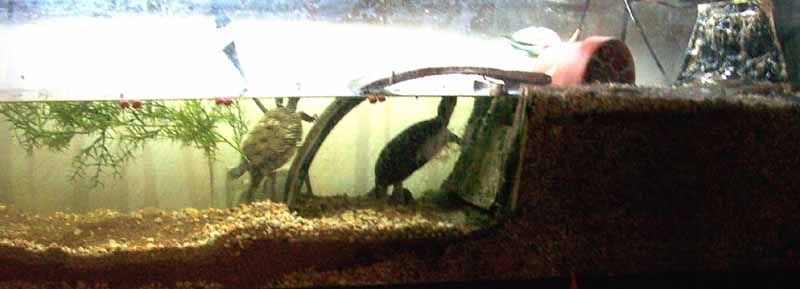
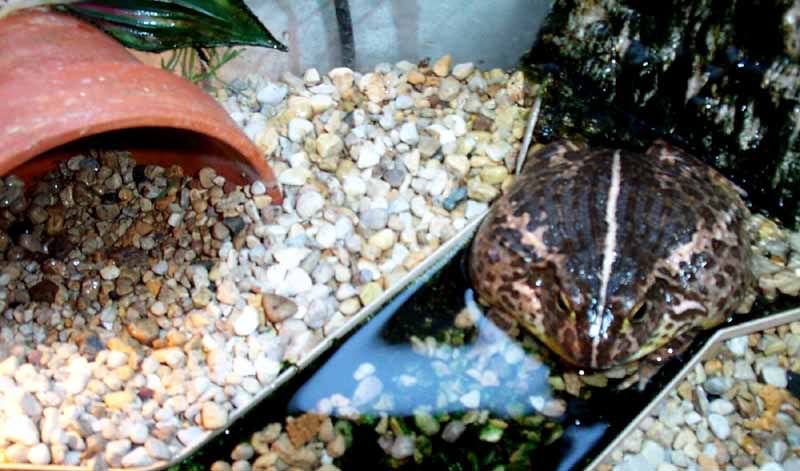
Amphibious turtles need to be able to get
out, dry completely.
|
Some Thanks And Praise 2/2/19
Hello all,
<Hey Koren... Oh, any relation to the author of the "Treatise in
Limnology" series?>
No questions, just some praise. Over the last few years I've come to
realize that your site is the best place online for accurate, reliable
information on such a huge wealth of fish and turtle keeping
information.
You all really know your stuff.
<Ahh; yes>
My partner and I have gotten very into fish and turtle keeping over the
last few years, and yes, we've developed multi-tank syndrome!
<Heeeee! It's contagious!>
I spend hours on your site reading the archives - the way you tag and
categorize your posts is great - very easy to find the information I
need. You've helped us with both diagnosing some issues, and by
providing a wealth of knowledge as we dream up and research new tank
communities.
<The pleasure; thank you>
A few years ago we went whole hog and set up a planted, turtle, fish and
shrimp tank. 2 musk turtles, red cherry shrimp, a few white cloud
minnows and zebra Danio, a true Siamese algae eater, a Chinese algae
eater (I know - lesson learned) and a common Pleco. We wanted a fun and
interesting, complete ecosystem. Pretty much everyone told us it
couldn't be done - the turtles will eat the fish! The water quality will
be terrible! But here we are now with a happy tank family and great
water parameters, that's given us endless hours of enjoyment to watch. I
think because all the occupants were introduced at the same time, as
juveniles, they developed a remarkable tolerance for each other. The
algae eaters and turtles (who are now rather equal in size) will sit on
the tank bottom side by side, or on top of each
other, and the shrimp have been know to hitch rides across the tank on
the turtles backs. We've yet to see an injury to any of the fish from
the turtles, though the shrimp do need to be replenished regularly. The
CAE sometimes acts like a jerk by latching on to a turtle shell, but
generally it behaves. I've never seen fish so tolerant of being stepped
on by a turtle as this CAE and Pleco, haha.
Anyway, in the course of setting up and maintaining this tank, I found
your website and have been consulting it ever since. We are currently
setting up a new 100 gallon as the turtles (a male and a female) have
reached an age where it's time to separate them. We have plans for more
tanks after this
and I have no doubt your excellent advice will be utilized for all of
them.
Many thanks for all your time and effort!
Koren in Calgary, Alberta, Canada
<Again, thank you for your kind, encouraging words. Means so much. Bob
Fenner>
|
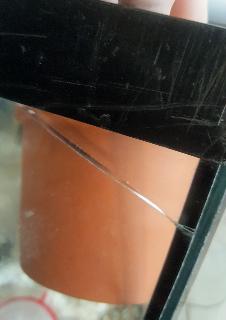
Cracked 46 gal bowfront top side panel
3/8/18
Hello there....first of all, thank you very much for dedicating your time to
help us. Second of all...we (the ones with many questions) are very lucky to
find this place full of knowledgeable human beings (You!)...for which, I have
this beautiful useless fish tank but maybe new well deserve home 3" slider
turtle. Is it safe to create a vivarium kind of home for Dorotea?
<Ah yes; I would feel confident filling this tank about a third of the way.
IF you wanted to fill it all the way, I would Silicone a piece (rectangle) of
acrylic (1/8" or so) over the inside or outside of this cracked area>
If so, should I silicone it or anything else?...IDK,
<Oh! Again, only necessary if filling up more than 1/4-1/3 of the way>
if is safe but I know I love my cute always hungry but not overfed Dorotea and
need to be sure I wont cause any harm just bc I'm trying to be a good
mommy..Many thanks! Greeyt
<Welcome. Bob Fenner>
|
  |
turtle tank water 8/24/17
hello,
<Hiya, Darrel here>
We have had Mr. and Mrs. T red eared sliders for 15 years. Currently Mrs. T has a
swollen tail and our tank is filled with wispy white slime. In the past she has
laid eggs that have gotten scrambled before we could get to them.
<The white slime is usually the remains of an egg that broke while in the
oviduct and leaked out the cloaca.>
She acts very lethargic possible can't pass the eggs this time and now her eyes
are closed and she doesn't swim around much at all. Any thoughts?
<This is tough. Once the eggs have shelled (formed the outer skin) they can’t be
reabsorbed and must eventually be expelled. To manually extract the eggs is
delicate work and not something an untrained person can easily do.>
<For the first round, give Mrs. T a warm bath once a day. Fill a bowl or
container of water that is warm to the touch that would be say, up to her
shoulders. Stir in 2 Tablespoons of salt (table salt is fine) and leave her in
the bath for about a half hour. You may want to pour in a bit more heated water
as it cools.> Do this once a day for a week and see if this stimulates her to
expel the eggs>
-Richi
Re: turtle tank water 11/6/17
Just wanted you to know Mrs. T is better!! Thanks so much sorry I didn't
thank you before now. Just cleaning up email and found your help.
-Richi Horne
<Glad we could help Richi!!
When you get rich and famous (or win the lottery or both) remember to
hit the {DONATE} button on our home page.>
|
my outdoor above ground turtle tank
5/23/16
-Dear WWM,
<Hiya – Darrel here>
I have 8 RES of various sizes and 1 pond turtle in a 700 gallon polyethylene
tank (8ft. diameter, 2 ft. deep). I live in Pasadena, California.
<One of my sons lives in Pasadena, CA. Do the turtles seem snooty to you?
Acting like they’re better than turtles that live in Highland Park or
Covina?>
The turtles have been outside in a much larger and deeper pond but I had to
move them. Does the tank need to be insulated or should I get a heater for
the winter. I've read your information but couldn't find an example that fit
my circumstances.
<no … and .. no>
<Our winters are more than mild enough for 2 feet of water. Assuming the
pond gets sunlight during the day the water will pick up enough heat that
the bottom is toasty (by turtle standards) all night long. I live
approximately 30 miles due south of you and MY turtles spend the winter in
an 8 foot wide pond 12 inches deep. The only caveat would be if the pond
spent all winter in perpetual shade, but even then I’d rig a couple of
basking lamps for daytime use, not a pond heater>
Also, you have a "turtle corral" picture on the first page of the turtle
section. Can you give me any information about how it was made? It looks
perfect for a better basking platform/nesting area for my girls. A male
turtle came out of nowhere and has been busy, so I would like to better meet
their needs.
<I’m not sure what picture you’re referencing but in my experience – every
time I’ve ever tried to construct a nesting box the turtles have rejected it
in favor of something they find on their own – and these are ordinary
Torrance turtles, not fancy, shmancy Pasadena turtles. Perhaps get them a
suite at the Sheraton?>
<Ahem. The best thing to do is expand the area around the pond to include
some grass area and allow them to wander around? In the wild they’ll climb
the banks of their swimming area, find a spot about the high water line and
dig test holes, looking for some indescribable situation.>
<That said, Sliders are flexible little guys. When the female is gravid
she’ll start acting fussy and hyperactive, never satisfied and always
wanting more even when she’s not sure what she wants … in that way not at
all unlike my ex-wife. This phase will last for a week or so (not my ex –
THAT phase lasted 22 years) and toward the end of that she will either
absorb the eggs and she will expel them wherever she happens to be. People
who can recognize the behavior have been known to put the turtle in a big
cardboard box for two days and one day come look and see the turtle with 6
small eggs just laying on the bottom of the box. Those eggs can be incubated
just as if they’d been laid and buried>
Thanks for your generosity in helping the rest of us care for our turtles.
*-- Lou Anne*
Re: re my outdoor above ground turtle tank
5/23/16
Dear Darrel,
My turtles and I thank you for the quick response. They aren't snooty
because they're all rescued turtles and are grateful they're not homeless.
How many turtles do you have?
The tank is sitting on concrete and they have no way to get out. They have a
basking area in the pond. I was going to make a cover for the tank so
raccoons, herons, and my dogs can't get them. That's why I was interested in
the corral (see attached).
Would it be better to move them to a grass area where they can have an
enclosed fence with a top? Then how they get out of the tank onto the
ground to walk around or lay their eggs. Do your Torrance turtles have a
little stairway up and over, similar to the picture of the corral? Any
design suggestions would be appreciated. I've been pouring over the
internet for ideas but everything I've see is either too fancy or too
down-market for Pasadena turtles, not to mention the discussion of egg-bound
turtles who will die if I don't provide a proper nesting ground.
What do you suggest? What do you do with your turtles? Does Torrance have
the same predators to worry about? I would appreciate hearing your thoughts.
Thanks,
Lou Anne
|
 |
Hi, I found this site. Emydid sys.
5/8/16
My name is Tera, I see you know a lot about red ear slider, my question
is my daughter has two red ear slider and one painted turtles, how do I
make or get a tank at a reasonable price. Plus I don't know if I'm
taking car of them right. help me please
<Here Tera. They are easy (and cheap!) to care for. Rather than a pet
store, a home improvement store will have everything you need except for
one special light. here:
http://www.wetwebmedia.com/FWSubWebIndex/RESCareBarton.htm >
Terrapin enclosure, a matter of ethics.
1/17/16
Hello all,
Some thoughts below!
Cheers, Neale
Subject: Terrapin enclosure, a matter of ethics.
Greetings.
This probably isn't a typical string of questions and i will say outright for
the sake of you prioritising your workload that this is not a critical medical
query. Nonetheless i think these are important questions. I would very much
appreciate your feedback and educated opinion on these considerations. After
all, i am but a self opinionated nobody on the internet. Ethics in pet keeping
has always been important to me, but i think it is equally important to consider
a stance objectively before holding true to it. I am unsure if i am being
objective and fully considering level of activity and true needs. The bulk of
this relates to RES/YBS terrapins, although the general principle extends to
many species of aquatic life in captivity.
<Agreed. In the UK at least, ‘Sliders’ seem to be the standard species in the
trade, and certainly the ones kept by the less experienced hobbyists.>
A couple of years back i stumbled on a child who had rescued a yellow belly
slider from a life in a small plastic tub. As keen as he was to keep it, after
explaining their needs to him, he asked if i would care for his now beloved
friend. I obliged knowing i could give it a better life than it had in store,
but knowing i myself would run into problems down the line regarding enclosure
should it turn out to be female. Turns out that is the case, it is now showing
it's gender, female. No doubt a common story arc.
<Yes.>
So off i went to the drawing board. I had always pipelined a bigger tank once it
was needed, only now it needs to be for a terrapin of up to 11-12” opposed to
8-9" (i suspected it to be male). We hear these rules banded around across the
web, such as 'you need at least 2-3 times body length in tank width', 'x gallons
per inch of terrapin' and the likes. It seems to be generally accepted that a
deep 125 USGAL tank is about right for a female. I am not sure i agree this is
ethical, i think the commonly stated sizes are akin to a prison cell and more
emphasis needs to be put on the word minimum on certain websites. Some don't
even make any logical sense, such as the gallon per inch nonsense not mandating
footprint, those types of guidelines need to die a death in my mind; they have
no relevance aside from filtration needs.
<An animal behaviour scientist at university introduced a class by describing
the care of lions versus tigers. Lions don’t do much until they get hungry or
see rivals, so while it might seem unfair to keep them in small enclosures,
provided they’re well fed and kept apart from social threats, they would mostly
sit about sleeping anyway. On the other hand tigers actively patrol their
territories leaving scent markings and so on. They are much more active and
interact with their environment much more frequently. For them, the circus
situation might actually be more humane, in the sense that they’d be doing
something rather than sitting about all day. In other words, one has to be
careful about applying human standards to animal situations. I’d argue that
turtles don’t do much until they’re hungry or need to regular their body
temperature. They aren’t, for example, patrolling territories. So provided
they’re given access to food, somewhere to bask, and somewhere to cool down,
simply being able to move between those three parts of the tank will satisfy
their basic psychological needs. Of course giving them space to be able to do
more exercise is always a plus, and a decent water current that provides
something to swim into could help to tick that box quite nicely too.>
For a 12" terrapin, it seems to me that the bare minimum that should be desired,
once accounting for substrate and background items is around a 4'x3'x20" body of
water. That meets, in fact exceeds a wide range of care sheet recommendations
and in my mind has a much better footprint than the common 6' 125GAL tanks often
used. I still consider it minimal. Even if i built to 5'x4'x20" - the biggest my
floor could support - i would consider this to be at best a compromise or
borderline acceptable.
<And a good deal better than that experienced by most ‘Sliders’ in the aquarium
hobby, I’m sure!>
I priced up making a tank of the smaller size from 12mm acrylic, i doubt 10mm
would suffice. Works out around £750 +/- depending on the exact method i use,
which i will pay readily. The larger tank needs thicker acrylic IMO, probably
15mm, the price jumps up significantly and i would still consider it a
compromise. This begs the question, how many owners could afford to build that,
or even know how to? Keep in mind that tanks like that don't come off the shelf
and custom tanks are huge money. I doubt the percentile of owners than can is
above single digits. I further doubt there is any realistic hope of the majority
of buyers ever providing a good home. The way i see it right now is people are
making do with the bare minimum to survive and kidding themselves. In my current
frame of mind a 6' 125GAL is in no way acceptable as a permanent living space
for an adult female, unless you happen to be trying to make the best of a bad
situation and acknowledge it as such. Yet according to many, this is ideal, i
have even seen the word perfect used. Do you agree with me on these points?
<Do see above. Your goal is admirable, and to be recommended for sure.
Zoo-quality situations are always better than those at the bottom end of the
cheap pet trade. On the other hand, I think there’s some diminishing returns
here. 90% of what’s needed for a happy, healthy ‘Slider’ will be provided by the
right food, a heat lamp, a UV-B lamp, room temperature water, and basic
filtration. Such a system could work in, say, a 40 or 50 gallon tank. Might not
be pretty, but the turtle would be basically happy, if not basking in luxury.
Such a shopping list could be priced at under £100, which is doable for anyone
even half serious about keeping these animals properly. Spending many hundreds
of pounds will of course provide a better environment, but I’m not sure the
turtle will be 5, 6, or 7 times happier or healthier.>
So i thought about building a pond. I live in the UK. The instant thought
process is: 'warm water+cold air=evaporation=humidity=respiratory problems'
'cold air+wind=a whole host of problems, including improper basking temps and
potential pneumonia / hypothermia' Cats... Birds…
<Quite so; while there are some Red Ear Sliders living feral in the UK, I’m sure
their mortality is high and reproductive success close to zero… basically, such
populations are topped up by more specimens dumped in such city ponds by people
who no longer want to care for these animals at home.>
There is far more potential for freedom of movement in an outdoor pond but it is
arguably a bad choice here. Would you agree?
<It is possible to keep these and other chelonians outdoors in the UK during
summer… there’s a solid body of experience with regard to thinks like Spur-Thigh
Tortoises. Perhaps of interest, and likely to be similar so far as protection
against cats, escapes, and so on goes. I agree though, you’d want to bring them
in when it gets colder.>
Ultimately, i have concluded not only is it not possible for me to ever provide
a GOOD home for her, but since most owners no doubt have more restrictions than
me (im a single home owner with disposable income), few ever could. Would you
agree? It seems to me they are destined to a life of compromise, especially in
the UK where it is cold outside and houses are typically small.
The only peace of mind i have is that at least she doesn't live in a tub and is
going to get a better tank than most could ever hope for. Right now i am feeling
rather appalled that it is legal to keep these without licence and that the
RSPCA seem to not want to enforce, or even stipulate enclosure sizes for aquatic
animals. They claim at the local rescue they are inundated, yet when asked said
they don't legislate to control sales or enclosures. We have natural ponds full
of them that kids have dumped locally, it's appalling, but i can understand why
this is happening.
<Animal cruelty to release any domestic pet into the wild. No discussion. Anyone
who does so is, frankly, behaving no better than those people who let their
horses starve to death or use dogs for fighting. Most pets dumped in the wild
die a miserable death, in the case of reptiles, usually from exposure to the
cold and subsequent infection, assuming they don’t get eaten by a fox, run over
by a car, or whatever else might happen.>
Ultimately the main point is this: I don't think they should be sold without
licence and i think legislation is needed on enclosures. Enclosure requirements
need to be advertised on stock tanks and vocally stated to potential buyers by
law (for all animals tbh). Do you agree?
<It’s a tricky one. In a sense, yes, pet animals operate in a weird situation
where the government assumes potential pet owners will do their research and
treat their pets properly. Quite obviously a big number of such pet owners don’t
do that, and one way or another allow “lower” animals especially (fish,
reptiles, frogs) to die for no other reason than the pet owner can’t be bothered
to feed or house them correctly, let alone provide (often expensive)
veterinarian care. There’s a strong case to make that wild reptile and frog
collecting is extremely harmful to wild populations, and that wild-caught
lizards, snakes and so on simply shouldn’t be traded. But the flip side to that
is that those species that have become established in the hobby and bred by
hobbyists have a bulwark against extinction that wouldn’t otherwise be there.
Garter Snakes, Bearded Dragons, and Red Ear Sliders are all likely to be around
for as long as humans are, and that’s a good thing. The unpleasant reality
though is that before species can become established as breedable at home they
have to be collected from the wild, and before someone has the skills to breed
reptiles, fish or frogs, there has to be a time during which they’re learning
those skills. If governments wanted to regulate the hobby, they’d have to find a
way to balance things such that new species could be imported, albeit
sustainably, and that potential hobbyists weren’t priced out of the hobby before
they got started or blocked by too much paperwork.>
Ultimately i feel not only am i unable to provide the animal with the space it
deserves, but realistically it never even had a chance, that this is common and
this needs to change. I sincerely hope for the sake of many terrapins out there,
including this one, that i am mistaken. Thanks for taking the time to read this
and for any information and criticism that may follow.
Kind regards
Stuart, Cumbria.
<And thanks for the thoughtful email. Regards, Neale.>
My Turtle; Emydid presumably... fdg., sys.
8/13/15
My turtle is not eating BUT I know the reason why is because we got him a new
tank and it has lots of bubbles in it
<Why? From the filter? Do remember there's precisely zero reason to add an
airstone ("bubbler") to a turtle tank because these animals breathe air, not
water. Adding bubbles won't do anything useful at all. A strong electric filter
though, rated for a tank at least twice the size of the one you have, is a good
investment though. Small turtles are cute, but when they get bigger they become
very dirty animals, and without a filter the vivarium will become mucky and
smelly. Very smelly! So swap out the bubbler for a proper filter.>
so when he sees the food floating he thinks that it is just bubbles or something
else. I was able to get him to recognize some pieces of food but that was about
it. They are the Tetra ReptoMin floating food sticks.
<I know them well. Were the only thing around when I kept turtles!>
Is there any way for me to get him to understand that the shadows are food?
<Yes; add variety to his meals. Specifically, greens. Grab some cheap aquarium
plants, such as Pondweed, and leave them in the tank. As Red Ear Sliders get
older, their diet becomes more herbivorous, and sticking with turtle pellets
alone can cause problems (such as constipation). Koi Pellets are actually even
better than ReptoMin, and A LOT cheaper, so when your current pot of ReptoMin is
finished, don't bother replacing it. Also, bear in mind you don't need light for
the tank. You need UV-B for the turtle to grow his bones properly, and you need
a heat lamp for him to warm himself up on his rock. But you don't actually need
light for seeing. In the UK at least combination heat/UV-B lamps are widely
sold, and if you have just ONE light fitting in the vivarium, this is the lamp
to buy.>
I have tried showing him that I was putting it in the tank but it only got him
to eat a few pieces. Should I consider getting him food that sinks or start
feeding him by hand? -Thank you SO much! :) Anna
<Do read this article:
http://www.wetwebmedia.com/fwsubwebindex/RESCareBarton.htm
Lots of preventative healthcare tips there. Cheers, Neale.>
Re: My Turtle 8/15/15
Thank you! I have been feeding him different types of veggies (and sometimes
fruits) and he eats them a lot better then he eats the floating sticks.
<Cool.>
He also loves munching on a cuttlefish bone that floats around in his tank.
<Excellent.>
We are going to see about getting him to eat more protein, any suggestions as to
what we should try to feed him for more protein in his diet?
<No real pressing need. The vegetables and the occasional fruits are enough,
alongside the reptile pellets (and eventually Koi pellets). If you want to offer
occasional (mouth-sized) offerings of any fish or seafood you guys are eating,
then sure, once or twice a week that'll do no harm. But they don't need a lot of
meat, any more than you'd worry about protein when feeding a sheep.>
We are not quite sure what kind of turtle he is. We think that he is a yellow
bellied slider or red eared slider subspecies.
<Various slider-like turtles out there, and some can be difficult to identify. I
had one that look like a Red-Ear, except everything that should have been red
was yellow.>
-Thanks again! Anna
<Welcome. Neale.>
Re: My Turtle 8/16/15
One last thing (I am sorry for all of the questions) where can I find a good
basking rock for him?
<I get rocks from the garden centre. Be sure to choose something without lime
(which affects water chemistry) or any metallic seams (which can be toxic).
Granite is a good default. Slate is usually good too.>
He is 8 years old and we have a 49 gallon bow front tank. I have found some on
Amazon but none of them seem to work. If there aren't any online, how should I
or what materials should I use to make one?
<You can buy 3 or 4 smaller rocks and one big flat rock. Arrange the small rocks
like the feet of a table, and put the flat rock on top. You need something
stable otherwise the rocks will fall and crack the glass (very bad!). You can
also buy plastic shelves with suckers that attach to the glass, but these might
not be cost effective for big turtles.>
This will hopefully be my last question! XD
<Cheers, Neale.>
Turtle info 5/16/15
I just cleaned my turtles tank and it started splashing around as if he wants to
get out of the tank. Swimming back and forth trying to escape.
Should I be worried about him?
<Did you use dechlorinator in the water? While turtles aren't as sensitive as
fish to untreated water, their eyes can still be irritated by the chlorine and
Chloramine used to sterilise drinking water.>
Is that normal?
<Turtles are "prey" in the wild, and don't like being moved about or having
their surroundings suddenly changed. So yes, it's normal for them to be a bit
skittish at times. But if this always happens when you clean the vivarium, do
think about things you could do to reduce stress.>
Thank you,
<Welcome. Neale.>
turtle traveling in air conditioned train
11/10/14
Dear Crew,
<Hiya - Darrel here>
I have a RES and its shell is the diameter of 1.5inches. I got it two
months back and it seems to be fine!
<Glad to hear that.>
I have to take him to a little colder place (north) in a totally air
conditioned train.
<Does he get a window seat?>
My questions are;
1. What precautions should I take?
<Don't let him pack his own things. They get so excited that they forget
things>
2. Can he travel and survive in these circumstances?
<Yes!>
3. Should I cancel the trip?
<No!>
<Your turtle can easily survive a train trip of even 4-5 days if he's in
a well-planned travel container. A small container with cloth or towel
on the bottom is best. 2 or 3 air holes on the sides and top are all
that's needed. Don't make the towel damp or wet because wetness draws
away heat and while any temperature that is OK for you is OK for him,
that temperature would drop quickly if he was in water.>
<In circumstances like this they like to find a fold or bend in the
towel and crawl in (like a tight cave) and then just go to sleep until
they reach their destination>
My turtle also eats twice a day (4 and half pellets in the morning and
9-10at night). Is it too much for it?
<Perhaps it is. I feed mine all they can eat in 3-5 minutes … 6 times a
week in the warm weather and 3 times a week in cold.>
His bowel movements seem to be fine. Please help! Thanks in advance :)
<No problem - I hope we did>
<Have fun on your trip>
Re: turtle travelling in air conditioned train
11/11/14
Your epic suggestions inspired me to ask more number questions for even
More such amazing replies!
<Thanks!>
So here is a new set:
1. What should be his food schedule during the journey? Should we give
him food before we board the train? (He only poops when he is in water)
:P
<No food. Is transportation is going to be stressful. Not it a dangerous
way, but just that it will be a big change and a lot of strange
surroundings, so it's unlikely that he'll eat. Plus since he's not going
to have the luxury of a basking rock his stomach won't get warm enough
for proper digestion anyway. Just pack him up and enjoy your trip>
2. When I change his water, should I retain a part of the previous
batch?
<No reason to do that at all. Reptiles don't particularly benefit from
the Nitrogen cycle that causes up to preserve bacteria cultures in the
water. An entire tub of fresh tap water, well water or even river water
is just fine>
3. Our turtle is not in an aquarium..but it stays in a tub and we put
him in water for 5-6 hrs everyday! Is this set up ok? Can u please give
me some suggestions?
4. Should we put sand or mud in his home? we had 2 RESs before, and they
both didn't make it for long due to an infection in the eye (still feel
so guilty about it)
I think it was because of the sand or because the younger one had it
already when we got him(he wasn't in a very hygienic place) but yeah,
now I don't know if i should take the chance of putting sand for this
one.
<Sand is not the issue. Heat, Light and Diet are the causes of almost
all losses. An eye infection suggests a vitamin deficiency that was not
corrected>
Please suggest.
<This is an article about the basics of turtle keeping, including very
low cost suggestions for housing, lighting and food. The main things are
- cool water, warm basking, proper diet and UV-B lighting.>
Also, if you could attach a few pictures of the set up of your turtle's
PALACE (since they do not settle for anything less :p)..it would be
really helpful
Thanks a million in advance!!!!
<I don't have any pictures. Maybe that would be a good project me this
winter>
http://www.wetwebmedia.com/FWSubWebIndex/treating%20RES%20Dis%20DarrelB.htm
I have some question bout my painted turtle and my
yellow bellied slider
I have a heat mat under the tank is this ok ?
12/11/13
<A heat mat under the tank is not necessary. What are essential are (a)
a heat lamp over a rock for basking; and (b) a source of UV-B, without
which reptiles become prone to all sorts of (eventually fatal)
deformities and diseases. You can buy heat lamps that include UV-B as
well, and such lamps are very convenient. The water in the vivarium
should be at room temperature, and there's no need at all to warm the
water. Turtles move between the basking rock (to warm up) and the water
(to cool down) and thereby keep the right body temperature.>
And can they mate in the winter
<Potentially.>
and why do they keep try to escape there tank all they do all day is
run into the glass like there saying let me out
<May be "saying" exactly that. If the vivarium isn't adequate, your
turtles will try to move somewhere else. That's an instinct. If I throw
you into the water, you'll try to get out! You aren't really telling me
anything about their environment, so I can't say what's good and what's
bad. But have a read here:
http://www.wetwebmedia.com/fwsubwebindex/RESCareBarton.htm
Providing the right conditions isn't hard (realistically, for juvenile
turtles budget $50-100, adults a bit more because they'll need a larger
--
55+ gallon -- tank). The ongoing expenses include food and replacement
heat/UV-B lights every 6-12 months. So while turtles are definitely
cheaper than dogs or cats, they're not exactly cheap pets. Hope this
helps. Cheers, Neale.>
re: I have some question bout my painted turtle and my yellow bellied
slider 12/12/13
There in a ten gallon tank i knw that they need something bigger and the
water in there tank is to cold i think that why i put the
heat mat down and it seems like she wont eat
<Well, it sounds like you understand that the vivarium you have is
totally inadequate. Your turtle is suffering (hence trying to escape and
not eating) and kept this way for a few weeks it will soon become sick
and then die. Time to spend some money. Do understand you need a large
tank (anything less than 55 gallons will need replacing within a couple
years), a heat lamp, a UV-B lamp, and a suitable flat rock or something
similar for the turtle to crawl out of the water onto. Budget $100 or
so, and you should be fine, especially if you shop wisely. Read.
http://www.wetwebmedia.com/fwsubwebindex/RESCareBarton.htm Cheers,
Neale.>
Red-Eared Sliders attacking a tank thermometer
9/2/12
Hello WWM Crew,
<Hi Brittney, Sue here with you.>
I have two red-eared sliders, aged 5 for the larger male who is roughly
5 inches and 4 for the younger male who is roughly 3 inches, give or
take a few quarter inches on each. They are in a 20 gallon tank, which I
do realize is small for the two but at the time I got them in which they
were both the size of quarters and the space was plenty adequate for
what research I had done. Recently I have hit money troubles and while I
can afford the proper nutrition, I have not been able to upsize their
tank. However, every day while I am home I let them swim in the
bath tub in luke warm, about 74 degree water to allow them to really
stretch their legs.>
<No need to do this. You don’t need to buy an expensive glass aquarium.
Clear plastic storage bins work just fine and are much cheaper. For
example, Sterilite makes a 110 quart size one that’s around 35” long,
19” wide and 12+ inches deep. I’ve seen them at Target for only around
$13.00.>
The diet consists of this:
10(per turtle) ZooMed Natural Aquatic Turtle Pellets. It is the Formula
for turtles 2-6" and the pellets are 3/16".
<The Zoo Med pellets are OK to use. I’d personally start switching
them over to the Maintenance pellets that have a higher vegetarian
content. You can also try alternating them with Koi pellets which are
almost all vegetarian based.>
4-5(per turtle) ReptoTreat suprema Krill Enriched Food Sticks with
Beta-Carotene and Canthaxanthin to enrich color. 4-5(per turtle) Freeze
Dried Mealworms. I occasionally treat them to Dried River Shrimp or
Krill in place of the Meal worms.
<Wouldn’t give them any of these at all for a treat. Instead I’d feed
them a couple of LIVE earthworms each every few weeks. Live earthworms
are a much more nutritious treat.>
They get greens about once a week that includes Kale, baby spinach and
Parsley. (the same greens we feed our rabbit)
<That’s great. Mine also enjoy eating red leaf lettuce, carrot top
greens and some bits of shredded up sweet potato.>
The staple diet is fed 3-4 times a week while the treats are fed 1-2 times
a week.
<Would limit the treats (earthworms) to only once every few weeks, not
1-2 times a week. You don’t want to over feed them.>
The water stays at roughly 70 degrees and they have a large basking
platform that while not heated itself is heated by the two UV bulbs,
which are about 40 watts a piece.
<First of all, double check to make sure the UV bulbs are specifically
UVB bulbs. They must have UVB. Next is that their basking temperature
should be in the 88-90 degree range. They need this amount of heat
to be able to properly digest their food. If the UV bulbs aren't giving
off enough heat to get the temperature into this range, you may need to
add a heat bulb as well.>
The bottom of the tank is covered by river pebbles and large smooth
pieces of rose quartz. It is filtrated by two canister filters.
<That’s great!>
Both are active and shed occasionally, have hard shells and clear eyes.
<All good.>
But my question stems from something totally different, the first
paragraph was also to ensure that my turtles are indeed healthy and
whether or not the thermometer attacking could be a result of hunger.
They have never had any strange health issues, but recently a strange
behavior has started occurring. I installed a tank thermometer a few
months back. They were fine with its presence up until about two weeks
ago. They have been fed as normal, and I even tried increasing the diet
to 15 pellets a piece, which they still ate in the amount of time
recommended.
<That's fine; just feed them as much as they can in 5 or so minutes,
then remove whatever food is remaining. My guess, though, is that their
attack on the thermometer is more due to a lack of space to move around
in than it is an issue of hunger.>
Recently though, both males have begun to attack the thermometer. At the
size the older male is, he can get his mouth around the tip of the
thermometer and I'm afraid he will break it and hurt himself with the
glass shards. I have tried moving the thermometer, removing it and
hiding it behind the basking area but they still attack it. Any
suggestions on how to remedy the situation? I have found no information
searching Goggle and the FAQ on your site for the answer.
<Actually I do have a suggestion – simply remove the thermometer!
There's no need for one, and turtles shouldn't have glass thermometers
at all in their tank for precisely the reason you mention! As long
as you keep your room temperature around 68-70 degrees or so the water
should reflect this. Having said that, though, sometimes the water in
smaller tanks can be more susceptible to heating up from filters running
and/or heat/light bulbs. If you feel this is happening and want to
monitor it, then what I’d suggest instead of a glass thermometer is one
of those thermometers that’s kept on the outside but has a (plastic)
sensor you drop in the water. That will eliminate your concern about
them breaking it and injuring themselves.>
Thanks so much for your help and I am sorry if provided too much
information or if I am rambling. I wanted to ensure that my reptiles are
indeed healthy because I really do love them.
<You’re welcome Brittney. It’s always better for us to have as
much information as possible about your care and set-up so you did
great! It sounds like you’ve already done a lot of research, but I’m
also going to give you a link to our basic care guide just to make sure
you have everything covered!
http://www.wetwebmedia.com/FWSubWebIndex/RESCareBarton.htm >
Brittney Kurr
Algae in the Tank
10/26/11
Dear WWM,
<Hiya - Darrel here>
I'm having trouble keeping my turtle's tank in
good shape. I clean it about every 5 days at this point because the
algae growth is insane. The tank is a 20 gallon long but I only have it
filled about 6.5 gallons worth. I have an Aqueon50 HoT filter and the
Tetrafauna decorative rock filter on opposite ends of the tank.
I've read that sometimes the phosphate levels in a tank are cause
for algae growth so I've added phosphate removal media to Aqueon
and also put two filter pads inside of the decorative rock
filter...none of it helps. When I full clean the tank, I wash
everything in a very diluted bleach solution, then spray and scrub it
with a 1 part vinegar 2 part water solution. Afterwards I rinse all of
it with distilled water and then scrub a little bit more before doing a
final distilled water rinse...it's exhausting!!
<That's a tremendous amount of work, Jonathan - far more than
you should have to do for a tank that size>
Of course I'll do what I have to in order to keep my turtle's
tank clean, but I'd prefer to have to full clean the tank less
frequently, ideally something like every 3 weeks and do water changes
in the mean time. What can I do to fix this tank problem? If the answer
is get a better tank or get a different filter that's fine, I am
willing to spend money on the enclosure to alleviate the time sink of
cleaning it constantly.
<For this go-around we'll just cover the basics: Algae needs
food, warmth and light in order to grow out of control, so let's
examine those in reverse order:>
<What kind of lighting do you have in the tank? How close is it to
the water? What is the lighting cycle? If you have the lights on more
than 10 hours a day, cut them back by a few hours.>
<Warm water grows algae faster than cooler water. You haven't
mentioned one but just in case, you shouldn't have a water heater
of any kind in a turtle tank. The water should be right around room
temperature. If you don't have a heater and the water is warmer
than room temp, it means that the basking (heat) lamp is on too long,
too close to the water or not directed far enough from the
water>
<In a closed system, Algae gets all the food it needs from the
micro-nutrients in the water, but a tank that's broken down and
cleaned with bleach every 5-7 days is not a closed system, so the algae
is getting food from somewhere. Over-feeding the turtles is one. Not
siphoning their soon enough is another.>
<Now with all that said, my guess is on lighting. Examine your setup
carefully and see what can be changed. Two other things. You can use a
much higher concentration of bleach in cleaning a turtle tank since you
since afterwards. Lastly, don't de-chlorinate the water you use to
fill.
Turtles are fine in water chlorinated to drinking water standards and
that will also retard the algae growth. If you are using well water and
in some area where the water is not chlorinated, add 2 teaspoons of
household bleach per gallon of water when you refill -- and 1
tablespoon per 5 gallons every 7 days thereafter until a water change.
Naturally, scoop out 2 cups of tank water, add the tablespoon, mix and
then re-add to the filter outflow>
Jonathan
Re: Algae in the Tank, turtle 10/28/11
Darrel,
<Hiya Jonathan!>
I've been adding Reptisafe water conditioner every time I change
the water, I just want to be explicitly clear, I do not need to do this
at all? Or should I just put in less than what is written on the
directions?
<I'm saying that if your tap water is safe for humans to drink,
you do not NEED to add anything to the water. Specifically we do NOT
want to remove any chlorine or chloramines from the water, but if your
conditioner doesn't remove those, you can use it or not. My point
was that there is no NEED to do so. Your turtles will live happily
without you going to that time, trouble or expense>
For lighting I've been keeping the UVB light on about 10 hours a
day and same with the heating lamp.
<That's about right>
I originally had a low wattage red light to keep an area warmer during
the night but I've stopped using this since its winter time and the
house is a little warmer from the heat compared to the summer time when
we have the AC on.
<Water should be room temperature always (68-73f). Basking area
should get to 88-92f when it's on - and allowed to cool to room
temperature when it's off. Turtles do not need a night/heat
lamp>
You mentioned the basking lamp being directed away from water, I have a
turtle log in the tank that I put in the middle and the basking lamp is
situated over it, should I try to set up a basking area in a corner of
the tank instead to minimize water exposure to the heated area?
<Well yes. What we're trying to do is keep the water from
getting warmer. You can't help if the house is heated to 77f during
the winter that will just BE the water temp -- but we don't want to
add to that natural temperature: The warmer the water the more algae
-AND- warm water (80+f) is NOT healthy for the turtles.>
At this point what do you recommend for clearing the tank? I can do a
full cleaning again but I suspect there's algae growth in the
filters as well and that's why it's growing back so fast. Could
I let the bleach solution run through the tank and filters overnight
and then wash it all out and re-introduce the turtle?
<Jonathan - in all my turtle environments tanks, trays and even
outdoor ponds, my filters are there to provide mechanical filtration
and water circulation only. I never try to create a biological filter
like we do for fish because turtles produce too much organic waste for
that. So yes. Remove any activated charcoal you may be using and add
the bleach to the entire system. Run for a few hours, then drain,
refill/rinse, drain refill/rinse, drain & fill. And then we hope
that's the last full sterilization for a long time>
I'm skeptical that the source of the algae is from feeding the
turtle, I feed him ReptoMin floating sticks and he gobbles them up very
quickly and doesn't leave them around to decomp.
<I agree. I was writing that for the general information to all our
readers. In your case I suspect light & heat are the
culprits>
As a more long term plan, I got this turtle (Yellow-Bellied Slider)
because my brother bought it and did not realize how much work it would
be, but I understand he will grow to a size that this tank cannot
hold.
<Yes he will. And in time we will need a bigger enclosure. But for
now, its fine -- and it SHOULD NOT BE as much work as you're having
to do. Turtles are actually very easy that's why we're looking
to find & correct the problem.>
Honestly YBSs grow larger than I'm willing to maintain so I do plan
on giving him to a
zoo, nature center, etc when he grows larger, but I've really
enjoyed owning a turtle and have my eye set on getting a Southern
Painted because it is significantly smaller at max size.
<You can worry about that 10 or 15 years from now when he really
does get that big>
Should I just get a larger tank/bigger filter in anticipation or will
this suffice me for a while?
<No, Jonathan - I think you're fine for now. Once we find and fix
this one problem you're having, it should all get easier for
you>
Thanks for everything!
<No charge!>
Fly Larvae in Turtle Tank, shoo fly,
shoo 6/29/2011
Dear Crew,
<Hiya! Darrel here>
I have a problem with larvae getting into the filters.
<I hate when that happens>
I know there's been questions like this asked but normally they
describe white circles or worms that swim around in the water and are
parasites.
<A parasite swimming around in the water sounds more like my
brother-in-law on vacation in Hawaii>
I know that the larvae grow up to be some type of flying insect, not
sure what kind but they look almost like fruit flies. So here's the
deal:
<OK>
I have a year 1/2 old Red Eared Slider who resides in a 20 gallon
aquarium with a waterfall type filter and a real log.
<Real wood gets really waterlogged and grows real fungus eventually.
An alternative might be some sort of rock or plasticized wood often
sold in aquarium stores for tank decoration>
There have been dark black-brown worm-like larvae crawling on the
filters when I clean the tank every week 1/2 - 2 weeks. I'm not
sure when they start to develop but by the week 1/2 point there is
normally one or two types of flies surrounding the tank;
<Sounds attractive, huh?>
While some may be getting in from outside and being attracted to the
heat lamp, the larvae have been growing on the filters for a couple
months and the filters have been replaced every time I've cleaned
them. Do you know what this could be caused by?
<Yes>
He eats Omega One Adult Turtle Sticks and the filters seem to have a
type of rock in them and are white rectangles.
<Ceramic cells that encourage bio-filtration>
I'm not sure of the brand at this time.
<Many brands same stuff>
He was found in a pipeline in a steel mill and rescued by my
half-sister's dad who gave him to us.
<Thanks, Dad!! That was really nice of you.>
Thanks for your help, and sorry if this has been asked already!
<No apologies necessary, Courtney. It happens all the time>
<The answer is most likely that you've never fully killed the
eggs, so some hatch and pupate before you even notice and in turn
mature and lay new eggs.>
<So here's what I'd do: Take Piper ('cuz you'd name
a turtle from a pipe Piper, right?) out of the tank and find him a new
place to live for a few days. Someplace warm and DRY. We're going
to keep him out of water except for 15 minutes a day when you put him
in a shallow container of water with a bit of food. He'll eat &
drink and hopefully he'll poop. If he poops in the container water,
which you're flushing - any eggs in his digestive tract will be
eliminated from the cycle. If he poops in his dry box, the eggs will
likely not hatch anyway, but you're still cleaning that up
daily.>
<Meanwhile, leave his tank intact. Water to the regular
"full" level and maybe even an inch more. Add 1 cup of
chlorine bleach per approximate gallon of water. Even a bit more is OK
as long as you can ventilate the room so no one breathes the fumes.
It's important that you leave the filters on and running during
this process. What we want to do is kill the larvae and eggs everywhere
-- inside the tubes, down in the impeller -- all the places you'd never
reach with even the most thorough cleaning. After 24 hours, you can
drain the water, break the system down and clean everything. Rinse, use
soap and water, rinse again & then set it back up.>
<Let it run clean & sterile for another 3 days, then put Piper
back in. Chances are that you'll have broken the larvae
cycle>
<How was THAT as an answer on a scale of 1 to 10???>
Identify turtle type and am I doing this
right? Slider, sys. 6/7/11
Hello,
<Hiya - Darrel here>
I'll start this with the stereotypical story...
<I'll run get the popcorn and a Snuggie>
My son came home one month ago from a fair with a 1.5"
turtle.
<Look on the bright side he could have come home from the fair with
a girlfriend>
We currently have the turtle in a 20 gallon aquarium, half filled with
water. A heater, basking rock with UV lamp (desk lamp fitted with
reptobulb), filter, some submerged hornwort and goldfish are all that
is in the aquarium.
<OK so far. I'm not sure what a Repot-o-Bulb is, but I assume
you know he needs a basking light tat generates heat AND a UV bulb -
specifically UV-B>
The goldfish is transplanted from our 250 gal. pond because my son
thought the turtle needed a friend, turtle and fish get along just
fine, occasionally squabble a bit over food, but fish always
defers.
<Turtles don't really need fishy friends, so if it was me,
I'd put the goldfish back in the pond>
The water is a constant 75 degrees.
<68 to 71 degrees is preferred. Normal room temperature. So, unless
you live north of the Arctic Circle remove the heater
completely>
I have every intention of when the turtle outgrows the tank to move him
to the pond. The pond is a plastic bottomed variety, filled with water
lilies, water grass (that tall reed like stuff) and has 8 other
2-4" goldfish. I'm not sure when the move will be necessary,
but assume once the turtle at least gets to be 3 inches or larger.
<Or 4 inches or so.>
I feed the turtle turtle pellets 2x per day and now he swims to the
side of the aquarium under which the drawer to his food is located and
basically "begs" for food.
<Quickly how they learn that>
Occasionally I've seen him taking big bites of the hornwort in the
aquarium. Once or twice a week I will also give him some cooked chicken
or some egg yolk. He seems to love that. My question is, I want to let
him outside some during the day, I have a large underbed plastic bin
that I could put a rock and some grass or something in for him to bask.
Is this a bad idea?
<Not at all. No bulb is as good as natural sunlight. Here's the
checklist:
1) Can he climb out of the bin? If it's not AT LEAST twice his
shell length, he probably can.
2) Can he get OUT of the sun into some shade when he's too
warm?
3) Can any other creatures (Dogs, Cats, RED TAILED HAWKS) reach or
swoop down on him and carry him off?>
Also, how much time can he spend out of the water?
<A healthy turtle can spend weeks out of the water without much
damage. When a turtle is sick, we routinely keep it out of water for
MONTHS except for a daily 10 minute bath (to drink, poop and
eat)>
Am I feeding him the correct food/amount?
<I feed my turtles all the Koi pellets they can eat in 5 minutes,
three times a week. In captive animals, OBESITY is a much more common
health problem than undernourishment>
Finally, I would think he was a Red Eared Slider, but where the red
part would be, it's just yellow. Is this because of his age or is
he a different variety?
<There are many varieties of Sliders and only one kinds has the red
ears. Yellow Bellies don't, for example. They look just like a Red
Eared Slider except there is yellow where the red would be>
Thank you for your help!
Jennifer
<No Charge!>
|
Questions on glass panels for a unique shaped indoor
turtle pond - 9/10/10
Hi Bob!
<Sue>
I hope you can offer me some help with a current project Im
working on. I sent this query to you because I know you've had
much experience constructing aquariums and ponds. Im in the
process of having an indoor *winter* pond constructed for my
turtles. One thing in particular that Id like to incorporate into
the design are glass viewing panels, but some questions came up
during the process. I read over the pond articles and many of the
applicable FAQs on WWM, and also looked at some of the links
provided in the FAQs to other sources (i.e.., www.GARF.org,
www.OzReef,), but found varying advice on this topic, how to best
accomplish it, etc. Im hoping you might be able to guide me in
one direction vs. another.
<Will do my best>
Also, most of the advice I read assumed a basic rectangular
shaped aquarium which is not the case here. Its a bit of an
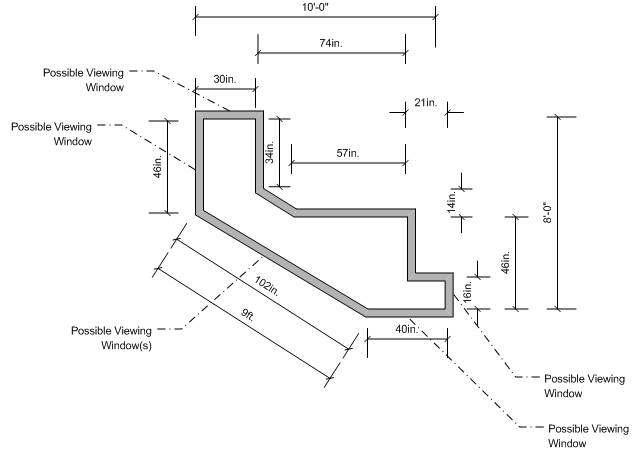
unusual layout! (see the attached file) Its going to sort of wrap
around one side of the island between the kitchen and family
room. I decided to go with a free form layout instead of a
preformed pond (as I did with the outside pond this summer)
because of the constraints of the indoor space, and also to
maximize the amount of surface area for the turtles to swim
about.
<I see, and agree>
The *pond* is going to be raised up off the floor on a framed
platform using 2x8s
<Mmm, the uprights I'd make of 4 X 4">
so that its higher than the filter (a Fluval FX5).
<You'll need more than this>
The depth of the pond will be 18. Given the dimensions and depth,
I calculated this out to be approx. 350 gallons. The plan is to
frame out the walls using 2x3s attached to the platform floor
joists to give them some lateral support in order to try and
avoid the need for tension cables.
<I'd use 2 X 4", and good screws>
The walls (and potentially some of the viewing glass) would
extend a few inches above the water to keep the turtles from
climbing out.
<Good idea>
Where the questions arose was with the glass viewing panels.
These are the two options I came across in my reading
Option 1 (using PVC liner): The interior would be lined with
plywood, a thin layer of Styrofoam, and commercially available
pond PVC liner. However, from everything I read, it seems that
adhering the glass to PVC will be a challenge,
<Close to impossible>
and prone to leakage. Also, fitting the PVC liner (14x21) to this
unusual shape could also be a bit of a challenge.
Option 2 (marine plywood coated with a fiberglass epoxy to make
the enclosures watertight): The concern here over Option 1 would
be potential leaking due to some likely flexing of the structure
since it will rest on the intersection of two existing 2x8 floor
systems (though fortunately some of the weight will be supported
directly from the original houses foundation wall).
<Mmmm>
OK, so here are my questions!
1. Given the unusual custom layout/design, which technique/option
above would you recommend I go with? Which option would be less
prone to leakage?
<If it can be figured into a budget, I might make the frame of
this tank itself mostly of wood and fiberglass and resin all
except the viewing panels... which I'd have made of glass...
if you can expand the frame on the largest side/viewing panel,
I'd keep this length under 8 foot... IF money is no object
I'd have a steel frame (bead blasted and coated) made for
all, and glass as you like for the viewing panels, Siliconed
in...>
2. If Option 1, do you think there would be a risk of the (male)
turtles claws scratching/puncturing a hole in the lining?
<Too likely. I would NOT use a liner in such an indoor
pond>
3. What would you recommend using to adhere the glass to either
the PVC lining (Option 1) or the plywood coated with epoxy
(Option 2) so that a water tight seal is maintained?
<None. I wouldn't go this route>
Some options I read about were to use 100% Silicon or Silastic.
Is there any difference between these two?
<They are brand names for the same product>
4. Would one piece of glass span the 9 foot long diagonal wall
section, or would you suggest splitting that into multiple
viewing windows with interim 2x3 supports?
<I'd use an eight foot piece (much cheaper)... one
piece... and top supports... either "Euro" fashion or
spanning front to back>
5. What thickness of glass would you recommend for the viewing
windows given the size, dimensions?
<Likely 3/8"... thicker if it's cheap enough... used
likely>
6. Does it matter if its tempered or regular glass?
<Not really>
7. As a completely separate option (Option #3) would an all glass
alternative also be possible given the size and shape of this
design? If so, would it be more or less preferable than the two
options above?
<It will be very hard to make a stand that will adequately
support such a shaped system that is all glass... I would go with
either the two by and one inch ply (With every four inch
screwing, and fiberglass and resined over), or the welded metal
frame>
Thanks so much, Bob! Id very much appreciate whatever insights,
suggestions you might have on this!
-Sue
<Welcome! I am going to run this past Darrel Barton here... as
he has much experience w/ turtle systems, and may have other
ideas. Bob Fenner>
Re: Questions on glass panels for a
unique shaped indoor turtle pond
Hi Darrel - I noticed Bob passed my email along to you for
further comment, but left out the attachment when he forwarded it
to you. I re-attached it above.
I'd appreciate whatever other input you might want to offer
on the construction. In particular, please let me know re:
Bob's comment about the Fluval FX5. The owner of the pet
store (who's kept turtles privately for many years) told me
that the *multiple x gph rule* applies more to people who crowd
turtles into smaller volume aquariums. He thought this filter
would be more than capable of handling a 350 gallon tank. If you
don't think so, and know of a specific filter that would do a
better job, please let me know. The FX5 is what I'd come up
with in my research. It's rated for 925 GPH, but supposedly
it's more like 600+ GPH or so with media added. I had looked
into the compatible Eheim but read in several places that the
Fluval does better with mechanical filtration; the Eheim with
biological filtration (but didn't think the bio would keep up
with the turtles anyway so went with the Fluval).
Thanks Darrel, would appreciate your take on the project. Did you
also get my email to you about the other queries? Let me know if
you need my help.
|
 |
Re: Questions on glass panels for a
unique shaped indoor turtle pond
Sue... is this "our" Sue Garrett? What a project! B
Re: Questions on glass panels for a unique shaped indoor
turtle pond 9/11/10
Hi Bob!
<Sue>
Yeap ... and YEAP!! I can't believe you didn't receive
this message below from me until 10:30 PM last night (7:30 PST)!!
I sent it you 3:30 yesterday afternoon!! (12:30 PM PST!) I had
checked WWM shortly after I sent it to make sure it went through
to WWM OK, and saw that it hadn't, which is why I landed up
re-sending it to you via crew mail!
<I see>
BTW - could you tell that most of the words in that email were
not my own?
Frankly, I'm not even sure what it is I even asked you in
that message!
LOL!
I read your reply and noticed you also forwarded it to Darrel for
comment.
Thanks so much for all your valuable input on this, I really
appreciate it!
-Sue
<Heck. I wish I was building it with you. An interesting
project. BobF>
Re: Questions on glass panels for a unique shaped
indoor turtle pond 9/12/10
<Heck. I wish I was building it with you. An interesting
project. BobF>
<Wish you were too. I'll send you some pix when it's
done, so at least you can see how it turned out! Sue>
>Much obliged. B<
Questions on glass panels for a unique shaped indoor
turtle pond 9/12/10
Hi Bob!
<Sue>
<Darrel too, Sue!>
I hope you can offer me some help with a current project Im
working on. I sent this query to you because I know you've had
much experience constructing aquariums and ponds. Im in the
process of having an indoor *winter* pond constructed for my
turtles. One thing in particular that Id like to incorporate into
the design are glass viewing panels, but some questions came up
during the process. I read over the pond articles and many of the
applicable FAQs on WWM, and also looked at some of the links
provided in the FAQs to other sources (i.e.., www.GARF.org,
www.OzReef,), but found varying advice on this topic, how to best
accomplish it, etc. Im hoping you might be able to guide me in
one direction vs. another.
<Will do my best>
<DB- Usually in a project of this magnitude I try really hard
to ignore it and hope it will go away. It makes for far less
work, no skinned knuckles and far more time and money for
drinking beer. WHO'S WITH ME??????>
Also, most of the advice I read assumed a basic rectangular
shaped aquarium which is not the case here. Its a bit of an
unusual layout! (see the attached file) Its going to sort of wrap
around one side of the island between the kitchen and family
room. I decided to go with a free form layout instead of a
preformed pond (as I did with the outside pond this summer)
because of the constraints of the indoor space, and also to
maximize the amount of surface area for the turtles to swim
about.
<I see, and agree>
< DB- Yup>
The *pond* is going to be raised up off the floor on a framed
platform using 2x8s
<Mmm, the uprights I'd make of 4 X 4">
so that its higher than the filter (a Fluval FX5).
<You'll need more than this>
The depth of the pond will be 18. Given the dimensions and depth,
I calculated this out to be approx. 350 gallons. The plan is to
frame out the walls using 2x3s attached to the platform floor
joists to give them some lateral support in order to try and
avoid the need for tension cables.
<I'd use 2 X 4", and good screws>
The walls (and potentially some of the viewing glass) would
extend a few inches above the water to keep the turtles from
climbing out.
<Good idea>
< DB- Umm - yeah. Also, having the walls stop UNDER the water
level is both messy and wet. Just sayin.>
< DB- Ima let you finish - but it's like those signs in
businesses that say "this door to remain unlocked during
business hours." I can't help but wonder about the first
person to discover that secret to increasing business: "Uh,
Calvin? We been in bidness now fer about 8 months & we
ain't had a single customer. What say we unlock that front
door & see what happens?" Then Calvin things it's
such a good idea puts up a sign so they won't forget
again!>
< DB- Ok - I'm done>
Where the questions arose was with the glass viewing panels.
These are the two options I came across in my reading
Option 1 (using PVC liner): The interior would be lined with
plywood, a thin layer of Styrofoam, and commercially available
pond PVC liner. However, from everything I read, it seems that
adhering the glass to PVC will be a challenge,
<Close to impossible>
< DB- I figured out how to do that, if anyone wants to
know.>
and prone to leakage. Also, fitting the PVC liner (14x21) to this
unusual shape could also be a bit of a challenge.
< DB- I agree here - the origami necessary to fit the liner
and the amount of adhesive to keep all the folds flat is in
itself a huge project>
Option 2 (marine plywood coated with a fiberglass epoxy to make
the enclosures watertight): The concern here over Option 1 would
be potential leaking due to some likely flexing of the structure
since it will rest on the intersection of two existing 2x8 floor
systems (though fortunately some of the weight will be supported
directly from the original houses foundation wall).
<Mmmm>
< DB- This is a relatively small weight distributed over a
large surface area, Sue. If your house was built any time after
1903 structural issues in supporting the weight isn't your
issue.>
OK, so here are my questions!
1. Given the unusual custom layout/design, which technique/option
above would you recommend I go with? Which option would be less
prone to leakage?
<If it can be figured into a budget, I might make the frame of
this tank itself mostly of wood and fiberglass and resin all
except the viewing panels... which I'd have made of glass...
if you can expand the frame on the largest side/viewing panel,
I'd keep this length under 8 foot... IF money is no object
I'd have a steel frame (bead blasted and coated) made for
all, and glass as you like for the viewing panels, Siliconed
in...>
< DB- I'm in agreement here, Sue. I'd start with a 1
inch plywood "footprint" of the tank resting directly
on the floor, I'd use 2x4 uprights from the base to the top
of the tank at all the corners/joints (some will have to be
shaved to meet at the right angles) and along the top edges.
I'd then criss-cross the footprint with the number of pieces
of 1 inch plywood (cut 18 inches wide) to make a "support
grid" for the second 1" plywood footprint that would be
the actual bottom of the tank. This structure would support the
weight the Space Shuttle should it decide to land there.>
< DB- I'd then finish the INSIDE of the tank walls with 1
inch exterior-grade plywood walls. The outside? Anything from
paneling to fine wood to fake (or real) stonework to Formica
(Demand Genuine Formica Brand imitation Plastic!)>
< DB- I'd seal the edges of everything together with
silicone, but I wouldn't run a bead along the inside edge
like we do on aquariums. I'd scrape sand and gouge any
visible silicone out of the way>
< DB- The reason I'd do this is because, like Bob, I'd
use fiberglass strips and resin to re-enforce the joints -- then
I'd just paint the interior with a medium color Gel-Coat
paint.>
2. If Option 1, do you think there would be a risk of the (male)
turtles claws scratching/puncturing a hole in the lining?
<Too likely. I would NOT use a liner in such an indoor
pond>
< DB- Again - Bob is wise beyond his years. No wait NO ONE
could be wise beyond THAT MANY years but he is a smart
guy>
< DB- The turtles couldn't puncture a quality Firestone
EDPM liner without hand tools, which I assume you only let them
play with under supervision, but the liner is just a bad
idea>
3. What would you recommend using to adhere the glass to either
the PVC lining (Option 1) or the plywood coated with epoxy
(Option 2) so that a water tight seal is maintained?
<None. I wouldn't go this route>
< DB- Again, I agree.>
< DB- The old joke about the guy who asks how to get to the
Washington Monument and the other person says "well, you
can't get there from here. You have to go someplace else
first: If you HAVE to use a liner, you have a local plastic shop
fabricate a "U" Shaped outline of your window out of
3/8 thick x 2 inch wide acrylic that conforms to the shape of
your viewing area. You sand the contact surfaces of the liner and
acrylic and then you glue them together with Weld-on #16 and then
put countersunk stainless wood screws through the plastic &
liner into the wooded frame. Then, 24 hours later, you can use
silicone to the other side of the plastic just like we've
been doing for years.>
Some options I read about were to use 100% Silicon or Silastic.
Is there any difference between these two?
<They are brand names for the same product>
4. Would one piece of glass span the 9 foot long diagonal wall
section, or would you suggest splitting that into multiple
viewing windows with interim 2x3 supports?
<I'd use an eight foot piece (much cheaper)... one
piece... and top supports... either "Euro" fashion or
spanning front to back>
5. What thickness of glass would you recommend for the viewing
windows given the size, dimensions?
<Likely 3/8"... thicker if it's cheap enough... used
likely>
6. Does it matter if its tempered or regular glass?
<Not really>
< DB- The fact is that 18 inches of water isn't that much
stress on the glass. The only reason I'd go tempered is that
indoors, in family life, there are people and scooters and vacuum
cleaners that bash into furniture but that's just a
suggestion>
7. As a completely separate option (Option #3) would an all glass
alternative also be possible given the size and shape of this
design? If so, would it be more or less preferable than the two
options above?
<It will be very hard to make a stand that will adequately
support such a shaped system that is all glass... I would go with
either the two by and one inch ply (With every four inch
screwing, and fiberglass and resined over), or the welded metal
frame>
Thanks so much, Bob! Id very much appreciate whatever insights,
suggestions you might have on this!
-Sue
<Welcome! I am going to run this past Darrel Barton here... as
he has much experience w/ turtle systems, and may have other
ideas. Bob Fenner>
< DB- I made such a tank to house my alligators once. Only it
was 14 feet by 10 feet by 48 inches tall. Here's what I
learned about the viewing glass: You frame around the edge of the
windows with wood. The wood has to be planed down to the
thickness of the glass plus the thickness of the gel coat. I
could wave my hands here to make it more clear, but what
we're doing is making a 3 sided frame (bottom & two
sides) that the glass with sit flush into. You then delicately
glue in a piece of .022" OD silicone tubing around the three
surfaces, press the glass into place (which now sticks OUT from
the edges of the wood by the thickness of the tubing) and then
use 1.25 inch aluminum angle and stainless steel screws to clamp
the glass into place.>
< DB- Then - you use a silicone sealant around the outer rim
of the glass to prevent the seepage from the gasket. -- this is
what I learned after 4 unsuccessful tries to just use silicone to
seat the window in place>
< DB- Now - as far as filtration is concerned - I agree with
Bob that one Fluval FX5 is not enough - and here's why:
Unlike Fish, it takes a biological filter the size of the
Everglades to process the waste from turtles, so the mechanical
filter has to take that scum and crud out of the water and trap
and then you have to clean that filter. What I'm saying is
that in an aquarium or even a pond - -the surface area of the
tank/pond itself is the bulk of the bio-filter and the mechanical
filter is there for "some" additional help and
primarily water circulation. In your case that filter has to trap
all the debris AND contain enough charcoal to adsorb the stuff
that would otherwise make your kitchen smell like my
ex-wife's cooking>
< DB- Now, since you're making such an investment in this
-- what I'd plumb a few bottom drains and a few skimmers
(bottom drains with a standpipe to water level) through ordinary
bulkhead fittings, then run the pipes through the floor to the
basement (or outside or garage) where you could have a high
volume pump and plenty of filter felt material and no worries
about the noise. And it might be, all things considered,
cheaper>
< DB- Beer anyone?>
|
My Yellow Bellied Slider Turtles
7/24/10
Hi <Hiya - Darrel here>
We have had our turtles (Terri and Torres) since March last year, we
got them for our daughter for her birthday. As I have never known
anything about them we went to a Pet shop to enquire about them before
we would take one on. The man in the shop told us it is pretty straight
forward and with a tank, a few stones and a heat lamp we were good to
go. So she ended up picking two!!
<So far, so good. You need a bit more, but I'll cover that
later>
We took them home and set up the tank like the man in the shop said,
stones along the bottom and a basking area under the heat lamp. He sold
us frozen fish and said to feed them that once a day.
<No. and No.>
To start with they seemed shy and didn't eat but we thought they
just needed to settle in but after nearly two weeks of them still
eating very little I got worried so had a nosy online to look for tips
on how to help them settle......to my horror I realized we needed to be
doing a lot more for them (the pet shop had a tiny tank with about 30
small turtles in with no uvb or filter!!!!!) so after an evening of
research we headed off the next day to get what we needed. By that
evening they had a filter set up in the water and uvb lighting beside
their heat bulb, we also added a few fake plants for them to hide
around as I had read they like this. We stopped feeding them just the
fish and started giving them dried food and fruit too. They did start
to eat more and seemed to be happy and were getting more and more used
to us and their new home. So at this point we were all happy that
everything was as it should be!!
<I'm liking this better now. Good work on reading and
adapting!>
Until about 6 months ago I noticed on FB a friend posted pics of her
turtle Yoda which is around the same age as our two (she got hers a few
months after us) and it was sooooo much bigger. By this stage ours had
barely grown from when we got them (ours were about 1 and 1/2 inch long
and hers was about 2 and 1/2 inch long) and until I saw that pic I did
not realize they should have been growing more. I spoke to her and she
said she has no lighting or filter and just feeds it dried food twice a
day!?!?!?!?! At this point I thought I should visit a vet for advice
but the vets in my area just have no clue and could not advise me so I
did some more online research. I ended up even more confused with so
much conflicting advise out there. We came to the conclusion that they
needed to be eating more/better!! For about a month we tried a few
different things recommended by people/websites and nothing we offered
them seemed to tempt them to eat any more so we tried a few things to
change their tank to see if that helped their 'mood' to see if
that would encourage them to eat more. We tried cuttlefish in the tank
for them to nibble(they never went near it), live plants (they never
ate them and they just got in the way of them swimming about), I
can't think of anything else off the top of my head that we tried
but basically we tried anything we read might help!!! In the end we
read about ReptoMin and we changed them to getting only that, I give
them it every evening and they get the odd piece of fruit or fish about
once a fortnight for a treat. They started to grow and each week we
could see them getting that wee bit bigger so again we were happy that
we had finally everything sorted for them.
<Good work>
BUT recently I again saw a pic of Yoda and it is bigger than your hand
and Terri and Torres are only about 2 and 1/2 inch long now!!!! So this
has me worried again!!!
<Stop worrying!! That right there will help everyone
involved>
I would like to ask you what I can do or what I am doing wrong. Why
have my turtles not grown this much and why is hers thriving when she
has no lighting etc for it?
<You're not really doing anything "wrong" at this
point. Terri and Tores are possibly a bit behind the curve, but they
can live over 50 years they is plenty of time for them to grow. You
signs are
(1) are they active
(2) Do they alternate between swimming and basking
(3) Are they eating
(4) Are their eyes, nose and skin clear
If you answered yes to all these, Sit back, relax and enjoy
them>
Here is a rundown on how we keep/care for them:
-They live in a plastic 'tank' (it is actually an indoor rabbit
bed/hutch with a solid bottom/sides and a cage like top with a door to
let you reach in, it is hard to explain but it works well), it is about
3 feet long and 1 and 1/2 feet wide and the water is about 7 inch deep.
We do not have a water heater as when we tried one they stopped
swimming and I think because we keep our house warm the water stays at
a nice temp for them anyway.
<Turtles don't need nor should they ever have a water heater
unless you live north of the Arctic Circle. They get cool water and a
warm basing area and then they get to choose what they need at the
moment>
They have a terracotta plant plate turned upside down for their basking
area, which is held up by a plant pot turned upside down again maybe
not the norm but it is nice and steady and it works well and because
the plate is a few inch wider than the pot holding it up there is an
area below they can 'hide' in when they want to.
<Visual privacy is a plus just make ABSOLUTELY sure there's no
place they could get into and get stuck!>
There is a uv bulb and a heat bulb that we have on a timer to be on 12
hours a day. They have a few smooth pebbles built up as steps to the
basking area and we also gave them a few pebbles in a corner of the
tank which are just below the water level as they seem to like to be
half in and half out of the water sometimes.
<Very nice touch>
There is also a fake rock with fake plants on that they like to
climb/cling to. There are no places they can get stuck the basking area
is in the middle of the tank and has plenty of room all round for them
to get on and off etc. All pebbles are smooth and sturdy so won't
move or hurt them.
<So far, so good>
- there is a filter and we top up the water level about once a week
(tap water) and change the water and clean the tank out about once
every 3 weeks, we used to do this less but it needs it more now as it
gets dirty quicker now they are eating a bit more.
<Also good>
-they get fed in the tank as although it causes more mess than a
separate feeding area they seem to prefer this and although they eat
most of the pellets straight away the odd one left over they will
nibble on later...I assume they are getting enough as if they
weren't full they would not be leaving some ( there are always one
or two pellets left when I go to feed them the next evening)
<Constantly taking them out of their tank to be fed separately is
something I've always thought of as stressful, so I don't do it
either. I feed mine all the Koi pellets they can eat in 5 minutes
around 3 times a week or every 3rd day.>
- we lift them out about once a week to 'pet' them, they like
to get their chins rubbed and always put their head up waiting for us
to do it
<Yes they do>
-they swim about often and bask with their feet curled up, their eyes
are clean and there shells are hard, we sometimes clean their shell
with a cotton bud if they get a little green
<wonderful>
-they do like to hide away sometimes under the basking plate but we
just leave them in peace assuming they just want peace and quiet. They
come to the side of the tank when they hear us and put their head out
of the water as if to say hi :) They seem to like activity and noise
around them as once we moved them to a quiet room thinking they might
prefer quiet and they stopped swimming etc, when we moved them back to
the hallway where there is always noise etc they went back to
normal!!!
<I agree they seem to like interaction with their
environment>
I think this is everything, one of them is definitely more shy and
hides away more and if their routine changes any (like we go on holiday
and someone else is caring for them or we are out a lot for a few days)
it seems to be affected more i.e. it will not be so active for a few
days and will hide away more!! They both seem to get 'down'
with any change but once things go back to normal within a few days
they are back to normal too. This sounds silly but they seem to miss us
and then not feel like swimming etc!!! Like I say one is more shy and
takes longer to get over change than the other but I think this is just
it's personality. I think they are both happy and healthy but why
aren't they growing more?? Could it be something to do with bad
care when they were in the pet shop? I read without uv they can go
blind and their shell soften so I have always worried that with them
being in the pet shop without uv it could have done some damage, but
their shell is hard and they can def see. I do not know how many weeks
old they were when we got them as we never thought to ask at the time
so I am not exactly sure of their age but we have had them 1 year and 4
months.
<Doesn't really matter, does it?>
Sorry for the epic e mail and thanks in advance for any advice you can
give.
<No problem - happy to read a HAPPY story, Emma - we don't get
as many of those as you think>
Emma
<I think you're being a great Turtle Mom. I understand
you're a bit confused by it all -- that's a cycle we all go
through. When my son and I were starting out in the Marine Tropical
Fish hobby, we sought out so much advice that our heads were spinning
like Linda Blair in The Exorcist and this is the really weird part our
success with the hobby started about the time we STOPPED taking advice
from everyone and their brother!! There are often a dozen ways to
accomplish any task, but that doesn't mean that attempting all 12
ways will accomplish the task. So we decided on "our" regimen
for Quarantine and "our" regimen for feeding and
"our" regimen for water changes, etc. and almost as if by
magic, the problems started to subside. This isn't to say that we
just made stuff up but we decided that Sara knows best how to start out
on a budget, Steven Pro knows more about Ick and quarantine than we
ever need to know Bob Fenner knows more about systems and filtration
(and just about everything else, too) than we could ever learn so we
follow their advice and life gets real simple!>
<For turtles, I wrote the following care sheet
http://www.wetwebmedia.com/FWSubWebIndex/RESCareBarton.htm
It covers just the basics from a starting out point of view, covers
everything you need to know and in every case it offers what is known
in the industry as the "right" or "correct" way to
do things.>
<Read it, measure your standards of care against what is written,
adjust anything that is sub-standard (but my guess is you won't
find anything sub-standard in your care!!) and then .
RELAX and ENJOY!>
New Pond, stkg., turtles 12/25/09
I live in SW FL. My husband has just finished putting in a 1,000gallon
pond in our front yard. We got the pond and the 5 fish that are in it
(1 8" Koi and 4 misc. Cichlids) from our friend. He says I
can't have a Pleco or a turtle in it because they will die In the
winter time. (I have never seen it get any colder then 44degrees in
15years)
<Mmm, what species are the cichlids? These will perish if the temp.
gets this low. If the temp. is suitable year-round for Cichlids, the
hardier Plecos/Loricariids should be fine here... a few of the common
species are cultured in S. to near N. Florida outdoors>
The pond is I think 24 inches at least at its deepest point and
it's 9 x8'.
I want to know what all I can put in it? I want it to look very awesome
and have high expectations. We will be finishing it up tomorrow as soon
as the truck delivers our landscaping!!
<Mmm... well...>
The pond setup is as follows. Large pond about 4 inches above ground
level, has small pond (300gallons) about 1foot above ground level which
waterfalls into large pond. Will have slate rock and river rock around
the perimeter
and a 1' tall fence around the area. Total area the pond is in is
12 x 12' (it's locked in by cement between garage, sidewalk,
and porch on all 4 sides.) I mainly did this so the turtle if I am able
to have one, won't escape.
<The turtle may well go after the fishes... and they are quite
"dirty">
I think I will be able to have a nice pond but everyone is doubting
that it won't just be a "fish" pond.
I also wanted to say I have been sitting here for 2 hours trying to
search Plecos and turtles to see if they are pond friendly and nothing
was helpful then I came to your site and am still reading all the
articles on here.
Thanks in advance for reading this.
Jessica
<I would go ahead with your plans for a Turtle (or a few) in the
smaller pond... screening the fall area and around the basin so it/they
can't escape. Do provide a basking area if they are to be
amphibious species (vs. totally aquatic). Bob Fenner>
Reeves turtles/Golden thread turtles paradise or
turtle slum? 10/29/09
Hello Crew
I have a question about setting up a turtle tank. I have never owned
turtles.
<Buy a book. Seriously. Turtles are fairly expensive and very
long-lived pets, so this is something you're going to be doing for
the next twenty years. An evening spent reading a book written by a
turtle-keeping expert will give you a fair idea of what's involved
and whether it's a hobby that appeals. Am I trying to sound
discouraging? Only slightly: while I like turtles as much as the next
person, I have to admit they're bad pets for most people.>
I am sure you get many questions about that and hope that I am not
reiterating something that has been discussed. After several hours of
searching both your website and others I could not find any answers to
my questions or at least not enough to answer the full question.
<Fire away.>
I am acquiring a used tank that has in my mind become a turtle utopia
:D (haven't even got it home yet) and I was hoping for some
constructive criticism the tank is 4ft x 20in x 24in tall.
<That's about 100 US gallons, which is a reasonably good size,
particularly given the fairly small size of Reeves' Turtle
(Chinemys reevesii). Golden Thread Turtles (Ocadia sinensis) get much
bigger, but they should still fit in there comfortably. Provided you
used a really beefy filter to keep the water clear, you should be
fine.>
I had planned on making it 30% land and of course %70 water filling it
to 1/2 (12in) water with a partial sand bottom the rest bare and a
sand/ver..(can't remember the name, used for planting
aquariums)
<...vermiculite... floats in water...>
mix for the land mass with a acrylic/plastic stand with a gradual slant
for the land to sit on, with a waterfall.
<Would stick with plain vanilla smooth silica sand, just 1 cm or so;
easy to clean, chemically inert.>
I would plant it with ingestible plants (yes I know not beautiful for
long)
<Pointless... turtle food. At best, get epiphytic plants (e.g., Java
fern and Anubias) that are distasteful so should be left alone. Can be
removed and run under a cold tap to rinse of gunk. Rooted plants will
be eaten, damaged, uprooted, or otherwise clogged up with silt and
faeces and bits of reptile skin. Add floating plants (like Indian Fern)
that will be eaten but are cheap/easy to replace.>
that would have about 4 months to grow as the hatchling turtles would
be in a smaller tank till they began swimming quite well (would this
take closer to 6 months or a year?).
<Something like that.>
I would plant part of the land as well, also with nonpoisonous
plants.
<Again, approach with caution; the land should really be a flat
stone or something that absorbs heat, since this is where the turtles
warm up.>
Other half basking/nesting site. I was planning on introducing 4
turtles, 2 Reeves turtles (have read that they are aquatic on some
sites and semi-aquatic on others)
<Are more or less entirely aquatic when young living, in very
shallow water, becoming more and more terrestrial as adults, though
they still swim periodically and don't travel far from water.
Indeed, Chinemys reevesii shouldn't be kept in tanks with deep
water at all; if they can't stand up in the shallow end of the
water (usually on their back feet, with their noses poking out) then
the water is too deep.>
and 2 Golden thread turtles (aquatic). Hoping for a male and female of
each and hoping they would breed.
<Good luck!>
Ok now for the questions (sorry for the extended background); 1)
Although these are smaller turtles is there going to be enough room for
them?
<Should be okay, but that said, males of both species can be
aggressive and won't tolerate others of their gender in this
environment. Sexing juveniles is difficult, and having an expert look
over the prospective turtles before you buy them would be a good idea.
Whether males of different species would fight is difficult to say;
usually males of different species ignore each other, but there are no
guarantees.>
I don't want them to be crowded and I know that some people have
bigger ones in less but I want them to be happy.
2) If I had both would they inter-breed? I know both these turtles are
endangered or threatened in there natural habitat I do not want to
create some bizarre hybrid I would want them to stay true to
species.
<Unlikely to hybridise.>
3) Should I get the females a year or so before the males? As I am
under the impression they sexually mature later in life and this may
aggravate the males and possibly lead to some serious issues.
<Certainly a good idea. Also likely to minimise aggression, since
the males will be strangers and the females established in the
vivarium. On the other hand, if you add one male at one time, and
another male of the other species some time later, there could be
fighting.>
4) How long (I know not definite but approximate) till they are
sexually mature?
<Varies with species, but with Ocadia sinensis the males are mature
from 12 cm at minimum, females from 20 cm. For Chinemys reevesii,
sexual maturity is around the 10 cm mark.>
5) Can these species live harmoniously or am I just asking for
trouble?
<Reptiles generally are not social, and almost by definition keeping
multiple species and both sexes is asking for some degree of trouble.
While raising them together should solve some problems, there are no
guarantees.
The standard advice is usually to keep turtles as one species, one
specimen to a tank, except for breeding. Obviously not everyone does
this, and oftentimes mixing them works fine. Both these species are
fairly peaceful though.>
6) Would placing a removable basket below ground lvl in the nesting
site filled with the substrate work for removal to an incubator? or do
they need to be removed from how the mother lays them?
<Yes, a removable sand tray is fine.>
7) Do you know of any sites that give the specifics on breeding these
species?
<Start off at
http://www.chelonia.org/
and
http://redearslider.com/
Even if they don't have pages on these species breeding habits,
their associated forums and other resources should help.>
I have read that they are some of the most common turtles sold but I
have not been able to find ANY info on breeding them and have ran into
very few people who even know what they are. My LFS people just look at
me and blink lol even the GOOD LFS guys tell me they don't have any
idea what I am talking about. Reptile place also has no idea. The other
pet store is keeping box turtles in a 10G with a rock for basking that
barely fits one of the two and no other land.... Going to have to mail
order them.
Thank-you so much for your time sorry about the length or the message.
I have researched the basic care of turtles and these guys in
particular but I am getting different stories and not much specifics. I
want to make sure I set their tank up right and have what they need
BEFORE I get the little guys.
Sincerely KJ Cahoon
<Cheers, Neale.>
Is the UV-B bulb a substitute for sunlight?
Turtle Sys., lambda... to do: split up/sub-FAQs: tank, filtration,
maint... 10/10/09
<Yes. Turtles (and many other day-active reptiles) need UV-B light
to synthesis Vitamin D. While it is *technically possible* to
administer Vitamin D, e.g., via food or injections, this is something
only done under lab conditions. The average person cannot judge the
amount of Vitamin D needed, and if you provide too much or too little,
the turtle will get sick, for example, Metabolic Bone Disease. By
providing a UV-B light, the turtle will choose when to bask, and it
will manufacturer all the Vitamin D it needs.>
What if I let my turtle bask only in sunlight and never under the
bulb?
<If your turtle is *outdoors* for something like six hours per day,
every day, then it will not need a UV-B basking lamp. It will get
enough UV-B from the sunshine. Obviously, this isn't viable if you
live somewhere in the temperate zone (e.g., the US or Europe) because
except for the summer, it will be far too cold for your turtle to be
put outside. Because glass stops UV-B, putting the vivarium next to a
window is hopeless, and will NOT be a suitable alternative. If your
turtle lives indoors, then it MUST have a source of UV-B. This will be
explained in any book on reptiles, and is extremely well supported by
hobbyist experience as well as science. There's a nice site at the
link below all about UV-B and why reptiles need it:
http://www.uvguide.co.uk/index.htm
Because UV-B is comparatively inexpensive to provide, it shouldn't
really be a discussion point. A combination metal halide UV-B/heat lamp
is one convenient option. See for example the discussion here:
http://redearslider.com/light_sources.html
If you can't afford the cost of a UV-B lamp, then you probably
can't afford to keep a pet reptile anyway. Similarly, if adding a
UV-B lamp sounds like a lot of effort, then keeping a reptile will be
too much effort as well.>
My turtle species is Kachuga smithii.
<Cheers, Neale.>
New Terrariums from Penn-Plax
8/25/09
Hey Bob and Crew,
<Paul>
Just thought I'd let all your loyal readers know about 3 new lines
of terrariums that Penn-Plax is introducing under the Reptology name.
Some very exciting products for all your readers that are also into
reptiles
and amphibians, please check out the video -
http://www.youtube.com/watch?v=aeTq3bm4784
<Nice units.... lots of good features. Neat video>
Thank you as always.
Paul Demas
Project Manager
Penn Plax, Inc
<Welcome. Bob Fenner>
Destructive Slider. (Trachemys scripta troostii;
destroying plastic habitat) 07/28/09
I've been searching the web to find anything about destructive
behavior and I haven't found anything that fits the scenario of my
turtle.
<As someone who, the hard way, learned not to mix glass heaters with
either Red-ear Sliders and your species, Trachemys scripta troostii,
your message doesn't surprise me in the least. They are both clumsy
and destructive, end of story.>
I have a Cumberland Slider and have had him/her for about 2 years.
Recently a new floating dock was put into his/her tank and he has been
ripping / biting it apart. He/she does not eat it, but just tares it
apart.
<Guess he doesn't like it.>
I was wondering if this destructive behavior is a sign of needing more
room, doesn't like the floating dock or wanting a more varied
diet?
<It is true that these are omnivores, and their diet should be
varied: plant matter like Elodea should be balanced with things like
unshelled shrimp, aquatic snails, frozen lancefish (smelt) and even
bits of fruit. A
monotonous diet of pellets will make for an unhappy reptile, that's
for certain. So yes, review diet, and act accordingly. Do also consider
whether your pet has sufficient swimming and basking space, and if not,
upgrade the tank. An adult of this species is fairly big, so you're
going to be looking at something around the 50 gallon mark, I'd
have thought.>
Thanks for you time. Jessica.
<Happy to help. Cheers, Neale.>
UVB light 07/23/09
Hi crew! It's me again, Felix from Malaysia XD
<Hiya Felix, Darrel here is Los Angeles!>
I have 3 Red Ear Sliders, I got everything except UVB light, it's
super hard to get it here, just wanna ask, those full spectrum
fluorescent light for fish tank, do they give UVB? I saw a lot, like
those that kill germ, those for aquarium plants... I plan to keep them
outside under the sun, but they're still small, their shell less
than 2.5 inches long... Any better idea
<Natural sunlight is by far the very best and only UV the turtles
need, Felix. That is IF they can get it directly -- it can't be
filtered through glass of any kind and even screen the size of window
screen or mosquito netting. Also, if they are outside, make sure that
they have shade where they can get away from the sun -- and lastly,
that there is enough water that the sunshine doesn't make the water
too hot. Remember, a small tub of water left in the summer sun will
easily reach 120 degrees and that can kill your little friends.>
<Inside the house, they really should have a dedicated UV bulb, but
on the other hand I have used full spectrum bulbs myself for many
years. The Vita Lite by Duro is a full spectrum bulb that I used for
many years and should
be easy to get since they have many uses. Just remember that the
effective range of the UV declines significantly beyond 8 to 10 inches
and place the bulb accordingly>
Please help us! 5/16/09
Hello,
<Hiya, Darrel here>
We have two small turtles. They are about the size of
a half dollar and have yellow belly's with beautiful markings.
<Regardless of the species, they sound like water turtles of the
genus Emydid (most of the hard shelled water turtles) of which the most
common is the Red Eared Slider. Do a web search on "red eared
slider" and "yellow belly turtle" and see what images
pop up.>
One of them keeps throwing him/her self on it's
back. Then when I turn it over the right way he/she sticks
it's head out of the water and opens it's mouth really wide.
Then it climbs back on the side of the rocks..and pushes it's self
back onto it's back and looks like it's dead but it's
not... The second turtle seems to be scared or something as it swims
around back and forth in the tank...I have no clue of what's going
on. Could you please help me?
<It sounds like they don't have quite the right environment,
Teresa. I'm getting the idea that he's in water shallow enough
that he can press his head against the bottom and flip over while in
the water. If that's the
case, that's too shallow. At the same time I'm going to guess
that they don't have a basking areas that is dry enough and warm
enough. I'm enclosing a link on the basic care of this kind of
turtle and it's important to know that they don't need very
much, but they do NEED what they need. Please give it a solid read and
compare your keeping to the instructions in the guide -- then do what
you need to do to correct things.>
<Meanwhile, There is a possibility that I'm just not
understanding you very well. It's been said that I have a mind like
a steel trap ...>
[Editor's note: He does actually have a mind like a Steel Trap:
everything that goes in, comes out mangled]
<.... but sometimes my mind picture isn't what you really meant,
so please don't hesitate to write back with more explanation. In
the mean time, fix things up for them and let's see what happens
next.>
< http://www.wetwebmedia.com/FWSubWebIndex/RESCareBarton.htm
>
Algae control, pond, reading 6/7/09
Hello, my name is Russell. I am having a algae problem with my outdoor
turtle pond. Ok, I will explain. I built the 100 gallon pond this
spring to use as a pond for my turtles, 3 RES and a southern painted
turtle.
<Not much volume for these "dirty" animals>
But it isn't a full time home for the turtles. I take them out in the morning
and inside at night, because we have a lot
<No such word>
of predators were I live at night. The pond also has about 5 comets in
it and some feeder goldfish. But I have noticed after a rain the algae
goes crazy. It spreads all over the sides and on the rock in the
bottom. I
should mention the pond has a 600 gallon filter. My question is what
chemical can I use that is safe for both the turtles and the fish to
get rid of the algae? Thanks for your help.
<None... there are other means of avoiding such... shade, plant use,
aeration... Read here:
http://wetwebmedia.com/PondSubWebIndex/pdalgcontrol.htm
and the linked files above. Bob Fenner>
Spiny soft shelled turtle 05/27/09
Dear Crew,
<Hiya Angie... Darrel here>
We found a spiny soft shelled turtle at the creek.
<How big?>
Will straight tap water hurt him?
<Not a bit. In fact the clean, chlorinated water is better for him
than stagnant water.>
Also, what kind of habitat do I need to set up for him?
<Soft shell turtles are one of the most interesting of all the
turtles.>
<WATER QUALITY: They're a quite bit more sensitive about water
quality than what a Red Eared Slider will tolerate, so you need to have
good filters and change the water/clean the tank more frequently. The
water should look clean and pure and have ZERO odor of any
kind.>
<LIGHTING: Contrary to popular notions, soft shells ( the genus is
now called Apalone but it used to called Trionyx) DO haul out and bask
and DO require heat and UV lighting just like a Red Eared Slider would
.. it's just that they are shy and nervous creatures and will
retreat to safety
(the water) almost any time someone is around. Even after they are
accustomed to humans, many still find 'sunbathing' to be a
private thing and will slip into the water even as they swim up to the
glass as a human approaches.>
<FOOD: Again, they are a bit more carnivorous than a Slider, but
I've raised them from hatchlings to breeders on nothing more than
high quality Koi pellets and the occasional (once a month) night
crawler/earthworm.>
<HOUSING: The same basic instructions for Red Eared Sliders apply
here (link enclosed) with just a few reminders (1) Water Quality is
critical to their long term health. (2) Care must be taken that their
bottom, basking area, etc. be free from sharp or rough objects because
their skin is much more sensitive to abrasion.>
<HIDING: This is one thing not strictly REQUIRED, but your Spiny
Soft shell (Apalone spinifera) will love you for it: Take a glass or
plastic dish around 4 inches deep, fill it with very fine aquarium sand
and place it in such a manner as to be now more than an inch below
water level in the tank or pond. Usually this means placing it on top
of rocks or even upside down garden pots. The soft shell finds security
in burying his entire body in the sand and sticking only his very long
neck up to the surface (very much like a snorkel). The more security
they find in their ability to hide, the more secure they will be when
they're out and about where you CAN see them.>
<http://www.wetwebmedia.com/FWSubWebIndex/RESCareBarton.htm>
Hibernation for aquatic turtles 12/15/08
Good morning Neale, ...I have 2 babies aquatic turtles (yellow belly
and northern red belly) in a 10 gallon tank. 2 inches each of them in
size....Suddenly one (the Yellowbelly) of them decrease his activity,
remain in a corner of the aquarium and principally stop of eating.
I'm very carefully with all conditions of the environment and the
turtle looks good at his external characteristics.....is possible that
he is trying to hibernate?....What is the best to I can do it? Thanks
in advance Victor <Hello Victor. Generally aquatic turtles
won't/can't hibernate in captivity. It is possible to
"force" them to do so safely by controlling temperature
carefully, but otherwise it is simply much safer and much better to
leave them pottering about their tank as normal. Day length may
regulate activity levels, and decreasing temperature (if your tank is
unheated) certainly will. But otherwise just leave them doing their
usual thing, cutting back food if they aren't feeding much. It
won't do your turtle any harm at all not hibernating, and indeed
the risks caused by improper hibernation are much more serious.
However, because your tank is small -- much smaller than I'd
consider safe for even a single turtle, let alone two -- I'd be
very cautious about water quality. Also check the diet is correct (lots
of greens!) and that their is UV-B light for basking. When turtles, and
reptiles generally, don't get the right food and the essential
UV-B, they slowly become less active and healthier, eventually getting
sick. If your turtle is seemingly lethargic, and temperature is
appropriately warm, I'd double check your turtles is healthy.
Cheers, Neale.>
Frozen painted turtle 11/29/08 Hi.
<Hiya Deb - Darrel here this morning> We recently found a painted
turtle (4 inch diameter) frozen in the ice of our pond. We chipped out
a section of ice with the turtle and brought it inside to thaw.
Incredibly, the turtle does appear to be alive but still in
hibernation. <Yes, he was hibernating to the point of stasis. The
Emydid turtles, for the most part, do quite well in frozen creeks and
ponds by shutting down to an almost imperceptible metabolism until the
thaw comes. On the other hand, this is never something we intentionally
do to our pets because not all do survive. In your case, I would have
suggested to leave him alone and let nature take it's course, but I
understand the desire to "jump in" (pun intended) and try to
help. Now that he's out, we'll press onward> We aren't
sure what is best for his survival now ... keep him indoors and let him
come out of hibernation or place him in a shallow goldfish pond that
hasn't frozen over yet. The daytime temps are still in the mid
30's with overnight lows dropping to high 20's. What is his
best chance of survival? <Deb, at this point, I'd like you to
bring him indoors, place him in a cardboard box or some other suitable
container with high sides and then place him in the coolest part of
your house. Not a porch or area exposed to the outside temps in the
20's, but not next to the heater either. I'd like him to
experience temps in the 40's, 50's & 60's for a few
days, if possible and then up to the comfortable indoors temps of your
house. In other words, we want to warm him up FAIRLY quickly, but not
so fast as to shock his system. If he warms up gradually over a few
days or a week, you'll see occasional signs of activity (mostly
looking around probably the way WE do when we first wake up in the
morning) and then small movements until he has shaken the hibernation
off and then begins to walk around. Wait a week after he's fully
active to place him in a shallow bowl of room-temperature water to soak
and hydrate for a few minutes, and then another week before offering
him some Repto-Min sticks or Koi pellets (same thing only less
expensive) in the water.> <At that point, might as well give him
a name and create a more {semi}Permanent winter home for him and either
keep him there as a pet, or plan to release him to the pond when the
nighttime temp is consistently above 60 and the daytime has consistent
sunlight and at least 75 degree days.> Thanks you, Deb <Yer
welcome, Deb!>
Yellow Bellied Slider, sys, fdg. 10/6/08
Hi Crew,
<Hiya Cherie, Darrel here this afternoon>
I have a young (5 months) yellow bellied slider that I house indoors,
in a 15 gal. tank. Recently he has been acting very restless. He has
always been an active little guy, he loves to climb anything as high as
he can, and because of this I made him a long ladder/hill with a
basking site on top, so that he can see out the window that his tank
sits next too. I have been searching online for possible reasons for
his sudden restless behavior (scratching at the tank, pacing back and
forth), and have found that if turtles are not getting enough UV light,
they sometimes try to go looking for it. I don't have a lot of
money, (although I am willing to spend whatever I can to make sure my
turtle is healthy), and when I was buying supplies for him I was told
by the pet store owner that a plant light from home depot would provide
the right amount of UV light, and is a lot cheaper than the expensive
lights sold at places like Petco. So, I bought the plant light, and
have been using it for 3 months, do turtles require more intense UV
light as they are growing?
<Not higher intensity as they grow. Remember UV A & B comes
naturally from the sun and (hopefully) the sun doesn't get more
intense as they grow. What's important is that they need the right
kind of UV and most Plant-Gro bulbs don't have the right spectrum.
While I appreciate the Pet Store guy's logic .. and yes I'm
going to say this -- It's better than NO UV light, it's not
optimum for him and I urge you to save up if you have to and buy a more
specific light for him. Normally I don't endorse products by brand
in this column because there are many good products out there, Google
is your friend, and I want people to do their research and learn. That
said I'll tell you that back when I started, I used Vita-Lite by
Duro Test because they were the only UV Bulb supplier that actually
published their scientific research rather than just "trust me
it's a reptile bulb." I did a quick search online and found an
18" Vita-lite fluorescent for around $15 that fit's in a $9
fixture from Home Depot or Lowes.>
I have been feeding him Gammarus (aquatic shrimp), along with water
plants, and lettuce, and he has been eating more, but I assume that is
because he is growing. I try feeding him when he is restless, but it
only calms him down about 1/2 the time. I also tried giving him toys,
but he doesn't show much interest in them. Is he sick, bored, or
other? Does a plant light really supply enough UVB light?
<If he's eating and active ... swims and basks, we'll assume
he's not sick. Please read the attached link and check your care
against the article.>
<The next thing is diet. The pet store will have Repto-Min sticks.
They're good but a bit expensive. HOWEVER ... on the same shelf at
the bottom will be commercial Koi pellets that contain the exact same
food for mush less money. Plants are good, lettuce & shrimp ... no.
Actually ... NO! Switch him to the Koi pellets as the staple and a
weekly or every other week treat of an night crawler earthworm (also
available at the pet store.)>
Thanks so much for your help!
<Make these changes over the next month and then please write back,
OK?>
Cherie
Florida Soft Shelled care, and turtle sys. period
8/30/08
Dear Crew
<Hiya Tina - Darrel here today>
I am going to do my best and keep this short...
<Let's see how you do>
A few weeks ago my boyfriend surprised me with two baby turtles from
the reptile show that he had gone to, 1 Florida Soft Shelled
<Trionyx ferox!! one of my all time favorite turtles>
and a Spiny Soft Shelled
<Trionyx spinifer - virtually identical care & needs in every
respect>
We are reptile people and have had many snakes and lizards over the
years, some of which we bred, so the turtles are a new venture for
us!
<Welcome to a bigger world, Tina. At the risk of hurting the
feelings of my 4 iguanas, turtles and tortoises are my favorite
reptiles. While not possessing the intelligence or personality of the
iguanids, chelonians are fun, active, personable and generally fun to
be around ... come to think of it .. that also describes my last
girlfriend. Hmmmm>
They are in a tank together right now and seem to be getting along just
fine.
<Soft shell turtles are not particularly social, Tina. In the wild,
they tend to live singly like the snappers, mud & musk turtles as
opposed to the Emydids (Sliders, Cooters, etc). They can be housed
together and usually will get along fine as long as there is enough
room for them to get away from each other when they need to. Make sure
you feed them separately as well. Try to entice them each to a
different corner of the tank at feeding time so they don't even
APPEAR to have to compete for food.>
The tank air is at about 80 to 85 degrees normally and the water ranges
from 72 in the early morning (before the lights turn on) and 76 by time
the lights turn off for the night. They have been eating a pellet food
that he got from the breeder and occasional frozen brine shrimp (which
the Florida loves!)
<Not bad. I use a high quality Koi Pellet for all my aquatic turtles
and I "treat" them with an occasional earthworm (night
crawlers which your local tropical fish store should carry) Brine
shrimp are OK, but there is very little nutritional value and the
uneaten shrimp foul your water ... which is an important consideration.
Pellet food and one worm per week per turtle is more than enough. The
worms will keep in the fridge for about a week and then you can dump
the rest in your garden, which does wonders for the plants.>
I have a filter and I am attempting to grow vegetation in the tank
presently.
<Item #1 and Item # VERY important, Tina. Our soft shells require
MUCH higher water quality than almost any other kind of turtle.
We're talking almost tropical fish-tank water quality. Crystal
clear and charcoal filtered. Skin/shell infections are serious
conditions for the Trionyx and VERY difficult to treat... so keep it
clean>
<**********General Note to Turtle Keepers Everywhere********>
<Please, abandon ALL hope of having a mature biological filter
system for your turtles the way you do for your fish tanks. Chelonian
dietary needs, combined with a fairly primitive digestive system
(aquatic turtles, at least) provide such a high output of .. um ... raw
materials for the biofilter that it has virtually NO hope of catching
up and keeping pace. Change the water regularly, siphon the bottom
every time you change, add lots of activated charcoal to the filter and
change it regularly.
<Thanks for listening>
I noticed today that the Florida has a white tint to his shell and I am
growing concerned, Why would this happen and is it dangerous to him. I
would like to know what to do to fix this problem now so that I can
keep him for a long time to come. Please let me know if you have a clue
as to what it may be. It doesn't appear to be filmy, just
white-ish.
<Difficult to say Tina, for a number of reasons. First, fungal
infections down IN the skin (as opposed to on the surface) will appear
whitish yet not slimy. Second,. as T. ferox matures and loses that dark
shell with the beautiful orange band, one of the first things that
happens is that the shell starts to "fade" by looking
slightly whitish. My suggestion for the moment is that you attend to
the water quality issues and then make sure that the tank lighting
provides UVA and UVB and then see that he (both of them actually) get
plenty of natural sunlight. 15 to 20 minutes a day of direct sunlight.
Now that doesn't mean COOK them of course. Put them in a box with
side high enough that they can't climb and place that box where
sunlight can hit the bottom directly and then cover half the top so
that there is shade. Even if they choose the shade, the unfiltered
light that reflects around the inside on the box is still "direct
enough" to be beneficial.>
<Here are some tips on keeping the Trionyx family: they DO bask just
like the rest of the water turtles and they NEED the UV light, same as
the others. Being somewhat shy about it, they do it carefully and away
from eyes (often in the weeds, reeds or tall grasses) in the wild. As
they grow, they spend much of their time buried in the sand where they
only need stick out their long snorkel-like neck to breathe. Now this
is the part that people miss, when the water is shallow enough that
they can be UNDER the sand and still stick their heads out of the
water, a LOT of that hot Florida sunshine is reaching them.>
<This brings up another tip: In every instance where I keep soft
shelled turtles, I have shallow water with small grained sand as least
3 times deeper than their shell so that they can engage in this natural
behavior. Sometimes that can be as simple as a small clear plastic
shoebox filled with sand and set inside a bigger "normal"
aquarium atop some rocks so that it's 1 inch under the
surface.>
Sincerely,
Tina
<Check the water quality issues, Tina. Provide the daily sunshine
and write us back in 14 days -- Darrel>
|
UV Lighting for Reptiles: A new problem with high UVB output
fluorescent compact lamps and tubes? 7/15/08 Hi Neale
Christine over this way. I just wanted to thank you for all you
help answering all my questions. Also I just came across this on
the internet and thought you may find it interesting. I think
this is what is wrong with my turtles. I think everyone needs to
read this link and not use the UVB lights. Thanks again Christine
http://www.uvguide.co.uk/phototherapyphosphor-cases.htm <Hello
Christine. This is one of those situations where humans tend to
be bad at judging risk. The same way we feel happy in cars (which
have an abysmal safety record) yet nervous in aeroplanes (the
safest way to travel). This report sites a few (twenty) cases of
reptiles getting sick from one particular brand of UV-B lamp. Yet
the numbers of captive reptiles in bad health because of lack of
UV-B must run into the thousands if not millions because so many
people are too cheap/too ignorant to buy these essential pieces
of equipment. The laboratory work is beyond debate on this:
without access to UV-B, reptiles cannot process Vitamin D
correctly. See here: http://www.anapsid.org/gehrman2.html My
worry with the article like the one you've drawn my attention
to is that some people will read the article and decide NOT to
use UV-B lights at all. Some of those folks out of genuine
concern, others because they're cheap and can now rationalise
away the need to buy a UV-B lamp. At most what that article is
saying is that one specific brand of UV-B lamp, the ZooMed
ReptiSun 10.0, has been correlated by some pet owners to
observable health problems. However, as someone who teaches
biology including statistical methods, let me make this
completely clear: the authors of that web page have demonstrated
no statistically significant effect at all. We do not know how
many people also use ZooMed ReptiSun 10.0 and have perfectly
healthy reptiles for example. If each sick reptiles are only one
in a thousand healthy reptiles, then the effect is not
significant. Moreover, simply because two things happen one after
the other (the reptiles get sick after the new UV-B lights were
installed) it does not mean the two things were actually
connected ("post hoc ergo propter hoc"). These reptiles
could be getting sick for other reasons, e.g., the fact the UV-B
lamps used before the new ones were installed were weak, and so
the reptiles had already started to develop a UV-B deficiency,
but only later did the symptoms become visible. Or these pet
owners could be using these high-power UV-B lamps in a way not
recommended by the manufacturer, e.g., in a standard fitting that
places them too close to the animal. In short, while an
interesting and perhaps worrying article, reptile keepers should
be fully aware that even if one particular brand of UV-B lamps
may have faults or may be easier to use incorrectly, UV-B lamps
remain essential parts of the kit and must be used. Cheers,
Neale.>
Re: UV Lighting for Reptiles: A new problem with high UVB
output fluorescent compact lamps and tubes? -07/18/08 Neale,
Thanks for your reply. I will absolutely continue to use the UVB
light, as you said it is vital for my turtles to live as with all
other reptiles. I just think that these companies that
manufacture these lights should be more careful and let the
consumer know the effects this could have on all reptiles if not
used properly. People grow to love their reptiles and for
something to happen to them is devastating. Without the knowledge
and time of helpful people as yourself that we could rely on,
some of us (especially me) would never know what to do to keep
our reptiles safe and happy. Thanks once again Christine
<Hello Christine. I think you've hit the nail on the head.
Researching potential equipment purchases is just as important as
finding about a pet animal before you buy it. Some brands and
models may well be better than others, and discussing purchases
on the various pet-keeping forums is always worthwhile. As you
express clearly, owners can develop a real bond with reptile and
amphibian pets, even if it isn't always clear that those
animals take much interest in us! My main worry in the
reptile-keeping side of the hobby is that so many people,
especially children, buy these animals without doing any kind of
research at all because they are "cool". Only later do
they realise that in many ways reptiles are very demanding and
expensive animals to keep. Cheers, Neale.>
|
Box Turtle Spills Water 7/6/08 Hi Crew, <Hiya
Jay -- Darrel here> My female box turtle lives alone in a 24 gallon
Rubbermaid container with cypress mulch substrate. She is always
burrowing under her plastic water dish and spilling the water, so I am
always bailing out the spilled water and refilling the dish.
<Welcome to the world of turtles. For some reason they seem to know
what causes the most mess for us and they head straight for it> She
has a nice hide box at the other end of the container, but she prefers
to hide under the water dish. If I attached the dish to the container,
the dish would be hard to clean; if I gave the turtle a very heavy
dish, she might get trapped or crushed underneath. <First, no dish
you put in is going to crush her. If she's strong enough to push
her way under it then she's ten times strong enough to withstand
it's pressure> Do you have any suggestions to discourage this
water spilling? <Why .. as it turns out ... I do! Chalk it up to 20
years of breeding turtles and a Box turtle named Clara being the first
to lay eggs for me.> <First, I'd like to say that I'd
like to see her in a bigger container if possible. That said,
here's how you solve the problem: Use a rectangular water dish,
such as a smaller Rubbermaid tray or a shallow shoe-box sort of thing.
Next, take two small wooden dowels from the local hardware or building
supply store and attach one to either end of the tray so it points
upwards (so if you pick up the ends of the rods, the tray is suspended
below like a basket. (wire ties will work for this) Now set the tray in
the end of the big container and clamp the sticks to the rim of the big
container -- so the two sticks, clamped to the side, would prevent the
tray from being lifted or pushed. When you need to clean, just unclamp
the sticks and lift!> I appreciate your helpful advice. <Jay ---
it was very brave of you to call my advice 'helpful' before you
even got it -- thanks!> Jay Smith
Pond for turtle... 7/6/08 hi, <Hiya Juanita -- Darrel
here> I'm planning to build a pond in my new home (when the
house is done so it will be in a couple of months). I've had a
little turtle that's about the size of my hand (not counting
fingers) and the guy that sold it to me said that it would get as big
as a plate. At the moment she's in a very very little aquarium and
she doesn't fit in it anymore (she does fit in it but can't
move a lot). So I've been looking around to see how this pond thing
works because I really don't know much about ponds. I've got
lots of questions. 1.) How big does the pond have to be? <It
doesn't have to be all that big -- the trade-off is that that
larger the body of water, the less it resists change (heating in
summer, cooling in winter) and the larger the pond, the less likely one
turtle will foul the water -- but then the filter needs to be bigger
and when it does need service the job is that much larger. I've
seen a single slider housed happily in a 67 gallon preformed plaster
pond.> 2.) Should I buy a pond or build one? <Too many variables
for here -- building a pond gives you many more options but costs more
and takes longer. Buying a preformed pond lets you dig a hole and have
a pond all in the same day> 3.) Do I put a fence around the pond so
the turtle doesn't escape? (the back yard is going to be fenced)
<YES! Turtles are remarkably good climbers. The fence should be
twice as tall as his shell is long, PLUS another 5 inches bent INWARDS
(like a flat lip) on the top.> 4.)Should I put fish in with the
turtle? <Not for the turtle's benefit, no. Many of us have put
in 'feeder goldfish' at some point, only to have them grow to
be almost the size of small Koi and become pets themselves. The truth
is that turtles are more opportunistic and scavenger eaters and rarely
catch a healthy fish> 5.)Do I need a water fall? If yes how do I set
one up? <Not unless you like the look and the sound, but they are
pretty and they do help aerate the water. Give it some thought --
doesn't have to be complicated, either -- if you BUILD a pond, you
can find many books at the local building supply store giving you all
of the in's & out's and if you decide to BUY a pond, most
of those same stores sell the kind where you can buy a small pond and
have it drain into a bigger one -- presto! instant waterfall> 6.)Do
I need to put sand or rocks around the pond so the turtle can go out of
the water or can I put things in the water that stick out? <Yes,
this is important. Turtles are more comfortable climbing out of the
water on a rock or a log than they are climbing to shore. If you BUILD
a pond, put in a couple of shallow-sided bays for him to crawl out.
Preformed ponds are designed for water gardens and Koi and usually have
steep sides, but they make them with a shallow shelf-tray on one side
to hold plants -- you can place stones and large rocks there in
"ramps" so that he can climb out & bask on the rock or
easily make it to shore> 7.)How do you put a filter in? 8.)How do I
choose a filter? <Again, more many variables than we can discuss
here. External filters are a better bet for long term use because they
require less care, but in pond filters are less expensive and easier to
clean -- the major building supply chains that sell the preformed ponds
sell a range of low end pumps and filters that should be just fine for
a turtle or two in a pond> 9.)What kind of plants do I need?
<none, really. Turtles just tear them up> 10.)Can I keep the
turtle out year round? (I live in Florida so the cold weather is not a
big deal) <You can from a temperature standpoint. In fact, winter
isn't usually the problem -- it's summer. Remember when I said
the larger the pond, the more resistant it is? Well beside the fact
that a larger pond stays clearer longer, a larger pond stays cooler
longer in summer and warmer in winter. For example, a 20 gallon pond in
the Florida sun would get so hot so quickly that the turtle would
suffer from over heating if not in fact dying from it. Same turtle in a
1,000 pond wouldn't even sense a temperature change. Assuming you
will go bigger than 10 and not 1,000 an important criteria is placing
your pond where it will get a good deal of shade in the hottest
months.> 11.)Is the turtle going to get lonely? Should I buy another
one? <You can, they seem to get along just fine, but there is no
"need" to do that. 12.) How deep does the pond have to be?
<Again, deep water stays cooler in summer and warmer in winter ---
at least 18 inches at it's deepest point> 13.)What kind of
plants can I put in or around the pond? <on the OUTSIDE of the
fence, around the perimeter, would be a great place to plant some
shrubs that would shade the afternoon sun (to the west side of the
pond) but nothing INSIDE the fence or he'll use it to climb
out.> 14.)Should I change the turtles feeding habits? Right now she's
feeding on "REPTILE PREMIUM STICKS" and once in a while
romaine lettuce or can she feed on plants in the pond. <Repto-Min is
great stuff. Koi Pellets from your local fish/pond store is the SAME
THING only a lot cheaper. Either one is fine & no, don't
change. I raise hatchlings to breeders on that same food.> 15.)Are
there any predators for her, like raccoons, snakes, or squirrels? If
yes what can I do to keep them out? <Ah yes, a major down side to
all outdoor life. They are all out there and they will all try for her
if they can. The only SURE way is to make a fence with a tight fitting
top and again this is a trade off -- easy to do for a small pond, not
possible for a large one. Beyond that .. wide, deep water allows the
turtle to rest on the bottom at night, more or less out of sight and
reach of the common predators.> 16.)In what season or climate should
I build the pond? <In Florida? Any time it's not too hot for you
to be out there!> <Good luck to you> <Darrel>
Bad
trees for pond/turtles 06/26/08 Hi, my name is Russell. I have
asked several questions on this site and I have always gotten a very
good response. But i have another question about my water turtles. I am
wanting to put a tree across the turtles pond for them to bask on and
hide in. My question is is there any types of trees that could possibly
poison or harm my turtles? By the way I have three red eared sliders
and one southern painted turtle. Also the tree that I was wanting to
put in the pond is a walnut tree from my backyard. Thanks for your
response in advance. <Yep... read here:
http://wetwebmedia.com/PondSubWebIndex/landpltspd.htm Same list as per
fishes. Bob Fenner>
Turtle Dock - 02/09/2007 I am making a turtle dock out of PVC
and Plexi-glass. What glues do your recommend? Would PVC cement (
Oatey's brand) be ok? <I would use this between the PVC pipe
itself and some Silastic ("Silicone") to adhere the Plexi to
the top> Also, what is the difference between silicone adhesive and
silicone sealant? <These are identical> I have heard many
different things, and I do not want to kill the turtles. Thanks for
your help, Katherine <Just look for, buy one that states it is 100%
Silicone... no additives (some have mildewcides for tub, window
applications). Bob Fenner>
Putting my turtles to hibernation 11/19/07 Hi
<Hiya! Darrel here> I have a Three Toed Box Turtle (about 6 or 7
inches long) that I have had for 6 or 7 months. I keep him in a large
outdoor 5x8 cage built out of cinder blocks 2 high and lined with
bricks sunk in the ground inside to keep him from digging out. There is
a small shallow pond in it and I also have a chain link cover over the
top. Our dirt is mostly clay so I mixed up a patch of it with lots of
sand for him to dig in but he never digs. <Box turtles seldom dig
actual holes. They're more likely to just find a natural depression
at the base of some plant and hunker down for the evening or the season
that way.> It is starting to get colder so I figure he should go
into hibernation soon. The thing is he doesn't dig so I don't
know if he will just go sit somewhere and hibernate. That would be bad
for him right? <"Bad" is a relative term, Amanda. Winter
causes their systems to shut down to a minimum for the season, but you
have to remember that in nature, not all of our animal friends survive
each winter. When possible or practical, I arrange for my animals to be
spared the entire process> I also considered putting a box stuffed
with hay for him to dig into in his cage so he wouldn't have to go
underground. <Two course of action here. You could find a bigger box
of cardboard or wood, put some straw or hay in the bottom and bring him
inside, maybe to your room, and spare him the whole hibernation
process. Two, you could get a smaller box, fill it with straw as you
suggest and place him in a safe place on your porch or in your garage
and let him shut down for the season. You don't say where you live,
so I'm not sure just how cold or dangerous your winters are. More
on this in a moment> Should I stop feeding him yet so his food
won't rot in his stomach? <As fall approaches their appetites
should start to shrink and yes, you should slowly reduce their
feedings, both in amount and frequency> I also have a Map Turtle
(about 4 or 5 inches long) I keep in an outdoor aquarium. Last year I
just put him in a smaller container and put him in our glassed in porch
(its unheated) and he hibernated on the bottom of the tank. Is this an
okay way for him to hibernate this year? <A lot of the same advice
applies, Amanda. For my inside animals and individual specimens, I
bring them inside the house or porch and add a little heat and avoid
hibernation, but for my outdoor ponds I have no choice but to let
nature take it's course. The worry is that the pond is deep enough
and the body of water large enough to maintain some temperature balance
(cold or hot) and here's the reason: Most of our reptile and fish
friends from temperate climates can hibernate over winter without
problem, but what I call "almost winter" can be lethal to
them. "Almost Winter" is where it is clearly winter and their
metabolisms shut down according to plan, but it's not cold ENOUGH
to shut down all the way .... or it has too many warm periods where
they reheat and become semi-active only to be hit by another cold snap
.. these transitions can be lethal to them.> <Here's an
example: Yes, you could put your Map turtle in a large enough tank and
allow him to over-winter, or you could keep the water warm to around
65-70 and a basking area warm to 88-90 and avoid winter altogether. BUT
.... if you were to let the water become 50 or 55 and still have the
basking area active, his only choices would be TOO HOT (for winter) and
TOO COLD (for summer). Personally, I'd rather see the Map Turtle in
a tank on top of the dresser in your room all year 'round than
outside.> I would appreciate any reply to this. Thanks. -Amanda
<You're welcome & best of luck to you!>
Re: Putting my turtles to hibernation 11/24/07
Thanks for all of the tips but I have a few questions about what you
said. I live in Southern Louisiana and the weather has been going under
35 for a few days and back up to 85 for awhile from what you told me
this is dangerous for them. <Well, see .. this is where more
information is better. Southern Louisiana doesn't really have
"winter" in the conventional sense. Your turtles won't
really "hibernate" in the traditional sense but rather slow
way, way down to a state we call "torpid".> Should I just
take them in the garage where the change is less severe until the
weather levels out? <In the climate you have as I now understand it,
they'll both be fine outside during the winter PROVIDED that (A) -
They are healthy, active and properly fed until this winter started,
(B) - you stop feeding them until the weather warms permanently and (C)
- the winter is more or less "normal" and starts warming
again in late March or April> I would bring them both inside for the
winter (the Map Turtle all the time) but my parents have a no pets in
the house policy. <I have two sons. Reptiles and fish are welcome in
my house ... it's a no KIDS inside policy I'd like to have!>
How big would a box for the box turtle have to be for him to live
comfortably if I were to take him inside? <For "over
wintering" not very big at all. Twice his length would be fine,
but in Southern Louisiana I wouldn't worry about it.> I
don't have a basking lamp for my map turtle but I have his tank
where the sun hits it in the morning and afternoon sort of a natural
lamp does he need a real lamp? <Make sure the sun isn't filtered
through the glass. Standard aquarium glass and even window glass filter
out a great deal of the healthy UV waves and can over heat them as
well. If you do that, you should be fine. Make sure that all animals
that get direct sunlight can also get OUT of that sunlight when they
choose.> Thanks again for a reply. Amanda
Turtle Tank Molded Background 11/19/07 Hi Crew
<Hiya Alex> Do you guys know of where one can purchase one of the
molded backgrounds for a turtle tank? I've seen them before where
they look like a rock wall, and sometimes I'll see where someone
has worked a waterfall into the mold, etc. I'm not sure what
they're made of, but I know there is a place in the UK that sells
them. Just wondering if there is anywhere stateside that offers them
for a 55 gal. tank? <Nothing comes to mind, Alex, beyond the Google
searching that you're already doing -- but here's an idea you
might consider: Make one yourself! It doesn't have to be a molded
plastic to be effective. Start with a piece of cardboard painted to a
background color and then attach anything that interests you in various
places. It has the advantage of being very cheap and easily changed.
Currently, my son has one behind is 55 gallon marine aquarium that has
fake plastic plants and hidden around them is a crushed coke can, three
pop-tops (that's an old age memory), an obviously crashed Hot
wheels car and an empty can of Star-Kist Tuna (that last one may be a
cry for help!) and he changes them on a regular basis. Just a
thought> <Regards - Darrel>
Turtle care question (RES): basking problem
10/23/07 I have two turtles living in a 55 gal. tank. I have a
problem with the basking space though. I've gotten the floating
dock/platforms (like R-Zilla or Zoo-Med) and I've also tried cork.
The problem is that one of the turtles bites the platform, so I end up
with bitten pieces messing the tank as well as clogging the filters,
and platforms getting smaller and smaller for turtles that keep getting
bigger and bigger =D Both turtles are in good health and well fed.
I've had them for a couple of years and they are about 5" now
(when I got the first one is was smaller than 1"), but I just
'adopted' the one that chews the platforms a few months ago.
What can be causing this behavior? Any other ideas on materials or
designs I can use to create a new basking area? Thanks in advance.
Yenelli <Greetings. To be honest, the floating cork idea sounds a
bit of a non-runner. Possibly viable for delicate things like frogs,
but inadequate for turtles. So I'd get rid of that. Floating
platforms really aren't going to work for adult turtles. Fine for
fingerlings, but an adult Red Ear Slider is the size of a dinner plate
with a weight to match, and that's simply not going to balance on
any floating object much smaller than the Queen Mary! Instead, you need
to create a rigid platform above the waterline. There are lots of ways
to create a safe and stable basking area like this. The classic
approach is to create a rock or sand bank at one end of the tank. This
might involved safely securing some rocks in a heap, and then filling
the gaps with sand or gravel to stop things from rolling down
accidentally. Using silicone sealant is always a good idea when
creating such structures. Three or four squarish boulders with a big
slate on top can also make a nice table-like structure. Sliders really
aren't that fussy. The most important thing is that whatever you
make is [a] stable and [b] easy to clean. Cheers, Neale.>
UV Eh? UV Bee? - 10/07/2007 Hey, <Hiya - Darrel here>
Do you know any brand or place I can buy a UVB bulb that is 50-75 watt?
Also, what is the average price for a UVB bulb. Thanks for your help.
<Hmmm. We're not, generally, in the business of being personal
shoppers, Chris. It's not that we don't want to help, but our
job is to get information out there so that you can more intelligently
decide BETWEEN all the vendors and suppliers out there.> <I split
my shopping between on-line sources and traditional "brick and
mortar" local stores. My reasoning is that if you and I and
everyone else buy ALL of our expensive goods and services from online
sources, then the local retail Pet/Fish/Reptile store that we really
NEED for a Sunday afternoon emergency won't be there anymore. In a
way, the profit that they make from the sales of filters, heaters and
lamps is part of how they can "afford" to have the livestock
available too. Now, with that having been said, UV lights are something
that I've always purchased On-line. It's an area where I feel
that usually the store's selection is too small and I see too many
"new and revolutionary" brands of lights --but no literature
or documentation of any sort to back up their claims. For years I
exclusively used Vita-Lite fluorescent bulbs from DuroTest (because I
could access real, scientific literature on their bulbs) and had
nothing but good results. Lately I've been using Repti-Sun Compact
Fluorescent from my friends over at Zoo Med and have no complaints.>
<The thing to keep in mind is that UV rays do not travel very far
before they diffuse and lose potential and for this reason they need to
be quite close to the animals for them to benefit. This is why I've
always used linear fluorescent (long tubes) -- I can get the entire
bulb within inches of the turtles without worrying about burning
them.> By the way, your website is really good and I learned a lot
from reading your replies. <Thank you so much> Thanks once again.
<No charge!>
A TwoFer! Turtle sys/UV light and RES fdg.
10/04/07 <What we have here is a TWO-FER! One question comes in
and even before we can answer, another follows the first one> Hey
guys, <Hiya John - Darrel here> I was just wondering, in the wild
how do turtles and other reptiles get UVB and uv rays on a cloudy day.
Does UVB and uv rays still pass through the clouds. If so, is it okay
to leave my red eared slider outside on a cloudy day. Thanks for all
your help. <There is some UV on cloudy days, but the simple answer
is that some days they don't get some. It's no big deal. We
stress the importance of UV for two reasons 1) They need it for LONG
TERM health and 2) We encourage all pet keepers to be habitual about
things -- in other words we want you to put your lights on timers and
UB bulbs above your tanks, etc. rather than relying on you to remember
(or forget) to take the turtle out for some sun. With that said ... if
your UV bulb burns out and it will take a week to get another one,
don't break into a cold sweat about it -- as long as they've
had some recently and will have it back in a week, or so .. they'll
be just fine without it for a while.> * <Part Two!> Hey guys,
<Hiya again!> I was just wondering, do baby red eared slider,
under about 2 inch, need a varied diet or can I just feed them
commercial stix, just until they get bigger though. <I feed mine Koi
pellets from birth to breeding age. If the Sticks you mention are
Repto-min brand, they're the same thing - just in stick form and a
lot more expensive. They're a fine basic diet for their whole
lives, John (see below)> Thanks for all your help I really
appreciate it. By the way, your website is great, I learned a lot about
my pets and how to take care of them. You guys are doing a great job!
<That's always nice to hear! We all try really hard. Well .. all
except ONE of us (he knows who he is!)> <http://www.wetwebmedia.com/FWSubWebIndex/RESCareBarton.htm>
Yellow bellied scum does not HAVE to be
fightin' words! Turtle... sys. 9/13/07 Hi, <Hi Lois! --
There's a joke there for those of us that are very old> My
daughters each have a yellow bellied slider, about 2 years old. They
seem to be doing fine. Last summer we got a baby pool and started
putting them out there filled with well water (sulfa water). They seem
to enjoy being together and more swimming room. Recently I noticed
their shells have green on them. I scrubbed them with tooth brushes to
get it off but it doesn't seem to get it all. Their tanks are kept clean
and there are no green algae in them. How do I get the green off of
their shells and will it hurt them? <It's algae. While the
turtle shell looks smooth to you and I .. it has lots of micro pores
that certain filament-algae can really sink their roots into. It's
not harmful too them at all, Lois and the solution, beyond simply
keeping the tank clean and the water cool -- is to increase their
basking time. The more they can haul out & dry off in the warm UV
rays ... the more that pesky stuff will just fade away. But if it
stays, it's merely a nuisance.> Thank you <You're welcome
-- Darrel> <http://www.wetwebmedia.com/FWSubWebIndex/RESCareBarton.htm>
Red worm looking things in turtle/fish tank
9/12/07 Hello Crew, <Hiya Lauren -- Darrel here at my desk in
Honolulu today> I was wondering what these things are. I found them
in my filter when I went to clean it out. They are inside, and I feed
them Krill. Could it be baby krill??? I fed them some shrimp a couple
times but other than that it's been regular turtle food. <Krill
& shrimp require a very different environment to hatch, so no
it's not that.> If you want me to send you a picture of them I
will. I have 2 Red Eared Sliders, and 2 Eastern Painted Turtles.
<What you have are one of a whole family or worms and/or Planaria
and they are exactly what you see -- little worms. They're
parasites and can get into a closed tank system in many ways. Your
solution is to break down the tank and then clean and sterilize
everything -- pay close attention to the filter and the filter lines
& hoses. And you may have to do this several times, since the
turtles have undoubtedly ingested some of them (or the food they road
in on). In other words, worm eggs are probably in the pipeline (so to
speak).> <the good news is that they're just a maintenance
hassle and not really dangerous to your animals> I just recently
added a goldfish, but these wormy looking things were there before I
got the goldfish. <fish are common transmitters of parasites too
(Not that Goldie is our source) but speaking of sources, she might be a
source of dinner for your turtles. There are a number of reasons not to
feed them goldfish -- not the least of which is that the turtles are
not very good at that kind of hunting and the goldfish can live &
thrive until one day you have these HUGE goldfish that were supposed to
be dinner and now have names and they're too big for the turtle
pond so you put them in your Koi pond only to find that they're so
pushy that they're bossing around and terrorizing your 10 pound
Koi!> <well OK, just because that happened to ME doesn't mean
it will happen to you ... but ya never know...> Thanks, Lauren
Re: Red worm looking things in turtle/fish tank
09/13/07 Haha wow thanks so much! I've cleaned it out already
and I'll keep an eye out. If I have anymore questions I'll be
sure and ask on here, if I can't find an answer from Google. <By
"find an answer from Google" we certainly hope you mean the
Google Search Bar at the bottom of our WetWebMedia Page after having
checked the "WetWebMedia" box, correct? Not Google "in
general", right? The web "in general" is a great place
to buy a pair of socks or find out who thinks that aliens from the
planet Zordo have landed, but when it comes to things wet & living,
please start here! Not only do we know what we're doing, but the
site gets better with every question asked and answered!> Take Care,
Lauren <Darrel>
Map Turtle Queries 8/30/07Hi, <Hiya
right back! -- Darrel here> I'm just curious if I am caring for
my Mississippi Map Turtle, as best I can? I got him in March and
researched thoroughly beforehand and afterwards but still some things
I'm unsure about. <Wow! Just researching before you obtain makes
you special, Melissa! Congrats> He currently has a large 3ft x 2ft x
2ft tank (I don't know how many gallons of water it holds, but
takes ages to clean!), even though he's only approx 4.5 inches long
from tail to head. We have just upgraded his tank as he's grown
from 1 inch to 4.5 inches in just 6 months!! (..is that right for a Map
Turtle?) <That's fast .... way too fast. Map Turtles are
actually one of the more slow-growing turtles> The tank is set up
with gravel lining the bottom, sloping up to where the basking rock is
placed, with UV lighting which is lit for about 8 hours a day. The
water is heated to approx 90F and to the touch is always lukewarm. The
water is also filtered and pumped around the tank, which is filled with
water to the depth of about 8 inches. <everything you have there is
PERFECT ..... except the water. Turn the heater OFF. Any room
temperature YOU can stand is good for him. The point is to offer cool
water and a warm rock and let him choose between the two. With the
water at 90 degrees you have his metabolism in over-drive and
that's why he's growing so fast.> My main concern is with
his diet, I feed him in the morning and some extra food sticks through
the day if he's searching the gravel. I give him about 10 food
sticks each morning and if they haven't all been munched by about
15 minutes, I clear any that are left. I do give him washed, small
pieces of lettuce and cucumber (without the skin) but I'm not sure
if these are okay? Therefore I only feed him this once a week (although
he seems to like it!) Would you suggest he needs more/less green veg?
<They are omnivorous, Melissa and eat almost whatever is offered.
The food sticks are just fine -- as I wrote in an article (I'm
sending you the link) I've raised sliders, maps and Cooters from
hatchlings to breeders on nothing but Koi food. Just like your food
sticks, it's nutritious, plenty of vegetable matter and just a fine
food.> I am quite squeamish, and couldn't chop up live
earthworms, or watch him eat a goldfish, so will he be okay just with
food sticks and some veggies occasionally? Or are there less
'messy' live foods I could give him that are suitable for a Map
Turtle? <Goldfish aren't all that good a food for them anyway.
And they don't taste very good, either. Er..... ah .... um .... so
I hear. If you feed him an earthworm every so often, don't chop it
-- just put it in there and walk away.> He is a lovely turtle and I
want to make sure I'm doing the best I can to take care of him, He
is healthy and does the usual "begging" every morning,
splashing water loads at about 6am!! He's definitely got us well
trained! Even though he can make a racket and takes time to clean, I
love him to bits! Any help or advice would be great to help my turtle,
"Squirt", live the best life possible! (Sorry for the massive
email!) <Melissa -- you're doing GREAT except for the heat
thing, which I'm sure you'll correct. Down below is a general
outline on the water turtles (sliders, etc.) and the main addition with
regard to Map turtles -- is water quality. They are far more
susceptible to disease and debilitation from substandard water than
most of the rest of them, so keep cleaning that tank and tending to
that filter.> Many Thanks <You are most welcome!> Melissa
Tostevin (UK) <Darrel Barton (Torrance, California, USA)> <By
the way, Melissa, I used my Word Editor to add a LOT of apostrophes to
your letter. Is there a shortage of them in the Old Empire?>
Yellow bellied turtle, UK... Sys. 07/26/07 Hi
<Hi right back! -- Darrel here> We have 2 yellow bellied turtles
and they have started to get white patches on the top of their shell.
The water temp is 27 degrees and the basking light temp when on is 30
degrees. <Well, it's a good thing that your email address tells
us that you're across the pond (as we say) in Britain, otherwise
you'd be having frozen turtles.> <Come to think of it, Across
THE POND is a pretty good pun for a fish & water web site, huh?>
<For us yanks, as they call us, who don't read Celsius, their
water temp is 80.6 and their air/basking temp is 86 degrees> We also
have 2 fluorescent strip lights which we keep on all the time, we feed
them in a different tank to keep the water clean in the main tank, we
have a floating basking area we have a Fluval 2 plus water filter in
the tank, we feed them on dry shrimp and occasionally blood worms and
live worms as a treat. Could you tell me why and how they are getting
these white patches and what we can do to prevent this happening?
<For one thing, you're certainly making a good effort! Feeding
in a separate tank is a neat way, but very laborious one .. so
congratulations on your efforts. The white patches sound like fungus
and my guess would be that with the water being HOT (should be around
73f) and the air being COOL (should be around 92f) you've
accidentally set up a perfect growing environment for shell fungus. Not
to worry, easy to fix! Search this web site (see the search bar below
on the main page and put in "Darrel" and "fungus")
and you can see what I've written before.
www.wetwebmedia.com/FWSubWebIndex/turtlefdgfaqs.htm
www.wetwebmedia.com/FWSubWebIndex/turtshelrotfaq2.htm
www.wetwebmedia.com/FWSubWebIndex/rescompfaqs.htm There are just three
-- and there's more. In fact, I'm now a bit depressed that I
talk about fungus as much as I apparently do.> Could you also tell
me anything else we can do to keep them happy, and how long should we
keep the basking light on for and how long can we keep the UVA and UVB
fluorescent strip lights on for? <Sounds like you're doing very
well. I'd have both lights on for around 12 hours a day, but
turtles are VERY forgiving about that: If the light sources are
shorter, they'll just bask more during the "on" hours.
The only thing I'd do is increase the temperature difference
between water and land.> They both feed ok and swim about without
any probs. <Here's a link with all MY basics:
http://www.wetwebmedia.com/FWSubWebIndex/RESCareBarton.htm Other than
THAT .... I think you're doing GREAT!> thanks tink <Hmm,
yesterday I was called Putzakitty .. and today Tink. Hmmmmm>
Heated Turtles 6/29/07 Hello <Hello back to
you> I just recently bought two baby turtles and provided them with
everything. I have an aquarium heater which keeps the water temp to ~78
Fahrenheit. The basking area is set to 85-90 F. The problem is that my
turtles don't seem to bask a lot anymore. They spend a lot of the
time in the water swimming, even sleeping in the water. I just wanted
to know if this was healthy. They are both eating regularly and seem
healthy. If there's something wrong with them, can you provide some
suggestions as to what I can do to make it better. <Yes, I can. The
water temperature is too warm and this dampens their desire to bask.
Unfortunately, without drying off it subjects them to opportunistic
fungal and bacterial infections that take root in the constantly wet
skin. The water temperature should be no warmer than 73 degrees. In
fact, if you have the turtles indoors you should probably take the
heater out altogether. Unless their water temperature drops below 60
degrees, they can regulate their heat just by swimming or basking --
and the risk of them getting burned on the heater is greater than the
value of heating the water. SO .... just unplug the heater and see how
they respond over the next 7 days> Thanks <Yer Welcome,
Darrel>
Silicone seal? Turtle sys. 5/29/07 Hi. I have a
turtle and I keep her in a clear plastic storage container. In the
summer she has the identical set-up outside. This year I found a crack
in the bottom. I fixed it with General Electric silicone 1 will this
harm the turtle or should I just buy a new one or can you tell me what
I should repair it with <Silicone sealant is generally safe to use
in aquaria and vivaria. If in doubt, check with manufacturer. Be sure
and allow it to cure fully before putting it to use (usually takes 24
hours or so) and then test with water to see if there are any leaks.
All this said, be sure and provide large enough quarters for your pet.
Turtles need space as they grow, and it may well be that this year a
larger vivarium is on the cards.> Thanks Sheri. <Cheers,
Neale>
Pig Nosed River Turtle Questions, sys. 4/16/07
Hello guys, I hope you can bear with me and try to answer my questions,
I am really sorry I have so many questions and taking up your precious
time. Really appreciate your help and time and efforts! Thank you in
advance! My pig nose turtle has been really restless for the past
month, swimming from one end to the other in the tank and flapping
water furiously but stopped once I go over or pat it on its head. Last
time it (I am still not sure of its gender, I know a long tail and long
nails at front flippers should indicate a he but I am not sure how long
exactly is considered long enough.) used to calm down after I fed it
but food doesn't work anymore so I really don't know what my turtle is
asking for now. I have seen similar questions posted in the forum but
the replies did not directly explain this behaviour. I have varied the
diet but it didn't help. I have kept the turtle for years and this hasn't
happened before. There's no hiding place for my turtle and I will try to
get one because its difficult to find a cave-like structure big and
light enough for the glass tank. My turtle is about 22cm from head to
tail and 17cm in width.. Do you know how old it is?. < They grow
very slowly and no literature is available on the growth rate of this
turtle.> When I bought it, I believed it was just a hatchling, no
bigger than about 10cm from head to tail. And is it also 80F for the
water temperature for Pignose turtle? < That sounds like it is in
the range for this species.> Can you tell me how many Celsius degree
is 80F? <Around 27 C.> Should the basking area be higher in
temperature? < Generally the basking areas are always higher so the
animal can increase its body temp to fight disease and to aid in
digestion.> And aside from the basking light, do I also need another
lamp for the tank? < You need heat and another lamp to provide the
proper lighting spectrum for vitamin development.> Are these two
kinds of lamps different? < Usually yes although some lamps can
provide both heat and some UV radiation.> And should I keep the
lights on during the day and off at night? < Yes.> I also don't
have a basking area for it, because the water level of the tank is
about three quarter full and I have no idea how to build a basking area
so high above the water. If I keep the water level lower, will it
deprive my turtle in terms of swimming space? < Yes try and build a
shelf on which the turtle can get out on. ZooMed makes a Turtle Dock
for just such a situation but it is not big enough for a turtle like
yours.> If I put it out in a tub for basking, is half an hour
enough? < Only the turtle itself knows how long it needs to
bask.> It doesn't really get a lot of direct sunlight because I stay
in a flat and have no garden or porches or anything in kind. Do I need
to add a bit of water in the tub? < This is a very aquatic turtle
that in the wild would spend hours swimming around in a big river. If
you are going to confine it to a tube then I would still and try to
provide as much swimming are as possible.> So sorry I have so many
questions. I hope you can answer to them all. So sorry to take up so
much of your time and efforts, really appreciate any help given!..
Thank you soo soo much! Lost and frantic owner, Jaz Singapore < This
is a very rare turtle and I believe on some CITES lists too. Very
scarce and very expensive in the U.S. The cool thing about these
turtles is they look and act like ocean sea turtles but are found in
fresh water instead. They get pretty big for a pet turtle. The shell
can get up to almost 20 inches and they can weigh up to 35 lbs. There
is very little known about these turtles and literature is scarce.
Since they get soo big and are very aquatic I would try and give them
as much swimming space as possible. They may come out to bask
occasionally but I don't think they will use a basking spot very
often. Some people in the US that are fortunate enough to have this
turtle have told me that they are totally aquatic and don't require
a basking spot. But I would still provide UVB and UVA over the basking
site to cover my bases. The basking site should still be around 85 to
90 F. The water temp should be around 80 F. The diet may need to be
modified for minerals that it may not be getting. Try adding a few
vitamins to the food to see if that helps settle him
down.-Chuck>
Basking Light For Turtle - 4/8/07 Hi, I have a 1
and a half inch long yellow bellied slider. We have a 60 watt basking
spot lamp. I don't know if it's UVA or UVB. Anyway, how long do
I keep it on? How does he sleep if it's on all night? Please get
back to me ASAP. Thank-you, Emily < You should have a lamp for heat.
It should heat the basking site up to at least 85 F. The other lamp
should provide both UVB and UVA. Check the writing on the lamp and look
it up on the internet to see what you got. They should both be on
during normal daylight hours, about 10-12 hours every
day.-Chuck>
Changing Water In A Turtle Tank, The Easy Way -
02/11/2007 Thanks for your help in the past, I have a new issue I
need to discuss. I'm getting sick and tired of all my turtle
maintenance and frankly I haven't read any solid pointers on
handling all of the water for changes etc. If I empty half of my tank
every week (55 gal. approx. 2/3 full) that's about 12 gals, how do
people do it? I fill 6 one gallon jugs w/ water and let them sit
overnight to come up to room temp. Then I siphon the turtle water into
a large container (it takes to trips) and dump it into a utility sink
then dump the 6 gallons of water in, after I've rinsed out the
filter media. And finally refill the 6 jugs to leave overnight and dump
it in the next morning. Do you have any advice for me? Also, I'm
thinking of using my old tank for feeding only, how does that work? Do
I have to change all the water and bring it up to temp every day?
Thanks, Helen <Go to DrsFosterSmith.com and order a Python No Spill
Clean 'N Fill system. Measure the distance between the aquarium and
the utility sink. They come in lengths up to 100 feet but you can
always join two lengths together to make it longer if you have to. Turn
off all the power to the turtle tank. Attach the hose to the faucet at
the sink and set it to drain. Vacuum all the water out of the tank and
vacuum the substrate while you are at it. When the tank is dry you can
set the water temperature at the sink for lukewarm and then set up the
python to fill the aquarium back up to the desired level. Add water
conditioner as you are adding water to remove any chlorine or
chloramines in the water. Then turn the power back on and check the
electronics. An aquarium filter is very helpful to keep the tank
looking good in between water changes. Place you turtle in a wide
container with some lukewarm water. Feed your turtle until his eating
starts to slow down. He is getting full so don't force any more
food on him. They can die from over eating. Usually when they eat they
will soon defecate in this container to make room for the new food.
Just dump out the water. Do this three times a week.-Chuck>
Worms In A Turtle Tank. Was: Changing Water In A
Turtle Tank, The Easy Way 2/23/07 Thank you! I love the No Spill
Clean 'N Fill I did my first full water change in her new (used) 55
gal tank (I was wondering how I could possibly do it regularly) it was
great. And I've been feeding Stephanie in a separate container to
keep her tank clear - but now I've found some very tiny thin white
worms in her tank. I've noticed these before when there was
sediment at the bottom of her tank - I thought it was from uneaten
food. Since I haven't put any food in her tank I assume it's
from a bowel movement. I had a sample tested and was told she
doesn't have any parasites. Have you seen this before? Any ideas?
Helen < These could be worms from the sand or plants. They will not
hurt your turtle. If they are a bother then treat the tank with
Fluke-Tabs. I am glad the water change system is working.-Chuck>
Turtle Dock - 02/09/2007 I am making a turtle
dock out of PVC and Plexi-glass. What glues do you recommend? Would PVC
cement ( Oatey's brand) be ok? <I would use this between the PVC
pipe itself and some Silastic ("Silicone") to adhere the
Plexi to the top> Also, what is the difference between silicone
adhesive and silicone sealant? <These are identical> I have heard
many different things, and I do not want to kill the turtles. Thanks
for your help, Katherine <Just look for, buy one that states it is
100% Silicone... no additives (some have mildewcides for tub, window
applications). Bob Fenner>
Via Aqua Filters Hi This is a stupid question but I just
moved into a house and the previous tenant had 2 turtles in a tank he
said he would come back in a few days and pick the turtles up and never
did. I don't know any thing about filters or how to keep marine
life in general! Any way the water is all dirty so I figured the filter
and tank needs cleaning. The tank has a Via Aqua filter but I have no
Idea where to begin and If I take It apart water just flows out. I have
been to all my local pet stores etc and no one know of these filters. I
need to do some thing I feel cruel keeping these turtles in the tank
like that. How do I go about Cleaning these filters? <Mmm, easy
enough... disassemble, rinse... sometimes renew activated carbon to rid
the smell of those stinky turtles... Please see here: http://www.commodityaxis.com/ResourceData.aspx?id=21
or contact Commodity Axis for more information re their canister
filters. Bob Fenner>
Turtles Need The Right Light 1/3/07 Hi , I need
some help about the set-up of terrapin tank. From this website and
several others , I found out that basking spot is needed for terrapin
but currently I didn't have any UVB or UVA light installed. I
recently have 3 small terrapin in a rather small tank, approximately
25cm by 40cm, and I wanted to ask whether is UVB and UVA really
necessary ? < Absolutely! This lighting prevents shell problems and
helps the turtle develop normally.> Because from some other website
, they say that placing your tank near natural sunlight is sufficient.
<UVB and UVA is somewhat filtered out by glass. To make sure they
get what they need it is best to actually purchase the correct lighting
they require.> My question is, is it true that by placing the tank
at natural sun light sufficient for the terrapin ? <Depends on many
factors. Duration and intensity of the light are the big ones. The sun
moves through out the year. What may work today may not work in a few
weeks when then sun changes its angles for the seasons.> If it is
sufficient, should the tank be placed under direct sunlight or just a
spot whereby there is sun light? I hope you do get what I mean because
my command of English isn't very good. < The hours off
illumination should match the outdoor daylight hours. Longer in the
summer and shorter in the winter. If you keep you turtles indoors where
it is warm and limit there basking hours to the short winter time
exposures they will have problems. Turtle can live for 40+ years with
proper care. I would recommend that you invest the small sum required
to give these little guys a chance at a long health life.> Also like
several of the people here , I have 1 terrapin that's less active
and closes its eyes for a longer duration compared to the other 2
turtles. When I hold it , it will open its eyes and clearly its not
swollen and look visually infection free. It mixes around with the
other 2 terrapins and also eats normally. Is it ok ? < When I pick
up a healthy turtle, it should retract into its shell for a moment and
then extend its legs and attempt to get away. Staying retracted in its
shell for an extended time does not sound healthy.> Is my tank too
small for them? They are about 3 cm (1"+) in length? < Your
tank is fine for them at the moment, but you will need a bigger tank in
about a year if you follow my recommendations.> I hope you could
reply as soon as possible as I love them a lot and I don't want
them to pass away like their friends and other terrapin I got from
those shops. < Spend a little money to get the right equipment a
they will reward you with years of entertainment.> Is it true that
they recognize their owner in time? <They are really smart. After
awhile they realize who is the one feeding them and soon they will be
begging every time they see you.-Chuck>
African Side Neck Turtle Care 12/31/06 Greetings,
I recently found myself in possession of a African Side-Necked Turtle,
I was curious as to his/her requirements with temperature, food, UVB
lighting and wet/dry requirements? Also what size enclosure is
suggested for such a animal? I currently have him housed in a 15 gal. @
85-86 degrees, I feed him HBH turtle bite, Tetra fauna ReptoTreat
Suprema, live crickets and he has a little floating dock to bask on. He
has a 7.0 UVB light and a Whisper power filter to filter the water. I
have searched for care sheets or information on the web, but
haven't had any specific luck finding the information. Just
tid-bits here and there. Best, Steve < These are very hardy little
turtles that come from muddy areas in East Africa. They get about 8
inches and will need an aquarium or container about 30 to 40 gallons
when an adult. They need a basking area that gets about 85 to 90 F.
Since they come from a warm climate they need to have their water
heated to the mid 70's F. They eat anything. Older turtles should
get lots of vegetable matter like kale and spinach. They are best kept
by themselves. They tame down pretty well over time. Be careful because
the long neck can reach around and cause a nasty bite.-Chuck>
Wise Parent Needs Turtle Knowledge 12/17/06 I
want to buy a turtle for my daughter. However I want one that will stay
fairly small. Are there any breeds that make fairly good pets and stay
under 6 inches at full growth? Also what supplies will I need to
purchase up front to provide good care for a turtle? Thanks Abby Michl
< First let me compliment you on checking in BEFORE you buy the
turtle. Too many times we get questions on turtle after they buy them.
Check out painted turtles. They don't get as big as red eared
sliders, and only get about 7 inches long. Red eared turtles get
aggressive too. A painted turtle will go well in a 40 gallon aquarium
that is half filled with water. They need to come out of the water and
bask to get the proper lighting and warmth to digest their food and
develop vitamins. They do well on a diet of commercial aquatic turtle
pellets, insects ,worms and green vegetables. Here is the check list:
1) 40 gallon aquarium for one adult turtle 2) Hood/Top with fluorescent
fixture to keep critters out. 3) Porcelain Clamp light fixture to
provide a heated basking spot 4) UVB fluorescent light to light up the
aquarium and provide the right light wave lengths 5) Basking Spot Lamp
to provide heat for the basking site. Needs to be at least 85 F. 6)
Water conditioner to remove chlorine from the water. 7) Water filter to
keep the aquarium water clean 8) Basking site 9) Thermometer 10)
Aquatic turtle food 11) Hand sanitizers Turtles can carry bacteria that
is harmful to humans. It is very important to wash your hands and or
sanitize them after handling turtles or cleaning the cage. If this
sounds like a lot of money and equipment just think that this turtle
may live for another 20 to 30 years! There is a very good book on water
turtles titled " The Proper Care and Maintenance of Water
Turtles" by Phillipe De Vosjoli. ZooMed distributes this book
along with almost all of the items you will need.-Chuck>
Canister filter problems with air locks on turtle
tank 12/15/06 I'm in the process of setting up a 280 gallon
turtle tank, in an aquarium that used to be just fish. All was going
well until I dropped the water level about 9" below the top of the
tank, tried to restart my Fluval FX5 canister filter, and discovered
that it is not strong enough to overcome the airlock. <Ah, yes...
actually the "draw" or vacuum is problematical here... Like
most canister filters, this ones pump is intended to "push",
not pull...> For the time being I am pushing water into the Fluval
with an Iwaki pump, but it is very noisy and of course the Fluval was
not designed for such use. <Yes... and quite dangerous... could
easily "pop" open the canister... flood your floor... I would
remove this pump, not use it> What do people usually do to overcome
this problem? Frank. <Mmm, many folks use internal filters with
turtles... there are powered and air-driven types you could use... do
ask your LFS dealer (fish stores) what they have, suggest here. These
types of filters require about as regular... weekly, cleaning as a
canister. Bob Fenner>
46G Bowfront for Turtle?
11/23/06 <Hi, Pufferpunk here> Is there such a thing in all
the world as a 46 gal bowfront screen mesh top for a turtle tank??
<No, you would have to custom make something like that. I don't
think a bowfront is the best tank for a turtle. It needs a longer
footprint for swimming room, not taller. A 55g would be much better
& you can find screen tops for them. ~PP>
River Tank 10-27-06 Hi Kathy, It's
Pufferpunk (not Pufferpink but that does sound kinda funny...) Thanks
so much for the reply. I'm a new turtle owner (just a few months),
she is an adult painted turtle. Can you explain about or send a link
about the river-tank system you mention? I have a huge canister filter
but it does, eventually, clog with plant bits. <Here are a couple of
pics of the 55g river tank kit I have: http://img.photobucket.com/albums/v345/Pufferpunk/TurtleRiverTank.jpg
http://img.photobucket.com/albums/v345/Pufferpunk/DwarfAfricanBullfrogHome.jpg
I'm sorry I don't have better pics. I think if you really
search, these are still being sold somewhere... There's a powerhead
under the water fall, that draws all the water through the gravel
that's built up on the land side. It goes over a water fall &
through a river, back into the water 1/2 of the tank. It's pretty
cool. ~PP> Thanks again, Kathy Thanks so much for the reply. I'm
a new turtle owner (just a few months), she is an adult painted turtle.
Can you explain about or send a link about the river-tank system you
mention? I have a huge canister filter but it does, eventually, clog
with plant bits. Thanks again, Kathy
Turtle Surviving In the Outdoor Koi Pond 10/5/06
My wife found a tiny baby turtle in our yard in the spring, we named
him Sal Manilla. We constructed an enclosure in the shallow end of our
koi pond, about 12" wide by 24" long, and about 8" deep.
He's been there all summer, and grown to around 2 inches in size on
a diet of turtle pellets, koi pellets, blood worms and brine shrimp. We
had considered bringing him indoors for the winter, but now are
wondering if it might be better for him if we released him into the
pond. The pond is about 3 feet deep, 3000 gallons, and our koi survive
the winter well there. Our concerns are due to cold winter (we can
easily expect long stretches where it will remain below freezing, and
occasional overnight temps as low as 0 degrees F), his young age, and
in some small part, also concerned he might burrow into the gravel
bottom and tear the lining of the pond. Option 2 is a 5 gal aquarium.
Do you think our turtle Sal has a decent chance of surviving the winter
outdoors in Rhode Island? After all, he was born wild... You opinion
would be greatly appreciated. Dave < I would keep him indoors. The
natural pond is made of a soil/clay bottom. If the water gets too cold
then he could bury deeper in the mud and increase the insulation.
Gravel is too porous and allows the cold water all the way through to
the bottom liner an offers no insulation.-Chuck>
Calcium Build Up On Shell 9/8/06 I've been
doing my research and trying to get specific help for such a case. My
problem is: I have very hard water which does have a mineral build up
around my tanks glass as the water evaporates. I've had my two baby
turtles for around 2 months now. One is growing much larger than the
other it has nearly doubled the others size already) and has started
shedding. Along with the rapid growth and shedding it's shell has
gone from a nice green to a grey/green all over...his skin is nice and
green still, but I don't like the color of his shell. Now, I know
that this is probably due to the minerals in my water, but how can I
get this under control before they turn completely white? *smiles* And
btw, the smaller of the two is also starting to show signs of a greyish
shell. Any help would be appreciated. Thanks Mitch < The only
effective long term solution is to demineralize the water with a very
good R/O (Reverse Osmosis) unit. Figure out how much water you need per
week and buy a unit that at least will double it. Get one that has a
back flushing valve to prolong the membranes life. Lots of
articles/FAQs on R/O on the WWM site. Mix the R/O water with 25% tap
water. The turtles need some calcium in their water.-Chuck>
Canister Filter For Turtle Tank - 09/07/06 Hello
Bob, I just found your site on questions and answers today while doing
some research on canister filter systems. My set up is for 2 red eared
sliders about 15 years old, 7 and 8 (inches approx.) in length. The
tank (50 gal) is about 80 % full of water. I have attached a ramp and a
flat dry area near the water line with ledgers and aquarium silicone
(very basic and not pleasing to look at but you can't have stuff
the turtles can fit into their mouths). I had an old AquaClear outside
power filter hanging off the back but it recently got dropped during a
cleaning. It was doing a fine job of keeping the water clear with the
sponge and carbon but each time the power went off it would get hot and
stop. Luckily it never burned out. I probably should have done more
research but as you know, you can't leave a turtle tank unfiltered.
Stinky! I would do complete water changes every 7 to 10 days to keep
the glass clear and remove the turds. I purchased a Odyssea CFs 4 and
so far no problems. I have been doing research (belated I know) on this
product because I had not heard of it before. I worked for a local pet
store 20 plus years ago and it was not around then. Info that I have
seen suggests that the o rings dry quickly and the on off valves where
the hoses attach to the canister are not up to par (don't last too
long leak wise and break easily). It can still be returned for an
exchange. You seem to prefer the Eheim in the info that I have read.
Would you suggest going that route? < This is a new filter that has
had mixed reviews. It is cheap, somewhat powerful and a little noisy. I
think if your tubing is fairly straight then there is less of an issue
with the valves. With sharp bends on the tubing, the valves can't
hold the hoses intact and this stress and it creates cracks and leaks.
Eheim has been around for many years. Their filters are expensive and
not as powerful but they are well made and will last a very long
time.> Also the outlet part of the Odyssea seems to create a lot of
foam. They seem to be afraid of the foam. The falls from the AquaClear
did not make foam. I could lower the outlet into the water because the
turtles do not require aeration like fish, just filtration. Also would
a sterilizer be a good investment? < Not needed for a turtle
tank.-Chuck> Thanks you for any information you might have to give
me. Alethea
Small Soft Shell Turtle 8/30/06 Hi I have a soft
shell turtle I have had it for nearly a year now and its still about
5cm long is this normal? < Soft shell turtle actually require some
warmth. Your turtle should be close to twice that size. Get a heater
for the tank and set at 75 to 80 F. Feed foods that are high in protein
like fish, insects and worms.-Chuck>
Turtles Survival In Pond 8/19/06 Thanks. I have
one more question. My friend has a pond at his home and its in the
woods a bit and its a natural pond with leaves, mud, fish, and a few
other sliders and other species of turtle. This pond is not heated and
is over 6 feet deep in places. Could my turtles live in this pond year
round with out being fed by people and having to get fish and bugs
themselves? I have released a red eared slider in this pond a few years
ago before I had any info about if I could release or not without it
dying. Also one of my turtles is a 6" red eared slider and the
other is a small other species of turtle that looks like the slider but
has no red on its neck. What kind of turtle is it and can this kind of
turtle be released into this pond? Thanks for your time and your help
is very appreciated. < Depending on where you live in the U.S., the
red eared slider could be found there naturally. I would not release
any turtle into an area once it has been established in captivity. In
this friend's pond the turtle is subject to attack by predators
like raccoons. If your turtle is sick then it could make other turtles
sick too. This turtle could possibly cross breed with other turtles. If
you no longer want your turtle then offer it to a friend, school or pet
shop instead of turning it loose on the environment. There is a big
problem with red eared sliders competing with native turtles. Send a
photo of the other turtle for a species ID.-Chuck>
New Yellow Bellied Slider Turtle - 08/12/06 Hi. I
found a turtle in my front yard the other day and I have some
questions. I read the FAQ's and found a lot of useful info, but I
need to know if I put Reptisafe in along with the little turtle-shape
blocks? Or just one at a time? < The Reptisafe is a water
conditioner that removes chlorine and some harmful minerals. The Dr
Turtle Sulpha Block adds sulfur to the water to inhibit bacteria and
acidify the water.> <<Can be mixed. RMF>> Also, she
swims and swims against the glass. Is this normal? Is she freaking out?
She was in a pond at one time as there is algae on her shell. I only
have a 10 gal tank for now. < Your new turtle is accustomed to being
out in the open with lots of swimming room. Now he is confined to a
little 10 gallon tank and needs time to slowly get use to his smaller
tank.> Thanks for the help and I do enjoy your site. Are you guys
veterinarians or just have a lot of experience? Sara < I am a long
time amateur aquarist/herpetologist with some experience and lots of
good books to look things up.-Chuck>
Hibernating Turtles 8/12/06 Hello. I have 2 red
eared sliders and I have them outside in a pond. They have plenty of
basking space and shady places. I have been keeping them in the pond
for a few summers now and have been bringing them inside during the
winter. I was wondering if it is possible to keep them outside during
the winter and if so do I need mud in the bottom or what should I do.
Thank you <Hibernating turtles can be somewhat challenging. First
your turtles must be in good health. Sick turtles do not usually
survive a season of hibernation. Secondly, is make sure they are well
fed. They must have enough fat reserves to last them through the
winter. Do not feed them in the late fall when things have already
cooled off. The food will rot in their gut and cause problems.
Depending on where you live the pond needs to be fairly deep so that it
doesn't freeze solid. In the south a couple of feet may be fine.
Deeper the farther north you go. They need mud to bury themselves and
to help insolate them. This year many turtles came out of hibernation
early because of an unusually warm winter and early spring. Sudden cold
fronts caught them already out and many turtles got sick with
respiratory infections.-Chuck>
Chinese Soft Shell Turtle in a Pond?
6/9/06 Dear WWM Crew, <Hi, Pufferpunk here> I have a female
Chinese soft shell turtle that I love dearly. I am moving into my
boyfriend's house and he doesn't want her. :( <Guess you
love the boyfriend more?> I don't want to give her up, so I am
trying to find a compromise to keep her with me. I live in the UK, so
its pretty warm here at the minute, but as you know the winters can be
bitter. So, my boyfriend has a pond, with nothing in it. I was
wondering if I could build an enclosure that was kept at a constant
temperature to house her in? I'm a designer and he is an
electrician - I'm sure we could come up with something! Do you
think so long as the temperature was controlled and the water filtered
she'd be ok? Are there any other considerations we should take into
account? <Would work but very expensive to heat, IMO. ~PP> Thanks
guys, I look forward to hearing from you
Rare Wood Turtle Needs Proper TLC -
06/07/2006 Hello Crew, I just saw Brandon Heuyard's turtle pix
& post of 4-11-2006 post . It is a woodland turtle,... rare,
possibly threatened. It is semi aquatic, lives near stream &
rivers. Needs a lot of good care, fresh water for soak immersion which
must be changed daily suggest & right after defecation, food is
berries fruit, earth worms, fresh lean beef cut up small. If one wants
to keep one, I suggest reading up on them, food, habitat & very
important hibernation requirement for continued well being. Not a
child's fun pet , but a serious custody only. I do not know how to
reach & am not figure out how to access forum. Please post &
you may share email address with him. Ellen <
eplanner(AT)ix(DOT)netcom(DOT)com <<Replace the (AT) with @
and the (DOT)s with . - just trying to avoid someone getting spammed.
-Sabrina>>> < Thank you for your concern and we will
post on the site for all to read.-Chuck>
Old Box Turtle 5/26/06 My name is
Stacy I am 14. Hi Stacey, Pufferpunk here.> My sisters boyfriend
found this box turtle on the side of the road on a rainy day. When he
got home he gave me the turtle. I noticed that my turtle has 2 holes in
her shell. <This is common with older turtles. Had some shell damage
in the past but should be fine & be able to live a long life with
this.> On his right back leg that he only has 1 nail on it and the
other has all 3. <Yes, you have a 3-toed box turtle with 1 deformed
foot. No issues there.> I was wondering what I could do to fix
everything that's wrong with her. <Nothing to fix. Just things
that happen to a turtle in the wild. Be sure to give it at least a 20
gallon tank, with a shelter on one side (an overturned box with the
side cut out will do & a water bowl large enough for it to bathe in
on the other side. Be sure to change the water daily, or it will be
drinking poop water. Mulch is a great substrate for them. It's
cheap & you can buy large bags even at most gas stations during
gardening season. Just make sure not to use cedar, it poisonous! Change
every 2 weeks & hand clean any poop daily (most will be in the
water). You will also need a reflector lamp for warmth. Food: dark
green veggies (no iceberg lettuce--mostly water), any fruits. Frozen
mixed veggies (defrosted 1st, of course) work well. So do fruit
cocktail, well rinsed, for quick feedings. They love red foods. Canned
dog food or dry soaked in water. Crickets & earthworms (found in
wild-box turtles tummies when dissected), are a favorite treat. Dust
the food with reptile vitamins (be sure they have calcium in there, for
the shell). If kept properly, a box turtle can live over 30 years!
~PP> Thanks a lot, Stacy Cline
Turtle Toys - 05/17/2006 I was wondering if you
guys have any ideas for turtle toys. Our 2 turtles (Tank and Diesel)
get bored. I was wondering if there were any toys made for turtles or
any thing that could be turned into a toy. Thanks, Lisa < Turtles
are always interested in food. I would recommend that you vary their
diet with live earthworms, crickets, mealworms and kingworms. If they
are somewhat larger you could add vegetable matter like spinach and
kale. Zoo Med has recently come out with a floating turtle log. It is a
hollow floating log that turtles can climb out on as well as go inside
to feed. I am confident they will love it.-Chuck>
New Birthday Turtle Questions 5/9/06 Hi! My
friends just recently bought me a turtle for my birthday and I had a
couple of questions. First: They set up the tank for me and
automatically put the turtle in the water is this bad? < No; turtles
are used to being put directly into water.> Should they have let the
water settle? < No, not needed as with fish.> Second: The heater
is lying on its side in the water. I have read that heating rocks are
not good for turtles. I was wondering if the turtle is able to climb on
it, will he burn himself? <Pull the heating rock and replace it with
a good basking with a proper light bulb that will heat the area up at
least 85 F and provide the required UVA and UVB radiation.> Should I
rig it up differently? < Yes as described above.> Third: I have
read through your website and wanted to know if when changing the
water, how exactly should I do this? Should I let that settle for a
couple of days before putting it in? What is the best way to go about
this? < Siphon or pour the water out of the tank. Fill a 5 gallon
bucket with a good water conditioner and fill up the bucket and then
pour it in the tank.> I want to do this the safest way possible for
my turtle please help! A seriously concerned turtle parent! <
Turtles are not as touchy about their water as fish are. Just add the
water conditioner and pour it in.-Chuck>
Smelly Turtle Tank - 04/04/2006 Hello all, I
tried searching your site and while I found people with somewhat
similar problems, none seemed quite so severe as mine (so I apologize
if this is a repeat question). I have two Mississippi map turtles in
what I seem to recall is a 20 gallon tank. The turtles are about
fourish inches long (one slightly larger). The problem is this: I am
having to clean the tank (and by clean I don't mean a partial or
complete water change, I mean empty the entire thing out and scrub it
down) two to three times a week because the water gets very cloudy and
they start to stink horribly. I understand these type of turtles are
relatively high maintenance, but I did not think they would be nearly
this bad. The worst time I cleaned them in the afternoon and literally
that evening (say a turnover of four-five hours) the water was clouding
already. Is this normal (I really don't feel it is)? And if not,
what am I doing wrong? Just a quick note, I have not changed what I
feed them at all, I have started feeding them a little more than I used
to -3 times a day about 3ish pinches of ZooMed aquatic turtles food-
(because they splash around at the top of the tank and eat like they
are starved each time I put food in). Water temps and such have
remained constant. I've had them for nearly 1 1/2 years and this is
the first time I've experienced such a problem. Sorry for the long
e-mail, just trying to get you as much info as possible. Any help you
can offer would be greatly appreciated. Thanks Luke <As turtles get
older they need more vegetable matter in their diets. If you
haven't already, switch to the adult turtle formula instead of the
hatchling formula. I suspect that they are passing much of this protein
into the water causing the ammonia spike. Try this, feed your turtles
as much as they will eat. In an hour then vacuum out all the water with
a Python Water Changer and replace it with fresh water. This will
remove any uneaten food as well as any new fecal matter. This should
keep things cleaner for a longer time period. A 20 gallon tank is small
for two turtles of this size. Try to up grade to a bigger tank with
greater surface area.-Chuck>
Re: Tank Space For Turtles - 04/04/2006 Just a
quick follow up question (the original should be included, so I hope
there is no confusion there). About what size tank would you recommend
for these two turtles (Mississippi map about four inches)? And for
about how long would a bigger tank be ok for them (in other words,
should I just break down and buy a huge tank now)? Thanks so much for
all your help. < A rule of thumb that Zoo Med Labs recommends is the
tank should be at least 5 times the length of the turtle. One four inch
turtle needs 20 inches or approximately a twenty gallon tank. Two
turtles should have a 40 gallon tank. Keep in mind that a female will
get up to 10 inches while a male will get about half that size. Two
adult females need a 100 gallon tank while two males would need a 50
gallon. Consider placing them outdoors during the summer.-Chuck>
Poor Painted Turtles - 03/22/06 I have 2 red
eared sliders that I've been raising for about a year now and their
doing awesome but now my sister brought to me her 2 painted turtles she
got this summer and they have not grown at all! They're probably
the size of a quarter still. She never had a light or warm water or
anything for them and now I have to take care of them. I have no clue
what to do with them and I feel bad for them! All I have right now is
one cage, so I put them in with my red eared sliders. They're
probably 3-4 inches and their a male and female but I don't think
their even one yet? Can they reproduce? < Probably not until next
year.> Is it okay for the baby painted turtles to be in the tank
with them? < No, red eared sliders are very aggressive turtles and
will hog all the food and intimidate the smaller turtles to the point
to they will not eat.> What should I do to help them grow? <
Start treating them like you RES's when they were small and give
them the TLC they deserve.> When I pick them up I can actually feel
their legs moving through the center of their shell on the bottom in
the center. I think their not in good shape? What can I do? Help me
please! < Start by giving them their own tank. Set up a basking site
that gets at least 85 to 90 F. Start to give them ZooMed Aquatic Turtle
food for hatchlings along with some small washed earthworms. Basking
and proper diet with start to harden the shell and get them back on
track.-Chuck>
Cleaning the Turtle Tank. - 02/16/2006 Chuck, Thank you for
your response. We have done 100% water change (I'm going to hate my
water bill this month) twice since I sent you the below email. Within
2-3 days, we can't see the other side of this tank. I did notice
when I cleaned it, in the corners and by his heater and dock there were
orange/red particles. I've never seen or heard of an orange algae.
Also, describing it as "cloudy" is a bit misleading. His
water looks kind of like LA smog - a bit of a yellow/orange tinge to
it. Below you mention feeding him. We have been feeding him the same
diet and the same amount of food. Nothing has changed. We also scoop
out any left over food after about an hour. We also bought a brand new
Fluval 4 filter and changed the submersible filter. I went to the pet
store to look at some algae kill products, but I don't want to hurt
my turtle. Any more suggestions? < I don't think it is an algae
problem. He is what I think is going on. Is your turtle food and orange
color? I am thinking that when the turtle bites into the food it breaks
down into fine dust like particles. This dust settles out in the
corners of the tank with little or no current. The dust starts to
decompose and feeds the algae and clouds the tank. Probably with the
food particles. Instead of feeding him the same food I would suggest a
change in diet. For one week try mealworms, kingworms, and earthworms
and see if the tank clears up. If it does then switch another brand of
turtle food and continue to supplement his diet with the occasional
worms.-Chuck>
Keeping Turtles In The Dark 2/13/06 I know I am supposed to
get a UVA/UVB light and a heat lamp for the basking area, but at night
when I go to sleep, should I turn off both, or just the UVA/UVB light?
< Turn off all the lights at night.> Also, I have been given
advice to get a water heater that transfers heat from a pad underneath
the tank. Will that work ok, or should I put the heat source directly
in the water? <Follow the manufacturers directions and use the
product as it is intended. If the pad is not intended for use under an
aquarium then do not use it.> One more question. As far as
thermometers go, can I stick them on the inside of the glass tank, or
will that give me an inaccurate reading of the real temperature of the
water and the air? < Follow the directions on the package of the
thermometer for best results.-Chuck> thinks Dan
Wormy Turtle Tank 2/13/06 Hi guys, I am lately finding very
tiny red worms in the water when I clean the habitat of my RES? Is this
a parasite? What should I do? Thanks, Therese < Could be a parasite.
Clean the tank and treat with Fluke-Tabs. This will kill any worms in
the water. If you still find worms then take a fecal sample to a vet
for analysis and further treatment if needed.-Chuck> Turtle Care
02/12/06 Thank you so much that was really quick and great advise I
have some more questions, my turtles are now in a 20 gallon tank with a
basking light and a UVB light they are being fed ZooMed's pellets
and meal worms I gave them tomatoes today and they like them a lot I
hope that was ok. They have a turtle dock in there and an alligator
that makes bubbles and some other decorations. Am I doing everything
right? Is there anything I can do better? <Hi, you did not mention
the type of filtration you are using or your maintenance regime, but
other than it sounds like you are in the right track, they will need a
larger tank in time. Best Regards, Gage>
Smelly Cloudy Turtle Tank 2/10/06 Hello, I have a 100 gallon
tank with a Fluval 400 underneath it and I also have a submersible
inside the tank. It is complete with heater, basking dock, basking
light and fluorescent lighting as well. We've had Wilo for over 9
years now and we have noticed some changes in his tank. It started to
get very cloudy. We did a partial water change and within a couple
days, it was cloudy again. So, we did a complete change of the water
the weekend before last and within a few days, the tank turned cloudy.
Now we are used to the tank clouding up a bit when we change the water,
but it is never this bad and the cloudiness goes away in a couple of
days. This wasn't getting better, so we went to the pet store and
bought some water treatments, but that didn't work. So, last
weekend we took everything out (new turtle dock, new rocks, new
filter). I came home last night AND THE TANK WAS CLOUDY. It is driving
us nuts. So, since we have changed out everything inside the tank but
the turtle himself, could it be the turtle? Is there some kind of
disease that would make them smell bad and possibly cloud up his water?
He is a very healthy turtle and doesn't seem sick, but it's not
like he can tell me if he is or not. As advanced as Wilo (he is like a
dog in a shell) is for a turtle, he isn't all that. :-) Can you
help or are we being dumb? Thanks, Christine < There are three
things you need a filter to do. One is called mechanical filtration.
This is the removal of large visual particles you see in the water.
Next is chemical filtration. This is the use or reagents and resins to
remove undesirable chemicals in the water. The third and most important
thing is the biological filtration. This is a process of establishing
the microbes needed to break down smelly cloudy ammonia into less
smelly nitrites and then finally nitrates. First feed you turtle three
to four times a week. Feed him until he is full. After a half hour,
siphon out all the left over food and any waste. This will remove the
largest part of the problem. Leftover food and fecal matter will
pollute a tank very quickly. Once a week vacuum the gravel while doing
a 50% water change. Clean the Fluval once every two weeks. Add carbon
to the filter to improve water quality. On the weeks you don't
clean the Fluval you should clean the submersible. If you clean
everything all at once you will lose the good bacteria needed to break
down the waste. Bio-Spira from Marineland will put the bacteria back in
and help take care of the problem.-Chuck>
Turtle Questions - 2/4/2006 Do turtles need a shaded spot?
<They should have an area under the water out of the direct light.
On land they do not need one.> I just bought a 29gal long tank, 2
small 1" RES's, have about 9"s of water (had them with
little water before) and a large floating a whisper filter up to 40gal
filter, floating large island and a night bulb and day bulb from
Wal-Mart. Do turtles need no light at all sometimes? < They should
have between 10 to 12 hours of darkness to reflect a normal day.>
Should I use the night bulb at night and day bulb in the day? < The
daytime bulb should contain UVA and UVB. There is no need for the night
time bulb.> Should there be no light sometimes? < Ten to twelve
hours of darkness will allow them to get the rest they need.> How
soon (sidewise I guess) should you feed turtles small fish? < Small
turtles need a bigger percentage of protein than older turtles. I would
recommend that you stay away from the feeder fish and go with a
commercial turtle diet supplemented with washed earthworms, mealworms ,
crickets and kingworms.> What type of fish do they eat? < In the
wild they will eat whatever fish they can catch.> Does it matter? I
took all the rocks out now, now they have a lot of room to swim? They
will probably appreciate the additional space.> I will be buying
another small island, so the 2 can bask in there own spot, good idea?
<Yes if they will use it that way. Normally they go to which ever
spot is the warmest.> What is the best temp? I've herd from
74-80 F? < The basking spot should be at least 85 to 90 F. The water
can be at room temperature.-Chuck> Thanks, Alex L
Turtle Care 2/7/06 Thank you so much that was really quick
and great advice. I have some more questions, my turtles are now in a
20 gallon tank with a basking light and a UVB light they are being fed
zoo meds pellets and meal worms. I gave them tomatoes today and they
like them a lot. I hope that was ok. They have a turtle dock in there
and a alligator that makes bubbles and some other decorations in there.
Am I doing everything right? Is there anything I can do better? <As
you turtle gets older he will need more vegetable matter,-Chuck>
Python Water Changer For Turtle Tank 1/22/06 Hi there! I have
been reading these posts all night, and I am impressed. This e-mail
isn't to ask a question, but rather to suggest a new post. Many of
your readers have asked about keeping the tank clean. I have recently
discovered a little gizmo called 'The Python'. It is my opinion
that EVERYONE who has turtles should get one because they make life a
heck of a lot easier. All it is a tube that hooks to any faucet in your
house and the other end goes into your aquarium. You just switch the
settings a bit and it sucks the water out of the tank and puts in back
in...all WITHOUT a pump!!! It is amazing. I have had my RES for almost
6 years, and she is doing very well and always has. I don't know
why someone didn't suggest this to me earlier because it makes the
weekly 30-50% water changes MUCH MUCH easier. They come in all
different lengths so it doesn't matter how far away your sink
is...so go invest...IT IS WAAAAAYYYYY worth it!!!Melanie < Aquarists
have used these for years and they do work great. Happy to pass this
along to the turtle keepers out there. thanks.-Chuck>
New Turtle Found - 01/09/2006 Hi. I've tried
the Google search, but I need more detailed help and info, please. =) I
found a tiny baby turtle laying on the ground outside by my car this
morning. He was non-responsive and has been throughout the day. I have
never owned a turtle and I know nothing about them. Although I'm in
FL, it's been really chilly the last couple of days. (Thick sweater
weather.) If I'm cold, I know this tiny creature must be freezing.
What can I do to nurse him to health? He moves slightly if I touch him
but he doesn't open his eyes at all. He doesn't walk or swim,
but, he did very briefly open his tiny mouth and then he promptly shut
it. Please help! =) <Get the turtle in a shallow dish of fresh
water. Just enough to cover his shell. Provide a ramp on to which he
can crawl out of the water. At the top of this ramp provide a plant
bulb that is hot enough to heat the spot at the top of the ramp to 85
F. If the eyes are swollen or inflamed then treat them with Zoo Med
Repti Turtle Eye Drops. When his eyes are open and he starts to move
around you can feed him small washed earthworms or a commercial baby
turtle food that you can get at a local pet shop.-Chuck>