 |
|
| Home | Marine Aquariums |
Freshwater Aquariums |
Planted Aquariums |
Brackish Systems |
Ponds,
lakes & fountains |
Turtles & Amphibians |
Aquatic Business |
Aquatic Science |
Ask the WWM Crew a Question |
| Please visit our Sponsors | ||||
Zebra fish & p53 02/01/09 http://news.bbc.co.uk/2/hi/health/7861474.stm <Some good news. BobF>
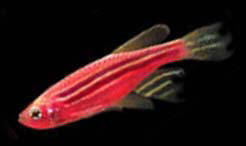
Zebra Danio acting strangely 5/6/08 Hello, <Sarah> I have an established hexagon tank, I believe it is 35 gallons. I had e-mailed last Sept when some of my fish died suddenly after a heater malfunction. Since that time, I have not added any other fish, we had 1 zebra Danio and 2 Cory cat. This weekend I picked up 5 very small zebra Danios at Petsmart (where the other fish came from as well) and 2 more Cory cats. I have checked the water daily, it still shows zero nitrites. All the new fish seem to be active and happy. The coloration on the new Danios brightened from a pale brown to bright stripes almost immediately. All the Cory cats are happy. However, the one original Danio is acting strangely. It seems to be swimming in a labored fashion, moving his tail constantly, as if it cannot keep itself straight in the water. Its tail is lower, and its head is high. He has had a bloated look for a very long time, so not sure if it could have some sort of problem. Any suggestions? I had wanted to get more Danios so he would have someone to school with, as he was just hiding in the plastic plants all the time. Now he's out and swimming, but not looking good. Also, he has a large bright red spot on one side behind the eye- is this normal coloration for zebra Danios? Thanks, Sarah <Mmm, is not... could be most anything at this juncture, description. Please do send along a well-resolved image if you can. Bob Fenner>
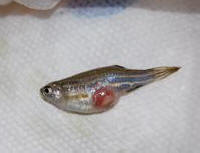
My ever-dwindling Danio population (Danio Illnesses) 12/23/07 Hello out there in the wonderful world of Wet Web Media, <Brian> I am writing out of a combination of consternation and desperation. I am new to fishkeeping (February 14 will be my one-year anniversary) and I have two tanks: one is a twenty-nine gallon planted tank and the other is a ten gallon planted tank. In this post, I am writing about the twenty-nine gallon tank. First, a little background... My tank is about eight months old and I added fish slowly (though I might add, without quarantining - that is what the second tank is for, but I bought it mid-way through stocking the first one). My ammonia and nitrite are both zero. My nitrate is greater than 20ppm but less than 40ppm <Both too high...> (hard to tell with the color based tests). I do a 25% (about 5 gallons which is 25% since there is only about 25 gallons of water in the tank accounting for the displacement from the substrate, rocks, wood, and plants) water change once a week. I do NOT use a C02 machine, but I do put in Excel (one capful) every other day. <I would hold off on this for now...> The plants in the tank include: a ton of Blyxa japonica, a hearty Anubias, two flourishing (melon?) swords, crypt spatulata, java moss, and Myrio which grows like weeds. The non-fish fauna in the tank include: Amano shrimp (2 males, 1 female), 5 cherry red shrimp (and about 20 babies across three generations), and green shrimp (not sure how many because they hide, but at least one no more than four) and various snails. The fish in the tank include: one Bristlenose Pleco (sans bristles - grumble!), two honey dwarf Gouramis (one definitely male, one either female or passive male); one flame dwarf Gourami, one Oto negro, one Siamese algae eater (too big for its britches - not sure what to do with this voracious eater), <Keep your eye on... move if too aggressive> one pregnant female platy (who has never once -visibly- given birth but is a fat blimp), one chocolate Gourami (named chip, short for "chocolate chip"), and two male rainbowfish (dwarf praecox), one zebra Danio and one leopard Danio. So here's the problem. My tank population has recently dwindled. In the last two weeks, I have lost two zebra Danios. About a month before that I also lost a zebra Danio (when I started my tank I had four). About four months ago, my fattest (alpha?) female Danio seemed to get sick - her spine started to curve and she was "hiccupping", having these strange convulsions that looked like she had a neurological disorder. Over the weeks, she got progressively worse until she was swimming funny (she almost seemed like she was no longer buoyant - she kept sinking and was swimming in this weird diagonal pattern). I tried to look it up online (even on this site) and from what I could glean - the fish was constipated. The cure seemed to be quarantine and no food for 2 days. After six hours in the quarantine tank she seemed improved and after three days, I returned her to the main tank. She was fine for about six weeks and then she died. Four weeks later, one of my Danios had a pinkish sore on its side. I am not sure but I think it was "missing a scale" (not even sure if this possible, but it is my best estimation). About two weeks later, I came home and a different zebra Danio was dead (at the bottom of the tank) and the one with the sore, well it was ... well, I am not sure how to describe it. It looked as thought it was being eaten alive. One side of its body it was fine and silvery and the other side was raw - pink/red as though someone had been munching on it. Oddly enough, the fish was swimming around just fine, but it looked nasty. I put it in one my larger fish nets (I know not the best idea, but it was a contingency plan) and tried to isolate it from the other fish after I found my dwarf flame Gourami trying to nip at it. Sadly, the Danio didn't make it. Two days ago, I came home and my leopard Danio was swimming at an angle and well... I also don't know how to describe this but it looked like had exploded. Pardon the description - from the front and sides it looked fine but most of the bottom 1/6 of the fish was ... well gone and looked pink and fleshy. If it were possible for a fish to "explode" from eating too much, this is what I would hazard it would look like. The good news is that after two days, the fish is still alive (not visibly being harassed by other fish ... ) and seems to be healing. The fleshy part has actually gone from a reddish pink to a paler pink. It looks less like it is "throbbing". Now that you have heard my story, here are my questions: 1. Does this sounds at all like "whirling disease"? I just started reading about this (by the way, your link to www.fishdiseases.net on the whirling disease FAQ is broken) <Does read as some sort of internal bacterial complaint... particular to Cyprinids...> 2. If not, what does it sound like? I have not had any luck finding anything that fits these symptoms (if they are all related). 3. What do I do? Are my other animals in danger? <I would skip using Danios and their relatives in this system... Really. Not worth trying to treat, remedy here. The list of other livestock... that is more sensitive to general areas of poisoning let's say, is telling> I am not sure if you can tell from my post, but I have taken being a fishkeeper really seriously. <Yes... you 'read' as a very earnest individual of intelligence, tenacity> I have been reading a ton (subscribe to two fishkeeping magazines, read this site, joined my local aquatic plant society). Every time a fish or other animal dies (3 Otos, 1 bamboo shrimp, 1 white dwarf Gourami, 1 bumble bee goby [which would have done better in a brackish environment, I found out after] and 2 female Amanos), I spend hours trying to figure out why they die. My water is clean, my nitrogen cycle is fine, I feed regularly, and my plants are thriving. Any help would be useful. <As stated... many Danios perish "consequent" to the conditions in which they were reared in the Far East...> 4. I read somewhere that if a fish has whirling disease, the fish should not be flushed. ACK! I didn't realize that - is that true for all dead fish? I am a city boy and I don't really have a "plant" to bury the fish in. Can you please give me some suggestion for appropriate means of disposing dead fish? <Best to freeze all in a plastic bag... toss out with solid trash service> Sorry for the long post. I look forward to your reply. Brian in San Francisco <Bob Fenner in Key West>
Pregnant Zebra Danio 10/2/07 Hello, <Hi there> I have a 55 gallon tank with a 13 inch ?Plecostomus, <Yikes! Needs more room... or to be traded in for a smaller individual> 3 zebra danios(2 females, 1 male).? My? problem is with one of the female Danios.? She appears to be very very pregnant.? She is huge.? Her skin appears to have cracks? running down the side and underneath her belly.? She is eating and swimming.? She will not release any eggs.? I am assuming that is what she should be doing. Do you have any advice on what I could do to help her out?? It looks like she is going to explode. Thanks, Julie <Likely some sort of gut blockage... what do you feed and how? Please read here re possible Epsom Salt treatment: http://www.wetwebmedia.com/FWSubWebIndex/saltusefaqs.htm Bob Fenner> Re: Pregnant Zebra Danio... Lg. Pleco in small world 10/3/07 Hello, <Hi there> Thank you for your reply about my problem with my pregnant Danio. <Welcome> However, I was taken back by your response to me having a 13 inch Plecostomus in a 55 gallon tank. <Yes... the fish is as long as the width of this tank...> I don't have the tank over loaded with plants or decorations so he moves around easily. <Mmm... do you know which species of Loricariid this actually is? There are some that would/might be stunted here...> I see him swimming on his side, upside down, enjoying the bubble curtains - eating the algae all over the tank. He "appears" happy and able to move around freely. I have moved him from a 10 to 20 to 55 gallon tank as he has grown from 2 inches to 13 inches in the last 4 years. I am a novice at the Plecos and didn't have any idea of what I was getting into. Could you explain this to me in a little for detail please - this fish has become a part of my family - my husband thinks I love the fish more than him (haha)- as I sit and talk to the fish and just watch the fish's personality unfold daily. Thanks, Julie <Do take a look on fishbase.org re the family... some of the species listed... This fish really does need more room still. BobF>
Breeding my Zebra Danios 8/10/07 I have a male and a female Longfin zebra Danio. I want to breed my Danios and the female appears to be full of eggs, but she seems uninterested in the male. I have a breeding tank, but I am not sure how to breed them. Can you please give me some advice? Thank you. <Greetings. Breeding Danios is not usually difficult. But as with any fish, you need to get the conditions right. You want slightly soft to moderately hard water, and the temperature must not be too high (about 22-24 degrees C) is ideal. Prior to spawning the fish, you should keep them cool, around 18-20 C, for a couple of weeks. Then warm the fish up, and start feeding lots of live or wet-frozen foods, perhaps 3-4 times per day. This is called "conditioning", and what you're doing is tricking the fish into thinking it is the breeding season. In the breeding tank, cover the substrate with glass marbles or small pebbles. What you want to create is a tank bottom where the eggs can sink safely out of reach of the parents. For spawning to occur, you need to add a small group of males and females, ideally slightly more males than females. It has to be a group, not a pair. These fish spawn in groups. Once they've spawned, you can remove the parents. The eggs hatch in about one day, but it's another 4 days or so before the fry are swimming about looking for food. Give them infusoria or commercial baby fish food (of the egg-layer, not livebearer, variety). The fry grow quickly and are basically hardy and easy to rear. Danios are among the best egg-laying fish for a first breeding project, so you should find them quite rewarding. Cheers, Neale.> Minnow behaviour & health 10/3/06 Hi <Hello there Charlotte> I have four pairs of minnows (2 zebra Danios, 2 coldwater, 2 long fin and 2 yellow ones: apologies for the lack of description by proper name but I can't remember). <Perhaps a small journal you can keep...> They all get along quite happily with four fancy goldfish and a coldwater Plec and all seem in general good health, having joined the goldfish approx 6 months' ago. On Sunday, I purchased 3 very tiny fantails (one smaller than the zebra minnows!) and all seem well. Today I have noticed that the yellow and long-fin minnows seem to be displaying to each other by opening their fins wide and synchronized swimming! I have been trawling the internet and my books but none give any indication as to what this behaviour means. <Perhaps reproductive behavior... maybe just dominance displays> Is it possible that it's due to the slightly reduced territory now there are 3 new fantails (albeit very small ones) or is it a breeding thing (one of the yellow ones looks a bit portly)? <How large is this system?> As a secondary point, on reading various articles relating to minnows I noticed in one of yours reference is made to a bent spine indicating TB infection. <One possible cause of several... covered on WWM.> This concerns me as one minnow has a very bent spine. He's always looked like this, has grown well since purchase, as have all the other fish. As mentioned above, all of the fish in the tank seem in general good health and water quality is fine. Should I be concerned about TB or do I just have a minnow with a wonky back? Your comments would be greatly appreciated. Many thanks, Charlotte <Please read here: http://www.wetwebmedia.com/FWSubWebIndex/gldfshsystems.htm You may need more room, less fish livestock. Bob Fenner> Siphoning Babies - Danio Fry and Gravel Cleaning - 09/30/2006 Hi Crew, <Hi, Mike! Sorry for the delay.... your email wasn't able to come through properly in our Webmail system; my computer was able to read/respond, but I've been out a bit. I do apologize for this delay.> I spend far too long reading your website but enjoy it immensely. <Heh! Me too.> I have a mature 240 litre freshwater community tank and over the last few weeks, every time I do my weekly partial water change, I syphon tens of baby zebra Danios out with the tank cleanings. Obviously they are too small to net and I've tried various methods of separating them from the muck but, inevitably, I spend hours every week with my head in a bucket rescuing baby fish by whatever painfully slow method I've invented; dipping cup, air-tube syphon or pipette usually. <How about a brine shrimp net?> My problem is that I'm becoming increasingly fond of dumping the baby laden sludge directly into one of the fry tanks to save time. Although it's probably very good baby food, it does mean that I am building up waste in tanks that I can no longer syphon 10% of the water out of weekly since I'm back to square one - babies and muck. So what, if any, faster methods can you suggest of separating the babies from my siphonings please <A pipette and patience is probably the best/safest way....> and what is the best way of cleaning the gravel in the fry tanks? <Best option here is not to keep gravel in your fry tanks. Keep them bare-bottomed instead, if possible.> On a marine note, have you seen the new marine shop/website in Leeds? www.reefranch.co.uk http://www.reefranch.co.uk/ ? <I haven't; I don't think anyone on the Crew right now is in the UK - but if I'm out that way, I'll have a look!> Fantastically well cared for fish and corals. <Sounds great. I like to hear of new, good shops opening up.> Best regards, <To you as well!> Mike Cursons <Wishing you well, -Sabrina> Danio with bubble-like growth 4/3/06 Hey Crew. My zebra Danio has recently developed a small, bubble-like growth on it's bottom lip. I've had this fish for a just over a month, and this has developed perhaps within the last week or so... just after the fish was added to the main tank. I would have liked to attach a picture, but I'm sure you know how difficult it is to get a zebra Danio to sit still. The bubble is grey/clear in colour, and probably about 1mm in diameter. I'm fairly sure it's not ich, as it isn't white and has a well-defined round shape. The fish is otherwise swimming, eating, and behaving normally. <A good clue... very likely this is "just resultant from a bump"> Here's the data on this fish's environment: 20 gal. tank with live plants, heated to 23-24c. Tankmates are two other zebra Danios, two dwarf Otos, and four Cory cats, all healthy. The tank is cycled, readings are ammonia 0, nitrite 0, nitrate approx. 15 ppm, pH stable at 8.0-8.1. <A bit high...> In my own research to determine what this growth is, I saw references to lip fibroma, but I only read of it occurring in angel fish. Could this be what's afflicting my Danio, or is something else afoot in my tank? <Could be an "oma", tumorous... but doubtful here... And assuredly nothing one can treat... nor would I risk excising it. Likely will "go" of its own accord. Bob Fenner> As always, thanks in advance for any help you can offer. JM Wasting symptoms in Zebra Danio 3/15/06 Hello, <Sharon> I had a 30L freshwater BiOrb containing 3 White Cloud Minnows, 2 Zebra Danios and a living plant. Water condition is good - Ammonia 0, Nitrates 0, Nitrites 0 and pH 7.6. About 6 weeks ago I lost one of the Minnows. Symptoms included enlarged abdomen (I initially thought it may have been pregnant) followed by (48 hours before death) bent spine, floating near surface and lack of appetite. In recent weeks I have noticed: * one of the Danios appears to be wasting away i.e. is very skinny (although it is still eating normally and active), * one of the Minnows appears to have an enlarged abdomen (also eating normally and active). I lost a second Minnow last night - not the one with the enlarged abdomen. I had been away for a couple of days and returned to find it with looking skinny with a bent spine. It also had swim difficulties (probably due to bent spine), lack of appetite and was floating near surface. I quarantined it immediately in salt water, but to no avail. I have searched your website and come to the conclusion that my fish may have either an internal parasite (bad) or TB (really bad). What do you think? <Could be... perhaps from just "initial" troubles (you bought them with this)... But could be environmental to a large extent... or nutritional. What do you feed your fishes?> And, if you could provide some advise for on my next course of action that would be much appreciated? Regards, Sharon Bell. <Mmm, I would ask your stockist/LFS if they've been having trouble with their minnow fishes... You can/could become involved in sequential antimicrobial "trials"... in the hope of blocking something at play here. My first choice would be a Furan compound (likely Furanace). Bob Fenner> Re: Wasting symptoms in Zebra Danio 3/17/06 Hi Bob, <Sharon> Thanks for the speedy reply. <Welcome> I just wanted to let you know that I didn't buy the fish with the BiOrb. I set the BiOrb up about 9 months ago initially (unsuccessfully) with a couple of small fancy goldfish. <I see> The Danios and minnows were purchased and added to the tank 3-4 months ago - after a 75% water (de-chlorinated) change, a thorough cleaning of the BiOrb and making sure that the BiOrb had cycled. I feed them frozen daphnia, frozen bloodworms, flake food (left over from the goldfish - but I did compare the ingredients with those of the other fish foods available) and boiled peas. If I go away, I leave them a sinking pellet (Spirulina rich) to nibble on. <Should be fine> I do a 25% water (de-chlorinated) change fortnightly, and change my filter quarterly - whether it's dirty or not. (The Danios and minnows are much cleaner than the goldfish were!) <Yes> I live in Australia and haven't been able to find anything containing a furan compound. Also, what did you mean by antimicrobial trials? And, how would I carry those out? <Mmm... there are a goodly number of "broad spectrum, gram-negative antibiotics" sold for pet-fish use... And as hinted, the "search" for one that is efficacious here is a matter of trial/s... I would use (serially) what you can find... at a/the stock dosage of 250 mg./ten gallons system water... three times, three day intervals... with water changes between> I will ask my LFS if they have had any trouble with their minnows this weekend, but in the meantime is there anything else you suggest? Regards, Sharon. <Mmm, the application of Epsom salt here might act as a temporary cathartic. Bob Fenner> Danio Swimming into HOB Filter - 3/16/2006 Hey Crew, here is a new one...to me, anyways. I have three zebra Danios in a 10 gallon cycled quarantine tank. I am seeing some very odd behaviour from one (or perhaps two) of these fishes. Twice in the past 24 hrs, one of the Danios has found his way up into my hang-on-the-back power filter. I say "one" of them, but I am not sure...it could have been two different fish who did this. On both occasions, I have found the fish swimming around in the confines of the filter's media chamber, unharmed. Does this behaviour signify anything, other than the antics of hyperactive fish? <<It is likely out of curiosity, but could be a sign of something else. How are your water parameters? It could be due to aggression from the other fish as well. Keep an eye on them, just in case.>> Is there any device I can employ to stop them swimming up into the filter? <<If there is no screen in the intake, try some filter floss, or a bit of screening of some kind to fashion your own.>> It is rather alarming to me that they are doing this, not to mention risky to the fish when I have to retrieve them. <<Risky in general. Do cover the intake!>> Any help you can offer is appreciated. <<Glad to help. Lisa>> JM Zebra Danio Q 3/10/06 Hey Bob! <June> My fiancée and I are looking forward to seeing you at IMAC (we actually met at IMAC last year and are getting married this June). <Congrats!> Any way, I'm currently working for a research lab that is working with zebra Danios <A fave test animal species in the sciences> (ophthalmology research) and I tend to keep the pH at about 7.2-7.6, but one of the ladies that works in the lab says that's too high and that their eggs are becoming coagulated (just with in the past 2 days). She thinks that it's because of the pH. <Mmm, is possible... do you know the corresponding alkalinity? Might be better to blend more/some "just water" in the system here> Now, I have my degree in marine biology, and take my water chemistry results to heart, and to have someone double checking my results is insulting to me, so that is why I am e-mailing you to see what your opinion is. The PI of the lab trusts me very much and hold me in high regard, but for some reason these ladies seem to not trust me. Go figure. <They may have practical experience going for them here...> Any info you can give me would be very helpful as then I can have someone who has even more experience backing me up. :-) Thanks again!! June PS: Didn't know which e-mail address to send to, so I sent to both. <Ah, no worries. Bob Fenner> Zebra Danio with strange caudal fin 1/16/06 Hello there! I've been breeding zebra Danios for a while, and recently, after my fry matured into full grown adults, I noticed that a few of them have a different colored caudal fin. All them, except these few, have the lines going through their body, go into the fin, ending when the fin stops. However, for these few, it stops where this fin is attached to the body, and on the fin, it has blotches of like black lines and black dots all mixed up on the tail randomly, that really sticks out, and sort of reminds me of a guppies tail. I tried to take pictures so I could attach it to this, to show you what i mean, but i couldn't get the camera to focus on the Danio and everything kept coming out blurry and unfocused so you couldn't really tell what was going on. I looked all over the net but i couldn't find anything about Zebra Danios with tail fins like this, and I thought this might be something new going on, because I've never seen any other Danios like this before until now. What do you think? Thanks, Tyler Ross <Mmm, likely just part of the randomness of genetic mix... This is how the vast majority of sport mutations are "developed"... e.g. long tails... Bob Fenner> Zebra Danios With TB 12/05/2005 Hi, We have 10 gallon tank and have started the tank 4 months from now. We bought 3 Danios to start with, and they did very well for first 2.5-3 months. We used to do weekly water change. Our local pet store suggested to not to change water for first month to have fully cycled tank. We stopped the water change. I am not sure if this is the cause or something else, but we lost our smallest fish during this time. Rest two fishes has lived fine for some time and they started slowing down. They used to eat a lot and swim around in whole tank that is filled with natural plants. They stopped eating with that eagerness. They stopped playing. We noticed that their spine is also got curved. First we were thinking that they are getting old. After reading FAQ section in your website, we are scared about fish TB. I have been touching the water to clean up the tank. Though I don't have any wounds, but still I am scared and wanted to know what measure we can take to diagnose if we got infected or not. About the fishes, now they both are dull and during the night they lie down on the bottom of tank. Actually till light is off mostly they lie down on the bottom. If light is on, they try to swim. We can see they have hard time swimming. They most stand still at one place. I have also read on internet somewhere that when they are at the end of their life cycle, then also they develop curve in their spine. So how do I know if my fishes have TB or they are just old. In summary these are questions I have. 1) What measures can we take to find out if we have infected ourselves with the fish TB? < Fish TB is very very rare. If people were getting infected and it was a problem I think you would see warnings all over the place. As a precaution I just wash up after having my hands in an aquarium.> <Rare in people, yes.... but I have seen many, many cases in fish lately - many of which were Betta splendens.... -SCF> 2) how do I find out if my fish's spine is getting curved because they are old or they have fish TB? < More than likely your fish are getting old. Usually these little guys don't last more than a couple of years tops and the contouring of the spine is one of the signs of a fish getting older.> 3) In case of fish TB, how do I sterilize the whole tank? Do we have to start from scratch for the new fishes? < I think you fish may have gotten ill due to poor water quality. Check the nitrates. The lower the better. These little guys like clean well oxygenated water.-Chuck> The Ethics of Glo-Fish (TM) (6/5/05) Hiya Bob, <<Howdy. RMF>> I just finished reading the article on the Glo-fish, and I was wondering if it would be possible to ask the author if he considers every breed of dog, most breeds of milk and beef producing cattle, and probably 80% or better of all of the grains and fruits he eats as also being 'garbage' due to the fact that they are also man induced 'mutations' (yes, the method may be different, but the intent and process is the same and similar-one is just more 'trial and error, after all, no?) For the record, I also don't like the idea of Glo-fish, or painted chandas, but plenty of folks hate telescopes, black moors, fancy guppies and swords for just as legitimate reasons. <Agreed> I can understand a POV of distaste and dislike, I was just wondering what selective bias the author uses to determine which of our obvious genetic alterations are 'garbage' and why? ;) (heh, maybe I should write a counter point article for submission, playing devil's advocate) <All submissions are welcome for consideration. You will have to use a lot better grammar than you did in this e-mail. Please capitalize the proper noun "I" and the first letter of sentences. We post all e-mails and replies. It's a lot easier for folks to read them if they are punctuated properly. If you do it then we can spend less time proofreading and more time answering.> Keep up the good work-been observing your website for years, all the best! Alan <Thanks. The author of the article is not a member of the question-answering crew, so I do not know how to contact him. I do agree with you on this issue. I have nothing against Glo-Fish (TM) myself. They were created to serve a utilitarian purpose (pollution detection). If there is a side benefit of providing pretty fishes that have not been chemically burned and dyed, that's great from my perspective. I have no problem with GM foods either. I say you're right that there is no difference in principle between this and selective breeding. It's only method and speed. In fact, GM is better because the planning will lead to fewer bad mutations. It just needs to be properly regulated. As for the other fish you mention, I have qualms about some of them. If fish are selectively bred for appearance, I only have a problem if that creates a deformity that impairs the fish or causes pain. Some of the fish sold these days definitely suffer as a result of their selectively-bred appearance. That's my opinion, for what it's worth. Steve Allen> Re: cichlids Bob, Hi, my name is Brenee King and I am a students of Mr.. Nordell's. I was considering doing a project with Cichlids (Zebra Danio ?) <Hmm, Zebra Danios? These are actually not cichlids, but cyprinids (egg laying toothed carps, Brachydanio rerio I think is still their valid scientific name> having to do with their familiarity effecting their mating habits and wanted to know how often I could expect them to mate? Also how long it takes for the females to complete their cycle, mating and having their children? Please contact me when you have a chance. Thank You for your time and considerations. <Do put this fish's name in your search engines, go to a college library with the same... and start developing your working bibliography on this species biology. See the pieces on the site www.wetwebmedia.com on how to search the literature.. You will have more questions, need more answers than you have asked for here. Bob Fenner> I need help fast for my zebra Danio I'm not really sure what the problem is. <Sabrina here, to try and help> He or she, I can't tell, has just over the past few days shown any of the listed symptoms. swollen belly, hunchback tail, head pointed upward, won't eat, but he swims normal hangs out at the top with the rest of the zebras. <Hmm, this isn't a lot to go off.... Can you give us some more specs about your tank? How big is the tank? What other fish are in with the Danio? Do you test your water for pH, ammonia, nitrite, and nitrate? If so, can you let us know the values? What you describe could be a number of things, but what sticks out most to me is the swollen belly - are his scales sticking out, pinecone fashion? I'm afraid you *might* be dealing with dropsy, which is extremely difficult to cure at best, but perhaps there are other possibilities, too. Let us know more about your tank, and we'll be more able to help you figure out what's wrong.> Thank you for your time. <No problem - I wish you the best.> GloFish Question Bob, <Yep> Wondering if we can get your opinion on the GloFish fluorescent zebra Danios? They look amazing, esp. for freshwater (n fact, even better than some marine species). Could you comment? If you haven't heard of them yet, they are at www.glofish.com and http://www.reuters.co.uk/newsArticle.jhtml?type=scienceNews&storyID=3873977§ion=news has a good article. Thanks! Sandi <Have seen these transgenics... a whole bunch at last times Aquarama in Singapore... a neat scientific application... but para mi, "no sale"... too pricey. Bob Fenner> Re: GloFish Question Bob, Thanks so much for your time. I think I'll go with the GloFish even at the price. They look to cool to pass up. Sandi <They are very beautiful, and a very interesting "story" to relate re their "genetic clip-on" technology. Bob Fenner> High pH, Fighting Danios Hi guys. You have the greatest website! I got my first tank two weeks ago. It is a ten gallon freshwater community tank, several plastic plants, 50 watts heater, two thermometers one internal and one external, one fake rock with 3 holes on it, one undergravel filter, two inch deep gravel strata (rounded and more or less pea sized), one aqua-tech outside power filter, one small sponge filter. The pH of our tap water is about 7.4 to 7.6. I added water conditioner (Tetra Aqua Safe), Stress Zyme, five teaspoons of salt for freshwater aquarium. At the beginning the water got a little cloudy. I waited one week and added 3 Zebra Danios Next day I added one ounce of Bio-Spira freshwater bacteria from Marineland. The water became clear again within 24 hours. The Danios (one small male, one small female and a larger older individual whose gender is a mystery to me) were fine. They were exploring and racing around. Then the two smaller Danios began to dance in circles at the bottom of the aquarium. The older individual took possession of the upper and middle part of the aquarium and began to chase and bump-fight the small male while the small female was hidden in the plants. Within 48 hours the small male stopped racing and eating and died. I examined the body. There were no signs of disease or injury. The older individual still chases the small female every time they meet. The small female is fine but she is confined to a corner of the aquarium that is covered in plants most of the time. She ventures out often, but she goes back when the larger Danio chases her. When I feed the fish, I feed them very little food, twice or once a day. I try to feed them the minimum amount of food possible. I underfeed them because they are too busy fighting each other to eat all of it. Although the Danios come immediately to the food, they promptly begging to fight and some flakes end up sinking and the fish remain hungry. I worry about the food sinking. My last pH reading is in the range of 7.6 to 8. My ammonia reading is 0. My nitrite reading is 0.2. I have several questions: What could have happened to the small male Zebra Danio? <<Aggression, high ammonia, nitrites. What did your ammonia test at last week? Must have been some, there has to be ammonia for it to be converted into nitrite. Do you have nitrates yet? You should be testing this tank everyday.>> What is it with the large Zebra Danio (I was told they are peaceful fish)? <<They are not. And a toxic tank will not make them any nicer, either...>> Could the small female Zebra Danio be hurt by constant harassment? <<Certainly>> Is it a good idea to add other fish to the tank? <<No.>> If so is this list a good list: one male Beta, two more Zebra Danios, two female Guppies and two small Cory Cats? Are this fish too many (taking into account all my filters and that I am willing to do a 25% water change weekly and a mayor water change monthly)? Would they take my pH as it is? How can I modify this list to avoid disaster? <<Do NOT add any fish now. Your tank is still cycling. Hence the high pH, etc. And certainly don't add all of these at one time! And definitely avoid putting guppies and a Betta into a tank with Danios. Disaster awaits if you do.>> Until now I have resisted the impulse of applying pH-lowering product to my tank but What can I do with my pH (7.6 to 8.0)? Should I make a 25% water change now (taking into account that the food keeps sinking because of the fighting of my Danios)? <<As I said, your pH is high because the tank is CYCLING. It will stabilize in a month or so. Have PATIENCE, please. Do not mess with your pH, you will not be helping your fish if you do. The pH will end up all over the place, and your fish will end up dead from a combination of pH shock, nitrite poisoning, and stress..>> Finally, If Bio-Spira is so amazing, why are some dealers against it? Thank you for your help. <<I personally like Bio-Spira, it's an excellent product when it's being used properly. However, results will differ from tank to tank. Dealers simply don't like it when people with no experience try to cycle with it and end up with dead fish, as in your case. Please do some reading, buy yourself some ammonia, nitrite, and nitrate test kits, and be PATIENT. Test your water regularly, do water changes when readings become high, and do NOT add fish until the tank has NO ammonia and NO nitrites left. Keep two small fish in the tank during cycling. TWO! not more! Keeping a written record of your test results will help. :) -Gwen>> Danio We recently set up a 48 gal tank and we purchased 4 Long Fin Zebra Danios. One of the Danios is chasing the other three and actually taking pieces out of the other tails. The pH is 7.6 and all other readings are in spec. The aggressive Danio is not bothering the other fish in the tank. It seems the other 3 non-aggressive Danios are not bothering each other, it is just the one that is aggressive. Should we isolate the aggressive fish? Any help would be greatly appreciated. Love you website. < You could either add more Danios or take out the aggressive one. I am afraid that if you remove the aggressive one then another one may become dominant and chase the others as well. A 48 gallon tank should be big enough so that they should have room to get away. I usually recommend that schooling fishes like these be kept in groups of at least 6.-Chuck> Bob
Pandas and Barbs Incompatible? Hi! I have a 10 gallon tank with 2 striped barbs and 2 long-finned Danios. All 4 fish are about 1" in size. Tank has been cycled and water tested. They have been living together for a few months now and get along great. I do a 20-30% water change every week. The other day I added 2 small panda Corys. Right away, one striped barb started chasing one of the Corys. This went on for a few days. Every time the panda tried to rest, the barb would seek him out and chase him. It only happened with one barb and one panda. Also, the barbs were hogging all the food, so we tried a sinking pellet for the pandas, but the barbs found that too and devoured it! Needless to say, when I got home from work one night, both pandas were dead. I took them out and did a water change and the 4 original fish are back to normal. Will this happen with any new fish I add or was there some incompatibility with the panda and the barb? I feel like the barb harassed the pandas to death!! < Some fish do get territorial and some barbs have been known to become fin nippers. Next time do a water change and rearrange the tank just before adding any new fish. This may help. Or you could try to add numerous fish at the same time to help disperse the aggression of the barbs.-Chuck> Thanks, Frances Danio Problems Hi, I started off with 5 Zebra Danios and 4 Peppered Corys in a 70 litre tank and I'm now down to 2 Danios. About 5 months ago one of them got really bloated overnight and I found him the next day looking like his stomach had burst. Last week another one bloated up and then dropped dead within two days. Last night though, I noticed another one carrying what looked like a bruise on his side, he looked red beneath his skin then this morning he was dead on the substrate with what looked like two, small skin bubbles protruding from his underside. <Hi Dave, Don here. Two things come two mind. Let's hope it's a water quality issue. Do you check your water for ammonia, nitrite and nitrate? Any amount of the first two could be the cause. But, if you see any Danios showing a bend in their spine you have TB in your tank. If so, then the fish will have to be put down and the system sterilized. TB can spread to humans with a break in the skin. Be careful and wear gloves. There are also other bacterial infections that can cause this. If the spines are straight, try a good broad spectrum antibiotic. Oxytetracycline may help. Like I said, let's hope it a water quality issue> I replace 5 <less than 10%> litres of the tank water every 7 days and the tank looks clean but there is obviously something going wrong somewhere. Any advice would be more than appreciated as I really don't want the fish to suffer any more. <First thing I would do is test the water. If you see any ammonia or nitrite, or if nitrate is over 20ppm, fix it with large (50%+) water changes daily. I would also up your normal water changes to around 20 to 30%> Thanks and best regards, David Danio Problems Hi, Thanks for your advice. I have just been out to buy testing kits and will test the water quality when I have finished work this evening, I really hope it is poor water as the TB possibility terrifies me if I'm honest. How worried should I be for my own health, I know you say that it can enter humans via open wounds but what about just being around the tank, do you know if it becomes airborne? <No, it can't. I must enter through a break in the skin> Also, do you know of any websites that you know of where I would find pictures of Zebra Danios with TB (curved spine etc). <Here's a link to my photos in our forum. Scroll down to the next to last pic. The two female White Clouds at the top of the photo show the bend pretty well. http://wetwebfotos.com/Home?actionRequest=userview&userID=4258 Some fish become very thin, mine bloated.> Sorry if I seem to be panicking a little! <Understood. I really try to pass along the warning without causing any undo concern. I rarely succeed. Some say the bacteria is always present in our tanks, and that it takes a drop in the fish's immune system for it to show. If true, it would seem transmission to humans is rather rare. But some very respected people here suggest sterilization of the entire system whenever TB is found. That's a hard call to make, but harder to argue against. Let's hope it's the water. Don> Thanks again, David Dying Danios Hi, We've had our tank for about 3 months now. Among the second batch of fish we got were three Zebra Danios. All three have since died, one after the other. The first one experienced a bloating and a dullness of his color a few days before dying. Both the others seemed to waste away, becoming very thin over a period of about two weeks. All refused to eat after the symptoms set in. It took all three of them about a month and a half to die total. All the other fish in the tank seem to be doing fine. Is this something that we should be concerned about either for the other fish or for ourselves, or was this just a "bad batch" of fish? -Greg <Hi Greg, Don here. I do think you got a batch of bad fish. The question is bad with what? They had some sort of internal infection. It could have been anything from bacteria, protozoa, even worms. Knowing what type of infection it was would set the risk to the other fish and yourself. If the Danios spines curved as they wasted away then they had fish TB, which humans can catch through breaks in the skin. I would just watch the others at this point. If any more get thin, email us back with details> Question: my Danio's tail is gone Hello! I'm hoping you can help me. I noticed yesterday that one of my Danio's tail was mostly gone (long finned Danio). I have zebra Danios and plain Danios in my tank. I thought they were a non-aggressive fish so I didn't think that anyone else would've bitten his tail. His spine doesn't look bent. He spends more time hiding in the foliage than he used to and seems a bit sensitive, but swims around with everyone some and eats fine. Any ideas what is going on? The tail nubbin' looks healthy as far as I can tell. < If the tail was not actually bitten off by a fellow tankmate then chances are that it was damaged and may have developed a bacterial infection that slowly ate it away. Do a 30 % water change, clean the filter and treat with Furanace to prevent any further damage.-Chuck> Thank you so much! Megan Re: Question: my Danio's tail is gone Thank you for the info. Can the Danio grow a new tail fin? < If the damage is limited to the fin portion itself then it may grow back. If the damage has reached the caudal peduncle, The meaty portion of the tail then probably not.-Chuck> Megan Lumpy Danio Hi Bob, <Don here today, Hi back> We have a 10 gallon tank and have managed to keep 4 zebra Danios and one golden algae eater alive for 10 months. We have a carbon filter and change the filter every month. We perform water changes every 2-4 weeks (2 gals per time - treated with AquaSafe). We added a small aerator (bubbler) about six weeks ago. The bubbler is not adjustable so it runs constantly and seems noisy. <Get a 3 way valve for the airline. Open the valve to the bubbler all the way. Close another. Open the third to slow the air flow to the bubbler. Adjust the blank valve until you get a good air flow. If it hisses, add a foot or so of airline as a muffler> Lights are on from 8 am to 8 pm daily. <Good> Recently one Danio started developing a lump on its spine. Over the course of two weeks the Danio became listless and spent much time on the bottom of the tank. We removed him to a temporary place and tested the aquarium water. <Good to remove him. Is the spine bending? Or does it look like a small pea under the skin> Temp 74 degrees <Ok, but 76 to 78 better> Ammonia 0 <Great> Nitrate 40 <Good, but a little high. Try to keep below 20ppm> Nitrite 0 <Great> Hardness 25 <Hard> Alkalinity 300 (high) <Very> pH 8.4 (high) <Very, very> Do you know what the lump is? <Could be a tumor, in which case there is nothing to do. Sorry> Can the fish be saved? Right now he's sitting at the bottom of the temporary shelter, barely moving but still breathing. <This could be just about anything. I would try a good broad spectrum antibiotic. However, if the spine is bending the fish must be put down. Bury or put in trash. Do not flush. Wear gloves> Is the pH or alkalinity to blame? <Could be. Danios will adapt to a wide range of water conditions, but yours are extreme. You could try peat moss in the filter. It will stain the water a rich tea color. Charcoal will remove the color> Should we take corrective action? <As above> Did the bubbler cause anything? <No> Peg
|
|

|
Features: |
|
| Featured Sponsors: |

.jpg)