|
FAQs on the Zebra Danios
Health
Related Articles:
Barbs, Danios & Rasboras,
A Barbed Response; Wrongly maligned for being fin-nippers, barbs
are in fact some of the best fish for the home aquarium by
Neale Monks
Related FAQs: Zebra
Danios 1, Zebra
Danios 2, & FAQs on: Zebra
Danios Identification, Zebra
Danios Behavior, Zebra
Danios Compatibility, Zebra
Danios Selection, Zebra
Danios Systems, Zebra
Danios Feeding, Zebra
Danios Reproduction, & Barbs,
Danios, Rasboras 1, Barbs,
Danios, Rasboras 2, B,D,R
Identification, B,D,R
Behavior, B,D,R
Compatibility, B,D,R
Selection, B,D,R
Systems, B,D,R
Feeding, B,D,R
Disease,
|

|
Possible swim bladder issue
5/29/18
Hi crew!
I have a question about possible swim bladder problem with one of my
long fin zebra Danios (female). Recently she has been
subjected to non-stop bullying from a dominant female in the school of
six. The affected Danio, who was discovered Sunday having issues
swimming, has been removed to a hospital tank. She is exhibiting
negative buoyancy. She will occasionally swim to the top with great
effort but will return to the bottom where she will wobble to one side.
She is alert and responds to movement outside of the tank (she will
scuttle to opposite side of tank when I approach). She is healthy in all
outward appearance with good color and clear eyes, but is slightly
swollen in the belly with one side being slightly more pronounced. She
may be slightly egg bound. Her respiration is normal. She has not
accepted food while she has been in the hospital tank (since Sunday).
Presently she is in a cycled 2.8 gallon tank to which I've added about
1/4 tsp of Epsom salt (one dose). The water temp is about 75-76°F.
<Good moves, conditions>
I thought that she may have some sort of intestinal blockage as my
Danios like frozen bloodworms and the larger Fluval bug bites I feed my
larger fish.
<Am not a fan of Bloodworms, though frozen are better than other
formats. I'd sub Daphnia, Brine Shrimp for now; for their mild laxative
effects>
I know that the stress from the recent bullying could have predisposed
her to some sort of GI infection/parasite. I know the prognosis is not
great, but do you think that a course of antibiotics may be helpful? I
have both Kanaplex and Metroplex on hand. Or should I continue with the
Epsom salts?
<For me, just the MgSO4>
I was planning on a 50% water change tomorrow and replacing just the
quantity of salts removed by the water change. I'm quite perplexed as to
how to proceed with treating her.
Thanks in advance for your help.
Susan
<Really just time going by and favorable setting will/should see this
situation resolve. Bob Fenner>
Re: Possible swim bladder issue /RMF 5/30/18
Thanks Dr. Bob!
She is making an attempt to swim around a bit today but still spending
most of her time on her side on bottom of tank (bare bottom). She
mouthed some brine shrimp I held up to her mouth but not eating yet.
One development this morning, long stringy white poo. Does this sound
like inflammation/infection of GI tract or parasites?
<Could be or not>
No other passage of normal looking feces.
<Mmm; do you have a 'scope of a few hundred power... ability to hook up
to USB for sharing pix of a sample?>
Otherwise, Color good and still responsive to movement outside and
inside of hospital tank. Ammonia and nitrite are zero.
Is the white stringy poo cause for concern or should I just give her
more time with water changes and Epsom salt?
<For me, the latter. BobF>
Susan
Possible swim bladder issue /Neale 5/30/18
Hi crew!
I have a question about possible swim bladder problem with one of my
long fin zebra Danios (female). Recently she has been subjected to
non-stop bullying from a dominant female in the school of six. The
affected Danio, who was discovered Sunday having issues swimming, has
been removed to a hospital tank. She is exhibiting negative buoyancy.
She will occasionally swim to the top with great effort but will return
to the bottom where she will wobble to one side. She is alert and
responds to movement outside of the tank (she will scuttle to opposite
side of tank when I approach). She is healthy in all outward appearance
with good color and clear eyes, but is slightly swollen in the belly
with one side being slightly more pronounced. She may be slightly egg
bound. Her respiration is normal. She has not accepted food while she
has been in the hospital tank (since Sunday). Presently she is in a
cycled 2.8 gallon tank to which I've added about 1/4 tsp of Epsom salt
(one dose). The water temp is about 75-76°F.
I thought that she may have some sort of intestinal blockage as my
Danios like frozen bloodworms and the larger Fluval bug bites I feed my
larger fish. I know that the stress from the recent bullying could have
predisposed her to some sort of GI infection/parasite. I know the
prognosis is not great, but do you think that a course of antibiotics
may be helpful? I have both Kanaplex and Metroplex on hand. Or should I
continue with the Epsom salts? I was planning on a 50% water change
tomorrow and replacing just the quantity of salts removed by the water
change. I'm quite perplexed as to how to proceed with treating her.
Thanks in advance for your help.
Susan
<Hi Susan. Danios are social animals, and in small groups can sometimes
bully one another. It's usually a male, but no doubt sometimes big
females throw their weight around too. The best solution to this sort of
bullying is, inevitably, adding more of the same species and hoping for
the best. I've been in a similar situation with Danio choprae, and
eventually ended up with just one male! But in the meantime, yes, Epsom
salt may help with bloating and egg-binding, if these are the issue, and
an antibiotic used against Dropsy can be useful. I'd not go crazy with
randomly medicating where small fish are concerned; partly not worth the
expense, and partly tends to harm the fish more than help them. So at
some point, euthanasia tends to be the better option, as described
elsewhere on this site, and after a week or two to confirm the remaining
fish are healthy, the addition of sufficient replacement livestock to
mitigate any social behaviour problems. Cheers, Neale.>
Injured Danio 3/17/18
Hi guys!
<Hello Susan,>
One of my long fin zebra Danios was discovered stuck head down in a
section of my tank's driftwood yesterday.
<Not good.>
I found him a couple of weeks ago in the same predicament. Fortunately,
I only had to tilt the wood to one side for him to swim free. He is
pretty scraped up on one side with his scales roughed up and a red spot
under his pectoral fins that now juts out at his side at a 90° angle.
Since his injury he is being bullied by the other Danios in his school,
although he continues to swim with them. Last night I noticed the
redness was more pronounced and he wasn't coming up to eat so I decided
to move him to a 5 gallon hospital tank with a cycled sponge filter.
<Fish generally don't "get stuck" though I have seen Corydoras catfish
stuck inside hollow ornaments because of their spines, and if they can't
escape quickly enough to take a gulp of air, such catfish can drown. No,
normally when we see fish "stuck" somewhere, they've actually drifted
there, unable to swim strongly enough to control where they're going.
Think of them more like a bit of flotsam, drifted up onto a beach
somewhere. Sometimes the problem can be over-strong water currents
rather than anything wrong with the fish in question. Bettas for example
find it hard to swim because of their very long fins, so need tanks with
gentle water currents. Artificial varieties of fish with veil-tails and
other longer than normal fins may suffer from the same problem because
their fins increase drag (imagine trying to swim in baggy, waterlogged
clothes) while their swimming muscles are no stronger than those of
normal fish.>
I hated to remove him from his school, but I wanted to treat with
Kanaplex and give him some time away from the other bullies. I now think
that he has probably been stressed and bullied all along.
<Quite likely. Danios are aggressive towards each other. I've kept them
in groups of six, and find they fight all the time! I would definitely
keep a big group, eight or more, and crucially, I would not mix regular
and long-fin varieties, the latter being too "encumbered" to compete
well, so (more) likely to end up at the bottom of the hierarchy.>
Question. Should I keep him in the hospital tank for the three days of
treatment or is this just additional stress?
<A singleton Danio will be fine for a few days, even a couple of weeks
if you need to medicate / re-medicate. Prioritise the medication
instructions in terms of doses, etc. But when you return him/her to the
main tank, certainly turn the lights off for a few hours to prevent
bullying the "newcomer", or better yet, remove all of them temporarily,
move some of the rocks or plants about, and then return all the Danios
to what will seem, to them, a new habitat. This re-sets their hierarchy,
and in many cases fixes bullying, especially if you can add a couple
extra specimens of the same species at the same time.>
I could just treat the whole tank but I would have to find and remove my
Nerites first; also I wasn't certain how my Corydoras would react to the
meds.
<Antibiotics such as Kanamycin (what is in Kanaplex) should have no
negative impacts on non-bacteria, so should be fine with snails and
catfish. If you wanted to take your Nerites out though, you could
probably keep them a few days in a large food container (such as a
plastic ice cream container) holding a couple of litres of water. Kept
somewhere warm, the snails should be fine for a few days, provided you
did periodic water changes.>
Also, SeaChem stated somewhere in a forum that there may be some plant
die back.
<Can't think why.>
I'm more concerned about my fish. The plants are just there to make them
happy.
<Indeed. And again, just take a few cuttings, put them to one side, and
return to the main tank if the existing plants look unhappy.>
Susan
<Cheers, Neale.>
Re: Injured Danio 3/18/18
Thanks Neale!
<You're welcome.>
Planning on getting more Danios as I have just the 6.
<Ah, understood.>
My little guy is improving on the Kanaplex. He is one of two small
males.
My females are massive.
<I would guess the other male is dominant, and pushing this other male
about.>
He is now swimming normally and exploring tank, red spot is fading after
just one dose and poor pectoral fin is now functioning somewhat more
normally. Still not eating and spitting out food but at least showing
interest this morning.
<A good sign.>
Thanks for the advice on rearranging the tank and reintroducing them all
at once back into tank. Great idea. My girls even bully my large
Columbian tetras.
<Yikes!>
Susan
<Cheers, Neale.>
|
Help please. Brachydanio hlth., no info. 8 plus megs of blurry pix
6/19/17
Hi there
<Bry>
Came home from a day out and found our zebra Danio severely bloated and quite
red and blotchy. One big red patch on under side just before tail fin. All the
other fish seem fine and water tests show everything fairly good just minorly up
on nitrite by a fraction.
Help?
<Mmm, need data (of use) re the system water quality (test results), food/s
used, maintenance routine....>
Thanks
B
<Could be too much dried food, gut or reproductive blockage; "poor water
quality" issues... Read here:
http://www.wetwebmedia.com/fwsubwebindex/zebraddisf.htm
and the linked files above. Bob Fenner>
|
 |
|
GloFish concerns
I have a concern about my GloFish. It has had a "fat" appearance for several
weeks, probably close to three months. Initially I thought it was full of eggs,
but since I pretty much watch for eggs everyday and haven't seen anything for
this length of time, I'm not sure if this is the issue anymore. Is it sick?
<Might be.... is the fullness symmetrical about the body? What foods do you use?
What other livestock is present? What water quality test results do you have to
share? Bob Fenner>
What can/should I do at this point? Thank you.
--
Very Respectfully,
Sharonda Miles
GloFish concerns /Neale
7/1/16
I have a concern about my GloFish. It has had a "fat" appearance for several
weeks, probably close to three months. Initially I thought it was full of
eggs, but since I pretty much watch for eggs everyday and haven't seen
anything for this length of time, I'm not sure if this is the issue anymore.
Is it sick? What can/should I do at this point? Thank you.
-- Very Respectfully, Sharonda
<Hard to say for sure, but a good first guess is some type of internal
bacterial infection causing Dropsy. Danios are a little bit prone to this,
oddly enough, especially in small tanks. Antibiotics are usually the best
bet here, such as API Furan-2. Treat as indicated, remembering to remove
carbon from the filter (if used). The use of Epsom Salt alongside the
antibiotics is a cheap but very effective supplement; 1-3 teaspoons per 5
gallons/20 litres is about right. Epsom Salt also happens to help against
constipation, which is the other reason fish swell up, so using it with the
antibiotic is a clever way to deal with both possibilities. Good luck,
Neale.>
re: GloFish concerns /Neale
Yes the fullness is symmetrical (I attached a picture of him, of the four
Glo fish pictured he's the blurry one, but you can still see his belly). I
use the flake food for the Glo fish that came with the tank. I have three
other Glo fish and a catfish (I attached a picture of the catfish). I
haven't tested the water quality. Honestly I never thought to nor do I know
how.
<The "dip strips" are inexpensive, easy to use and adequately accurate.
Nitrite and pH are the two "must haves" so far as environmental measurements
go. Agree that the Danio looks off; Dropsy is likely. Review previous email
and act accordingly. Cheers, Neale.>
re: GloFish concerns 7/1/16
<.... seven megs of files...>
Yes the fullness is symmetrical (I attached a picture of him, of the four
Glo fish pictured he's the blurry one, but you can still see his belly).
<...? Are these all Gymnocorymbus? Or is one a Danio? >
I use the flake food
<This is likely the cause of the "fatness" here. Mix in some frozen, perhaps
live foods>
for the Glo fish that came with the tank. I have three other Glo fish and a
catfish (I attached a picture of the catfish).
<These Pictus may eat your Tetras, Danio... is that an African
Cichlid there too? Incompatible>
I haven't tested the water quality. Honestly I never thought to nor do I
know how.
<Take the time to educate yourself. Your livestock relies on your knowledge
applied actions. Bob Fenner>
|
 |
|
Diseased Glofish/zebra Danio
5/31/16
Hi crew,
You've helped my fish get through an illness some months ago, but
unfortunately she is sick again.
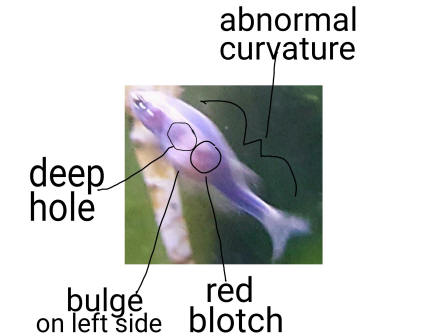
<I'll say! That's a very sick looking fish.>
I labeled a picture of her to better explain her physical symptoms which
include a gaping hole in her side, a left sided bulge in her belly, red
blotches and an abnormal curvature to her body that has only recently formed
a few weeks ago. These symptoms started with the red blotches at least a
month ago and then gradually progressed to all of this.
<My best guess would be some type of Mycobacteria infection. What used to be
called (inaccurately) Fish TB. Virtually impossible to medicate and can be
contagious, though to be fair, usually only crosses over to other fish if
they're stressed somehow. That said, ulcers can be caused by other reasons,
such as physical damage, and bent spines can be caused by poor
genes, too-small living quarters, lack of vitamins in the diet... a bunch of
things really. So to some degree you need to take my suggestion as a best
guess rather than a diagnosis, and consider the other options too.>
All of the other fish are unaffected. I've treated her with salt baths for a
few weeks and concentrated tetracycline baths. The hole has gotten smaller
and she started eating again, but the curve in her back has gotten more
pronounced and generally she has only shown little improvement over all.
<The spine won't heal. It's deformed bone growth. If it was always bent, can
be genetic. But if it was straight but has become bent with time, then
something was/is amiss with the aquarium environment, diet, etc.>
Please help! Thank you, Danielle
<Some reading:
http://www.wetwebmedia.com/euthanasia.htm
http://www.wetwebmedia.com/ca/volume_6/volume_6_2/mycobactera.htm
Hope this helps, Neale.>
|
 |
Illness in Glofish Danio 12/1/15
Hi crew,11 days ago I noticed that one of my five GloFish danios had a red spot
between his fin and tail on one side. Two other GloFish danios seemed to have
red gills, but I couldn't tell if they were redder than normal. I also have
cories, tetras and kuhli loaches in this tank who all seemed to be unaffected.
<I see>
The only thing I knew for sure was that my blue GloFish with the red spot was
definitely ill. One of his fins was also in a contorted position and he wasn't
eating.
<Well; these Glofish varieties of Brachydanio are not as hardy as their
wild-types>
The water parameters were the same as usual - 0 ammonia, 0 nitrates, 10
nitrites, 6.8 pH. I chose to treat with MelaFix
<I would not.... has no real use, action. Can/does contaminate the water;
interfere w/ nitrification>
since it was the only thing I had on hand. I saw improvement within 2 days so I
continued with the MelaFix. The red spot on my blue GloFish lightened daily
after treatment and his fin regained normal function. I followed the 7 day
treatment plan and continued as needed since the spot wasn't completely gone.
After 11 days I missed 2 days of treatment since I was away for the holiday. Now
I've noticed that my blue Danio is starting to develop the spot on his side
again. The water parameters are the same except the pH has shot up to 8.2!
<?! How is this possible?>
Im guessing this was caused by the MelaFix??
<Have never heard of this effect. What is the pH of a drop of this API scam in a
test of water?>
I haven't made any other changes to the tank. Should I continue with MelaFix or
try a different product?
<I would not treat this symptom period; but instead do what I can/could to
improve water quality (water changes, gravel vacuuming, use of carbon...) and
nutrition>
Please help if you can offer any insight! Thanks so much! Danielle
<Mmm; I'd like to have you read re Danio disease:
http://www.wetwebmedia.com/fwsubwebindex/zebraddisf.htm
My strong intuition senses there's "something missing" in our discussion here.
Foods/feeding?
Bob Fenner>
Re: Illness in Glofish Danio 12/5/15
Hi Bob, Thanks so much for the response. I wanted to wait a few days to give you
the most accurate update possible.
<Ah, good>
My plain tap water has always(and still) has a pH of 7.8.
<This is fine for Danios (in fact, most all aquarium organisms)>
My tank has also been reading 7.8 daily since we last spoke, which is no
surprise since I've been doing 10% water changes daily. I've discontinued the
MelaFix as well.
<Good>
My blue GloFish Danio still has the red spot on his side but it hasn't gotten
any better or any worse. You said it was unheard of for the pH To shoot up the
way it did due to MelaFix, so I'm searching for another reason. It could be
partially due to the 25% water change that I did after the first 7 days of
treatment with the MelaFix. I also add a tsp of baking soda and a drop per
gallon of calcium chloride to my new water.
<Mmm; well; sodium bicarbonate could be the cause here.... it will/DOES raise pH
to about 7.8; and act as an effective buffer at that "point">
If I don't, my kH and gH would read zero.
<Mmm; do please read Neale's excellent piece here:
http://www.wetwebmedia.com/fwsubwebindex/fwh2oquality.htm
You can, should either make or buy a commercial prep. that will add Calcium,
Magnesium, and likely some carbonate to your water (ahead of use)>
I also started feeding my fish a frozen variety food that includes plankton,
brine shrimp, meal worms etc, but I've also been reading the same product to my
snail tank and the water in that tank hasn't exceeded a pH of 7. I may have
messed up the baking soda measurements in the community fish tank.
<Yes; this is a more/most likely scenario>
Although unlikely that's the only possibility that I can think of. Since
discontinuing the MelaFix I am at a standstill with my one symptomatic Danio.
<I really don't think this spot is pathogenic... NOT caused by a biological
disease agent. DO READ on WWM re general Barb/Danio/Rasbora disease; the FAQs
file/s>
I trust your judgment but really don't want to lost him. He was one of my first
in that tank about 9 months ago. He's still happy and healthy as of now(minus
the red spot), so I still have plenty of hope. I don't know if its relevant, but
2 of my albino cories have taken on a rather pale tone while the others still
look shiny/iridescent. Thanks in advance! Danielle
<Read on! And write back if anything is unclear, incomplete in your mind re a
course of action. Bob Fenner>
|
Danio issue or non-issue?
/Neale 1/25/15
Hello, first of all I'd like to thank you for running the excellent site
that you do and ask you to keep up the good work! :)
<Thanks for the kind words.>
So I'm a rather new aquarium keeper I've had a 10 gallon for a year that
i kept stocked with a dwarf gourami (who by the way isn't very colorful
unlike my friend's but is definitely a male and shows no signs of the
Iridovirus and I've had him for about a year), three zebra danios, 1
emerald Cory cat, and one gold molly.
<A nice selection of fish, though more suited to 15-20 gallon tanks than
10.>
Bad numbers for schooling fish i know but I had deaths for various
reasons over time (bad handling by staff at fish store, one molly died a
day after giving birth, etc)
<Indeed?>
Anyways the gold molly was given to a friend for perhaps selfish reasons
(I didn't like how unnatural he looked compared to the setting of my
tank and my friend had an Oscar... catch my drift)
<Yikes!>
so i transferred the rest of the fish to my new 20 gallon last week and
before hand added a whole bottle of Safe Start (that stuff really works)
and I've had no fish death or ammonia poisoning symptoms.
<Good and good.>
However my danios are much happier and I noticed something on one of
them.
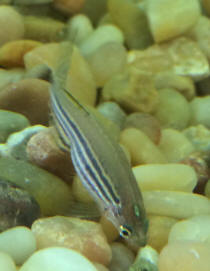
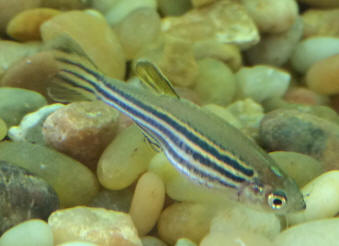
Have a look below......... That spot on her head concerns me however she
has 100% been acting normal (she only was slow enough for me to catch a
pic and at the bottom because I fed algae wafers). What could it be? Is
it just an odd patch of scales?
<Yes.>
No new fish have been added in months however I was gonna add three
Longfin leopard danios today that have been in QT for a week. Should I
not add them? Should I even be concerned?
<Not especially, no. Doesn't look like anything "bad" to me. The fact
it's symmetrical and silvery suggests it's a patch of scales rather than
anything more suspicious.>
My friend seems to think I should treat for fungal infection but I
strongly oppose medication use in my fish tanks and im not sure what
that medication does to my cycle as well as my plants (green Cabomba, a
moss ball, and sprouting hybrid Aponogeton bulbs). Also you might have
noticed the belly on the Danio? I've been using your site to try and
figure that out. I have always fed very sparingly every 1 to 2 days for
fear of overfeeding and I typically rotate between shrimp pellets, flake
food, freeze dried blood worms, and an algae wafer. Recently I tried
tetra granules in an attempt to brighten the color of my fish (which
worked in my opinion). I have yet to try the mini krill that I have as
well. This in mind I have chosen to believe she is carrying eggs as well
as the other Danio that's quite larger (not the belly) but is also
similarly shaped. The third Danio is long and thin (not bloated looking)
like a male should be but he keeps to himself. I see no pine coning on
any of them. I would just like your thoughts on some of the issues
presented if you need anymore information or pictures ill be quick to
respond.
<Hmm... sounds a mixed bunch of odd symptoms. Nothing immediately
obviously wrong with the one in the photo. Would tend to sit back,
optimise water chemistry and quality so far as possible, wait, moderate
diet (to avoid overfeeding), perhaps use Epsom salt (1-3 teaspoons per 5
gallons/20 litres) if you suspect constipation. I would not be randomly
medicating,
anyway, unless there were more immediate signs of a definite problem.>
Thank you so much for your help. Paislee
<Most welcome. Neale.>
P.s. I keep my tank at 81 F currently as i do whenever the fish may be
stressed or I add new fish (to prevent diseases like ich). I use a tetra
whisper ex 20 for filtration and i have a small airstone in my tank.
<81 F/27 C is a bit warm for Danios to be honest, though unlikely the
immediate cause of any problems. Long term though, not ideal. 25 C/77 F
is about right for most tropicals, with warmer water reserved for
strictly hothouse flowers such as Cardinals and Discus.>
Danio issue or non-issue? /RMF
1/25/15
Hello, first of all I'd like to thank you for running the excellent site
that you do and ask you to keep up the good work! :)
<Welcome>
So I'm a rather new aquarium keeper I've had a 10 gallon for a year that
i kept stocked with a dwarf gourami (who by the way isn't very colorful
unlike my friend's but is definitely a male and shows no signs of the
Iridovirus and I've had him for
about a year), three zebra danios, 1 emerald Cory cat, and one gold
molly.
Bad numbers for schooling fish i know but I had deaths for various
reasons over time (bad handling by staff at fish store, one molly died a
day after giving birth, etc) Anyways the gold molly was given to a
friend for perhaps selfish reasons (I didn't like how unnatural he
looked compared to the setting of my tank and my friend had an Oscar...
catch my drift)
<Yikes!>
so i transferred the rest of the fish to my new 20 gallon last week and
before hand added a whole bottle of Safe Start (that stuff really works)
and I've had no fish death or ammonia poisoning symptoms. However my
danios are much happier and I noticed something on one of them. Have a
look below.........
That spot on her head concerns me however she has 100% been acting
normal (she only was slow enough for me to catch a pic and at the bottom
because I fed algae wafers). What could it be?
<Maybe a blem from physical trauma>
Is it just an odd patch of scales? No new fish have been added in months
however I was gonna add three Longfin
leopard danios today that have been in QT for a week. Should I not add
them?
<I would not worry; would add>
Should I even be concerned? My friend seems to think I should treat for
fungal infection but I strongly oppose medication use in my fish tanks
<You are wise here>
and im not sure what that medication does to my cycle as well as my
plants (green Cabomba, a moss ball, and sprouting hybrid Aponogeton
bulbs). Also you might have noticed the belly on the Danio?
<Mmm; just a bit of a bulge from over-eating perhaps... Maybe egg
production>
I've been using your site to try and figure that out. I have always fed
very sparingly every 1 to 2 days for fear of overfeeding and I typically
rotate between shrimp pellets, flake food, freeze dried blood worms, and
an algae wafer. Recently I tried
tetra granules in an attempt to brighten the color of my fish (which
worked in my opinion). I have yet to try the mini krill that I have as
well. This in mind I have chosen to believe she is carrying eggs as well
as the other Danio that's quite larger (not the belly) but is also
similarly shaped. The third Danio is long and thin (not bloated looking)
like a male should be but he keeps to himself. I see no pine coning on
any of them. I would just like your thoughts on some of the issues
presented if you need anymore information or pictures ill be quick to
respond. Thank you so much for your help.
Paislee
P.s. I keep my tank at 81 F currently as i do whenever the fish may be
stressed or I add new fish (to prevent diseases like ich). I use a tetra
whisper ex 20 for filtration and i have a small airstone in my tank.
<I'd lower this temp. a bit... slowly... a degree or two per day... to
the mid 70's. Your fish will be happier/healthier and live longer. Bob
Fenner> |
 |
Zebra Danio Health 11/17/13
Good afternoon,
<And likewise, Joel!>
Hope you are doing well today. I have a 55 gallon moderately planted
community tank that has been running for about 7 months now. The tank
has the following parameters:
Temperature: 24C/75F
pH: 7.6
dH: 10
<All sounds ideal for a mixed community tank.>
The tank is currently stocked with 15 Zebra Danios (Danio Rerio),
<Normally a good species, but...>
4 Upside-Down Catfish (Synodontis Nigriventris) and 3 Zebra Nerite
Snails (Neritina Natalensis). I perform twice weekly 10% water changes,
and the tank is currently reading 0 Ammonia, 0 Nitrite, and 5 Nitrate.
<Again, sounds good.>
Last night, I noticed one of the Danios was very lethargic, colour
somewhat faded, and showed little interest in either schooling or food.
After isolating to a spare 5.5 gallon tank for the night (not ideal, but
my 10 gallon quarantine tank is currently being used to treat a Betta
for Finrot), the Danio is currently resting on bottom, gasping for
breath and the back half of his scales are protruded in what certainly
looks like Dropsy. Given that, I added slightly less than a tablespoon
of Epsom Salt to the tank.
Today, I've noticed two other Danios with the same behavior and isolated
them as well. One did not survive the transition, but the other is in
the same tank as the first Danio. Since Dropsy does not seem to be
contagious, this worries me that it might be Neon Tetra Disease. Four of
the Danios were purchased 2 weeks ago, while the rest have been in the
tank for about 6 weeks. Do you believe this to be the case? Please let
me know if I need to provide any other information.
<True Neon Tetra Disease, Pleistophora, doesn't commonly "jump" to
species other than small characins, but it has been recorded. But many
instances of Neon Tetra Disease are simply bacterial infections of
various types, likely Mycobacteria. This/these bacteria can and do jump
species, and possibly are latent in many (farmed?) fish species and only
become problematical when something gives them the opportunity --
wrong/poor environment, poor diet, poor genes, etc. Neither sort of Neon
Tetra Disease is treatable. In other words, my bet would be on this fish
being doomed, and I'd focus on minimising the risk of transferral to
other livestock. Remove and euthanise this fish, and don't add any new
livestock for at least 6 weeks, and if you do buy anything else, ideally
quarantine such livestock properly before introduction. Fish bred to a
price rather than a quality seem to be most at risk from Mycobacteria
infections -- Zebra Danios, Angelfish, Guppies, Dwarf Gouramis, etc. --
so these are the fish I'd be leery about buying if the price tag is very
low and/or you see sickly specimens in the tank with the ones you want
to buy.>
I appreciate your time and any advice you can give.
Thanks,
Joel
<Have asked Bob Fenner for his thoughts... I may be being overly gloomy!
Cheers, Neale.>
Re: Zebra Danio Health (Bob???) <nada mas>
11/20/13
Neale,
<Joel,>
Thank you for your response. I appreciate the quick reply (and fix...
adding the 'u' to 'color' was a nice touch haha) to my email.
<Ah, not deliberate... my browser does this while replying to
messages... trying to be helpful. The "u" in colour (in British English)
is, I'm told, an affectation of the 18th century, with the lack of "u"
retained by the English settlers to the American colonies the older,
original way of spelling the word. So which is the more proper English
spelling is an interesting question!>
I'm of a similar disposition (that is to say, somewhat gloomy) on the
subject. In the days since the last correspondence, I lost half of the
Zebra Danio flock. I'm currently down to 7 remaining in the 55 gallon
and 1 sickly guy in a 7.5 gallon tank. Seems like each day, 1 or 2 came
down with similar symptoms, and expired shortly after being netted.
<Not good. My experience with Neons is much like this, and I've given up
treating them or frankly buying them or recommending them.>
For the most recent fish I netted, I looked online and found that
Mycobacteria are generally Gram-positive. I have Amoxicillin (Fish Mox)
on hand and decided to give it a shot as the Danio appeared to be
circling the drain. After two days, I am seeing a little improvement in
his swimming habits, which gives me at least a little hope.
<For sure. But Mycobacteria are notoriously hard to treat.>
Either way, I think this is the push I need to actually start using the
quarantine tank for new livestock... I have the set up, might as well
use it.
<Indeed. Or at least, avoid the more risky species. Danios, as we
probably
agree, are usually reliable. But maybe they've succumbed to the same
inbreeding and mass use of antibiotics that seems to have ruined Neons
and
fancy Guppies.>
Thank you again for your help. I will keep on the look out for Bob's
response.
Joel
<Best of luck, Neale.>
|
ADVICE NEEDED: Danio has a huge sore/hole in it’s side
6/23/13
Hello,
<Audrey,>
I am having a problem with a Golden long-fin Danio, and I haven’t been able
to find answers anywhere. It has a huge sore/hole in it’s side that started
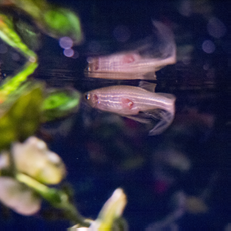
with a red bump on the side of the body. It behaves a tiny bit
lethargic (swimming in the same area sometimes instead of exploring all the
time). I didn’t know what it was, and couldn’t find any answers, but I
went ahead and treated with a little aquarium salt, and parasite clear with
daily water changes, and it healed, and acted normally. However the hole
came back 2 months later, in a different location. It's the exact same Danio
too. I only have 3 golden danios (one is shorter finned, the other is
a leopard). This has not happened to any other fish. I’ve tried
posting to forums, and no one has any idea, and I was referred to you.
I've attached photos. Can anyone please tell me what this is, and
if/how I can get rid of it once and for all? I’d be grateful for any
advice!
Tank: 29 gallon tank, running for over 2 years
Filter: Fluval c3
Parameters: pH is at exactly 7, ammonia < 0.02 ppm, Temperature set at 25C
Fish: 6 Black skirt tetra, 9 phantom tetra, 2 Pristella tetra, 3 Glowlight
tetra, 3 golden danios, 1 long fin zebra Danio, 1 golden algae eater (no
other fish showing symptoms)
Food: flaked food (TetraMin pro), sometimes I add freeze dried bloodworms
and frozen Mysis shrimp.
Maintenance: Last water change was 10 days ago, about 10%, usually done
about once every 3 weeks.
** Nothing was changed recently
ADVICE NEEDED: Danio has a huge sore/hole in it’s side
https://skydrive.live.com/redir.aspx?cid=21d17f320d9a2215&page=browse&resid=21D17F320D9A2215!165&parid=21D17F320D9A2215!152&type=5&authkey=!AF4wwJRjfRJgBro&Bsrc=Photomail&Bpub=SDX.Photos
Thanks,
Audrey
<Okay, this is some sort of ulcer and should be treated
using a good quality anti-Finrot medication. Often the ulcer seems to be
caused by a physical injury, e.g., jumping into sharp metal around the hood
or lights, swimming into a filter inlet, or attacks from another fish. Your
"Golden Algae Eater" may be Gyrinocheilus aymonieri, and this species is
known to sometimes attack other fish when hungry (adults are more omnivores
than algae-eaters, and are easily starved unless properly fed). Usually they
go for big fish they can latch onto, but it's a possibility to consider.
Gyrinocheilus is a bad community fish, regardless. So, bottom line, try to
figure out how this fish became injured (twice, but the sound of things) and
treat as per Finrot (remembering to remove carbon, if used, during
medication). These wounds to the muscles on fish do seem to heal extremely
well if medicated and water quality is kept good. Cheers, Neale.>
|
 |
I live in Turkey and need some aquarium help... Danio
losses... very new tank
4/21/13
Dear Crew,
<Diane>
I have a 25 gallon Hailea E 25 aquarium that I
just bought this week.
<Mmm... a week back... is this system cycled?>
I have a community tank with 2 silver zebra angel fish, a pair of m/f
balloon mollies, a pair of m/f red swordtails, 6 pink zebras or danios,
8 neons and two dwarf gouramis. There's also a catfish and a small
yellow apple snail.
I read that danios can be aggressive in groups less than 8. I had 6, so
I bought 2 more and at the same time, the 2 dwarf gouramis. By the next
morning 2 of the danios were missing. Completely. I checked the filter
and the aquarium is covered. Not a trace of them. Then a day later, I
noticed that one of the gouramis was missing a 'feeler' fin. I know that
I would have spotted that when I bought it, so it happened in my
aquarium.
The danios are not aggressive and I haven't seen them attack any of the
other fish. The male balloon fish is constantly tormenting the female to
mate. But he only chases her around. The gouramis and all the fish are
healthy and eating well.
My question is would danios attack each other or the gouramis at night
when the light is off?
<More likely the Danios are perishing from this system being "too new">
Do you think the danios ate the 2 new ones I bought?
<Not likely, no>
I have a plastic branch with plastic greens on it to create a sort of
quiet corner for the gouramis and angels, which they do like. I prefer
natural plants, but they are hard to find and when you do, very
expensive.
Thanks for any advice that you can give to me.
Best Regards,
Diane
<Please read here:
http://www.wetwebmedia.com/FWSubWebIndex/fwcyctrbfix.htm
and here:
http://www.wetwebmedia.com/FWSubWebIndex/fwestcycling.htm
Bob Fenner>
huge zebra Danio, hlth. 1/30/13
Dear Crew,
<Hello,>
I hope the attached picture makes it through to you. I have a 20
gallon long freshwater tank, about 3 years old. BioWheel filter,
heavily planted.
20% weekly water changes, carbon rinsed weekly and changed monthly.
Inhabitants are 4 zebra danios, 2 swordtails, 2 brass tetras, about a
dozen amino and cherry shrimp, 2 Nerite snails. Temp stays at 74F.
No recent changes. Tank has been very stable.
About 4 months ago I noticed that one of the female danios was carrying
eggs - or I thought she was carrying eggs.
<Possibly, but not the problem here.>
She kept getting larger and larger. She is now huge and I've been
thinking, maybe she is not carrying eggs. I tried to research her
condition and came up with dropsy or some type of intestinal blockage or
kidney problem, or fluid retention.
<Yes, this is something along those lines.>
This fish is very active, eats well, socializes with her fishy
friends and her poop looks normal. She has none of the classical
symptoms of dropsy (except for the large "belly" ) like "pine cone"
scales. Her spine has become more and more misshapen, perhaps due
to the "load" she is carrying beneath her. Here is a picture.
On the right is a normal Danio.
http://s1220.photobucket.com/albums/dd451/printpail/?action=view
<http://s1220.photobucket.com/albums/dd451/printpail/?action=view¤t=DSCN0885_zpsb1ca74e7-1.jpg
> ¤t=DSCN0885_zpsb1ca74e7-1.jpg
I removed the fish to a hospital tank and did a mild saltwater bath for
2 weeks. No change. I then used Maracyn 2 for 2 weeks.
Still no change. I only fed every other day, very sparingly.
The fish remains active and interested in its surroundings. Should
I just return it to my main tank?
Is there anything else I can try? I really think this fish is
going to explode at any minute.
Thank you for your wonderful site and any advice.
Janet
<This is not uncommon. Bad genes (inbreeding) may be part of the
problem, but the kinked spine is very typical of dietary problems and/or
Mycobacteria infections. The kinked spine is incurable, but it'd be nice
to get the abdominal swelling down. Treat as per Dropsy, using Epsom
salt (not aquarium salt) at a dose of 1-3 teaspoons per 5 gallons/20
litres alongside a reliable antibacterial medication (such as Kanaplex
or eSHa 2000). On the plus side, this sort of thing doesn't seem to be
contagious as such, though the things that causes it in your aquarium
could strike again, affecting currently healthy fish. So review your
fishkeeping, and act accordingly.
Cheers, Neale.>
Re: huge zebra Danio 1/30/13
Thanks, Neale, for your quick reply. Yes, I did use Epsom salt. I
will try one of the other anti-bacterial meds you recommended.
<Wise.>
If there is no decrease in the abdominal swelling after this round of
treatment, would you recommend returning her to the tank?
<By all means. I wouldn't remove, to be honest. Schooling fish are
likely to be stressed by isolation, and that'll make recovery less
likely. Neither Epsom salt nor antibiotics should cause healthy fish any
harm.>
If the fish is not contagious, and is otherwise healthy would that be
ok?
<Yes.>
I ask because the hospital tank is small and I bet the fish is anxious
to get back to lots of swimming. All other fish are very healthy -
tank is kept in great shape. I would like to learn more about this
inbreeding problem you mention - I will investigate.
<Oh, it's been a problem for years. Manifests itself in various ways
depending on the fish species.>
Also, for future reference, do you not consider the Maracyn 2 an
appropriate med for this situation or is it just not as good as those
you recommend?
<I haven't personally used Maracyn 2 so can't comment on how well it'd
work on its own. But the Maracyn 1 and Maracyn 2 combo should deal with
almost all bacterial infections, so if you can afford to use both,
that's the way forward.>
Thanks again. Much appreciated!
<Most welcome. Neale.>
|
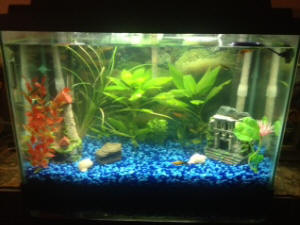
Zebra Danio 11/8/12
As I was looking around this site to see if their was anyone else with
this same problem.. I read that a picture helps.. I got up to take a
picture and my poor Danio died.. I still took the picture though just to
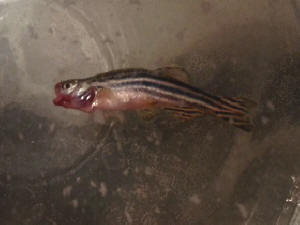
see what happened.. Well here goes.. Yesterday morning as I was doing a
partial water change and pruning my plants I noticed that my Danios
mouth was a bit open.. He seemed just fine, swimming around chasing my
skunk loaches (3) around.. And swimming along side my gold dusted
mollies(3) in the tank(20
gal) I also have a very small brittle nose Pleco about an inch long and
two platys.. Monday I went to my local PetSmart and got my water tested
by them and they told me that everything was perfect... I don't know
what could of happened.. I feed the fishes flake food, Algae wafers and
staple food tablets for my Pleco and loaches..
Today when I got home from school I saw that my Danios mouth looked
bloody and his/her gills were inflamed and also bloody looking.. So I
immediately separated him from the tank and put him in my 1 gallon( I
know it's bad for them but I freaked out) I used the same water from the
tank..
Looking at the picture his spine looks bent, but he didn't look like
that while he was still alive.. I know the water looks dirty in the
picture but it's because it was surprisingly really difficult to fish
him out of the tank and I moved around a lot of gravel..
Any ideas on what it could of been?
<Some sort of damage, trauma... From a loach?>
Do you think it is contagious?
<No, I don't>
Or maybe he just go into a fight with my loaches.. :(
Just hoping to hear your opinions..
Thanks! -Jessica
<Welcome. Bob Fenner>
|
 |
Danio with fish TB or merely bad water
quality or old age? 9/16/11
Hi,
first of all, I'd like to thank you guys for running this website
-- it's helped me out many times and it's always my first stop
when there is something wrong with my fish and I need an answer.
<Thanks for the kind words.>
I have a tropical fish tank with a mix of loaches, Platies, a Cory, and
four (or, as of yesterday, three) zebra Danios. I feed them mainly with
fish flakes and some additional sinking food for the loaches. I
can't recall how big the tank is, but from previous calculations I
know that it isn't overstocked (since I had a few deaths recently
it's rather a bit under-stocked, but more of that later). As for
food -- occasionally they get bloodworms or daphnia but they
haven't had much variety recently because we were on hold for a few
weeks and it's easier for the fish feeder to just give the
flakes.
<Sounds fine. Good quality flakes can make an adequate staple,
though offering occasional live or wet-frozen foods really can help
with constipation problems.>
Now, to give you the back-story. I have to admit that in recent months
I've been a very bad fish keeper indeed. I am pregnant and the
constant exhaustion and nausea has thrown me for a bit of a loop,
meaning that I've been less than diligent with cleaning out the
tank. Add to that that every time I clean it I seem to have to flush a
fish or two afterwards (is it the shock of all that clean water?) and
tank maintenance hasn't looked too appealing recently and the tank
has on occasion looked pretty bad.
<I see.>
Through this neglect I have lost a few fish recently, but there was
nothing in particular about those deaths that alerted me to anything
like an illness -- fish would stop eating, keep themselves separate,
and eventually die. There were no sores, discolouration or anything
else odd. Losses were varied -- an aquatic frog, a couple of guppies, a
Cory, and some Platies, but with many weeks in between). It's bad,
I know, and I feel rather guilty, but I attributed it to the bad water
quality and tank hygiene rather than any disease.
Now the Danio -- A while back (at least a month or so ago) he developed
a curved spine. Looked really odd, like he had a hunchback or something
like that. Initially this didn't seem to bother him much at all,
but during the past week or so he got slower and stopped swimming
around much. Eventually I found him at the bottom of the tank, kind of
crumpled up -- he looked almost paralysed, his spinal deformity looked
that bad. He wasn't moving and I thought he was dead, but when
touched he roused himself and swam off. The next morning I found him
floating at the top of the tank, dead, but get this -- by the time I
got round to fishing him out (had to get kids off to school, etc, so it
was a couple of hours later), he was gone! This was two days ago and
I've done two water changes since and I haven't found him.
Perhaps he was eaten?! Granted, I have a lot of plants in there, but I
did check through them and nothing!
<Could be a combination of things. Crooked spines typically appear
either at birth if genetic or in older fish as a result of
environmental stress and/or poor diet. Simply being old shouldn't
cause this problem, but it might I suppose.>
Since he died in such an odd way, today I sat down to Google the
hunchback syndrome and after reading about Fish TB for a couple of
hours I am more than a little freaked-out, in particular as it can be
passed to humans. As I said, I cleaned the tank twice in the past two
days and I did discover a little wound (cuticle) on my hand, so that
wound was definitely in contact with the water! In particular as I am
pregnant I'm rather worried that I may have contracted something...
Do you think it is likely the Danio died of Fish TB? He didn't
appear to have any sores, etc. that I could detect, but then, that
appears to be optional. He was quite big and I think I must have had
him for at least 1.5 years so perhaps it was just old age? Or it was
the dismal conditions that the tank was in for a while? I have today
discovered that another of the remaining Danios has a slightly curved
spine, although not nearly as bad as the one that died. He is also a
rather large (so I'm guessing one of the older) Danios. So far he
seems fine otherwise.
What is your opinion? Fish TB? Old age? Bad water and nutrition? Or
some other weird and not so wonderful fish problem? And should I go to
the doc to get this TB thing checked out?!
<If the aquarium is otherwise fine, and the fish all seem healthy
now, I wouldn't worry. The Mycobacteria infection aquarists call
Fish TB (probably erroneously) is likely latent in most tanks anyway,
but provided the fish are healthy and well cared for, there's no
particular reason to worry about it. Nonetheless, I would wait a good 6
weeks before adding any more fish. And if finding the time to maintain
the tank is likely to be hard, then understocking the tank will really
be a good idea.>
Any help would be much appreciated. Thank you!!
Best regards,
Iris
<Hope this helps. Cheers, Neale.>
|
Question: Mollies/GloFish Dying
2/23/11
Hi WWM crew,
<Hey Jace>
I've got a question regarding the general health of my
aquarium. About a month ago, I completed cycling my 55 gallon
aquarium and added 3 black mollies (1M 2F) while I decided on the
other tankmates that I wanted. Since then I have added 3 sunburst
platys (again 1M 2F), 8 male guppies, 6 GloFish, and 10 ghost
shrimp. My tank is moderately planted with plenty of rocks and
other constructs and the substrate is a smooth gravel. My water
is at 76F, about 7.8 PH, 0 ammonia, 0 nitrite, and about 5ppm
nitrate.
<Okay...>
While one of my platys has recently given birth to some fry
(unsure how many... removed one shelter to clean it today to
discover a few baby fry, most of which became a snack before I
could move them somewhere safe), I have lost two GloFish that had
no visible problems but had been swimming deeper than usual. I
also lost one molly after it had developed a kink in its back and
had difficulty swimming -- its tail frequently drooped and it
swam with its head very far up. I could not seem to get it to eat
and its excrement had become a translucent white and seemed to
come out much slower than normal. My second female molly is now
keeping close to my water heater right at the surface, in a
similar behavior to the now deceased female, but does not appear
to have the other issues.
<Mmm, what species of molly is this? Can you look into its
recent water quality (from/through your dealer)... They may well
have been kept in "saline" conditions. Please read
here:
http://wetwebmedia.com/FWSubWebIndex/mollies.htm
and the linked FAQs files above re Systems and Disease>
Should I be thinking about some sort of fungus, bacteria, or
parasite treatment here? I'm a new aquarist and don't
know quite what to do when the water appears to be fine.
-Jace
<Do read for now. Bob Fenner>
Re: Question: Mollies/GloFish Dying - 2/23/2011
Bob,
<Jace>
Thanks for the response. They are black mollies -- I'm afraid
I don't know any more than that, though the link that you
gave me makes me believe it to be Poecilia latipinna (text later
reads Poecilia hybrid).
<Okay>
When I purchased the fish I was told they were kept in slightly
saline conditions and to add one tablespoon of aquarium salt to
each five gallons of water, which I have been doing. I don't
know the specific DH for my water, but I do know that my location
is notorious for hard tap water (my tank is showing the lime
deposits from evaporation to prove it).
Jace
<Mmm, well... as you are likely aware (now), this genus has
many issues as captives. Nothing from the information you
presented "jumps out" as a/the likely source of
mortality... GloFish as well are poor shippers... It may be that
you just have "too stressed" specimens here.
BobF>
Re: Question: Mollies/GloFish Dying 3/4/11
To follow-up, I have since lost a fancy guppy and another female
black molly is exhibiting this "kink" in its back.
<Mmm, unusual... as with such in humans, these conditions are
genetic/developmental, nutrition, injury/trauma and at times,
pathogen-related>
What once were lively, fine fish a few weeks ago have this kink
seemingly appear overnight. I've included a picture of this
fish. Thinking it may be some sort of infection/parasite, I
gradually increased water temperature to 80 degrees and bit of
extra salt to the tank. I have continued to check water quality
and it is consistently 0 ammonia and nitrite, 5-10ppm nitrate, PH
7.8-8.0. After reading around on your site, I have read that one
cause of bent spines is Mycobacterium marinum. I am a college
student with not a lot of money and not a lot of space and I
don't have a hospital tank -- the only other thing remotely
close to this hobby is a 1 gallon fish bowl. Thoughts on where to
go from here?
Jace
<Considering your present circumstances, I'd leave all as
is, not "treat", and not raise the temperature beyond
the 80 F. Bob Fenner>
|
|
[1]%20molly%20kink%20back.jpeg)
|
re: Question: Mollies/GloFish Dying 3/4/11
Bob
<Jace>
Lost the two black mollies overnight. Glancing about my tank, I
noticed that those fish that passed as well as some others that
visibly look normal all have that milky white, stringy feces I
mentioned -- it's typically almost hair like in diameter with
thicker white beads every so often. I have noticed that while my
fish used to easily pass either pink or green feces (the color of
the protein or algae flakes they ate), almost none of them have
feces of that color. The mollies especially had a white anus.
Many of the fish that swam energetically in schools, like the
guppies, now spent most of their time in the corner or by the
heater.
<... you might want to look at their fecal material under a
'scope. Perhaps Hexamita/Octomita. B>
-Jace |
zebra Danio mouth-eating fungus? 10/12/10
Hi Crew,
Thanks in advance for your help. I have a 20 gallon long freshwater
tank holding 11 zebra Danios, 2 swordtails, about 10 red cherry shrimp
and 3 zebra Nerite snails. The tank is heavily planted, temp stays
around 74F, 20% water change every week, BioWheel filter - pretty
simple set-up that's been going for about a year and a half.
About 6 months ago one of my older Danios came down with what I'll
describe as looking like a white speck of salt on its chin. As I tried
to learn about what was going on, one or two months passed. The
condition did not seem to get worse, however... one day the Danio
picked up a small piece of algae wafer and the food became
"stuck" in its mouth. Apparently the white spot was some sort
of mouth-eating fungus(?) or bacteria(?). It looked like part of the
mouth area had been eaten away and the food was lodged so that it
couldn't be consumed. I didn't know what to do and the fish
died a few days later.
A week ago I noticed this same condition on the "chin" of
another Danio. I don't know what causes this or what I can do to
relieve it. Do you have any suggestions?
Thanks very much,
Janet
<Without a photo it's hard to say for sure, but Mouth Fungus --
actually a bacterial infection -- does seem probable. This infection is
often known as Columnaris, so look for a medication that mentions
either of these names.
Ideally, choose one that does Finrot as well. Don't go with
tea-tree oil type things like Melafix, but serious, heavy-duty
antibacterial or antibiotic medications. As for *why* the fish are
becoming infected, Columnaris is primarily an opportunistic infection
that sets in when conditions are poor, though fighting can sometimes be
a triggering factor if the mouth is damaged. Start by checking the
nitrite level is zero. Your
tank isn't overstocked, but it is heavily stocked, and adult
Swordtails don't really belong in a 20 gallon tank. Filtration
should be very robust given this stocking level, and rather than a
filter rated for a 20 gallon
tank, I'd be looking at one for 30 or better still 40 gallons. Put
another way, turnover rates should be brisk given the fact Swordtails,
Danios and Nerites all appreciate cool, fairly fast-flowing water, so a
turnover rate of 6 times the volume of the tank per hour will be
required. So for a 20 gallon tank, the filter should be rated at 6 x 20
= 120 gallons/hour. Even the best filter won't do its job if you
aren't caring for it properly; make sure it's stocked with the
right type of media and that you're cleaning this media properly
and as often as required. Usually, cleaning the media in a bucket of
tank water every 6-8 weeks does the job nicely. Don't waste filter
capacity with Zeolite or carbon, neither of which serve any useful
purpose in your tank. Naturally, you also need to be sure you
aren't overfeeding the fish as well. Cheers, Neale.>
Sick Danios: need help urgently 7/3/10
Dear Crew,
<Hello,>
I have a 20 gallon tank with 7 (earlier 8) zebra Danios and 5 Cory
catfish.
They were added to a fully cycled tank in march. I recently moved
houses (4 weeks ago) and after the water changes and transferring, the
ammonia and nitrite levels started being high (ammonia 0.25 ppm,
nitrite 0.25 ppm when tested today with API master test kit).
<Oh dear. Yes, these non-zero amounts of ammonia and nitrite can,
will make fish sick.>
I have been doing frequent water changes to try to combat this.
<Remember, water changes only DILUTE the problem, they don't
make it go away. You need to establish why you have non-zero amounts of
nitrite and ammonia. Typically, it's some combination of these:
overfeeding,
overstocking, or inadequate biological filtration. When it comes to
biological filtration, careless cleaning of biological media can kill
some of the filter bacteria. So you need to be as gentle with the
sponges and ceramic noodles as you would any other living creature. Do
also remember that space in your filter given over to carbon or Zeolite
is WASTED space in most freshwater tanks. Make sure your filter
contains sufficient biological media for your fish BEFORE you start to
use carbon. Zeolite ("ammonia remover") is completely
unnecessary.>
Somehow the tanks cycling seems to have been undone. The smallest
Danios in my tank started looking like he/she had a curved spine
yesterday and today morning I found her dead. Now one of the other
larger Danios is not swimming as fast as she normally does and is not
hanging out with the other 6 Danios. The Corys are behaving
normally.
<Corydoras can breathe air and to some extent that helps them
tolerate less-than-perfect water conditions. Danios are not so
lucky.>
I have done a 50% water change today. I don't know what else to do/
add medication or instant cyclers to the aquarium/ separate the Danio I
suspect is sick (I do not have a quarantine tank ready right now)?
Please help.
<I doubt the fish have a disease, so medicating is pointless.
Instead, review filtration, and check you have the right sort of filter
AND you are looking after it properly AND you are using the correct
types of filter media.
http://www.wetwebmedia.com/FWSubWebIndex/fwset-up.htm
http://www.wetwebmedia.com/fwsubwebindex/fwestcycling.htm
http://www.wetwebmedia.com/fwsubwebindex/fwfiltrmedart.htm
>
Thank you very much.
Meenakshi
<Happy to help. Cheers, Neale.>
Danios? Env., gen. care... reading 12/16/2009
Hey, <Hi Ellie.>
I a newbie to the aquarium world. I have a three gallon aquarium with a
tetra filter and tank heater.
<This is a small volume which requires very careful stocking in
order to be successful.>
I have gravel and glass stones. I have had the aquarium going for 3
months now. The pH is around 7.2. Water temp at 76. When I got the
aquarium, after letting it stabilize after 24 hours I bought 6 glowing
Danios and 5 tiger barbs.
<Please read here re: the nitrogen cycle:
http://www.wetwebmedia.com/FWSubWebIndex/fwestcycling.htm. Basically,
to summarize, your fish produce Ammonia, and a special type of bacteria
is required to turn that Ammonia, which is incredibly toxic, to a
less-toxic
substance called Nitrate. By not allowing this bacteria to grow prior
to adding fish via a fish-less cycle or adding cycled media to your
filter, you've subjected your fish to the toxic conditions of
Ammonia. Also, this is way, way too many fish to add, not just at one
time, but also at all.>
Everything had been going smoothly until recently.
<You really need to be testing the water here. There's more to
aquarium water than pH, which I think you'll realize after reading
the link that is above. You'll want to test Ammonia, Nitrite, and
Nitrate. Ammonia and Nitrite should always be zero in a cycled
aquarium, and Nitrate should be kept under 20 with regular water
changes. This is going to be especially important in the small volume
you've got here -- about two and a half gallons, probably, after
substrate and decor.>
I change about 15% of the water 2 times a week.
The fish are fed NUTRAFIN Max flakes. I came home after work one night,
about 2 weeks ago, to find one of my Danios dead on the bottom of my
tank.
And they've been dying since. The dead ones look like they have
been fed on.
<This is normal behavior for pretty much all fish -- to them,
it's food.>
I am down to 3 Danios. I came home today and found one sitting on the
bottom of my tank, still alive but not moving, I removed it from the
tank and put it in a separate one with some of the water from the big
tank. It is swimming around the smaller tank ok. However it seems to be
missing part of it's tailfin.
<A little research into the fish you've chosen to keep would
reveal that your Barbs are notorious fin-nippers when kept in small
aquaria and less-than-adequate group sizes. In these close quarters, it
was bound to happen. Also, when the fish are sickly, they are an easier
target, but really, there's nowhere to hide in this small
tank.>
Is there any way I can save it from dying too?
<It's all going to come down to understanding the biological
cycle and testing the water. Also, you'll need to stock much more
sparsely and more carefully than you have been if you want this system
to work.>
Also, one of my other Danios seems to have a swollen belly, is it sick
or pregnant?
<Likely water-quality/stress related.>
should I do anything if it is pregnant, i.e. remove it from the
tank?
Help
would be greatly appreciated.
~ Ellie
<Ellie, please begin to use our site, not only by writing, but by
reading it, as well. Most of your questions are answered in many places
on the site, and using the Google search tool will get you to them
quickly -- more quickly than waiting on a response from a crew member,
and in this case, fast action is required. Obviously, we're here to
answer queries, and don't mind doing it, but hope that folks will
take the initiative to do a little research of their own first. I think
that, at this point, the fish that are still alive should be taken back
to the store, because even if you are able to cycle the tank,
there's a good chance that only one of these fish (likely a Barb)
will be left standing in this size tank, and he'll be lonely (they
are schooling fish) and cramped. If you're able to do that, and
then to begin where it's best to begin -- the research -- and take
your time stocking this tank carefully (perhaps a Betta, but this is
even very small for a Betta), then I think you're going to have a
much more positive experience, and your fish will, as well.
Here's a link to where the Tiger Barb information is archived:
http://www.wetwebmedia.com/fwsubwebindex/tigrbarbfaqs.htm
And where the Danio information is archived:
http://www.wetwebmedia.com/FWSubWebindex/brachrerfaqs.htm
There's just a lot to learn between here and there, and I worry
that these fish don't have enough time. Please write back after
you've had a good chance to look over the links provided if you
have any more questions.
--Melinda>
Re: Danios? 12/16/2009
<Hi Ellie!>
thank you so much for your time.
<You're welcome.>
I apologize for my ignorance in the matter.
<I think it's good that you're on the right track now. This
such a fun, rewarding hobby (for many, turns into somewhat more than
that, even), but most folks get a horrible first impression due to not
doing diligent research. Then, they aren't successful, and give up
on the hobby for good!
What a shame!>
I unfortunately believed the advice of the local pet store that is
supposed to specialize in fish.
<Unfortunately, you just can't. First of all, there's no
"test" in order to become an employee in a local pet store,
so you can't hold them to any sort of standard. The person standing
in front of you may have been a pizza delivery driver last week, and
hold no specialized training. Also, the research part of the hobby is a
really fun aspect. My hopes in advising you to take the fish back were
that you could then take your time and learn the ins-and-outs of what
is really a rewarding pastime. As it is now, though, you're not
going to be successful.>
They told me the Danios and barbs would be
fine together and that they would all be able to survive in the
tank.
Guess you can't always believe what people tell you.
<This is the case, for sure. The healthy amount of skepticism that
people hold when someone's trying to sell them something seems to
go out of the window when they walk into a pet store! This is not the
worst case I've heard of, Ellie! Imagine if you had walked out the
door with a fish that grows to three or four feet in length, or barely
survives in captivity due to specialized feeding needs? It happens all
of the time, unfortunately.
These fish are all over in your local pet store, and the salesperson
will bag one up for you with a big smile. Then, there's the
shocking realization that this fish is going to cost thousands and
thousands of dollars to house properly, or that trying to meet the
fish's nutritional needs is an almost-impossible, losing
battle.
Again, I want to be clear that my advice to return these fish was not
to say, "Ellie, leave this hobby for good!" but rather to
stress the importance of researching first for success. Please let us
know if you have any more questions.
--Melinda>
Re: Danios? 12/19/09
Thanks again. :D I will continue my hobby as soon as I know more.
<You're welcome, Ellie. Good luck to you in your endeavors.
--Melinda>
Glofish Danio - Crooked Tails and Red Spots?
11/9/09
Hello! I've found lots of information about fish TB and bacteria
issues from both here and Google, but am not sure what to do about my
current situation.. I'm hoping the crew can help!!
<Will try.>
I've had a 5 gallon tank up and running with 4 zebra Danios
(Glofish, to be specific - 1 male and 3 females) for probably around 7
to 8 weeks now (I regret not using a 10 gallon tank and I'm sure
that once I get home for the winter break I will be upgrading to a 10
gallon).
<Do bear in mind [a] Danios should be kept in groups of 6 or more;
and [b] even a 10 gallon tank is too small for this species. You need a
tank at least 50-60 cm long given their size and activity
level.>
All is well in the main tank and they've been an absolutely
wonderful edition to my dorm room thus far. Test kits are indicating
that the water is stable as far as PH and hardness go, although I need
to find a more accurate test for my ammonia and nitrate/nitrite
levels.. especially since this is a newer tank.
<I see.>
About a week after the fish had been added to the tank, I'd noticed
that they had managed to spawn and many of the eggs had dropped down
into the gravel and hatched. I did a regular water change and caught
maybe 15 of them and put them aside in a separate bucket, using some of
the water from the main tank. Many of them were a bright green color, I
couldn't resist!
<And in doing so, bizarrely enough, you were breaking the terms of
the license you accepted when buying these fish. While this might not
be something you're terribly bothered about, here at WWM we do need
to make this crystal clear to avoid any problems with lawyers.
http://glofish.com/license.html
>
It's been about a month and a half since I first found them and my
numbers are down to 6. I've upgraded them from a little bucket to a
1.5 gallon Betta tank with a small filter with enough water flow to
keep the water from becoming stale, but not too much as it overpowers
the fry easily ( the intake tube is covered with mesh so they won't
be sucked up into it).
<When rearing fish fry, use an air-powered sponge filter.>
25% water changes are performed usually every one to two days on the
fry tank, and every week for the adult tank.
<OK.>
A week and a half ago, one of the fry refused to eat, mingled at the
bottom of the tank, and ended up basically swimming on it's side,
and laying down in the gravel.
<Likely a water quality problem, or perhaps inadequate diet.>
I isolated this fish in one of the original buckets, and in a few days
it seemed back to normal, so I added it again into the main fry tank
(which now seems like a bad idea). Since they're so darn small, I
only noticed a few days ago that about 4 out of the 6 fry seem to have
crooked tails. The back will taper like normal, but where the tail fin
begins, their body's seem to make a relatively jagged swing to the
left or right. It doesn't appear to be inhibiting their swimming,
nor their livelihood, but I can't help but worry.. is this normal
for Danio fry and should I be concerned?
<No, it isn't normal, and usually such developmental problems
imply either [a] inbreeding or [b] poor environmental conditions. One
very common misunderstanding is that because fry are small, they
don't need a big tank.
In fact they're often more sensitive to environmental problems than
the adults of the same species. I use 8-10 gallon tanks for rearing
fry.
Anything smaller is a false economy. You can't rule out inbreeding
though, given how inbred Glofish are to begin with.>
I've also noticed that they all have small red spots around the
swimming bladder, spine, belly, etc, which is never a good sign.
<Indeed not; does sound like a water quality issue.>
Some only have a few, others have it all over (internally, not
externally).
This also I only noticed a few days ago, particularly because these fry
are so small and it's really only visible on the clear ones that
didn't inherit the fluorescent gene.
<Indeed.>
Would this most likely be classified as a bacteria infection or TB or
something of that nature?
<Bacterial, yes, but caused by the environment.>
If so, what on earth can I do? I would prefer to not kill them,
especially since one of them is the actual fluorescent green that
they're supposed to be, not the yellow version they're selling
in stores, and another is red. Though I do plan on upgrading to a 10
gallon tank and expect only 4 of these fry to live through the next few
months (if any), any other fry found will not be kept as I don't
have the room, nor am I sure of how close the original four are
relation wise (the current fry are of course related, haha.. let's
not tango with probably already awful genetics by inbreeding some
more).
<Indeed.>
Currently none of the adults are showing any of the symptoms that the
fry have.
<Is often the case; adults will resist changes in environmental
parameters than fry cannot.>
Any suggestions or ideas as to what might be going on or what I can do
to keep these 6 from dying off, especially since I've kept these 6
in stable condition for several weeks now? Any and all thoughts are
greatly appreciated!
<Would plan on using the 10 gallon tank for rearing fry; equip with
a sponge filter and a heater, but otherwise leave empty. Keep clean,
and perhaps use anti-fungal medication (even something like Melafix)
through the first few weeks. Most any book on fish breeding will cover
the basics; I particularly like "A Fishkeeper's Guide to Fish
Breeding" by Chris Andrews, a book you can literally pick up for a
penny on Amazon. It covers Zebra Danios, and what goes for them goes
for these fish, since they are Zebra Danios except for one different
gene.>
Thanks much!
~Steph
PS: An image of 2 of the fry with crooked tails can be found by
following this link:
http://img.photobucket.com/albums/v462/Artsywolven/Crooked_tails.jpg
Unfortunately, I couldn't manage to catch any images of the red
spots they have, seeing as they're so small and my camera can't
take pictures of them that well.
<Cheers, Neale.>
|
Danio (Glo-Fish) with bent spine 8/14/09
Hi,
<Hello,>
I just stocked my aquarium this past Sunday (using a bottle of
Tetra's SafeStart) and noticed immediately upon bringing the
fish home from the store that one of the new red Glo-Fish had a
strangely bent spine.
<Not uncommon. Danios are very easy to breed, so when the Glo
Fish craze caught on, lots of people bred them to satisfy the
demand among those aquarists interested in such fish. Needless to
say, where there's a seller's market, quality goes down
as breeders fall over themselves to get as many fish onto the
market as they can. This involved practises such as inbreeding,
the purchase of minimally small starter populations with little
genetic variation, and the accent on the numbers of fish raised
from each batch of eggs rather than culling the weaker ones to
ensure only the best are reared to maturity. End result, not all
the Glo Fish on sale are good quality specimens.>
It seemed to be swimming normally with the others through
yesterday afternoon. (With 5 Glo-Fish I might not have noticed if
this particular one wasn't eating, although I'm paying
much more attention now to each individual fish's eating
habits). Although it was relatively active yesterday afternoon,
last night we found it dead, half-stuck in the tank's filter
inlet.
<Well, besides having a deformed spine, it also looks
underweight, and likely isn't in the best of health. Danios
are aggressive fish amongst themselves because of their fiercely
hierarchical school structure. You must always keep more than six
specimens, otherwise what commonly happens is the dominant male
works his way through the others, stressing them to death. This
is a common mistake beginners make, purchasing three or four
Danios and then wondering why, six months later, they only have
one (or sometimes two, each one patrolling different ends of the
tank). I can't stress this point strongly enough.>
Attached is a picture showing the oddly shaped back on this fish.
My first question is whether this bent spine indicates TB,
<No, it's not TB. Whatever gave you that idea?>
and if so, what I should do about the other fish in the tank (4
Glo-Fish and one Betta).
<Danios will, as is widely know, nip at Bettas. Danios need a
tank 60 cm/2 feet long, minimum, given their potentially fairly
substantial size, upwards of 5 cm/2 inches. They are also
hyperactive, and need relatively cool (around 24 C/75 F) water
with a strong current, whereas Bettas need warm (around 28 C/82
F) water with a gentle current. So there's no way to keep the
two species in one tank.>
Also, I'm concerned that the orange Glo-Fish isn't
thriving -- it didn't seem hungry today even though I offered
it brine shrimp in the afternoon (which the others go crazy
for).
<Live brine shrimp make good snacks, but don't use more
than once or twice a week: they contain virtually no nutritional
value at all. Concentrate on a good, balanced flake or
mini-pellet food, such as Tetra Min or Hikari Micro
Pellets.>
It also doesn't seem to be growing/moving as actively as the
others, although it is still swimming around. In contrast, the
other fish (two greens and one red Glo-Fish and a Betta) have
been eating well and seem quite active. The Glo-Fish all came
from the same tank in the fish store, but the Betta was housed
separately originally. Should I separate the orange Glo-fish
asap?
<If you want. It may recover some strength and vitality given
the chance to feed normally; mixed with just three other Danios,
you already have a stress nightmare for the species, and this
poor chap is right at the bottom of the pecking order.>
Return all the fish to the store (they have a two week
warranty)?
<If you want. If this tank isn't big enough for Danios,
you shouldn't be keeping them anyway.>
Empty the tank and start all over again? (It's an Oceanic
BioCube.)
<What size? The 14 gallon one has no value at all for keeping
Danios, but the 29 gallon one would be okay.>
A side question: is the Biocube's filtration system too
strong to be suitable for a Betta?
<Probably. Bettas do best with air-powered sponge or box
filters. Cheap, reliable, easy to use.>
Occasionally, the Betta seems to get caught in a strong current
and carried halfway across the tank before it stabilizes
itself.
<Obviously not good.>
Or is this a sign of some illness?
<No, merely bad choices on your part.>
The tank's temperature has fluctuated a little (from a low of
78 to a high of 82), but for the most part has stayed around
79-80.
<Far too warm for Danios in the long term. Do read up on the
needs of species prior to purchase, preferably in books or at
least in web sites written by recognised experts rather than
people selling fish.>
Thanks for your help.
<Cheers, Neale.>
|
 |
|
Re: Danio (Glo-Fish) with bent spine
8/15/09
Thanks for your detailed answer.
<Ahh, Neale is marked "out"; BobF w/ you now>
Yes, it looks like the advice we received from the store was not
very reliable -- ("great tank for those fish -- they should
be fine together"), just as the specimens were not very
strong, either. So what kind of fish do you consider appropriate
for the 14 gallon Oceanic BioCube?
<Smallish species that are easy-going temperament wise...
Please read here:
http://wetwebmedia.com/ca/volume_5/volume_5_3/stocking.htm>
Another Glo-fish (one of the aggressive, healthy-looking,
large-appetite green ones) was found dead this morning. This
whole experience is actually quite depressing for me. Given the
need for more than 6 Danios (and I thought buying 5 at first was
pushing things because it was a new tank), should we immediately
re-stock with 4+ more Danios?
<Mmm, no... Wait till the system is fully established; at
least in terms of biological cycling>
Or might the deaths be due to new tank syndrome and we should
give them a few weeks before introducing more?
<This last>
If they're likely to pass away soon, what should we replace
them with, given our tank constraints? (My daughters have their
eyes on the fancy guppies and some cories.) My fish TB question
was based upon comments on your site linking "bent
spine" with "fish TB," but I couldn't find
pictures to try to analyze whether the crooked spine of my
Glo-fish was the same look as the bent-spine-from-fish-TB.
<I saw this... and do differ in opinion from that which seemed
to be stated. Mycobacteria might be involved... but I hasten to
point out that this genus is almost omnipresent in captive
aquatic systems... what is really germinal in its expression is
environmental conditions, predisposing genetic and developmental
circumstances that promote such expression>
Thanks again for your advice.
<Welcome. Bob Fenner>
Re: Danio (Glo-Fish) with bent spine
8/16/09
"<I saw this... and do differ in opinion from that which
seemed to be stated. Mycobacteria might be involved... but I
hasten to point out that this genus is almost omnipresent in
captive aquatic systems... what is really germinal in its
expression is environmental conditions, predisposing genetic and
developmental circumstances that promote such expression>
Thanks again for your advice.
<Welcome. Bob Fenner>"
<<Bob, if I may, let me just add a comment to two. Whilst I
agree Mycobacteria are likely troublemakers in many tanks, and
certainly Mycobacterium marinum (the specific Fish-TB bacterium
species) troubles hobbyists from time to time, my gut feeling is
that Fish-TB simply isn't that common. Bob may have a
different feeling for this, but I'd reckon of every ten
freshwater fish stated by their owners to be sick from (or killed
by) Fish-TB, likely only one of those fish is actually suffering
(has suffered) from said disease. The incidence of other
problems, in particular "New Tank Syndrome" as well as
chronic malnutrition, careless use of feeder fish, antagonistic
social behaviour, and so on likely account for far many more
deaths. Outside of a microbiology lab, it's impossible for us
as hobbyists to positively ID cases of Fish-TB, but the flip side
is that it is almost always a better use of your time to review
the issues mentioned above water quality/chemistry, diet,
aggression. Reviewing those issues will catch many more problems
than Fish-TB paranoia, and likely provide you the data you need
to effect your own remedy. In the case of Danios, simply keeping
them in a large (20 gallon+) tank with relatively cool water and
plenty of current will go a long way to preventing problems.
Danios on the whole sail through the cycling process, provided
the aquarist performs frequent (ideally daily, but certainly
every second day) water changes around 20-25% and avoids
overfeeding by offering food every other day. Do that for the
first 3-4 weeks, and Danios are about as good a fish as their is
for new tanks. Glo-fish Danios will inevitably be less hardy than
the real things, but still, judicious use of your nitrite test
kit should help you detect serious problems before they happen,
and water changes will keep conditions in the tank tolerable.
Cheers, Neale (Stuck at CVG airport for the next 4 hours, so may
well look through the WWM inbox!).>>
<I do concur that Mycobacteriosis is quite often ascribed
where it is not a primary "causal agent" of aquatic
ornamentals, however the genus is indeed quite common in both
marine, fresh and brackish settings, and can be a cause of spinal
deformity... Further, I do strongly agree with your assessment
concerning prevention... good water quality, nutrition,
under-crowding prevent almost all cases. I am more concerned with
the occasional granulomatous troubles hobbyists suffer from
broken skin, septic conditions in their too-"dirty"
systems and this contagion... Lastly, a personal note. An old
acquaintance, Stan Sniezsko, did a good deal of real science
work, popularized the fact that humans (from the
"consumption" years back) could pass Mycobacteria to
fishes (and now known vice versa)... And very ultimately, bon
voyage. BobF>
|
Zebrafish TB? (RMF, opinion?) -- 06/12/09
I recently moved about 50 Zebrafish into a 10 gallon tank (about 2
weeks ago).
<Sorry, is this a typo? Fifty Danio rerio! In a ten-gallon tank!
Seriously, this isn't going to work. Even using the somewhat
unreliable "inch per gallon" rule, your tank is one-fifth the
size it needs to be. If this is for lab work, as I suspect given your
e-mail address, then your problem isn't just animal cruelty but bad
science. I make this point as a (PhD) biologist who's worked in, or
visited, more than a few zoology labs in his time. Labs that take
animal welfare seriously are the ones that produce good science because
they're able to control all the variables like intraspecific
aggression and metabolite toxicity most reliably.>
I noticed one of the fish had a severely bent spine but assumed a
genetic defect.
<Not uncommon for one in fifty commercially-farmed or tank-bred fish
to have this type of deformity; the lack of natural selection coupled
with high levels of inbreeding mean that the quality of offspring
produced in
such ways isn't high. Poor water quality only makes things worse
because it leads to non-genetic developmental problems and
mortality.>
After a couple of days a brown biofilm started to build up on the tank
walls and plastic plants.
<Likely diatoms; these are golden-brown and feel greasy. Very common
in poorly illuminated tanks with variable or poor water quality. In
themselves quite harmless, and the least of your problems.>
I had to remove this every couple of days. The tank water was kept
between 24-26 degrees C, fish were fed flake food/Artemia daily.
<Much too warm for Danio rerio; it's a subtropical species that
does best around 20-22 C. As you doubtless know, the warmer the water,
the less oxygen in contains, and the faster the fish respires -- so
keeping them excessively warm causes problems as oxygen demand falls
below oxygen availability. If all else fails, consult Fishbase with
regard to optimal conditions; while it isn't 100% reliable in terms
of *aquarium maintenance* as opposed to the wild, it's a very good
start.>
I used a regular flow through filter system with a bio filter. A couple
of days ago I noticed that another fish had developed a curved spine.
The fish were eating and swimming normally though so I just changed 25%
of the water and the foam filters.
<Until you upgrade this tank, you should be changing 25% of the
water daily. Also, don't forget that cleaning a filter doesn't
mean killing the beneficial filter bacteria, so approach this task
cautiously!>
I left for a day with instructions for a friend to feed and check on my
fish which they didn't do.
<In itself, leaving an aquarium unattended for 24 hours
shouldn't be a problem at all.>
So 36 hours later when I got back half my fish were dead and the tank
was a mess.
<Certainly not your friend's fault. Your fishkeeping skills are
to blame here. You really cannot expect these fish to survive in this
tank.>
A lot of the fish were in pretty bad shape and it seemed like a few
more had the spine problem.
<Dismal.>
Other than that it was hard to notice any signs as the fish were in
rough shape. The twenty or so fish that survived are being treated with
LifeGuard as I suspect mycobacterium infection.
<On what basis? Mycobacteria infections are fairly rare, and in your
case, the problem is almost certainly water quality. Have you yet
checked ammonia or nitrite levels?>
I have another tank where I recently moved 5 fish from the now infected
tank, but the other tank is fine. Both tanks contain fish from the same
supplier but only one tank has the biofilm and spine problem. Any
ideas??
<For the love God, please think about what you're doing. If this
is a science project of some sort, how about starting with the basics,
like what Danios need to thrive in aquaria. This information is widely
described in aquarium books. Next up, bear in mind these are animals,
not computer simulations, and certainly in England, this kind of dismal
treatment of vertebrates in labs would be considered animal cruelty.
You cannot possibly expect good science from a tank where half the fish
die within a week, either. So on multiple levels you have a lot of work
to do. Forgive me for having a bee in my bonnet about this, but over
the years I've seen too many undergraduates and masters students
maintaining animals in squalid, lethal
conditions. It depresses me to think about how much casual suffering
goes on in universities and research labs. I'm not against animal
use in labs at all, but such animals should be treated properly, and I
fear this isn't the case here. Cheers, Neale.>
<<Not likely Mycobacterial... but manifestation of poor
husbandry... A very good/bad example here of total disjunction betwixt
"science" and practical aquariology. BobF>>
Re: Zebrafish stocking density/temperature --
06/12/09
A ten gallon tank is 34.27 L, so my stocking density is less than 2
fish/liter (this is well below the maximum stocking density of 10
fish/liter for adult Zebrafish). Also the other tank (same size) has 45
fish in it and they are doing just fine. I have had them in there for
the last 5 months without any deaths. These fish are eating properly
and growing. If you look at some recent publications regarding fish
husbandry you will see that my stocking density is well below the norm.
"All fish were maintained at 27°C using a 14-h/10-h
cycle of light and darkness at a maximum stocking density of 10 adult
fish per liter of water." Lucia N. Vojtech,1,2 George E.
Sanders,2,3 Carla Conway,2 Vaughn Ostland,4 and John D. Hansen. Another
paper: -- "They were acclimated for 2 weeks in glass aquaria, in
40 L of dechlorinated Hamilton city tap water (for ionic composition,
pH, and hardness, refer to 14), at a stocking density of 10 fish L-1.
The water was maintained at 28 °C by submersible heaters and
filtered through appropriately sized multi-stage external power filters
(which included mechanical, chemical, and biological filter
components). The water was returned to the aquaria by a
'waterfall' return which also ensured adequate aeration.
Feeding was twice daily with a commercially available tropical fish
flake diet. Fish were maintained and treated according to ethical
guidelines established at McMaster University and covered by AUP
06-12-65." Characterization of a Radiation-Induced Stress Response
Communicated in Vivo between Zebrafish- Carmel Mothersill,*'
'¡ Richard W. Smith,' Nalini Agnihotri,'¡ and
Colin B. Seymour
<You can't possibly expect Danio rerio to do well under such
conditions. Do note that these scientists are maintaining their fish
for short periods. But for all that, the guys who actually know how to
keep Danio rerio properly -- aquarists -- would never dream of keeping
these fish at such stocking levels. I have been to multiple labs in my
time, and seen a lot of animals being kept very badly. Sure, they
publish papers saying all kinds of stuff. But what they don't
advertise is the attrition rate in their labs: how often animals,
particularly fish, die. Do these Danios live the full 4-5 years they
should do? I doubt it. Are they constantly having to treat for disease,
or top up stocking levels with new livestock? Yes. I've been to
labs producing good science on the back of bad fishkeeping, including
things like Danios, Killifish and Tilapias. If you're asking me why
your Danios are sick, I'm telling you: you're keeping them
wrong. Forget the scientists -- they don't know what they're
doing -- and look at the aquarium literature. Danios have been kept and
bred for something like a hundred years. We know what we're
doing.>
For Zebrafish "The maintenance temperature of 28.5 °C
recommended by Westerfield (1995) is almost universally cited for
Zebrafish in culture and the wider range of 24--30 °C is
recommended by Matthews et al. (2002)" - The husbandry of
Zebrafish (Danio rerio): A review Christian Lawrence. Also see the
temperatures used in the papers above.
<It's still too warm. Again, keeping them warm speeds up their
metabolism, which increases growth and maturation rate, which might be
fine if you're after certain sorts of data. But does it help the
Danios stay healthy? Of course not. In the wild, these are SUBTROPICAL
fish from things like lowland streams and rice paddies. Feel free to go
against evolution if you want, but you know you'll lose.>
The fish were in the tank for 2.5 weeks prior to the recent deaths and
before this were kept in a 15 gallon tank for 5 months with no
incident. If you look at the literature regarding Zebrafish husbandry
you will realize that the stocking density and temperature of my tanks
is not the issue.
<Yes it is. It's this sort of casual indifference to what
animals need to be happy that gives zoology a bad name. Just to repeat,
I am a scientist; I have a BSc in zoology and a PhD in geology.
I've got a stack of papers to my name, and I've written a
textbook on cladistic phylogenetics, not to mention my stuff on
palaeontology and of course fish. So I'm not some tree-hugging
freak who dislikes lab work on principle. But please understand this:
the reason your Danios are sick is because you're keeping them at
an insane stocking density, and at a temperature that likely puts
additional stress on them in terms of oxygen consumption versus oxygen
availability. What other people did when writing their papers
shouldn't be an issue: use your initiative, read the aquarium
literature, and adjust your husbandry methods accordingly. In other
words, be an ethical, efficient scientist rather than someone who
throws animals through a grinder until you can pulp out some data just
about good enough to throw onto a paper. Until you fix the conditions
your animals are being maintained under, treating the fish is largely
irrelevant. Better yet, use the ammonia and/or nitrite test kit I'm
sure a good scientist like you has, and test the water. If you detect
levels of either above zero, then there's empirical proof that the
water is toxic. From there, it's not much of a leap of deduction to
establish that if the fish are being kept in toxic conditions,
they're going to get sick. If the water has zero ammonia and zero
nitrite, and does so a different times of the day and between (at
least) weekly water changes, then you will at least be able to tell me
-- with some credibility -- that the environment isn't the issue,
at least in this regard. So what are you going to do, cling to some
idiotic papers, or else actually grab a test kit and check out the
water quality? A good scientist could make only one decision. Cheers,
Neale.>
Danios, science and posing as such, the/a human condition --
6/12/09
Bob,
<Neale>
The Danio e-mail was interesting. I wish I could have dropped some
names, but I've seen appalling examples of animal "care"
in both US and UK universities. Besides being unpleasant to see, it
also makes me wonder just how good the science is these guys are
collecting when their animals must be severely stressed.
<Ah yes... too many, and current instances of "poor"
science... actually, due to a lack of real controls non-science
(alludes to nonsense)>
Those exact same scientists then wonder why we -- the taxpayers who pay
them -- don't trust them when it comes to animal welfare and
medical ethics!
<Yet another separate, though valid concern>
What really sticks in my craw is that most of the really casual cruelty
is not medical research that at least has some practical value, but
crappy stuff done by undergraduates and masters students!
Honestly Bob, one place I went, they had rows and rows of aquaria in
which salamanders and other amphibians were being kept, but the
students had got bored, and they'd all dried out, with the poor
mummified animals left in them. There's no excuse, and if it was up
to me, that would have been an animal welfare law suit right there.
Cheers, Neale
<Mmm, this and perhaps a case study for (non) ethics. Keep pushing
toward the high-ground my friend. BobF>
|
Zebra Danios - red gills or normal
3/1/09 Hello Crew and Happy Weekend! Bob, you were
right, the Fish Yoda's work here is certainly not done. As
Hans said to Luke "Great, kid. Don't get cocky."
Today I got my API freshwater master test kit, and test results
at 2 p.m. were: Ammonia 1.0 <Dangerous!> Nitrite 0.25
<Tolerable in the short term. Does appear the filter is not
"over the hump" yet. Do also check you're not in an
area with chloramine in the water, and if you are, use a
dechlorinator that removes it, as well as chlorine.> Nitrate
40 pH 8.2 Test results at 22:15 were: Ammonia 2.0 (highest result
so far) <I'll say. Cut back on food to zero.> Nitrite
0.0 Nitrate 10 pH 7.8 I did a 30% water change at 2 p.m. adding
Ammo-Lock and Nutrafin Aqua-plus to the new water. I think I will
do a 50% water change tomorrow too. Do you think that's a
good idea or should I do it tonight? The ammonia results with the
API test were higher than with the Interpet tablet test, which
concerns me because maybe I've had higher ammonia than my
tests showed before. I'm also surprised that every reading
changed so much in 8 hours, are those changes possible? <If
they happened, they're possible!> The Rat Pack are going
strong, and are scattering eggs every 3 days or so. I have two
concerns: 1) They are not swimming at the surface much,
they're very active in the mid to bottom levels and were
digging in the gravel today. I'm hoping that's because of
the egg scattering and because there aren't any mid or bottom
dwellers yet. They show no lethargy, are constantly moving, and
are not gasping for air. <That's a good sign. I'd
trust this rather more than the test kits; test kits can be
notoriously unreliable, and the ammonia test kit in particular
can test other chemicals in the water too. I forget which
ones.> 2) Some of them seem to have reddish gills, but I'm
not sure about this. I went online to compare pictures and some
pictures look just like my zebras, but I'm concerned and hope
I'm just being an overprotective parent. Picture attached.
You can see the red 'dot' by their eyes, and when
they're swimming I can see red inside when their gills flare
out. Normal or not? Do they have any red insides that could be
showing through? Should I treat them to help them heal if they
are damaged? <Not normal, and can be a sign of ammonia
irritation. Wouldn't do anything treatment-wise, but would
reduce food to zero, do a 50% water change twice today or until
the ammonia goes to sub-0.5 mg/l levels. Do check the filter is
properly configured, e.g., you've bought the right media and
then put the different media in the right order, that the filter
is appropriate to the size of the tank, etc.> Many thanks!
Summer <It'll take about 3-4 weeks for the ammonia
processing to go from none to full whack, and then about another
two weeks after than nitrite processing should be running at its
full level too. So a ballpark figure of 6 weeks is often quoted.
But this depends on various factors including temperature,
oxygen, pH, etc. The optimal pH is just under 8 for the ammonia
bacteria and just over 8 for the nitrite bacteria, so you're
fine with regard to these. As for temperature and oxygen, what
suits Danios suits the bacteria: around 25 C, with lots of water
movement. While bubbles aren't the thing, the water should be
shifting from the top to the bottom of the tank at a nice brisk
pace. Other than these things, it's all down to time. Cheers,
Neale.>
|
| |
|
Update: Zebra Danios - red gills or normal
3/1/09 I decided to test the ammonia again, and got 2.0
again, so changed ~70% of the water. My verdict is it's best
to be cautious. <Would agree. Good luck, Neale.>
Re: Update: Zebra Danios - red gills or
normal <This is BobF, cutting in here... as this is a
dire emergency and NealeM may be out (he's in the UK)>
I'm still having crazy ammonia after the 70% water change
late last night and a 90% water change today. At 3:00 pm today
the readings were: Ammonia 5.0 (oh my gosh - oh NOOOOOO!) Nitrite
1.0 Nitrate 40 pH 7.8 temp 97.5 (I can't seem to get this
temp down even turning off the heater and lights, but it is
stable) <!!! I am hoping the ammonia reading is spurious (do
use another test kit), your nitrates are much too high... and
anomalous with the ammonia... as if this system were cycling...
there would be no ammonia... nor nitrite... Just nitrate...
Again, something is amiss here... I am almost positive it is with
your testing/kit... as your livestock would be dead. The
temperature as well is deadly high... turn your lights off,
adjust your heater... Do you know how to do this?> I
immediately did a 90% water change. That took two hours, and now
two hours later at 7:30 pm, my ammonia is back up at 2.0 and
nitrite at 0.50. That's with the API testing kit, and I
tested the tap water with API to compare. The tap water result
was 0.0 ammonia. I tested the tank water with tablets as well,
and that result showed 0.0 ammonia. So my test results for the
tank ammonia are currently ranging from 0.0 to 2.0! <Toxic>
I'm preparing to do another large water change, <Need to
solve the source issue... not simply by massive water changes...
You need to introduce nitrifying bacteria... STOP feeding...>
but this is freaking me out. I last fed the fish yesterday
morning, they seem fine except some have the red gills I
mentioned. All are very active and nobody is gasping for air;
quite the contrary, they prefer swimming in the mid to bottom
levels. I'm not aware of anything dead in the tank, and I
checked the filters to ensure all was in the right place, so
I'm at a loss as to why I'm seeing these quick, alarming
ammonia spikes in a 240 L tank with 6 zebras. Any thoughts?
Should I do another 90% change or 50% right now? My poor fish!
Thanks, Summer <STOP and read here:
http://wetwebmedia.com/FWSubWebIndex/fwestcycling.htm and the
FAQs files linked above... NOW. Bob Fenner>
Re: Update: Zebra Danios - red gills or
normal <Bob: thanks for your additional comments and
catches. Summer: for what it's worth, I don't think
there's actually anything wrong with your tank. If the Danios
are behaving normally, and you're doing 25% water changes at
least every other day, and continue to do so for the next 2-3
weeks, I'd expect this tank to cycle safely. While not the
"best" way to mature an aquarium, Danios have been used
for precisely this process for decades, and if you do the water
changes, without harm. Safe water should smell sweet, and the
Danios shouldn't be breathing heavily, gasping, nervous, or
otherwise stressed. I do suspect your test kits are wrong, or
else you're using them wrongly. Do check you're adding
the right number of drops, and you're holding the colour card
up to a white light (daylight, ideally). Test strips are flaky,
and while fine most of the time, sometimes they're way off.
Perhaps a manufacturing/quality control issue? I don't think
your aquarium is as hot as your thermometer says, either. The
standard 25 C (77 F) is barely warm to the touch, and in a
centrally heated home, will actually feel slightly cool. Just a
reminder: in a centrally heated home Zebra Danios are fine
without a heater, so feel free to switch off the heater if needs
be. They're subtropical fish with a high tolerance of cool
conditions down to around 18 C (68 F), perhaps less. The bottom
line is this: if your fish are behaving normally, and you're
minimising the food you give them, and you do regular water
changes to dilute ambient nitrite/ammonia in the system, this
tank will cycle normally. The only cautions are those relevant to
biological filtration generally: ensure the filter is adequate to
the size of the tank, and always remember to rinse the
(biological) media in a bucket of aquarium water or running
lukewarm water, but never hot water or using anything likely to
kill the bacteria. While cycling the tank, don't use zeolite
chips (sometimes sold as "ammonia remover") in the
filter media either, as these will obviously take the
"food" away from the bacteria, slowing down the cycling
process. Don't confuse this with ammonia-remover added to new
water though; that's something else entirely, a liquid used
to treat traces of ammonia sometimes present in drinking water.
Cheers, Neale.>
Re: Update: Zebra Danios - red gills or
normal Thank you Bob for such a quick response. I'm
doing my best here to fix this issue. I have unplugged my heater
and turned the lights off and the temp still doesn't seem to
drop even though it's about 73 in the room. <Just leave
all as is... reset the heater (elsewhere) to the upper 70's
F... re-install and plug in within the tank... The temp. will
come down (safely) on its own> I tested my thermometer and it
seems to be correct. <The water should feel very warm...>
The tank is only 2 weeks old <Hmmm, should NOT have aquatic
life present> and is cycling, so I'm not sure if I
understand your comment "as if this system were
cycling". <The NO3, nitrate is evidence that it is indeed
cycling... though not completely "cycled"... as the
predecessor molecules (ammonia and nitrite) are still present...
AGAIN, PLEASE READ where you were referred to> How do I
introduce nitrifying bacteria? I've added Nutrafin Cycle to
the water. Anything else I can do? <No... just time going
by> I've gone over the website you said to read many
times, but will do it again NOW. <Good. B>
Re: Update: Zebra Danios - red gills or
normal Bob, you're right that something's amiss.
There is certainly a problem with one of my testing kits or both!
I have two kits, tablet and drops, and the tablet shows ammonia
at 0.0, drops show ammonia at 4.0. Tomorrow I'm going to buy
another kit. <Ahhh! I strongly suspected as much. The stated
high amount of ammonia would be deadly> The fish are not
showing signs of distress, so I will wait on the water change
especially considering I did a 90% change today, and two large
water changes yesterday (30% & 70%).
Re: Update: Zebra Danios - red gills or
normal Bob & Neale, I send you both a giant, big hug
THANK YOU. I'm calming down now. Using your valuable input,
my deduction is that I likely have a bad combination of two
faulty water test kits and a faulty digital thermometer.
<Makes sense.> Bob, I did read the website, I promise! I
still don't know the nuances. I understand that nitrate means
the tank is cycling, and was confused by my test results. I'm
going to print that page and read it regularly until I can recite
the biological process in my sleep. <In big cities like
London, the nitrate from your tap water can be as high as 50
mg/l; against that, detecting the increase in nitrate from the
fish can be extremely difficult. So while Bob's advice that
detecting nitrate implies the biological filtration process is
occurring, detecting a rise from 50 to 55 mg/l isn't going to
be east. The background nitrate level in London tap water varies
too, so sometimes it's quite low, almost zero, and other
times much higher. Ideally you test the nitrate of each batch of
new water and then detect the nitrate level a week later in the
aquarium. But realistically, that's a pain in the
backside.> And for the record, Neale advised me to do fishless
cycling, and I did not follow his advice. I see the error of my
ways, and won't EVER do that again. <Once you've
cycled on tank, you need never cycle another: filters can be
"split" into two whenever you want, by donating live
media to a new aquarium, instantly cycling it.> My tank water
feels cool to the touch, and is definitely not warm. I'm not
sure if it smells sweet, but it smells nice and clean. The heater
is unplugged. I have radiators, not central heating, and I keep
my room temperature cooler than most. <Ah, by
"sweet" I mean precisely that, clean and fresh, as
opposed to meaning sugary.> I carefully follow instructions
with the test kits and measure exactly the required mm,
distribute the drops vertically and evenly, and always use good
lighting with the test tube against the white background to
determine the result. I don't use strips. <Cool.> I
don't use zeolite chips and only once have rinsed the filters
in the tank water. Ummm on that note, I inserted the carbon
filter into the filter basket after I rinsed the others for the
first time on Saturday morning. I can't recall why I decided
to do that, but removed it that afternoon after I researched WWM
and read that it was virtually of no use. All of these spikes
occurred Saturday after the first/only time I rinsed the filters,
could that have contributed to the spiked readings? Did I make a
mistake rinsing the filter pads? <Possibly, but I think not.
Bacteria by their very nature are "hardy", and unless
you do something really dumb, e.g., wash the media under a hot
tap, the bacteria in the media should be more or less happy
through any normal maintenance process.> My Danios are if
anything, curious and responsive. The second I open the aquarium
lid, they swim right up to the top. I try to get water samples
from areas away from them, but I have to trick them. It's as
if they want to jump into the test tubes! And three times one of
the Rat Pack has darted his way into my siphon while I change
water. I'm just glad my siphon is wide and lacks enough
suction to whip the kids into a bucket. These zebras are curious
and fearless and cheeky. I badly want them to live and feel
horrible that they have red gills. <Suspect they're fine.
Fish do have red gills normally, since these are blood-rich
tissues. If the fish are so small the gill covers (opercula) are
transparent, then you'll easily see the red gill
filaments.> I am so appreciative of your time and advice!
Summer <Cheers, Neale.>
Re: Update: Zebra Danios - red gills or normal --
03/03/09 Hi Crew, Here's a quick update - I
didn't manage to get another testing kit today, and my
*faulty* kit still showed outrageous ammonia and nitrite levels,
so I did another 90% water change at 2 pm today. I tested again
30 minutes after the water change, and the results were pretty
much the same, reinforcing there is a problem with the kit.
I'm going into town tomorrow and will get another testing kit
for sure. The water temperature finally is down to 25 C,
questionably considering my thermometer may be inaccurate. The
Rat Pack are active and still show no signs of stress. They look
pretty happy right now, albeit maybe a bit hungry. They all rush
to the top when I open the lid, and continue to swim in the mid
to bottom levels. How long can they go without feeding? Speedy G
is cruising around too, when I can find him. Take care, Summer
<Does sound positive. Wouldn't worry too much about these
fish. Keep doing what you're doing. If your Danios are happy
and healthy, that's the main thing. Cheers, Neale.>
Re: Update: Zebra Danios - red gills or normal --
03/03/09 Oh, and I tested the tap water for nitrate
today and it was at 20, so I'll test it regularly. I'm in
Chiswick, West London. <20 mg/l sounds about right for London.
So given that, detecting nitrate doesn't imply that
biological filtration has become established. Coincidence time:
one of my best friends (who happens to keep fish too, though
marines) lives in Chiswick. She rates 'Tropicals and
Marines' in Mortlake highly as her local LFS. It's a
small, family-run store. If you visit that store, ask for Hamant
and drop my name: he'll take care of you. Cheers,
Neale.>
Re: Update: Zebra Danios - red gills or normal --
03/03/09 Thanks and Tropicals and Marines is where I
bought my tank, plants and fish! He was very helpful and has
beautiful fish. However, he did sell me those non-aquatic plants
you said to take out. <Next time you're there, tell Hamant
I'm slapping him on the wrist! I just wish retailers
wouldn't stock these plants, or at least said to purchasers,
"You do realise those plants you just selected for your
aquarium can't live underwater?" Wholesalers may be to
blame, sending 'variety packs' of plants, some of which
are non-aquatics. But whatever the excuse, it shouldn't
happen. Selling them to aquarists is basically a con. Cheers,
Neale.>
|
|
Update, good result and thank you Re: Zebra Danios -
red gills or normal, RMF 3/20/09
Hi Crew,
<Summer>
The last response I received from you was two weeks ago and a
deserved slap on the wrist from Bob, which hurt but I take it as
a lesson learned in not only being clear about the tank actions
I've implemented, but also reinforcing my respect for the
advice and experience of you Fish Yodas.
<Am about as cranky, though not quite as short, nor
green...>
I can happily report that The Rat Pack and Speedy G are now
living in a cycled tank!
<Yay!>
I was using nitrifying bacteria (Hagen Cycle, which I reported as
Nutrafin Cycle) and also obtained a used filter from Aquatic
Design Centre in London. All fish are still alive and thriving
and thank you very much for your help. Bob, Speedy G decided to
have little Ramshorns this week, some albino looking, and also at
least one different conical snail has appeared (Hmmmm). I think I
might move Speedy G and The Rat Pack to a smaller tank and turn
my 240 L into a cichlid tank. I also will set up a quarantine
tank.
Thanks a million and I'm sure I will be in touch.
Best,
Summer
<Thank you for your uplifting follow-up. Excelsior!
BobF>
Well, Bob, sure Yoda was a bit cranky, and also ~ 900 years
old and just outright honest and straightforward and didn't
waste time. Instead he was dishing out experienced and excellent
advice. Call it cranky if you want
-
so yeah, you have those Yoda qualities and frankly I respect them
much more than someone faffing about and being nice while I could
be hurting innocent fish.
<Thank you my friend. B, who has a friend with a precious
daughter by your name>
Awww, love to hear that about the precious girl and I hope
she'll enjoy having such a unique name!
On that note, maybe I'll name a couple of my future fish Bob
and Neale...nah, that's a bit over the top.
<Heeee! Seems reasonable to me. BobF> Update,
good result and thank you Re: Zebra Danios - red gills or normal,
Neale's go 3/20/09
Hi Crew,
<Ave,>
The last response I received from you was two weeks ago and a
deserved slap on the wrist from Bob, which hurt but I take it as
a lesson learned in not only being clear about the tank actions
I've implemented, but also reinforcing my respect for the
advice and experience of you Fish Yodas.
<I'm not sure I like the idea of being short, green, hairy
and with big ears. But that levitating X-wings thing is kind of
cool.>
I can happily report that The Rat Pack and Speedy G are now
living in a cycled tank!
<And I bet they're happy now!>
I was using nitrifying bacteria (Hagen Cycle, which I reported as
Nutrafin Cycle) and also obtained a used filter from Aquatic
Design Centre in London.
<Always a fun shop to visit.>
All fish are still alive and thriving and thank you very much for
your help. Bob, Speedy G decided to have little Ramshorns this
week, some albino looking, and also at least one different
conical snail has appeared
(Hmmmm). I think I might move Speedy G and The Rat Pack to a
smaller tank and turn my 240 L into a cichlid tank.
<Why not mix Danios and Cichlids? Danios make superb dither
fish for non-predatory but shy Cichlids such as Eartheaters and
Acaras.>
I also will set up a quarantine tank.
Thanks a million and I'm sure I will be in touch.
Best,
Summer
<Have fun, Neale.>
Thanks Neale, and I associate you and the Crew as "Fish
Yodas" for your teaching wisdom, not physical attributes!
I'll reserve any short, green, hairy and big ear comparisons
for when I meet you in person.
<I can assure you I'm not green, at least.>
If it helps, feel free to associate me with Princess Leia, cute
but bossy and clearly not good at taking advice, although I
usually come to my senses in the end.
<Bossy perhaps, but a babe nonetheless! And a princess, too.
Score!>
Maybe I will combine the Danios and Cichlids. I was more worried
that the Cichlids would eat Speedy G.
<Some certainly will eat snails. But others will ignore them
completely.
Acaras like the Keyhole Acara would be a particular
recommendation. Or, if you're in a hard water area, some of
the easier Tanganyikans like Neolamprologus brichardi,
Julidochromis ornatus, or Neolamprologus leleupi would all offer
some colour while ignoring surface-swimming dither fish such as
Danios.>
I've formed an attachment to this lively Ramshorn snail. Just
recently, Speedy G seems to enjoy floating in the water currents.
Have you witnessed snails "flow jumping" like that, and
are they even capable of joy or am I anthropomorphising?
<Whether they do this intentionally I cannot say, and as for
enjoyment, who can fathom the Molluscan Mind? But yes, this
"surfing" behaviour has been reported, and I've
seen similar.>
I thought he was ill and possibly dead the first time I saw him
floating in the current, but he eventually landed on a surface,
stuck to it and went about his business before finding another
current. I think he might be a bit of a party animal.
<Some speculation that the Cephalopoda evolved from ancestors
that did this, initially making short hops from rock to rock, but
eventually becoming better at floating so they could go further,
and finally learning how to swim through jet propulsion.>
Also, Speedy G has grown very quickly from his pinprick size.
He's now approximately 1" x 1". Will Cichlids still
eat or stress him at his size?
<Depends on the cichlid; some eat snails, shells and all,
while others peck at soft wiggly things, including snail
tentacles. These would definitely cause harm. But others ignore
snails completely.>
I don't mind if they eat the baby snails.
<Indeed. Cheers, Neale.>
Here's some pictures of Speedy G current surfing and landing
for reference.
<A very cute little snail. Ramshorns tend not to cause much
harm in terms of breeding, but they are notorious plant-eaters.
Likely a Planorbis species or similar. Cheers, Neale.>
|
| |
Crooked Danio Baby 10/30/08 Dear WWM
Crew, <Hello!> Hi, I am raising four baby Danio fish in a three
gallon tank with a sponge filter and a heater. The heater temperature
set a 75 degrees. I feed them small meals three to four times a day and
change the water once everyday. <Sounds great.> One of my baby
Danio fish tail in the back seems to be crooked. <Not uncommon with
fish generally. The longer a species has been bred in captivity, which
almost always means inbreeding, the more likely bad genes will surface.
Nothing much you can do.> The baby Danio fish that has the crooked
spine is eating and swimming normally. <May well remain fine, but
often such fish have other problems as well and die sooner or later.
It's your choice whether to destroy the fish or let nature take its
course.> I read that this can be a vitamin deficiency or a genetic
problem. <Can be either, but with "common" fish like
Danios and Corydoras that have been bred for many generations in
captivity, genetics is most likely the issue.> If this is a vitamin
deficiency what foods or vitamins can I give him/her to help overcome
this deficiency? <The damage is done; there isn't anything you
can do. Next time around, you might decide to get parent fish from two
or more stores, so that the odds of inbreeding are reduced.> Thanks
ahead of time for all your help. Jean <Good luck, Neale.>
| Zebra Danios don't look right
8/24/08 Dear Wet Web Guys: <Coleen> I have attached an
image to show you how fat some of my zebra Danios have become, but
these fish won't stay still for a photo and the lights not
right. Sorry. It looks like the works of a Dutch Master.
<Hey!> I initially thought this fish was "with
eggs", but as she has remained big for months without change,
I am wondering if she is less than healthy. Perhaps I have overfed
her (and if so does she need a "diet"). I feed them Tetra
Min flakes twice a day - only so much as they finish in 2 minutes.
They don't really eat that much. (My growing female guppies in
another tank can out eat them hands down on any day of the week).
<Mmmm...> I am beginning to think it might be a more sinister
problem - Is it possible that several things I have noticed are
coming to suggest another problem? <Is mostly a matter of diet
here...> Cracks in their skin: For example, I notice that larger
of the six Danios I keep in this 10G tank have apparent cracks in
their skin (especially underbelly). Dark Spots: I have also just
recently noticed several indistinct dark spots on the head of
another fat girl. (I think they are girls, more silvery) I believe
the spots are a new development for this particular fish as I have
not noticed these before yesterday. Tail ends drop down: Their tail
end drops down when they pause from swimming. Perhaps just aging? I
don't think so: I wondered if my zebras might just be getting
old, but I haven't had more than a year and they were all
svelte when I bought them. Tank set-up: Over the back filter which
I turn off at night. Aerating with oxygen wand, no heater in tank.
Central air in the house kept at 79. Aquarium planted with
low-light plants and with substrate of laterite, 3mm gravel and
Eco-complete and some Mopani driftwood. Using tap water treated
with Tetra AquaSafe and tsp API aquarium salt per 10G with 1/3
water changes every week. <Good practice> Today's Quick
Dip Test Results: pH 6.2 KH 40 ppm Cl 0 ppm GH 75 ppm Nitrite 0 ppm
Nitrate <20 ppm Thank you for any insight you can provide
regarding these problems. Coleen <I do think that simply
changing their diet will result in slimming, improved health here.
I encourage you to feed frozen/defrosted once per day (the AM
likely) and the Tetra the evening meal. Brine shrimp or Daphnia are
my choices for the bfast meals. Bob Fenner> |
Dying Fish... Brachydanio 8/5/08 HI I was trying to put out
some of the stagnant water in my breeder's tank, and when I put it
back into its suction I accidentally, partly crushed a Zebra Danio. He
is now coughing upside down at the bottom of the tank. He is jerking
around a bit. What should I do? Sarah <Hello Sarah. If the fish
isn't dead yet, my assumption would be the physical damage is so
severe recovery is unlikely. So if this appears to be the case,
euthanasia is the only reasonable option.
http://www.wetwebmedia.com/euthanasiafaqs.htm Cheers, Neale.>
Lumpy Danio Hi Bob, <Don here today, Hi
back> We have a 10 gallon tank and have managed to keep 4 zebra
Danios and one golden algae eater alive for 10 months. We have a carbon
filter and change the filter every month. We perform water changes
every 2-4 weeks (2 gals per time - treated with AquaSafe). We added a
small aerator (bubbler) about six weeks ago. The bubbler is not
adjustable so it runs constantly and seems noisy. <Get a 3 way valve
for the airline. Open the valve to the bubbler all the way. Close
another. Open the third to slow the air flow to the bubbler. Adjust the
blank valve until you get a good air flow. If it hisses, add a foot or
so of airline as a muffler> Lights are on from 8 am to 8 pm daily.
<Good> Recently one Danio started developing a lump on its spine.
Over the course of two weeks the Danio became listless and spent much
time on the bottom of the tank. We removed him to a temporary place and
tested the aquarium water. <Good to remove him. Is the spine
bending? Or does it look like a small pea under the skin> Temp 74
degrees <Ok, but 76 to 78 better> Ammonia 0 <Great> Nitrate
40 <Good, but a little high. Try to keep below 20ppm> Nitrite 0
<Great> Hardness 25 <Hard> Alkalinity 300 (high)
<Very> pH 8.4 (high) <Very, very> Do you know what the lump
is? <Could be a tumor, in which case there is nothing to do.
Sorry> Can the fish be saved? Right now he's sitting at the
bottom of the temporary shelter, barely moving but still breathing.
<This could be just about anything. I would try a good broad
spectrum antibiotic. However, if the spine is bending the fish must be
put down. Bury or put in trash. Do not flush. Wear gloves> Is the pH
or alkalinity to blame? <Could be. Danios will adapt to a wide range
of water conditions, but yours are extreme. You could try peat moss in
the filter. It will stain the water a rich tea color. Charcoal will
remove the color> Should we take corrective action? <As above>
Did the bubbler cause anything? <No> Thanks,
Peg Question: my Danio's tail is gone Hello!
I'm hoping you can help me. I noticed yesterday that one of my
Danio's tail was mostly gone (long finned Danio). I have zebra
Danios and plain Danios in my tank. I thought they were a
non-aggressive fish so I didn't think that anyone else would've
bitten his tail. His spine doesn't look bent. He spends more time
hiding in the foliage than he used to and seems a bit sensitive, but
swims around with everyone some and eats fine. Any ideas what is going
on? The tail nubbin' looks healthy as far as I can tell. < If
the tail was not actually bitten off by a fellow tankmate then chances
are that it was damaged and may have developed a bacterial infection
that slowly ate it away. Do a 30 % water change, clean the filter and
treat with Furanace to prevent any further damage.-Chuck> Thank you
so much! Megan Re: Question: my Danio's tail is gone Thank you for the
info. Can the Danio grow a new tail fin? < If the damage is limited
to the fin portion itself then it may grow back. If the damage has
reached the caudal peduncle, The meaty portion of the tail then
probably not.-Chuck> Megan
Danio Problems Hi, I started off with 5 Zebra Danios and 4
Peppered Corys in a 70 litre tank and I'm now down to 2 Danios.
About 5 months ago one of them got really bloated overnight and I found
him the next day looking like his stomach had burst. Last week another
one bloated up and then dropped dead within two days. Last night
though, I noticed another one carrying what looked like a bruise on his
side, he looked red beneath his skin then this morning he was dead on
the substrate with what looked like two, small skin bubbles protruding
from his underside. <Hi Dave, Don here. Two things come two mind.
Let's hope it's a water quality issue. Do you check your water
for ammonia, nitrite and nitrate? Any amount of the first two could be
the cause. But, if you see any Danios showing a bend in their spine you
have TB in your tank. If so, then the fish will have to be put down and
the system sterilized. TB can spread to humans with a break in the
skin. Be careful and wear gloves. There are also other bacterial
infections that can cause this. If the spines are straight, try a good
broad spectrum antibiotic. Oxytetracycline may help. Like I said,
let's hope it a water quality issue> I replace 5 <less than
10%> litres of the tank water every 7 days and the tank looks clean
but there is obviously something going wrong somewhere. Any advice
would be more than appreciated as I really don't want the fish to
suffer any more. <First thing I would do is test the water. If you
see any ammonia or nitrite, or if nitrate is over 20ppm, fix it with
large (50%+) water changes daily. I would also up your normal water
changes to around 20 to 30%> Thanks and best regards, David
Danio Problems Hi, Thanks for your advice. I have just been
out to buy testing kits and will test the water quality when I have
finished work this evening, I really hope it is poor water as the TB
possibility terrifies me if I'm honest. How worried should I be for
my own health, I know you say that it can enter humans via open wounds
but what about just being around the tank, do you know if it becomes
airborne? <No, it can't. I must enter through a break in the
skin> Also, do you know of any websites that you know of where I
would find pictures of Zebra Danios with TB (curved spine etc).
<Here's a link to my photos in our forum. Scroll down to the
next to last pic. The two female White Clouds at the top of the photo
show the bend pretty well. http://wetwebfotos.com/Home?actionRequest=userview&userID=4258
Some fish become very thin, mine bloated.> Sorry if I seem to be
panicking a little! <Understood. I really try to pass along the
warning without causing any undo concern. I rarely succeed. Some say
the bacteria is always present in our tanks, and that it takes a drop
in the fish's immune system for it to show. If true, it would seem
transmission to humans is rather rare. But some very respected people
here suggest sterilization of the entire system whenever TB is found.
That's a hard call to make, but harder to argue against. Let's
hope it's the water. Don> Thanks again, David
Dying Danios Hi, We've had our tank for about 3 months
now. Among the second batch of fish we got were three Zebra Danios. All
three have since died, one after the other. The first one experienced a
bloating and a dullness of his color a few days before dying. Both the
others seemed to waste away, becoming very thin over a period of about
two weeks. All refused to eat after the symptoms set in. It took all
three of them about a month and a half to die total. All the other fish
in the tank seem to be doing fine. Is this something that we should be
concerned about either for the other fish or for ourselves, or was this
just a "bad batch" of fish? -Greg <Hi Greg, Don here. I do
think you got a batch of bad fish. The question is bad with what? They
had some sort of internal infection. It could have been anything from
bacteria, protozoa, even worms. Knowing what type of infection it was
would set the risk to the other fish and yourself. If the Danios spines
curved as they wasted away then they had fish TB, which humans can
catch through breaks in the skin. I would just watch the others at this
point. If any more get thin, email us back with details>
|
Hunchback Danio I am a fairly new aquarium hobbyist
(1 year) and keep having a problem with "hunchback"
Danios in my one of my tanks. <Not good> The tank in
question is a small Eclipse Hexagonal 5 gallon with a small
pebble base, plastic rock formations and a couple of small live
plants that was cycled about 4 months ago. There are currently 3
Zebra Danios, a Chinese Algae Eater and many small snails (from
the live plants) in the tank. My current readings are Ammonia 0,
pH 7.0, Nitrite at 0 and Nitrate is 20. <Thanks for testing
your water and sharing the results. But not the problem here.>
I have had two other Danios run through the same symptoms as the
current one, hunched back, decreased size, hover at the top of
the tank, don't play with the other fish, don't eat and
then finally end up as floaters that get flushed. I would like to
avoid flushing anymore of the little guys if at all possible,
symptoms just started a few days ago, can you help? Shelly <Hi
Shelly, Don here. I saw where you posted this in our forum and
strongly agree with Steve and others that this is a situation
where the fish should be put down safely. The hunchback Danios
have TB that can spread to humans. I know it's hard, but this
is one of those times that as responsible pet owners we must act
in order to keep ourselves and our other fish safe.>
Humpback Danios I did not explain correctly on the
bio-filter, it is a bio-wheel. Can it be sterilized? <Yes.
Soak it in a bleach solution then rinse well and soak in
dechlorinator. Good to go. Boiling would also work, but may warp
the wheel. Don> Shelly
Humpback Danios Okay, I think I have come to the
realization that I need to put my good little fish down and
sterilize the tank but one more question. This tank has a
bio-filter; do I need to get rid of it too? <No need to throw
it away, but it must be sterilized like the tank. You will need
to recycle it. Just refill it and throw in a small cocktail
shrimp or a pinch of food. When both ammonia and nitrite have
spiked and crashed you're good to go. Figure 3 to 6 weeks.
Don> Shelly
Humpback Danios Okay, I think I have come to the
realization that I need to put my good little fish down and
sterilize the tank but one more question. This tank has a
bio-filter; do I need to get rid of it too? <No need to throw
it away, but it must be sterilized like the tank. You will need
to recycle it. Just refill it and throw in a small cocktail
shrimp or a pinch of food. When both ammonia and nitrite have
spiked and crashed you're good to go. Figure 3 to 6 weeks.
Don> Shelly
|
I need help fast for my zebra Danio I'm not really sure
what the problem is. <Sabrina here, to try and help> He or she, I
can't tell, has just over the past few days shown any of the listed
symptoms. swollen belly, hunchback tail, head pointed upward, won't
eat, but he swims normal hangs out at the top with the rest of the
zebras. <Hmm, this isn't a lot to go off.... Can you give us
some more specs about your tank? How big is the tank? What other fish
are in with the Danio? Do you test your water for pH, ammonia, nitrite,
and nitrate? If so, can you let us know the values? What you describe
could be a number of things, but what sticks out most to me is the
swollen belly - are his scales sticking out, pinecone fashion? I'm
afraid you *might* be dealing with dropsy, which is extremely difficult
to cure at best, but perhaps there are other possibilities, too. Let us
know more about your tank, and we'll be more able to help you
figure out what's wrong.> Thank you for your time. <No
problem - I wish you the best.>
Zebra Danio with strange caudal fin 1/16/06 Hello there!
I've been breeding zebra Danios for a while, and recently, after my
fry matured into full grown adults, I noticed that a few of them have a
different colored caudal fin. All them, except these few, have the
lines going through their body, go into the fin, ending when the fin
stops. However, for these few, it stops where this fin is attached to
the body, and on the fin, it has blotches of like black lines and black
dots all mixed up on the tail randomly, that really sticks out, and
sort of reminds me of a guppies tail. I tried to take pictures so I
could attach it to this, to show you what i mean, but i couldn't
get the camera to focus on the Danio and everything kept coming out
blurry and unfocused so you couldn't really tell what was going on.
I looked all over the net but i couldn't find anything about Zebra
Danios with tail fins like this, and I thought this might be something
new going on, because I've never seen any other Danios like this
before until now. What do you think? Thanks, Tyler Ross <Mmm, likely
just part of the randomness of genetic mix... This is how the vast
majority of sport mutations are "developed"... e.g. long
tails... Bob Fenner>
Zebra Danios With TB 12/05/2005 Hi, We have 10 gallon tank
and have started the tank 4 months from now. We bought 3 Danios to
start with, and they did very well for first 2.5-3 months. We used to
do weekly water change. Our local pet store suggested to not to change
water for first month to have fully cycled tank. We stopped the water
change. I am not sure if this is the cause or something else, but we
lost our smallest fish during this time. Rest two fishes has lived fine
for some time and they started slowing down. They used to eat a lot and
swim around in whole tank that is filled with natural plants. They
stopped eating with that eagerness. They stopped playing. We noticed
that their spine is also got curved. First we were thinking that they
are getting old. After reading FAQ section in your website, we are
scared about fish TB. I have been touching the water to clean up the
tank. Though I don't have any wounds, but still I am scared and
wanted to know what measure we can take to diagnose if we got infected
or not. About the fishes, now they both are dull and during the night
they lie down on the bottom of tank. Actually till light is off mostly
they lie down on the bottom. If light is on, they try to swim. We can
see they have hard time swimming. They most stand still at one place. I
have also read on internet somewhere that when they are at the end of
their life cycle, then also they develop curve in their spine. So how
do I know if my fishes have TB or they are just old. In summary these
are questions I have. 1) What measures can we take to find out if we
have infected ourselves with the fish TB? < Fish TB is very very
rare. If people were getting infected and it was a problem I think you
would see warnings all over the place. As a precaution I just wash up
after having my hands in an aquarium.> <Rare in people,
yes.... but I have seen many, many cases in fish lately - many of which
were Betta splendens.... -SCF> 2) how do I find out if my
fish's spine is getting curved because they are old or they have
fish TB? < More than likely your fish are getting old. Usually these
little guys don't last more than a couple of years tops and the
contouring of the spine is one of the signs of a fish getting
older.> 3) In case of fish TB, how do I sterilize the whole tank? Do
we have to start from scratch for the new fishes? < I think you fish
may have gotten ill due to poor water quality. Check the nitrates. The
lower the better. These little guys like clean well oxygenated
water.-Chuck>
Danio with bubble-like growth 4/3/06 Hey Crew. My zebra Danio
has recently developed a small, bubble-like growth on it's bottom
lip. I've had this fish for a just over a month, and this has
developed perhaps within the last week or so... just after the fish was
added to the main tank. I would have liked to attach a picture, but
I'm sure you know how difficult it is to get a zebra Danio to sit
still. The bubble is grey/clear in colour, and probably about 1mm in
diameter. I'm fairly sure it's not ich, as it isn't white
and has a well-defined round shape. The fish is otherwise swimming,
eating, and behaving normally. <A good clue... very likely this is
"just resultant from a bump"> Here's the data on this
fish's environment: 20 gal. tank with live plants, heated to
23-24c. Tankmates are two other zebra Danios, two dwarf Otos, and four
Cory cats, all healthy. The tank is cycled, readings are ammonia 0,
nitrite 0, nitrate approx. 15 ppm, pH stable at 8.0-8.1. <A bit
high...> In my own research to determine what this growth is, I saw
references to lip fibroma, but I only read of it occurring in angel
fish. Could this be what's afflicting my Danio, or is something
else afoot in my tank? <Could be an "oma", tumorous... but
doubtful here... And assuredly nothing one can treat... nor would I
risk excising it. Likely will "go" of its own accord. Bob
Fenner> As always, thanks in advance for any help you can offer. JM
Wasting symptoms in Zebra Danio 3/15/06 Hello, <Sharon> I
had a 30L freshwater BiOrb containing 3 White Cloud Minnows, 2 Zebra
Danios and a living plant. Water condition is good - Ammonia 0,
Nitrates 0, Nitrites 0 and pH 7.6. About 6 weeks ago I lost one of the
Minnows. Symptoms included enlarged abdomen (I initially thought it may
have been pregnant) followed by (48 hours before death) bent spine,
floating near surface and lack of appetite. In recent weeks I have
noticed: * one of the Danios appears to be wasting away i.e. is very
skinny (although it is still eating normally and active), * one of the
Minnows appears to have an enlarged abdomen (also eating normally and
active). I lost a second Minnow last night - not the one with the
enlarged abdomen. I had been away for a couple of days and returned to
find it with looking skinny with a bent spine. It also had swim
difficulties (probably due to bent spine), lack of appetite and was
floating near surface. I quarantined it immediately in salt water, but
to no avail. I have searched your website and come to the conclusion
that my fish may have either an internal parasite (bad) or TB (really
bad). What do you think? <Could be... perhaps from just
"initial" troubles (you bought them with this)... But could
be environmental to a large extent... or nutritional. What do you feed
your fishes?> And, if you could provide some advise for on my next
course of action that would be much appreciated? Regards, Sharon Bell.
<Mmm, I would ask your stockist/LFS if they've been having
trouble with their minnow fishes... You can/could become involved in
sequential antimicrobial "trials"... in the hope of blocking
something at play here. My first choice would be a Furan compound
(likely Furanace). Bob Fenner>
Re: Wasting symptoms in Zebra
Danio 3/17/06 Hi Bob, <Sharon> Thanks for the speedy reply.
<Welcome> I just wanted to let you know that I didn't buy the
fish with the BiOrb. I set the BiOrb up about 9 months ago initially
(unsuccessfully) with a couple of small fancy goldfish. <I see>
The Danios and minnows were purchased and added to the tank 3-4 months
ago - after a 75% water (de-chlorinated) change, a thorough cleaning of
the BiOrb and making sure that the BiOrb had cycled. I feed them frozen
daphnia, frozen bloodworms, flake food (left over from the goldfish -
but I did compare the ingredients with those of the other fish foods
available) and boiled peas. If I go away, I leave them a sinking pellet
(Spirulina rich) to nibble on. <Should be fine> I do a 25% water
(de-chlorinated) change fortnightly, and change my filter quarterly -
whether it's dirty or not. (The Danios and minnows are much cleaner
than the goldfish were!) <Yes> I live in Australia and
haven't been able to find anything containing a furan compound.
Also, what did you mean by antimicrobial trials? And, how would I carry
those out? <Mmm... there are a goodly number of "broad
spectrum, gram-negative antibiotics" sold for pet-fish use... And
as hinted, the "search" for one that is efficacious here is a
matter of trial/s... I would use (serially) what you can find... at
a/the stock dosage of 250 mg./ten gallons system water... three times,
three day intervals... with water changes between> I will ask my LFS
if they have had any trouble with their minnows this weekend, but in
the meantime is there anything else you suggest? Regards, Sharon.
<Mmm, the application of Epsom salt here might act as a temporary
cathartic. Bob Fenner>
Minnow behaviour & health 10/3/06 Hi <Hello there
Charlotte> I have four pairs of minnows (2 zebra Danios, 2
coldwater, 2 long fin and 2 yellow ones: apologies for the lack of
description by proper name but I can't remember). <Perhaps a
small journal you can keep...> They all get along quite happily with
four fancy goldfish and a coldwater Plec and all seem in general good
health, having joined the goldfish approx 6 months' ago. On Sunday,
I purchased 3 very tiny fantails (one smaller than the zebra minnows!)
and all seem well. Today I have noticed that the yellow and long-fin
minnows seem to be displaying to each other by opening their fins wide
and synchronized swimming! I have been trawling the internet and my
books but none give any indication as to what this behaviour means.
<Perhaps reproductive behavior... maybe just dominance displays>
Is it possible that it's due to the slightly reduced territory now
there are 3 new fantails (albeit very small ones) or is it a breeding
thing (one of the yellow ones looks a bit portly)? <How large is
this system?> As a secondary point, on reading various articles
relating to minnows I noticed in one of yours reference is made to a
bent spine indicating TB infection. <One possible cause of
several... covered on WWM.> This concerns me as one minnow has a
very bent spine. He's always looked like this, has grown well since
purchase, as have all the other fish. As mentioned above, all of the
fish in the tank seem in general good health and water quality is fine.
Should I be concerned about TB or do I just have a minnow with a wonky
back? Your comments would be greatly appreciated. Many thanks,
Charlotte <Please read here: http://www.wetwebmedia.com/FWSubWebIndex/gldfshsystems.htm
You may need more room, less fish livestock. Bob Fenner>
|
Zebra Danio with growth? on side 9/23/07 Hi, I have an
approx 35-40 gallon tank-it's one of the tall 6 sided ones. I
inherited it from a business I purchased a little over a year
ago, and ended up moving it to my house. It came with a few
swordtails, and I added 3 zebra Danios about a year ago. Two
swordtails died three or four months ago, I had calculated they
were at least 2 years old, and possibly as old as 4 according to
an employee so I assumed it was due to old age. There was 1
swordtail left and the 3 Danios, and we added 3 Cory cats.
Nothing else has been added in the last 3 or 4 months.
There's a hang-on filter as well as a long airstone in the
bottom, and there's a really thick gravel layer. I vacuum the
gravel and do about a 30% water change every few weeks- I know
it's pretty lightly stocked so confess I haven't been too
terribly obsessive about this. I have not added more fish as I
have been pretty busy and didn't want to upset the balance in
the tank as everyone had been settled a while. Last week, the
last remaining swordtail died. I know she was only about a year
old as she was a baby when I inherited the aquarium. She acted
fine, then one day I noticed her hiding in the plants, (plastic
plants) next morning was dead. Last night, I noticed one of the
Danios has a horrible growth? sore? something on his side. It
looks for all the world like his intestines are spilling out of
his side. Last night it was red with a white spot on the top,
like a pimple. Today the white spot is gone. He was swimming and
schooling normally last night, but today is at the bottom in the
plants, hiding. The other fish are acting fine. Please advise on
how I should try to treat him-is it some sort of parasite? I
tried all sorts of searches but couldn't find anything. I
don't have a quarantine tank or extra filter but could put
him in a bowl, or something similar. Sarah <Sarah, without a
picture it is impossible to safely identify this disease or
problem. From the sounds of things -- where you are seeing
internal organs pushed against the skin -- it sounds like a
tumour or cyst of some sort. These are relatively uncommon in
aquarium fish, and there causes are various. There is no cure,
and generally the best situation with very small fish (like
Danios) is to painlessly destroy the fish. Large fish, such as
big cichlids and Koi, can sometimes be treated by a vet, either
through surgery or via drugs. Now, this isn't to say that
destroying the fish is the end of the story. Whenever fish sicken
or die within a short space of time, you need to wheel out the
nitrite and pH test kits. Use the nitrite test kit to make sure
the filter is working properly. If the nitrite level is anything
other than 0, you have a problem. Likewise, the pH test kit will
reveal if the water chemistry is stable. For the collection of
fish you have, the ideal pH is around 7.5, and more specifically
you want moderately hard water as well. Also, you might consider
increasing the water changes. A good level is 50% weekly, though
if the tank is understocked, you might be okay with 25% weekly.
Cheers, Neale>
Update-Zebra Danio with growth PICTURES 9/23/07 These 2
pictures show the growth on the Danio- the first one you can see
how it protruded. The second one, only about an hour later, is of
the dead fish- it was stuck to the water intake on the growth
side, and the growth was no longer protruding and looked like the
skin was rubbed off, but you can see the size/position. (I do
have bigger pictures, if needed.) <Definitely a tumour of some
sort. No cure in a fish this size. Can be caused by any number of
different things. Concentrate on check water quality and
chemistry, and then acting accordingly. Cheers, Neale>
Update: Zebra Danio with growth 9/23/07 Hello,
<Hello,> I sent a question earlier today regarding my zebra
Danio with a growth on its side-it had some details about the
problem, and the history of my tank (acquired as part of a
business purchase.) Unfortunately, the Danio has died. One moment
it was schooling and I was trying to take pictures, I came back
and it was dead and stuck to the water intake. I have taken
several pictures which I am sending in a separate e-mail, as I am
still wondering what this was and what caused it, and I am
worried about my other fish as I seem to have more problems.
<Ah well, nature took its course there...> I wanted to give
a bit more info as I was in a hurry earlier. After e-mailing you,
I did about a 20% water change-I replaced 9 gallons. My standard
procedure involves mixing the tap water with a dechlorinator in a
3- gallon bucket, then adding slowly to the aquarium in case of
temp variations. I used Stress Coat by Aquarium Pharmaceuticals.
I have 3 gallons marked on the bucket and added 3 ml of product
to each bucket, as directed on the product for stressed fish. (is
this a suitable product, btw? I noticed your article talking
about "real" dechlorinators but not sure how to tell
which is which.) <They're all "real", but the
question is whether or not your dechlorinator removes chloramine
as well. Some do, some don't. If your local water board puts
chloramine into the water (not all of them do) then adding a
standard dechlorinator without chloramine remover results in high
levels of ammonia. This ammonia is toxic to the fish. 'Stress
Coat' has chloramine remover, so should be fine.> I have a
hang-on "Aqua Tech 20-40" filter, and also replaced the
filter cartridge (not the biological medium, just the carbon
filter.) <I'd bin the carbon, and add more biological
filter media. Carbon is redundant in most freshwater tanks, and
is a positive risk in some ways, because it removes
medications.> I added new water slowly to minimize any temp
variations. I usually match the new water temp to the existing
water temp by the decidedly low-tech method of
"feeling." <It doesn't really matter too much if
the new water is cold. Provided the water temperature difference
is a few degrees C, the fish couldn't care less, and some,
like Danios and Corydoras, actually like swimming into cold
water.> I noticed the water in the aquarium seemed awfully
warm, but thought that since the heater had turned on I must have
been mistaken. I little later, I noticed the heater still on. On
a whim, I pulled out my candy thermometer and found the aquarium
water was between 85 and 90 degrees. I unplugged the evidently
malfunctioning heater, which was set to the lowest heat level.
<This happens from time to time. One approach that works well
is to use two slightly too small heaters instead of one. For
example, if your tank needs a 100 W heater, use two 50 W heaters
instead. This way, if one sticks in the on position it cannot
"boil" the fish because it is too weak to heat the tank
dangerously high. The other heater will switch off normally. All
this said, modern heaters from reputable manufacturers tend to be
very reliable.> I know that the water I added was slightly
cooler than the existing aquarium water, so there is no telling
how long this thing has not been working right and I am wondering
if the hotter water was the reason I lost my swordtail.
<Possible, but unlikely. Generally extremes of temperature
cause obvious problems first: if too hot, the fish gasp at the
surface, if too cold, they become lethargic and off their
food.> I had noticed the heater seemed to be on a lot, but I
was not really sure how warm they needed the water to be and as
the heater was relatively new and was supposed to automatically
regulate the temp, I assumed all was well. The fish were all
acting fine, and were not gasping at the top or acting
distressed- the Corys happily scavenging and the Danios hanging
out near the top. <Very good.> About an hour later, I went
to check again, and one of the Corys was dead, just laying upside
down on the bottom. <Curious. At this stage, I'd be
whipping out the nitrite test kit.> Now I am wondering if I
inadvertently caused the death by unplugging the heater and
causing a rapid temp drop, but I was afraid of how high the temp
would go. The candy thermometer says the temp is 85 now. I also
can't figure out if something went wrong at the water change,
although I used the same bucket and did everything as I always
do. <Water doesn't tend to rapidly cool down or warm up,
and Corydoras in particular have quite a high tolerance for
extremes, at least in the short term. They are air breathers, so
able to tolerate warm water, and the common species (peppered and
bronze Corydoras) are subtropical fish that can tolerate cold
water for weeks at a time in the wild.> Right now the heater
is still off. The Danios seem agitated, although I may just be
nervous. <Again, Danios are subtropical fish, and generally
tolerant of cold water for short periods. So lack of heat, unless
the room is very cold, shouldn't be an issue.> I am out of
water test kits- I tested frequently when I added the Cory cats
about 3 or 4 months ago to make sure of no spike, but haven't
tested recently As I inherited the tank after it had been
established for years, and have only added a couple fish, I have
never had a reading over 0 on ammonia or Nitrite, and Nitrates
have always been under 10. <That was then, this is now... do
the water tests. Nitrite and pH are essential here, as both are
good indicators of background changes.> I should mention I
consider myself a complete newbie. Although I've had this
tank about a year I have not really added many fish, basically
just doing water changes and letting it be. I added the hang on
filter, the airstone, and the heater, it had none of the above.
There was an existing undergravel filter but I realized that it
did not seem to be properly set up- it was just a loose tube from
an air pump pushed down into the tall tube without being
connected to anything, and I wasn't sure how to fix it.
(please excuse my technical terms.) <Hmm... normally their is
a transparent vertical tube a few cm in diameter in one corner of
the aquarium. This is connected to a filter plate underneath the
gravel. An airstone is placed at the bottom of the vertical tube.
As the bubbles rise, they pull water up the vertical tube, and
this up-flow of water draws water into the undergravel filter.
While considered "old fashioned" nowadays, a properly
maintained undergravel filter works very well. It is possible by
disconnecting the undergravel filter you've reduced
filtration capacity below that needed for your aquarium. Without
an undergravel filter, you need an external or internal filter
that generates turnover of not less than 4 times the volume of
the tank. So if, for example, your aquarium holds 100 litres, the
filter should be rated at 400 litres per hour.> I wanted to
take the time to do more research before really getting into
adding fish, etc, as I didn't want to rush in and kill
anything, and have been too busy to do much with it. I have had
the David Boruchowitz Freshwater Aquariums book for a long time,
well before I had this tank, and had wanted a tank a long time
but never took the plunge. The book is great, and has lots of
advice for getting started the right way, but not really anything
about what to do if you run into a problem. <Ah, well, maybe
WWM can help out here!> Anyway, if you can, please let me
know: 1. If the growth seems to be some sort of parasite I should
worry about, or something individual to the fish. <Not a
parasite.> 2. Is the death of my swordtails related to this
recent death? <Quite possibly; if conditions are
"bad", fish may all die from different diseases but
were ultimately connected to the same cause.> 3. Was the high
water temp likely the cause of all the problems? <Possible,
but unlikely. Unless the water went about 30 C, there
shouldn't be any immediate risk to your fish. That said, the
ideal temperature for your collection of fish is around 24 C,
given you have a mix of tropical and subtropical species.> 4.
Do I need a new heater with the fish that I have? <Well, you
need a heater, yes.> I live in the Houston, Texas area. It
stays pretty hot, so the AC runs almost year round. My house is
pretty much a constant 77. I had been keeping the top off the
aquarium as a lot of sun comes in the windows and I didn't
want it to get too hot. I was reading the online article about
the sub-tropical aquarium, with no heater- would this be a good
choice for me? <Depends on the fish. Even in subtropical
climate zones, having a heater set to its minimum setting is a
good idea. During the summer here in England, I turn the heaters
down to 18 C. This way, the fish get the nice, natural variation
in temperature they prefer, but I get the peace of mind of
knowing if there's an unseasonably cold night, the fish will
be fine.> Of course, I'm adding nothing until I've
figured out what the problem is now. I just have 2 Cory cats and
2 zebra Danios left, would they be OK with that kind of setup?
<What kind of set-up? A subtropical one? You appear to have
zebra Danios (Danio rerio) and three-line Corys (Corydoras
trilineatus). Both of these will tolerate fairly cool water quite
well, though only Danio rerio is truly a subtropical fish.
I'd recommend adding a heater but setting it to slightly
below normal, around 24 C. Most of the time the heater will stay
off, given where you live, but it'll come on during the
colder times of the year.> I basically want something with
fairly hardy fish, as my kids get pretty attached to them.
I'd like to add some more Cory cats- maybe a total number of
6, and another 2 zebra Danios. Then I am assuming I can add one
more small school - what would be a good choice- I was looking at
perhaps 3 or 4 white clouds, although my young daughter would
like serpae tetras. <Research your fish carefully. Corydoras
and Danios work best when kept in large groups of their own
species. In the case of Corys, they school nicely and become much
mess shy and nervous. In the case of Danios, you don't get so
much fighting between the males. Serpae tetras should be avoided
if possible because they are notorious fin-nippers, and Corydoras
seem to be prime targets for nippy fish. White Clouds, on the
other hand, are good subtropical fish and would do well at 24 C.
They do tend to get bullied by the slightly larger and more
boisterous Danios though, so approach this combination with
caution.> As it is one of those annoying tall aquariums, and
the Danios hang out at the top and Corys hang out at the bottom,
perhaps you could recommend something that would like the middle
ranges. <To be honest, my first call would be to swap the tank
for another if you can. Choosing fish for a tall tank is throwing
good money after bad: tall tanks hold fewer fish than long ones
(because of surface area at the top for gaseous exchange) and
schooling fish especially don't enjoy the limited swimming
space. You can obviously re-use the filter, heater, etc in a new
aquarium. But if this isn't an option, then perhaps your best
bet would be paradise fish (Macropodus spp.). While the males are
aggressive (so only get one, or none at all) the females are
harmless enough. They are classic subtropical fish, and when
mature have beautiful colours: blue and red stripes.> Thanks
for your assistance, I've been reading quite a while and
enjoy it. <Hope this helps, Neale>
|
|
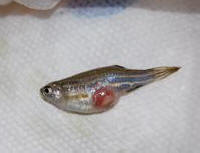 .jpg)
|
My ever-dwindling Danio population (Danio Illnesses)
12/23/07 Hello out there in the wonderful world of Wet Web Media,
<Brian> I am writing out of a combination of consternation and
desperation. I am new to fishkeeping (February 14 will be my one-year
anniversary) and I have two tanks: one is a twenty-nine gallon planted
tank and the other is a ten gallon planted tank. In this post, I am
writing about the twenty-nine gallon tank. First, a little
background... My tank is about eight months old and I added fish slowly
(though I might add, without quarantining - that is what the second
tank is for, but I bought it mid-way through stocking the first one).
My ammonia and nitrite are both zero. My nitrate is greater than 20ppm
but less than 40ppm <Both too high...> (hard to tell with the
color based tests). I do a 25% (about 5 gallons which is 25% since
there is only about 25 gallons of water in the tank accounting for the
displacement from the substrate, rocks, wood, and plants) water change
once a week. I do NOT use a C02 machine, but I do put in Excel (one
capful) every other day. <I would hold off on this for now...>
The plants in the tank include: a ton of Blyxa japonica, a hearty
Anubias, two flourishing (melon?) swords, crypt spatulata, java moss,
and Myrio which grows like weeds. The non-fish fauna in the tank
include: Amano shrimp (2 males, 1 female), 5 cherry red shrimp (and
about 20 babies across three generations), and green shrimp (not sure
how many because they hide, but at least one no more than four) and
various snails. The fish in the tank include: one Bristlenose Pleco
(sans bristles - grumble!), two honey dwarf Gouramis (one definitely
male, one either female or passive male); one flame dwarf Gourami, one
Oto negro, one Siamese algae eater (too big for its britches - not sure
what to do with this voracious eater), <Keep your eye on... move if
too aggressive> one pregnant female platy (who has never once
-visibly- given birth but is a fat blimp), one chocolate Gourami (named
chip, short for "chocolate chip"), and two male rainbowfish
(dwarf praecox), one zebra Danio and one leopard Danio. So here's
the problem. My tank population has recently dwindled. In the last two
weeks, I have lost two zebra Danios. About a month before that I also
lost a zebra Danio (when I started my tank I had four). About four
months ago, my fattest (alpha?) female Danio seemed to get sick - her
spine started to curve and she was "hiccupping", having these
strange convulsions that looked like she had a neurological disorder.
Over the weeks, she got progressively worse until she was swimming
funny (she almost seemed like she was no longer buoyant - she kept
sinking and was swimming in this weird diagonal pattern). I tried to
look it up online (even on this site) and from what I could glean - the
fish was constipated. The cure seemed to be quarantine and no food for
2 days. After six hours in the quarantine tank she seemed improved and
after three days, I returned her to the main tank. She was fine for
about six weeks and then she died. Four weeks later, one of my Danios
had a pinkish sore on its side. I am not sure but I think it was
"missing a scale" (not even sure if this possible, but it is
my best estimation). About two weeks later, I came home and a different
zebra Danio was dead (at the bottom of the tank) and the one with the
sore, well it was ... well, I am not sure how to describe it. It looked
as thought it was being eaten alive. One side of its body it was fine
and silvery and the other side was raw - pink/red as though someone had
been munching on it. Oddly enough, the fish was swimming around just
fine, but it looked nasty. I put it in one my larger fish nets (I know
not the best idea, but it was a contingency plan) and tried to isolate
it from the other fish after I found my dwarf flame Gourami trying to
nip at it. Sadly, the Danio didn't make it. Two days ago, I came
home and my leopard Danio was swimming at an angle and well... I also
don't know how to describe this but it looked like had exploded.
Pardon the description - from the front and sides it looked fine but
most of the bottom 1/6 of the fish was ... well gone and looked pink
and fleshy. If it were possible for a fish to "explode" from
eating too much, this is what I would hazard it would look like. The
good news is that after two days, the fish is still alive (not visibly
being harassed by other fish ... ) and seems to be healing. The fleshy
part has actually gone from a reddish pink to a paler pink. It looks
less like it is "throbbing". Now that you have heard my
story, here are my questions: 1. Does this sounds at all like
"whirling disease"? I just started reading about this (by the
way, your link to www.fishdiseases.net on the whirling disease FAQ is
broken) <Does read as some sort of internal bacterial complaint...
particular to Cyprinids...> 2. If not, what does it sound like? I
have not had any luck finding anything that fits these symptoms (if
they are all related). 3. What do I do? Are my other animals in danger?
<I would skip using Danios and their relatives in this system...
Really. Not worth trying to treat, remedy here. The list of other
livestock... that is more sensitive to general areas of poisoning
let's say, is telling> I am not sure if you can tell from my
post, but I have taken being a fishkeeper really seriously. <Yes...
you 'read' as a very earnest individual of intelligence,
tenacity> I have been reading a ton (subscribe to two fishkeeping
magazines, read this site, joined my local aquatic plant society).
Every time a fish or other animal dies (3 Otos, 1 bamboo shrimp, 1
white dwarf Gourami, 1 bumble bee goby [which would have done better in
a brackish environment, I found out after] and 2 female Amanos), I
spend hours trying to figure out why they die. My water is clean, my
nitrogen cycle is fine, I feed regularly, and my plants are thriving.
Any help would be useful. <As stated... many Danios perish
"consequent" to the conditions in which they were reared in
the Far East...> 4. I read somewhere that if a fish has whirling
disease, the fish should not be flushed. ACK! I didn't realize that
- is that true for all dead fish? I am a city boy and I don't
really have a "plant" to bury the fish in. Can you please
give me some suggestion for appropriate means of disposing dead fish?
<Best to freeze all in a plastic bag... toss out with solid trash
service> Sorry for the long post. I look forward to your reply.
Brian in San Francisco <Bob Fenner in Key West>
|
Question re: TB, and Fin damage - 4/3/08 Good day,
First off I want to thank you all for this extremely valuable
resource for us fishkeepers and your time and knowledge- You have
saved a many of fish I assure you. Couple questions: In my 100
gallon main tank I have 4 Bala sharks that are still fairly
young. The tank is cycled with Am-0 ,nitrite-0, nitrate-10- There
are lots of Amazon sword plants and a few other plants I am not
sure of. All except one of the Bala's have either frayed or
split fins but are otherwise very healthy and growing fast.
Should I be concerned or should I just keep a watchful eye on
them? The one with fins intact seems to have a belly unlike the
others so I don't know if they are squabbling over "her
" or what. Some of my other inhabitants can be fin nippers
so I realize that this is not the only possibility. My next
question involves Goldfish (a.k.a zebra Danios) I went to my dads
last night (not the best fishkeeper) and I saw that his Goldfish
was sort of floating vertically, listlessly. Not only that but he
has a definite "bump" or hunched back (see attached
pic, hopefully you can see it) I am not sure of his water
parameters but I snatched him, brought him to my house and put
him in my QT tank so my dad wouldn't flush him. After
researching I have concluded that it could be either be TB or
just old age (even though I don't think he's more than a
year old but one "expert" stated that Danio's can
get a hunch back just as they age (I don't know how reliable
they are) Well, immediately after getting into my QT tank he has
perked up and is swimming around and everything...He
"acts" like he is eating but I honestly think he is
just spitting it back out- its hard to say for sure. Do you think
it is indeed TB and if so, exactly how do I disinfect my tank
after he "succumbs" and what do you recommend as an
ideal method for Euthanization (I realize everyone has their own
opinions but I am looking for the easiest for both me and the
fishy) I am nervous about using bleach to disinfect the tank
because when I was a young'n I did and I guess I didn't
rinse well enough because it killed all of my fish immediately
:(- Lastly, (I know, sorry this is a lot) About two weeks ago I
had a big oops. In my QT tank (at the time had 5 Neons and one
female Pregnant guppy) I was stupid and decided to buy the
cheapest heater there was. Well, little did I know there was
absolutely NO safety feature on this thing whatsoever. I plugged
it in and fell asleep woke up an hour later and the thermometer
read 115 F !!!... Amazingly only 2 of the Neons and possibly the
fry in "utero" didn't make it. In my frenzy I
decided to forgo the "gradual" temp change rule and
kept putting ice directly into the tank until it was WNL. Well,
the second the ice started melting the lifeless fish that were
laying on the bottom perked up and swam to the top to get more so
I couldn't deny them. ANYWAYS- My question here is this: I
know that this stress could very well open the doors to many of
illnesses and now 2 of the surviving Neons have white areas on
their body's that are opaque and completely block the
"neon" and all color. Is this "neon tetra"
disease or something else and how do I handle it? FYI I will
never buy such useless and dangerous equipment again- I assure
you. One more thing I promise....A month or so ago, I emailed in
with problems regarding Dwarf Gourami's- I was told that it
was probably DGD and it would be best to put them down. I did
lose 2 but on the third I decided to try something. He had all
the symptoms of DGD BUT the lesions. Well, I treated with
Parasite Clear for 4 days (it took two treatments to see results,
I thought he was dead many times) a few weeks later he is better
than he has ever been!! Has tons of energy and eats like a pig. I
just thought that this might be helpful and others might be able
to try this if they suspect DGD but want to try and save their
pets. Again, thank you all for all that you do and please know
that I (as I am sure others) are extremely grateful for every
second you devote to helping. Very Respectfully, Grace
question re: TB, and Fin damage - 4/3/08 Good day,
First off I want to thank you all for this extremely valuable
resource for us fishkeepers and your time and knowledge- You have
saved a many of fish I assure you. Couple questions: In my 100
gallon main tank I have 4 Bala sharks that are still fairly
young. The tank is cycled with Am-0 ,nitrite-0, nitrate-10- There
are lots of Amazon sword plants and a few other plants I am not
sure of. All except one of the Bala's have either frayed or
split fins but are otherwise very healthy and growing fast.
Should I be concerned or should I just keep a watchful eye on
them? <Yes, be worried. Either Finrot (caused by poor water
quality, regardless of what your test kits say) or physical
damage (fighting/fin-nipping). Treat with anti-Finrot medication,
e.g.. Maracyn or eSHa 2000, but not Melafix or "tonic
salt".> The one with fins intact seems to have a belly
unlike the others so I don't know if they are squabbling over
"her " or what. Some of my other inhabitants can be fin
nippers so I realize that this is not the only possibility.
<Remove the fin-nippers to another tank.> My next question
involves Goldfish (a.k.a zebra Danios) I went to my dads last
night (not the best fishkeeper) and I saw that his Goldfish was
sort of floating vertically, listlessly. Not only that but he has
a definite "bump" or hunched back (see attached pic,
hopefully you can see it) I am not sure of his water parameters
but I snatched him, brought him to my house and put him in my QT
tank so my dad wouldn't flush him. After researching I have
concluded that it could be either be TB or just old age (even
though I don't think he's more than a year old but one
"expert" stated that Danio's can get a hunch back
just as they age (I don't know how reliable they are) <One
year isn't "old" for a Danio. They easily live for
3+ years when properly cared for.> Well, immediately after
getting into my QT tank he has perked up and is swimming around
and everything...He "acts" like he is eating but I
honestly think he is just spitting it back out- its hard to say
for sure. Do you think it is indeed TB <Unlikely; quite rare
in freshwater fish. I'd simply feed him up and see how he
does. Nothing to lose. If he gets fatter and healthier, then
he'll be fine; if not, painlessly destroy.> and if so,
exactly how do I disinfect my tank after he "succumbs"
<Clean and air dry the hospital tank.> and what do you
recommend as an ideal method for Euthanization (I realize
everyone has their own opinions but I am looking for the easiest
for both me and the fishy) I am nervous about using bleach to
disinfect the tank because when I was a young'n I did and I
guess I didn't rinse well enough because it killed all of my
fish immediately :(- <See here:
http://www.wetwebmedia.com/euthanasiafaqs.htm > Lastly, (I
know, sorry this is a lot) About two weeks ago I had a big oops.
In my QT tank (at the time had 5 Neons and one female Pregnant
guppy) I was stupid and decided to buy the cheapest heater there
was. Well, little did I know there was absolutely NO safety
feature on this thing whatsoever. I plugged it in and fell asleep
woke up an hour later and the thermometer read 115 F !!!...
Amazingly only 2 of the Neons and possibly the fry in
"utero" didn't make it. In my frenzy I decided to
forgo the "gradual" temp change rule and kept putting
ice directly into the tank until it was WNL. Well, the second the
ice started melting the lifeless fish that were laying on the
bottom perked up and swam to the top to get more so I
couldn't deny them. ANYWAYS- My question here is this: I know
that this stress could very well open the doors to many of
illnesses and now 2 of the surviving Neons have white areas on
their body's that are opaque and completely block the
"neon" and all color. Is this "neon tetra"
disease or something else and how do I handle it? FYI I will
never buy such useless and dangerous equipment again- I assure
you. <Observe for a while before deciding this is Neon Tetra
Disease; stressed Neons will indeed lose their colour. But Neons
with NTD also lose weight and become strangely shy, separating
off from their school. NTD is unfortunately not curable.> One
more thing I promise....A month or so ago, I emailed in with
problems regarding Dwarf Gourami's- I was told that it was
probably DGD and it would be best to put them down. I did lose 2
but on the third I decided to try something. He had all the
symptoms of DGD BUT the lesions. <In that case, not DGD!>
Well, I treated with Parasite Clear for 4 days (it took two
treatments to see results, I thought he was dead many times) a
few weeks later he is better than he has ever been!! Has tons of
energy and eats like a pig. I just thought that this might be
helpful and others might be able to try this if they suspect DGD
but want to try and save their pets. Again, thank you all for all
that you do and please know that I (as I am sure others) are
extremely grateful for every second you devote to helping.
<Very nice to hear this story. It's worth repeating the
point that while Dwarf Gourami Disease is a common reason Dwarf
Gouramis get sick, not all sick Dwarf Gouramis have Dwarf Gourami
Disease. Sometimes they get other things!> Very Respectfully,
Grace <Good luck, Neale.>
Re: question re: TB, and Fin damage 4/4/08
Hi again, You say that TB is unlikely in FW fish but after
reading numerous pages on this site I've gathered the
complete opposite. <I don't agree with them. Fish TB has
historically been cited by aquarists for all sorts of
"mystery deaths", and recent work by scientists has
certainly proven that some Mycobacterium strains are common in
aquaria. But in my experience, almost all "mystery
deaths" are better explained by other factors: Hexamita,
poor water quality, genetics, use of feeder fish, and so on. In
any event, because Mycobacterium is untreatable, you may as well
try to concentrate on things you can fix, in the hope that the
fish will recover. If it doesn't, no harm is done.> Most
other people state that if its an adult fish with a bent spine
(and its even a Danio ((Glofish but they are the same thing))- at
any rate tonight he's laying at the bottom of the tank barely
breathing- Hopefully my husband gets home soon because I cant
bring myself to euthanize him. Does this mean that this QT tank
is now infected? <What the Czech scientists who looked at
Mycobacterium discovered was that the bacteria are present in 75%
of fish tanks.
http://www.practicalfishkeeping.co.uk/pfk/pages/item.php?news=1055
In other words, you probably have the bacteria that could cause
Fish TB anyway, but then so do I and so do most other
fishkeepers. So why don't 75% of fishkeepers have fish dying
from Fish TB? That's the question! While you should certainly
clean the hospital tank as a precaution -- something you do with
a hospital tank anyway -- don't bother getting paranoid about
the Mycobacterium itself. By the way, the variety of
Mycobacterium that can infect humans is the one most common in
marine aquaria, Mycobacterium marinum.> After reading your
email I put two other sick fish in my QT tank with him (I found
my black Sailfin molly with skin that looks like it is
"decaying" he has holes in his Sailfin and body and the
rest of his skin looks like its going to fall off) and the Neon
(of which got even MORE white on his body after putting him in
there. <Mollies are never that healthy kept in freshwater
tanks. The vast majority of Molly deaths come down to high
nitrate and the wrong water chemistry, and I'd bet all the
money in my pockets that that's the issue here.
http://www.wetwebmedia.com/fwsubwebindex/mollies.htm Neon Tetras
are very prone to a disease called Pleistophora (or Neon Tetra
Disease) that is incurable.
http://www.wetwebmedia.com/FWSubWebIndex/fwdistrbshtart.htm If
you're suddenly getting a bunch of fish looking sick, then
I'd first turn to my water test kits. Check the water
quality. Neons and Mollies for example require completely
different water chemistry, and choosing what's right for
Mollies will stress/kill your Neons. So you have work to do
there. I'd review nitrate especially, as that's a killer
for Mollies. Neons need soft/acid water, and Mollies hard/basic
water with salt added at a dose of about 6 grammes per litre.>
Have I gave these fish the death sentence? If they didn't
have it already? If not how would you recommend me helping them?
<If the Neon has Pleistophora, it'd doomed so you may as
well destroy it painlessly. Mollies usually recover quickly when
kept in brackish or marine aquaria, so that's what's
required there. As for the Danio, it doesn't look that good
to me.> With my Balas in my 100 gallon how do you recommend I
treat that? Like I said they do have some spits/ and frays on
some of their fins but otherwise act VERY healthy and seemingly
fine. <Depending on where you are, you'd use different
medications. In the UK, I've found eSHa 2000 very safe and
effective. Americans like to use Maracyn instead.> I am
hesitant to treat in this tank because its my main and so large
yet I cant put them in the small 10 gallon with all the other
terminally ill fish- <Treating the fish in the 100 gallon tank
is fine. Used correctly, no modern fish medication should cause
undue stress on the fish.> Ugh...Couldn't I just put in
some salt and keep and eye on the fins? <No. Salt doesn't
really have any useful impact on Finrot. Salt can help with
Fungus, but only up to a point. Anyway, the salt would stress
these freshwater fish rather more than medication.> And if
they start to get any worse treat the whole tank with Maracyn
like you said? <No.> What a mess I have here. I really
shouldn't have "saved" this hunchback Glofish from
my dad but at the time I didn't know I had two other
"sick" fish. <No good deed goes unpunished!> The
Molly started with a shimmy and I had him in the qt tank for a
few days with salt- put him back in the main tank and 3 days
later looks horrible. <Precisely. I know people sell Mollies
as freshwater fish, but they really aren't reliable as such.
Sorry, but that's just the way it is.> and was either
laying on the bottom listless or hiding in my deco. in the past
24 hrs. I haven't slept in 2 days because I am trying to
change all the water and take care of all of these issues ( I can
only do it at night when my baby is sleeping) so if this is a
little hard to follow I apologize. Any guidance would be greatly
appreciated. <Gosh, I'm sorry you're having such a bad
time! Obviously you have to put children before animals. This
being the case, painlessly destroying sick fish would be
completely understandable. Lesser of two evils.> V/R Grace
<Cheers, Neale.>
Re: question re: TB, and Fin damage 4/4/08
Thank you for your prompt reply- I usually keep my mollies in the
100 gallon which is my "semi-aggressive" some salt tank
and my Neons in my 20 gallon "community" tank - its my
QT tank where they have to be combined. I've been testing my
water every few days since my Bala's first started showing
the frayed fins (I think it might have been from a new decoration
we just put in there) <Hmm... physical damage can cause
symptoms similar fin-nipping. Spiky ornaments can scratch fish
that bomb around the tank when alarmed. Though that does raise
two points: firstly if your fish are getting scared, that's
something that needs to be fixed. Secondly, even if the fins are
scratched rather than bitten, Finrot is still a problem. I'd
also mention that if physical damage is the issue here rather
than nipping, you'd expect to see scratches on the body
and/or missing scales, not just frayed fins.> Am-0, Nitrite-0
and Nitrate 15(aprox)- So do I get all the money in your pocket?
(lol). <I guess!> I am in the US so I guess I need to go
out and get a huge box of Maracyn today....should I take my
BioWheels out and put them in a bucket of aquarium water so I
don't destroy the biological filter? <None of this is
necessary. Maracyn is completely harmless to your filter when
used as instructed.> I was hoping the neon with the white
"insides" was a fungal infection from the broken heater
issue and not the NTD and I was going to try and treat him and
the Molly (and I suppose the Glofish too because today he is
swimming around again! <All sounds very perplexing. NTD
typically has the Neon losing colour, becoming shy, hiding away
from the group, not eating, and then wasting away. It's
highly contagious to other Neons and perhaps other tetras, though
rarely affects other types of fish.> He was acting SO
"dead" last night) for fungal/bacteria issues. <Well
maybe there's hope!> The molly's skin looks REALLY
bad. Mollies can sometimes be improved by giving them dips in
"seawater" -- a litre of aquarium water with 35 grammes
of salt, ideally aquarium salt but rock or kosher salt will do.
Dip the fish for 2-20 minutes depending on how it reacts. That
should clean up the skin quite a bit. Repeat daily.> I do have
4 other molly's in the 100 gallon and they seem perfectly
fine as I am in South Texas and the water here is naturally
"hard" (high lime content) actually my Ph naturally
runs 8.2 -.4 out of the tap- I was told to not bother treating it
as long as its constant they will be fine? is this the case?
<"Liquid rock" water is certainly what Mollies
prefer. Quite why Mollies are so unpredictable in health when
kept in freshwater is unclear. They are common enough in
freshwater in the wild. While 100% of the Mollies sold thrive in
brackish water aquaria, in my experience, only some Mollies will
do well in freshwater aquaria.> And I have never tested for
hardness or softness (not even sure what a test for these would
be) because in the things I have read they never stated it
necessary- should I? <If you have rock hard water, then
chances are you have hard, basic water conditions. Ideal for
livebearers, Goldfish and many cichlids, but not necessarily
ideal for fish from soft water environments, including Neons. To
be fair though, your water is probably similar to mine here in
Southern England -- out of a chalk aquifer -- and most fish adapt
just fine.> Thank you again. I pray my issues get resolved
soon. <So do I! If you have a digital camera to hand, some
photos of the Molly and the Neon might help us diagnose things
further. Good luck, Neale.>
|
|
|
Zebra Danio acting strangely
5/6/08 Hello, <Sarah> I have an established hexagon tank, I
believe it is 35 gallons. I had e-mailed last Sept when some of my fish
died suddenly after a heater malfunction. Since that time, I have not
added any other fish, we had 1 zebra Danio and 2 Cory cat. This weekend
I picked up 5 very small zebra Danios at PetSmart (where the other fish
came from as well) and 2 more Cory cats. I have checked the water
daily, it still shows zero nitrites. All the new fish seem to be active
and happy. The coloration on the new Danios brightened from a pale
brown to bright stripes almost immediately. All the Cory cats are
happy. However, the one original Danio is acting strangely. It seems to
be swimming in a labored fashion, moving his tail constantly, as if it
cannot keep itself straight in the water. Its tail is lower, and its
head is high. He has had a bloated look for a very long time, so not
sure if it could have some sort of problem. Any suggestions? I had
wanted to get more Danios so he would have someone to school with, as
he was just hiding in the plastic plants all the time. Now he's out
and swimming, but not looking good. Also, he has a large bright red
spot on one side behind the eye- is this normal coloration for zebra
Danios? Thanks, Sarah <Mmm, is not... could be most anything at this
juncture, description. Please do send along a well-resolved image if
you can. Bob Fenner>
|
|

