|
Crayfish, Crawdads, Yabbies, Ditch
Bugs Systems
Related
Articles: Forget Crawfish
Pie, Let's Make a Crawfish Tank! By Gage Harford, Invertebrates for Freshwater Aquariums by
Neale Monks, Freshwater
Shrimp, Crayfish, "Lobsters", Prawns Freshwater to Brackish
Crabs
Related FAQs:
Crayfish
1, Crayfish 2, Crayfish ID, Crayfish Behavior, Crayfish Compatibility, Crayfish Selection, Crayfish Feeding, Crayfish Disease, Crayfish Reproduction, Freshwater Invertebrates/Use in
Aquariums, Freshwater Crustaceans for the Aquarium,
FW Crustaceans
2,
Fresh to Brackish
Water Crabs, Hermit
Crabs,
|
.JPG)
|
Cycling new Crawfish tank from existing one
12/28/18
Hey WWM,
<Hey Darren>
I recently got a larger tank for my crayfish as she was getting bigger and
also a new filter along with it. How can I go about using the old tank to
aid with the cycling of my new one?
<I'd move a good half of the water from the existing one, a good part of the
substrate, decor and filter media to the new. Bob Fenner>
|
Crayfish position 1/25/18
Hi
<Geraldine>
Like to seek your help.
<Okay>
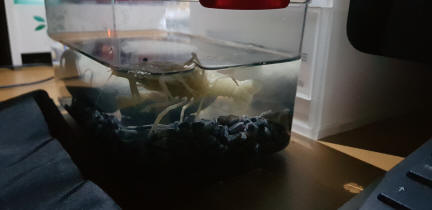
Is it weird that my crayfish is often in this position?
<Could be; yes... many species need to get out of the water at times, and
they can't live in their own wastes>
There's no filter. He had shifted the mini stones and kinda stacked it
higher so he can be in a more "comfortable" position .
<Need a filter>
The big stone was for him to climb.. instead he used it as a hiding corner.
Regards,
Geraldine
<And a larger world... Please read here:
http://www.wetwebmedia.com/ca/volume_5/volume_5_3/crayfish_basics.htm
and the linked files at the bottom. Bob Fenner>
|
 |
|
Re: Crayfish position 1/26/18
Thank you for the prompt reply.
<Welcome>
I also do on the air con in my room at night. About 24degree Celsius. Is that
fine for him?
<Should be... again, a larger system, with a filter is what is needed. More
stable. BobF>
Regards,
Geraldine
|
|
Require help for a bigger aquarium/ Crayfish... gen., sys.
9/22/16
Hi WWM,
<Darren>
I am planning to get a 7.5 OR 10 gallon tank for my crayfish and I need
help setting it up.
<I would go with the 10 gallon>
Firstly, can I keep possibly maybe 2 sucker fishes in there to help
clean the tank better?
<I would advise against this if you want anything to survive. Plecos
need large tanks, as they get over a foot in length. They
are bottom feeders, like the crayfish, so they will surely fight.>
My crayfish is about 7cm large and I'm afraid he will eat the fishes.
<He will.>
And is there even a need for sucker fishes?<No need for them> (Sorry I
haven't had an aquarium before)
<No worries :) >
Secondly, my biggest concern is the filtration. What kind of filtration
do you think is required for such a tank of this size WITH probably only
1
crayfish and maybe the 2 sucker fishes as mentioned above?(Don't count
the sucker fishes if you think they shouldn't be put in the tank)
<I would use a HOB filter for a 10-20 gallon tank>
I hope to find a system that does not require a lot of water changes
(I'm really busy most of the time till November). <You will need to
perform water changes once a week, even with good filtration. Vacuum the
substrate once a week to remove excess waste.> And if this kind of
filtration works, how
often do I change the water and how many % do I change each time?
<See above. No more than 25% once a week>
Thirdly, for the water quality, do I need the water to be at a specific
pH?
<It should stay around 7.0 so it is neutral>
How hard must the water be and how do I keep it at that level? I know
crayfish produce large amounts of bio load so I think water quality is
very important for their survival.<Correct> And I don't think I need a
heater right? I live in the tropics so the water should be warm enough
as the surrounding temperatures go as high as 38C and as far as I know
crayfish can't survive well in heated water.
<This is very true. Water should stay around 27-28 C at the most. You
may need to invest in a chiller, or cool the house down. 38 C water will
kill the animal>
Lastly, I am planning to get either calcium or iodine supplements so
that I can help supply my crayfish with extra nutrients for his shell(he
is about
to molt in probably the next week) and I can't really decide which to
get.
How much do I dose the supplements as well? <Not necessary> Hopefully I
can get my first proper aquarium, I guess you could say, to
work and for my $90 Procambarus Clarkii ghost variant to survive. You
can also drop me other advices that could potentially help me(like maybe
adding in other fish but note that I don't think I will be adding plants
but if they are so beneficial then I might add them according to your
suggestions).
Thank you in advance :) If this aquarium works I'll send you some pics
of my beautiful P. Clarkii Ghost Crayfish ;)
<Good luck Darren, and feel free to ask more questions. Cheers, Gabe>
Re: Require help for a bigger aquarium
9/23/16
Thanks a lot!
<My pleasure>
I don't think the water temperature will ever be as high as the
surrounding temp so I should be fine.
<Good to hear... You wouldn't want a cooked crayfish :) >
Shouldn't calcium supplements help decrease mortality rates that are
caused by molt deformities?
<Yes, and Iodine as well.
Add when molting. I'm afraid the diet I am planning to give (fish flakes
and occasional greens and treats and possibly algae wafers too)may not
be enough.
<Add shrimp pellets or other sinking pellets. Avoid the flakes, as
they'll just clog everything up. For more info, read here
http://www.wetwebmedia.com/ca/volume_5/volume_5_3/crayfish_basics.htm
As always, feel free to contact us again, and don't forget to send
pictures.
Good luck Darren. Cheers, Gabe.
Re: Require help for a bigger aquarium; now Crayfish comp. 9/26/16
What other fish can I keep with the crayfish? (The 10 gallon tank
will probably look too empty if there is only 1 crayfish in there with no other
fish). Also, should I get any plants and if I should what kind of plants are
easy to maintain but won't be eaten by the crayfish?
<I would stay away from fish, because the crayfish will most likely eat them,
and because the tank is so small. If you must add fish, choose something fast
like Danios. Plants need very special lighting and water additives. Too extreme
for a 10 gallon tanks, and not to mention an inexperienced hobbyist. Cheers,
Gabe>
re: Require help for a bigger aquarium
9/28/16
So... being a 16 year old Asian living under your parents, obviously things
don't always go out the way you want it to.
<Ha! I have the same problem! I'm 15 and my parents limit me to 2 tanks at a
time in the house... It's a real drag!>
I was not allowed to buy a bigger tank, BUT at least they got me a filter,
which is the slim filter by up aqua
(I don't know if it's good).
<Perfect for your situation>
My crayfish is a lot more lively with all that extra oxygen from the water
flow of the filter and I am kinda relieved now as I don't have to check on
him every hour to see if he's still alive (he was a lot less mobile very
unresponsive before I got the filter). Hopefully after my exams, I'll
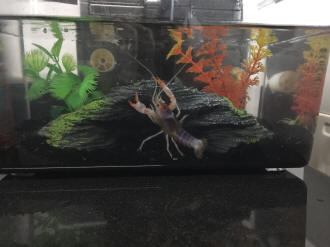
finally be able to get a bigger aquarium. For now, here are some pictures.
<Darren, that is a very nice specimen you have there! Too bad about not
upgrading, but there is always time to do that in the future. Glad to hear
the crayfish is doing well, though. Good luck in the future, mate. Cheers,
Gabe.>
|
 |
container size for crayfish 5/25/16
Hi, what is the minimum size container to house a crayfish? I currently
have it in a 10-gallon tank but a friend will baby-sit it at her house
while we are out of town, so we would like to put it in a smaller
container (easier to carry). Thanks.
<Ah, let's have you do some reading, Justine. Maybe start off here...
http://www.wetwebmedia.com/ca/volume_5/volume_5_3/crayfish_basics.htm
http://www.wetwebmedia.com/ca/volume_1/cav1i4/crayfish/crayfish.htm
But if you follow the links at these articles, you'll find a tonne more
stuff. For a couple weeks, a 5-gallon tank would be fine, maybe even a
little smaller, but water quality is always the danger when aquarium
pets are being "baby sat", and a bigger tank means less likelihood of
anything going wrong. Not that a crayfish needs feeding for a couple
weeks, and not
feeding them will minimise any risks even further. Seem reasonable to
you?
Cheers, Neale.>
Crayfish, systems - 1/25/13
Hi WWM,
<Ashley,>
I have a problem that you may be able to help with. I keep a Red
Claw Crayfish (Cherax Quadricarinatus) and he has chewed through the
cables to the filter and heater in his tank causing a very low
electrical current to pass through the water.
<Do give him something else to eat; these animals are herbivorous in
part,
and need something to chew. Have you tried plain vanilla Pondweed as
sold for Goldfish?>
I have tried positioning the heater and filter so the cables are out of
the water but he climbs up them and pulls the cables back into the
water.
<Is what they do. Crayfish aren't really amphibious as such, but they do
explore, and they do clamber through swamps from one pool to another.>
The electric current doesn't seem to affect him as he is moving and
feeding as normal. Is there anyway of making the cables 'chew proof'?
<For sure. Wrap with pond-quality plastic liner or mesh. An external
heater (e.g., Hydor ETH) may be more effective, particularly if
connected to an external canister filter (some of which, like certain
Eheim models, have built-in heaters anyway).>
Thanks in advance,
Ashley
<Cheers, Neale.>
|
Lobster/ Crayfish "in berry"? - 12/01/2012
Hi WWM crew - firstly, thank you for a great resource!
<And thank you for your kind words!>
I have learned so much but still have a few things I am puzzled about.
<Me too.>
I live in South Africa and in July I got a "lobster" as a pet. I think
she is a Procambarus species?
<Quite possibly. Maybe P. alleni.>
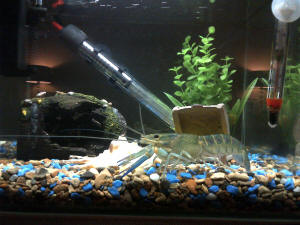
See the attached picture. We were told she is a female.
<Looks like it to me.>
I am not sure how old she was when we got her but she has moulted three
times since we've had her and is now approximately 8cm long. She lives
by herself in a tank about 25cm x 15cm.
<Bigger would be better, if it's reasonably possible for you.>
The temperature is kept at 24 degrees Celsius and we have a water
filter.
So far all has been going well. We had been feeding her the Tetra
Tabimin tablets but recently changed to the AquaPlus bottom feeder
tablets as we were told they were the same thing but cheaper?
<I'm not familiar with the latter.... Do please consider feeding
her some iodine-rich foods; frozen/thawed shrimp (the kind you would
cook and eat yourself) with the shell still on, dried seaweed, etc.,
and/or dosing the tank with an Iodide supplement. Although it's
okay to use one designed for reef tanks, DO NOT use the amount
recommended for a reef tank. Just a drop or two per ten gallons
per week of Kent's marine Iodide supplement is sufficient, for example.>
I am not sure if it's coincidence but a few days after we changed her
food she started "itching" a lot - scratching all over but especially
under her tail near her swimmerets. I thought it was because she was
going to shed.
<Could be >
To my horror, I came home the following day to find her tank full of
tiny little white "worms" floating in the water and stuck to the glass.
<Probably something (mostly) harmless just there as a result of "stuff"
available in the tank for them to eat.>
After doing some reading it seems these were Planaria?
<Very possible.>
I cleaned the tank and all seems fine again.
<If they happen again, just step up your regular maintenance a bit.
A bigger tank will help in this.>
I am wondering if the new food caused this Planaria bloom?
<Any "overage" of nutrients available for them would allow for it.>
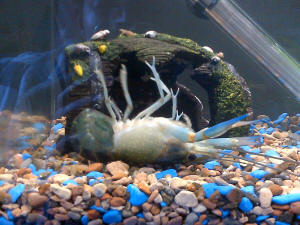
The next morning I awoke to find our lobster lying on her back, tailed
clamped tightly shut.
<Yikes!>
Initially I thought she was dead but after yet more reading it seems she
is laying eggs?
<Possible.... There is one known (almost) entirely parthenogenic
Procambarus species, and others may also reproduce Parthenogenically,
including possibly P. clarkii. But it's also possible that the
animal may have been moulting, or trying to, and having a hard time of
it.>
It is two days later and she is still lying on her side/ back and seems
very withdrawn (mostly in her cave).
<This is bad news.... Laying eggs should happen fairly quickly,
usually right after a moult, and she should be up and about directly.
Lying on her side/back indicates trouble of some sort. Do please
be dosing with an Iodine/Iodide supplement to allow her to properly use
available Calcium in the moulting process.>
She is eating though (we went back to the Tabimin).
<Very good that she's eating. Try to get some shrimp or something
similar into her as well, if she'll take it.>
I cannot see under her tail as it is tightly clamped shut. Today I also
noticed a spider web-like substance on the pebbles in front of her cave?
What could this be?
<Could be, like the Planaria, just something opportunistically making
use of available nutrients.... Maybe a bacteria, perhaps an
algae....>
Thank you for your help and advice! Catherine Griffiths
<Best wishes to you and your Crayfish! -Sabrina>
|
 |
Yabby's tail curl up, toxic water
cond.s 3/14/12
Hi there,
<Danielle>
Here I am asking for your help again. Missy (my female Yabby pet) has
her tail curled up to her body in the last two days. She held it like
that all the time, which is abnormal. Before she only did it when she
needs to run or claim a rock. Is that a sign of sickness?
<Mmm, maybe... perhaps a dietary shortage, water quality or
reproductive behavior>
She is the only one in the 2" tank. I change water change 25%
every week.
Ph is at 8 and 2 drops of iodine every time I change water.
<Good>
The tank however is going through a biological cycle with
ammonia = 0.25,
<Toxic>
nitrite = 5
<Even more so!>
and nitrate = 10. Tested last week. The reason I did not test this week
is because through internet reading, it seems best for the tank to go
through the cycle naturally, without adding any chemical liquid.
So if there is nothing I could do about it, there is no point to test
the water. But the question is am I right? Should I buy the Stress Zyme
to speed up the cycle?
<It won't do this... stop feeding for now and read here:
http://www.wetwebmedia.com/FWSubWebIndex/fwestcycling.htm
and the linked files above. Bob Fenner>
Thanks so much for your time and help.
Best regards,
Danielle
|
Iodine for my Yabby 2/7/12
Hi there,
<Danielle>
My name is Danielle and I am from Melbourne Australia. I got a
pet Yabby.
Through all the reading on the internet, I am trying to give him
the most pleasant environment to live in. So I am writing to you
to check if I am doing the right things and I have a question on
Iodine.
1. He is in a 37 Lt tank
2. There is 1 filter and 1 air pump
3. PH is measure every week to make sure rank around 7 to 7.6
4. He eats crayfish food, peas and meat ( a tiny tiny bit each
time, twice a week)
5. He has a hiding cave in the tank and other pieces to play
with. He is very playful
6. There a gravel in the tank that he carries and move around a
lot 7. There is a solid lid on the tank to make sure he
doesn't get a lot of light after 8pm
8. Change 50% water weekly, but I am not sure how to get all of
his output lying around at the bottom of the tank
<All sounds/reads good thus far>
So far he is doing he fine. Do you suggest anything else? or
should we change something that we are doing?
<No>
Next is the question of iodine.
I have purchased the Coral Colos A Halogens (I2, Br2, F2)
Supplement from Red Sea (Coral Coloration Program). The label
reads Iodine/Halogen complex that promote the pink colors in
corals. Can I use it with him?
<Yes; half dose, about once a week; perhaps tied in w/ your
water change/maintenance schedule>
Please let me know. I am looking forward to your answer as I am
so keen on giving him Iodine. We have had him for around 2 weeks
and the pack of iodine has just arrived yesterday.
Thank you so much for your help. I had cats before but have never
known having a yabby could be so much fun. We love him dearly and
want him to live well and happy.
<Ah good>
Will you reply my email or I have to keep checking the website
everyday?
<We reply to all directly, and post most all as well>
Best regards,
Danielle
<And you, Bob Fenner>
|
|
|
Re: Iodine for my Yabby 02/08/12
Hi Bob,
<Dani>
I was so looking forward to your reply. There are 2
problems occurred since my last email to you.
1. Yabby has been really down since. Not eating for 2 days.
I even tried the meat treat that he loves. He did not touch
any food.
He has been very shy for the last two days. Before if
people came close to the tank, he will show who is the
boss. But now he just run around hiding.
<Make a large (half) water change... and another
tomorrow or the next day>
That is not to mention the sleeping all day schedule. I
thought he was dying yesterday. But when I tapped the tank,
the quickly responded by getting in further, trying to hide
every bit of himself.
We have a big mug as a cave for him, it fits him perfectly,
if he doesn't move. Does he need a bigger cave that he
can move freely in?
<The one in your pic looks fine>
Anyway back to the problem. Is he molting or dying? I am
worried so much.
<Just likely stressed from the acid addition>
2. Iodine issue. I am trying to put Iodine in the water but
it was a bit tricky.
Here is the dosage on the label
<Didn't come through>
[image: image.png]
I am quite confused with how much I should put in. Does
that mean I need a Iodine measurement test kit to test the
current Iodine level in the water?
<Try just one drop per ten gallons>
What is the Ideal Iodine level ppm for yabby? I've read
somewhere it is 0.06 for coral. Please help.
<Not a good idea for folks to get involved in such small
measurements...
The halogen is quite transient... drops out of solution
readily. Only large dosings are dangerous>
And what about the ammonia and nitrate level? I was reading
like crazy last
night I found those two. Do I have to also make sure the
ammonia is at 0 and nitrate is 0 too?
<Just NH3 and NO2>
Thank you so much for your help and I hope my yabby
won't die before I get your next email. He is our first
marine pet so we are not very confident with how to take
care of him.
Regards,
Worrying Danielle
<When, where in doubt, read on WWM. Bob Fenner>
Re: Iodine for my Yabby 02/08/12
Hi,
Sorry about the image, I am sending you the link to it.
http://www.swelluk.com/img/shop/original/RCP_Supplements_Reef_Colors_Program_chart1.jpg
<... link doesn't work>
I am confused about the dosage that I should use. The small
pocket has 1,2,3,4 level of measurement while the large one
count in ml. Which one should I use? Never thought it could
be so tricky.
<... as previously stated, one drop per ten
gallons>
Attach is the photo of the cap. It is divided into 2. Which
side should I use?
I am also sending you photo of the yabby, it has some white
things on its claw. Are they harmful?
<Can't tell>
I also saw a white little thing moved around its claw too,
tiny and white, like some kind of worm. Couldn't catch
a photo of it though.
<Not likely harmful>
As I am writing to you, he is getting a bit better, moved
out of cave, walked around, carrying gravels, everything
but eat.
I am worried as he has not been eating for 2 days. He
stepped on the food but did not care.
Thanks for your help.
Best regards,
Danielle
<B>
|
|
[1].JPG) 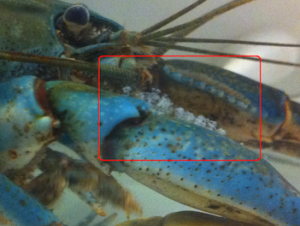
|
Re: Iodine for my Yabby 02/08/12
<Dani>
Hi Bob,
It turned out my Yabby wanted to molt. He molted last night
when we slept.
I was so relief. Now I have 3 short questions to ask
you.
<Likely the I2 addition was of use here>
1. I know yabby eat its own shell for calcium, but should I
still give him some food?
<Yes>
Do it leave the shell there until he eats it all, or should
I scoop it out at some stage? I doubt he can eat it all as
it's quite big <I would definitely leave it in
place. Won't cause pollution... is of use in
reincorporation>
2. I bought him a new bigger tank, and I think I
shouldn't move him until he gets as hard as normal, am
it right?
<I agree w/ you>
3. The new tank is 2 ft one, and I am planning to use 2
drops of Iodine every week, is it enough?
<Yes>
Thanks so much for your time and answer.
<Certainly welcome dear>
Best regards,
Danielle.
<And you, BobF>
Re: Iodine for my Yabby 2/11/12
Hi Bob,
<D>
Sorry for bothering you again, but is it normal that
crayfish does not eat after they molt? Mine has
successfully molted, but he has not eaten anything since
Tuesday, and he molted Thursday night. He is still not
eating now.
<Not uncommon. Patience. B>
I am worried again. I drop food into his tank, but it is
hard to take them out as they become too soft to catch. I
use crayfish food from petstore and shrimp pallets.
Thanks for your help.
Best regards,
Danielle
Re: Iodine for my Yabby 2/11/12
oh that is not to mention that he did not touch his old
shell either (not that we could see). he did not even come
close to it, staying in his cave most of the time
<Change nothing.>
|
|
Are there any ways to encourage specific colours
in Yabbies? (and lots of other questions), diet, sys...
2/7/12
Good Morning/Evening/ Day (please read which ever is applicable in your
part of the world)
<Early evening here in Blighty.>
For the past few weeks I have owned a stunning blue yabby (Cherax
destructor) whom I named Darling. Darling is an absolutely stunning
colour and I want to do what I can to keep him that way. I know that
The colour of yabbies is affected by their environment and their diet,
and while I've been doing a bit of reading I can't find
information about how to encourage specific colours in yabbies, in fact
finding any in depth information about their care is a difficult
task!
<Colours are as seen! Generally, juveniles have brighter colours
than adults, and the more mixed the diet (especially the more algae and
crustaceans) the richer the colours will become. But you can't make
a grey-blue Crayfish electric blue if its genes aren't that way
inclined.>
As far as his diet goes, I feed him on a staple of two
"yabby" pellets a day. Unfortunately I don't know what
these yabby pellets contain. The pet shop I bought him from was closing
down and he was the last yabby in stock, so the cashier gave me the
stores supply of pellets to use, which were kept in a ZipLock bag.
I've combed the internet for commercial "yabby pellets"
which has led me to believe that the pellets are actually axolotl
pellets.
Will these be harmful to him?
<Nope. Crayfish are a mix of herbivores and scavenger, so anything
that includes suitable fresh greens, algae, and dead animal (ideally,
shelled or bony) animals will all be useful.>
I supplement his diet with fresh fruit and vegetables every day and
I've ordered some algae wafers from the internet (along with marine
iodine, why did I never hear about that stuff before I visited this
site?) ,
<Good question!>
so is it alright for me to continue feeding him the pellets until the
wafers arrive in the post?
<Yes.>
I've been giving him a wide variety of fruit and veg and so far his
favourite foods are sweet corn, strawberries, green grapes, garden peas
and chick peas. I've given him lots of other things but he seems
reluctant to eat leaves or beans (except for live Anubias plants, those
he loves to shred up and munch on). But I notice that he also likes to
chew on the silk plants, even when fresh fruit and veg is available. Is
this something I need to address?
<It's instinct.>
At first I thought it might be a vision problem, because he is often
sitting right next to the food and seems to have put the wrong thing
into his mouth, he always spits them out again and will eventually find
the real food, but I've seen other users on your site complain of
similar things and they have been told that they need to provide their
yabbies with more veg, so should I give him more? Or should I simply
give him something a little chewier than what he's used to, such as
whole snow peas?
<Sure.>
Whoa, sorry for drifting so far off topic there, what I would like most
of all is how this diet affects his colouration, will the high levels
of keratin cause him to become more purple? And how can I best adjust
his diet to retain his blue colour while also keeping him in good
health?
<You really can't beyond giving a *good* diet.>
I'd also like to ask another question about mineral levels, your
site heavily endorses the use of marine iodine.
<Correct.>
Before I knew about that stuff I was trying to find a way to put more
calcium in his diet, and eventually started him on chick peas
(according to Wikipedia they are very high in calcium and other
minerals) and he loves them.
<Cool.>
But another source recommended that I put sterilized eggshell into the
water, have you had any success with this?
<Seems redundant and messy, but sure. Otherwise smash up some pond
snails, buy some unshelled prawns, offer a chunk of cuttlebone.
Whatever seems easy.>
I don't see why he would want to eat something like eggshell, but
he won't eat prawns so I need to find some sort of alternative
source of iodine until my order arrives.
<He will eat unshelled prawn skeletons if he needs the calcium.
Frozen krill is a good alternative.>
I'm not even sure if iodine is in eggshell, but it was inferred in
the source I read, can you confirm or disprove that?
<I doubt it'll be sufficient or useful.>
And finally (this is the last question I swear!) how does the colour of
the substrate affect the yabbies colour?
<Not much.>
I found one source that said dark substrate and clear water would
promote blue tabbies.
<Never heard that before. Good, clear water will certainly promote
good health, and that, in turn, would be a plus.>
Can you verify that?
<Nope.>
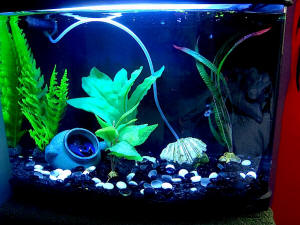
I have attached an image of my setup, it is lit (with uv lighting) for
12 hours of the day and it has a high current producing sponge filter.
I've attached an image of my setup so you'll know what it looks
like, I've added more silk plants and hidey holes since that photo
was taken, but the colour scheme is still the same.
Thank you for your time and the infinite patience needed to go through
all of that!
Kind Regards
-Emily
<Best, Neale.>
Plants in/for a Crayfish sys.
2/6/12
Hello WWM Crew!
Well currently I have been searching all over the web, asking any LFS
employee I can, and even going to the library to find a decisive answer
about my questions so I hope you guys can help. I have a ten gallon
setup with a Red North American Crayfish and about 6 shrimps colors
ranging from blue to red to yellow (Yes, I know he will eventually eat
them but right now the Cray is still tiny and I figure if he does eat
them when he gets older it would be a decent source of protein) I have
2 10 Watt Aqueon Coralife mini compact fluorescent 50/50 Colormax
lamps, an Aquaclear 20 filter, a couple caves and such for
hiding/molting purposes, an aerator/air stone, and finally 20 pounds of
CaribSea Super Natural Moonlight sand. Now here's the thing I added
plants about a week ago to improve oxygen levels so I wouldn't need
that noisy aeration system anymore.
<Mmm, good luck>
Could that potentially work?
<Worth trying. Though I wouldn't count on any planted types
staying there... Better to utilize floating, "bunch" type
plants et al. w/ Crays... a fave, Ceratopteris>
Having plants supplement the oxygen contents through photosynthesis
rather than the aeration? I have no idea but it kind of makes sense
no?
<The dark reaction series (at night) reverses such oxygen
generation...
Short answer, leave your outside power filter going... if too noisy,
look into another make/brand>
Anyways, I never put any type of nutrient rich layer underneath the
sand because I was not planning on setting up plants originally and was
wondering if I absolutely needed it in order to promote my plant
growth?
<Can help... see WWM re:
http://www.wetwebmedia.com/PlantedTksSubWebIndex/substraags.htm
and the linked files above>
As of right now I only have two types of plants; Anubias barteri and
Anacharis.
<Good types...>
They look okay but the Anubis's root is sticking out of the
substrate.
Not sure if the crayfish named "crawl the warrior king"
(gf's idea) has been uprooting it at night or what but every time I
see him he seems to be leaving it alone.
<Sneaky little bugger>
I know I can't add fertilizer either because the iron will kill all
my inverts
<Nah, not so.>
so I ask is there anything I could do to promote the plant growth
without harming crawl and his warriors?
<All sorts... commercial prep.s or DIY... Please learn to/use the
search tool (on every page) and indices on WWM. Peruse here:
http://www.wetwebmedia.com/PlantedTksSubWebIndex/AquariumGardenSubWebIndex.html
Also, these are my first plants and I want to add more if possible
please get back to me as soon as you can before I can no longer
restrain and put a bunch more plants in
there. Thanks for taking the time to help me out.
Sincerely,
Paul
<Cheers, Bob Fenner>
Electric blue lobster habitat
8/11/11
Hi, I recently purchased an action-air aquarium ornament for my blue
lobster, its a pirate and he moves his arms up and down to take a drink
from a bottle. I was wondering if that would be bad to keep in the
habitat with my lobster?
<If there's room for it w/o getting pinched... Bob
Fenner>
Thanks, Devin
|
Cherax tenuimanus listless and not eating - no
it's not moulting, env.
11/24/10
Hi WetWebMedia,
History: I have a blue (well it used to be) marron (Cherax
tenuimanus) that is approx 2years old weighing around 50g. I got
it from a marron farmer whilst doing experiments during my
honours year at university (the thesis was on marron
nutrition).
Problem: The marron has not eaten for 3-4 weeks, it is listless,
doesn't lift it's claws in response to my presence,
doesn't get 'excited' when food is introduced into
the aquarium. Has small brown patch on each of it's
claws.
Water parameters: Ammonia - 0.0, Nitrite - 0.0, Nitrate -
0.25ppm, temp - 23-25 degrees Celsius, pH - 8.4
Water changes: 50% once weekly, gravel vacced
Additives: I add bicarbonate soda (1 tablespoon per 24L), triple
does Wardley's dechlorinate (we have high levels of chlorine in
our tap water and there is also Chloramine), rock salt at 1
tablespoon per 24L, Easy-Life fluid filter medium (10ml per 30L).
I have read on WetWebMedia that iodine needs to be added to
crayfish tanks so I am getting SeaChem iodide as well.
I will not put rock salt into the aquarium once I start adding
the SeaChem product.
Food: Crayfish (Cherax spp.) formulated food, zucchini
(blanched), sinking fish pellets (treat once weekly), algae
chips, lettuce, kelp paper (used for making sushi wraps).
Filter: No filter, just aeration.
Tanks size: 24L
Thanking you in advance for your help!!! Please let me know if
you require further information.
Philippa
<Hello Philippa. The problem here is that this crayfish is
being kept in a tank that is too small and not properly filtered.
I'm writing this as someone trained as a zoologist and who
spent years ferreting about university aquaria and labs as an
undergraduate. I've visited many zoology departments over the
years, and by and large, the way animals are maintained in labs
is very variable. Despite laws ensuring good welfare with regard
to mammals and other vertebrates, invertebrates tend to be
treated much more poorly, and even fish and frogs commonly suffer
from neglect of all types. I won't name names, but I've
been to world-class universities and walked away in a state of
shock after seeing how some of the animals were maintained. This
is especially the case with the "expendable" animals
given to undergraduates and masters students. I'm about as
pro-science as anyone on the planet, and flaunt my PhD with
pride, but a lot of zoologists have not the least idea how to
properly maintain "lower" animals in the long term.
What I'm getting at here is that the way your crayfish was
maintained at the lab should not be taken as the model for
maintenance at home. Quite the reverse in fact! The problem with
invertebrates generally is that we know next to nothing about
their healthcare. Essentially they exist in a binary state: happy
and healthy, or sick and dying. Medicating them just isn't an
option in most cases. So you need to provide tip-top conditions
right from the start. Because crayfish are extremely hardy
animals, they take a long time to sicken -- and yours is clearly
sick -- but on the other hand when returned to good conditions
there's a very good chance your crayfish will recover. So
let's start from the top. A crayfish the size of Cherax
tenuimanus needs a fair amount of room. I'd say 20 gallons/75
litres, and certainly not much below 15 gal/55 l. Heating may or
may not be required depending on your ambient room temperature.
But filtration is essential. As I'm sure you realise, Cherax
tenuimanus is losing out to Cherax cainii because of its lesser
tolerance for poor environmental conditions, including stagnant
water. So you're definitely after a brisk water current, lots
of oxygen, and clear, neutral, moderately hard water chemistry.
If there's no filtration I just don't believe you have
zero ammonia and zero nitrite all the time, and 0.25 mg/l nitrate
is so trivially low and outside the range of aquarium nitrate
test kits, I don't believe that result either. Be sure
you're using your test kits properly. Most tap water has a
nitrate level around 0-50 mg/l, and in cities especially nitrate
levels below 30 mg/l are very unusual. Given this range, aquarium
nitrate test kits tend to detect amounts from 0 to 100 mg/l, with
five or so steps between those extremes. Salt isn't essential
as such, but I would use a proper Rift Valley salt mix if you
have hard water, like the one described at the link below, though
perhaps at half the recommended dosage. Bicarbonate of soda
raises carbonate hardness but not general hardness.
http://www.wetwebmedia.com/fwsubwebindex/fwh2oquality.htm
I hope this helps. Cheers, Neale.>
|
|
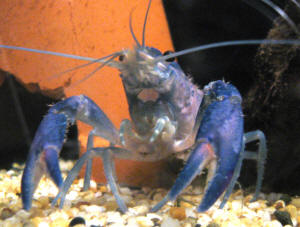 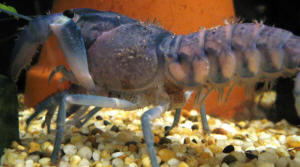
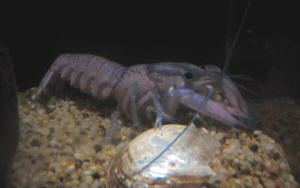 well, well, and sick Chompy well, well, and sick Chompy
|
River type setup (Crayfish with Hillstream
fish, snails) 10/26/10
Hi crew! With the acquisition of a very large tank for my crayfish
around the corner I am now able to look at the future of the 55g home
they have been in up till now. I recently found a design I like for a
'river flow' bulkhead that got me wanting to tinker and
experiment with it. I don't plan to go over the top with flow to
the degree that Hillstream loaches prefer, however I aim to replicate a
single direction in the water flow with a noticeably strong current to
benefit some temperate species I previously acquired. I hope this will
encourage fish to swim in the current, as oppose to aimlessly around
the tank. I will be placing large rocks in the tank to provide 'low
flow' areas for resting places when needed and for the shrimp to
gather. Here I have a list of what I would like to put in there and
already own, I ideally want temperate species so I can integrate my
apple snails and WCMM into the setup. Please could you give me some
input into the compatibility of the listed species with a flowing river
setup, and/or advise me toward a more suitable species should I have
made error in choice. I am quite prepared to keep the snails/shrimp in
their current tank should they dislike current. Tank size; 55G 3 sponge
filters on manifold to 2x500GPH (ish) powerheads to be rigged with DIY
flow 'diffusers' WCMM (have available) Danios (have available)
Kuhli Loaches / Cory Cat's Apple Snails (Pomacea bridgessii - have
available) Vampire Shrimp Yellow cherry shrimp Red cherry shrimp Amano
shrimp (have available) Thanks for reading! Stu
<Hello Stu. The short answer and the most reliable one is simply not
to mix crayfish with snails or fish. Snails at least will be viewed as
dinner, so they're a non starter. Shrimps will also be viewed as
live food, even quite large shrimps, and especially so when they're
moulting. Fish are a gamble, but bottom-dwellers like Kuhli Loaches
(which actually need warmer, stiller water than subtropical conditions)
will certainly be on the menu. Minnows and Danios might work, but
there's a real risk if they get within pincer range, especially at
night. So to summarise, this isn't a brilliant idea. As for a
Hillstream type scenario without the crayfish, yes, Danios and shrimps
should get along. Danios tend to bully White Cloud Mountain Minnows so
they should not be kept together. Kuhli Loaches and Atys/Atyopsis fan
shrimps need to be kept around 25 C, which is much warmer than
Hillstream or subtropical conditions. Apple snails rarely do well in
captivity for more than a year unless you tailor the tank to their
needs and allow them to aestivate for a few months per year. Hope this
helps. Cheers, Neale.>
Re: River type setup 10/26/10
Hi, Thanks for the fast response!
<No problem.>
I should have been more clear, I am very bad at putting across things
in text.
<OK.>
The Cray is only with minnows, Danios and shrimp atm, I am getting a
new tank solely for the crays and shrimp.
<Crayfish *will* eat the shrimp first chance it gets.>
I am purely looking at what to add to the 55 tank the crays will be
leaving if I make it into a high flow tank. I had previously moved the
snails following an incident discussed on WWM.
<I see.>
So I will give Corys and Kuhlis a miss, I plan to have a FW DSB in this
tank, at 22 C so the snails hopefully should be less inclined to need
an aestivation period,
<Wouldn't bank on it. The simple fact is that apple snails
rarely live more than 12-18 months in aquaria, and often less if nipped
by crayfish and fish. Do see the excellent AppleSnail.net site. Better
to keep the snails alone, or failing that, remove them each year for a
few months and rest them in their own vivarium.>
however should they want to they can burrow or leave the water onto
some floating wood, even lay eggs if they please. Is this understanding
correct?
<More or less. But don't expect baby apple snails to thrive
without some
degree of care. They're small and easy prey for crayfish. I've
reared apple
snail babies, but always in their own tanks.>
Are you able to advise me to a sand sifting temperate (22C-ish) species
that will aid with the DSB for me to consider?
<I shouldn't bother, though at 22 C you have a wide selection of
Corydoras species to choose from, as well as some of the Whiptail cats
and Nemacheiline loaches.>
Is there such a thing as a cool water 'filter feeding'
shrimp?
<No. Filter feeding anything tends to be on borrowed time in
aquaria, whether fan shrimps or little clams. Some people keep fan
shrimps alive by feeding them finely powdered flake food or liquid fry
food, delivered via a pipette. But without that sort of feeding every
couple of days they eventually starve to death. Few live more than a
few months in captivity. Those that do thrive are usually in large,
mature, well-planted tanks with at least some of the detritus and
micro-organisms they like to eat.>
Or would I be better off going with Kuhlis, vampire shrimp and upping
the
target temperature from 22C to 24C?
<Up to you. I wouldn't be keeping either of these species in a
Hillstream aquarium.>
The AqAdvisor's app shows no conflicts at 24C, although my understanding
was the minnows don't like 22+,
<White Cloud Mountain Minnows will be fine up to 24 C through
summer, but yes, they're happiest cooled down a bit in
winter.>
and the whole idea of this tank is to provide a better home for the
minnows and snails which I now know where not ideal to tropical
conditions, hence why I am looking at cooler water and flow (if the
snails tolerate flow?) Link ro AQresults
<Nothing came through.>
With regards to the Danio / Minnow combo, I will just move the Danios
with the Crays into the larger tank when it arrives and leave them out
of this high flow build.
<Danios will likely end up crayfish food. Let's be crystal clear
here, crayfish and fish do not mix. While crayfish are mostly
herbivores in the wild, they are very able to catch small fish in
aquaria, usually at night. Many have tried this combination, and very
few have succeeded. Crayfish need their own quarters where you can
provide them with the green foods they need.>
I should point out however that in my scenario it is the minnows
picking on the Danios, although not enough to prevent them spawning,
yet.
<I see. Well, the usual thing is for Danios to bully the Minnows, at
least once the Danios are big enough. Bear in mind Zebra Danios are
twice the size of White Cloud Mountain Minnows.>
Thanks for reading!
<Happy to help. Cheers, Neale.>
Re: River type setup 10/26/10
Thanks again for the fast response.
<No problem.>
I do not intend to make a Hillstream aquarium at all, merely to borrow
the high flow in one direction idea a Hillstream tank uses. Which from
my understanding is the only type of tank a filter feeder should be
kept in, and beneficial to WCMM, is this incorrect?
<Filter feeders don't really care about how strong the current
is, provided there is at least some current. They'll often go and
stand in front of the filter outlet. What they can't abide is still
water conditions, e.g., a small air-powered sponge filter.>
Is it not correct the adding brine shrimp and daphnia on regular
intervals with give filter feeders sufficient food? (my lfs has a good
stock of live foods) If not I will give them a miss.
<Filter feeders really do need filter feeder food; a marine aquarium
shop will have such products, though liquid baby fish food works well
too.>
If the snails are not bothered by the fish I assume this removes the
need to be removed for aestivation? If not I have several hospital
tanks running for such occasions either way.
<Not so much another tank as a container with some peat or moss into
which they can be placed.>
I do follow the applesnail.net site, however I found nothing regarding
whether they are ok in a flowing setup, apart from that if the snail
has a syphon it is typically from stagnant water. This leaves me in a
pickle as the name of the snail is 'snail under the bridges' if
I am not mistaken, which would indicate that they are found in inland
rivers.
<Apple Snails are indifferent to water current, and will be fine in
a tank with strong currents, provided it isn't so turbulent they
can't move about easily. Turnover rates 6-8 times the volume of the
tank will do no harm.>
Will they be ok in high flow, assuming they get the necessary yearly
break you advise on? The minnows and snails are the species I want to
tailor this display tank for, I don't mind removing the snails
should they need it yearly and have the spare tanks ready for such
occasions.
<Indeed.>
Thanks,
Stu.
<Most welcome.>
Just to clear up, I know the risks with crayfish, they are nothing to
do with this tank, other than they will have previously been in it.
Please can we keep the crayfish warnings at a minimum :) I have maximum
respect for what you and the crew do and what you know, however this
topic is about what I can do to improve the quality of life for my
minnows and snails in their own enclosure and it is becoming more about
my crayfish, which where only mentioned as background information in
the first place.
<Hmm'¦ in your last message you said you'd "just
move the Danios with the crays into the larger tank" and that
would seem to suggest the Danios and the Crayfish would be cohabiting,
which would be a very bad idea. I'm a simple man and can only react
to whatever is written down in front of me. Cheers, Neale.>
my blue yabbie... hlth./env. - 6/12/10
Hi I have a blue yabbie, I live in Australia. It has developed a large
brown spot and lost both his claws. He used to be so active and has
been in hiding for about two months, he has lost his appetite and does
not seem to want to eat. He used to be so active , he is in a 20 litre
tank and he is the only yabbie in there as he ate all the fish . He
used to be really aggressive and it seems like he now has depression
and is in permanent hiding. Can you please tell me what might be
wrong
Thanks
Veronica
<Hello Veronica. It's almost certainly poor environmental
conditions that are to blame. 20 litres isn't enough space for
anything but the smallest crayfish, so if your chap has a body length
above, say, 5 cm, he really needs a bigger home. Filtration is
essential, not optional, and diet should be based primarily on green
foods, not fish. Do read about the needs of these animals, and pay
attention to water quality, water chemistry and the use of iodine
supplements.
http://www.wetwebmedia.com/ca/volume_5/volume_5_3/crayfish_basics.htm
http://www.wetwebmedia.com/ca/volume_1/cav1i4/crayfish/crayfish.htm
http://www.wetwebmedia.com/FWSubWebIndex/crayfishdisfaq.htm
Cheers, Neale.>
Is there strength in numbers? Crayfish torture
4/11/10
Hi there.
I have about 25 crawdads in a 10 gallon tank but none of the crawdads
will hurt the other crawdads. I know that the crawdads are supposed to
fight others but they wont fight and they are standing on the rocks out
of the water and 3 of them have eggs.
I have no idea what to do!!!!!!!!!!!!!
Please help me!
<Why do you want your crayfish to fight? As for coming out of the
water, yes, they sometimes do that if the water is poor in oxygen. Your
tank is rather overstocked and I imagine water quality is pretty dire,
hence their behaviour. You would be wise to move them to a much bigger
aquarium, and use this little tank for rearing the babies, should you
want to. Do read here:
http://www.wetwebmedia.com/ca/volume_1/cav1i4/crayfish/crayfish.htm
http://www.wetwebmedia.com/ca/volume_5/volume_5_3/crayfish_basics.htm
Cheers, Neale.>
Re: Is there strength in numbers? Crayfish... incomp., repro. sys.,
referral? 4/14/10
I didn't want my crawdads to fight it is just that they are suppose
to but they didn't so I wanted to know what was wrong. And for the
eggs why wont the females lay the eggs. The eggs are already fertilized
over spring break but the crayfish wont come out I have no idea why.
please tell me step by step on what to do for raising eggs starting
from introducing the male and female to introducing the next
generation. thank you.
<Females don't lay eggs. They carry the eggs around with them
until they hatch, and that's when the miniature crayfish appear. In
a tank with adults those baby crayfish have virtually no chance of
surviving. So take a female
"in berry" (i.e., carrying eggs) and put her on her own in a
10+ gallon tank with a filter and lots of rocks and plastic plants.
Eventually the babies will leave the eggs, scuttle under the rocks and
plants, and you can remove the female back to her original quarters.
The babies are notoriously cannibalistic, so you'll need to keep
them well fed and segregate them as they mature, so the bigger ones
don't attack the smaller ones. Make sure there are adequate caves
to go round as well, otherwise the baby crayfish are very vulnerable
when moulting. Cheers, Neale.>
Crayfish basics, hlth., env. -- 11/12/09
Hi.
<Hello there>
My son has 5 small crayfish (2"-3") in a 75 gallon tank. They
all seem to get along OK, no major fights and only occasional
skirmishes. However, they have all developed a condition where they
seem to have white feathery things growing out of their sides and white
fuzz around their faces.
<Mmmm>
The white feathery bits seem to have a bit of red in them, at the ends.
I would like to send a picture, but I don't have an appropriate
camera.
<Drat!>
I found on your site that this is apparently caused by a poorly
executed molt, caused by poor nutrition and poor water conditions. That
was all I could find.
<This is one principal "cause" here... but indirect. That
is, what is it that lead to the poor moult is the real concern. Do you
dose "iodine"? Have sufficient biomineral (Ca, Mg mostly) and
alkalinity content in your system water?>
We *were* overfeeding them on protein, as the article described.
Now I have a few more questions:
1) What exactly is that stuff? Is it a fungus or what?
<Can't tell; but could be>
2) How do I get rid of it?
<Better conditions>
3) Does it hurt the crayfish just by being there?
<Too likely so>
4) What exactly are the ideal water conditions for crayfish?
<Posted:
http://wetwebmedia.com/ca/volume_5/volume_5_3/crayfish_basics.htm
and the linked files at the bottom>
5) Since they all have it, is it contagious?
<Mmm, yes; but in this case, the cause/s are communal, not so much
that the vector is contagious>
I have never kept fish before. My husband fancies himself something of
an expert, but knows less than nothing about crayfish.
<Heeee! Ah, the human condition>
Please help. My son loves his crayfish. I would hate to see them all go
belly up.
Thanks.
Erin
<Do read a bit more and write back if a path has not awakened to
your conscious. Bob Fenner>
P.S. I really appreciate what you are saying about well-written
letters.
It is appalling what some people will consider as communication, even
in printed matter. People do not realize what a difference it makes
when you are clear about what you say.
Re: Crayfish basics 11/13/09
Ok, Bob,
<Erin>
I looked over your site until my eyes are ready to bleed, and I did
find a little more info. Now I know to buy algae pellets and only
occasionally give a shrimp pellet for a treat. Is Once a week
appropriate?
<Two, three times per week is ideal>
We also noticed that they love corn, peas, and edemame beans. Is this
ok to feed them, too?
<Sparingly, yes>
I also know to give them iodine and to change the water 25% a week.
<Yes!>
What I don't find that I wanted to know is, when I stick a test
strip into the tank, what is it supposed to say?
<Mmm, I really don't like test strips... sorry. They're
notoriously inaccurate and imprecise... not measuring right or
consistently what is there>
I found contradicting information about pH levels, and no actual
acceptable ranges for nitrates, nitrites,
ammonia, or whatever.
<Most Crayfish species like water that is neutral (7 ish) to
moderately alkaline. Low Nitrate (under 10 ppm), and NO ammonia or
nitrite period>
I found only passing references to these things. So specifically, what
am I testing for, and what numbers do I want?
And another question about water. My husband brings home City of
Chicago tap water from his work. It has a lot of chlorine in it, but
that is what we use for the tank. He swears you can just let it sit in
the bottles with the tops off for a while to let the chlorine
evaporate,
<Likely so... but nowadays it is very likely treated with
chloramines, not chlorine... Need to leave the tops off for a week or
so ahead of use>
but I am not so sure. The pet shop guy tried to sell me something to
treat the water with, but hubby told me not to buy it. We have nasty
rusty well water at home.
I use a salt water softener for household water,
<Mmm, likely a salt-recharged type. Don't use this water>
but we drink the city water.
Can we use the softened water, or is the city water better?
<The city>
Thanks again for your help.
Erin
<Certainly welcome. BobF>
Re: Crayfish basics 11/16/09
Hey Bob!
Thank you so much for all the helpful information. Sorry to be a
bother, but I wanted to ask you, what are the ideal Ca and Mg
concentrations for the water?
<Doesn't matter the exact values, but something on the
"medium hard" to "hard" scale of whatever test kits
you use should work just fine. While pH should be in the basic range
(7.5 is ideal) the hardness is critical too.
Generally, if you have water that furs up kettles quickly, you should
be fine. But to be on the safe side, adding Rift Valley salt mix at
about one-half the amount of stated for Malawi cichlids will do just
fine. Cheap, easy, and effective.
http://www.wetwebmedia.com/FWsubwebindex/fwh2oquality.htm
>
I missed that the first time I read your original reply. And, some good
news--the pet store sold us an anti-fungal for the crayfish, and
apparently it is working because the "feathers" seem to be
dropping off and the
face-fuzz seems to be going away.
<Cool.>
I know we have to take better care of the water, but it is a relief to
see them feeling better, anyway!
Thanks again!
Erin
<Happy to help. Cheers, Neale.>
|
ELB Crayfish, comp., fdg., terr. plants...
10/12/09
I recently acquired an almost mature electric blue crayfish. It
was identified as a male and will trust in that as I have no way
of knowing different.
<Hardly matters. They are not animals that get along with
each, and are generally one per tank. Sure, you can try and keep
two, but eventually one will eat the other.>
He is approx. 6-1/2" - 7" long. I have had him for one
week, in a 60 Gallon tank at 74F, low KH, med-high GH, ph of 7.0
to 7.3, nitrite and nitrate do not register on my tests.
Roommates are 2 small (3-1/2") leopard Botia, 6 mystery
snails and, until today, 10 small (2-1/2") comet
goldfish.
<Well, the snails will be eaten. As for the fish, as soon as
he can catch
them, he will eat them. Crayfish are NOT suitable for community
tanks.>
The tank was recently set up, about 4 weeks ago. Goldfish moved
to a cooler (non heated) environment. Loosely planted with live
plants.
<Crayfish are primarily vegetarian, and while they eat meat
given the chance, most of their diet is plant material. Needless
to say your plants will be viewed as a salad bar. At least some
of those plants look like "non aquatic" plants -- and
these WILL die underwater. The fern at the far left front is one
non-aquatic that will soon die. Take it out. The next two plants
at the front might be Anubias, but they might also be
Spathiphyllum tasson "Brazilian Swordplants". Again,
these are non-aquatics and WILL die.
Obviously, dead plants pollute the aquarium. Such plants DO NOT
adapt to aquaria and there's no point whatsoever to leaving
them in the tank for a nanosecond longer! The other five plants
at the front, from the centre to the far right seem to be Amazon
Swords, and provided you have bright light and provide them with
fertiliser pellets in their roots once a month, can do well.
Mostly they just die when bought by inexperienced aquarists
because their need for good light and fertiliser is ignored, so
be carefully. The thing at the back looks like Water Wisteria
(Hygrophila difformis), a species that thrives under bright
light. Unfortunately it is edible and will become crayfish food.
Do read here:
http://www.wetwebmedia.com/FWsubwebindex/keepoutfw.htm
If you do have Anubias in your tank, do recall that these plants
CANNOT be planted. They will die. Anubias are epiphytes, like
Java fern, Java moss, and Bolbitis ferns, and need to be attached
to bogwood or lumps of lava rock. Any part of them stuck under
the substrate will simply rot, eventually killing the whole
plant. If you want to grow live plants, it's absolutely
critical to read about each species before you buy them: it's
very easy to throw all kinds of money down the drain
otherwise.>
Stacked slate to hiding spots, etc. Bottom filtration, external
filtration.
<Undergravel filters are incompatible with plants that have
roots in the substrate. Such plants will rarely do well, and most
species eventually die. Floating plants and epiphytes are the
exceptions, since they don't have roots in the
substrate.>
So that is the background. Now to my issue......
<Indeed.>
I noticed this evening a few, very small (1-2 mm or less) bright
gold 'dots' on his carapace. I recognized these as he was
scratching or rubbing himself with his feeder claws. There are a
couple on the 'head' section, one on the thorax and one
larger (3 dots) colony on the tail.
<Could be harmless commensal organisms if the gold spots are
stuck to the shell; if they're pits on the shell, then that
implies the water is too soft and acidic.>
Since this is a new set up and he was recently acquired from
another fish person with multiple tanks, I am guessing that the
gold dots are parasites, but I am not sure what may afflict this
type of crustacean.
<Many.>
I know there are anti parasiticals that are available that are
suitable for use in tanks with crustaceans, but have never heard
of a fresh water version specifically for their (crustacean)
treatment.
<Don't bother. Most such "parasites" are
relatively harmless, and any medications far more likely to cause
harm.>
Do you know of such a product...or am I wrong and this is a
fungal infection?
<Fungus can happen, and looks like patches of off-white
thread, likened to cotton wool.>
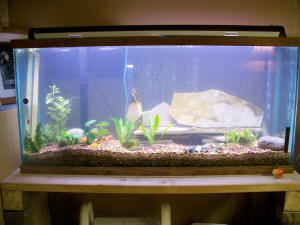
Pics of tank and Crayfish attached, and the gold dots are clearly
visible in the second section of the tail, to the right of the
thorax (as viewed in pics). Darned things seem to have appeared
overnight. (please note that the cloudiness in the tank is from
fluorite substrate (specific to the planted areas only) that had
not completely cleared from RE-planting the plants that my blue
demon crayfish uprooted) Are the 'dots' something that I
shouldn't even worry about?
<Probably not.>
I have kept fish for many years, but have never had this
particular incidence. It makes me think of 'gold dust' or
velvet in its early stages in fish, but no other species are
affected. Any ideas?
<Fish parasites -- Ick and Velvet -- won't parasitise
crayfish, though their infective stages can of course move from
tank to tank via the wetness on the shell of a crayfish just as
they can via a wet bucket or wet net.
Hope this helps, Neale.>
|
 [1].jpg) |
|
Nitrate concentration in crayfish tank -- 06/28/08 Hi,= I
have a problem with the nitrate level in my crayfish tank which I
hope you can help with. It's only a small tank, just under 10
gallons, with an undergravel filter and another small internal
foam- filter. It has been set up for over three months, and my
crayfish (the only occupant) has been in it for two weeks- less
than that. Since I added her, my nitrite and nitrate readings
have always been 0. For the last couple of weeks, my nitrate
level has jumped to 25 mg/L (nitrite still 0) and I cannot get it
down. I know this is not high for fish, but am concerned that it
may be too high for her as a crustacean. I have always done 25%
water changes each week. The last couple of weeks, I did two 10%
changes the first week, and then, as the nitrate level didn't
decrease, a 50% change about 5 days ago. It doesn't seem to
have any effect. I tested the nitrates of the tap water, after
conditioning, and this was 0. I suspect its the amount of food
that she loses when feeding (miniscule bits of fish seem to
'cloud' off while she chomps) and I do have some brown
scum/algae which accumulates at the front, which I keep having to
scrub off. I can't understand why the water changes are
having no effect. I don't know whether doing any more just
yet is a good idea as I don't want to start the tank off
cycling again. Have you any suggestions? Should I be worried
about this concentration? Thanks very much for your time. I
couldn't find anyone else with this query for crayfish tanks.
Best wishes, Kathryn <Hi Kathryn. Nitrate can be difficult to
manage. The first thing is to establish the nitrate level in your
tap water, which you have done. If you're finding that the
tap water has 0 mg/l nitrate but the aquarium has 25 mg/l after
one week, you almost certainly have an overstocked or overfed
aquarium. Given that nitrite and ammonia are zero, the filter
itself is doing its job just fine. Your crayfish isn't in any
immediate danger -- the common swamp-dwelling crayfish sold as
pets have evolved to live in a variety of water conditions, and
will adapt to relatively high levels of nitrate without problems.
Given the crayfish are primarily herbivores in the wild, you
could opt to focus the diet on plant matter. There is less
protein in plant material, and while your crayfish will still
receive all the nutrition it needs, the amount of ammonia dumped
in the water, and consequently the nitrate produced by the
filter, will be far less. Across the week you might feed your pet
on 5 days with plant material, and 2 days with something meaty.
Beyond that, more frequent water changes will dilute the nitrate,
and the use of fast-growing floating plants under bright
illumination will further use up nitrate. Hope this helps,
Neale.>
Re: Nitrate concentration in crayfish tank -- 06/29/08
Hi, Thank you very much for your advice- I will certainly try to
shift her to a more vegetarian diet and find some floating
plants. Hopefully she won't be able to catch and destroy them
like she does everything else! Thanks for your time, Kathryn
<Glad to help. Try soft plant foods like tinned peas and
cooked rice as staples. The peas are great for protein, and the
rice provides starch. You can also offer Sushi Nori, cucumber,
courgette (zucchini), cooked carrot, blanched lettuce or pretty
much anything soft and/or green. There's no need to feed
crayfish every day. Feed in small amounts, and at night if you
want to minimise wastage (crayfish are nocturnal). Inexpensive
pond plants like Elodea will do double duty as forage for the
crayfish as well as nice decorations for the tank. Maybe once a
week offer something meaty with either shell or bones in place.
These provide the calcium required for successful moults. Frozen
krill and/or lancefish (both available in aquarium stores) will
do the trick here. Some aquarists recommend adding iodine drops
to the crayfish aquarium. You can buy this stuff (inexpensively)
at marine aquarium stores. It seems to help prevent one common
problem with crayfish, namely "bad" moults, where the
crayfish dies part-way through. Use as indicated on the bottle,
though perhaps a half-dose would be ample for just one crayfish.
Cheers, Neale.>
|
Crayfish, sys. -- 10/09/07 I have a freshwater
tank with a red crayfish in it. Some of the readings I read said to add
iodine. I was just wondering if the iodine could harm the freshwater
tank and could it harm the cichlids that I have in it now. I was also
wondering what brand of iodine I should get for my freshwater. Thank
you very much for your answers. <Should be fine if used as per
Sabrina's instructions here: http://www.wetwebmedia.com/FWSubWebIndex/crayfishfaqs.htm .
But just to be sure, start with a low dose (maybe 50%) and observe. If
the fish start behaving oddly, do a water change and use a lower dose.
It goes without saying that crayfish and fish shouldn't be kept in
the same tank anyway. Cheers, Neale>
Yabbies and algae control 5/23/07 hi, <Howdy> I read
through a lot of Q&A but didn't find my specific question. I
apologise if I missed it. <Okay> I have two small yabbies (around
2 inches) as well as some smaller feeder fish which am happy to say
have not been eaten. My problem is I'm gettin algae building up in
the tank. Is there any kind of algae eater that would survive with
them. <Mmm, maybe...> Are they just as likely to attack fish on
the glass as fish swimming through the water? Or are snails a
possibility to slow down the amount I need to clean the glass? <The
snails are a poorer choice... too slow... I would actually try a
Chinese Algae Eater (Gyrinocheilus) here. And read re other algal
control strategies... here: http://www.wetwebmedia.com/FWSubWebIndex/fwalgcontrol.htm
and the linked files above. Bob Fenner> Regards, Matt
Questions GALORE! Crayfish sys., Salamander nutr., ADF nutr.,
Neon Health, 1/19/07 Wow. The forum rocks. I kept trying to find
the sites with information and realized all the questions I could have
were pre-archived before my very eyes. But, despite other's
curiosities, mine persists. Here goes a big thank you to the crew once
this message gets drawn and quartered to the appropriate experts.
<About a day> Crayfish: Recently, I caught four 1 inch crayfish
from a quiet Atlanta stream (other beauties accompanying below). As I
read, I did my research and studied their natural home (a stone's
throw away) extensively. Although their water is quite cold now (being
an icy Ga. Winter), I attempted to recreate their environment in a 10
gallon tank. I provided a good number of rocks (atop gravel bottom) for
them to hide. These rocks, I made sure, came with natural moss/algae
from their stream and they have all taken to the four corners and
pretty much kept to themselves. I think I did an ok job, as they all
remain quite hidden (onlookers other than myself exclaim my tank is
empty they hide so well). Here comes the kicker. There were loads of
these crayfish AND Salamanders. <And plenty for the Crays to eat
otherwise...> I researched the crayfish will eventually pick on
anything their pincers can catch. <Pretty much, yes> For now, the
crayfish are but a fraction of the salamanders' size, but I want to
know how I can further ensure they remain comfortable and well fed
(feed them wafers, dropping pellets, and elodea or natural moss?) so
they won't pester the salamanders but for territorial gain? <A
matter of time, your careful observation> Other than that, I wanted
to know how else to make them comfortable. There is only about 3
gallons of water at the moment as I tried to recreate their shallow
stream - put in aeration and cascading filter. So I'm pleased with
the water flow, hiding places, native terrain and roommates - what
else? <Please read here: http://wetwebmedia.com/ca/cav1i4/crayfish/crayfish.htm and
the linked files at the bottom>
Question regarding Yabbies and
tank size. 1/10/07 Hi. I've been furiously reading your website
and am thoroughly impressed at the information you have. <Like your
use of adverbs> Just thought I'd ask for a bit of advice
regarding our Yabbies (hope you don't mind). <Not at all>
After losing our two original pet shop bought Yabbies fairly quickly to
some disease that I'm sure came from the pet shop with them (the
pet shop denied this but I noticed they stopped selling Yabbies
altogether shortly after my purchase) we decided to catch our own from
a local water hole (we live in NSW Australia... and catch our native
Cherax destructor). We ended up with one female Yabby (Marge) who has
lived with us happily for over a year. <Good> Last weekend, after
an encounter with a 2 year old (of the human variety), we had to get
her a new tank. Which we have done but it is quite a bit larger than
her last. It is 2 foot long, 1 foot wide and deep (I think.. used to
metric here). So we decided that she might enjoy some company at last.
<Mmm> Today we went yabbying again and came home with a mix of
males and females to put in with her. <A mix?> They are not large
(smallest female over 2 1/2 inches... largest is a male not quite 4
inches) however now I am worried we are overcrowding them. <If the
dimensions are what you state, you are correct> The tank now
contains 3 females and 2 males. I think it holds about 56 litres (15
gallons??), however we only have it a little over half full so that
they can climb out of the water onto the rocks if they choose to. I
have plenty of hiding places for them to get away from each other. Do
you think I should get another tank and pull a couple out? <Yes, I
would... and even then... you need to keep an eye on all for signs of
overt aggression... particularly during molts> It is a bit hard at
this stage to tell how they are getting along as the only one who
isn't frightened of us is Marge. And while she doesn't mind us
and will come to the side of the tank when she sees us, she is hiding
as well... wary of the new arrivals in her tank I assume. <I sense
you are correct here> As an aside, and not a question at all, it has
finally dawned on me just how badly in drought we are. The water hole
we went to today was probably an 1/8th of the size it was at the same
time last year. All of the smaller holes around it are gone. I
don't know what happens to the Yabbies when that happens. <Mmm,
hopefully some "walk out" to somewhere propitious,
survive> I guess they just get awfully crowded and become much
easier pickings for predators. Sad though. Many thanks for taking the
time to read this. Kind regards Tascha Marshall NSW Australia <Thank
you for sharing. Bob Fenner>
Re: Question regarding Yabbies and
tank size. 1/10/07 Dear Bob <Yes Tascha> Thank you for your
quick reply. The information is much appreciated. We will endeavour to
get another tank today to move a couple of the Yabbies into. Thanks
again. Kind regards Tascha Marshall <Ah, outstanding. Thank you for
this follow-up news. Bob Fenner>
Re: Question regarding Yabbies and tank size 1/12/06 Hi again
Bob. <And to you Tascha> Sorry to be bothering you again so soon.
Some more Yabby questions. All seemed well with our over crowded Yabby
tank this morning so we left it as it was this morning while we went to
town to get another tank. However when we returned, (with a new tank),
we found our Marge with her two front claws missing. The claws of
course are no where to be seen, so I'm assuming they've been
eaten. <Yes> So we moved her into the new tank, along with the
smaller of the males. I've been watching both carefully to make
sure that she was ok and that he wasn't aggressive towards her.
<Keep them fed...> Keeping in mind I've never observed two
Yabbies together before, but the male (who my children had to name
Homer) seems quite fond of Marge. And she doesn't seem to mind him
either. Spending a large part of this evening with her tail in his
face. If this means anything at all I have no idea. But he doesn't
respond to her aggressively so I figure it can only be a good sign.
When they were not sitting around cleaning themselves they were quite
active, especially the male. I'm guessing this means they are very
pleased to be where they are now. <Perhaps so> Now to my
question. I have no idea when Marge is due to moult again, but is it
likely that she will grow her claws back in just one moult? <Mmm,
not if this specimen is quite large... or your water deficient in
biomineral and alkalinity... nor if there has been a history of little
nutrient uptake... Likely two, three molts to full regeneration>
Also I have been wondering, is it possible for them to mate with Marge
having no front claws? Not that I'm particularly bothered if they
mate. I'm just curious more than anything. <Mmm, not as far as I
know... it is the female who moves the "sperm packet",
manipulates the fertilized eggs... with her claws... Are both sets (the
larger and smaller gone?> I'm happy so long Marge is going to be
ok. Which I assume she will be if she doesn't encounter any more
problems. She is eating and moving about as usual, although her
favourite pass-time of shifting gravel and hiding rocks will probably
be a bit harder for her. <Yes> The new tank has a light which has
turned out to be a great thing. It is a miracle my family got fed
tonight given how much time I have spent sitting in front of the tank
watching Marge and Homer interact. <Good for them to have lessons in
self-sufficiency...> Thanks again for reading these emails. Your
advice is fantastic. I'm sure my husband wasn't convinced we
needed the second tank until he read your reply. What a shame
you're not available for non-fishy advice. Ha ha. <I know little
about other aspects, avenues of life> Oh.. before I leave you in
peace.... my husband insisted on putting sand and a piece of bark from
the water hole, into our larger tank. The tank has not cleared since he
did it, despite rinsing both sand and bark well, and use of the filter.
I'd rather get rid of the bark and maybe the sand (if the removal
of the bark alone doesn't clear the tank) but more importantly
I'd like to know if either are likely to cause any health problems
for the Yabbies. My husband says the bark feels like rubber and has
been in water so long it can't possibly do any damage. But I'm
not so sure. Any ideas? <Mmm, I would "test" this/these
materials with a small fish... or two... perhaps comet goldfish... to
assure that they are non-toxic... in a separate aquarium/container...
for a few weeks. Too likely to haul in undesirable hitchhikers,
chemicals...> Many thanks again and I promise I'll stop bugging
you soon. Kind regards Tascha Marshall NSW Australia <Not a bother.
Cheers, Bob Fenner>
My new pet Crayfish 11/27/06 Hello. I work at PetSmart, and
every now and then, strange animals will show up in the shipments of
feeder fish, <Ah, yes... always a delight, adventure> and I
usually enjoy taking one or two home with me. Usually the stow aways
are tadpoles, but yesterday, I picked up a Crayfish that I named Garth.
<"He's got friends in lowww places...."> Right now,
he is living in a tiny little bowl, but after reading up on your page
and others, I am ready to purchase and set up a tank for him tomorrow.
<Ah, good> I was wondering a few things, and if they are on your
page and I missed them, I apologize for the inconvenience. 1. Do you
have any idea what he may be? I was trying to find pictures of several
species, but after reading up on them, I think he may be a juvenile. He
is probably 2 inches long, and he is a light tan color, but he has
speckles all over him, including his pinchers. They themselves are very
small and thin, but they are long. I live in Colorado, but our fish are
usually shipped from Arizona. Any species around that area that he may
be? <There are some 300 plus species that occur in N. America, but
the vast majority of those seen/used (for consumption as well as
ornament) are Procambarus clarkii> I was just wondering, because I
wanted to know about how big he would get. <Do place the above name
in your search tool... likely some 3-4 inch body length maximum> 2.
Exactly what/when should he be fed? I have read different things. Some
say stick to mainly vegetables, and don't feed too often, while
others say feed mainly meats, and feed frequently. What would be a good
feeding/diet schedule? <A mix of these... animal and vegetable
foods... prepared or fresh will serve you both well here> 3. How
much space should he have? <A ten gallon system would be perfect...
with some rock work...> I do not have the room for anything HUGE, as
I already have a ten gallon fish tank and a large critter keeper for my
hermit crab. Would a large Critter Keeper (15.875" x 8.375" x
12.083" ) be enough? <Yes> I know some aquatic animals
don't need a lot of room, and some do. <You are correct here>
Thank you so much for your help. I apologize again if I've asked
anything that was available on your web site. Sometimes Im not the best
at searching for information, lol. Thank you for your help. ~Amber
<Thank you for writing, sharing. Your genuine concern and
intelligence are refreshing, obvious. Bob Fenner>
Crayfish Climbing - 07/25/2006 Me again with a
rather odd problem, <Hi again!> Vladimir, (Freshwater Crayfish)
Has been trying to climb out of his tank. <.... and this is odd....
how? ....This is actually a very normal action, to be expected of
Crays.... especially wild-caught Crays or ones that might prefer more
space.> He will only do this in the middle of the night. We have 2
air driven corner filters for them. We do full water changes about
every week, and try to keep the water as clean and clear as possible,
yet he still tries to climb out. <Really, this is to be
expected.> Would it be possible that Mavra (A female in the same
tank as him but separated with a clear divider) is causing him to want
to get to her, even if it means climbing out. <This is in fact
possible.> We had a few close calls with him, he would constantly
climb up the air tubing for the filters and almost completely out of
the tank (15 gal) <A little on the small side for space for having
only a small section (even if half) of the tank - I'd be climbing,
too. This is a sufficiently sized tank to maintain their health, but
they'd do a bit better in a larger system. Even that, though, may
not put an end to the climbing.> We had to place a barrier over the
top during the night to keep him from getting out and falling onto the
ground. <A VERY necessary component of a crayfish aquarium.> On a
better side, Mavra has molted and is closer in size to Vladimir, but at
the same time Vladimir might be getting ready to molt also. I think
this might make the gap slightly larger again. The other thing is,
Vladimir is a lot more "thick" than Mavra, his body seems to
be quite larger in mass than hers. She seems to be about 2/3 the
thickness of him and I am afraid this would cause her to be damaged.
<Yeah, I'd give 'em a bit more time.> Thanks for your
time, -Colin <And thank you for your emails, Colin! I hope you will
some day see baby crayfish from this pair! All the best to you,
Vladimir, and Mavra, -Sabrina>
Crayfish In A FW Tank - 04/27/06 Hello, I
contacted you the other day about my 55gal setup and had a few more
questions to ask. My blue crayfish hasn't bother any other fish yet
unless they actually come into his cave. He doesn't seem to be
worried about any of the other fish as he will even sometimes roam
around during the day and I make sure he gets fed. Sometimes my shrimp
are in the cave with him filtering the water and he usually doesn't
mind them. He is slightly bigger then them but he is only about an 1
3/4in. Will he become more aggressive as he gets bigger? <He will
always try to catch something to eat. Just because he can't catch
them now doesn't mean he will give up trying.> I am assuming
being a crustacean he molts as he grows and was wondering if you need
something to add calcium or iodine to aid in the molting or if he will
do fine alone. < Usually the minerals in the water are enough.
Sometimes iodine needs to be added but this all depends on diet and
water chemistry.> I don't use a reverse osmosis filter and I use
freshwater salt at the recommended 1 tbls per 5 gal of water. Also, he
has a habit of eating the roots of my smaller plants. He eats my algae
wafers but still goes after my plants. Would something thing like
lettuce or zucchini help? < Try it. Lettuce has very little
nutritional value.> I was also curious of my disc and my silver
tipped cat stretching their mouth and fins every now and then. Could
this be a problem down the road or have something to due with water
quality? < This is a way that fish realign their jaws. It could be
more of a result of the food then a problem.> I am appreciate your
help very much since the locals don't seem to know much except how
to sell them. Even other resources on the web either don't answer
or take over a month to reply. Thanx again for your time. :-) Jason
< The WWM crew are all aquarists and know how important time is when
you need a reply. We are all volunteers and try to get to as many
questions as we can. Thanks for the kind words.-Chuck>
Keeping Crayfish - 03/13/2006 My son just found a crawdad in a
creek behind our house and was wanting to keep it as a pet to which I
don't have a problem with. <Can be done, with a bit of
studying.> Here's the thing, I have read most of the articles
from other people but I am just lost. Is one from the creek just like
the ones they buy at the pet store or is there a difference in how a
tank should be set up for one. <Actually, in the US, the most common
crayfish offered for sale in fish stores is Procambarus clarkii, almost
certainly the same animal as your son found in the creek.> I would
just go to a pet store around here and just ask them and get everything
while I was there, but the last time I did that I ended up with a lot
of stuff that wasn't needed for the pet we had. I would love to
keep this crawdad as a great experience for my 12 yr. old. Any help
would be great. What size tank, <Depends entirely upon the size of
the animal. If this guy is more than a few inches in length, I would
advise to put the feller back in the creek, and go looking for a
smaller Cray. If he's a few inches or less, a 20 gallon tank would
be great. Be CERTAIN to have a good, tight fitting lid.> how much
water, <Tank should be mostly full, and have a tight fitting
lid.> water temp, <Room temperature will be okay - try not to let
him get too warm. No heater. Tight fitting lid.> and lighting, <A
fluorescent aquarium light will be great. Don't use an incandescent
light; this will raise the temperature of the water dangerously. Very
often, you can get light/lid combos. Did I mention a tight fitting lid
will serve you well.> I understand the rocks and cave things.
<Lots of hiding spaces will be necessary.> Also what is the ph
y'all are talking about? <A matter of water chemistry.... Please
read in the freshwater articles of WetWebMedia regarding water quality
and maintenance.> Again thank you for the help. Dena <All the
best to you, -Sabrina>
Novice has question about crayfish
3/3/06 Dear Mr. Fenner: <Karen> My 10-year old son brought
home a crayfish from school to care for over the summer. <Ahh, I had
these (Procambarus clarkii and others) at this age as well> We
became attached to it and have kept it ever since. We don't know
what species it is, but it started out red and has now turned blue. The
school provided a very small plastic "tank" with a few
pebbles (no gravel or sand). We kept it there, but after a few moltings
it had grown pretty large (about 5 inches), so we moved it to a
10-gallon tank that we just set up. We have gravel on the bottom, some
pebbles, some plastic plants, places for it to hide, a filter, and an
aerator. We know nothing about crayfish, but we have been reading up on
the Internet (and now realize that it should have had more space and a
more varied environment long ago). My most pressing question (I'm
sure we'll have more) right now is this: ever since we brought it
home, we have been feeding it "crab and lobster bites" (by
HBH), which the pet provision store said would be appropriate for
crayfish. It seems to have been doing well on these. <Yes... a good
company... with real science...> We moved it to the larger tank
yesterday, and we gave it the same crab and lobster bites. We have
noticed that it has been eating some of the gravel. Will this harm it?
<No, not harmful> Is it doing this because in its previous small
tank, there was a smooth bottom with no gravel, no sand, and only a few
pebbles, and now the gravel in the new tank is confusing it so that it
is having a hard time distinguishing gravel from food? If this is a
problem, do you have any suggestions? <Not a worry... just part of
natural behavioral repertoire> Thank you very much, Karen
<Welcome. Bob Fenner>
Crayfish I was wondering wither I
could successfully keep a crayfish in a 2.5gallon tank with a sponge
filter. <it would be a little cramped, but it would likely work too.
They are incredibly hardy creatures.>
Cherax sp. with a Doritos Diet? Hello there! <Hello! Ryan
Bowen with you today.> I'm Tracy, nice to meet you! *waves*
<Ah, nice to meet you as well> We just got a pet crayfish
recently cause the people at my mom's office got tired of taking
care of it.. =( <Too common, sad> But we're doing our best to
take care of her now. <A fishkeeper is born>. I learnt much about
how to do that from your site, so many thanks! And I identified her
gender, which no one bothered to do in the 1 year they had her!! *rolls
eyes* <Nice work!> Anyway, she was very active for a few days and
climbed all over the tank exploring.. or whatever it is crayfish do..
but we're quite concerned now cause for the past few days she's
been hiding in her hole most of the time and staying very still for
long periods of time. Even at night, she only gets out to climb around
for a bit, then she's back to hiding. At first we thought she might
be molting, but nothing has happened for 5 days. Does preparing for
molting take that long? <It can, and after the animal molts it will
remain hidden as the shell is not hard yet.> Or is there another
reason for her behaviour? We try to keep the tank clean.. uneaten food
is taken out after a few hours. About 20% water change every week. We
feed her sinking fish food and bits of peeled tomato. There's
limestone in her tank. I am not sure where I can find iodine in my
area, does feeding her fish/prawns occasionally work as well? <Water
changes alone should be plenty of trace elements.> Shy says hi!
I'm not sure what species she is.. she's blue all over though!
<Cherax sp.> The brown markings are actually algae cause her
previous owners fed her potato chips and didn't clean her tank
enough. *grumble* <I'm not surprised that your pet is
"adjusting" to her new environment!> She's about one
year old and is 5 inches long. <That's about as large as
she'll get. Feed sinking algae pellets, and supplement with some
small, meaty items for best coloration.> And very adorable! Thank
you for bearing with me, I can get really long-winded at times.. =)
<No worries! You ought to hear how long those "reef" guys
get.. sheesh! ;) Ciao Tracy!> *hugz* Tracy
Yabbies, Pet Crawfish? Hello - I am a huge fan of crawfish,
Yabbies as I have heard them referred to. However, I prefer them
steeped in a spicy stock and served up with potatoes, corn, and
sausage. (Sorry to all those who disagree) Here's my question....my
son (he's 11) usually helps me when I cook outside (BBQ, fish fry,
crab boils, etc.) This weekend we had a crawfish boil and he managed to
keep a few hidden from me. Now he would like to keep them as pets. he
has a tank with platies, and a swordtail. I am certain the crawfish
would eat them as soon as he could get his claws on them! So tell me,
PLEASE, what could I do or should I do to keep them in captivity and
keep them alive? He has 3 of them about 3 inches in length each. <I
have kept crawdads for years as a kid and never really had any problems
with them. One per tank is best because they will just fight with one
another. They are scavengers and will eat anything including the other
fish you mentioned. The are messy to and will require a good filter and
lots of water changes to keep the water clean and to help reduce
algae.> I currently have an African Cichlid tank with lots of rocks.
It's a 35 gallon tank and has 15 Cichlids about 2.5 - 3 inches
each. Would they be compatible with them? I know the Cichlids are
aggressive, and so are the crawfish! Who would eat who? < The
African cichlids would be too fast for the crawfish to catch them. In
the wild they live with large crabs so they know their way around. When
the crawdad sheds its exoskeleton it will become a living breathing
mobile banquet block and be eaten by the cichlids and never seen
again.> What do you recommend? What kind of water conditions do they
prefer? What kind of filtration is necessary? What size of tank is
needed? What types of substrate is best? What kind of set up is needed?
I would like to get away as cheaply as possible. These crawfish were
not bought at a pet store, so I don't think they were bred to be
kept as pets. My guess is they won't live for too long, but I
don't want to break my sons heart. I would like to put forth some
effort to keep them for him. (By the way, I had to get him a happy meal
while we ate today!) Thanks so much for all your help! < Get one of
those 10 gallon starter kits that you see at the fish store all the
time. You don't need the heater though. Place about one inch of
inch of washed sand on the bottom and somewhere for him to him. Watch
for chlorine in the water and copper from any new plumbing. They will
any type of sinking pellets. Just make sure to not overfeed and pollute
the tank. He will need to change a couple of gallons of water every
week until the bacteria get established. -Chuck>
Yabbies Hi I was thinking about purchasing a yabbie, and all
the sites I have looked at have said nothing that can help me. I was
wondering how much space and how many gallons would be needed for 1
yabbie. -Cristi <Hey Christi, if I were to house one yabbie I would
not go any smaller than a 10gal. I have 4 in a 29gal that have bred and
so far the young are growing up healthy and happy, I am amazed there
are still some left, these guys have not problem eating their own. I do
have problems with aggression and will be moving them to a larger tank
soon. I like to feed mine the clippings from my plant tank, these guys
love live plants. Best Regards, Gage>
I Love to Eat Them Yabbies! >Hmm...I aimed my last note at
Sabrina, but now I suspect it is Marina who is the Crayfish lover
>>Umm... I am, but I love to EAT them. I know a little bit,
though. >...anyway, any help, from any of the crew, regarding the
odd-angled leg, much appreciated, Andy >>A Crawdaddy with an
oddly-angled leg? Post molt, maybe? You could actually just pinch it
off, and it'll grow back with the next molt. Same thing with the
claws, if it's getting too aggressive, just take 'em off (with
the bigger ones I'd use some kitchen shears to get a clean cut).
Sounds awful, but they encounter lost limbs all the time in nature (do
it to each other, you see) and have ways of dealing with it. Know that
such inverts appreciate having "biominerals" available;
iodine and calcium are what's needed to proper shell formation and
the like. You may want to test your water, though I couldn't tell
you what proper levels for a freshie would be (iodine), and calcium..
Hhmm.. I know I'd like it to be in the range of, oh.. say 350-400
(tested on a calcium kit), but don't know if that's what
we're shooting for fresh, either. I'll suggest at this point
that you ask the folks at ThePlantedTank.com, I think there
may be someone who knows. Marina
This Yabbies Ain't For Eatin'! >Thanks Marina...
>>You're welcome Andy. >I append the full note explaining
the leg thang. Gage reckons leave it alone. I just am not sure
what's best. Any further advice much appreciated. >>Sure
thing. >Here we go: I have a little blue crayfish, nearly 3"
long, 2 years old, called Lopez. >>Aah.. a blue. These animals
are more inbred, and thus more prone to such problems. >At the last
molt (Sunday) he got a let stuck and when he finally got it out, the
leg/pincer was at an odd angle, kind of backwards, clumsy looking.
>>Alright. >He is moving and eating (lots) and can still use
the leg and pincer, but it is certainly not right. It is bent backwards
and gets in his way when he tries to hide in his jar/burrow, though he
gets in in the end. I am wondering whether to somehow tweak it off
(ouch) so he can grow a new one. But really, I am scared to hurt him
and would rather think he will be fine and that he is not in pain as he
is. >>I don't think he's in pain at all. Remember when I
told you how these animals lose limbs all the time? It's true, and
this is no more harmful to them (to lose one or two) than a lizard its
tail. It causes them little to no distress. When I was working
import/export it was standard to remove the claws of the larger
animals, or else they'd tear apart those with smaller claws. As I
said before, a pair of kitchen shears would make it clean and FAST. No
worries, really, just do it at the joint. This would allow Lopes (I
love that name) less struggle with regrowth and shedding of the new
limb. In the meantime, let's do be sure he's not in need for
iodine or calcium, as I mentioned before. >What do you think? How
can I tell? >>Well, we can't really tell, it would be
difficult to see things as Lopez does. But, what's natural for him
isn't quite natural for us and vice versa. If I were close by
I'd come and do it myself, it literally takes less than a moment.
>And if you think I really must tweak it off, any advice on how to
do so...?? >>If he's got large pincers, then take him up with
a towel, he can be out of water just fine. Take those shears, aim, and
SNIP! Quick as that. Then, put him back, give him a hot dog or some
such treat (maybe a bit of shrimp, that would be a good source of
iodine, eh? Raw, please) and he'll forget about it before you do.
Then, watch out for future molt issues, it may indicate need for
biominerals, as mentioned before. >I really like this little fellow
and want to do my best for him. Any help appreciated. Cheers, Andy
>>No worries, Andy. He's not competing for food with anyone,
so as long as he's not really struggling (if you lose your nerve to
snip the dickey leg) and feeding he should be fine. Marina
Blue Marron covered in Algae Hi, hope you can help. I've
had a blue marron for a year now. In the first 2 months he molted twice
and hasn't done so since. Now it looks like he may have external
parasites on him, 1/4" long white worms, that stay in one spot but
do sway in different directions. I also have a huge algae problem in my
tank (72 gal) and now the marron is covered in algae too. I do water
changes twice a week, vacuum the gravel, clean the filter (Fluval
304)every month. I have several large fish, 18" Pleco, 10"
iridescent shark, and various other catfish. The fish get a diet of
algae wafers, shrimp pellets, flake and sometimes fresh greens. There
are also many live plants in the tank which grow at lightning speed, I
have to keep cutting them back. The marron seems happy enough, eats
well and travels the tank, I just wish he looked good again. Thanks
Taru <Check the ammonia , nitrites and nitrates. The ammonia and
nitrites should be zero. The nitrates should be under 25 ppm. If the
nitrates are above the 25 ppm range then you may need to clean the
filter more often and change more water. The parasite will be difficult
to treat since the medication may affect the blue
marron.-Chuck.>
Please Help I Don't Know How To Take Care Of My Pet Craw
Fish Hi My friend just gave me a baby crawfish he is no bigger than
2 and 1/2 cm and he is in a small glass aquarium that's about a
pint and a half . I don't know much about crawfish and neither did
my friend. I just got over a loss of my pet rat so I felt that maybe
taking the crawfish would make me feel better. I told my friend Lexi
about him and she told me that she once had some pet crawfish she said
that they basically eat dog bones and she said that you u have to put
fish chemicals in the water so I did but that's all she really
said. Here is what I put in the water... 2 drops of Aquari-sol and 1/8
tsp (6ml) of Tetra Aqua (Easy Balance water conditioner for fresh water
aquariums) (eliminates frequent water changes). My mom basically said
that's what I should put. I don't know anything about crawfish
so I wanted to know if u can help me and tell me how to take care of
them and if I am doing anything wrong. I didn't put any plants or
rocks in it should I? Thank you for your time sincerely, Andy Ruvolo
<Have a read here: http://www.wetwebmedia.com/ca/cav1i4/crayfish/crayfish.htm
and the linked files at the bottom. Bob Fenner>
Plastic Plants and Crawdads 6.11.05 Hello, I found you
website using Google when I searched for crawdad pet info and was
amazed at what I found here. I spent the a couple of hours enjoying the
info you and your members had to offer. I am writing because I just
received six - 1 inch crawdads from a local pet store. they now reside
in a 15 gallon tank with only four feeder goldfish. I assume the
conditions are fine for both groups. my concern is, in all of the
material I have read so far I have not come across wither plastic
plants will be eaten by crawdads, and if so can they be harmful? If you
have any info on this subject, or can suggest a source for this info I
would appreciate it. <As your crawdads grow they will most likely
fight and kill each other, they are very aggressive towards each other
and a 15 gallon tank is not terribly large. I had that problem in a
20gallon tank with 4 crawdads. Provide a lot of hiding spaces to reduce
the aggression. I have been keeping crawdads for a few years now and
have never had a problem with them eating plastic plants, I am sure
they know it tastes like plastic and is not yummy. Your crawdads and
goldfish both would appreciate some Anacharis (also known as Elodea),
it is pretty cheap both critters would be happy to munch on it. Best
Regards, Gage> thank you, Ryan
Blue Crayfish Questions - 11/29/2005 Sorry to bother you.
<No worries - 'tis no bother.> <<Why, we're
here to be bothered! Marina>> I have
searched through your website to gather as much information on Blue
Marrons as possible. The following are the things I have been unable to
find: Are these crayfish completely freshwater? <Yes.... Though
there are some crays that will tolerate brackish conditions.> In
other words would they be fine in a freshwater tank? <Yes.> Do
they need access to air or can the tank be completely filled with
water? <Completely filled is fine; and do make sure your tank is
well-covered.> As for their tank setup the article on your site
informed me that a 10 gallon tank would be sufficient for one crayfish,
but I am wondering what would be the best aquascape for these animals.
I am planning on using sand as a base, with an assortment of lava rock
<I would use something a little smoother, if possible.> in order
to create caves of some sort for the animal. I do not plan on putting
plants in the tank since I have heard they will eat them. I guess my
final question is does this setup sound like a good environment for the
blue Marron. <Certainly.> If it is not I would really appreciate
any input you could give me on setting up a good tank for the Maroon.
On a side note if this should be of any relevance I plan to put a few
white cloud minnows in the tank. I understand that there is a chance
that the crayfish will eat them but I have read many forums where
people claim they have had small fish live alongside the blue Marron in
harmony. <It can/does happen. Just be aware that it is possible that
the Cray may eat your fish.> Thank you in advance for taking the
time to read and answer my inquiry. Your site is a very valuable source
for new and advanced hobbyists. <And thank you very much for taking
the time to research and share. Much appreciated.> -Marcin G.
<Wishing you well, -Sabrina>
Crayfish Quarters 12/1/05 Hello <Hi.> I have read the
article on crayfish but still have a few unanswered questions that I
hope you will be able to help me with. <Sure.> My first question
is do you think the crayfish would be ok in a 10 gallon tank?
<Depends on the species but for one of the smaller specimens this
could work. If it is the only specimen with limited decorations this
could be acceptable but as I'm sure you know the bigger the
better.> I am also wondering if it would be possible to put 2
crayfish in the 10 gallon tank or would that be too crowded? <I
would go with one specimen.> I am also wondering if the Australian
blue marron needs a heater and if so what should I set the temperature
at? <I believe this species is on the larger side (larger than
6" if I recall correctly) <<There are many species of
"marron".... This is a word like "crayfish",
"crawdad", and "yabbie".... refers to many animals.
Some crays stay quite small.... "The" Australian blue
Yabby/marron/Cray (there are several; one in particular that is often
available in the US) does grow a touch large.>> and would not
be suited to a 10 gallon tank. It will need a tropical temperature. The
75 to 80 degree Fahrenheit range will be fine but don't let it
swing a lot keep it stable. So yes a heater will probably be
needed.> My next question is in regards to the setup. Maybe I will
describe what I plan on doing and if you could tell me if this is the
best environment for the crayfish or if I could improve anything. I
plan to use a black sand as substrate with an number of larger lava
rocks set up in a way to create a cave for the Cray. I then plan to
distribute an assortment of smaller rocks all over the tank since I
read that crayfish destroy plants. <Yes live plants and crayfish
don't mix very well, but as mentioned above other than the cave I
would use other decorations sparingly.> I also plan to run an
adequate filter for the 10 gallon and a heater if this is necessary.
<Without knowing the environment the tank is in (temperature wise) I
will go out on a limb and say yes you'll probably want a
heater.> Should I put anything else in the tank or would this be
enough for the Cray to be happy and healthy? <Sounds good thus far
for a smaller specimen.> Thank you for your time <Welcome.>
Marcin Goman <Adam J.>
Crayfish Quarters 12/10/05 Hello <Hi.> I am planning on
getting an electric blue crayfish (Procambarus paeninsularus) and I was
wondering first of all what ph range they can live within. Would higher
ph water ( more basic) be ok for him? The reason I am asking is that I
have bought some Tufa rock which from the internet sources I have read
raises ph past 7. <Slightly above 7 is okay as long as it is stable
but I would not go much higher than that if I could avoid it.> When
I was buying the rock the sales people told me it is an inert volcanic
rock like lava rock. <<Most lava rock is not inert. The glass,
obsidian, may be, but I don't believe so. Marina>>
<Even if it is inert I don't like to utilize this rock with
freshwater inverts. In a natural freshwater habitat (riverbeds and
lakes) most of the rocks have been eroded over millions of years and
are smooth. A molting invertebrate needs a place to hide and will
likely choose the rocks, on coarse sharp rocks like limestone and lava
they can snag and mortally injure themselves. I prefer driftwood and
slate rock for this application.> My question is should the crayfish
be alright with the Tufa rock even if it alters the ph? <Depends on
how much, I would not go over 7.5. The key is stability but again I
prefer not to use it.> I am also wondering is it true that this
species only grows to 5 or 6 inches and lives in freshwater? <This
is correct, I would read here for more detail though: http://www.wetwebmedia.com/ca/cav1i4/crayfish/crayfish.htm
.>
|
|


