|
|
| Home | Marine Aquariums |
Freshwater Aquariums |
Planted Aquariums |
Brackish Systems |
Ponds,
lakes & fountains |
Turtles & Amphibians |
Aquatic Business |
Aquatic Science |
Ask the WWM Crew a Question |
| Please visit our Sponsors | ||||
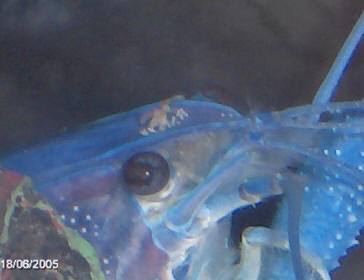
Blue Crayfish mis-mixed with African Cichlids 1/25/06 Hi there, <Hello> I just bought a blue crayfish from my local fish store this past Friday. He is in a 20 gallon tank with 4 smaller African Cichlids and a small pleco. <Too small...> For the first three days after I put him in the tank he really seemed to enjoy wandering around the tank and exploring the decorations. The fish bothered him a little bit at first, but they are starting to learn their lesson. When I came home today I realized I could not find the crayfish. I checked his usual hiding spots and when I lifted up the castle (which has an opening just large enough for him to fit through) I found one of his antenna in the gravel. I freaked out thinking one of my fish had ate him. I turned the castle on its side and eventually found him curled up where I could not see him. He has not come out of the castle at all today. Is he molting or is he just being shy? Should I be concerned? <I would be concerned... the Africans are harassing the crustacean... and will likely do so to its demise. It needs other quarters. Bob Fenner> Thanks so much, Chris My crayfish... 1/16/06 I have an electric blue crayfish I bought from the pet store about 2 months ago. Chomper is about 3 and a half inches long. She eats blood worms, Hikari crab pellets and the odd fish flake if she is still hungry. She has been a big eater since she came home. She shares a 20 gallon freshwater tank with 2 rainbow fish. There are live floating plants (were rooted but thanks to her they are not anymore), <Know what you mean> there are plenty of hiding spaces and gravel / sand for her to borrow in, filtration and aeration systems. The water levels and temperature are all normal. All was fine until 2 weeks ago. Her shell started turning brown with white dots. Her pinchers are still blue. Now she has a velvet growing on her joints and on the tip of her nose - I don't think that is what it is called, but it sticks out. She still runs around the tank and eats as normal but why is this happening and how can I fix / prevent this from happening again. <Mmm, I do hope this is not pathogenic... that is, caused by an infectious or parasitic agent... but from water quality, perhaps a missing nutrient> As far as I know she has not molted since she came here. She doesn't hide often and if she does she is out and about shortly after. I've tried taking pictures of her but as soon as she sees the camera she runs... everything I can find relates to worms and they don't look like that. Any information would be a great help. Thanks <Have you read Gage's Crayfish article and the Related FAQs on WWM? Please do. Bob Fenner> Crayfish Quarters 12/10/05 Hello <Hi.> I am planning on getting an electric blue crayfish (Procambarus paeninsularus) and I was wondering first of all what ph range they can live within. Would higher ph water ( more basic) be ok for him? The reason I am asking is that I have bought some Tufa rock which from the internet sources I have read raises ph past 7. <Slightly above 7 is okay as long as it is stable but I would not go much higher than that if I could avoid it.> When I was buying the rock the sales people told me it is an inert volcanic rock like lava rock. <<Most lava rock is not inert. The glass, obsidian, may be, but I don't believe so. Marina>> <Even if it is inert I don't like to utilize this rock with freshwater inverts. In a natural freshwater habitat (riverbeds and lakes) most of the rocks have been eroded over millions of years and are smooth. A molting invertebrate needs a place to hide and will likely choose the rocks, on coarse sharp rocks like limestone and lava they can snag and mortally injure themselves. I prefer driftwood and slate rock for this application.> My question is should the crayfish be alright with the Tufa rock even if it alters the ph? <Depends on how much, I would not go over 7.5. The key is stability but again I prefer not to use it.> I am also wondering is it true that this species only grows to 5 or 6 inches and lives in freshwater? <This is correct, I would read here for more detail though: http://www.wetwebmedia.com/ca/cav1i4/crayfish/crayfish.htm .> Thank you for your help. <Welcome, Adam J.> Crayfish With Worms? Parasite, or Symbiont? - 12/06/2005 Hi, <Hello.> I am a Veterinarian with very limited, if any, experience with marine animals. <Good thing crays are freshwater, then! <grin> > << <giggle> >> My son's 7th grade class has an aquarium with crayfish and he tells me that they have white worms on them, about 1/2" long. My question is, if he acquires a worm for me and I can determine whether it is a worm or a fluke, what would be the meds that I could use? Please include dosages and exactly how to administer the meds. I do have liquid Fenbendazole but it is thick and white, is this OK to use in water? Please help, if possible. <The real question here is whether these worms are actually a problem.... or whether they may be a *benefit* to the class Cray. It sounds like these are Branchiobdellids, which are often found on crayfish, and pose no threat to the animals. Though perhaps a little unsightly, these guys do seem to offer some benefit to the Cray, and apparently even consume damaged eggs of carrying females while not harming healthy eggs. Were it me/my class, I'd probably leave the worms be, and maybe make a sort of a project out of it to count the crayfish's "helpers" every now and then, and have a chance to learn about symbiosis. Here is a link with a bit of information: Worms & Crayfish .... Also, I recommend doing a Google search on "Branchiobdellid annelids"; using this term in Google Scholar might be a good idea, too. http://scholar.google.com/ . And.... to offer just a little extra (less satisfying) information.... There's just not a whole lot known or done regarding invertebrate pathology in pet inverts. The only real information in this area is in relation to the food industry, and culturing shrimp for food. The solution to pathogenic problems in the food shrimp industry is to destroy the affected stock, sterilize the affected system, and start from scratch. Of course, that won't help hobbyists, or hobbyist shrimp , and it certainly won't help a classful of 7 year olds with a beloved pet crawdaddie. This is a pet peeve of mine, and something that I hope will be remedied in the future.... One of my dreams is to go back to school for fish pathology, and try to forge a bit of a path for myself in invertebrate pathology.... but I have a hundred other dreams I desperately wish to pursue, so we'll see what happens.> Thanks, -Robin Rosen-Sharp DVM <All the best to you, your son, his class, and their Cray, -Sabrina> Crayfish Quarters 12/1/05 Hello <Hi.> I have read the article on crayfish but still have a few unanswered questions that I hope you will be able to help me with. <Sure.> My first question is do you think the crayfish would be ok in a 10 gallon tank? <Depends on the species but for one of the smaller specimens this could work. If it is the only specimen with limited decorations this could be acceptable but as I'm sure you know the bigger the better.> I am also wondering if it would be possible to put 2 crayfish in the 10 gallon tank or would that be too crowded? <I would go with one specimen.> I am also wondering if the Australian blue marron needs a heater and if so what should I set the temperature at? <I believe this species is on the larger side (larger than 6" if I recall correctly) <<There are many species of "marron".... This is a word like "crayfish", "crawdad", and "yabbie".... refers to many animals. Some crays stay quite small.... "The" Australian blue Yabby/marron/Cray (there are several; one in particular that is often available in the US) does grow a touch large.>> and would not be suited to a 10 gallon tank. It will need a tropical temperature. The 75 to 80 degree Fahrenheit range will be fine but don't let it swing a lot keep it stable. So yes a heater will probably be needed.> My next question is in regards to the setup. Maybe I will describe what I plan on doing and if you could tell me if this is the best environment for the crayfish or if I could improve anything. I plan to use a black sand as substrate with an number of larger lava rocks set up in a way to create a cave for the Cray. I then plan to distribute an assortment of smaller rocks all over the tank since I read that crayfish destroy plants. <Yes live plants and crayfish don't mix very well, but as mentioned above other than the cave I would use other decorations sparingly.> I also plan to run an adequate filter for the 10 gallon and a heater if this is necessary. <Without knowing the environment the tank is in (temperature wise) I will go out on a limb and say yes you'll probably want a heater.> Should I put anything else in the tank or would this be enough for the Cray to be happy and healthy? <Sounds good thus far for a smaller specimen.> Thank you for your time <Welcome.> Marcin Goman <Adam J.> Crays and Crabs? Nope. How 'bout Coldwater Flounders? - 11/27/2005 Hello. <Hi.> I have been thinking about setting up a 10 gallon aquarium for a blue Marron. I would like your advice on whether the crayfish would be compatible with one or more fiddler crabs. <Nope. Fiddlers all require fully marine conditions to survive long-term. It is truly a shame that they are sold (doomed) as freshwater animals. Though they'll keep tickin' for a few months with only freshwater access, it's not something that can last. More importantly, though, they absolutely MUST have land access.> I am also wondering if the two species are fairly easy to keep and if they are hardy since the blue Marron is very expensive in my area. I do have one more question for you Mr. Fenner. <Whups, you got me, Sabrina, today. Bob's out of the country right now.> I have purchased a fresh water flounder (very small less at most 1/2 inch long) today at my LFS and the worker told me it was from British Columbia. <Mm, I find this rather unlikely. The "flounders" available for sale in the aquarium trade are typically tropical animals, though a quick search on freshwater flounders of BC brought me this: Oregon State University piece . Here's the fishbase on this animal: Fishbase on a flounder. But probably, your animal is one of these: http://www.wetwebmedia.com/FWSubWebIndex/fwflounders.htm . If it IS the fellow from BC, an aquarium in your refrigerator might be ideal - this animal would not survive long at all in the temperatures needed for tropical aquaria.> She also told me it will only grow up to 4 inches long. <Better be hoping it's not that P. stellatus, then. That fish gets about three feet in length. I'd keep your fingers crossed that it's the one species of actually freshwater tropical flounder that we see often in the trade.> My question for you is do you know what this fish will eat, what kind of environment it likes, if it truly is like she said a freshwater flounder and finally if it will kill the rest of my fish (tetras and white clouds minnows)? <If it isn't obvious yet, please understand that you really must research an animal PRIOR to purchase, so you can be prepared for these things. The tropical flounders offered in the trade rarely take anything other than live foods, though you might have some luck getting them onto frozen meaty foods like bloodworms. As to its environment, I'd recommend you look at the species mentioned in Bob's article above and look them up (in Fishbase, Google, wherever you like) to find out more about each.> Thank you for your time. <Sure thing.> -Marcin. PS. I would like to clarify that the worker in the store told me that the flounder is interesting because it can be acclimated to freshwater, brackish water, and marine water. I did not take this too seriously because it sounds like this is highly unlikely. <Apparently the fellow from BC starts in freshwater, but by the time it's several inches in length, prefers increasingly brackish conditions. Again, I'm holding out a hope that it's not a large coldwater animal, or it and all the others the store is selling are, like the fiddlers, pretty much doomed. Please learn, and pass on the information you find so that others may learn - soon, you may be teaching the folks at your fish store. All the best to you, -Sabrina> Blue Crayfish Questions - 11/29/2005 Sorry to bother you. <No worries - 'tis no bother.> <<Why, we're here to be bothered! Marina>> I have searched through your website to gather as much information on Blue Marrons as possible. The following are the things I have been unable to find: Are these crayfish completely freshwater? <Yes.... Though there are some crays that will tolerate brackish conditions.> In other words would they be fine in a freshwater tank? <Yes.> Do they need access to air or can the tank be completely filled with water? <Completely filled is fine; and do make sure your tank is well-covered.> As for their tank setup the article on your site informed me that a 10 gallon tank would be sufficient for one crayfish, but I am wondering what would be the best aquascape for these animals. I am planning on using sand as a base, with an assortment of lava rock <I would use something a little smoother, if possible.> in order to create caves of some sort for the animal. I do not plan on putting plants in the tank since I have heard they will eat them. I guess my final question is does this setup sound like a good environment for the blue Marron. <Certainly.> If it is not I would really appreciate any input you could give me on setting up a good tank for the Maroon. On a side note if this should be of any relevance I plan to put a few white cloud minnows in the tank. I understand that there is a chance that the crayfish will eat them but I have read many forums where people claim they have had small fish live alongside the blue Marron in harmony. <It can/does happen. Just be aware that it is possible that the Cray may eat your fish.> Thank you in advance for taking the time to read and answer my inquiry. Your site is a very valuable source for new and advanced hobbyists. <And thank you very much for taking the time to research and share. Much appreciated.> -Marcin G. <Wishing you well, -Sabrina> Crawfish With Other Fish-Not For Long 11/11/05 I was wondering if crayfish pose any threat to fish or dwarf frogs, <Absolutely> both are smaller than the crayfish by a lot. < Crawfish are excellent hunters. Those large claws aren't for show.> I also have goldfish which are slightly bigger. Also, is there anything you can tell me about crayfish, Are they territorial? < You can keep more than one in a tank. They will fight too. The biggest problem is when they shed their exoskeleton. For a while after they shed their outer shell they are very soft and tender. Other crawfish will go after them and try to eat them before their shell hardens up and they are able to defend themselves.> Can you keep more than one in a ten gallon tank? < I think one would be plenty.-Chuck> Crayfish Food? - 09/11/2005 I saw some crayfish at my local PetCo and was considering picking up one. I have read about them, and for the most part there is ample warning that crayfish are semi-aggressive <Not exactly "aggressive", just "hungry".> and will eat any fish small and slow enough for it to catch. <True.> I need a bit more information than that. Would Otocinclus and other bottom-dwellers like clown loaches or catfish count? <Yes, especially the otos.> I also have some Singapore (aka wood, bamboo, etc) shrimp. How would they fare? <Less apt than the otos to become food, but still potential Cray food.> I have a 75 gallon tank and there's plenty of room. <You could try it, but realistically, you will probably lose some fish to the Cray. You could try other peaceful shrimp, though, like Atya gabonensis (another filter-feeder like the wood/Atyopsis moluccensis). Be sure to avoid those loveable "blue prawns", Macrobrachium rosenbergii, as they will decimate anything and everything in the tank that isn't large enough to eat them first. Definately take a look here: http://www.wetwebmedia.com/ca/cav1i4/crayfish/crayfish.htm - I know Gage's crays never bothered his common guppies. Wishing you well, -Sabrina> Crayfish Reputations? - 09/11/2005 We have a 70 gallon fresh water tank. About a year or so ago we bought a small blue lobster (Procambarus alleni?) <Likely, but other possibilities as well.> about 1.5 inches long. It's now a least 3 times that big and tremendously fun to watch. <They're great, aren't they?> Although there are said to not catch fish, <Who said? These and other crays are quite capable of turning fish into food....> I've started to notice that fish sometimes disappear. Do we have to choose between having fish or the lobster. <Mm, possibly; otherwise, have fish that are large enough (or fast enough) to not interest the Cray as meals.> If we no longer have fish, what and how much do we feed the lobster? <Greens (aquarium plants like anacharis/elodea/Egeria), thawed frozen uncooked shrimp, sinking fish foods.... lots of options. I would feed once every two or three days, probably.> I'd appreciate any advice you can give us. <You might consider getting him/her a mate and enjoy the fun of breeding these guys. Our crewmember Gage (awesome guy) wrote a great article on Cray behaviour, feeding, breeding, etc.: http://www.wetwebmedia.com/ca/cav1i4/crayfish/crayfish.htm .> Susie <Wishing you well, -Sabrina> Crayfish Reputations? - II - 09/13/2005 Thank you very much for your fast response. <You bet.> Gage Hartford's article was great. <Ah! Glad you enjoyed it; I'll tell him.> The only thing I still had a question about is the ph level they like. <Extremely variable.... Don't drop 'em below 6.8 if possible - they can go above 8.0 with no real adverse reactions. Wishing you well, -Sabrina> Crayfish/Yabby Deaths - 08/17/2005 We purchased a Yabby last week and put it in our small(ish) tank. We had been keeping danios so we were used to changing water and keeping clean etc. The water had been treated and left for 42 hours to get rid of chemicals - all seemed well. The Yabby looked well for 3 days then it became very quiet, I partially changed water, it didn't recover and died. <Any chance you have EVER used a copper-based medication in this tank? Any metal objects in the tank?> We bought another Yabby (we had liked "Godzilla" for the short time we new him). This time, just to be sure, we used our bigger tank, conditioned the water, washed the gravel and installed a filter. A day later (today) the Yabby shows the definite signs of soon demise -it's falling on it's back or side and doesn't move (except a little when I think it's dead and I go to remove it). WHAT are we doing wrong! <Not sure. I trust you are maintaining ammonia, nitrite at zero, nitrate less than 20ppm? pH somewhere between 6.8 and 8.5?> And why does it happen so quickly. My kids are scared off from getting anymore yabbies but they were so delighted with them and they paid for them themselves. Iodine is mentioned quite a bit on your site but usually in conjunction with molting problems. Neither of the yabbies showed signs of molting. <Mm, all the same, I think a lack of iodine may indeed be a problem, here.... If you do try another Yabby, please do considering adding iodine for a week or so prior to purchase.... You've seen the FAQs, so I assume you know I use and recommend Kent marine iodine at a rate of one drop per ten gallons each week (NOT the marine dose)? I have, occasionally, doubled this when adding new shrimp from somewhat disreputable stores.... My only other thought is that there may be something in the tank(s) that is actually toxic to the crays.... Copper is the very first thing to come to mind. Medications like CopperSafe, Cupramine, Aquari-sol, all contain copper. Something to think about.> Please help, Kelly (mother and grief councilor!) <Wishing your sad patients a swift recovery, -Sabrina> Crayfish/Yabby Deaths - 08/17/2005 Thanks for speedy reply. <Of course.> "Spartacus" died overnight (should have picked a longer-living namesake perhaps?) <Perhaps "Lazarus" next time, eh?> No copper, no medications -this tank was started from scratch with all new components and all prepared 24 hours in advance. The little fishes are still happy, water quality looks clear but i haven't the means to check chemical make-up (we were assured that these Aussie yabbies were cyclone proof, more like - don't breath too heavily!) <This reminds me of the importance of teaching folks how to distinguish healthy shrimps and crays from sick ones prior to purchase.... Can be tough, unless you know what to look for. Next time, find a Cray that is active, brightly colored and has a quality of "clarity" in the coloring.... very tough to describe, until you've seen the "opaque" look of a sick shrimp. Make sure the animal is interested in food prior to purchase, as well - if the shop employee puts in food and the Cray is not happily bumbling about looking for it, pass on that animal and look for a healthier one.> I'll try iodine if we have the nerve to try again. <Do please try again - I fear that the animal may have been quite ill prior to purchase, to die so quickly.> Thanks again for your help, -Kelly <Wishing you and your kiddos well, -Sabrina> Yabbie Thanks - 10/20/2005 Thank you very much for the quick response of my letter. The information you gave me is very useful. Thank you again! From Jarrad <I'm glad I could be of service, Jarrad. Wishing you well, -Sabrina> Crayfish page? I'm sorry I'm such a dork, I'm looking for a way to post a question on the crayfish page. My son caught a crayfish and wants to keep it for a week then return it to the creek. We made a tank with pond water and rocks. Now the crayfish stands on top of the rock with his back out of the water. We are wondering if he is going to die soon. My son is in Second Grade and is taking this pretty hard. Thanks for your help. Chad <Actually "crawdads" are pretty tough... and some are amphibious! Yours should be fine. Bob Fenner> Re: crayfish page? Bob <Chad> He made it through the night just fine. Thanks for your help. <Ahh, good to hear, read. BobF> Chad Crawdad with no pincers... Hello! I just saw my crawdad molt for the first time, and I have a question or two. I never even knew they molted, actually, but it does kind of make sense when you think about it. <Yep, have to molt to grow...> Anyway, my crawdad, Nixon (so named because when I first got him, he'd run around the tank with his claws open a la "I'm not a crook"), now has no pincers due to his molt... I've had him for at *least* three years, and he lost one claw in a battle with another, rather temporary, crawdad. Since then, he'd been doing fine with just one claw. But now I'm worried. He's about 6 inches long, and I'd never seen him molt before. I found all the pieces to his old shell, including his one and only claw. Will he be able to eat, and will the claw grow back? <Mmm, a couple things to impart to you... one, do leave the old exoskeleton in the tank... or put it back if you've removed it... "Tricky Dicky" can/will reincorporate this into its new outside... and do read on WWM re Crayfish keeping... they need adequate nutrition, sometimes iodine/ide additions, hard, alkaline water to grow, successfully molt... And will regenerate limbs if so kept> His other claw never did. Why did he lose the claw at all, was it a bad molt? <More likely insufficiencies in its system, feeding> He lives in a 30 gallon "pond" with three goldfish, about a bazillion snails, and lots of green mossy stuff that I think is called "bloodwort". I'm not worried that the goldfish will get him or anything, but I just wonder if he'll be able to function normally (i.e., can he still move rocks or get food?) . He's just a local creek crawdad, no special pedigree or anything. Thanks for any help! ~Ida <Please read here: http://www.wetwebmedia.com/ca/cav1i4/crayfish/crayfish.htm and the linked files on the bottom. Bob Fenner> Crayfish Worms 6.12.05 I bought a small blue crayfish from a local pet store. After he molted for the first time I noticed some white worm like parasites on the top of his head. These worms multiplied all over his body seeming to be located around joints and the bottom of his tail. These worms also seem to be getting longer as the days go by. Watching the worms closely I noticed that they seem to be trying to pick up food. I am very worried and can't seem to find any sites to help. Hope to hear from you soon... <Ew. I have not heard of white worms that hang out on Crayfish. Are they in other areas of the tank to or just on the Crayfish? It would really help if you could send us a picture. Gage>
Plastic Plants and Crawdads 6.11.05 Hello, I found you website using Google when I searched for crawdad pet info and was amazed at what I found here. I spent the a couple of hours enjoying the info you and your members had to offer. I am writing because I just received six - 1 inch crawdads from a local pet store. they now reside in a 15 gallon tank with only four feeder goldfish. I assume the conditions are fine for both groups. my concern is, in all of the material I have read so far I have not come across wither plastic plants will be eaten by crawdads, and if so can they be harmful? If you have any info on this subject, or can suggest a source for this info I would appreciate it. <As your crawdads grow they will most likely fight and kill each other, they are very aggressive towards each other and a 15 gallon tank is not terribly large. I had that problem in a 20gallon tank with 4 crawdads. Provide a lot of hiding spaces to reduce the aggression. I have been keeping crawdads for a few years now and have never had a problem with them eating plastic plants, I am sure they know it tastes like plastic and is not yummy. Your crawdads and goldfish both would appreciate some Anacharis (also known as Elodea), it is pretty cheap both critters would be happy to munch on it. Best Regards, Gage> thank you, Ryan Please Help I Don't Know How To Take Care Of My Pet Craw Fish Hi My friend just gave me a baby crawfish he is no bigger than 2 and 1/2 cm and he is in a small glass aquarium that's about a pint and a half . I don't know much about crawfish and neither did my friend. I just got over a loss of my pet rat so I felt that maybe taking the crawfish would make me feel better. I told my friend Lexi about him and she told me that she once had some pet crawfish she said that they basically eat dog bones and she said that you u have to put fish chemicals in the water so I did but that's all she really said. Here is what I put in the water... 2 drops of Aquari-sol and 1/8 tsp (6ml) of Tetra Aqua (Easy Balance water conditioner for fresh water aquariums) (eliminates frequent water changes). My mom basically said that's what I should put. I don't know anything about crawfish so I wanted to know if u can help me and tell me how to take care of them and if I am doing anything wrong. I didn't put any plants or rocks in it should I? Thank you for your time sincerely, Andy Ruvolo <Have a read here: http://www.wetwebmedia.com/ca/cav1i4/crayfish/crayfish.htm and the linked files at the bottom. Bob Fenner> Lost my Lobster, Losing my Fish Hello there my name is Cody, I have a couple questions, fist off, I just lost my blue cobalt lobster. We had him for about 6-7 months. My questions are, do you think that when he died if he could have gave the tank some kind of disease? <Possibly, but doubtful. Most FW crustaceans die from poor water quality issues, most of the remainder from a lack of nutrition> For some reason a few days before he passed away all of our fish looked and acted fine. Now that he died, just this past couple of days we have lost 3 fish. One of them, what looked like it was bleeding from the bottom of his fins, the others had red spots. Please help we are afraid that we are going to loose our other fish. Thanks a lot. Cody <Time to check your water quality, do water changes... Bob Fenner> Crayfish behaviour After one of my smaller crayfish died (yes I was very sad) I thought they may have lacked in oxygen. I didnt have a pump. (Could this have been the reason?) <Yes... or consequences thereof... e.g. no filtration> So I purchased a pump. It saves me from changing some of the water as often anyway. But Ive noticed all they do is climb on the pump and what appears to be eating bubbles from the pump. I have a lid so they cant get out but they also like to climb up and rest completely outside the water. Is this normal behaviour? <Sounds like this is so... perhaps this is a species that needs shallower water, or even to emerse itself at times. You might try to find out specifically what you have, use the Net search tools to determine its natural history. Bob Fenner> Sometimes they hang there for a good hour. Thanks for your help. Daniel Crayfish Safe Ich Medication Hello crew (probably Sabrina), <Sorry, Ya got Don tonight. Sabrina's birthday today. Hope she has a happy one> I apologize for resorting to e-mailing you, but I've searched quite a bit and I can't seem to find what I'm looking for. Neptune, my electric blue crayfish (Procambarus alleni), lives in a 55 gallon tank with a small selection of plants, 2 gold Gouramis, 2 blue Gouramis, a large Plecostomus (Jacques), a dinosaur eel (Scuttlebutt), a baby whale fish, and a temporarily small Arowana. I made the hasty mistake of dumping in some small feeder guppies for the Arowana without quarantining them. Now I have a fun little (deserved) ich outbreak. I've slowly elevated the temperature to the mid-80's (Fahrenheit) and added some salt. The ich doesn't seem to be giving in that easily though, so I am going to medicate my tank. I currently have Quick cure. I understand that copper is quite unhealthy for my crayfish. The Quick cure label only lists the active ingredients (formalin and malachite green). Is Quick cure safe to use with my crayfish? If not, is there another effective medication that is crayfish-safe? Would it be best to just remove my crayfish into my empty QT and medicate the main tank? If it is, I read that the too-small-to-see ich cysts can stick to a crayfish, so would my tank be re-infested when I moved the crayfish back? Again, I apologize for bothering you, but at least now anyone else with these questions will be able to find them! Thanks in advance for your help (again). -AJ in Florida <Don't use the copper in any tank where you may someday keep inverts. Months, and dozens of water changes, later it can still kill. If your QT is large enough to house all your fish for four to six weeks, move all the fish (but not the crayfish) and treat them in QT. Leaving the 55 fishless while treating in QT will starve out the parasites. If not then you will have to move the crayfish into the QT and treat the main. Treating in the main is a last resort as the meds will nuke your bio filtration resulting in ammonia spikes. This will require that you do many large water changes to keep your fish alive, replacing the med with each. Much easier (and cheaper) in a small QT. I would use heat and salt only, no matter where you treat. Your eel and Plec will be badly stressed by copper. Possibly to the point of killing them. Salt is much easier on the fish and 100% effective if used at the proper dosage, 76 grams per 10 gallons. For a 55 gallon that works out to 418 grams or just under 15 ounces. Make a brine out of tank water and add it back over a day or two. Take the temp up to 84. When ever you do a water change add the same concentration of salt to the new water before adding it to the tank. Of course you will need to test for ammonia and nitrite during any treatment. Continue treatment for at least two weeks after the last spot drops. Always use a gravel vac to remove water. The Ich reproduces at the bottom of your tank. You have a lot of work ahead of you. Get your fish off of feeders. And oh yeah, the crayfish. Just keep him away from any fish for the four to six weeks and any hitch hikers will starve out. He can not be infected. Good luck. Don> Yabbies Fighting Over Dinner I have 3 small Yabbies about 2 inches. They are fine but when it comes to feeding they fight. 2 have lost limbs from this. So I started taking 2 out of the tank and letting 1 feed at a time. I do this about every second day. How many hours can they stay out of water? Also occasionally I've feed the others outside of the tank. Is this safe letting them eat on land? <I would not rely on taking them out for any length of time. In nature they can come on land for a short time but how long they can stay out depends on the temperature and humidity of the air. Try and feed each one its own little piece of food in their own corner of the tank or add lots of PVC piping so they can hide and get away with their dinner.-Chuck> Blue Marron covered in Algae Hi, hope you can help. I've had a blue marron for a year now. In the first 2 months he molted twice and hasn't done so since. Now it looks like he may have external parasites on him, 1/4" long white worms, that stay in one spot but do sway in different directions. I also have a huge algae problem in my tank (72 gal) and now the marron is covered in algae too. I do water changes twice a week, vacuum the gravel, clean the filter (Fluval 304)every month. I have several large fish, 18" Pleco, 10" iridescent shark, and various other catfish. The fish get a diet of algae wafers, shrimp pellets, flake and sometimes fresh greens. There are also many live plants in the tank which grow at lightning speed, I have to keep cutting them back. The marron seems happy enough, eats well and travels the tank, I just wish he looked good again. Thanks Taru <Check the ammonia , nitrites and nitrates. The ammonia and nitrites should be zero. The nitrates should be under 25 ppm. If the nitrates are above the 25 ppm range then you may need to clean the filter more often and change more water. The parasite will be difficult to treat since the medication may affect the blue marron.-Chuck.> Worried about my blue lobster! I bought my blue lobster not even a month ago. She was very active, ate well (plankton cubes, blood worms so far.) She even ate a goldfish the night I bought her. Here's the problem, I fought the lobster on its back, and looked dead. I water sample was a high PH. The tank was warm and big enough. I cleaned the tank, corrected the water issue, and periodically check the water, put the goldfish in a separate tank, so the lobster is by itself. She came around again, to her normal self. About 5 days later she's on her back again. I understand this is molting I think, I can see the shell lifting off her. My question is, how long does the molting last, <Usually only minutes to a couple hours> is she dying? She's been upside down for 24 hrs. BUT when I moved her little house, she moved? I got a bad feeling about this. But do lobsters all have a different style to their molting? PLEASE HELP! thanks, from Kay in Ohio <May be that your water is too soft... do you have readings for pH, alkalinity? Do you supplement iodine/ide? Bob Fenner> Yabberin' about a Yabby Hi there We have a pet Yabby, named Minnie, and she has recently lost her shell and is looking great except for these black spots that appear to be spreading. The tank is always clean and we have had her for about 12 months and this is the first time she has had black spots. We have recently moved house and her tank now lives indoors with no natural light whereas previously she lived in a tank outside under shelter with exposure to natural light. Perhaps this has something to do with it??? Cheers Amy and Corey <Maybe... could be nothing, could be mineral content of your water, nutritional, perhaps an iodine/ide deficiency... Please read here: http://www.wetwebmedia.com/FWSubWebIndex/fwcrustaceans.htm the Related FAQs files above. Bob Fenner> Non-molting FW Crayfish I have had a blue crayfish for about 8 months. He seemed to be doing well, and, at first, he molted every four weeks about three times. He has not molted for about three months. <Mmm, perhaps a nutritional or iodine, other deficiency is slowing down its rate of growth/molting?> He is about four inches long. He lives in a ten gallon tank with no other creatures. I feed him algae wafers. He does not seem to like anything else. <Unusual> I give him shrimp pellets, and I recently tried frozen krill, without success. For the past two weeks, he seems like he can't see and as if he is about to molt. The problem is he has not molted and does not appear to be interested in eating. <Am wondering re this system water quality... do you test for pH, alkalinity? Do you supplement iodine/ide?> He would normally grab the algae wafers and come over to the tank when he saw us. Now he seems to walk around and remain still in one spot for hours, but does not respond to our presence. His water is clean. I monitor it for ammonia. His temperature varies with room temperature from 68 to 75 degrees. I don't know what to do for him, and I don't know what is going on with him. Please e-mail me at XXXX with any ideas at your earliest convenience. The pet shop told me to put a drop of Kent Marine Iodine in his water to help him molt. <Ahh, a good idea> I did this three days ago. Our water is alkaline naturally. Thanks, Louise <I encourage you to put the terms: "blue crayfish keeping" in your search tools and read a bit further re this animal's practical husbandry. It needs other food... Bob Fenner> CRAYFISH AMPUTEE Thank you for the quick response...one other question...In this same tank I have a blue crayfish...apparently, one of my Bala sharks got a hold of him right after he molted and ripped one of his big pincher arms off...all of it is gone. Will it grow back? < Yes but it may not be the same and take a few molts to get back to its original size.-Chuck> Blue Lobster - Not for Eating.. >>Hi, >>Hello, sorry for the delay, it seems that the folks best suited to help you aren't available at this time. >Hope you could assist me.. >>Me too. >My freshwater lobster has not been able to eat lately; it puts food to its mouth with its claws (legs I think) and yet the food seemed unable to go into its mouth. It had molted a few times since I bought it - the tank size is quite small but it is the only occupant as it will attack other fishes like the tetras, goldfish or even the Betta. >>Oh, yes it WILL. However, (be prepared, this may seem cruel, but I assure you it is not), should you wish to house it with fishes, the large claws can be pinched off. It is still able to feed with the small claws, though. >Is this quite common as it did not eat before it molted some time ago? >>Not unless there are water quality issues to the best of my knowledge. >But then this time around , it did not molt and cannot eat its food. >>This is problematic indeed. I do know that iodine (the lack of) can cause molting problems with many crustaceans, but do not dose/add any unless you can test for such. Have you tried searching our site? Start here (but this may not be the entire inventory on site) http://www.wetwebmedia.com/FWSubWebIndex/crayfishfaqs.htm >Thank you so much. Cheers - Ho [from South East Asia] >>You're welcome. Marina in the Northern Sierra Nevada Mountains.
Yabby Lifespan hey fellas I was wondering how long a Yabby lives for???? thanks <About three years. Bob Fenner> Crayfish With Ich? - 12/13/2004 Hi, I was wondering if crayfish can get ich. <No. Ich (Ichthyophthirius multifilius) is an obligate fish parasite - the Cray cannot be affected by ich. A Cray can, however, have ich cysts stuck to it, while the cysts are reproducing and before they become free-swimming in search of fish. These would be totally invisible to the naked eye, and can be stuck to anything from an infected tank - gravel, plant, and crayfish alike.> I have one that I saved from the feeder goldfish tank at my work. Once I got it home I realized it has what looks like ich on it. <It's more likely either his coloring or bits of detritus stuck to him. I wouldn't be terribly worried.> I can't seem to find any info on treating crayfish with ich though, which made me wonder if it is ich at all. <Very, very highly unlikely.> I do not want to introduce him to my tank if he could make all my fish sick. <As above, he can have (invisible) cysts stuck to him - I wouldn't be too worried, but it would be best to quarantine him anyway, as it is best to do before introducing any animal to your established tank.> I have a 20 gallon heavily planted (swords, and frills) tank with one Creamsicle and one silver Lyre-tail (sp?) molly, their new fry, a dragon fish, <This common name is applied to a few different critters.... but any one of them (Polypterus sp., Erpetoichthys sp., Gobioides sp.) will all outgrow a 20g tank in short order - and the last, Gobioides, is a brackish animal. Please research this fellah a bit, find out what you have, and what your options for it might be.> a rummy nose tetra, and a gold mystery snail. I really don't want to get ich and have to uproot my whole tank. <Agreed. Ich sucks.> Any info would be great. <As above, your absolute safest bet is to quarantine *any* new livestock before adding to your tank. BUT - this is pretty important - a crayfish really isn't a good tankmate for any of the fish that you've mentioned; any/all of them are more than likely to end up as crayfish food eventually. I urge you to set up a new tank for the Cray (even just a very, very simple 10-gallon setup would suffice). One cool bonus is that this is more than likely Procambarus clarkii, and you would not at all need a heater for his tank. Crayfish are unbelievably interesting animals to watch and care for, I think you would really appreciate him if you can give him a place to call home. I also urge you to read crewmember Gage Hartford's excellent and fun article in our online Conscientious Aquarist e-zine, on care and breeding of crayfish: http://www.wetwebmedia.com/ca/cav1i4/crayfish/crayfish.htm > Thanks, Candice <Wishing you and your crayfish well, -Sabrina> Blue lobster (crayfish) My blue lobster (about 6 inches) has repeatedly produced eggs she then carries on her feelers under her tail. What I would like to know is how to breed her with a male so that these eggs will hatch. How is the easiest way to distinguish between male and female lobsters? I know that the male has to hard feelers under his tail while the females are all soft....am I correct? And how do they mate? I understand that it would not be wise to keep to lobsters in a tank together for an extended period of time, but I have plenty of tanks, and only want to get a male to mate with my female. Please help!! Thank you in advance. <This one was way beyond me so sorry for the delay I had to do some research. I found a wonderful sight online though great help. Take a look at this http://www.crayfishworld.com/breeding.htm. Good luck, MacL> Crayfish parasites I have an electric blue crayfish which I purchased a couple of weeks ago at our local pet store. Over the past couple of days I have noticed some (5) small white creatures (approximately 1/8th inch) that are inhabiting around the nose and the base of the feelers. They look like a tube with 2 tiny arms at the top (one on each side) and as I was watching them one of them kind of flipped end over end to move up the crayfish's head. Also when I was feeding my other fish in the tank (33 Gal) and the flake food moved past one of these so called parasites it looked like it tried to grab it. Any ideas as to what these are or do you require further information. <I'm sorry I really am uneducated in crayfish other than catching them in the local creeks here, so I had to look up and see what I could find. You might look at this site which seems to really have a handle on crayfish http://us.geocities.com/crayfishdisease/pages/intro.html. Good luck, MacL> Thanks, James Crayfish in a Pond Hi, I was reading some articles on your web. My husband and I have put in a pond in our back yard and were wondering if we could add a few crawdads and what we do if we can. Is it possible and what would we need? <Certainly this is possible. If you have any slow moving or small fish, however, they'll likely become food for the crayfish (crawdads, crayfish, po-TA-toe, po-TAH-toe.... same difference). They're pretty equal-opportunist eaters; I'd suggest feeding with something that sinks quickly, to prevent your fish from getting the food before the crayfish, which would starve the crayfish and force them to snack on your pond fish.> Do they crawl out? <Not really; it'd be a good idea to keep the water level a touch low, just in case.> Could you give us some ideas? We live in the Eastern Sierra Mountains in Ca. <Look into what species are native in your area, for best results.> Thank-You Sandi <Any time. -Sabrina> Blue Water Lobster Dear Bob <Hey there - I'm not Bob, but I am the freshwater invert-obsessed Sabrina - hope I can shed some light on your new critter.> We have a Blue fresh water Lobster but are having a few tiny problems with him/her and wonder if you may have any answers? <Hmm.... I've seen a few different animals that fall under this name, any of which might be the critter you've got. It could be any of a handful of Procambarus species (crayfish) that is blue or has a blue form; or could be either of two blue Macrobrachium shrimp species - M. rosenbergii from Thailand or another species from Mexico. A picture would go a long way to identifying it, if you've got one.> He is attacking the big Plec and ripping the Pleco's fins. He has also started recently to kill the smaller fish by grabbing them with his claws. <For any of the species above, this is quite normal.... they don't play well with fish.> Is there any way we can stop this? <No, not really. Separating him from the fish is pretty much the only way to end the carnage.> We have now put in a ceramic pot and cave entrance to give him a safe cover, will this help combat the problem? <No, unfortunately. Regardless of which of the above critters it is - they're aggressive, and fish-hungry.> We feed him on prawns <Excellent food for 'em> and specially bought crab cuisine which states is ok for Lobsters. Should we be feeding him anything else? <Ocean Nutrition's frozen Formula One is a good food choice.> We have looked everywhere for a book on Lobsters but have had no luck. <Do some google searches on 'blue crayfish' and 'blue prawn', as well as the above Latin names.> He is now about 4 inches long without counting the claws. <And will grow about twice that> He is shedding about every three to four months and eats his shell afterwards. We have had him now for ten months and has shed three times. He is showing signs of being due for another shed as he is constantly laying on his side and acting as though he is dead, which we have noticed he does this just prior to shedding in the past. <I don't think that's a good sign.... perhaps try adding iodine to the tank (use Kent's marine Iodine supplement); one drop per ten gallons every week.> He is constantly shoveling the stones about, we have had to change from a sand bottom as he kept blocking the filter with the constant moving of the sand. We now have an undergravel filter. If you have any information that will help our Lobster Rocky to have a good life, would you please be so kind and inform us? <I am sorry for the news that he'll be always incompatible with most fish; he may warrant a tank of his own. There are a few fish compatible with these animals; do some google searches to try to find out exactly what you've got, and hopefully that'll help you out some. Wishing you well, -Sabrina> Thank you in anticipation. Yours sincerely Mr. John Edwards Freshwater "Lobster" Troubles Hello, <Hi Lace, Sabrina here today> My Daughter has a 10 gallon aquarium, in it she has a blue lobster. <Just to clarify, in case you're interested, this is probably either one of the blue crayfishes available in the hobby, or perhaps one of the two Macrobrachium shrimp species available that are blue.> It appears it has now gotten a thread like thing on it. She thinks it could be worms. It's condition has gotten worse and I would like to know what to do to get rid of what it has. <I'm afraid this is kind of vague.... Could you please describe this in more detail? Are there many of these thread-like things? Where are they located on the animal? How are they attached? Does it look like it's part of the shell (perhaps coloration), or are they sticking out? If there is any way you could email us a picture of the animal and its condition, this would help tremendously.> Could you please give me some advise on how to help it, I've grown quite fond of it and would like to help get rid of these things, what ever they may be. <To try to figure out what these thread-like things are, I really do need some more information, as above. It would also help to know what else (if anything) is living in the tank with it, how long you've had it, how large it is, and what the water parameters in the tank are (Ph, ammonia, nitrite, nitrate). If you don't have test kits to find out your water parameters, you can take a sample of your water to the fish store, they should be willing to test it for you. I'd also like to mention here, it is very beneficial to add aquarium iodine to tanks with freshwater invertebrates; I use Kent Iodine, marketed for saltwater aquariums. Only one drop of Kent Iodine for every ten gallons once a week really vastly improves invertebrate health. I have seen this in my own shrimps and even the few large snails that have escaped removal. Just a side thought. Please get back to us, Lace, and let us know a bit more details on your pet's condition, and we'll do our best to help you out. -Sabrina> Thanks for your help. Sincerely, Lace Ditch Bugs Hello guys and thank you for taking time to read this Recently I caught some crawfish to cook at home... I kind of felt bad so I took the two smallest ones "about three inches long" and put them into my freshwater tank "75 gallon" with the rest of my fish....two Bala shark one red tail shark a striped cat and bushy nose Pleco. to protect my fish I removed the part of their main claw or pinchers that moves to pinch. <Youch! I am not familiar with that practice.> my question is what effect can the craw fish have on my tank. i.e......cleanliness and stress on the fish... or how do they breathe and what do they eat? or if I should just take them out? thank you for your time!!! <I have 4 crawfish in one of my sumps, they are more entertaining than the fish in the main tank, they will eat just about anything, I feed mine algae wafers and whatever leftover pellets or frozen food I have sitting around at feeding time. I doubt your fish are in too much danger, in fact, if your catfish gets big enough, your crawfish may be in danger. They are good scavengers, I'd keep them. Best Regards, Gage> Yabbies Hello, We have some red claw yabbies in a tank. One is a female and she has been carrying eggs under her tail for about 7 weeks. They have just hatched and I noticed her in her pipe lying on her side motionless. She appears to be molting because her body seems to be breaking out of her shell. She was moving around well last night. My question is how long does the molting process take is it hours or days? I must admit she doesn't look healthy, but then I suppose losing your shell would be a hard task. I would appreciate your input because I can't seem to find anything of the Internet about it. Regards Kim <Hi Kim, the last time one of my crawfish molted it was over matter of days, it stayed secluded for a while, then I found bits and pieces of shell everywhere, I thought he had been munched. Then a couple days later, he was back. After they molt they like to stay secluded while their new exoskeleton hardens. They are vulnerable to cannibalism while they are still soft. The article below may provide you with some more info. Best Regards, Gage http://216.239.57.104/search?q=cache:E_IVJdpNrGMJ:aquanic.org/publicat/usda_rac/efs/srac/244fs.pdf+yabbie+molting&hl=en&ie=UTF-8 > Here comes another one, just like the other one Hi I wrote to you last week but did not see an answer posted. <Wow, my deepest apologies! We do try to get everything answered right away, I'm sorry this one fell through the cracks.> My question is... can lobsters and snails live in the same tank? The reason I ask is because two days after I put a snail in the tank with my lobster my lobster died. He died on his feet, but the night before he died he had flipped over onto his back twice. Could it have been the ph? <Woah.... Dude.... De ja vu and a half! I'm sure this is related to a correspondence I just had with another person about the exact same topic, but just in case, all the info again: Assuming that the snails and 'lobster' are freshwater, as I was told in the other correspondence, I feel that the 'lobster' death is likely unrelated to the snails. Test the water for ammonia, nitrite, nitrate, and pH; if any of these are out of whack, it could be what did in the little crustacean. Your little lobster (actually, either a Macrobrachium shrimp or a crayfish) may possibly have just suffered a bad molt. Sometimes, when they shed their old skins, the new shell doesn't harden properly or tears, or has some other sort of complication. This is one of those things that can 'just happen'. The best way to avoid it ever happening in the future is to dose the tank with iodine (I use Kent marine) at a rate of one drop per ten gallons every week. Beyond this, the only risk in keeping these two animals together is to the snails - I wouldn't put it past the shrimp/crayfish to decide to dine on escargot some day.> I would greatly appreciate any input. Thank you in advance! Deysha Rivera <Hope this gets to you properly, this time! Wishing you well, -Sabrina> Murderous snails? dear sir, <Or maam? ;) Sabrina here today> my boss has requested me to ask you for some information regarding snails and lobsters. <First chunk of info I need here - are we talking freshwater snails and lobsters, or saltwater snails and "lobsters" (crayfish, Macrobrachium shrimp)??> You see, she recently put two snails into the same tank as her lobster. <Do you happen to know what kind of snails, and what kind of lobster?> Three days later, the lobster was dead. The day before he died, he was exhibiting sluggish behavior and even turned himself over onto his back twice? <Two things come to mind; one, that he had a 'bad' molt and didn't survive it, or that water parameters were out of whack - what are/were your readings for pH, ammonia, nitrite, and nitrate (and salinity/specific gravity and calcium, if we're talking saltwater)? Is it possible that the slugs murdered him with their deadly pH? <Uhm, I'm a touch confused, here.... snails, or slugs? And by "their deadly pH" what do you mean, exactly? Did the pH change after you added them?> I would appreciate any input you have on the occurrence. Thank you for your time. Cricket McLeod p.s. it was a little blue lobster. <Just a touch more info (FW or SW, water parameters) will greatly help us to help you. Wishing you well, -Sabrina.> Murderous snails? continued He/she was a fresh water little blue lobster (well that is what the pet store told me anyway) about four inches long. <Likely either a Macrobrachium shrimp or a blue crayfish then; a few species of these are often sold under the name "blue lobster".> Fresh water snails also. I don't know what kind light brown in color, does that help? <Since we're talking freshwater, I think the type/species of snail is irrelevant; there are a few marine snail-types that are quite venomous; although it'd have been a long shot, it was a thought.> Not sure if the water was out of whack. I did not test it after adding them. Could the snails have altered the ph, ammonia, etc..? <If one died, yes, but other than that, I'd think it far more likely that the water quality was going downhill (do you change water regularly, vacuum gravel, etc.? how big of a tank?) or that the 'lobster' simply had a bad molt. This threat can be avoided (though not completely eliminated) by dosing the tank with Iodine (I use Kent marine) at a rate of one drop per ten gallons every week.> But if all ph, ammonia, etc. is normal is there any reason they can not live together? <Well, these (both the big arm shrimps and the crayfishes) are really equal opportunist eaters. I remember as a kid feeding crayfish in a friend's pond stale potato chips (not a good idea, though!). I might be concerned that the 'lobster' would decide to munch the snails, but that's the only issue I see with it.> thank you again! <Sure thing! -Sabrina> "Lobster"/snails continued The "lobster" lost it's shell about two weeks prior to the addition of the snails. It ate it and all appeared fine after that. <I would probably suspect water quality issues, then.> If I do choose to purchase another one do I add the iodine after it losses the shell? <Add the iodine weekly, every week, one drop per ten gallons.> Surprisingly enough the "lobster" did not bother with the snails. <It may be one of those things that it's just a matter of time, or they may live in harmony forever.> Once again thank you I won't bother you any more. <Not a bother! That's what we're here for. Wishing you well, -Sabrina.> Red lobsters I have a red lobster which was very happy but just recently he has stopped eating. he normally eats cockles and that crab and lobster food but as I say he has just stopped. he has shed his shell once and keeps climbing up the plants to the top of the tank. could you please help.<I would check your water quality (check for nitrates, nitrites, ammonia, and copper) invertebrates are sensitive to copper (which could come from your tap water) if this is the problem you will have to purchase RO/DI water if you want your lobster to live, otherwise just keep trying to feed him different types of meaty foods...like silversides, krill, mussels etc, Good luck, IanB> thanks, mark, United kingdom Crayfish Kicking the Bucket? >Hi, >>Hello. >I have a blue freshwater crayfish, and I think he might be dying - he's been on his back for about a day and he doesn't move around much. >>Not sounding too good. >Every once and awhile he moves his legs, but some of them are at a funny angles. >>Sounds as though you're describing a roach sprayed with Raid. >He previously lost a claw, and I am wondering if he's trying to molt and is having trouble with the regeneration of his claw, or is maybe stuck or something. >>Difficult to tell. For the most part, I've found mudpuppies both easy to care for and mighty good eating (born in New Orleans, hope you can understand the sentiment). They lose claws all the time, and in shipping we tend to find better behavior within the group of we go ahead and pinch the claws of those with larger appendages. >I talked to the fish department at a pet store, and they said that sometimes a molt goes badly and the animal grows back into the old shell. >>Um.. I've not quite heard this sort of explanation, "Grows back into the old shell". A molt can go badly, but it's a bit uncommon, especially with animals as (relatively) hardy as crawdads. >Could this be happening, and if not, what is? >>This is very difficult to tell. I would first wonder if you had VERY soft water with little mineral content. Unfortunately, even if you do, it may not be of any help to buffer it at this point. >Is he dying? >>It doesn't sound as though he's in very good shape at all, I'm sorry to say. You haven't mentioned any water testing or parameters, and this could be an issue. I suggest testing for the usual suspects, and doing a water change anyway, trying not to disturb him. >Is there any way I can help him? >>As above. >Any advice will be well appreciated - I love this animal! Thanks! Robin >>Beyond what I've mentioned above, I can't offer much more in the way of help for your pet. If it's a very large individual, he could just be old. In any event, I would still test the water and do a change or two, just in case. Marina Blue Lobsters He Says! >I am writing to you from England! >>The very same Merry Olde?? I have mates in London, at Oxford, and in Yorkshire. >I was wondering what kind of Lobster would be good in a 100 gallon tank? >>Tank of what? Freshwater? Saltwater? Would the tank be dedicated to the lobsters? >If there is one how many should I get? >>Generally, be careful with these crusty crustaceans. They have a tendency to quarrel, take unwary fishes, that sort of thing. If you want more than one, then get several (displacement of aggression sort of thing). >If they are solitary are there any fish you can keep with it that WON'T get eaten? >>Well... again, I'd need to know if we're talking fresh or saltwater. If fresh, then it's going to be tough, as the fish that won't get eaten will likely eat IT. If you've got the stones, you can place it with more peaceful (but larger) fish, and pinch their claws. Doesn't hurt them, as this is par for the course for such animals (again, I'm talking about freshwater animals here). Please reply soon. >>Is this soon enough? Even for a non-emergency, eh? Yours sincerely Dom. >>You're not "Dublin" Dom, are you? Sister attending Oxford by the name of Marie-Elise? If so, I still have great chuckles about that little misunderstanding, hope you're not holding my hearing/perception issues against me <giggle>. Marina - Crayfish Parasites - I have two freshwater crayfish (they are probably Florida Crayfish and they are approximately 3" long) in an Eclipse Six Tank. We have had them a few months. I just noticed many parasites on them. They look like small white worms approximately 1/16 - 1/8" long. <Quite likely one or more varieties of Branchiobdella which is an obligate crayfish parasite.> I also see white specs all over the glass. How do I kill these parasites without killing the crayfish? <Hmm... well, I had to look this up on the Internet and actually used Google and put in the subject of your email, "Crayfish Parasite" - if this is indeed Branchiobdella then there is no known treatment. Do not introduce these crayfish into the wild or to other captive crayfish as the parasite will spread.> Please advise A.S.A.P. Thank you. <Cheers, J -- > Crawdaddies Hi, I need help!! I work at a Nature Center and received a donation (unwanted pet) of a mother craw fish with about 60 babies still clinging to her tail. <You lucky Dawg, I love those little things, just added 4 to one of my sumps.> They soon dropped off and began to grow. Mom thought they were tasty and started feasting on them. <They are tasty.> She now has a tank of her own. Well, the young one are growing, and range from 1/4 inch to 1 1/2 inches and are still light blue and soft (mom is gorgeous and deep red). The problem is now the babies are eating each other (and they get fed very well! Spoiled in fact) Will this stop when they are grown and have a hard shell? Is it territory? And what does one do with 30 or so young craw fish without 30 or so separate tanks?? Any help would be fantastic! Thank you, Michele <I wish I had a better answer for you Michele, they are cannibalistic, which really becomes a problem when their shells are soft (young or molting). I would try putting them in as large of a tank as possible with as many nooks, crannies, hidey holes, and a sandy substrate to dig in, feed well, and hope for the best. As for what to do with them... In the words of Hank Sr. "Jambalaya, Crawfish Pie, and File Gumbo" throw in a 6pack of Abita Turbo Dog, some friends, and you've got a party. http://www.foodnetwork.com/food/recipes/recipe/0,,FOOD_9936_4985,00.html Or you could try to find homes for them, they make very entertaining pets. Best Regards, Gage> I Love to Eat Them Yabbies! >Hmm...I aimed my last note at Sabrina, but now I suspect it is Marina who is the Crayfish lover >>Umm... I am, but I love to EAT them. I know a little bit, though. >...anyway, any help, from any of the crew, regarding the odd-angled leg, much appreciated, Andy >>A Crawdaddy with an oddly-angled leg? Post molt, maybe? You could actually just pinch it off, and it'll grow back with the next molt. Same thing with the claws, if it's getting too aggressive, just take 'em off (with the bigger ones I'd use some kitchen shears to get a clean cut). Sounds awful, but they encounter lost limbs all the time in nature (do it to each other, you see) and have ways of dealing with it. Know that such inverts appreciate having "biominerals" available; iodine and calcium are what's needed to proper shell formation and the like. You may want to test your water, though I couldn't tell you what proper levels for a freshie would be (iodine), and calcium.. hhhmm.. I know I'd like it to be in the range of, oh.. say 350-400 (tested on a calcium kit), but don't know if that's what we're shooting for fresh, either. I'll suggest at this point that you ask the folks at ThePlantedTank.com, I think there may be someone who knows. Marina This Yabbies Ain't For Eatin'! >Thanks Marina... >>You're welcome Andy. >I append the full note explaining the leg thang. Gage reckons leave it alone. I just am not sure what's best. Any further advice much appreciated. >>Sure thing. >Here we go: I have a little blue crayfish, nearly 3" long, 2 years old, called Lopez. >>Aahh.. a blue. These animals are more inbred, and thus more prone to such problems. >At the last molt (Sunday) he got a let stuck and when he finally got it out, the leg/pincer was at an odd angle, kind of backwards, clumsy looking. >>Alright. >He is moving and eating (lots) and can still use the leg and pincer, but it is certainly not right. It is bent backwards and gets in his way when he tries to hide in his jar/burrow, though he gets in in the end. I am wondering whether to somehow tweak it off (ouch) so he can grow a new one. But really, I am scared to hurt him and would rather think he will be fine and that he is not in pain as he is. >>I don't think he's in pain at all. Remember when I told you how these animals lose limbs all the time? It's true, and this is no more harmful to them (to lose one or two) than a lizard its tail. It causes them little to no distress. When I was working import/export it was standard to remove the claws of the larger animals, or else they'd tear apart those with smaller claws. As I said before, a pair of kitchen shears would make it clean and FAST. No worries, really, just do it at the joint. This would allow Lopes (I love that name) less struggle with regrowth and shedding of the new limb. In the meantime, let's do be sure he's not in need for iodine or calcium, as I mentioned before. >What do you think? How can I tell? >>Well, we can't really tell, it would be difficult to see things as Lopez does. But, what's natural for him isn't quite natural for us and vice versa. If I were close by I'd come and do it myself, it literally takes less than a moment. >And if you think I really must tweak it off, any advice on how to do so...?? >>If he's got large pincers, then take him up with a towel, he can be out of water just fine. Take those shears, aim, and SNIP! Quick as that. Then, put him back, give him a hot dog or some such treat (maybe a bit of shrimp, that would be a good source of iodine, eh? Raw, please) and he'll forget about it before you do. Then, watch out for future molt issues, it may indicate need for biominerals, as mentioned before. >I really like this little fellow and want to do my best for him. Any help appreciated. Cheers, Andy >>No worries, Andy. He's not competing for food with anyone, so as long as he's not really struggling (if you lose your nerve to snip the dicky leg) and feeding he should be fine. Marina Blue Crayfish Dear Crew, especially Sabrina, <Sorry, I stole the email from Sabrina, Gage here, your local Crawdaddy fanatic.> I have a little blue crayfish, nearly 3" long, 2 years old, called Lopez. At the last molt (Sunday) he got a leg stuck and when he finally got it out, the leg/pincer was at an odd angle, kind of backwards, clumsy looking. He is moving and eating (lots) and can still use the leg and pincer, but it is certainly not right. It is bent backwards and gets in his way when he tries to hide in his jar/burrow, though he gets in in the end. I am wondering whether to somehow tweak it off (ouch) so he can grow a new one. But really, I am scared to hurt him and would rather think he will be fine and that he is not in pain as he is. What do you think? How can I tell? And if you think I really must tweak it off, any advice on how to do so...?? I really like this little fellow and want to do my best for him. Any help appreciated. <I vote to leave it, I do not think it is worth the stress of breaking it off. Chances are he will correct it himself in the next few molts. Best Regards, Gage> Cheers, Andy Blue Crayfish, cont'd Many thanks for the swift reply. I am inclining towards leaving it. <I definitely agree with Gage here, better to leave it.> If he was in pain, I think I'd see differences in his behavior wouldn't I? <I would think so, yes. If he's eating, acting normal, let 'I'm be.> He looks to be acting as usual, but with a dicky leg... Andy <I would strongly recommend adding iodine to his tank if you don't already, and if you do, to increase the amount by just a bit until his next molt. I use Kent marine iodine, at a rate of one drop per ten gallons every week. Wishing your lame pal a swift recovery, -Sabrina> White worms? Thank you for the help. <Glad to be of service.... I do hope for the best for your crayfish.> Will the worms hurt crayfish? <I'm afraid I cannot find a correspondence of yours regarding white worms; please re-send, with prior correspondences attached if possible, or if not possible, please describe the details of the situation with the white worms; it is difficult to impossible to offer help based on so very little information. Please do get back to us, and we'll be glad to help out. Wishing you well, -Sabrina> White Worms, and a Big Lack of Info - II - 02/04/2004 I really don't know anything about them. <I understand that much - but I don't know anything about what you are asking. Please ask your full question, tell us what you are seeing in the tank, describe these worms, where they are in the tank, how big they are, any and all details you can. Without knowing what you're asking, I can't help you. Just asking if white worms will hurt your crayfish doesn't give me enough information to answer you. For all I know, you are using white worms (a food worm) to feed the crayfish; I have no idea what you are asking. Please be more detailed; I'd love to be able to help you. -Sabrina> Cherax quadricarinatus - Red Claw Crayfish/"Lobster", Molting Issues Hi I have a red claw lobster and it is laying on its side and it is still moving and it looks like it is molting because some of the shell is off. I was wondering if it is molting or is it dieing. <Tough to say, I'm afraid. Laying on his side is not a good sign, I must say. It does sound like he's having difficulties with molting, a "bad molt", as it were. At this point, the best you can do is wait and see. In the future, though, please consider adding iodine to his tank, to help him with his molts in the future. I use Kent Marine iodine (marketed for saltwater tanks) at a rate of one drop per ten gallons every week. The difference this tiny bit of iodine makes is truly amazing. Since using iodine in my freshwater shrimp tanks, I haven't lost a shrimp to a "bad molt". For now, just leave him in peace, and hope he recovers. If he does, do please start dosing iodine in his tank to prevent this from happening again; if he doesn't, well, at least you know you can prevent it from happening to future pet crayfish. My fingers are crossed for your crustacean pal.> Can you e-mail me back at XXXX please. <Done. Wishing you well, -Sabrina> Cherax quadricarinatus - Red Claw Crayfish/"Lobster", Molting Issues, II (01/31/2004) I am sorry for e-mailing you back here it's just I don't know what XXXX means. <Since we post these questions and answers for all our readers to read, and you had posted your email in the text of the message, I removed it; that's all the X's were for. While on this note, though, the text sent back with this reply was very, very jumbled; I hope that it made it through to you okay.> My lobster has been laying on it's side for 3 days and only a little bit of it's shell is off. It looks like he is trying really hard to get the rest of the shell off. What should I do? <If there are any other animals in the tank with him, it'd be a good idea to quarantine him separately to help him recover. Then I would certainly add iodine (I use Kent marine iodine at a rate of one drop per ten gallons) to his tank; this might help him out. Further, you should definitely check your water parameters (ammonia, nitrite, nitrate, and pH), and ensure that ammonia and nitrite are zero, and that nitrate is as low as possible. If not, do water changes to correct the issue. Any of these values being too seriously out of whack could cause harm to your crayfish. Wishing you well, -Sabrina> Lobster Attack Hello, I recently purchased a black ghost and enjoy him. I had him with a pair of tiger barbs and a pair of iridescent sharks, and 1 lobster. When I went to check on him I saw the lobster had the knife fish in his claws. I separated them and the tail of the knife fish is badly injured. He is resting on the bottom on the tank on its side and sometimes on its back. I took the lobster back to LFS and got an channel catfish. The Knife doesn't seem very well and was wondering what I can do to help him. Thanks Pat <<Dear Pat; good job on taking back the lobster. They are aggressive and are quite capable of trapping live fish in their claws. For the black ghost, you need to be sure to test your water. Test for ammonia (should be zero), nitrites (should be zero) and nitrates, as low as possible, around 20-60ppm is best. You need to be sure the water is clean to prevent secondary infections of the wound. You can also add some Melafix to the tank water, to help him heal up. I hope he was not internally damaged. How big is the tank? That channel cat will grow 2 feet long, almost as big as the iridescent sharks. -Gwen>> Yabbies Hi I was thinking about purchasing a yabbie, and all the sites I have looked at have said nothing that can help me. I was wondering how much space and how many gallons would be needed for 1 yabbie. -Cristi <Hey Christi, if I were to house one yabbie I would not go any smaller than a 10gal. I have 4 in a 29gal that have bred and so far the young are growing up healthy and happy, I am amazed there are still some left, these guys have not problem eating their own. I do have problems with aggression and will be moving them to a larger tank soon. I like to feed mine the clippings from my plant tank, these guys love live plants. Best Regards, Gage> Yabbies, Pet Crawfish? Hello - I am a huge fan of crawfish, Yabbies as I have heard them referred to. However, I prefer them steeped in a spicy stock and served up with potatoes, corn, and sausage. (Sorry to all those who disagree) Here's my question....my son (he's 11) usually helps me when I cook outside (BBQ, fish fry, crab boils, etc.) This weekend we had a crawfish boil and he managed to keep a few hidden from me. Now he would like to keep them as pets. he has a tank with platies, and a swordtail. I am certain the crawfish would eat them as soon as he could get his claws on them! So tell me, PLEASE, what could I do or should I do to keep them in captivity and keep them alive? He has 3 of them about 3 inches in length each. <I have kept crawdads for years as a kid and never really had any problems with them. One per tank is best because they will just fight with one another. They are scavengers and will eat anything including the other fish you mentioned. The are messy to and will require a good filter and lots of water changes to keep the water clean and to help reduce algae.> I currently have an African Cichlid tank with lots of rocks. It's a 35 gallon tank and has 15 Cichlids about 2.5 - 3 inches each. Would they be compatible with them? I know the Cichlids are aggressive, and so are the crawfish! Who would eat who? < The African cichlids would be too fast for the crawfish to catch them. In the wild they live with large crabs so they know their way around. When the crawdad sheds its exoskeleton it will become a living breathing mobile banquet block and be eaten by the cichlids and never seen again.> What do you recommend? What kind of water conditions do they prefer? What kind of filtration is necessary? What size of tank is needed? What types of substrate is best? What kind of set up is needed? I would like to get away as cheaply as possible. These crawfish were not bought at a pet store, so I don't think they were bred to be kept as pets. My guess is they won't live for too long, but I don't want to break my sons heart. I would like to put forth some effort to keep them for him. (By the way, I had to get him a happy meal while we ate today!) Thanks so much for all your help! < Get one of those 10 gallon starter kits that you see at the fish store all the time. You don't need the heater though. Place about one inch of inch of washed sand on the bottom and somewhere for him to him. Watch for chlorine in the water and copper from any new plumbing. They will any type of sinking pellets. Just make sure to not overfeed and pollute the tank. He will need to change a couple of gallons of water every week until the bacteria get established. -Chuck> Cherax sp. with a Doritos Diet? Hello there! <Hello! Ryan Bowen with you today.> I'm Tracy, nice to meet you! *waves* <Ah, nice to meet you as well> We just got a pet crayfish recently cause the people at my mom's office got tired of taking care of it.. =( <Too common, sad> But we're doing our best to take care of her now. <A fishkeeper is born>. I learnt much about how to do that from your site, so many thanks! And I identified her gender, which no one bothered to do in the 1 year they had her!! *rolls eyes* <Nice work!> Anyway, she was very active for a few days and climbed all over the tank exploring.. or whatever it is crayfish do.. but we're quite concerned now cause for the past few days she's been hiding in her hole most of the time and staying very still for long periods of time. Even at night, she only gets out to climb around for a bit, then she's back to hiding. At first we thought she might be molting, but nothing has happened for 5 days. Does preparing for molting take that long? <It can, and after the animal molts it will remain hidden as the shell is not hard yet.> Or is there another reason for her behaviour? We try to keep the tank clean.. uneaten food is taken out after a few hours. About 20% water change every week. We feed her sinking fish food and bits of peeled tomato. There's limestone in her tank. I am not sure where I can find iodine in my area, does feeding her fish/prawns occasionally work as well? <Water changes alone should be plenty of trace elements.> Shy says hi! I'm not sure what species she is.. she's blue all over though! <Cherax sp.> The brown markings are actually algae cause her previous owners fed her potato chips and didn't clean her tank enough. *grumble* <I'm not surprised that your pet is "adjusting" to her new environment!> She's about one year old and is 5 inches long. <That's about as large as she'll get. Feed sinking algae pellets, and supplement with some small, meaty items for best coloration.> And very adorable! Thank you for bearing with me, I can get really long-winded at times.. =) <No worries! You ought to hear how long those "reef" guys get.. sheesh! ;) Ciao Tracy!> *hugz* Tracy Crawfish Caviar I purchased a blue marron <crayfish> about 3 weeks ago. She (I'm assuming - I haven't really looked) She was out and about for the first week then, after her grand escape and recapture, has been in hiding until today. I had to see what was going on since the last one that went into hiding got stuck and died the cave (very smelly situation). Anyway when she finally came out I noticed many eggs attached under the swimmerettes (sort of dark in color) She soon went back into hiding and was very eager to do so. I never noticed any eggs when I got her. What happens now? time line wise. Does she need a male to fertilize the eggs? <Sure. Females usually "berry" from 1 to 3 weeks after mating. If she was with a male before you got her, then there is a chance you will see a hatch. If not, no chance> How long is the whole egg to crayfish process? <A lot of variables. Species, water temp etc.. The eggs will lighten if they are fertile> I haven't had any luck trying to find info. <Google "Crayfish". Tons of info out there. Don> Please help. Thanks Shari Freshwater Lobster <Lorenzo Gonzalez standing in for Bob-in-Asia> Hi, about three weeks ago I bought a blue freshwater lobster, and I know that it needs fairly hard water, do you know of any suitable tankmates for it? I hope that there are some hard water cichlids that will be suitable for it, but I'm not too bothered if they aren't cichlids. <Almost any Rift Lake Cichlid that won't get too big to eat it, and isn't too small to get eaten... will probably do fine. The larger S. American cichlids will happily eat the lobster, besides, most prefer softer water than their African relatives. Either way, most of these cichlids, and probably the lobster too, will likely be just fine with tapwater, if it isn't softened with a household softener (anathema to all fish, really) -Lorenzo> Please help !!!! Hey, I have a tropical aquarium with a small blue marron <This is a Crayfish for browsers: Cherax tenuimanus> about 3 inches long and went I went to check my tank this morning I found the blue marrons shell without him in and than I looked under a rock and he is there and he isn't moving is hibernating or some thing and growing back a new shell or is he dead please write back as soon as possible thank you for your help. <In all likelihood your Marron is indeed hiding while its new exoskeleton is hardening. Do leave the old one in the tank (sometimes they are eaten to help build the new one) and the crustaceans hiding space intact... It should come out in a week or so. Bob Fenner> From Ian Any non-fish for a community tank? Mr. Fenner: Thank you for your prompt reply and helpful information in response to my questions about freshwater lobsters and crayfish. <You're welcome> (My interest in these crustaceans and the like is purely non-gastrological, though) <oh> If lobsters and crayfish are not ideal candidates for a community tank... are there any invertebrates that are? Any that won't be eaten by the fish? <Yes... depending on which species we're talking about... of a certainty there are ones that can/do/will eat each other> Must have fish and invertebrates (and not eat them) too! Please help! AHR <Do take a read through the various fresh and brackish water sections (livestock sub-sections) posted on WetWebMedia.com for input on selection, choices. Bob Fenner> Update Dear Bob, I thought I'd let you know that Oscars et al are doing well. We have been testing the water daily - everything coming up normal, and doing a 20% water change every other day. I would once again like to thank you for your help (my fish thank you too). <Great to hear of the improvement> We set up a 40 gallon tank yesterday and will follow your advice and let it cycle for a few weeks before adding livestock. That will give us time to plan what goes in and keep the stress level to a minimum. I am thinking of putting a couple of crayfish (Astacus) in (cause I like to watch them) <Very interesting animals... I had Procambarus clarkii (the most common "crawdad"... used as "ditch bugs" in Louisiana, Texas, and California when I could get enough of them...) for years> and need to figure out what to add with them. I haven't had an aquarium since I was very young (too young to know how to look after them) and I had forgotten how enjoyable and relaxing it is to watch them. <Look for livestock that's fast, aware, large enough... but not too susceptible to crayfish dinners!> Thanks again for your help and do/will keep in touch. Linda <Do so. Be chatting. Bob Fenner> "Craw Dads" Dear Bob, After our emails earlier today I searched the net for info re crayfish. Correct me if I am wrong, but not too many people have an interest in these creatures. <Not that many... surprising for how many species, interesting biology...> I have spent more than a couple of hours searching and other than recipes on how to prepare them, I have come up with three articles. I live in Canada and to see these creatures is a relative rarity. I suppose elsewhere, i.e. the U.S. and Australia, they are considered too common to get excited about. I did live in Mississippi in the early 80's and do recall them on menus, ( I did not partake) but still kind of think of them as an unique creature worthy of observing. Here at home, my favorite creature (outdoors) is our toads, we have an extensive garden and pond area dedicated to just those creatures. Just because I don't know, where abouts in the U.S. do you reside? <In southern California, next to Mexico, a town called San Diego> Do you ever come north to Canada? <Yes, but not often... usually travel to places where the water is warmer... to dive, make photographs. Bob Fenner> Linda "A Craw-Fish by any other Name would Chew Plants..." Mr. Fenner: I am in the early stages of preparation for building my first community tank. I am planning a 35-Gal tank with many live plants and two species of schooling middle fish, one species of surface fish, and an additional species of bottom-feeding/pleco-type fish. Is this feasible? <Sure> My main concern is this: I feel that in the future I may be unable to defend myself against the irresistible charms of lobsters and crayfish. <They are delicious... prepared properly!> Is there a place in a perfectly harmonic community tank for one of these invertebrates? <Mmm, no, not really. There are some fresh to brackish crustaceans that are "better"... please read: http://www.wetwebmedia.com/shrimpfw.htm> I hear that they have picky tastes in water pH and temperature, are destructive to aquatic landscaping, and can be determined to bust out and go AWOL. Is there a way to have fish AND yabbies? <Again... not really... their tastes are actually "too cosmopolitan", and many species are known to be quite "eury" condition... adaptable to widely varying conditions... but most all what folks call "lobsters", crayfish, crawdads, ditch "bugs"... are all too destructive, fish-eating to be "harmonious" in a community tank... Maybe two tanks? Bob Fenner> Please advise. Blue Marron, Brown Algae and dying Guppies Hi Robert, <<Greetings Mark, JasonC here.>> Firstly I will go through what I have and my experience, that may help to answer my questions. I have about 8 months experience with a 3' 126 litre home made tank in which I have 5 Barramundi, 1 Eel Tail Catfish and 1 Bumble Bee Catfish. This tank has an undergravel filter and an Aquaclear 200 filter and is decorated with mangrove root, rocks and various plants. I have found this tank a pleasure to observe and maintain. Luckily there has been no casualties and all 7 fish have grown considerably, so much so I am thinking of building a 4 1/2 foot tank with some glass I have, to accommodate there size. <<good idea.>> Because of the Barra's ferocious appetite and the cost of their food I have built another 3" 126 litre tank which I have 3 Hockey Stick Tetra's, 5 Cardinal Tetra's, 2 Male Guppies and 3 Female Guppies and about 25 Baby Guppies. The Tetra's are in the tank for a bit of colour while the Guppies are being bread as feeder fish to supplement the Barra feeding. This tank also has an undergravel filter and an Aquaclear 200 filter and is decorated with rocks and a variety of plants, some to make it easier for the baby Guppies to hide. This tank is only 2 months old and has been a little challenging as I have had a few problems with Guppies Dieing and a brown algae that seems to be growing on everything, including the upward facing leaves of the bigger foliage plants. I am constantly cleaning this algae from the rocks, upward facing leaves and the glass sides. Then vacuuming as much as I can before it settles. I feed these fish flakes and for the babies Liquid Small Fry. Firstly can you help with the brown algae and how do I control/eradicate it? <<You should avail yourself to the materials on WWM, of interest to you would be these two algae-control articles, one on fresh water and one on planted tanks: http://www.wetwebmedia.com/fwalgaecontrol.htm http://www.wetwebmedia.com/algcontagb.htm >> Secondly, I don't understand why the Guppies are dying. They seem to swell in the stomach and after death bust open through the anus. <<According to Bob, this is unfortunately this is indicative of a bacterial condition [Chondrococcus or Columnaris disease] which can only be cured with the use of Neomycin sulfate. You could also use the Tetra medicated flakes, but you should probably evaluate the cost/benefit of this exercise. I would certainly stop adding new fish to this tank until you have this under control.>> Thirdly, I have inherited a Blue Marron and am keeping it in the breeder tank and was wondering if this is ok with consideration to: How do I feed it with the correct diet? If kept feed properly will it still be a threat to the other fish? Is the neutral PH of the community tank ok? <<read up on these guys: http://www.wetwebmedia.com/shrimpfw.htm >> If there is to much in this email the main thing I am concerned about is the Blue Marron issue, followed by the brown algae then the dieing Guppies. Any help would be greatly appreciated as at the moment I am running totally blind. <<Definitely go through the WWM site, there is much information there to help you.>> Thank you Mark <<You are quite welcome. Cheers, J -- >> Blue Marron Mr. Fenner: I have found a site with what I had hoped would be an article on how to care for my new Blue Marron on WetWeb. However, there was no article where it should have been. I am in need of some assistance as to caring for my new friend and would appreciate any information that you could provide. <The only related material we have presently is the coverage of freshwater crustaceans in general: http://www.wetwebmedia.com/FWSubWebIndex/fwcrustaceans.htm and the FAQs beyond. Perhaps you will pen an article on this species. Bob Fenner> Thank you. Crayfish Hi Bob Fenner I have a 2.5gallon tank with a crayfish and a 29gallon hard alkaline cichlid tank with a divider. I want to move the crayfish to the empty portion of the 29gallon tank and was wondering how to go about acclimating him from his neutral water. <I would "drip acclimate" the crayfish/crawdad to the new water by placing it in a lower position, dropping half the water out, and use a length of airline tubing (with an adjustable knot) to drip (about one drop a second) the cichlid water into its smaller system... Most species (yours... likely an astacid... maybe Procambarus clarki?) will make this transition easily... after this abrupt mixing, just place the animal by scooping it into a bag or plastic container underwater and put in the larger system> Ps. I appreciate your past help, and the speed at which you have replied. <You proverbially "ain't seen nothing yet". Bob Fenner> Crayfish I was wondering wither I could successfully keep a crayfish in a 2.5gallon tank with a sponge filter. <it would be a little cramped, but it would likely work too. They are incredibly hardy creatures.> Crayfish Starting from scratch here. We have success in sustaining crayfish. We have had zero success in growing the tank population. What could we be doing wrong? <Likely the ones there already are eating each other. Especially when they molt (shed their external skeleton, to grow) crayfish are very susceptible to predation. Maybe adding more rockwork, some plants (plastic or real) will help boost your population. If you're expecting them to reproduce, there are a number of reasons why their young may not be being produced or likely being consumed as well. Bob Fenner> Blue lobsters Hi folks I'm new to this site so forgive me for any indiscretions. <No worries> A friend has asked me to find out.... his blue lobster has eggs on it should he leave it in the tank it shares with an Oscar and Piranha or should he put into another tank that it doesn't normally go in but it has other blue lobsters in? <The females will often give up on the eggs if she is disturbed at all so it is recommended that you leave her where she is.> Thanks for any help. Billy <Youre welcome. Ronni> Shrimp/Crayfish As a Valentine's Day gift for my two sons, my husband purchased two African Clawed Frogs, while the man at the pet store was trying to catch the albino frog, he came across a little guy my oldest son likes to call "Pincher." He gave him to us for free since he wasn't sure what he was. I think he's either a shrimp or crayfish of some kind. How do you tell the difference between the two? He's about 1 inch long with two pinchers and a grayish/brown color and a flat fan like tail. I would greatly appreciate your answer. Thank you. Susan <Hi Susan, generally crayfish are larger than shrimp. It's hard to say without a picture. Does it look like any of these: http://www.thekrib.com/Fish/Shrimp/ Regards, Gage> Shrimp/Crayfish I am going to try and get a picture sent to you of "Pincher". <Awesome> I looked at the site you sent and couldn't find any one shrimp that looked enough like him, they all resembled him but not enough for me to say he's a shrimp. The only other way I can describe him is he likes to hoard food, he at first didn't mind the African Clawed Frogs but then suddenly started to chase them around and even pinched off some of the little albino frogs toes. <Maybe a crayfish, they are pretty aggressive.> He has dug himself a little home in the gravel under a decoration in the tank. I know this probably doesn't help you much more, so like I said I'm going to try to get a picture sent to you. Thanks for all your help. <In my experience freshwater shrimp will usually do their best to hide and avoid confrontation with anything and everything. This sounds like a crayfish to me, I named mine "fish pinchin' crawdad" I'm working on a country song about him. A picture would be great. Regards, Gage> Susan Friends for our Tiger Oscars? We have a 55 gallon freshwater tank that is currently home to four Tiger Oscars (approximately 2") and they're getting lonely. Knowing that these fish can be pretty ferocious, we're not sure what we can safely add. <At this size you should be able to safely add any similar sized fairly aggressive fish. There are several other Cichlid species would work nicely. Just make sure to get some that like the same water parameters.> We've got our eye on a blue or red lobster that's available at our local fish store that are a little larger than the Oscars (maybe 3" in length?). We're concerned that either the Oscar's will attack the lobster, or the lobster will attack the Oscars. <I dont have any experience with freshwater crustaceans so cant say for sure. I would be more worried about your fish picking on the lobsters than the opposite but on the other hand they may not. Despite their reputation, Oscars can be fairly docile fish. My LFS has a large (10) Oscar housed in a tank with a bunch of baby Frontosas and they havent had any problems. They did also have some Rusty Crabs in that tank but the crabs were going after the babies so they removed them. Ronni> What other types of fish and/or crustaceans do make good tankmates for Oscars? Thanks, Fred Classroom Tank >Hi crew! >>Good morning, Joy, Marina here. >One of my students took home the class pet for summer vacation, renamed her, and now my red eared slider has a new home and I have a 55 gallon tank to fill. Help!! I've purchased an aquarium divider. I want to know can I have a crayfish or lobster on one side of the divider and a shrimp and some type of aquatic or semi-aquatic frog on the other. >>Yes, you can do this. >Possibly a fish or two if you can recommend ones that won't be eaten. >>Not with the crawdad/freshwater lobster, but if you have something like a small leopard frog on the other side, then you can put in mosquito fish or similar small fish. Also, consider land hermit crabs (the Caribbean variety). I don't think they can pinch any worse than a crawfish! They do require a different setup, though. If interested, check out http://www.hermit-crabs.com for best information. >My concerns are having species that have the same temperature and water hardness requirement. >>Not exactly a worry with frogs and crawdads, very hardy, as are most commonly available tropical fish. >Some of my students have vision issues, so could you please recommend colorful species (our school uniform colors are white and blue, I would love to say my aquarium creatures are dressed in uniform). >>Sorry, but most colorful species are VERY specialized and difficult to care for, and the ones that I can think of that would match your school colors are poison dart frogs. Even though their stay in captivity and lack of variety in diet seems to seriously reduce toxin levels, still not a good idea in my opinion (mostly for meeting their requirements). There does exist, however, a BLUE freshwater crawfish that is also known as a freshwater lobster. This may take some searching to find. Marina |
|

|
Features: |
|
| Featured Sponsors: |
.jpg)