|
Crayfish, Crawdads, Ditch Bugs
Reproduction
Related
Articles: Forget Crawfish
Pie, Let's Make a Crawfish Tank! By Gage Harford,
Invertebrates for Freshwater
Aquariums by Neale Monks, Freshwater Shrimp, Crayfish,
"Lobsters", Prawns Freshwater to Brackish
Crabs
Related FAQs: Crayfish
1, Crayfish 2, Crayfish ID, Crayfish Behavior, Crayfish Compatibility, Crayfish Selection, Crayfish Systems, Crayfish Feeding, Crayfish Disease, Freshwater Invertebrates/Use in
Aquariums, Freshwater Crustaceans for the Aquarium,
FW Crustaceans
2,
Fresh to Brackish Water Crabs, Hermit
Crabs,
|
|
Marmorkreb problems. Repro.
11/3/16
She won't stop having babies! In. 20 gallon tank I currently have at
least 100 one inch long baby Marmorkrebs. In a 15 gallon tank I have the
mother.
She has more eggs.
<Ah yes; this species is parthenogenic... only females; that reproduce
triploid young in profusion given good circumstances>
I seriously just got the babies separated from her tank a week ago. Is
there anything I can do to stop her from reproducing so much?
<Mmm; yes... you could present some adverse condition... Poor nutrition,
aspect/s of water quality... but I would not do this. I would market the
excess production. Alternatively there are predators one could stock, or
move the excess young to as feed... or vent them to waste>
We had no idea what type of crawfish she was (fish store didn't either)
until her first clutch of babies appeared.
<What's that maxim? "Look before you leap?" Best of course to
investigate before purchasing....>
Her first berry she dropped, her second she produced at least 200
babies(my fish ate some and then some ate each other) and now she is
full of eggs again. The fish place I got her from said they would take
the babies after they reach about 2 inches. But I doubt they want me to
bring them 100-200 baby Marmorkrebs every other month. HELP! Know anyone
in the Charleston, SC area looking for Marmorkrebs?
Randi
<Actually; this species is a pretty good shipper.... You could send them
distally for income. Will share this with Neale Monks here for his
separate insight. Bob Fenner>
Marmorkreb problems /Neale
11/4/16
She won't stop having babies!
<Yes, this is why these "Marmorkrebs" are an ecological disaster! The EU
wants to place a total ban on their trade in Europe, which is probably a
bit late now, but a good idea in terms of keeping them out of countries
where they haven't gotten yet.>
In. 20 gallon tank I currently have at least 100 one inch long baby
Marmorkrebs. In a 15 gallon tank I have the mother. She has more eggs. I
seriously just got the babies separated from her tank a week ago. Is
there anything I can do to stop her from reproducing so much?
<Turns out, no. But if you find something that works, conservation
biologists in Europe, North America and Asia will be very pleased to
hear from you.>
We had no idea what type of crawfish she was (fish store didn't either)
until her first clutch of babies appeared. Her first berry she dropped,
her second she produced at least 200 babies(my fish ate some and then
some ate each other) and now she is full of eggs again. The fish place I
got her from said they would take the babies after they reach about 2
inches. But I doubt they want me to bring them 100-200 baby Marmorkrebs
every other month. HELP! Know anyone in the Charleston, SC area looking
for Marmorkrebs?
<In all honesty, your range of options is limited. There are animals
that eat crayfish, such as pufferfish, so that's one option. Humanely
destroying them is another. Clove Oil works, and for fish at least, 30
drops in a bowl containing 1 litre of aquarium water creates a bath that
causes them to lose consciousness and die within a few minutes,
certainly by half an hour they're dead as a doornail. Crayfish are
tougher/less sensitive, so you might try doubling that amount (i.e., 30
drops in half a litre) but this should be a cheap and effective (plus
the clove oil smells nice!). Smashing tiny babies with a mallet should
work (yuk!) but anything bigger than an inch it's going to be risky.
Because crayfish don't have centralised brains like vertebrates,
smashing their heads in likely doesn't really kill them as quickly or
painlessly as you might imagine. Unfortunately the classic "chef's
approach" of dropping crustaceans into boiling water isn't humane,
we know that because they sometimes shed legs, which they only do when
shocked and stressed, basically trying to escape as if a predator had
grabbed them. It's all a thorny problem for those who like to eat
crustaceans (like me) because virtually none of the ones we eat has been
killed in anything approaching a humane way, whatever fishermen and
fancy chefs like to tell us. Bags and bags of scientific research on
this out there. Do use your web search engine of choice to research
humane killing of crustaceans. But don't read if you're planning on
having Lobster Thermidor for dinner at your local French restaurant!>
Randi
<Welcome, Neale.>
Re: Marmorkreb problems 11/4/16
Thank you! I convinced the fish store to take ALL of them. Let even let
us watch their puffers eat a couple! They did tell me that they won't be
selling any of them because a lot of people would probably toss the
babies in a pond and that would be bad. Going to get another Cray, but
never another marmorkreb!
<Understood! Glad to have helped, and have fun. Neale.>
Crawfish; berried; not fdg.
4/21/16
Electric Blue Crawfish-has black eggs under tail-not eating. Is it
normal for her to not eat during this time?
<Not particularly, but crawfish "in berry" can become more reclusive and
nocturnal, especially in tanks with other crayfish or bigger fish.
Providing such females with their own quarters and/or nighttime feeding
will help.>
How long will this go on? Please advise.
Thank you,
Sarah
<The incubation period varies wildly with temperature, species, and
other factors. But around a month is typical. Cheers, Neale.>
|
crayfish/unfertilized eggs
3/1/16
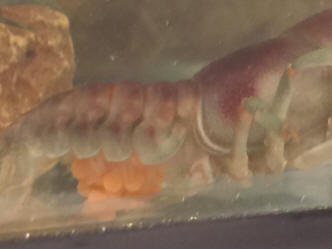
Hi, is it too late to have a male crayfish fertilize some eggs by mating
if the female is currently carrying large orange eggs? If yes, I could
ask a friend to lend me her crayfish for a few days.
Are these crayfish eggs? They are large compared to some px I found on
the web. Thank you.
<While there is a little variation between species, what normally
happens is that the males mate with the females first, depositing a
packet of sperm inside the female. Then the female stores the sperm for
some days to several weeks depending on the species and situation, and
eventually the mature fertilised eggs are expelled onto her swimmerets
to be brooded.
That's the point where you see the eggs. Breeding crayfish is difficult
because they are territorial and tend to attack each other if they're
confined in too small a space. Obviously they're much easier to breed in
ponds and other situations where they can spread themselves out. Cheers,
Neale.>
Re: crayfish/unfertilized eggs 3/1/16
Thanks for your response Neale.
<Welcome.>
Do they breed at any time of the year? e.g. should I get a male crayfish
to mate with my female one in the summer or wait till the fall?
<Crayfish will breed at certain seasons in the wild, usually during the
warmer part of the year. But in aquaria and ponds where conditions are
more equitable all year round, they can and do breed more often. The
problem is, I stress, that the genders don't cohabit well. They can be
cannibalistic towards crayfish that have just moulted (and are
consequently still soft and vulnerable). There is intense competition
for the best shelters. So while do-able, you will need to plan carefully
and ensure all specimens have plenty of space and hiding places.>
What do I do with the unfertilized orange eggs, take them out or let the
crayfish eat them?
<Pretty much, unfortunately. On the flip side, if your female has been
with a male, it can store sperm for some months, so may well have
fertilised eggs. Females of at least one famous crayfish, the
Marmorkrebs, can reproduce without a male.>
My crayfish was separated from others at Thanksgiving and now shows
orange eggs. I guess there is no chance they are fertilized.
<Quite possibly.>
Thank you!
<Have fun, Neale.>
Re: crayfish/unfertilized eggs
3/2/16
Thank you Neale.
My crayfish is laying orange eggs .. no sign of molting. When do you
recommend I bring in a male for a day or two?
<Really tricky. Ideally, choose ones the same size, and provide several
caves, such as ceramic tubes. Feed relatively generously, but bearing in
mind these animals are omnivores rather than carnivores, so a
substantial amount of vegetable foods is a plus. Softened root
vegetables for example, courgettes, and cooked peas. Algae wafers are
the ideal staple. Occasional raw, unshelled shrimp will provide
essential calcium and other minerals they need for their shells. They
aren't psychotic, and yes, it's perfectly
possible to keep pairs. But don't expect them to mate within a day or
two (just doesn't work that way) and don't let them get hungry! My point
is: get them settled in and cohabiting and they'll take care of mating
for you. Trying to introduce a male at just the right time will be hit
and miss.>
I could try a different crayfish (I know of a few families who have a
male crayfish). I hear you, these crayfishes are territorial. Mine has
an antenna that is partially missing.
btw, my crayfish's tail has a fan, it should be a male, shouldn't it?
<Sexing crayfish depends primarily on the genital pores on the last
pairs of walking legs. Other features, such as tail fin shape and the
size of the claws are unreliable.>
Thanks!
<Welcome, Neale.>
|
 |
Crayfish sexing with age? 2/20/16
Neale or Bob,
<The latter here Jacob>
Is there a general rule of thumb as to how old/large a crayfish needs to be to
be able to sex them?
<Mmm; depending on species; your eyesight... just an inch or two>
I know this'll vary with species/family, but with red claw crabs they mature
when they're still young while with panther
crabs they mature late in life. It's the r/K selection theory in ecology,
respectively.
<Ah! Yes>
I received 3 female and 2 male crayfish from my university invert lab and am
trying to determine what species they could be, but they're still juveniles (I
think, but I had an idea that they may be dwarf crays since I can sex them,
their gonopods are well developed, and they're only maybe an inch, inch and a
half long) so distinguishing between species is difficult at best.
<Likely so>
Thanks for any information and/or insight you can provide!
Best Regards,
Jacob "GreenGo" Green
<Will ask Neale for his independent input here. Bob Fenner>
--
Jacob "GreenGo" Green
future aquarium population ecologist with an emphasis in sustainability and a
preference for carcinology (crustaceans, primarily freshwater crabs and shrimps)
Crayfish sexing with age? /Neale's turn
2/21/16
Neale or Bob,
Is there a general rule of thumb as to how old/large a crayfish needs to be to
be able to sex them?
<Inch or so, assuming you have a decent dissecting lens handy. Some species have
different claw shapes and other easy features, but most need to be inverted and
their abdomens pulled open, which isn't easy with tiny specimens.>
I know this'll vary with species/family, but with red claw crabs they mature
when they're still young while with panther crabs they mature late in life. It's
the r/K selection theory in ecology, respectively.
<I see your point, if you're arguing that crayfish are K-selected and produce
smaller numbers of larger offspring that receive extended broodcare on the part
of the female. The whole r/K concept is a fascinating one. But do bear in mind a
lot of coastal amphibious crabs (like Red Claw Crabs) are "locked" into a
particular type of reproduction. They have marine larvae (a consequence of their
phylogeny) that may be actively selected for (because it helps their
distribution across Southeast Asia) so might well be unlikely to switch to
crayfish-style brooding.>
I received 3 female and 2 male crayfish from my university invert lab and am
trying to determine what species they could be, but they're still juveniles (I
think, but I had an idea that they may be dwarf crays since I can sex them,
their gonopods are well developed, and they're only maybe an inch, inch and a
half long) so distinguishing between species is difficult at best.
<Possibly, but the different positions of the gonopores on the males vs. the
females should be apparent even in youngsters.>
Thanks for any information and/or insight you can provide!
Best Regards,
Jacob
<Likewise, Neale.>
|
Blue crayfish/lobster; repro.
1/20/16
Hi!
This is the second time I observed my pet laying lots of yellowish eggs.
They would appear one day under her swimmerets. Prior to the eggs appearing,
they were nothing on her swimmerets.
I would like to know if these eggs are fertilized and how often do they appear?
It's the second time it has appeared in less than 6 months.
Cheerios!
Shirleen
<The short answer is that unless there's a male in the tank, the eggs your
crayfish produces will be unfertilised. However, the long answer is that some
crayfish species can reproduce parthenogenetically, most notably the famous
"Marmorkrebs". The common Blue Crayfish of the trade is Procambarus alleni, not
regarded as a parthenogenetic species, so if your female is one of these, you're
unlikely to find baby crayfish in the aquarium without the presence of a male.
Cheers, Neale.>
|
.JPG)
.JPG) |
|
Re: Blue crayfish/lobster 1/21/16
So how often do they actually lay eggs?
<It varies with temperature especially. The warmer the water, the more often
they produce eggs. Diet and light intensity are relevant factors too.
In an unheated system, you can expect several breeding attempts during the
warmer part of the year, perhaps one every month or so. That's about how long it
takes for a batch of eggs to turn into fully-formed, independent baby crayfish
able to leave their mom and fend for themselves. But this varies wildly with
conditions, as noted above, as well as the type of
crayfish being kept.>
I do not have a male in my tank and mine should be the common blue crayfish
Cheerios!
<Cheers indeed, Neale.>
|
Crayfish; repro. ish concern
We took home a crayfish from my son's classroom several months ago and were
surprised to find eggs hidden under her tail this morning. We really don't want
babies (we thought we had a male) and didn't know if it is safe to remove the
eggs. We don't want to hurt her, but I also don't want my kids to deal with her
eating the babies or them eating each other. Please
advise!
<I would do nothing here. Likely these eggs are not fertile (were not
fertilized); and will take care of themselves... Do just be vigilant re regular
water changes, the use of iodide; as gone over on WWM.
Bob Fenner>
hello! I have questions about Cherax albidus's eggs
4/24/15
I have some question to ask you about Cherax Albidus's eggs.
Could you please tell me..
1. Why Cherax albidus's egg have fungus?
<Most likely: either not fertilised or water quality really bad.>
2. Could you tell me about methods for avoid fungus in Cherax albidus's eggs?
<Make sure they're fertilised. Honestly! Crayfish are normally excellent
mothers, and will clean and oxygenate their eggs. Check water quality, and make
sure there's plenty of filtration and water circulation. While Methylene blue is
widely used to keep fungus off fish eggs, this chemical may be toxic to
crayfish, so use at your own risk. I wouldn't use it, and would instead focus on
making sure the water quality was good.>
Thank you.
<Welcome. Neale.>
What does it mean when my reddish brown crayfish has white
eggs 1/10/15
<Precisely what it appears to mean. Without a male crayfish, eggs will
usually be infertile but some crayfish species are parthenogenic. Don't
forget to use marine aquarium iodine (at half the dose) to this tank.
Your female crayfish will need iodine after the process of making eggs
and before she moults again. Lots of people don't know about the iodine,
and their crayfish, sooner or later, wind up deformed or dead. Cheers,
Neale.>
Crayfish; repro.
5/29/14
Hi there! I bought an electric blue crayfish about three months
ago from the local pet store and "he" was really beat up missing several
legs and one of his claws. Luckily, the crayfish grew everything back,
moulted several times and a couple days ago I discovered "he" was a she
because she is hiding a tail full of eggs.
<Cool.>
I was absolutely delighted but now I am worried about her she won't eat
and is constantly on guard.
<Is normal for this to happen. Don't worry about her. She will stay in
the burrow, more or less hidden away until the baby crayfish have
hatched.>
I have 2 loaches in the tank with her and they seem very interested in
those eggs.
<Indeed. Part of their natural diet.>
I also noticed today that she was picking some of them off, will she eat
the eggs?
<The unfertilised ones, yes. If stressed many animals will eat their
eggs (even their young) to "recycle" the energy in another breeding
attempt. In evolutionary terms this makes sense -- no point wasting time
and nutrients on offspring with no chance for survival. So finding ways
to minimise stress (isolating from tankmates for example) can be
useful.>
I do not have a male crayfish so the eggs were quite a surprise, but
then I read that they can hold sperm for 6-8 months and she was in a
tank with other crayfish at the pet shop. Can crayfish produce infertile
eggs without mating because she was kind of small when we got her?
<Possibly. Don't know for sure. Fertilised eggs will be speckled/dark,
and very quickly show signs of developing embryos; unfertilised eggs go
white very quickly.>
She is in a 55 gallon tank with the other 2 loaches should I separate
her from this tank? I do not own another tank so I would have to go and
purchase a small 10 gallon or perhaps buy a divider? How long does she
usually carry the eggs before they hatch?
<Some, several weeks; maybe a month. Depends on the species.>
Thank you for your help in advance! -Heather
<Best of luck, Neale.>
Parthenogenesis? 6/11/13
Hi. I bought an electric blue crayfish from an aquatic
pet store in town about a year ago. It was only about an inch
and a half long when I got it, and has had no contact with other
crayfish since. A few days ago my girlfriend notice what looked
like a shrimp in our tank. After taking a long, close look, I noticed
that there were baby crayfish crawling about. I looked online, and read
about a marbled crayfish that can reproduce by means of parthenogenesis.
I read some more, but couldn't find any record of an electric blue
crayfish doing this. Is it possible mine has reproduced through such a
means?
<It does sound likely. The Marbled Crayfish (or Marmorkrebs) is the most
notoriously parthenogenetic crayfish and a species of Procambarus, while
parthenogenesis has recently been reported among the commonly farmed and
eaten Red Crayfish, Procambarus clarkii. Your pet is the Electric Blue
Crayfish, Procambarus alleni, closely related to these
two known parthenogenetic species, so I wouldn't be at all surprised if
you're seeing parthenogenesis in action.
Cheers, Neale.>
Re: Parthenogenesis? 6/11/13
Thank you very much for your timely and informative response. I'm
very excited to have such an interesting specimen. Cheers. Dave
<Most welcome! Cheers, Neale.>
|
crayfish molting during pregnancy? 1/30/13
Hi WWM Crew,
<DC>
I have a pair of bright orange crayfishes (I'm not sure as to what species
they belong to, please see pictures) and they were already mating just
a few seconds after I placed the male on the female's tank. After that, they
were mating non-stop (like every 15 minutes?) so I searched the web to check
if this was normal and found out that you had to separate them after mating
because the male is just going to replace the old sperm plug and just repeat
the cycle. Now after 1 week, the female molted! So my questions are:
1. is the sperm deposit affected by the female's molting process? do I need
to re-introduce the male?
<Is... shed w/ skeleton, unless already used. I'd hold off on introducing
the male. It may well eat the other>
2. when a male crayfish is in "form 2", he has to molt to be in "form 1".
Then if he molts again after that, will he go back to "form 2"?
<Usually will change back from "juvenile" in time, molts, w/ good
conditions... see WWM re systems, nutrition of Crays>
Thanks,
Daddy Chong
<Welcome. Bob Fenner>
|
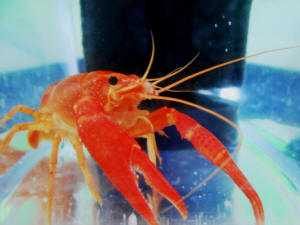
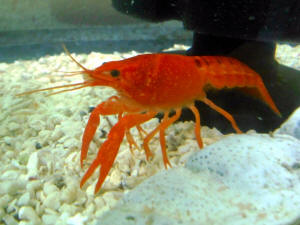 M, F
M, F |
|
Re: crayfish molting during pregnancy? 1/31/13
Oh I see.. Just 1 quick follow-up question.. What species do my
crayfishes belong?
<Don't know... would search Google images re. B>
Thanks,
Daddy Chong
|
|
Lobster/ Crayfish "in berry"? - 12/01/2012
Hi WWM crew - firstly, thank you for a great resource!
<And thank you for your kind words!>
I have learned so much but still have a few things I am puzzled about.
<Me too.>
I live in South Africa and in July I got a "lobster" as a pet. I think
she is a Procambarus species?
<Quite possibly. Maybe P. alleni.>
See the attached picture. We were told she is a female.
<Looks like it to me.>
I am not sure how old she was when we got her but she has moulted three
times since we've had her and is now approximately 8cm long. She lives
by herself in a tank about 25cm x 15cm.
<Bigger would be better, if it's reasonably possible for you.>
The temperature is kept at 24 degrees Celsius and we have a water
filter.
So far all has been going well. We had been feeding her the Tetra
Tabimin tablets but recently changed to the AquaPlus bottom feeder
tablets as we were told they were the same thing but cheaper?
<I'm not familiar with the latter.... Do please consider feeding
her some iodine-rich foods; frozen/thawed shrimp (the kind you would
cook and eat yourself) with the shell still on, dried seaweed, etc.,
and/or dosing the tank with an Iodide supplement. Although it's
okay to use one designed for reef tanks, DO NOT use the amount
recommended for a reef tank. Just a drop or two per ten gallons
per week of Kent's marine Iodide supplement is sufficient, for example.>
I am not sure if it's coincidence but a few days after we changed her
food she started "itching" a lot - scratching all over but especially
under her tail near her swimmerets. I thought it was because she was
going to shed.
<Could be >
To my horror, I came home the following day to find her tank full of
tiny little white "worms" floating in the water and stuck to the glass.
<Probably something (mostly) harmless just there as a result of "stuff"
available in the tank for them to eat.>
After doing some reading it seems these were Planaria?
<Very possible.>
I cleaned the tank and all seems fine again.
<If they happen again, just step up your regular maintenance a bit.
A bigger tank will help in this.>
I am wondering if the new food caused this Planaria bloom?
<Any "overage" of nutrients available for them would allow for it.>
The next morning I awoke to find our lobster lying on her back, tailed
clamped tightly shut.
<Yikes!>
Initially I thought she was dead but after yet more reading it seems she
is laying eggs?
<Possible.... There is one known (almost) entirely parthenogenic
Procambarus species, and others may also reproduce Parthenogenically,
including possibly P. clarkii. But it's also possible that the
animal may have been moulting, or trying to, and having a hard time of
it.>
It is two days later and she is still lying on her side/ back and seems
very withdrawn (mostly in her cave).
<This is bad news.... Laying eggs should happen fairly quickly,
usually right after a moult, and she should be up and about directly.
Lying on her side/back indicates trouble of some sort. Do please
be dosing with an Iodine/Iodide supplement to allow her to properly use
available Calcium in the moulting process.>
She is eating though (we went back to the Tabimin).
<Very good that she's eating. Try to get some shrimp or something
similar into her as well, if she'll take it.>
I cannot see under her tail as it is tightly clamped shut. Today I also
noticed a spider web-like substance on the pebbles in front of her cave?
What could this be?
<Could be, like the Planaria, just something opportunistically making
use of available nutrients.... Maybe a bacteria, perhaps an
algae....>
Thank you for your help and advice! Catherine Griffiths
<Best wishes to you and your Crayfish! -Sabrina>
|
Lobster/ Crayfish "in berry"? - II - 12/18/2012
Thanks for your prompt reply Sabrina.
<Sorry for the delay on this one, Catherine.>
I had a gentle peek under her tail now and she is indeed carrying eggs
under there!
<Excellent!>
Will definitely look for an iodine supplement though.
<Very good. Best of luck with her!>
Thanks :) Catherine
<Wishing you and your inverts well, -Sabrina>
|
Blue Crayfish with eggs 9/5/12
Hi, lately my electric blue stopped being as active and stopped eating.
At this point I hadn't discovered your site and since I have I have
learned a lot about my pet. She is in a 10 gallon tank with two
"caves." She has burrowed in the gravel in one all the way to the glass
bottom of the aquarium and established this one as her "home." When she
retreated into the other one for 3 days and hardly moved while I was at
work I became worried... thought I had a dead crayfish. After
spending the afternoon reading on your site what could be wrong with her
I came across a post where someone's Cray was acting the same way and
turned out it was producing eggs, sure enough, I went to look and she is
"in berry." She hasn't been in contact with any other crayfish
since I bought her from a local pet store about 6-8 months ago and I am
not sure if she was around any males there.
<Mmm, some species can/do "store sperm" in a packet>
Is there any way to know if the eggs are fertile other than just waiting
to see if they hatch?
<Mmm, yes; but mainly just waiting is advised, the best route to go>
Most of them are black in color and a few are a whitish/orangish color.
Just curious. Thanks in advanced for your help! - Jacob
<Thank you for sharing. Bob Fenner>
marbled crayfish, in berry, then gone!
8/13/12
Hi there!
I have been searching your site, and I cannot find anything about a
marbled crayfish that is in berry, then after a week or two, no more
berries!!
<Happens... usually when infertile... dissolve, are eaten>
I have one marbled crayfish, 4 small swordfish, a small Pleco and a
couple of snails in a 10 gallon tank. The Temp. in the tank remains
around 82 degrees F.(i live in Phoenix, AZ) and until winter comes, it
wont get any cooler.
<Mmm, this may be the issue here: Really need cooler water:
http://www.marbledcrayfish.com/water-requirements
What could be the problem? How come the berries don't stay, and become
baby crayfish? One day they are there, and Ill check another day, and
they are gone!
Any info would be greatly appreciated!
Thanks a bunch!!
Adam
<Do peruse the above site for this animal's requirements. Bob Fenner>
<Cross> Breeding Different
Genus' <Genera> Crayfish 3/20/12
Hi, first and foremost I would like to thank you guys for almost
everything I've learned about crayfish. I've read and read but
cannot find the answers anywhere (weeks of reading online). I
have a huge 6 feet long 150G tank housing random colorful platies and 2
different types of crayfish that are each about 3 inches long and live
happily with plenty of food and hiding.
With the right conditions, is it possible for a Cherax quadricarinatus
female and Procambarus alleni male mate successfully (Or Cherax Quad
female with Procambarus Clarkii male)?
<Mmm, I don't think so... too different genetically,
behaviorally>
Or likewise are there any examples or literature that point out what
genus'/species would produce successful offspring when being
bred?
<Don't know w/o doing a bit of visiting, computer-search
bibliographic work. Do see here re: http://www.wetwebmedia.com/litsrchart.htm
Bob Fenner>
Pregnant Crayfish.... reading 9/21/10
Hi!
<Hello>
I have a few questions about my pregnant crayfish. It would be just
great if you could answer them.
<Will certainly try to help you>
My crayfish has been picking at her eggs and ripping at them. Is that
normal?
<Mmm, it is normal for females to clean, aerate the egg mass>
Ever since she has been ripping at her eggs, the egg amount looks like
it has been getting smaller. It looks like she only has 40 eggs
now.
My crayfish hasn't been eating much since she has become pregnant.
Do you know any reasons why she is not eating?
<There could be a few... chemical troubles in terms of water
quality, stress, a lack of nutrition otherwise, a missing essential
material (e.g. iodide...>
What is the average amount of eggs that hatch and the amount that
actually survives?
<Highly variable>
My female has different color eggs, and I was wondering if that color
affects the color of the baby
crayfish or its growth in the egg .
<Likely some are fertile, others are not>
The colors are like an orangey-yellow and like a few like darkish eggs.
Which egg color will most likely hatch?
<The dark ones...>
Before she was pregnant she would always stay underwater. But now she
has a pebble hill that goes above water and she always likes to lay on
it. Is there a particular reason for that? Will my crayfish survive
after the eggs hatch? I read on a website that said there is a
possibility that pregnant crayfishes die after the eggs hatch and I
just wanted to be sure about that.
Should I separate the eggs from the mom right after they hatch or wait
a little? When the eggs hatch should I separate the other baby
crayfishes from each other? If I do how much room would they need? When
can I put all the crayfishes into one whole tank? I'm so sorry for
all of the questions.
This is my first crayfish and the first time my crayfish is pregnant.
It would be great if you could answer all the questions but if you
can't answer all that is okay. Thank you for your help.
<... Answers to your questions and more are archived on our site.
Read here: http://wetwebmedia.com/ca/volume_5/volume_5_3/crayfish_basics.htm
and here: http://wetwebmedia.com/ca/volume_1/cav1i4/crayfish/crayfish.htm
and the linked files at the bottom. Bob
Fenner>
Pregnant Blue Crayfish - 8/10/10
I have / had a pregnant blue crayfish that over the weekend she picked
all her eggs off. They are now just laying at the bottom of the tank.
Any reason why?
<Difficult to say. Crayfish normally carry their eggs until the
babies hatch and are fully mobile. Cannibalism typically follows from
stress, e.g., overcrowding or poor water quality. There may be some
variation among
species though. I assume this is Procambarus alleni; review the needs
of this species and act accordingly.
Cheers, Neale.>
Re: Pregnant Blue Crayfish 8/10/10
I "assume" that since she picked off all the eggs that they
won't hatch now. Is that correct?
<If they still look healthy, you could certainly try rearing them in
a breeding net with an airstone nearby to keep them oxygenated. No
promises, but you might get a few. But if they're opaque or fluffy
with fungus, then no, they won't hatch. Cheers, Neale.>
Re: Pregnant Blue Crayfish
I'm not sure how far along she was when she began removing them
over the weekend. They are just black and lay at the bottom of the
tank. She, nor the other two crayfish in the tank pay any attention to
them. I have the 3
in a 30 gal. tank but cleaned the tank not knowing she was pregnant
until I put her back in and I guess from all the info I've gathered
from you that is probably what stressed her and made her 10 days later
start removing the eggs.
<They won't last long on the bottom of the tank. They do need to
be agitated a bit to keep oxygen flowing across them. That's what
she does with her swimmerets when she's carrying them. So as I say,
if you want to have a stab at rearing them, put them in a breeding net,
stick an airstone or at least the filter outflow current nearby, and
see what happens. Not much more to add really. Good luck!
Neale.>
Is there strength in numbers? Crayfish
torture 4/11/10
Hi there.
I have about 25 crawdads in a 10 gallon tank but none of the crawdads
will hurt the other crawdads. I know that the crawdads are supposed to
fight others but they wont fight and they are standing on the rocks out
of the water and 3 of them have eggs.
I have no idea what to do!!!!!!!!!!!!!
Please help me!
<Why do you want your crayfish to fight? As for coming out of the
water, yes, they sometimes do that if the water is poor in oxygen. Your
tank is rather overstocked and I imagine water quality is pretty dire,
hence their behaviour. You would be wise to move them to a much bigger
aquarium, and use this little tank for rearing the babies, should you
want to. Do read here:
http://www.wetwebmedia.com/ca/volume_1/cav1i4/crayfish/crayfish.htm
http://www.wetwebmedia.com/ca/volume_5/volume_5_3/crayfish_basics.htm
Cheers, Neale.>
Re: Is there strength in numbers? Crayfish... incomp., repro. sys.,
referral? 4/14/10
I didn't want my crawdads to fight it is just that they are suppose
to but they didn't so I wanted to know what was wrong. And for the
eggs why wont the females lay the eggs. The eggs are already fertilized
over spring break but the crayfish wont come out I have no idea why.
please tell me step by step on what to do for raising eggs starting
from introducing the male and female to introducing the next
generation. thank you.
<Females don't lay eggs. They carry the eggs around with them
until they hatch, and that's when the miniature crayfish appear. In
a tank with adults those baby crayfish have virtually no chance of
surviving. So take a female
"in berry" (i.e., carrying eggs) and put her on her own in a
10+ gallon tank with a filter and lots of rocks and plastic plants.
Eventually the babies will leave the eggs, scuttle under the rocks and
plants, and you can remove the female back to her original quarters.
The babies are notoriously cannibalistic, so you'll need to keep
them well fed and segregate them as they mature, so the bigger ones
don't attack the smaller ones. Make sure there are adequate caves
to go round as well, otherwise the baby crayfish are very vulnerable
when moulting. Cheers, Neale.>
Electric Blue Lobster, repro.
11/26/09
Hello!
I have owned my electric blue lobster, Stella, for just over two years
now.
When we purchased her from the pet store that I am currently employed
at, she was in a large tank with two other males. Shortly after
purchasing her, she laid some eggs and, after extensive research, we
were able to set up four new tanks in order to give the babies adequate
room to grow. I assume that she became impregnated by one of the males
at the pet store.
We were successful in keeping about 100 of her babies alive, and when
they became large enough we sold them back to the pet store. Since
then, she has laid eggs several more times, even with no mate present.
I understand that crayfish will sometimes lay eggs whether they have a
mate or not. My question is: how long can a crayfish hold on to a sperm
packet? I can't seem to find the answer anywhere! And also, if her
eggs are infertile will they still be dark in color? She has been
living alone for just over two years. Is there any possibility that
these eggs are fertile?
Thanks for your time,
Sharon
<Hello Sharon. Female crayfish can store sperm in the spermatic
receptacle for several months. Biology books seem to suggest periods of
up to 6-8 months, but there are reports of females producing offspring
18 months after mating. Various factors like water temperature probably
come into play. So the short answer is that yes, females store sperm,
and no, no-one really knows for how long! If the eggs are infertile, it
should be apparent pretty quickly as they fail to change colour (as
happens when the embryos develop). Hope this helps. Cheers,
Neale.>
Cray fish Breeding tank
10/20/2009
Hi! Im a teenager fascinated by crawfish.
<Very interesting animals they are too...>
As of now i have a 10 gallon tank with 4 feeder gold fish and 1 Male
Crayfish. He just recently molted, today actually. he has a hiding spot
and gravel a small aerator for the water and a filter. i received him
from the
wild and im deciding to breed him.
<Certainly possible.>
Im curious of what tanks i should get. 2 10 gallon tanks? one for the
males and 1 for the female?
<Yes.>
where would i put the babies?
<They stay with the mother until they're ready to fend for
themselves, at which point placing them in another tank with lots of
caves (they're cannibalistic) is an option.>
do i need to buy them a separator? im planning on donating some to a
local PetSmart or pet-co and keeping a few in case some that im keeping
dies. can you send me a link of anything for a breeding tank plan?
Thank you sorry if i have a few misspelled i checked like 3 times but i
still may have some. :]
<One or two, but never mind! It's great you took the effort to
spell check -- if only more of our correspondents would, it'd be a
lot easier to read some of these messages. In any case, do read
here:
http://www.wetwebmedia.com/ca/volume_1/cav1i4/crayfish/crayfish.htm
http://www.wetwebmedia.com/ca/volume_5/volume_5_3/crayfish_basics.htm
http://www.wetwebmedia.com/FWsubwebindex/crayfishreprofaq.htm
Breeding "comes naturally" to crayfish, and all it really
requires is that the male and female are kept together, but not so
crowded one tries to eat the other. Sexing them is tricky, and you need
to turn them upside down and look at the location of the genital
openings. They're in different places on males and females.
It's easiest to Google "sexing crayfish" and take a look
at some of the photos. Anyway, males mate with females just after the
time the females have moulted; the rest of the time, both sexes are
pretty intolerant of one another. In a biggish sort of tank with two
caves, the two should avoid each other most of the time, especially if
well fed (sushi Nori, cooked vegetables, and the occasional unshelled
prawn or frozen lancefish). After spawning, the female and male are
separated. The female carries the eggs under her "tail" for a
few weeks, and once the fully formed baby crayfish leave her, she needs
to be removed or she'll eat them.
As they grow, they'll eat one another if hungry, especially when
moulting.
It's worth making the point that breeding crayfish on a commercial
scale requires a lot of space (and skill) and by and large hobbyists
are lucky if they rear two or three of them. You might place a bunch of
floating
breeding traps in a filtered 55 gallon tank, and put one to each trap,
but that's the sort of effort required. Hope this helps,
Neale.>
Crayfish, repro.
I had a quick question. My dad has a 120 gallon tank, and he had two
crayfish awhile back. One blue and one red. They blue one died not long
after he got it. So the red one ended up having a red baby. Now we have
two red big ones. We had found another little red one a few weeks ago.
Now today we have found a blue baby. I was wondering if the mother is
red can her off spring be a different color?
<If the two colours you had were varieties of one species of
Crayfish, a blue male and a red female, then yes, the mother could very
well produce offspring of different colours. Just like a blonde human
could give birth to a brunette baby! It's just down to the genes.
On the other hand, if the two Crayfish were both females of different
species, then the blue baby you've found may have been produced by
the one that recently died, and was hiding somewhere in the tank.
Crayfish produce offspring after mating, males mating with the females
once for each clutch of eggs the female produces. So a singleton
Crayfish may incubate eggs fertilised by a previous companion, but
after that batch of eggs, she won't produce any more offspring.
Hope this clears things up. Cheers, Neale.>
Breeding Trigger/Puffer food
9/21/09
Hello friends.
I have a 125 gallon predator tank with a Puffer and three Trigger
fish.
Before I made the switch to saltwater, I started with freshwater like
most folks do. During that stint, there was a time I had red and blue
crayfish.
One day I had lots and lots of little crayfish running around eating
each other. Long story short, I'm now on to saltwater and wondering
if I can raise freshwater crayfish and feed the young to my saltwater
chompers.
(using a separate 10 gallon freshwater aquarium of course).
Any input here would be great.
Thanks,
Jason
<Jason, yes you can use freshwater crayfish, but no, there's not
much point. The cost/benefit ratio simply isn't there to make this
a worthwhile endeavour. Sure, if you kept crayfish as pets anyway, and
had some spare juveniles to get rid of, these herbivorous crustaceans
would be a good choice as occasional snacks. You can gut-load them with
plant material and algae wafers, and expect them to provide useful
nutrition. So it's not like the situation with store-bought feeder
fish, where there are absolutely no good reasons to ever use them
whatsoever, short of deliberately wanting to make your fish sick. But
as a staple, you'd need a pond, not a 10 gallon tank, to raise
enough crayfish simply because of the numbers involved.
Let's say you used one crayfish a week, you'd need to breeding
them on a fairly industrial scale simply to be able to supply 52
crayfish a year!
You'd also be increasing the chances your predatory fish would get
hooked on live food, and thereby lose adaptability in terms of
variation (squid, cockles, and other largely thiaminase-free
seafoods).
http://www.wetwebmedia.com/ca/volume_6/volume_6_1/thiaminase.htm
There's also some anecdotal evidence that the use of live foods
increases aggression, and that's the last thing you want with
"big biters" like Triggers and Puffers. That's another
good reason why Bob and other experienced aquarists stress so strongly
that live feeder fish shouldn't be used for Lionfish, Morays and
the like. The key issue is that fish like Triggers and Puffer patrol
VAST areas of seabed picking off large
crustaceans, molluscs and cnidarians, and there's simply no way to
mimic that in captivity. They eat a little, but often, while consuming
a huge variety of prey, from chunks of coral through to hermit crabs.
I'd sooner
concentrate on finding a healthy, varied seafood diet for my fish, and
leave the 10 gallon tank for something more immediately useful, e.g., a
quarantine tank or a refugium. This hobby is hard enough work as it is,
and simplifying feeding down to the basics will make your life a lot
easier.
Cheers, Neale.>
Freshwater blue lobsters, repro.
4/21/09
I accidentally came across a beading pair of blue lobsters.
<Hmm... they don't really form pairs: they mate, and then the
male wanders off. Don't expect two adults to coexist in a small
tank; these are territorial animals prone to fighting.>
I did not know they were male and female when I got them and I got them
at different times.
<OK.>
I ended up with three "litters" of babies which I gave away.
One day every Lobster in my tank just suddenly died and I don't
know why.
<They all died at once? Most probably some kind of environmental
change for the worse, e.g., the use of copper-based medication, or a
sudden change in pH caused by a lack of buffering. Review the tank, in
particular water chemistry, filtration, etc.>
After that a friend gave me two of the baby's back in hopes that I
would get another breading pair. How do I know what their sexes are and
will Lobsters bread with a sibling and is that recommended?
<It's never recommended to breed closely related individuals,
whether human or animal. When you do so, the chances of mutations and
deformities go up.
That said, as you probably know this is routinely done on breeding
programmes where people want to "fix" a mutation or deformity
into a lineage: this is how you create new "breeds" of cat,
dog or whatever. In
other words, no, ideally you'd buy another crayfish to go with one
you have, and so ensure the offspring have the best possible chance of
good genes. But if you couldn't get another crayfish, it
wouldn't be the end of the world, provided you didn't mind that
any offspring could well be weaker or more prone to deformities than
otherwise, and the fertility rate likely lower as well. Cheers,
Neale.>
Red crayfish is pregnant.
4/19/09
I recently was cleaning my 55 gallon tank when I noticed that one of
the crayfish had black eggs under its tail. I did some research
&& discovered she was pregnant.
<Lucky you!>
I bought a divider to separate her from the other fishes I have but
when doing that one of the crayfish is trying to climb over the
divider, I am assuming he is the father.
<Possibly.>
Is it ok 4 me to have separated her from him?
<Better than merely OK; it's a good idea!>
Also are those black eggs caring babies or not. && how far
along can I tell she is. && how long is the process of her
pregnancy going to be?
<Varies, but typically the eggs are carried for about a month. At
which point they need to be removed from the parents and reared on
things like algae wafers and softened vegetables. Can be cannibalistic,
so keep an eye on them, separating out larger specimens from smaller
ones, and provide lots and lots of hiding places for when they
moult.>
P.s. @ one point she's was fighting with him to get out the little
cave I have made. But he refuses && stays near.
Thank you so much 4 the help.
<Happy to help. And next time, be nice to us and send messages
written with normal English rather than TXT speak. We do specifically
ask for that at the "front door" of the site, and usually
bounce back messages written in TXT speak. I was feeling nice, so
answered your query, but next time won't be so forgiving! Cheers,
Neale.>
Electric blue crayfish babies
3/23/09
Hello I had a few questions about electric blues I'd like to ask. I
read through the Crayfish Reproduction FAQ and just wanted to make sure
I'm doing the right thing. I just bought two of these guys which I
believe both to be females (one of course is).One had eggs and now they
look more like a white dot with a tiny bit of black on them. They seem
to be growing there legs so I was wondering how much longer it will be
until they leave there mom?
<Perhaps a few days>
She's had them so far for about 2 weeks. They are in a 20 gallon ph
8.0, Ammonia-0, Nitrite-0, Nitrate-5. I tried getting the ph down to
7.5
<I would leave this be>
when I was cycling it but it goes right back up. I have virtually no
hardness to my water because of the water softener.
<Mmm, and use water from an outside spigot (that is not softened)...
perhaps warm up with a bit of the inside/softened water>
So I feed the algae wafers, freeze dried krill, tropical flakes. I
heard about the iodine but wont the carbon filter take that out?
<Yes... but not immediately likely... better to use on a punctuated
basis, perhaps during water change outs (weekly), and put the carbon in
the next day>
Should I just take the carbon out and just let my water changes clean
the tank?
<Ah yes. Well done>
I don't want to kill the babies or the adults. Is there anything
I'm missing to keep these guys healthy and the babies alive?
<Nothing "jumps out">
What should I do about the babies?
<Mmm... what do you want to do? Try rearing them?>
Can I just keep them in a little 2 gallon Betta tank I bought when they
break from mom?
<Or move the adults... this would be better>
There of course is no Betta but I held on to the tank because it had a
filter and bio wheel which I figured I could use it later. Or can they
just hang out with the ladies?
<Mmm, not for long... likely to be consumed>
I guess they might eat them that way so I don't know. Please and
thank you for any help you can give
ps I love your site I'm learning a lot from it!
Deanna
<And contributing to it as well. Thank you for sharing your
experiences, speculations with us Deanna. Bob
Fenner>
Re: Electric blue crayfish babies
3/25/2009
I have a few more question for you about the baby's I've read
that they can come in and out of water.
<Mmm, no... not until they are much larger>
So my question is if I get a little 5 gallon today and a rock or two
for them to climb out a bit for air will this be ok? Or should I just
get a air stone for them? I was just going to do a water change and put
there moms water into the 5 gallon for now and throw a feeder guppy in
to keep it cycled, will this even work? I got a not so good pic just
for fun to show you. They are visibly moving now not much but a little
its so cool.
<Very nice... I would keep the young in place, move the parents...
You have read on WWM re? BobF>
Electric blue crayfish babies
3/23/09
Hello I had a few questions about electric blues I'd like to ask. I
read through the Crayfish Reproduction FAQ and just wanted to make sure
I'm doing the right thing. I just bought two of these guys which I
believe both to be females (one of course is).One had eggs and now they
look more like a white dot with a tiny bit of black on them. They seem
to be growing there legs so I was wondering how much longer it will be
until they leave there mom?
<Perhaps a few days>
She's had them so far for about 2 weeks. They are in a 20 gallon ph
8.0, Ammonia-0, Nitrite-0, Nitrate-5. I tried getting the ph down to
7.5
<I would leave this be>
when I was cycling it but it goes right back up. I have virtually no
hardness to my water because of the water softener.
<Mmm, and use water from an outside spigot (that is not softened)...
perhaps warm up with a bit of the inside/softened water>
So I feed the algae wafers, freeze dried krill, tropical flakes. I
heard about the iodine but wont the carbon filter take that out?
<Yes... but not immediately likely... better to use on a punctuated
basis, perhaps during water change outs (weekly), and put the carbon in
the next day>
Should I just take the carbon out and just let my water changes clean
the tank?
<Ah yes. Well done>
I don't want to kill the babies or the adults. Is there anything
I'm missing to keep these guys healthy and the babies alive?
<Nothing "jumps out">
What should I do about the babies?
<Mmm... what do you want to do? Try rearing them?>
Can I just keep them in a little 2 gallon Betta tank I bought when they
break from mom?
<Or move the adults... this would be better>
There of course is no Betta but I held on to the tank because it had a
filter and bio wheel which I figured I could use it later. Or can they
just hang out with the ladies?
<Mmm, not for long... likely to be consumed>
I guess they might eat them that way so I don't know. Please and
thank you for any help you can give
ps I love your site I'm learning a lot from it!
Deanna
<And contributing to it as well. Thank you for sharing your
experiences, speculations with us Deanna. Bob
Fenner>
Re: Electric blue crayfish babies
3/25/2009
I have a few more question for you about the baby's I've read
that they can come in and out of water.
<Mmm, no... not until they are much larger>
So my question is if I get a little 5 gallon today and a rock or two
for them to climb out a bit for air will this be ok? Or should I just
get a air stone for them? I was just going to do a water change and put
there moms water into the 5 gallon for now and throw a feeder guppy in
to keep it cycled, will this even work? I got a not so good pic just
for fun to show you. They are visibly moving now not much but a little
its so cool.
<Very nice... I would keep the young in place, move the parents...
You have read on WWM re? BobF>
Infertile crayfish eggs
1/28/09 Hello! I have learned from your site that female
crayfish can lay infertile eggs. However, I cannot figure out WHY they
do this. My female is the only crayfish I have and she has not shared a
tank with any other crayfish for two and a half years. What would cause
her to do this? Also, what will she do with the eggs, as they are most
definitely infertile? Should I remove them? Thank for any help you can
provide!! Sarah <Hello Sarah. Some animals will produce eggs
periodically at a set rhythm, regardless of the availability of a mate.
Humans are an example, the menstrual cycle having a periodicity of
about a month. If I recall correctly, female crustaceans generally
produce eggs at about the time they moult, and during a moult, a male
will try to mate with them. They don't produce eggs with every
moult, and in the case of coldwater species for example they only
produce eggs when the weather warms up in spring. There is a scientific
literature on this topic, particularly with regard to crayfish, because
of the importance of some species as food. In any case, without a male
present, the eggs will be infertile. Removal is up to you: she will eat
any infertile eggs she finds, but obviously having a bunch of rotten
eggs in the tank won't help water quality. Cheers,
Neale.>
Crayfish eggs
and oxygenation 1/12/2008 Hi, <Sue> We have one female
crayfish, who is "in berry", and we have been observing her
behavior in or third grade science class. We noticed that she rotates
her eggs under her tail. After learning about basic needs, the students
in the class inferred that she was moving freshwater around the eggs to
supply the eggs with a fresh supply of oxygen. <This is so... as
(tautologically) trying/resulting in removing detritus... that might
well lead to fungusing> The students in the class wanted to know if
there was a name for that process or the behavior that they observed in
the female? <As far as I'm aware the process/pattern is simple
termed "Berried egg manipulation, or cleaning"> We change
the water in the basin twice a week, she is well fed with Elodea and
fish food, has shelter, and is now in isolation. We have a video clip
of the female crayfish rotating her eggs under her tail, and we wanted
to describe what we were observing appropriately before posting it on
the Internet. Thanks for your help, Sue <Mmm, maybe search the
Net... with the species name: Procambarus clarkii and reproductive
behavior. Bob Fenner>
Pregnant crayfish
9/10/07 I have a crayfish that has had eggs for at least a week. I
noticed today that all the eggs are an off-white/cream color. Does this
mean the eggs are not fertile, or will it take longer for them to
darken? Thanks! <Only time can/will tell. Bob Fenner>
Breeding freshwater lobsters; using
WWM... 6/10/07 I have a pair of fresh lobsters and one
of them has eggs under her tail for the past 6 weeks. I'm looking
for info on how best to care for the juveniles once they are born,
feeding them etc. The two lobsters are approximately 5 inches and in a
small breeding tank, approx 60litres. There are also tiger barbs in the
tank at the moment. Any advice would be greatly appreciated. Also how
long before they should start to hatch? <Please read here:
http://www.wetwebmedia.com/ca/cav1i4/crayfish/crayfish.htm and the
linked files below. Bob Fenner>
Female Blue
Crayfish 5/13/07 I have read the info on your website
but just want to make sure I understand our female. She can
still produce eggs but unless with a male will not be fertile?
<Correct> Most of the eggs are dark but a few are white, I have
no idea how long she has had them, she's been hiding we thought she
was going to molt but apparently she had other things on her
mind. She was with 2 males and 1 other female until she
killed them all 6-8 mths. ago, is it possible she's held onto it
until now and became fertile? <Is possible that this female stored a
"sperm packet" and auto-fertilized the eggs... The white ones
"are" fungused, but the dark ones may be developing young>
My children and I are just amazed by this whole thing as we had a red
female for a year and a half and she never did this. Oh one
last thing I did move Blue as she was in a tank with semi-aggressive
fish and we didn't want her or any possible babies to be hurt, will
this cause her any problems? <Hopefully not... I would use this main
tank as a/the source of all new water... to provide a safe, clean
source... sans sanitizer from the tap/mains> Thank You! Amy S and
Girls <My welcome to all. BobF>
Yabbies repro., fdg.
young - 05/02/07 In a group of yabbies (Cherax destructor)
recently, I found a very small baby Yabby in all the left over debris
from the adults. The baby is less then a cm long, I'm not quite
sure how it ended up there, as there weren't any berried females or
females with young in the tank the yabbies came from. <Nice find!
The youngster at that size will have been around a while longer than
anything in berry. Crayfish mothers carry the babies around under the
tail for a while.> Anyway, since it managed to live through the long
car ride home, I've separated it from the adults and placed it in a
small container with about an inch of water. Firstly what on earth does
it eat? Do they just scrounge up crumbs that the mother normally drops?
Or do they need a special food? <They eat much the same thing as the
parents, just smaller. These crayfish are omnivores, eating algae and
plant material, as well as any dead animals they find. So I'd be
providing pretty much anything, perhaps algae wafers of the type used
to feed catfish, plus small crustaceans like krill periodically for the
calcium.> Currently its sooo teeny and transparent, I've given
it a tiny piece of steamed carrot (the adults all got a slice each) and
a sinking goldfish crumble which should be soft enough for it to eat.
It's so very small though, it's got the tiniest pincers and you
can't even see the most of the tail. Is there anyway of estimating
the age? And how often the baby will moult? <Sounds as if its a few
weeks old. Crayfish moult most frequently when young, and one your size
will moult every couple of days. Adults may only moult every few
months, if that. They are comparatively easy to rear. The main problem
is making sure the baby crayfish aren't eaten by other crayfish or
large fish.> Thanks, Emma <Cheers, Neale>
Removing crayfish
eggs - 03/24/07 I recently swapped the large cichlids in my
planted tank for a community of various Anabantidae, and
found left over feeder crayfish. After watching them
destroy my plants day after day, <What they do...> I decided to
remove them from the aquarium and take them back to my
LFS. When I did, I found a female with lots of
eggs. I scraped them from her tail and returned them to the
tank. What is the likelihood of the eggs hatching
without the mother? <Some... not likely if there are
fishes there to eat them...> I am interested, because I am sure they
will make a tasty meal for some of my fish once hatched. <Or vice
versa in time... Bob Fenner>
Re: Removing crayfish eggs-
03/25/07 The eggs were dropped in the tank at night and are not
visible anywhere in my tank at all. Thanks for the info
though. They crayfish became a tasty treat for a porcupine
puffer at my LFS. <Yikes... CRUNCH! Bob Fenner>
Unidentified Yabby
'bubble' 2nd email - photos attached.
02/17/07 I'm happy to report that our female Yabby was seen
this morning happily attending to eggs under her tail. She is clearly
very protective of them, backing away whenever she sees any of us
peering at her. We are all very excited. <Neat> Is there anything
extra we could be doing for her? <Mmm, you've read, re-read the
postings, article on WWM? This is about the sum-total of all I know
re> I clean the gravel and partial water changes once a week. There
are two air filters in the tank and I clean one of those a week as
well. I've been adding the iodine as suggested. They seem very
happy and comfortable in their environment. <Good> Should we
remove the male before they hatch? <Likely a good idea, yes>
I'm going to get another tank in the next week or so and set it up
so we can have it cycled before we need to move anyone. Any tips, as
usual, will be very much appreciated. Kind regards Tascha Marshall Aus
<See WWM... RMF>
Redclaw Lobster, repro. 12/29/06 Hi
<Hello there> I have a male Redclaw
called Redclaw and a female one named Gravy-Berry. <Likely Cherax
quadricarinatus> I used to have 1 other male and 1 other female, 6-7
freshwater Yamato shrimps and some snails. As I <... I> went
overseas some time ago, I had to give them away. but I found out
Gravy-Berry had eggs so we decided to keep her and Redclaw, who was my
favourite as he was always active and trying to snap at me when I went
near. I dropped them off at my aunt's, in separate, smaller
tanks. when I got back and transferred
them back to their original tank, I found that Gravy-Berry kept leaning
to her side when she was near Redclaw. my father said that she was
trying to ask him to fertilize her eggs. is that true? <Possibly>
because I thought they were fertilized already. also, ever
since then they ate very very little. before I went overseas, the tank
used to be choked with poo, but now it was more choked with food than
poo. I hardly see poo at all. and Redclaw just slumps under the
driftwood. he is no longer active. what
has happened and what can I do? <Clean the tank... slowly... vacuum
a bit of the detritus out every few days, replace the water with some
that you have aged, stored... Check the water quality, particularly for
biomineral and alkaline content... Food/Nutrition?> is it because
Redclaw wants his friends back? <... sigh... no> because he
always had such a great time chasing them around, bullying them. I
guess he cant bully the female in respect that she is pregnant. is that
why he is bored? <...> and he doesn't seem to react to the
female's tipping-overness. if the eggs aren't fertilized, what
will happen? <Perhaps they'll decompose> because I've
seen her dropping her eggs and eating them. please
help <Please read here: http://www.wetwebmedia.com/ca/cav1i4/crayfish/crayfish.htm
and the linked files at the bottom. Bob Fenner> Rachel Kam Re:
Redclaw Lobster 12/30/06 Thanks for the link, it is very
helpful...maybe u <you> didn't get me right, as in, I thought
the female had the eggs fertilized already, <Could be fertilized or
no...> I mean why else would she lay a bunch of eggs, right?
<No... lay them nonetheless... sometimes with or w/o a male or
stored spermatozoa> That is because my other female had no eggs?
<? Don't understand your implied causality here> And is there
anyway to tell if the eggs are fertilized? <Mmm, yes... with a
microscope, gauging development... or waiting to see if they hatch
out> thanks. That's because i'm <I'm> a bit
worried for my male lobster, he's really dull when he should be
happy. So is my female! Please, please help! Rachel Kam <Please read
where you were referred to, and the Net re the species. Bob
Fenner>
Re: Redclaw Lobster. Repro. 12/31/06 Okay, thanks a
lot! I'm so sorry for asking so many questions, but regarding the
part which you didn't understand, I am wondering why some females
lay eggs and some don't. I had two females, one which had eggs and
one which didn't. My question is, why probes a female redclaw into
laying eggs? Rachel Kam <There are environmental clues like
temperature, light duration, water flow/depth... nutritional ones (w/o
sufficient food eggs will not be produced or be healthy enough to
hatch), chemical inputs (inadequate biomineral and alkalinity have been
mentioned to you), and social/psychological mediators... the presence
of males... as well as stress... many organisms have a "bail
out" mechanism or two... for reproduction under adverse
conditions... RMF> Re:
Redclaw in Berry 4/2/07 Hello Bob,
<Rachel> I would like to ask you a
couple of questions to clarify some doubts:
<Okay>
Is it alright to separate the babies instead of the
mother into a smaller temporary tank (approx 1footX15cmX20cm). I have
two of these. How many of each baby should I place in the
tank? <Mmm... again, I would move the parent/s and leave
the young in place rather than the opposite... IF you elect to move the
young, do bring a good deal (as much as possible, practical, of the
water they are in with them... And I would allow "nature to take
its course" and leave all you do move to cohabitate (yes with some
cannibalism) in the new setting> When I scoop the
babies out of the main tank, will using a small net hurt
them? <Possibly... better to use a large/r diameter
siphon, or direct scoop... plastic, squared edged container>
The tank is getting dirty, is it better to wash it
now or when the babies are released? <After for sure...
not much trouble currently, though it may look, smell unsanitary>
what does 'investigating in the culture of food
stuffs' mean? Does it mean researching what food the babies eat?
<Yes... Sorry for the confusion here> Thank you for
your replies to my previous query; they were very helpful! Also thank
you for your trouble, it is very much appreciated. <Welcome my
friend. Bob Fenner> Re: Redclaw in Berry 4/3/07
Sorry to trouble you again, Bob, but I would like to see your views
about my suggested proposal of what to do. One thing to note is that in
my tank, there is a large rock which makes the water in the tank brown
after some time. My parent lobsters are not affected though, it should
not be poisonous or anything. Just stating in case it might be of
concern. <All right> #1: Transfer
out male lobster before release of babies. <Good idea>
#2: When babies are finally released, transfer out female.
<Yes> #3: Place lots of material (I'm thinking of
putting straw bits in for them to hide, is that all right?) <Should
be, yes, if it is well dried, re-soaked to sink> for the juveniles
to hide. #4: After a couple of weeks, transfer them out and
the parents in (I am planning to keep some while give others away;
however I am afraid due to cannibalism rate I might only have a
handful. In this case I'll return the parents when the juveniles
are a month old) However my temporary
tank is extremely small as stated, will that have any effect for the
adults if kept there for a month? <Do keep an eye on their
behavior... potential aggression, water quality... may have to be
separated somehow> If my proposal
seems wrong, please feel free to help me edit it. My female is small
(approximately 6cm), thus her approximate number of juveniles (before
release) is around 15. Thank you for all
your help! <Welcome Rachel. BobF>
Redclaw in
Berry 4/4/07 Hello it is me again. Just to update you
on my progress so far. I've separated the male into a tank only
thrice his size. I've another of those tanks which I will be
putting my female in soon. Babies are not released yet. Today I saw the
mother lobster curling her tail towards herself and using her tiny
claws to 'scratch the babies',. Probably cleaning herself.
Babies are actively moving, however showing no signs of being released
(It's almost a week since their eye spots and limbs
appeared). Also, as I find that PVC is a
little hard to get in my area, I would like to ask you if some
materials are safe for use: 1.) All kinds
of plastic (If not please indicate which plastics are suitable)
2.) Rubber band 3.) Raffia string
4.) Any rock I pick up, so long as I wash it with tap water
5.)The net used to hold onions (onion mesh?)
6.) Any adhesive? 7.) Any other home materials
I can use? <Mmm, am hesitant to endorse any of these... Likely a
"clay flower pot", fired or not would be a good general
suggestion here... Are almost all safe to use> Thank you
a whole bunch Bob, as today I found my male assaulting my female, just
before I separated him. I also feel the advice was helpful as he had
once devoured a 3cm lobster whole! Your fast replies are greatly
appreciated! <Yikes!> PS: I have a
huge driftwood (approximately 1-2 ft) in my tank now, will that suffice
as hiding places for my now diminished bunch of un-released babies
(approximately 8 left), or must I have more (like the straws?). <I
would stick with/use the driftwood alone... much easier to clean,
remove...> And I am puzzled how come there is one baby that is not
red but white (but it has eyes. Not sure if it is moving). <Mmm,
perhaps a melanistic/xanthistic, even an albino variety... does
happen...> I am planning to buy a filter rock/netting during the
weekend if the juveniles have hatched by then (as the numbers are
small, they might die easily and it would be a waste to buy the filter
rock for nothing) to use as hidey-holes. <Cheers,
BobF>
Re: Redclaw in Berry
4/5/07 Dear Bob, <Rachel> Thank
you for all your quick replies and all your help! My father lobster
keeps trying to escape from his mini tank, but I suppose it should not
be of concern as he is living alone in there (but it really is very
small for a lobster his size.. about one-third of a gallon at best).
Babies have not hatched yet (is that surprising? <Mmm, no> I was
actually expecting it to be somewhen this week, but the week's
almost over!). I guess I'll just do with the driftwood and not add
anything other foreign objects like you suggested. Thanks
again! <Perhaps some sprigs of floating plant... BobF>
Re: Redclaw in Berry
4/6/07 Rachel here again! Hey Bob, regarding your last reply on
adding floating plants, can they be fake plastic ones or must they be
real ones? Babies still not out yet, when do you think they will come?
Thanks again! <Either would be fine. I prefer the live.
B>
Redclaw Juveniles
4/10/07 Hello Crew! <There you are Rachel>
Today I noticed the first Redclaw juvenile leaving its
mother. I named him Big Si. Big Si's a bit blur, His mother has
eaten the Hikari Crab Cuisine pellets <Time to move...> and left
crumbs for him, but he just doesn't see it. But I can tell he is
hungry as he is clawing the poo-filled tank for crumbs. <Do you
recall my stating you should be looking into foods for the young?> I
just checked on him but he is nowhere in sight. He is either hiding or
eaten up by his mother. I fed her half an hour ago and she is clawing
for food again. I fed her again, and I suspect she has eaten Big Si in
the half hour that I wasn't looking. I have researched and found
that mothers only eat their young when enclosed in a small space,
<And/or hungry> however my tank is a 15 gallon tank, with only
one adult Redclaw (that's the mother). I also have
researched on juvenile foodstuffs, and I have decided to feed them
brine shrimp and Hikari pellets. However can I feed them on brine
shrimp alone? <For a while, yes> And are Hikari pellets
fulfilling the high-protein diet they require?
<Possibly> Also, I am planning to
transfer the juveniles out of their tank. How big must the diameter of
the siphon be and how old must the juveniles be for safe transportation
(as they are vulnerable when they are young)? <At least half an
inch... but again, better to remove the female for now... leave the
young present to grow. BobF> Thank
you, Rachel Kam
Re: Redclaw Juveniles,
repro. & incomp. 4/12/07 Hello Bob, the
female is keeping herself on top of the driftwood, out of the
male's way, so I guess it is much calmer right now. <Mmm,
tentative... dangerous possibly. Do keep your eyes on them> The
babies are all right, today I bought some brine shrimp to feed them.
Although it is frozen, my father has put it in the fridge. Is that all
right, too? <Yes... just small amounts at a time...> I fed the
brine shrimp to the parents as well, although they seemed to have very
much ignored it. When's a good time
to reintroduce the little ones to the main tank? <... can't
likely be done... These animals are cannibalistic... Unless there is a
very large space, enough for all to have their distance... they will
continue to consume each other> I am afraid as my male once ate up a
3cm juvenile. He's pretty rough, that guy. The female may have
evaded him but the little ones...maybe I should not keep them in the
main tank? Thanks again, Bob!
<Correct... I would trade them in at the fish store, gift them to
interested friends... Bob Fenner>
Re: Redclaw
Juveniles 4/15/07 Dear Bob,
<Rachel> I must've missed one
of the juveniles while transporting them out into the smaller tank as
my brothers noticed one in the main tank last night. I couldn't
find it so I left it there (probably will be eaten up by the big ones).
I gave one of the juveniles to my friend, so now there are four left.
It does not look as if they have molted yet, although I've read up
and at this age they are supposed to molt almost every day.
<Can do> My male just molted,
he's now twice the size of my female (when I first got them my
female was larger than he was). The female isn't bothering him at
all, just keeping her distance at the top of the driftwood.
<Hiding... Queen of the hill... again, I urge your
caution in observing, separating them> The
juveniles' tank is getting cloudy and murky due to uneaten brine
shrimp and the Liquifry. <Need to change a good deal of the water
out daily... possibly more often... with water from the main tank>
Instead of siphoning out the stuff, I have decided to place them in
another container (50% water from main tank where they were once in,
50% tap water <I would not use tap...> {this should be same as
the water in their tank now, only not as murky, even though I did not
take from their smaller tank at all}). Do you think I can do this?
Meanwhile I clear the smaller tank and refill it with 50% main tank
water, 50% tap water, re-transfer the juveniles back. I have not done
this yet, but am planning to. Just asking your advice before I
proceed. Thank you,
Bob! PS. I've got a couple of
decoration rocks and pebbles, although they do not have hidey-holes can
I put them in after washing them? <Yes> Will it give the
juveniles some coverage as they molt? <Hopefully yes> My friend
has this rock she got from the sea, it has hidey-holes, can it be used
after washing or will residue salt harm the juveniles? <Should be
fine with your water change regimen> How can I wash the rocks
thoroughly without using soap (which may not get washed off in the end
as well). <Please read here: http://wetwebmedia.com/clnornart.htm
and the linked files above. Bob Fenner>
Re: Redclaw
Juveniles 4/16/07 Thank you Bob, one more thing to
trouble you: I'm changing my main tank's water as it is getting
brown again, and as I need to remove the male's shell (it's
been in there for almost a week, he's not eating it). When I do
this how do I clean my smaller tank if it is not advisable to add tap
water? <Mmm,... as previously stated, it's a very good idea to
use the "conditioned" water taken from the present/larger
tank, to replace that removed to waste for the smaller> Thanks
again! I cannot separate them as I have lack of space but will continue
observing them carefully for any signs of aggression (the female has
come down once, but went up again. So far did not see any aggression.).
And the link you provided was very useful as well.
<To be clear... the behavior of the female,
staying on top of the decor... is indicative of its fear... aggression
by the larger male> PS. Whenever I wash my main tank, I
siphon out most of my water and add in tap water to the original level
(about one-third). <A good technique in Singapore... I want to add
for others reading here that the water in many other places in the
world is too toxic to do this with impunity... that new water should be
treated, stored, perhaps tested for residual sanitizer ahead of use.
Bob Fenner>
Re: Redclaw Juveniles
4/18/07 Dear Bob, <Rachel> So I
should not clean my main tank? When can I start adding non-conditioned
water as there will be a day when I have to change the water in the
main tank (getting dirty)...Or is there another way I can go about
doing this? <... I would change the water in your
main display... with new... but use the conditioned/old water from it
for making changes with your smaller system with the young... Is this
clear? This is the third time this has been stated. Please do not write
back with the same simple questions> My female has
finally come down, it seems the aggression has stopped, for now. The
male does not look like he is bothering her, except the occasional
shovel. Yes, I agree. Singapore's tap
water is cleaner. I got my lobsters from a reservoir, where the water
in that reservoir (after going through further cleaning processes) goes
into our tap. So it should be safe for the red claws.
Thanks! PS. My juveniles
appear quite hardy. I carried their tank around (as they are light they
float around and often tip over with their bottom in the air). Also,
before your advice to add "conditioned" water from the main
tank, I did add fair amounts of tap water in (diluting their water).
Through these entire week, I had to disturb the tank a couple of times
as I took out two juveniles to give away. And yet, after all this, they
are all alive and kicking. No cannibalism yet. <Ah, good.
B>
Re: Redclaw Juveniles
4/19/07 Hello Bob! <Rach!>
I am so sorry for the repeated questions as I was not
exactly clear, but now I understand. Thanks! <Ah,
good> One of my baby lobsters died yesterday afternoon,
of unknown causes. The other two are still alive. Do you have any idea
how the sudden death might have been caused? <Mmm, no... but do know
that this is not uncommon... many invertebrates, fishes... are not
"really ready" when they're young... do die off sometimes
in high numbers...> Not due to cannibalism, as the other two are not
interested in the dead body. I fed them Liquifry twice a day, so it
cannot be hunger. I am not sure if it is the water quality, but
probably not as the other two are not affected. I have removed the
body. What should I do now? <Keep on keeping on...
I would switch to other foods now though...> I heard
news that a baby lobster that I gave my friend died. It had food, clear
water and aeration. What could be the reasons?
<Developmental/genetic most likely...
environmental, nutritional... many possibilities> Really
hope you can help! PS. The parents are
doing fine, they are having such an immense appetite. Only yesterday I
realized. I fed them 10 pellets each, compared to the one pellet each
when they were separated. I did not overfeed (I hope) as I added one by
one, and as I could see they were clawing for more, I added in another
bit, and so on. The shell has also been almost completely eaten (I
think as I only found out their sudden appetite yesterday, the days
before they might have had to eat the shell due to hunger [as the week
before it was completely untouched]) <RMF>
URGENT: Redclaw
Problems 4/27/07 Hello Bob,
<Rachel> Not a very happy note! The
female moulted in the morning, when I came back from breakfast, I saw
white floss things floating around, an empty exo, and the female
nowhere in sight. I think my male lobster ate her up! I'm feeling
sick and sad, I should have removed her like you said but I had no
extra tank. <Ah, my young friend> I
found a juvenile in the tank (like my previous email stated my brother
saw it and I thought it was eaten up, but apparently it was growing
very well, now twice the size of the ones I keep in my smaller tank).
No idea how come he managed to survive although I did not add in extra
food. And I wonder how come the two other juveniles are still so small?
<Different circumstances... food availability
mainly> I'm very worried, now the whole main tank is
cloudy (due to the white stuff floating around, also as I have not
cleaned the tank for a long time now as you said I need the water for
my juveniles). I really want to clean it now. I can't see what is
going on inside (it's that bad), but I'm worried when I remove
the driftwood to clean, the juvenile will hop off and get eaten by the
bigger male. Also, If I clean the water will be drastically changed and
I don't think the juvenile will like that. I can remove him to
another tank (I'll try to persuade my mom to get a small temporary
container) as placing him in the smaller tank will result in
cannibalism (note that he is twice as big). However should I take the
polluted, cloudy and brown water from the main tank with him? What
should I do? <I would clean the main tank, risk
the short term predation> Also would appreciate it if
you could tell me how come he's grown twice the size of my other
juveniles and factors affecting growth rate. I mean, by right my other
juveniles should be bigger as they have received more attention.
I'm afraid once I separate him from the main tank, his growth might
be retarded like the other two in the smaller tank.
<Not likely> Thanks, I hope you can
reply as quick as possible as I have seriously no idea what to do now.
<As you state... remove the driftwood temporarily and clean the
larger system... BobF> Rachel Kam
Re: URGENT: Redclaw
Problems 04/30/07 Hey Bob, I cleaned
up the main tank, still a little cloudy but much better. Transferred
the larger juveniles (2cm)...2 of them in fact, into the smaller tank
(afraid that big daddy Redclaw will eat them once they grow too big to
hide in the crevices), while the other two smaller juveniles (one
moulted, about 1.5cm while the other still 1cm...about the size when he
was released) into a small plastic container. I tried adding in more
food but they didn't eat the excess which just clouds the water
after awhile. Now that I have 3 separate tanks, how do I clean the
water for the juvenile tanks since they have no original 'main tank
water'? Is tap water advisable?
Thanks a million for the quick reply! <Please read here:
http://www.wetwebmedia.com/FWSubWebIndex/taptrtmnt.htm
and the linked files above. RMF>
Freshwater Crayfish eggs - 12/07/06 Hello Crew! My
daughter brought Charlotte (freshwater crayfish) home from school in
mid-October 2006. At that time she had black eggs on her
swimmerettes. The eggs have grown and changed to pinkish gray. While
waiting for "birth" day, she molted. What an
incredible process to observe! As per a suggestion somewhere
in your site, we left the shell in there for her to eat. <Good>
My questions are: Do you think that the eggs will still hatch or will
she just eat them too? <They may well hatch... if the parent is
hungry... some may be consumed> Should we remove the tail section?
<?... no> Thanks for any suggestions that you may have. <You
have read here: http://www.wetwebmedia.com/ca/cav1i4/crayfish/crayfish.htm
and the linked files at the bottom? Bob Fenner> Red claw
lobsters, ID and sexing 11/29/06 hello I'm
from Singapore and I've caught 4 lobsters in a reservoir. one is
definitely a red claw (it has a red claw), but the other 3 I'm not
so sure. how can I find out what species are they? <Mmm, best to
seek out in-print books on local livestock, or call folks in your water
district (see your water bill re a contact number) here> are they
just female red claws? how do I go abt sexing them? <The arrangement
of the last pair of thoracic legs and the "pods" (overlapping
body "plates"... posted on WWM, the Net> I know its
something to do with gonopores, but I cant find them! Rachel Kam
<These are not as easy to make out... but the legs and
"pods" are indicative... take important roles in placement
and maintenance of fertilized eggs. Bob Fenner>
Australian blue
crayfish breeding question 9/16/06
Hi, I currently have a 125 gallon tank with 15
gold/blue/moonlight gouramis, 4 rainbows,1 big pleco, 3 Bala sharks, 2
tinfoil barbs, 1 four line catfish, 1 clown loach, 1 black ghost knife,
1 ornate Bichir and a 5 inch Australian blue crayfish. <Hope this
last isn't hungry...> The Crayfish has been in the tank since i
started about 6 months ago and have added the fish slowly over that
time. Other than the occasional disappearance of new fish
<...> everything seems to be in harmony and has been for a few
months. The 5 inch female crayfish is in my 125 gallon tank
and i have recently bought a 2 inch male aussy that is currently in my
38 gallon tank. I have the hopes of one day having them
breed. <Can be done> I know these species get very
large and I am assuming I have a large enough tank to give both enough
space. It also has lots of driftwood, ships, tubes, tunnels
etc. The 2 main threats to the small crayfish I imagine are
the Bichir and the big crayfish. <Not the Bichir unless it's
really much larger> Also just a note that the big crayfish is very
well fed lettuce, carrots, peas, algae wafers, shrimp, bloodworms,
brine shrimp) and any fish can come near her without much fear, she
will just raise her claws and shoo them away. She is very
active but not overly threatening. So my questions are as
follows. Will the small crayfish grow fast enough to get
close to matching the other one in size? <I'd wait till
they're closer... and introduce with a barrier twixt for a few
weeks... and then release only when you can be present to
"supervise", re-separate if necessary> how long might it
take? <Likely a few months> If I relocate the Bichir will it be
possible for the 2 to get along considering the amount of space and
hiding places? Any suggestions? Also, last
question for curiosity sake. How long can an Australian blue
crayfish live? Thanks so much, Chad <Please
read here: http://www.wetwebmedia.com/FWSubWebIndex/crayfishreprofaq.htm
and the linked files above. Bob Fenner> Crayfish Gender
Benders, No Breeding Here - 08/26/2006 Dear Sabrina, <Hi,
Colin!> I feel like a complete idiot.... <Well,
don't. You're not.> Mavra is actually a male and
Vladimir is also a male. <Heeeheeeeee! Well,
ya win some, ya lose some.> Also Leonid turns out to be a
girl. Leonid is a Clarkii, would she be compatible with
Vladimir, <Not for breeding. Even if they could cross,
please don't allow it.> though I might just give up on babies
since I can't seem to tell the difference between male and female.
<No worries, hon, you'll get there. And some day the
stars will line up for you and you'll have all the appropriate
genders and space to make magic happen.> We now have Mavra in the 15
alone and Vladimir and Leonid in their own separate 10 gal.
tanks. They haven't climbed at all and seem happy.
<Sounds beautiful.> Thanks again for all of the
help you've given me, <Glad, as always, to be of
service to you and your inverts.> Colin <-Sabrina>
Procambarus clarkii
Crayfish eggs concern/problem 8/21/06 Dear wet web
media, <Colin> I have a slight "concern" about my
freshwater Procambarus clarkii Crayfish. Her name is Beatrice, and we
have just noticed she is carrying eggs. <Ahhh!> We have had her
for about a month and she has never had contact with any of the males
we own. As for the eggs, they have just appeared today. <Can produce
these w/o a male present... won't be fertile> Is it possible
that the eggs are infertile? <Yes> If they are, should we just
let her hold on to them? <Yes, I would> This all happened pretty
fast and we are excited to see if babies are produced. Crayfish owner,
Colin <I worked with this species quite a bit years back... very
interesting... and though originally form S.E. U.S., is established
here in the wild in S. Ca.. Bob Fenner>
Crayfish Compatibility and Breeding - 08/08/2006 Hello again,
<Hello! Sorry about the delay....> Everything has been
going perfectly, the ghost shrimp we got from the store are surviving
with the crays, and Mavra has molted again after 17 days.
<Awesome!> She is now as close to Vladimir as she will ever be. I
think now would be a good chance to attempt to mate them, after giving
Mavra a few days to develop her shell. My mother only has one concern,
that there will be around 200 baby crayfish that will grow up to become
5+ inches. <Heeeeeeheeeeee!> If there would be triple digit
babies, <NOT highly likely.> is there any way to keep the numbers
maybe to the double digits? <They will probably limit
themselves.... unless conditions are absolutely incredibly
entirely perfect for them every step of the way. And what to
do with them? Friends, family, fish stores,
wholesalers! Fun....> We plan to purchase a new tank,
move her into it so she is alone, then after a while, introduce
Vladimir, and see what they do. <Don't forget to dim the lights,
put on some soft music....> We will keep a spatula handy if they
start to fight. Afterwards if they do mate, we would put Vlad back in
the 15 gal. tank, which would now be 100% his. I have read that it
could be up to a week before the eggs appear and around 3 to 4 weeks
for the eggs to develop. I have researched heavily and am trying to get
as prepared as possible for this huge event. <How exciting for
you!> Crayfish owner and possibly new stepfather, -Colin
<I hope to soon be congratulating you on crayfish
babies! All the best to you, Mavra, and
Vladimir, -Sabrina>
Crayfish mating process 8/6/06 Dear
Wet web media crew, <Colin> I have 2 freshwater (Cambarus
robustus, one male the other female) and I would like to mate them
together, I have set up an extra tank, and had tried to put them in
together. <Best to separate with a partition...> The male
(Vladimir) is about the same size as the female (Mavra), and seems like
he is trying to mate with her, but she keeps running away
from him, <Typical behavior... thank goodness you are/were
observant> she had molted, but we gave her a few days to harden her
shell. Is there anything I can do to spark a "love" note
between them? Their tank is always between 74 and 78 degrees. Any tips
on basic mating and breeding would help greatly, because I have read a
lot of websites that explains what happens, but not how to get to that
happening. Thanks, Colin <Mmm, please read here: http://www.wetwebmedia.com/ca/cav1i4/crayfish/crayfish.htm
and the linked files below. Need much more information re your water
chemistry, feeding... but you can educate yourself here. Bob Fenner>
Crayfish Cambarus robustus Breeding Question,
reading 6/28/06 Dear WWM crew, <Colin> I
have sent a few emails hoping for a response but have failed to get
one. =( <We respond to all (we receive), but do have ongoing issues
with our webmail> I do hope you will reply to my email, as i really
need your advice. I would like to mate my male Cambarus robustus with a
female, but I am not sure about breeding, and google didn't help so
much... <Do try Procambarus clarkii... much more common use,
experimental model/animal... and nearly identical biology/husbandry>
I also tried the forum but it would not allow me to register and gave
me an error, so all I have is Email. <Will cc Zo here re WWF>
When breeding do the 2 have to be the exact same for lack of a better
word.. type. <? Yes to being the same species, no to being the same
sex> My male was the only one of it's kind at the pet store and
now they only have a kind that is completely different and a lot
smaller. Is there any way to find a place that would sell s female
robustus? and do you have any breeding tips? <See the above> I
have read some websites that say the Male should visit the females tank
for mating. <Need space to get together and apart...> Also if you
have the time, I would like your opinion on the Crayfish Fry., along
with some basic info on them. =D When separating them, would I need a
new tank for every single one? That would take alot of tanks and cost
alot of money. =O! Thanks for reading, (A.K.A. Colin) <Have you read
here: http://www.wetwebmedia.com/ca/cav1i4/crayfish/crayfish.htm
and the linked files below? Bob Fenner>
| Crayfish Eggs - 04/24/2006 Hello. <Hi.> I am on my
second blue lobster. <Was the first one
tasty? Or....?> My husband loves it even though I
find it to be a murderous fiend <Well.... He
doesn't *mean* to be murderous, he's just *hungry*.> (no
Oto, Cory Cat, or any resting fish is safe).
<Completely accurate.> This blue lobster has only molted
twice and is fairly large. It has always been a big fan
of redecorating the tank, but yesterday it was digging much more
than usual. Today when it came out to eat, it had a lot
of what I'm thinking are eggs under its tail. <Nice!>
First of all, I guess we now need to come up with a girl name for
her. <Probably a good plan.> But, more
importantly, how recently would she have had to be with a male in
order to have fertilized eggs? <Mm, pretty recently,
I would imagine.... I'm not positive if or for how
long they can store the males goodies.> Is there anything
special we should be feeding her? She gets the remnants
of the fish flakes and a small shrimp pellet every day.
<I would recommend offering her some krill - oh,
wait. I didn't read on.> Today, I put in a piece
of frozen krill <Right on.> because I thought she would
appreciate it after the workout of laying all those
eggs. <Thawed frozen human-consumption shrimp or
shrimp tails with the shells and tails still on would be a great
offering too.> If the eggs aren't fertilized, do we just let
them on her? <Yep.> I attached a picture just to
make sure I am talking about the right thing.
<Indeed you are! You'll be able to see them
develop over time if they are in fact fertilized. Also,
I'd like to add that this is a VERY healthy, attractive looking
crayfish. I wish I had an image of a generally unhealthy
Cray for folks to compare; this animal shows very obviously that
"quality of clarity" I mention from time to time.>
Thank you for your help. <Glad to be of service!>
I spent a lot of time looking on the Internet and your info was the
best that I found. <Wow, thanks! And do please take a
look here: http://www.wirbellose.de/arten.html#Krebse
. It's all auf Deutsch but the information is the
best you'll find anywhere. Are you adding iodine to
this system? If not, please also take a brief look
through our FAQs for more....> Sharon Falk <All the best to
you, and may many tiny crays be in your
future! -Sabrina> |
|
|
Blue lobsters Hi folks I'm new to this site so forgive me
for any indiscretions. <No worries> A friend has asked me to find
out.... his blue lobster has eggs on it should he leave it in the tank
it shares with an Oscar and Piranha or should he put into another tank
that it doesn't normally go in but it has other blue lobsters in?
<The females will often give up on the eggs if she is disturbed at
all so it is recommended that you leave her where she is.> Thanks
for any help. Billy <Youre welcome. Ronni>
Crawfish Caviar I purchased a blue marron
<crayfish> about 3 weeks ago. She (I'm assuming - I
haven't really looked) She was out and about for the first week
then, after her grand escape and recapture, has been in hiding until
today. I had to see what was going on since the last one that went into
hiding got stuck and died the cave (very smelly situation). Anyway when
she finally came out I noticed many eggs attached under the swimmerettes (sort of dark in color) She soon went back into hiding and
was very eager to do so. I never noticed any eggs when I got her. What
happens now? time line wise. Does she need a male to fertilize the
eggs? <Sure. Females usually "berry" from 1 to 3 weeks
after mating. If she was with a male before you got her, then there is
a chance you will see a hatch. If not, no chance> How long is the
whole egg to crayfish process? <A lot of variables. Species, water
temp etc.. The eggs will lighten if they are fertile> I haven't
had any luck trying to find info. <Google "Crayfish". Tons
of info out there. Don> Please help. Thanks Shari
Crawdaddies Hi, I need help!! I work at a Nature Center
and received a donation (unwanted pet) of a mother craw fish with about
60 babies still clinging to her tail. <You lucky Dawg, I love
those little things, just added 4 to one of my sumps.> They
soon dropped off and began to grow. Mom thought they were tasty and
started feasting on them. <They are tasty.> She now
has a tank of her own. Well, the young one are growing, and range from
1/4 inch to 1 1/2 inches and are still light blue and soft (mom is
gorgeous and deep red). The problem is now the babies are eating each
other (and they get fed very well! Spoiled in fact) Will this stop when
they are grown and have a hard shell? Is it territory? And what does
one do with 30 or so young craw fish without 30 or so separate tanks??
Any help would be fantastic! Thank you, Michele <I wish I had
a better answer for you Michele, they are cannibalistic, which really
becomes a problem when their shells are soft (young or molting). I
would try putting them in as large of a tank as possible with as many
nooks, crannies, hidey holes, and a sandy substrate to dig in, feed
well, and hope for the best. As for what to do with them... In the
words of Hank Sr. "Jambalaya, Crawfish Pie, and File Gumbo"
throw in a 6pack of Abita Turbo Dog, some friends, and you've got a
party.
http://www.foodnetwork.com/food/recipes/recipe/0,,FOOD_9936_4985,00.html
Or you could try to find homes for them, they make very entertaining
pets. Best Regards, Gage>
Blue lobster (crayfish) My blue lobster (about 6 inches) has
repeatedly produced eggs she then carries on her feelers under her
tail. What I would like to know is how to breed her with a
male so that these eggs will hatch. How is the easiest way
to distinguish between male and female lobsters? I know that the male
has to hard feelers under his tail while the females are all soft....am
I correct? And how do they mate? I understand that it would
not be wise to keep to lobsters in a tank together for an extended
period of time, but I have plenty of tanks, and only want to get a male
to mate with my female. Please help!! Thank you
in advance. <This one was way beyond me so sorry for the delay I had
to do some research. I found a wonderful sight online though great
help. Take a look at this http://www.crayfishworld.com/breeding.htm.
Good luck, MacL>

