|
Crayfish, Crawdads, Ditch Bugs
Behavior
Related
Articles: Forget Crawfish
Pie, Let's Make a Crawfish Tank! By Gage Harford,
Invertebrates for Freshwater
Aquariums by Neale Monks, Freshwater Shrimp, Crayfish,
"Lobsters", Prawns Freshwater to Brackish
Crabs
Related FAQs: Crayfish 1,
Crayfish 2, Crayfish ID, Crayfish Compatibility, Crayfish Selection, Crayfish Systems, Crayfish Feeding, Crayfish Disease, Crayfish Reproduction, Freshwater Invertebrates/Use in
Aquariums, Freshwater Crustaceans for the Aquarium,
FW Crustaceans
2, Fresh to Brackish
Water Crabs, Hermit
Crabs,
|
MD.JPG) Mostly they hang out, look about for
food, check out other tankmates as such. Mostly they hang out, look about for
food, check out other tankmates as such. |
|
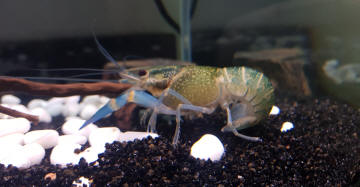
Crayfish turn green after moulting 11/20/18
Hey WWM,
<Howsit Darren?>
My female crayfish (Cherax quadricatinatus/red claw crayfish) moulted today and
her head turned from her usual brownish blue colouration to a
moss-like/grass-like green colouration. I tried searching for answers online but
nobody seems to have indicated that their crayfish have turned green (only turn
blue/brown). Do you know what might have caused this?
<Mmm; yes... "know" as in high enough confidence in my interpretation of
facts/evidence>
My water parameters are good and she is living quite comfortably in her 10
gallon. The tank is very sufficiently aerated (you can even see bubbles in the
water) and she is given algae wafers and traditional crayfish pellets.
Could it be the algae wafers (which was the only food she would eat prior to her
moulting) or could it be something else?
<Such color changing, difficulties in moults are most-often due to nutritional
and environmental (water quality) issues. These crayfish need some protein from
animal sources, iron and iodide/ate... and a setting with sufficiently hard,
basic water.
These requirements are gone over and over on WWM.
Provided all, your crayfish may well change shell color in time, with successive
moults. Bob Fenner>
|
 |
|
Re: Crayfish turn green after moulting
11/21/18
My water's pH is 7.8 and her crayfish pellets should be giving her
sufficient protein.
<I'd still be supplementing w/ a bit of animal source; AND iodide/ate added
directly to the water weekly>
I think she's fine but I'm just shocked to see a bright, almost grass-green
colour on this species because usually they don't turn green.
<Mmm, I worked quite a bit w/ Procambarus clarkii in college, and on my
own...
Crayfish can/do occur, change in shell color quite a bit... genetically, via
env. and nutritional influences. Bob Fenner>
|
White albino crawfish; changing color
5/30/17
I'm having trouble looking up information about this.
When I first got my crawfish he was full white but it's been 10 months
and is slow getting discoloration around looks like inside of it's body
bluish
blacks color.
<Ah yes; not unusual; and not problematical. Bob Fenner>
|
Weird crayfish behaviorism? Not weird. /RMF
9/9/16 9/9/16
Hello WWM,
<Hey Darren>
I've recently just bought a Procambarus Clarkii Ghost crayfish and I
noticed something weird.
<Was just talking this AM re experiments I did w/ this LA Cray many
years back>
So I've had him in this travel tank for 2 days. The tank is
about 30 to 40 cm in length and 20 in width and height.
<Mmm; needs more room than this... for stability and more>
This tank was perfectly fine for my previous crayfish which went
missing. Its a travel tank of sorts just that it is larger than the
usual. I've kept all the water conditions the same as for the previous
crayfish which thrived for 2 years. Except that this time I took a step
further to ensure that this 90 buck fella doesn't die by adding chlorine
remover. Do note that I don't have a filter but I change the
tank's water once every week or so.
<Let me ask you to read here re suitable env.:
http://www.wetwebmedia.com/ca/volume_1/cav1i4/crayfish/crayfish.htm
and here:
http://www.wetwebmedia.com/fwsubwebindex/crayfishsysfaqs.htm
The surrounding and water temperature is pretty high because I put my
tank next to a window where sunlight can shine and warm the water up in
the day. I live in Singapore too btw so it is pretty warm here. I also
fed it bread and some raw
chicken yesterday and I found it to be eating well.
<Yikes... not what I'd recommend. Please search, read on WWM re Crayfish
Foods/Feeding>
HOWEVER, there's a problem, it likes to climb onto the top of my fake
plant, and lay sideways there with half of his body out of the water.
Why is he doing that and is it something I possibly have to worry about?
<Trying to escape... which they do... But there may well be an issue
with water quality here. Please do the reading, and write back if all is
not clear about how to proceed. Bob Fenner>
Weird crayfish behaviourism? /Neale
9/10/16
Hello WWM,
<Darren,>
I've recently just bought a Procambarus Clarkii Ghost crayfish and I
noticed something weird.
<Indeed?>
So I've had him in this travel tank for 2 days. The tank is
about 30 to 40 cm in length and 20 in width and height.
<So, 16 litres/4 US gallons. A bit small for long-term success.>
This tank was perfectly fine for my previous crayfish which went
missing.
<Hmm...>
Its a travel tank of sorts just that it is larger than the usual. I've
kept all the water conditions the same as for the previous crayfish
which thrived for 2 years.
<Hmm...>
Except that this time I took a step further to ensure that this 90 buck
fella doesn't die by adding chlorine remover.
<If you're spending 90 US dollars, you should definitely be investing in
a bigger tank! Otherwise this is like buying a racehorse but keeping it
in the bathroom...>
Do note that I don't have a filter but I change the tank's water once
every week or so.
<Again, why not spend the money on a filter? An air-powered sponge or
box filter will cost very little, and an internal canister filter little
more. Both will do the trick, and protect your investment -- not to
mention make your pet happier.>
The surrounding and water temperature is pretty high because I put my
tank next to a window where sunlight can shine and warm the water up in
the day.
I live in Singapore too btw so it is pretty warm here.
<Your Crayfish will be happy at room temperature in Singapore; around
20-22 C is ideal for this species, given its subtropical US
distribution. No need to "boil" it! Indeed, very warm conditions will
stress your crayfish.>
I also fed it bread and some raw chicken yesterday and I found it to be
eating well.
<Neither of these foods is appropriate. Instead, a range of kitchen
leftovers will be much better. Some fresh greens (lettuce, cucumber,
cooked peas) alongside small quantities of seafood and white fish
fillet, either raw or cooked. Very occasional offerings of rice can be
given. Raw chicken is a bad idea because of the risk of disease, both to
you and your crayfish. Aquaria "culture" Salmonella very easily, leading
to nasty food poisoning in humans. And raw chicken often has Salmonella
bacteria. So dropping pieces of this in an aquarium is just asking for
trouble!
Occasional cooked chicken might be okay, but maybe once every month, no
more often than that. Instead you want to focus on calcium-rich foods
for the shell, so unshelled prawns are good. You can buy small dried
fish in Asian food markets which are very useful too, because they
contain tiny bones the crayfish will consume. Also, an iodine source;
Sushi Nori is good, but any other seaweed should do too.>
HOWEVER, there's a problem, it likes to climb onto the top of my fake
plant, and lay sideways there with half of his body out of the water.
Why is he doing that and is it something I possibly have to worry about?
<Crayfish will leave the water when heat-stressed or exposed to low
oxygen levels in the water. Review, and act accordingly. Cheers, Neale.>
WEIRD CRAYFISH BEHAVIOUR 10/19/16
Hi WWM,
<Hello Darren,>
It's me again and my p. clarkii ghost seems to have a big problem because
he
can't walk properly like other crayfish, he kinda stumbles every time he walks
and has a difficulty getting where he wants to. And I have found him flipped
onto his back many times and I have to help him get up a lot.
My tank is a 4 gallon(getting an upgrade to 10gallon in a few weeks when my
exams are over)with a up-aqua slim HOB filter(the shop owner said it was good so
i bought it) and I change the water completely every week. As for his diet, I
bought these crusta-pills that contain high amounts of calcium to promote shell
growth so I don't think he has any shell deformities. I also feed him one pellet
a day, so I don't think he has a lack of food.
I'm so desperate for help because I just bought him(yep he's a male) and I
really do not want him to die as he cost me 90 bucks from my own hard earned
savings(My parents would never let me buy a crayfish that costs over 20 bucks so
I kept it a secret, told them it costs 15).
<Yikes!>
Pls help I would really appreciate :( Hopefully it isn't any disease that's
plaguing him and causing this difficulty)
<This is tricky to answer without some environment and feeding details.
Let's recap. Procambarus clarkii is a warm-temperate to subtropical beast that
needs water at about room temperature. Excessively high temperatures, above
25C/77F, will cause stress, especially in the absence of supplemental oxygen.
Water quality should be as good for them as any fish; i.e., 0 ammonia and
nitrite. They do not handle low pH well; the optimum is between pH 7 and 8.
Heavy metals like copper are toxic to them; water conditioner that neutralises
heavy metals are important. So far as diet goes, iodine is often lacking, so
unless seaweed is fed to them (Nori, for example) the use of marine aquarium
iodine, at about half dose, works well. Most health problems come down to faulty
moulting, and this in turn seems to be related to iodine deficiency. Review, and
act accordingly. Cheers, Neale.>
Fwd: WEIRD CRAYFISH BEHAVIOUR 10/20/16
Hi,
my water temp is definitely and 25-27C cuz I live in Singapore.
<They don't overstock; also ensure good water movement, whether by filter or
additional airstones.>
I have not tested the ammonia and nitrates level before but all I can tell you
is I am very very diligent with the water changes.
<Water changes are good, but unless you're changing 100% daily, not a substitute
for water changes. A filter is a more economical, sensible approach.>
As for iodine, I don't think he's receiving much but he has received a lot of
calcium from the pills I feed him.
<Iodine =/= calcium; you need to provide BOTH; I would recommend marine aquarium
iodine food, or failing that, Nori and other seaweed foods.>
The funmy thing is, my previous crayfish (Cherax destructor) survived well over
2 years in the same tank and he lasted without a filter.
>Luck and genetics come into play; your Electric Blue Crayfish is an
artificially produced, inbred variety -- unlikely to be particularly hardy.>
I don't quite understand why this p.clarkii is experiencing this if my previous
one didn't.
<Life is complicated; living things especially so.>
Hopefully he moults sometime soon, it hurts my heart to see him every time I
walk past the tank :(
<Iodine and filtration are what matter, not intentions and affection.
Cheers, Neale.>
Re: WEIRD CRAYFISH BEHAVIOUR 10/21/16
I do have a UP aqua filter that provides him with oxygen as well.
I observed that his new shell is really apparent now, and it may be having a
delayed moult. Also, whenever I flip him over, a few of his legs seem to be in
pain whenever it touches the floor. I don't have any marine iodine (i don't
think i have the time to buy marine iodine because of exams)
<Mail order perhaps? Delayed moults are a common sign of insufficient iodine in
the diet.>
Am really worried, he is always upside down. Can being upside down kill him?
<Not in itself, no. But if he can't move about and feed, he'll starve.>
Also, how much length do they need to walk and. Im thinking of getting the 10G
tank from buceplant and the length of the tank is 45 instead of the usual 60..
<An adult Crayfish needs an aquarium a good 50 cm/20 inches in length.
Anything less and he's really cooped up. Cheers, Neale.>
Re: WEIRD CRAYFISH BEHAVIOUR
I'm going to go around looking for a fish store that sells iodine.
Will it be too late to save him?
<Hard to say. But it's probably your only chance. Adding marine aquarium iodine
supplement to a crayfish tank is the only known "medicine" we have, and a good
way to ensure healthy moulting. As always though, prevention is better than
cure: use iodine in tanks with crayfish, crabs and other large crustaceans to
prevent problems in the future. Cheers, Neale.>
Re: WEIRD CRAYFISH BEHAVIOUR
Is this suitable to dose for my crayfish
<This SeaChem product is fine as a source of Iodine for your Crayfish. Bob
Fenner>
|
 |
|
Crayfish plague? 10/28/16
So it's been almost a week of diligently dosing iodine into my p.clarkii ghost's
water and I am pretty convinced that it isn't a problem with his moulting
because he is still in the same state as before, maybe even less energetic.
<"Post hoc, ergo propter hoc" is something to beware of here! Just because once
thing follows another, doesn't mean they're causally linked. In this case, the
failure of the iodine to dramatically improve things doesn't mean the iodine
isn't helpful or wasn't the issue -- it might simply be too late, or
alternatively, things might have got worse without the iodine. So keep an open
mind. Iodine is absolutely essential for crayfish, that much is accepted by all
the hobbyists keeping them nowadays, especially those keeping expensive and rare
varieties.>
I suspect he is having crayfish plague and here's why:
1) His legs twitch uncontrollably as if he has no control over them (did some
research and that's a sign of crayfish plague). He cannot even move around to
eat anymore so I try to feed him by picking him up, turning him upside down and
placing pellets (which I softened by soaking them in water for a few mimutes) on
his beak. He initially accepted a bit of the food but now it seems that he has
lost his ability to squeeze and chew up the food with his beak.
<This just sound likes a stressed/dying crayfish. Not a symptom of anything
else. The clinical tests for Crayfish Plague require examination of the blood
and muscle tissues. Obviously if you're an ecologist who comes across a bunch of
dead or drying crayfish in a river with otherwise excellent environmental
conditions, Crayfish Plague is something to consider. But a single sick
crayfish in an aquarium? Nope, Crayfish Plague is kind of like "Swim Bladder
Disease" in fish -- i.e., meaningless, and just another way of saying "sick and
dying".>
2) On the underside of the tail where his pleopods are, his flesh seems to have
become transparent almost to the point where his alimentary canal is fully
visible (I think this is another sign of crayfish plague correct me if I'm wrong
<Again, indicative of a sick/dying crayfish. Their tissues do indeed change
colour (think about a cooked shrimp versus a live one) but in the case of
Crayfish Plague, one common symptom is darkening of the muscles where the legs (pleopods)
attach to the body. There are some photos you can find via Google, but I stress,
a sick Crayfish will look more or less like this, whatever it's dying from.>
All I can do now probably is to watch him die in his tank, I've probably already
done everything I could to save him.
<I agree, but there are a few things left. Substantial, daily water changes.
Increase aeration. Check hardness and pH. Don't force feed, but do try and feed
every couple of days, even if only a small bit of white fish fillet held in
front of the mouthparts. Crayfish are hardy, and have come back from seeming
death.>
Even if there's treatment, I probably wouldn't have enough money to buy it for
him. This will probably be the last crayfish I keep, unless I can get over this
one's imminent death.
<I do suspect you've been unlucky, and will direct you to the excellent
PetShrimp.com forum, which has a crayfish section where I think you'll get
quick, specific help if you can post photos as well as descriptions:
https://www.petshrimp.com/discussions/viewforum.php?f=3
While I don't agree with this guys on everything (the site owner isn't a big fan
of iodine, for example) they're very thorough and helpful people.>
Thanks for all the help that you guys have previously given me though :)
<Most welcome. Neale.>
|
Unusual crawfish behavior 11/8/15
I attempted to read through the pots for a few days and could not find anything
related to my situation.
I have a blue crawfish my brother gave to me roughly three weeks ago. When we
picked him up he was lively and acting normal. However, the next day he was on
his side. I moved him to the larger 25 gallon tank hoping he would perk up. I
then moved him back into the travel tank to isolate him hoping he would perk up
but still has not. He has been laying on his side, moving legs periodically,
gills are still moving, antenna and eyes are as well. He has not eaten.
<A bad sign>
I have had his water tested routinely (all perfect).
<... need values; not subjective evaluations>
Started changing his water once a week and also started iodine treatment.
<Ah, good>
I've even tried assisted feeding.
<? I would not do this>
He still laying on his side. I don't know what else to do. Any advice would be
great at this point. Thank you in advance
<.... what temperature, water pH, hardness.... Have you gone over our archives
re Crays in captivity on WWM?
Bob Fenner>
Re: Unusual crawfish behavior Neale's direction 11/8/15
I have been attempting to go through the archives, however it is proving to be
overwhelming. His water temp is 70 degrees fluctuating between 69 and 71. I
could have exact pH balances tomorrow
<Do start here:
http://www.wetwebmedia.com/fwsubwebindex/crayfishdisfaq.htm
http://www.wetwebmedia.com/ca/volume_5/volume_5_3/crayfish_basics.htm
Most problems with crayfish come down to [a] lack of iodine; [b] insufficient
filtration; and [c] the wrong water chemistry. Review what you're providing, and
act accordingly. Cheers, Neale.>
Re: Unusual crawfish behavior
11/10/15
Thank you so much. Have a wonderful day
<Well, donated blood and fixed my MacBook Pro recharger. So pretty good so far!
Cheers, Neale.>
|
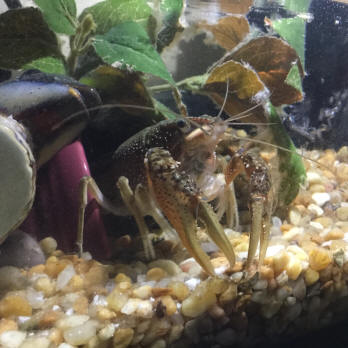
Crayfish no longer eats his exoskeleton.
8/12/15
I have a crayfish that I got for free when I went to buy a goldfish.
Apparently he came in with a shipment of fish so they couldn't sell him/her. I
was thrilled to say the least. He has shed his shell almost once a month the
first year and less frequently now (maybe once every 2-3 months. He was about an
inch and a half when I got him now he is about 7 inches. His last two
molts he didn't eat the exoskeleton Any idea why?
<Mmm; almost certainly "something" lacking in the environment and/or
nutritionally. Have you read on WWM re Crayfish health, nutrition? Do you
supplement iodide-ate? Know what the water alkalinity is?>
Also my crab (Mr. Crabbs) seems to eat MORE before he sheds his
exoskeleton. Any idea why?
<Oh yes; in preparation for the actual molt itself... takes energy and
crustaceans swell up to break the old skeleton, get out... and need more stored
food to generate anew>
I have had him almost 2 years. I change his water every month, have never added
iodine or checked the PH.
<See above and WWM>
He is in a 5 gallon tank and seems to be very happy and healthy. I feed him
crayfish food, algae pellets, bloodworm pellets, cucumber, zucchini, carrot,
green pepper, apple, cashews and nuts and small pieces of shrimp from time to
time. I have no idea what type he is or where he is from. HE is a beautiful
reddish brown in color.
Karen
<I'd be treating your Cray akin to your Crab. Bob Fenner>
|
 |
Craig the crayfish; beh.
5/3/15
Hi there again. I have a quick question (okay, two), nothing major, just
curious. Why does Craig sleep/rest, whatever it is he does when not moving
around in an awake state, in a vertical position?
<Could be that it deems the position, placement advantageous for avoiding
predation... could be it's missing a bit of material or its statocyst period....
Might be due to a deficiency syndrome. Have you read on WWM re Cray care?>
There is a fake tree (bush) in his tank in one corner and his preference seems
to be to wedge himself (back to the bush, feet to the glass) and stay there,
until he's ready to move around again.
<What they do>
He's got a nice cave and another column, some stuff to rearrange, plants to
gnaw, of course his iodine, water change, calcium and appropriate diet.
Normal or strange?
<Normal>
Thanks
Boo Rosko
Ocklawaha, FL
<Welcome. Bob Fenner, San Diego, CA>
FW Crayfish Behavior Change 4/18/15
Hey there. I bought a very spunky “Tangerine Lobster” (I think we determined it
was a variant of a blue crayfish) about four months ago for a 10 gallon tank (no
other occupants). She moulted about once a month/five weeks until the last time
she was “due" to molt. Displayed the same moulting behavior: decreased appetite,
increased shyness. However, two weeks later she will barely eat anything and
sits in her favorite hiding place for most of the day. She stopped eating shrimp
pellets so I temporarily substituted fresh greens and other vegetables. Now, she
will only occasionally nibble on cubes of carrot and one or two bites of shrimp
pellet. She never lays on her side like molting, and instead sits in her “cave”
with her tail slightly curled under (no eggs) and legs either tucked at sides or
sprawled out completely. This is very strange, because the last three months she
has had a voracious appetite and would snip and defend her tank to any passersby.
Temperature has been high 60s/low 70s and regular 25%-50% water changes every
two weeks (also removing uneaten food in the morning after evening meals).
Thanks a lot.
<Quick question: what sort of iodine supplement are you using? If "none" then
that's your answer right there. Go buy some marine aquarium iodine drops, and
use at half the dose stated on the package. It's crucial to long term success
with crayfish (by which I mean maintenance over several years). If you are using
iodine, then write back and we'll discuss further. Cheers, Neale.>
|
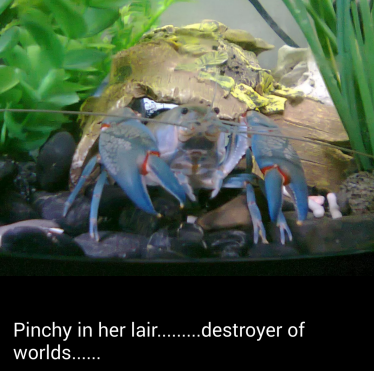
Cherax destructor joint colour faded /RMF
4/14/15
Hello!
I've owned two yabbies in my life ,one after the other.. the first yabbie
had a vastly different personality to my current one . Pinchy, the
first yabbie (creative I know, blame the husband)
was purchased at a fair from a farmer who was
getting rid of them out of his dam . Pinchy was massive,
and feisty . Hugely territorial and did all the right behavior
,digging, moving stuff like a mini bulldozer etc.. I'll will try and
attach a photo as she was the most gorgeous colour
and had such vibrant red in her
joints...which brings me to the question. How can I encourage that
red vibrancy in
our current yabbie?
<Good, consistent water quality (hard, alkaline) and nutrition. Gone over
and over on WWM>
River, the current yabbie is a large female just
like pinchy , but she is significantly more shy and she lacks the red
joint markings completely....could it be that she is a store raised
yabbie?
<Maybe>
She never digs ,and doesn't throw her weight around like pinchy did.
Or am I just a worried crawdad mum? Thanx for the help!
<Do read over what we have archived... Too much to keep re-keying.... Bob
Fenner>
Cherax destructor joint colour faded /Neale
4/14/15
Hello!
I've owned two yabbies in my life, one after the other.. the first yabbie
had a vastly different personality to my current one . Pinchy, the first
yabbie (creative I know, blame the husband) was purchased at a fair from a
farmer who was getting rid of them out of his dam . Pinchy was massive, and
feisty . Hugely territorial and did all the right behavior ,digging, moving
stuff like a mini bulldozer etc.. I'll will try and attach a photo as she
was the most gorgeous colour and had such vibrant red in her
joints...which brings me to the question. How can I encourage that red
vibrancy in our current yabbie? River, the current yabbie is a large female
just like pinchy , but she is significantly more shy and she lacks the red
joint markings completely....could it be that she is a store raised yabbie?
She never digs, and doesn't throw her weight around like pinchy did. Or am I
just a worried crawdad mum? Thanx for the help!
<Three factors here of note: gender, diet and iodine. While
both male and female crayfish burrow, their motivations do so may differ,
and their levels of aggression vary with reproductive status (in the wild,
crayfish often reproduce only at certain times of the year, though in
aquaria this may be less true). Females for example dig more extensive
burrows when
they're breeding, presumably so they can safely look after their youngsters.
Next up, diet. Crayfish (like other crustaceans) synthesise their colours
using chemicals acquired from their diet. Unshelled crustacean foods (such
as krill) and vegetable foods (especially algae) are crucial in this regard.
While crayfish can and do eat pretty much everything (there's an old story
about a murder victim's body being disposed of almost entirely in a pond of
crayfish!) in the wild they're very much omnivores that consume a lot of
plant material. Some pellet crayfish foods contain carotene for example, and
that's what they use to make red colours on their shells. Finally, there's
iodine. Pretty much all crayfish healthcare is preventative, with iodine
being the No. 1 item on that list! Iodine is massively important to
crustaceans, but especially so leading up to each moult, and you really do
need to provide an iodine source. The cheapest and easiest is to go grab
some marine aquarium iodine supplement, and dose at half the amount
recommended on the package. But you can also use iodine-rich foods such as
Sushi Nori and certain seafoods.
That's a bit more of a faff, but works too. Cheers, Neale.>
|
 |
Lobster claws dried up and are stiff; moulting beh.
4/2/15
So I had to move my lobsters by hand and I thought he was dead after 20 minutes
even though I kept him soaked and moist but he was just limp and thank God he
started moving again after I thought he died then I put him in a very small cup
only big enough for his body but his pincers stuck out so later when I finally
threw him I'm the tank at last I notice he is always
curled up and still he is alive as his legs move and his mouth is moving his
tail is still able to uncurl but he doesn't and I've noticed his claws are just
limp normally he would raise them but he doesn't do anything with them then I
got him out and noticed they were hard as rock I don't know if it was because of
being out of water too long and being dried up I don't
want to force them open as that might break em so will they overtime just go
back to normal or should I break em off because I know they will grow back but
just will be smaller I don't want to break em off so what should I do should I
wait for him to molt
< Never force a moult of a crustacean, however distressing it
seems. If the animal can complete its moult, it will; forcing a joint to snap is
not only stressful but, if the joint isn't properly formed, can lead to serious
(fatal) injury. Now, nine times out of ten, improper moults come down to lack of
iodine. What's the iodine source you've been offering? If the answer is "huh?
iodine?" then that's your problem. You can buy iodine drops for marine aquaria
inexpensively, and either use at full dose (for marine tanks) or half dose (for
freshwater) and your crustacean pets will moult normally. Indeed, some problems
they have now will be healed after one or more successful moults. Buy beyond
this, there's nothing you can actual do for your crustacean beyond the obvious:
optimise water quality, check water chemistry is correct, and minimise stress.
Cheers, Neale.> Blue Cray color loss
1/5/15
Hi guys.
<Suri>
I've had an Australian electric blue Crayfish, for almost 5yrs
now and her name is Mrs. Pinchy.
<Wow! That's a good long time>
She has only ever molted 3x, and her last molt was in late November
2014.
<Molt periods get longer as crustaceans age, grow>
After her first 2 molts, she was pretty white for a few days but then
her electric blue colour with pink dots would come back, looking vibrant
as ever.
I am really worried as its well over 6wks since her last molt in
Nov2014, and she is still extremely white in colour and showing no signs
of returning to her usual elec blue colour.
<Ah yes... genetic and nutritional. You could try introducing a bit more
carotenoid content... even just paprika in the food>
Nothing has changed with her tank or what I feed her
Would anyone be able to tell me what is wrong with my little, Mrs.
Pinchy?
<As stated, aging and diet>
Thanks
<Welcome. Bob Fenner>
|
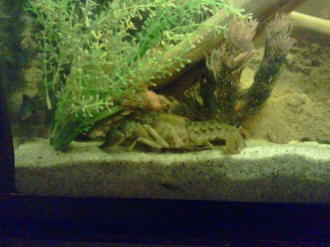
Crayfish attacking himself? Rdg.; no data
12/23/14
So my large crayfish just molted for the first time. I think he
lost a leg in the process,
<Does happen; most often when there is/are deficiency/ies... check WWM
re Crayfish needs for mineral content in their water, food/s, the use of
iodide-ate. Lost limbs can be recovered through correction and
successive molts>
but that is not the issue. he is acting like he is either
attacking himself or getting stuck on himself.
<Also symptomatic of>
He gets two of his legs "hung up" on his large forearm. he acts like he
is trying to scrape it off.
he can move the legs but then promptly sticks them back over his claw
arm.
He carries on like normal, he just had two legs stock over his claw arm.
He shed that claw so i can't see him trying to molt that leg AGAIN.
should i be worried?
<Mmm; if this stirs you on to review, fix the issue/s involved; yes>
He is quite content wondering around his tank. he just is doing it on 2
less legs.
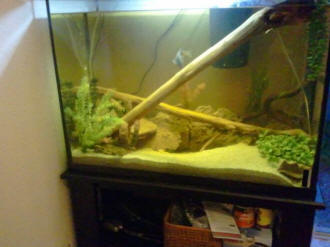
Here is a pic of him after he shed. you can see one of his legs hung
over his claw arm.
This was right before a 50% water change (discoloration is from the
drift wood). He is still exhibiting this behavior even after the water
change.
this is a 37 gal tank.
<Do you need help learning how to use the site, indices, search
tool? Bob Fenner> |
 |
|
Re: Crayfish attacking himself? 12/23/14
Ok go shrimp pellets and seaweed from my work (PetSmart). will that work
for giving him what he needs? i was giving him part of an oyster once a
week too and he loved it.
<Fresh seafood and dried seaweed do contain some iodine. But the
easiest/cheapest approach long term is to buy some iodine supplement as
used in marine aquaria, and dose (at half the dose on the bottle) every
week or however often recommended by the manufacturer. As Bob stated,
lack of iodine compounds in the diet is a major (if not *the* major)
cause of health problems with crayfish and other crustaceans. Get this
right and they're usually extremely easy to keep.
Cheers, Neale.> |
|
Crayfish - change in behavior after change of aquarium and
molt 12/4/14
Dear WWM Crew, My husband and I live in Japan and about a month ago we
bought a couple of crayfish,
<Oh! I kept these as a youth there as well (Dad was a lifer in the Nav)>
which are very common in pet shops here. By Googling and checking
pictures we believe we have Procambarus clarkii but we might be
mistaken,
<This one species of Cray has been
transplanted by humans most everywhere>
they were not very specific in the shop. We got a white one and an
orange one. I have read your articles and FAQ but we are still wondering
about a change in behavior in one of our crayfish. They told us since
they were roughly the same size they could live in the same aquarium,
<Mmm... until one molts and the other is hungry... DO keep your eye on
them, DO provide a one-way in only (like a blind piece of PVC... pipe
and cap) and KEEP them fed (daily)>
and in the shop they were kept in the same box. So we set up a 60L tank
with plenty of hiding places and few plants that we were told they enjoy
eating, plus filter and heater set to 23°C (there is no such thing as
central heating in Japan and our rooms can get very cold during winter)
<S/b fine for these animals>
. We bought them the specialized pellets they sell for this type of
crayfish and started our adventure. After few days they seemed to be
doing good, <well> and showed distinct personalities, the white one
despite being the one who got most easily scared by our presence would
stay in the open while eating, while the orange one would come to the
glass and show his bravery whenever we approached, but would carry away
his pellets and feed only while hiding inside a cave. Perhaps a week
after we got them I caught them by chance in the middle of a fierce
fight and in the next couple of days the white guy started
“mysteriously” loosing <losing> limbs. So we decided to separate them,
at least for the time being as clearly the white guy was no match in his
state. The decision was even more pressured as white guy molted and we
knew he would be too soft and could get killed.
<Too likely so>
We transferred orange fellow to a smaller tank with similar setting.
<Good>
This was three weeks ago. White guy has since molted again,
<... some deficiency at play here... What is the hardness of the water?
Do you measure pH... ? What water source are you using? Are you
administering iodine (ide-ate actually)?>
his legs growing very fast and himself growing quite a lot. We are
surprised by such fast molting and hope it is normal.
<Not normal, nor healthy>
I have more or less come to understand his routine, he stops feeding for
a while, he molts and after a couple of day she has finished eating his
exoskeleton and is back to his normal antics, eating his pellets as
usual. Orange guy on the other hand, has us very worried now. For the
first two weeks he behaved as he had in the big tank, playful and
showing himself when we approached, but hiding to eat and sleep. On
Monday evening we discovered he had molted when we returned from a
weekend trip. It's been 4 days since we found him and he has eaten only
about half of his exoskeleton and has refused any extra food we tried to
give him, he stays in his cave and rarely comes out all. Is this
behavior part of his normal routine after molt?
<Again; something is off, missing here... see the terms above in the
archives on Crays on WWM>
Just as he has behaved different from white guy, he acts different in
this case too? How long should we wait for him get back to normal? We
are worried he needs something else,
<Yes>
which we are missing from his small tank compared to the fellow in the
big tank. He has less space and hiding places, fewer plants, which he
barely eats anyway as opposed to white who constantly nibbles on them,
and different rocks at the bottom. Everything else we have tried to keep
exactly the same. Any advice or recommendation would be very helpful. I
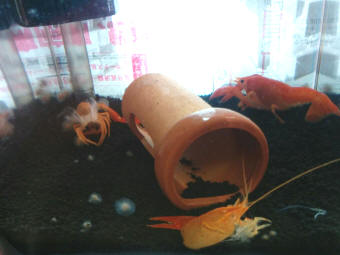
attach a picture of how we found him four days ago after we came back,
in case it helps identify him and if something is wrong. We have since
cleaned all the uneaten food that you see in the picture, and changed25%
of his water. Thank you very much, Camilla
<The I2 will likely work wonders... Can be purchased for aquarium use...
Check your water quality otherwise. Perhaps your water is "too soft",
lacks Ca, Mg salts, carbonate. Bob Fenner>
|
 |
do Louisiana crawfish hibernate in captivity
11/17/14
My daughter rescued a crawfish from a crawfish boil last May - about 6
months ago. We keep Isabelle (the crawfish) in a 10 gallon tank, filter,
gravel, half full and a hiding place.
<Neat! I "did this" also... with likely the same species, Procambarus
clarkii; as a college student studying this animal's substrate
preference behavior>
We feed her mostly the pellets and occasionally some veggies. She seemed
to be doing okay. Had some eggs, but lost them.
<Not fertile if solitary>
She molted a month ago and seemed fine. Last week she was on her side.
We flipped her over. Today she's seems virtually dead. Hardly moving.
<Mmm; very common... usually an issue of nutritional deficiency,
particularly a bit of iodine/ide... or usable iron... Search, read on
WWM re... or write back if you can't/don't figure out how to use our
indices or
search tool>
At one point I thought she was dead, but in a shallow bowl of water (to
observe her) the water kept circulating so she is clearly still
breathing.
It is November - is she beginning some sort of hibernation?
<Mmm; not likely if indoors... i.e. kept where warm>
Could this be nutritional?
<Yes; almost assuredly>
We didn't know to keep the exoskeleton in the tank, so she lost out on
that. I'm wondering if I need to be in emergency-doctor mode or hospice
nurse mode. Help!
<Can be rescued likely by application (to the water) of the above...
there are commercial prep.s for aquarium use... or one can assemble DIY>
Thanks for your site, it's really the only place to find good info about
keeping crawfish as pets (though I wish I hadn't overlooked the part
about leaving the exoskeleton in the tank!)
Thank you,
Pamela Berg,
Northbrook, IL
<Please do write back if any of this is incomplete. Bob Fenner>
do Louisiana crawfish hibernate in captivity
11/17/14
My daughter rescued a crawfish from a crawfish boil last May - about 6
months ago. We keep Isabelle (the crawfish) in a 10 gallon tank, filter,
gravel, half full and a hiding place. We feed her mostly the pellets and
occasionally some veggies. She seemed to be doing okay. Had some eggs,
but lost them. She molted a month ago and seemed fine. Last week she was
on her side. We flipped her over. Today she's seems virtually dead.
Hardly moving. At one point I thought she was dead, but in a shallow
bowl of water (to observe her) the water kept circulating so she is
clearly still breathing. It is November - is she beginning some sort of
hibernation?
<Nope. Just to be clear: only warm blooded animals, specifically mammals
rather than birds can hibernate. For sure some cold blooded animals
become torpid but they don't actively lower their temperature or
metabolic rate -- they are simply forced into a situation where ambient
coldness makes their metabolic rate slow down. So, if you're talking
about crayfish, they'll be as active as ambient water temperature
allows, and indoors, that's pretty
much optimal all year around so far as North American crayfish species
go.
Put another way, unless the tank is frigid-cold then it's very unlikely
a cold blooded crayfish would be deliberately slowing down in the same
way as a hibernating dormouse.>
Could this be nutritional?
<Immeasurably more likely.>
We didn't know to keep the exoskeleton in the tank, so she lost out on
that. I'm wondering if I need to be in emergency-doctor mode or hospice
nurse mode. Help!
<Optimise water quality and chemistry as per normal, but also use iodine
drops (sold for marine tanks, used at about 50% the quoted dose). Iodine
is the "wonder drug" for many crustaceans because it's lacking in their
diet
when given generic aquarium foods. Providing iodine prevents all sorts
of problems, and in some cases, can undo damage. Crustaceans, like
molluscs, tend to exist in a binary state under aquarium conditions --
they're either
thriving or dying, with not much in between. Do start reading perhaps
here:
http://www.wetwebmedia.com/fwsubwebindex/crayfishdisfaq.htm
Links to various articles and FAQs at top.>
Thanks for your site, it's really the only place to find good info about
keeping crawfish as pets (though I wish I hadn't overlooked the part
about leaving the exoskeleton in the tank!)
Thank you,
Pamela
<Glad to help. Cheers, Neale.>
Re: do Louisiana crawfish hibernate in captivity
11/17/14
Thank you so much. I'm off to the aquarium shop to get marine iodide
(iodine?) and better food (and a new filter). Didn't realize how much
all we loved this little girl until we thought we lost her.
<Ahh; a good life lesson. BobF>
Re: do Louisiana crawfish hibernate in captivity
11/18/14
Hi Bob,
We changed her water and added the .25tsp of marine iodine (it said 2
tsp per 50 gallon and our tank is 10 gallon). The person at the local
aquarium shop said the calcium in our hard water is probably good for
her too
<Yes it is>
-- and she did almost instantly perk up.
<Ah yes; the I2... miraculous in appearance eh?>
Last night she was crawling all over, trying to escape -- very
uncharacteristic of her, though I've read on your site how they can be
real escape artists, so we were very hopeful, almost giddy with
excitement. We thought it was a real miracle -- my husband called her
Lazarus.
<Ooh, a fave character in the R. A. Heinlein books he shows up in>
This morning she was on her back and motionless, though after I flipped
her I can see she's not dead. She is not eating -- even last night as
her little alien gill-like belly button of a mouth was going bonkers,
she would
not eat any of the food we put in the tank -- bottom crawler pebbles,
lettuce, algae tabs, a frozen pea. I thought about putting a few small
fish in there to stimulate her and maybe she'll eat them. Or get some
fresh plants?
<These would help... and just a drop more iodide-ate every other day>
Thanks for your help-- and any more advice you might have.
Pamela Berg
<Reading (on WWM, elsewhere re Crayfish) and patience. Bob Fenner>
Re: do Louisiana crawfish hibernate in captivity
11/18/14
Bob,
Thanks for all your advice. I made a small donation to your wonderful
website/organization.
Pam
<Ah; thank you. B>
Crawfish; beh. 2/13/14
My crawfish molted a few days ago but the shell did not come off right.
By the time I woke up he seemed to be stuck in his old legs. Is abdomen
and tail were off but he was laying on his back with his legs up. They
seemed to be half out of the shell because it seemed like the "shell
"was a tangled mess. I later realized that those were his actual legs.
During the molt not only did his two front claws tear out but all of his
legs are crumpled and broken. Now he just writhes on his back. It's very
upsetting and I don't know what to do. I keep expecting to find him dead
but he's still hanging in there somehow. I tried feeding him by gently
lowering food to his mouth on a skewer but he was more frightened than
hungry. Is there anything I can do to save him?
Thanks
Shannon
<Hi Shannon. We get a message like this every week or two. Invariably,
the crayfish was being kept without supplementary iodine (sold for
marine aquaria, and used at half the dose on the packaging). Do have a
read here:
http://www.wetwebmedia.com/CrayDis4.htm
Nothing you can do to help now, but the next moult may fix things if the
crayfish survives, in which case immediately using iodine supplement
will be the key to success. Good luck, Neale.>
blue lobster; beh.
1/19/14
just wandering why my pet lobster just leaps up almost jumping out of my
tank. What does that mean.
<... Something not to their liking... water quality likely; or
tankmate/s.
Bob Fenner>
Crayfish behavior question...
3/9/13
What are the crayfish doing when they just sit stationary and slowly
sway their appendages back and forth. The motion is reminiscent of a
rocking chair... back and forth, back and forth.
<If you mean the appendages around the head, these are mostly sensory,
either sampling the water directly, or else directing water towards
sense organs.>
Also, I swear it's possible that they can regrow appendages without
moulting. Am I correct?
<Unlikely; crustacean appendages grow back with each moult because
that's when their skeleton (which is external) gets "upgraded" to the
newer, bigger size. Cheers, Neale.>
blue crayfish acting strange 3/7/13
Hello-
<Hi Ann>
I have a blue crayfish in my classroom aquarium that has been acting
strange for a couple of weeks. I have had the crayfish for about 6
months.
It is in a 30 gallon aquarium with some rosy barbs and neon tetras.
<Surprising that these species all get along here; temperamentally and
water-quality wise>
She ( I think it is a she) has a log to hide in, but has not been staying
in the log for the past couple of weeks, instead choosing to walk around
and sometimes lay on her side.
<Laying on side... could be reproductive behavior, evidence of
nutritional deficiency... or nothing>
Also for the past couple of weeks she has been curling her
tail under her body when she walks around. When she uncurls her
tail she is picking at her stomach with her little back feet.
<How long have you had this animal?>
Sometime she puts the tip of her tail down on the floor of the aquarium
and raises the back half of her body and feet off of the floor. My
students are convinced that she is pregnant and that she is going to
have babies any day now.
<Mmm, can you see eggs?>
I am not so sure because she is the only crayfish in the tank, and I do
not believe that they are asexual.
<Are dioecious, from the Gk. meaning "two houses", boys and girls...>
I have tested the water and it is ok, but I did a partial water change
anyway. I would definitely be interested in any insight that you
may be able to offer.
Sincerely,
Mrs. D
<Mmm, well, IF the one was in the presence of a male before your
acquiring it, there might be a packet of sperm that was transferred...
But females will/do "go through the motions" often w/o actually
producing eggs, and of course, viable young. I would have you review
what we have archived:
http://www.wetwebmedia.com/FWSubWebIndex/crayfishbehfaq.htm
and the linked files above. Are you providing Iodide/ate? Is there
sufficient alkalinity here? Has this specimen molted in recent times?
Bob Fenner>
|
crayfish molting during pregnancy? 1/30/13
Hi WWM Crew,
<DC>
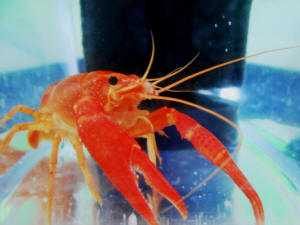
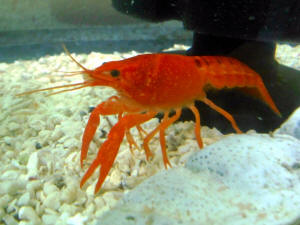
I have a pair of bright orange crayfishes (I'm not sure as to what species
they belong to, please see pictures) and they were already mating just
a few seconds after I placed the male on the female's tank. After that, they
were mating non-stop (like every 15 minutes?) so I searched the web to check
if this was normal and found out that you had to separate them after mating
because the male is just going to replace the old sperm plug and just repeat
the cycle. Now after 1 week, the female molted! So my questions are:
1. is the sperm deposit affected by the female's molting process? do I need
to re-introduce the male?
<Is... shed w/ skeleton, unless already used. I'd hold off on introducing
the male. It may well eat the other>
2. when a male crayfish is in "form 2", he has to molt to be in "form 1".
Then if he molts again after that, will he go back to "form 2"?
<Usually will change back from "juvenile" in time, molts, w/ good
conditions... see WWM re systems, nutrition of Crays>
Thanks,
Daddy Chong
<Welcome. Bob Fenner>
|
 M, F
M, F |
|
Re: crayfish molting during pregnancy? 1/31/13
Oh I see.. Just 1 quick follow-up question.. What species do my
crayfishes belong?
<Don't know... would search Google images re. B>
Thanks,
Daddy Chong
|
Crayfish, systems - 1/25/13
Hi WWM,
<Ashley,>
I have a problem that you may be able to help with. I keep a Red
Claw Crayfish (Cherax Quadricarinatus) and he has chewed through the
cables to the filter and heater in his tank causing a very low
electrical current to pass through the water.
<Do give him something else to eat; these animals are herbivorous in
part,
and need something to chew. Have you tried plain vanilla Pondweed as
sold for Goldfish?>
I have tried positioning the heater and filter so the cables are out of
the water but he climbs up them and pulls the cables back into the
water.
<Is what they do. Crayfish aren't really amphibious as such, but they do
explore, and they do clamber through swamps from one pool to another.>
The electric current doesn't seem to affect him as he is moving and
feeding as normal. Is there anyway of making the cables 'chew proof'?
<For sure. Wrap with pond-quality plastic liner or mesh. An external
heater (e.g., Hydor ETH) may be more effective, particularly if
connected to an external canister filter (some of which, like certain
Eheim models, have built-in heaters anyway).>
Thanks in advance,
Ashley
<Cheers, Neale.>
white and blue crayfish, beh., fdg.
8/19/12
I have a white crayfish and a blue crayfish in a 90 gallon tank I also
have a common brown crayfish. The tank has lots of caves and plants but
the white crayfish and blue crayfish are sharing a cave. They have built
a wall in the entrance of the cave and haven’t come out for 2 weeks.
<Odd. But do bear in mind Crayfish are largely nocturnal, and prefer to
feed at night.>
I have seen them mate several times and they never fight. I recently
knocked some of the wall down to see if they are alive and they are. I
thought that crayfish would fight is it normal for a blue and white
crayfish to live in the same cave together?
<Not at all normal! You are lucky. Of course, the acid test is what
happens when they moult; that's often when fatalities occur.>
I am also worried that they are not eating. Should I just leave them
alone?
<Yes. Naturally, check the aquarium is working properly in terms of
water quality (is the filter okay) and water chemistry (shouldn't be
soft or acidic). Review diet, and remember they need green foods, a
source of calcium (unshelled shrimp are good) and some use of iodine
(you can buy iodine-enriched foods for crayfish, but adding iodine drops
as sold for marine aquaria at 50% the quoted dose seems to work best).
There's a good review here:
http://www.wetwebmedia.com/ca/volume_5/volume_5_3/crayfish_basics.htm
Cheers, Neale.>
|
Blue Yabby... beh.
1/9/12
Hi there,
<Danielle>
I have had a blue Yabby in a filtered 200L tank for about a year
now.
As s/he moulted approx 3 times last year, I am guessing its age
to be 1-2yrs old. He is approximately 16cm from tail to end of
his pincer.
Last night, I came home to find one of his pincers lying beside
him. I was startled and quite upset, until I read up on your site
that this can happen and it's not fatal.
Q: Will it grow back?
<If there's sufficient nutrition, suitable water
quality... likely so>
Q: S/he also seems to like munching on it, should I remove it or
leave it in the tank?
<Leave it in... provides replacement biomineral and
nutrition>
I have also tested the nitrites, ammonia and pH levels. The
nitrites and ammonia levels are fine (I do a 25% water change
& scrub the rocks-with water- every 10 days & neutralise
the new water). However, from external research, my concern is
the pH level. It's at 6.4, which according to my research is
too low.
<It is too low. Do read further re necessary biomineral and
alkalinity...
here: http://www.wetwebmedia.com/FWSubWebIndex/crayfishsysfaqs.htm>
Q: Can you please advise the best way to increase the pH level
without harming him?
<Read here re: http://www.wetwebmedia.com/FWSubWebIndex/fwhardnessfaqs.htm
I also only feed him pellets but tomorrow I will go and buy some
algae food, i.e. that contains Spirulina. As per your advice,
I'll also buy some iodide to put in the water and only add
half dosage.
<Good>
Below, I have attached some photos of him, of his detached pincer
and the attached one. Both pincers appear to have brown spots on
them. The detached one looks like it has a lesion on it.
S/he's still pretty active and alert but I just want to make
sure I get this in time.
Q: Is it likely s/he'll lose his other pincer due to the
brown spots?
<Mmm, can't say. Depends on the cause/s of the
ecdysis>
Q: Could it be possible s/he have removed the infected
pincer?
<Mmm, yes>
Q: S/he is forever cleaning itself. Is this normal?
<Yes>
I look forward to your advice.
Thanks
Danielle
<Welcome. Bob Fenner>
|
|
%20blu%20yab.jpeg) 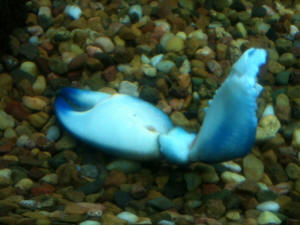
Re: Blue Yabby 1/9/12
Hi Bob
Thanks for the advice, I'll action today.
Cheers and happy new year.
Danielle
<And you dear. BobF>
|
why is my Procambarus alleni pale after
molting. Reading 9/6/11
Hello, Your forums are useful and informative.
<Appears you haven't read on WWM though>
I recently bought a blue crayfish. I did a lot of research, and I'm
sure its the Procambarus alleni crayfish. He is about 4 inches long and
was very blue when I bought him. After a week in my tank, he molted and
I removed his old shell the next day (I know better now). Anyway he is
very pale (almost white) and he does not look blue at all. he is eating
normally and seems comfortable i.e. moving around his tank and so on.
He lives with two (baby) iridescent sharks. It has been nearly a week
after he has molted and he looks the same. Please help! Thanks
Avinash.
<... what re chemistry of the water here? Levels of Ca, Mg,
Alkalinity? Use of iodide/ate? Foods/feeding. Please read here:
http://wetwebmedia.com/FWSubWebIndex/crayfishbehfaq.htm
and the linked files above. Bob Fenner
Cray fish molted .. what to do with old
shell ? 6/22/11
Hi,
<Hello>
My Cray fish just molted this morning and she looks fine .. all in one
piece. We are wondering if we need to keep the old shell in the tank or
can we remove it?
<Leave in... may well be consumed... Read here:
http://wetwebmedia.com/FWSubWebIndex/crayfishbehfaq.htm
Thanks
Simmi Manoj
<Welcome. Bob Fenner>
Rock's Exoskeleton 2/6/11
Hi Crew!
<Kat,>
Rock (my crawdad) just went through a molt and
it's all in one piece - how long do I leave it in the tank if he
doesn't eat it?
<As long as it takes, certainly 3-4 nights. Recycling the calcium in
the shell is crucial. Do also remember to dose the tank with iodine as
sold for use in reef tanks, albeit at 50% the quoted dose for the reef
tank; without iodine, crayfish don't seem to be able to repeatedly
moult successfully.>
It's kind of creeping me out... LOL!
<Then don't keep crayfish!>
Thanks,
Kat
<Cheers, Neale.>
re: Rock's Exoskeleton
Thanks Neale,
I'll pop out and get some iodine for him... :)
Kat
<Real good. Cheers, Neale.>
Crayfish changing colors? 1/12/11
Hello I have had my crayfish for about two months. It has molted twice
in that short time span. My question is about color. When I got pinchy
he/she was a bluish purple color. Now it is very dark blue with stripes
and at the joints a whitish color. I've looked up crayfish with
this coloring and the closest I've come is Cherax peknyi. I have
looked at numerous pictures but haven't seen any with the original
light blue coloring. I just want to make sure it is fine. He/she lives
in a 55gal with 4 tiger barbs 7 black skirt tetra 2 Chinese algae
eaters
<Do keep your eyes on these... see WWM re>
and 3 Plecos.
<Which species?>
Dark blue sand as substrate. Two 60 gal filters and ammonia 0 nitrite 0
and nitrate 5ish. Thank you very
much
C. Conner
<Umm, Crayfish do change colour (and markings) with environmental,
nutritional influence... some do change as well with age,
development... You might want to take a few photos, send them off to
the specialty FW crustacean sites w/ your query. Bob
Fenner>
Question for your staff... 12/25/10
I am having a discussion with a friend of mine who's grandfather
told her that a crawfish tail grows back when they are torn
off. I am of the impression that since she was a little girl
when she was told this, that
she was told this so that she wouldn't think that she was killing
them and being inhumane. So to settle the question we have searched
Google and ask.com to see if this is myth or real. Your site is the
closest to having similar questions answered and I was hoping that you
could help us answer this question. If you could reply within the next
couple of weeks that would be great. I know that it is the holiday
season and that you probably won't get back to me as quickly as
during a regular working week. Thank you for your time and knowledge in
this particular field.
David
<Hello David. No, crayfish (crawfish) cannot regrow their tails.
Removing their tails is indeed traumatic, and because the tail is
highly muscular and contains the organs used for breathing, the gills,
removing the tail will kill the crayfish quickly through blood loss,
shock, and suffocation. Your friend is perhaps remembering incorrectly
something her grandfather told her. Crayfish can, in theory at least,
regrow their limbs. They can do something called autotomy if a predator
grabs hold of a claw or leg, autotomy being self-amputation of a limb.
The leg or claw snaps off, the crayfish uses its tail to quickly swim
away, and the predator hopefully fails to re-catch the crayfish. The
amputation is controlled by the nerves, so its a voluntary thing, but
it is still quite stressful for the crayfish and used only as a
last-ditch attempt to escape a deadly situation. At the next moult a
small bud-like limb will appear where the leg or claw was lost. With
each moult (each one a month or so young, less often as they age) the
bud gets a little bigger and more similar to the leg or claw.
After six or more moults the claw or leg will be approximately
"normal" though re-grown claws are usually smaller than the
original claw. Because older crayfish don't moult often, if at all,
older crayfish have a very
limited ability to re-grow missing limbs and may not ever properly do
so.
Crayfish don't grow missing tails because their "tails"
aren't limbs but actually their abdomens, and we call them tails
purely because it's convenient to do so, not because they're
anatomically similar to tails of,
say, lizards, which can indeed shed the tips of their tails if needs
be.
Hope this helps. Cheers, Neale.>
crawfish lost claws in moulting, reading
10/16/10
Our crayfish moulted recently but this time he lost both of his front
claws.
<Mmm, happens... Usually due to nutritional deficiency and/or water
quality issue/s (lack of alkalinity, biomineral content,
iodide-ate>
When my husband found him, he was lying on his back at the bottom of
the tank. We were afraid he was dead but when he tried to fish him out
of the tank he shot all around but didn't seem to have very good
control as to where he went or how he landed. I don't recall him
having lost is claws in previous moults and we've never seen him
lying on the bottom of the tank like that before. He seems to be doing
a little better now, hiding in the castle, but at least he is upright.
Is it normal for them to lose both claws when they moult?
<Mmm, no>
Also, I noticed several postings where iodine supplements are
recommended. Should we be adding iodine to the water?
<Yes... actually iodide-ate>
Will the iodine have any adverse effects on any of the fish in the tank
with him?
<Not if "properly" dosed>
Thanks for your help.
Lynn
<All you need to know is archived on WWM. Start reading here:
http://wetwebmedia.com/FWSubWebIndex/crayfishbehfaq.htm
or learn to/use the search tool linked on the site on every page. Bob
Fenner>
crayfish concern... beh., hlth. -- 10/11/10
I have a concerning question about my crayfish. He is 3 years old and
pretty big now, he's blue and really shy. He use to always stay in
his cave but recently I always see him walking around my tank, he even
tried to get out today by climbing up the bubble cord. I noticed that
he has these long fuzzy transparent things about his legs and I was
wondering what they are and if this is bad. I've never seen it on
him before and I'm scared that he's going to die. I had him at
my mothers in a different tank and she never fed him and the water was
pretty gross because she hated him and refused to take care of it. When
I got him back I put him in my clean tank and I feed him everyday. Will
the transparent fuzzy things come off?
<Hello Stefanie. Chances are that the fuzzy things are relatively
benign parasites you needn't worry about too much. They're
unlikely to be related to your crayfish's odd behaviour. In fact
things should improve each time he moults if you remove the moult so he
cannot become reinfected. Because crayfish recycle calcium this way, be
sure to provide an alternative source such as unshelled shrimp or
whole, frozen lancefish (you can buy these from pet stores). As for the
odd behaviour, one of several things could be
amiss. Check water quality first, and water chemistry second. Water
quality should be good, ammonia and nitrite levels at zero. The tank
should be reasonably big -- 15 gallons would be about the smallest for
a large crayfish -- and filtered. You should be doing regular water
changes, 25% every couple of weeks. The water should be hard and basic.
If you live in a soft water area try adding to every 5 gallons half a
tablespoon of Epsom salt, half a teaspoon of sodium bicarbonate (baking
soda), and half a teaspoon of aquarium salt, ideally marine salt mix
but ordinary aquarium salt will do. Supplemental iodine is important
for moulting; use the stuff sold for marine aquaria, but at a half
dose. Without iodine, deformities are common, as are fatalities.
Basically check everything is as it should be.
http://www.wetwebmedia.com/ca/volume_1/cav1i4/crayfish/crayfish.htm
http://www.wetwebmedia.com/ca/volume_5/volume_5_3/crayfish_basics.htm
http://www.wetwebmedia.com/FWSubWebIndex/crayfishdisfaq.htm
Cheers, Neale.>
stressed crayfish
Will stress induce molting in a crayfish? 9/13/10
<Can't think why.>
One of our crayfish was attacked by another one ( a mishap while the
kids were observing them in the sink!) and lost a claw - traumatic,
I'm sure!
<Indeed, and without a claw crayfish are less able to defend
themselves, making cannibalism much more likely. Crayfish are
territorial and fairly aggressive animals. Re-growing missing limbs
also wastes energy, and that
can set crayfish back relative to their peers, with bigger ones
bullying and/or eating smaller ones.>
He then molted that very night. This posed a great question for my
science-minded kid - was it the stress or just coincidence?
<Likely the latter.><<Mmm, am not so sure... Perhaps the
molt after the autotomy (tossing of the "free" limb to avoid
outright death... has survival value. RMF>>
Thanks!
Leslie
<Cheers, Neale.>
More re: stressed crayfish 9/13/10
He then molted that very night. This posed a great question for my
science-minded kid - was it the stress or just coincidence?
<Likely the latter.>
<<Mmm, am not so sure... Perhaps the molt after the autotomy
(tossing of the "free" limb to avoid outright
death'¦ has survival value. RMF>>
<Would disagree Bob. It takes several days for the hormonal changes
prior to moulting -- reabsorbing calcium from the old shell, absorbing
extra water to expand the new shell, and so on. Moulting itself is the
point at which a crustacean is at its most vulnerable, whereas a lost
limb is a fairly trivial issue. I can't see how a crayfish could
speed up moulting, or why it should want to. But all speculation!
Cheers, Neale.>
<<Mmm, I still don't know re. Please see the first few
citations here:
http://mail.wetwebmedia.com/Default.aspx#page=/Main/frmMessages.aspx?user=crew&folder=sent+items&mapped=false&leftnav=true|section=UserEmail
B>>
|
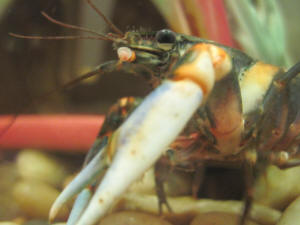
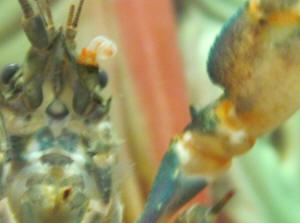
FW Lobster antenna missing --
08/06/10
Hi Crew,
<Hello Cap,>
I just purchased a Tiger Lobster
<Crayfish'¦>
and did not see that one of the antenna are missing. It looks to
have had the whole socket pulled off. In the photos there seems
to be a curling growth returning.
Will this ever possibly self correct or did I purchase a
'sensory challenged crustacean'?
<Will grow back *assuming* good water quality and the use of
an iodine supplement at 50% the dose recommended for marine
aquaria. This latter actually ensures good moulting generally,
and iodine deficiency is apparently a common reason why crayfish
fail to moult properly in home aquaria.>
Thank you for your kind attention.
Cap
<Happy to help. But please, next time keep your images down to
500 KB; we do ask for this where you got the e-mail address, and
if people ignore this and send 7 MB images like you did, that
gums up our e-mail allowance and causes other people to have
their messages bounced back unanswered. That's not fair, is
it? So please, help us to help you. Cheers, Neale.>
|
  |
Crayfish Question... beh., not good -- 05/21/10
Hi, I am trying to find out what it means when a crayfish turns up side
down, the crayfish is still a live in a 10 gallon tank she has every
thing it needs to be healthy I just cant figure out why it keeps
turning on its back like if its going to die, but my daughter just
turns it back over and it goes for a good hour before it turns on its
back again what could be the problem. Please help this is for my
daughter I would hate to see it die on her. thx Jesse
<Hello Jesse. No, it's not normal. In fact it's often a bad
sign. Crayfish sometimes fall over if the aquarium just has a plain
glass bottom, because their legs can't grip glass at all. Fine
gravel or sand is best. Make sure there isn't an copper or anything
poisonous, e.g., insecticide, getting into the water. Make sure the
water is adequately filtered and if necessary heated. Hard, basic water
is usually essential for most crayfish species.
Supplemental iodine is important for moulting; use the stuff sold for
marine aquaria, but at a half dose. Without iodine, deformities are
common, as are fatalities. Basically check everything is as it should
be.
http://www.wetwebmedia.com/ca/volume_1/cav1i4/crayfish/crayfish.htm
http://www.wetwebmedia.com/ca/volume_5/volume_5_3/crayfish_basics.htm
http://www.wetwebmedia.com/FWSubWebIndex/crayfishdisfaq.htm
Cheers, Neale.>
Crayfish beh., moulting 3/6/10
Hey guys,
I have a question about my crawdad. I took him out of my spring about a
year ago. He's been doing great in my fish tank. I put a deer skull
in there for him and he's made a pretty cool place for himself
underneath.
Well, I had noticed I haven't seen him for a while and found him
wedged under the skull and he hasn't moved for a little over a day.
He usually comes out everyday. I'm afraid of touching him because
I'm not familiar with their characteristics during molting.
I've been searching but can't really find anything. I don't
want to hurt him if he's alive and I also don't want him in my
fish tank if he's dead. Long story short, do crawdads basically act
dead during molting.
Thanks,
Evan
<"Play dead" is perhaps too strong; they do become
retiring for a few days, as their skeleton is shed and for a day or two
afterwards they wait for their skeleton to harden up. That said,
because crayfish often have problems when moulting, it's well to
understand their requirements. Among other things, lack of iodine tends
to cause problems. The addition of marine aquarium iodine drops, at 50%
the dose recommended for use in reef tanks, will do the trick nicely
and is highly recommended. Crayfish having problems moulting become
moribund, lethargic, deformed, and quite possibly end up dead. Cheers,
Neale.>
Yabby Question, beh. -- 02/22/10
Hi there!
<Hello,>
I'm really stumped on this one. I'm a bit worried about my
yabby (just a regular Australian dam yabby). I've had her almost
two years, in which she has doubled in size, and she recently moulted
for the second time while in my care.
<Well done.>
I got her a bigger tank, with more hiding places and things to play
with. I treated the water as per normal, and she wasn't doing
anything out of the ordinary for a few days. Just exploring and
climbing and eating and hiding.
However for almost the last 24 hours, she's been just standing
around various parts of the tank, rather still, almost trying to make
herself look bigger or something. Sometimes she props herself up higher
using one of her claws for balance, but her body is almost entirely off
the ground, and her tail is tucked under. I've seen her eating in
this bizarre posture, but I'm just concerned that she isn't
happy with something, either regarding her new tank or her recent
moult. It's rather strange behaviour for her. Also I think she may
be a he. But I'm not sure!
<It is possible that the Crayfish is posturing to its reflection,
either trying to scare away a rival or attract a mate. Sexing Crayfish
is notoriously difficult, and probably impossible to do reliably with
juveniles (does depend on the species thought). Sexually mature animals
have differently shaped genital openings. This will vary from species
to
species, so you'll need to identify the species you have, using a
Latin name ideally, and take it from there. In some cases, males and
females have different colours or differently shaped claws, but this
isn't common.>
Thanks a lot for any help you can give me!
<I wouldn't worry unduly, especially if the Crayfish is
otherwise healthy and happy. Cheers, Neale.>
|
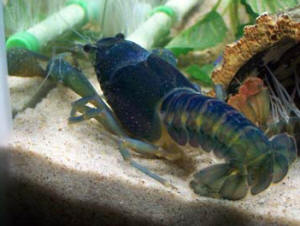
Blue after molting? 1/11/10
Hello, Sorry to bother yet again...but I need help (again). (And
your site is AWESOME by the way!)
Happy to report that Crash, the previously red crawfish, is still
alive, he just went through his second molt, and he's BLUE!
is this normal? Will he stay blue? It's been at least 24
hours since the molt. Just worried that we might miss something,
we've gotten quite attached to the little guy.
I have attached a photo (I hope that's okay) his old shell is
in the log on the right, so you can get an idea of the color he
used to be. Thank you,
Brenda
<Yes, is quite normal. Shell colour depends on diet, water
chemistry, age, and various other factors. But do make sure water
chemistry is hard and basic, and adding iodine to the water (via
the marine supplements widely sold, at half dose) can ensure
successful moults again and again. Cheers, Neale.>
|
 |
Re: Blue after molting?
1/11/10
So is blue good or bad?
<Neither, but you should be aware that seriously imperfect
moults can kill crayfish, so if anything seems slightly amiss, take
it for a potential warning, and review overall conditions. In soft
water for example, the new shell is unusually thin, and this can
result in a much paler colour than otherwise.>
He mostly gets algae discs, shrimp pellets (Which he doesn't
eat), and the occasional thawed and peeled frozen shrimp (does this
give them some iodine supplement or is it the wrong kind of
iodine?)
<Iodine comes as a liquid supplement you add to the water.
It's not expensive, and at a half dose relative to a marine
aquarium, very economical to use. Some companies make specific
foods formulated for crabs, crayfish and other crustaceans (e.g.,
Sera, JBL) and these make good staples. Whether or not they
completely remove the need for iodine supplement is unknown to
me.>
Thank you SO much, your so very helpful!
<Glad to help.>
Brenda
<Cheers, Neale.> |
Yabby is acting weird 9/30/09
I purchased a blue yabby (Luca) about a month ago and he is doing
well.
However, the paradise fish (Sydney) I bought is MIA. I am assuming that
Luca has eaten Sydney,
<Well, yes. Crayfish are herbivores in the wild, which is why you
feed them mostly greens with just the odd bit of white fish fillet or
unshelled prawn. But they can, and will, eat almost anything they can
catch.>
but he almost seems lonely now.
<He's not. These are territorial and aggressive animals.>
He used to be very active and greet me when I walked up to the tank
(now he just stays in his "cave"). Also, he has begun
"trimming"/eating the plastic plant that I have in the
tank.
<He's telling you this: feed me some plant material! These are
largely vegetarian animals, and would eat a lot of decaying plant
material. In captivity they often chew on plastic and sponges if they
can't get anything
else.>
Lastly, I have Malaysian driftwood and he seems to be eating that as
well.
<Indeed!>
I feed him every day (alternate between shrimp pellets and algae
wafers).
Why do you suppose he is acting strangely?
<He's hungry. Stick some Sushi Nori in, or perhaps some cheap
aquarium plants, such as Elodea. Lettuce and cucumber usually go down
well, too. Let him graze away.>
One last thing... I noticed his antenna things are getting shorter and
the tips look a bit discolored what can cause this?
<Does happen. Possibly physical damage, possibly a water quality or
water chemistry issue. Review conditions in the tank, and review diet,
in particular how calcium-rich his diet is. Do read these articles:
http://www.wetwebmedia.com/ca/volume_1/cav1i4/crayfish/crayfish.htm
http://www.wetwebmedia.com/ca/volume_5/volume_5_3/crayfish_basics.htm
Should give you some ideas on diet.>
Thanks,
Karen
<Cheers, Neale.>
Lobster hasn't molted for months... Child, English,
reading 9/1/2009
Hello,
My name is Michael, I've got a lobster (about 3.5-4 inches
probably, its a pail red, almost pink), I've owned the little
critter for a good 3 or 4 months, at least now and it's only molted
once.. I find this to be odd because I had owned a blue lobster a while
back with an ex and it molted several times before reaching the size
mine is now. Hasn't molted but seems to keep growing,
<Mmm... Michael, maybe it is molting and you're just not
noticing. Crustaceans can't grow w/o such>
also seems perfectly healthy mind you and Im not complaining because
his tank mates are 3 red belly piranhas(roughly the same length maybe a
bit shorter).
<Yikes! Might well consume the "bug" when it is
soft-bodied>>
They seem to be a good tank mates thus far as well- only ever tried to
attack the lobster once and he put the fear of the claw in'em by
pinching one between the mouth and eyes, i like to give my piranhas
pellet food, and frozen and veg. when i got stuff they'll eat and
of course live feeders (people say they are super unhealthy, ect,
ect,
<No such word... etc. is the contraction for the Latin "et
cetera res" (= and other things)>
i don't really care about that cuz i
<...>
balance the diet and they are what looks to be good exercise in my
opinion), - my lobster and 2 trap door snails clean up after them. The
snails i didn't really expect to last long so im not overly
concerned as they were bought as a 'treat' but became
cleaners.. Im really just curious why my lobster seems healthy, and
growing.. yet not molting? any ideas? i don't know pH or nitrates,
i keep good filtration, and keep up on top of the overall tank
maintenance. Oh and the last time he molted, which was also the first
time (in his life in my aquarium at least), was months ago shortly
after i first got it.
But mind you I've just noticed my piranha seem to be breathing
slightly more rapid then before, could that just be from a lack of
bubbler combined with body growth (larger body needs more oxygen,
right?)?
<Yes... dangerous>
Thanks for you're time, hope to hear from you soon - i got nothing
dying though so take care of those with sick fish first..
<Most often this situation is a matter of nutrition and/or low
alkalinity and/or biomineral content. Read here:
http://wetwebmedia.com/FWSubWebIndex/crayfishdisfaq.htm
and the linked files above. Bob Fenner>
Sluggish crawfish 4/14/2009
My son inherited a crawfish from school, He calls it an Australian
Crawfish (my husband is from Louisiana and thinks he has it all figured
out) We have had him for almost three weeks, and he has been doing
great so far. We have him in a 5 gallon tank almost full of water with
a filter (not sure if we have too much water in there) he has a log to
hide in and a couple of fake plants that he likes to chew on. We have
had him/her on a diet of mostly algae discs, and so far he has been
enjoying them. Tonight we noticed that he hadn't touched his algae
disc from this morning, and didn't seem to interested in the one he
got tonight. Water temp is the same as last week, and ph levels all
seem to be on target. Is it possible he is getting ready to molt?
<Mmm, maybe... lethargy is common in these cases>
Or do we have a sick crawfish on our hands?
<Perhaps>
Any help would be greatly appreciated.
Sincerely,
Brenda Collins
<Oh! One of my sis' names... Could be that you have a
"cycling issue" going on here... and/or a lack of alkaline
reserve. These possible chemistry issues and more are detailed in our
archives. Please read here:
http://wetwebmedia.com/FWSubWebIndex/crayfishdisfaq.htm
and the linked files at top. Bob Fenner>
Odd crayfish behavior -- 02/12/09 I was recently
(about 4 weeks ago) given a crayfish, Ruckus, from a pet store manager
and I am really enjoying keeping and caring for it. It can be quite
humorous to watch. I do have a problem though. Tonight my crayfish
started exhibiting a strange new behavior; I have Googled and Googled
and can't find much of anything dealing with it and I am hoping
that you could shed some light on this matter for me. Ruckus has
started to sit with it's tail curled under and while it is doing
this, it pushes up with one claw while all of the other legs move in a
walking like manner. Sometimes it almost looks like Ruckus is
obsessively cleaning his legs and claws; sometimes he/she just
rhythmically waves one side of the body's legs. It almost looks
like obsessive compulsive behavior. Ruckus has molted four times now
but every time it has happened I was asleep so I am not sure if this is
an indicator of a molt about to happen or if it is the beginning of a
problem. I currently have Ruckus housed in a ten gallon tank with a
power filter and an air pump supplying air (I tried plants but Ruckus
earned his name by eating them all and creating a huge ruckus in the
process). I have three hatchet fish in the tank with him/her for
company and because they are top dwellers I don't need to worry to
much about them meeting untimely ends, or at least I hope so, and I had
snails but Ruckus really liked them and I don't want to keep them
stocked anymore except for the occasional treat. I do 50% water change
every week on all my tanks and have never found any ammonia in any of
my tanks. Any ideas or insight that could help me understand this
behavior would be greatly appreciated. Thanks Shawn <Hello Shawn,
while I doubt crayfish can get OCD, it's not uncommon for animals
to develop quirks of various kinds, just like people. Genetic
abnormalities, damage to the nerves, malnutrition (particularly
vitamin/mineral deficiencies) can all cause problems. So review basic
care, in particular double checking your crayfish is getting lots of
green foods (they're mostly herbivores in the wild) and that
you're adding Iodine to the water periodically (use a marine
aquarium Iodine supplement, but at a half dose). As for the
Hatchetfish, they shouldn't be at any great risk assuming the tank
is reasonably deep, but generally I don't recommend mixing fish and
crayfish. Do review this article on Crayfish in Conscientious Aquarist,
here:
http://www.wetwebmedia.com/ca/volume_5/volume_5_3/crayfish_basics.htm
Cheers, Neale.>
|
Difficulty molting 11/09/08 Hello, I have a
crayfish, Marilyn, for 1 year now. She was brown as a baby Cray,
but has since turned blue. She has molted regularly throughout
her life. This morning I had the privilege of witnessing her
molt. She has shaken her way out of most of the exoskeleton,
except for the part on her back, that goes down her sides and
over her head and face. It has been 7 hours now. Fuzzy white
stuff is coming out and she looks uncomfortable. I have attached
a picture of where you could see the separation. It looks like it
should just pop off. Is there anything I should do to help her,
or should I just leave her alone? Sincere thanks, Lisa <Hi
Lisa. Crayfish experience molting problems for a number of
reasons. The two most common are iodine deficiency and poor diet.
The iodine issue is very common easily fixed, at least
preemptively: buy some marine aquarium iodine drops, and add to
the tank at 50% the dose for a marine aquarium. As for diet, you
must always remember crayfish are herbivores. Some people make
the mistake of feeding them just meaty foods! At least 75% of
their diet should be green things: algae wafers, tinned peas,
blanched lettuce, etc. As for the rest, try to make this sort of
thing calcium rich: unshelled prawns, whole lancefish (bones!)
and so on. There's really not much you can do right now.
Adding iodine to the water could help, but that's about all.
If you're lucky, she'll pull through and without too many
deformities, and subsequent molts will put them right. Don't
try and "help" her out -- you're more likely to
damage her in the process. Cheers, Neale. PS: Next time send
small images, around 500 kb; three different 2-point-something
megabyte images pretty well fills up our 10 MB e-mail space,
meaning some other folks might get their stuff bounced
back!>
|
  |
Red claw crayfish, sel., beh. 6/4/08 Hi! I was
just wondering about keeping red claw crayfish, Cherax quadricarinatus,
and have been reading on WWM about keeping them. I was just wondering
though, how interesting are they compared to other crayfish? I have a
Louisiana red P. clarkii and I find her active and always walking
about. <Yes... I've kept this species off and on for years...
very interesting IMO/E> Are red claws a lethargic type of crayfish
spending most of their time hidden? <Much more than Procambarus>
Plus some places I have read says they are not very aggressive towards
their own kind, while other places say they are always on the lookout
to murder each other. <The genus is more like the latter in my
experience> Have any of you had any first hand experience with
keeping these critters? <If hungry, crowded...> Thanks! Don Smith
<Welcome. Bob Fenner>
Crayfish lost both claws 5/16/08
Hello I started out by Googling my question and that brought me to your
site. I looked around there, but still haven't quite found the
answer. In any case, my daughter brought home a crayfish from school
yesterday. The only information I received with the crayfish was it
needed a tank with a filter. <All else being equal, this is correct.
But do add some sort of "cave" to the set-up; a ceramic
flowerpot will be ideal. Crayfish are retiring, nocturnal animals and
need hiding places.> I bought a new aquarium set up with a filter
and got it all ready for the crayfish (with fake plants, a cave made
out of flat rocks, gravel, etc.) The crayfish seemed okay, as far as we
could tell (active, checking things out). We tried feeding it lettuce,
carrot shreds, and fish flakes, but it didn't seem interested.
<Do try a mix of plant and animal foods. A raw peeled shrimp or
small piece of white fish would be an ideal food to tempt the crayfish
into feeding.> This evening my daughter looked in the tank and
noticed that both of its claws had fallen off! <Does happen when
stressed or alarmed.> We were both shocked as it doesn't seem to
otherwise be molting. Have we done something terribly wrong? I used
water from our well, which we used without any difficulty with other
water-pets in the past. It does have a significant sulphur content, but
I didn't see anywhere in a Google search that this would be a
problem. <Should be fine.> What should we do? I feel terrible if
the poor thing is being poisoned somehow! Also, could the tank be too
small? The pet store said 5 gallons was okay, but now I keep reading
that 10 gallons is the right size. <The size of the tank is not in
itself the issue, though I would agree that a 10-gallon tank is much
preferable for all sorts of reasons, the prime one being water quality
management. In brief, small tanks tend to have poor water quality, and
that will stress any pet, including crayfish. Filtration and water
changes mitigate this somewhat, but not completely. This is why we
routinely tell people starting in the hobby to use 20-gallon tanks.
Maintaining a 20-gallon tank is ten, twenty times easier than a
10-gallon tank, and probably a hundred times easier than a 5-gallon
tank! In any case, use a nitrite test kit to make sure the water is
clean, and if not, do water changes and improve filtration as
required.> It seems to be "healthy" aside from the claws,
but I don't know how to judge, really. <With crayfish, the
antennae and the mouthparts should be constantly in action; the eyes
should be alert and the animal responsive to movement outside the tank.
Whilst they can feed without their claws, and will regrow them slightly
at each molt, this may take many months and the claws will always be a
bit undersized relative to the rest of the animal.> Thanks in
advance for your help! <Cheers, Neale.>
Yabby shedding
problem, using WWM -- 04/21/08 Please help us! We have a pet Yabby
called Pinchie who has recently shed and seems to be having some
serious problems. We have had him for almost 4 years and have never
encountered a problem. It is like he has shed his claws and broken the
joint in his new ones. they bend under him at an odd angle. Should we
remove them? <Mmm, no... they'll be shed in turn when conditions
and nutrition allow...> He is upside down at all times and his head
is a turning a brownish/red colour. He is usually a whitish blue. He is
still moving but intermittently. As far as his tank goes nothing has
been done any different. We are at a loss at how to help him. Looking
forward to hopefully ending his obvious discomfort. Thank you for your
time. Rach & Jess. <Something very amiss here. Try using the
search tool (as requested before writing us) here:
http://wetwebmedia.com/WWMAdminSubWebIndex/question_page.htm with the
terms "crayfish shedding problems" and read the cached
views... Something awry here with water quality and/or feeding... as
detailed on WWM. Bob Fenner>
Blue lobster beh., hlth. 01/08/2008 Our behavior
of our lobster is weird, he is in a tank (55 gallon) with a red devil.
The red devil is not bothering him and we have had him approx. one
month. We have been feeding him wafers, and cichlid food. He is
currently lying on his back or side, been alive for five days like
that, we have been turning him over and he will start crawling to where
ever as if he is ok ? He is not hiding anywhere any more? We don't
know what is going on, Can you help? <Hello Sally. Usually when
crustaceans aren't able to stand up properly, they're dying, or
at least stressed. Start by checking water quality, and in particular
consider if any copper could have got into the tank, e.g., from
medication that was recently used. Do also check your dechlorinator
neutralises copper that gets in via the pipes. Copper is very poisonous
to crustaceans. Otherwise make sure water quality is good in all the
usual regards: zero ammonia/nitrite, low nitrate, and in the case of
crustaceans (and indeed Red Devils) that the hardness is nice and high
and the pH well above 7.0. Crustaceans need additional iodine in the
water, and the lack of it causes gradual, long term health problems.
Iodine can be purchased as a simple supplement you add to the water, a
bit like a medicine. It's sold primarily for marine tanks, so the
place to buy it is from stores catering to reef keepers. Cheers,
Neale.>
Crayfish comments, beh. 1/1/08 Every once in a
while I review
http://www.wetwebmedia.com/FWSubWebIndex/crayfishbehfaq.htm and find it
very interesting, although the answers don't always reflect my
experience. <Oh...?> I've had crayfish in a 50 gallon tank
along with a community of tropical fish. Yes, they're territorial,
but a good sized tank can be configured with all sorts of rocks and
decorations that provide ample "territory" for a dozen or
more crayfish. <Indeed. The problem is that many people who buy them
stick them into 10 or 20 gallon tanks, and this approach doesn't
work so well!> And they love to reproduce! The territorial
neighborhoods only get over crowded when the number of large crayfish
gets to me more than a couple. I also separate the female carrying a
tail full of embryos into a smaller tank and raise the babies for a
month or so until they're big enough to go back in the large tank
without being eaten by the fish. Fifty tiny crayfish have no trouble
finding or creating hiding places. As the population grows, you'll
need to be releasing some of them back into your local creek or lake
where they came from. <Ah, this may or not be legal depending on
where you live. In the UK for example, releasing captive-bred crayfish
into the wild is VERY DEFINITELY illegal. There is a major problem
there because of fungal infections from American crayfish varieties
having decimated native crayfish populations. Even releasing
captive-bred offspring of locally-caught wild crayfish may be illegal
in the US and elsewhere. While the crayfish themselves might not cause
problems, they can carry ornamental fish diseases on their bodies, and
these can spread to wild fish populations. Without exception, the
responsible thing to do here is destroy unwanted offspring painlessly.
In the meantime, do check your local Fish & Wildlife agency to see
if what you are doing is safe, ethical, and legal.> Regarding their
color, there are lots of variations within a new batch of babies: red,
brown, blue. <Agreed.> A vegetable diet seems to shift colors
reddish. A protein diet seems to shift towards a blue tint.
<Interesting.> Of course, across the country there are hundreds
of geographic variations that are beautiful. Almost black crayfish with
furry claws are in Wyoming in the Teton National Park. Pale brown
crayfish with bright orange claw tips are in the Rogue River in Oregon.
Brown crayfish with a blue tint under their tail and white
"elbow" bands on their claws are in the Sacramento river area
of California, yet a few hundred feet away from the river you'll
find the common all- red variety. I've not mated differing
varieties to see what combinations are produced. <Are these
"varieties" actually species?> I DO appreciate the
website's comments about adding iodine! I was experiencing my
largest (oldest) crayfish dying as they tried to molt without having a
new shell. <Something new to me, too, but does seem to help!>
Crayfish have personalities and provide hours upon hours of
entertainment while observing them. <Agreed, these are wonderful
pets. Do also look out for the giant Macrobrachium varieties like
Macrobrachium rosenbergii occasionally sold as pets. These colossal
shrimps are very impressive and I think you'd get a kick out of
them. Cheers, Neale.>
Re: Crayfish comments 1/1/08 Thank you for the
admonition/reminder about releasing "domestic" crayfish into
the "wild." Since mine came from a nearby natural source, it
didn't occur to me that they could become carriers of infection
despite what appears to be their thriving. For the record, I've not
released any. <Good. Do check with your local Fish & Wildlife
Bureau. They may be fine about it, but it's best to check.>
Regarding distinctive markings and colorations geographic variations, I
picked up the "species" term from a government fish and
wildlife employee who referred to them as different species when I
talked to him about the variations. <Very good.> I've algae
grow on the sunlight side of my small holding tank, the new fry seem to
love it. <Yes they do! Most crayfish, and indeed most crustaceans,
are at least in part omnivorous and appreciate plant matter and algae
in their diet. When I kept land crabs, they went wild over ripe
bananas!> Happy Gnu Ear! <And likewise, Neale.>
Lobster... FW Crayfish beh. 12/26/07 All right
Bob Sorry to bother you, I have a couple of questions if you could
please find time to answer I would be over the moon. I have a
lobster/crayfish not sure what he is, anyway he seams to be a red
colour but goes very blue when he is going to molt. is this in fact a
sign that he is about to molt going bright blue? <Certainly sounds
possible. Different crayfish change colours in different ways, so
difficult to say for sure. Do watch diet issues; iodine is apparently
one nutrient often lacking under aquarium conditions. Without the right
diet, skeleton abnormalities are certainly possible.> Can I add
other ones to the tank without them killing each other ? <No.
Crayfish tend to be territorial. Even the ones that aren't will eat
other specimens that are smaller/just moulted.> If you require pics
let me know and I will provide. Thanks and I look forward to your reply
happy new year S+F Scott <Cheers, Neale.>
Clawless Yabby; beh., fdg. 12/20/07 I am looking
after an Australian Freshwater Yabby for a friend who is overseas. Two
days ago, he escaped from his tank & fell off the kitchen bench
onto the floor, & was found about 4 metres away from his tank.
During this trauma he lost both of his claws. Once returned to the
tank, he has been floating upside down, but still alive. My question
is- if he stays alive, how do I feed him without his claws to grab the
food? Or will he die? Any suggestions would be greatly appreciated.
Kind Regards, Jodi O'Connell <This crustacean can, will consume
foods of use still... really only uses the large claws for defense and
seizing prey items... Maceration and manipulation are done via other
smaller elements closer to the mouth. If this animal can be recovered,
kept nourished, well-maintained, it will regenerate the larger claws
with time, successive molts. Bob Fenner>
My freshwater blue crayfish seems to be eating its
own antenna? Deficiency syndrome, reading 12/10/07 Dear WWM Crew:
<Vilma> Thank you for your research suggestions, I followed them
but I still did not find the answer to my question. I have a freshwater
blue crayfish in a 10 gallon tank, my brother in law gave it to me for
he could no longer house it with his fish species. I've had it for
a little over 3 months and it seemed to be doing well until about 3
weeks ago when I started noticing that the long pair of antennas seem
to have been shortened. <Good observation> The blue crayfish
molted a few days after moving her into her new tank but has not molted
ever since. <Also a good clue> Two weeks ago I did research
online about crayfish eating their own antenna and all I found was that
she might me iodine deficient <This and possibly biomineral, and/or
alkalinity> so I added iodized table salt <Mmm, not a good manner
to remedy> into the tank but I noticed that her antennas after the
iodized salt treatment keep getting shorter. I don't think it's
her diet, or water quality. <These are the most likely
categories...> I have noticed a gray hue at the end of one of her
antenna. Can you please tell me why her antennas keep getting shorter
and what I can do about it? Thank you, Vilma Molina <Please go back
and read on WWM re Crayfish husbandry, disease, nutrition, systems...
Your pet lacks calcium, possibly magnesium... maybe in too high/low a
pH/alkaline reserve situation... Some of this/these can be supplied
through feeding... all posted. Bob Fenner>
Crayfish, beh. -- 10/9/07 I have a red 3 inch
crayfish in a 75 gallon with a couple of other fish. He has just shed
very recently. He has only been in the tank for two weeks now. Problem
is when he shed he lost both his claws. I was wondering if this is
normal. I was also wondering how long it will take for him to grow back
his claws. There is no physical damage to him. <Greetings. Yes, this
happens, and yes, the claws will grow back. With each successive moult,
the replacement claws will get a little bigger. Within a year he should
be back to normal (assuming a moult once every 4-6 weeks). Crayfish are
easily damaged during the moulting phase, and being territorial and
rather aggressive, they do fight and can pull one another's claws
off. Ensuring all the crayfish have hiding places is important. Fish
can also damage them. Finally, there's some anecdotal evidence that
adding iodine to the water improves crayfish health. Be sure and read
this FAQ, where Sabrina explains doses and uses: http://www.wetwebmedia.com/FWSubWebIndex/fwcrustfaq2.htm
. Cheers, Neale>
My blue lobster/crayfish, fdg., beh. -- 9/29/07 Hi. I have a
blue lobster/crayfish, which i brought some time in march. my
lobster/crayfish was eating fine, until he/she shelled on Monday (24th
September), now he/she just doesn't seemed interested in anything
food what so ever. is there something wrong with my lobster/crayfish?
any suggestions please. thanks. <Greetings. Crayfish tend to be
extra-shy immediately after moulting. This is natural. For a couple of
days their exoskeleton isn't strong enough to provide useful
defence, so they stay hidden in their burrows. So give it a couple of
days, and then see what happens. Do remember to vary the diet. Crayfish
are primarily herbivores in the wild, and a lot of their diet is algae,
soft plant matter, and decaying organic detritus. So you could try
tempting your pet with something different. Sushi Nori would be ideal
and especially rich in iodine, which crayfish apparently need for good
health. You can pick this stuff up at any Asian food market or decent
grocery store, and it's very cheap (over here in the UK, around
£1 for 10 large sheets). Algae pellets (of the type sold
for catfish) make a good alternative. Top this off with the other major
part of the crayfish diet -- carrion. A nice bit of frozen whitebait or
lancefish would be just the thing. The bones in these little fish would
be a handy source of calcium. One last thing: crayfish, like most
freshwater invertebrates, are sensitive to water quality. Check the
nitrites are at zero and the nitrates fairly low. There must be no
copper in the water (e.g., from fish medications) or salt. Not all
species are tropical animals, so check which species you have, and if
required adjust the temperature accordingly. Do also read this and its
related articles: http://www.wetwebmedia.com/FWSubWebIndex/crayfishfaqs.htm .
Cheers, Neale>
Crayfish molting-wow! 9/15/07 I don't have a question
this time, more of an experience in awe. I got a 2" blue crayfish
a month ago (discussed with Neale) and instead of putting him with fish
as originally intended, his home became a 20 gal aquarium. The LFS said
all their crayfish had been the same size for the few months they'd
had them. I thought that odd they hadn't grown as they're
supposed to get to at least 5" minimum. 2 wks after I got him I
found his old shell where he'd molted. He'd been hiding in his
log whereas he's normally very active but was eating very well.
Thanks to Sabrina's insight I've added iodine since I've
had him. The past 2 days he's been hiding again but still eating
well. I just now looked into his tank and he's right smack in the
middle of molting again! He's in his log but the log faces front
and I have a perfect view with his fluorescent hood light. He's
pulling off his shell as I type and his claws have doubled in size.
This is the absolute coolest thing I've ever seen! He's super
bright blue with pink tints and it's so pretty. He looks like
he's doubled in size in just a month and I'm so happy to see my
efforts have actually showed real results. Even though he seems to be
molting a lot, I'm hoping that's only because he's
'catching up' and is healthy now. Just wanted to let you all
know how excited I am-ha! Mitzi (& Master Slurp B) <Thank you
for this endearing report! Bob Fenner>
Crayfish from Louisiana, beh. 8/10/07 Hi Nemo II,
a crayfish acquired from a school project in Ottawa but originally from
Louisiana, has claws that are turning fire engine red. Is it a sign of
sickness or of molting? Thanks Lyndsay ( and her stepmom who really
doesn't know what she is doing with this little creature!)
<Hello Lyndsay. Nope, what you're observing is completely
normal. Several species of crayfish develop coloured claws
(technically: chelipeds) at maturity, presumably for social
interactions. You likely have the species Procambarus clarkii though
without a photo, I can't say for sure. Cheers, Neale>
Crawfish dragging claw 5/15/07 Greetings My daughter brought
home a crawfish from school last September. He's been a happy
healthy guy and a really good eater. Last week, he moulted and lost a
claw at the same time. Problem now is his other claw is just dangling.
<Something "missing" either nutritionally or water quality
wise... for the "replacement" to be complete> He's
dragging it along side of him. What, if anything, can I do to help him.
<Improve both of the above... for "next time" it molts>
It's breaking our hearts to see him like this. I find lots of
information about claw loss, but nothing about a claw that wont drop
off. Any suggestions please??? Thank you. Carol <Please read here:
http://www.wetwebmedia.com/ca/cav1i4/crayfish/crayfish.htm
and the linked files at bottom... on Systems, Health, Feeding. Bob
Fenner>
Lethargic Red Claw Crab - 04/12/2007 Hi, <Hello.> I
have a red claw crab, I keep him in a tank with land, fresh and salt
water. <Excellent!> For the past two days he hasn't been
moving a lot. (not that he does usually, but he seems like he has
gotten somewhat stiff!) <Hmm.... Like he's.... moving more
slowly when he moves? Or....?> I have been checking the heat if he
is cold, but it hasn't changed a lot. <Do you have a thermometer
to check the temperature? What is the temperature in the tank, and is
it constant?> I have even been warming him up in my hand, but I
don't think it's helping him. <That may actually be
stressful to him, if he isn't accustomed to being handled.> I
have had him for almost four months already, and I don't want to
lose him. Please help!!! <If he hasn't molted yet, I would wager
that that's what's happening (or about to happen). If he
doesn't have a place to dig underground, try to give him a lot of
nooks and crannies to hide in really well. Molting is a dangerous time
in a crab's life, and they need to feel very safe and not be
handled or messed around with. Try to make sure the temperature in the
tank is warm (75-78F or thereabouts) and try to give him foods rich in
iodine (shrimp tails, krill....). He may not eat for a few or several
days, so remove any uneaten food. I should also say that he may not be
molting; he might be sick. Unfortunately, there just isn't a lot we
know, and really nothing we can do, about sick crabs. Mostly, the best
things to do is provide them a perfect environment (you're doing
great to give him fresh and saltwater, and land space), good nutrition,
and help them to stay in good health. I hope he's just molting and
growing though; that will be a sure sign that you're doing a great
job for him. All the best to you and your crab, -Sabrina>
Electric blue lobster 2/6/07 My son has an electric blue
lobster in his aquarium, and this morning it started molting. It
stopped moving after it got a piece off the top of its head. <Likely
a deficiency at play here... lack of biomineral, alkalinity, perhaps
iodine> Now it isn't moving at all, and when I moved it a little
with the net, I saw no movement. Is it dead, or is it still molting,
and how can I tell? I do not want to leave it in the tank if it's
expired, but I don't want to take him out if he might still be
alive either. Thanks. <Please both of you read here, and soon:
http://www.wetwebmedia.com/FWSubWebIndex/crayfishdisfaq.htm
and the linked files above. Bob Fenner>
Crayfish Molting - 10/21/2006 My crayfish is
having a hard time molting. Can I help him? He is flipping himself
upside down trying to crack his shell to molt. <Try adding Kent
marine Iodine at a rate of one to two drops (NOT the marine dose
printed on the label!) per ten gallons. This may aid him, but usually
by the time that they are actually molting, it is too late to help
much. Iodine should be added at this dose on a weekly basis.> Thank
you. <All the best to you, -Sabrina> Shedding Crayfish
9/2/06 We acquired a crayfish about a year ago, who had been found
in a box of books (which had been in storage for about 6 months to a
year). We have no idea how he survived, where he came from or even what
kind he is, other than he is bright red since beginning to molt.
Yesterday morning (Thursday) he began to molt for the first time since
we have had him and made it about half way, but as of this afternoon
(Friday) the old shell is still stuck to the back half of him. He
appears to be struggling to free himself every now and then. I am
wondering if I should help him out in any way, or just leave him alone
to do it himself? I know they stay hidden for couple of days after
shedding, but how long does the actual molting process itself take? Any
help or advice you can offer would be greatly appreciated. Thanks.
Christy Schenher < The outer skeleton needs to become rehydrated and
soften up. Give it some more time.-Chuck>
Crayfish Climbing -
07/25/2006 Me again with a rather odd problem, <Hi again!>
Vladimir, (Freshwater Crayfish) Has been trying to climb out of his
tank. <.... and this is odd.... how? ....This is actually a very
normal action, to be expected of Crays.... especially wild-caught Crays
or ones that might prefer more space.> He will only do this in the
middle of the night. We have 2 air driven corner filters for them. We
do full water changes about every week, and try to keep the water as
clean and clear as possible, yet he still tries to climb out.
<Really, this is to be expected.> Would it be possible that Mavra
(A female in the same tank as him but separated with a clear divider)
is causing him to want to get to her, even if it means climbing out.
<This is in fact possible.> We had a few close calls with him, he
would constantly climb up the air tubing for the filters and almost
completely out of the tank (15 gal) <A little on the small side for
space for having only a small section (even if half) of the tank -
I'd be climbing, too. This is a sufficiently sized tank to maintain
their health, but they'd do a bit better in a larger system. Even
that, though, may not put an end to the climbing.> We had to place a
barrier over the top during the night to keep him from getting out and
falling onto the ground. <A VERY necessary component of a crayfish
aquarium.> On a better side, Mavra has molted and is closer in size
to Vladimir, but at the same time Vladimir might be getting ready to
molt also. I think this might make the gap slightly larger again. The
other thing is, Vladimir is a lot more "thick" than Mavra,
his body seems to be quite larger in mass than hers. She seems to be
about 2/3 the thickness of him and I am afraid this would cause her to
be damaged. <Yeah, I'd give 'em a bit more time.> Thanks
for your time, -Colin <And thank you for your emails, Colin! I hope
you will some day see baby crayfish from this pair! All the best to
you, Vladimir, and Mavra, -Sabrina>
My crayfish lost all its legs on one side during the
last molt. 7/24/06 <Mmm... something not right...> I was not
home when it happened but I assume the fish took advantage of his
poorly designed hiding place and weakened condition. <Likely...>
This is his fourth molt in the past six months. <Pretty frequent...
is this a small specimen?> What should I expect to happen now? If
death is unavoidable is there a humane way to help? Thanks ~ <Might
be able to molt yet again, regain some, all of its appendages... I
would move this animal to another container, change its water out
weekly with water from the present tank... keep offering small bits of
food daily. Bob Fenner>
Crazy crawfish! Crawfish'¦.just being a
crawfish 7/4/06 Yo! <Dude?!> First of all, I would like to
thank Sabrina for her help with my guppy fry problems about 3 months
ago. <She's even cooler in person.> They are doing quite well
now (in fact, I had to give some away to prevent crowding), but I now
have a new problem! <Uh-oh.> My female crawfish, Ashley, is about
5 inches long, and is completely obsessed with redecorating my
aquarium! <'Tis quite normal.> I have a very well
(artificially) planted 20 gallon tank, plus a rock cave that had
formerly belonged to her (now taken over by my striped Raphael catfish,
Chinese algae eater, and dojo loach). <Not the best idea to mix
crayfish with these slower, bottom-dwelling fish.> Since he stole
Ashley's cave, she has retreated to my forest of kelp-like plants.
<Which if not anchored'¦.he/she will easily tear and
un-root'¦very normal behavior.> All would be perfect
except for the fact that she feels the need to move the plants to other
locations. <Hehe, sorry to sound repetitive but it is really, really
normal.> I have tried using plant anchors to weigh the down and keep
them in the gravel, but she is just too big to be stopped. I have also
tried to humor her and plant the plants in the locales of her choice,
but she just moves them again, and all of this movement is beginning to
stress my other fish out. Any suggestions? <None really, other than
using only floating plants or a better anchoring system with larger
gravel, perhaps another cave is in order?> Bonecutter <Adam
J.> (P.S. My new guppies are beginning to do some sort of mating
ritual or something. The males hover in front of the females and flare
their fins out, then swim around them, then repeat. Are they mature
enough to spawn already??) <How big/old are they? How long have they
been in the tank'¦I say just be patient they are the rabbits
of aquaria'¦>
Yabby/Crayfish, Age, Molting, Problems -
05/21/2006 G'day <Aloha.> I've read through quite a
few of the questions and answers on your site and found them very
useful. <Excellent!> Congratulations on such a comprehensive and
informative site; I have a question of my own. <I hope I can help
out.> Recently My Pet Yabby (Australian Cherax destructor) <A
BEAUTIFUL species!> started to become very lethargic. As she had
shed her shell several days before it did not concern me too much.
<Mm, it is actually disconcerting that the animal be lethargic for
this long after shedding....> However it became become worse over
the last few days and she kept falling over onto her side and curling
her tail in, and then struggling to get back onto her legs. I had the
water tested for by the local aquarium, and they concluded that
minerals water quality and pH levels were as they should be.
<Hopefully you were able to verify this yourself, as well....
It's best if you test the water yourself, too.> However the
condition got worse so I made water changes, and tried adding a small
amount of Sodium Bicarbonate but this still didn't help. I also
tried aerating the water more. Eventually it got to the point that my
Yabby could no longer roll back onto her feet without help, and I lost
her to Yabby heaven. <Yikes. I'm sorry to hear this.> Can you
please suggest anything that may have caused this? <Lack of iodine
in the water, perhaps....> As I now have a new Yabby and would like
to avoid any repeat. Could she have died of old age? I've kept her
for at least 6 years happily and healthily without ever having a
problem. <Six years? Yeah, I'd say "old age" may be
the ticket. She had a long life with you.> Suggested lifespan is 3-5
years... Also about 4 weeks ago I moved house and had gotten my Yabby a
larger tank (30 litre). So could the change of environment have
something to do with this as well? <Possibly, but again, it may have
just been her time to go.> Although she seemed to love her new tank
and was quite lively before she shed her shell. I was feeding her Yabby
and crayfish pellets (including fish and kelp meal), vegetables, and
the occasional Lucerne pellet, all of which I've fed her for the 6
years. I did notice that there was a piece of uneaten broccoli that I
missed, which would've been there for several days, could this have
poisoned her? <Only if it had begun to rot and there was measurable
ammonia in the tank.... I'll hazard a guess here and say that there
was likely not much you could have done to prevent her passing.> Any
advice your team could give me would be much appreciated. Thank you for
your time, and also for providing such a useful and informative site.
<Thank you for your kind words. I do wish you the best with your
next Yabby pet.> Crystal, Victoria Australia <-Sabrina, currently
in Hawai'i, USA, but usually in California.>
Colin's Concerns About His Crayfish -
05/21/2006 Dear WWM crew, Yeah, it is me again. <Heh, no
worries.> I am sorry for having to send another email but I need a
little more advice. <I hope we can be of service!> I searched for
crayfish molting but haven't found much pertaining to my problem.
Vlad, my larger crayfish seems to be molting. He seems a lot more
sluggish as of lately. He also appears to be turning a whitish color
from his usual brown. <Not a good sign....> Also lately he has
been going under the slate ramp to the "upper deck area" and
tilting himself to an almost 90 degree angle on his side. <BAD
sign....> Is this normal? <No.> Should I be worried?
<Yes.> I really love my little Vlad and I hope he is ok. If he is
molting and leaves his shell off do you think I should try leaving it
in and seeing if he decides to eat it? <Only for a day or so.>
Thanks for the help, I really appreciate it. <Please consider doing
a water change, urgently, and adding a bit of iodine - the kind sold
for saltwater/reef aquariums. Don't use the marine dose printed on
the bottle, though; just a drop or two per ten gallons will do. Offer
him foods like freeze-dried krill and shrimp. Hopefully these things
will help him out with his molting. Wishing you and Vlad the very best,
-Sabrina>
Shy Crayfish - 05/16/2006 I brought a blue crawfish
home from Louisiana several days ago. It's in a tank with pond
water, alone, but is burrowed into a fake hollow log I put in. Will she
ever come out? <Yeah, probably. Pay close attention to water
quality, give her meaty foods like bits or tails from frozen/thawed
human-consumption shrimp, and she'll probably do just fine. If
you're not familiar with these topics, please do read on WWM
regarding water quality, tank maintenance.... Wishing you and your new
Cray well, -Sabrina>
Yabbies Hello, We have some red claw yabbies in a tank. One
is a female and she has been carrying eggs under her tail for about 7
weeks. They have just hatched and I noticed her in her pipe lying on
her side motionless. She appears to be molting because her body seems
to be breaking out of her shell. She was moving around well last night.
My question is how long does the molting process take is it hours or
days? I must admit she doesn't look healthy, but then I suppose
losing your shell would be a hard task. I would appreciate your input
because I can't seem to find anything of the Internet about it.
Regards Kim <Hi Kim, the last time one of my crawfish molted it was
over matter of days, it stayed secluded for a while, then I found bits
and pieces of shell everywhere, I thought he had been munched. Then a
couple days later, he was back. After they molt they like to stay
secluded while their new exoskeleton hardens. They are vulnerable to
cannibalism while they are still soft. The article below may provide
you with some more info. Best Regards, Gage
http://216.239.57.104/search?q=cache:E_IVJdpNrGMJ:aquanic.org/publicat/usda_rac/efs/srac/244fs.pdf+yabbie+molting&hl=en&ie=UTF-8
>
Blue Water Lobster Dear Bob <Hey there - I'm not Bob,
but I am the freshwater invert-obsessed Sabrina - hope I can shed some
light on your new critter.> We have a Blue fresh water Lobster but
are having a few tiny problems with him/her and wonder if you may have
any answers? <Hmm.... I've seen a few different animals that
fall under this name, any of which might be the critter you've got.
It could be any of a handful of Procambarus species (crayfish) that is
blue or has a blue form; or could be either of two blue Macrobrachium
shrimp species - M. rosenbergii from Thailand or another species from
Mexico. A picture would go a long way to identifying it, if you've
got one.> He is attacking the big Plec and ripping the Pleco's
fins. He has also started recently to kill the smaller fish by grabbing
them with his claws. <For any of the species above, this is quite
normal.... they don't play well with fish.> Is there any way we
can stop this? <No, not really. Separating him from the fish is
pretty much the only way to end the carnage.> We have now put in a
ceramic pot and cave entrance to give him a safe cover, will this help
combat the problem? <No, unfortunately. Regardless of which of the
above critters it is - they're aggressive, and fish-hungry.> We
feed him on prawns <Excellent food for 'em> and specially
bought crab cuisine which states is ok for Lobsters. Should we be
feeding him anything else? <Ocean Nutrition's frozen Formula One
is a good food choice.> We have looked everywhere for a book on
Lobsters but have had no luck. <Do some google searches on 'blue
crayfish' and 'blue prawn', as well as the above Latin
names.> He is now about 4 inches long without counting the claws.
<And will grow about twice that> He is shedding about every three
to four months and eats his shell afterwards. We have had him now for
ten months and has shed three times. He is showing signs of being due
for another shed as he is constantly laying on his side and acting as
though he is dead, which we have noticed he does this just prior to
shedding in the past. <I don't think that's a good sign....
perhaps try adding iodine to the tank (use Kent's marine Iodine
supplement); one drop per ten gallons every week.> He is constantly
shoveling the stones about, we have had to change from a sand bottom as
he kept blocking the filter with the constant moving of the sand. We
now have an undergravel filter. If you have any information that will
help our Lobster Rocky to have a good life, would you please be so kind
and inform us? <I am sorry for the news that he'll be always
incompatible with most fish; he may warrant a tank of his own. There
are a few fish compatible with these animals; do some google searches
to try to find out exactly what you've got, and hopefully
that'll help you out some. Wishing you well, -Sabrina> Thank you
in anticipation. Yours sincerely Mr. John Edwards
Yabby Lifespan hey fellas I was wondering how long a Yabby
lives for???? thanks <About three years. Bob Fenner> Worried
about my blue lobster! I bought my blue lobster not even a month
ago. She was very active, ate well (plankton cubes, blood worms so
far.) She even ate a goldfish the night I bought her. Here's the
problem, I fought the lobster on its back, and looked dead. I water
sample was a high PH. The tank was warm and big enough. I cleaned the
tank, corrected the water issue, and periodically check the water, put
the goldfish in a separate tank, so the lobster is by itself. She came
around again, to her normal self. About 5 days later she's on her
back again. I understand this is molting I think, I can see the shell
lifting off her. My question is, how long does the molting last,
<Usually only minutes to a couple hours> is she dying? She's
been upside down for 24 hrs. BUT when I moved her little house, she
moved? I got a bad feeling about this. But do lobsters all have a
different style to their molting? PLEASE HELP! thanks, from Kay in Ohio
<May be that your water is too soft... do you have readings for pH,
alkalinity? Do you supplement iodine/ide? Bob Fenner>
Crayfish behaviour After one of my smaller crayfish died (yes
I was very sad) I thought they may have lacked in oxygen. I didn't
have a pump. (Could this have been the reason?) <Yes... or
consequences thereof... e.g. no filtration> So I purchased a pump.
It saves me from changing some of the water as often anyway. But
I've noticed all they do is climb on the pump and what appears to
be eating bubbles from the pump. I have a lid so they can't get out
but they also like to climb up and rest completely outside the water.
Is this normal behaviour? <Sounds like this is so... perhaps this is
a species that needs shallower water, or even to emerse itself at
times. You might try to find out specifically what you have, use the
Net search tools to determine its natural history. Bob Fenner>
Sometimes they hang there for a good hour. Thanks for your help. Daniel
Crawdad with no pincers... Hello! I just saw my crawdad molt for
the first time, and I have a question or two. I never even knew they
molted, actually, but it does kind of make sense when you think about
it. <Yep, have to molt to grow...> Anyway, my crawdad, Nixon (so
named because when I first got him, he'd run around the tank with
his claws open a la "I'm not a crook"), now has no
pincers due to his molt... I've had him for at *least* three years,
and he lost one claw in a battle with another, rather temporary,
crawdad. Since then, he'd been doing fine with just one claw. But
now I'm worried. He's about 6 inches long, and I'd never
seen him molt before. I found all the pieces to his old shell,
including his one and only claw. Will he be able to eat, and will the
claw grow back? <Mmm, a couple things to impart to you... one, do
leave the old exoskeleton in the tank... or put it back if you've
removed it... "Tricky Dicky" can/will reincorporate this into
its new outside... and do read on WWM re Crayfish keeping... they need
adequate nutrition, sometimes iodine/ide additions, hard, alkaline
water to grow, successfully molt... And will regenerate limbs if so
kept> His other claw never did. Why did he lose the claw at all, was
it a bad molt? <More likely insufficiencies in its system,
feeding> He lives in a 30 gallon "pond" with three
goldfish, about a bazillion snails, and lots of green mossy stuff that
I think is called "bloodwort". I'm not worried that the
goldfish will get him or anything, but I just wonder if he'll be
able to function normally (i.e., can he still move rocks or get food?)
. He's just a local creek crawdad, no special pedigree or anything.
Thanks for any help! ~Ida <Please read here: http://www.wetwebmedia.com/ca/cav1i4/crayfish/crayfish.htm
and the linked files on the bottom. Bob Fenner>
Crayfish page? I'm sorry I'm such a dork, I'm
looking for a way to post a question on the crayfish page. My son
caught a crayfish and wants to keep it for a week then return it to the
creek. We made a tank with pond water and rocks. Now the crayfish
stands on top of the rock with his back out of the water. We are
wondering if he is going to die soon. My son is in Second Grade and is
taking this pretty hard. Thanks for your help. Chad <Actually
"crawdads" are pretty tough... and some are amphibious! Yours
should be fine. Bob Fenner>
Re: crayfish page? Bob <Chad> He made it through the
night just fine. Thanks for your help. <Ahh, good to hear, read.
BobF> Chad
My crayfish... 1/16/06 I have an electric blue crayfish I
bought from the pet store about 2 months ago. Chomper is about 3 and a
half inches long. She eats blood worms, Hikari crab pellets and the odd
fish flake if she is still hungry. She has been a big eater since she
came home. She shares a 20 gallon freshwater tank with 2 rainbow fish.
There are live floating plants (were rooted but thanks to her they are
not anymore), <Know what you mean> there are plenty of hiding
spaces and gravel / sand for her to borrow in, filtration and aeration
systems. The water levels and temperature are all normal. All was fine
until 2 weeks ago. Her shell started turning brown with white dots. Her
pinchers are still blue. Now she has a velvet growing on her joints and
on the tip of her nose - I don't think that is what it is called,
but it sticks out. She still runs around the tank and eats as normal
but why is this happening and how can I fix / prevent this from
happening again. <Mmm, I do hope this is not pathogenic... that is,
caused by an infectious or parasitic agent... but from water quality,
perhaps a missing nutrient> As far as I know she has not molted
since she came here. She doesn't hide often and if she does she is
out and about shortly after. I've tried taking pictures of her but
as soon as she sees the camera she runs... everything I can find
relates to worms and they don't look like that. Any information
would be a great help. Thanks <Have you read Gage's Crayfish
article and the Related FAQs on WWM? Please do. Bob Fenner>
|
|

