|
Crayfish, Crawdads, Ditch Bugs... Use in Freshwater Aquariums 2
Related Articles:
Forget Crawfish Pie, Let's Make a Crawfish Tank! By Gage Harford,
Invertebrates for Freshwater Aquariums by Neale Monks,
Freshwater Shrimp, Crayfish, "Lobsters", Prawns Freshwater to Brackish Crabs
Related FAQs: Crayfish 1, Crayfish ID, Crayfish Behavior, Crayfish Compatibility, Crayfish Selection, Crayfish Systems, Crayfish Feeding, Crayfish Disease, Crayfish Reproduction,
Freshwater Invertebrates/Use in
Aquariums, Freshwater Crustaceans for the Aquarium,
FW Crustaceans
2, Fresh to Brackish
Water Crabs, Hermit
Crabs,
|
|
|
What happened to yabby 3/15/20
Hi
<Cecilia>
I found my yabby not active and he was dead the next day . His colour
changed to green . What is the cause of his death ?
<Mmm; need more/information. What re this animal's system, food, water
quality? Please tell me/us about the system, filtration, maintenance... Have
you had this crustacean long? Bob Fenner>
|
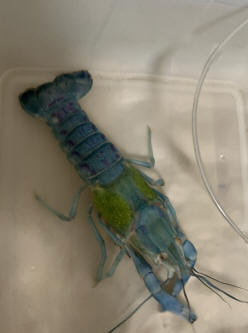 |
Hi I need help with my crayfish
2/17/20
I did a water change and had them in a tank together just yesterday
and added some plants in where the plants started having some plant
juice out
<!?>
and killed 2 of my crayfish now one of my female crayfish abdomen is
slowly turning white and her claws and legs are falling out... What
is happening?
<Reads as some sort of overt poisoning. I would MOVE your crays NOW
to somewhere (established) else; or barring this, change out most of
the water, add some activated carbon to the filter, and REMOVE the
plants if you haven't already. Bob Fenner>
Blue crawfish has a large, misty eye
9/7/18
Hi, I recently moved into college and started up a 10g tank for a
crawfish. Sal is an electric blue, around 2 inches, obtained from a
nearby pet store, and he’s been in the tank around two weeks.
<Ok>
About a week ago, his left eye started getting cloudy. If it was both
then I’d be pretty sure he was molting, but there’s been no change
anywhere else… And today I noticed the eye is getting more milky white
and may even be getting larger? Is there something I can do? I don’t
want anything bad to happen to him when he’s so new to the tank.
<Mmm; perhaps a physical injury... something infectious secondarily>
Water quality seems good. Hard, 100ish alkalinity (ppm) and pretty much
exactly neutral. I have just heard of the iodine for a tank
<Yes; Iodide-ate use I'd apply every weekly maintenance routine; after
partial water changes>
What should I do for his eye? He’s getting a bit more reclusive now and
I’m afraid he’s losing his vision in the eye.
<I'd double dose the Iodide for now; and try not to worry. Likely
whatever the issue is, it will be resolved w/ the next molt.>
If you have any more questions you can reply to this email or call XXXX.
Please leave a voicemail if I don’t answer.
-Ari
<Do read over our articles on Crayfish on WWM. Bob Fenner>
White albino crawfish; changing color
5/30/17
I'm having trouble looking up information about this.
When I first got my crawfish he was full white but it's been 10 months
and is slow getting discoloration around looks like inside of it's body
bluish
blacks color.
<Ah yes; not unusual; and not problematical. Bob Fenner>
|
Require help for a bigger aquarium/ Crayfish... gen., sys.
9/22/16
Hi WWM,
<Darren>
I am planning to get a 7.5 OR 10 gallon tank for my crayfish and I need
help setting it up.
<I would go with the 10 gallon>
Firstly, can I keep possibly maybe 2 sucker fishes in there to help
clean the tank better?
<I would advise against this if you want anything to survive. Plecos
need large tanks, as they get over a foot in length. They
are bottom feeders, like the crayfish, so they will surely fight.>
My crayfish is about 7cm large and I'm afraid he will eat the fishes.
<He will.>
And is there even a need for sucker fishes?<No need for them> (Sorry I
haven't had an aquarium before)
<No worries :) >
Secondly, my biggest concern is the filtration. What kind of filtration
do you think is required for such a tank of this size WITH probably only
1
crayfish and maybe the 2 sucker fishes as mentioned above?(Don't count
the sucker fishes if you think they shouldn't be put in the tank)
<I would use a HOB filter for a 10-20 gallon tank>
I hope to find a system that does not require a lot of water changes
(I'm really busy most of the time till November). <You will need to
perform water changes once a week, even with good filtration. Vacuum the
substrate once a week to remove excess waste.> And if this kind of
filtration works, how
often do I change the water and how many % do I change each time?
<See above. No more than 25% once a week>
Thirdly, for the water quality, do I need the water to be at a specific
pH?
<It should stay around 7.0 so it is neutral>
How hard must the water be and how do I keep it at that level? I know
crayfish produce large amounts of bio load so I think water quality is
very important for their survival.<Correct> And I don't think I need a
heater right? I live in the tropics so the water should be warm enough
as the surrounding temperatures go as high as 38C and as far as I know
crayfish can't survive well in heated water.
<This is very true. Water should stay around 27-28 C at the most. You
may need to invest in a chiller, or cool the house down. 38 C water will
kill the animal>
Lastly, I am planning to get either calcium or iodine supplements so
that I can help supply my crayfish with extra nutrients for his shell(he
is about
to molt in probably the next week) and I can't really decide which to
get.
How much do I dose the supplements as well? <Not necessary> Hopefully I
can get my first proper aquarium, I guess you could say, to
work and for my $90 Procambarus Clarkii ghost variant to survive. You
can also drop me other advices that could potentially help me(like maybe
adding in other fish but note that I don't think I will be adding plants
but if they are so beneficial then I might add them according to your
suggestions).
Thank you in advance :) If this aquarium works I'll send you some pics
of my beautiful P. Clarkii Ghost Crayfish ;)
<Good luck Darren, and feel free to ask more questions. Cheers, Gabe>
Re: Require help for a bigger aquarium
9/23/16
Thanks a lot!
<My pleasure>
I don't think the water temperature will ever be as high as the
surrounding temp so I should be fine.
<Good to hear... You wouldn't want a cooked crayfish :) >
Shouldn't calcium supplements help decrease mortality rates that are
caused by molt deformities?
<Yes, and Iodine as well.
Add when molting. I'm afraid the diet I am planning to give (fish flakes
and occasional greens and treats and possibly algae wafers too)may not
be enough.
<Add shrimp pellets or other sinking pellets. Avoid the flakes, as
they'll just clog everything up. For more info, read here
http://www.wetwebmedia.com/ca/volume_5/volume_5_3/crayfish_basics.htm
As always, feel free to contact us again, and don't forget to send
pictures.
Good luck Darren. Cheers, Gabe.
Re: Require help for a bigger aquarium; now Crayfish comp. 9/26/16
What other fish can I keep with the crayfish? (The 10 gallon tank
will probably look too empty if there is only 1 crayfish in there with no other
fish). Also, should I get any plants and if I should what kind of plants are
easy to maintain but won't be eaten by the crayfish?
<I would stay away from fish, because the crayfish will most likely eat them,
and because the tank is so small. If you must add fish, choose something fast
like Danios. Plants need very special lighting and water additives. Too extreme
for a 10 gallon tanks, and not to mention an inexperienced hobbyist. Cheers,
Gabe>
re: Require help for a bigger aquarium
9/28/16
So... being a 16 year old Asian living under your parents, obviously things
don't always go out the way you want it to.
<Ha! I have the same problem! I'm 15 and my parents limit me to 2 tanks at a
time in the house... It's a real drag!>
I was not allowed to buy a bigger tank, BUT at least they got me a filter,
which is the slim filter by up aqua
(I don't know if it's good).
<Perfect for your situation>
My crayfish is a lot more lively with all that extra oxygen from the water
flow of the filter and I am kinda relieved now as I don't have to check on
him every hour to see if he's still alive (he was a lot less mobile very
unresponsive before I got the filter). Hopefully after my exams, I'll
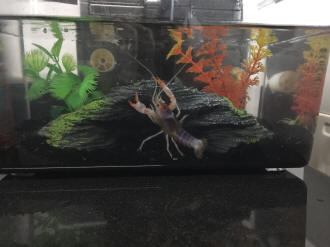
finally be able to get a bigger aquarium. For now, here are some pictures.
<Darren, that is a very nice specimen you have there! Too bad about not
upgrading, but there is always time to do that in the future. Glad to hear
the crayfish is doing well, though. Good luck in the future, mate. Cheers,
Gabe.>
|
 |
Crayfish /RMF
3/19/15
I now know more than I ever though I'd know (or thought I'd care to know) and
have spent a bunch of money on a crayfish one of the cats dragged up from the
pond as a 'gift'. It is all y'all's fault (won't embarrass myself on how many
hours have been spent on your website) for having too much great information.
<We stand (actually sit) accused>
So this little critter gets new digs, iodine supplements, fresh veggies and
cocktail shrimp (sans sauce)?
<No sauce>
Guess I just ought to be happy it doesn't have to be spayed or neutered.
Those darn cats. Your crew does a terrific job on educating folks and especially
had to chuckle at the request for proper grammar vs. texting.
<Am sure you understand.... tis a common courtesy; and allows search tools,
translators (the site is changed by others) and their programs ease and
function>
Ah, if only I could figure out how to get the script font to work on this
laptop.
<Oh; this is coming>
Thanks for the knowledge and keep your fingers crossed that I didn't fall asleep
in class, otherwise I see another purchase in my future.
Boo Rosko
in the wilds of the Ocala National Forest
Ocklawaha, FL
<Cheers, Bob Fenner, in fab-weather San Diego>
Crayfish /Neale
3/21/15
I now know more than I ever though I'd know (or thought I'd care to know) and
have spent a bunch of money on a crayfish one of the cats dragged up from the
pond as a 'gift'. It is all y'all's fault (won't embarrass myself on how many
hours have been spent on your website) for having too much great information. So
this little critter gets new digs, iodine supplements, fresh veggies and
cocktail shrimp (sans sauce)? Guess I just ought to be happy it doesn't have to
be spayed or neutered. Those darn cats. Your crew does a terrific job on
educating folks and especially had to chuckle at the request for proper grammar
vs. texting. Ah, if only I could figure out how to get the script font to work
on this laptop. Thanks
for the knowledge and keep your fingers crossed that I didn't fall asleep in
class, otherwise I see another purchase in my future.
Boo
<That's a really kind email, and I'm pleased we've been able to help.
Crayfish are fun animals. So are cats. Seems you get to enjoy both, willingly or
otherwise! Cheers, Neale.>
|
Lobster; FW Cray, rdg.
12/18/14
Hi my name is josh I got a blue Lobster a few days ago its around 8
inches or longer. Its not really taking an interest in eat as of now.
I was told to feed him beef heart cubes and peas. I
don't know if that's an accurate diet.
<Is not. You should just search, read... Here:
http://wetwebmedia.com/FWSubWebIndex/crayfishfdgfaq.htm
Also today I noticed he's walking on his claws and front legs with his
or her tail straight up. Is that a bad thing?
<... And read the rest of the files linked above... likely there are a
few things amiss here other than nutrition... Iodide, alkalinity...ammonia/nitrite/nitrate>
I tried researching it a little and this site seemed to be the best.
Please email me back at XXXX.com and let me know somethings about it. I
attached a picture also so maybe you can help identify the species as
well.
Thank you for your time.
<Read on! Bob Fenner>
|
 |
I have a question about my crayfish. Excellent/Neale
8/25/14
<Cool. But meantime, let me direct you to a couple articles of use:
http://www.wetwebmedia.com/ca/volume_5/volume_5_3/crayfish_basics.htm
http://www.wetwebmedia.com/ca/volume_1/cav1i4/crayfish/crayfish.htm
Virtually all healthcare issues with crayfish come down to a prevention
of trouble through proper care and the use of marine aquarium iodine.
http://www.wetwebmedia.com/fwsubwebindex/crayfishdisfaq.htm
Once the crayfish is sick, there's not a lot you can do.
Cheers, Neale.>
re: 8/25/14
Well the Cray fish died through an unfortunate series of events. It's
the eggs that it was carrying I'm concerned for and it seems difficult
to find information on how to take care of eggs without the mother.
<You probably can't. The mother not only carries them away from
predators, she also removes fungused ones and keeps a steady flow of
oxygen across them. Rearing crayfish eggs isn't especially hard provided
environmental conditions are good.>
Any advice you could offer might help.
<Read. Buy marine aquarium iodine. Honestly, you'll be amazed how useful
this stuff is for keeping crayfish, shrimps and other crustaceans.>
Thank you for the links.
<Welcome. Neale.>
re: 8/25/14
Alright I certainly appreciate your advice.
<Most welcome. NM.>
blue crayfish molt; rdg.
7/19/14
Our blue crayfish just molted today and lost one of his front claws.
He's laying on the bottom of the tank upside down and moving very
little.
When I tried to roll him over he bolted under his rock but toppled over
on his back again. Is he just exhausted from the molt or is it something
more?
He is our first crayfish and the learning curve is steep (however I've
found a lot of good info on your site so far - at least I know it's not
fatal to him that he lost a claw). Hard to explain all this to a
traumatized 6 year old boy :/
Thanks for any help you can give me
Jenny
<Such appendage losses with molts are generally indicative of nutrient
and/or iodide/ate insufficiency... IF the animal can still ingest foods,
it may well regenerate these limbs with successive molts. Please read
here re:
http://wetwebmedia.com/CrayDis4.htm
and the linked files above or use the search tool (on every page). Bob
Fenner>
|
Crayfish leans on sides. No data, poor nutr., no rdg.
6/21/14
Hi! I'm from Singapore. About a month ago, my cousin gave me a yabby.
But I'm not sure where it is from. I've been feeding him peas,
corn and a bit of luncheon meat.
<Poor... Read here:
http://wetwebmedia.com/FWSubWebIndex/crayfishfdgfaq.htm
The first few days he was very active crawling, trying to escape as days
pass by, he becomes less active. He would lean on his sides. Currently,
he is in a tub as my parents did not want to spend money on tank. I
change the water everyday. Today, he seems not to eat. He would scratch
his body and as usual, he does cleans. Sometimes, he leans in his side
for a long time.
At a point of time, I thought he was dead! I sprinkled some water and he
swing its claws. He did not moult at all.
Hope that you can help me.
Best regards,
Ann
<... What re water quality? Need some small gravel... for a statocyst,
substrate/filtration... You NEED to READ:
http://wetwebmedia.com/ca/volume_1/cav1i4/crayfish/crayfish.htm
and the linked files at bottom. Bob Fenner>
|
.jpg)
Re: Crayfish leans on sides. Didn't read....
6/22/14
Hi, WWM crew. Yesterday, I've tried feeding him some seaweed
<... READ where you were referred. B>
but he did show interest in that but he did not eat it. What should I do?
Today, he seems to be weaker, he is not responding to anything. Could you
please help me? Thank you.
Best regards,
Ann
|
Wukf crayfish in a bug tank HELP!
6/11.5/14
I have recently caught a crayfish, (my first one) and put it in a bug
tank, filled with water, and stones. I put in a tube, also. I know
nothing about crayfish ( except that the are delicious), and I have no
clue how to care for it.
<Mmm, just read here:
http://wetwebmedia.com/ca/volume_5/volume_5_3/crayfish_basics.htm
and the linked files at the bottom. And do write back if you have
further, specific concerns. Bob Fenner>
My mother and father are divorced, and I can't take it back and forth.
What should I feed it? Should I change its water? I put in some clams I
found, and the Cray has not tried to eat it. I put in a fat river worm,
if that will keep it alive. Please help! I don't want to eat my wild
Cray, but keep it as a pet.
Please help,
Jordyn
WILD CRAWFISH DYING URGENT 4/17/14
I was playing gold <?> when I saw this bird eating something, and I
chased it away and I found a crawfish with its tail eaten (gills still
on body). I first put it back in water, but the bird came back for it so
I ran home with the crawfish. It twitches from time to time, but you
can't really tell if it's alive. It is in a bowl with room temperature,
non filtered water. I called animal control. And they said Let nature
take its natural course. I disagree. Can it survive, and if so, what
should it et and what water temperature should it have? Please give me
advice as Google has nothing and i have no idea how to raise one.
Thanks,
Sadia
<Not likely to survive such trauma... To keep Crays alive... Read here:
http://wetwebmedia.com/ca/volume_5/volume_5_3/crayfish_basics.htm
and the linked WWM files below. Bob Fenner>
Red claw crayfish.
1/11/14
Hi,
<Muller>
I recently got a red claw crayfish, and put him in a 60litre tank with a
small bream, 3 red eye barbs and a bottom feeding sucker type fish in
it.
I have removed all the plastic plants and have made two caves using
river pebbles, as well as put in a milk jug for him to hide in.
He's been in the tank for 4 days now and has settled in one of the
caves. I have not noticed him eating as yet, how long can he live for
without feeding?
<Weeks>
And why do you think he is not eating?
<Can't tell w/ the information provided. Perhaps the wrong food/s, poor
water/unsuitability. What species of Cray is this? Is it tropical?>
I have given him grated carrot and a piece of ham, but up to now has
shown no interest.
<Poor choices... See WWM re foods/feeding of these animals>
He also has his tail curled up under him, even when he walks around, is
this normal?
<For most species; yes>
He is a juvenile, measuring about 15cm long. I say "him", but have no
clue what sex "he" is.
<... see WWM re reproduction>
The water temp is 26 degrees Celsius, and has an airstone as well as an
under gravel type filter.
The bottom is covered in small stones approx 6-10mm in diameter, and no
sand.
There are no live plants in the tank.
I look forward to hearing from you.
Kind Regards,
Muller Ferreira.
<Search, read ahead of writing us. Bob Fenner>
Crayfish... no data or reading 11/29/13
Hi there i own a blue crayfish and i have noticed that he or she is
acting different its lying on its side a lot and scrating its under neath
a lot im worried please help.
Sent from Galaxy S3 on Three
<Read here:
http://www.wetwebmedia.com/CrayDis4.htm
and the linked files above. Bob Fenner>
|
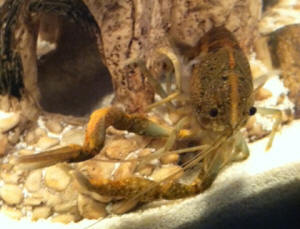
Crayfish pincher claws too long and crooked after molt
1/28/13
> Hi,
> We are new crayfish owners, only about 2 months. Our Cray has just
gone through his second molt and it seems to not be going well. He
finally emerged from his hiding place and there was shell everywhere.
<... should be left in place for ingestion, reincorporation...>
Immediately we noticed that both of his pincher arms were unbelievably
long and all bent the wrong way. The poor thing is unable to move.
He falls over and cannot right himself. He also will not eat. He
also seems to have little white feathers coming out from where his tail
meets his body.
<Mmm>
> After reading your web site I gathered that some iodine will probably help
the situation.
<Yes>
We have a 10 gallon tank a with waterfall filter.
> Is this normal?
<Not normal, but quite common... symptomatic of deficiency syndrome... lack
of necessary biomineral et al. Read here re:
http://www.wetwebmedia.com/FWSubWebIndex/crayfishdisfaq.htm
and the linked files above>
Will he shed these enormous appendages or will he eventually gain enough
strength to move them?
<Only given better conditions... I2, Ca, Mg...>
> Thank you so much for any advice you can throw our way! We're really
worried about our little guy!>
> I've attached a photo so you can see him.
> Jen
<Enjoy the reading, learning, empowerment... Bob Fenner>
|
 |
Crayfish 1/28/13
My daughter brought home a crayfish at the end of 3rd grade. The teacher
was left with "Angry Bob", whom no one was willing to take as he was
aggressive, so we took him too. Long Claw and Angry Bob did alright in a
tub I kept them in. Knowing nothing about crayfish I just kept giving
them clean water periodically and throwing spinach in. One night, about
2 months later, Angry Bob pulled Long Claw's one claw off, along with
part of his belly.
<Typical... Crays don't "get along">
Thinking he was dead I was going to scoop him out. He swam away and I
couldn't. The next night Angry Bob cut his tail off.
<... had you read...>
I was pretty unhappy but kept taking care of Angry Bob. One day I
thought he had developed a disease because his tail started looking real
funny. A few days later the funny looking things become beautiful eggs,
about 3+ months after Long Claw had died. As I scoured the Internet in
complete confusion my daughter informed me that she knew Angry Bob was
actually a girl. A little less confused, I watched a few weeks later as
she trumped around her tub. I recognized this behavior. She was nesting.
3 days later I thought there were gnats in the water and wow, baby
crayfish! She has taken great care of them, lugging around approximately
60 at one time under her tail. Having a new respect for "Angry Momma" I
bought a reptile rock that she loves to hide in, much better than the
flower pots, and crustacean pellets that sink. I know how hungry having
kids makes you.
2 months later she looked very sick, laying on her side, and we had to
leave town overnight. I came home and thought she was dead. Of course
she had molted. Now, just one month later, she is acting the same way. I
did just add a lot of water to the tub. Could she possibly molt again so
soon?
I'm really worried about her. Also, I feel like there are less babies
now, maybe 40...is that possible? Some are 4 times the size of others. I
can't figure it out. I am trying to raise them to donate back to the
school so they don't have to buy new ones this year, and also keep a
few. They are growing very slowly, even though I got them a larger tub.
I am thinking of separating them into a few tubs, by size. So here are
my ?'s-
1. How often can crayfish molt? Mine is red, by the way.
2. I want to put more rocks, sticks, etc in the tank, but I am worried
about introducing bacteria.
3. What should I put in the water? I just use water I have left out to
let
the chlorine evaporate.
4. How often should I feed these suckers?
5. Is there a way to get them to grow faster?
6. How long can they live?
7. Is a tub horrible? Should Angry momma have a tank? We had goldfish
that were a mess. I'm a single mom with 2 kids, a business, 2 toads, and
a dog.
I don't have a lot of time for maintenance and my kids can still only
tend to simple things.
<.... Read here:
http://www.wetwebmedia.com/ca/volume_1/cav1i4/crayfish/crayfish.htm
and the linked files at the bottom.>
Thank you very much for the info on your website and your help.
Kim
<Enjoy using it! Bob Fenner>
Florida blue, too much stress?
1/12/13
Hello, Sylvi here!
<Hello Sylvi,>
I have a major problem with my female, Orion. She came to me with one
claw smaller, obviously slowly regrowing.
<Correct, and may never reach full size. Crustaceans don't moult to
order. They moult periodically as they grow. They moult frequently when
young; infrequently when sexually mature. Eventually they all but stop
moulting altogether. So, if your crayfish is fully grown, it may moult
only every few months, in which case the claw will always be relatively
small.>
I noticed her carrying a bundle of eggs a few days ago (I'm not sure how
fast the laying process is, I was very surprised to suddenly see "her"
with eggs). Last night, my large male Boris was really restless and
constantly trying to invade Orion's safety cave, even though his regular
cave was empty along with two other caves. This morning I found Orion
cowering in a corner, her regular claw ripped off, by Boris of course.
<Hmm… confused here. Why are you keeping them altogether? Standard
operating practise is to keep crayfish one to a tank. If you keep
multiple specimens in one large aquarium, then don't go naming any of
them -- because their lives are likely to be short and brutal. What more
to say? Understand that crayfish aren't sociable animals, and keep them
accordingly. Kept in solitary, 5-10 gallons per specimen, and such
intraspecific aggression, even cannibalism, will be avoided. Simple.>
I separated her from the other two large males, leaving only a two inch
female, and a one incher, with a few fish to keep the balance. My
concern is, with only a smaller regrowing claw, carrying eggs, and
having a claw ripped off, will she survive this trauma along with her
eggs??
<Wouldn't put money on it. Crayfish are largely herbivorous in the wild,
but they are completely opportunistic as well, so anything dead or weak
is on the menu. Being nocturnal, we rarely see them doing much, which is
why people often say things like "my crayfish is completely peaceful, it
ignores all its tankmates". People can say that, but it isn't true, and
unless you're watching your crayfish with night-vision goggles, you
really don't have any idea what your crayfish are doing.>
I've been trying to feed her some greens, bloodworms, defrosted feeding
fish, and brine shrimp, but i haven't seen her eating yet....so I'm very
worried right now. Please tell me what I can do to make her as
comfortable as possible and have her eating again! Thank you so much!
<Easy. Keep her on her own. Problem solved. Once in such an aquarium,
she will recover if not too far gone, damaged.>
PS: The two inch "female" Rorschach started carrying eggs about 10 days
ago, but I noticed her reaching back and snacking on her own eggs as if
they were M&M's, and currently she only has about 5 eggs left, but they
are a strange light brown color. Is this why she ate them? Or the other
way around?
<Stress causes female animals to do all sorts of apparently odd things.
But in terms of biology, eating your young makes complete sense if you
are so stressed you know for sure your young won't survive. By recycling
the energy put into those eggs, that female can conserve that energy for
another occasion. Again, keep crayfish singly. This has been gone into
over and over again, and yet people do try to re-invent the wheel when
it comes to crayfish keeping. They just aren't trustworthy, sociable
animals. If you keep a group, expect fatalities, and don't be surprised
if you end up with a single, big male. Cheers, Neale.>
Re: Florida blue, too much stress? 1/12/13
I should add, I was keeping the 2 inch female Rorschach, 3 inch female
Orion, 4 inch Boris, and 4 inch Godfather all in a 10 gallon tank, along
with a 3 inch Chinese algae eater male, Bobby, who stands up to the
large male crayfish like a large black Spanish bull, also a 1.5" playful
yoyo Botia, who strangely befriends everyone and takes turns sharing
caves with the crayfish and Bobby, plus 6 zebra danios. Soooo yes, a bit
too much for one tank, but everyone lived in peace.
<So far…>
I keep the temp 65F - 75F, have a pump and bubble stones, lots of caves
to go around, and do 50% water changes every week. I treat the water
weekly with conditioner and Cycle, as well as aquarium salt. Water check
hasn't been done in a few weeks, my bad. Iodine I just found out about
reading through your website. I now have a 25 gallon beside the 10
gallon making sure there is no overcrowding. I use coral/gravel for the
bottom, but do not have live plants. (I am also wondering if it is safe
to buy potted indoor thick bamboo, let it root out in the gravel with
some waste/food in the aquarium water, and then add it to my aquarium.
<Has been done, yes. But beware "bug sprays" used on houseplants --
these can be lethal to fish.>
I see thick bamboo in closed off small decor aquariums with small fish
and African dwarf frogs, the waste keeping the bamboo alive, the bamboo
adding necessary nutrients to the water, which keeps the water clean and
the critters happy…strange.
<And also unlikely. Bamboo doesn't add anything to the water that's
helpful and while plants can remove ammonia from the water, whether they
actually "clean" the water is debatable in most aquaria. For that to
happen the ratio of plants to fish has to be very high, and the plants
have to be growing very fast, by which I mean you're cropping back the
plants (i.e., pruning) once a week.>
So back to the bamboo question...safe or not?) The aquarium diet
consists of tropical flakes, chopped small fish, brine shrimp,
bloodworms, frozen green peas, cucumber, and zucchini to keep everyone
happy. Sinking pellets didn't work well since they dissolved too quickly
and sunk into the gravel if my crayfish weren't hungry at the time, same
with sinking crayfish pellets. I will do water tests, add iodine, sushi
Nori asap, but for now my main concern is the wellbeing of Orion with
her eggs, lack of appetite, left with only her small claw, suffering
great trauma last night. Thank you so much!
<Sylvi, it's time to do some reading. Start here:
http://www.wetwebmedia.com/ca/volume_1/cav1i4/crayfish/crayfish.htm
http://www.wetwebmedia.com/ca/volume_5/volume_5_3/crayfish_basics.htm
Crayfish shouldn't be kept together if you want more than one specimen
to do well/survive, and crayfish shouldn't be mixed with fish. Cheers,
Neale.>
Re: Florida blue, too much stress? 1/12/13
Thank you for all of the help Neale/crew, and the very quick response!
<Welcome.>
I'm making major changes currently, and I guess I have to give Orion a
few days to see if she starts eating, as obviously the stress has been
great on her. The reason I kept all my crayfish together was because
they were given to me by a friend who has had them in large communities,
constantly reproducing for years in a 40 gallon cube tank, along with
some tropical fish.
<Ah yes, often happens. And it a big tank, you can get lucky. But
crayfish aren't reliably sociable or peaceful, so I'd never recommend
them as such.
To be fair, there are one or two exceptions, species of crayfish that
seem "better" than others.>
And of course LFS staff are not helpful at all. I heard everything from
"peaceful community crayfish" to "two per 10 gallon tank can thrive for
up to 20 years".
<I see.>
When reading up on the Florida Blues, that was when I realized I will
need a bigger/more tanks to house them all. They seem to have a
wolf-pack system though. The largest male was the "Godfather" until the
other male Boris took over the role after a battle, which thankfully
only resulted in Boris losing an inch of his left antenna, and Godfather
having a small piece clipped off of his right claw.
<Sounds about right.>
I wonder if maybe I've been lucky so far which no cannibalism due to the
conditions they lived in at my friend's 40 gallon aquarium holding about
40 Crays?
<Can be. Overstocking tanks is interesting. While it causes problems in
terms of water quality, it does prevent any one fish (or crayfish)
getting the chance to establish a territory. Any individual who tries
will have to constantly fight all the other crayfish, and he'd never
make any progress because all the others are doing the same thing to,
and there's no peaceful cave or corner he can defend consistently. Kind
of like how when people are on board a crowded subway train the usual
rules for personal space are ignored. Anyway, if you have a large group
in a reasonably big aquarium with adequate filtration, a sort of status
quo is maintained where none of the crayfish becomes dominant. Take five
of those crayfish and put them in their own tank and suddenly the rules
change. There's now a chance for the strongest specimens to become the
boss because he will be able to claim his corner and manage his
aggression adequately well, only having to fight the few other crayfish
occasionally.>
As for the fish, I added them to the tank in a span of two weeks before
the crayfish arrived, with Bobby, the aggressive Chinese Algae Eater
protecting his territory, which seemed to work. He stands up for himself
and for his new mate, another Chinese about the same size.
<Do read up on Chinese Algae Eaters, which are not from China and don't
eat much algae. Properly known as Gyrinocheilus aymonieri if you want to
look online about them, they're big fish (20-30 cm/8-12 inches within a
year or so) and as adults can be extremely aggressive.>
He also is very protective of Nighthawk, the playful Yoyo Botia, scaring
off any of the crayfish that wander too close to their caves.
<I doubt he's actually protecting the loach. They may have common cause
at the moment, but long term the chances aren't good they'll get along.
Interesting, the Yoyo Loach (Botia almorhae) is a good community
species, and a social one, so you'd be better off keeping 5 of them in a
tank upwards of 150 l/30 US gal.>
I have had them in the 10 gallon with the Zebra Danios for about 6
weeks, only having one Zebra killed, and one injured.
<That's actually not a very good track record, one dead fish, one
injured fish, and various crayfish injuries.>
So, I think my tank has been installed with some Luck o' the Irish!
<No such thing as luck. At least, look at it the other way. Playing
Russian Roulette once and surviving doesn't make it a safe game.>
But now I think I will be safer with 30 gallons for the 5 crayfish, two
of which are still adolescent. If I have luck and have hatchlings, I
already have a LFS who has a hard time shipping in Florida Electric Blue
Crayfish, willing to buy all the surviving hatchlings once they are 3/4"
in size. So, I am happy they will have a home to go to.
<Good.>
So, I think I have taken the right steps and am now prepared to keep a
safer environment for my tankmates. Last step will be the Iodine on my
next stop to the LFS. On a final note, when cleaning the tanks, I do a
full hand/arm sterilization as I was required in science/medical labs,
and gently usher the Crays into my cupped hands to transfer them to the
temporary bucket.
<Good personal hygiene/safety when working with aquaria is always a good
idea.>
They seem to be fine with this, and I am confident that with the
thorough scrub down/wash of my arms and hands, I provide no potential
harm or infection to them.
<To be fair, the risk is mostly the other way. Aquaria are commonly
infested with things like Salmonella wherever bits of food can decay in
warm, moist areas. The only real risk going the other way is if your
arms are soapy and that soap gets into the water as that can cause
serious harm.
As a general rule, it's also a good idea to clean nets, buckets, etc. or
at least let them dry out thoroughly as/when taken from one aquarium to
another, as wet objects can carry parasites (like Whitespot) from an
infected tank to a clean one.>
Also, I feel that this is a safer transportation method then the net or
the pinching in the middle, as this way there is no danger of a struggle
ending up in an injury. Does this seem safe enough for the Crayfish?
<Likely so. These animals aren't delicate at all.>
Once again thank you so much for the time and energy you and your staff
put into helping out all these hobbyists, and I sincerely apologize for
not doing enough research on my part, and for the many badly written and
very brief emails and texts you and your crew receive. I can only
imagine how irritating this must be on your part. Thank you very much
Neale, for all your help and useful information, it is much appreciated!
And I hope your weekend goes well, and you have a chance to sit back
with friends and enjoy a cold one or two at a nice pub or at home!
<I hope so too! Good luck, Neale.>
Blue Lobster... rdg. 5/2/12
We brought our blue lobster, Larry, home back in October. He lives
alone in a 37 gallon tank and has been fine until about a week
ago. My wife and I first noticed we hadn't seen him in a few days last
weekend (he has a 'house' he hides under and its hard to see him under
there). This is unusual since he is very active every night. He
has not molted since we brought him home
<What re alkalinity here? Do you use iodide-ate?>
so we figured that was what was going on. He hasn't eaten at all
in this time
<?!>
(we feed him shrimp pellets, veggies, algae wafers).
Well, curiosity (and the fear that he had passed on) got the best of us
tonight and we lifted the house to make sure he was okay. He's alive but
he has not molted. There seems to be something wrong with his tail. Its
red on the edges and looks as though bits of shell came off. Is this
tail rot?
How do we treat it? I checked everything in the tank. All levels are
normal.
Should I do a water change? Should we just let him be? Is there anything
we can do to help alleviate his stress? Any suggestions would be greatly
appreciated. We love him so much, we don't want him to be in pain or
stressed.
Thank you,
Glynnis
<Please read here:
http://wetwebmedia.com/FWSubWebIndex/crayfishdisfaq.htm
and the linked files above. Bob Fenner>
Freshwater Lobster... molting beh.,
comp... gen. f' 3/24/12
I have a lobster (Ornamental lobster might be the technical name) in my
55 gal. freshwater tank.
<It's not a lobster, it's a crayfish. Various sorts
available, but in the US, Procambarus clarkii and Procambarus alleni
predominate. Do also be aware of the giant long-arm shrimps like
Macrobrachium rosenbergii that sometimes end up in the trade.>
The lobster is about 5 inches right now.
<About full size then.>
I have owned him for right around 5-6 weeks, and he has grown
substantially in size and molted at least 3 times in that 5 week
period. First off, is it unusual for a lobster to molt that many times
in that short of a time period?
<Nope. They moult as they grow, and if you generously feed, they
grow that much faster.>
Second of all, when I got home from work today, I could tell that he
had molted again due to his shell being more transparent than normal.
Once he started to move, I saw that he had lost his two front claws and
possibly a leg or two. I was wondering if this is maybe caused by his
frequent molting?
<Nope. Lack of iodine is almost always the problem. Buy a bottle of
iodine supplement as used in marine aquaria, and use at one-half the
recommended dose. Alternatively, there are some crustacean-specific
foods, e.g., those from JBL, that can be used alongside and iodine-rich
food like Sushi Nori or Spirulina flake without the need for iodine
drops. Obviously crayfish are kept in their own tanks and not with
fish, so feeding them carefully shouldn't be a problem. Some people
unfortunately believe they can keep crayfish with fish, and apart from
the damage these two organisms can do to one another, it makes life
very difficult when providing either with the right diet. I assume
you've researched crayfish and understand it needs its own system,
not an aquarium with fish.>
Also, I do have a red clawed crab in there with him, but I have never
caught them fighting, but do realize it is a possibility that they
might have had an incident while I was away.
<The crab Perisesarma bidens is an amphibious, brackish water
species that has no place in this system. Move it or lose it.>
Is my lobster going to survive?
<Can do, yes.>
Does he need his front claws to live?
<No. They're used for fighting more than anything else, and they
have other limbs used for shoveling food into their mouths. So long as
those mini-arms are okay, the crayfish can survive until he grows his
claws back.>
Also, if it is a known thing, how do I fix this possible molting
problem?
<See above. Do also read:
http://www.wetwebmedia.com/ca/volume_5/volume_5_3/crayfish_basics.htm
http://www.wetwebmedia.com/ca/volume_1/cav1i4/crayfish/crayfish.htm
http://www.wetwebmedia.com/FWSubWebIndex/crayfishdisfaq.htm
Cheers, Neale.>
Crayfish Questions,
gen. 9/1/11
Hello, I am hoping you can help me provide a positive experience for my
seven year old son. It all started when he caught a crayfish in our
stream (western PA., Pittsburgh area). He wanted to keep the crayfish
as a pet. At which point, I began research on crayfish for pets, which
indicate they make great pets:
· You need a minimum of a 10 gallon tank
<Or thereabouts, yes.>
· Only put one crayfish in a tank
<Yes.>
· They are ok mixing with fish and will only bother weak
or sick fish
<Not true.>
· It was OK to catch in a local stream and mix with other
fish
<No.>
· Feed them shrimp
<Alongside other, better foods like algae wafers and small pieces of
white fish fillet. Unshelled shrimp are fine once a week, but they
aren't nutritionally balanced. Shelled shrimp are pointless food;
mostly protein with little else of use.>
· Water temperature should be keep between 70 and 75
degrees
<Room temperature is fine for North American species.>
So off like a great parent, I proceed to the nearest pet store and
purchase a fish tank. Being a novice and getting some bad advice my
initial purchase resulted in all died fish, and the initial crayfish
died before we had an opportunity to put it in the tank. Slightly more
knowledgably, I proceed back to the fish store where they educated me
of my mistakes and replace my dead fish.
With my new found knowledge, we embarked on our next adventure and
established the tank for a couple days, obtain new fish, caught a new
crayfish from our stream and everything seem fine for about a week.
Other than the amusing adventure of snippy and his great escaped,
although I not sure my wife thought it was amusing. In any case, after
a week, all the fish and snippy died.
We are about to embark on our third adventure and my son really wants a
crayfish, plus other fish in the tank.
<Not do-able.>
Before proceeding, we washed and emptied the tank, sanitized it and
everything in it with Clorox, thoroughly rinsed it and let it
completely dry for three days in the Sun. We just add water and the
purification solution to prepare for our next adventure. With each miss
step I learn more, but, cannot locate answers or advice necessary to
make this third adventure a success.
Is there a problem mixing a crayfish my son catches from a local stream
with fish purchase from the store, which is how this adventure
began?
<Indeed, this is a bad start. Keep fish or crayfish, not
both.>
Is a 10 gallon tank enough?
<Yes.>
Am I better off with a purchased crayfish, and, if yes, is there a
recommend species?
<Either wild-caught or purchased species do well. The point is that
an un-cycled aquarium is a hostile environment to anything. There are
two approaches here. The first is takes time but is less hassle. Set
the tank up, and every day, add a small pinch of fish food (or,
alternatively, a sliver of market shrimp 1 mm in thickness every 4-5
days). Over the next 4 weeks, do regular water changes, 25% once a
week. Using a nitrite test kit (which you really want to own)
you'll see the nitrite level go from zero during the first few days
up to a peak about week two, and then drop down to zero again at about
week 4. Now your tank has a mature filter, and you can go ahead and add
the crayfish. Alternatively, set the tank up, add the crayfish, but
don't feed it more than a tiny sliver of prawn or fish once a week.
Do 20% water changes every day for the first two weeks, and then every
second day for the next two weeks. You should again see nitrite rise
and fall as the filter matures, but by doing water changes, you keep
nitrite below 0.5 mg/l, above which nitrite becomes quickly lethal.
After four weeks, the tank should be cycled. You can also buy instant
cycling products but these are unreliable at best. So if you do go and
buy something like Tetra SafeStart, I'd use it alongside the second
method described rather than on its own.>
We considered catching everything from the stream, fish and crayfish
for the tank, would you recommend this adventure?
<There are some excellent books about North American fish in
aquaria, such as North American Native Fishes for the Home Aquarium, a
book that's out of print but surely available via your public
library even if you don't feel like buying a used copy. In any
event, I'd suggest you proceed cautiously. A 10-gallon tank is
adequate for a crayfish, but there aren't many North American
natives that would do truly well in such conditions, and those there
are, like killifish and livebearers, are going to be prey for a hungry
crayfish. Conversely, species that might be too big to be harmed, like
adult Sunfish, would need a much larger aquarium, 55 gallons
upwards.>
Or is this another sad story in the making? What else should I be
asking or need to know?
<Do start reading here:
http://www.wetwebmedia.com/ca/volume_1/cav1i4/crayfish/crayfish.htm
http://www.wetwebmedia.com/ca/volume_5/volume_5_3/crayfish_basics.htm
>
Am I asking the wrong question? How would you recommend I proceed,
other than not procreating? I already have a son, which got me into
this predicament
Thank You
Jayme
<Glad to help. Cheers, Neale.>
Re: Crayfish Questions 9/2/11
Neale,
Thank you very much for taking the time to answer my questions.
Jayme
<You are most welcome. Cheers, Neale.>
Crawfish help needed! 8/23/11
Hi
I recently bought a pair of Crawfish under the impression that they
were lobsters.
<Related, but different.>
I live in Pakistan. People running the aquarium shops know nothing
about what they are keeping.
<Oh dear.>
I think they just catch fish and name them whatever they feel like and
then sell them off to poor, unsuspecting people like me.
<I see.>
Sadly, I decided to Google my new pets after getting them. I don't
mind they are crawfish instead of lobsters. They look pretty. But I am
extremely worried about how to care about them. I have been looking at
different websites for some information, but I can't find any.
<Lots here!>
Your site looks good so I decided to contact you. I hope you can help
me. I will be very grateful.
<Read here:
http://www.wetwebmedia.com/ca/volume_5/volume_5_3/crayfish_basics.htm
http://www.wetwebmedia.com/ca/volume_1/cav1i4/crayfish/crayfish.htm
>
Here's the problem: I know crayfish are freshwater fish. I am
keeping them in an aquarium filled with tap water. A few rocks, shells,
etc. I'm putting Methylene Blue water conditioner 4-5 drops per
week and Anti-chlorine instant formula 8-9 drops every time I clean the
aquarium and put in fresh water. I have installed a filter in the
aquarium as well.
<Good. Wouldn't use Methylene blue water conditioner though. May
harm them in the long term. Dechlorinator should be fine
though.>
I put around 5 biscuit like tablets in the aquarium daily as the guy at
the shop instructed.
<Daily is perhaps too much.>
The Ingredients are: White fish meal, Wheat Flour, Spirulina, Scallop
Meal, Wheat Germ, Yeast Powder, Seaweed, Red Alga, Chitin, Lactic acid
Calcium, B-carotene, B-glucan, L-lysine, DL-Methionine, complex
vitamins and minerals.
<All sounds good. But would use these tablets a couple times per
week. Rest of the week raid the kitchen! Crayfish are scavengers, so
bits of raw fish, cooked peas and spinach, even a few cooked rice
grains will be useful additions to their diet.>
Now the problem is I think something's wrong with my fish. One is
blue, the other is red. The red one seems fine. The blue one seems
reclusive. It keeps hiding behind a rock in the corner.
<May be different species, one more/less territorial than the
other.
Crayfish rarely get along in the same tank, and fights are common. They
need space! Do be aware that at moulting time they become shy, hide in
a cave, and may not be seen for several days. All crayfish are
nocturnal animals and dislike bright light.>
When I brought them in about a week ago, the blue one used to be active
as well. Both of them used to swim around the aquarium. Now it just
lies there in the corner. I'm afraid it's not even eating
anymore. I can see the tablets just sitting there in the water. I
don't know if the red one is eating or not but at least it still
swims around a bit. I don't know what's wrong.
Immediate help needed.
Thanks,
Iqra
<Cheers, Neale.>
More info on iodide use with
Crayfish 6/30/11
Hi WWM,
I've been reading your Iodide FAQs and I'd love to read the
source publications of where you get your information. Could you
possibly email me a reference list so I can get into the nitty gritty
of things?
<Mmm, no. You'll have to generate on your own unfortunately.
Have no time for this.>
I'm specifically interested on how iodide aids the moult
process.
<Please read here re the process of looking: http://www.wetwebmedia.com/litsrchart.htm
Thanking you in advance!!!
Philippa
<Welcome. Bob Fenner>
Re: More info on iodide use with Crayfish 8/30/11
Hi WetWeb,
Thanks for your reply! Unfortunately, all searches u suggested turned
up empty. Can you please sent me references for the advice you
give???
Many thanks, Philippa
<Iodine helps crayfish grow and moult successfully. You can use the
iodine sold for marine aquaria. Dose at 50% the amount it says on the
bottle, each time you do a water change. Alternatively, you can use JBL
NanoVitol is a very economical product designed specifically
for freshwater aquaria and can be used as directed on the
packaging. It is possible to keep crayfish successfully without any
supplements, but you will need to use iodine-rich foods on a regular
basis, for example marine seaweed (Sushi Nori).
Unshelled crustaceans such as krill and prawns should also be provided
once a week; they contain some iodine (not as much as seaweed) and are
also a good source of the proteins crustaceans require to grow.
Otherwise crayfish are omnivorous and do well on softened vegetables,
small pieces of white fish fillet, algae wafers, etc. Cheers,
Neale.>
|
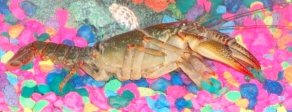
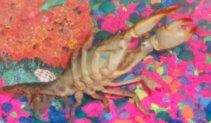
Can you tell me what kind of Crayfish I have?
6/21/11
Last week, on Thursday, my husband mentioned something about a
tower by the porch. He, points to the ground by the back porch.
There is a tower of Mud that stands about 10 in tall with a hole
in the middle. He said, I'm watching to see what comes out.
We figured a mole, or some kind of frog.
Friday we had a hard rain, and it washed away some of the tower,
so he is standing there watching to see what comes up. It started
coming to the top to rebuild the tower. When he saw what it was
he knock over the tower and put what came out in the fish tank
(it didn't have any fish anyway).
I know it is a Crawfish but not what kind. (I believe it is a
male). We live in Eastern Alabama middle of the state 10 miles
from the Chattahoochee River that separates GA and AL. We had a
creek that went through our back yard, it finally went
underground about 17 years ago. I have attached two pictures of
it.
About 7 years ago, we had been doing some digging in the back
yard and came upon some old rusty barrels, they were full of
water and it had a bunch of little ones in it, we caught 2 little
ones and one big one (not as big as this one). But they only
lived six months. I think the big one ate the little ones (along
with the rest of my fish). The big one also kept escaping the
tank.
With this one, we have removed all the fake plants and moved the
two fixtures that are left to the middle of the tank. And taped
over all the openings. It has a filter and heater, with gravel on
the bottom. I gave it a piece of cooked shrimp and put in flake
food. It has not eaten the shrimp. I would like to know what kind
it is and I have been reading your site for feeding tips.
Won't lettuce float? And should I just cut up small pieces of
carrots and zucchini? How much do you feed them?
Thanks for your help.
Michelle
<Hello Michelle. At first I thought this was Procambarus
pygmaeus on account of its small size and the orangey tips to the
pincers. But I do wonder if it is actually the common species
Procambarus clarkii. In any case, I'm fairly sure it's a
Procambarus species of some sort. As for care, do read here:
http://www.wetwebmedia.com/ca/volume_5/volume_5_3/crayfish_basics.htm
http://www.wetwebmedia.com/ca/volume_1/cav1i4/crayfish/crayfish.htm
Basic care is generally straightforward. Crayfish eat both plant
and animal foods and under aquarium conditions are very
omnivorous. Algae wafers, cooked peas, small bits of fish fillet,
unshelled shrimps all make good foods. Variety is important. Dose
the tank with iodine (sold for marine aquaria) at 50% the dose
stated on the bottle -- this is very cheap to do, and ensures
they moult properly. They tend to be aggressive as well as
predatory, so will harm one another as well as fish. They like to
dig, and yes, they will escape given the chance. Hope this helps,
Neale.>
|
|
|
Re: Can you tell me what kind of Crayfish I have?
6/21/11
Thank you for letting me know what it is. I have read the basics
already and I've been reading everything else on your site. I
bought the Algae wafers and shrimp pellets for bottom feeders. I
only found 1 store with the iodine and it was such a large
bottle, I saw somewhere on your site that I should use, 1 drop
for a 10 gallon tank a week. Does that sound right?
<Hmm'¦ there's no rush here, so why not
mail-order a small bottle? Going without iodine won't hurt
for a few weeks; it's in the long term, once the animal uses
up the iodine it still has from its diet in the wild.>
Also, the girl at the store said I didn't need it, "we
don't use it here". I have seen your thoughts on things
like that.
<She may well not use iodine, and if she only keeps crayfish
in stock for a month or two each specimen, she doesn't have
to worry about the long-term health of these animals.>
I also have read some of the comments and thought I trust your
information more than hers. I will go back and get the big
bottle.
You mentioned its' small size, I thought it was pretty big.
When it is still and straight out from the tips of his claws to
the tip of his tail he is approximately 5 inches long. Does that
mean he will get bigger?
<Not by very much; this sounds like an adult P.
clarkii.>
I took the solid house out and replaced it with a new longer fake
log that had several openings in the sides and open at the bottom
so it could dig out and get comfortable.
<Cool.>
I have see several listings of foods for them but not sure how
much to feed, it also says to remove un-eaten food. But no
suggestions on volume or duration to leave it there. Any
suggestions for me? I don't want to under feed it or leave
extra for too long.
<Plant food can be left in indefinitely, so if you're away
for a couple weeks, just leave a bunch of Canadian Pondweed or
similar (as sold for ponds and Goldfish aquaria) and leave the
chap to graze at his leisure. But meaty food put out at night
should be removed if any remains in the morning. Feed sparingly.
One algae wafer (about the size of a penny) should be adequate
per night, 4-5 nights per week. Once a week supplement with
something meaty, perhaps single piece of fish or shrimp about the
size of your thumbnail. Leave live plants in as often as you want
for grazing. Also provide regular offerings (once or twice a
week) of something mostly calcareous for calcium. Squished pond
snails would be ideal, but otherwise try whole krill (from the
pet store), whole lancefish (again, from the pet store), or
unshelled mussels or prawns smashed with a rock or hammer. Again,
a thumbnail-sized portion is about right.>
Thanks,
Michelle
<Glad to help, Neale.>
Re: Can you tell me what kind of Crayfish I have?
Sys., nutr. 6/21/11
Thank you Neale! The information on what and how much to feed it
wonderful. The algae tables are not as big as a penny and the
seem to dissolve in about 5 minutes.
Did I get the wrong thing?
<Sounds like it. Use these for now; if the substrate is sandy
rather than gravel, the crayfish will "sift" the sand
and extract the nutrients.
Smooth, non-calcareous sand, like pool sand, is ideal for
crayfish tanks. The best algae wafers for crayfish are the sort
sold for Plecs, for example, Hikari Tropical Algae Wafers. These
take hours to fall apart. A German company called JBL also make a
whole range of foods expressly formulated for freshwater
crustaceans.
http://www.jbl.de/en/aquatics-freshwater-products/group/2780/crabs--shrimps
Although pricey, like most German products, they're
excellent. A pot used to supplement the foods outlined earlier
would be an excellent approach, and economical too.>
Thanks,
Michelle
Re: Can you tell me what kind of Crayfish I have?
6/21/11
Neale, it has gravel not sand.
<Acceptable, but less fun, and I'd argue less easy to keep
clean -- dirt sits on sand and can be pipetted out with a turkey
baster (a great tool for the aquarist!). Gravel has gaps that let
dirt sink down, so while it
*seems* cleaner, it's not.>
Where is the best place to get the sand?
<In the US, pool sand seems to be the easiest and cheapest
option. Here in England, I tend to buy something called smooth
silica sand (also called smooth silver sand as opposed to sharp
sand) that is widely sold in garden centres. In either case, the
stuff is very cheap.>
Do they have it at a pet shop?
<Some pet shops have non-calcareous sand (as opposed to the
coral sand used in marine tanks). But they usually charge several
times what garden centres charge.>
And I know I sound stupid but what is a "Pot" you
mentioned to supplement the diet?
<Pot, as in a container. I meant you could buy one container
of fancy-pants JBL food, and use it to supplement the kitchen and
frozen foods.>
Michelle
<Cheers, Neale.>
Re: Can you tell me what kind of Crayfish I have?
6/21/11
Thank you for the information. You were most helpful and patient
with me
for stupid questions. Have a great day.
Michelle
<Glad to help. Cheers, Neale.>
|
Converted crayfish to saltwater, as food
for Tetraodont 4/6/11
Dear WWM crew,
<Nick>
I have a question that I am having a great deal of trouble finding
information about online or on WWM. I purchased a freshwater crayfish
today at my super market for a dime; I took him home, dripped him for
several hours, and placed him in my marine tank with 2 Saddle back
Clown fish (aprox 2-3 inches) and a Dog face Puffer (aprox. 4 - 5
inches). My intention was for the puffer to have something different to
eat (he does not like muscles,
clams, live shrimp, squid...he seems to only like Krill or dead shrimp
if I hand feed him).
<A poor diet... trouble in the longer haul. See WWM re this
fish/species feeding, Thiaminase...>
Well, the puffer just looks at this crayfish like it's a monster
(it's about 3 inches) and will not touch it. My question is
this:
If the crayfish stays alive and active (which he has been for about
5
hours now), is he a threat to my 2 clowns or my puffer?
<Maybe the Clowns; but I strongly doubt this Cray will live for
long>
I appreciate your advice and I apologize if I overlooked an article
already addressing a similar situation.
Thank you,
~ Nick
<Welcome. BobF>
Crawdaddy, reading 3/1/11
I know nothing about crawdaddies, crayfish, whatever people call them.
But I do know that they like water, are mostly found in or near creeks,
lakes, ponds, etc., So I found the behavior of the two crawdaddies that
I found peculiar. I was out at the barn taking care of my horse when I
started walking toward the barn door and there crawling toward me in
the dirt was a very large Crawdaddy. I looked at him and thought to
myself, "where the heck did you come from?", well I went and
found a bucket to put him in and put some water in it and the
Crawdaddy. I went on getting hay and such for the horse and as I walked
toward the barn door again there was another Crawdaddy in the aisle
way. I thought at first that maybe the one had gotten out of the bucket
so I checked. But no, this was another one. I put that one in the
bucket with the first (cause I was taking them home to show my 7 year
old son) and finished up what I was doing. I didn't see anymore so
when I went outside the barn I looked all over the ground figuring I
might see more but there was nothing.
Ok, my question is, Is it normal for crawdaddies to be so far away from
a main source of water?
<Mmm, not unusual... they can/do leave if the body of water
they're in has troubles. Particularly during "wet
periods">
I mean there is a culvert where excess water comes through and runs
through the pasture but it is a good ways over a slight hill from the
barn and the crawdaddies would have had to come up through the field
and around the corner to the front barn doors. Other then this water
source there is now where else. It was raining that night and it had
rained for the two day before too. I did look up crawdaddies online to
learn a few things and I do know that I have one male and one female
here. I don't know which I found first though. Could one have been
following the other?
<Doubtful>
Also while watching them I noticed they sit up on their pinchers a lot.
Is there a reason they do this or is it just something they do?
<To ward off predators>
Also the female seems more aggressive then the male. I am guessing this
is normal?
<Don't know>
I have read that they are great to watch in a tank and war are thinking
of keeping them so I am trying to learn all I can about them.
I just found it quit odd as to where I found them and wondered if you
could shed some light on it for me.
Thank you
Ruth
<Do read here re their general husbandry:
http://wetwebmedia.com/ca/volume_5/volume_5_3/crayfish_basics.htm
and the linked files at the bottom. Bob Fenner>
Broken Link 12/19/10
Hello,
<Hi>
I found the following link to be broken while searching for information
today: Forget Crawfish Pie, Let's Make a Crawfish Tank!
< http://www.wetwebmedia.com/ca/volume_1/cav1i4/crayfish/crayfish.htm>
By Gage Harford...which was to lead to here:
../ca/volume_1/cav1i4/crayfish/crayfish.htm.
I remain grateful for the hours the crew spends answering letters and
doing site maintenance each day. Keep up the good work!
Sincerely,
Jackie
<Thank you. Will fix. BobF>
Question about crayfish, gen.
5/15/10
My daughter's and I found a crayfish under our carport, walking
around on gravel when we arrived home.
<Bizarre!>
There are no bodies of water near us, but I am sure that is what this
is.
<Small, lobster-like thing?>
I put him into a one gallon tank and covered him with water, but his
movement is greatly declining and I am worried.
<Indeed.>
It is the middle of the night and we have only one other fish (a beta)
for which we have no pH altering chemicals or anything.
<I see.>
I used distilled water that was just under room temperature.
<No! Don't use distilled water for either fish or crayfish! This
is VERY, VERY BAD for them. Use dechlorinated tap water, from the
drinking water tap, if you have a domestic water softener.>
I have heard they are interesting creatures and think it would be great
if my daughters could learn from this, but I don't want to kill it
because I am keeping it.
<Yes, they are hardy and easy to keep, and in their way,
fun.>
Could it simply be sleeping?
<They do sleep, but even then their swimmerets (under the tail)
should be beating.>
Or should I just set it free on gravel as we found him and hope for the
best?
<No. Most likely dropped by a cat or bird. They do move overland
very short
distances, but they dry out quickly, so do so at night during
rainfall.>Also, why must this little creature be kept in a 10 gallon
tank?
<Well, for a start they grow! But really, the analogy is this: A
German Shepherd dog would fit just fine in your garage. But would you
keep it in there for life? Of course not. Just the same with fish and
crayfish. Your Betta needs a 5 gallon or larger aquarium to have any
sort of quality of life, and a smaller aquarium would not only be
psychologically cruel, but also wouldn't dilute the wastes it
produces fast enough. That's why I get a bit cross when people
write in about their sick Bettas in 1 gallon bowls!
All aquarium books tell people to keep them in proper heated, filtered
tanks 5 gallons or larger, yet some people who seem willfully ignorant
at times try to keep them in bowls and jars without heaters and
filters. It's
the same with your crayfish. You could perhaps keep a juvenile an inch
or two in body length in something 5 gallons in size, and that would
give it space to explore, set up its territory, and forage for food,
all activities
that make it "happy" in a crayfish sort of way. Such a tank
would also dilute the wastes it produces quickly enough to allow the
filter to remove them without the crayfish being poisoned. Adults are
4-5 inches in body
length, with the claws on top of that, so I can't see less than 10
gallons being humane or even workable. The thing with animals is this:
they aren't toys. Their needs are often well understood and clearly
documented. If you can provide those needs, by all means keep a pet
animal, whether it's a crayfish or a German Shepherd. If you
can't, or you don't want to, then keep pet rocks or collect
teaspoons or something that doesn't involve suffering. I hope
I'm not being too aggressive here in my response, but each and
every day I'm helping people keep their pet animals, and some of
those people will be having problems precisely because they refused to
keep their animals properly from the outset.>
At first arrival into the 1 gallon tank he climbed on and in the rock,
as well as pushed around gravel for a very long time. He seemed to be
ok with the amount of space he had is what I am trying to say.
<He won't be for long. Even if he was "happy", he
would eventually be stressed by water quality problems, pH instability
and rapid temperature changes in such a very small "aquarium"
-- a better word would be "death chamber".>
Any help you can give would be much appreciated!
Kayla
<Do read:
http://www.wetwebmedia.com/ca/volume_5/volume_5_3/crayfish_basics.htm
http://www.wetwebmedia.com/ca/volume_1/cav1i4/crayfish/crayfish.htm
Cheers, Neale.>
Crayfish... gen., more rambling, not using
WWM 3/2/10
Melinda,
<Hi Jordan.>
a Bob guy told me to try a bb?
<The "Bob guy" is the one who created and runs this
site... I agree with him that you'd find our board helpful. Please
follow the link he provided, sign up (it's free), and discuss your
hobby with others.>
(what's that) anyhow I saw
a lot <two words, not one> of videos on YouTube about crayfish and
how they clean up a lot
<I have one. I've never seen him clean anything.>
they even eat Poo the guy said lol
<Ridiculous. Please research these yourself. You'll find they
are animals with needs, just like any other, and are not good choices
for community aquaria. I keep my electric blue one all by himself, in a
ten gallon tank, with places to climb and hide, and he's a couple
of years old now, and still molts pretty regularly. They have needs for
water chemistry, additives... please use WWM search tool.>
and debris I Was wondering if I could Put one in my fishtank 20 gallon
and you know the stock. But on the other hand I heard they are
aggressive and can kill
<Then you should research the fish yourself, not listen to some guy,
especially on YouTube. I've seen videos of Blacktip Reef Sharks in
180 gallon aquariums on YouTube. Clearly, these folks aren't
necessarily experts in the field. You can do research on WWM with any
of the fish that you become interested in by using the Google search
bar on our homepage.
Please do begin to use our discussion board and the website and learn
more about the hobby. Also, please take no offense, but I feel like a
lot of what I'm saying to you is going in one ear and out of the
other... I've already discussed your need to add more Raphaels, at
least two, since these are schooling fish. This addition alone will
cause your tank to be overstocked. The cories would appreciate a couple
of more friends, as well, which further overstocks it. Then, you're
talking about adding something else, but have not even responded to my
previous statements re: stocking, schooling fish, etc.>
.... And I'm super Sorry I'm bothering you a lot <it's
"a lot.".>. Really. Thank you.!
<It's not that you're bothering me, because I'm here to
answer questions, but a lot of the things you're asking me are
already on the website, and we do ask folks to use the site prior to
e-mailing us. Also, the spelling/capitalization/run-on sentence issues
have begun to creep back in, so it takes me extra time to fix your
e-mails in order to get them ready to go onto the site. Overall, these
are things that you can research on your own, taking pleasure in the
process of discovering and learning, and then e-mail if you have
questions that you can't find the answers to, or if you read
something you don't understand.
--Melinda>
Crawfish Question 1/14/10
I need your advice please. A week ago I purchased 6 regular crawfish
from a pet store. The store owner also talked me into buying two
additional ones what he called a "crimson" and a "Blue
Lobster". I ordered them the day before they were delivered to the
store.
<Okay>
First what he called a crimson I found out after looking him up on the
net is a Procambarus clarkii. He is considerably larger then all the
other crawfish.
<Oh! I did a "senior report" in Ecology on this species in
college! A substrate size preference study... P. clarkii has been
spread over a good deal of the U.S.... is quite common (though
invasive) in California where I live>
The "Blue Lobster" is very small in size and I really
couldn't find a species called "Blue Lobster". I have the
Blue guy in a separate tank.
<Mmm... please see here:
http://wetwebmedia.com/FWSubWebIndex/crayfishidfaq.htm
some species are predominantly blue, but can/do change with molts,
nutrition, water quality...>
Of the six regular crawfish I purchased two are "Reddish" in
color, Two are Brown with the fatter kind of claws and two are a very
light gray, almost white or see through.
<Mmmm>
I have the Clarkii and the other 6 in a 10 gallon tank with the 2
previous crawfish I had before them.
<Yikes! Are predaceous... will eat each other...>
After about three days home with them, I started to notice some
white-like- mold growing on the end of the Clarkii's tail. Soon
there after, I noticed that one of the Brown ones has some white bumps
on it, like tiny granules of salt sticking to the side of it's
head. Today I saw that one of the Reddish ones that has these salt like
things on top of his head and a Brown one has them growing down his
side too.
<Could be... Please read here:
http://wetwebmedia.com/FWSubWebIndex/crayfishdisfaq.htm
Is this the WSSV I have been reading about?
<Mmm, White Spot Syndrome Virus... maybe>
I could not find a picture of what this looks like. I tired to take
pictures of mine, both in and out of the tank tonight but for some
reason my camera just will NOT take a clear picture of them, always
comes out blurry. Just the crawfish everything else in the background
is always in focus.
<Need either another camera or to see/check if this one has a
"close up" setting (look for a symbol that looks like a
tulip)>
Tonight one of the Reddish ones with these growths (a male) mated with
a brown one (female) that has no signs of this growth.
I bought these six originally to try and get them to have babies
because one of my original four had 12 this past November and they were
all eaten either by the other three of the feeder gold fish I keep in
the tank with them.
So now that you have the story what I would like your advice about
is:
.Should I return just the infected crawfish to the store as I have a 14
day guarantee on them?
<I would return them all>
.Or do I return all of them?
.Should I keep them. Does this stuff just keep spreading and will it
hurt the feeder fish in the tank?
<The Procambarus will likely try to eat the goldfish...>
From what I read if this is WSSV there is no cure for it yet. By the
way the blue on is in a separate tank and shows no sign of this problem
either.
Thanks,
Confused In Iowa
<Read a bit first... try sending along a good image or two; then
decide what you want to do. Bob Fenner>
Crawdad Daredevil -- 10/22/09
Good afternoon-
<Hello,>
I am a teacher and a few days ago one of my students brought in a
crawdad as a classroom pet. I, of course, accepted but have no clue
what all is entailed in the care of a crawdad and have been doing my
best to keep him happy. As of right now, he is in a 10 gallon aquarium
(I was told this was the size needed for a single crawdad), the water
level is much higher than he is used to (about 6 inches), there is a
cave he has to hide in, and an aerator. He was in a little carrier and,
from what the student told me, had been living in about 2 inches of
water, with some gravel, and kept in a dark corner.
<Right. Now, do take a look at this article; it covers all the
basics:
http://www.wetwebmedia.com/ca/volume_5/volume_5_3/crayfish_basics.htm
Crayfish are basically tough, easy-to-keep herbivores. The main
problems with them are aggression and their intolerance for copper (a
trait shared with other crustaceans).>
Since placing him in the bigger aquarium, he has been running back and
forth like a jack rabbit, climbing on the cave, pushing it away from
the walls of the aquarium, and seeming like he is trying to find the
surface of the water. The other thing is he keeps attacking the
aerator. This morning I came him to find he had moved the gavel to form
a hill and he was swinging from the aerator (which had been previously
out of his reach).
<I see. Digging, at least, is natural: crayfish live in
burrows.>
In a nutshell, my question is, is this normal? Should I be worried?
<Depends. If there's anything that might be toxic, like traces
of copper (from medications for example) then yes, what you're
seeing might be stress behaviours. But if the environment is basically
sound, and water quality is good, and the water chemistry isn't
acidic or soft, you should be find.>
Also, is there anything else I need to do to care for my crawdad.
Various websites I have been to have been fairly vague in terms of
assistance. Even the information I'm getting from different Petco
people changes from person to person.
<Hmm... does happen.>
Thanks so much!-Concerned 5th grade teacher
<Cheers, Neale; occasional Year 7 teacher.>
|
ELB Crayfish, comp., fdg., terr. plants...
10/12/09
I recently acquired an almost mature electric blue crayfish. It
was identified as a male and will trust in that as I have no way
of knowing different.
<Hardly matters. They are not animals that get along with
each, and are generally one per tank. Sure, you can try and keep
two, but eventually one will eat the other.>
He is approx. 6-1/2" - 7" long. I have had him for one
week, in a 60 Gallon tank at 74F, low KH, med-high GH, ph of 7.0
to 7.3, nitrite and nitrate do not register on my tests.
Roommates are 2 small (3-1/2") leopard Botia, 6 mystery
snails and, until today, 10 small (2-1/2") comet
goldfish.
<Well, the snails will be eaten. As for the fish, as soon as
he can catch
them, he will eat them. Crayfish are NOT suitable for community
tanks.>
The tank was recently set up, about 4 weeks ago. Goldfish moved
to a cooler (non heated) environment. Loosely planted with live
plants.
<Crayfish are primarily vegetarian, and while they eat meat
given the chance, most of their diet is plant material. Needless
to say your plants will be viewed as a salad bar. At least some
of those plants look like "non aquatic" plants -- and
these WILL die underwater. The fern at the far left front is one
non-aquatic that will soon die. Take it out. The next two plants
at the front might be Anubias, but they might also be
Spathiphyllum tasson "Brazilian Swordplants". Again,
these are non-aquatics and WILL die.
Obviously, dead plants pollute the aquarium. Such plants DO NOT
adapt to aquaria and there's no point whatsoever to leaving
them in the tank for a nanosecond longer! The other five plants
at the front, from the centre to the far right seem to be Amazon
Swords, and provided you have bright light and provide them with
fertiliser pellets in their roots once a month, can do well.
Mostly they just die when bought by inexperienced aquarists
because their need for good light and fertiliser is ignored, so
be carefully. The thing at the back looks like Water Wisteria
(Hygrophila difformis), a species that thrives under bright
light. Unfortunately it is edible and will become crayfish food.
Do read here:
http://www.wetwebmedia.com/FWsubwebindex/keepoutfw.htm
If you do have Anubias in your tank, do recall that these plants
CANNOT be planted. They will die. Anubias are epiphytes, like
Java fern, Java moss, and Bolbitis ferns, and need to be attached
to bogwood or lumps of lava rock. Any part of them stuck under
the substrate will simply rot, eventually killing the whole
plant. If you want to grow live plants, it's absolutely
critical to read about each species before you buy them: it's
very easy to throw all kinds of money down the drain
otherwise.>
Stacked slate to hiding spots, etc. Bottom filtration, external
filtration.
<Undergravel filters are incompatible with plants that have
roots in the substrate. Such plants will rarely do well, and most
species eventually die. Floating plants and epiphytes are the
exceptions, since they don't have roots in the
substrate.>
So that is the background. Now to my issue......
<Indeed.>
I noticed this evening a few, very small (1-2 mm or less) bright
gold 'dots' on his carapace. I recognized these as he was
scratching or rubbing himself with his feeder claws. There are a
couple on the 'head' section, one on the thorax and one
larger (3 dots) colony on the tail.
<Could be harmless commensal organisms if the gold spots are
stuck to the shell; if they're pits on the shell, then that
implies the water is too soft and acidic.>
Since this is a new set up and he was recently acquired from
another fish person with multiple tanks, I am guessing that the
gold dots are parasites, but I am not sure what may afflict this
type of crustacean.
<Many.>
I know there are anti parasiticals that are available that are
suitable for use in tanks with crustaceans, but have never heard
of a fresh water version specifically for their (crustacean)
treatment.
<Don't bother. Most such "parasites" are
relatively harmless, and any medications far more likely to cause
harm.>
Do you know of such a product...or am I wrong and this is a
fungal infection?
<Fungus can happen, and looks like patches of off-white
thread, likened to cotton wool.>
Pics of tank and Crayfish attached, and the gold dots are clearly
visible in the second section of the tail, to the right of the
thorax (as viewed in pics). Darned things seem to have appeared
overnight. (please note that the cloudiness in the tank is from
fluorite substrate (specific to the planted areas only) that had
not completely cleared from RE-planting the plants that my blue
demon crayfish uprooted) Are the 'dots' something that I
shouldn't even worry about?
<Probably not.>
I have kept fish for many years, but have never had this
particular incidence. It makes me think of 'gold dust' or
velvet in its early stages in fish, but no other species are
affected. Any ideas?
<Fish parasites -- Ick and Velvet -- won't parasitise
crayfish, though their infective stages can of course move from
tank to tank via the wetness on the shell of a crayfish just as
they can via a wet bucket or wet net.
Hope this helps, Neale.>
|
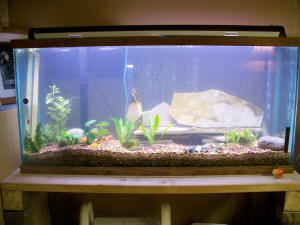 [1].jpg) |
Question concerning Crayfish. --
06/15/09
Hello there, names Josh. I've been searching the internet for a
while now and have yet to come across the information that I am
after.
Though your site is quite informative and I've picked up a few bits
of info that will help.
<Cool.>
Right so I'll fill you in with a bit of background info first:
I've had the tank for about 3 months now, it's a 60 litre
(15ish gallons?) tank and my first addition to it was 2 crayfish, which
I believe are Red Claw crayfish
but im not 100% on that.
<A bit small for Crayfish and fish; do bear in mind Crayfish are
opportunistic, and they'll view small fish as potential
food.>
Shortly after I added several fish including some different types of
tetras, a couple of bronze corydory's, a Plec (who is growing
extremely fast), a male and female fighting fish and recently a couple
of guppies.
<None of these are viable in 60 litres. A Plec will need something
upwards of 200 litres, Corydoras should be kept in groups of 5+
specimens in tanks 90 litres upwards, and Guppies also need a lot of
space, say 90 litres, because the males are very aggressive towards
each other and the females. A male Betta is simply Crayfish food, being
so slow and easily captured, and in small tanks, male Bettas do tend to
harass female Bettas.>
I've lost a few of the tetras and a guppy which im not too bothered
about, as when I bought them I expected a few of them to get caught, I
guess its good for the crayfish's diet to have some live food
available (which has become pretty much impossible to acquire with a
lot of new laws coming in in England about live bait....).
<The English laws are about animal cruelty, and sticking animals
together and not caring if some of them get eaten is irresponsible,
whether or not you personally view it as cruel! These laws don't
stop the trade in live
river shrimps, bloodworms and other invertebrates, but yes, most
retailers have taken these laws to mean the use of feeder fish is
prohibited. It isn't clear that's true in point of fact, though
doubtless someone could
make a case and set a precedent. That American hobbyists use feeder
fish isn't an advantage; Bob has long argued that feeder fish are a
major cause of mortality to things like Lionfish, and recent work on
Thiaminase has clearly demonstrated that Goldfish and Minnows are
highly inappropriate foods for predatory fish. So unless you're
breeding and gut-loading your own livebearers or killifish, there's
no safe way to use feeder fish, and moreover, most predatory fish
don't need them anyway. Besides, crayfish are largely
herbivores/detritivores anyway, so there's no need to give them
live fish as food. Algae wafers or their equivalents make excellent
staples, augmented with occasional offerings of meaty foods such as
small
pieces of krill and lancefish now and again. Do see here:
http://www.wetwebmedia.com/ca/volume_5/volume_5_3/crayfish_basics.htm
>
The crayfish are around 4-5" now and are about to moult again.
Their diet includes sinking pellets named "Crab Cuisine",
flakes of fish food that the fish don't get, live plants, and
frozen food such as brine shrimp and bloodworm.
<Fine.>
Okay so here's my query: Since I've bought them I've been
noticing that they have these strange white worms on them, they are
usually around the front of their face, near the eyes and the shorter
antennae/feeler things they have.
<Harmless commensals.>
But they do move around the body as well... At first i thought they
might be somewhat beneficial to the crayfish cleaning them and stuff
but I thought it best to check as when I was searching the internet I
came across an un-answered question where someone's crayfish was
found dead with "loads of white worm things crawling out of
it".
<Not a threat as such.>
Also I was wondering if you could provide me with or point me in the
direction a DETAILED list of food (household vegetables and meats) that
the crayfish can eat because I don't want to be putting something
in there that will be harmful to them.
<See above, and stop feeding them live fish.>
Thanks a bunch for your time and I'm sorry if you've already
answered a similar query and I've overlooked it. :)
<Cheers, Neale.>
Crayfish Questions - 05/03/09
Hello crew,
I am going to say about two months ago I came home to find something
hiding behind a plant in my tank. I quickly asked my father if he had
put anything in there and he said he had put a royal blue
'lobster' in there.
<Oh dear... fun as Crayfish are, they aren't really good
additions to aquaria with either fish or plants, since they view both
as food! Do make sure you read here:
http://www.wetwebmedia.com/ca/volume_5/volume_5_3/crayfish_basics.htm
It's a great primer to these interesting animals.>
I was ecstatic since I did not know you could keep such a pet and had
always wanted to keep a lobster as a pet (in freshwater
anyway 'I later learned that it is not a true lobster but a
crayfish from reading many sites devoted to this type of thing).
Anyway, he lives in a 10 gallon tank with 1 beta (which he has attacked
the other night), 4 ghost catfish, 1 bright yellow cichlid (which is
separated off since he attacked the beta before the arrival of the
"lobster"), 2 mollies, and 2 guppies (was three but he ate
one of these before I noticed he was in there).
<Way overstocked for 10 gallons! Mollies need much more space than
this, and Guppies, well, I'd sooner keep them in 15-20 gallons.
I'm assuming the cichlid is Labidochromis, which really has no
business being in this system at all, and yes, by community tank
standards it is far too aggressive. It's actually a fairly mild
Mbuna, and a good one for beginners... but not a community
fish.>
I realize this probably is a crowed tank for him but like I said I did
not know I was getting one so there was really nothing I could do since
the other three tanks in the house were not acceptable homes for them.
The five gallon tank was full of goldfish, the 55 gallon is saltwater,
and the 75 is freshwater with very large Oscars, Pacus, parrot fish,
upside-down catfish, and etc, which would have eaten all of my fish in
one swallow.
<Hmm... okay....>
The last water change was two weeks ago and another one is going to
happen today. When my father purchased the 'lobster' he also
purchased Spirulina discs for him which the lady at the store said he
would eat.
<Indeed; an ideal food for them, though fresh greens and the odd
whole lancefish or unshelled prawn is even better.>
He did eat them but then I learned through my research that they also
like other types of food which contain protein.
<Plenty of protein in algae wafers. Turn the bag over and look at
the nutritional breakdown; if it's the same as the wafers I'm
using, there will be around 25-30% protein in there, far more than
these animals would get in the wild. Just as a reminder, Crayfish are
largely herbivorous animals that do some scavenging on the side. Mostly
they eat algae and organic detritus, but once in a while they'll
find a dead fish or something. Their requirements for food are not
major, and it's actually calcium and to some degree iodine you need
to worry about, not protein.>
So my mother said I should go out and get some of the Pollack from the
freezer and give him some of that. So I went out and cut off a tiny
piece and gave it to him. He quickly grabbed it up and devoured it.
<I bet!>
The next day I gave him an algae disc and he did not eat it. I figured
he was probably just not hungry after eating the fish the day before.
So the next day I did the same thing and have been doing so for the
last few days. I have not seen him eat an algae disc since his first
experience with the fish I gave him, but will eat fish when I drop it
in. Is the fish just more filling or should he be eating something
different?
<He certainly doesn't need daily feeding.>
What is the ideal diet for him?
<Anything, provided it's varied, rich in calcium, contains fresh
greens, and is fed SPARINGLY. Do see the linked article mentioned
above.>
Also, I noticed the other day that his tail was red where it is
normally white, but when I came home that night he was back to normal
so I didn't think any more about it until the next morning when he
was redder than the day before and then when I came home that night he
was back to normal again. Is this something that should be taken care
of or nothing to worry about?
<Difficult to say; assuming water quality is good, the main health
issue is iodine, and you want to be adding some to the water, otherwise
moulting tends to go wrong. Buy some iodine supplement from your local
marine aquarium pet shop, and add at half the quoted dose.>
He does not act like anything is wrong with him. He is very active and
attacked one of the fake plants in the tank last night when I went to
turn out the light. Any help with these matters would be greatly
appreciated.
Thank you,
Dee
<Good luck, Neale.>
Wild crayfish 5/17/08
HI, I was wondering if it is alright to go and catch a crayfish from my
creek and put it in my freshwater aquarium... <No, unless your creek
is in the tropics. Putting a coldwater crayfish into a tropical
aquarium is setting yourself up for a disaster one way or another.
Likely the crayfish will die, rot, and so decimate your aquarium's
water quality.> with 2 iridescent catfish, <Danger! Danger! Not
suitable for home aquaria. These things can get to 2 m/6' in the
wild, and even in aquaria routinely reach 60-90 cm/2-3'.>
Columbian shark, <Brackish water when young, needs at least 50%
seawater salinity once mature. Also a schooling fish, and apt to be
very listless and unhappy kept singly. Keep in groups of at least 3
specimens.> dojo loach, <Coldwater animal; do not keep above 25
C/77 F.> brown ghost knife, elephant nose, <Amazed the
Elephantnose is feeding in this system. How long you had it? Most
captive specimens die after a few months from starvation. Can't
imagine it is getting enough food with loaches and catfish in its
tank.> and an algae eater. <Gyrinocheilus aymonieri by any
chance? Be careful with this. Becomes increasingly aggressive with age.
Reaches around 30 cm/12" once grown, and hardly eats any algae
once even half grown.> If it is ok to capture a crayfish and put it
in, should I clean it to make sure it want emit any parasites, or
diseases into my tank. <Don't do it.> If so what should I use
to clean it?... Also, If the crayfish starts to try to pinch my fish,
is it okay to put like a rubber band around their claws so they
won't, because I'm pretty sure that they don't need them to
scavenge for food, only for defending themselves (but I could be
wrong). <No to all of this. Think about how you'd feel if
someone tied up your hands all the time, just so you wouldn't make
a mess. The key to humane animal care is to understand what an animal
*wants* to do, and then create an environment around that. Crayfish are
lovely pets, so why not create a small tank (say, 75 l/20 gal) with a
sponge filter, some floating plants, and a cave of some kind. Add your
crayfish, and let it do its thing. If you have a big tank, you could
keep several specimens and try breeding them. Great fun to watch, and
the babies are easy to rear. But they are *very* territorial and will
fight, eat one another if cramped.> one last thing, my Columbian
shark is currently only about 3 or 4 inches long, <Already LONG
overdue companions of its own species PLUS a brackish water system at
not less than SG 1.005. Will become increasingly nervous and restless
if you don't do this, and will simply die eventually from Finrot,
Fungus or similar. So this isn't a discussion point -- if you want
this fish to live, it needs a proper tank suited to brackish water
fishkeeping.> so is it to small to have a crayfish in with it.
<Most crayfish are intolerant of brackish water, so no, this
isn't an option. Colombian Sharks are predators anyway, and feed
primarily on shrimps and crabs.> I would appreciate any help you can
give me thanks. <Hope this has helped. You've got some great
fish there (in other words, species I personally like to keep!) but
they're almost entirely incompatible with one another, so your
first job is to separate them into tanks suited to their long term
welfare. Cheers, Neale.>
Re: wild crayfish 5/17/08
well, first off my tank is a freshwater tank, not tropic...
<Doesn't matter; your fish are mostly tropical freshwater
species that need around 24-26 C, except the Dojo Loach (Misgurnus sp.)
which needs cool freshwater, around 15-18 C being about right. The
catfish Sciades seemanni is only found in tropical freshwater when
young, and migrates into estuaries after a few months. Arguably a
marine fish once mature, though adults do perfectly well in mid- to
high-end brackish water aquaria. Locally caught crayfish will
(obviously) need whatever your local climate dictates. If you're in
the temperate zone of Europe or North America, then relatively cool
conditions; if you live in tropical Africa or Asia, then tropical
conditions. Simple as that. You wouldn't expect a penguin to
survive in a desert, so why imagine a coldwater fish/invertebrate would
be happy in a tropical aquarium?> the tank size is 500gallons, home
made.. <Nice!> also I feed my elephant nose brine shrimp and it
goes crazy for them... <Brine shrimp aren't acceptable in the
long term, and one reason he "likes" them so much is he's
starving by inches. Adult brine shrimp contain virtually no nutritional
value; feeding fish a diet based on adult brine shrimp is like
expecting people to survive on cucumbers. Brine shrimps are primarily a
source of fibre as far as fish go, and MUST be used as a treat, not a
staple. Baby Brine Shrimp on the other hand are excellent, which is why
they're widely used to feed newly hatched fish. But adult brine
shrimp are obsolete as far as the hobby goes, and certainly
shouldn't be used any more often than once a week. Elephantnoses
need things like insect larvae. This is really no big deal as they will
happily take (wet) frozen bloodworms and the like, which will work out
cheaper than live brine shrimp anyway. Do read Bob's excellent
article on these fish, here:
http://www.wetwebmedia.com/FWSubWebIndex/mormyrids.htm The vast
majority of Elephantnoses die prematurely because they starve to death
across a few months. Big Mormyrids like Gnathonemus petersi should
easily live 10+ years, but people insist on keeping them the wrong way,
despite aquarists like Bob and I writing in the magazines explaining
their special needs. It's a shame really, because they're
lovely fish and fascinating to watch. Widely kept in research labs,
which is where I became familiar with them. We'd set up the
oscilloscope to detect the electric pulses, so you could
"hear" them communicating with one another. Very cool.>
and I will be transitioning my Columbian shark to a full saltwater
tank, as he gets bigger, and I will be doing it slowly with separate
tanks. <No need to do it slowly. Just go ahead and do it now.
Sciades seemanni can be acclimated to saltwater conditions across an
hour or two, certainly once around 10 cm/4" long. And please do
get him at least two friends; not doing so is very, very mean and
won't do anything for your karma. Cheers, Neale.>
Crayfish... 01/13/2008 do crayfishes need
land? Also, do you have a good care sheet for crayfishes? I couldn't
find any on your site. Thank you.
<http://wetwebmedia.com/ca/cav1i4/crayfish/crayfish.htm and the
linked files below. B>
My new pet Crayfish 11/27/06 Hello. I work
at PetSmart, and every now and then, strange animals will show up in
the shipments of feeder fish, <Ah, yes... always a delight,
adventure> and I usually enjoy taking one or two home with me.
Usually the stow aways are tadpoles, but yesterday, I picked up a
Crayfish that I named Garth. <"He's got friends in lowww
places...."> Right now, he is living in a tiny little bowl, but
after reading up on your page and others, I am ready to purchase and
set up a tank for him tomorrow. <Ah, good> I was wondering a few
things, and if they are on your page and I missed them, I apologize for
the inconvenience. 1. Do you have any idea what he may be? I was trying
to find pictures of several species, but after reading up on them, I
think he may be a juvenile. He is probably 2 inches long, and he is a
light tan color, but he has speckles all over him, including his
pinchers. They themselves are very small and thin, but they are long. I
live in Colorado, but our fish are usually shipped from Arizona. Any
species around that area that he may be? <There are some 300 plus
species that occur in N. America, but the vast majority of those
seen/used (for consumption as well as ornament) are Procambarus
clarkii> I was just wondering, because I wanted to know about how
big he would get. <Do place the above name in your search tool...
likely some 3-4 inch body length maximum> 2. Exactly what/when
should he be fed? I have read different things. Some say stick to
mainly vegetables, and don't feed too often, while others say feed
mainly meats, and feed frequently. What would be a good feeding/diet
schedule? <A mix of these... animal and vegetable foods... prepared
or fresh will serve you both well here> 3. How much space should he
have? <A ten gallon system would be perfect... with some rock
work...> I do not have the room for anything HUGE, as I already have
a ten gallon fish tank and a large critter keeper for my hermit crab.
Would a large Critter Keeper (15.875" x 8.375" x 12.083"
) be enough? <Yes> I know some aquatic animals don't need a
lot of room, and some do. <You are correct here> Thank you so
much for your help. I apologize again if I've asked anything that
was available on your web site. Sometimes Im not the best at searching
for information, lol. Thank you for your help. ~Amber <Thank you for
writing, sharing. Your genuine concern and intelligence are refreshing,
obvious. Bob Fenner>
Forceps Crayfish? - 10/21/2006 Hello There!
<Hello, fellow invert-lover!> Not long ago my area suffered a
week-long power outage, and unfortunately all my fish, Freshwater and
Saltwater, have passed away. <Oh, dear. I am sorry to hear this.>
I'm currently working on getting my Marine tank up and running
again (and when that happens I'll try and get those predatory
snails I asked about earlier). <Neat!> As of now, however, I have
finished cleaning and reworking my freshwater tank, so now it is
functioning. It's just empty. One thing that has caught my eye was
a species called a "Forceps Crayfish". Its URL is http://crayfishshop.com/product_info.php?cPath=23&products_id=30
. <Neat!> I did send for some information on this species, but
it's always nice to have another viewpoint. <Wish I had one for
you. I can't find much at all about this fellow.> He does seem
very interesting and is something that I would like to own, but there
seems to be very little information about him. My biggest worry is his
maximum adult size. If he gets as large as those "Giant Australian
Lobsters" then the Forceps Crayfish will be totally out of the
question. If his size is on par with the classic "blue
lobsters" then he will much more manageable. As far as I know,
there really is no species of crayfish that is particularly delicate
and sensitive. Please correct me if am wrong. <Correct, for the most
part. I really don't have any clue how big this fellow will grow.
If they're shipping 6" individuals, though, I imagine they
will exceed that size by a good amount.> p.s. I have NO intention of
keeping any other animal in the tank with the crayfish. The aquarium
will be a display tank meant to house him and only him. Any
compatibility issues will be irrelevant. <Perfect!> Thank you
VERY much. <I only wish I had more to say. Do please let us know of
your experience with this animal, should you choose to go forward with
it. Wishing you and your future Cray well, -Sabrina>
Australian blue crayfish breeding question
9/16/06 Hi, I currently have a 125 gallon tank with 15
gold/blue/moonlight gouramis, 4 rainbows,1 big Pleco, 3 Bala sharks, 2
tinfoil barbs, 1 four line catfish, 1 clown loach, 1 black ghost knife,
1 ornate Bichir and a 5 inch Australian blue crayfish. <Hope this
last isn't hungry...> The Crayfish has been in the tank since i
started about 6 months ago and have added the fish slowly over that
time. Other than the occasional disappearance of new fish <...>
everything seems to be in harmony and has been for a few months. The 5
inch female crayfish is in my 125 gallon tank and i have recently
bought a 2 inch male aussy that is currently in my 38 gallon tank. I
have the hopes of one day having them breed. <Can be done> I know
these species get very large and I am assuming I have a large enough
tank to give both enough space. It also has lots of driftwood, ships,
tubes, tunnels etc. The 2 main threats to the small crayfish I imagine
are the Bichir and the big crayfish. <Not the Bichir unless it's
really much larger> Also just a note that the big crayfish is very
well fed lettuce, carrots, peas, algae wafers, shrimp, bloodworms,
brine shrimp) and any fish can come near her without much fear, she
will just raise her claws and shoo them away. She is very active but
not overly threatening. So my questions are as follows. Will the small
crayfish grow fast enough to get close to matching the other one in
size? <I'd wait till they're closer... and introduce with a
barrier twixt for a few weeks... and then release only when you can be
present to "supervise", re-separate if necessary> how long
might it take? <Likely a few months> If I relocate the Bichir
will it be possible for the 2 to get along considering the amount of
space and hiding places? Any suggestions? Also, last question for
curiosity sake. How long can an Australian blue crayfish live? Thanks
so much, Chad <Please read here: http://www.wetwebmedia.com/FWSubWebIndex/crayfishreprofaq.htm
and the linked files above. Bob Fenner>
My Electric Blue...
lobster/s, Poor English 8/4/06 Hello, <Hi there> I have a 255
ltr tank, in which a have a variety of fresh water fish and live plants
also had 2 marrons, <... the Crayfish?> of which 1 has died, the
problem is the 2nd 1 is lying on its side all the time like the other 1
did before it died. <Water quality troubles, or overt poisoning>
It's between 20cm and 25 cm long and use to be very active until 2
days ago his colour looks good and the fish don't go near him as he
showed them whose boss at the beginning. Have found him on the floor,
<Where are the spaces between your sentences?> after he climbed
out of the tank because I had it too full. The ph level is good and
temperature is fine. I know I haven't giving you much help but
that's all I can give you, hope you can give me some idea as
what's wrong Thanks David <Please read here: http://www.wetwebmedia.com/ca/cav1i4/crayfish/crayfish.htm
and the linked files below... and learn to/use your English tools to
learn/present clear communication. Bob Fenner>
Australian blue... read 7/18/06 hi; we have
become the owners of a creature advertised as an Australian
<Grammar...> blue lobster after our daughter fell in love with
it, after some research I believe it to be a crayfish and it seems to
be happy living in its own new tank. I am an experienced fish keeper
but know hardly anything about these creatures. it is a very lovely
looking thing however the aquarium shop we had it from advised us on
the food it needed and told us to feed it 1 pellet 2xday. the poor
thing looks like it is always searching for food and I would love some
advice as how to know how much to feed it. also the shop couldn't
tell us the sex of it and I believe it is to do with the segments on
its tail. can you help. many thanks dawn-England <... Dawn... what
happened to your English? Please read here: http://wetwebmedia.com/ca/cav1i4/crayfish/crayfish.htm
and the linked files above. Bob Fenner, who needs to fix your writing
now...>
| Crayfish Eggs - 04/24/2006 Hello. <Hi.> I am on my
second blue lobster. <Was the first one tasty? Or....?> My
husband loves it even though I find it to be a murderous fiend
<Well.... He doesn't *mean* to be murderous, he's just
*hungry*.> (no Oto, Cory Cat, or any resting fish is safe).
<Completely accurate.> This blue lobster has only molted
twice and is fairly large. It has always been a big fan of
redecorating the tank, but yesterday it was digging much more than
usual. Today when it came out to eat, it had a lot of what I'm
thinking are eggs under its tail. <Nice!> First of all, I
guess we now need to come up with a girl name for her. <Probably
a good plan.> But, more importantly, how recently would she have
had to be with a male in order to have fertilized eggs? <Mm,
pretty recently, I would imagine.... I'm not positive if or for
how long they can store the males goodies.> Is there anything
special we should be feeding her? She gets the remnants of the fish
flakes and a small shrimp pellet every day. <I would recommend
offering her some krill - oh, wait. I didn't read on.>
Today, I put in a piece of frozen krill <Right on.> because I
thought she would appreciate it after the workout of laying all
those eggs. <Thawed frozen human-consumption shrimp or shrimp
tails with the shells and tails still on would be a great offering
too.> If the eggs aren't fertilized, do we just let them on
her? <Yep.> I attached a picture just to make sure I am
talking about the right thing. <Indeed you are! You'll be
able to see them develop over time if they are in fact fertilized.
Also, I'd like to add that this is a VERY healthy, attractive
looking crayfish. I wish I had an image of a generally unhealthy
Cray for folks to compare; this animal shows very obviously that
"quality of clarity" I mention from time to time.>
Thank you for your help. <Glad to be of service!> I spent a
lot of time looking on the Internet and your info was the best that
I found. <Wow, thanks! And do please take a look here: http://www.wirbellose.de/arten.html#Krebse . It's all
auf Deutsch but the information is the best you'll find
anywhere. Are you adding iodine to this system? If not, please also
take a brief look through our FAQs for more....> Sharon Falk
<All the best to you, and may many tiny Crays be in your future!
-Sabrina> |
|
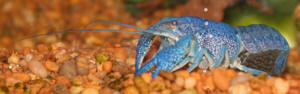
|
Crayfish, Claws, and Complications - 04/20/2006
Hello. <Hi.> I am hoping this is the email I send my FAQ's
to. <It is.> If not, please help me figure out where I do ask the
questions. :-D <Right here, matey.> Anyways...I have a red
freshwater crayfish. <Probably Procambarus clarkii, if you're in
the US. These are common at pet shops, and make awesome pets.> He is
in a 55 gallon tank with: 7 guppies, 2 five inch long feeder fish, and
3 hatchet fish. <Do please be aware that any of these fish *might*
become midnight snacks - but hopefully are "fast" enough not
to get snatched up.> I was reading through the other FAQ's to
find some info on crayfish not molting. When I got my crayfish, he
molted instantly. In the process of molting, he pulled off his own
claw. <Ouch!> His claw then began to grow back again. Then he/she
molted again and pulled the newly grown claw off AGAIN.
<Disconcerting....> Now he hasn't molted for a couple months,
and its claw is not growing back. <VERY disconcerting....> You
requested others with the same problem to add iodine to the water.
<Yes. Urgent.> Would that affect my other fish that are in the
tank? <Nope. Just use the rule of thumb I usually recommend - one
drop of Kent marine iodine per ten gallons weekly. Note that this is
NOT the marine dose printed on the bottle. In this fellow's case,
for the first couple/few weeks that you do this, I'd use two drops
per ten gallons, then in a few weeks, go to one drop per ten. This
won't affect your fish.> I also don't really feed the
crayfish. <A problem.... especially since if he's hungry, those
guppies are going to start looking very tasty to him....> He just
eats the extra fish food that floats to the bottom. <That's
good. Also offer him bits of frozen (then thawed) raw human-consumption
shrimp, preferably the tails.> I tried feeding him uncooked bacon
strips, but the guppies would eat it and keep the crayfish away.
<Don't offer any land mammal or poultry meats - not only are
these bad for the Cray, but bad for the fish, too.> Could a bad
eating diet be keeping him from growing his claw too? <Yes.> He
sometimes eats the fish that die, but my fish don't die too
frequently. <Probably only once, I imagine! Dead fish are pretty
much "okay" for him to eat, just not so okay to leave in the
tank.> If I should be feeding the crayfish something healthier than
left over fish food, what do you recommend? <As above, shrimp is
good, also frozen/thawed human consumption fish meats, or sinking meaty
foods. You can give him these things just after you turn the lights out
so he'll have a better chance at finding it than the fish.> How
would I keep my other fish from eating the food that is meant for the
crayfish? <Whups, I jumped the gun. Feed him just after lights-out
on the tank.> Oh yeah, just something to add in real quick. My fish
had ick recently, so I added "Kordon Rid Ich+." Is it
unhealthy for my crayfish to be in the tank when I am treating the fish
for ick? <Yes, VERY.> The crayfish is still alive, and the
crayfish has been in the tank every time I have treated the fish for
ick, so I cant imagine it being TOO harmful for the crayfish. <It is
*very* harmful for him, and may be part of the reason he's not
moulting well for you. Please, please read on WWM regarding quarantine
tanks - please quarantine any new livestock for two weeks minimum
*before* adding them to your tank; this will keep your other fish safe
from Ich and you should not have to ever treat Ich in your main tank
again.> Have a nice day <You as well, thanks.> *A crayfish
owner needing help. <-Sabrina>
Mixing Crayfish And Bichirs 4/09/06 Hi, thx in
advance for answering my question. I have a 40 gallon tank with (1) 4
½' Australian blue crayfish, (2) gold gouramis, (2)
pearl gouramis, (1) Bala shark, (1) Pleco. I would like to make a
Bichir the final addition to my tank, but of obvious reasons there may
be a clash between my crayfish and the Bichir. Do you have any thoughts
on how this setup will work? Sincerely Chad < The crayfish will try
to eat the Bichir at first depending on the size of each. As the Bichir
gets bigger there will come a time when the crayfish will molt and the
soft new shell will leave the crayfish vulnerable to attack by the
Bichir.-Chuck>
Keeping Crayfish - 03/13/2006 My son just found a
crawdad in a creek behind our house and was wanting to keep it as a pet
to which I don't have a problem with. <Can be done, with a bit
of studying.> Here's the thing, I have read most of the articles
from other people but I am just lost. Is one from the creek just like
the ones they buy at the pet store or is there a difference in how a
tank should be set up for one. <Actually, in the US, the most common
crayfish offered for sale in fish stores is Procambarus clarkii, almost
certainly the same animal as your son found in the creek.> I would
just go to a pet store around here and just ask them and get everything
while I was there, but the last time I did that I ended up with a lot
of stuff that wasn't needed for the pet we had. I would love to
keep this crawdad as a great experience for my 12 yr. old. Any help
would be great. What size tank, <Depends entirely upon the size of
the animal. If this guy is more than a few inches in length, I would
advise to put the feller back in the creek, and go looking for a
smaller Cray. If he's a few inches or less, a 20 gallon tank would
be great. Be CERTAIN to have a good, tight fitting lid.> how much
water, <Tank should be mostly full, and have a tight fitting
lid.> water temp, <Room temperature will be okay - try not to let
him get too warm. No heater. Tight fitting lid.> and lighting, <A
fluorescent aquarium light will be great. Don't use an incandescent
light; this will raise the temperature of the water dangerously. Very
often, you can get light/lid combos. Did I mention a tight fitting lid
will serve you well.> I understand the rocks and cave things.
<Lots of hiding spaces will be necessary.> Also what is the ph
y'all are talking about? <A matter of water chemistry.... Please
read in the freshwater articles of WetWebMedia regarding water quality
and maintenance.> Again thank you for the help. Dena <All the
best to you, -Sabrina> Novice has question about crayfish
3/3/06 Dear Mr. Fenner: <Karen> My 10-year old son brought
home a crayfish from school to care for over the summer. <Ahh, I had
these (Procambarus clarkii and others) at this age as well> We
became attached to it and have kept it ever since. We don't know
what species it is, but it started out red and has now turned blue. The
school provided a very small plastic "tank" with a few
pebbles (no gravel or sand). We kept it there, but after a few moltings
it had grown pretty large (about 5 inches), so we moved it to a
10-gallon tank that we just set up. We have gravel on the bottom, some
pebbles, some plastic plants, places for it to hide, a filter, and an
aerator. We know nothing about crayfish, but we have been reading up on
the Internet (and now realize that it should have had more space and a
more varied environment long ago). My most pressing question (I'm
sure we'll have more) right now is this: ever since we brought it
home, we have been feeding it "crab and lobster bites" (by
HBH), which the pet provision store said would be appropriate for
crayfish. It seems to have been doing well on these. <Yes... a good
company... with real science...> We moved it to the larger tank
yesterday, and we gave it the same crab and lobster bites. We have
noticed that it has been eating some of the gravel. Will this harm it?
<No, not harmful> Is it doing this because in its previous small
tank, there was a smooth bottom with no gravel, no sand, and only a few
pebbles, and now the gravel in the new tank is confusing it so that it
is having a hard time distinguishing gravel from food? If this is a
problem, do you have any suggestions? <Not a worry... just part of
natural behavioral repertoire> Thank you very much, Karen
<Welcome. Bob Fenner>
Differences between
lobsters/crayfish/species....? 1/26/06 I recently purchased an
"electric blue lobster" from a trusted pet store, but when I
search the internet for information, I find many different
names/species/varieties. <Yes... you start to understand the value
in scientific names... many organisms have more than one common
moniker, and these are often applied to more than one species> I
called the pet store to see if they knew the Latin name of the species
they sold me, but to no avail. I have searched for hours for a way of
determining what it is that I have actually purchased. Could you
enlighten me as to what the physical differences are between lobsters
versus crayfish, species of crayfish, and how to identify what
variation I have? <Can... a beginning... both common names are
applied to a few groups of crustaceans... marine and fresh... that is,
the terms crayfish and lobster are often used for different taxonomic
groups... They are not definitive as to their systematic
classification> I also wanted to commend you on the fantastic
website you have here. I am extremely impressed (almost a little
overwhelmed) by the enormous amount of information you supply. Thank
you!! Tammy <A photograph will be useful here. Have you read through
the freshwater and marine articles on crayfish and lobsters posted on
WWM? There are some pix, systematic information, identifications there.
Bob Fenner>
| FW Crayfish in N. America ID - 1/30/2006 What Would
These Interesting Specimen Be Classified As. I Fish Them Out Of The
Delaware River. <Are some sort of crayfish... aka crawdad... Use
your search tools to find more by putting this word and
"Delaware River". Bob Fenner> |
|
|
|
|

