|
|
| Home | Marine Aquariums |
Freshwater Aquariums |
Planted Aquariums |
Brackish Systems |
Ponds,
lakes & fountains |
Turtles & Amphibians |
Aquatic Business |
Aquatic Science |
Ask the WWM Crew a Question |
| Please visit our Sponsors | ||||
|
Hermit crab babies 11/7/04 Hi Bob <Anthony Calf in his stead> I had a question on saltwater hermit crabs, my hermit crabs had babies and I read some of the articles on your website (great by the way). But I have heard that you must mimic a beach coastline, if not the baby hermit crabs will drown and die. If this is true than why can there parents be in an aquarium, wouldn't they drown also. Thank you! Sincerely, Jenny <there are many possibilities here... hermit crabs are known to be terrestrial, intertidal and of course - fully aquatic. Some spend their entire lives in a given niche while others spend certain life cycles in different niches. The "land" hermit crabs must be get moist and humid but not submerged or they will drown. Anthony> A Sesarma By Any Other Name.... Would Be A Pseudosesarma 10/26/2004 Hi guys... <And gals. Sabrina-the-freshwater-invert-freak at your service.> We need your help. <Well, what d'y'know, that's what we're here for! Hope to help you out.> We have been getting conflicting information on our RCC. <For our readers, that's "Red Claw/ed Crab", or as you've mentioned in your subject line, Sesarma bidens.... Actually, this animal is now thought to be more accurately Pseudosesarma moeshi. Just a fun tidbit.> One thing that everyone seems to agree on, is that RCCs are brilliant escape artists. <True. Most (all?) crabs are.> However, when we have been trying to research as to whether they actually NEED to breathe air half of the answers are yes, the other half are no. <Mm, not so much that they need to "breathe" air (all land crabs use gills and require high humidity - even hermit crabs, which carry a bit of ocean in their shell!), but yes, they absolutely *require* a land mass to thrive. They will not last long, forced to be fully submerged.... Or worse, fully submerged in a freshwater aquarium, as they are unfortunately sold to be. In addition to their need to get out of the water, they also fare much better with some salt in the water. Doesn't need to be much, but they do much better with a bit of salinity.> Could you please set the record straight for us? <Land mass required, yes. Most definitely. It will live for a time fully submerged, but will not thrive, and will not live long.> We don't want the little guy to die, but we don't want him to escape either. <Any chance you could drop the water level a few to several inches and offer a good-sized land mass (even a very large piece of floating wood) with lots of nooks and crannies to hide? This would likely be sufficient. I suspect that the reason they are so renowned for escaping is simply that they are desperate to find a way out of the *water*, not the *aquarium*. All the same, a tight-fitting lid is definitely called for. Do please try to accommodate this animal rather than returning him; you will be greatly rewarded with a fascinating pet, with just a little work. Perhaps even a small, 10-gallon tank as a dedicated home for him and an opposite-gender pal?> Thanks so much, <You betcha. I really hope you choose to make this work out - these are fun critters.> - Ian Fenn <Wishing you and your crab well, -Sabrina> A Sesarma By Any Other Name.... II - 10/30/2004 Hello again, Gurus of Aquaria! <Well hello!> Thanks so much for your Red Clawed crab-help Sabrina. We finally found someone/place that knows what they are talking about! <Heh, or at least we *hope* we do! So glad to have been of service.> We were wondering if we could please have some help with our cichlid tank now. <Whups, not me.... I am cichlid-ignorant, for the most part. Chuck, our mega-awesome cichlid master is in possession of a duplicate email; hopefully he'll give you the answers that you seek. I'll truncate this now, and give you a big hearty "Thanks!" for all the kind words. Wishing you well, -Sabrina> Anomalous Crab Question - 10/30/2004 Hello, My little red crabs keep getting on the filter and just sit there like they are in a stream. <Er, do you know what kind of crabs these are? Can you give me a good description of them? Size, coloration, markings, anything like that?> I do not see how they are getting up there unless they can swim. Why and how do you think that they are doing this? <The how is the easy part. Crabs are *amazing* for being able to climb nearly anything.... I wouldn't be too terribly shocked if they were simply climbing the glass! But more likely, they're finding a way up to the filter intake tube, and climbing that. Now, as for the "why" of it, there are likely a few reasons. First, is this a fresh, brackish, or saltwater aquarium? In what country do you live? In the US, there are nearly - or absolutely - no crabs sold in the hobby that are truly freshwater animals. Most will survive in freshwater for a time, but they will not thrive and will not live their full life span. Moreover, nearly - or absolutely - no crabs sold in the trade in the US are truly aquatic. All are amphibious, or land crabs that only occasionally venture into the water. Chances are, your little inverts are just trying to find a way out of the water. At the very, very least, I recommend you drop the water level a bit, and give them a surface to rest on out of the water. Try to provide them with a few hidey-holes on the surface to help them feel secure. Remember, crabs are extremely adept escape artists, and they can and will find any way out of the tank, especially if they're not happy with their setup. Please be sure you have a tight-fitting lid, or you might wake up in the morning to find a crab cuddling you in bed! ;) > Thank you Kayce <Wishing you well, -Sabrina> Crawfish Caviar I purchased a blue Marron <crayfish> about 3 weeks ago. She (I'm assuming - I haven't really looked) She was out and about for the first week then, after her grand escape and recapture, has been in hiding until today. I had to see what was going on since the last one that went into hiding got stuck and died the cave (very smelly situation). Anyway when she finally came out I noticed many eggs attached under the swimmerettes (sort of dark in color) She soon went back into hiding and was very eager to do so. I never noticed any eggs when I got her. What happens now? time line wise. Does she need a male to fertilize the eggs? <Sure. Females usually "berry" from 1 to 3 weeks after mating. If she was with a male before you got her, then there is a chance you will see a hatch. If not, no chance> How long is the whole egg to crayfish process? <A lot of variables. Species, water temp etc.. The eggs will lighten if they are fertile> I haven't had any luck trying to find info. <Google "Crayfish". Tons of info out there. Don> Please help. Thanks Shari Did my land hermit crabs lay eggs? Hey, my sister and I bought two hermit crabs, together, a few months ago. Today, we came home, and my sister went to feed them and mist and everything else, well she picked up their food container, and found two semi-clear, with what looked like pink "claws" on each side? We are freaking out, mainly because, this is the first time, this has happened to us? We've been researching ever since, we discovered what was in their food container, and cannot find any answers. We would greatly appreciate your help!! < Your hermit crab has an exo-skeleton so the only they can grow is to shed this skeleton every once in a while as they grow. I think what you found is the left over external skeleton of each of the claws.-Chuck> Land Hermit Reproduction or Shed/Molt? 10/23/04 I came home, and was going to feed my hermit crabs, I found in their food bowl, one little pink ball, I left it in there, gave them some fresh food, I woke up the next day, and went to check on them, on the other side of their food bowl, was another ball. The one that I found the day before had been buried. This was a couple of days ago, what is it? <tough to say without a picture or better description. The burying of eggs for terrestrial varieties would not be a surprise though. A picture is worth a thousand words here in the absence of a description more detailed then "little pink ball", my friend. Anthony> Hey guys, great site. Some kind of worms in the hermit crab tank!! I have two small hermit crabs I keep in a small tank with pea gravel, a water dish and a feeding dish. They also have some decoration and a small branch to climb on. (although I have not seen them climb). I recently started misting the whole tank when I've been taking them out for food/water changing and their own misting. A day or two after this first tank misting I found a colony of little white worms living in the gravel, just beneath where the food dish had been. I gave the tank a scrub, threw out all the wormy gravel and cleaned the rest. Now about a week later, I took a closer look under the food dish and found more! Is this something in the food? I feed them dry Hermit food. Or contaminated gravel? Or just normal for Hermits. It's really pretty gross. Any help would be great! Thanks >>>I really have no idea Amy, some kind of fly larvae/maggots perhaps. Jim<<< Hermit Concerns - 09/26/2004 <First off, Lisa, please forgive me for the delay in response. Sabrina with you, tonight.> I came home tonight and found one of my hermit crabs alive and in his shell but his pinchers and legs were beside him not attached anymore. What happened?? <First off, are you 100% positive the legs themselves are off, or has he simply molted? It can certainly appear that they've lost legs if you find bits of exoskeleton laying around, but then later see the crab walking around perfectly intact.> What do I do? He is still alive but has only one leg. <So you've seen the whole crab, then? Not just the bits of legs? If he really has lost all his legs but one, there's not a whole lot you *can* do, but hope that he can still feed himself. If he cannot feed himself, I have heard of success with hand-feeding them, but it's not very likely to do the trick, unfortunately. Be certain to keep his tank very humid (75-80% humidity - might consider getting a hygrometer) and be sure to offer him both freshwater *and* saltwater (use a marine aquarium salt to mix the saltwater). Keep the tank's temperature warm, too, 70-80 degrees.> Will he survive? <I'm sorry; I do not know. Stranger things have happened, but we can only do our best.... Definitely try to keep his tank warm and humid, and just care for him as best you can. They can and do regrow legs, but this might be just too much to recover from. My fingers are crossed.> We had been out of town and their sponge was dry. Does that have something to do with it?? <It is possible. Humidity is *extremely* important to hermit crabs.> Should I leave the legs in there or remove them or what do I do? <*If* the crab has only molted, and really still has his legs, he should eat the old shells. If they are actually his legs, remove them, as they will rot and stink.> Sorry if this is a stupid question. <The only stupid question is the one that goes unasked. Thanks for writing in.> Lisa :) <Wishing you and your hermit well, -Sabrina> Hermit Concerns - II - 10/05/2004 Hi Sabrina. <Hi again, Lisa.> Thanks for replying. My hermit crab did die. We had a little funeral for him. <I'm so sorry to hear of your loss.> What do you supposed caused this? I read somewhere that he was possibly stressed out for many different reasons. <Stress is likely a big factor; other things, like bacterial infections, may have been at play, as well. I'm afraid that not much is known - or at least easy to find - about the illnesses of hermits.> I did go purchase a heater and all of my other crabs seems to be ok. <Glad to hear that. Make sure the tank stays nice and humid, too.> By the way I was 100% sure his legs were off. I mean all he had in the shell was his body and one leg. <Poor feller!> That one finally fell off and the next morning he was dead. His little body fell right out of his shell when I picked him up. It was depressing. Oh well. <Again, my condolences for your loss.> Thanks again. Lisa <Take care, Lisa, and thanks for writing in. Wishing you and your other hermits well, -Sabrina> Hermit questions How much are hermit crabs and there cages? Do they make good pets? What do they eat < Hermit crabs seem to be all over the place now. I have seen them in malls and pet shops. The cost of the hermit crab depends on the size of the crab and how attractive the shell is. Usually under ten dollars with 5 dollars being the cost for an average sized crab. They really don't require too large a cage so a ten to twenty gallon aquarium would be plenty of room. They need humidity of at least 70% so they need a good source of water to keep them moist. The only real drawback is that they are most active at night. If they in a bed room then they are often heard walking around with their shells tapping the glass every once in a while. There are commercially available hermit crab foods available at the shops where you buy the crabs. ZooMed has a lot of products for hermit crabs so you may want to check out their web site at ZooMed.com.-Chuck> Furry Shrimp? - 09/10/2004 Hi all, I have a question for Sabrina, the shrimp-obsessed! <Wayhay, thass me!> Actually anyone will be just fine :) I have some Japonica shrimp in my 25G freshwater tank. I have had them for about 4 months. Well I noticed that on one of them the rear legs (all the small ones) have what looks like fur, thick, fluffy stuff (for want of a better word) in between the legs. It's really hard to describe. <And hard to envision, from the description.... Is this "fur" on/among the swimmerets/pleopods (the legs used for swimming, not walking), or on the walking legs?> It goes from the body of the shrimp down to the end of the legs and its thick! It's not on the front legs just those small multiple rear ones. <I don't suppose you could provide a photograph.... ?> It looks like a thick algae growth or something. <I *have* seen algal growths on the backs of very large shrimps, like fully grown M. rosenbergii, when kept in a poorly-cared-for tank, but never, ever seen C. japonicas with algae on 'em; I doubt that's what it is.> It's the same color as the shrimp kind of beige-y color. <I'm supposing what you're seeing is, in fact, a normal "hair" that grows on the pleopods - not really true "hair" at all. Strikes me as though I've only seen such "furriness" on larger japonicas.... I know my two biggest exhibit this, and all my Atya and Atyopsis shrimp are so furry on their undersides they make puppies look bald.> Anyone have any idea what this could be? <Though admittedly, I don't know what the hair is called off the top of my head (ouch, bad pun), I do believe this is absolutely normal.... A pic would help immensely.> All my water param.s are good, NH3, NO2 zero, NO3 about 5ppm. My other fish and shrimp are fine. <Sounds good.> I'm really mystified. I was hoping it was eggs but I found a picture of what a shrimp with eggs looks like and they ain't eggs! <You'll know eggs when you see 'em. But unless you're keeping your japonicas in brackish water, no eggs from them will survive; the larvae would require quite a bit of salt in the water to make it to adulthood. If you are interested in breeding, though, there are a lot of species that will do so successfully in a freshwater tank like yours!> Thank you for your help and time as always. <And thank you for your interest and kind words!> Maggie <Wishing you and your inverts well, -Sabrina> Lookin' for Atyopsis - 09/10/2004 I saw three rather large shrimps (larger than the typical ghost shrimps) while browsing in a pet shop. <There are indeed quite a number of freshwater shrimp that grow larger than ghosties.... Even one carnivorous monster that'll reach nearly 20 inches....> Unfortunately I did not purchase them. Now I would love to have three or four of those guys in my aquarium. The pet shop does not know when they will get another shipment. Know of someone who sell the type of shrimps mentioned on your website? <I do, indeed. Frank Greco, of http://www.franksaquarium.com/freshwatershrimpfarm.htm , sells a number of freshwater inverts. You might send him an email regarding the particular species you're interested in and see about availability. Also, Toyin at Rehoboth Aquatics http://www.rehobothaquatics.com/index2.html carries a couple species of Atya (including my all-time favorite, Atya gabonensis). I got my own five A. gabonensis from him, about a year ago, and all are doing quite well today. Also, do be sure to check out your local stores - I've seen some very nice Atyopsis moluccensis at Petcos, and they're also carrying M. rosenbergii, the "blue prawn" (largest, most aggressive freshwater shrimp - and tasty, too!). Do beware of this blue prawn, as they WILL grow up and eat all their tankmates. Mom'n'pop fish stores are almost always willing to order what you want, as long as it's available - definitely check with any local stores around you to see what's available to them.> Betty <Wishing you well, -Sabrina> Attack of the Killer Cabomba? - 08/22/2004 My sister put a plant called Cabomba caroliniana in her aquarium and within hours the shrimps she had died. <Pure coincidence, unless the plants had some sort of toxin spread on them....> Does anyone know if this type of plant is injurious to shrimps? <It is not, not at all. I have had plenty of shrimp in aquaria containing this species of plant. Did your sister use any sort of a dip for the plants before adding them? Some people will dip plants in solutions to kill snails, etc., and if not rinsed *thoroughly*, I imagine some of the water from the dip would get in the tank, and possibly cause harm. Otherwise, I assume this is pure coincidence. If you wish to explore other reasons for the shrimps' deaths, please respond with great detail on your tank - what size tank? How many and what kind of shrimp? How many and what kind of fish? What do you feed the animals? How often do you change water? What other maintenance do you do? Do you add any chemicals to the water (aquarium plant fertilizers, iodine for the shrimp, etc.)? What are your readings for ammonia, nitrite, nitrate, and pH? When was the most recent animal added to the tank, and what was it? Hoping to help you get to the bottom of this, -Sabrina> Destructive Terrestrial Hermit Crabs <Hi, Mike D here> I have two Land hermit crabs I have had them for about ten months they started out with a decent sized sponge that they would drink out of. It always had fresh water (chlorine free) but lately I have noticed that they are tearing it apart.<OK> For the past couple of days I have been hermit crab sitting and all the hermit crabs are getting along but the sponge that the visiting hermit crabs had brought with them was in perfect condition and now it is a little torn apart. I am pretty sure that it is my hermit crabs doing all of the destroying of the sponge. Is there any reason that they are doing this?<It could be any number of things, such as algae beginning to grow in the sponge tissue, or, if it's a natural sponge vs. an artificial sponge, it could contain a vitamin or mineral that they require, or at least enjoy> Is there anything that I could do to make them stop it?<Why would you want to? They are doing it for a reason known only to them, and be it a vitamin deficiency or just sheer boredom, they seem to be getting some enjoyment from it. Sponges are so inexpensive that it would seem like a worthwhile and minor investment if it makes their life a little better> Sincerely, Neva Red Claw Crab <Hi Anthony, MacL here. The only red claw crab I know of is actually a brackish crab often sold for freshwater. Is this what you have?> I purchased a red claw crab from a local Fish store about 2 weeks ago. I believe the crab is a female due to the very small claws. Anyway, recently she has had her abdomen hanging open. <Maybe releasing eggs?> I figure she was getting ready to molt, but she hasn't done anything for 2 days now. She has already molted once since we have had her and it didn't take long. She has plenty of different kinds of food. Also these past 2 days she is flipping herself over on her back. <Not a really good sign.> Can you tell me what is wrong? <I'm just guessing here but I think you probably have her in fresh water and she needs some salt. I also think it might be a difference in PH as well.> I have searched through the internet, but cannot find any information on Red Claw Crabs. <I did a search on Google and came up with tons of thing on them. You might try www.google.com> Thank you for your time and patience. <Anthony you might do the research on them and decide if it needs to be in brackish water or not and make a decision from there.> Anthony <An excellent site re this species: http://wrongcrowd.com/aquaria/crab/ RMF> Cherax sp. with a Doritos Diet? Hello there! <Hello! Ryan Bowen with you today.> I'm Tracy, nice to meet you! *waves* <Ah, nice to meet you as well> We just got a pet crayfish recently cause the people at my mom's office got tired of taking care of it.. =( <Too common, sad> But we're doing our best to take care of her now. <A fishkeeper is born>. I learnt much about how to do that from your site, so many thanks! And I identified her gender, which no one bothered to do in the 1 year they had her!! *rolls eyes* <Nice work!> Anyway, she was very active for a few days and climbed all over the tank exploring.. or whatever it is crayfish do.. but we're quite concerned now cause for the past few days she's been hiding in her hole most of the time and staying very still for long periods of time. Even at night, she only gets out to climb around for a bit, then she's back to hiding. At first we thought she might be molting, but nothing has happened for 5 days. Does preparing for molting take that long? <It can, and after the animal molts it will remain hidden as the shell is not hard yet.> Or is there another reason for her behaviour? We try to keep the tank clean.. uneaten food is taken out after a few hours. About 20% water change every week. We feed her sinking fish food and bits of peeled tomato. There's limestone in her tank. I am not sure where I can find iodine in my area, does feeding her fish/prawns occasionally work as well? <Water changes alone should be plenty of trace elements.> Shy says hi! I'm not sure what species she is.. she's blue all over though! <Cherax sp.> The brown markings are actually algae cause her previous owners fed her potato chips and didn't clean her tank enough. *grumble* <I'm not surprised that your pet is "adjusting" to her new environment!> She's about one year old and is 5 inches long. <That's about as large as she'll get. Feed sinking algae pellets, and supplement with some small, meaty items for best coloration.> And very adorable! Thank you for bearing with me, I can get really long-winded at times.. =) <No worries! You ought to hear how long those "reef" guys get.. sheesh! ;) Ciao Tracy!> *hugz* Tracy Shrimp. It's What's For Dinner. - 07/13/2004 Hi, <Hi, Tim, Sabrina here, this evening'!> I have bought a number of freshwater shrimp (japonica) to help control hair algae. However, they apparently are being consumed by someone in the tank. <What leads you to believe this? Are you missing shrimp, or have you found shells and/or dead shrimp?> I have a long-standing 30-gallon tank with 10 golden white clouds, 5 green neon tetras, 3 marble hatchets, 3 Kuhli (sp?) loaches, 1 spotted Cory cat and 1 stick catfish. <By stick catfish, do you mean a Farlowella/Sturisoma cat, or something else? I don't see anything in this list that looks like a shrimp eater, provided that cat is in fact a Farlowella or Sturisoma....> Any idea who the shrimp eating culprits might be? <No clue whatsoever. None of the above animals seem like something I'd think twice about.... I have a large Sturisoma aureum in with my japonicas, and haven't seen any problems.... Also, how big are your shrimp? And are you *positive* they're being eaten?> Thanks, Tim <Wishing you well, -Sabrina> Shrimp. It's What's For Dinner. - II - 07/14/2004 Hi, Sabrina, <Hi, Tim! Glad to hear back from you.> I've bought maybe 18 shrimp over the last six months - four in the last couple of weeks. I saw 2 yesterday (none now but they could be hiding in the plants - Amazon Swords). <They are a good critter at hiding.> Their size is maybe 1/2 to 3/4 inch. <Pretty small, but even still, I don't see how any of those tankmates could be at fault.> Yes, I've seen some shells, which I expect are molting, and occasionally I see what appears to be the meaty portion of a shrimp body on the floor of the tank. <Some things to consider, here. Do you dose the tank with iodine? And have you ever, in the life of the tank/substrate/decor, used ANY medication containing copper? AquariSol, Cupramine, and CopperSafe are just a few.> My "stick catfish" is a Farlowella (according to the pictures). <A very cool fish. I would not expect this animal to go after shrimp, at all.> Still stumped, but thanks for your thoughts. Tim <My best guess is that the shrimp are dying for reasons other than predation - first and foremost, I'm thinking a lack of iodine. I used to lose a few ghost shrimp a month before I began using iodine in my shrimp tanks; now, not only am I not losing any, but everyone's breeding. I use Kent Marine Concentrated Iodine, marketed for reef tanks, at a rate of one drop per ten gallons every week - NOT the marine dose! The other idea I can come up with for your losses is toxicity of the water; copper naturally comes to mind, possibly ammonia or nitrite.... Do be testing. I hope we can get to the bottom of this! Wishing you and your inverts well, -Sabrina Atyopsis moluccensis; Molting, Behaviour - 06/14/2004 Hello Bob, <Hi, Michelle, Sabrina (the freshwater shrimp-obsessed) with you, today!> Recently we bought 2 bamboo shrimp for our tank a couple days ago. We thought that one of them died because he was laying there. But when we looked at it we found both shrimps and what we saw was a shell. My question is if they shed or lose their shells, or why are they doing that? Thanks, Michelle <This is totally normal, Michelle. All shrimp - and even crabs, lobsters, and crayfish - shed their exoskeletons (their shells) as they grow larger. They form a new shell beneath their old one, and when they've grown too large, the old one splits and is shed off. The new shell is soft when this happens, and then hardens after the old shell is off. This process of shedding shells is called 'molting', very much like lizards or snakes shedding their skin. If you feed them well, your shrimp should molt regularly. Wishing you and your shrimp well, -Sabrina> Molted Crab - 05/31/2004 I have a Red Claw Crab, he is my first crab and I don't know what to do now that he has molted. His old shell/skin is sitting at the bottom of my tank, I don't know if I should remove the skin or leave it in the tank. <I would leave it.> I know Hermit crabs need their old skin to eat, but I don't know what to do with this one. <If it's not gone in a few days, pull it out. I would assume the crab (or other denizens of the tank) will have made short work of it, by then, but if not, best to get it out. Wishing you and your crab well, -Sabrina> Shelly Warren Freshwater Invertebrates, ID? Hey guys I am trying to ID a crab that is appearing more and more frequently in Australian stores. It has been incorrectly identified by several stores as Amarinus lacustris (Freshwater spider crab). I suspect the supplier is keeping this myth alive *lol Anyway, the crab in question is often referred to as a "brown backed crab". Orange/brown body with a chocolate brown H symbol on its shell. claws of equal size and quite heavy set, not long/slender. It seems to get to about 2" shell width. I would LOVE to know the scientific name for this little beauty, as although I am sure I could keep it happy using general crab knowledge, it would be nice to know its specifics. Sincerely, Abbey AKA Callatya <Hey there, sorry it took me forever! http://www.fishprofiles.net/files/~adam/tanks.htm Right down the bottom of that page is a front-on view of that crab. I asked a large pet store and they said they are buying them under the name Holthuisana agassizi. I cannot for the life of me find any reference to this species online, so I thought maybe, just maybe, you guys might have more references that I have access too. Thanks for your help! < I have seen this crab at wholesalers referred to as "red clawed crabs" from Asia. Try looking in the internet under that name to see if you can find more info. -Chuck>
Yabbies, Pet Crawfish? Hello - I am a huge fan of crawfish, Yabbies as I have heard them referred to. However, I prefer them steeped in a spicy stock and served up with potatoes, corn, and sausage. (Sorry to all those who disagree) Here's my question....my son (he's 11) usually helps me when I cook outside (BBQ, fish fry, crab boils, etc.) This weekend we had a crawfish boil and he managed to keep a few hidden from me. Now he would like to keep them as pets. he has a tank with platies, and a swordtail. I am certain the crawfish would eat them as soon as he could get his claws on them! So tell me, PLEASE, what could I do or should I do to keep them in captivity and keep them alive? He has 3 of them about 3 inches in length each. <I have kept crawdads for years as a kid and never really had any problems with them. One per tank is best because they will just fight with one another. They are scavengers and will eat anything including the other fish you mentioned. The are messy to and will require a good filter and lots of water changes to keep the water clean and to help reduce algae.> I currently have an African Cichlid tank with lots of rocks. It's a 35 gallon tank and has 15 Cichlids about 2.5 - 3 inches each. Would they be compatible with them? I know the Cichlids are aggressive, and so are the crawfish! Who would eat who? < The African cichlids would be too fast for the crawfish to catch them. In the wild they live with large crabs so they know their way around. When the crawdad sheds its exoskeleton it will become a living breathing mobile banquet block and be eaten by the cichlids and never seen again.> What do you recommend? What kind of water conditions do they prefer? What kind of filtration is necessary? What size of tank is needed? What types of substrate is best? What kind of set up is needed? I would like to get away as cheaply as possible. These crawfish were not bought at a pet store, so I don't think they were bred to be kept as pets. My guess is they won't live for too long, but I don't want to break my sons heart. I would like to put forth some effort to keep them for him. (By the way, I had to get him a happy meal while we ate today!) Thanks so much for all your help! < Get one of those 10 gallon starter kits that you see at the fish store all the time. You don't need the heater though. Place about one inch of inch of washed sand on the bottom and somewhere for him to him. Watch for chlorine in the water and copper from any new plumbing. They will any type of sinking pellets. Just make sure to not overfeed and pollute the tank. He will need to change a couple of gallons of water every week until the bacteria get established. -Chuck> Shrimp ID <Hi! Ananda here while our resident shrimp experts are off in the wild blue yonder...> I was hoping you might be able to help me ID this little guy that came into my tank as a hitchhiker and where I could find more info. Thanks. Troy <While I personally don't know what species this is (or even if it's saltwater or freshwater!), I can point you at a shrimp site with bunches and bunches of photos: http://www.wirbellose.de/arten.html ...It's a German-language site, but the shrimp species names are still in Latin. :-) Have fun! --Ananda> Wood Shrimp Have just acquired a Wood Shrimp. Have looked at many web sites, but have not really found that much information about them. The LFS I buy from is long established, well-respected, and staff is quite knowledgeable and always available and helpful. They always have healthy live-stock; both Marine and Freshwater, and interesting inverts. They admit they also are not yet completely knowledgeable about the shrimp. At any rate, the first one we bought home this past Friday was dead by this past Sunday morning. I tested our water quality with two different test kits: pH=7.4, KH=4.5, GH=9, Nitrate=0, Nitrite=0, Ammonia/Ammonium=0. The tank is well-planted (all plants doing well), it is a 46 Gallon Bow Front and has the following members: 4 quarter-sized Angelfish 1 small Pearl Gourami 1 dwarf Flame Gourami 1 dwarf Honey Gourami 6 Amano shrimp 3 Kuhli Loaches 3 small Clown Loaches 2 Blood Fin Tetras 5 ghost shrimp (I am fairly sure, but not absolutely positive these have all been eaten by now; have not seen any in about 2 weeks) 6 small Siamensis 5 Otocinclus 6 pygmy Corys 3 green Corys 3 Sterbai Corys 3 Panda Corys 11 Harlequin Rasboras 1 Pair- Sailfin Mollies 1 Pair- Sword-tails Mollies 3 small Clown Plecos 3 very small Borneo Plecos (butterfly loaches) The tank has been up since 3/26/04. Everyone doing fine, looking fine, eating well. I bought the Pearl Gourami, 3 of the Amano Shrimp, The 6 Siamensis, and one of the Angelfish at the same time I got the first Wood Shrimp. I returned the deceased crustacean along with a water sample to the LFS, and they agreed with my water tests. They believe as do I, that the Wood Shrimp dying that quickly is more than probably a reflection that something was wrong with it to begin with. They gave me another Wood Shrimp that has appeared and behaved much more actively and interested than the first one. I am interested in your opinion, (s) regarding this death and my tank numbers. I would also be very interested in any and all info about Wood Shrimp and Vampire Shrimp. I enjoy research and reading and do not mind technical jargon ( I give anesthesia for a living). I appreciated Kevin's remarks regarding setting up my 275 Gallon reef tank and am looking forward to hearing from you regarding the above matters. Thanks so much, Dave Harvey <<Dear Dave. Here are some sites for Atyopsis moluccensis, a filter feeder: http://www.plantedtank.net/woodshrimp.html http://www.fishpondinfo.com/shrimp2.htm#wood http://www.azgardens.com/shrimpfactory.php etc etc...I get the feeling there isn't much info because there isn't much to say about them :P basically, they're filter feeding inverts that look cool but are a tad more sensitive than other shrimp species. Dave, btw, your tank is WAY overstocked. I am very concerned regarding the fact that your NITRATES measure zero, to me this means something is wrong with your testing kits. I have not seen such a stocking rate with zero nitrates. It is physically impossible unless you have so many plants in there that you can't fit any water in. Is there a freshwater plenum being used? Please re-test your water. You may want to keep an eye on your pH, if it starts to fall, the substrate may be becoming anoxic. Chances are, there are sections already anoxic (or anaerobic) in the tank, small gaseous emissions like sulfide or methane may be killing your shrimp. You can read up on anaerobic substrates here: http://www.thekrib.com/Plants/Fertilizer/roots.html or you can check the WetWeb plant section, or do a Google search. You might not want to add any more shrimp for a while, it is obvious they will not survive in this tank. When you do decide to add them, you may want to drip them, as you would a saltwater invert. A nice slow drip may make the difference in acclimating the sensitive shrimp to your tank parameters. Or better yet, put one into a small cycled quarantine tank, and observe it for a week or so before adding to the 46g. But please, buy yourself a new nitrate test kit. Ammonia and nitrites at zero are logical. Nitrates need to go somewhere, but in your tank, I fail to see where! -Gwen>> Hermit Crabs - The Land-Dwelling Type 05/07/2004 I had paid for 2 hermit crabs. A month later the first one I found out of his shell dead, and the 2nd hermit crab was in his shell and then next day, 2nd hermit crab had moved back in his own shell. Then 2 week later 2nd hermit crab died out side his shell. <I'm sorry to hear that :( > I am new at this and don't understand why they died. <I'm afraid I don't, either. I have, though, found a decent care sheet online, and I do hope that this will help get you re-started. Furthermore, on this link is also a forum, where you can detail your situation to the other forum users, and see if they can help you discern what happened, and whether it is preventable should you try hermits again. http://www.landhermitcrabs.com/ I would guess that the crabs were either in poor shape to begin with, or lacking something crucial to survival, like water. Without more detail on their housing, temperature, humidity, etc., it will be difficult to determine exactly the cause of death. I do recommend that you get on that forum, read that care sheet, and try again, implementing everything that you learn.> My 6yr old cried and cried. I want to get another but scared to. <Understandable - but I think that, once you have a good understanding of these animals' needs, you could be confidant to try again.> I read a clipping saying they might not be dead so I still have 2nd hermit crab and hoping comes alive but I don't know if that article is right or I misunderstand the article. <My only best guess is that it was referring to the empty shell of the crab's exoskeleton after molting.... but I don't know.> Can you please help me and tell me what I am doing wrong. <I wish I could, Melody. I'm sorry I don't have any more to tell you - but I do think you'll find that link useful. A simple Google search of "land hermit crab" will probably yield lots of information, as well. Wishing you, your kiddo, and your future pet crabs well, -Sabrina> Melody Linton Couple O' Freshwater Crab Questions - 05/02/2004 What is the condition in which the female crab will lay her eggs? <This is very, very dependent upon species; some will need brackish or marine conditions before they will mate, and a few species do not; temperature and pH may play a factor in meeting the animals' breeding needs.> Do the eggs have to separated from all other fish? <Crabs will carry their eggs in a sort of a trapdoor hinged pouch under their bellies. The eggs should not be loose or separate from the female. However, it would probably be a good idea to isolate a carrying female, to protect the eggs and hatching young from predation - from other crabs as well as the fish. Wishing you well, -Sabrina> Help me I've got fleas I have a 6 gallon fish tank with 4 fancy tailed guppies, a Chinese algae eater, and an ugly sucker fish of some sort. I do not know the name of the sucker fish, but believe that after I bought him and put him in my tank, is when the problem started. I have some sort of fast breeding crustaceans taking over my tank. I have broken my tank down and cleaned and cleaned and cleaned it on several occasions, but they keep coming back. They seem to start down in the gravel, then you can see them look like they are floating up to the top, just to swim back down. After a week or so, they will start up moving and down the walls of the tank, almost marching like an army. I have asked several pet stores and they sell me stuff to treat the fish with, even though I have tried to tell them that the fish are fine. The fish will not eat these things and these things do not attach themselves to the fish. I even dipped some out of these things out of the tank and took it to several places that sell fish. They don't have a clue what they are! I looked at 3 under a 5X's magnifying glass. They are light tan color, shaped like a football with black dots (I could not see any legs), and feel like a piece of sand. I hope you can help me with getting rid of these, because I really do enjoy having a fish tank. < I think you have a species of daphnia or water flea. Some small red species are edible to fish, but others are hard and fish do not like them. I suspect that your gravel or some live plants may be responsible. If you used a inexpensive natural sand then I think the local river bed may have contained some of these critters and it took them a little while to reproduce in the numbers you now see. The red ones feed on algae particles in the water. In fact some green water would be required to keep them alive. I have seen something similar to what you describe in with pond plants and duckweed all the time but I am not sure what they eat. Since you have such a small tank I would take the tank apart. Then I would wash the sand thoroughly in a five gallon bucket along with the decorations. Carefully add a cup of bleach and let everything soak. The water fleas should be floating to the top of the bucket dead. If not then add another 1/2 cup of bleach. If everything is dead then I would get some rubber gloves and wipe down the interior of the tank with the bleach mixture. Rinse everything good at least three times. Put everything back and check the chlorine levels in the water. Add a water conditioner to remove any remaining chlorine residue. Your tank has now been sterilized and you have no biological filtration so you will have to carefully watch the ammonia levels until your tank gets cycled again Don't add any of the water from the container with the fish. Pour the fish into a net and place them back in the tank.-Chuck> Crab Questions - 04/15/2004 Hello Crew- <Hello, Jessica!> First of all, I wanted to tell you how much I've learned from your website on the subject of my newly purchased Sesarma bidens! However, I do have a couple of questions for you, and I know you can help. <Whew, you're a lot more confidant than I am! But I'll try my best.> I have a 10gal. freshwater tank for the two crabs I purchased close to two months ago. Both of the "girls", my 12 year-old son lovingly named "Tara" & "Melissa", have been doing wonderfully. They both have been eating well on a diet of algae pellets and shrimp pellets. <So far, so good.> But, after checking them both yesterday morning, and then later that afternoon, I discovered "Melissa" was in a normal up-right position, but wasn't moving at all. Maybe I'm being very ignorant and naive, but I didn't want to throw her out until I knew for sure that she wasn't actually dead and could be molting. <No, I understand. Though, the molting process is usually relatively quick, and they'll usually hide while they molt, and while their new shell hardens.> I did check her this morning and there's still no movement. I've spent the last three hours culling through information about the crabs, but I've had no luck in finding anything on what a dead crab will look like compared to a molting crab. <At this point, if she's not moving, I would pretty much suspect the worst. I am very sorry. It may have been aggression from the other crab; this species, like quite a few others, are pretty aggressive with one another.> We owned a very large hermit crab for five years, so I am very familiar with molting. But I've never owned crabs before. <They're pretty much the same.... Though I would add iodine to the water (see our shrimp & invert FAQs for details), and would certainly allow them a space where they can get out onto a dry space somewhere in the aquarium; it is quite crucial that they have a land space.> I also wanted to ask about the actual necessity for salt in the water for these crabs. <It is unnecessary. They may do somewhat better in brackish water, and certainly need high-end brackish to breed, but should do quite well in freshwater.> I found a ratio of 1tsp/10gal of kosher salt...it this a correct and safe figure to go with, <Yes, certainly. You'll still be "fresh" water, essentially. Even salt-sensitive fish can tolerate this concentration.> and will it hurt goldfish if I choose to put them in the water too? <The salt would certainly be fine for the goldies - BUT - ten gallons is really far too small for goldfish. I would recommend something simpler in terms of maintenance; goldfish are really far too messy of waste producers to keep in such small confines. How about mollies? These would do exceptionally well, you could keep a few in a ten gallon with the crab, and bring up the salinity, even to full saltwater, if you desired.> Thank you so much, and I hope to hear from you soon. Jessica Linaweaver <You are quite welcome; thank you for writing in. Please let us know if you have any further questions! Wishing you and your crab well, -Sabrina> Dead Hermit Hello, I am so sad! I have had my two land hermit crabs in the same exact environment for over 1 year, with fresh food, fresh water on a sponge, toys, sleeping cave, etc. Five days ago, one of them died. I was concerned about the other one being lonely, then all of a sudden, he too died yesterday. <Wow, I'm sorry for your losses. that's very surprising.> I am baffled at what might have killed them? I have to admit when I got them, the book I got never mentioned that daily spraying is necessary, and I bathed them but hardly sprayed them. I also have a water softening system, and did not know that could cause harm. My question is, if I was so utterly irresponsible with their care, how is it that they both died within 5 days of each other? <these animals are extremely hardy, most likely something might have been sprayed into the tank like a cleaning chemical or perhaps you had changed around their location in the room, for instance a woman last week lost her land hermit crabs due to the fact she had moved the tank closer to a heat register without realizing it. The heat was to much for the crabs.> After reading your website, I feel so super guilty for not caring for them properly. Could the sponge have acquired a bacteria that might have killed them? I cannot think of anything else. <it might have been, but I've known many people that have kept the same sponge in their tanks for many years with no problems.> We buried them in their own boxes, side by side, and I truly miss them. Is it stupid that I am crying right now as I write this? <It's not stupid, it shows that you actually cared for the animals you brought into your home. I would much rather have people like you in the world then the idiots I see walking into the pet stores every two weeks to purchase "replacement" animals.> Thanks for any help. <I suggest you check out the land hermit crabs forum. it's a fun place, lots of people their know their stuff about these weird little critters. http://www.landhermitcrabs.com/ Check the place out I imagine you will fit in quite well with LHC owners. Good luck. Magnus> Yabbies Hi I was thinking about purchasing a yabbie, and all the sites I have looked at have said nothing that can help me. I was wondering how much space and how many gallons would be needed for 1 yabbie. -Cristi <Hey Christi, if I were to house one yabbie I would not go any smaller than a 10gal. I have 4 in a 29gal that have bred and so far the young are growing up healthy and happy, I am amazed there are still some left, these guys have not problem eating their own. I do have problems with aggression and will be moving them to a larger tank soon. I like to feed mine the clippings from my plant tank, these guys love live plants. Best Regards, Gage> Legless Fiddler - 03/27/2004 Any idea how long it takes a fiddler crab to regrow its legs? <A few to several molts, I would assume.> I have one that lost all but 1 leg and has his 2 pincers still (poor guy) <Poor guy, indeed! Yowch!> someone is obviously nipping at him, but haven't figured out who since I have so many other inverts. <Yikes, that's no good. He won't recover unless you separate him from whatever's hurting him. He really needs a separate tank to allow him recovery time. If you like, you can let us know what all you have in your tank, and how big the tank is, and we can try to figure out who the aggressor is.> Anyway, any idea how long till the poor guy gets his legs back? <Feed him plenty, and be sure to add iodine to his tank, if you don't already. This will help him as he molts to produce a good quality exoskeleton.> Thanks! Jennifer Schelfhout, Palatine, IL <You bet. Wishing you and your crab well, -Sabrina> Killer Crabs - 03/27/2004 Hello, <Hi! Sabrina here, today!> I am hoping that you can tell me if it would be possible for fresh water crabs to partially devour a human? <Please envision a huge question mark floating about my head. Er, *WHAT*?!?!> I am writing a screenplay in which such a horrible event would occur. <Ah, good! Whew! At least you're not trying to account for a body in your back yard, heh!> I would like to confirm that such a thing would at the least be somewhat plausible. <Mm, I'm afraid not. There aren't a great many species of freshwater crabs, for one, and all are pretty timid. If the person were already dead, and starting to decay, I'm sure he'd be a tasty tidbit. But a live, flailing person? No, I'm afraid not.> I know that I have seen such things in movies involving sea crabs. Pirates evidently used it as a type of torture to get people to tell them what they wanted to know. <Even these scenarios are rather unbelievable, to me.> In my story, a villainous man bales out of a plane and lands in a large Mexican lake. <Not even sure there *are* freshwater crabs in Mexico.... some shrimps of the genus Macrobrachium, yes, and these likely more aggressive than any crab! But I still don't think they'd attack a person. And somehow, being attacked by a swarm of hungry shrimp just doesn't have a very stunning quality to it ;) > He makes it to shore three quarters dead. I need him to be disfigured in some way. And this is what I have come up with! What do you think? <Um, how about drop him in drying pond, amidst a group of starving ten-foot alligator gar? http://www.fishbase.org/Country/CountrySpeciesSummary.cfm?Country=Mexico&Genus=Atractosteus&Species=spatula Or tropical gar? http://www.fishbase.org/Country/CountrySpeciesSummary.cfm?Country=Mexico&Genus=Atractosteus&Species=tropicus Fishbase reports these as gathering in large groups to spawn during the dry season - so, a large school of starving, sex-crazed gar? Still a bit fantastical, but I suppose far likelier than man-eating-crabs.> Thanks for any and all help. Martin Phillip <You bet - and thanks for sending us your extraordinary question! Certainly brought a smile to me! Wishing you and your screenplay well, -Sabrina> Killer Krabs - II - 04/05/2004 Thanks for responding! <You bet, Martin.> It's not the answer that I'd hoped for but I do appreciate the expert information. <Flattery will get you anywhere :D > I really do not want to create an implausible scenario. I'll think of something else. <Wish I had some better ideas for you, but good luck with your screenplay, either way.> Thanks again. Martin Phillips <Any time. Wishing you well, -Sabrina> Crab Attack - II, III - 04/09/2004 Sabrina -- thanks for your reply and suggestions. <You bet - that's why we're here.> As you asked, here's the scoop on my tank - 100 gal w/ about 65lbs live rock and live sand. Numerous "cleanup critters" -- 2 cleaner shrimp, 1 fire shrimp, 1 arrow crab (just got him, very, very small), 2 strawberry crabs, 3 emeralds, a variety of hermits from tiny blue legged, Mexicans, Scarlets, 2 peppermint shrimp, numerous snails too (obviously they're not the culprit) -- fish are as follows -- 1 blue tang, 1 yellow tang, 1 neon dotty back, 1 diamondback goby, 2 goldenhead sleeper gobies (mated pair), 2 Perc clowns (mated pair). <My vote is on one of the Mithrax/emerald crabs, or one of the strawberries.> You mentioned treating the tank with iodine -- is it safe for everyone else in there? <Oh, goodness, YES! I had been given the original question, and answered, under the impression that we were talking about a "freshwater" (brackish) fiddler - I would *definitely* recommend dosing iodine for your inverts.> If yes, I would appreciate dosage info. <Please take a look at our Iodine FAQs: http://www.wetwebmedia.com/iodfaqs.htm and the various articles on supplementation and testing: http://www.wetwebmedia.com/marine/maintenance/index.htm > THANKS SOOOOOOO MUCH!!!! Jennefer <Any time.> ----------------------------------- Sabrina -- I know this may sound totally nuts, but I'm thinking the culprit(s) may have been 2 (vicious) yellow tangs I got rid of (had 3). <Er, yeah, multiple tangs in one tank is most often a pretty bad idea, especially of the same species. I've seen multiple yellow tangs slice each other to ribbons when housed together, even in large tanks.> If I didn't see it for my own eyes, I wouldn't believe either that they actually went after my cleaner shrimps, ending up killing one of them, ripping half of the legs off the other one <WOW.> (he's much happier since getting rid of the 2 Satan tangs and growing his legs and antennae back and back to climbing on the rocks instead of cowering in a corner). I never saw them go after the fiddler, but I don't know. What do you think? <Well, with the behaviour that you observed, I'm sure it's possible.> I was (pleasantly) surprised to still see the fiddler crab even though he's just a body with 1 lonesome leg and his 2 nippers. <Poor fellah! I'm glad he's holding on.> It makes me sooooo sad every time I see poor "stumpy". <Hah! I like that. 'Course, I have named a Sturisoma cat "Stick", and an L-260 Plec "Suckhead". Go figure ;)> Anyway, would appreciate any and all suggestions. <I would definitely test/dose iodine. Testing is a pain, but you get used to it.... or numb from it.... or something. Also look into calcium - er, and check out those links to find out more about what you can/should dose, and how to go about it.> Oh, as far as treating with iodine, just to give you the full scoop on my tank, I have a wet/dry filter, w/skimmer and U.V light. THANKS AGAIN! Jennefer <You're quite welcome. Wishing your crab a swift recovery, -Sabrina> Lobster Attack Hello, I recently purchased a black ghost and enjoy him. I had him with a pair of tiger barbs and a pair of iridescent sharks, and 1 lobster. When I went to check on him I saw the lobster had the knife fish in his claws. I separated them and the tail of the knife fish is badly injured. He is resting on the bottom on the tank on its side and sometimes on its back. I took the lobster back to LFS and got an channel catfish. The Knife doesn't seem very well and was wondering what I can do to help him. Thanks Pat <<Dear Pat; good job on taking back the lobster. They are aggressive and are quite capable of trapping live fish in their claws. For the black ghost, you need to be sure to test your water. Test for ammonia (should be zero), nitrites (should be zero) and nitrates, as low as possible, around 20-60ppm is best. You need to be sure the water is clean to prevent secondary infections of the wound. You can also add some Melafix to the tank water, to help him heal up. I hope he was not internally damaged. How big is the tank? That channel cat will grow 2 feet long, almost as big as the iridescent sharks. -Gwen>> Land Hermit Crab Molting Hello! I was wondering how long a hermit crab will take to molt. Also, what should I do to it (if anything) when its molting. The last thing I was wondering was where I could get a good online source about land hermit crabs. <Honestly I am really not sure, I would check out the links below to see if you can find this information. Best Regards, Gage http://landhermitcrabs.com/ http://www.hermit-crabs.com/ > Water Needs of FW Shrimp - 03/15/2004 Hello, Thank you for a wonderful website!! It gave me a lot of good tips and answers to questions concerning tapwater I had. <Glad to hear it, and thank you for the kind words.> I have been using P.A.T. by Aqua Craft, Full Spectrum Multipurpose Water Conditioner for water changes, now I'm not so sure that that alone is enough. <I must say, I'm not familiar with these products; I'm assuming we're in geographically different places?> I had a problem with slimy black algae last year and the pet store told me that came in our tapwater?? <Uh, not *quite*. The algae didn't "come in" your tapwater, but was probably there due to the presence of nutrients that it could feed off.> I live in Northern Washington. <Ah, bet it's nice and cool, there! It's already like summer here in sunny silicon valley. I'm envious.> I purchased 6 algae eating shrimp a day ago (about 1inch long, transparent) and they seemed quite happy roaming around the tank and on the glass eating. <Truly wonderful critters. I recommend dosing the tank with iodine - I use Kent marine iodine, at a rate of one drop per ten gallons weekly (NOT the marine dose).> This morning they were all hovering around the top (plastic knob) of the aquarium heater. The aquarium temperature is 78. Is that to cold for them? <Not at all, this sounds fine. Out of curiosity, do the shrimp have sort of a "cloudy" look to them? Healthy shrimp, even opaquely colored ones, can be discerned from unhealthy ones by an almost "clear" quality to their color.> I have a 46gallon tank with 6 cardinals, 6 gold tetras, 2 Otocinclus. Would it be safe to add 4hatchet fish, or would that be overcrowding? <Sounds like an excellent addition to your tank. You have room in your tank, plenty and to spare. Do please be sure to employ a quarantine tank, hatchets are notorious for bringing in ich. I'd recommend getting six or so, though, as they're happier in groups, like the tetras.> That's a lot of questions...hope you can help me. <Hope so, too! Everything sounds good, to me. The only thing to be very concerned of with the shrimps is metals like copper in the water. Look for that "clear" quality in your shrimps as a telltale sign of good health.> Eliza <Wishing you well, -Sabrina> Water Needs of FW Shrimp - II - 03/21/2004 Sabrina, Thank you for you quick reply and the tip about adding iodine to keep my shrimp healthy. <Yes, a very important issue, I'm glad to have been able to help.> They are doing an amazing job of cleaning the tank! <Wonderful critters, eh?> They are so opaque that I have trouble locating all six of them at one time. <Er, do you mean clear? Or really mean not-see-thru? Basically, clear = good, cloudy = bad, and both qualities can be observed on shrimp that are an opaque color (like wood shrimp, cherry shrimp, etc.). Now that I re-read my previous message, I realize how er, "unclear" my wording was - sorry about that.> Will they eat fish food when they run out of algae? <Yes. I would try to offer them foods high in veggie content, perhaps something like Ocean Nutrition's frozen "Formula Two", or things like blanched zucchini, cucumber, etc.> Eliza Thanks for writing in, Eliza. Wishing you well, -Sabrina> The Holy Soap Dish - 03/12/2004 My soap dish crab recently molted about, three weeks ago. <A Cardisoma species.... Perhaps Cardisoma armatum.> He has several holes, or sores, in his pinchers. He seems healthy, but I have not seen this before. Could this be a parasite or is there some deficiency in his diet? Do you know what this is and how I might treat it? <The likeliest thing that comes to mind is a deficiency in iodine. Are you adding iodine to his water? I use Kent marine iodine in my freshwater invert tanks, at a rate of ONE drop per TEN gallons, once every week. I would imagine your crab could/would like to have that increased a bit, though. The second thing that comes to mind, this species, as well as many/most other freshwater crabs, requires an area to get out of the water. Without this, they may have health issues, perhaps including what you are describing. If you don't have such an area, please do consider adding something for him. Even dropping the water level a bit and adding a ramp/platform of cork bark in the back of the tank would do the trick.> I have had this crab for over a year now and want to keep the creature in good health. <Wonderful to hear.> Thank you, Bob <Wishing you and your pinchy pal well, -Sabrina> Holy Soap Dish - II - 03/21/2004 Sabrina, <That's me!> I will take your advice. Many thanks for your help. There is not a lot of information about these crabs available. <Agreed. I am SO glad you wrote back, I forgot to add the link I had wanted to give you. Here's a listing of (mostly) freshwater crabs (also shrimp, crayfish, snails, clams....), auf Deutsch, but otherwise useful for identification - and if you can read it, or translate via Google's language tools, there's lots of valuable info there, too. So, without further ado,: http://www.wirbellose.de/arten.html#Krabben > It was nice of you to share your expertise. Regards, Bob <Glad to have been of service. Thanks for writing in! -Sabrina> The King of Freshwater Shrimp Someone on my message board was looking for info on these guys. <Would you mind sending along a link to the discussion? I would be very, very interested in participating....> I searched all over the web myself and can't find anything but a single picture. I was wondering if you could help me out a bit here with some info on these really neat looking shrimp. Their common name I guess is Vampire Shrimp and the scientific name is Attya gabonese. <Ahh, Atya gabonensis! Dear me, these are my ALL-TIME FAVORITE shrimp - and that's saying a lot, with my major shrimp addiction!! I have never heard of them being called "vampire shrimp", though. In fact, I do not believe there are *any* widely used common names for this animal. Try a search under the accurate Latin name, this should yield some pics. The only good, solid information available on the web is located at: http://www.wirbellose.de/arten.cgi?action=show&artNo=030 . This is in German, so it may or may not be of much help to you. You can translate the page (somewhat) at Google, using their language tools. Some basic info - they get about 6" long at their largest. Juveniles are orange, females (and possibly sub-dominant males?) are grayish-brownish-bluish, and the big head honcho male will get lustrous black and blue. They are a filter feeder, and are of absolutely no threat to even tiny fish or fry. There are actually perhaps even three or four different animals that fall under this name somewhat loosely.... can be found in eastern South America with some variances from their central-western African cousins. As with all filter-feeding shrimp, these MUST be fed in the aquarium; it is a common misconception that the animals will take what they need from the water - our tanks are simply too pristine for that to happen. Sinking foods which break up into a fine dust, or frozen foods that can be mushed up (I like Ocean Nutrition's Formula One and Two for this) are great. These shrimp are largely nocturnal and very shy. Provide them with a lot of rocky places where they can hide - stressed shrimp are *not* long-lived shrimp. To facilitate seeing them once in a while (again, VERY nocturnal), provide with subdued lighting, or lots of floating plants to block out some of the light. They prefer to have areas of open substrate that are not planted, as well; they are quite clumsy. Lastly, and perhaps most important with these and any other freshwater shrimp - please dose your tank with iodine. I use Kent's marine iodine at a rate of one drop per ten gallons every week (NOT the marine dose!). This really, really, REALLY makes all the difference in the world. Another tidbit - I got mine from Toyin at Rehoboth Aquatics ( http://www.rehobothaquatics.com/ ). They were (still are) in EXCELLENT shape and great health. They had poked holes in the nice, thick bag (double bagged) with their pointy legs and all but a couple tablespoons of water had leaked out, but they still did absolutely fine. He is a wholesaler, and may possibly have a store near you that you can get these from, and if not, he may sell to you directly. Another 'site you should check out: http://www.franksaquarium.com/ - he has several species of not-very-common freshwater shrimp, and has been an invaluable source of info for me, too.> Thank you in advance for any help you can give. <Ahh, no, thank YOU for giving me a chance to discuss my favorite critter! As uncommon as they are in the US, it is WONDERFUL to hear of increasing interest in them.> Regards, Kristen <Wishing you well, -Sabrina> The King of Freshwater Shrimp - II - 03/01/2004 Thank you soooo much for all the info on these really neat little critters. <You bet. And again, thanks for mailing us. I could talk the ears off of corn regarding these shrimp.> Here's a link to the thread on my message board. http://www.aquatiqterrors.com/forums/index.php?s=248e4199c7eb812b3d38122b7b82f115&act=ST&f=46&t=15336&st=0& <Excellent. I've joined (am "vintage_fish") and hope to chat there!> Thanks again, Kristen. <And thank you for helping to increase interest in these awesome little beasties. Wishing you well, -Sabrina> Ich medication is not working Hello there, I am having a problem treating ich in my tank. I have a 29 gallon freshwater tank. I have a few hatchet fish, and some black phantom tetras (I did have cardinal tetras, but they all died) <A tough fish to keep, indeed; very, very sensitive to medications and water parameters.> The hatchet fish were the first to show symptoms. I also have a wood shrimp, which I took out before adding any medication. <Ahh, good move!> First I got Kordon RidIch, I have been using this for over a week and it does not seem to be doing anything. <It may take a while for the meds to become effective, especially if you are using it half-strength (recommended with sensitive tetras, etc.).> After I started using it, I noticed that the black phantoms started to get spots, it looks like the hatchet fish have more ich now than when I started. <It may appear to get worse before it gets better. I would strongly recommend reading the following article for a better understanding of this illness: http://www.wetwebmedia.com/FWSubWebIndex/fwich.htm > I have been following the directions, and doing a water change before each treatment. <Wonderful.> I went to the pet store today and bought some Mardel CopperSafe, it doesn't give me very much information about it. I also read some where that if I use copper in my aquarium, I won't be able to put any invertebrates in the tank, and I would like to put my wood shrimp back in. <You are *exactly* correct! Copper will adhere to your substrate, decor, etc., and leach out slowly over time. Returning the shrimp to the tank after copper treatment is very, very risky - I would not use the copper, at all. Ananda introduced me to a product called "Eco-Librium FW" made by Fish-Vet; she has informed me that it works very, very well, and has thus far been safe for her scaleless buds - but I do not know how shrimp-safe it would be; no ingredients are listed. Here is the manufacturer's rundown: http://www.fishvet.com/pages/disease2.tmpl?sku=09202001140509 .> Do you have any suggestions? <By far, your best option is to remove the fish from the tank and use whatever medication you prefer on the fish in a separate quarantine/hospital tank. Then, you will not have to worry about the shrimp, and he can go back to his home after you clean the RidIch from the tank.> Thank you so much, <Any time.> Leeann Pippert <Wishing you well, -Sabrina> I Love to Eat Them Yabbies! >Hmm...I aimed my last note at Sabrina, but now I suspect it is Marina who is the Crayfish lover >>Umm... I am, but I love to EAT them. I know a little bit, though. >...anyway, any help, from any of the crew, regarding the odd-angled leg, much appreciated, Andy >>A Crawdaddy with an oddly-angled leg? Post molt, maybe? You could actually just pinch it off, and it'll grow back with the next molt. Same thing with the claws, if it's getting too aggressive, just take 'em off (with the bigger ones I'd use some kitchen shears to get a clean cut). Sounds awful, but they encounter lost limbs all the time in nature (do it to each other, you see) and have ways of dealing with it. Know that such inverts appreciate having "biominerals" available; iodine and calcium are what's needed to proper shell formation and the like. You may want to test your water, though I couldn't tell you what proper levels for a freshie would be (iodine), and calcium.. hhhmm.. I know I'd like it to be in the range of, oh.. say 350-400 (tested on a calcium kit), but don't know if that's what we're shooting for fresh, either. I'll suggest at this point that you ask the folks at ThePlantedTank.com, I think there may be someone who knows. Marina This Yabbies Ain't For Eatin'! >Thanks Marina... >>You're welcome Andy. >I append the full note explaining the leg thang. Gage reckons leave it alone. I just am not sure what's best. Any further advice much appreciated. >>Sure thing. >Here we go: I have a little blue crayfish, nearly 3" long, 2 years old, called Lopez. >>Aahh.. a blue. These animals are more inbred, and thus more prone to such problems. >At the last molt (Sunday) he got a let stuck and when he finally got it out, the leg/pincer was at an odd angle, kind of backwards, clumsy looking. >>Alright. >He is moving and eating (lots) and can still use the leg and pincer, but it is certainly not right. It is bent backwards and gets in his way when he tries to hide in his jar/burrow, though he gets in in the end. I am wondering whether to somehow tweak it off (ouch) so he can grow a new one. But really, I am scared to hurt him and would rather think he will be fine and that he is not in pain as he is. >>I don't think he's in pain at all. Remember when I told you how these animals lose limbs all the time? It's true, and this is no more harmful to them (to lose one or two) than a lizard its tail. It causes them little to no distress. When I was working import/export it was standard to remove the claws of the larger animals, or else they'd tear apart those with smaller claws. As I said before, a pair of kitchen shears would make it clean and FAST. No worries, really, just do it at the joint. This would allow Lopes (I love that name) less struggle with regrowth and shedding of the new limb. In the meantime, let's do be sure he's not in need for iodine or calcium, as I mentioned before. >What do you think? How can I tell? >>Well, we can't really tell, it would be difficult to see things as Lopez does. But, what's natural for him isn't quite natural for us and vice versa. If I were close by I'd come and do it myself, it literally takes less than a moment. >And if you think I really must tweak it off, any advice on how to do so...?? >>If he's got large pincers, then take him up with a towel, he can be out of water just fine. Take those shears, aim, and SNIP! Quick as that. Then, put him back, give him a hot dog or some such treat (maybe a bit of shrimp, that would be a good source of iodine, eh? Raw, please) and he'll forget about it before you do. Then, watch out for future molt issues, it may indicate need for biominerals, as mentioned before. >I really like this little fellow and want to do my best for him. Any help appreciated. Cheers, Andy >>No worries, Andy. He's not competing for food with anyone, so as long as he's not really struggling (if you lose your nerve to snip the dicky leg) and feeding he should be fine. Marina Blue Crayfish Dear Crew, especially Sabrina, <Sorry, I stole the email from Sabrina, Gage here, your local Crawdaddy fanatic.> I have a little blue crayfish, nearly 3" long, 2 years old, called Lopez. At the last molt (Sunday) he got a let stuck and when he finally got it out, the leg/pincer was at an odd angle, kind of backwards, clumsy looking. He is moving and eating (lots) and can still use the leg and pincer, but it is certainly not right. It is bent backwards and gets in his way when he tries to hide in his jar/burrow, though he gets in in the end. I am wondering whether to somehow tweak it off (ouch) so he can grow a new one. But really, I am scared to hurt him and would rather think he will be fine and that he is not in pain as he is. What do you think? How can I tell? And if you think I really must tweak it off, any advice on how to do so...?? I really like this little fellow and want to do my best for him. Any help appreciated. <I vote to leave it, I do not think it is worth the stress of breaking it off. Chances are he will correct it himself in the next few molts. Best Regards, Gage> Cheers, Andy Blue Crayfish, cont'd Many thanks for the swift reply. I am inclining towards leaving it. <I definitely agree with Gage here, better to leave it.> If he was in pain, I think I'd see differences in his behavior wouldn't I? <I would think so, yes. If he's eating, acting normal, let 'I'm be.> He looks to be acting as usual, but with a dicky leg... Andy <I would strongly recommend adding iodine to his tank if you don't already, and if you do, to increase the amount by just a bit until his next molt. I use Kent marine iodine, at a rate of one drop per ten gallons every week. Wishing your lame pal a swift recovery, -Sabrina> White worms? Thank you for the help. <Glad to be of service.... I do hope for the best for your crayfish.> Will the worms hurt crayfish? <I'm afraid I cannot find a correspondence of yours regarding white worms; please re-send, with prior correspondences attached if possible, or if not possible, please describe the details of the situation with the white worms; it is difficult to impossible to offer help based on so very little information. Please do get back to us, and we'll be glad to help out. Wishing you well, -Sabrina> White Worms, and a Big Lack of Info - II - 02/04/2004 I really don't know anything about them. <I understand that much - but I don't know anything about what you are asking. Please ask your full question, tell us what you are seeing in the tank, describe these worms, where they are in the tank, how big they are, any and all details you can. Without knowing what you're asking, I can't help you. Just asking if white worms will hurt your crayfish doesn't give me enough information to answer you. For all I know, you are using white worms (a food worm) to feed the crayfish; I have no idea what you are asking. Please be more detailed; I'd love to be able to help you. -Sabrina>
Fish, Shrimp, and Thanks Our fish would like to say thank you to the WetWebMedia crew. (tank you, tanks, tanka) <To you and your fish - you're very welcome! Please forgive the delay in response; I've been having computer issues, but it looks to be all sorted out now.> We have had a lot of fun with our new freshwater tank and several learning experiences. Our first fish was a "Betta in a bowl" purchased by my two eldest, they saved their allowance to do this and we ended up with two new family members, Blootie a Betta, and Pickles, an African frog. A few months later we knew we wanted an actual aquarium so we soon had Blootie and Pickles housed in a ten gallon with five neon tetras, several plants, free snails which appeared out of nowhere and every thing was fine; we do a 20% water change weekly and add some aquarium salt and dechlorinator. <Sounds like great fun! Please remember, when you add salt, only add enough to compensate for water you *remove*, not water that has evaporated, as salt does not evaporate.> Our tank is held at 78F and we have several plants which we prune every two weeks, we run a Whisper filter with activated carbon, every other week we switch the carbon for Ammocarb, though I am not sure it does anything, <Only the carbon is needed; test your water regularly for ammonia, with your water change/maintenance scheme, I doubt you see a trace of it.> we have a shallow smooth gravel substrate. We feed a mixture of flakes, bloodworms, brine shrimp and a pea every night about an hour before lights out. <Mmmmm, yummy!> Our first problems started when we obtained two new fishes, Odie and Sink (Otocinclus). The primary pea consumer was Blootie but after Sink and Odie arrived things changed. Sink metamorphosed into a new fish we called Stink. He chased everybody, the tetras, the frog, the Betta and especially Odie, Odie lived in perpetual fear, Stink would charge the full length of the aquarium to get him. <WOW. That does *not* sound like normal Oto behaviour! Please check out the following links, perhaps you have something different.... First, on Otos: http://www.wetwebmedia.com/FWSubWebIndex/otocinclusart.htm on SAEs (and non-SAEs): http://www.wetwebmedia.com/FWSubWebIndex/saes.htm > Stink actually latched on to Blootie a couple of times leaving a white mark which has now cleared up. <Yikes....> Stink may have been starving when he arrived but that passed, he turned into a very messy fish and was getting visibly fatter and meaner. <He's sounding an awful lot like a "Flying Fox" or "Chinese Algae Eater" at this point.... notoriously mean buggars.> Pretty soon everybody started hanging out somewhere safe from the seriously deranged Stink and this caused problems, nobody was eating the pea, our water started to get cloudy and green algae started to grow on our floating plant. The tetras which previously tested every floating speck to see if it might be food, stopped doing that and spent their time up high, avoiding Sink. Blootie stayed at the top of the tank, ready to run, Stink couldn't eat all the food but he was determined to try. We finally decided Stink had to go and things are back to normal. Our water is clear again, nobody is chasing anyone and everyone seems happy. (We gave Stink to an unsuspecting local fish store, not telling them he was an insane fish.) <*Laugh!*> I have been reading the freshwater links (I have actually been reading everything I can on your site as time allows) and my question has to do with adding a crustacean of some sort. We really do not want a repeat of the Stink trials and we really would like to add a shrimp or something. Given our current happy tank is there anything we could add that would probably be happy. <Stick with shrimps of the genera Caridina and/or Neocaridina; these primarily algae-eating lovelies include "the" algae-eating (aka "Amano") shrimp (Caridina japonica), cherry shrimp (Neocaridina denticulata), bumblebee shrimp (Neocaridina sp.), red-fronted or "Rudolph" shrimp (er, I think a Neocaridina species....), red-tailed tiger shrimp (another Neocaridina), to name a few that are occasionally available in the US. Ghost shrimp would be a safe addition, as well (and cheap, to boot - and commonly available). Filter feeding shrimp, such as Singapore/bamboo/flower shrimp (Atyopsis moluccensis) are commonly available, and also perfectly safe to add to your tank; this last would probably be the most "fun", as they are large, diurnal, and uber-cool. Stay away from "big-arm" shrimp of the genus Macrobrachium; these are nearly all carnivores that will prey upon your fish. Same goes for crabs, they'll eat anything that holds still long enough - and some things that don't.> I have read about the shrimps in the freshwater shrimp section <Currently and unfortunately very lacking in information - I intend to rectify that with an article or two as soon as I dig up some time, I promise!> but I am still not satisfied that I won't get it wrong. <One important point - please dose the tank with iodine if you get shrimp. This is easy and cheap. Get a bottle of Kent Marine Iodine from your fish store (geared for saltwater tanks). Ignore the directions on the bottle completely, as your freshwater shrimp have nowhere *near* the iodine needs of a saltwater tank - add only one drop of the iodine once every week (use a pipette or a medicine dropper from the pharmacy). Doesn't sound like much, but it makes all the difference in the world.> In addition to adding a shrimp to our ten gallon, we intend to get another ten gallon aquarium and move the frog (Pickles) in with two fire newts, for which my oldest boy is saving his pennies, is this going to work ? <Oh, wow, I have absolutely no idea.... I'll pass this along to Gage for his input; hopefully he'll be able to help you on that one better than I can.> Thank You <You bet! Wishing you and your critters well, -Sabrina> Molting, Dead, or a Shell? Ok, I've had this bamboo shrimp for several months and when I woke up yesterday it wasn't moving. <Yikes, sorry to hear it!> Well, I know a dead/ sick/ injured fish when I see one but I don't have much to go on when it comes to shrimp. Its legs are still spread out as if he's about to start walking and yet there he stays not moving any appendage at all. <Do check that this isn't an empty shell - I have been fooled a few times by shells left over from molting.> Well, the shrimp and other crustaceans I've seen curl their legs inward as life ceases but those are usually served with cocktail sauce. So, not wanting him to be dead I convinced myself that he is/ was merely molting therefore I should leave him be. <It should be fine to remove the shrimp/shell. If the shell is empty, your shrimp is probably lurking around somewhere in there. If it turns out to be a shrimp, well, my apologies. :( > However, if he is dead I don't really want him to decay in my tank. <Agreed.> How long should I wait before removing the body (exoskeleton or carcass) from the tank? <Go ahead and remove it. My shrimps usually devour their shells before I get to them, so I've given up trying to pull them out. If the shell/shrimp is still in there, and still not, well, alive, go ahead and pull it out. I'd also like to mention, adding iodine to the tank will help your inverts out tremendously. I use Kent Marine iodine in my freshwater shrimp tanks, at a rate of one drop per ten gallons every week. Since doing this, I have experienced tremendous results with my shrimps. I do wish you and your fan-handed pal the best! -Sabrina> Lice? >I have been told hermit crabs carry lice is this true >>Was this a quest.. never mind. More "netspeak". Yes, if you're talking about land hermits then it's true, they can indeed carry lice. I will assume that you're concerned that they may be the kind of lice that afflict humans, and THIS is impossible. The lice they can carry are specific to this creature. Marina
Freshwater "Lobster" Troubles Hello, <Hi Lace, Sabrina here today> My Daughter has a 10 gallon aquarium, in it she has a blue lobster. <Just to clarify, in case you're interested, this is probably either one of the blue crayfishes available in the hobby, or perhaps one of the two Macrobrachium shrimp species available that are blue.> It appears it has now gotten a thread like thing on it. She thinks it could be worms. It's condition has gotten worse and I would like to know what to do to get rid of what it has. <I'm afraid this is kind of vague.... Could you please describe this in more detail? Are there many of these thread-like things? Where are they located on the animal? How are they attached? Does it look like it's part of the shell (perhaps coloration), or are they sticking out? If there is any way you could email us a picture of the animal and its condition, this would help tremendously.> Could you please give me some advise on how to help it, I've grown quite fond of it and would like to help get rid of these things, what ever they may be. <To try to figure out what these thread-like things are, I really do need some more information, as above. It would also help to know what else (if anything) is living in the tank with it, how long you've had it, how large it is, and what the water parameters in the tank are (Ph, ammonia, nitrite, nitrate). If you don't have test kits to find out your water parameters, you can take a sample of your water to the fish store, they should be willing to test it for you. I'd also like to mention here, it is very beneficial to add aquarium iodine to tanks with freshwater invertebrates; I use Kent Iodine, marketed for saltwater aquariums. Only one drop of Kent Iodine for every ten gallons once a week really vastly improves invertebrate health. I have seen this in my own shrimps and even the few large snails that have escaped removal. Just a side thought. Please get back to us, Lace, and let us know a bit more details on your pet's condition, and we'll do our best to help you out. -Sabrina> Thanks for your help. Sincerely, Lace Ditch Bugs Hello guys and thank you for taking time to read this Recently I caught some crawfish to cook at home... I kind of felt bad so I took the two smallest ones "about three inches long" and put them into my freshwater tank "75 gallon" with the rest of my fish....two Bala shark one red tail shark a striped cat and bushy nose Pleco. too protect my fish I removed the part of their main claw or pinchers that moves to pinch. <Youch! I am not familiar with that practice.> my question is what effect can the craw fish have on my tank. i.e......cleanliness and stress on the fish... or how do they breathe and what do they eat? or if I should just take them out? thank you for your time!!! <I have 4 crawfish in one of my sumps, they are more entertaining than the fish in the main tank, they will eat just about anything, I feed mine algae wafers and whatever leftover pellets or frozen food I have sitting around at feeding time. I doubt your fish are in too much danger, in fact, if your catfish gets big enough, your crawfish may be in danger. They are good scavengers, I'd keep them. Best Regards, Gage> Yabbies Hello, We have some red claw yabbies in a tank. One is a female and she has been carrying eggs under her tail for about 7 weeks. They have just hatched and I noticed her in her pipe lying on her side motionless. She appears to be molting because her body seems to be breaking out of her shell. She was moving around well last night. My question is how long does the molting process take is it hours or days? I must admit she doesn't look healthy, but then I suppose losing your shell would be a hard task. I would appreciate your input because I can't seem to find anything of the Internet about it. Regards Kim <Hi Kim, the last time one of my crawfish molted it was over matter of days, it stayed secluded for a while, then I found bits and pieces of shell everywhere, I thought he had been munched. Then a couple days later, he was back. After they molt they like to stay secluded while their new exoskeleton hardens. They are vulnerable to cannibalism while they are still soft. The article below may provide you with some more info. Best Regards, Gage http://216.239.57.104/search?q=cache:E_IVJdpNrGMJ:aquanic.org/publicat/usda_rac/efs/srac/244fs.pdf+yabbie+molting&hl=en&ie=UTF-8 > Here comes another one, just like the other one Hi I wrote to you last week but did not see an answer posted. <Wow, my deepest apologies! We do try to get everything answered right away, I'm sorry this one fell through the cracks.> My question is... can lobsters and snails live in the same tank? The reason I ask is because two days after I put a snail in the tank with my lobster my lobster died. He died on his feet, but the night before he died he had flipped over onto his back twice. Could it have been the ph? <Woah.... Dude.... De ja vu and a half! I'm sure this is related to a correspondence I just had with another person about the exact same topic, but just in case, all the info again: Assuming that the snails and 'lobster' are freshwater, as I was told in the other correspondence, I feel that the 'lobster' death is likely unrelated to the snails. Test the water for ammonia, nitrite, nitrate, and pH; if any of these are out of whack, it could be what did in the little crustacean. Your little lobster (actually, either a Macrobrachium shrimp or a crayfish) may possibly have just suffered a bad molt. Sometimes, when they shed their old skins, the new shell doesn't harden properly or tears, or has some other sort of complication. This is one of those things that can 'just happen'. The best way to avoid it ever happening in the future is to dose the tank with iodine (I use Kent marine) at a rate of one drop per ten gallons every week. Beyond this, the only risk in keeping these two animals together is to the snails - I wouldn't put it past the shrimp/crayfish to decide to dine on escargot some day.> I would greatly appreciate any input. Thank you in advance! Deysha Rivera <Hope this gets to you properly, this time! Wishing you well, -Sabrina> Murderous snails? dear sir, <Or maam? ;) Sabrina here today> my boss has requested me to ask you for some information regarding snails and lobsters. <First chunk of info I need here - are we talking freshwater snails and lobsters, or saltwater snails and "lobsters" (crayfish, Macrobrachium shrimp)??> You see, she recently put two snails into the same tank as her lobster. <Do you happen to know what kind of snails, and what kind of lobster?> Three days later, the lobster was dead. The day before he died, he was exhibiting sluggish behavior and even turned himself over onto his back twice? <Two things come to mind; one, that he had a 'bad' molt and didn't survive it, or that water parameters were out of whack - what are/were your readings for pH, ammonia, nitrite, and nitrate (and salinity/specific gravity and calcium, if we're talking saltwater)? Is it possible that the slugs murdered him with their deadly pH? <Uhm, I'm a touch confused, here.... snails, or slugs? And by "their deadly pH" what do you mean, exactly? Did the pH change after you added them?> I would appreciate any input you have on the occurrence. Thank you for your time. Cricket McLeod p.s. it was a little blue lobster. <Just a touch more info (FW or SW, water parameters) will greatly help us to help you. Wishing you well, -Sabrina.> Murderous snails? continued He/she was a fresh water little blue lobster (well that is what the pet store told me anyway) about four inches long. <Likely either a Macrobrachium shrimp or a blue crayfish then; a few species of these are often sold under the name "blue lobster".> Fresh water snails also. I don't know what kind light brown in color, does that help? <Since we're talking freshwater, I think the type/species of snail is irrelevant; there are a few marine snail-types that are quite venomous; although it'd have been a long shot, it was a thought.> Not sure if the water was out of whack. I did not test it after adding them. Could the snails have altered the ph, ammonia, etc..? <If one died, yes, but other than that, I'd think it far more likely that the water quality was going downhill (do you change water regularly, vacuum gravel, etc.? how big of a tank?) or that the 'lobster' simply had a bad molt. This threat can be avoided (though not completely eliminated) by dosing the tank with Iodine (I use Kent marine) at a rate of one drop per ten gallons every week.> But if all ph, ammonia, etc. is normal is there any reason they can not live together? <Well, these (both the big arm shrimps and the crayfishes) are really equal opportunist eaters. I remember as a kid feeding crayfish in a friend's pond stale potato chips (not a good idea, though!). I might be concerned that the 'lobster' would decide to munch the snails, but that's the only issue I see with it.> thank you again! <Sure thing! -Sabrina> "Lobster"/snails continued The "lobster" lost it's shell about two weeks prior to the addition of the snails. It ate it and all appeared fine after that. <I would probably suspect water quality issues, then.> If I do choose to purchase another one do I add the iodine after it losses the shell? <Add the iodine weekly, every week, one drop per ten gallons.> Surprisingly enough the "lobster" did not bother with the snails. <It may be one of those things that it's just a matter of time, or they may live in harmony forever.> Once again thank you I won't bother you any more. <Not a bother! That's what we're here for. Wishing you well, -Sabrina.> Red lobsters I have a red lobster which was very happy but just recently he has stopped eating. he normally eats cockles and that crab and lobster food but as I say he has just stopped. he has shed his shell once and keeps climbing up the plants to the top of the tank. could you please help.<I would check your water quality (check for nitrates, nitrites, ammonia, and copper) invertebrates are sensitive to copper (which could come from your tap water) if this is the problem you will have to purchase RO/DI water if you want your lobster to live, otherwise just keep trying to feed him different types of meaty foods...like silversides, krill, mussels etc, Good luck, IanB> thanks, mark, United kingdom Crayfish Kicking the Bucket? >Hi, >>Hello. >I have a blue freshwater crayfish, and I think he might be dying - he's been on his back for about a day and he doesn't move around much. >>Not sounding too good. >Every once and awhile he moves his legs, but some of them are at a funny angles. >>Sounds as though you're describing a roach sprayed with Raid. >He previously lost a claw, and I am wondering if he's trying to molt and is having trouble with the regeneration of his claw, or is maybe stuck or something. >>Difficult to tell. For the most part, I've found mudpuppies both easy to care for and mighty good eating (born in New Orleans, hope you can understand the sentiment). They lose claws all the time, and in shipping we tend to find better behavior within the group of we go ahead and pinch the claws of those with larger appendages. >I talked to the fish department at a pet store, and they said that sometimes a molt goes badly and the animal grows back into the old shell. >>Um.. I've not quite heard this sort of explanation, "Grows back into the old shell". A molt can go badly, but it's a bit uncommon, especially with animals as (relatively) hardy as crawdads. >Could this be happening, and if not, what is? >>This is very difficult to tell. I would first wonder if you had VERY soft water with little mineral content. Unfortunately, even if you do, it may not be of any help to buffer it at this point. >Is he dying? >>It doesn't sound as though he's in very good shape at all, I'm sorry to say. You haven't mentioned any water testing or parameters, and this could be an issue. I suggest testing for the usual suspects, and doing a water change anyway, trying not to disturb him. >Is there any way I can help him? >>As above. >Any advice will be well appreciated - I love this animal! Thanks! Robin >>Beyond what I've mentioned above, I can't offer much more in the way of help for your pet. If it's a very large individual, he could just be old. In any event, I would still test the water and do a change or two, just in case. Marina Blue Lobsters He Says! >I am writing to you from England! >>The very same Merry Olde?? I have mates in London, at Oxford, and in Yorkshire. >I was wondering what kind of Lobster would be good in a 100 gallon tank? >>Tank of what? Freshwater? Saltwater? Would the tank be dedicated to the lobsters? >If there is one how many should I get? >>Generally, be careful with these crusty crustaceans. They have a tendency to quarrel, take unwary fishes, that sort of thing. If you want more than one, then get several (displacement of aggression sort of thing). >If they are solitary are there any fish you can keep with it that WON'T get eaten? >>Well... again, I'd need to know if we're talking fresh or saltwater. If fresh, then it's going to be tough, as the fish that won't get eaten will likely eat IT. If you've got the stones, you can place it with more peaceful (but larger) fish, and pinch their claws. Doesn't hurt them, as this is par for the course for such animals (again, I'm talking about freshwater animals here). Please reply soon. >>Is this soon enough? Even for a non-emergency, eh? Yours sincerely Dom. >>You're not "Dublin" Dom, are you? Sister attending Oxford by the name of Marie-Elise? If so, I still have great chuckles about that little misunderstanding, hope you're not holding my hearing/perception issues against me <giggle>. Marina - Crayfish Parasites - I have two freshwater crayfish (they are probably Florida Crayfish and they are approximately 3" long) in an Eclipse Six Tank. We have had them a few months. I just noticed many parasites on them. They look like small white worms approximately 1/16 - 1/8" long. <Quite likely one or more varieties of Branchiobdella which is an obligate crayfish parasite.> I also see white specs all over the glass. How do I kill these parasites without killing the crayfish? <Hmm... well, I had to look this up on the Internet and actually used Google and put in the subject of your email, "Crayfish Parasite" - if this is indeed Branchiobdella then there is no known treatment. Do not introduce these crayfish into the wild or to other captive crayfish as the parasite will spread.> Please advise A.S.A.P. Thank you. <Cheers, J -- > Crawdaddies Hi, I need help!! I work at a Nature Center and received a donation (unwanted pet) of a mother craw fish with about 60 babies still clinging to her tail. <You lucky Dawg, I love those little things, just added 4 to one of my sumps.> They soon dropped off and began to grow. Mom thought they were tasty and started feasting on them. <They are tasty.> She now has a tank of her own. Well, the young one are growing, and range from 1/4 inch to 1 1/2 inches and are still light blue and soft (mom is gorgeous and deep red). The problem is now the babies are eating each other (and they get fed very well! Spoiled in fact) Will this stop when they are grown and have a hard shell? Is it territory? And what does one do with 30 or so young craw fish without 30 or so separate tanks?? Any help would be fantastic! Thank you, Michele <I wish I had a better answer for you Michele, they are cannibalistic, which really becomes a problem when their shells are soft (young or molting). I would try putting them in as large of a tank as possible with as many nooks, crannies, hidey holes, and a sandy substrate to dig in, feed well, and hope for the best. As for what to do with them... In the words of Hank Sr. "Jambalaya, Crawfish Pie, and File Gumbo" throw in a 6pack of Abita Turbo Dog, some friends, and you've got a party. http://www.foodnetwork.com/food/recipes/recipe/0,,FOOD_9936_4985,00.html Or you could try to find homes for them, they make very entertaining pets. Best Regards, Gage> Shrimps and Iodine Hello again, seems like I'm pestering you folks a lot with invertebrates questions lately. I was looking through the Freshwater Snail FAQ again, and noticed a note by Sabrina <Me!> that freshwater shrimp tanks can/should be dosed with iodine <I first got this notion from another person that had asked about it, and I got the dosing rates from the fella at http://www.franksaquarium.com/ , in case you (or others) wished to know.> (she recommended Kent reef iodine - I found a bottle of Kent's marine iodine while browsing an LFS this weekend and picked it up) at a rate of one drop per ten gallons every week, and that it may help snails as well. Getting to my questions, does the iodine break down over time in the tank, or get absorbed by the charcoal in the filter, or what? <It'll get used up by the shrimp, and will break down in time> Also, is there a way to measure the amount in freshwater, and would you be able to suggest a recommended level? <I think it highly impractical to test for it.... Iodine tests are very awkward and time consuming, and I'm not even positive they'll work with freshwater. One drop per ten gallons weekly is a very, very small amount, but really does improve overall health of the shrimps.> I've been told there are iodine test kits for reef tanks, but the individual who told me that wasn't sure if they would work in freshwater. <Yeah, I rather doubt that it would.> I change approximately 10% of the water in my tanks weekly, and 25% once a month, would that be enough to remove any excess to prevent buildup? <I think you'll be absolutely fine with that.> Additionally, can the iodine harm fish or other life forms in the tanks? Other than ghost shrimp and mystery snails, the other tank inhabitants are black phantom tetras and Otocinclus (golden Otos, I believe) in one tank, and African dwarf frogs in the other. <I don't know much at all about the frogs - but everything else should be great. I've used this in a heavily planted tank with some pretty sensitive fish, with absolutely no effect on the fish (or plants) whatsoever. Wishing you well, -Sabrina.> Thanks again for any help you can provide, Chris Blue Water Lobster Dear Bob <Hey there - I'm not Bob, but I am the freshwater invert-obsessed Sabrina - hope I can shed some light on your new critter.> We have a Blue fresh water Lobster but are having a few tiny problems with him/her and wonder if you may have any answers? <Hmm.... I've seen a few different animals that fall under this name, any of which might be the critter you've got. It could be any of a handful of Procambarus species (crayfish) that is blue or has a blue form; or could be either of two blue Macrobrachium shrimp species - M. rosenbergii from Thailand or another species from Mexico. A picture would go a long way to identifying it, if you've got one.> He is attacking the big Plec and ripping the Pleco's fins. He has also started recently to kill the smaller fish by grabbing them with his claws. <For any of the species above, this is quite normal.... they don't play well with fish.> Is there any way we can stop this? <No, not really. Separating him from the fish is pretty much the only way to end the carnage.> We have now put in a ceramic pot and cave entrance to give him a safe cover, will this help combat the problem? <No, unfortunately. Regardless of which of the above critters it is - they're aggressive, and fish-hungry.> We feed him on prawns <Excellent food for 'em> and specially bought crab cuisine which states is ok for Lobsters. Should we be feeding him anything else? <Ocean Nutrition's frozen Formula One is a good food choice.> We have looked everywhere for a book on Lobsters but have had no luck. <Do some Google searches on 'blue crayfish' and 'blue prawn', as well as the above Latin names.> He is now about 4 inches long without counting the claws. <And will grow about twice that> He is shedding about every three to four months and eats his shell afterwards. We have had him now for ten months and has shed three times. He is showing signs of being due for another shed as he is constantly laying on his side and acting as though he is dead, which we have noticed he does this just prior to shedding in the past. <I don't think that's a good sign.... perhaps try adding iodine to the tank (use Kent's marine Iodine supplement); one drop per ten gallons every week.> He is constantly shoveling the stones about, we have had to change from a sand bottom as he kept blocking the filter with the constant moving of the sand. We now have an undergravel filter. If you have any information that will help our Lobster Rocky to have a good life, would you please be so kind and inform us? <I am sorry for the news that he'll be always incompatible with most fish; he may warrant a tank of his own. There are a few fish compatible with these animals; do some Google searches to try to find out exactly what you've got, and hopefully that'll help you out some. Wishing you well, -Sabrina> Thank you in anticipation. Yours sincerely Mr. John Edwards Land Hermit Crab Question? >>I am going ahead and retyping much of this as it is so short. >Yes I have two hermit crabs and I've never seen one molt so my biggest one lost its legs. I thought that it was molting but after three days I smelled something and he smelled bad. Would it be [he] died or is this something that they go through when they molt? If you can, please write me back and let me know. Thanks, Tanya >>Well, Tanya, I'm going to assume that you mean to say you have land hermits. There are two commonly kept species that I know of, the Caribbean and the Ecuadorian. Both require sand deep enough to molt in, as it seems you may know (?). However, it seems the nose knows, if it smells bad my guess is it did indeed die. I will link you to a site where I've learned not only what kind of land hermit my oldest son "blessed" us with (which has been buried in the sand for about three weeks, we assume to molt as he stays tight in his shell and doesn't smell), but how to care for him. The sites are http://www.hermit-crabs.com/ and http://www4.tpg.com.au/users/vanessap/hermit/cs/ Best of luck! Marina
Crayfish in a Pond Hi, I was reading some articles on your web. My husband and I have put in a pond in our back yard and were wondering if we could add a few crawdads and what we do if we can. Is it possible and what would we need? <Certainly this is possible. If you have any slow moving or small fish, however, they'll likely become food for the crayfish (crawdads, crayfish, po-TA-toe, po-TAH-toe.... same difference). They're pretty equal-opportunist eaters; I'd suggest feeding with something that sinks quickly, to prevent your fish from getting the food before the crayfish, which would starve the crayfish and force them to snack on your pond fish.> Do they crawl out? <Not really; it'd be a good idea to keep the water level a touch low, just in case.> Could you give us some ideas? We live in the Eastern Sierra Mountains in Ca. <Look into what species are native in your area, for best results.> Thank-You Sandi <Any time. -Sabrina> |
|
|||||||||||||||

|
Features: |
|
| Featured Sponsors: |
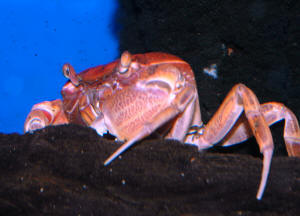 Most freshwater crabs
are actually amphibious...
Most freshwater crabs
are actually amphibious...