|
FAQs on Freshwater (and Terrestrial)
Crustaceans, Health
Related Articles: Freshwater Crustaceans, Invertebrates for Freshwater Aquariums by
Neale Monks, Forget Crawfish
Pie, Let's Make a Crawfish Tank! By Gage Harford
Related FAQs: FW Crustaceans 1, FW Crustaceans 2, FW Crustaceans 3, FW Crustaceans 4,
& & FAQs on:
FW Crustacean Identification,
FW Crustacean
Behavior, FW Crustacean
Compatibility, FW Crustacean
Selection, FW Crustacean
Systems, FW Crustacean Feeding,
FW Crustacean Reproduction
& Crustacean Selection, Crustacean Behavior, Crustacean Compatibility, Crustacean Systems, Crustacean Feeding, Crustacean Disease, Crustacean Reproduction,
Freshwater
Shrimp, FW Crabs,
Terrestrial Hermit Crabs, &
Marine Hermit ID,
Hermit Behavior, Hermit Compatibility, Hermit Selection, Hermit Systems, Hermit Feeding, Hermit Reproduction, Hermit Disease/Health, &
Crayfish FAQs, Crayfish 2, Crayfish ID, Crayfish Behavior, Crayfish Compatibility, Crayfish Selection, Crayfish Systems, Crayfish Feeding, Crayfish Disease, Crayfish Reproduction,
|
|
|
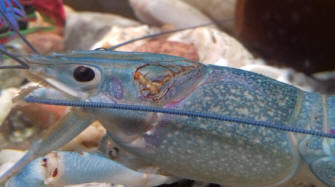
Blue crayfish injury 6/14/17
Hi there, I have a blue crayfish and whilst moving it from the tank for cleaning
(I scooped it up in its terracotta cave ) I tried to pick it up... it jumped.
..! I jumped.., dropped the pot and banged it's head!
The injury is about 4weeks old. Is this injury likely to kill it? It looks no
worse after these weeks.
<That the animal has survived this long is a good indication that it will
persist; and clear this crack with the next moult or two.
You do administer Iodide regularly? I'll list the reading:
http://www.wetwebmedia.com/fwsubwebindex/crayfishdisfaq.htm
Bob Fenner>
|
 |
|
Re: Blue crayfish injury 6/14/17
Yes, marine iodine, half dose as specified in your previous q&a's. Will it moult
again though?
<Yes; if it lives>
It's approximately 3yrs old, I didn't expect it to get any bigger, though I'd be
delighted if it did.
<Moulting frequency decreases with age/size, but never stops altogether>
Does the head area moult too?
<Yes>
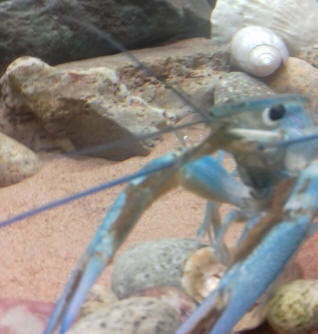
Is the discoloured fur on its pincers normal or should I attempt to remove it?
<Looks like algae of some sort... this will come off w/ the moult>
Thanks for your swift response
<Welcome. Bob Fenner>
Laura
|
 |
Please help. Wood shrimp med. poisoned
8/24/16
Please help me i have a wood shrimp in my tank along with other fish the
glow fish had ich i used ick away with the wood shrimp in the
tank during medication for three days but used only half the
dose which was three drops in a ten gallon tank today i saw the shrimp
upside down not moving along the bottom on the rocks its still a little
alive we moved the wood shrimp into a separate place with new water and
a air pump and a hiding rock its still alive but wont move much sitting
on the rock cave hands are black and tucked in is it gonna make it and
live and is there anything i can do for it please help asap thanks
<Just keep it under propitious conditions. Bob Fenner>
The Plague! (Maybe). FW snail control,
crustaceans... 12/5/11
Hello. I just noticed a problem with my aquarium... I have quite an odd
aquarium you see! Its one of those.. Nano Cubes.. but its the largest
Nano Cube! (Which still isn't very big) And inside of this I have 3
main species: Crayfish, Snails (Invaded), and some form of miniature
lily pad (Invaded). What I mean by "(invaded)" is when I
bought some of these crayfish, or plants, a little creature came with
them! First time it was just one snail.. one snail, not too much!
Right?.. Wrong. I think they reproduce asexually or something
because I had maybe 50-60 of them! They are all really small though,
their max size is about the size of a piece of rice.
<Unless these bug you aesthetically, they're not a
problem>
At one point every morning I killed a couple with this window-scrubber
thing you use to get the algae off of your glass. I had to do these to
keep them in check! But now.. they are all gone! Not that I liked them
much in the first place, but it is quite odd to have an epidemic one
day and have it disappear several days later.
<Mmm, not really. Likely the Crayfish discovered how edible they
are>
(My aquarium is in pretty good health since I have plenty of
Crayfish who have lived quite long seemingly without problems) Now..
with the Lily pad infection. One day I bought some plants and
wouldn't you know it some Lily pads came with them! Also about the
size of a piece of rice. But I think these things have minds of their
own... sometimes I see them with these thin string projectiles attached
to the sides of my aquarium of the filterer. And I KNOW they reproduce
asexually since their plants.. Its impossible to eradicate them since
if one is hiding somewhere they come back. They clog up my filterer and
block out the light from my light bulb that is giving my crayfish..
light. But one day.. nearly around the same time frame as the snails
they all disappeared! (Almost) And I was quite pleased. Better yet they
weren't even coming back. Around this exact same time I was
experiencing a flourish in life from my Aquarium. None of my crayfish
were dying, and everything was fine and dandy. I decided to get this
one big crayfish to accompany my Dwarf Crayfish.
<... these are largely predaceous species... Eat one another>
(Who are about the size of two-three pieces of rice!) This
crayfish was about 2-2.5 inches long. Quite a big fella but I was told
he did not harm any small crayfish and all he did was clean the ground,
eating the particles he finds. And it was good.. for about 2-3 months.
Then a serious of cataclysmic events happened! First my crab (also
small, maybe one inch) who I had for about 8 months died! Soon after
that period the 'invaders' started coming back. Then about 4
days ago I saw my big crayfish, who is usually always in hiding be
outside.. directly in my view against the glass. I guess he wanted to
get out of his dark hiding? I was wrong! He didn't move from that
point. He was still alive since he was moving his hands around and
pointing his antenna in certain directions. Then his body started
changing color... his head (carapace area) was turning red!
<Neat!>
Now I knew something had to be wrong, he must have a disease!
<Not necessarily, no>
Now as of about yesterday evening I noticed his tail has started to
turn red, I looked up on Google if there were any diseases that matched
this description but I could find none.
<Likely just change due to age, maturation...>
Now the center of his body is turning yellow and I assume it will be
red soon. I have not changed any procedures I do in keeping my aquarium
healthy! I did the same thing ever since I got my aquarium and
everything has been fine, no diseases, no nothing. But only as of
recently have bad things been happening... what should I do?
<Mmm, keep on keeping on...>
Should I completely clean out my aquarium and fish out the
remaining crayfish until then? Get a new filterer? Use some kind of
disease-killing liquid?
<I wouldn't, no and nah>
I would get one, but I don't even know what disease this is! Is the
return of the invaders linked to the death of the crab?
<At least temporally eh?>
Was he keeping them in control somehow? Is the death of the large
crayfish linked to the return of the invaders!? Thanks for your
help!
<Please read here re Snail control:
http://www.wetwebmedia.com/FWSubWebIndex/fwsnails.htm
and the linked files above. I wouldn't change anything in this
system overtly. Bob Fenner>
|
Cherax quadricarinatus - Red Claw
Crayfish/"Lobster", Molting Issues Hi I have a red
claw lobster and it is laying on its side and it is still moving
and it looks like it is molting because some of the shell is off.
I was wondering if it is molting or is it dying. <Tough to
say, I'm afraid. Laying on his side is not a good
sign, I must say. It does sound like he's having
difficulties with molting, a "bad molt", as it
were. At this point, the best you can do is wait and
see. In the future, though, please consider adding
iodine to his tank, to help him with his molts in the
future. I use Kent Marine iodine (marketed for
saltwater tanks) at a rate of one drop per ten gallons every
week. The difference this tiny bit of iodine makes is
truly amazing. Since using iodine in my freshwater
shrimp tanks, I haven't lost a shrimp to a "bad
molt". For now, just leave him in peace, and hope
he recovers. If he does, do please start dosing iodine
in his tank to prevent this from happening again; if he
doesn't, well, at least you know you can prevent it from
happening to future pet crayfish. My fingers are
crossed for your crustacean pal.> Can you e-mail me back at
XXXX please. <Done. Wishing you
well, -Sabrina>
Cherax quadricarinatus - Red Claw
Crayfish/"Lobster", Molting Issues, II (01/31/2004)
I am sorry for e-mailing you back here it's just I don't
know what XXXX means. <Since we post these questions and
answers for all our readers to read, and you had posted your
email in the text of the message, I removed it; that's all
the X's were for. While on this note, though, the
text sent back with this reply was very, very jumbled; I hope
that it made it through to you okay.> My lobster has been
laying on it's side for 3 days and only a little bit of
it's shell is off. It looks like he is trying really hard to
get the rest of the shell off. What should I do? <If there are
any other animals in the tank with him, it'd be a good idea
to quarantine him separately to help him recover. Then
I would certainly add iodine (I use Kent marine iodine at a rate
of one drop per ten gallons) to his tank; this might help him
out. Further, you should definitely check your water
parameters (ammonia, nitrite, nitrate, and pH), and ensure that
ammonia and nitrite are zero, and that nitrate is as low as
possible. If not, do water changes to correct the
issue. Any of these values being too seriously out of
whack could cause harm to your crayfish. Wishing you
well, -Sabrina>
|
Attack of the Killer Cabomba? - 08/22/2004 My sister put a
plant called Cabomba caroliniana in her aquarium and within hours the
shrimps she had died. <Pure coincidence, unless the plants had some
sort of toxin spread on them....> Does anyone know if this type of
plant is injurious to shrimps? <It is not, not at all. I
have had plenty of shrimp in aquaria containing this species of
plant. Did your sister use any sort of a dip for the plants
before adding them? Some people will dip plants in solutions
to kill snails, etc., and if not rinsed *thoroughly*, I imagine some of
the water from the dip would get in the tank, and possibly cause
harm. Otherwise, I assume this is pure
coincidence. If you wish to explore other reasons for the
shrimps' deaths, please respond with great detail on your tank -
what size tank? How many and what kind of
shrimp? How many and what kind of fish? What do
you feed the animals? How often do you change
water? What other maintenance do you do? Do you
add any chemicals to the water (aquarium plant fertilizers, iodine for
the shrimp, etc.)? What are your readings for ammonia,
nitrite, nitrate, and pH? When was the most recent animal
added to the tank, and what was it? Hoping to help you get
to the bottom of this, -Sabrina>
Freshwater shrimp? Dear Crew, We have unfortunately had a
small tragedy in our freshwater tank (240L, ph6.5-7, temp 75-77,
nitrates 0, hardness 3-4)...in with our neon tetras (11), black widow
tetras (6), Otos (5), Rams (3), Corys (6) we had had 5 "red claw
shrimp". Now from the pictures on your site and on all of the
other freshwater shrimp sites, they look like ghost shrimp, but are a
reddish/orange color. We bought them from one of the LFS staff who
lives in our area and breeds them in her tank. The biggest of these
fellows is about 2 inches long, and the smallest about 1 inch. Until
yesterday all was well (how can you tell there's going to be a but)
but yesterday evening I noticed small red shrimp on its back,
scrabbling a bit. I thought this was strange, so turned him over and
moved him into a sheltered corner, he seemed to be struggling, so I
wondered whether he was molting and turned off the tank lights to
minimize stress and left him to it. This morning at work I have
received an e-mail from home telling me that small red shrimp is no
more. So now I have 2 questions, first of all, do you have any ideas
what species these fellows might be? and secondly, what could have
killed small red? his legs and claws looked strangely pale and he
seemed sort of bunched up (cramp?) but apart from that we have no
clue... Any suggestions would be useful, we want to prevent the same
happening to the other 4. Thanks for your time. Nicola <Hey Nicola,
sorry to hear about your shrimp. It is hard to get a positive ID
without a good picture. The common ghost shrimp will not reach 2in.
Take a look at the link below, is it one of these guys?
http://www.calacademy.org/research/izg/SFBay2K/ghostshrimp.htm My first
concern would be water quality. I would do a good water change, and add
a poly filter to absorb metals and many other contaminants. Keep an eye
on the other shrimp, if it starts happening to the others we will know
that it was not a molting complication and can start troubleshooting
from there. Let us know how it goes, Best of Luck, Gage.> Nicola
Blay, BSc, MSc International Zoo Veterinary Group
|
|

