Stingray pups 10/15/17
Dear WWM Crew,
I've been keeping freshwater stingrays for almost 10 years. Love 'em!
<Certainly rewarding fish, for those with the skills -- which you
certainly have!>
One of my female P. motoro gave birth to four large babies last night.
All are doing great.
<Well done!>
She's now flat on one side but still kind of bulging on the other side.
And four is a small litter for her. So I'm assuming she only gave birth
from one uterus and will give birth from the other either today or soon.
My
question is, "Is it possible for stingrays to give birth several days
apart?"
<Certainly several hours can elapse between first and last pup in a
litter, and I guess a day or two might be possible. Still, I'd be
getting a bit nervous at this point in case there's a blockage of some
sort. A substantial water change, and turning off the lights, would be
two obvious things to do. The first to dilute any of the fluids and
wastes from birth, and the latter to reduce stress. I'd think about
Epsom salt too, as this mild laxative might help delivery the babies if
they're not quite out but on their way.>
Thanks as always for your wonderful site.
Margie
<Do think about posting at Monster Fishkeepers. While that forum plays a
bit fast-and-loose when it comes to using live food, it's a focal point
for the big predatory fish community, and several Stingray breeders post
their
regularly. Cheers, Neale.>
stingray pups from different fathers?
12/26/12
Hi,
Love your website! I can usually search and find what I'm looking for,
but here's one I've come up empty on.
I've been keeping P. motoro and P. leopoldi stingrays for over 4 years.
They're doing well and I've had two litters of pups so far.
<Neat!>
I've read they have 2 uteruses; one on the left, one on the right. I know
they can sometimes be pregnant only on one side.
Question 1: Do stingrays have to mate twice to get pregnant on both
sides?
<Mmm, don't know>
Question 2: If so, does that mean you could have pups from one father on
one side, and pups from a different father on the other side?
<Could be two (or more) males involved or just a repeat from the one>
I'd sure appreciate any information you can provide.
Margie
<It may be time for a trip to a large/college library (or online)
searching for what biology you can find for the family Potamotrygonidae.
Maybe have a read here:
http://www.wetwebmedia.com/litsrchart.htm
and the linked Related FAQs file (above). Bob Fenner>
Re: stingray pups from different fathers? 12/25/12
Thanks for your reply. I'll follow up on this. Margie
<Ahh, please do write back re your findings. Cheers, BobF>
Re: stingray pups from different fathers? FW f'
3/28/13
Hi, I'm following up on a question you responded to last December ...
Apparently stingrays CAN have multiple fathers associated with a single
litter. Wow.
http://www.kare11.com/news/news_article.aspx?storyid=879485
<Yes; as stated previously>
I haven't yet been able to find out if it requires two matings for a
stingray to become pregnant on both sides. I suspect it does.
Another question I'm looking into is the issue of whether or not
stingrays can store sperm and become pregnant later.
I've found multiple sites that claim they can.
<Mmm, it is known that some Teleost (advance bony) fishes can>
I have a lot of questions regarding these amazing fish! For instance, I
haven't found much info. on how long they live and at what age they
typically become too old to breed.
<This info. should be available from references listed for the family
and species on Fishbase.org>
Thanks for listening.
Margie
<Thank you for sharing. Bob Fenner>
Motoro stingray 5/15/09
Hi. I sent a question a few months back asking about breeding Motoro
stingrays ( spelled breeding, Breading )
<Mmm... breaded stingray!>
I now have a concern about something else. I had both stingrays a male
approx 9" and a female approx 10" in a small 90 Gallon tank.
(27" wide X 52" long and 18" deep approx) My problem was
other than the size Too small.
The Male became to aggressive and chewed off the lower disk and fins of
the female. I moved the Male into there to be new home a 250 gal tank
36" wide X 72" long and 30" deep. This tank has been
cycled for 4 months and has two Fluval FX5 filters and one Aquaclear
500 filtering it. It has two Eheim 250W heater.
<Sounds good; do keep the heater protected with a "heater
guard" though, or better yet, inside the sump. Stingrays easily
burn themselves on glass heaters.>
With glass bead substrate. Very soft and non abrasive ( like tiny
marbles)
<Never heard of this; can't say I like the sound of it all that
much, so do check with other Stingray keepers that it is known to be
safe. Even if it is smooth, the texture or colour may be off-putting.
If all else fails, plain vanilla gravel works, as does smooth silica
"silver" sand from garden centres. Neither of these costs
much. Do observe all the usual rules when selecting, using substrates
re: being lime-free, non-abrasive, thoroughly cleaned before use, and
regularly cleaned once installed.>
With a large pc of bog wood for decor. I do a 30% -35% water change
every 4-5 days. Last time I checked 2 days ago the ammonia, Nitrates
and Nitrites where at 0ppm The PH Is 5.5 The temperature was 81 f But
I
replaced a defective heater and it is now 76 f. The only fish in the
tank are 2 angelfish, 3 SAE's and 20 Guppies.
<Fine.>
The male Stingray has been in the tank for 30 days. He spends most of
his time swimming against the glass near the surface of the water in
the same spot. When I first put him in the tank he ate like a pig as
usual. Silver sides, night crawlers, black worms, Ghost shrimp and
sometimes grubs or crickets. But now he is eating very little and not
so eager to eat. Just swimming in his spot or sitting on the bottom. Do
you think he just needs more time acclimating to his new tank? or
should I be more concerned about something else?
<With Stingrays, you should *always* be concerned when these fish
don't behave normally. Put simply, behaviour is your first and only
warning of problems; by the time symptoms of ill health appear,
it's often too difficult (or impossible) to treat them. So yes,
review water chemistry, water quality in particular, but also potential
social issues such as the Siamese Algae Eaters "nibbling" on
the Stingray and annoying it. Don't keep adding food while he
isn't eating, but do try offering earthworms after 3-4 days of
starving to see if he's ready to eat again. Do consider possible
sources of toxins: paint fumes, cleaning agents, etc. Check water
circulation throughout the tank is adequate: is the bottom layer of
water being moved about? Or just the top? Does adding extra aeration
make a
difference? Rays are super-sensitive to low oxygen concentration, which
can be caused by poor circulation and excessive heat. Look for signs of
decay in the tank: particularly organic debris stuck in the substrate.
Perform a
large water change, controlling pH and hardness changes as much as
possible.>
When he was in the small tank with the female he was doing better under
poor tank conditions. Where the female is now flourishing and healing
nicely. Getting bigger and fatter. Any suggestions would be
helpful.
Thank you. Kevin
<These are difficult fish at the best of times. If water
quality/chemistry are good, I'd be reviewing tankmates, diet,
substrate, and sources of disturbance such as loud TV sets close to the
aquarium. Cheers, Neale.>
Regarding Freshwater Stingrays' Babies. 7/15/08
Hello, Can you advise me as to how to take care of new born
babies of PLE14? <I assume you mean Potamotrygon species P 14;
I've never heard of 'PLE14' but I admit my knowledge
of these animals is hardly encyclopaedic!> What kind of
procedures should I follow? <Same as the adults, though
removing the adults, particularly the male, is recommended.> I
have almost a dozen of new born babies which came from the
breeding of PLE10 and PLE14. When they were born, the babies
seems to be in good conditions, however after a couple of days
they started behaving weirdly. <Well done on getting the
babies!> Some of them start having fin curl issues, some start
leaking sticky substance from their bodies. <Ah, this is the
tricky bit with all livebearers, whether Stingrays or Guppies --
getting the babies is easy, rearing them in good numbers is
difficult.> Have checked the water ph (is around pH 7),
changed the water gradually to get it slightly more acidic,
temperature was normal (around 27 degrees Celsius), with filters
and heaters. Everything seem to be in good condition. <I
wouldn't mess with water chemistry. It doesn't matter
much to Stingrays. What matters to them is water quality
(ammonia, nitrite and nitrate) first and pH stability second.
Changing the pH, even to a nominally optimal value, can stress
them. Moreover, as with any freshwater fish, changing the pH
without changing the hardness as well is pointless and likely to
cause pH instability.> The adults rays were in the same pond
but they don't have any issues, however the babies seems to
be having a very tough time, in fact a few of them have already
passed on. <For a start I'd concentrate on keeping water
chemistry stable and water quality optimal. I'd be tempted to
isolate the juveniles, and perhaps the females as well (the male
Stingrays, like male Guppies, can be quite persistent re: mating,
and in the process can stress, even damage, the females.>
Please advise what should I do to prevent the others from
becoming the same way. <Can you tell me a bit about the pond,
i.e., capacity, pH, general/carbonate hardness? Do also review
the substrate. While Stingrays definitely prefer sand on the
bottom of the tank, there's some experience to suggest sand
can trap dirt and/or bacteria and cause problems. While adults
may be relatively resistant if the sand is kept clean, juveniles
may be more sensitive. This is certainly the case with many other
benthic fish, for example juvenile catfish.> Thank you very
much. Regards, Qianling <Good luck, Neale.>
Re: Regarding Freshwater Stingrays' Babies. --
07/16/08 Hi Neale, Thanks for the prompt reply! :)
<You're welcome.> We have removed the babies from the
main pond, to avoid adults having conflicts with them. <Good.
Do also try and separate the female for a while, so she can
"fatten up" a bit.> The ponds that we shifted the
babies to is 4ft long 2 ft wide 2ft depth (6 in one and 5 in the
other), the pond for adults is 18ft long 10ft wide 2ft depth
(total 8 adults within it). <Sounds great.> There is no
substrate at all, totally clear water. pH was around 7.2. <All
good.> We did put in the Pandan plant to minimise the ammonia,
nitrite and nitrate issue. <Hmm... is it possible some
pesticide spray came in with this plant? Also remember that
things like ceramic plant pots can carry various residues into
the aquarium too.> Temp is around 26.5 ~ 27 degree Celsius.
<OK.> Adults pond have 1 big and 2 small filters. Babies
ponds don't have filter at this moment. <Ah, this
isn't going to work in the long term... or even the short
term. I'd have at the very least a decent canister filter
working here.> All ponds do not have heater as my
country's (Singapore) climate is pretty warm unless
there's storm in the night then perhaps the water temp might
be slight cooler. <Sounds fine.> What other things should
we take note of? <Nothing obviously remiss here, except the
lack of filter on the pond with the juvenile fish. I'd
perhaps check the nitrite/nitrate levels first, and then also
consider whether the diet offered to the juveniles is
sufficiently balanced. Do also consider extrinsic factors, e.g.,
pesticide sprays, paint fumes, cooking fumes. Use of activated
charcoal to remove any potential toxins from the water might be
worthwhile if these are suspected. Consider running tests for
chlorine and copper, both of which are very toxic to Stingrays,
and likely more so to juveniles than adults.> Please advise.
<There's really not much more to say. Generally if
Stingrays are happy, they breed. And if water conditions are good
enough for breeding, the juveniles are comparatively easy to
rear. You could separate off one or two of the youngsters to an
aquarium where you can control water quality/chemistry more
easily.> Thank you very much!! :) Regards, Qianling
<Cheers, Neale.>
Re: Regarding Freshwater Stingrays' Babies.
7/17/2008 Hi Neale, Again Thank you!! :) <Most
welcome.> Will inform my dad about all these issues that he
has to take note of. He's still considered as a newbie in
rearing stingrays though he does have a few more experience
people with him however they seem totally unsure what to do about
the babies. <Very good. The thing is to experiment. Healthy
fish will produce many batches of babies, so you can test out
different ideas each time until you find a system that works for
you.> You have been a fascinating help!! :) Last question that
got me seriously curious about these rays.. <Yes?> How does
one feed them one by one? using hand? or those stick like thing
to put the food in? Won't they be uncomfortable with the
stick like thing? <Simply placing live foods at the bottom of
the aquarium should be enough to get the juveniles feeding.
Bloodworms and other small invertebrates would be the ideal.
Small earthworms seem to be especially favoured by Stingrays (and
indeed fish generally!). Frozen foods may work too. Surprisingly
perhaps, I find using forceps or other tools to hand feed fish
works rather well. Fish seem to accept an inanimate object much
more readily than me sticking my arm into the tank.> Oops
another... Can the babies eat what the adults are eating?
<Pretty much the same stuff, but smaller in size of
course.> Thank you very much!! :) Regards, Qianling <You
are welcome! Good luck, and how about some photos? Cheers,
Neale.>
|
| Stingray question, FW, ID, sexing... 5/22/07
Hello <Morrow> I was wondering if I would be able to send you
a couple of pictures. <Certainly> I purchased a teacup
stingray from a local pet store, which I believe to be a motoro.
Wondering if you could confirm. I also think "it" is a
girl, but would like to know for certain :)
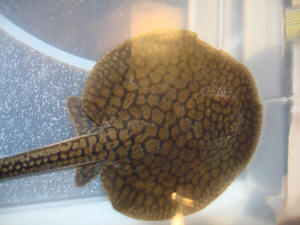
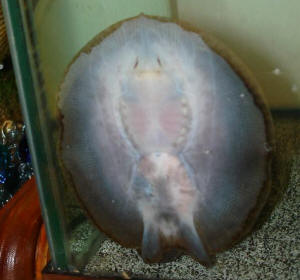
<Sure... just send a few pix showing the underside...> I
really enjoyed reading your article on wetweb media and have
bookmarked it for future reference. Have a wonderful
day ;) Stefanie <You as well. Bob Fenner> |
|
| Re: stingray question, ID, sex 5/22/07
Thank you very much. <Welcome> Here are the pictures.
Let me know if you need more. <Thank you... this is a female...
and... though I can't be sure, appears to be a Potamotrygon
reticulata... now synonymized with P. orbignyi... though the one
pic (dorsally) almost appears to be P. marinae (only found in Fr.
Guyana...). BobF>
Stefanie |
|
|
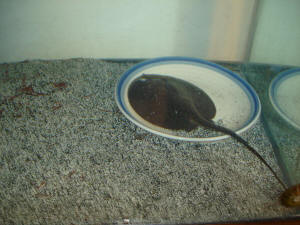
Good substrate choice and useful ceramic
plate/feeding station
|
|
|
|
|

