|
FAQs on Freshwater Stingray Systems
Related Articles: Freshwater Stingrays,
Related FAQs:
Freshwater Stingrays,
FW Stingray Identification, FW Stingray Behavior, FW Stingray Compatibility, FW Stingray Selection, FW Stingray Feeding, FW Stingray Disease, FW Stingray Reproduction,
Systems need to be a MINIMUM
of twice the width, three times the length of the likely maximum
size of the ray/s.
|
|
Freshwater stingray advice needed
8/30/19
Hello!
<Holly>
I am writing on behalf of my employer. She is an avid stingray hobbyist,
owning very many freshwater rays, half of which are black diamond. She
is having problems breeding the diamonds though and asked me to reach
out to anyone who might be more knowledgeable about ray breeding. I know
it might be a long shot to ask for advice but I am a bit desperate.
<Mmm; have read quite a bit, written some re FW rays, Potamotrygonids>
The rays seem to be having pups fine, but the pups only last about two
weeks before losing some color, curling and then expiring. She gets
maybe one or two out of every 20 that actually makes it.
<Yes... need to know, have information re mainly water quality (and
maintenance therein) and nutrition here. How do folks treat the source
water and what is its make-up? What foods are being employed and are
they supplemented?>
Any advice at all would really be appreciated, thank you for your time.
Sincerely,
Holly
<Data please. Bob Fenner>
Re: freshwater stingray advice needed
8/30/19
Thank you Bob for replying,
<Thank you for sharing Holly>
She has a large setup. It's a 2000 gallon system consisting of three
large oval concrete tanks, 2.5 feet deep, connected to a small hatchery
consisting of multiple 50 gal tanks.
<Ahh! Am wondering, concerned with the accumulation of metabolites here>
fresh water source is well water which flows in constantly.
<Ah, very good>
There are 5hp submersible pumps which feed into sand filters then
degassing towers. There are aerators throughout and a bio ball filter
before the pumps.
<Wow! Some electrical cost now!>
parameters are normally around or close to : Ammonia - 0.25
<Aye; this NEEDS to be zero, zip, nada. This value alone might account
for the trouble here. I'd look into using contactor... resin, carbon...
to eliminate all NH3/NH4OH>
nitrite - 0
nitrate - fluctuates between 5 and 20, rarely as high as 40
<This too needs to be addressed. I'd keep NO3 concentration below 10 ppm
at all times>
and PH - between 8.2 and 8.4.
<And this is way too high for wild-collected Amazonian rays>
The temp ranges between 81 and 83 Fahrenheit.
The well water was just tested for heavy metals, all came back looking
fine.
<Good>
My employer's friend keeps insisting it could be bubble sickness so she
ordered a TGP meter. I tested all over and have seen it up to 95.4 % O2
and 103.7 % residual TGP in the concrete tanks. I can't seem to find
much about what levels rays can tolerate but the more I look into it the
more I don't think that is it. The rays don't look like they have any
visible tissue damage.
<Gas/embolism is not a problem w/ these values. Supersaturation is...
and with the use of the towers, likely most all excess gas is released>
I separate the baby rays from the adults into floating baskets when i
find them. i have also tried moving them to their own hatchery tank as
well but same results. I have tried feeding finely chopped earthworms,
live Tubifex worms and finely chopped fish but they are reluctant to
eat.
<Mmm; I would further experiment, and provide the young with softer,
more acidic water. Do see, read on the Net, Fishbase.org re their
natural waters. Quite different than what they're being exposed to here.
There are simple/r, inexpensive means to modify water quality. The young
will be better off kept in the 50 gallon systems either separate from
the recirculated water or very slowly dripped/overflowed>
Thank you again,
Holly
<Welcome. Bob Fenner>
Re: freshwater stingray advice needed
8/30/19
thank you very much, you have been extremely helpful. I'll relay all of
this to my employer and try setting up a separate tank for the pups.
<Ah, good. I've visited a few Potamotrygonid hatcheries... your issue
here is not uncommon, and easily solved. Bob Fenner>
My Moto Stingrays; sys. 5/20/16
Hello,
<Hey Ben>
1st off I love this website. So much info.
<Yay!>
I wanted to know if the PH level I keep my rays at is hazardous to their
health.
<Mmm; as given below; no; you're within range>
There are so many opinions out there. I use my Rays appetite and
activity as my first insight into their health level.
<Yes>
As far as water quality:
Nitrite/Nitrate are 0
<... really? Zip NO3? I'd check your water w/ another kit. Having NO
nitrate is exceedingly rare in established captive aquatic systems>
PH = 6.2
0 ammonia
Temp kept 79-81 degrees Fahrenheit
As far as water changes: I use a 4 stage RO filter and
constantly directly drip about 12 gallons a day into the tank, putting
about 70-80gallons of new water in a week (obviously have an overflow).
<Mmm; do you (re) add "mineral" content? I would, or at least mix in
some
(a few tens of percent likely) tap/mains water. Fishes, invertebrates,
plants, algae won't live long or well in straight RO>
I have a male and female and they eat voraciously. Earthworms, Prawn and
Silversides for the most part.
The male has been showing signs of breeding, he has been nipping at the
female.
Am I doing anything wrong?
<As stated... a bit more solids content in the water is highly
recommended.
There are some commercial prep.s... and some you can make.... SeaChem's
"Replenish" is a fave. Bob Fenner>
Benjamin Foster
Re: My Moto Stingrays
Wow! That was fast! Thank you so much for the quick response. So from
what you wrote I should be more concerned about my mineral replacement
due to only RO water going in more than my PH?
<Mmm; actually, both... the min. replacement product won't bump up pH
much>
Again, I have heard many opinions about minerals in water, mostly being
that fish get more mineral internally from diet than any other way...
<Yes; tis so... but... nitrification... and a few other bio-geo-chem rxn
series are greatly dependent on mineral substrate...>
I have no way to store water, that is why I just direct drip from RO
into the tank. I could however create another drip straight from tap and
drip about 15 gallons a week from straight tap.
<This would be superior>
Should I be concerned about chlorine or does it get off gassed and since
it is dripping in so slowly is should not be a problem?
<IF very slow.... I'd add no more than a gallon per day... the sanitizer
addition should not be problematical>
I did retest with my own set, sorry LFS did my 1st test.
My actual results:
NO2 = 0
NO3 = <10ppm
<Ahh; yes; much more realistic>
Ammonia <.25
<You NEED for this to be 0.0 ppm>
PH 6.2
From these results I would ask myself if I should up the water drip to
more gallons per week.
<.... Too much going back and forth here.... Again, you NEED to address
the ammonia... likely insufficient biofiltration, circulation... perhaps
over-feeding here at play>
Again, thank you so much for the advise.
<Certainly welcome. Bob Fenner>
|
Freshwater Stingray / Arowana & big tank filtration related
question. 3/15/16
Dear WWM crew,
<Timur>
there might be a bit of text, but bear with me.
<Sure; take your time. Best to be thorough>
I live in Czech Republic and I'm not new to the hobby, but not veteran
either, though I do my fish stuff with passion.
<Ahh!>
I'm moving out this year and I had to sell my 120G tank, wood fishes &
everything. (Still got 3 small tanks left, which will move with me, red
cherry shrimps galaxy Rasbora etc)
Here is my 120G when it was active.
https://www.youtube.com/watch?v=1hWCI6nQoZ8
(https://www.youtube.com/watch?v=1hWCI6nQoZ8 )
Initially I wanted to go for Oscars, some silver dollars and bottom dwellers
(like angel catfish), but after some weeks of thinking I will go for single
silver Aro, school of silver dollars(Metynnis maculatus variant at least 8)
and motoro ray or leopoldi ray (single) on the bottom (depends on the
market).
<The Arowana and either Potamotrygonid will grow... to be too large for a
120 gallon tank>
I was thinking to go for smaller variant of FW ray, like reticulatus or
hystrix, but after reading I learned, that they are not as hardy(not trying
to say any FW ray is hardy here, all are very delicate) as motoro and that
the tail gets very long + they are almost impossible to get in my country.
<I see>
I've studied the fish extensively and I'm aware of the diet, sand bottom and
the size the fish will grow into. The diseases and issues that these fishes
have (like Drop-eye issue with silver Arowanas) and all the possible
information .. dangers of the sting from the ray, treatment and possible
long lasting effects. In the end this setup is what I came to.. the
tank will be 330 gal/ 1215 liters ish including the filter which
will be part of the AQ.
<Oh! Yes>
In ideal situation I would build bigger AQ and put 300liter sump filter
below it. But I'm limited by the total weight of the aquarium & all the
accessories.
I decided on the fish setup (numbers) in regard to the bioload, surely some
people would put more fish in it considering it's a big tank, but from what
I studied this tank is a border-line minimum for an adult fish of the
species and I would like it to have as much space there as possible for the
fish, without having an empty tank.
<Good; you and I's philosophy is concurrent here>
Since I'm limited by weight (new house, but not meant for x tons of weight
concentrated on one spot) .. I decided to put the filter inside (no piping
outside the tank, no drilling) here's a diagram. Not here to discuss that,
it's going to be inside. No canister filters either.
<All right>
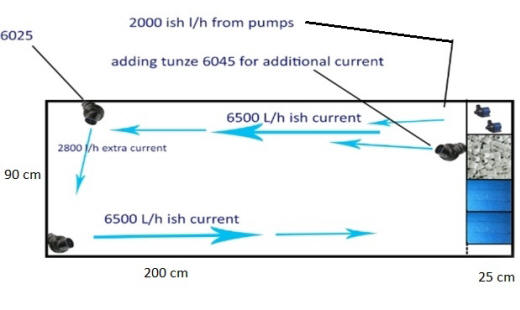
On the diagram you can see that the swimming space for the fish is 200x90x60
which should be enough for these fish considering there will only be 1 Aro,
1 ray and school of smaller fish (15cm max silver dollars).
I will have the water & drainage near the tank so water changes will not be
an issue.
<Good>
Pumps will be either Jebao or something similar (intended flow from both
pumps choked at 1000L/H each, because any more L/H and the overflow filter
would not work properly and would not do the needed bio filtration
correctly) adding bunch of Tunze Turbelle to create good flow in the tank.
This image has been resized. Click this bar to view the full image. The
original image is sized %1%2.
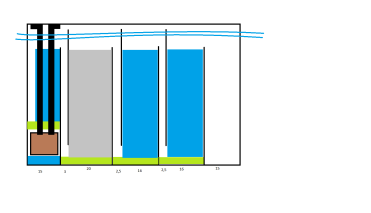
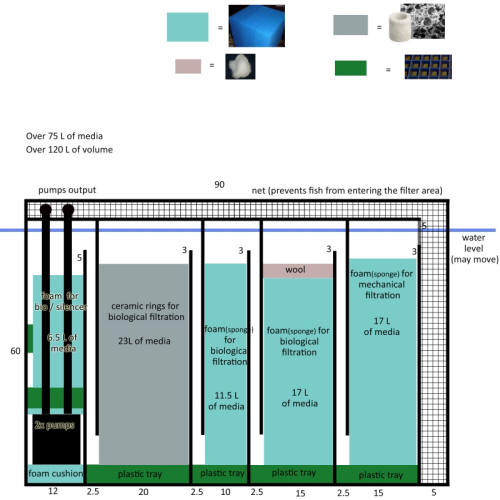
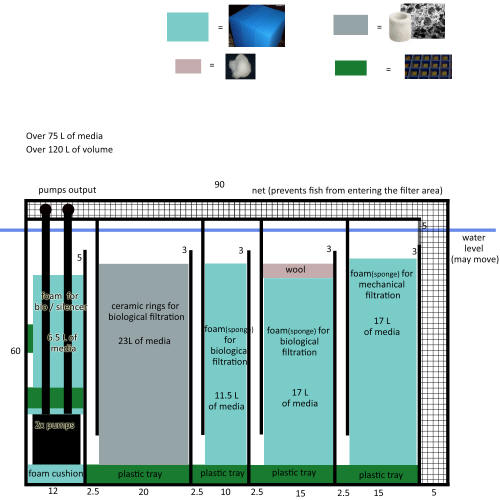
I pretty much have a very good idea how the filter could look, here is
another diagram, please comment on it.
<Looks very work-able>
This image has been resized. Click this bar to view the full image. The
original image is sized %1%2.
the first chamber is the intake from AQ and there will be a net so the fish
wont get in.. now why is it so big you say, well because I want to add some
sort of mechanical filtration in there. That's the only thing I'm unsure of
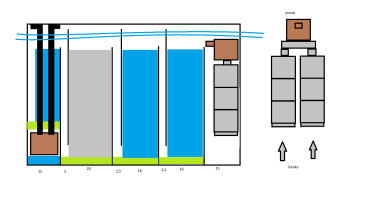
how to do properly.. I thought of using the AquaEL turbo 2000 internal
chamber filter to do that another diagram:
<Open cell foams meant for aquarium use would be my first choice here... I'd
have at least two sets; one for in-place use, the other for processing...
bleaching possibly, freshwater rinse, air-drying...>
This image has been resized. Click this bar to view the full image. The
original image is sized %1%2.
What do you guys think, or do you have a better solution for this first
chamber ? I want to lessen the particles & waste that gets to the sponges
area, I do know about the socks that marine aquarists use for their sump
filters, but they clog way too fast and require change every few days
according to the marine aquarists.
<Agreed; these bags are better for marine applications>
as for parts of the actual filter: starting from chamber to the left: blue
is a sponge which will lessen the sounds that the overflow makes, below it
is plastic that will hold it and allow good flow to the pumps (there will be
2 pumps hence 2 pipes inside of the chamber), pumps sit on sponge as to
lessen noise.
next mini chamber is 3 cm and is dedicated to create good flow, the 20 cm
chamber is purely out of ceramic bio filtration media that will be in a
netted bag, so I can easily take it out when needed. We get another small
chamber for flow and then we have the sponges, I am not sure if it should be
20 ppi to 10 ppi left to right (coarse first) or just both of them 20 ppi,
because there will be less waste coming.
<Okay>
The big question is how to do the first chamber properly. In ideal solution
I would only clean the filter in first chamber i.e. - take out clean, put it
back.. once in a few weeks.
<The "blue" sponge material of pore size... I'd switch out weekly, when
doing gravel vacuuming, water changes>
And the actual bio media would not get cleaned in months.. all depends on
how well the mechanical ones work.. Also what would you put inside of it?
<More foam cut to size... smaller pore size>
Picture related, the chambers are stackable.. up to the height of the tank
basically.. I think 3 & 3 would be enough. No sponge there, just that
plastic intake.
Sorry for so much text, but it's easier to understand if I write this much
<This is fine; am wanting to understand completely, and be understood in
turn>
Thank you for your time
Cheers.
<And you; Bob Fenner>
|
|
re: Freshwater Stingray / Arowana & big tank filtration related
question. 3/16/16
Dear Mr. Fenner,
<Mr. Tuktarov>
thank you for your swift reply. I'm glad that you agree on the philosophy and
that from your point of view the tank is sufficient for this fish setup.
<Welcome>
I had thought of keeping Jardinei instead of Silver Arowana, but from experience
of many keepers of this fish, it is quite evident, that it is a gamble to try to
keep it with anything like an expensive FW ray, so I scratched that idea.
<This is best; they're not easily kept in "other fishes" set ups>
"<Open cell foams meant for aquarium use would be my first choice here... >
I'd have at least two sets; one for in-place use, the other for processing...
bleaching possibly, freshwater rinse, air-drying...>"
I see, what PPI would you suggest to use for these?
<Not so important the porosity... as long as it is fit to the flow
characteristics of the chambers, pump flow>
I've re-made the filter
design (8th now :D )
The initial filtration chamber what PPI would you use there?
<The larger.... let me see if I can find on the Net:
http://www.swisstropicals.com/filtration-shop/poret-foam-shop/ The Poret 30
PPI is a good choice>
It's meant for mechanical filtration, I chose 15 cm instead of 10, so it would
not clog so fast, after this first chamber stops most of the dirt
particles I put wool in second chamber right below the overflow, so the finer
particles get caught there, wool would not be washed... just tossed when dirty.
after that the second chamber could have a bit finer PPI (your suggestion?)
<The 45>
third chamber could use the same as the 2nd, fourth chamber would be sera
Siporax or other quality ceramic rings for bio filtration, fifth chamber starts
with foam, because the fifth chamber will have the least of water (pumps
working) and there will be noise made upon water descending, that's why the foam
is right below it. But the water has to flow fast here, so there will be 2 cm of
free space so it can go over if needed. The green stuff is plastic tray meant to
help with flow.
Net is all over the "open" areas that connect to the aquarium, in the water and
out of it, in case a fish decides to jump it wont get into the filter, net would
be hard (non-corroding metal) and it would be "glued" with
aquarium silicone.
<A good plan>
Since I've never built an actual overflow filter, I have to ask, will this work
as intended ?
<Should; yes>
The pumps will be adjustable. Each can go from 600 to 2000 L/H and can be
controlled by a remote .. so I can figure out the exact best flow.
<Good>
I expect to clean the first chamber once the flow stops going as fast as
normally.. wool will be thrown out when needed. I think that at first (small
fish) it wont need much cleaning.. but when they Aro/Ray grow to substantial
size, it will require cleaning more often.
<Yes>
Goal is to make the chamber 1 and wool, the only things that need cleaning.
Other chambers should remain clean for months ideally.
Anything you would change here? Are the partitions in the filter correct?
<Appear to be okay for starting>
All of this is a theory by my I must say average understanding of water flow...
<You're learning; and quickly. All will become much more clear w/ install and
operation. Bob Fenner>
|
 |
|
re: Freshwater Stingray / Arowana & big tank filtration related
question. 3/16/16
Dear Mr. Fenner,
<Mr. T.>
thank you for your time! Can't wait to build this.
<Oh; please do send along progress reports, images of your work>
Kind regards,
Timur
<And you; BobF>
re: Freshwater Stingray / Arowana & big tank filtration related question.
3/16/16
Will do, expect them by the end of summer, my house should be finished by
then.
T
<Ahh! B>
|
|
Hello crew! inquiring about the best sand substrate for keeping motoro
rays 10/1/15
HI I am inquiring about the best sand substrate for keeping motoro rays my
friend recently purchased one and is getting so many mixed opinions I thought I
would ask here for him. Thank you so much in advance I really look forward to
your input.
<Ahh; really, the best substrate for captive use is none.... The folks who
reproduce and sell these animals for the ornamental trade invariably utilize
bare-bottom tanks.... easiest to keep clean... Relying on filtration (nitrifying
surface area, buffering capacity from reductive processes) from materials
"elsewhere" (i.e. out of tank mechanicals, filtration... there are many
options). READ here:
http://www.wetwebmedia.com/fwsubwebindex/fwraysysfaqs.htm
and the linked files above... Oh, and Dr. Rich Ross's book as well, for what all
is invested here, a VERY worthwhile read. Bob Fenner>
Stingray; and other disastrous mis-matchings; FW large tank stkg.
8/5/15
Hello
<Hi there>
I am currently stocking my final tank. I have just moved and want to
have a show tank aside from the aquatic monsters in the basement, including a
true alligator gar and goliath tiger fish.
<Yeeikes! Need ROOM (thousands of gallons) and all that go with it....
(expensive to run) pumps, heating....>
This is a custom 125 that is 7×2'x 18".
<.... too small by far. The Al. Gar could grow to more than six feet (there are
ones in public aquariums bigger); the Hydrocynus and Lepisosteid will kill
themselves before long.... from dashing against the tank, top.... THINK here;
and change your plans>
I have a 4" reticulated stingray pup. I just got it qnd it is only
accepting blackworms, live.
<My young friend.... you need to do some studying, and quick.... re
Potamotrygonids... this fish can't live with these others very long or well>
I am not comfortable with this as I want it healthy and accepting a varied diet
of assorted worms, shrimps, both frozen and live and Massivore and sinking
carnivore pellets by Hikari.
<Oh; good idea. READ on WWM re the family's husbandry>
I also have a 13" florida gar. They both will be in the same tank together. Is
it safe to do so now?
<IF the substrate is fine, the water quality a middling reach twixt both needs>
I also have a 4" Dempsey that is pretty chill
<.......>
that will also be added to this tank in addition to a school of silver dollars,
a "alligator" gar which I believe is actually a spotted, and a pair of Senegal
bichirs. When is it safe to add these fish together?
<Nope>
What else that has visible teeth would you recommend for this tank?
<Another tank>
I was thinking H. Odoe (Kafue African Pike).
Would Severums work here, maybe greens, blues and rotkeils?
<These might go w/ the Dempsey, the Dollars, if there's room>
Thanks
-Finn
<I don't want to discourage your dreaming; but it is wrong not to temper it w/
encouraging your learning ahead of mis-action. What you state above will NOT
work. STUDY for now; and do write back w/ specifics. Bob Fenner>
re: Stingray.... Gar and Tigerfish
8/5/15
The alligator gar is not a part of this tank. He has a 2.5k pool
<..... Ahh; am hoping this volume is sufficiently covered, filtered,
circulated.....>
in the basement he shares with the tiger fish.
What would you recommend for this tank to go with the stingray and gar?
<I would not keep these last two in the same setting.... See reference works re
their water quality needs.... Not compatible. IF you want to keep freshwater
rays, you need to be very careful re what you place with them; and circumspect
re the env. DON'T WRITE W/O READING first. Where I've prev. sent you. BobF>
-Finn
re: Stingray; and skinny Hydrocynus f' 8/5/15
Yes the pool is covered with Plexiglas with a maintenance lid. My tiger fish
seems to be getting skinny, what can I do to fix this?
<.... meaty acceptable foods of size, perhaps (see Mazuri.com) vitamins sneaked
inside.>
He is about 12 years old. At least that's how long I've had him.
<Ahh! B>
Re Hydrocynus, feeding, chatting re FW Ray stkg. NOT a reader
8/5/15
He has been my pride and joy and he has eaten out of my hand since I got him.
He was feed Hikari when he was little but now can eat an entire bag and still be
hungry and I don't have 45$ for 3 times a day for him.
So he gets raw chicken, peas, banana, rice and an occasional rat. The gator gar
the same and my arapaima did
as well but he sadly passed. I had him for 32 years.
<I'd look into gathering marine fishes, other meaty items>
So does this stocking for my show tank sound acceptable?
A retic ray
School of silver dollars
A red tailed catfish, which will be transferred to the monster tank when big
enough
A few Severums
<The Potamotrygonid will not go here.... the Phractocephalus... will eat all
food, likely the Cichlids will bother...>
A huge school of silver hatchet fish, don't care if they are eaten, mine breed
like mice
What would you put in here?
-F
<READ (Don't write):
http://wetwebmedia.com/FWSubWebIndex/fwraycompfaqs.htm
and the linked files above>
re: Stingray; comp. 8/7/15
Ok I have read the information on the link and I now have a better understanding
of tankmates. Large peaceful placid tankmates.
<Ah yes>
So would this new stocking work as I didn't see a few of these fish on there.
A school of silver dollars, probably 6
<Yes>
2-3 Severums
2 lima shovelnoses
<Not the two above... for the same reasons as given last times.>
And the "reticulated stingray"
Please let me know on the Severums as I think that they are generally peaceful
but I want what is best for my ray.
Would an Arowana work in this set up as a grow out tank before it goes into the
650 gallon and eventually the 2.5k tank? I was thinking silver or black
Arowana.
<Likely too messy and disturbing to the Ray>
Thank you for all your help -Finn
<W. B>
Stingray; Neale chimes in 8/7/15
Hello
I am currently stocking my final tank. I have just moved and want to have a show
tank aside from the aquatic monsters in the basement, including a true alligator
gar and goliath tiger fish.
This is a custom 125 that is 7×2'x 18".
<Too small for a Stingray. Bear in mind a Stingray tank needs to have a front to
back measurement at least twice the disc size of the adult. Even a small species
(18" disc) demands a 3-foot front to back measurement, and most of the commonly
traded species are bigger than that, so we're talking a 4-foot front to back
measurement. Stingrays are crazy expensive to keep. If the idea of a massive,
expensive tank isn't appealing to you, then don't waste your money. Honestly.
These fish are not just demanding in terms of skills, they're demanding in terms
of $$$. As in "if you have to ask the price, you can't afford it" sort of
fishkeeping. Buy one of Richard Ross' excellent books for now. Then go to law
school, become a partner in a successful law firm, and save enough to retire in
your 50s. That's pretty much the recipe for Stingray success.>
I have a 4" reticulated stingray pup. I just got it qnd it is only accepting
blackworms, live. I am not comfortable with this as I want it healthy and
accepting a varied diet of assorted worms, shrimps, both frozen and live and
Massivore and sinking carnivore pellets by Hikari.
<Sounds a sensible diet provided the shrimps are less than 20% the food they
get. Much too great a risk of thiamine deficiency otherwise. Earthworms are
about the only "good" live food for Stingrays, but quality frozen and pellet
foods are a more convenient staple. But since your tank is too small for a
Stingray, this is all academic.>
I also have a 13" florida gar. They both will be in the same tank together. Is
it safe to do so now?
<Not for long. Florida Gar get big, couple of feet in length, and your
125-gallon tank is too small. Double that and we'd be in the right ball park. I
kept mine in a 200 Imperial gallon (240 US gallons) and even that was a hardly
generous. Enough space for a few cichlids and catfish alongside him.>
I also have a 4" Dempsey that is pretty chill that will also be added to this
tank in addition to a school of silver dollars, a "alligator" gar which I
believe is actually a spotted, and a pair of Senegal bichirs. When is it safe to
add these fish together?
<Senegal Bichirs are extremely mild mannered fish. Do not mix with cichlids
(except perhaps largish dwarfs such as Kribs). I've seen cichlids strip the fins
from Senegal Bichirs. They're just too slow to avoid problems with territorial
cichlids. For sure your particular JD might be easy going now, but he's hardly
full grown (6-8 inches is typical) and could get a lot nastier in time. Keep
Bichirs with other mild species of similar size, such as Synodontis, Silver
Dollars, that sort of thing.>
What else that has visible teeth would you recommend for this tank?
<You can't really combine pike-looking fish because they tend to be territorial
to varying degrees. There are some exceptions, and Gar in particular are happier
in small groups. Similarly, if you were keeping Senegal Bichirs in this tank, a
school of Ctenolucius (fairly easy to keep) or else Boulengerella (dramatically
more delicate/demanding) would work well.>
I was thinking H. Odoe (Kafue African Pike).
<Hepsetus odoe isn't difficult to keep as such, but its sheer size rules in
right out of your budget. Adult size is upwards of two feet, and on top of that
this species is "jumpy" as well as nervous, making it prone to stress and damage
in small spaces. 250, 300 US gallons would be barely enough for this species,
even though it's actually quite tolerant of dissimilar fish (large Synodontis,
Plecs, etc.). Groups have been kept in public aquaria, but not practical in
homes.>
Would Severums work here, maybe greens, blues and rotkeils?
<Severums are okay with Bichirs, but they can become aggressive when spawning,
so wouldn't be my first choice, though a singleton should be safe enough. I
actually prefer Ctenopoma over cichlids when cohabiting fish with Bichirs.>
Thanks
-Finn
<Most welcome. Neale.>
re: Stingray 8/7/15
Thank you for your valuable input Neale
<Welcome.>
The stingray is a confirmed P. Reticulatus. Its max size is a 14" disc size so
wouldn't the 2ft width be enough?
<Potamotrygon reticulatus is a synonym of Potamotrygon orbignyi. It is indeed
one the smaller species. But small is relative here! Adult size around 35 cm/14
inches, so we're still talking a front-to-back measurement of over 2 ft being
recommended. Depth is relatively unimportant of course, but still, I can't see
anything smaller than 6 ft x 2ft x 2ft being acceptable in the long term.>
Its a male if that would have help.
<Not that I'm aware of. I don't believe one sex is smaller than the other.>
I have Richard Ross' book and it a priceless insight into these wonderful
creatures.
<Indeed.>
The stingray was a birthday gift by my mother. Im not sure how much she paid for
it.
<A generous gift indeed. But one with many strings attached!>
So the terms of tankmates are peaceful and placid and no bottom dwellers?
<Stingrays are best kept (especially in tanks borderline big enough) on their
own in tanks without a substrate or any other clutter. Such tanks are easy to
clean and easy to service. While good for Stingrays, the lack of cover will make
them less than pleasant places for most catfish, while upwelling light from the
bottom will annoy cichlids. Honestly, every tankmate you add to a Stingray tank
makes it more likely your Ray will get sick or damaged. There are no situations
where tankmates improve things, and certainly beginners to Stingrays would do
well to focus all their efforts on keeping the Stingray in 100% perfect water
conditions.>
So a school of silver dollars
A few Ctenopomas
And then my family and a lot of people in my area have bad success with Cichla
as tankmates.
<What does "bad success" mean?>
Would my tem. be a good tankmate?
<Cichla spp. can cohabit with Stingrays in really big systems, but Cichla pump
out massive amounts of ammonia, which is the one thing you don't want.
To stress the basic point: Stingrays will keel over and die at anything beyond
the merest whiff of nitrate, and nitrite and ammonia are immediately toxic to
them. You're already likely to be doing a crazy number of water changes keeping
nitrate below, say, 20 mg/l just with the Stingray. Why complicate things by
adding some big-ass predator that's going to double or
triple the number of water changes needed?>
If so I would also like to add a few ocellaris bass, which will all be
transferred to my pool in the basement with my tiger fish and gator gar once
15".
<Cichla spp. cohabit well with (non-brackish) Datnoides spp., and also
Lepisosteus spp., assuming adequate space and shelter for all concerned.>
Any other species you would recommend would be great.
<Personally, I think Lepisosteus work best as the sole midwater fish, looking
great in groups and placing few, if any demands on the aquarist beyond simple
swimming space. They are tough and hardy animals. I'd be looking at interesting
benthic fish that aren't too demanding. Giraffe Catfish for example, Fire Eels,
that sort of thing. L-numbers of course, some of which are carnivores
(Acanthicus spp. for example) and make a nice change from common Plecs! Gar-type
fish are too likely to snap their snouts (or at least bend them) when kept with
active midwater fish, though very docile "gentle giants" such as Osphronemus
could work. Do also look at some of the overlooked characins and barbs. These
are often very tough animals
once settled, though some, like Leporinus can be nippy. Distichodus sexfasciatus
is a classic (if variable in temperament) characin for jumbo communities.>
Thank you Neale
-Finn
<Cheers, Neale.>
re: Stingray; comp./stkg. 8/8/15
Have had success with Cichla. Sorry typo on that.
<Didn't notice it! So no worries.>
Wouldn't the other fish in this tank pick of tetra and such?
<I'm not suggesting tetras. But characins. The big species. A mean Leporinus can
take apart an Oscar, and Distichodus have the bulk and power to become dominant
fish in jumbo communities. These are extremes, but there are species out there
well worth considering. Some of the smaller Pacu for example, or the larger
Silver Dollar relatives. Various African characins. Ctenoluciidae. A bunch of
stuff you might have overlooked.>
I have a pond filter on this tank and 15% water changes are done every day.
<Just the start when it comes to Stingrays. Truly, these fish are very
demanding. I'd recommend, strongly, maintaining the fish alone for the first 6
months at least, until such time as it has put on solid growth. By then you'll
have a good handle on its needs. After that, then have a read through what
Richard Ross says about tankmates and choose accordingly. I know he isn't a fan
of L-numbers, though I suspect the strict herbivores (such as Panaque) would
actually be okay.>
So a school of silver dollars
<Some of the larger species, yes, with non-aggressive predatory fish that aren't
big enough to eat them.>
Not my florida gar for too long. Just a temp home while my 230 is finished being
built.
A Ctenopoma
<Ah, but which one! See what's available. Ctenopoma acutirostre is the pick of
the bunch, but at 8 inches and very docile (as in, quieter than an Angelfish)
it's a good companion of Bichirs but not for cichlids. Ctenopoma kingsleyae is a
more robust species of greater size.>
A Cichla ocellaris
Can my baby al. Gar go in here until it can go in to the 635?
<Probably, but once he has trouble turning around you'll know it's time to move
him. Gar are extremely docile fish (I love 'em!) but easy targets for aggressive
fish and easily damage themselves when alarmed.>
-Finn
<Cheers, Neale.>
re: Stingray 8/8/15
Ok. So my plan is since these fish are all babies, I will divide the tank in
half. The stingray is now eating mollies and other livebearers.
<Why? Under what situation is this sensible? Unless you're breeding Mollies and
feeding your Stingray their offspring (not the store bought adults)
then using feeder fish is crazy.>
Keep it this way until the ray is say 5-6" in diameter then let them all be
together?
<I've lost track of the tankmates to be honest. But alongside non-aggressive,
non-predatory tankmates that don't occupy the substrate, yes, potentially
do-able. A bad idea though for reasons gone over before.
Stingrays best kept alone, best kept in tanks without substrates, intolerant of
standard fish medications. Nobody, as in, not one single expert on the planet,
says adding tankmates makes keeping Stingrays easier.
Nobody recommends adding them either. At the very best, we're talking "yes, this
species will cohabit safely, but will mean you'll be doing more work keeping the
tank clean".>
In order to keep the water as clean as possible, I plan to have zero substrate,
<So catfish are out.>
a few pieces of rounded driftwood,
<Which means little/no shelter for those that need it: most cichlids, Datnoides
spp., etc.>
one that sinks and one that doesn't as my gar like to shove the wood around the
surface and hide behind it.
<Gar aren't fussed about substrate or shelter, so can work in this sort of
aquarium assuming lighting is subdued.>
So I have a baby blue ocellaris bass. Can he go into my 55 grow up quickly tank
as I like to call it, until he is say 5"?
<55 US gallons, 44 Imperial gallons... hmm... I guess for a few weeks maybe, but
longer term, not the best idea ever imagined, no.>
There are angels, a bgk, a few cats, a JD, a school of baby silver dollars which
will be in this tank when older.
<Angels with a Jack Dempsey? Seems like trouble. Black Ghost Knifefish aren't
going to work with an aggressive cichlid either. Do read up on your fish
carefully before purchase. A singleton Black Ghost needs an aquarium
upwards of 75 US gallons, ideally well over that. These fish get massive if kept
properly. Most die prematurely because, yes, you've guessed it, they're kept in
tanks too small for them. Highly sensitive to low oxygen levels and poor water
currents, as well as the usual dissolved metabolite problems. Youngsters produce
less waste so are, in some sense, "easier" to keep. But bear in mind that as an
animal doubles in length the amount of bulk in that animal actually goes up
eight-fold, so big fish produce far
more waste than you imagine.>
Would a motoro ray be a better stingray for this set up and then be moved to the
635 and then to the 2.5k set up?
<What does 2.5k mean? 2500 gallons? That's a great tank for any Stingray
species. But as we've said before, there are no "easy" Stingrays and the slight
differences in size among traded species aren't enough to make much/any
practical difference.>
The retic ray can go into my 60 until the jardinii grows up and goes into the
Arowana show tank.
<Are you sure all these fish will grow at a convenient rate? By dad used to say,
"If you want to make God laugh, tell him you have a plan".>
I had a flower ray in this tank but he died, a gorgeous ray he was.
<This sentence sums up virtually everyone's experience of Stingrays unless they
plan ahead and have everything ready from the get-go. Lovely fish, difficult to
keep alive.>
Thanks
-Finn
<Cheers, Neale.>
Re: Stingray.... sys., fdg. 8/8/15
So does this sound like a good routine? Im sorry with the so many questions, I
just want this to be a success.
A 15% water change weekly
<No enough. 50% weekly is mean, when it comes to Stingrays. The more the better.
Expect to spend several hours per week on maintenance. Keep the Stingray alone
in the big tank and you might be fine with 50% weekly. Every extra jumbo fish
doubles your workload. I am NOT a fan of adding tankmates to Stingray aquaria.
No benefits at all to doing so.>
And then I am a big fan of Kordon's water conditioner, the zero Nitr/ite/ate
(both) and zero ammonia.
<Let us be crystal clear about this. Water conditioners neutralise these
chemicals IN TAP WATER. They do NOTHING, ZILCH, NADA, for the dissolved
metabolites produced by your fish. That's the job of the filter, water changes,
and optionally fast-growing plants under intense lighting. An analogy: bleach
and antibiotics both kill germs. But they both have
different jobs and you wouldn't drink bleach to treat a sore throat!>
This is just to be sure nothing hurts Gizmo, my ray. It is also stingray and
delicate fish and plant safe.
<Understood.>
Food will be assorted live, frozen and pellet including Massivore, sinking
carnivore, live declawed crayfish, in house bred minnows,
<No. You will NOT be using these if you are sensible. Minnows contain
Thiaminase, and that's a major health problem for predatory fish. Please, will
someone tell me for the love of all that is holy, why Americans still use feeder
fish? Has been obsolete in the UK since at least the 80s. There are no benefits
to using feeders except in extreme cases (such as South
American Leaffish) where the predator will flat refuse anything else.
Feeder fish otherwise are nothing but a string of health risks and behaviour
risks.>
blackworms earthworms and lastly snails.
<Please do read Richard Ross on Stingray feeding. They're super-easy to feed
properly; settle them in with earthworms and possibly a few gut loaded river
shrimp, and once settled, switch to safe frozen and pellet foods.
They are greedy fish, easily starved, and need a couple of substantial meals per
day, which is one reason why cohabiting with other species causes problems: it's
harder to ensure they're getting enough to eat, and all that extra food dumped
in the tank increases the amount of ammonia the filter has to process. The most
economical route is frozen seafood, biased
towards those foods without Thiaminase (little/no shrimps and mussels, but
plenty of cockles, lancefish and tilapia fillet). Do read:
http://www.wetwebmedia.com/ca/volume_6/volume_6_1/thiaminase.htm
Consider the use of a vitamin supplement too.>
Tankmates:
School of silver dollars (6)
My gar temporarily (1)
1 Cichla ocellaris grow out (1)
Thank you for all your help
-Finn
<As Bob would say, "Keep Reading". Cheers, Neale.>
FW stingray, env. hlth. 4/1/13
Hello WWM.
Thank you for this very helpful website.
I started keeping stingrays a year and a half ago, and I have been
reading a lot of helpful info inhere.
<Good>
My tank is:
2600 liters. I turn 20.000 liters pr. hour. Temp. is 26 degrees. Gravel
is river sand 0 - 1,2 mm. Ammo. 0. Nitrite 0. nitrate 10 - 20 (fighting
with the nitrate). Ph 7,5 - 8 (but constant).
<All fine, though the pH higher than I would keep>
I have 85 watt uv lights on 24 hours a day.
I change about 40-45% pr. week. I use carbon filter when filling in
water. I use Happy Life liquid filter media with every water change.
<Don't see a translation on the Net for the active ingredients here>
I have lost 5 rays over the last 1,5 years. I have learned to use carbon
and filter media the hard way you can say.
I have not lost any rays after using carbon and filter media.
Fishes:
3 silver Arowanas 60cm, 2 Cichla 25cm, 1 "Peru" male ray 30 cm, 1 hybrid
motoro/henlei male 30 cm, 1 motoro female 30 cm, and 1 henlei female 40
cm.
There has never been a problem with the fishes bother the rays.
The henlei is my problem, she swims just underneath the surface and is
showing abnorm. behavior.
The smaller rays swim on the bottom and is acting normal.
I had an ammonia problem for a short while
<Big trouble>
but I changed a lot of water over several days and it is back to normal
now (I think I overfed). You think it can be because I feed to much?.
<Yes; a real possibility>
She has been in the tank for about 2 months now, can it be she is still
adjusting?
<Could be>
She has been acting a little strange from the start, but I think it is
getting worse?
She is a little pink on the belly and besides the mouth, but it is
not much, the other rays is white and not red at all.
I hope you can help me. I truly do not like the pink belly..
<Me neither>
I don´t want to lose any more rays.
Thanks a lot for this informative website.
Michael
<I'd look into more and better filtration... there are ways to reduce
nitrate along w/ preventing accumulation of ammonia. These methods and
gear are gone over on WWM... Could be a simple as adding large canister
filtration, or more advanced, like a large lighted sump/refugium w/ a
deep sand bed and plant culture. Bob Fenner>
SV: FW stingray
Thanks bob
<Welcome Michael>
I will suck up some of the sand during my next water change, so there
will be a minimum of layer.
What do you think is the worst: to stress the rays from massive water
changes, or poor water??
<A close call, but likely the latter; which does involve/include the
former>
I have 2 extra fx5´s. I will put them 2 the system today, and let them
cycle.
<Ahh, good. I would pack these w/ a denitrifying type of media...
Siporax, Ehfimech, or such... never to be changed, likely never to be
cleaned>
I think Liquid filter media is like your prime..
<Ahh, thank you>
It does the same as AquaSafe from tetra, binding metals in water.
I Think I will have a day a week with no food.
<A good idea. I'd likely make it two a week, or even just feed the
fishes you list (all) every other day period>
I´m truly happy with your website.
<Ahh, me too>
I´ve learned a lot, especially from reading the answers to other WWM
users.
Thank you for quick reply.
Have a nice day.
Michael
<And you. BobF>
freshwater ray growth rate? 1/17./2013
Hi all,
<Chad>
As if I need an excuse to buy a bigger fish tank, I'm looking at getting into keeping a castexi fresh water stingray. My LFS has one specimen in stock that has been living in the shop for a couple of months now, so condition on arrival isn't a huge concern for me. The LFS owner is a real champ and she looks beautiful.
<Ah, good>
I know this will require a bigger tank one day, but I'm trying to figure out if that one day will come in 6 months, or two years. Currently, running a 180gal tank (2ft x 6ft x 2ft) with a Fluval FX5 and an Eheim Pro 2280. Figuring with both filters getting just HALF of their rated flow rates, I'm turning the entire tank 5 times per hour. Water flow and filtration is adequate I think. If I feed her twice or three times a day, how fast can I assume she'll grow? Are rays like
Arowanas, and put on 1" every month?
<Some Potamotrygonid species (the larger ones) do grow more quickly than others, but most are slow... a few inches per year maximum> I figure the 180 gal can house a ray up to about 14" disc size if kept alone... am I crazy?
<Not re this>
My plan would be to do a daily water change of 10-15% to reduce fluctuation with large changes, while also keeping new water coming in daily. This would put me at about a 50% change weekly, once you account for dilution of waste and what not.
<Do see WWM re this family>
Lighting is sparse at best right now, as I've had some bulb failures that I never replaced (one Coralife T5 48"). I work at a local swimming pool shop and I have access to tanks and ponds for cheap, but the bigger factor for me is timing. I'm currently renting and planning on buying a house in the next year (just renewing a lease for May 2013 to May 2014. Am I crazy thinking I can keep this ray in my 180 until we buy the new house and I build my dream tank with half of the basement?
<Likely so w/ good care/maintenance> Thanks for any input you can give.
<Again, see WWM. Bob Fenner>
Chad
Re: freshwater ray growth rate? 1/21/13
Thanks Bob,
<Welcome Chad>
I went back to the LFS today to talk to the owner. Turns out it's a boy!
Got some work to do around here to get ready, but hopefully he'll be
home in the next week or so.
<Ahh!>
Glad to know folks like you are around in case I run into any trouble.
<Many good folks here>
Thanks again.
Chad
<Cheers! BobF>
Re: freshwater ray growth rate, sys. ? - 01/27/2013
Hi Bob,
<Chad; am still out traveling in the P.I.>
Thanks again. I brought the ray home a couple of days ago. I've
dubbed him "Bradbury". He's settling in nicely as far as I can tell.
Still trying to adapt myself to the new behaviour/mannerisms of this
strange fish. What's abnormal or concerning behaviour?
<... have you read the materials archived on WWM re Potamotrygonids? Do
so>
He seems to spend most of his time puttering around the sand and
sniffing corners and walls. He's still not actively roaming up
glass, though I assume he'll start when he gets used to our routine at
home. I've been doing 10% water changes, twice a day, in hopes to
keep chemistry "steady-ish" for now. pH is a touch higher than
preferable at 7.3, but he's been living in this pH for two months now at
the LFS. I figured it best to keep things consistent for
move-in/acclimation. Should I slowly work that down?
<... yes; this is gone over on WWM>
On feeding: the LFS had been feeding him live earth worms and told me to
swap him over to shrimp from the grocery store.
<I wouldn't.... one last time... search/read on WWM. B>
Day one, he ate about half of one shrimp, cut into small pieces (no
shell). I couldn't resist at least trying to feed him. From
reading WWM, I see that variety is better, so I'm working on getting
earth worms to make up a bigger part of his diet. Trouble is, I
don't drive, and the only place selling live worms in Winnipeg is across
the city. I guess there's not much market for fishing bait in our -40
degree winter weather. I'm going to have to build a worm box. In the
short term, I have access to live ghost shrimp from my LFS. Is
this suitable for the weekend? Or is this a bad idea? Am I better
to go to the fish market and get some squid or Pollock?
On maintenance: Water change schedule will soon be 20% daily in one go,
but for now I'll stick with the above. Filtration on the tank is a
Fluval FX5, Eheim Pro 3 2080, and two Aquaclear 70 power-heads for extra
flow and mechanical filtration. Is it possible to have too much
water flow? I'm changing the filter floss in the power-heads
daily. My plan is to clean one of the canisters weekly. FX5 this
weekend. Eheim next weekend. Repeat. Am I overdoing things?
I'm thinking about losing the power-heads and adding a second FX5. Good
idea, or waste of money?
Well, this has turned into a Tolkien-esque adventure in email... sorry
about that. But I did at least slide a couple of questions in
there...
Chad
motoro stingray, hlth.,
env. 4/3/12
hi
I have had my stingray now for a month or so now and its great but now
he seem to be losing the flesh around the tip of his tail and now its
just the bone showing i have check all the readings and they are all
fine. What can i do to help him.
<Hello Simon. Do need information about your aquarium. Size, water
chemistry, nitrite, ammonia, nitrate values... It's almost certain
this is environmental, caused by poor maintenance and/or a lack of
understanding, so the question is what is you're doing wrong.
Saying your readings are "fine" means nothing at all.
Let's have the values so we can discuss them.
Just to recap, Stingrays MUST HAVE the following:
0 ammonia;
0 nitrite;
0-10 mg/l nitrate (no higher!);
stable pH at some value between 6.0 and 7.0;
water that isn't too hard (up to about 15 degrees dH is fine);
The big issues with Stingrays are aquarium size, water changes and
filtration. I'm assuming you have an aquarium not less 900
litres/200 Imperial gallons because anything smaller just isn't
viable for an adult (even a juvenile needs 750 litres/150 Imperial
gallons). On top of that, I have to assume you're using RO water
for water changes buffered with discus salts, because tap water is
almost never adequate. If I further assume you aren't an expert
Stingray keeper, then the other assumption I have to make is that you
aren't keeping it with any tankmates. Tankmates cause all kinds of
problems, not least of which is worsening water quality. So, go through
this list of things, and check what you aren't doing. The thing you
aren't doing is the cause of this (likely to be fatal without
vet-prescribed antibiotics) bacterial infection. Since you've
chosen to keep Stingrays -- which are expensive to keep successfully --
I assume the expense of going to a vet won't bother you. In
addition, do make sure you have one of the excellent Stingray books on
your library shelf; the one by Richard Ross is extremely good and
highly recommended. Hope this helps. Cheers, Neale.>
Teacup
stingray and tankmates, stkg/sel., sys. -- 12/5/11
Hi,
<Hello,>
I have been trying to do some research on what I can keep with a teacup
stingray.
<You mean a juvenile Stingray. There's no such thing as a
"teacup stingray"
as such, any more than there's any such thing as a
"kitten". You can buy a kitten, but you actually end up with
a cat. Same here. Teacup Stingrays are simply smaller, even more
delicate versions of the 30-60 cm/12-24 inch disc-width Stingrays kept
by very advanced, very rich aquarists.>
I have an 85 gallon fish tank
<Much too small.>
and was looking to populate it.
<You mean with OTHER things beyond the Ray? Not a chance. Even for
the Ray, this is, at best, a temporary home for a few weeks while you
buy the 200, 300, 400 gallon aquarium you need. Let's be CRYSTAL
clear about this.
Stingrays are incredibly difficult to keep alive, and most are killed
by their owners within a few months. Unless you have a HUGE amount of
money, LOTS of space, and a VERY understanding family, they're not
viable pets.
Put it this way: I'm an expert fishkeeper, and I wouldn't touch
a Stingray with a bargepole. Don't have the money, space or
time.>
I was considering a black ghost knifefish, tire track eel, teacup
stingray and possibly a hammers cobalt blue lobster and snails (snails
for food and for cleaning).
<Not in this tank. In 300, 400 gallons perhaps the Tyre-Track Eel
and the even the Knifefish might work. The crayfish would simply be an
unnecessary risk (both ways -- the Ray might eat the crayfish, but just
as easily, the crayfish could damage the Ray). Snails, sure, why not.
As you say, live food.>
I was going to do a sand substrate or a fine gravel.
<Or no substrate at all, depending on your aquarium. There are
arguments both way, and I urge you to review them. If nothing else,
what sort of sand or gravel do you intend to use?>
I have a pretty powerful filter (canister).
<"A" filter won't be enough. You're aiming for
turnover rates of 8 times the volume of the tank per hour. Let's
say you start with a bare minimum 200 gallons, which would be okay for
growing out a youngster for a year or two. That means a filter 8 x 200
= 1600 gallons/hour. That's almost twice the 900 gallons/hour
rating of the MASSIVE Fluval FX5 filter.>
I also wanted to be able to hand feed my fish.
<Sure. But do be aware of how dangerous Stingrays can be.
Furthermore, there's a small risk that chemicals on your skin,
e.g., soap, can get into the water and poison your Stingray. Much
better to use satay sticks or forceps to lower food into the
aquarium.>
I know the teacup and the knifefish can be fed by hand. I was also
thinking of an Arowana (which I have also seen hand fed). I just wanted
to know if those seemed like compatible tank mates.
<A single Arowana can't be kept in 85 gallons, let alone with a
Stingray. I like your choice of fish, I really do. Some great species
there. But you need a massive tank for these. A pond, really. Since
Stingrays are wildly expensive pets, I'm assuming you're a rich
chap. That's great. So, run to your nearest bookstore, and buy one
of these two books: Freshwater Stingrays (Complete Pet Owner's
Manual) by Richard Ross, or else Freshwater Stingrays by Hans Gonella
& Herbert Axelrod. Both will set up back around 10-20 $, but if you
can't afford that, you can't afford to keep a Stingray.
After all, you'll be spending at least that much a week on water
changes because of the RO filter you need to produce soft, nitrate-free
water (tap water is essentially unusable unless you happen to have soft
water with less than 10 mg/l nitrate out of the tap, which hardly
anyone does).>
I know that some eels will snap at an invertebrate that is in the tank,
but the cobalt lobster is pretty big, almost 6 inches.
<And yet precisely the sort of prey Rays would eat in the
wild.>
Than I was thinking if the lobster would snap or pinch the stingray
since they're both bottom dwellers?
<Indeed.>
Any feedback would help.
Thank you,
Ramy
<Hope that this isn't too negative! I don't mean to be harsh
here, but you're bought an INCREDIBLY difficult animal to maintain,
and unless you have many hundreds of gallons of water, even keeping the
Stingray alive, let alone the other fish, will be hard/impossible. Best
of luck, Neale.>
Re: Teacup stingray and tankmates -- 12/5/11
Thank you very much for your feedback. I am aware of the teacup term, I
just use it out of habit. I have read that they only get around 12cm
around
<Uh, no. Definitely not. These are Potamotrygon species of some
sort.
Potamotrygon orbignyi and Potamotrygon reticulatus are two common
species.
Both get to at least 30 cm across, which means they need a tank twice
that in width front to back, and four times (preferably six times) that
from left to right. Depth is largely irrelevant. But that's still
an aquarium about 60 cm in width and 120, ideally 180 cm from left to
right. That'll be around the 200 gallon mark rather than 75 or 85
gallons.>
and other sites have said that a 75 gal would be the smallest doable
aquarium for it.
<Not a chance.>
In regards to my filter: I think my filter does 250gph, and I already
have the 85 gallon aquarium, I'm not going to replace it, I'm
going to get what I can in it, if that means a couple substitutions to
my list than so be it.
<Substitute what? Filter media?>
To the substrate: I was thinking a sand or a fine gravel, maybe 1.5
inches deep (that was cause I know rays like to hide in it)
<Ah, now, that's the thing. Yes, they like sand, and a couple
cm/1 inch would be about right. Enough for them to hide under. But at
the same time sand and gravel trap dirt and are difficult to clean.
This means you don't see things like faeces and uneaten food, and
that in turn means you can't keep nitrate levels low. Plus, sand
and gravel can encourage bacteria to grow on the bottom of the tank,
and these bacteria can irritate, even infect, the underside of the
Stingray. So while you can keep Stingrays in tanks with sand,
there's a good argument not to. I'd read what people like
Richard Ross have to say before making your decision. As you observe,
there are psychological benefits, and ultimately you have to balance
them against the potential for problems through trapped dirt.>
I really appreciate your comments they helped, but its so hard when so
many different sites say such different things (and by different, I
mean opposite ends) some say that rays are not THAT hard to care
for,
<Ask yourself who's saying they're "easy". Someone
who's kept a Stingray for a few months? A year? Then go read what
someone says who's kept them for 12, 12 years; someone who breeds
them. I urge you to read one of those two books I mentioned.
They're experts in Ray keeping and will tell you the truth.>
others say that a 75 gal is ok,
<Crazy talk. If this was true, we'd all be keeping
Stingrays.>
others say a 200 gal is required
<Starting to get realistic, but the surface area of the tank is even
more critical than it's volume.>
and the list goes on with discrepancies.
<Really, if you read the solid, reliable stuff -- it's actually
very consistent what Stingrays need. A big aquarium, sized as mentioned
above, twice the width of the ray front to back, and 4-6 times,
minimum, from left to right. A sump is recommended for extra water
volume so pH fluctuation is minimised and nitrate diluted. Massive
filtration. RO filter for nitrate-free water at water changes. Discus
buffer or similar to hold the soft water at a steady pH (actually, you
can keep them in moderately hard, slightly basic water successfully,
but water quality MUST be excellent). No tankmates ideally, but if you
must have tankmates, choose VERY peaceful species that won't cause
problems, e.g., Oscars. The problem with Stingrays above all else is
that once they get sick, they die. There is very little medication that
works, and many medicines kill them quickly, e.g., copper and formalin.
So you must PREVENT problems, and that means the biggest tank and the
best water quality you can provide. And that's before we even talk
about diet!>
I'm sure you're right so I may have to adjust my list a
little.
Thanks,
Ramy
<Glad to help. Cheers, Neale.>
Re: Teacup stingray and tankmates -- 12/6/11
I mean to say 12 inches ~ 30cm (I'm American, sorry, we use the SI
not metric). I understand what you're saying about the size, yeah
my tank is about 122cm by 55cm (area of bottom).
<Which will be fine for a Ray up to about, what, 27 C/11 inches disc
width.
At least, in terms of "square footage". Volume will still be
a problem. Do understand the real issue you'll have keeping nitrate
low (below 10 mg/l) and pH stable.>
And I meant substitutions to my fish list. I may have to erase the
stingray (so sad) and the Arowana. If that's the case I'll just
get the knife fish and the fire or tire track eel and maybe a
puffer.
<Not in the same tank, I hope! Puffers are one fish, one tank
animals in almost all cases. On the other hand, the African Brown
Knifefish, Xenomystus nigri, is an exceptionally good choice for tanks
in the 50-100 gallon range and can be kept with Spiny Eels of
appropriate size, e.g., Mastacembelus favus.>
Im glad I got your advice first, I would love to have a stingray and an
Arowana; however, I'd be heartbroken if they died.
Thank you
<Glad to help. Cheers, Neale.>
Re: Teacup stingray and tankmates 12/6/11
Would the spotted puffer cause trouble to an eel or
something much bigger?
<The Green Spotted Puffer, which is the one you see in the
shops, is a brackish/marine fish. It should not be kept with
anything except, perhaps, other GSPs.
http://www.wetwebmedia.com/ca/volume_1/cav1i1/green_spotted_puppies.htm
Pet shops sell them as freshwater fish, but they're not. It's a
lie!!!
Cheers, Neale.>
What about the SAP? 12/6/11
<What about it? Do read:
http://www.wetwebmedia.com/fwsubwebindex/ColomesusartNeale.htm
A small, nervous, hyperactive and quite gregarious species that looks
best kept in groups in planted tanks. Not entirely community-safe, but
can be kept with fast-moving barbs, Danios, etc., as well as catfish
that hide away a lot (not Corydoras!). Too small to be kept with
anything aggressive or substantially larger. One of my favourite fish,
but approach with caution. Cheers, Neale.>
Re: Teacup stingray sys. 12/6/11
If I told you my tank specifications would you be able to tell me what
I'd still need to buy in terms of setup:
<Sure.>
I have an 85 gal tank:
an Eheim canister filter (250 gph) - Should I buy one of those little
Hob filters to compliment it?
<Honestly, I'd get another external canister filter, even a
generic one, but it's up to you. You've got a turnover rate of
about 3 times the volume of the tank per hour. That may well be
adequate if the tank isn't heavily stocked, but I'd go with 4
times turnover rate for small fish up to, say, about 8 cm/3 inches, and
6 times for bigger fish that produce more waste (both solid waste and
ammonia). Canister filters are useful because you can position them
anywhere in the tank, and thereby get optimal water circulation. Have
one spray bar at one and, another spray bar at the other, a sucking-in
pipe at the bottom, and a sucking-in pipe higher at the other end of
the tank. Hang-on-the-back filters largely limit you to one position.
They can be good value, and they do aerate the water nicely, but they
do mean you have a big opening at the back of the tank through which
jumpy fish (such as Spiny Eels, Loaches and Puffers) will surely
escape.
Internal canisters can be a good compromise, and some of the heavy-duty
ones are very convenient. They're super-easy to clean, can be
placed anywhere in the tank, and they only require a small opening for
the power cable, easily blocked with filter wool if you're worried
fish might escape.>
2 heaters - 200 watts each 12" I think (do I just need one?)
<Depends on the temperature of the room. But these two should be
easily adequate together, whereas one might have to work too hard,
which will increase the chances of it failing. Consult the aquarium
size guide on the packaging that came with the heaters, or Google
aquarium heater wattage or some such to find tables published
online.>
Do I need an air pump or would the canister filter do a good job at
agitating the water enough? I initially thought they were mandatory
than research told me otherwise.
<Quite so. If you have adequate water circulation from the filter,
i.e., water is sucked up from the bottom of the tank and sprayed out at
the top, an airstone isn't essential. Try without it, and if the
fish seem lethargic or hang around the surface of the tank too much,
add the airstone. In a correctly filtered tank, airstones aren't
usually needed, so I tend to spend the money on an extra filter, even a
little clip-in internal canister filter, than on an air pump and
airstone.>
Also, what type of media do I put in my canister? I just read that you
said carbon is basically worthless if you're doing water
changes,
<In freshwater aquaria, yes, this is so. Carbon removes dissolved
organic chemicals that acidify the water and turn it yellow. In a
well-run aquarium you'll be doing water changes every week or two
that will remove these chemicals anyway, so the carbon does little of
use. Plus, carbon needs replacing every couple weeks. In practice,
carbon left in the filter for a few weeks becomes a rather good
biological filter, hosting the bacteria, but you can use sponges or
ceramic noodles for that. If you have the carbon, go ahead and use it,
but do understand that it isn't likely to be doing what you think
it should be doing.>
I was going to order mechanical (Ehfimech) and biological media
(Ehfisubstrat pro), so what should I put in the third level, the blue
pad?
or should I do wool and sponges for all 3? What do you think?
<Any combination sounds good. The Eheim media are excellent. In my
bigger community tank, I simply fill the Eheim 2217 with blue sponges
and the Fluval with ceramic noodles.>
I haven't decided a 100% what I'm going to put in my tank, but
I was thinking of getting some fine gravel (rounded edges) incase I get
a bottom dweller?
<Sounds good. There are pros and cons to gravel, but a fairly fine,
smooth grade is a good default substrate. The only fish I'd avoid
keeping with gravel on principle are Spiny Eels, but otherwise most
fish, even medium to large Loaches, will prosper in a tank with this
substrate.>
Also, would i be able to use a siphon to clean the gravel if its fine
or will it come up the tube with the water?
<Some will, but it ends up in the bucket and you can just pour it
back in.
With a bit of care though, you'll find this isn't really a
problem.>
And if so what can you use to clean fine gravel?
<Ideally, you stir the gravel with a stick first (a chopstick or
bamboo cane is ideal) and then as the dirt comes into the water, you
siphon out the water. You'll never remove all the dirt this way,
but you will remove enough, and some of the silt is helpful in
providing nutrients for plants such as CO2 and providing a substrate
for filter bacteria (though neither of this benefits is a big deal).
You can get gravel vacuum attachments to stir the gravel as you siphon,
and these do help keep the gravel cleaner, but I don't find them
particularly good value. Or at least, in a well-filtered tank, the
sediment that accumulates in the sand (I rarely use gravel) doesn't
seem that big of a deal.>
Thanks
<Cheers, Neale.>
Re: Teacup stingray and tankmates, sys. UV use 12/11/11
Hi Neale,
<Hello!>
It's me again, I just bought another canister (cascade 1000) so my
85 gal tank is now up to about 6 times turnover per hour. I did want to
ask you what you think about the in line UV sterilizations add-ons for
canisters? I heard they do pretty good work and was wondering if you
think they're worth purchasing?
<If you have the money, yes, they can be useful. They reduce certain
types of algae (diatom and blue-green algae blooms in particular) and
also reduce the risks of, but do not cure or prevent completely,
certain types of infection (for example, Whitespot). UV filters
don't do any harm, and while expensive to install, if you only run
them when you need to (e.g., after adding a new fish or if you have a
bloom of diatoms) the UV tubes will last a long time (switched on
continuously, they last about 12 months). On the other hand, outside
wholesale and retail, where they are essential, UV is a luxury rather
than a necessity, so if money is an issue, there are better ways to
spend your money.>
Thanks,
Ramy
<Cheers, Neale.>
Re: Teacup stingray and tankmates 12/11/11
Wow that was the fastest response I've ever got, thanks.
<Most welcome.>
Is 6 times per hour too much, is there such a thing as too much
filtration?
<Not really, no. You can have too much current for certain types of
fish, e.g., those from ponds rather than streams, but big, riverine
fish like Stingrays appreciate strong currents and can do well with 8,
10 times the volume of the tank in turnover per hour. Do avoid
supersaturating the water with oxygen though. Circulation is good, but
turbulence isn't necessarily good. Cheers,
Neale.>
Question 2/1/11
Hello once again!
I been having trouble keeping my stingray FW tank PH to 7.0 it
keeps readying 7.6.
<So long as it's steady at 7.6, don't worry.>
I just added a baby Motoro to my tank have a three year old motor in
there as well. Have two hang on filters as well as a canister filter
there is nothing else in the tank besides the stingrays and sand
substrate don't know what else to do.
<Nothing. It's likely your carbonate hardness is moderately
high, and that'll raise the pH above 7.0. But the thing is, it
doesn't matter!>
I have been doing a daily water change on the tank to try and bring it
the P.H to 7.0 both are eating very well but the larger stingray is
hiding because of the ph being all messed up. I would have thought the
baby would be more affected but she is doing great! Hope you guys can
help (oh ammonia is 0 nitrites are 0 and nitrates are 20 )
Maria
<You're fine. Don't worry about this any further. Provided
water quality is good, a steady pH at 7.6 will be fine for Stingrays.
Cheers, Neale.>
Re: Question, FW Ray sys. 2/1/11
Thanks so much I think what worried me more is that my older larger ray
is not as active because of the KH being high
<Provided the water isn't extremely hard, this shouldn't be
a problem.>
I guess as long as he is eating he is fine.
<I would agree.>
He seems more active at night then during the day.
<I believe that Stingrays are somewhat nocturnal in the wild.
Dimming the lights and/or adding a source of shade such as floating
plants might help.
Cheers, Neale.>
|
FRESHWATER STING RAY IN SALTWATER? (Bob, anything to
add?)<<Nada>> 1/6/11
Hi Guys & Gals,
I hope everyone is in one piece after December holidays
(Grin).
<More or less!>
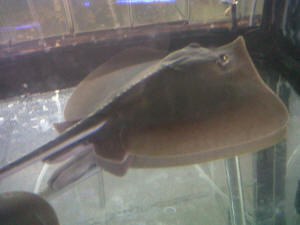
Could someone help me with a question about a stingray?
<Will try.>
Some guy is selling 6 fresh water stingrays, the biggest is about
10" disc wide I think a mature male as I observed the
claspers (rigid and thick). My question is: could I acclimate
this rays to full saltwater?
<Does depend.>
he said he collected them in the gulf of Mexico in a river that
is too close to the coast and the water
<I'm assuming that these are Atlantic Stingrays (Dasyatis
sabina). Most of these do indeed come from brackish to marine
environments, typically estuaries and shallow coastal waters. So
yes, these specimens will do just fine in fully marine conditions
(though not at tropical temperatures, so please do understand
that these are subtropical animals and unsuitable for life
alongside typical tropical marines sold in pet shops). However,
there are populations of Atlantic Stingrays confined to rivers,
notably St. Johns
River in Florida, and these seem to be fully adapted to
freshwater conditions, not making migrations into the sea at all,
even to breed.
Brackish water is probably upwards of SG 1.005 at 25 C would be
recommended for "normal" Dasyatis sabina, while the
"freshwater" populations could be kept in either
freshwater or up to SG 1.005 at 25 C. In other words, confirm the
salinity of the environment where they were collected, and set up
their aquarium accordingly.>
there is brackish but he keeps them in freshwater with a few
amount of salt used for FW tanks, I send you 2 pictures (not too
clear cause were taken with my cell phone)
but hope you could identify the species.
Thanks as always and Happy New Year to all...
Wilberth
<Do see, for example,
http://www.sms.si.edu/irlspec/dasyat_sabina.htm
http://nersp.nerdc.ufl.edu/~pmpie/dsabina.html
Cheers, Neale.>
<Sorry, these are subtropical animals, and specific gravity
varies with temperature. So for the brackish to marine ones
you'd be aiming for 1.007 at 18 C, i.e., about 9 ppt, and for
the freshwater river ones, up to 1.007 at 18 C. Cheers,
Neale.>
|
 .jpg) |
Re: FRESHWATER STING RAY IN
SALTWATER? 1/6/11
Thanks a lot for your answer Neale, so you say I shouldn't buy
them for my marine tank?
<Only if you know it's an estuarine/marine one as opposed to
a freshwater one. And even then, not for a tropical marine
aquarium. Unless you're keeping subtropical marines, you'd
need to set up a tank just for this specimen. That being the case,
you'd be setting up a large, shallow aquarium several hundred
gallons in capacity and set to a temperature of about 18 C/68 F.
Setting the salinity to about 9 ppt should suit both
brackish/marine and the freshwater sort. So it's really not a
big deal -- it needs its own tank whatever happens!>
Unfortunately I can't verify the salinity of the waters they
were taken from as I'm 250 miles away.
<The collector should know. If they're being kept in
freshwater or very slightly brackish, then they're presumably
from the freshwater population that are happy in low-end brackish
conditions as mentioned earlier, but the brackish/marine specimens
will adapt to such conditions too. Cheers, Neale.> |
FW Stingrays and Jungle Aquarium Plant Care Solutions -
10/21/10
Hi I've had a stingray for six months and decided that I wanted to
plant some plants in the aquarium. I have two Peacock Bass and a Retic.
Stingray in the tank, the tank is 90 gall. I will soon be upgrading to
at least
180-210 gall, the tank is run by a Fluval FX5 filter. My question is,
are Jungle Aquarium Plant Care Solutions fizzing tabs ok to use with
the stingray? Because I know rays are touchy about chemicals used in
the aquaria and I don't want to do anything rash and hurt or kill
the ray. I have searched the web and have come up empty hopefully you
guys can help.
Thanks,
Ron
<Hello Ron. This is a pretty easy one to answer. Don't use the
fizzing tablets. Not only are they pointless so far as plant growth
goes -- the CO2 will bubble out too quickly to be much use -- messing
about with CO2 will lower pH and stress your fish. It's hard to
imagine any situation where the high oxygen, high water turnover
conditions stingrays need would be maintained alongside the high CO2,
low turnover conditions plants prefer. Plus, stingrays uproot delicate
plants anyway, so you're best using epiphytic plants on bogwood
roots, such as Java Fern and Anubias, and these couldn't care less
about CO2. Likewise, floating plants such as Indian Fern, which would
be extremely worthwhile in a stingray tank as nitrate removers, get
their CO2 from the air. So far as trace minerals like iron go, you can
use liquid fertilisers to add these with each water change, should they
be required. Hope this helps. Cheers, Neale.>
FW Stingrays and Jungle Aquarium Plant Care Solutions
<PS. You should either have no substrate or a very thin layer of
smooth silica sand, and in either case, rooted plants couldn't be
grown. Deeper substrates are hard to clean and tend to promote
infections on the ventral surfaces of stingrays, at least under
aquarium conditions. Cheers, Neale.>
Re: Stingrays and Jungle Aquarium Plant Care Solutions -
10/21/10
Thanks Neale,
I was planning to plant on bog wood anyway I guess I failed to mention
it. What other plants besides java fern and the Anubias would grow well
on the bog wood I have been doing more research on fertilizers that are
safe to use with rays then actually the types of plants that I would
like to use.
But I have read in my research that everyone uses black cotton thread
to attach plants to bog wood, is this just for looks or does it matter
if another color is used such as white, sorry for all the tedious
questions.
Thanks again,
Ron
<Hello Ron. Java Fern (both the regular kind and
"Windelov") and the various Anubias species (there are
several) are the best bogwood plants. Bolbitis heudelotii is another
option, but it's a finicky species that's difficult to grow.
Java moss is another epiphyte but when kept with big fish tends to get
destroyed, so I wouldn't spend a huge amount of money on Java moss
before trying out a small clump first. Because all the epiphytes grow
slowly, you almost don't need to use fertilisers; simple water
changes, plus the wastes from fish, should produce enough mineral
nutrients. Yes, black cotton is used because it isn't
noticeable
underwater. You could use red, white, blue or any other colour if you
wanted. I've used rubber bands and lead strip as well. Sometimes
you can simply wedge rhizomes or stolons into cracks on the bogwood.
Cheers, Neale.>
Re: Stingrays and Jungle Aquarium Plant Care Solutions -
10/21/10
Much thanks,
Ron
<Most welcome. Cheers, Neale.>
Freshwater Stingrays, comp. 6/8/10
Hey, how's it goin? I was hoping to get a little advice on
tankmates for a freshwater stingray.
<Hope you have a gigantic aquarium!>
I had kept them with Silver Arowanas but they grow very fast and I
would like to switch things up.
<Meaning what? You're rehoming the Arowanas? That's good,
because Osteoglossum bicirrhosum is not really suitable for home
aquaria. It's far too large.>
I really like Frontosas.
<Not a good choice here.>
Would it be possible to keep one of these gentle giants with a ray?
<No.>
I know they have different ph requirements.
<It's not the pH, it's the hardness. That you're talking
about pH worries me, because that's a "newbie" level of
comprehension, if you don't mind me saying so. Fish don't mind
about pH, but they do mind about hardness, both
general hardness and carbonate hardness. I'm assuming you're
keeping your Stingray in fairly soft water, up to 10 degrees dH.
Cyphotilapia frontosa needs water that is much harder, and in
particular needs a much higher level of carbonate hardness so that the
pH is steady at around 8. There's really no overlap between what
the Cyphotilapia needs and what the Stingray needs.>
But I was told the stingray can adapt to a higher ph.
<Told by whom?>
If this is not possible can you steer me in a better direction?
<Before you spend one more penny, run to your nearest bookstore and
buy a copy of Richard Ross' excellent 'Freshwater
Stingrays' from Barron's. If you can't afford the less than
$10 for book, you can't afford to keep a
Stingray. Simple as that. Do remember almost everyone who buys a
Stingray kills it prematurely. The mortality rate among these animals
is horrific.
Maybe one in ten survive the first year. All experts agree that they
are best kept alone, and if you have a burning need to spend money,
then you'd be better off buying a larger aquarium, bigger filter,
and preferably an RO unit for producing nitrate-free tap water.>
I appreciate your time and knowledge. Thank you, Aaron
<You are most welcome. Cheers, Neale.>
Re: Freshwater Stingrays 6/8/10
The tank is a 180 gallon.
<Far too small for Stingrays.>
I just converted from saltwater back to freshwater. I have not bought
anything except some Danios to cycle the tank.
<Okay.>
I have kept the stingray and Arowanas combination in the past.
<Can work, though some Scleropages are highly territorial, e.g., S.
jardinei, in which the combination is very risky.>
Yes, I had to rehome two of the Arowanas.
<I see.>
Which is why I do not want to go that route again.
<Wise.>
I had kept my stingray alive and healthy for a good two years and
decided to try saltwater.
<Did you give away the Stingray? Seriously, 180 gallons, especially
180 US gallons, is far too small for an adult Stingray. It's not so
much the gallons as the square feet. Remember, a Stingray aquarium
needs to be 4 times as long as the Stingray's disc width, and at
least twice as broad (front to back) as the disc width. For a common
Stingray like P. motoro, we're talking a 45 cm/18 inch disc width,
in which case the aquarium needs to be 6 feet long and 3 feet broad.
That's a huge aquarium! Even the "small" species P.
reticulatus isn't much smaller than that, over 30 cm/12 inches
across.>
Was not too impressed.
<Nor was I, which is why I stick with freshwater!>
Really wish I had kept the ray. I had been reading a forum and they
were discussing the combo I asked about. I figured it wouldn't
work. I am not a newbie. Don't mind you saying so.
<Cool.>
Have been keeping fish for 15 years or so. Everyone has a different
opinion as to what is right and wrong.
<Which is why I really recommend that Richard Ross book. It's
very, VERY good.>
Very hard to find a good LFS. Which is why I prefer your info. Any
other suggestions?
<Tankmates for Stingrays are tricky because [a] each fish of similar
size doubles the rate at which ammonia, nitrite and nitrate accumulate;
and [b] even relatively docile fish, such as Plecs, can cause physical
damage to the Stingray, and treating any subsequent infections is very
difficult.
Among catfish, that standout species is Sorubim lima, a very peaceful
species best kept in pairs or trios. Quiet South American cichlids such
as Oscars and Rotkeil Severums can also work well, the latter being
particularly colourful as well as herbivorous, so there's limited
competition for food. If you can find them, Canara Pearlspots would
probably work well, too -- but you'll pay a pretty penny for these
beauties! Bichirs are sometimes kept with Stingrays, but I'd be
wary about this because both compete for living space at the bottom of
the aquarium.
Medium-sized tetras, like Congo Tetras and Silver Dollars can work
nicely if kept in a big school, but you have to choose species too big
to be eaten while not so aggressive they're a hazard to the
Stingray.>
Thank you.
<Cheers, Neale.>
Re: Freshwater Stingrays 6/8/10
Yeah, I gave the stingray back to the store. I know my tank will not
house a stingray as it gets bigger.
<Mine neither. But there are some excellent oddballs you could keep
in an aquarium this size. Look at Bichirs for example, especially
Polypterus ornatipinnis and Polypterus delhezi. Among the medium to
large sized predatory characins are Ctenolucius and Boulengerella, both
of which are very peaceful towards fish they can't actually eat. If
you know where to look, you can find some stunning Loricariidae, such
as the bizarre colour-changing whiptail Pseudohemiodon apithanos, a
species that lives on sand and pretends to be leaf litter. Schools of
Anostomus anostomus are exceptionally beautiful, but if you want a
challenge, what about Pike Cichlids, Mormyrids, Fire Eels or Tetraodon
lineatus? Really, the list of unusual freshwater fish is inexhaustible,
you just have to be prepared to
shop a little harder.>
I had what the store calls a teacup. I know they are only referring to
size when they say teacup.
<Indeed, but is commonly P. reticulatus these days.>
But I was able to keep him for two years and could have had him even
longer if I didn't decide to make a dumb decision and try
saltwater.
<Oh.>
I may decide to go in another direction, who knows. Just trying to
figure out exactly what I want to do with the tank. I may go the route
of African Cichlids again.
<Can be a great choice, but many people end up with a mish-mash of
fighting, hybridised cichlids. Do spend some time reading here and
elsewhere before embarking on this. Planning is crucial.>
Thanks.
<Cheers, Neale.>
Question re. stingray "thorns" 5/5/10
Hello,
<Hello,>
I have two P. leopoldi stingrays in an 865 gallon system (no
tankmates).
<Fantastic! Sounds a really good size for this species.>
I have read extensively (including your web site, thank you!) and still
have a couple of unanswered questions.
<Fire away.>
1. My stingrays have three rows of vertical spikes on their tails.
I've read they are called "thorns." Do they shed these
periodically, the way they do their tail barb?
<While the stinger is shed periodically, the dermal denticles on
their dorsal surface generally aren't.>
2. My stingrays are in a round open pool in my basement. How far below
the edge do I need to keep the water level to ensure they can't
jump out? I've observed them push half their disk diameter out of
the water trying to climb out. Can they do more than that? I've
securely netted the pool to be safe. I'm just wondering ...
<I think what you're doing now is about right. Stingrays
aren't "jumpers", but most public aquaria do ensure
there's around 30 cm/12 inches between the waterline and the edge
of the pool. Experience has taught me not to underestimate the suicidal
tendencies of fish! I've seen a small pufferfish jump several
inches out of the water into a filter overflow, so I'd tend to be
careful with something as potentially powerful as a stingray.>
Thank you for your wonderful site!
Margie
<If you haven't already, do track down Richard Ross'
excellent stingray book from Barron's. Well worth having to hand if
you're keeping these difficult fish. I must say, I'd love to
see a photo of this pool! I have
trouble finding places for 20 gallon tanks, so an 800 gallon tank would
be a dream come true! Cheers, Neale.>
Setting up freshwater ray tank 3/16/10
I am changing my 180 gal salt tank to a freshwater. I want to get two
freshwater rays
<What/which species? A 180 gallon stock dimensions won't fit
many...>
that have been at my LFS for the past few months.
<Good to have them stabilize there>
Nice pair and they eat regularly. They are in a bare bottom tank now
and I was wondering if to go the same route.
<Mmm, I prefer fine sand... have you read re on WWM?>
I understand you need to be very careful with any substrate and since I
can't be sure, I think it wise to go bare, no?
<Please read here:
http://wetwebmedia.com/FWSubWebIndex/fwraysysfaqs.htm
and the linked files above>
I got a nice large piece of slate and wanted to construct a shelf life
structure. Maybe a stupid question, but to use bricks to hold it up (I
want as small a footprint as possible to leave more open space on the
bottom), might there be materials in common bricks that could be deadly
in a fish tank?
<These can often be used... are chemically inert>
Other option - just to use pieces of pvc pieces to hold it up?
<Can/could... but better to have low illumination period... use
floating plants...>
Any suggestions?
<See WWM re...>
Thanks,
Mark
<Welcome. Bob Fenner>
Discus Fish, incomp., FW ray sys. 2/1/2010
Good morning Crew,
I'm considering adding Discus to my 240 gallon aquarium.
I currently livestock:
1ea.14" Arowana
1ea. 5" African Knife
1ea. 5" Black Ghost Knife
1ea. 6" Bala Shark
1ea. 6" diameter Retic Rey
4ea 2.5" Clown Loaches.
<I'd worry about housing this bunch of fish before adding
anything else.
240 gallons is borderline for Stingrays, and marginal for Arowana. Bala
sharks should be kept in groups, and the Clowns are messy fish at the
best of time. You have some big, territorial species in there (e.g.,
Arowana).
The poor Xenomystus is going to be very put upon eventually, assuming
he doesn't end up as dinner.>
So my biggest concern is necessary water quality and parameters for the
Discus. I've already made my tank very water change friendly, in
that all I have to do is open a valve and filtered water enters the
tank and an overflow allows water to leave. I did this in consideration
of my Rey's water quality needs.
<Neat. But still, without knowing anything about square footage, I
have to remind you Stingrays need a tank with a width twice their
mature disc diameter, i.e., at least 2 x 12 inches in the case of
Potamotrygon reticulatus, and five times the length of their disc
diameter, i.e., 5 x 12 inches. So, we're talking a tank 24 inches
front to back, and 60 inches left to right. Common Arowana
(Osteoglossum spp.) are even more demanding: they do get to about a
yard long.>
The various online Discus vendors I've spoken to have assured me
that Ph is not a problem as long as it is consistent. Do you think
these vendors are telling me the truth, or just trying to sell their
fish?
<For farmed Discus, this is indeed true. Farmed discus will do well
in neutral, moderately hard water. Wild-caught Discus are much more
picky.>
My LFS tells me that Discus have very specific Ph requirements, and
that the tap water in our area would require adjustment and constant
monitoring. I adore Discus, but I don't want the expense nor the
hassle of maintaining a specific Ph in a 240 gallon aquarium.
<Academic really. There's no way Symphysodon will work in this
system. The Arowana will terrify them. Discus are best kept with small,
peaceful tankmates. Ideal companions include Corydoras sterbai,
Rummy-nose tetras,
and Silver Hatchetfish. Some of the Southeast Asian gouramis work
rather well, too.>
I value your knowledge and experience, and will consider your advice on
this subject the final word on whether or not to continue to pursue the
addition of Discus to my hobby.
<Strongly recommend against.>
Thank you,
Pat
<Glad to help. Cheers, Neale.>
Re: Discus Fish 2/1/2010
My 240's footprint is 96" by 24"
<They you tank is right at the minimum range for width for the
Stingrays, and too small for Osteoglossum. Think about it, this Arowana
will be 36 inches in length, so how's it going to turn around in a
tank 24 inches wide? This is one reason Osteoglossum aren't
(thankfully) all that often traded. Asian Arowanas, Scleropages spp.,
tend to be a bit smaller, though markedly less tolerant of tankmates.
Scleropages jardinei for example is positively psychotic! In any case,
Discus aren't an option. Osteoglossum are riverine fish that need
strong currents; Symphysodon are fish of the sunken forest, and live in
habitats with very gentle water flow. No overlap at all. Cheers,
Neale.>
FW stkg... Ray, no... -- 1/28/10
Hi, I have a 46 gallon bowfront tank with a 10" fire eel and
8" black ghost knife fish.
<46 US gallons I take it, 175 litres? Already overstocked given the
size of these fish now, let alone when full-grown.>
Would putting a small sting Ray in there be ok?
<Not a chance.>
I'm not sure if the eel and Ray would be comparable, I also have a
125 to move them to when they get bigger, but I would like to stay with
a smaller breed.
<The 125 gallon tank is sensible for the Spiny Eel. But still far
too small for a Stingray.>
Also how fast do stingrays grow?
<Stingrays either grow fast or else are dying. There is no such
thing as a "small" Stingray. Even the smallest species have a
disc width of about 12 inches, and the aquarium they are kept in needs
to be at least twice that (i.e., 24 inches) from front to back, and at
least five times that (i.e., 60 inches) from one end to the other. Do
start by reading here:
http://www.wetwebmedia.com/FWsubwebindex/fwraysysfaqs.htm
Then buy Richard Ross' book "Freshwater Stingrays", which
costs less than $10. If you can't afford that, or aren't
prepared to spend $10, then there is NO WAY you can or should be
keeping Stingrays. Simple as that. Stingrays
are extremely expensive to house (need huge tanks) and to maintain
(need huge filters and massive water changes of nitrate-free water).
The sad fact is most Stingrays die within a few months of purchase
precisely because people ignore these issues.>
thank you, you guys are truly the best!
<Kind of you to say so. Cheers, Neale.>
FW rays tank 1/25/2009
Hello, I have 2 freshwater p. Reticulata ray that are currently 6 inches
diameter, and I know they will get bigger. they are currently living in
a tank that's 6 feet long by 16 inches wide with a tankmate of an
12 inch lima catfish and 3 quarter size angelfish for the last 2
months. Would a tank that 24 inches wide and 4 to 5 feet long be a
better tank for them?
Thanks
<Potamotrygon orbignyi (varieties of which aquarists and wholesalers
call P. reticulatus) gets to 35 cm (14 inches) in disc diameter. The
final aquarium you buy for these fish should be at least twice the disc
diameter in width, front to back, and at least five times the disc
diameter in length, from left to right. In other words, at least 2 x 35
cm wide = 70 cm (about 27.5 inches) and 5 x 35 cm long = 175 cm (about
69 inches). Don't bother economising. Many have tried, and
they've mostly failed. There really are non-negotiable limits on
tank size when it comes to Stingrays,
making them expensive pets, which is precisely why I don't keep
them.
Cheers, Neale.>
Fish (Potamotrygon and Balantiocheilos; cohabiting)
1/18/10
Can Bala sharks live with rays if in correct tank size? Thanks
<In theory, yes, but unless you're running the Shedd Aquarium
it's hard to imagine you'll have a tank the correct size. I
mention this because Stingrays need huge tanks to do well, a tank twice
the disc width of the species front to back, and at least three times
its disc width from left to right. This would be about 6 feet long and
4 feet wide for the "small" species usually sold, like
Potamotrygon Motoro that get to 18-24 inches in disc width. Let's
say you start with a tank 6 feet long, 4 feet wide, and 2 feet deep,
that's 48 cubic feet, or 360 US gallons. Oh, you say to me, surely
most people keeping stingrays don't have tanks that big? Indeed
not.
And most people keeping stingrays end up with dead stingrays. Very,
VERY few people keep them alive for anything like their natural
lifespan, often losing them within the first year. Let's say a
group of three or four Bala Sharks needs another 125 gallons on top of
that (a conservative estimate, given their adult size and need for
company of their own kind). We're then looking at a tank nearer 500
gallons. To be sure, you could get by with less volume if the
filtration was extremely robust and you did massive water changes, but
given the cost in RO water to reduce nitrate levels, plus the minerals
you'd need to harden the RO to the appropriate water chemistry,
it's still very expensive. So, think VERY carefully before
embarking on a project like this. If you haven't already bought
Richard Ross' excellent (and very cheap) book "Freshwater
Stingrays", do so NOW; it's the best $9 you'll ever spend.
If you can't afford that book, you can't afford to keep a
stingray. Cheers, Neale.>
|
Question about Motoros, sys., beh.
1/18/10
Hello!
Just a quick question how long does it take for a stingray to
settle down when moved into a new tank?
<Does depend on the size of the tank, water quality, and to
some extent things like bright light (don't like them) and
loud noises (don't like them either).>
Have a 15month old Motoro . He is just showing signs of swimming
in the center and on the current in one corner of the tank. Know
that means he is stressed.
<If he's actively swimming into one particular water
current, that may imply a lack of water circulation elsewhere in
the tank. Do remember that the bottom of the tank is furthest
away from the air, and therefore contains the least oxygen. Water
circulation needs to be very strong at the bottom of the tank, so
that oxygen is pulled down from the top of the tank to the
bottom, replenishing the oxygen there as fast as possible. Do try
adding a powerhead or airstone, and seeing if that helps.>
Everything else is normal.
<Cheers, Neale.>
Re: Question about Motoros... sys.
1/23/10
Hello Neale!
Maria here. I sent you guys a question about my 15 month old
Motoro and about his swimming in one spot.
<Yes, I remember.>
I forgot to add that I do have several air lines in the tank and
three filters that are def. allowing a lot of current in the
tank.
<Certainly looks that way from the photos. Do try moving the
spray bars and outlets about though, just to see if that makes a
difference.>
I can tell b/c my black tetras try and swim thru the current. And
other suggestions of what I may put in the tank to make it more
oxygenated at the bottom if that is the prob.
<The thing with airstones and bubble walls is that they
don't actually move much water. They're a relatively
inefficient solution, which is why you mostly see them in books
written before the 1980s. Most fishkeepers today keeping
difficult fish -- like stingrays -- have opted for powerheads
instead. These can be clipped onto the aquarium anywhere you
want, and produce good, strong currents for relatively little
electricity. They're also silent. Do have a look at things
like the Koralia Powerhead and other equivalent brands. What
you're after is rather than just one wall of rising water (as
you have now, at the back) a current of water that is equally
strong but evenly spread out.>
He is still eating great!...
<In which case, I wouldn't worry too much. As/when
you're upgrading the tank to a bigger one, that may be the
time to take a more holistic approach to water current. Rather
than adding lots and lots of airstones, look at marine aquaria
(maybe even buy one) and use a big pump for a filter in the sump
and then one or two powerheads stuck on the glass elsewhere to
add a bit of extra push in the corners furthest from the
pump.>
Sending some pictures of the tank system. Hope you can help me
once again!
Thanks!
Maria
<Good luck, Neale.>
|
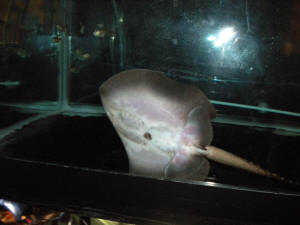 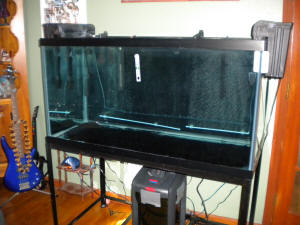 |
FW Rays... sys., comp., 12/27/09
Hello,
<Hi.>
I have 2 freshwater reticulated 6 inch diameter rays. Male and female.
My tank is 6 feet long by 18 inches wide and 24 tall. I have 300
gallons of filtration
<I'm not sure what you mean by this. Do you mean you have a
filter "rated" for a 300 gallon tank? Or you're turning
over 300 gallons per hour? These rays are some of the more sensitive
rays in terms of making it "through" trauma after shipping,
and yours are still quite small. Pristine water conditions are going to
be necessary. I would ensure that you're getting 8 to 10 times
turnover of your tank's volume per hour for these sensitive fish.
In addition, it's best to test regularly with these fish -- when
kept well, they eat a surprising amount, and all of that food comes
right back out as waste. You'll want to catch any potential
problems with the biological filter quickly in order to keep them
healthy. Also, frequent water changes are necessary to keep Nitrate as
low as possible.>
and will be getting a 200 to 300 gallon tank in about a year or so.
<This sounds good! Do make sure that you pay attention to footprint
when selecting the new tank. You're going to want something at
least 32 inches wide to allow for their growth to adulthood. Also,
volume is your friend when it comes to keeping sensitive fish -- the
more water to dilute their waste, the better. This is true with any
fish, but especially with rays, as they are so sensitive to
Nitrate.>
I was wondering if I can get a Severum, a 3-8 inch silver Arowana
depending what's best, or a shovelnose catfish? Whatever's
best.
<Well, some fishkeepers have had luck keeping rays with various
Cichlids, and some haven't! It really depends on the individual
personalities of the fish involved. I would skip these tankmates for
now, and allow the rays to get some size on them and become really
established without having to worry about picky tankmates. As for the
Arowana, the 3-8 inch fish you got right now would likely outgrow this
tank within a year. They are very fast growers! This would compound the
issues you're going to have keeping this water good and clean for
optimal growth from the rays. However, Arowana are often considered
good tankmates for rays, since they are primarily top-level fish, so
this would be something to think about after the upgrade, if you choose
to go with a tank 300 gallons or larger, with the right dimensions, and
the right filtration, and he is the only other tank mate for these
rays. Silver Arowana usually reach about three to three and a half feet
in aquaria, and would need a tank with a pretty large footprint and a
heavy-duty, latching top. Lastly, I'm not sure what you mean by
"shovelnose catfish," as there are several catfishes with the
"shovel" nose, but if you mean a Tiger Shovelnose, this is
not a good idea -- these fish grow three to four feet in captivity, and
would need a larger tank than you're planning on upgrading to due
to the amount of bioload they place on a system -- catfish like to eat!
Another problem is getting food to the rays with such a hungry bottom
dweller in the tank -- it can be difficult. In addition, the bottom of
this tank is going to be crowded pretty soon -- if these rays are six
inches in disc length, then they're probably almost double that in
total length. I'd hold off on adding tankmates until you have these
guys in a bigger system, with robust filtration. This system is likely
to be very "crowded" within the year!>
Thanks
--djrock856
<You're welcome. Please feel free to write back if you have any
other questions.
--Melinda>
Re: Rays, FW, sys. 12/28/09
My tank is 20 in wide 24 tall and 6 ft long.
<That's 34560 cubic inches, or 20 cubic feet, or 149 US gallons.
So, the volume is enough for one adult Potamotrygon, assuming regular
50% water changes and generous filtration. HOWEVER, as it is only 20
inches front to back, it's actually suitable for Potamotrygon with
disc diameters less than 10 inches (25 cm), and since there aren't
any traded species that small when fully grown, it's actually
useless for adults. Hope you're planning on
a bigger tank real soon! Let me repeat for absolute clarity, most
people keeping Potamotrygon spp. end up with dead fish. The odds must
be something like 99 dead fish for every 1 that lives 2+ years (their
lifespan in the
wild is probably 10-20 years). Trying to do things on the cheap
won't work.
Adults need tanks AT LEAST twice their disc diameter front to back. I
couldn't possibly afford to keep these fish, so despite my skills
with freshwater fish, I wouldn't dream of buying a Stingray.
Cheers, Neale.>
Re: Rays
I will be getting a 300 gallon in 6 months to a year.
<Cool. But as stated, it's the front-to-back measurement, as
well as the length, that count... if the tank is narrow but deep, the
volume may seem okay but the tank will actually be inadequate. If you
haven't already bought Richard Ross' excellent and inexpensive
(under $10) summary of Stingray care, rush out right now and order a
copy. As I've often stated on WWM, if you're too poor to buy
this book, you can't afford to keep Stingrays. It's really that
simple. Most Stingrays die through lack of planning, and the resulting
problems with tank size, filtration, nitrate
control, diet, etc. This book will set you up nicely beforehand.
Cheers, Neale.>
Re: Rays
K, ill have to go get it.
<Cool. Good luck! Neale.>
Emergency! My Motoros are in danger :[ (RMF, second
opinion?) -- 11/10/09
Hello!
<Hello,>
After probably about a year of reading your site and procrastinating, I
decided to purchase some beautiful p. Motoro Stingrays.
<Hope you bought a book first. And a gigantic aquarium. And an R/O
filter.
Seriously, only about 1 in 100 aquarists have the funds to keep these
fish properly, and the sad truth is that most Stingrays end up dead
within a year, often within 3-6 months. There's an excellent book
by Richard Ross on Stingrays published by Barron's that sells for
less than $10. By my reckoning, if you can't afford this book, you
can't afford Stingrays.>
I've owned them for about a year now, and they've been thriving
in their 6'x4'x1' tank.
<Cool. But after a year, they're ready for a bigger
tank.>
I use 3 "heavy duty" sponge filters, for lack of a brand name
on the item.
<Fair enough. But this should probably be augmented with some type
of canister filter that can remove solid waste on a continual basis.
Organic matter that collects on the substrate is a have for bacteria,
and this in
turn makes it more likely infections will develop. There's a
ongoing argument about whether the tank should even have a substrate,
some suggesting a clear glass bottom is easier to keep clean. While
that may be
overkill (and isn't much loved by the Stingrays) there is certainly
much to be said for a canister filter with massive turnover (8-10 times
the volume of the tank in turnover per hour). This will remove silt and
debris
quickly.>
I do 30% water changes every 3-4 days, and sometimes a 50% at the same
rate, depending on how messy their tank looked.
<Hmm... pre-emptive maintenance is critical here: you clean the
water such that there never is any mess in it.>
Perhaps a silly way of doing things. PH 7.2, Ammonia 0, Nitrite 0,
Nitrates always low, sand substrate. There are no plants or rocks. Just
filters, sand, and fish.
<OK.>
I feed them 1-2 Nightcrawlers a day, and small amounts of Krill at
night.
Once every 2 weeks I give them each 2-3 Ghost Shrimp to play around
with.
<Fine.>
Well on to the subject, sorry for the rambling. I woke up one day, and
my tank almost looked like milk.
<Eek! Likely a bacterial bloom thanks to excessive organic material
in the water.>
I could see about 5-6 inches into it, but nothing more.
<Can we assume this wasn't silt (from the sand) or a diatom
bloom?>
When I finally found my stingrays they were alive, but having a lot of
trouble breathing.
<Does sound like a bacterial bloom. Silt and diatoms are harmless,
if unsightly.>
I instantly water tested and everything looked fine, but I did a water
change nonetheless (it'd been about 2 days since the last one).
<Your water tests don't measure bacterial counts, and that's
the issue.>
This seems to have only made it worse. I rushed up to the store
who's employees I've trusted for a long time, and they said
everything should be fine just wait it out.
<Almost never a good idea with Stingrays. The best approach is to do
a series of water changes across the day, maybe 25% every couple of
hours, so that you can totally flush out the system. Obviously, water
chemistry must be identical, so check the pH of both old and new water.
Don't do this if you're using tap water that experiences pH
changes after it's been drawn.
If you're using RO water and hardening it with, for example, a
small quantity of Rift Valley salts (the ideal approach) then this
shouldn't be an issue.>
I come home and my female is floating on the top breathing through her
spiracles!
<Not sure they can do this. Do you mean she's gasping at the
surface?
Again, suggests a bacterial bloom; bacteria consume oxygen, creating
eutrophic conditions, removing oxygen from the water, suffocating the
fish.>
At this one I did another 50% water change (2 in one day) and loaded
the tank up with dechlorinator. I had feared I wiped out my bacteria
colony, because apparently my city adds chlorine at this time of
year.
<The RO filter you should be using should sidestep the
issues.>
I'm not really sure where to go from here, and I really don't
want to lose my stingrays :[
<Indeed. I really cannot stress too strongly that the problem is
likely environmental, and more specifically, a tank too small for these
fish. In the short term, massive water changes while keeping water
chemistry stable
will help, and adding a sump to the tank may increase the volume
adequately to get you through the next few weeks or months. But longer
term, Potamotrygon motoro needs a much bigger tank than you have, and I
suspect eutrophic conditions in the tank are at fault here, and noxious
to your livestock. Cheers, Neale.><<I do concur w/ all
you've stated Neale. BobF>>
Re: Motoro Stingrays in danger! -- 11/10/09
I really hate to spam you guys, and I apologize for this.
<Not a problem.>
I somehow forgot to add this to my last query. My female Motoro also
has a large hump on her rear right side. It's raised higher than
the left sides hump, and it appears to be causing her rear to float.
She's been
constantly fighting to get back to the sand.
<Can't be specific, but likely a reaction to anoxic, or poorly
oxygenated, conditions in the tank. Especially at the bottom of the
tank (which is why Stingray aquaria need massive water circulation that
pulls water down and across the substrate). Treatment options are very
limited with Elasmobranchs generally, so would concentrate on
optimising water quality and chemistry. Do read here:
http://www.wetwebmedia.com/FWsubwebindex/fwraydisfaqs.htm
Cheers, Neale.>
Re: Emergency! My Motoros are in danger :[ --
11/10/09
Thank you so much for the quick and informative reply!
<Happy to help.>
Yes she was gasping at the surface.
<I see. Fish do that when oxygen levels at the bottom are
insufficient, and given the cloudiness of the water, there's good
reason to assume that there's either insufficient circulation or
else something in the tank using
up the oxygen. Bacterial decay is the classic example. Look for organic
matter, clogged filters, uneaten food, stuff in the substrate,
etc.>
Aside from water changes is there anything else I should be doing? I
can afford whatever it takes at this point to keep them alive. Would
adding some airstones help?
<Extra circulation, including airstones, would help, but whether
they'll fix the problem I cannot say. Your immediate concern is to
change the water as quickly as possible without exposing the fish to
dramatic water
chemistry changes. You also need to clean the aquarium, check the
filter, sift the substrate, and check for any other problems. Cheers,
Neale.>
Stingray housing and care- 10/25/09
i currently have a tank 5ft long, 2ft wide, 2ft tall which i used to
grow out all of my big fish such as Oscars, mystic sharks and even
piranhas and 1 freshwater turtle.
I'm not really sure what the capacity of the tank is but i
currently have a almost 2ft long silver Arowana, a 1ft long shovel nose
catfish and a tilapia cichlid. the tank is filled about half way until
i can get it properly covered. it has 2 in-tank power filters and 2
sponge filters. if i completely fill the tank will it be adequate to
house 2 tea cup stingrays with the already existing occupants??
<In a word, no.>
my name is Akeem, i live in Barbados so a heater is unnecessary in the
tank since the temperature is constantly warm
<Akeem, bear in mind Stingrays are extremely difficult to keep.
Water quality must be excellent, and there's no way that's the
case with the fish you have in the aquarium you have. We're talking
0 nitrite, 0 ammonia, and levels of nitrate below 20 mg/l. Water
turnover must be generous, at least 8-10 times the volume of the tank
in turnover per hour. They need very large tanks, even when kept on
their own. There is no such thing as a "teacup stingray" --
that's a name used for juvenile stingrays. All stingrays get big,
at least 12 inches in disc width, and in many cases 18-24 inches in
disc width. The aquarium needs to be 2-3 times as wide as
the disc width, and 6 times as long. A typical system would be around
400 gallon. Do read here:
http://www.wetwebmedia.com/FWsubwebindex/fwraysysfaqs.htm
Most stingrays die within a few months of purchase. Before you buy a
stingray, please, buy a book about them. There's an excellent book
by Richard Ross on Stingrays published by Barron's that sells for
less than
$10. If you aren't prepared to spend $10 on a book, then you
can't afford to keep a stingray. Simple as that. They are expensive
to house, expensive to maintain, and extremely difficult to keep
healthy. Cheers, Neale.>
Preparing for first Ray!! 10/13/09
Hello Crew!
I'm currently at the end of cycling for my 140 Reef Ready Oceanic
tank to house 1-2 motoro stingray pups.
<You do realise 140 gallons will last them a couple of weeks? Well,
maybe a few months. Your tank measures 48.5 long x 24.5 wide x 29
inches deep. All Potamotrygon species need a tank that is 5 times
longer than their width, and 2 times wider than their width.
Potamotrygon motoro is a big, fast-growing species that gets to at
least a 24 inch width under captive conditions. So going by the
numbers, your tank will be adequate to a disc width of 48.5/5 = 9.7
inches (by the length of the tank) or 24.5/2 = 12.25 inches (by the
width of the tank). So, being conservative, to about a ten-inch disc
width. Since you have two, not one, specimens, you'd need to be
*even* more conservative, and realistically, you could probably lop off
about a third in terms of disc width, so let's say you tank is
adequate up to a disc width of about 6 or 7 inches. With me so
far?>
My setup includes a FX5, a Pro Clear 200 sump powered by 2- Marineland
3000 (775 gph) return pumps, and an additional Marineland 900(247 gph)
running to a uv filter and then from the uv to the refuge (10 gallon).
The refuge is then gravity fed back into the sump. I'm using
Tahitian moon sand as a substrate (about
½-¾ inch).
<Don't use this sand. It's a glass byproduct and far too
sharp for burrowing or soft bellied fish. The Carib Sea web site says
as much. Either use fine pea gravel, smooth silica sand, or no
substrate at all.>
I also have a whisper 100 air pump driving one round airstone. For
lighting I bought the Odyssea T5 48' (4x54w) light fixture. I have
all lighting on timers so the refuge is lit when the tank isn't and
vise-versa. I was cycling for about 6 weeks, and my test results are:
pH-7.6 Ammonia-0 Nitrite-0 Nitrate-10, GH-0, and KH-9 using an API /
Tetra test kit. I recently added Sphagnum peat moss in hopes of
lowering pH, but the 2 cups of peat I put into my filter sock has had
no affect on pH, which is probably due to my high KH.
<You shouldn't be alternating the pH of water *in the tank*.
That's daft. Potamotrygon are far to sensitive to water chemistry
changes. Peat, as you probably know, slowly changes the pH by adding
organic acids. It does this at a completely unpredictable rate. So,
alter water chemistry outside the tank, e.g., by using a 50/50 mix of
hard tap water and either rainwater or RO water to lower the carbonate
and general hardness levels. Aiming for a pH around 7-7.5 with a
general hardness of 10 degrees dH would be just about perfect. Do
remember biological filters work steadily less well as pH drops, and
below pH 6 stops working altogether. Potamotrygon are far more fussed
about water quality than water chemistry.>
Should I be worried about the high pH?
<Generally no; a steady pH at 7.6 would be well within the
tolerances of this species. Water quality, including nitrate, is a much
more critical issue.>
I have a little Anacharis and Java moss in the refuge and plan on
adding more when I get the ray, or I was also thinking about
hydroponics using Pothos to help with Nitrates.
<Somehow doubt any plant will have any effect on nitrate levels. If
you think about "the wild" and the abundance of plants versus
animals, you'll see you need a lot of plants to "support"
a single big predator like a stingray. For nitrate control, you need to
look at [a] reducing the nitrate going into the tank by using a
low-nitrate water source; and [b] doing lots of water changes to dilute
nitrate as its builds up in the tank. The bigger the tank, the more
slowly nitrate reaches critical levels, but in your small tank, nitrate
will quickly become a hassle.>
I had two Marineland stealth heaters in my refuge but took them out
since my water temperature doesn't get any lower than
80°. It tends to hover around 80-83, which I know is a
little high, but I really don't know how to counter this other than
possibly removing the covers to allow more evaporation.
<Indeed. Or a chiller, or placing the tank somewhere cool and/or out
of direct sunlight. Switching the lights off for a while can help, as
can siting them well above the top of the tank in a "pendant"
fitting rather than inside the hood. Stingrays prefer dim lighting, so
if you can do without plants (and they are pretty pointless in a tank
with burrowing fish) then leaving lights off most of the time may be
helpful.>
I bought the Barron's Educational freshwater stingray book which
has LOTS of good information. So is there anything I'm forgetting
or anything I have overlooked? Thanks Guys!!!
<Read some more. Save up for a bigger tank. Lots of people buy
stingrays, but most of those people end up with a dead stingray within
a few months. These are difficult, extremely expensive fish to
maintain. You need to be able to spend $1000 up front, and $100s per
year keeping them (primarily on the huge amounts of RO water needed to
dilute the hardness and nitrate in your tap water). Cheers,
Neale.>
Fresh Water Stingray 9/1/2009
We currently have a 55 gallon aquarium that we have started with
CaribSea Instant Aquarium Torpedo Beach substrate, we are wanting to
purchase our first freshwater stingray.
<Buy a bigger tank first. While a 55 gallon tank seems massive,
it's a bucket so far as Stingrays are concerned. Ever seen those
small "Teacup Rays" in the shops? Yes? Well, here's the
surprise: there's no such thing.
Teacup Rays are merely baby rays, and even the smallest species will
get to a disc diameter of at least 30 cm / 12 inches, and most more
like 45 cm / 18 inches. At minimum, a tank needs to measure at least
twice the disc diameter from front to back, and that means the very
smallest tank for the very smallest species will be something like 120
cm / 4 feet long and 60 cm / 2 feet wide front to back. Realistically,
successful ray keepers use tanks quite a bit bigger, commonly 180 cm /
6 feet long and 90 cm / 3 feet front to back. This latter tank would
typically be around 400 gallons in size, and even a 120 x 60 x 60 cm /
4 x 2 x 2 foot tank is around 120 gallons in size. Healthy stingrays
grow fast, so one thing you can't do is buy a smaller tank and
upgrade. Well, you can try, but the stingray will die before you
upgrade, because they're so very sensitive to poor water
conditions. I really cannot stress this latter point too strongly.
Here's the acid test. There's an excellent book by Richard Ross
on Stingrays published by Barron's that sells for less than $10. If
you haven't already bought this book, buy it. If you can't
afford to, or don't want to, then you shouldn't keep stingrays,
and if you try, it'll probably die, wasting it's life and your
money. It's really as simple as that. Stingrays are hideously
expensive to maintain across their full 10-20 year lifespan, and to
succeed you need not just money but also time and the willingness to
learn about their needs before buying your specimen.>
We have stabilized the water to where it is almost constantly 80
degrees the PH is between 6 and 7 the nitrite and ammonia is at a
lovely 0.
<Well, a zero ammonia level in an empty tank isn't too difficult
to manage.
The tricky bit is when you have a whopping great stingray in there
eating all the earthworms and river shrimps (not feeder fish!) you can
throw at it.>
We have a penguin dual bio-wheel and also a Fluval canister filter
rated for a 75 gallon aquarium.
<Inadequate filtration. Assuming you have a big enough aquarium,
typically around the 300-400 gallon mark, you're after a filter
with a turnover rate around 6-10 times that of the volume of the tank,
i.e., at least 6 x 300 = 1800 gallons per hour for a 300 gallon tank!
We're talking massive filtration here. No compromises. The people
who keep stingrays successfully use all kinds of filters, from
undergravels to canisters, but in whatever case, they're the best
filters they can assemble on their budget.>
Sadly we keep receiving conflicting information on what time of
juvenile freshwater stingray would be best for our tank right now.
<None.>
Eventually we'll be purchasing a larger tank, but in the mean time
do you have any suggestions on what type of ray would be best for us
and also anything else that would help out our tank?
<For beginners, without question, stingrays are best kept alone.
They are incredibly difficult to maintain, and adding another fish,
even a socially compatible one like an Oscar, simply means the water
gets dirtier faster
and the chances of disease are that much more likely.>
Thank you for your insight!
<Do, please, read the Richard Ross book first.>
Lindsey and Gary
<These are superb fish, but they simply aren't viable pets for
99.999% of the fishkeepers out there -- including me! I don't have
the space, time, or funds to keep one, even if I thought I had the
skills. Cheers, Neale.><<Well done Neale. B>>
Advice for Care of a Freshwater Stingray
8/28/09
Good afternoon...
<Hello,>
To begin, I am consciously trying not to waste your time and I have
done some research on your website (and others) but there is a lot of
conflicting info out there.
<Yes, this is true. But there are some good, inexpensive books on
the market. "Freshwater Stingrays: Barron's Complete Pet
Owner's Manuals" by Richard Ross costs less than $10 and is
very well regarded. It contains all the key information you need to
know.>
Thus, I have to write and ask. First a little background...
I had 2 Freshwater Stingrays (6" in diameter, approximately) many
years ago, on separate occasions. Both died after having them for
approximately 1 year.
<Not an uncommon result.>
The first one died because I introduced Tiger Barbs into the aquarium
(very bad advice from my local store) who, I discovered later, pecked
at the back to the Stingray, causing him to head to the surface. I took
the Tiger Barbs out but the damage was done... he was never the same
and died a about a week later. The second one died from what I thought
was lack of appetite due to wanting only what he was used to. Both
Stingrays were on a diet of live Earthworms (cleaned and segmented)
which they ate happily. Actually, they stalked their prey and jumped on
them (hilarious to watch). In the winter (I live in Canada), I could
not get Earthworms, so I tried switching his food. I bought frozen
Ghost Shrimp, frozen Krill and live Goldfish feeders (I even tried
crushing them a bit for him)... his response was simple: Not
interested. He died about two weeks after he "quit"
eating.
<Healthy Stingrays tend to eat anything and everything. Let's be
clear that feeder fish ARE NOT acceptable. Besides the ethical issue
and the price, and they are also very, very unhealthy. We have
discussed this countless times on WWM, and I'd encourage you to
review the topic before even thinking about this approach again.
Partly, it's about the risk of parasites and the high fat content
of Goldfish, and partly it's because they contain a lot of
Thiaminase.
http://www.wetwebmedia.com/fwsubwebindex/fdgfdrartneale.htm
http://www.wetwebmedia.com/ca/volume_6/volume_6_1/thiaminase.htm
Earthworms and various wet-frozen invertebrates should work well,
including stuff you can buy from a grocery store.>
Now that I read some articles and your responses, I believe my aquarium
equipment was inadequate (more bad advice from my local store). Tank
was too small (55 gal), filter too small
<55 gallon tank not even remotely adequate for Stingrays.>
and I used silica for the floor of the tank (which I have read can
actually scratch the belly of the stingray - - even though it looked
like he liked it and used to bury himself in it from time to time).
<There are two schools of though re: sand; smooth (rather than
sharp) silica sand has been used successfully, but if it isn't kept
clean, can promote bacterial infections of the underside. A plain glass
bottom is easy to clean and therefore less likely to cause this
problem. On the other hand, Stingrays unquestionably prefer a habitat
where they can "dig in" just as they'd do in the wild.
Richard Ross argues that to some degree it depends on the Stingray, the
hardier species being fine with sand or even fine gravel, while the
more delicate species are perhaps best kept in a glass-bottomed tank.
If you do use a substrate, it should be shallow (an inch is about
right) and you must keep it scrupulously clean. Strong water movement
on the BOTTOM of the tank is essential here, and with fine gravel, a
reverse-flow undergravel filter is a VERY good addition to the mix.
Plain sand would need to be stirred and siphoned AT LEAST weekly. The
aim is to avoid pockets of organic decay; whether aerobic or anaerobic,
these allow bacteria to thrive, and increase the risks of opportunistic
infections.>
I also had a piece of Plexiglas on the floor of the tank, slightly
buried in the sand... He would swim a very graceful lap of the tank and
"land" himself by sliding onto the Plexiglas, over and over
again whenever I was in the room. In fact, he used to come to the front
of the tank when I came in the room ("feed me!"). Yes, I miss
him.
<Indeed, these fish can become very tame.>
So, now my questions before I try a Stingray again:
1. Will I likely be more successful if my plan is as follows...
Tank: 90-100 Gallons Filter: 400 GPH (possibly with additional
under-gravel filter) Environment: T 22-24°C, pH=6.8-7.4;
GH=10; KH=6; NO2=0; NO3=10 (or less) Maintenance: Water test... weekly.
New water... 25% of the tank, every 2-3 weeks (adjusted for test, if
required)
<It's still a borderline tank. Let's be clear: for even the
smallest Stingray, you're after a tank some 6 feet long and 2 feet
from front to back. A widely quoted restriction is that the tank should
be TWICE as wide, front to back, as the disc diameter of the Stingray,
which in most species aquarists keep is something like 30-45 cm, hence
the need for tanks 2-3 feet in width. Depth largely immaterial except
so far as the more water volume, the better in terms of water chemistry
stability. Stingrays are very, VERY expensive to house because of this,
and it's the main reason I don't keep them. A smaller tank
might work for a few months, but a healthy Stingray grows fast, and
eventually you will need a bigger tank, so open that savings account
now, and save up.>
2. What should I put on the floor of the tank? Is fine silica really
not recommended?
<As I said above, it's argued both ways. The easiest is probably
a plain glass bottom, but handled correctly, a smooth silica sand kept
suitably clean is more natural and more reassuring to the Stingray.
You'll get to see a wider range of behaviours, including foraging
and hiding. It's just more work to keep Rays in such tanks. Read
Richard Ross' book, and come to your own decision.>
3. Is it ok to feed Earthworms to a Stingray 100% of the time?
<You wouldn't be feeding them on these all the time. Rotate
foods from the get-go, initially offering earthworms and live shrimps
(these latter containing Thiaminase, so gut load them with flake). Then
cycle frozen foods into the mix: whole lancefish, small bits of white
fish fillet, mussels (these also contain Thiaminase), cockles, and
other types of seafood.>
4. In your experience, what is the typical life-expectancy of a
Freshwater Stingray?
<Varies, but wild fish live between 10-20 years, perhaps longer.
Hobbyists seem well able to keep them alive for similar lengths of time
given adequate care.>
5. Could you suggest a few suitable tank-mates for a Stingray (amicable
in both directions, if you know what I mean)? Is it better (or worse)
if he has the tank to himself?
<Without exception, they are best kept alone. Advanced hobbyists
have mixed them with big but docile midwater fish: Oscars, South
American Arowanas, freshwater Siamese Tigerfish species. But every fish
you add speeds up the rate at which nitrate accumulates, so makes your
fishkeeping that bit harder. Avoid anything that lives on the bottom:
catfish, loaches, territorial cichlids, etc.>
6. I plan to purchase "Freshwater Stingrays: everything
about..." By Richard Ross. If you are aware of it, do you know if
this book is any good? Or can you suggest any others?
<As mentioned already, the Ross book is an excellent book.>
Thanks, in advance, for your assistance... it's greatly
appreciated!
- Steve
<Cheers, Neale>
Re: Advice for Care of a Freshwater Stingray
8/28/09
Neale:
<Steve,>
I bet you are busy, so I will keep it short...
A sincere thank-you for sharing your knowledge and insight! I'll be
sure to update you if and when I take on another Freshwater
Stingray.
<Very good. They are hard work to keep, but rewarding.>
- Steve
<Good luck, Neale.>
Motoros, sys. 7/23/09
Hello I've been researching Motoros for a few months & I
had a question I can find an answer too...
<to>
I have a 155 bow front tank ( I know will be outgrown) .
In my tank I have a Pacu & blue Arowana in it!
<Blue? Neat>
I had (for looks only )
reef sand from a previous set up awhile ago I had in storage so I
decided to use it a few years later for my fresh set up for the white
bottom affect .
<What about the chemical, physical effects?>
My Pacu & Arowana seem to be doing fine with it . My ph is just
under 7.0 . My ? Is... Because rays do better in sand, would 1 do well
in a fresh set up with reef sand for the bottom or do I need to change
it out before purchasing a motoro? Please help ... Rick
<Potamotrygonids only do well in fine, soft sand (not sharp
edged)... I do hope/trust this is not silicate... Read here:
http://wetwebmedia.com/FWSubWebIndex/fwraysysfaqs.htm
and the linked files above. Bob Fenner>
Motoro Stingray Tank Size: Think Big! 7/7/09
Hey Crew,
<Hey there, Lynn here this evening.>
I am interested in this species but I was concerned about the tank size
requirements for them.
<You're right to be concerned. Good on you for researching
before purchasing! Also, these are dangerous venomous animals so that
also needs to be taken into consideration.>
From some research, considering the fact that they get well over two
feet, what size aquarium would be suitable for them?
<Bob recommends at least three times the disk diameter of the ray
(~1m for P. Motoros), so that translates to close to 10'. You might
be able to get away with a 10' x 8' system, but obviously the
bigger the better. These guys need plenty of swimming area.>
Even a 180+ aquarium that's two feet in width seems very cramped to
me.
<Yep, that would only be okay when the ray is very small. They'd
outgrow a 180g pretty quickly.>
I was looking into some custom made tanks that have a large base but
not so much the height.
<Yep, the most important dimensions are length/width.>
Having said that would a 4.5' * 4.5' be reasonable?
<Unfortunately, that's not nearly large enough for an
adult.>
From what I understand the volume is not as important as the available
length and width to swim. Is this correct?
<Both are actually very important. Water quality is critical for ray
health, so the more water volume you have, the better. Please read
through Bob's section on freshwater stingrays at the following link
for more information regarding care/requirements:
http://www.wetwebmedia.com/FWsubwebindex/fwstingrays.htm
Be sure to also go through each of the associated FAQ links at the top,
starting with this one:
http://www.wetwebmedia.com/FWsubwebindex/fwraysysfaqs.htm >
Thanks in advance
<You're very welcome. Take care, LynnZ>
FW Stingrays: Sudden Death\Neglected Tank\Toxic Water\
Textbook example of
how NOT to keep a stingray 6/27/2009
<Hi Zeep.>
I had a Motoro stingray for roughly 10 months now, and an Arowana as
its tank mate for about 7 months.
<I hope this tank is huge...>
They co-existed fairly well for the most part.
<Not the best choice of tankmates. Stingrays are best kept in a
species only tank in my opinion.>
The ray got a little nick here and there every now and then, but for
the most part she was left alone.
<and stressed...>
She was a very active ray, always moving around, digging in the soft
sandy bottom. Every now and then she would swim up the side of the
tank. She ate bloodworms from my hand and never showed any signs of
death curl. I never had any issues with feeding her either.
<OK. Hand feeding isn't really advised on a ray that is
classified as "A dangerous venomous fish".>
As far as I could tell, she showed no signs of illness. Her underside
was a very light pink, borderline white.
<Normal>
Nowhere near as red and blotchy as when I first got her, so I figured
it was just her normal underside coloring. She had one black spot in
the middle of her underside. I cant remember a time that I have not
seen this spot, and I have seen a few other pictures of peoples
stingrays with the spot before, so I assumed it was normal.
<Could be.>
My tank is set up with a nice Eheim Pro II canister filter which does
the trick perfect.
<Hmm.... how big is this tank? An appropriate sized tank for a
Motoro ray needs a lot more filtration that one Eheim.>
I have a UV sterilizer hooked up in the tank as well to help with the
water a bit more. Even with the set up however, I still had rather
rapid brown algae growth on the sides.
<Excess nutrients.>
However, I figured it was just because of the blackwater extract that I
put in there every now and then.
<No, that will not cause excessive algae growth.>
The place I bought her from said they added a little bit of that to her
tank every week, and she enjoyed it.
<Likely so.>
I had a few live plants growing over in a corner of the tank. They
thrived and she left them alone for the most part. I only had to
replant them about three or four times when I first got them. After
that, she left them alone just fine.
<OK.>
At first I use to change about 25% of the water every other week.
However after a few months of that I got lazy,
<...and the downhill slide starts...>
I know shame on me. I proceeded to do it about once every two months
for awhile. Every water change I would add some Seachem Prime, and some
Tetra AquaSafe.
<Why both? They perform the same function? Also, stingrays should
have soft acidic water.>
Every other water change I would give the filter a little bit of a
cleaning as well. I'd give the sponges and media a little rinse.
Nothing too much though, just enough to try to keep the filter in
check.
<So you produced a nitrate factory.>
I also place a Hagen Phos-X bag in with the media of the filter. I
replace that every time I clean the filter. For the past 3 months
however, I have been adding small doses of API AlgaeFix.
<Ouch>
After reading your site a bit, I now realize this was toxic, and I
shall refrain from using it again, but at the time I knew nothing of
it.
<Research before adding anything, particularly for difficult
species, like Stingrays.>
Well a little bit ago I hit a real lazy streak and went roughly 4
months without cleaning the tank.
<The downhill slope is getting steeper and we can see the
cliff...>
Every now and then I would top off the tank with tap water treated with
the prime and aqua safe.
Today was the day I ended that streak and cleaned the tank. At 10 AM I
started to clean the tank, and I did about a 40% water change on it. I
also did the filter maintenance today, and that includes putting in the
new Phos-X bag.
<What else? How did you clean the filter?>
However, I also added one more step into today's cleaning. See, I
have always had hard water in my area, and no matter what I tried, I
could never fix it.
<Use Reverse Osmosis water.>
So I decided to try the API Water Softener Pillow. It was more of an
experiment then anything, I just wanted to see if it would possibly
help even a little bit. Not having much hope in it however, I bought
the
smallest one I could find, one for a 20 gal tank.
<Not knowing how large your tank is, I cannot say for certain, but
this is unlikely the cause.>
I wanna say at about noon I was done with it all, the tank was back up
and running and I was done disturbing the waters. Everyone was just
fine, she acted normal as she always has. I continued to periodically
check up on the tank throughout the day, and everything was fine every
time I looked.
I am a night owl who is currently job searching. With that said, when I
checked up on them to feed and shut off the tank lights at roughly 2:20
AM, much to my horror she was upside down on the sand and stiff. The
last time I Saw her alive was roughly 9 PM, and she still looked just
fine.
<...off the cliff and into a free fall.>
I took her out and bagged her up. I examined the body for any sort of
clues to her death. The only 'battle wounds' she had were the
ones she has had for some time now.
<From the Arowana?>
Nothing too serious, and they were healing up just fine. I failed to
find any fungus growth, parasite infestation, or any sort of oddities
like that.
<Not likely to find anything like that. There is very little that
kills that quickly.>
The only thing I found (which I guess would make me a liar, cause it
does qualify as an oddity) was near that black spot on her underside.
Her skin had started to turn a tint of green next to that black spot on
her underside.
<Could be morbid lividity>
I know my water conditions were nothing desirable, but I did what I
could when I could, and she always seemed ok. took a reading of my
water shortly after I disposed of her body. NO3 was reading at about
30, closer to 20.
My NO2 was at .5 and ph was sitting at a solid 7.
<So the water was toxic. What about ammonia?>
Like I said before, my water has always been hard no matter what I
tried to do. With that said my KH was at 240 and my GH was at 180.
However, those are as high as the test strips went, so they very well
could have been higher then that.
<Test strips are notoriously inaccurate. Buy a regular test
kit>
So with my novel now done, I was wondering if someone could help
pinpoint the cause of her death.
<Unfortunately, very easy to determine. Toxic water conditions
caused by neglect.>
Was it the water quality that killed her?
<Yes>
Could it have been the water change that did it?
<You likely destroyed the biological filter when you cleaned the
canister filter out.>
Did the AlgaeFix take its toll on her?
<Not likely.>
Do you think one of my plants are toxic and she ate it?
<No, Stingrays are carnivores>
Possibly some of the chemicals I am adding, aside from algae, caused
her death?
<They certainly weren't helping, but no.>
I'd like to get another ray, but I'm going to wait for a few more
months till we move.
<I would not recommend it. They need huge systems, hundreds, if not
thousands of gallons and pristine water quality Read here:
http://www.wetwebmedia.com/FWsubwebindex/fwstingrays.htm and then read
every linked page at the top.>
So any advice for next time would be highly welcome.
<Unless you are prepared to invest the time and work required to
care for one of these animals, I would go with something easier and
more forgiving.>
<Do read the articles on the following pages related to maintenance
and biological filtration.
http://www.wetwebmedia.com/FWSubWebIndex/fwmaintindex.htm >
Thanks for any advice, Zeep.
<MikeV>
|
Reticulated Stingray 6/27/09
I have some questions regarding my female reticulated stingray.
She is about 5.5-6 inches in diameter.
<Still a pup!>
First off, I should mention that I am the aquatics manager at a
local pet shop. I am very knowledgeable about freshwater fish
(still learning about salt which I don't have at my store).
Water parameters: Ammonia 0 PPM, Nitrite 0 PPM, Nitrate 10 PPM,
PH 8.0, using API liquid test kit.
Temperature is 80F.
<All fine, though the pH is a bit on the high side.>
I live in an area where our tapwater is pretty hard and alkaline,
(about 140-150 PPM). I will soon begin doing water changes with
RO water to dilute that down.
<Very good.>
The tank is a 140 gallon with 2 Aquaclear 70's and a Magnum
350. I don't use any carbon filtration currently.
<While carbon is generally redundant in freshwater tanks,
there's probably an argument for using it in Stingray tanks,
at least as a precaution, and provided it wasn't used at the
expense of biological media.>
I currently have only 2 pieces of driftwood in the tank with fine
gravel.
Tankmates include 5 small (for now) angelfish, 3 clown loaches
(also small for now), 3 German blue rams, and 1 black ghost
knife. I feed once daily with HBH rainbow color flake food, New
Life Spectrum Thera+ 1MM sinking pellets, and my choice of live
earthworms, krill (frozen), bloodworms (frozen), and brine shrimp
(also frozen). I also put in about 10 or so ghost shrimp and
replace them when they are all gone (she really has to work to
catch them!) I alternate the earthworms and krill every other
day.
She loves the live and frozen both, and I think she may eat some
of the pellets, but its hard to tell.
<All sounds very good.>
Ok so on to the question. I ordered her for my store about 4
months ago.
By the time I get fish here, they have already been acclimated to
the type of water we have here in MO. I instantly fell in love
with her and decided to buy her. It took me 2 weeks to get her
eating anything (at the store, where I might add I have almost
identical water quality in my systems).
She slowly went from worms only to the variety I have her on now.
After about 5-6 weeks, I noticed some unusual bumps had appeared
on the top side of her disc.
<Potamotrygon species do develop additional spine-like
structures called denticles on their bodies, usually around the
middle of the back towards the region where the tail and body
disc meet. These denticles look like little teeth and should be
arranged in longitudinal rows, making it quite easy to tell these
normal structures from the symptoms typical of underweight
Stingrays.>
They almost seemed to appear overnight (or in a very short time).
They are almost symmetrical only appearing about 1/2 an inch from
the outside of the disc on both sides from head to tail. Each
bump (about 2-3 MM in diameter)
look to be made up of 3-5 smaller bumps all pushed together
(kinda like a bunch of grapes). They are semi-transparent but
retain some of her skin color (which I should mention, has always
been a little on the pale side compared to some of the other
specimens I have seen). These bumps don't ever move and have
not increased or decreased in size since I first noticed them.
However about 3 weeks ago, another set of bumps (about the same
size as the others) appeared just behind her left eye (once
again, seemingly overnight). She is a great eater and her
behavior has not changed any through all of this.
<Again, I suspect that this is all normal ontogeny.>
She seems as active as I have read they will be, she actively
forages for food, and pounces quickly when she finds it. I have
had her home for about a month now.
<Usually, lack of appetite is the first sign of problems, so
if she's eating, that's good.>
Earlier this week I treated the tank with Quick-cure in the hopes
to rule out external parasites. I did 2 treatments, but on the
third day I noticed that my water was a little cloudy, and there
was no change whatsoever in the bumps. She did however darken in
color a little on the second day.
None of the other fish in the tank have shown any sign or
symptoms of illness, and if it weren't for the bumps I would
call Chloe (that's her name) a perfectly healthy and active
stingray. Is this anything you have seen or heard before
regarding FW rays (or any FW fish for that matter)?
What can I do to make them go away and improve her color other
than get the PH and alkalinity down?
<Before doing either of these things, do make sure you can
keep them both stable; Stingrays are more bothered by water
chemistry that changes between water changes, rather than the pH
not being precisely optimal for the species.>
Is this problem going to threaten to kill her? I thank you very
much for your time. I have referred to your website countless
times both at work and at home to answer questions that I
don't know. I have been researching this problem for months
now and can't find an answer. This is the best pic that I
could get to turn out. The darker spots closer to the outer edge
of the discs are the ones I am referring to.
-Doug
<Cheers, Neale.>
|
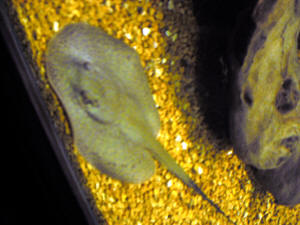 |
|
Re: Reticulated Stingray
6/28/09
How much water would you suggest I change out at a time and how
often to achieve my final water, which I hope to hold at about
60-70 PPM with a PH of 6.7-6.8.
<In theory, you can change as much water as you want per water
change, provided pH and hardness stay constant. But in practise
it's wisest to do relatively modest changes, around 25% per
day, one or more times per week, as required to keep nitrate
levels at the low levels you're after. If you're also
changing the water chemistry from one set of values to another,
this is even more important, so do small, frequent water changes
that nudge the pH and hardness levels rather than dramatically
change them. Cheers,
Neale.>
|
Question about Motoros... fdg... hlth.... env.
6/19/09
Hello!
I have a 8 month old stingray. My question is simple. He ate well this
am i feed him ghost shrimp. Tried to change him to live red wigglers
this weekend and he ate about 3. But not he seems disinterested in
food. This evening i gave him his 10 shrimp and he didn't even
bother to catch them. I check the water and everything was normal
ph-6.0 am-0 n-0. So i know its not the water. I know they go on hunger
strikes but i was wondering should i be worried?. I looked at your web
site to see if other people have the same problem but it didn't
really answer my question. He does this i notice only when i try to
change his food. Is he just spoiled? Or is he sick?.
Don't know what to think hope you guys can help me out a bit.
THANKS!!!
<Maria, you absolutely *should not* rule out water chemistry or
water quality issues! These are BY FAR the most common reasons
Stingrays stop eating or otherwise behave abnormally. Because you have
a very low pH, 6.0, your biological filter will be working at a very
low efficiency, so nitrite and ammonia spikes through the day are
possible. In case you're wondering, biological filter bacteria
prefer pH to be in the range 7.5 to 8.5, and the lower the pH goes
below that range, the less they work, and below pH 6.0 they don't
usually work at all. A very low pH also implies minimal carbonate
hardness (what you measure with a KH rather than GH test kit) and that
means that pH may well vary through the day, so again, take pH readings
several times: before you turn the lights on in the morning, around
midday, and sometime in the evening, at least. Ideally, you would be
keeping a Stingray in water with a moderate amount of carbonate
hardness
(4-5 degrees KH) and a pH around neutral (6.5-7.5). But as you
hopefully know, making sudden changes to water chemistry will stress a
Stingray, so if you do decide to alter water chemistry, you need to do
so very carefully and in small steps. If for some reason your Stingray
doesn't particularly want to eat the food you're offering him,
then try starving him for a couple of days and see what happens.
Besides earthworms and river shrimps, Stingrays should receive a
variety of foods so that shortcomings on one are balanced by the
others. Frozen seafood often works well, and things like squid and
cockles are particularly nutritious and lack the Thiaminase found in
mussels and prawns. Small pieces of white fish are good, too, and you
can buy frozen lancefish that can be used whole. This said, earthworms
and shrimps are favourites, so be critical of environmental conditions
and fix them, rather than missing this "early warning" and
not realising something
was wrong until the Stingray got sick. Cheers, Neale.>
Re: Question about motors... Potamotrygonid sys.
6/25/09
Hello again.
<Hello,>
Got your e-mail back. To clarify a few things i KNOW for a fact there
is not spikes in either Am or N because i have tested thru out the day
(every couple of hours) and are reading zero plus i have two filters on
my tank.
<It's good you can be sure that water quality isn't an
issue. Having two filters doesn't automatically mean you have
perfect water quality though, so I'd dissociate those two ideas!
But let's assume these two filters are adequate to the task, i.e.,
big canister filters that are maintained at least monthly so that there
aren't issues with either turnover or nitrate levels rising between
each time the filter is cleaned.>
He eats fine just is burred more the usual. Going to be up grading him
to a bigger tank and want to make sure he is health before moving
because of stress.
<There are multiple things you can think about. Firstly, is water
circulation adequate? Hang-on-the-back filters for example have their
inlets and outlets close together, so are less likely to provide good
water
turnover than canister filters positioned with the inlet and outlet at
different ends of the tank. If you're using hang-on-the-back
filters with large fish, providing additional circulation via
powerheads is probably
essential, especially given that Stingrays get their oxygen from a
layer of water at the bottom of the tank, the layer that contains the
least oxygen because it's furthest away from the air. Secondly, is
diet sufficiently
varied? River shrimps are fine when used some of the time, but shrimps
contain a lot of Thiaminase, and this leads to severe nutritional
imbalances in the long term (vitamin B1 deficiency) so you need to
balance
them out with food items that don't contain Thiaminase, such as
earthworms and cockles. Here's an article that summarises this very
important but often neglected topic:
http://www.wetwebmedia.com/ca/volume_6/volume_6_1/thiaminase.htm
Thirdly, consider "psychological" effects. Stingrays will
become stressed if there isn't sufficient swimming room, if house
with aggressive tankmates, and perhaps if housed in a room with a lot
of noise. Review, and
act accordingly. Generally speaking fish don't go off their food
for no reason, and assuming that they're simply not bored with
whatever is being offered, there's usually some environmental or
health problem that needs to be fixed. Cheers, Neale.>
Re: Question about motors
Thanks so much!..i am trying to get him a more variety of diet but
every time i do he only eats its the new diet for about a day or so
then doesn't want to eat.
<Are they still alive/wriggling when offered?>
Anything you suggest on how to get him to eat a new diet. I did buy red
wigglers for him and he like i said ate some of a day and then
didn't want them. So i have been trying to switch up his food but
un successful.
<There are numerous books on Stingrays; I'd suggest borrowing or
buying one of them so that you have a detailed account of feeding this
difficult and expensive fish. But in brief, pieces of squid, mussel,
white fish and even small amounts of oily fish such as salmon have all
been used successfully.
Live "feeder" fish are not recommended unless home-bred
livebearers or killifish, which are "safe" in terms of fat
content, Thiaminase, and parasite risk.>
Maria
<Cheers, Neale.>
Re: Question about motors 6/25/09
Yes they are alive and moving he will attack them but then realize Eww
i don't want this.
<Odd, usually they love earthworms. Maybe try different types/sizes
of worms?>
i do have a book on fw stingray got them before buying the ray to
educate myself.
<Very good. Cheers, Neale.>
Re: Question about motors 6/25/09
I will try.
Thanks a bunch!!
<Most welcome. Cheers, Neale.>
Re: Question about motors 7/6/09
Hey just want to update you guys on my motoro. He seems to be doing
great.
<Cool!>
Still don't know why he goes thru weird acting it might just be his
personality. He is back to his swimming on top of the bubbles in the
tank.
<Might simply be curious, but could also mean he's favouring the
well-oxygenated part of the water rather than the "proper"
place he should be, the bottom of the tank. So by all means enjoy
watching him, but be aware of possible problems, and act accordingly.
If you have a plain gravel substrate, consider using a reverse-flow
undergravel system. This pushes oxygen water down to the bottom of the
tank and up through the gravel; besides producing extremely good water
quality, it ensures superb circulation of oxygen at the bottom levels
of the tank. Reverse-flow
undergravels are much under-appreciated.>
Which I don't know if I should be concern about that because
someone told me that means poor water quality.
<Can indeed.>
But he is active like he always does. He's a pisser but I love
him!
<Hmm... okay>
Maria
<Cheers, Neale.>
Re: Question about motors 7/6/09
Thanks. I have a sand substrate. How can I make the water quality
better for him by the way? If that's the problem?
<With Stingrays, there's really three options: Firstly, a bigger
tank (or at least adding a sump to your existing tank). Secondly, a
bigger/additional filter (more turnover, more oxygen). Thirdly, more
water changes (less nitrate, less pH variation). Likely some
combination of the three will work best. Cheers, Neale.>
Re: Question about motors, sys. 7/7/09
Thanks! for the info. I am actually upgrading him to a very long and
wide 125gal tank in the next few months.
<While a bigger tank is always better, to price up larger tanks; 125
gallons is at the low end of what an adult Potamotrygon motoro will
thrive in; you really need a tank with a "footprint" twice
the width of the Stingray's disc. Saving money now, to afford a
better tank later would be a sensible plan. Do read around; you'll
quickly find that people keep Stingrays most successfully in very large
tanks; 200-400 gallon tanks are not uncommon!>
I just bought a canister filter for a 350gal and I am actually going to
put it on my 40 gal breeder which has the 2 hangons. so I am hoping it
will do for the month or so till I get the new tank up and running.
<Cheers, Neale.>
Stingrays, Eels, and Brackish Water Fish... sel., sys... --
06/10/09
Hello Crew,
I'm in need of some advice about what tank mates are most suitable
for a Stingray.
<Depends on the Stingray; but for the Amazonian species (usually
Potamotrygon spp.) they're best kept with docile midwater fish:
Osteoglossum spp. Arowanas, tinfoil barbs, Panaque spp. catfish,
Oscars, etc.>
I'm going to get a custom made tank (3' wide 2' tall 4'
long) I hope this will be big enough!
<The rule of thumb is that the tank should be at least twice as
wide, front to back, as the maximum disc diameter of the species in
question. So a tank measuring 3 feet front to back would be adequate
for a species up to 18 inches disc diameter. That said, four feet
length is really not much space at all, and you would be very well
advised to get something around the 6 foot mark in this regard. Depth
doesn't matter at all. There are some excellent books on Stingrays,
including a very inexpensive one published by Barron's,
"Freshwater Stingrays" by Richard Ross. I'd heartily
recommend spending the $8.99 on this book before spending the $100s if
not $1000s on the Stingray and what it needs.>
If I do fw I'm looking to put in 5 Silver dollars, 1 Fire Eel and a
Stingray.
<Fine.>
If I do bw I'm looking to put in a Stingray and a Monoray Eel,
please advise me if this will be ok, if not can you please give me a
list of fw and bw that will be compatible with my Stingrays.
<Amazonian Stingrays are not brackish water fish, so can't be
kept with such tankmates. Asian freshwater Stingrays are often brackish
water species. These are typically Himantura spp., or family Dasyatidae
at the
least. These could be mixed with robust but non-aggressive brackish
water fish: monos, archerfish, Siamese TigerFish, large sleeper gobies,
etc.>
Thank you in advance
Brittney
<Cheers, Neale.>
Freshwater stingray 05/23/09
Hi, I am considering a freshwater Motoro string ray for my aquarium. I
already have a 90 gallon cichlid tank that I may make the new home for
the stingray out of. My only concern was that my tank might not be
large enough. The dimensions for the tank are 24"tall,
52"long, and 18"wide. I have read that Motoro's should be
kept in no smaller than a 100 gallon tank but I just want to see if
there is a possibility I could use my current tank.
<None. While a juvenile might be safe for a while, you do ultimately
need a tank twice the disc width of the Stingray, in this case a
species that gets to some 45-60 cm across. Often you don't realize
a Stingray has overgrown its quarters until it starts to get sick, at
which point there is usually nothing you can do to save it.>
Thanks,
John
<Please do spend a little money on one of the many Stingray books
first; these are extremely easy fish to kill, and the majority probably
die prematurely. So $5-10 spend on a Stingray book (such as the
excellent little volume 'Freshwater Stingrays' by Richard Ross
from Barron's at a mere $8.99) will be money very well spent.
Cheers, Neale>
FW Stingray system: Not in a 125. 5/15/09
Hello,
<Hi>
I was curious.. I am looking to get a 125 gallon fresh water tank and I
wanted to put a sting ray or in it.
<Not large enough for a stingray.>
I wanted to know what advice you had for me and what kind of sting ray
you would recommend putting in it.
<The best all around is a Potamotrygon henlei, the Bigtooth River
Stingray
:http://fishbase.org/Summary/speciesSummary.php?ID=53761&genusname=Potamotrygon&speciesname=henlei
>
Or do I need to get a larger tank.
<Yes, You want a tank at least twice as wide as the maximum size of
the ray's disk.>
I already have a 55 gallon and I think that I am ready to upgrade. Any
advise or good books I could read would be wonderful!!!
<There are hundreds of articles here on fresh water tanks. You can
start by looking here:
http://www.wetwebmedia.com/FWSubWebIndex/fwsubwebindex.htm and
following the links on that page. >
<For FW Stingray information, you can read here:
http://www.wetwebmedia.com/FWSubWebIndex/fwstingrays.htm
http://www.wetwebmedia.com/FWSubWebIndex/fwraysysfaqs.htm >
Please let me know! Thank you!!!!
<You're Welcome>
Jennifer
<Mike>
A worm question (Horsehair worms; stingrays)... Nada re
Vermes, reading to do re FW rays, Alk. 04/03/09
Hello!
<Ave Maria>
Just wanted to ask a quick question i hope you have the answer to. I
have a 6 month old motoro stingray. He is doing great eating about 20
ghost shrimp a day.
<Mmm, and more than just this as a diet I hope/trust>
Is the only thing in the tank. tank has a O2 line sand and filter. I do
weekly water changes and weekly testing of the tank but i notice over
the past month or so the PH has went from 6.4-6.0.
<May need, want to bolster your alkaline reserve here. See WWM
re>
I was just wondering what can cause this when i keep very good
maintenance on the tank.
<Simple acid-base reactions/drift... most captive aquatic systems
tend to "go acidic"... they're reductive due to an
imbalance of foods, waste cycling, and a dearth of basic materials to
"buffer" the pH upward. Does this make sense to you? In the
wild there would be much more water volume, photosynthesis... Please
read here re: http://wetwebmedia.com/FWSubWebIndex/fwph,alk.htm
and the linked files above>
Change filters 1 every other month. Clean sand. Clean air line once a
month.
<Mmm, might be better to clean the filters (alternating) one every
week, the sand every time (weekly) you change out water (by
vacuuming)... and add a bag of "shell" somewhere in the
circulation/flow path... See Neale's articles...>
And was wondering what is the best PH for this type of ray heard they
like it around 6.4-6.8
<See WWM, Fishbase.org... this is about right>
and other places i read that they like it at 5.0-6.8 don't know
which is the best for him. he is a growing boy and would like to keep
him that way!. Thanks!
Maria
<Please read...
http://wetwebmedia.com/FWSubWebIndex/fwstingrays.htm
and the linked files above... esp. re Potamotrygonid nutrition,
systems... Bob Fenner>
Question about substrate cleaning, reading 3/3/2009
Hello!!...i just had a quick question i have sand as my substrate in my
tank for my motoro ray.....just did a water change on Monday and i just
happened to test the water and it had some ammonia in it about .25
<Ooh, very bad... Potamotrygonids do NOT like such> and a slight
not noticeable amount of No2 so i went to my local aquarium store where
i bought the ray and they tested the water and found the same thing i
have found and they asked me if i clean the substrate at all since i
got him and i said no...well to make a long story short i bought a
gravel cleaner. i just want to know how often should the sand be
cleaned i know its every water change but i change it once a week its
that too soon?.wondering if i should clean a 1/4 of the sand every
other week?. just worried because of the ammonia want to get it down
but don't want to take out the good bacteria out of the tank.
please help if you can Thanks Maria <Help yourself. Read here:
http://wetwebmedia.com/FWSubWebIndex/fwh2ochgs.htm and the linked files
above. Bob Fenner>
Stingray... None for a 40 2/22/09 Hello there. I
recently went to my LFS and saw a beautiful motoro stingray. I have a
40 gallon tank set up at home and i was thinking about buying it.
However, after reading your site i realized it was too small. Do you
know of any type of stingray that can be put in a 40 gallon tank,
without any tankmates. I will be willing to do as many water changes as
it takes to keep them in good shape. Also, what are teacup stingrays?
Do they stay small or do they grow big as well? Anyway, thanks for your
help. -Jordan <Umm, neither freshwater nor marine Stingrays will
"fit" in such a small volume long-term. Bob Fenner>
"Freshwater" Moray Review, sys. --
02/16/09 Hello Experts at WWM! :) Trevor here again, <Hi
Trevor.> Well, just to see if I'm doing everything correctly
even though my moray (Gymnothorax tile) seems to be thriving, I'll
list off how my aquarium is set up. Currently, he was moved into a 50
gallon about a week back with the water already having been set at
1.012, brackish. I switched the gravel out with aragonite sand (as
suggested by your website) and the tank has double the filtration than
it needs. I went off another person's layout in terms of how to
decorate the tank. Shale was used (if I'm mistaken, it looks like
large black/gray pieces of very flat, large, wide rock) in the corner
with smaller pieces of the same rock being used to elevate one piece
above the other. The gap this makes is about as large as the eel is
wide and allows him to go far, far back and out of sight. (there are
two other these lairs by the way, the other is much smaller) I
don't know how else to show you other than to send the YouTube link
of the idea for the setup. Just in front of the lair is a piece of
driftwood the eel likes to nose over and around from time to time. The
heater's temperature is set the that of a tropical fish tank and
the eel currently lives by himself and I'm planning to keep it that
way as he does seem to do fairly well. I don't want to stress him
at all. Ever. I've heard how picky they can be when they're
stressed and how hard it becomes to keep them. The eel eats
silversides, ghost shrimp, prethawed and rinsed (in a cup of the tank
water) frozen shrimp, crab meat, pieces of octopus and squid, with all
this being supplemented with dietary supplements found at the fish
store from time to time. Maybe once a week. The tank water has 20% of
its volume changed once a week. I should think that the eel is almost
at its full size, as it has stayed around two feet or so for some time
now but shows some growth. (an inch or so since I got him?) The eel is
a deep blue/gray in color. This is about all I can think of to mention
at the moment other than the feedings are about every other day...
<Sounds very good. I cannot think of anything that needs to be
improved. Care in marine water is an option, the oldest G. tile I know
live in marine tanks, but I think 1.012 is equally sufficient. Well
done. Marco.>
Question about freshwater stingrays 11/6/08 Hi I am
new to this site and I had a question. I have two freshwater stingray
and a Arowana in a 75 gallon grow out tank with a hydro filter and two
penguin bio-wheel 350s. I have had one ray for 4 months the other for 2
1/2 months and the Arowana for about a month. I have noticed odd
behavior by the rays they are breathing faster than usual, just sitting
upright on the side of the tank and trying to jump out of the tank and
they have never acted like this before. The one ray will eat blackworms
and chopped night crawlers and the other will only eat blackworms. I
have tested the water a bunch on time the ammonia is 0 the nitrates and
nitrites are 0 and the ph is 6.5. I do 50 % water changes every 2
weeks. I was just wonder what might cause this weird behavior and the
rapid breathing. Thank you in advance. Amber <Hello Amber. Your tank
is too small and too poorly filtered for Stingrays, and what you're
seeing are general signs of stress. These are indications that it's
time to move them to their next aquarium. Even if the only fish you had
was an Arowana, the tank would be too small and inadequately filtered.
Depending on the Stingray species you have, you'll need at tank at
least 90 cm wide from front to back and 200 cm in length from left to
right. (The width of the tank should be at least 1.5 times the maximum
width of the "disc" of the Stingray species in question;
since the common species are 60 cm in disc size, 90 cm is a good
baseline width.) Depth isn't critical. Filtration needs to be a
serious external canister filter. Hang-on-the-back filters have little
value in serious freshwater fishkeeping; they're really only suited
to small community tank species. You need something with lots of space
for biological media, and offering water turnover 8-10 times the volume
of the tank in turnover per hour. So if you use a 200 gallon tank, the
minimum for a Stingray, your filter (or more likely, pair or trio of
canister filters) will need to be rated at 1200 to 2000 gallons per
hour. There's no getting around this fact: Stingray aquaria are
insanely expensive to set up. People who try to economize end up with
dead Stingrays. Many books on the topic now available; I'd heartily
encourage you track down one or two of these at your local library or
bookstore. Cheers, Neale.>
|
Potamotrygon motoro, Can an adult (in the home
aquarium) reach 24"? 9/29/08
<45 cm/18" is more typical, but bigger specimens far from
unheard of.>
If not how big? Is that nose to tail tip or left disc to right
disc?
<It's the size of the disc; so any aquarium intended for
this species should be at least twice that wide. In other words,
the minimum front to back width of the aquarium will need to be
90 cm/36".>
So would a 18" or a 24" wide tank be no good for the
life of this fish?
<Absolutely not.>
If not, besides a small round pool how wide of a tank would be
enough?
<When planning around Stingrays, the golden rules are that [a]
the tank be at least twice as wide from front to back as the
Stingray's maximum disc size; and [b] that the length of the
tank be as much as possible, and certainly not less than 180
cm/6'. There is ABSOLUTELY no point using smaller tanks;
Stingrays grow rapidly when healthy, and if kept in a too-small
aquarium quickly end up dead anyway. So either do it right, or
don't do it at all. There's no middle ground. This is one
reason I haven't been tempted to keep these beautiful fish:
they are VERY EXPENSIVE to maintain, both in terms of aquarium
size and the enormous amounts of reverse-osmosis water you need
to do their water changes.>
I've been told they do get that big and I've been told
they don't, same with the tank widths. Thank you for time and
any advice.
<There are several good books on Stingrays out there: I
strongly suggest you spend the $10-20 on one of them before doing
ANYTHING else. I happen to like 'Jurassic Fishes' (which
covers a whole bunch of primitive fish as well) but it's been
out of print (and largely superseded) by lots of other books as
well.>
Thanks Matt
<Cheers, Neale.>
|
|
Stingray issue 7/22/07 Hi there, My question is
about my fw stingray. I currently am housing 3 fw stingrays, 2 Motoros
and one reticulata (teacup). Motoros are 12 in and 6 in and teacup is 6
inches . I have had them for about a year in a 265 gal with a large
Pacu and 14 in silver Arowana. As of late the smaller Motoro has been
swimming above where the air bubble wand and filter outtake meet. Its
def out of character for her. I am using a Fluval fx5, an emperor
BioWheel and Eheim canister for filtration. One of her eyes seems
cloudy and closing. I lost the first ray I had a year ago and he showed
some similar signs. Ammonia 0 nitrate 0 ph 6.0. Temp about 82. I feed
rays jumbo night crawlers I get from bait shop and once in a while
feeder goldfish but not to much. I added Pimafix. She also has a little
red around her mouth. The swimming funny really has me thinking
somethings up. She eats and has not lost any weight. Any helpful hints.
I would really appreciate any help your site is the best. Oh and
substrate is sand very easy on them. <Greetings. As you probably
realize, freshwater stingrays are exceptionally difficult fish that are
only suitable for very advanced, highly experienced fishkeepers. When
it comes to disease, the problems are that [a] we don't really have
a textbook list of stingray diseases yet and [b] many of the
medications safe with bony fish are dangerous to cartilaginous fish.
Now, as a general rule, when fish swim into the filter current it is
usually because this is where the water quality is highest and the
oxygen concentration highest. Likewise, when fish show red patches on
this skin (signs of irritation) then again, water quality is something
to think about. In your case, you need to be reviewing a variety of
things. Ammonia and nitrite obviously (you say the former is 0, but how
regularly do you test it? try testing over a week and at different
times of the day, especially shortly after feeding). Nitrate needs to
be as close to zero as possible, which you say is the case. But water
chemistry is also important. Stingrays aren't that fussed about pH
and hardness, but they are bothered by changes. So if you're
manipulating your water supply to get the low pH and hardness levels
you have, check to see you're being consistent. Another issue is
air or water pollution: it's easy for things like paint vapours and
tobacco smoke to end up in the aquarium, and these will irritate/poison
the fish. Yet another issue is filter turnover. For a stingray, I'd
recommend not less than 8x the volume of the tank in turnover per hour
(i.e., marine quality filtration and twice that for regular small
community fish like guppies and tetras). Given your aquarium is 265
gallons, that means you need filtration around 2120 gallons per hour,
minimum. Your Fluval delivers about 600 gallons per hour, the Emperor
280 gallons per hour, and the Eheim I don't know how much because
you don't say the model. But it needs to be *at least* 1240 gallons
per hour to even make the baseline your stingrays need. Since even a
really big Eheim like the Professional 3 is only producing a
"mere" 450 US gallons per hour turnover, your tank is very
likely (almost certainly) under-filtered. Some more general advice.
Melafix and Pimafix are largely useless as treatments. While they
sometimes work for some people under some conditions, they're too
inconsistent to be relied on, and therefore of no value with expensive
fishes like yours. Another problem is diet. Stingrays feed on a variety
of animals in the wild including small fish, but never Cyprinidae. The
nearest Cyprinidae are hundreds if not thousands of miles away from
where they live. Why do I mention that? Because Cyprinidae -- things
like goldfish and minnows -- have high quantities of Thiaminase that
breaks down Vitamin B1 over time. They also contain a lot of fat. Fish
that eat them in the wild, like pike, presumably are adapted to this,
but most other predatory fish do not seem to be, and long term both
these issues cause damage. Bob Fenner has written at length on the
issue of feeder goldfish and marine predators like Lionfish. Since your
stingray is, basically, a marine fish that happens to be living in
freshwater because it got trapped on the wrong side of a newborn
mountain range, your stingray likely will react the same way to a high
fat, high Thiaminase diet as any other marine predator (i.e., poorly).
On top of this, feeder fish are the Number 1 best way to introduce
parasites and bacteria into your nice clean stingray aquarium. To be
honest, whoever advised you to feed cheap "parasite time
bombs", sorry, feeder goldfish, to something as delicate and easy
to kill as a stingray deserves to spend some quality time on the
Naughty Spot. The ideal foods for stingrays are either terrestrial
foods (like earthworms), marine foods (like mussels and prawns), or
"clean" frozen foods (like bloodworms and lancefish). All
these will be safe because they have no chance of introducing parasites
or bacteria into the aquarium likely to harm a freshwater stingray.
Over here in the UK, live estuarine river shrimp are widely used with
success and these match very closely the preferred staple diet of
freshwater stingrays in the wild: large crustaceans. As you realize,
stingrays have teeth adapted not for catch fish but for crushing
shells. Finally, the whole sand issue in aquaria for stingrays is
debated endlessly. There's some good evidence that dirty sand can
trap bacteria and cause infections. This has been observed on catfish
barbels for years (erroneously put down by some people to
"sharp" gravel wearing the barbels down). Catfish generally
shrug off such infections and re-grow their barbels when conditions
improve, catfish being, fundamentally, very hardy animals usually
adapted to swamps and other horrid environments. Stingrays do not have
this level of robustness. So double check the sand is spotlessly clean.
You should be stirring it weekly and siphoning out any detritus. Many
stingray keepers prefer to keep their rays in tanks without sand to
side-step this issue. Finally, do check the fish aren't able to
burn themselves. It is *extremely* common for stingrays to burn
themselves against the heater. The heater should be either inside the
filter or covered with a plastic mesh of some kind (called
"guards" and these often come with the better heaters
anyway). Hope this helps! Cheers, Neale.>
Stingray and tank tops -- 06/04/07 Hi WWM Crew,
<Hello there Lauren> My Motoro stingray is a very active girl.
She loves to go up and down the walls of the tank and splashing around
at the top, but I'm very concerned she may climb too high and out
of the tank with all of the splashing she's doing (sometimes comes
half way out of the tank above the edge.) Is there any negatives
against getting the glass tops for the tank or do you have any other
suggestions that will work? Thanks, Lauren <An ideal Ray system
would have a large volume, including a gap/air-space above to allow for
such natural behavior... while disallowing the animal to come to
harm... It is a good idea to at least consider the ramifications of
physical injury from sharp edges, burns and more from lighting... that
might occur here... and possibly retrofit a cover/barrier of sorts. Bob
Fenner>
FW teacup Stingrays 5/19/07 Hello <Hi
there> My two new stingrays are kicking up a lot of sand, which is
having the affect of clouding up the water and settling down on my
rocks as if it snowed in my aquarium. <Mmm, yes...> I've
invested is two filters one is a Wet/Dry the other a Rena Canister and
added a UV sterilizer to combat any parasites and other junk from the
sand kicked up from these rays. Would a sand filter help in keeping the
tank clearer - and a more important question, what negative impact will
the sand have on my filters? <... good question... Could severely
restrict nitrification... though not likely an issue with the use of
the wet-dry... You do need more mechanical, particulate filtration...
And possibly a re-visiting of substrate choices...> Thank You for
your help, Aydan Savaser <You have read here: http://www.wetwebmedia.com/FWSubWebIndex/fwstingrays.htm and
the linked files above? Bob Fenner>
Freshwater stingrays getting body slime (water cloudy)
3/28/07 first here's info on the stingray tank: INITIAL TANK
SET UP: 125 gallon tank installed on December 15, 2006 with RO water
and smooth/fine gravel. Added BioSpira and the following day added
around 20 small African Cichlids to cycle tank. <Mmm, mistake... I
encourage folks NOT to cycle with livestock... for a few good reasons:
Principally the very real chance for introducing pathogens (disease,
parasitic organisms). Secondly, the production of fright chemicals
there from... And lastly, because it's unnecessary to the tanks
development and stress to the life involved...> One month later: Low
PH = 6.0; Ammonia = 0; Nitrite = 0; Nitrate = 0 More set up info: 175
gal wet/dry filter, Mag Drive Water Pump 1200 gph, dual T5 Light
Fixtures, black magic 12x12 carbon pad, white/blue filter pad, 8W UV
sterilizer, 2 ChemiPure, two 250W heaters (hidden) <Good note>
set at 82.5 degrees, RO Unit for water changes/top off. <Mmm, the
low pH... what was the start? What does your alkalinity test/s
show?> Added air bubbles at the back of the tank wall on 3/16 using
a Rena Air 400 pump and added 2 plastic plants to hide the tubes. No
other decorations in the tank. LIVESTOCK: Removed Cichlids. Added 2
Potamotrygon Motoro Rays (4" and 6") on Monday, Feb 5, 2007.
Rays were very active and eating. Added 4" Silver Arowana on March
12. Arowana hardly ate. <Typical... and a bit hard to train to do so
in such a large system> MAINTENANCE INFO: I do a 25% water change
(30 gal) weekly. I also add 30 ml RO Right and 5 ml Prime during water
change (RO water is aged in a 40 gal bucket at 82.5 degrees to match
the main tank water). I add 60 ml Waste Control weekly to tank. <I
would skip this last... unnecessary and perhaps a source of trouble
here> I clean filters and all pads (replace when nec..). <And
only do "about half" of these at any given maintenance
interval... To preserve nitrifying et al. useful microbial activity>
Water was perfect until March 21 when the ammonia reached 2 <More
than deadly toxic> and nitrates 40. <Danger... this is way too
high, by at least double... your bio-filtration, perhaps circulation
are inadequate...> PH is still 6.0 and nitrites 0. Performed 20%
water change on 3/21 with 25 ml RO Right and 10 ml Prime. Performed 25%
water change on 3/24 with 60 ml of Amquel Plus & NovAqua Plus + 30
ml RO Right. The tank seemed cloudy after the 3/24 water change.
<Not good. Likely bacterial... rather than just chemical,
physical... From? Excess food? Inadequate circulation, filtration?>
Performed another 25% water change with the same additives (60 ml
Amquel Plus & NovAqua Plus + 30 ml RO Right) on 3/26. Ammonia went
down to 1 <Very dangerous... needs to be zip, zero, nada> and
nitrates to 10 but water is still cloudy. On 3/27, water is still
cloudy and the stingrays are less active with body slime. I performed a
35 gallon water change on 3/27 with 30 ml RO Right and went back to
using 12.5 ml Prime. Rays are a little better but the water is still
cloudy hours later. Did I do something wrong by changing from Prime to
Amquel Plus and NovAqua Plus? <Mmm, no... but if it were mine, I
would not add any of these water conditioners... period. You're
using RO water? It has no sanitizer, excess metal et al. in it to
remove...> This stingray tank is at my work and my boss was
overfeeding the ray a variety of frozen silver sides, prawns, blood
worms, krill, shrimp which caused the ammonia and nitrate spike. I
instructed him to lessen the feedings to 2 very light feedings a day
(recently did not feed the stingrays Sat thru Mon). The Arowana started
as a picky eater and we tried live crickets and feeder fish which also
might of caused the ammonia and nitrates to go up. We will no longer
feed live foods. <Mmm, or move this Bony Tongue fish for a few
months into a smaller system, where it will be easier to train to take
offered foods... This IS what I would do> What can I do to fix the
situation? How can I clear up the cloudy water? <First, stop with
the water conditioners, over-feeding... look to (GET AND USE) BioSpira
to boost your nitrification, rid the system of measurable ammonia)...
LOOK INTO and GET more biofiltration... perhaps a nice large Eheim
canister filter... packed with their bio-media... See WWM re... a nice
one-time investment...> Should I add Melafix and/or Pimafix for the
body slime/fungus? <No... these are worthless "Melaleuca
Leaf" extracts... that will do more likely harm here than good...
You don't want to forestall nitrification any more...> Am I
doing too many water changes and/or adding the wrong additives (RO
Right, Prime vs. Amquel+/NovAqua+)? THANK YOU IN ADVANCE! - Michael
<Please read here: http://wetwebmedia.com/FWSubWebIndex/fwestcycling.htm and the
linked files above... And I take it you have read my article on
Potamotrygonids archived on the site, and our FAQs files on FW rays.
Bob Fenner>
Re: freshwater stingrays getting body slime (water cloudy)
3/28/07 Thank you for replying. <Welcome> I have "Bacter
Boost" a Marc Weiss product. I used this in my home tank back in
Sept 2005 and kept it refrigerated since then (I don't see an
expiration date on the bottle). <I would not use this... or actually
any of this companies products...> Can I use this product or should
I just buy BioSpira? <Only the Marineland product is endorsed (oh,
obviously by me) here> For the product you recommend, do I add
directly to the sump or in the tank? <Directly to the sump is
best> Should I continue 25% water changes to remove the ammonia or
just use Bacter Boost or BioSpira to increase the beneficial bacteria?
<Please see WWM re... there is a not too fine line between the
benefits of such dilutions versus the stultifying effects on
nitrification, other stress caused therein> Are the bioballs in my
175 gal wet/dry not enough where I need to get an additional canister
filter? <I would remove the bioballs period... Again, all this,
including the rationale is archived on our sites> Thank you again.
I'll start reading your article while I await your answer. <Real
good my friend. Life to you. Bob Fenner>
P. orbignyi compatibility with Redtail Catfish?... A large S. Am.
Ray and VERY large Catfish... in a 29?! Need to read... 02/17/07
Hi, <Kev... we'll skip the epaulettes> I currently have a 29
gallon tank with a 6 inch Redtail Catfish and a few small fish that are
there just to take up a little space. <?...> I can assure you
that I have no plan on putting any size ray in a tank that small. I
will be buying a all-glass 210 gallon tank(72Lx24Wx29H) within 2
months. <Oh. This will still be too small in time> I will be
running 2 Fluval FX5's and sand for substrate. <I'd use
other... posted...> I read that the P. orbignyi and the Redtail Cats
are both native to the Orinoco river Basin. <With spelling
improvement, yes> That leads me to believe that they are compatible.
<In terms of water quality at least> Here's my question.
Would it be advisable to house these animals together? <Mmm, not
really> From what I read, my tank will be large enough and I
don't think that the filtration will be a problem. <Will be
inadequate> I already feed my Redtail Cat bloodworms, feeders and
ghost shrimp (at least 10 in the tank at all times). <The feeders
are an exceedingly poor idea... see WWM re> Lastly, where can I find
the stingray. Price doesn't really matter. I'm just looking for
a baby. I've tried to find them online and I haven't seen them
in any local pet stores. Thanx, Kevin from Az <Go to the Internet,
Go to the Internet... Bob Fenner>
Sand For A Ray Tank 11/01/06 Hi, I have a
few questions that I can't find in the Q&A section. I am
getting a few fresh water rays and bought some sand for substrate. I
was told to put the sand in a bucket and overflow the bucket to clean
the sand. Well I did this and poured the sand into the tank and have an
absolute mess now. The water is FULL of loose sand and floating on top
of the tank. Question, how do you prepare sand properly before putting
it into the aquarium? < Take the sand and place some in a bucket
until the bucket is half full. Turn on the garden hose about 1/2 way
and force the end of the hose to the bottom of the bucket several times
in several places. Organics and dust will be forced to the surface.
Repeat until the water flows clear.> The mess that I have already
created, How do I fix it? < Take a large fine screened net and run
it through the tank several times to collect the larger items floating
in the tank. Let the tank stand for a while until the fine dust settles
out. Then gravel vac the fines out of the sand.> Also, I have a bio
filter and a sponge filter. Will the sand work with these filters?
<The type of substrate has no effect on these filters.> Seems
that the sand would be hard on the impellers or clog the filter. <
Please follow my recommendations to remove the material described
above. A sponge prefilter used for power heads would prevent these
things from damaging the impellor.> If so what should I do in order
to prevent this from happening? Sorry for asking so much but Am
sickened by the site of my aquarium and need a little help at this
point. Always had gravel never dealt with sand, But think it would be
the best choice for a ray so they can burry themselves. Any help would
be greatly appreciated. Thanks...Alan < Sand is best but not all
sand is created equal. For creature that inhabit sand they need a sand
that is non-abrasives to their skin. Sand blasting sand is very cheap
but when you look at very closely you can see that the individual sand
grains are subangular and have very sharp points on them. This makes
them ideal for sand blasting but no so good for aquarium fish. The
sharp edges scratch the fish and cause infections. Look for sand that
is small and well rounded like beach sand.-Chuck>
Re: My
Motoros ... sys. 9/9/06 Hey Bob Brian again, Last wrote to you on
8/15/06. Just giving an update my Motoros are doing great with no
problems they are still behaving normal. I took your advice and lowered
the ph to 6.8 from 7.5 and this did not affect the rays and the temp is
being kept at about 82. I could not get them to accept the frozen foods
so after some research I found a Black Worm dealer in New Jersey that
ships and those rays are loving those black worms. They are also still
eating the red wigglers. Only a couple questions for you this evening.
I feed the rays twice daily once in the a.m. and once in the p.m. is
this too much? <Mmm, should be fine> They eat everything in under
15 min. Is it true that live worms used as a primary food source is
unhealthy in a sense of introducing disease in to the aquarium and
rays. <Mmm, not nowadays... with "blackworms" being
cultured... not like "the bad old days" (still present in
some places/cases) with "poop" derived, collected
Tubificids> Second is it difficult to build a custom aquarium that
would be large enough to house these rays for there maximum potential
size. <Mmm, no. Not IMO> I have room in home to build a very very
large aquarium, what it be made of? <... liner... or wood...
plastic... fiberglass... block/cement?... perhaps with some glass or
acrylic viewing panels> Or would it be easier just to have some or
company custom build me one. <If money is "no
object"...> Also what size and dimensions would you recommend?
<As big as possible and practical> I have a 24 x 36 foot room in
my basement that is empty with a concrete floor that does not get any
water and walls/ ceiling are dry walled. Thanks for the help hope I am
not too much of pain but as I all ways say you guys are great. Brian
<Mmmm, get some bids... and read here: http://wetwebmedia.com/ca/cav1i1/pondDIYCalfo/diy-pond.htm
and the linked files at the bottom. Bob Fenner>
Stingray mega system - 09/07/06 <Hey Dan you are in luck,
I've kept some stingrays and have some experiences to share with
you.> After seeing all the great advice on your site, I thought I
might tap your brains as well with a few questions on my mega large,
stingray system. I have been in the saltwater hobby for almost 10
years, currently running 3 other tanks, so I know the basics, but this
is my first go-round with stingrays. After seeing something at a LFS, I
decided to build my own "lagoon". The display tank (not
counting the filter) is Approx. 1,200 gallons, in the lower level of my
house, with a pond liner. It is roughly 8 foot by 8 foot and 2.5 feet
deep. It is filled with a 1-2 inch deep sand bed made of sugar sized
Aragamax, and has a small (30-40 lbs.) pile of live rock in the center.
It is now time to stock the system. My questions are these: -Should I
be worried about the pond liner (40 mil typical outdoor pond liner)
being punctured by the stingrays' spines/barbs when they swim
around? <Based on my experiences no. Stingrays aren't usually
aggressive unless they are provoked. Meaning they don't go around
with their rays ready to puncture all the time.> -I would like to
house a variety of stingrays in there, and after doing the research it
seems that, in a system this size, I would be able to put 3-5 rays in
there total. Could I maybe do a Bluespot or two, maybe a California
round or two as well? I know Bluespots are difficult to keep, but due
to the size of my system, I think many of the problems most folks
encounter will be overcome. <My friend kept Bluespots without any
troubles. I believe that the major thing with them is that they need to
be shipped in healthy and from a reputable dealer. But I don't
think you are going to be able to keep Bluespots and California species
together because Bluespots need a warmer water tank than the California
rays.> -Finally, in a system this size, do you see any problem with
adding a big fish or two (like a grouper, something that will not
generally pick at rays)? <You possibly could add some fish but let
me warn you RAYS ARE HUNGRY and will eat and or attack lots and lots of
other fish and devour them pretty quickly. Especially, in my
experience, the blue dots.> Thanks in advance for the advice, and
the past advice to others cautioning them to treat these animals for
what they are: living creatures who need to be cared for, not merely a
"thing" to be had. <If it was me I would plan on trying to
keep a pair of stingrays and I would put any other fish you planned on
keeping in first and letting them get establish. Let the system
stabilize and get settled as well. Realize that stingrays like other
predatory fish are going to produce a tremendous amount of waste and
that you'll need to plan your filtration to accommodate them.
Realize that most stingrays are going to be larger animals and
that's going to require special equipment for changing things in
the tank. Realize that you aren't going to want to reach your hand
in the tank for many reasons. Figure out other options for cleaning.
Bless Steve Irwin's soul, but these animals do have the potential
to kill so keep that in mind as you choose what to do in this system.
Hope this helps and if you have any more questions just let me know.
Good luck, MacL>
Info on T cup stingray Hi, I'm considering purchasing a
freshwater stingray. Could you give some information on these beautiful
animals? I currently have a 50 gallon community tank with Bala sharks,
tetras, ghost catfish, a Cory, and 2 Plecos. Thanks Jeff Lawson
<Thanks for the prompting... Wrote a review of this group (the
family Potamotrygonidae... I'll place this article and the
accompanying images on the www.WetWebMedia.com site later today (or
tomorrow when I move off this FAQ onto the new (to be made) FAQs pages
on FW Stingrays... These South Americans can be gotten and kept... but
most get pretty big for captive use... and a fifty is small... and it
will be eating your other fishes... Bob Fenner>
Stingray Hi..! I have a freshwater stingray a laticeps one as
far as I know, it was OK but yesterday night I saw him upside down, as
soon as I saw I took it on the right way and push a little bit by hand
in order to have flow on his gills, immediately responded..! My
question is: Is it normal to happen or there is something to do about?
is similar reaction like happen with sharks? Best regards. Carlos
Gorgon <it sounds peculiar and perhaps unhealthy. Can you confirm
that dissolved oxygen is high enough? Is the tank large enough too
(minimum 90 gallon for a juvenile... much larger for adult. Sand bottom
is sugar fine and there are no visible sores on undersize? Do research
the archives here on WWM for pertinent articles and FAQs to lend
insight. Kindly, Anthony>
Re: Stingray, II (Oxygen Level) Thanks, how should I confirm
that dissolved oxygen is high enough? <There are test kits by
various manufacturers made to test oxygen levels. Look around the
various online sites for them. -Steven Pro> Best regards. Attn.
Carlos Gorgon
Stingray, FW, test kit units of measure Hi..! I have three
freshwater stingrays, I tested the water before put them in, reading
form ammonia and nitrites were low but on your site are referred to ##
ppm but I have a scale of mg/ltr so which is the right amount of
nitrites in mg/ltr for this stingrays ( teacup ) <The units of
measure, milligrams per liter and parts per million are equivalents...
the same. The concentration you want is 0.00, none for nitrites,
ammonia... and as little measurable nitrate as possible. Please see
here: http://www.wetwebmedia.com/fwstingrays.htm and the links beyond.
Bob Fenner> Best regards. Attn. Carlos Gorgon
Two questions First of all thanks for your last advice and
fast response, I will get the PH and nitrite tests. 1) I have a
Gymnothorax polyuranodon (freshwater eel) and some times he changes
color to a pale one but just happened twice during a month and later he
has its original color, is this normal or what could be happening? is
eating well, as I see during everyday observation is quite good.
<This is normal... seems to have more to do with "mood"
than water quality, other external influences... Not necessarily an
indication of trouble> 2) I will get a freshwater stingray soon but
I can't find written thinks online about injuries caused by the
sting and envenomation, what should I do in case of envenomation or
being touch by it sting ( accidentally, of course I will take care of
this everyday). <Please take a read through the Freshwater Stingray
article: http://www.wetwebmedia.com/fwstingrays.htm
and Injury piece: http://www.wetwebmedia.com/Wound.htm and we'll be
chatting. Bob Fenner> Best regards. Attn. Carlos Gorgon
Freshwater Stingray... FW Bob, Thank for the info regarding
fw porcupine puffer. I will ask the LFS to clarify the species. Another
question. fw stingray. I saw these fishes at another LFS. Can it
co-existence with fw moray eel? <I would not keep them together.
Please see the coverage on these species on WetWebMedia.com> Does it
need brackish environment or just freshwater? What steps to follow to
pick the right stingray? <Oh, obviously you aren't familiar with
WWM. Please see here:
http://www.wetwebmedia.com/FWSubWebIndex/fwstingrays.htm Bob
Fenner>
Arowana and Ray Biotope Tank Hi, I'm setting up a 225
gallon Arowana tank with Rays. <Even though 225 gallons in rather
large, it is still a rather small tank in comparison to the fish you
selected. I do not think you could safely stock more than two of
each.> I would like to use a few live plants to make them a little
more comfortable. <I think the Rays would wreck any live plants.>
If I am only using a few plants how much fluorite should be used <I
would stick to a sand bottom for the comfort of the Rays.> and what
kind of plants. <Perhaps you could grow some Java Fern attached to
something. There would be little danger in it becoming up rooted.>
Thanks, Dave <Good luck! -Steven Pro>
Re: Arowana and Ray Biotope Tank Thanks for the info and the
225 is only for 2 years until we build our dome home where there new
tank will be the circumference of 30' by 3' wide 4' tall
with a main tank connected at one end 10' x 4' x 4'
<Wow! Truly impressive concept. Do send us pictures when done.
-Steven Pro>
Questions re freshwater stingrays I have just read your
article on freshwater rays and found it very interesting. I would like
to keep one my self but was wondering if my tank is suitable, it is 8
foot wide 2 foot top to bottom and 18 inches back to front. The motoro
is the one I like and I need to verify that it only gets a maximum
14" wide disc. Also could you suggest suitable tankmates for this
species. Thanks for your time and I look forward to hearing from you.
Yours Matt Milburn. <This size, shape tank should work out very
well. I've seen displays with many types of fishes kept with
freshwater rays, including peaceful, slow-moving fishes like angels and
discus, and even shoals of small South American tetras (Characoids) of
many types. I do encourage you to delve into the popular (and possibly
scientific) literature on the habitat and distribution of the species
you're interested and definitely select for a "biotopic"
presentation (physical, chemical and social/biological make-up
mimicking their natural environs). Bob Fenner>
Sand for FW stingrays? (10/19/03) Hi, <Hi!
Ananda here tonight> I have had a hard time finding sand substrate
for Fresh water stingrays. Right now it is bare bottomed. I know it has
to be silica free sand. It also can't raise the Ph of my tank. I
called some companies that make play sand. They all have silica in the
sand just not in a free dust form. I read about silver sand on a UK
website but no one states has heard about it. What do you recommend.
<Not silver sand. It's silvery due to mica, which could scratch
the ray's stomach. You will probably need to look for sand from a
specialist fish store. You might also check with some of the companies
that package sand for aquarium use, and have your local shop order some
for you (since the companies are unlikely to sell directly to
hobbyists).> thanks, john <Sorry I couldn't be of more help!
--Ananda>
Tea Cup Stingray Thanks gage, I will do it.
Actually I'm curious, are the tea cup rays very hard to keep and
what can they be put with if anything? <Tea Cup Rays are difficult
to keep, they require excellent water quality, 0 ammonia 0 nitrite, and
next to 0 nitrate, they are very sensitive. They also need a large tank
a 4'x4' foot print would be as small as I would go, the height
is not as important. Tank mates would need to be moderately large and
stay high in the tank. There is a book by Richard Ross on freshwater
Sting Rays. -Gage>
Freshwater Stingrays and Substrate Hello Crew, <Hello
Reader.> I've been reading up on FW stingrays and have noticed
most people seem to be trying to keep FW rays in large, rectangular
aquariums on a sand substrate. I'm wondering if they can be kept in
a smooth (no sand), round, PLASTIC stock tank. <The trend of having
them with a sandy substrate is for the aesthetic look for the aquarium
owner as much as it is for the stingrays themselves. It's true that
these rays natural environment is for them to burrow into the sand and
hide. But, many of the large aquariums have barren bottoms on their ray
tanks. In fact, the last three I visited that had feeding/petting
Marine ray tanks had no sand at all.) I've got a 500+ gallon, 8
foot round one that I use as a turtle pond. The double thick walls help
to insulate it and it is easy to drill and plumb. It was also
cheap-----$240 . <I'm very jealous! that is quite an impressive
find, and would love to have something like that for any one of my
fish!> Can one of these be used for a ray tank? (The 6 foot round
will roll through a doorway and into a house.) <I have seen these
tanks used for shark tanks, and of course for Koi and Goldfish tanks. I
believe that this tank could be used for a ray tank. Provided that you
do offer the ray places to hide. Be it large pieces of driftwood, or
large make shift shelves that the rays could hide beneath. You know
that you can purchase a large amount of tropical play sand from your
local hardware store (or Home Depot, Lowe's, etc...). Enough to at
least offer some sand on the bottom for the fish.> I know that a
traditional tank would make viewing much easier, but that big of a tank
(300 gallons) is very heavy to move, very expensive, and requires an
expensive stand. <When dealing with Stingrays, one of the best ways
to view these animals is from the top! It's like watching Frisbees
or dinner plates swim, seeing them from the side is still interesting,
but the larger viewable surface is looking down on them. As for a 300
Gallon tank you could build your own to save on money. there are many
sites online that show people building 1000 gallon tanks into walls
(with three sides being solid, and one large glass/Plexi window to view
from). In fact I recently gave a fish to a man who built a 650 and 750
gallon tank in his basement using info he found online. Though, they
are more of a permanent fixture thus making them not moveable, but it
can be less expensive if you build one yourself.> With the prices of
the more vividly colored FW rays as high as they are, I'd rather
buy more space for less money and get better filtration with the
savings. Would a stock tank work? <Considering I have seen this used
at many aquariums around the world to hold their Stingrays then I do
believe that this will work for you as well. You might want to visit
some Stingray message forums and see if anyone has suggestions.>
Would a totally bare tank (no sand at all) be too stressful for a ray?
<Totally bare yes it would be stressful, but if you sink other
objects in there for the fish to hide under (like a make shift shelf,
and lots of driftwood and plants) then I could see a stingray being
okay. The tank I'm envisioning can not be viewed from the sides...
so the stingrays won't see you unless you are over the top of them.
So, in actuality they will be quite secure and less stressed since they
can't see outside the tank.> Could a sunken tray of smooth sand
be used if needed? <The sand will be spread out of the tray in no
time, but I do think that this is an option that you should keep open.
I've never seen it done, but it might work great for your rays, and
offer them another area to feel secure.> Could drift wood with java
fern and moss be used to aquascape or would it scrape the ray? <Rays
scrape against all that stuff in the wild and it doesn't bother
them. Provided you don't have any extremely pointy pieces, or sharp
areas then it should be fine. Check the wood over and sand off any
areas that look dangerous.> Thank you for your time, Tam Jones
<No problem, and I hope the tank works out for you. Look online for
Stingray forums and see what others are saying. You might learn a great
deal from them as well. Also, if you are going to have a tank that
large only viewable from the top you might want to invest in a mask and
snorkel! Good luck. -Magnus>
Indoor Pond filtration? 7/29/04 Hello, I really appreciate
all the great advice you have given me!! I am now facing the next
dilemma. I have purchased 2 Rubbermaid Agricultural 300 gallon stock
tanks. I intend to use them side by side in my basement to keep
freshwater Stingrays. <Neat> I am at a loss as to what to use for
filters. I know these fish demand excellent water, and am prepared to
do lots of water changes with RO/DI water. What type of filters should
I run? I have heard these fish very sensitive to nitrates. Too bad they
are freshwater instead of marine or I could just use live rock. What is
the answer for nitrate reduction in freshwater besides water changes?
<Good questions... the "real" or "best" answers
to nitrate accumulation are likely "person specific"
(actually worse, I'm susceptible to offering a very variations
myself!). Low stocking density, careful feeding would get mentioned of
course... the use of "in-sump" or in tank vascular plants,
deep sand beds (same sort of approach as marine DSBs) would certainly
work... water changes, perhaps occasional use of chemical filtrants
should be cited... More volume ties in with the idea of low stocking
density... Okay, I would tie in another Rubbermaid container if
it'll fit, use it to grow lots of rapid-growing, floating (maybe
some above like Ceratopteris spp. and submerged... Myriophyllum,
Egeria...?) plants, a deep sand bed there (five or more inches) and not
count on the same areas in the tubs with the rays (as they will stir
these up continuously)... get, use large (as you can afford) canister
filters (my faves are Eheim brand) and stock them with their media and
basically forget them (they won't require much service)... get yet
another Rubbermaid container to collect likely reverse osmosis water
(or other pre-prepared water you intend to use for water changes) and
be very diligent in making BIG (like 25% or more) weekly water
changes... stock up on nitrate test kit reagents and check these once a
week... And see what develops. Bob Fenner>
Freshwater ray,
automated water changes Hello, I've been reading through your
site and find it very insightful. I've been reading about the
freshwater rays for a couple months now, wanting to try them but
thinking I did not have the time or money to put into one. My
fiancé© recently bought me a surprise...a male P. hystrix!
Being it was a surprise, I didn't have very much time to prepare,
and it seems my friends and family didn't have much of an idea of
what these fish require before they bought him for me. Well, for the
time being he is in a 55 gallon tank, peacefully living with an Oscar
and eating well. the Oscar, though, is horribly messy, and I'm
having to do 75% water changes every week to keep his water conditions
under control. I have the materials to build an 8x6x1 foot pond for
him, but cannot set it up until I move out of my current residence (my
landlord won't allow it). I'm moving out July of next year, so
in the time being I have to figure out how to keep my ray healthy. I
have some time off work, and was thinking about trying to build a
continuous water changing device for my tank. My water is the right
quality (soft, neutral to acidic). I want to drill a hole in the back
of the tank for the overflow, then use airline tubing connected to a
bathroom sink with a sprayer nozzle on the end. I've never had a
problem with chlorine before, sometimes even being as bold as to put
water straight from the tap in with my hardier fishes. <Be aware
that municipalities do not continuously administer the same
concentration (generally chloramine, not chlorine) and that you may
well "get caught" by their pulsing sanitizer> In your
opinion, would the sprayer nozzle be enough to evaporate the chlorine?
<No, but you could use a contactor of sorts... chemicals that would
absorb...> As a side note, my pond will have a large, 3x3 foot
viewing pain on the surface, kind of like a big snorkel mask, I'll
also plant two kinds of tropical water lily around the outside to give
my ray a sense of security. Could you give me any helpful hints and
criticisms before I put money into these projects? thanks! Jon <What
specifically are you looking for? I would not go ahead with your
continuous water changer as you describe it... too risky, and the
chance to siphon/gravel wash the present system would be lost... keep
changing the water manually, twice a week if necessary, and look into
more filtration, circulation. Bob Fenner>
Freshwater Stingrays,
Plants, Substrates.... - 10/21/2005 Hey crew, I was just wondering
about freshwater stingrays and live plants. In some of your info it
talks about those two working together. I was just wondering
wouldn't the f/w stingray knock them down? <Mm, were I to keep
the two together, I would probably stick with plants that can be rooted
on wood (Anubias sp., Microsorium pteropus / java fern, Vesicularia
dubyana/java moss....). Thus I could keep the substrate mostly clear
and open for the rays.> Also I use fluorite for my plants instead of
gravel. Is that ok for the stingray? <Oh, no. No, not at all.> Or
should I put a layer of fine sand down on top of the fluorite for the
stingray? <Due to the tendency of smaller, lighter particles to
"settle" and larger, heavier particles to be displaced and
come to the top, this will not help.... A tank with a substrate of
fluorite would be fatal to a stingray.... literally.> Most
importantly will my live plants be safe from harm's way <I
assure you this is less important than not having harmfully abrasive
substrates in a ray's tank....> due to the fact that the
stingray lacks a gas bladder and once in motion... stays in motion?
<If you stick with plants that can be rooted on wood, or use terra
cotta pots for other plants like swords, etc., plants would do
excellently. The ray absolutely requires a non-abrasive substrate and a
great deal of open space. Keep this in mind if you choose to consider a
ray. Wishing you well, -Sabrina>
Freshwater Stingrays (Sand?, Filters?, and Heaters?) -
2/28/2006 Guys, <And gals...> First of all, thanks for your
feedback reference my earlier correspondence questioning Freshwater
Stingrays. I have decided to increase my filtration to maintain the
water quality in the approximately 180-Gallon tank. Have you heard
anything good/bad/indifferent with regards to the new Fluval FX5
Canister Filter? <Mmm, no... but this line has been greatly improved
over the years... used to be junk... had a few "pop-apart"
many years back> They claim that it will pump approximately 925 GPH
and maintain a tank of approximately 400 US Gallons??? <Mmm, an
over-estimate... akin to the U.S. gov't rating of automobile
mileage... once the media is a bit dirty/clogged... I would count on
about half this capacity/flow.> My intention is to purchase this
filter and add an existing Fluval 404 filled just with BioMax for
Biological Filtration (and maybe ammonia reducer)? <Hopefully...
these rays are quite massive... and do produce a good deal of
nitrogenous waste... and "don't like it"...> I have
also purchased a large UV Sterilizer that will be added to the tank to
control pathogens and algae. I still don't know what direction to
go with the sand bottom. I have read that Estes Ultra Reef Sand and
Calci Sand are good selections. <Yes... something fine, non-angular
(not silicate based)> What do you guys think? Will 100lbs. of sand
be adequate for a 1" thick base on tank dimensions of 7ft. x 2ft.
x 2ft.? On more question, I am desperately looking for an inline heater
(or two), but cannot find one that will not affect the throughput of
the Fluval FX5 Filter. <Not likely... I would add a "closed
loop" external recirculation system here... and use the dedicated
pump here to drive the water through the in-line heater... OR place
these heaters in an external sump, and use this arrangement of pumping.
Please read here: http://www.wetwebmedia.com/pbh2oret.htm and the linked files
above...> The filter's input and output hoses are approximately
1" in diameter and the only inline filter that I have found
(Hydor) offers a 5/8" connection which would limit the flow of
water. <Mmm, and these pumps are not engineered to have any/more
resistance. Again, I would not use them to move water through anything
else, including your proposed UV> I have purchased online a
fiberglass aquarium background that resembles real sandstone and do not
want to hide it with heaters, pumps, etc. <These are really neat...
gorgeous> As always, I greatly appreciate your feedback and value
your opinions. Regards, Steven W. Smith Jr. <Thank you for writing,
sharing. Bob Fenner>
Was Stocking a Brackish Tank, now Potamotrygonids 2/24/06
Ouch... looks like that archer tank won't happen until I get a
massive tank. I do want to have at least 6 or so, so until I can afford
a 300 gallon or something of the like... Anyhoo, I guess I'll just
stick with freshwater for now. Imagine what I could put in 100 gallons!
A small school of piranhas...freshwater stingrays (juvenile, of course)
etc... anyways, I won't get ahead of myself. Just wondering about
reticulated stingrays - do they need a fine sand substrate, gravel, or
bare bottom tanks? <Please see here: http://wetwebmedia.com/FWSubWebIndex/fwstingrays.htm Finer is
better> My LFS recently got in some teacup reticulated stingrays -
79 bucks (a pretty good deal here in Canada). My guess would be a 200
gallon tank minimum for a full grown adult? <Something like this>
I just think rays are really awesome, and would like to look into them
soon. I am willing to do 20% water changes every other day, and I think
discus would make suitable tankmates (same water parameters, water
changes, etc.). By the way, I asked about the 2000 gallon shark tank...
apparently, they only do top-ups! Incredible. I've somewhat lost
respect for them, though, after finding that they were keeping two
white tip and one black tip reef shark in this small tank, along with
some kind of bamboo or epaulette shark. Thanks, -Eddy <Be chatting,
reading. Bob Fenner>
Freshwater Stingrays and the perfect
environment? - 2/4/2006 WWM Crew, <Steven> First of all,
thanks in advance for your help. I am in the process (well, the
contractors are in the process) of refinishing my basement. I intend on
adding a Freshwater Stingray tank into my plans and have ordered a
custom tank to be built (72" x 28" x 20") (approximately
180-gallons). This tank will be built into the wall in the Pool Room (I
am hoping the calming effects of the aquarium help my Pool game:- )).
<Heee! Hope no one scratches in the direction of the tank!> I
have had Motoro Rays in the past and been quite successful with
managing their higher maintenance requirements, but I wanted to make
sure that I was on the right track with this design. I will probably
purchase two 4"-6" freshwater rays (1- Potamotrygon henlei
& 1- Potamotrygon motoro). Do you feel as though the tank will
support them comfortably? <At least for a while, yes. Would be
better in something larger...> Also, I have little experience with a
sand-bottom tank, but want to have the right substrate for their
health. Can you recommend a specific type of gravel that would be safe
for me to use? <Fine, river sand... something roundish, not too
alkaline...> Or should I research sand more closely? My concern with
sand is the cleaning process? <Mmm, just rinse in 10-15 pound
samples... in running water... in a plastic (pickle) bucket... with a
garden hose and your hand... till the water runs clear> Also, I
planned on 3 x Fluval 404 Canister Filters for filtration. I always
like to err on the side of too much filtration vs. not enough. What do
you guys think? <Should work... though if it were me, I'd fit a
refugium/sump on here, with RDP lighting, live plants, a DSB... and one
or two canister filters. Oh, and make sure I'd have plenty of
stored, soft/er, warm make-up water for changes positioned nearby... an
R.O.? Bob Fenner> Best Regards, Steve
F/W Stingray Questions 6/20/06 Hello folks got a
couple of questions concerning F/W Tea Cup Stingrays. I have been
researching these rays for quite some time and I have found a few gray
areas if you know what I mean. First I was told a minimum tank size was
25 gallon. I have a 75 gallon. <... at least three times their
likely maximum size, at least twice this in width...> Second I was
told a Tea Cup is almost impossible to keep in an aquarium with long
lasting success. <Mmm, not so> I have raised Salt Water Blue Dot
stingrays in a 180 gallon tank with much success( just shy of 4 years
and going strong only lost one of 2). Third do these rays like
aggressive water movement( 1 magnum 350 canister, and penguin 330 or
350 dual bio- wheel) and how about oxygenation would a air pump be
advised. <Do need high DO, not necessarily tremendous water
agitation> Fourth tank mates I was told rays should be kept with
rays and no other tank mates. <Can be easily kept with other
biotopic livestock... hailing from same micro-habitat is best> Fifth
this tank was set up for African cichlids (fish are in new tank and
doing well) but my question is can I bring my ph down and do a fifty
percent water change and leave the current filter media in there to
cycle the tank with the new sand or should I just tear it all down
clean it well and just start from scratch. <... likely a different
substrate...> The dealer I found told me that there rays are eating
very well and healthy. My question is the rays are eating live black
worms and raw shrimp is this nutritious enough for him. <I would mix
in other meaty foods... insect larvae...> I am unable to get the ray
for about 2-3 weeks because I am going to the florida to go diving with
family and coworkers who are on my fire departments dive team so I am
in no big hurry. The stores name is That Fish That Pet Place in
Lancaster Pa. Check them out the place is really cool. Check them out
at _www.thatpetplace.com_ (http://www.thatpetplace.com) <Know
this business well. Fine folks. Knowledgeable and honest> Hey thanks
for the help and next time we speak I will send you some pictures of my
blue dot I am currently at work don't got my camera. Brian, York PA
<Do send along. And... you have seen our coverage of
Potamotrygonids?: http://www.wetwebmedia.com/FWSubWebIndex/fwstingrays.htm
and the linked FAQs file above. Bob Fenner>
How do you move a 10 inch freshwater stingray from
one aquarium to another? 6/28/06 Query: How do you safely move a 10
inch freshwater stingray from one aquarium to another? Dave DuBois
<Best to scoop up/direct with a very large, soft net, into a
suitably thick, large clear "fish" bag underwater, lift this
whole thing up, leaving behind a good deal of the water (don't
strain your back!). Bob Fenner>
|
|

