|
FAQs on Freshwater Stingray
Foods/Feeding/Nutrition
Related Articles: Freshwater Stingrays,
Related FAQs: Freshwater Stingrays,
FW Stingray Identification, FW Stingray Behavior, FW Stingray Compatibility, FW Stingray Selection, FW Stingray Systems, FW Stingray Disease, FW Stingray Reproduction,
|
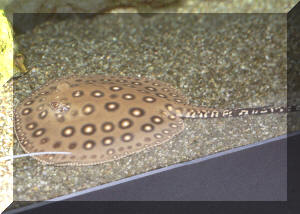 Water temp... warm... Water quality: Soft, acidic... Lack of
boisterous tankmates? When in doubt, patience...
Water temp... warm... Water quality: Soft, acidic... Lack of
boisterous tankmates? When in doubt, patience...
|
Skinny Stingray 4/21/18
My motoro stingray is a pretty active stingray but parameters in the
tank are normal (no nitrates, nitrites, ph levels are normal)
<I would prefer the values rather than a statement! To recap, nitrite
should be zero of course, and nitrate as low as practical, though zero
nitrate is in practical terms very difficult to achieve. If you are
honestly getting a zero reading for nitrate, I'd double-check you're
using the test kit right, because a zero nitrate reading in a tank with
a large,
predatory fish is so unlikely. While the precise pH value isn't
critical, it should be stable and not too high, and ideally, hardness
and pH would be towards the soft water end of their respective ranges;
maybe 2-15 degrees dH, pH 6.5-7.5.>
and there is no chance of infection or parasites.
<How can be you be so sure? Even at the retailer there's some risk of
exposure.>
There are constant water changes and filter changes with at least 25%
changed. He is fed everyday or every other day with more food (this does
not happen often, but there are issues that come up as they do in life,
but not enough for there to be leftovers in the tank).
<Understood.>
He has been in our tank for over a year and a half and has been growing
steadily, so we are pretty sure there is no stress, and as he has
survived this long and continues to grow.
<I agree, this is promising.>
Our substrate is a soft gravel that My parents used years ago with
another ray who lived a long life (obviously rinsed thoroughly with
water).
<I am sure you're aware of the debate surrounding the use of substrates
in ray aquaria. There are arguments in favour of soft sand substrates,
and arguments in favour of no substrate at all. I wouldn't say it comes
down to personal taste, but the latter approach is perhaps easier and
safer.>
He is a very happy ray in all searching through gravel, finding
Blackworms, swimming around all normal ray things. My problem is that he
is too skinny.
He is fed a good diet of shrimp, Blackworms and live fish (who have been
quarantined by fish store for at least a month usually more) but he will
not gain weight.
<Live fish is already one major risk factor. Let's be clear, unless
you're home-breeding thiaminase-free fish from parasite-free parents,
then any live fish are dangerous. End of story. For a start, cyprinids
(goldfish, minnows, and their relatives) contain thiaminase and simply
should never be used as live food. No scientifically sound argument can
be made in favour of using those types of fish, and store-bought
"feeder" goldfish and minnows are simply parasite-bombs. If you've used
those, then right there is one very probable reason for the ill-health
of your Stingray. Thiaminase is an enzyme that breaks down thiamin
(vitamin B1) and when used regularly the predatory fish can/will develop
all sorts of vague, but potentially lethal, health issues. There's a BIG
scientific literature out there on this subject, but let me direct you
to Marco Lichtenberger's summary here at WWM, written specifically for
aquarists:
http://www.wetwebmedia.com/ca/volume_6/volume_6_1/thiaminase.htm
Next up, the feeder fishes bought at pet stores will almost certainly
have parasites of some sort in them, and quarantining them only means
those parasites aren't killing the host fish. Get those feeders inside
your predatory fish and things become more complicated. A goldfish
might, for example, have a degree of resistance to a certain parasite
because they evolved together over thousands if not millions of years,
but South American Stingrays may never encountered parasites common in
Eurasia, and would have no resistance at all to that parasite. Do you
see the problem here? It's not a definite explanation, but the use of
feeders is just such a wildly risky chance to take, that it is very
difficult to rule them out. Given Stingrays aren't obligate fish-eaters
in the wild, there's no real reason to feed them live fish anyway, and
most if not all experienced Stingray keepers and breeders avoid them.
Instead focus on invertebrates, particularly worms, as well as more
mixed, vegetable-rich food items that offer vitamins and fibre.
Gut-loaded earthworms and river shrimps are a good way to get vegetables
into your Stingray! Alongside these, a good
quality Stingray pellets will help round out their diet, and arguably
could make up their entire diet if you're on a budget.>
He also completely refuses to eat things like smelt, nightcrawlers and
even wild caught shrimp (as in once he smells it on your hand he will
not come near you the rest of feeding time he hates them that much) and
we have tried countless times to introduce him to other foods.
<The golden rule with fish remains this: they'll eat when they're happy
and healthy. If they're not eating, it usually means there's a problem.
It's very rarely the food itself that's wrong, but something else. Could
be water quality or chemistry, could be the lighting (Stingrays hate
bright light), could be the tankmates, if any (Stingrays are best kept
alone). But as we've discussed, there could be a deeper problem if live
feeders have been used, especially goldfish or minnows. Nobody keeping a
fish as valuable and as delicate as a Stingray should be giving them
live feeder fish.>
We have even hidden some in the foods he does enjoy and he spits out the
food he doesn't like once he figures out it is there.
<Classic food refusal.>
He is too skinny but as I said he is still growing outwards so he is
still healthy but I hate seeing him so skinny.
<I would be thinking along the lines of internal parasites, if he "eats
but stays thin" but I'd also be worried about thiamin deficiency.>
Are there any fattening foods that I can safely feed a ray?
<See above; your Stingray doesn't need more calories, but he does need
his appetite back. You need to review that aspect, and act accordingly.>
I've seen people suggest clams, muscles, and worms.
<Clams are good. Mussels can be used sparingly -- again, they contain
thiamine. Earthworms are good and safe; bloodworms and especially
Tubifex worms substantially more risky, and best avoided.>
We can try other fish but I'm not sure how he will react. Any tips or
suggestions will be much appreciated!
<Hope this helps. Cheers, Neale.>
Re: Stingray.... sys., fdg. 8/8/15
So does this sound like a good routine? Im sorry with the so many questions, I
just want this to be a success.
A 15% water change weekly
<No enough. 50% weekly is mean, when it comes to Stingrays. The more the better.
Expect to spend several hours per week on maintenance. Keep the Stingray alone
in the big tank and you might be fine with 50% weekly. Every extra jumbo fish
doubles your workload. I am NOT a fan of adding tankmates to Stingray aquaria.
No benefits at all to doing so.>
And then I am a big fan of Kordon's water conditioner, the zero Nitr/ite/ate
(both) and zero ammonia.
<Let us be crystal clear about this. Water conditioners neutralise these
chemicals IN TAP WATER. They do NOTHING, ZILCH, NADA, for the dissolved
metabolites produced by your fish. That's the job of the filter, water changes,
and optionally fast-growing plants under intense lighting. An analogy: bleach
and antibiotics both kill germs. But they both have
different jobs and you wouldn't drink bleach to treat a sore throat!>
This is just to be sure nothing hurts Gizmo, my ray. It is also stingray and
delicate fish and plant safe.
<Understood.>
Food will be assorted live, frozen and pellet including Massivore, sinking
carnivore, live declawed crayfish, in house bred minnows,
<No. You will NOT be using these if you are sensible. Minnows contain
Thiaminase, and that's a major health problem for predatory fish. Please, will
someone tell me for the love of all that is holy, why Americans still use feeder
fish? Has been obsolete in the UK since at least the 80s. There are no benefits
to using feeders except in extreme cases (such as South
American Leaffish) where the predator will flat refuse anything else.
Feeder fish otherwise are nothing but a string of health risks and behaviour
risks.>
blackworms earthworms and lastly snails.
<Please do read Richard Ross on Stingray feeding. They're super-easy to feed
properly; settle them in with earthworms and possibly a few gut loaded river
shrimp, and once settled, switch to safe frozen and pellet foods.
They are greedy fish, easily starved, and need a couple of substantial meals per
day, which is one reason why cohabiting with other species causes problems: it's
harder to ensure they're getting enough to eat, and all that extra food dumped
in the tank increases the amount of ammonia the filter has to process. The most
economical route is frozen seafood, biased
towards those foods without Thiaminase (little/no shrimps and mussels, but
plenty of cockles, lancefish and tilapia fillet). Do read:
http://www.wetwebmedia.com/ca/volume_6/volume_6_1/thiaminase.htm
Consider the use of a vitamin supplement too.>
Tankmates:
School of silver dollars (6)
My gar temporarily (1)
1 Cichla ocellaris grow out (1)
Thank you for all your help
-Finn
<As Bob would say, "Keep Reading". Cheers, Neale.>
Sting Ray picky eater 3/23/13
Dear WWM Crew;
I have a juvenile male Potamotrygon reticulata ray that will only eat
small feeder shrimp (I kill the shrimp first and then present them to
him with metal tweezers). The ray readily eats the freshly killed shrimp
but will not eat any other food source I have tried to feed him (small
chopped up bits of frozen fish, shrimp, prawn, squid, octopus or blood
worms that have thawed). I have tried these either food types either
plain or soaked in aquarium grade garlic extract. I haven't tried earth
worms yet, as the ground is still frozen here in Canada. I am aware that
there are nutritional problems in eating only shrimp. Also, live shrimp
get expensive, and it will only get worse as the ray gets bigger
(current diameter 4 inches). What can I do to get my ray to eat other
food types?
When I first got the ray, I tried only blood worms and frozen food for 2
weeks with no luck before discovering the live shrimp, and I think it
never ate that entire time.
[Tank = 125 gallon; tank mates = small Neotropical cichlids, tetras,
silver dollars; tank fully cycled and water quality good; pH = 7.6 to
7.8, temp = 79 to 82; biweekly water changes of 30%; substrate = pool
filter sand]
Thanks,
Jason
<Hello Jason. Live shrimp is an okay food for Stingrays but unless
gut-loaded first, they shouldn't be used exclusively. Yes, earthworms
are a very good food, and most Stingrays go for them without any
encouragement.
Because they contain plant material in their guts, earthworms are a
nutritious food, and being terrestrial animals, the chances of them
carrying any parasites that could cause harm to fish is practically nil.
They are difficult to find outdoors in winter if you don't have a
compost heap, so one option is to rear your own indoors in a basement or
garage, which is easily done using widely sold earthworm "wormery" kits
(or you could knock something together using plans found online or in an
earthworm-rearing book). Practically a hobby in itself, there's a great
book about earthworms called "The Earth Moved" by Amy Stewart that'll
give anyone with even a slight interest in nature a lot of pleasure. You
can also buy earthworms at bait shops catering to anglers. Stingrays
aren't normally fussy feeders in the wild or captivity, and should eat
all sorts of things including the seafood you've suggested. Frozen
lancefish cut into bite-sized chunks are another excellent food, and you
can substitute this with any white fish you happen to be cooking for
yourself, such as cod, Pollack or tilapia. Some experts also use small
amounts of beef heart and beef liver, the latter in particular providing
useful vitamins, but I'd use these sparingly, no more than 10% of the
food used. Do also keep any food offered small enough to swallow;
Stingrays don't appreciate very large chunks of food, so err on the size
of small rather than big pieces of food.
However, a bigger issue with Stingrays isn't so much what they'll eat
but making sure they're happy enough to be hungry. Like cichlids and
puffers, Stingrays have huge appetites when settled, but for a week or
two after purchase they may be too insecure to be hungry. Beyond that
first week or two, Stingrays normally settle down well, but if it still
doesn't feed, review living conditions. Water quality is the key thing,
but also ensure there's a good turnover of water in the tank, especially
from top to bottom, so oxygen is thoroughly distributed. Keep an eye out
for tell-tale signs of stress like hyperactivity, lethargy and odd
swimming positions such as swimming into the filter stream or hovering
about at the top of the water. If your Stingray is eating just one food
but ignoring other (non-live) foods, then just stop feeding the live
food -- after a few days, hunger will ensure the Stingray tries the
other foods on offer! Don't be afraid to starve a healthy (i.e.,
well-fed and chunky) Stingray for a week or two! Cheers, Neale.>
Re: Sting Ray picky eater
4/2/13
Hi Neale,
<Jason,>
Thanks for the advice. The ground has now thawed, and my ray is happily
eating earthworms. I will try cultivating them like you suggested. The
ray still will not eat frozen seafood (even though I cut it up into
small bits). I will try the starve method to get it onto frozen food as
soon as it puts on some weight.
<Prudent.>
You mentioned unusual behaviour. My ray was swimming into the strong
current in the filter stream at the surface for about 20 hours a day for
a total of 5 days. This was about a week after I introduced it into the
tank.
<Not unusual immediately after purchase, but beyond the first week or
two, you'd expect most fish to have settled down -- assuming their new
home was adequate.>
At this point nitrites were a bit high, and I hadn't yet fed the fish
any live foods, so it hadn't eaten. The ray stopped swimming into the
filter stream the moment I fed it live food. However, this also
coincided with when nitrites in the tank fell to 0. As such, I cannot be
sure if it was water chemistry or feeding that made the ray happy with
living on the bottom again. So why did the ray swim into the filter
current?
<See above. Swimming into a current "feels" like swimming away from
wherever you are, which makes sense if you're an unhappy fish anxious to
get somewhere better and/or familiar. Of course, it can also mean a fish
has a migratory instinct (Colombian Shark Catfish likely swim into
filter currents because of this) or else needs oxygen-rich water lacking
in the tank generally (you'll see this behaviour among the more picky
stream-dwelling fish such as Otocinclus and Hillstream Loaches).>
At first I was alarmed. I thought it might be improper oxygen levels in
the water, or perhaps due to the purer state of the water coming out of
the filter. However, I have read that other people have had rays which
like to play in bubbles and current. What do you think of that theory?
<As good as any. Likely no single explanation for all Stingrays in all
aquaria.>
It was beautiful to watch the ray swim and I miss this behaviour.
The ray still occasionally goes up the glass and appears to gulp air at
the surface. None of my other fish appear to experience any oxygen
related issues, so I haven't been alarmed. Should I be?
<Not really. It seems pretty common for Stingrays to surface
periodically, in captivity at least. If otherwise healthy and feeding
well, don't worry too much.>
Cheers,
Jason
<Have fun! Neale.>
FW Ray fdg.
9/13/2011
Hey guys quick question
I feed my motoro this AM and tonight she pooped out a part of
undigested night crawler that was feed to her in the AM should I be
concern? This has never happen to any of my rays. Thanks again
Maria
<This is not unusual and not a problem. Cheers, Neale.>
What could be wrong ? FW rays...
upset, non-fdg., NO3 9/1/11
Hello again my friends. just got over a hurricane Irene(sun). My
stingrays were on air pumps for 15 hours till I got a
generator (Mon) that night the bigger ray ate great smaller female had
one piece of krill . Yesterday I fed them and they both ate krill put
female was not acting like herself she would sit in one spot and be
raising her front lip like she was sniffing today she didn't want
to eat at all I don't know if she is just
stress by the whole ordeal . I tested the water they were :
6.8-0-0-30.
The readings have always been this since she's been in the tank had
her a yr my male I had for 4 yrs they got two hang on filters and a
canister that's for a 300gal tank hope you guys can help
Maria
<Hello Maria. Don't feed the fish for a few days. Review water
chemistry, and make sure it's where it should be. Review water
quality, and if necessary, do a water change. Check the filter is
working properly. Dim the lights. If the filter was switched off for 15
hours, there's a good chance the filter bacteria are stressed.
Assume the worst, and reduce feeding and increase water changes for at
least the next couple of weeks. That'll give time for the filter to
recover. Do also check the temperature is correct.
Cheers, Neale.>
Re: What could be wrong ? 9/1/11
I did do a 20% water change yesterday I will I only feed them once a
day every other day so I will just keep it to light or no feedings all
the filters are working fine nothing broke all working strong I will
keep an
eye on water quality and such and I will do another water change soon.
But y would it only effect her and not the other ray and other tetras I
got in the tank?
<It's a complicated world, Maria. Sometimes one fish reacts
differently to a power outage than another fish in the same aquarium.
All you can do is be patient, observe carefully, check water quality,
and hope for the best.
Dimming the lights will reduce stress, and hopefully the ailing fish
will perk up. Use an airstone to add some extra oxygen. Cheers,
Neale.>
Vitamin deficiency, shrimp as
food, FW stingray fdg. 1/8/11
Hi crew,
<James/Pat>
I haven't had any issues for awhile, and I still really don't.
But, I have a concern.
In one of our e-mails you had mentioned something about some sort of
vitamin deficiency syndrome that results from feeding market (cocktail)
shrimp.
<Mmm, likely Thiaminase issue/s. Read here re:
http://www.wetwebmedia.com/ca/volume_6/volume_6_1/thiaminase.htm
and the linked FAQs file above>
At the time, I had a silver Arowana that I was feeding them to. I no
longer have the Aro, but I still have my Retic ray, who started eating
the shrimp about 2 months ago. I'd been feeding him live blackworms
because those were all he'd eat.
<A poor choice as a steady diet>
About once a month I'd put some shrimp in and he'd either
ignore them, or recoil as if they were hot coals. I couldn't bring
myself to attempt the starvation method to get him to eat the shrimp.
Imagine my delight and surprise when I saw him start to eat them. Now
he seems to really enjoy them, he sucks them up like a vacuum
cleaner.
Are there any dangers associated with feeding shrimp?
<Yes...>
If so, can you tell me what they are?
<I can>
What are the symptoms I should be looking for?
<Goiter, colour-blanching, bloating... Do read here:
http://www.wetwebmedia.com/FWSubWebIndex/fwrayfdgfaqs.htm
and why not? The linked files above>
Thank you
Pat
<Please learn to/use the indices and search tool ahead of writing us
on WWM. Bob Fenner>
Question about motors... FW Ray
fdg. f' -- 8/3/10
Hello Again!
I have a question that I am sure its nothing to serious. My going to be
2 year old motoro today didn't want to eat its first meal of the
day. Tanks parameters are perfect(ph 7, Ammonia 0, NO2 0, NO3 20). He
ate great last
night. I feed him 5 ghost shrimp and 7 frozen krill (which I defrost of
course) and every other day night crawlers . Today I had to give him
his food at noon which I normally do not do and it was small end pieces
from the last of the frozen krill not the big amounts that I normally
give him.
So I was wondering if I should be worried at all he is still moving
around the tank like normal and the other fish are perfectly fine. Hope
you can help!
Thanks,
Maria
<If he's acting normal, and there's no sign of physical
damage or unusual posture -- e.g., fin curling -- then I wouldn't
worry about it. Don't feed him for the next couple of days, and
then see what happens. There's no
point dumping food in the tank if he isn't eating it, as all that
will do is mess up water quality. Wait, test for ammonia and/or
nitrite, and after a day or two, offer a small meal. Cheers, Neale.>
Re: Question about motors
Ok thanks. No he has no curling. I also did a water change to be on the
safe side. Was wondering could I be feeding him to much?
<Possibly, but you'd expect to see water quality issues if this
was the case.>
Don't know if they get upset stomachs.
<Certainly possible, but unlikely to cause long-term
problems.>
Thanks again
Maria
<Cheers, Neale.>
motoro rays... Fdg., nutr.
dis. 7/13/10
Greetings Crew,
I have two Male Motoro rays. They are about 10' disks now. Both
have lived in a 1200 gal tank since they were 4" disk. They have a
complete Life support system, reservoir, sand filter, chemical filter
,bio filter, R.O., UV sterilizer, chiller the works! I Back wash the
system 2-3 times a week.
They live with discus and an Arowana and a few Blood Parrots they are
in an aquarium we custom built in a local Casino. Within the last week
they have slowly lost their appetites. They seem to have lost their
desire to swim.
One has been bumping into walls and is now showing a lot of trauma to
his disk. He swims upside down and has been puffing from the top. All
my water tests are perfect.! They eat krill, bloodworms and any small
schooling fish they can catch. I feel the bloods are taking advantage
of them. Though the owner doesn't want to let them go! Ughh! To my
question...I retrieved the Rays last night and isolated them in their
own tank. I don't know what to treat them with. They are swimming
about a little more today but the white (picking) areas look bad. And
still not eating. Any and all suggestions are much requested.
Thank you
Ginger
<Hello Ginger. The reasons why Stingrays refuse food are varied. As
you correctly surmise, environment is the commonest issue. So yes,
checking water quality, water chemistry, and water temperature are all
important.
Consider any possible toxins: paint fumes, insecticides, etc. Make sure
no-one has been doing anything silly to these Stingrays like feeding
them human food "treats". Next up, the use of feeder fish.
This cannot be
stressed too strongly. If you have predatory fish and you want them to
die, feed them feeder fish. Never, EVER use store-bought feeders.
http://www.wetwebmedia.com/fwsubwebindex/fdgfdrartneale.htm
Goldfish and Minnows are the worst because they not only contain
parasites but they also contain large amounts of thiaminase and fat,
and used regularly will cause [a] vitamin B deficiency and [b] damage
to the internal organs. Thiaminase is common in some types of seafood
and fish, notably prawns, shrimps and mussels. Use thiaminase-rich
foods no more than once or twice a week, and all the rest of the meals
must be thiaminase-free foods. Until quite recently most aquarists had
never heard of thiaminase, but it is now reasonably clear that this is
a major source of ill-health and premature mortality.
http://www.wetwebmedia.com/ca/volume_6/volume_6_1/thiaminase.htm
If you've been using feeders or not taking care of the thiaminase
issue, the damage may be done. A vet trained in handling cartilaginous
fish may be able to offer some help, but otherwise there's little
you can do. Next up, there's monotony. Stingrays need a varied die,
and surprisingly, it needs to include some green foods for fibre.
Cucumber, cooked peas and lettuce leaves are nibbled on by hungry
Stingrays, and whether they're a major source of nutrients
isn't clear, but their value as fibre does seem helpful. Zoos often
create mixes with things liked cooked brown rice and carrots! If they
won't take greens, then live earthworms are nearly as good, having
guts filled with decaying leaves. Finally, there's harassment.
Stingrays generally mix poorly with other fish, and suckermouth catfish
in particular can harass them. As for their injuries, if these are
nothing worse than scratches, these should heal fine assuming water
quality is good. There are no completely reliable medications for
treating Stingrays, which is why avoidance of sickness is so important.
Potamotrygon spp. tolerate salt quite well, at least for periods of a
few weeks, so in some instances slightly saline water may be helpful
for external parasites, but generally that isn't necessary. If the
Stingray can recover, it will do under its own steam. Cheers,
Neale.>
Re: motoro rays [RMF, any ideas on medications?] <<Furan
cpd.s RMF>> 7/13/10
Thank you, unfortunately I lost one of them earlier today after writing
to you. The other fellow is still struggling with himself. I have
offered bloodworms twice to no avail. Is there no treatment to help the
healing I could add to his tank?
<No. As stated, a vet who treats sharks and rays may be able to
help, but adding "potions" as you'd do with regular fish
won't have any positive effects at all. An antibiotic might be used
safely, but you'll need to check with your vet or the manufacturer
first.>
I have him now isolated in a 500 gallon holding tank. With a soft sandy
bottom. The wounds are pretty much all white and some dark patchy areas
on his upper side. Thank you for your time with me.
<As stated, if you have ever used feeder fish, you've basically
thrown all your chances out of the window. Feeder fish are hands-down
the single best way to kill predatory fish short of hitting them over
the head with a priest. If you've offered thiaminase-rich foods too
often, again, the damage is already done. It really comes down to this:
if water quality is excellent, and the internal organs haven't been
damaged by thiaminase or parasitised by the use of feeder fish, sick
Stingrays can get better under their own steam. But if the damage is
done, there's really nothing left but praying to the Fish Gods.
Cheers, Neale.>
How to sex discus, &
overfeeding FW Ray 7/5/10
Hi crew,
<Pat,>
I have a couple of questions:
1) Can you tell me how to tell the difference between male/female
discus?
<You can't. Of course, the genital papillae will be different,
but by the time the female exposes her papilla the fish will be within
hours of spawning anyway, so you'll likely know which fish are
paired.>
2) I understand the concept of not wanting uneaten food remaining in
the aquarium and rotting and fouling the water. But when I feed
Blackworms, is it still a concern if there are any left?
<Yes.>
My ray is always foraging, as are my discus. In fact, it seems that
they can't seem to get enough. Will they stop eating at some
point?
<Not really. If you're providing protein-rich, but fibre-poor
foods, you're essentially asking whether a child will stop eating
candy at some point -- yes, but not before that child makes itself
sick.>
As their bellies swell, I figure that they've had enough. Is there
a formula to follow?
<Experience; common sense. The aim is to provide enough to keep a
normal body profile, but not so much they are swollen, or so little
that their bellies have a concave profile. Under-fed rays lose
condition quickly, while nitrate-rich water from overfeeding quickly
stresses them. This is why you need a big aquarium and massive water
changes to keep Stingrays healthy. Several small meals per day is
better than one big one, and skipping a day doesn't do any
harm.>
Also, is there a concern that overfeeding will cause more poop
therefore fouling the water that way?
<Faeces are largely irrelevant, since they contain mostly material
that doesn't decay into ammonia quickly/at all. The toxic ammonia
comes from protein metabolism within the fish, and that's invisible
to you. Uneaten food of course rots, and in doing so releases ammonia
via saprotrophic bacteria.>
I have my tank on a "drip" water change, and this morning my
Nitrates are less than 20ppm, judging by the color of the test strip,
I'd say maybe 10ppm.
<20 mg/l nitrate is high by Stingray standards; you're aiming
for near-zero levels, and preferably no higher than 10 mg/l. Anything
above 40 mg/l quickly becomes toxic.>
As always your help and direction are greatly appreciated!
Thank you
Pat
<Happy to help. Cheers, Neale.>
Blue whale catfish... hlth.,
sel., FW ray fdg.... dwarf Orcinus...? 3/14/10
Hello,
<Hello,>
My husband and I bought two blue whale catfish,
<Interesting fish. Cetopsis coecutiens, one of a group of Amazonian
catfishes known as the Cetopsidae. Rarely kept by aquarists because of
their strange appearance, lethargy and strictly nocturnal habits. But
apparently not difficult to maintain under aquarium conditions.>
which we have had for a little over two weeks. Yesterday we changed the
water and today we noticed some white spots on their body, from what I
read on your site, it could be ich.
<Very likely. All catfish lack scales, and the Cetopsidae also lack
the heavy scutes (hardened skin) typical of things like Corydoras and
Plecs. So they're very vulnerable to Ick and other external
parasites. Treat using the heat/salt method rather than copper.>
We also have a fresh water stingray,
<I hope you won't be keeping these catfish with the Stingray!
The Cetopsidae are "flesh biters", ranging from simply biting
chunks out of bigger fish in the case of Cetopsis coecutiens through to
swimming inside their gill chambers and feeding on blood, as in the
case of the infamous Candiru. Without exception, Cetopsis are either
kept singly (they're not happy that way) or in groups of their own
kind (much better). But never, ever with other fish, except possibly
larger, armoured catfish like big Doradidae. Make sure you feed these
catfish a healthy diet, i.e., not goldfish or minnows. Earthworms are a
favourite food, and you can augment these with fresh and wet-frozen
foods of all sorts: tilapia fillet, squid, mussels, prawns, etc. The
usual warning about minimising foods that contain thiaminase apply
here, so while mussels and prawns are good in some ways, they
shouldn't be used too often. Be sure to read Marco's excellent
piece of thiaminase and aquarium fish for more on this topic.
http://www.wetwebmedia.com/ca/volume_6/volume_6_1/thiaminase.htm
Settled specimens may take carnivore pellets.>
and I want to make sure that I know what to feed him, he is about an
inch in diameter.
<Feeding what, the Stingray? At an inch in diameter Stingrays are
VERY easy to kill, and I'm surprised you were sold one this small.
It's very unusual for (good) retailers to sell them that small. In
any case, at that size they mostly feed on live insect larvae including
bloodworms and mosquito larvae; wet-frozen may be take as well, but
I'd start off with live food until the little chap has put on some
weight.>
Also, this may sound strange, but is there such thing as freshwater or
saltwater mini killer whales?
<Yes and no. Obviously no, there are no "mini" killer
whales as such. But there are some small, pack-hunting fish. Of the
species in the trade, Exodon paradoxus is the one most often kept by
aquarists. If kept in large groups (like 20!) the pack works properly
and they're great fun to watch when you throw a bit of fish fillet
or seafood into the tank.
Unfortunately, too many people try to keep this species in smaller
groups, and even in groups of 10 they have a tendency to turn on one
another, and you end up with just one specimen.>
Thank-you
Tiffany
<Cheers, Neale.>
Re: re: Blue whale catfish 3/14/10
Neale,
<Tiffany,>
Where I bought them from, they were in the same tank together and the
catfish don't seem to be bothering the little stingray.
<So far. But what these catfish do in the wild, apparently, is swim
about at night and bite chunks from anything too big to be swallowed
whole. See how they lack long whiskers? That's so there's
nothing to get in the way of that big mouth when it's pressed
against its target. These aren't "scavengers" that use
their whiskers to find worms and such in the mud!
Your species is a large (25 cm/10 inch) predator that cannot be kept in
multi-species tanks.>
I also looked up the "mini killer whale", and I didn't
find much on them.
Do they have blow holes and or use them?
<I have no idea what you're asking here. There are no mini
killer whales.
You're talking about the big black-and-white dolphins, right? As
for freshwater fish species, there are things called Baby Whales, and
this is a nickname used in the trade for small, schooling Mormyrids, in
particular Pollimyrus isidori. Mormyrids are difficult fish to keep,
and I'd strongly recommend you read up on their very specific needs
before buying any. They are difficult to mix with other fish, and
because they are sociable electric fish, you have to keep a certain
number or else their communication goes haywire and they bully each
other. Six is a good number
to start with.>
Or do the catfish? We were waiting for a mini killer whale, that the
pet store said that they could get and have had one before, and she
also said that they used there blow holes.
<She's talking nonsense. There are no cetaceans sold as pets via
aquarium shops. Whatever she's talking about, it's not a
"killer whale". I haven't a clue what she actually means.
If you can get a Latin name, then I can help.
But otherwise...>
Any way, when the catfish came in, she told us that the whales were in,
and she said that they use their blow holes, I know I asked above, but
is that true?
<No fish has a blowhole. A blowhole is a nostril used to pass air to
the lungs. Since fish don't have lungs and breather via their gills
anyway, they don't need a blowhole.>
I feel like this pet store has done nothing but lie us.
<"Lie" is a strong word, but ignorance is VERY common in
some parts of the hobby. The solution is simple. Find out about the
fish first, then get some information from a trustworthy aquarium book.
Failing that, e-mail us here,
since we write books and magazine articles, and we're about as
reliable a source of information as you're going to get. If you
don't have the Latin name for the fish, and the common name the
store clerk offers doesn't match
anything you can find in a book, then take a photo and send that. But
whatever you do, read before you buy.>
I also bought what I was told to be a freshwater dragon fish.
<A brackish water goby, Gobioides broussonnetii. Actually very easy
to keep in a brackish water system. But yes, its lifespan in freshwater
is minimal, and it does need a good, varied diet based on stuff other
than mere flake.>
Unfortunately it died three or four days later. I believe that this pet
store doesn't care about their animals, but more about the money. I
can't believe that any person couldn't give a care about the
animals that they are selling.
<Caveat emptor, I'm afraid. If a store really does go out of its
way to be disingenuous, you might want to ask to speak to the manager
and explain your concerns. If that doesn't help, write to your city
or county retail licensing office. Pet shops are regulated to some
degree, and they have to provide a certain degree of care to their
animals. If they're failing in that regard, then the city or county
will inspect them, talk with them about how to improve, and if
necessary remove their license.>
Thank-you
Tiffany
<Cheers, Neale.>
Re: Rays, comp.,
fdg. 12/28/09
My smaller ray is 4 and a half inch diameter and my bigger one is 6
inch diameter. I know they will get 14 inches because they are p.
Reticulate.
<OK.>
Will 7-9 inch long lima shovelnoses be okay with them.
<Yes; though Sorubim lima can, will reach at least 30 cm/12 inches
and frequently 45 cm/18 inches.>
My rays are now growing rapidly now on uncooked shrimp rather then
bloodworms.
<Do not use shrimp more than a couple of times per week; shrimp,
particularly that which has been frozen (even if sold defrosted)
contains a lot of thiaminase but little or no vitamin B1. The end
result is while the
calories and protein are in these foods, over time you run a serious
risk of vitamin deficiency. Do read here:
http://www.wetwebmedia.com/ca/volume_6/volume_6_1/thiaminase.htm
Augment their diet with thiaminase-lacking foods, e.g., earthworms,
tilapia fillet, cockles, etc.>
Thanks for all the help!
<Cheers, Neale.>
Re: Rays
if not lima shovelnose, what is a few more catfish that will be fine.
My LFS barely ever has them in.
<To be honest, I'd take your time and have your retailer order
them in.
Sorubim lima really are THAT GOOD as catfish go. Otherwise, some
possibilities include Pimelodus ornatus (a rather smaller Pimelodid
catfish) and Leiarius marmoratus (a much bigger Pimelodid). Almost all
of the larger Loricariidae can work, including things like Panaque
nigrolineatus, Acanthicus adonis and Pseudoacanthicus sp. L025, but as
ever with the Loricariids, these are territorial and grossly polluting
animals so should be mixed with Stingrays only after due consideration
for their needs. Catfish like these can damage Stingrays when
quarrelling over space, and the resulting wounds can be fatal. So
ensure the "footprint" of the tank is big enough for all
concerned, and that there are hollow, tube-shaped caves into which the
Loricariidae can withdraw and feel secure
away from the Rays. Cheers, Neale.>
Re: Rays
Ok thanks, ill stick with lima shovelnose.
<Cool. Enjoy your fish. Cheers, Neale.>
Question about Motoros... fdg...
hlth.... env. 6/19/09
Hello!
I have a 8 month old stingray. My question is simple. He ate well this
am i feed him ghost shrimp. Tried to change him to live red wigglers
this weekend and he ate about 3. But not he seems disinterested in
food. This evening i gave him his 10 shrimp and he didn't even
bother to catch them. I check the water and everything was normal
ph-6.0 am-0 n-0. So i know its not the water. I know they go on hunger
strikes but i was wondering should i be worried?. I looked at your web
site to see if other people have the same problem but it didn't
really answer my question. He does this i notice only when i try to
change his food. Is he just spoiled? Or is he sick?.
Don't know what to think hope you guys can help me out a bit.
THANKS!!!
<Maria, you absolutely *should not* rule out water chemistry or
water quality issues! These are BY FAR the most common reasons
Stingrays stop eating or otherwise behave abnormally. Because you have
a very low pH, 6.0, your biological filter will be working at a very
low efficiency, so nitrite and ammonia spikes through the day are
possible. In case you're wondering, biological filter bacteria
prefer pH to be in the range 7.5 to 8.5, and the lower the pH goes
below that range, the less they work, and below pH 6.0 they don't
usually work at all. A very low pH also implies minimal carbonate
hardness (what you measure with a KH rather than GH test kit) and that
means that pH may well vary through the day, so again, take pH readings
several times: before you turn the lights on in the morning, around
midday, and sometime in the evening, at least. Ideally, you would be
keeping a Stingray in water with a moderate amount of carbonate
hardness
(4-5 degrees KH) and a pH around neutral (6.5-7.5). But as you
hopefully know, making sudden changes to water chemistry will stress a
Stingray, so if you do decide to alter water chemistry, you need to do
so very carefully and in small steps. If for some reason your Stingray
doesn't particularly want to eat the food you're offering him,
then try starving him for a couple of days and see what happens.
Besides earthworms and river shrimps, Stingrays should receive a
variety of foods so that shortcomings on one are balanced by the
others. Frozen seafood often works well, and things like squid and
cockles are particularly nutritious and lack the thiaminase found in
mussels and prawns. Small pieces of white fish are good, too, and you
can buy frozen lancefish that can be used whole. This said, earthworms
and shrimps are favourites, so be critical of environmental conditions
and fix them, rather than missing this "early warning" and
not realising something
was wrong until the Stingray got sick. Cheers, Neale.>
Re: Question about motors...
Potamotrygonid sys. 6/25/09
Hello again.
<Hello,>
Got your e-mail back. To clarify a few things i KNOW for a fact there
is not spikes in either Am or N because i have tested thru out the day
(every couple of hours) and are reading zero plus i have two filters on
my tank.
<It's good you can be sure that water quality isn't an
issue. Having two filters doesn't automatically mean you have
perfect water quality though, so I'd dissociate those two ideas!
But let's assume these two filters are adequate to the task, i.e.,
big canister filters that are maintained at least monthly so that there
aren't issues with either turnover or nitrate levels rising between
each time the filter is cleaned.>
He eats fine just is burred more the usual. Going to be up grading him
to a bigger tank and want to make sure he is health before moving
because of stress.
<There are multiple things you can think about. Firstly, is water
circulation adequate? Hang-on-the-back filters for example have their
inlets and outlets close together, so are less likely to provide good
water
turnover than canister filters positioned with the inlet and outlet at
different ends of the tank. If you're using hang-on-the-back
filters with large fish, providing additional circulation via
powerheads is probably
essential, especially given that Stingrays get their oxygen from a
layer of water at the bottom of the tank, the layer that contains the
least oxygen because it's furthest away from the air. Secondly, is
diet sufficiently
varied? River shrimps are fine when used some of the time, but shrimps
contain a lot of thiaminase, and this leads to severe nutritional
imbalances in the long term (vitamin B1 deficiency) so you need to
balance
them out with food items that don't contain thiaminase, such as
earthworms and cockles. Here's an article that summarises this very
important but often neglected topic:
http://www.wetwebmedia.com/ca/volume_6/volume_6_1/thiaminase.htm
Thirdly, consider "psychological" effects. Stingrays will
become stressed if there isn't sufficient swimming room, if house
with aggressive tankmates, and perhaps if housed in a room with a lot
of noise. Review, and
act accordingly. Generally speaking fish don't go off their food
for no reason, and assuming that they're simply not bored with
whatever is being offered, there's usually some environmental or
health problem that needs to be fixed. Cheers, Neale.>
Re: Question about
motors
Thanks so much!..i am trying to get him a more variety of diet but
every time i do he only eats its the new diet for about a day or so
then doesn't want to eat.
<Are they still alive/wriggling when offered?>
Anything you suggest on how to get him to eat a new diet. I did buy red
wigglers for him and he like i said ate some of a day and then
didn't want them. So i have been trying to switch up his food but
un successful.
<There are numerous books on Stingrays; I'd suggest borrowing or
buying one of them so that you have a detailed account of feeding this
difficult and expensive fish. But in brief, pieces of squid, mussel,
white fish and even small amounts of oily fish such as salmon have all
been used successfully.
Live "feeder" fish are not recommended unless home-bred
livebearers or killifish, which are "safe" in terms of fat
content, thiaminase, and parasite risk.>
Maria
<Cheers, Neale.>
Re: Question about motors
6/25/09
Yes they are alive and moving he will attack them but then realize eww
i don't want this.
<Odd, usually they love earthworms. Maybe try different types/sizes
of worms?>
i do have a book on fw stingray got them before buying the ray to
educate myself.
<Very good. Cheers, Neale.>
Re: Question about motors
6/25/09
I will try.
Thanks a bunch!!
<Most welcome. Cheers, Neale.>
Hopefully a quick question
05/27/09
Just was wondering my motoro that I have for the past seven months is
doing great!. but this past weekend since we had the holiday and all my
pet store was close where I get his food so he didn't have any food
for almost 3 days. (feed him today and ate great) but I notice he was a
little skinny.
Can just three days caused such a show of skinniness?
<Potentially, but not likely; it takes a good couple of weeks before
fish really have to dig into their fat reserves, hence the standard
advice that it's safe to leave fish without food over holidays than
to risk have someone overfeed them during your absence.>
Of course I tested the water just to make sure things are ok and it was
good (just a tiny spike in ammonia )
<No such thing as a "tiny spike" of ammonia with
Stingrays, anymore than a person can be "a little bit
pregnant".>
but he always cause it to go up because he plays in the sand so he
brings it up sometimes. Stressing out because of the ammonia spiking up
here and there and then he lost weight. just wanted to know if I should
be worried?. How long will it take for him to put weight back
on?(feeding 20 shrimp a day) Also as an added note. He didn't eat
his shrimp today which is not like him!
<Would review water quality and maintenance procedures; Stingray
health -- including appetite -- is closely correlated to environmental
parameters, and they invariably feed readily on live shrimp and
earthworms when properly maintained. So rather than worrying about the
food, worry about the water. Do also vary the diet: shrimp is rich in
thiaminase, and this means that while your fish can get the calories it
needs, the thiaminase can lead to a Vitamin B1 deficiency. By all means
use shrimp for one or two meals out of seven, but the rest should be
foods lacking thiaminase, such as earthworms. See here:
http://www.wetwebmedia.com/ca/volume_6/volume_6_1/thiaminase.htm
This is a critical issue that aquarists are only slowly
comprehending.
Cheers, Neale.>
|
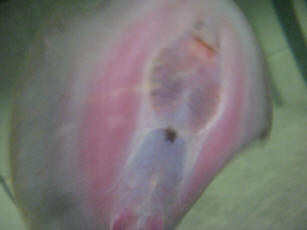
Possible Motoro Parasite/Feeding Frustrations (RMF,
second opinion please) 3/10/09 Hello, <Hello
Kyle,> Before I ask my question I think it's important to
note that my 7 inch Motoro was purchased and acclimated 3 days
ago, so he is still undergoing the typical acclimation stress
(and the underside of his disk is reddish). Now that he has
become more acclimated and begin scrounging for food, I noticed a
small brown spot on the underside of his disk in the shape of a
butterfly, with a little raised light-colored bump in the center
of the spot. I have attached the best picture I was able to get
of the spot (my ray swims fast on the glass), but I was wondering
if this could be a parasite that hitched a ride on my ray; and if
so, where can I find instruction to remove it as safely and
stress-free as possible? <It isn't clear to me what this
is, and I'm asking Bob for advice here.> <<Isn't
clear to me either, but at largest amplification, cleaning up...
and the position of this mark... it appears to be more of a
"bruise" to me than anything else. Not parasitic.
RMF>> In case it helps, my tank is registering nitrates at
5 PPM, with everything else at 0. I have a fine sand substrate
and filtration to turn 10 times the volume of the tank. In
addition, I was wondering about feeding. I have read and heard of
stingrays on "feeding strikes" or "not accepting
food" but mine seems to be very fickle about his food,
neither accepting nor rejecting it in any predictable way.
He's nearly always blowing the sand around looking for food,
but if he does pick up a worm or small piece of raw shrimp, he
will sometimes spit it out of his mouth even if he's accepted
it from me greedily before... only then to further swim around
the tank looking for something else to eat. One example is just
an hour ago, I put half a live nightcrawler in there, and he
sucked it out of my hand hungrily, then spat it out. For the next
half hour he would gnaw at it, spit it out and then swim around
the tank, eventually eating it. So far, I have tried bloodworms,
red wigglers, nightcrawlers, and ground raw shrimp; all which
have been accepted and rejected in an unpredictable fashion.
Thank you for your time and advice, I look forward to hearing
back from you. Kyle <While these fish are finicky, one key
thing about their appetite is stress. So your Stingray may simply
be settling in and not ready to feed consistently. But it could
equally easy be an issue with water quality or water chemistry
stability, so think about these factors too. Review tankmates,
and see if there's anything that might be stressing the
Stingray. Take care not to overfeed; when we bring home a new
fish, it's tempting to keep feeding the new fish to check
it's healthy and happy. Cheers, Neale.><<Totally in
agreement. RMF>>
|
  |
|
Re: More: re: Possible Motoro
Parasite/Feeding Frustrations (RMF, second opinion please)
3/12/2009
Hi, guys- thank you for your help and quick responses. I tried to
see what might be stressing him, but the water seems stable,
<"Seems"? You don't get this latitude with
stingrays; the water MUST be stable. Keeping them in huge tanks
helps, as does performing very regular (ideally, daily) water
changes so that background acidification doesn't get
a chance to occur. The carbonate hardness should be reasonably
high; while soft water fish in the wild, pH variation is much
more harmful than moderately hard water.>
he has no tank buddies, and the temp is kept at 80 degrees.
<Too warm. The usual 25 C/77 F is ample for these and indeed
most Amazon Basin fish (with a few exceptions, like fish from the
Xingu River which do like things a bit warmer). The warmer the
water, the more active a Ray will become, but the cost of higher
metabolism is increased demand for oxygen and a heavier workload
on the filter. Unless you're breeding fish, it's usually
best to keep them at the cooler end of their preference range.
Not cold, by any means, but verify their preferred temperature
range from Fishbase or similar, and work from there.>
And I have decided to call that brown spot a "beauty
mark" and will continue to do so until the moment (if and
when) it appears to be a trouble spot.
<OK.>
I have noticed since my e-mail before that there is a small
amount of regularity in his feeding. He seems to have no trouble
accepting one nightcrawler in the morning and evening, but
anything after that he will not eat. His belly also appears to be
getting less and less red each day (although this may partly be
wishful thinking more so than objective observation)... so I am
taking that as a sign that he's getting better
acclimated.
<Yes.>
It's still a little weird to me that he is spending a lot of
time blowing sand around looking for food, but won't eat
much, and then spends a lot of time swimming in the same pattern
around the glass.
<What kind of sand are you using? Anything likely to irritate?
Many aquarium sands are too sharp for benthic fish. If in doubt,
plain vanilla "smooth" silica sand is fine.>
I actually had to put a book on the corner of my tank, because it
appears as though he keeps trying to jump out that corner (I wont
worry about a tank cover until I see him trying to jump out
anywhere else).
<Normal behaviour if they're stressed. Again, this may
stop if the fish settles in, but if it persists, then review
conditions and act accordingly.
The usual problems with Stingrays are insufficient water
volume,
insufficient filtration (water turnover), and unsteady water
chemistry.>
Is it possible, since the tank at the store was decently
decorated, that adding some small decorations would help him with
his level of comfort, or are rays not as concerned with decor as
some other fish?
<Wild fish hide by digging into the sand. Floating plants will
certainly be welcomed for the shade they provide, but bogwood,
rocks, etc are redundant and indeed undesirable if they trap
dirt.>
Well, it seems this 'thank you' has turned into a
"holiday mailer" so I will cut it off here. Thanks
again for all your help,
`Kyle
<Cheers, Neale.><<Excellent resp. Neale... content,
format wise... Have nothing further to add. BobF>>
Re: More: re: Possible Motoro
Parasite/Feeding Frustrations (RMF, second opinion please)
3/12/2009
With regard to the substrate, it is a very fine sand. It may be
that the granules, although small, are sharp if the sand is an
issue.
<Feel the sand; smooth sand feels velvety, sharp sand feels
otherwise.>
If upon further investigation of his habits, I determine that the
substrate
is causing him irritation, would adding a small layer of a
different, smoother sand work?
<Replace all the old sand with smooth sand. No point being
cheap here; for the sake of a few dollars' worth of sand, you
could end up with an infected Stingray. Dump the old sand in the
garden. Mixed with soil, it helps improve drainage. So no
waste.>
I am trying to avoid ripping out the bio-colonies in the sand by
replacing the substrate altogether.
<No useful bacteria in the sand.>
Perhaps replacing the substrate over time, bit by bit? What would
work best for that?
<Replace all.>
Now that I read what I wrote, I realized "seems"
doesn't fit what I am observing with the water. That was my
way of saying I am checking it daily, levels are fine, so unless
there are fluctuations in the water source here in ways I
can't measure, then water quality isn't the issue. So, in
this case, seems=if something's wrong, it's going to
catch me off guard.
<Right, I see.>
Sorry to be such a bother with all these questions and trouble.
This is (quite obviously) my first ray, so I am erring on the
side of cautiousness, which may not be an err in ray-keeping at
all.
<Very wise indeed. Do invest in one of the several books on
the topic. Some are inexpensive (like the Barron's one) and
will save much money in the long term.>
`Kyle
<Cheers, Neale.>
Re: More: re: Possible Motoro
Parasite/Feeding Frustrations (RMF, second opinion
please) 3/15/09
I thank you again for your assistance. I don't know what the
problem could be anymore, because the substrate feels soft and
smooth to me, not scratchy like some sands I have used.
<Well, that's good.>
Water quality is fine and I have been changing at least 10
percent of the water every day.
<Define "fine". The thing with Stingrays is that 99
times out of 100, problems are down to water quality and/or
chemistry issues. Obviously you need zero levels of ammonia and
nitrite, but nitrate also needs to be very low, realistically as
close to zero as is practical. The water chemistry should be
stable; ideally soft and slightly acidic, but regardless of the
hardness level, the pH should be rock steady.>
He simply is refusing to eat anymore.
<Was he feeding at the aquarium shop? What were they feeding
him? For all the usual reasons, I'd never recommend buying a
specimen that was fed feeder fish, particularly goldfish. But if
it was consuming earthworms and other safe foods, it should be in
good shape. Assuming he's eating something, and has hitherto
taken a meal every couple of days, he can be "starved"
for a week or more without problems. But the flip side is
this:
Stingrays tend to be greedy feeders for things like earthworms
and live river shrimp when happy, but refuse to feed point blank
when stressed in some way.>
There seems to be a connection between me coming into the room or
near the tank to do maintenance and him going to hide in the
substrate.
<Some degree of nervousness is common initially after
purchase, but fish generally settle down within a few days to a
week. Do review the general environment though: loud televisions,
slamming doors, busy corridors can all make fish much more
nervous than otherwise.>
I am honestly getting a little frustrated with this guy; I really
only try to feed him morning and evening. Maybe I just need
clarification on what people mean when they say "feeding
strike." Obviously, there's an element of non-eating,
but if he's on such a "strike" then why does he
spend the whole day searching for food?
<To some degree you must dissociate foraging behaviour with
actual feeding; fish will instinctively forage for food all
through their day (or night) activity cycle. They don't need
to be eating constantly though, and simply because they're
foraging doesn't mean they need to be fed.>
Most times, he finds what I give him and greedily begins to suck
it down but then spits it out or leaves it, and then goes to
hide.
<Maybe he doesn't like it? What are you offering?>
I'm afraid I am going to lose this guy, and it just feels
wrong because I have been doing everything that I have been told
either by people or by my very deep research (I did get the
Barron's book before I bought him).
<My gut feeling here is this: [1] Review environmental/water
conditions; [2] Double check them! [3] Turn the lights out for
the next few days. [4] Don't feed him for at least 3 days.
[5] Get some nice, fat, juicy
earthworms and offer one of them late in the evening on the
fourth day.>
I am sorry there wasn't much of a question in this e-mail. I
guess I figured I may have said something about his behavior that
may show something we haven't noticed before.
`Kyle
<Cheers, Neale.><<I do agree with your probable
prognoses... advice Neale... If none of these can be found to be
at fault, when-corrected, restore this fish to feeding, I would
return it to the store. BobF>>
Re: More: re: Possible Motoro
Parasite/Feeding Frustrations (RMF, second opinion please)
3/15/09
Hm... thank you for the distinction between searching and
hungriness. That has helped me a little. When I bought this one,
I was actually in the LFS looking at another stingray that they
tried to feed an earthworm and he didn't go for it, but this
guy came speeding up to it and started to eat it down; he looked
healthy and obviously hungry so I got him instead.
<An excellent way to choose Stingrays.>
He did have a little trouble eating the whole thing because
he's a smaller ray still, but he did (and still does) get the
whole nightcrawler down eventually. I have also tried breaking
the worms in half or 3 parts but he loses interest or only eats
the front-worm part. Thank the Lord I care for an African clawed
frog who will eat what my ray rejects. Other foods I used are
glass shrimp and raw supermarket shrimp, and red wigglers.
<Do try something very small, like bloodworms. Shrimp are fine
up to a point, but because they contain a lot of thiaminase, it
is sensible to use them in small amounts, no more than 25% the
weekly food input. Earthworms are very nutritious, in part
because they are 'gut loaded' with decaying plant matter
and soil. While that sounds icky, it does mean they provide lots
of useful vitamins, minerals and fibre.>
I will try not feeding for a couple days. My only worry is that
he's already looking very malnourished from his rejection of
food (hip bones showing, dent in forehead, etc). I will do that
if he can last the couple days without food even like this.
<Well, if he's not eating, he's not eating. So whether
you put food in the water or not, it hardly matters. I'd
certainly stop offering food he shows no interest in. A day or
two starving should make little difference, though I agree, a
"skinny" Stingray is at risk.>
Water quality (ammonia/nitrite/nitrate) is still stable, nitrate
at 3 PPM and I am going to change 20% of the water again
today.
<The nitrate is fine; the nitrite is zero though?>
I honestly do not know about PH... maybe I made an unsafe
assumption that using the same water source each time gives the
same PH.
<Ah, yes, this matters. A lot of people in the US seem to have
water that has been treated in various ways by the water company,
presumably to improve its potability. But the chemicals used,
such as flocculants, cause the pH to change dramatically within
24 hours of being drawn from the tap.
Try testing the pH of some tap water now, and then leaving the
same water for 24 hours and seeing what the pH is then. You might
be surprised. Also, do of course remember the basics: don't
use water from a domestic water softener, do use dechlorinator,
and do use a dechlorinator that treats ammonia and/or chloramine
if either are issues with your local water supply. You might also
want to check for copper in your tap water supply.
If your pipes are made from copper, it is possible for tap water
to become contaminated. Copper is highly toxic to Stingrays, and
such water supply will need to be treated with a water
conditioner than neutralised copper.><<And copper ion
presence would definitely send them off feed. RMF>>
`Kyle
<Cheers, Neale.>
|
A worm question (Horsehair worms;
stingrays) 10/17/08 Hello, <Hi,>
was just wanted to know I notice some of my ghost shrimp have worms in
there intestines are to believe they are Gordian Worm, a.k.a. Horsehair
Worms...one died bc the worm killed it but I never notice them b4 on my
shrimp I feed these shrimp to my Motoro stingray which I have had for
about a week I know they are prone to roundworms and tapeworms but I
was wondering if I did feed some shrimp that had these in them can they
kill my ray I called the pet store where I got my ray and they never
really heard of these worms really and are not sure if they will harm
the ray they feed there ghost shrimp to there rays and had no prob but
they never looked at there shrimp to see if they had worms so they
could be feeding ones that do so I don't know what I should do I
don't want my ray to die and I don't know if I should get new
shrimp the other ones seem to not have these worms in them..should I
continue to feed them to my ray or go and get new ones??????
<Sheesh... not even a period or comma. Do please review our very
modest "fee" before writing: we expect e-mails to be spell
checked and written with proper grammar. Not much to ask, and the point
is that we depend on properly formatted messages so that we can share
them with other site visitors. The better Google can index our pages,
the more people will view our pages, and the more revenue our
advertising generates to pay for bandwidth. It's a simple deal
really.> HELP!!! PLEASE KINDA SCARED FOR MY RAY I LOVE HIM!!!
<Horsehair worms are not likely to cause your Ray any harm. Most
parasites are species-specific, and while they may be harmful to the
shrimp, they are unlikely to adapt to the particular anatomy of your
Stingray. If you're really that bothered, don't use the
shrimps. Earthworms are a very safe food if collected from an area that
is "organic", i.e., not sprayed with chemicals. Most rays
love earthworms. There's no reason to use live food with most
Stingrays anyway, and a varied diet of mussels, prawns and squid is
easily provided using foods sold for humans.> thanks Maria
<Cheers, Neale.>
FW Ray Feeding 03/19/2008 A quick question on my
hystrix rays. They seem to want to eat constantly. <Yes. A good
sign> They are on frozen foods, I think there's virtually
nothing they wouldn't eat but I can't seem to figure out just
exactly how much is too much or too little? <Better to keep a bit
hungry> They are both young. The female is about 6 inches diameter
and the male about 4 inches. She's the bigger piggy of the two but
both are all about the food. This is my first time emailing you and
your website is fantastic. I work in a pet store and recommend your
site to my customers frequently. <Have seen in some stores that they
have terminals for all to peruse the Net... Neat idea!> I hope this
isn't listed in the FAQ section somewhere but for love nor money I
could not find it. <Ahh, this and life-times more info. to be
added... as long as your Potamotrygonids aren't obviously concave
in the tummy region, they're fine... Better for all to have them
grow slowly, not pollute their tank. Cheers, Bob Fenner>
Stingray not feeding, FW
11/16/07 hi i have a young freshwater stingray it has not fed since
i got it. i have had it for about 4 weeks. i have poot it in a new tank
on its own. <Sorry, what's the question? There are many reasons
why Stingrays won't feed, and almost all of them come down to
improper care. So the problem is much more likely with you and not the
fish, and unless you fix that problem, it'll die. Stingrays are
exceedingly difficult fish that should only ever be kept by aquarists
with many years experience. They need big tanks in particular with a
wide surface area, at least 75 cm by 200 cm, and filtration needs to be
top-notch, of the order of 10 times the volume of the tank per hour.
Water changes need to be not less than 50% per week, and really two or
three times that. Water chemistry isn't critical, but water
chemistry stability is, so that needs to be factored in, and chemical
buffering used if appropriate. There are no "small" species,
and the appealing little juveniles widely sold are even more delicate
than their parents. I'd suggest that around nine out of every ten
stingrays sold dies within the first six months. Almost no-one who
tries keeping them succeeds, UNLESS they have lots of experience and
done plenty of reading. And even then, it all comes down to having a
big tank with perfect water quality. When healthy, stingrays will eat
pretty much anything: river shrimp, earthworms, chunky seafood,
silversides, etc. Cheers, Neale.>
Re: stingray not feeding -- 11/17/07 thank you for
your time, ill let you know if I get it feeding <You're welcome.
Good luck! Neale>
FW Ray fdg. - 7/23/07 Hi Robert I am not
sure if you are the guy to ask this question but her i goes. I have a
Motoro ray he is about 6" was doing real well. My water quality is
perfect <?> and so is the temperature. <Is this a guessing
game? How about some clues if so?> His tank mates are a Pleco and a
couple surviving tetras (food) I made the mistake of just feeding him
earth worms fro a couple months ( I know bad) Gave him kidney or liver
failure. He lost tons of wait and is real skinny. I am trying to bring
him back to his heath again. I have been feeding him bud worms for the
last few days he seems to be eating them but there not too filling I
don't think. He does not want to eat any frozen krill or shrimp. I
am even trying to feed him a small live 3/4" crayfish. But he does
not seem too keen on it or the ghost shrimp. Do you have any
suggestions for me that might get him eating again. <Mmm... need to
know the values you hint at above... likely lowering the pH, raising
the temperature, offering live food... maybe like ghost shrimp...
Possibly soaking in a vitamin/HUFA supplement...> Yes I learned my
lesson f/w rays need variety for food. Thanks in advance Kevin B Me
Kevin B. <Please read here:
http://wetwebmedia.com/FWSubWebIndex/fwrayfdgfaqs.htm and the linked
files above. Bob Fenner>
Stingray issue 7/22/07 Hi there, My question
is about my fw stingray. I currently am housing 3 fw stingrays, 2
Motoros and one reticulata (teacup). Motoros are 12 in and 6 in and
teacup is 6 inches . I have had them for about a year in a 265 gal with
a large Pacu and 14 in silver Arowana. As of late the smaller Motoro
has been swimming above where the air bubble wand and filter outtake
meet. Its def out of character for her. I am using a Fluval fx5, an
emperor BioWheel and Eheim canister for filtration. One of her eyes
seems cloudy and closing. I lost the first ray I had a year ago and he
showed some similar signs. Ammonia 0 nitrate 0 ph 6.0. Temp about 82. I
feed rays jumbo night crawlers I get from bait shop and once in a while
feeder goldfish but not to much. I added Pimafix. She also has a little
red around her mouth. The swimming funny really has me thinking
somethings up. She eats and has not lost any weight. Any helpful hints.
I would really appreciate any help your site is the best. Oh and
substrate is sand very easy on them. <Greetings. As you probably
realize, freshwater stingrays are exceptionally difficult fish that are
only suitable for very advanced, highly experienced fishkeepers. When
it comes to disease, the problems are that [a] we don't really have
a textbook list of stingray diseases yet and [b] many of the
medications safe with bony fish are dangerous to cartilaginous fish.
Now, as a general rule, when fish swim into the filter current it is
usually because this is where the water quality is highest and the
oxygen concentration highest. Likewise, when fish show red patches on
this skin (signs of irritation) then again, water quality is something
to think about. In your case, you need to be reviewing a variety of
things. Ammonia and nitrite obviously (you say the former is 0, but how
regularly do you test it? try testing over a week and at different
times of the day, especially shortly after feeding). Nitrate needs to
be as close to zero as possible, which you say is the case. But water
chemistry is also important. Stingrays aren't that fussed about pH
and hardness, but they are bothered by changes. So if you're
manipulating your water supply to get the low pH and hardness levels
you have, check to see you're being consistent. Another issue is
air or water pollution: it's easy for things like paint vapours and
tobacco smoke to end up in the aquarium, and these will irritate/poison
the fish. Yet another issue is filter turnover. For a stingray, I'd
recommend not less than 8x the volume of the tank in turnover per hour
(i.e., marine quality filtration and twice that for regular small
community fish like guppies and tetras). Given your aquarium is 265
gallons, that means you need filtration around 2120 gallons per hour,
minimum. Your Fluval delivers about 600 gallons per hour, the Emperor
280 gallons per hour, and the Eheim I don't know how much because
you don't say the model. But it needs to be *at least* 1240 gallons
per hour to even make the baseline your stingrays need. Since even a
really big Eheim like the Professional 3 is only producing a
"mere" 450 US gallons per hour turnover, your tank is very
likely (almost certainly) under-filtered. Some more general advice.
Melafix and Pimafix are largely useless as treatments. While they
sometimes work for some people under some conditions, they're too
inconsistent to be relied on, and therefore of no value with expensive
fishes like yours. Another problem is diet. Stingrays feed on a variety
of animals in the wild including small fish, but never Cyprinidae. The
nearest Cyprinidae are hundreds if not thousands of miles away from
where they live. Why do I mention that? Because Cyprinidae -- things
like goldfish and minnows -- have high quantities of Thiaminase that
breaks down Vitamin B1 over time. They also contain a lot of fat. Fish
that eat them in the wild, like pike, presumably are adapted to this,
but most other predatory fish do not seem to be, and long term both
these issues cause damage. Bob Fenner has written at length on the
issue of feeder goldfish and marine predators like Lionfish. Since your
stingray is, basically, a marine fish that happens to be living in
freshwater because it got trapped on the wrong side of a newborn
mountain range, your stingray likely will react the same way to a high
fat, high thiaminase diet as any other marine predator (i.e., poorly).
On top of this, feeder fish are the Number 1 best way to introduce
parasites and bacteria into your nice clean stingray aquarium. To be
honest, whoever advised you to feed cheap "parasite time
bombs", sorry, feeder goldfish, to something as delicate and easy
to kill as a stingray deserves to spend some quality time on the
Naughty Spot. The ideal foods for stingrays are either terrestrial
foods (like earthworms), marine foods (like mussels and prawns), or
"clean" frozen foods (like bloodworms and lancefish). All
these will be safe because they have no chance of introducing parasites
or bacteria into the aquarium likely to harm a freshwater stingray.
Over here in the UK, live estuarine river shrimp are widely used with
success and these match very closely the preferred staple diet of
freshwater stingrays in the wild: large crustaceans. As you realize,
stingrays have teeth adapted not for catch fish but for crushing
shells. Finally, the whole sand issue in aquaria for stingrays is
debated endlessly. There's some good evidence that dirty sand can
trap bacteria and cause infections. This has been observed on catfish
barbels for years (erroneously put down by some people to
"sharp" gravel wearing the barbels down). Catfish generally
shrug off such infections and re-grow their barbels when conditions
improve, catfish being, fundamentally, very hardy animals usually
adapted to swamps and other horrid environments. Stingrays do not have
this level of robustness. So double check the sand is spotlessly clean.
You should be stirring it weekly and siphoning out any detritus. Many
stingray keepers prefer to keep their rays in tanks without sand to
side-step this issue. Finally, do check the fish aren't able to
burn themselves. It is *extremely* common for stingrays to burn
themselves against the heater. The heater should be either inside the
filter or covered with a plastic mesh of some kind (called
"guards" and these often come with the better heaters
anyway). Hope this helps! Cheers, Neale.>
Motoro sting ray... RMF rant on the new trade, poor
env., poisoning, lack of useful info. - 02/15/07 Hello, I
have a motoro stingray with a sand substrate. <Hopefully not
silicate... but smooth...> I was using new Tetra Tec filters with
internal heaters to protect the ray but the impellers kept failing.
<What is happening with the "new" Tetra? And while
we're at it... Aquarium Systems salts? Oceanic
Tanks...? What gives with the "consolidation" of
the pet-trade anyhow? The big owners are doing a crap job of
"managing"...> I switched to Filstar Canistar
filters <Am not a fan of...> and had a mild algae
bloom. I treated the tank with a small amount of "algae
fix" <NO!!! Toxic...> which corrected the algae issue but
now she refuses to eat. <Poisoned...> It has only
been three days and I have tried bloodworms, ghost shrimp, and krill
all of which she used to love. All levels are fine <...
worthless> and she seems fine but I would like to know if there is
anything I can do to get her back to eating regularly? <...> I do
not think that the filter change is the problem because I changed the
filter on another ray tank at the same time and that teacup ray is
eating normally. I did a water change but she still refuses to eat. Bob
Fenner had some great advise which helped in setting up for both my ray
tanks and I hope that he or anyone else can help with this question.
Please advise, Thanks, Joe <Please take the (re)read here: http://www.wetwebmedia.com/FWSubWebIndex/fwstingrays.htm and
the linked files above. I would do a series of water changes to remove
the algicide, make sure the water is warm, soft, acidic per this
species requirements... and be patient at this point. BobF>
Hystrix Stingray Not Eating? 1/23/07 To Whom It
May Concern, <Okay> I have had a Hystrix Stingray in a 250 gallon
tank for approx. 9 months and she has now stopped eating?? <Mmm, you
tell me... Potamotrygonids, in fact all cartilaginous fishes do
periodically seem to go on feeding strikes... generally no problem>
I checked the water quality (ammonia = 0, nitrates = 0)and have even
performed two water changes (approx. 20%) over the last 4 days, but to
no avail? <Was I there with you?> She was eating shrimp (4-5 per
day), <Mmm... I wouldn't feed this much, and not daily>
bloodworm cubes, earthworms, salmon, but is no longer accepting any of
the above. The water temp is approx 80-82 degrees and the PH is
6.0-6.2. I am unsure what to do, but she has not eaten in approx. 5
days and is looking very thin and weak. <Do you administer vitamins?
Iodine/ide?> In the past, she was very aggressive when eating and
would accept food as often as I would put it into the tank. Is there
some type of medication that I should add to the water? <The
aforementioned supplements> Thanks in advance for your help.
Regards, Steve <Please read here: http://wetwebmedia.com/marine/fishes/index.htm The second
tray... Batoids Disease, Potamotrygonids Feeding... Bob Fenner>
Re: Hystrix Stingray Not Eating? Wasting WWM time
1/24/07 Thanks for the suggestions. How long
(theoretically) can she go without eating (considering she was very
well fed prior to her fasting)? <Mmm, at this size... a couple of
months likely> I just placed a bunch of ghost shrimp in the tank
this evening in hopes that the "thrill of the chase" will
spur her appetite, but I am not expecting much. <Perhaps the
occasional earthworm...> Unfortunately, I have not given her any
vitamins and just tried to vary her diet to provide the proper
nutrition. <... read... where you've been directed. There are
some very common deficiency syndromes with these (Chondrichthyans)
fishes... as you will/would have found by now> Can you
recommend something that can be added to her food (when she starts
eating again) to help her receive the correct balance of nutrients?
<Hello... this is posted... see WWM...> Reference the
proper medication, I understand that Freshwater Rays are particularly
sensitive to medications and I have never tried to use any in this
particular tank. Could you recommend a particular product?
<...> Also, the one test that I am unable to perform, is to
determine if my PH has dropped too far below 6.0. My test
kit only shows the PH reading to 6.0 and I have been unable to find any
type of standard test kits (i.e. test tubes, liquid, litmus paper) that
provide a lower gauge. Could any of the Crew recommend a
good quality electronic/digital PH tester that's not to costly?
Thanks again for your help. Regards, Steve <Please, don't waste
our time... Read. Bob Fenner>
Hystrix ray - 10/17/06 Hello <Hi Emma, MacL here with you
today.> I recently purchased a hystrix ray and am wondering if it is
safe to feed freshwater stingrays red wiggler worms? My stingray is in
a tank with discus so I need to be sure that these worms are safe for
them as well. <In my experience its best to stick with ghost shrimp
to feed them. I do know some people who have fed them blood worms and
the discus as well but I find that the rays thrive with the ghost
shrimp and you can give the ghost shrimp things to eat that make them
more nutritious.> Thanks Emma
Feeding freshwater stingrays - 08/15/06 Hello Brian
here I wrote a few months ago about getting into freshwater sting rays.
Anyway I have only a few questions for you this evening. I
purchased 2 freshwater motoro rays and they are doing great eating well
and look to be in good nutritional and physical
health. Their color is great and they are very active
looking for food. <Beautiful animals> When I
purchased them 3 weeks ago they were eating live red wigglers and live
black worms. The problem is no stores in my area sell these
items and that fish place will not ship them to me. So I tried feeding
them frozen blood worms and they got all excited that they were being
fed but they would not eat them. I was told when the rays
got hungry enough they will start to eat them <Should... best to
train by mixing "some live, some frozen/defrosted" for a
time...> but this does not sound right to me. The other
question is the motoro rays are about 7 inches in diameter and in good
health the water is kept identical to the dealers Ph 7.5, <I would
lower this in time. Please read here: http://www.wetwebmedia.com/FWSubWebIndex/fwstingrays.htm
and the linked files above...> ammonia 0, nitrate and nitrite about
0 with MINOR changes nothing to worry about. My tank is a
220 gallon with ProClear aquatics sump and an in line chiller (if not
the tank would get about 84 degrees) <This actually is a good
temperature for this species> Is this a sufficient tank
set up for these types of rays. <Mmm, not for very long... gets to
be about a meter in diameter (and 15kg in weight) in the wild...>
Last question I understand rays do not like high amounts of light so
instead of running many fluorescent bulbs I only run 2 one on each side
of the tank is to much light or not enough <Good> (the rays do
not seem to mind the 12on12 cycle I have them on). I appreciate the
help you guys are great. <Let's summarize: I would lower your
pH, raise temperature, and see about mixing some live with non-live
foods to train your Motoros. Ultimately get a much larger system... Bob
Fenner>
Re: Feeding freshwater stingrays
8/16/06 Hey thanks Bob I appreciate the help and will be sending
pics of the Motoros in the near future. <Please do>
Due you know any online sites that ship or sell live black
worms? Thanks again. <Yes... try Paul Dover at Bayou...
bayoubrine@aol.com Bob Fenner>
Freshwater Stingrays, Sabrina's Envy - 12/15/2005 Around
6 moths ago after 15 years of fish keeping I decided to try freshwater
stingrays. <I envy you. Deeply. You've no
idea how much I love these animals, wish I could keep,
breed.... Not in California. Sigh.> The most
frequently available and affordable to were Potamotrygon reticulatus.
<Beautiful.> I set up a 6' x 2' x 18" high tank
filter using 2 canister filters - an Eheim 2213 and a Fluval 304) with
a sand substrate about 1/2" thick. The pH was and still is 7, temp
80degrees C, ammonia zero and nitrates controlled with weekly water
changes. <Nitrite, I trust, is zero as well.> About mid June I
purchased 2 Retics (only males were available) about (XX)" dia
<Unfortunately, portions of your email are
garbled.... the lettering I can figure out, but this is
impossible for me with your numbering, unfortunately; not sure what
happened here.> and settled them into the tank with the intention of
getting 2 females at a later date. These 2 males settled within the
hour and were eating earthworms the same day. <Wow,
excellent!> About the end of October the shop finally got more
retics in and I got (XX) <Same trouble....> females again about
2" dia. The males are now about (XX)5"-4" <I'm
assuming this is 3.5-4 inches? Blast this webmail....>
and the females were added to the same tank.
<Yikes! I'd've quarantined the newcomers, to be
sure.... there's just SO much that can go wrong with
rays....> Although I could see no problems between the rays the 2
new females have not settled like the males and do not seem to be
eating anything I put in the tank. <VERY bad news.... At
this tiny, tiny size, they may not make it without food
urgently....> I have tried blood/earth worm, prawn, mussels, flake,
tablet and I have even tried Live deformed Endler's guppies (which
is normally a big no no for me) all without success. <Try live
bloodworms, failing that, try live blackworms.> I am now at a stage
where I have placed a divider in the tank as one female is extremely
skinny (hollow in the head and showing pectoral bones) and the other
seem not as bad but fear it will go the same way. <Very, very
dangerous....> I feel the possible mistake has been adding them at
different times and if so then lesson learned as I feel I will lose
these 2 females. <I fear you may.... The urgent lesson
here is QUARANTINE your newcomers.... Not only to protect
your existing, healthy stock, but to help the newcomers chill out and
eat.> Sorry for the length of this mail but the more info u <Not
'u', 'you'.... we have to correct these for
posting on the site.> have the less speculation you will need to
make. <Quite correct. Thank you for the detailed
info.> If you can help or advise it would be appreciated. <I
would advise removing the females to a separate quarantine system if
possible - and NEVER add to your main tank without a four week
quarantine for new rays. If these girlies don't make it,
I will also *strongly* advise that you start with slightly larger
specimens next time, and make the shop owner show you the animals
eating prior to purchase - if they don't eat, don't buy.>
Thanks, Stuart, Scotland. <Thank you very much
for sharing, Stuart - Keep up hope, and try to get some live bloodworms
or live blackworms into these girlies. If you get them to
eat, keep them eating - get 'em fattened up a bit before you wean
them off onto dead or prepared foods. All the best to
you, -Sabrina>
|
|

