|
FAQs on Red Devil Cichlids:
Identification
Related Articles: Red
Devils, Texas Cichlids,
Firemouths, Oscars, Neotropical Cichlids, African Cichlids, Dwarf South American Cichlids, Cichlid Fishes in General, Cichlid Systems, Cichlid Identification, Cichlid Behavior, Cichlid Compatibility, Cichlid Selection, Cichlid Feeding, Cichlid Disease, Cichlid Reproduction,
Related FAQs: Red Devils
1, Red Devils 2, &
Red Devils Behavior, Red Devils Compatibility, Red Devils Selection, Red Devils Systems, Red Devils Feeding, Red Devils Health, Red Devils Reproduction, &
Neotropical Cichlids 1, Cichlids of the World,
|
|
|
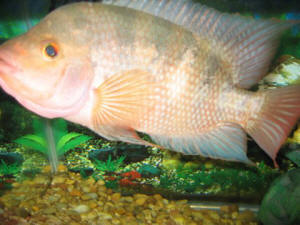
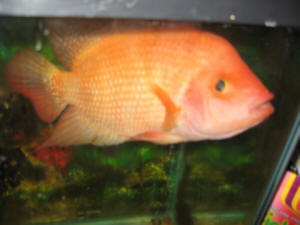
Cichlid ID 7/6/10
Hi, I was wondering if this is a midas cichlid or a red devil
cichlid. Is it a male of female. Thanks Domenica
<If this specimen was bought in a pet store and isn't
wild-caught, it's probably a hybrid. With wild-caught or
carefully bred fish, you tell the difference by looking at the
fish from above. If you look at Amphilophus citrinellus from
above, the shape of the head looks like a V. If you look at
Amphilophus labiatus from above, the head looks like a U. Hybrids
can look like either, or something in between. Wild-caught
Amphilophus labiatus usually also have well-developed lips, much
more so than those of Amphilophus citrinellus; however, tank-bred
Amphilophus labiatus almost never have this feature. Bottom line,
your specimen is probably a male, and if bought in an ordinary
pet store at a low price, it's probably a Amphilophus hybrid.
Cheers, Neale.>
|
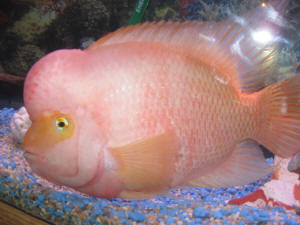 |
Red devil or Midas 5/15/10
Can you please tell me if this is a red devil or a Midas cichlid I
would really appreciated.
<If you bought this from a pet store, it's almost certainly
a hybrid. Pure-bred Amphilophus citrinellus and Amphilophus
labiatus are very rare. In theory, the "easiest" way to
tell tank-bred orange-morph Amphilophus citrinellus from
Amphilophus labiatus is by looking at them from above. The shape of
the mouth of Amphilophus citrinellus is seen to be somewhat curved,
like a regular arch, while Amphilophus labiatus has a mouth that
looks more pointed, like a gothic arch. There are some other, very
slight differences in body shape. But do be aware that Nature
isn't neat and tidy, and there's variation in both species.
Indeed, some authorities consider
them to be one and the same species. Maintenance of both true
species, as well as the mutt sold in pet stores, is identical.
Cheers, Neale.> |
 |
Typo ("What's in a (common
Cichlid) name?") First let me tell you that I thoroughly enjoy
your website, but today while I was browsing I found one piece of
misinformation: Amphilophus citrinellus (Gunther 1864), the Midas
Cichlid, aka one of the Mesoamerican Cichlids called a/the Red Devil.
The Midas cichlid (Amphilophus citrinellus) is located in the great
lakes of Nicaragua and Atlantic slope rivers in Nicaragua and Costa
Rica from the Rio san Juan to the Rio chiripo del Atlántico.
The Red Devil (Amphilophus labiatus) is restricted to the great lakes
of Nicaragua. Loiselle, Paul V... 2000. Cichlid Forum. Aquarium Fish.
12/00. <Hmm, thank you for this input. Will post in the appropriate
FAQs area on the site. Lots to say here... there are at least four
species of meso-American cichlids sold as "Red Devils" in the
hobby interest... If you insert the common name: "Red Devil"
in www.fishbase.org you will find only A. citrinellus comes up... I
accept that both species mentioned are "this" fish. If you
query further, deeper you will find this to be the general consensus.
Bob Fenner>
Nomenclature question Hello - For
many decades, I have always kept Red Devil's and was familiar with
the scientific names. In fact, back in the mid to early 80's, I had
several questions answered by Aquarium Fish Magazine regarding the
possibility of breeding my large male. In each of these
correspondences, the scientific name was always printed with the
response, in fact one of the questions I posed dealt with a particular
name change which occurred back then. When I first started rearing Red
Devils, the scientific name was Heros labius or Heros labiatus. Several
years later, they started changing the name from Heros to Cichlidae
labius and/or Cichlasoma labiatus. Today, I have noted that they are
also using the name Amphilophus labiatus. I remember that the
original name change from Heros to Cichlidae was an effort to properly
show the familial relations as well as reduce the number of animals
that had multiple names as a result of different scientist describing
the same species. Thus, what is the current/proper name of the Red
Devil? Furthermore, what have all of the different versions been and
why are they constantly revising the name? Thanks. Art <<Hello
Art, The name Amphilophus is current and should be final. The genus
Cichlasoma was an umbrella for all cichlids from Central America until
things got sorted out. Today it has been split into a whole bunch of
new genera according to morphological characteristics, so the fish
eaters for example are Parapetenia (i.e. friedrichstahli), the
rheophile cichlids are Tomocichla (i.e. tuba), the group around the red
devil are now Amphilophus. There are still some fish that have not been
placed in any of the groups including the salvini and the Jack Dempsey
(C. octofasciatum). The genus Heros is now reserved for the fish we
know as the Severum (now Heros severus), and includes around a half
dozen species. To check on current names you can go to http://www.fishbase.org - this site is
pretty current with what is happening in nomenclature. Hope this helps,
Oliver >>
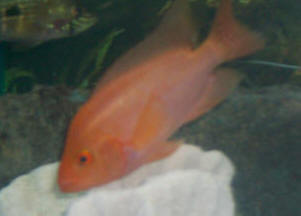
| Identifying an albino ... actually a Xanthic
variety... 7/28/06 <<Hello, David.
Tom>> A fellow co-worker got married and this killed all her
fish. <<Had to re-read this sentence a couple of times,
David. I thought you were suggesting that the marriage killed her
fish. :)>> He brought it to work to flush. (Wife wouldn't
let him flush it in house.) <<I won't even go into the
abominable practice of putting fish down by flushing them.>>
I adopted the fish and put it in a 39 gallon tank that had three
guppies. (Not anymore). <<My hat's off to you for saving
the fish, David, though your Guppies wouldn't concur.>> I
was very heavy into Africans in the past but have not seen this
fish. Please help to identify.... <<Based on your photo (very
nice) and this animal's aggressive/murderous behavior, I'd
say you've got a Red Devil Cichlid (Cichlasoma labiatus) on
your hands. I'll let Bob take a look at the photo for
confirmation, though.>> <I concur Tom. RMF> Thank you
very much <<You're welcome, David. Tom>> |
|
|
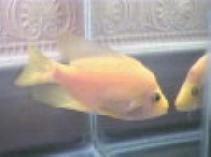
| 2 pictures for you Firemouth Not a Firemouth, Red
devil beh. 4/16/08 I have a Firemouth cichlid that
I have had for a couple of years now. A few months ago, he started
losing his scale color-it almost looked like he was molting. Now,
he is completely orange. He has been completely orange now for
about three months. He eats well, I give him cichlid pellets, blood
worms, etc. he started having the problem when I gave him a bunch
of feeder minnows. Water pH is around 7.8, temp is 80 degrees,
ammonia level is zero. I regularly do water changes once a month,
and he is alone in a 25 gallon tank. He is very large, probably 9
inches long. My question is - what is the matter with him? How can
I get his stripes/coloring back? Why does he now look like a giant
goldfish with teeth? There are no visible parasites on him. His
fins are in perfect shape. Any ideas? I am attaching a couple of
pictures showing him when it first started happening, and what he
looks like now. Can you help? Thanks----------Wayne <Your
Firemouth is really a red devil. Once they change from their grey
color to orange they don't go back.-Chuck> |
|
|
|
|

