|
FAQs on Red Devil Cichlids: Foods,
Feeding, Nutrition
Related Articles: Red
Devils, Texas Cichlids,
Firemouths, Oscars, Neotropical Cichlids, African Cichlids, Dwarf South American Cichlids, Cichlid Fishes in General, Cichlid Systems, Cichlid Identification, Cichlid Behavior, Cichlid Compatibility, Cichlid Selection, Cichlid Feeding, Cichlid Disease, Cichlid Reproduction,
Related FAQs: Red Devils
1, Red Devils 2, &
Red Devils Identification, Red Devils Behavior, Red Devils Compatibility, Red Devils Selection, Red Devils Systems, Red Devils Health, Red Devils Reproduction, &
Neotropical Cichlids 1, Cichlids of the World,
|
|
red devil not eating
1/15/12
Hi i have currently had My red devil fish (Chester) for nearly a
year now.
I'm not actually sure whether its a he or a she, Chester was a baby
when i bought him from the pet shop. He is around 4-5 inches long. He
has always been in a tank
<How large, filtered?>
by himself and since we got to know each other he has been quite happy
in his tank, and interacting with me when i came close to the glass. I
have never fed him fish, just cichlid pellets and blood worms
daily.
<Do cut down on the last... sewage fly larvae have been implicated
in metabolic disease in recent times>
He has Always had a healthy appetite and came to the top of the
tank to get his food from me. i clean his tank out around every
month and a half.
<... Better by far to do partial water changes, w/ gravel vacuuming
weekly... and filter maintenance at these times>
i recently cleaned his tank and filter and got him a new heater
due to the old one starting to die and not keep the right temperature.
after the tank clean his water was at 7.5 PH
<What re ammonia, nitrite and nitrate?>
and temperature was 25-26 degrees Celsius. But he has not eaten since
the water change and has been hiding all day in his little cave. He is
getting very pale as well. its been about 10days since he has eaten
anything and is not interested in any food which is not like him at
all. he refuses to come out of his cave. i took the cave out to see how
if that would change anything but he just hides near his filter and
behind his fake plants. he still spits his rocks around like always but
not when anyone is watching.
When i go close to the glass he will swim away and hide which also is
not like him. Other than being more pale than usual his appearance
hasn't changed. no cloudy eyes or spots anywhere. Please help i am
getting very worried about him not eating. what else can i do?
<Please answer the questions above and read here:
http://www.wetwebmedia.com/FWSubWebIndex/reddevdisf.htm
and the linked files above.
Bob Fenner>
|
Red Devil not eating
1/5/12
Hi Guys, I have a red devil that is about 2.5 years old. I had
her in her own 39 gal tank for over 2 years and only had 1
decoration that she could hide behind. At that time she will only
eat the Cichlid Gold pellets. She would go crazy over them and
eat about 5 or 6 pellets every day. I've tried peas, lettuce
and Shrimp pellets but she would eat one and then spit it out.
She won't eat anything that doesn't float either. Nov 9th
or so I bought a 75 Gal fish tank that had 3 fire mouths and a
really big Pleco in it. I brought it to my house set it all up
and added in those fish. About 2 days later I added in 2 small
convict Cichlid and a small Pleco. I also added in lots of
smaller decorations for the fish to hide. I added my red Devil,
Chi, about 11 days later.
<I do hope it gets along w/ the other Cichlids... Red devils,
well, can become "devils" toward their
tankmates>
I added a very large pipe for her to hide in but hasn't taken
to it yet. She is acting fine swimming around and actually not
bother the other fish too much. My problem is that I haven't
seen her eat yet. She doesn't do crazy over pellets like she
used to. I feed the other fish flakes and smaller pellets. Once
she sees that the other fish are eating she sill go over and swim
around but not eat any of the food. She is still moving rocks
around, still following my fingers along the glass, seams to have
gotten bigger and her teeth are still brown, but its been about a
month and I still haven't seen her eat. Is there anything I
can do?
<Mmm, yes... I'd switch to a food w/ higher palatability.
Do look for "Spectrum" brand.>
I haven't had the water tested and the heaters I have I
don't know if they always work as the water temp seams
<seems> cold and then the next way warm and I have them set
to be about 82 degrees.
<This should be fine; I might lower to the high 70's
F>
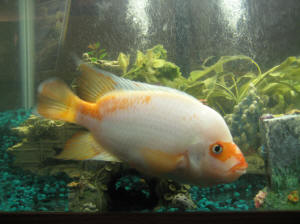
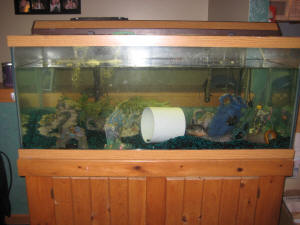
The pictures are of Chi and how my tank is set up. Please
help.
Joie
<Do try to be patient as well... Your Chi won't starve
even if it doesn't eat for several days. Often fishes go
"off feed" when moved to new circumstances, new
livestock is added. I urge patience and the switching to Spectrum
pelleted food as a staple. Oh, do read here:
http://www.wetwebmedia.com/FWSubWebIndex/reddevfdgf.htm
Cheers, Bob Fenner>
|
|
|
Gizmo our Red Devil... health... env., nutr.
12/28/09
Hi
I have a 8 Year old red devil that has not had no trouble at all during
his life in the last couple of months we have noticed him slightly
losing appetite and sinking to the bottom of the tank and laying
sideways.
<May be getting old, though this species should live a little longer
without problems.>
PH is 7 Tank temp is 30 degrees Celsius, tank size is 270 Litres.
<The pH is too low, and the temperature a bit too high. Indeed, if
it's been at 30 C all its life, it may well be "old"
before its time. These fish do need hard, basic water -- you're
aiming for 10+ degrees dH, and pH 7.5. I mention these specifically
because tanks that rely on coral sand and Tufa rock for hardness may be
fine for a long time, but eventually algae and bacteria so encrust the
sand and rock that the buffering ability drops to zero. Replacing
some/all of this material will help. Otherwise, simply add something
like a Rift Valley salt mix at 50-100% dosage to provide the conditions
required.
http://www.wetwebmedia.com/FWSubWebIndex/fwh2oquality.htm
>
We had our filter not running efficiently by the time we realised the
water quality wasn't very good over the last 2 weeks
<Well, that's one possible cause of problems.>
I have done a 2 x 50% water changes, cleaned the filters re leveled out
his Ph level and put some live fish in their for him.
<Why have you added live fish? Let's be clear here: one of the
silliest things any aquarist can do is use cheap, store-bought feeder
fish. Goldfish and minnows contain too much thiaminase and fat, and
over time will cause chronic vitamin deficiency and degeneration of the
internal organs.
http://www.wetwebmedia.com/ca/volume_6/volume_6_1/thiaminase.htm
http://www.wetwebmedia.com/goldfshfd.htm
Cheap feeder fish can also internal parasites, some of which can infect
predators that eat them. The information about thiaminase is
increasingly widely known now, but the problems with fat and parasites
have been known for years, which is why no aquarium book advises
aquarists to use live feeder fish.>
We went away for 4 days came back and he had no colour at all but he
would come out and say hello then go hide in his log again. When he
swims it sometimes is sidewards then when he stops he hits the bottom
fairly hard.
What can I do to help him?
<See above. Optimise water chemistry, check water quality, use a
proper diet. Amphilophus labiatus evolved to eat small invertebrates
from the mud; that's what its thick lips are all about. It also
eats things like algae and organic detritus. I mention these because
aquarists often assume feeding their cichlids feeder fish is good for
them. Almost all cichlids are omnivores that feed primarily on algae,
organic detritus, invertebrates, and plants. Very few are
"predators" in the sense of eating smaller fish, though to be
fair, Amphilophus labiatus does occasionally eat small fish. So once
you have water chemistry and quality optimised, concentrate on things
like cooked peas, earthworms, wet-frozen krill, insect larvae, etc.
Good quality cichlid pellets are extremely useful, perhaps augmented
with things like Spirulina flake and Sushi Nori. Small portions of
thiaminase-free fish fillet (e.g., tilapia) can be added, perhaps once
a week.>
Regards
Kurt
<Cheers, Neale.>
Frelling Red Devil! Hi! I was wondering if you could
help me with an issue that I am having with my Red Devil. He is an
adult male, and approximately 10 inches in length. About a week ago I
put him in a new 60 gallon aquarium and now he has not eaten in a week.
The pH is set proper and so is the temp. I have tried all the foods he
normally eats and then some. He still won't eat. I thought that it
may be because he is still getting acquainted with his new
surroundings but I don't feel like it should take this long. What
do you think and do you have any answers that may help me save my fish?
He is active and still moves his gravel around. How long can he go
without eating? < Cichlids in general are territorial and seem
to be more shaken up by a change in surroundings then most other fish.
A couple of things come to mind. If the tank is in a new location then
additional foot traffic may make him more reluctant to come out.
Brighter colored gravel may make him more obvious and once again more
reluctant to come out. Try some washed earthworms to get him going. If
the temperature is around 80 then he can probably go a couple of weeks
without too much suffering.-Chuck> Ron Sankary
Red Devil Cichlid Hello once again Bob, My name is Courtney
and I have a RED DEVIL CICHLID and, well, it doesn't seem to eat
anything that we put in the tank. What would you recommend as we have
two other little cichlids about 2" in length and out RED DEVIL is
7-8". What should I do, I mean, maybe he eats when we are not
around but it always seems to be the little ones that eat and not him.
What could be wrong and what could I possibly do? Thank you once
again. I hope that you are able to answer my questions. Courtney
<Mmm, what had this fish been eating? Is it new to your tank? What
were the people feeding it before...? It may be conditioned to eating a
particular food/format... like pellets, or specialized food sticks... I
would not worry much re... as these cichlids will eventually come
around, eat most any/everything... I am concerned re your other
fishes... as the Red Devil... can be a devil! Please read here re
Cichlids: http://www.wetwebmedia.com/FWSubWebIndex/fwlivestkindex.htm
Bob Fenner>
Re: Red Devil Hello again Bob, <Courtney> Well the Red
Devil is new to our tank. Same with our other little cichlids. Now the
Red Devil used to eat pellets, and sticks when the pet store had him.
Our other cichlids eat fine, but the Red Devil seems to not eat, now,
whether he eats when we are not looking is the other question. The rest
of the fish in the tank never and I mean never get picked on by the Red
Devil. They are getting along fine. The ones that do the picking are
the little ones and they pick on each other. But they have not hurt one
another. It's like they are both saying to each other, NA NA Boo
Boo. It's rather funny. But the Red Devil watches them, but never
goes after them. Now, we had a ship in there for him to go behind and
well my boyfriend took it out of the tank and now he swims around more
and we are maybe thinking that's the problem. Now that he is out in
the open we think he well start eating, but we still left rocks in the
tank for the little ones to him under. Thank you for your time.
Courtney <This fish will eat eventually, no worries... and it is
VERY likely to be trouble with these smaller fishes. Read here:
http://www.wetwebmedia.com/FWSubWebIndex/reddevils.htm
and the linked files above. Bob Fenner>
Loui, the Red Devil... not feeding 11/14/06 Hi:
<<Hi, Daniella. Tom here.>> I'm wondering if you can
help me. <<I'll give it my best effort.>>
Loui Lucifer is our red deviled cichlid. <<Red Devil Cichlid.
Just a little help. :) >>>> He is a 10' male in 47
gallon tank. <<10' (inch), not 10' (feet). My apologies,
again.>> He used to have a lot of energy and was very
temperamental. (I couldn't keep anything in my tank or else he
would kill and eat it). <<Definitely a Red Devil
Cichlid! Not unusual for this fish at all.>> Within the last week
he has changed. He does not eat and he stays in one corner
in the side of his tank. He hasn't touched his feeder
fish. <<Too many feeder fish isn't recommended.
They're not a good part of a Cichlid's diet. They're not
nutritious and can introduce disease(s) into the tank. Yes, Cichlids do
feed on fish in their natural habitat but these aren't the same
fish we buy at the store.>> I can't notice anything unusual
about his appearance except he has turned a much brighter range in
comparison to before. He's much paler. We have tried
feeding him blood worms thinking that he might need a change in diet.
<<A variation in diet is excellent but I don't
think this is the problem.>> He hardly swims and appears
extremely depressed. We have done a 25% water
change. The pH level is about 8 and I'm not sure what
the nitrites are but am taking a sample in. <<Very
good! Ask them to check ALL of the parameters including ammonia,
nitrite and, particularly, nitrate levels. Cichlids are not very
tolerant of nitrate levels over 20 ppm (parts per million). We, in the
hobby, think of levels up to 40 ppm as being 'safe' but this
isn't necessarily true for Cichlids. The lower the levels are, the
better.>> The feeder fish we bought 2 weeks ago are still alive
and had appeared to have ich on them. Would this have an effect on Lou
and why he is not eating? <<Hopefully, Lou will not
eat a fish infested with Ich. (I wouldn't!) Unfortunately, the fact
that the 'feeders' have Ich means that Lou is liable to get it,
especially in the state that he's in. Please, research our site
regarding the use of aquarium salt for treating Ich. Much as it bothers
me to say this, your Cichlid comes first. Treat your tank with Lou in
mind and forget the feeders.>> Could he have an internal
infection from these fish? <<Again, Daniella, this is
entirely possible. Without more information, it's very hard to say
what might be wrong with him. There are many good foods available for
your fish. Stay away from 'feeder fish' for the time being.
There are just too many problems associated with them.>> Help. We
are really worried and don't feel he's going to make it.
<<Keep doing regular water changes to reduce possible high
nitrate levels. Use aquarium salt and heat to get rid of the Ich
problem. Make sure that you vacuum the bottom of the tank, or
substrate, during water changes. This will help in ridding the tank of
Ich and nitrates. It sounds like Lou is big and, otherwise, healthy.
Hopefully, what I've suggested will bring him back to his
'usual' self. Good luck, Tom>>
Red Devils natural diet? And fat lips? Chuck's
Take - 02/11/2007 I have a 7' Red Devil cichlid, his name is
Marmalade. He currently is the only fish in his 55 gallon aquarium.
<And likely to be the only fish tolerated...> The tank is
filtered by two <Good> AquaClear 500s, with weekly 25 to 50
percent water changes. <Also> Water parameters: pH-8.2,
ammonia-0, nitrite-0, nitrate-always under 10ppm, and temperature 79
degrees Fahrenheit. Marmalade's tank will be upgrading to a 150
gallon in May. He deserves more tank space to destroy. <Heeeee!>
I am wondering if anyone can tell me what would make up the
majority of their natural diet. <Mmm, you can take a look on
fishbase.org: http://fishbase.org/Summary/SpeciesSummary.php?id=4786
here for the most commonly named Red Devil Cichlid (there are a few
other species so-named). See the notes under "Biology"...>
I can find gut analyses for many Amphilophus cichlids citrinellus,
xiloaensis, Amarillo, '¦ but not labiatus. <
http://fishbase.org/Summary/speciesSummary.php?ID=28238&genusname=Amphilophus&speciesname=labiatus>
I want to raise live foods for treats. I currently raise cherry red
shrimp (Neocaridina denticulata sinensis), snails, and swordtails
(Xiphophorus Sp). In the summer I also raise red worm. <All accepted
greedily> I also need to know if anyone has suggestions on fattening
up Marmalade's lips. The only info I can find about their fat lips
says it is callus buildup from their feeding practices in the wild. I
want to replicate Marmalade's natural environment as well as
possible. My plan is decorating the 150 with 100+ pounds of honeycomb
limestone. My hope is that he will excavate the rock for his live
treats and fatten up his lips. Any other suggestions? <Mmm, really
just time going by... May "fatten up" or no...> I guess I
need to mention that I don't know Marmalade is 100% red devil. I
purchased him from a pet store, not an importer. I think he shows
mostly labiatus characteristics. His nuchal hump is relatively small.
When viewed from overhead his jaws come to a point, not rounded like
Amphilophus citrinellus. <Am going to place this note in our
resident Cichlid expert's in box as well... Chuck Rambo will likely
have much more input here. Bob Fenner> <(Chuck's Take). In
the wild these guys feed on all kinds of invertebrates like snails,
crustaceans, insects as well as small fishes. These prey items are
found in between the cracks of the rocks in their natural environment.
The large lips on these cichlids are used like a gasket over the
openings so they can suck out the prey out between the cracks. When
these fish are brought into the aquarium they stop doing this
technique and the lips soon go back to a normal size. There
are many Lake Malawi cichlids that have the same large lips in the
wild. So far there has been no documentation of any captive cichlids
developing these massive lip structures.-Chuck>
|
Red Devil Has Not Eaten in 1 Week! 07/07/08 Red Devil On
Hunger Strike Hi! and Help! I recently acquired a Red Devil
(? He has no nuchal hump) in a tank purported to be 75 gallons
but only 48. Charlie is 10 inches long. I placed him by a sliding
glass door by the dining table. He can see people in the kitchen.
He can see people and critters at the dining table. He can see
people and critters in both the front and back living rooms. He
can see out the window when I draw the blinds and he can see out
the back porch onto the back yard a bit also. He did very little
typical behaviors his first 3 weeks here, seemed to smile a lot
and was not shy with us. Then I finally got around to cleaning
his tank. Prior to this I only had a small goldfish tank and
still only have that antiquated siphon method. Charlie's'
tank was quite dirty as I did receive it dirty as well. (Most of
the water was removed for the move and I had to fill it with a
hose while he was in another tank). My way of cleaning the tank
means that I have to wait for the dirty water to settle down and
then pour water from the top of the buckets back into the tank.
(I only just learned that they need a 50% water change every week
so I was doing the 25% goldfish rule.) So the cleaning occurred
all day on Friday the 25th of June. As of Friday July 4th he has
still eaten nothing. Since the cleaning he acts as if he has been
violated. He no longer wants anything to do with us and he
cleaned a spot to the mirrored floor of his tank and spends days
just looking at his own image. He often ignores us when we talk
to him and try to visit. We have tried to feed him and he has let
the food rot. Last night I cooked chicken for the soft-shell
turtles and gave Charlie a piece because I had read that they
like it. This morning I fished it out untouched. Today I tested
his water which was all fine except for slightly high nitrates -
I put some chemical in and gave him a Rosie red minnow. He came a
little alive and the poor tortured thing was eventually murdered
but he did not eat it. The carcass is laying on the floor of the
tank right where we can all see it and Charlie has eaten nothing.
How long can this go on? This fish is starting to torture me
because I feel so guilty for him and I am soon to purchase a more
efficient cleaning machine to avoid this in the future. I have
read that a fish cannot go more than 5 days without food. This
has been 7. If Charlie refuses to eat something how soon should I
remove it from the aquarium? What am I to do to make him happy
again? I am not skilled with cichlid disease. Is there a disease
that I should be looking for? < Start by checking the water
temperature. It should be between 75 and 80 F. Get a thermometer
and get a heater if needed. Next check the water chemistry. The
ammonia and nitrites should be zero. The nitrates should be under
20 ppm. Big cichlids can be pretty messy so you should have a
power filter that turns the water over at least 200 gph. An
outside power filter would be best. Assuming everything else is
fine then offer him a few high quality cichlids pellets once ech
day at the same time. After five minutes remove any uneaten food.
Repeat every day until he eats. If he doesn't eat after a
week then try some washed earthworms. Feeder fish are notorious
for contaminating big cichlid tanks with diseases.-Chuck>
Re: Red Devil Has Not Eaten In A Week II -- 07/08/08 Yes
there is a lot more but I went to a store called "Ocean
Floor" in central Phoenix and got some better bacteria than
these chain stores sell. < Many stores sell bacterial
additives that claim to add the beneficial bacteria to a tank so
you can put fish in right away. The one I recommended for years
was Bio-Spira by Marineland. The item is no longer available. A
new product by Dr Tim called "The One and Only" is
working very well for a friend on mine who has a aquarium
maintenance business and sets up tanks all the time. This product
is available from DrsFosterSmith.com.> I also bought a new
Fluval 450 and a bunch of other stuff. Placing him in the window
was a mistake and the heat is spiking the ammonia and nitrates.
< Heat by itself won't increase the ammonia and nitrates.
Elevated water temperatures may have increased the breakdown of
the fish waste.> Plus all the water changes were misadvised.
We put a huge board outside the window for now because the store
guy thinks he is too fragile to move the tank right now. So both
my tanks are blooming right now with the good bacteria and the
fish are starting to do a bit better. The company that makes
these products is right here in Phoenix. It is called Tropical
Science and the bacteria have to be kept in the fridge. These
chain stores have inferior product and they think they have
bacteria and the products even say so on the label but absolutely
nothing happens. I was stuck in a position that I did not have
time to cycle tanks properly. (What happens when you buy used
tanks with fish in them.) I do need to learn how to do it
properly since I need to get larger tanks for the cichlid and the
spiny softshells. I had a product with live bacteria for many
years. The bottle did not need refrigeration. Whenever my tank
was in trouble I would throw a couple of drops in and get instant
results. I have always kept my goldfish in windows and done
great. When I finished the bottle I remember thinking to myself
that I ought to save the empty bottle so I would know what to ask
for. I threw it out. None of the stores have it anymore. It was
fantastic stuff. I didn't even mention about Charlie being in
the hot window when I first wrote because I did not know it was a
problem. The city tap water is too high in nitrates and ammonia
already. I had read to find another water source but had always
learned that purified drinking water would kill the fish. The guy
at the store said I could use purified drinking water but I am
still leery. We get OPremium water and I don't know if I
could use that or not. I need more feedback on alternate water
sources. I would really appreciate if one of you could look at
this OPremium water site and tell me if the water is safe for the
fish. My first instinct is no - but maybe I am wrong. Please
advise: http://www.owaters.com/10-step-purification.html Or do
you have suggestions for other water sources? Thanks for asking
Bob. <<Welcome. B>> And thanks for your initial
response Chuck. < If your water is too high in nitrates you
could always use R/O or distilled water. This water by itself is
not good for fish because it is too clean and has no buffers in
it. You have to add some buffers to keep the pH from going all
over the place and stressing your fish. The R/o will reduce most
of the nitrates. You could by an r/o unit for a couple hundred
bucks and could filter water up to 50 gallons per day.-Chuck>
Red Devils Have Not Eaten IN One Week III 7/10/08 <
First off. Stop injecting additional questions/comments within
the text of formally answered questions. The crew usually injects
their comments in response to multipart questions to try and not
confuse the readers. When you add the additional comments it
makes it very difficult to sort out if the questions have been
answered or not. In the future please ask questions that you need
help with.> OK. I do not know what R/O is so hopefully can
Google. < Go to the WWM and Google R/O. This has been asked
many times before.> This is getting insanely expensive and I
don't think my husband will go for an R/O unit at this point.
Also I don't know what "buffers" are. < Once
again Google the WWM website for buffers.> I saw some pH
stabilizing product somewhere - not sure if Dr Foster Smith or
Austin's Turtle Page. < DrsFosterSmith definitely have
buffers for R/PO units.> I am super frustrated right now
because these Ocean Floor employees don't really know either
and the guy we bought from is off work till Thursday and there is
a lot of stuff he didn't tell us. < Unfortunately the
retail tropical fish store employee typically doesn't have
much more experience than the customers they are trying to help.
The job usually doesn't pay that well so turn over is very
high.> The Tropical Science product (Aqua Chargers) has no
directions on the label - just lists of other product. So my idea
is that they think they have designed the most fantastic surface
for bacteria but it is the liquid in the container that has the
bacteria? (The employees cannot even answer that - probably
because they do not want to admit that I was stupid enough to pay
$160 for a bottle of plastic doo-dads.) < In the past I have
not been impressed with this brand of products.> Because I saw
other plastic thingies on Dr Smith Foster for a hell of a lot
less money. < Online retail stores are definitely very
competitive with traditional retail stores.> My two tanks are
acting very different with it and I told the employee about the
water change and chemical soup added over the weekend with the AP
products and this Tropical Science has been added on top of it.
It does not seem to me to be very scientific when everything is
so nebulous and proper written directions are not given. I called
back the store and asked why one tank is super cloudy and the
other one is clear. The employee told me to do a 25% water
change. I said "WHAT!?!?! I just spent $160 (plus tax) on
this stuff (never mind the hundreds of dollars of other product I
purchased along with) and 24 hours later you are telling me to
pour it down the drain?!?!?!?!" I called and asked to talk
to the manager and she put a guy on who speaks hardly any English
and he could not tell me anything concrete either or even
speculate with knowledge - he told me not to feed any of my fish
for 3 or 4 days till it clears up. I haven't even tested my
water because I am getting too emotional about this now. All I
can say is my 10 inch Red Devil is miserable in his cloudy tank
and my 10 inch goldfish is miserable in his alternately cloudy
and clear tank. I tried to ask about the life cycle of this
bacteria I have added and of course no-one knows a thing. The
rapid changes of cloudy and clear repeatedly over the course of
the day means something and I would like to know what. But
Charlie's tank is just deathly cloudy. Interesting to me is
that the other fish in the goldfish tank are OK for the most
part. I have small feeder goldfish, Rosie minnows and of course
plecostomus. When the 2nd Fluval started up in their tank it
emitted a huge white cloud - I assume from the aqua chargers that
had been sitting in there while I was doing battle with the
hoses. It was frightening to watch that cloud go into the tank
and the little fish got all jerky for hours afterwards. They
moved a lot but very jerky also. What does that mean? The Ocean
Floor employees cannot tell me. Sorry for this long run-on line -
I am very low-tech and do not know why this happens once in a
blue moon. Thank you for the continued correspondence. I had been
told years ago never to use distilled so I would need to know a
lot more about what buffers are and how to use. Where can I
learn? < Once again buffers and R/O water is well covered on
the website. I would recommend trying to contact the
manufacturers by either email or by trying to call them directly.
Search for a web for a contact info.-Chuck>
Red devil Not Eating IV -- 07/11/08 Thanks Chuck. I did
speak with a Steve Wilson at the Tropical Science and he answered
some questions in his way and told me that the 25 % water change
was correct. I did it and the fish stopped stressing as much.
Then the retail guy at the store came back to work and told me he
thought that I understood not to put all the liquid into the two
Fluvals with the media. No I did not understand because there was
nothing written to tell me that. So basically I OD'd each
tank on too much bacteria and the bacteria ate all the
fishes' oxygen. Plus the bacteria being too much were dying
off rapidly. Also turns out the cichlid tank gravel and decor
rocks are calcifying. He says it is a dangerous time to change
the gravel right now but should be done once tank is cycled. So I
had a feeling the gravel was wrong - it is rough like when they
are trying to make their lips thick and also probably the gravel
for African cichlids not American. The guy at the store has
different ideas than anyone else but since he can explain his
logic more rationally than almost anyone else (except you all) I
have a tendency to want to believe him. He says no more water
changes - to use the Liquid Gravel Vacuum product. I had read on
AustinsTurtlePage that he cycles the tank quicker by combining
the Tropical Science Nutramax with Biozyme but the guy at the
store says the Biozyme is the exact same thing as the Liquid
Gravel Vacuum. Yes the company says their products are gentler
and take more time but it is doing it right. I am not smart
enough to know but I am learning. I added the Nutramax to the
turtle tank and they have been sleeping a lot more than normal so
I asked the store guy if the bacteria was eating up the
turtle's oxygen too. He said no but I am not so sure. They
are usually very active and so the only other variable that I
could think is maybe if they are weather sensitive - we just got
a huge storm and maybe they felt that coming and went into
hibernation mode. I sure miss that bottle of bacteria I had for
years. It was great for a working person with kids who can't
always take the time to do the right thing in a tank. Just a
couple of drops and the fish were great. OK and thank you. I will
go back to the site and read up on it. Been cramped for time - so
I will do it when not so tired. I am really trying and got up at
2 a.m. to change the water. I promised my fish they would live
long enough to have babies. Plus tonight I got the proper liquid
testing material that you probably use instead of the dip strips.
The Steve Wilson from Tropical Science pointed out that my
testing material was inferior and could be giving me false
readings also. When you are in crisis it is hard to wait to order
on-line. < I understand your dilemma and wish you and your
fish well.-Chuck>
|

