 |
|
| Home | Marine Aquariums |
Freshwater Aquariums |
Planted Aquariums |
Brackish Systems |
Ponds,
lakes & fountains |
Turtles & Amphibians |
Aquatic Business |
Aquatic Science |
Ask the WWM Crew a Question |
| Please visit our Sponsors | ||||
Emergency! Turtle lost in pond 6/5/07 Hello, <Hi> I purchased 2 red-ear slider turtles, Their shell was about 6 inches. We put them in our pond in backyard. They seemed to be fine for the first week. They looked healthy and would bask on the rocks. Then after a week one was missing. I searched my yard and couldn't find him. Then one late afternoon I saw the turtle floating in the water. He was dead. Now the other turtle is missing too. My question is, could he be trying to hibernate too early. <I'm very sorry for your loss :( I doubt he's trying to hibernate, but it is most likely too cold for him at this stage.> I live in Long island, New York and the weather at night had been about 54 degrees for 3 nights. Before this disappearance, I noticed he wasn't going in the water. He was always on the rock. I don't think he got loose. After doing research, I'm beginning to think my pond was too cold for him. <I agree, Sliders don't normally live that far north but they can survive winters cold enough that the water freezes -- but there are two important things: 1) Their instinct to hibernate comes on slowly with the season changes and they have MONTHS of preparation in putting on fat stores, they stop eating so that there's no undigested food in their stomach, etc. all in preparation for winter -- this is quite different than an animal that's been in pet store conditions and suddenly put into an outdoor situation. 2) And this one is important for any future turtles you have .. not all Sliders survive their winter hibernation.> Maybe he thought it was hibernation time? The temperature in pond was about 68- 70 degrees most of the time. <There could be many reasons, Annie. The lower temperatures would cause his metabolism to slow down and slow or even stop his digestion. If he had food in his stomach it can start to rot and become toxic to him. He could have been sick right from the store. Is the pond 100% safe as far as them getting caught in filters, pumps or under rocks until they suffocate? What about wild animals like skunks or raccoons that got a hold of your little guy?> Please respond soon- My pond is dark in water color so I can't see if he's in there. If he is in hibernation would it be alright to wake him? Or is he going to die, like I think the other one did. <My suggestion is that you do whatever you can to find him, drag the bottom of the pond with a net, search at night with flashlights and look for the outline of his shell ... whatever you can ... and then bring him indoors where it's easier to control with environment and easier to observe him. Here is a link of quick care instructions: http://www.xupstart.com/wwm/quickturtleguide/index.html this document is just a start but it will get you and your turtle going.> I feel so bad cause we should of did the research first. Today is second day, that I haven't seen him. <Our best wishes are with you and your Turtle, Annie> Thank you for any help soon. -Annie Reservations about a Slider's travel? 5/23/07 I have searched your Q & A section and have not seen this question. We built two small ponds last July and just recently noticed a very large RES has taken up residence in them. She is about 11" to 12" long. <wow, how neat is that?? And that is a respectable size for a slider, too.> Our ponds are rubber lined, each about 400 gallons. She is living among our small Koi quite nicely even though she does, seem to like nibbling on some of our plants. <Turtles with Koi can be O.K. especially if the turtle is well fed. With time she should be happy to feed on the same Koi food as the fish get unless she's already performing a service for you by eating worms and snails. And even in the best case their ability to chase a fish is limited and they're almost comical to watch. But with that said, wild things are wild things and a turtle taking a nip out of a sick or weakened fish isn't unheard of.> My question is how far do these turtles normally travel? We can't figure out how she traveled so far. The nearest large pond is 1/3 of a mile from our house through, wood fences, baseball fields and streets. <they can travel great distances in search of a perfect pond and as often as I've seen it, I've never learned what makes one pond better than another. But, is it possible that someone saw your beautiful ponds and decided to make a late night contribution?> She is fun to watch sunning on the rocks. It seems she travels from one pond to the other during the night, they are about 10' from each other. If she causes to much damage to our plants we will have to relocate her. Do you think she will return if we have to move her? <probably not. They explore a lot but rarely show a homing instinct so if you relocate her and she decided to leave that place, she'll as likely as not move off in a new direction. But please .. if you DO decide to relocate her, please take the time to make sure that the new location is suitable.> Thanks, Lisa <you are MOST welcome!> My red ear sliders are shedding 5/20/07 I read somewhere if I over feed them that can lead to skin and shell shedding is that true? <Not exactly, David. Shell shedding is what naturally happens as the turtle grows, but over feeding leads to obesity just like with people and with that comes looking fat & pudgy and a whole host of internal health problems.> I notice that they can consume a good 10 pellets, this is for two turtles. What is considered overfeeding them? <David, this is a really good question. Over feeding & Over eating are the among the top health problems in captive reptiles. Without having exact size and weight on each animal we can't say that any arbitrary number of pellets is good or bad. The rule of thumb I use is "all they can eat in five minutes, three times a week." A rule of good health for turtles and people is "leave them a little hungry." In the summer when it's hot, every other day.> .. Because what ever I throw in the tank whether its lettuce, pellets, treats and even slice cooked meat they will eat it. <yes, but lettuce and cooked meats aren't healthy for them. Many people feel that lettuce is exactly like candy to humans -- very good tasting but no nutrition at all. My advice is to stick to the Koi pellets and limit the amount they eat.> Re: Red Eared Sliders shedding? 5/23/07 My Read Eared Sliders are still shedding I was wondering how long it takes them to fully shed it all off cause that stuff looks nasty just hanging from their neck <David, Sliders don't shed very much skin and it usually comes off in very small pieces that are hardly noticeable. If what you're seeing is a gray mucky-looking stuff that hangs on for a long time, that may be dead skin mixed with a bit of fungus. Make sure they're getting enough natural sunlight (not filtered through any glass, clean water and a good diet. If it lingers for another week I'd mix a tablespoon of salt into an inch of water in the bottom of a 5 gallon bucket and place them in it, one at a time, for 15 minutes.> Re: Red-Ear Slider Follow-up 5/23/07 Hello! <Howdy!> Thank you so much! The Tetra feeding sticks worked beautifully! <See? You caught me on a good day.> Should I feed them once or twice daily? <once daily -- actually about 6 times per week,. Remember, they have very little to do except relax and eat, so they don't need a whole lot of food. Overfeeding is a health problem for them> Also you said to watch for bubbles around their nose, do you mean to make sure they are breathing or something else <It's a sign of respiratory problems and a fairly easy one to spot. Just something to look for -- not worry about> Thank you again Samantha <Back atcha> Shedding Turtle Gets Brighter Colored Shell 5/5/07 I just got a RES about a month ago I am sure he is an adult b/c of his size about 4 1/2-5 in. <If he is a male then this would be getting close. A female can get up to 12 inches.> Well he eats every 2 days. I read you were only suppose to feed adults every few days. < Too much food that is high in protein will create a very thick hard shell that is difficult for a turtle to expand as it grows.> He also gets out of the water and basks during the day. <This is what he is suppose to do to remain healthy.> When I am not home and at night while I sleep I think he is shy :) < As time goes on he will learn to recognize you and not be so skittish.> Anyhow, I would like to know if there shell changing color is normal? He is shedding as well his shell around the edge and some places on the top are turning lite green yellowish is this normal? Amanda <When turtles shed the scutes on their shell, the old faded scute is pretty dull and colorless. The new scute that is revealed is usually a brighter color. Over time this will get dull until he sheds again.-Chuck> Shedding Red Eared Slider 04/29/07 Hey, I have a question about my red eared slider. He seems to be constantly shedding his skin and am not sure if its because he's constantly growing or if he's sick he has a place to get out of the water and warm himself and get dry and he does if you have any advice it would be greatly appreciated. Thank You < Young turtles grow rapidly under good conditions and shed often. As turtles age their diet changes from a meaty diet to one with more vegetable matter. This slows down the growth rate a little bit but allows the shell to develop normally. Your turtle may be getting too much protein, so vary the diet with some vegetable matter.-Chuck> Turtle Age 4/23/07 Hey there. A coworker found a RES at work. I think it is a male turtle. We are curious as to how old he is. His shell measures about 4" in length. Also, his back legs seem to be shedding or peeling. Is this normal, or could he have some type of skin condition? Thanks for a response. Pam < RES's are normally found wild in many parts of the country. Assuming that the turtle you found is wild and is a male it could be from three to five years old. Turtles in the north grow slower than turtles in the south because the have a shorter warm season to eat and grow.-Chuck> Smallest Turtle In The Group With Problems 4/10/07 Hello. I have three RES turtles. I'm not sure of their ages, but I have had them for about two years now. I would guess that they are about five years old. Two of them love to bask. They bask all day long, only leaving their rock at meal times and when the basking lamp is off. The other RES hardly ever basks. It will lay its head up on the rock and sleep sometimes, but I rarely see it actually fully out of the water. The other two seem to neglect it. They aren't mean to it; however, the other two swim together and play together while the little one is off by itself. Should I be concerned with their behaviors? <I would separate the third turtle for awhile and see if he gets more active. If he does then he is clearly not happy in the existing situation.> When I first got the turtles, one was twice the size of the other two. The other two were relatively the same size. They have been very healthy since I got them and have been growing wonderfully. In the past three weeks, one of the smaller turtles (the one who does bask) has been growing rapidly. It is now the same size as my larger turtle. It is beginning the shedding process and its shell looks as if it is caving in in sections. Is this normal? < The turtles shell should be round and smooth. Irregularities in the shell are usually caused by diet. As turtles grow they need more vegetable matter in their diet and less protein. I would recommend an adult pelleted commercial turtle food as a staple, supplemented with veggies such as kale and spinach.> Also, today, I noticed a small brownish- red spot under its neck. It seems fine, but the spot is a little abnormal, so I am concerned. Also, my smallest turtle doesn't seem to be growing at all. It's half the size of the other two. Could this be because it rarely basks? It eats normal, just as the other two. How quickly should they grow? Thank you for all of your help, Denise < Turtles can grow at different rates depending on their sex. Male turtles don't get as big as female turtles. If the smaller turtle is eating fine and seems active then this may be the case. If it acts shy, doesn't eat, doesn't bask, then I think you have a problem and the turtle needs his own set up for awhile. Turtles should grow a couple inches a year in the first couple of years and then start to slow down to about an inch a year. -Chuck> Turtles always acting hungry/begging 3/29/07 Hi there! Thanks so much for your incredibly informative website! It has really helped me learn how to properly care for my two Red Ear Slider turtles. I've had them about a year and a half and they are 3.5 inches long and 3 inches wide (they were silver dollar size when I got them) they are now growing fast and shedding skin. They are active swimmers and like to bask under the heat and UVA/UVB lamps. <Sounds like you have a great set up!> I have a couple of questions though... <Fire away.> My turtles constantly want food! <Normal for most people and animals.> They are always begging when I come by the tank, swimming up to me and poking their heads out of the water. I currently feed them once a day, a rounded teaspoonful (approx. 50-60 pieces) of Nutrafin Max Turtle Gammarus medium pellets which I pre-hydrate before feeding in a little water mixed with ReptoCal supplement and they eat them up SO FAST! <Sounds good, but be sure and augment the pellets with other foods, perhaps alternating each day to get variety. Pellets one day, veggies the next, earthworms the third, and so on. Besides being more fun for the turtles (or terrapins as we call them here in the UK) variation prevents animals become either addicted to just one food or else turned off by it all of a sudden.> If I give them more, they eat more - no food ever goes uneaten. <Suggesting their appetites are good, always a positive sign with reptiles.> They gobble up earthworm and mealworm treats and try to swallow them whole as snakes do. <That's how reptiles eat -- they can't chew.> I usually cut up the worms because I'm afraid the turtles will choke. <Most animals can't choke; humans choke largely because of where the larynx is, an evolutionary adaptation that provides a benefit (speech) at the cost of greater risk of choking. But I digress...> I've read on your site that overfeeding is bad and can lead to the turtles growing faster than their shells. <I'm not sure they grow faster than their shells, but it is certainly possible for turtles to get insufficient calcium in their diet (or insufficient UV light) and therefore develop improperly formed shells as they grow. Provided the diet is rich in calcium as well as the other nutrients, I wouldn't worry too much.> I don't want to feed too much or too little, so how much food and how often should I be feeding? <Tricky question because it depends on the nutritional value of the food being used. The pellets should state on the packaging what amount to give per day. Vegetables can be really be give at liberty, because they can't really overindulge in them, since most of the plant material is water and indigestible cellulose. What matters in the plants are vitamins and minerals. Meaty foods are more serious. But I'd not give a turtle a bigger food item at one time than was the size of its head. Not very scientific, but at least easy to estimate! It is actually much easier to overfeed a turtle than underfeed it (just as with fish, or for that matter humans).> Also, I've read that older turtles need veggies such as spinach and kale in their diets - but exactly how old is an "older turtle"? When should I introduce the veggies? I would appreciate your advice. <Indeed correct, as red-ears mature they become more herbivorous in the wild. Presumably their size and bulk makes it less easy for them to catch prey. Anyway, there's no harm in feeding some greens straightaway. If nothing else, you'll be training your young turtles to accept a variety of foods. Greens also provide essential vitamins as well as roughage, which prevents constipation, a common problem with captive turtles. Be sure and use a variety of plants. Dandelion leaves and round (not iceberg) lettuce are particularly good. Obviously, thoroughly clean anything used to avoid pesticide residues. As mentioned earlier, these can (perhaps should) be available 24/7 so that the turtles can graze when they're feeling peckish.> Thank you, Gina <Cheers, Neale>
Turtles Acting Strange - 03/20/07 OK, I think I got some good info from you guys but still feel like I need to be sure here. I have two RES. We found them in our driveway about two days after a big rain about a year ago. They were so small, about the size of a quarter. They are growing well and doing fine together but recently they started what I read as some sort of mating thing. Tucking their heads in a bit and extending their front legs out, flapping them at each other's face. Both of them are doing it and they have been swimming all over, like they were racing or something. I cooled the water some but it still continues and has been for about four days now. If they are trying to mate now what do I do? < Sounds like you have a couple of young males that are trying to express their dominance. Probably still too young to mate and just going through the motions.> And when do they actually start doing this? < The actual mating is usually reserved until they get up to about 4 inches. They must be well cared for and feel like they have gotten "spring fever".-Chuck> I mean, they are only about a year old, maybe 14 months. Thanks ahead of time for your help because I am completely lost here. Female Turtle Biting Off Male Turtle's Nails 2/25/07 Hi! I have 2 RES who are 3.5 yrs old and have always lived together happily. One is a male with .5 inch long nails and considerably smaller then the other one. Recently I noticed that the little guys was missing a nail and his hand looked a little pink. Tonight I noticed another missing from the other hand so I decided to take a good look at him. During his mating dance the female took a snap at him and took off another nail! My little guy doesn't seem to be in any pain and there is no blood etc. My questions are: 1. Is this normal? 2. Is there anything I should be doing to treat the missing nail. Your help is much appreciated! < These are just a few of the problems people have when they keep more than one turtle together. The male wants to mate and his showing off to the female. In nature she would just swim away. Unfortunately in an enclosed space like an aquarium she has nowhere to go so she tries to discourage him by biting at him. The nails may grow back. Keep the water clean so they don't get infected. Add a Dr. Turtle Sulpha Block by ZooMed to inhibit any bacterial grow.-Chuck> Aggressive Female RES 2/25/07 For the past several years I've owned two red-eared sliders. I believe from what I've read one is female and one is male. In the past, the female tended to be a bully, but on the whole they coexisted nicely in the same 50 gallon tank for years until now. I just noticed what I thought to be a sore on the foot of the male. I attempted to brush it, thinking it was fungus or such, however it started to bleed and I realized that it was a healing wound. When I returned them to their tank I watched for a while and noticed the female attacking the male, particularly the healing wound area and the other foot. She was actually attacking the foot of the male. Why all of a sudden? < Could be pregnant.> Is she suffering from PMS? < It is getting to be spring in some parts of the country. A pregnant female turtle doesn't want anyone around when she lays her eggs.> Do I have to keep them separated all of a sudden? Which will be a problem due to space limitations. Thank you. Trish <Get a tank divider but supply a basking site for the male too. Try putting them back together in a couple of months. Sometimes the female like her space and will continue to harass the other turtle.-Chuck> Turtle Not Acting Normal - 02/11/2007 Hello all, I've been reading your site for a few hours now and I still can't find what I'm looking for. < Thanks for trying.> My Red Eared Slider, Manny, was 'rescued' from Chinatown, NY on Christmas about a month and a half ago. Everything was going fine, he was eating well (not too much, a few pellets and some freeze dried shrimp once a day), and basking a good deal. Things changed, however. Manny stopped eating about a week ago. He stopped basking about 4 days ago. I have a 5 gallon tank for now (I plan to get another temporary 30 gallon tank when he grows a little more and becomes a stronger swimmer). I keep his water at between 80 and 85 degrees and his basking site between 85 and 90 degrees. I clean his tank once every 1 or two weeks. I forced him to bask (placed him in a container with no water under the basking light) for a few hours yesterday. Today I took him to the vet today and he gave him a shot of vitamins but he's still not eating or basking. I read somewhere on your site when they are sick to turn the water temp down to 70, which I did, but now he's still staying in that 70 degree water and not coming out to bask and I feel bad chilling the poor guy. I only noticed yesterday that he was breathing with his mouth opened when I went to feed him (I feed in a separate tank). He's mouth breathing today too. There is no discharge or anything seeming wrong with his nose. The vet said he looked healthy-a good color and there was no chipping cracking or peeling on his shell. I was just wondering if there's anything you could add to clarify poor Manny's situation. Thanks so much for your time and help, -Jill <This is a difficult situation. None of the symptoms you have mentioned really stand out as anything in particular but lets cover the basics. The tank set up sounds good. I recommend that the tanks water temp always be set at 70 F. The temp change between the basking site and the cooler water make it difficult for pathogens to survive. The open mouth breathing could be a respiratory infection but that usually is seen with a nasal discharge and the turtle's inability to sink while swimming. Many times these rescue turtle are starved nearly to death. The rescuer tries to put weight back on the poor turtle and they get over fed. The food rots in their gut and the gas and bloat expand the digestive system and starts to displace the other vital organs like the lungs. Turtles are trapped in a shell and cannot expand their waistband when they eat too much. Turtles die from being overfed. I think you have done all you can for now. Keep the water clean and don't try to feed him again until he gets more active and acts like he is hungry.-Chuck> Turtle Wants In The Water 2/2/07 Hi. I read thru the FAQ but didn't see an answer to my concern. We got a red slider (slagmar) for Christmas for our pond...it has a basking rock that we are pretty sure he can get on and it has a beach area that we are certain he can get to. We are in AZ and was told that he would be fine in the pond but the temp dropped recently (30 at night / 60 in the day). Well, slagmar seemed to stay under water forever in one spot and when we put him on the basking rock he jumps right back into the water. We have also placed him on the beach area (tail facing water) and he goes as fast as he can right back into the water. We broke down and brought Slagmar indoors into our 10 gallon tank (threw the little goldfish into the pond) and he is now swimming around and as happy as can be. We would like to put him back into the pond when it warms up, hopefully in a week or two but are concerned that Slagmar will go back to just sitting in one area at the bottom of the pond. Do you think he will be fine once the weather warms up or should we just break down and purchase a larger tank and keep him indoors? Thanks for your help! Kathy < Winter is a poor time of year to start a turtle outdoors. Keep him indoors for a few months and when the weather warms up he can be placed outdoors and kept year round.-Chuck> Little Turtles Not Moving 1/23/07 Hello, I was wondering if you could answer my questions. I believe that my baby red ear sliders are either sick or malnourished. I have had them for about a month now and they have been pretty active, and now all they do is sit under that basking lamp all day. They are in a ten gallon aquarium with two pumps and a basking area with a UVA bulb that gets about 90 or so degrees. I have gravel and some big stones so they can relax in the water. There basking area is completely out of the water its like a turtle tree house. I also have a heater and change the water at least once every two weeks with a nice rinse of each filter. I also bought them bait fish. I take them outside at least for 2 hours a day if not more and they just are not staying active. I have not seen them eat in about 4 days and all the fish are still there. They refuse to dive and one sleeps upside down in the water belly up. Their shells are also really soft and when you put a little pressure on the outside of the shell it will bend. It is almost like bending leather yet it is still supportive. They are only babies so I was wondering if there was something wrong. They both also have a brown spot on their head, its like a discoloration or it could be normal Im not sure. I use a sulfa block in the water and the brown spot was not there when I got the turtles. Thank you so much! Kyle <Your little turtles are overfed on the wrong food. Little turtles need a varied diet of insects, fish, worms and vegetable matter. You have let them stuff themselves on bait fish. Bait fish have almost no nutritional value. These fish are barely maintained to stay alive. When you let the turtles eat the fish at will, they overate, and now the fish in their gut has started to rot causing gas and all kinds of intestinal problems. Stop feeding the turtles. Remove all food items from the tank. Allow them to bask and heat themselves up. Turtles die from being overfed. Hopefully the heat can generate enough digestive enzymes to move the rotting food through the turtles digestive tract. If your turtle do survive and act hungry, feed them three times a week. Feed them pellets made especially for baby turtles. Watch them eat. When they start to slow down they are getting full and should not be fed any more and the remaining food removed from the tank.-Chuck> Unhappy Turtle 1/19/07 Hello, <Hi Michelle, Pufferpunk here> I just got a RES and spent numerous hours researching to make sure I provide him a proper environment. I have noticed that he seems to spend much of the day rapidly swimming against the edges of the tank. Is this normal, is he just following a reflection or is he in distress??? Thank you for your time and any response would be greatly appreciated!! <It could be a few things: Tank is too small. Toxins in the water (are you using dechlorinator?). Water too cold/hot. Does it have any land to rest/bask on? Could just be adjusting to his new surroundings... Check out this site for more turtle info: http://www.turtletimes.com/ ~PP> ~~~Michelle E. Olson~~~ Weird Turtle Dance - 1/18/07 Okay so I have a Red Eared Slider and he is about 6 years old. I adopted him about two years ago, he was living in really poor conditions with his previous owner and now he is doing extremely better with the exception of his shell being turned up, damage he will never recover from. < Over time he shell may eventually flatten out during molts.> I recently took him to the vet just for a check up because he was constantly on basking spot, seemed very lethargic and was not really eating, but it was chalked up to being the season for this sort of behaviour. It was a week ago that he went to the vet and now he has done a complete 180 and is so obnoxious wanting attention all the time and never going on his dry spot except to dive off and splash. I let him out to roam around a lot, he seems to enjoy it but the last week when ever I do he tends to gravitate to our hardwood floor area and he does this l call it "weird" dance. The best way to describe it is he has his back legs sprawled out so he would be balancing on his knee area and completely raises his front off the ground and goes into a trance mode and wiggles around. You can't distract him from it and it's almost automatic for him to go to that same area and start doing that same little dance whenever he is out. Any ideas as to what is going on? Steph* < On land, turtles tend to gravitate toward the safety of the water. I suspect that your hardwood floors are very shiny and the turtle may be confused that the shiny floor may be the reflection of water. Once on the floor I have no idea what is going on and can only guess. The floor may be very cold and he is trying to suspend his body off the cold substrate so he will not lose any body heat.-Chuck> Little Turtle Sunning Himself All The Time Hi, I have had a res since about October. He used to be energetic and swim and run off his log where he suns when someone would come into the room. Now he won't eat, just suns himself all the time, he also has diarrhea, and I have noticed the bottom of his shell is soft but the top is fine. He doesn't want to swim or do anything he just stays up and suns him. I know his water is warm because we put in a heater at about 78 degrees and he lives in a 10 gallon tank. We feed him ReptoMin with vitamin and calcium in it and romaine lettuce. We don't know what's wrong or what we should do. Thanks AO <Check the temperature of the basking site . It should be at least 85 F. Stop feeding him. If he is not eating then the food is just polluting his tank. When he does start to move you should only feed him three times per week. Watch him eat and stop feeding him when his eating slows down. He is full and does not need to be stuffed. Your turtle may already be "Too" full and needs time and heat to digest his food. Especially if he is not warm enough. Many little turtles die from being overfed. The food rots in their gut causing some of the problems you are describing.-Chuck> Turtle Won't Bask Hello, I have a very important question. My red ear slider turtle is about 4 months old I guess (shell is about 5 inches long, maybe that helps for age determination) <He is much older than 4 months.> , Since I have had him, he never wanted to bask. I have a 55 gallon long tank, usually filled about half way, with a landing pad from pet smart (can be seen here :http://www.petsmart.com/media/ps/images/products/detail/standard/March04/5974_36757.jpg). The only times he has gone up there is when I lured him up there with some food. But then he took the food and dove back in the water. He never wants to sit up there. What can I do? Thanks in advance.-Joe Garite II < Basking helps the turtle develop vitamins needed for good growth. The heat from the lamp helps him digest his food. Check the temperature of the basking spot with a thermometer. It should be at least 85 F. If it is too cold then get a bigger light or move the existing one closer.-Chuck>
Female Turtle Very Active - 09/13/06 Hi there, I have two red eared slider turtles, a male and a female. Lately the female (the larger of the two) has been acting strange and, every time I walk into the room that the tank is in, she starts splashing around with her legs really aggressively and make water go everywhere. I thought the problem might be because she's hungry and excited that I'm there too feed her, but even when I've fed her heaps she'll do it continually, so I'm out of ideas and I was wondering if you could help me out, thanks! < A number of things could be going on here and we will address them one at a time. Older turtles need more vegetable matter in their diet. Try adding some greens like spinach and kale. The additional fiber will make her fuller, longer and she will not seem as hungry. As fall approaches the days are shorter and winter will not be too far behind. Many turtles use this time to fatten up before hibernation so they can survive a long winter on stored fat. Lastly, she could be pregnant and wants out or a dry sandy spot so she can lay her eggs.-Chuck> Was: Female Turtle Very Active, Now: Pregnant RES Turtle - 09/14/06 Hi there. Thanks for replying so quickly! My turtle is only 3 years old so she probably is pregnant due to the circumstances (she also has vitamins and things in her food) and I was wondering if you knew of any other characteristics and signs turtles show when they are pregnant and if she is pregnant how do I set up the tank?? thanks again!! < We got a couple of questions similar to yours this week. I consulted with a real turtle expert and he seems to think that the females may be gravid with eggs and are indeed looking for a place to lay them. Turtles lay their eggs in soft sand. The female excavates a shallow 4-6 inch hole and lays her eggs. They are then covered up and the female has nothing more to so with them. You will find a few websites with very detailed information on setting up and hatching turtle eggs.-Chuck> Turtle May Be Wanting to Lay Eggs 9/9/06 I have two Red Ear Sliders. One male and one female. They are in a 40 gallon tank with 20 gallons of water. There is a platform for basking with a heat lamp. The last few days the female has been trying to climb out of the tank. I feel that there is plenty of room for both turtles. Do you think she is trying to find a sandy area to lay eggs?? < The male could be harassing her wanting to breed or she could be looking for a place to lay eggs. Usually they lay their eggs in the late spring, but they are known to lay eggs during almost any month it is warm. After a while she will lay her eggs in the water and the turtles will eat them. If you really want to breed them then you will need to provide a sandy are for her to lay her eggs. Then incubate them for a few months .-Chuck> Turtle Growth Rates 8/8/06 I have read various articles on the internet about red ear sliders (RES) and I know that they grow quickly, but I haven't been able to find out how quickly. I understand that it depends somewhat on their care. I am looking into getting a RES for the first time and I would like to know how quickly I should expect them to grow. I am looking at getting a 40 or 60 gal. aquarium to start, but I would like some idea about how long those tanks will be big enough. I am looking to start with a turtle that is about 4 inches. Thanks, Troy < Turtle growth rates as you know depend on a few factors. Males stay smaller than females. A very large old female may get up to 12 inches over many years. Males may get up to 8 inches but that would be pretty rare. When turtles are small they eat a lot of meat. This protein promotes an very quick growth rate. Older turtles like yours actually change their diet to a more vegetarian one. Vegetables have less protein than meat so they don't grow as fast. Turtles kept outside in the southern portion of the U.S. are growing year round while others kept outside in the north hibernates in the winter and don't grow at all during that time. A 40 to 60 gallon tank would probably keep your turtle going until it got to be about 8 inches. Under normal conditions this would probably take another 5 to 10 years if it is a female.-Chuck> Turtles Getting Older 7/28/06 Hello. I like your site. <Thanks> A family I knew was a typical "turtles are cute let's get turtles" family and they ended up giving their pair of red-eared sliders to me. Well I wanted to be responsible so I read up on care, bought a bigger tank (twice now), and have tried to give them a reasonably good home. They seem happy, except for the occasional bullying. They act like they are well acclimated to my home, I've never noticed any health issues (spots, mucus, etc that would be obvious concerns). They swim around a lot, they bask, they shed, they are growing so much every time I have guests they say they are huge. I think they are about 3 or 4 now. One is about 6 inches long and the other is about 4. Both lower shells are flat and I see no difference in tails or claws, so I figure they must be the same sex, aside from the whole size thing. I had thought they were both female until suddenly the big one had a wound on the neck so I separated them. Since I only have one light and one filter, I put the other one back in under supervision so he can not be too deprived and they both started fluttering their front claws at each other (so now they are both males?). Is there any chance that a female will do the dance as well or because I saw both of them doing it at the same time, is that proof-positive that they are both males? < This fluttering is usually associated with males but I guess females could do this too.> I don't want to see either of them get hurt or have a bad home. I live alone so I enjoy having the company. They beg for food when I come home from work, which is fun at first but they will do it for hours (I put a blanket up in front of the tank if it bothers me). They like to watch TV and they have distinct personalities. I've seen the big one trying to bite the tank wall before (presumably trying to attack his own reflection) but he gives up after a short time and it seems no harm is done. It's amusing to say the least. He also learned to eat from my hand and now won't leave my hands alone whenever I have to put my hands into the tank to do maintenance on the filter (also amusing - I know it's my fault for playing around with teaching them to eat out of my hands, so I don't blame him for it). Any way, I doubt I can keep up two separate tanks for the next 40 years, any tips on how someone who lives in a very rural area can find a good home for a turtle? < Give to a pet shop, place an add in the paper, county animal rescue or even a school.> I think the littler one lost the battle for dominance and is now afflicted with a sort of "short man's syndrome" and has become more aggressive. The big one is bolder but gentle with humans and likes to explore but the littler one will bite people, although not hard enough to hurt anyone, I worry about children and won't let them touch him, much to their disappointment (and no worries, I insist on thorough hand washing if any kids do get near the turtles). Another question, is it important to feed them a varied diet? It's not very easy to get specialized pet food in my area because mostly we just have your typical cats, dogs, birds, goldfish, and farm animals. They've had a diet of Wardley reptile premium sticks since I got them. I tried feeding them some kind of lettuce-like green early on after I got them, but they acted like they couldn't tell that it was edible. This year I fed them some cherries that I tore into little pieces and they were noticeably more enthusiastic for them than they are for their normal food, so I am thinking I'll do that again. I'm not sure if I can do worms and bugs, though. If I don't vary their diet am I going to have to find homes for both of them instead of just one? < Try earthworms, insects , kale and spinach. They will try them and eventually learn to eat them.-Chuck> Sorry for the length and thanks for your enthusiasm for water-loving creatures. Heather Found A New Turtle 7/28/06 Hi there! I stumbled on this site today & its GREAT! My teen daughter found a small RES (about 2-2.5) this afternoon in the middle of our street. Theres no water in the immediate area, so Im thinking he was abandoned by a neighborhood kid. First he seems very scared of people normal at such a young age? How much handling should he be getting? < Small turtles are very wary of everything that may potentially eat them. Small turtles can inflict a painful bite and may carry diseases. I would recommend that if you plan on keeping him that you let him get use to his new home before you begin to handle him. wash your hands every time you pick him up.> Second I set up a temporary home using a large Tupperware container (about a foot high) with a large baking dish full of water sunk down in a few inches of dirt / pebbles. There is a large rock that allows him to climb easily in / out of the water & he likes the cave created underwater. This arrangement seems to work for now because of his size, but I cannot afford a filter for the water for a little while. I do plan on changing the water daily (I used bottled water and make sure the temp is right) will the lack of a filter / aeration device cause a problem for a few weeks if the water is kept clean? < Daily water changes will be fine. feed him first and this will make him defecate . Then clean the tank.> I live in central FL & plan on keeping this habitat in the shade on the front porch - moving it a bit to receive partial direct sun for a bit each late afternoon but Im not sure how hot a hatchling can tolerate. It gets in the mid 90s lately. Do I just make sure the water temp stays cool (75 80)?Appreciate all your help this site has already helped greatly! T. < Put a board over some of the tank to prevent full exposure to the sun for extended periods. They can handle water in the mid 80's for awhile but they really need to cool down too.-Chuck> Is my red eared slider lonely ... Nope . Is your English bunk? Yep 7/27/06 I had two red eared sliders, we got them when they were little and they been together for about 4 years, recently my other turtle wondered <And wandered?> off when she/he was in the yard and I haven't been able to find it, I need to no <Doctor?> if it would be a good idea to get another slider because my other turtle is not eating like he use to and he spends most of his time in the corner of his tank. Would a Western Painted turtle and a Red Eared slider turtle get along in the same tank <Mmm, about as well as a conspecific> and if so if one is bigger or smaller then the other would that be a problem. <... about the same size is a good match. Please read here: http://wetwebmedia.com/FWSubWebIndex/rescompfaqs.htm and the linked files above.> BobF> RES After New RES's 6/26/06 We have had our Red-eared Slider for about 4 months and she has grown quite nicely. We had hoped to add another RES to our family but never got around to it until now. We went ahead and purchased a much larger custom made tank with plenty of basking space, and hiding spots for them to explore. Our new arrivals (the g.f. decided to get 3 new additions instead of the one we had planned) have come before the new tank is ready for use. So we decided to add the new babies to the existing tank for the time being. The problem we are seeing is that our existing RES is bullying the much smaller new kids on the block. Her behaviour includes putting her front legs together and vibrating or fluttering them very quickly at the tail end of the newbies, chasing after them from behind,(the newbies do not even know they are being followed and do not pay any attention to their stalker) and even pulling them off the floating basking dock when they attempt to climb aboard. We have even witnessed the old lady attempt to take a bite out of one of the newbies but was surprised when the newbie snapped at her 1st. Do we have any need to fear that the existing turtle will kill, or severely injure any of our new additions, and do RES become cannibalistic? The existing RES is well fed, actually spoiled, and very much larger than her new tank mates. Any answers would be of great help. < If you read any of the past FAQ's about turtles you will find that I always recommend only one turtle per container. Turtles view other turtles as competition. The only time they want nother turtle around is for mating. The front claw fluttering is usually associated with male turtles attempting to get the attention of a female. Hopefully things will settle down over time and the new turtles won't have any bites taken out of them. In the meantime I would prepare to separate the turtles before it is too late. Your older bigger turtle will kill and eat a smaller turtle. RES's are actually very aggressive turtles.-Chuck. Turtles Shedding 6/25/06 - Hi Crew - I can read your questions and answers for hours. Great information! I have three red-eared sliders. Two males (Phantom and Tucker) I adopted about a year ago, both of which are blind. One of them, Phantom, is now shedding his scutes but they are taking there time about falling off. When he is under water I can see they are transparent and almost iridescent. When he is out of the water I can push on the top layer and see there is water underneath. He does not have shell rot and his shell is smooth and hard. Should I be concerned? <To get a clean shed it is important that there is a big difference in temperatures. Very hot from basking to very cool in the water is the kind of temps that cause the explanation and contraction of the scutes and helps them shed. Since they are blind they may not be basking as much as they should. give them a little time to get rid of them.> Or is there anything I can do to expedite the process? Or should I want to?... <Check that the basking site is at least up to 85 F and keep the water clean to prevent any infections.> Now that Phantom is more comfortable in his surroundings he is eating better. He has a great deal of shedding skin that occasionally falls off and floats in the water. Any suggestions as to how I can get rid of this skin shedding? < This is normal for a growing turtle.> Or at least help him loose it faster? I'm not sure if it bothers him but looking at it is driving ME crazy. < Once again, elevated basking temperatures makes everything go a little faster with turtles.> My third adopted RES, Francesca, is a large female. I only have her a few months. She has a mild form of MBD where her carapace turns upward over her head and tail - the sides are normal and her plastron is flat but her entire carapace is very rough so that you can see each and every scute ring. I am hoping the proper diet she is on now will help. Last week I discovered two spots of shell rot. One on her plastron and one on her carapace. I removed the necrotic tissue and cleaned the area with Povidone-iodine for a week. Now, every other day I apply gentian violet to the areas. Any advice? < Keep the water clean and add a Dr Turtle Sulpha Block by Zoo Med to prevent any additional bacterial infections.> All three of them are in separate tanks. Each tank has two large canister filters/a large "turtle dock"/ and UV spotlights. They are all eating well and bask regularly. I vary their diet which includes: fresh greens and vegetables/freeze dried krill/freeze dried Tubifex worms/Spirulina disks/shrimp pellets/premium reptile sticks/TetraMin Tablets "The Rich Mix"/gut-loaded crickets/snails/slugs/red wriggler earthworms/vegetarian tropical fish pellets/ carnivore pellets/chicken or beef cat treats/high-end low protein cat kibble/Reptivite powder/liquid vitamins (I add to the water since they are fed in their respective containers - outside their tanks). The water is clean - parameters stable/filters maintained regularly/regular water changes. I can't understand why Francesca would get shell rot and Phantom is shedding so much skin. I appreciate any thoughts you may have and thanks in advance - both for your site and response. Regards, Thomas (Phantom, Tucker and Francesca) < Mature turtles need more vegetable matter in their diet. I would reduce some of the animal protein with more vegetation.-Chuck> Turtle Not Moving, Too Cold 6/11/06 Hi I just got a baby RES turtle, she's a girl, and I went to check on her awhile ago and she was all tucked inside her shell and when I picked her up she wouldn't come out!! After about 10 minutes she had moved from where I had put her but I am concerned that I am doing something wrong! I am buying a thermometer and heater for her tank tomorrow because I am afraid she is too cold but I am not sure!! I hope that u can answer my questions! Signed, a concerned parent. < The basking site should be at least 85 F. Check that you have the proper lighting and that the basking site is warm enough. Turtles need to go between hot and cold to stay healthy. Too hot or too cold is not good.-Chuck>
Aggressive RES - 05/29/06 Hi, I have one RES and one painted turtle living together. The RES is much bigger than the painted and seems to bite and claw at it. My painted turtle also seems scared of the RES and has sores where its nails should be. I think the RES is biting the Painted turtle's nails. The RES is very aggressive toward the painted and I don't know what to do. Please help me. Thank You < As far as turtles go the RES is a very aggressive turtle and is not likely to change anytime soon. They are even this way with each other. Many times people think they get lonely and need the company of another turtle. They actually view each other as competition and need to be separated for good.-Chuck> Turtle Can't Sink - 5/18/2006 Hi, I'm hoping you can help me. I have two little red eared sliders that my brother won at a street fair last summer. We have them 9 months, in a 20 gal long tank. Plenty of swimming and diving room in warm water, nice basking area and good filtration. We take them out to feed them ( feeders, tuna, cooked meat), they would not eat the ReptoMin so my husband blended it with some grapes and lettuce and they nibble on it now. The problem is one has stopped eating. It's been several weeks now. At first it would nibble on the food, not it's usual eating manners, then it looked like it was grabbing food and spitting it out. Now, it won't eat anything and is getting very thin. It's lethargic, doesn't swim ( just floats on the water or lays on land, doesn't look like it can dive). I took it to the vet on Monday, it doesn't have any of the typical sickness signs. She thought it might have a blockage and gave it some baby oil as a laxative, it discharge a little mushy, yellow poop but that's it. What can I do? The poor thing looks like it is starving to death. Help! Thank you, Rosemary < When a turtle has trouble sinking it is usually a respiratory infection and the lungs fill up with fluid. Check the temperature of the basking site. It should be up around 85 to 90 F. If not, move the source closer to the site or get a bigger light. Have you vet check with another veterinarian that is familiar with turtle diseases. Go to Kingsnake.com to try and find a vet that is experienced in reptiles.-Chuck> Turtle Toys - 05/17/2006 I was wondering if you guys have any ideas for turtle toys. Our 2 turtles ( Tank and Diesel) get bored. I was wondering if there were any toys made for turtles or any thing that could be turned into a toy. Thanks, Lisa < Turtles are always interested in food. I would recommend that you vary their diet with live earthworms, crickets, mealworms and kingworms. If they are somewhat larger you could add vegetable matter like spinach and kale. Zoo Med has recently come out with a floating turtle log. It is a hollow floating log that turtles can climb out on as well as go inside to feed. I am confident they will love it.-Chuck> RES Hibernating - 05/17/2006 My sister has had a RES for years. She keeps hers in a tank. I just got one and put it in my pond. She keeps worrying about it going into hibernation. She says it will die if it does. Is this true? The coldest that it would get in the pond in the winter is the low 50s. < Hibernation is a normal process for many "Cold Blooded" animals to survive the winter. If you turtle is put out now it will slowly acclimate to being outside. As the fall comes and the air begins to chill your turtle will start to rely more on body fat than on actually eating. If your turtle has not accumulated enough body fat, then it will not make it through the winter. This year was a very difficult year for turtles being kept outside. Sporadic heat waves brought turtles out of hibernation. When the cold settled back in , many turtles could not find enough food to eat and got sick with respiratory infections and weak from hunger. Many turtle keepers resorted to bringing their turtles indoors until the outside air temps remained consistently warm.-Chuck> RES is Not Growing - 5/17/2006 Hi! My sister brought me two red eared sliders from Florida over spring break. They were roughly the same size (1.5-2 in) and both seemed to do okay when I gave them a heat lamp, UV lamp and filter. I feed them in a separate tank, but together. Recently I have noticed that one has gotten much bigger and darkened tremendously in colour. He eats like crazy and is very healthy. The other turtle has not grown at all, and hides a lot, wedging himself under rocks. He wasn't eating, so I started separating them to eat. He seems to be eating a little more, but mostly just the baby shrimp by ReptoMin and not his pellet food. He is also growing an extra scute that looks like it has wedged itself in-between two of his regular ones. This scute and the one above seem to be lifting in the lower left corner. Is he going to be okay? Carrie <Usually when two little turtles are placed together in the same tank, one becomes dominant and other becomes very stressed. The dominant one grows like crazy, gets all the good food and the best basking spot. Over time the dominant one continues to get bigger and smaller one gets worse and worse. Many people think that turtles need companionship so they get two and end up in the same situation. I recommend that you separate them. Hard to say what may be causing the abnormal growth on the shell. The constant wedging may have damaged the shell and caused the abnormal growth. Separate the turtles and see if the shell starts to go back to a normal shape.-Chuck> Mean RES 5/14/06 Okay I have two red eared sliders. Both of them are the same age. I recently got another red eared slider the same age because it came from the same nest. My friend gave it to me. The two turtles I have are real nice but, the third one I got is always trying to bite the other two. I have them separated now, but what should I do. They are in a 35 gallon aquarium. Help Please!!!! Thank you < RES's are actually pretty aggressive turtles. The newer one is trying to establish a pecking order. Keep them separated or get a bigger tank in which the others can get away. Older turtles seem to get worse as time goes by.-Chuck One Turtle Does Not Grow - 04/24/2006 Hi, I got two baby red-eared sliders last November. One has grown considerably to about 4 inches in length but the other has not grown at all -- he's still about an inch and one-half long. I feed him ReptoMin pellets for babies and he tries to eat them though he has to eat a bit at a time because a whole one is too big for him. Is it normal for a turtle to be so slow in growing? Is there anything I can do to help him grow? Thanks, Theresa < One turtle could be a runt with a genetic deformity that will not allow it to grow. A more likely situation is the largest turtle is more dominant and eats all the food and gets the best basking site. Separate the two turtles and see if the smaller one starts to grow when he gets his own set up.-Chuck> Keeping Turtles Together - 04/19/2006 I had a slider named Titus who turned out to be female when she was 25. After she started laying eggs she got more wild. One day in June when I was cleaning my house she ran out the door & went to live in the pond next door. Even though it was mating season, I used to think she was lonely sometimes because she was alone with no one else in the house a lot. I got her a male, Trajan, about 12, who didn't seem to think the pond was his thing last year, but this year made a bee line for it on the first warm day. That was why I thought 2 turtles, either 2 females or a male & female might work better. Due to Titus' size I have an extra large kiddy pond (maybe 600 gallons) with a ramp so they can run around the house if they want to. What is the problem with more than 1 turtle? Thanks, Stephanie < Many times pet owners give human traits to animals. Turtles really don't require the companionship of fellow turtles unless they are ready to mate. As you have found out that the turtle's drive to mate can be very strong, but over a few weeks the drive will subside and the turtles will look at each other as competition. Over 90% of the turtle questions we get are dealing with younger turtles in a small aquarium condition. In this instance I still recommend a single turtle per container.-Chuck> Turtle Got Away - 04/19/06 Hello, We have lost our turtle and need help! We have had a pet RES for 8 years. She is about 12" long and we have never had any health problems. She lived in our bath tub (easier to keep clean!). However, we had company and needed to have an empty bathtub for them to bathe in. We (my son) put our turtle in a plastic pre-formed, variable depth pond in our yard, propped up by wood to keep it from tipping over. We put the rock she basks on in the upper ledge. We did this in December and had no problems. This time we set her out on Thursday night. We last saw her approximately 10:00 a.m. on Saturday. At 4:30 PM we discovered her missing from the 'pond'. My children are devastated and blaming themselves (and me, for having company)- they forgot to feed her since she was outside, and my husband asked our son at 10:00 a.m. whether the rock was too close to the edge and could the turtle get out? My son said no. We figure one of two things happened: 1) she climbed out to search for food (basically it would not be hard- she would just have to edge over a big on the far side of the rock, then fall out- approximately 18-24" down. We had a service person at the house that morning at 11:00 a.m. who said he heard rustling in the underbrush by the road (~250' from the makeshift pond) and said it was something 'big', bigger than a snake. We live in Central Florida and there are 3 ponds close by our property (the service truck was about 125' away from them). RES have lived in them before, however I haven't noticed any lately. Currently there are several soft shelled turtles living in one of them. 2) a raccoon got her. We have had a youngish raccoon hanging around a lot, quite frequently walking our property in the day. Has walked up our side porch steps to get the cat food on occasion. I saw the raccoon on Saturday walking in our front yard (the turtle pond was in the back) sometime- I don't recall when. My son doesn't think the raccoon could get the turtle without tipping over the pond or falling in. Our turtle was very reactive when approached suddenly and would always dive off her rock. We went to two of the ponds to see if we saw her, but two are very large and hard to scope out entirely. We also put floating turtle pellets to see if she would come up- no luck in the short time we observed. Can you give me a realistic assessment of what happened/will happen to our turtle? I am not looking for the sugar coated version. If there is something positive to glean that I can share with my children, great. However if the prognosis is not good, then we need to accept that. Thank-you for any guidance you can provide us, Jennifer < As the spring temperatures warm up, herps become much more active. Spring fever gets them going and they are capable of things they were never able to do before. Start at the plastic pond and start walking in a circle and slowly expand the circle. Along the way check out every bush, board, stone or object that she could be hiding under. If you encounter another body of water then look for tracks in the mud along the edges. Go as far as you can. If the turtle was eaten by a predator then there should be some remains to be found like a shell. Turtles need to bask. Set a board in the water so some of it extends out and the turtle could climb out and bask. Eventually you will get some idea if the turtle is in one of the natural ponds.-Chuck> Fat RES Turtle - 04/10/2006 Hi, thanks for taking my question. My Red Eared Slider seems to be quite swollen all over his body. I bought him approximately 5 years ago from a retailer without any previous issues. I've searched multiple other forums with no other mentions of the issue. I found the attached picture on another site, but with no explanation of the cause. My Red Eared Slider's affliction is no where near as bad as the one pictured, but I hoped it would give you an idea. Is he just overweight for his shell or could it be something more serious like constipation? His appetite hasn't changed and his behavior normal, I'm just a bit concerned. Thanks much, Rob < If the condition happen rather suddenly then I would think it was a disease and consult a vet. It is has happened gradually then I think it is a dietary issue and change over to a diet with additional vegetable matter and less protein and see if that helps.-Chuck> Turtle Scared Of Human Contact 4/8/06 Hi, I have two RES that I got about a year ago. I bought one of them when it was a baby, about the size of a quarter. I got the other one shortly after from a relative of mine that didn't want to keep it anymore. At first I was afraid to put them together because mine was just a baby and the new one seemed to be an adult, the baby was about the size of the big ones head. To my surprise they have been living together now for a year and are very friendly towards each other. The small one is about half the size of the big one now. The tank I have is about 70 gallons, I have a large rock on one side and a heat light above it for them to bask. Since the little one grew up with me it is very friendly and even eats out of my hand. The big one on the other hand is afraid of me and any other human it sees, always in the water. The only time I see it basking under the lamp is when I spy on them and they cant see me. He doesn't even eat unless I walk away from the tank and watch from a distance. Sometimes I come home and as soon as I walk in it leaps from the rock into the water like it was going to get a heart attack. At first I thought it was because it was a new environment for it and just needed getting used to, but its been over a year and no progress. Do you think he will ever change or is he always going to be this way. Thanks in advance. < This is a normal reaction to a turtle that does not see humans too often. In order to get him to change you need to convince him that you are no threat and get him use to the activity outside the tank. Move the tank to a room that you will be in most of the time when you are home. Your typical movements in the room will probably scare him at first but his need to bask and feed will become stronger. At feeding time place the food in the tank and stay there for an hour and then remove any left over food. Over time the turtle will associate you with food and get over the fear or starve. Be careful, after they become trained they will beg for food for hours while you are in the room.-Chuck> Turtle Shedding Its Skin 4/4/06 Hello, I purchased a RES about a month or two ago (4-5 inches) and I have noticed that his skin is peeling. I have set up a 30 gallon tank, provided plenty of basking and swimming room-for now. I was told by the pet shop to clean out the tank and use Mr. Turtle, so I did. However, the peeling has not stopped. I also use a water conditioner. I have a 75W heat lamp and a 15 W (25%)/UVB (2%) light. I have both lights set up for 12 hours a day, I was told to leave the heat lamp on, is this true? What else can I do about his skin peeling, is this normal? I don't see any type of infection and he is very active (healthy looking, besides the peeling). Please advise and thank you, Karen < Shedding is a normal process for a growing turtle. Turn the heat lamp off at night and allow the tank to cool down. These major changes in temperature keep the turtle healthy.-Chuck> Red Ear Slider/Green Feces - 04/02/06 Hi, My one and a half year old red ear slider turtle had green in his feces last night. It was a small tiny green clump, looking almost like gum. I was wondering if this was a reflection of what he is eating. Currently all we have fed him is Wardley Reptile Premium sticks. They have a minimum of 40% crude protein, min 6%crude fat, min 2%calcium, max 2.5% calcium, min 1%phosphorus, max 5% crude fiber, and 10% max moisture. Any help would be appreciated. Thanks Stu Lyons Canada < Most fecal matter represents the diet. Could be plants or some algae fiber accumulation. Older turtles require more plant matter in their diet than younger turtles.-Chuck> Red Eared Sliders Left Out In The Cold 4/1/06 We have owned a RES for 7 years. Since 2002, after moving from Texas to Washington State, the turtle has been in an outdoor pond and has hibernated in the mud. Here in Washington State, the winter temperatures are very cold but the turtle has seemed to thrive in the natural habitat. About 2 weeks ago, we found the turtle on the grass. It seemed completely limp but very hydrated. We put it back in the pond and put some water around it by hose, until the permanent pond water is turned on for the season. Just yesterday, we saw the turtle floating in the water and pulled the turtle out to check on its condition. Its head, legs and tail are all out; however they are 100% limp but not stiff. His eyes are closed and it doesnt move but it is not shriveled or degraded in any way other than slight shell peeling. We put it back at the edge of the pond, slightly in the water with a hose lying around it so it wouldnt float out. Four to six hours later, we found it about 6 feet up on the shore of the pond but again 100% limp with its eyes closed. Is the turtle sick hibernating or dead? Our weather this spring has fluctuated from cold to warm quite a bit. The temperature here right now is 55 degrees and will probably reach 60s throughout the day!?! HELP!!! We love our turtle :-) < With all the strange weather going across the country, the outdoor turtles are really taking it hard. After a few warm days the turtles come out of hibernation only to get hit by a long cold spell that leaves them vulnerable to the elements. Your turtle has a respiratory problem and needs to be taken to a vet for antibiotics. In the meantime , bring him inside and set him up with a basking site that will get to at least 85 F. The fluid in his lungs prevents him from swimming.-Chuck> RES Looking For LOVE. - 03/05/06 I read that when RES males perform their "mating dance" with females they extend their front claws and they vibrate while facing the turtle. Even though you said that males might simply "dance" with other male turtles, my RES does this dance with a black and blue striped African Cichlid fish. He even follows the fish around the tank vibrating like that. Is my turtle just being weird or is this normal? Thanks for the help!! < Normally they perform for a female RES. When a female is not present they have been known to perform for rocks filters and other fish. It will go away after awhile.-Chuck> Turtle Is Left Home Alone - 02/27/06 Hello, I am an owner of a 4 year old RES that I've raised since he was a baby. I have gone away to college but had to leave my turtle at home. He has a 20 gallon tank and a nice set up, the only problem is that he is in my room and is alone all day. I had him pretty tame and he was always swimming around and showing off, but now when I come home (about once every 3 months) he seems almost sad and doesn't do much but sit on his rock or in the water. Can turtles get depressed? < Turtles get conditioned to respond and almost beg at feeding time. Apparently he has lost that incentive because he doesn't see anybody often enough.> Also, I've notice the skin on his head has taken on a blue-green tint. My mother tries to clean the tank good while I'm gone, but there is usually some algae on the rocks and I have to give it a good cleaning when I get back. Does he have algae or something wrong with his skin? Please e-mail me back as soon as possible. April. Thank you very much! < If you are not going to be home much and you parents really don't have time for your turtle , then I suggest giving him away or invest in a larger set up with lots of filtration and lighting that is on a timer. Add a Dr. Turtle Sulfa Block by Zoo Med to prevent any infection, but as you tank gets dirty while you are gone the infections may come back and get worse.-Chuck> Turtles Biting Each Other - 2/21/2006 I have 2 turtles baby red eared sliders I had one for almost a year now and my GF recently gave me hers which is the same age since we bought them at the same time. I put them together and the first few days they were together my GF's turtle was biting mine and hers was slightly bigger, but after a couple of days they got along fine and they were swimming with each other. I was wondering if this was ok? < Red Eared Sliders are actually pretty aggressive as far as turtles go. When putting them together they are establishing a pecking order food and turf.> My other question is that my turtle is about 1.5 inches and my girlfriend's turtle is about 2 inches bigger and as I said they were bought at the same time. Do you know why my turtle is much more smaller than my girlfriend's turtle? < It could be she kept hers warmer and it had a higher metabolism or it could be a female. They get bigger then the males.-Chuck> answers will be greatly appreciated thanks in advance! Little Turtle Staying Little 2/6/06 Hi, I have 1 RES and he is only 2". I have read that they grow like 2 or 3 inches in a year. But anyway I've had my RES for 2 yrs now and I was wondering if at 2" long that's the right length for being 2 to 3 yrs old? I have 2 baby YBS coming in 3 or 4 days so I want at least get a good start with these 2 little 1s (I had my RES in a 10 gallon tank and then just recently upgraded to a 20 gal with filter heater etc. . I am going to put the 2 babies in with her). Does tank size matter to how big they get or is it in how u feed them?? Please help me I really need. Thank you! < Typically a turtle that old should be bigger. Get some ZooMed Aquatic Turtle Food and feed him three to four times a week as much as he will eat at one sitting. Siphon out any uneaten food so it will not pollute the tank. In between the big feedings you can give him some washed earthworms, mealworms, crickets and king worms. Older turtles require less protein and want more vegetable matter in their diet. As they grow you can increase the tanks size to accommodate them. I would not recommend mixing turtles of different sizes.-Chuck> Shedding Turtles 1/16/06 Hello, I have three red eared sliders. I think I have 2-females and 1-male. I think one of my females is pregnant but I don't know how to tell if it is. Could you tell me how you can tell? I wanted to know how to tell if I have males or females, too. < Females are larger than the males. Males have very long front claws. It is difficult to tell if a turtle is pregnant. The first sign is usually she is digging a pit in the dirt to lay her eggs.> My two bigger turtles shells look foggy or kind of like they have chalky. (whitish) on different spots of the shell. It also looks like they may be shedding. Is this normal or could this just be my water? I have really hard country well water. < Hard water is water with lots of minerals in it. As the water evaporates the minerals are left behind. The minerals would resemble a whitish chalky appearance on the shell or around the perimeter of the tank. If they are getting ready to shed then the scutes on the shell would get cloudy just before they fall off.-Chuck> Turtle Domination 1/7/06 I have a question about my red eared sliders. I realize through reading your FAQ's that a 30 gallon tank is far too small for 2 turtles. But is there any reason why my female is hiding in the corner a lot? The water temp is 73 and they have plenty of food to eat. They definitely have enough space to bask in. I just don't know what the problem may be other than the tank is too small. Thanks! < Usually with two turtles in a small tank you get one dominating the other. The results are one hides because the other picks on it. It is stressed, stops eating and gets sick. Separate the turtles and give each its own space and see if things get better.-Chuck> Red Eared Slider Acting Weird - 01/03/2006 I bought 2 RES's in Chinatown in October, that are under 4 inches. I now know that they are illegal to sell if they are that small! They have been healthy since, not growing that much though. In the past few days one of them has a really puffy neck. It looks enlarged. And I don't know why. It also "yawns" a lot, And puts his head and neck down on its rock, which I've never seen him do before. The other RES is fine. Do you have any ideas why he would be like that? < If it has swallowed something then it may have an obstruction and may be trying to clear it. If it is an infection it may need antibiotics. Most turtle problems can be treated with heat. Check the temperature of the basking spot , it should be up around 85 F. If it is till eating then try and get some reptile vitamins in case it is a deficiency. To be sure take it to a vet to be sure of your turtles condition.-Chuck> Slider behavior 12/17/05 I had a question about my Red Eared Slider and I am hoping you can answer it because I am definitely puzzled. I've had him now for about 4 months and he is in a 10 gallon aquarium with a filter and all...and has been very active and in the water with minimal sunning throughout the day. Now all of the sudden, all he wants to do is sit on the turtle dock and bask, and rarely does he go down in the water. He still eats and everything so I would assume nothing is wrong, just wanted to check. If you have any ideas or anything could you please let me know? I'd appreciate it a lot. Thanks, Alex <Mmm, don't see a mention of a heater... Please read here: http://www.wetwebmedia.com/FWSubWebIndex/redearsliders.htm and the linked files above, particularly re turtle systems, behavior. Bob Fenner> Red Eared Slider Age Hi I was wondering how to tell how old my red eared slider is, roughly how to tell. Thank You Jeanne <Hi Jeanne. I am not really sure how to tell how old a Red Eared Slider is, or any chelonian for that matter. They can live for approximately 20 years, as they age their colors will be more drab and less defined. Size can help to factor in the age, unless the turtles growth was stunted at some point in its life. They can reach adulthood at anywhere from 5-12 inches. Hope this helps a little. I am sure your turtle has many happy years ahead of it. Best Regards, Gage> Red Eared Slider My turtle has been acting up lately. When I let her out of the tank she goes to a rug and seems to be enjoying herself. Is it possible she is masturbating? Her tank has become real sudsy also? Please help! <Hmm, I am not familiar with this behavior in turtles, you might post your question on some of the turtle discussion forums to see if anyone else has experienced something similar. Best Regards, Gage http://forums.kingsnake.com/forum.php?catid=32 http://www.turtletimes.com/Forums/default.asp > Turtle Behavior I have a red-eared slider, I've had him for a few years. But whenever someone enters the room he gets scared and runs into the water. and if someone touches him, he hides in his shell. he also seems depressed. what's a good way to make him happier? Would getting another turtle work? Or what? <This is really just their natural behavior, I am not sure if there is a way to train it out of them, you could start hand feeding some yummy treats like night crawlers, after a while it will probably beg for food every time it sees you, which can get annoying. My old slider would splash in her tank to wake me up to feed her. I would not add another turtle unless your system can handle it. Gage> Riddle Me This - Red Eared Slider Questions To who can answer these questions, I have three questions to ask about Red Eared Slider turtles: 1) how do you know if, a Red Eared Slider turtle is dead or alive? 2) < You should see some movement after a few hours after the turtle has been warmed up. If it is not breathing that is usually a pretty good sign it is not alive.> How do you know if, a Red Eared Slider turtle is in hibernation? 3) < Hibernation is a pretty complicated process in which the turtle would bury itself into some soil and emerge after a few months when things have warmed up.> Could a Red eared slider turtle put it self in some sort of comma, to help it heal a problem it might have? < No, sounds like your turtle has died. Sorry-Chuck> Shedding Turtle 12/1/04 <Hi, Pufferpunk here> I have looked on the Web for about 45 minutes and can not find the information that I am looking for. I have two red eared sliders in a 20 gallon tank with fluorescent, basking lamp, and heater. I have had them almost a year and they seem to be doing well until a couple of days ago. One is much larger than the other and is shedding it's skin. I haven't seen this before - is it normal for a turtle to shed? <Yes, that's how they grow. They will also shed pieces of their shell. Are you aware they will need a much bigger tank within a year or so? ~PP> Thank you, Danielle Kerr Turtle beh. comments, on...
comments! 3/26/11 Green Turtle Turning Yellow? 12/13/04 <Hi, Pufferpunk here> My Red Eared Slider's shell is starting to turn yellow and has very little green left. He is fed properly and has the correct tank set up. He doesn't act sick and he still eats well. We have had to deal with soft shell before and it looks similar but I'm much more educated now on lighting and diet so I don't think that's what's causing his shell to turn yellow. Is there another disorder that could cause this? I have been to every web-site I can find but can't find anything describing this. Please let me know. <I would be interested to see a detailed description of habitat set-up, lighting types (right down to wattages, brands, bulb ages, height of fixtures above basking area), diet, temperatures....and photos of the 'ailing' terrapin in question. The herp expert I am collaborating with on this question usually works with all the data he can collect, then go with a process of elimination. There are a couple of possibilities that could be linked to diet and/or lighting on this one. ~PP> Amy Female Turtle Bit Off Male's Claws? 1/9/04 Hello, <Hi, Pufferpunk here> We recently came back from vacation and while cleaning the 150 gallon tank that holds our two red eared sliders (6 inch male and 10 inch heavy female) <What a nice sized tank for 2 turtles! So many folks don't give them enough room to live.> We realized that the male's long beautiful claws had been replaced with some awful wounds. There may be one or two claws left but they look like stumps now. <What leads you to believe the female caused this? I've never heard of turtles attacking each other's claws like that. Maybe his foot got caught in between some rocks?> They seem to be healing fine (not much red left on them). Is there anything I should do to shorten the healing process (like antibiotics, extra vitamins, or separating them)? <You could try adding Melafix (sold in the fish dept.) to the water.> He harasses her constantly and always seems to be fluttering her face. I have not seen him do this since we've gotten home but he is still continuously trying to get it on. I even saw "it" out today. It is the middle of winter and I am wondering why he is still trying to mate. <Sorry to say, that is the male of most species' behaviour!> The temps in the water are about 69-71 degrees. Should I change the water temps. I have yet to turn the heater on because I thought they still have yet to calm down for the winter but can do so if recommended. (They have had eggs in past and once we incubated them and about 40% hatched but are not hoping to do this again at least until the house is warmer -spring/summer if not until next year 2006). <My opinion is that if you are not planning on seriously hibernating them for at a least a 6 week period, I'd keep them warmer.> They eat well - lots of goldfish, pellet food, and snacks like worms, crickets, etc. with extra reptile powder vitamin on some of their food. They seem to get along fine except when he's incredibly horny. What can we do to give him the equivalent of a cold shower when he's getting out of hand? OR is it possible the wounds are something else? <Sorry, I don't know any way to "cool" him off. There is a possibility that his nails just got too long & shed naturally, or got caught on something. I try to trim mine when they get overgrown.> His eyes look clear and he seems to be fine with exception to his swimming skills decline do to the actual wounds. Can you recommend a good book that would cover these topics - I may need to learn more even though we've had her for 9 years and him for 7. <It sounds like you are taking great care of your turtles--even breeding them! I like this site to search for info: http://www.turtletimes.com/> On a side note, we've always wanted to get a pastel and are wondering if another male or female would be safest to introduce? We will be sure to wait until it is large enough to go in their tank and disease free but what would get along best (a female we guess would be better)? <Actually, getting another female would probably take the "heat" off the other one.> How often are you supposed to feed them - we are sometimes erratic with a feeding schedule and while we are writing in were curious if this is bad for them. <Binge & purge feeding is most natural. Feed well every 3-4 days. You could save some $$$ by buying the cheapest fish you can find at the produce market. I cut up into bite sized strips & freeze, then thaw in warm vitamin water, as needed.> Thanks, Sara Yule Producer Wiggle Puppy Productions <What are Wiggle Puppy Productions? I really love my new JRT, Kalvin the Krazydog! ~PP> My Red Eared Sliders Hi, I bought two RES for my son for Christmas one of them is doing fine and seems to be growing normally. The other my favorite is not growing he is still the same size as he was when I got him and today I noticed that he seems to be off balance he keeps flipping backwards and swimming in circles I have looked him over for injuries and have found none, his eyes look fine the only thing I have done different is I got them some krill said it was high protein. If you could give some advice I would appreciate it. I know of no reptile vets in my area. Thanks Sandra < You don't want to give them a diet too high in protein or else they grow faster than their shell. This leads to a distorted shell that never really looks the same. I would isolate the smaller turtle into his own tank. Makes sure. If he still has a good appetite then I would give him some live food such as mealworms, earthworms and crickets. Make sure to give him a warm dry area to bask. A heat lamp with a full spectrum bulb is recommended. Usually high heat will take care of most of the parasites that affect turtles. Make sure to keep up on the maintenance and keep their tank clean.-Chuck> Turtle Q's Hello <How goes it?> I have a slider which I have had for about two months now and everything was going good, but lately he has not been so active. He has been sleeping all day, even after I got him a heater, his shell has spots the people at the pet store told me he's shedding. <Hmm.. can you get a picture? Does the turtle have an area to get out of the water, and a lamp (that provides UVB rays) in which to bask?> When he is in the tank he has white stuff around his mouth <Can you be more descriptive\get a picture?> He really doesn't get out of his water; I have to take him out of the tank. <See above question regarding a heat lamp> His eating habits are very good and he is still very strong but I'm still really worried. I did every thing I was told to do, but I'm afraid he's not ok. <Have you been feeding him a variety of food, and bring him outside for a half hour or so of sunshine every other day? Turtles NEED UVB radiation to properly absorb calcium, and the spots on the shell may be decalcified areas. Get him a heat lamp with a UVB incandescent heat bulb, and make certain to take him outside for a half hour of sun each day. Also, obtain a reptile vitamin supplement and add it to his food> Is it time to take him to the vet or am I being overprotective? <Nothing wrong with a checkup from a vet, they know a ton about animals> Please help I don't want him to die. <See above :) From now on please use proper capitalization\punctuation, as these letters are archived for future reading> Thanks <You're welcome, good luck!> Turtle Fun Yata-HEY! I read a lot and gain very good info from here. Much appreciated. Here is one to make you smile. My Red Eared Slider was a road-rescue, Friend of mine found it several months ago on a neighborhood street and knowing I'd kept turtles brought it to me. She was the size of a silver dollar and has doubled in 7 months. At any rate. I'd tried not necessarily to tame her but I didn't want her afraid of me either. She hides in her shell and sits and stares when I take her out of her tank but she 'chases' me thru the glass. Paddling furiously over to the glass and following anything I might be doing outside the tank. Just found out she has no inhibitions playing in her element as she followed my hand around the inside of the tank as I was pulling moss from the filter intake. She let's me grab her by her tail or leg and drag her gently thru the water and will boost herself on my hand to get air. Also noticed she loves the heck out of the little waterfall and bubbles coming from the filter and will park herself under it at the surface and take a Jacuzzi break, ;) Satanta the WhiteBear < These little turtles have a personality you just gotta love.-Chuck> Red Eared Turtles How long can a red ear slider survive outside of water? < They don't need to be wet all the time. They can survive a couple of days in a cool damp environment, like when they are being shipped. They re-hydrate rather quickly. In warm weather I would not let them go more than a day without letting them soak in water for awhile.-Chuck> New Red Eared Slider Hello, I just got a slider a week ago. Someone left him in a house once they got evicted, so I really don't know anything about him. I believe he is old and might be sick. I am taking him to the vet in two days. He eats a lot and is pretty active, but I am a little scared when I pick him up. I heard they can bite. I really like him and want to take care of him. Do you have any suggestion on picking him up. I have to take him to his doctors appt. Should I be scared? Thank you Tammie <Red eared sliders can inflict a nasty bite when they are picked up. I would recommend that you hold him from the back side away from his mouth so he can't bite you. After holding your turtle you need to carefully wash you hands with warm soapy water to prevent you from getting sick. Your vet can get you set up on the right track. They are pretty easy to keep as long as a few requirements are being met.-Chuck> Hiding Turtles I have a big pond and water fall. It is 15 feet by 16 feet 4.5 feet deep. A friend gave me two slider turtles for the pond one is a baby. Then I bought one. For the first day or so I could see them swimming on the top of the water. But when I open my sliding glass door to get a better view they went to the bottom. I have not seen any of them for a few days. How long can they hold their breath? < Up to a couple of hours depending on the water temp and their activity level. During the summer months it is up to about 20 minutes.> I have a bunch of feeder fish in there too. I have a UV sterilizer that I just add and it is clearing up the water. I still can't see them. I have rocks and gravel at the bottom of the pond. Do they dig in to hide? < They do some digging but not to the extent you are suggesting.> Do the walk away for the pond? < It is totally possible for your turtles top walk away.> It's in my back yard and there is really no where for them to go. My pond has not a lot of shade I am waiting for the trees to grow. How do I get them to come out if they are still there? < When turtles get hungry they leave the pond to find food. I would put one of the turtles in a small kiddy wadding pool with some water, a brick to create a basking spot and some cover over the pool for shade. Leave the turtle in there for a few days. Walk up once a day and throw a turtle food stick in right in front of his face. After awhile your turtle will not be afraid and will learn that you are the source of food and actually come out to see you and be fed. Once one turtle does it then the others catch on pretty quick and they will all be out wanting food.-Chuck> Little Turtle Getting Bigger 10/21/05 I am concerned about a hatchling red eared slider that was given to me almost two weeks ago. (S)he appeared fine and healthy when (s)he arrived, but in the last three days has developed some kind of discoloration on or beneath several of (her) his scutes. I've been pouring over all the information I could find, and nothing seems to describe this condition. It almost looks as if water is getting under the scutes or something because when (s)he basks, the light patches fade, but reappear again when the turtle goes back into the water. They do not appear to be shiny when viewed under the water, are not white or furry and are not oozing; they are just paler green than the rest of the shell, and the normal shell markings fade like a letter that has been smudged with water. The little turtle measures about an inch and a quarter from the tip of his shell behind his head to the back by his tail, and this seems too small for shedding if that is what's happening. The shell is uniformly firm, with a little "give" as I understand is normal for a hatchling. The light areas seem to begin between the scutes, and some are totally light while on others the light areas only go about a 16th of an inch into the scute -at this point almost half the shell seems to be affected to some extent. The turtle is very active and strong, eating greedily once a day. I usually offer a few hatchling micro pellets, small bits of gut loaded cricket, a quarter of a small mealworm, and shredded carrots or dandelions -- not all of this gets eaten, but is offered. Also I keep a bit of a calcium block and duckweed in the tank at all times. Today (s)he even ate a baby Ramshorn snail. Also the turtle basks regularly at some length and has regular and normal looking bowel movements usually about a half hour to an hour after eating. The eyes are clear and do not appear to be puffy or swollen, and the turtle does not seem to be distressed at all. The water temperature is usually 78 to 82 degrees depending on the time of day, and the temp on the basking rock ranges from 85 to 95 degrees because I try vary the intensity during the day to mimic the natural progression of daylight. I do not have a UVB light source at this time, but try to take the turtle out into the sun with plenty of water and a spot to bask for half an hour to an hour 4 times a week. Please take a look at the attached pictures and tell me what you think is going on with this little turtle because I am very concerned! Thanks so much for your help! < Sounds like a simple case of the little guy getting ready to shed some of the scutes. The scutes turn opaque as they start to lift off the shell. Eventually they will come off in the water. The start to separate at the intersection of the scutes. Your photos were not included with your email but I am certain this is probably what is happening, especially the way it is eating and acting.-Chuck> High-N-Dry Turtle 10/25/05 Thank you for the quick response. I have another question, how long can RES stay out of water? Thanks < This depends on the conditions. Out in the hot summer sun not long. Buried in hibernation, for months. During transport I would try and hydrate them at least once every 24 hours and then keep them in a cool damp enclosure.-Chuck> Red Eared Slider Shell Shedding 11/4/05 I have a red slider that is app 2.5" in dia. I have had him since he walked up my driveway when he was a baby. I leave him outside when the weather is nice in a tub of water. There is a large rock which he uses to sun himself. Recently I have seen what looks like his shell peeling. Is this normal, and if not what is wrong. Thanks Karen Normand < Sounds like a turtle shedding pieces of the shell. Underneath there should be a new fresh shell.-Chuck> Turtle Hides 12/03/05 I have a RES about 3 inches in diameter. It is December now and he is kept in a medium sized tank about 75*F. I bought it a row of fake plants and he is using it to cover himself. He dug a hole beneath a large rock I provided and dragged my mini aquarium heater into it. He hides himself beneath the rock with the heater on top of him so he is out of sight. Is this "normal" or should I be worried? < You turtle should spend a certain amount of time basking under a heat lamp and some time foraging for food. At night it would be OK to rest out of sight but not all the time.-Chuck>
|
|

|
Features: |
|
| Featured Sponsors: |
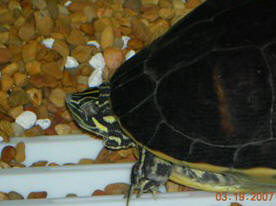
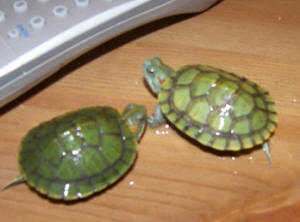
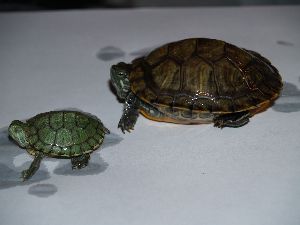 Both turtles here are exactly the same
age.
Both turtles here are exactly the same
age.