|
FAQs About Red Ear Slider Turtle
Compatibility
Related Articles: The Care and Keeping of the
Red Eared Slider, Trachemys scripta
elegans by Darrel Barton,
Red Ear Sliders,
Turtles, Amphibians, Red
Eared Slider Care, Shell Rot in
Turtles,
Related FAQs: Turtle
Compatibility, Sliders 1,
Sliders 2, Red Eared Slider Identification, RES Behavior, RES
Selection, RES Systems, RES Feeding, RES
Disease, RES Reproduction,
Turtles in General: Turtles,
Turtle Identification, Turtle Behavior, Turtle Compatibility, Turtle Selection, Turtle Systems, Turtle Feeding, Turtle Disease, Turtle Disease 2, Shell Rot, Turtle Reproduction, Amphibians, Other
Reptiles,
|
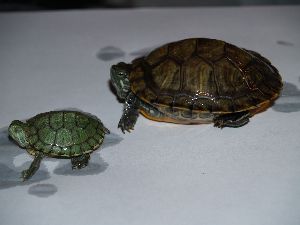
RES often don't get along w/ their own
kind... they're not really social animals...
|
|
Turtle Compatibility. RES, Snappers
6/10/18
Hello Staff!
<Hiya – Darrel here>
I have a red eared slider approximately 10 years old. We acquired (him) CRUSH
about 8 years ago crossing over a tennis court at a high school going away from
the pond in 110 degree weather
<Thanks for saving him. He probably would have been road kill>
So, we happened to be driving down a highway and saw a truck advertising turtles
so we stopped. He had yellow bellies, soft shell, mud and snappers! One snapper
left.
<Uh-oh>
<Folks –as a general rule for a happy and healthy life, don’ buy turtles
from a guy in a truck on the side of the road or sushi from a gas
station/Mini-mart.>
She picked him up and he stretched out his neck and she rubbed his head and then
under his neck he loved it! Looked like a little dinosaur. So, he came home with
us! We set him up in a 30 gallon tank with basking ramp and heat lamps. I read
where the young need to bask the adults not so much they prefer the muddy murky
waters hiding waiting for their prey to swim past. Well, SNAPPER (ironically)
did great with her holding him daily and of course he grew rather quickly from
the 2" little swimmer to a 4" handful. He would still let her reach in the tank
and pick him up and she would sit on the couch watching shows rubbing his
head/neck. THEN, she decided to give him a small goldfish that Crush had in his
pond. That did it! The hunting instinct was now awakened and from that point on
no one could pick up Snapper without being snapped at. Snapper is now 11' long
and NOT at all willing to let a hand go inside his tank, not even for cleaning!
Daughter has since moved on and left Snapper to be taken care of by "grandma"
(me)! I have him in a 75 gallon tank with no more heater or basking lights. I
have a great set up for him with bricks and paver creating at cave for him to
hide in. Gravel on the bottom (actually small river rocks from Lowe's not
aquarium gravel). I have two regular fish filters one at each of the 4' ends and
two long air tubs hidden under the bricks so he can't move or chew on them. He
loves it. I love it too as I keep the tank water (well the filters do) very
clean I do let the algae build up sometimes just enough that I have to squint a
little to find him then I'll drop in my sump pump and exchange that water for
fresh. That happens only like twice a year. I mainly feed him strawberry tops,
romaine lettuce hearts, floating pellets, dehydrated crickets, meal worms and
occasionally goldfish.
<To be honest, I never feed my turtles live food. Both the Slider and the
Snapping Turtle can grow from hatchlings to full-sized adults and even breed –
with a diet of high quality Koi pellets and an occasional (once a month) Earth
worm. Some of the things you’re feeding Snapper are the nutritional equivalent
of Reese’s Peanut Butter Cups.>
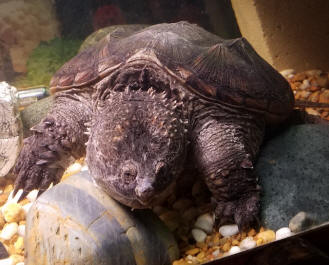
He is NOT an alligator I have 90% confirmed this. He is not a common though
either, I forget what species I found with a science teacher that came to see
him.
<For the pictures you have there, you have a Chelydra serpentine .. the common
snapping turtle>
I on occasion will carefully catch Snapper (although not for about three months
as he bit through the largest net I have, I'm afraid to catch him with my hands,
I know what pain feels like!)
<But you don’t know what losing a finger feels like. The proper place and method
for picking up a common snapper is to grab the tail, right at the base and lift
him up from there, allowing him to hang downwards. The tail is VERY strong and
this causes him no discomfort at all – except that we can assume he doesn’t care
for being hung face down from his tail any more than we would.>
<He can bite and latch on to anything touching anywhere on the front half of his
shell!>
Anyhow, now that you have a detailed history of the two shelled kids I have.
<Yes – some details are edited for space>
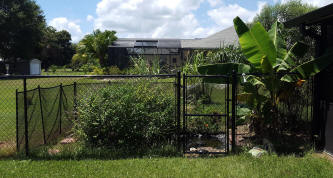
My dream is to dig a 10'x8'x3' pond with caves and surround it with tropical
plants and a small fence to keep BOTH turtles inside away from our Jack Russell
dog, Marley and our 2 years old grand-daughter, Byron. I would think and hope
that a 10'x8' would be large enough pond and the total surface area would be a
triangle (I'm angling this INSIDE our fencing from the back fence to the right
hand side) the triangle to the back will keep the above ground filter and
possible waterfall to help with circulation. I have a 100 gallon tank that is
currently the housing for feeder goldfish. I have some that Crush never caught
and when Irma came through we scoped all those fish from his pond and put into
this tank. I found some in that as large as my hand!!! They look like baby koi!
But those will eventually go into this dream pond too. I know Crush will never
catch them but Snapper may. LOL
<Also know that Snapper will have no mental or ethical reservation of catching
and eating Crush, either.>
My question is do you think with a pond of that size and a yard for Crush to
cruise do you think the turtles could cohabitate?
<no>
I don't care that they are "friends" but as long as they don't attack or hurt
one another. I don't think Crush could do so well against Snapper but then the
day that Irma hit (she got us late at night) us my husband was out and on his
way home saw a small turtle crossing the road and was far from a pond he stopped
and brought it home. It was a small snapper about 3". I kept him inside for
about two weeks but I didn't have a filter for that tank and I didn't want to
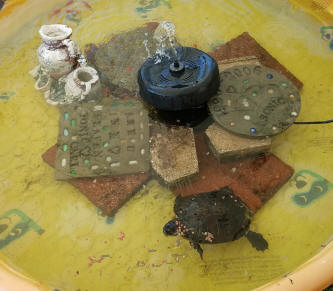
spend the money for one so I put him then in the kiddie pool we had Crush in
(didn't trust him to be roaming yet so he was kept inside a kiddie pool with
bricks in the middle for basking. Well, that lasted for about a month then one
day I couldn't find IRMA (we named him/her) I carefully moved the bricks so I
didn't get bit and found her facing the back of a brick but she looked strange.
When I tapped her she floated up and I picked her up to see that she had no back
legs and no belly. Just shell and head!!!! My only answer was Crush had trapped
her/him and eaten his body and legs!!!! Cannibal-turtle!
<Almost all water turtles are opportunistic omnivores. I only house
turtles of similar size AND temperament together. For example, soft
shells or snappers are ONLY housed with their own kind and ONLY of similar size.
Sliders and Cooters of course can intermix but still I never house smaller ones
with larger ones>
So, I'm not sure about housing them together I don't want to lose either but I
feel Snapper is getting too big for his tank. He can twist and turn very easily
right now even with his long tail but I just think he would be much happier (not
that he knows different either) in a larger area. Selfishly though part of me
knows I then losing the enjoyment of actually having a snapper because I will
never seen him again. Unless I build a glass front above tank for them, which I
am also considering. Much like a decorative koi pond where I can have the tank
near the front and use glass/acrylic with dirt etc in the back for Crush to
cruise around. Then we could enjoy the fish and Snapper if he comes out of any
caves.
I've attached some photos hope they aren't too large. You can figure out what is
what I'm sure.
Thanks! For your opinions, suggestions and advice!!!
Connie in Florida
<Connie – when raising a snapping turtle you should know from day one that there
will be a day when you will be saying goodbye. Worse, you can’t (or shouldn’t)
release him into the wild for a myriad of reasons I won’t go into here. There
are several people in Arkansas and Missouri than have huge private ponds that
will accept snapping turtles, but in Florida I imagine you could also find a
private collector that has the room and the patience and discipline to keep
him.>
<Just like Alligators, they don’t make good pets.>
|
 |
A compatibility question: red-eared slider + Platydoras
armatulus? 4/22/16
Greetings to The Crew,
I hope this message finds you all enjoying some sunny springtime
weather, and in the best of health!
<I thank you>
I have a bit of a tricky question, and I'm hoping that you can shed some
insight that will help me in keeping my wet pets in the best of health -
as you have never disappointing in the past. n_n
<Will do my usual best>
A bit of background. . . I am a lover of freshwater fish in naturally
planted aquariums, this is a passion for me, and has led to what is
known as "Multiple Tank Syndrome" in my own home - a thing I'm sure
you're all very familiar with!
<Heeeee! Oh yes>
I've done fairly well thus far, barring a few bizarre illnesses (thanks
again for your help with these!). An unfortunate side-effect of this is
that people tend to come to me for advice regarding their own, generally
terrible, set-ups, and in a few cases, I've 'rescued' and rehabilitated
fish that had previously been poorly cared for, or had owners who could
no longer care for them. In addition, I work very closely with my
children's school, having helped several classrooms set up and maintain
(with proper research!) their own classroom community tanks. It's a lot
of work on both sides, but a joy to work with the children, and help
them to learn the right way to take care of their own wet pets at home.
<I salute your efforts at sharing>
I wouldn't consider myself a fish expert at all - I only know the
animals I've kept! Unfortunately, in the eyes of the school. . . I'm the
"aquarium expert," and so it came to pass that a sweet-tempered female
red-eared slider was put into my care. The turtle, Crystal, lives in the
Kindergarten classroom (we are VERY conscious of the fact that she may
carry the dread salmonella, and take great pains to ensure the safety of
the children -as well as the turtle WITH the children!).
<Mmm; much more likely the children may deal w/ this bacterium from
other sources>
When Crystal was first brought to my attention 2 years ago, I knew
nothing about turtles, but it was obvious even to me that she was
suffering, and in dire need of some help. Since I seem to be the only
one in the school who is willing, I took her under my care. She is
around 7-years old (give or take), and her carapace measures about 10
inches front to back. She was then living in a 30-gallon 'turtle tank,'
barely able to move, and unable to fully pull herself out of the water
to bask.
<Mmmm>
She was suffering from a fungal infection, malnutrition, and a whole
host of other problems caused by living in filthy water in a poor
environment. Since then, I've donated a 125 gallon tank to the school
for her care, along with the filter it came with (which is not
sufficient for her bioload), and do weekly water-changes. She's come a
long way, and at this point, she's much happier and healthier. Though
her scutes may take years to recover from the damage, the fungus is
gone, and she is living in as close to a natural environment as I could
create, with a proper basking area built up with river rocks and
driftwood, and the proper lighting over her basking area. After so much
time and research, I STILL feel that I know nothing about turtles - but
we manage!
<We have Darrel Lantera>
During this period, a friend of mine was no longer able to keep his
9-year old(ish) Platydoras armatulus (Raphael/Humbug/Armored/Croaking
catfish), and with nobody else to turn to, Mr. 'Scutes ended up in my
care. Unfortunately, s/he is a bit over 6 inches long, and not
compatible with any of my other tanks, which are densely planted, and
have smaller/nano fish, so he has been given a 75 gallon tank, and has
been thriving under my care for nearly 2 years now.
All this rambling. . . but the question is exactly as stated in the
subject!
<Yes; and the answer is unfortunately; no; not compatible w/ this or any
other temperate Emydid turtle>
The turtle needs more filtration in her tank, unfortunately, I can't
afford to donate another filter to the school, and they are
unwilling/unable to afford a second filter for her. Though I've
committed, and am more than willing, to keep this beauty of a catfish
for the rest of his natural life (which hopefully will be a VERY long
one!), I could surely do with one less large water-change on my home
water bill.
So I've gotten the (slightly mad) idea in my head that perhaps, since
the catfish is large and well armored, and there are plenty of natural
hides in the turtle's 125 gallon tank that he could get into, but the
turtle could not, perhaps I could combine the two tanks, and put ol'
Scutes the catfish - along with his filter (a nice Fluval G6 Hydrotech
rated for 80-160 gallons) in with Crystal the Red-Eared Slider? This
would more than double the turtle's filtration, and nothing seems to
bother ol' 'Scutes the catfish. Both the catfish and the turtle's tank
are currently unheated, and remain at a fairly stable temperature of
about 76 degrees Fahrenheit.
I've read accounts on forums online of these two species dwelling
peacefully together, but I trust those people's accounts about as much
as I trust my 5-year old when she says she's flossed her teeth, and so I
come to you for your advice and input on this situation. Is this
a terrible idea? Or a possibility?
<A poor idea... turtles as you've noted are "really dirty" and "clumsy"
animals. Better to place this catfish elsewhere>
I do realize that some of
this will depend on the unique temperaments of both animals, and so
would be VERY vigilant as to the stress level of the catfish, and the
curiosity of the turtle, who has never had a tank-mate before. I'm quite
fond of both animals, and want what is best for both. I DO feel that
both animals would be best suited to be in their own environments -
apart from one-another, but if it's possible that they could
co-habitate, it would make my life in caring for theirs much easier!
I am in the school every day at least twice a day checking on all of the
tanks there, do weekly water changes (sometimes bi-weekly for the
turtle's tank) and also have access during holidays and summer vacation,
so I will be tending to their care throughout the summer months. I have
two children who will be in this school system (barring unforeseen life
changes), through to high-school graduation. As the youngest is in
Kindergarten now, this will be many years to come!
I truly appreciate any feedback you can offer on this idea, YOU'RE the
experts, not me! I still know nothing about turtles, and even Mr. Scutes
the catfish is a whole new type of fish to me, though I've been caring
for both for two years now, I feel very unsure...
Thanks in advance for your time and advice!
Sincerely,
- Jes (aka Chesh)
<Thank you for your well-written essay; and caring! Bob Fenner>
Found new baby RES turtle outside need to know if it's okay
to introduce my 3 year old turtle
4/20/16
Hello,
<Hiya, Darrel here>
I'm needing to know if my 3 year old RES turtle will get along
with the baby RES turtle will get along with it? I have them
separate right now but my daughter rescued the baby today at school he
was about to get stepped on
so she grabbed him and the school gave her a bowl to carry the baby
home.
We're not sure if the turtles are boys or girls so hopefully you might
be able to help me thank you so much!
<I wouldn't mix them. It's not age but size. An adult turtle may
inexplicably see a hatchling as a snack... but even if they are closer
in size, a minor snap form the larger one could be fatal to the baby>
|
Help - Aggressive Red Ear Turtles
10/24/15
Hi! My name is Sabina and I have two red ear sliders turtles in Brazil. They have
between 15-20 years old each. One is a male (Belo) and the other is a female
(Wawa). In the beginning (20 years ago) we started to raise turtles and there
was a time we had 15 turtles. However, we had to move to a smaller apartment and
my parents decided to give the turtles to a friend.
We only kept Belo and Wawa with us. They were raised in plastic bowls. Part of
the day they stay separately inside water where they feed (turtle pellets) and
part of the day they are left free together outside water.
They stay in a balcony where they walk free, take sun and sleep in a baby
blanket (they go there on their own). I know this is very unconventional, but
they have been growing well and are healthy. The reason I am writing is because
this year Belo started to behave in a very aggressive way. He started to bite
Wawa on her neck, on her toes and arm. Sometimes we need to intervene and
separate them. Sometimes he bites so hard that she bleeds. I do not know why she
doesn't fight back, as she is much bigger than him. Once I saw Belo looking at
her, he opened and closed his mouth and Wawa started to run like crazy. I know
this looks like is a courting behaviour.
They have been presenting courting behaviour since many years, but it was
restricted to a "dance" with Belo putting his nails on Wawas eyes. I guess they
never mate (at least I never saw eggs - unless she had ate them...).
What we do not understand is why this year this aggressive behaviour started. We
separated them when they are outside water, but after a few days when they meet
he is aggressive again. The funny thing is that sometimes she forgets what he
did, and we find them sleeping together in the blanket. My parents are seriously
thinking to give one of them to a friend. I think it is sad because they have
been with us for many years. I am also afraid that they will miss one another.
Could you give me an advice on what we should do? Attached I am sending some
photos. Thank you advance for your help.
Cheers, Sabina
<Turtles aren't social animals. They are perfectly happy on their own. The males
can be territorial, and they're also aggressive when it comes to "forcing"
females to mate with them. In the wild females simply swim off if they don't
want to mate. But in aquaria that isn't an option because they're cooped up
together. So the short answer is that if two turtles aren't getting along, you
can and should separate them. Incidentally, the way Belo is putting his hands
and nails in Wawa's eyes is 100% normal mating behaviour. It's what they do. So
in this case, I'd definitely separate them if this is getting so bad Wawa is
being hurt. I've cc'ed our turtle expert, Darrel, in case I've missed something.
Cheers, Neale.>
Re: Help - Aggressive Red Ear Turtles
10/24/15
Hi Bob, Darrel,
I tackled the two I’m confident about, and left one message in Darrel’s inbox.
As I’ve stated before, I’m not a turtle expert by any means, and appreciate
Darrel’s greater knowledge and insight when it comes to the more “medical”
questions that require treatment.
<I as well>
The ones I handled were about behaviour and cleaning, so far as I could
determine.
Cheers, Neale
<Thank you Neale. B>
|
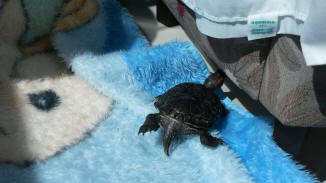
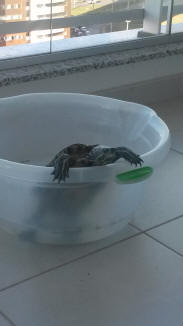
Re: Help - Aggressive Red Ear Turtles 10/27/15
Thank you for your quick reply Narrel. I will separate them. I would be happy to
also hear Darrel comments.
<As would I.>
Cheers, Sabina
<Glad to help. Neale.>
|
New turtle mate? 6/22/15
Hi.
<Hiya, Darrel here>
I've been reading on your website about turtles getting a new mate..but I never
really found the answer I'm looking for. I have a female red ear slider
a year old about 5-6 inches and I've been thinking of getting her a male western
painted turtle..who seems to be about 4 inches.
<No problem>
My red ear slider was a wild turtle. We found her as a hatchling and the western
painted is from a farm supply.>
<Would that be a problem? A wild and a pet store turtle?>
<Turtles are remarkably simple that way. They don't care where you come from or
where you've been>
How do I know if she likes the western painted turtle?
<You'll never know "for sure" because turtle brains don't work like human
brains. They live just fine alone and they live just fine in pairs or in
colonies -- as long as there is enough room and enough food to go around.>
<Sliders, Cooters, Painted ... all those turtles that look so alike not only get
along, they'll actually mate and produce cross-bred hatchlings.
The three keys are size, room and temperament:
A - if the turtles are about the same size they tend not to bully each other -
or at least not as much
B - if there IS some fighting, then as long as one can get away from the other,
things usually cool down. You housing arrangement should include some rocks,
bricks or plants or the like so that one turtle can get out of sight of the
other.
C - once in a long while you will just run into a turtle that just has a bad
attitude. It doesn't happen often, but when it does you just can't house the two
together unless it's a pond-type arrangement where they can have territories.>
<What I suspect will happen is the male will exhibit mating behavior (flashing
his long nails in front of her eyes all the time) and just generally annoying
her. At 4 inches he's mature and she is probably not until she gets bigger. She
may nip at him and push him, etc. to stop him ... and that happens for a while
until he settles down (or she get's used to the behavior) but that's not an all
out BATTLE or anything.>
It would be great if I heard from you soon. Thanks for your time
<good luck!>
Red eared slider issue; intra-species incomp.
5/23/15
Hello crew,
Recently we acquired 3 red eared sliders from a neighbor. My daughter bought a
new complete tank kit with all needed accessories from PetSmart, heat, UVA,
<UV-B. They don't need UV-A. Or rather, UV-A is used to calibrate their body
clocks. Not a big issue. But UV-B is used to synthesise vitamins, and without
it, many reptiles quickly develop all sorts of problems, ultimately lethal ones
at that. The exceptions are nocturnal reptiles, especially snakes, which don't
need UV-B, but turtles are mostly day-active and require plenty. A couple hours
of unfiltered sunlight (i.e., outdoors, not sunlight through glass) is viable in
hot countries like India, but most everywhere else, including Europe and the US,
that means a UV-B light over their vivarium.>
basking, etc. Plenty of room for all 3 with several basking areas as well.
We have done everything you have recommended, hopefully. The 2 larger ones are
5-6 inches from head to toe, Frodo and Lily, the smaller one is 3-4 inches,
Luna. We do not know how to tell if they are male or female.
<Easily sexed. Males generally have longer claws and, most tellingly, a longer
"tail" after the cloaca (the combined anus/urogenital opening).
Females have a shorter tail. It's obvious when comparing the two sexes side by
side, but you'll find numerous photos online.>
We picked name's based on male or female PERSONALITY traits. We noticed
immediately that there is clearly an aggressive dominant, Frodo. The smaller
one, Luna, is being bullied now. Originally Lily and Luna hung out, while Frodo
has always seemed the dominant. Now Frodo and Lily, the larger 2 of the 3, are
hanging out while Luna is being bullied by Frodo.
<To stress: turtles aren't social animals as such, and the males are sexually
mature from a body length of something around three inches. Sexually mature
males will, as you'd expect, try to mate with any/all female turtles (even
different species!) kept with them. Egg crate can be used to segregate the sexes
if the vivarium is large enough, but otherwise building multiple basking spots
can achieve the same thing. Nonetheless, outnumbering the males with females
will at least ensure each female isn't harassed all the time. As/when the
females become fertilised, they'll want to lay some eggs, and if they can't,
that can lead to egg binding. So have a plan for some way to place a tray of
sand in their vivarium where females can deposit their eggs. Egg bound females
MUST go to the vet or they die an excruciating death as the eggs rot. Yuck.
Hmm... did anyone mention turtles can be tricky pets? Not expensive compared to
cats or dogs, that's for sure, but not "cheap as chips" as we say in England.
You need to plan ahead because once reptiles get sick they get expensive.
Prevention is much, much cheaper, but sadly not zero cost.>
They look darker green, normal, same coloring as always, but Luna's shell seems
to be changing to lighter color, and skin around neck is becoming translucent
and thinner. She is staying in the water as well. Is this shedding? Or bullying
symptoms?
<The former. As they age, Red-Ear Sliders change colour a bit, becoming more
dark muddy green, and the shell will flake away scutes as it grows.
Again, numerous photos online will indicate their appearance.>
She is also becoming skittish and hides a lot.
<I bet. See above. A dominant male will harass a weaker male, and will of course
pester females. I'd always recommend keeping just a singleton, and a male at
that, because then egg binding isn't an issue (sometimes female turtles produce
infertile eggs even without mating).>
We have separated Luna from Frodo and Lily, in her own nice tank, and are
preparing possibly to try and put her in a dry warm place, if needed, as we
think she may be getting sick from stress.
<Good moves. "Dry docking" injured turtles is discussed elsewhere on this
website. Do avail yourself of these articles, perhaps starting here:
http://www.wetwebmedia.com/fwsubwebindex/treating%20RES%20Dis%20DarrelB.htm
>
We are constantly checking on the turtles. They were really friendly and stable
together for a few weeks, until we noticed Frodo bullying Luna. I've studied ALL
of your turtle information, THANK YOU, and really want to take care of all 3,
and have happy, healthy turtles. Are these bullying issues male vs. female? Or
feeding competition issues? Just plain dominant vs. others?
<Yes!>
I could really use your thoughts about now. My daughter is 19, smart and kind,
she will be a Surgical Tech finishing school next year. She loves the turtles
dearly, and is extremely worried about Luna. Could you help us please, let us
know what your thoughts are..?
<Have cc'ed our turtle expert, Darrel, in case there's anything I've missed.
Cheers, Neale>
Sincerely yours,
Jen
Re: Red eared slider issue 5/24/15
Very much big help. Just to be reassured means a lot.
<Glad to help.>
The woman we got the turtles from, we have found out (asked because worried
about Luna, thought we needed more history), did not have any UBV lighting or
water filter.
<Yikes!>
I'm getting a little worried, Luna isn't eating today and she vomited last
night.
<They do this, occasionally. Do review diet, make sure they're getting lots of
"greens" (cheap plants like Elodea work great for this) and feel free to let
them starve a few days, even a couple weeks, if plant foods are available for
them to graze. Like people, turtles will usually opt for steak over salad if
they have the choice, even though the salad is the bit that keeps them healthy,
not the steak!>
We have now put her in dry dock. We are watching her closely. Thank you very,
very much
Sincerely,
Jen
<Welcome. Neale.>
Adult res aggression toward young res
4/26/15
Hi there! My name is Alejandra. I have my res Frenchy since 2010. She was about
a year when I saved her from my cousins house. Last weekend my sister bought me
a young res (Rizzo). She's about 3-4 inches. Frenchy is about 8-9 inches. When I
first introduced them Frenchy ignored Rizzo. About 10 min later Frenchy laid on
top of Riz and wouldn't get off. I moved Frenchy off and then she tried to bite
Riz. I separated them into different tanks facing each other. They just sit in
their tanks sleeping by each other and not leaving each others side. Should I
try putting them together again?
help?!
<Red-Ear Sliders are not social and often (usually) do best kept singly
unless you have enough space for several specimens. Two males simply won't
tolerate each other in anything less than, say, a 75 or 100 gallon tank.
So do check you've seed them right. Males "mount" females in a very distinctive
way, on top, fluttering their front legs across the face of the female. While
you can keep pairs, the downside will be the production of eggs, which if they
can't be laid on dry sand, end up becoming stuck inside the female (egg binding)
which is invariably fatal without help from a Vet. Cheers, Neale.>
Re: re: Adult res aggression toward young res
4/26/15
They are both female. It did not appear to be mounting what she did. Simply
bullying. the tank is a 55 gallon. should I not try to put them together again?
<Really depends on whether the smaller one is being harmed (and able to breathe
when underwater). They might settle down eventually. Do they have separate rocks
for basking? Enough space for swimming easily away from each other? Cheers,
Neale.>
Re: re: Adult res aggression toward young res
4/26/15
I have two basking areas and they have plenty of room to be apart. I
might put a screen up between them during the night though.
<Plastic egg crate works well for this.>
thanks for the help!
<Most welcome. Neale.>
Co-Habitating RES 3/28/15
Hi!
<Hiya - Darrel here>
I have two presumed Female RES. They are approximately 10 (she has been with me
since 2010, but her actual age isn't clear, so 10 is a total guess) and 3 years
of age (the 14 year old is about 5.5" head to tail, the 3 year old about 4".)
After watching the younger one for two years in a separate tank, I moved her
into a tank with the bigger RES and utilized a screen to keep them separated as
the older turtle is much larger than the younger one. They have been living and
co-habitating this way for about 12 months.
I was having filtration issues this week as the screen (Penn Plax Tank Divider)
was not permitting water to pass through to be filtered as well. I have been
filtering the water of the tank for 24 hours now and as I prepare to put the RES
back in I wanted to see if you have any suggestions regarding either a better
screen divider or if allowing them to share a space without the screen would be
ok. They have been "sharing" the tank for a year now and I have had little issue
with them showing aggression towards each other at the divider point, but wanted
a few other opinions before I move forward with co-habitating them for real.
Any help you can provide would be greatly appreciated :)
<I segregate my Sliders, Cooters, etc. based on size. When they are similar in
size, as yours are, the aggression is usually mild and, I think, the most
important thing: the target turtle can tolerate it well. An occasional nip from
someone her own size hurts but heals. If the size difference were great (1.5
inch and a 6 inch) then no, never! In your case I'd completely break down and
re-arrange the tank so that they both are in a "new-ish" home (as opposed to one
being dumped into the other's
home) and then just watch for signs of aggression. What I mean by that is every
once in a while for no real reason whatsoever, you can get a turtle that is just
plain MEAN and can't be kept with others. So if you see one making its life
mission to kill the other one for days on end .. then you need a tank divider or
new tank>
Thanks,
Hannah Turtle question. YBS, RES comp.
11/3/14
Hi:
<Hiya - Darrel here>
I'm glad that I found your site. It's a true wealth of information.
<Thank you. You show a great deal of taste and wisdom for noticing>
Unfortunately for me, even after searching, I did not find an answer to
my problem so I am writing in hopes that you can give me one that will
work for Stan & Olivia (turtle's names).
<OK>
We are fairly experienced turtle-owners having had several for 5-6 years
now and no health problems.
<It makes it easier to care for our pets when we don't have health
problems>
We had 2 yellow-belly sliders that we got as babies
and, as they grew, we bought larger and larger tanks for them. When we
hit 185 gallons we got a red-eared slider to add to the other two. At
first they did not get along well but soon adapted and they are all
"buddies" now and even share the same basking deck.
<Sometimes they even climb on top of one another to bask, like a
pyramid. It's comical when one at the bottom decides to move and a stack
o6 6 or 7 topple over>
Well, we decided to get 2 more RES (a male and female
so as to help ensure mating) as I wanted to observe the egg-laying and
hatching process. The new turtles arrived with an unknown age but about
4-5 inches in size and seemed healthy. We put them in the tank with the
others and they just disappeared. We had to remove tank decor to find
them. With their hiding places gone
they just stayed under the two decks we had for basking and never
climbed out of the water.
<That's fairly typical for new introductions. Stay quiet, stay out of
the way and don't attract attention>
Then I noticed that the YBS's were "bullying" them by biting at their
feet and tails. I immediately took them out and put them in the bathtub
until we could get another tank. Luckily, we were able to find a used 55
gallon tank and stand but paid lots of $$ for accessories. Now they have
their own home.
<Assuming their sizes were about the same, they "probably" would have
gotten over it after a while. What we normally do when introducing a new
animal to the collection is re-arrange the entire tank - move everything
around, change rocks, reposition the basking area, change the angle of
the lights, etc. That way NO ONE has "their" territory and all of them
are more-or less in a "new" space. It puts them all on equal footing, so
to speak>
Anyway, these poor turtles are terribly scared. I don't know if this
developed before we got them or because of the bullying (don't really
think so) but I can't get then to "come out of their shells" (pun
intended).
<Time. It takes Time>
The big problem is that they won't bask. I've checked water temp and
have nice warm heat lamp and UV lamp over their basking deck. Nada. We
spent 80 bucks on an "over the tank" basking area that has enclosed
sides thinking maybe they would be less afraid in there. They won't go
in on their own and if put in they immediately run down into the water
and hide in the darkest
area of the tank.
<Yep. Leave them alone. They are skittish. They need time>
Knowing that they have to bask occasionally to dry out, I daily take
them out and put them into a small kiddie-pool with no water and with
heat & UV lamps. Because they looked sad alone in the empty pool I put
the floating basking deck in there (again there is no water) thinking
maybe they would climb on it to get closer to the warmth but they
immediately crawled UNDER the
deck to hide.
<Right. All the changes and moving are, unfortunately, contributing to
their fear>
I weekly put shell conditioner on them and try to pet their feet and
stroke their shell daily to get them used to me but the smaller one
(male?) just tucks in completely and the larger one opens it's mouth as
if to bite.
<Yep>
So, after this long diatribe my main question is how do I get them to
bask on their own? Secondary questions are how long is it OK for them to
be IN and be OUT of water?
Your response will be greatly appreciated.
<Well - let's start with the basics. Let's assume they are bright and
alert, clear eyes, strong limbs and firm shells. In other words just
like you - they also have no health issues. Given that. Put them in
their tank in some corner of the house where they are seen & see but not
fussed over or gawked at continually… then leave them alone. Don't
handle them or walk them or come to the tank and try to feed them. Leave
them alone. If they surface to breath and notice that the outside air is
warm and the environment looks safe, they'll slowly venture out and
eventually bask. Water should be room temp (68-73 degrees) and basking
88-94 degrees. Feed them once a week by dropping a few pellets into the
water. It's OK if they get hungry. In fact, hunger is a significant
reason to get over one's shyness: You may be the great big, scary-hands
monster, but when you are also the source of food there is a reason
(after a week or two) to try to overcome their fear.>
<In short, my first guess is that things are happening too quickly for
them and it all blurs into one big commotion - so they hide>
Bob & Debbie
PS: they get along great with each other and are virtually inseparable.
Re: Turtle question > reply 11/7/14
Hi Darrel: Thanks for replying (enjoyed your humor - we are still in
good
health).
I just came back to the computer after being the "big scary monster" and
taking them out of their comfy familiar surroundings and put them into
the "dry pool." I read your advice and now will put them back into their
home and leave them alone. I was under the understanding that handling
them helped them to "bond" to you and get used to you as their owner.
<It does -- but timing is everything. When you are new in town and
scared of everything, being levitated and handled isn't going to calm
you down. AFTER they are accustomed to seeing you walking around and
learning that most times they see you -- means food -- THEN you can
start to handle them without annoying them. In that regard not much
different than a teenager>
The other 3 can be hand fed and I can "swoop" them around in the water
by their foot and
they just come back for more play. But, I will take your advice and
avoid the new turtles as much as possible.
My one important question remains: how long is it OK for them to be
immersed in the water? I don't want them to have problems with their
shells not drying out...
Bob
<*IF* they are otherwise healthy -- they're good for a month at least.
Leaving them alone in a room all day with a basking light… they'll
almost always bask when no one is looking>
Red eared slider, stkg. comp.
4/23/14
Dear Crew,
<Hiya - Darrel here>
I am a first grade teacher and have several classroom pets.
<Thank you. Thanks to people like you, I can read and write and due knot
Re: lie two much on spell Czech!>
One being a red eared slider. He is about 4 inches in diameter. We found
one outside today that is as big as a 50 cent piece. Can I put him in
the same tank?
<It's a tiny bit dicey because the sizes you mention are borderline.
Sliders are colonial and social so it's generally not a problem. My only
reservation is that an insignificant "get away from me you're bothering
me"
type of nip from a fully grown turtle can be fatal to a newborn.>
<If the larger turtle is generally friendly and has been well fed it's
likely that he'll ignore the little one>
I do not know how quickly you respond to your emails, but we really want
him to get settled as quickly as possible into a home.
<Best of luck>
RES Turtle Companion – 12/03/12
Hi!
<Hi there!>
You guys have helped me a lot, but unfortunately Mars died earlier this
morning.
<I’m so sorry to hear that! I know you much you cared about him and
tried so hard to help him.>
Just a few questions about him and about keeping a new turtle.
<Sure.>
The thing is, 2 days before Mars's death we had given him Cod Liver Oil.
When he had it he started squeaking a lot!! More than he did when he had
RI. I assumed it went in the glottis, but the vet said it would be
absorbed by him (have my doubts about that happening). Anyways wondering
why that happened.
<Darrel really said it best in the link I sent you on general illnesses:
“Wheezing sounds, labored breathing and bubbles from the nose are signs
of a respiratory infection and a clear indicator for a veterinary
examination. Among many reasons it's hard to be a turtle, they
have no ability to cough or sneeze so any fluid that accumulates in the
lungs becomes life threatening.” Having said that, though, I agree
with your vet that the reason he died wasn’t from the two cod liver oil
drops but from advanced respiratory illness. Respiratory illness is one
of the more aggressive turtle illnesses. His illness was likely already
too far advanced by the time he received the vitamins and antibiotics.>
The other thing is that I thought of asking my parents for a new RES to
keep Pluto some company so that he does not feel the loss of Mars, in
case turtle feel that.
<Actually quite the opposite – especially when they’re not in the wild,
but instead forced together in the much smaller confines and close
proximity to one another in an aquarium. They prefer being alone and
view other turtles as competitors.>
But I wasn't so sure because usually bigger RES attack smaller ones,
though I don't know if that applies to older baby RES attacking newer
one.
<Vyushti – I wouldn’t recommend getting another turtle, especially if
you still haven’t gotten a UVB light or whatever else you might need
that was mentioned in the general care link I sent you. Also, keep in
mind that when cared for properly, females can land up being the size of
a dinner plate, males only a little smaller, and they can also live to
40 years of age or older! It's a decision and life-long commitment not
to be taken lightly.>
And the last thing is, how to keep him busy since if we shouldn't get
another RES. I thought of looking for turtle toys but I can't find
anything useful on the net.
<The only thing they seem to think of as “fun” is when I occasionally
toss in a small chunk or two of Zoo Med “Turtle Bone” for them. They
seem to love chasing them all around and grabbing onto bits of them!>
<Turtles don’t care about actual toys per se, but here’s what they do
enjoy – a set-up that is as close to their own natural environment in
the wild as you can get. Personally it adds to my enjoyment also to see
them exhibit more of the natural behaviors that you'd see them exhibit
in the wild. In my turtles’ habitats for example, I incorporate things
like
Zoo Med’s natural cork bark flats for their basking
areas
Plastic floating plants and plastic weighted plants
(I place some of the plants under the cork bark for them to grab onto as
they get out of the water, similar to what they’d have to do outside.)
Larger rounded rocks near the weighted plants
Natural woodsy/pond looking background “scenery”, etc.
Mini waterfalls (you can find many variations of these at
the pet store). I’ve caught all my turtles at one time or another
sitting under the waterfall getting a spa treatment!>
<Google “indoor pond images” for some inspiration. You’re somewhat
restricted as to how much you can do in a smaller aquarium and you
definitely don’t want to put too much in place that's going to make
cleaning it a nightmare. That always needs to be the first
consideration. But you can definitely scale down the ideas to
size!>
Thanks!!
<You’re so welcome. Again, I'm so sorry to hear about Mars; that’s the
hardest part about having pets. Forget about getting another turtle for
now, though, and just focus on making sure you get/have everything for
Pluto that he needs to stay happy and well. ~ Sue
turtle tank mates, Map and RES comp.
7/31/12
I was recently on Hilton Head Island and had purchased what were
supposed to be 2 RES turtles however after examining both of them and
doing some research I have discovered that one of them is actually a
Common Map turtle.
<Now called the Northern Map Turtle, Graptemys geographica.>
Will there be any problems keeping the two of them in the same tank?
<Provided it's big enough, no. 75 gallons should be adequate for one,
125 gallons for two, with two males being less likely (and therefore
needing more space) than females.>
they are both about 1 1/2 - 2 inches in length at the moment and I have
them housed in a 10 gal tank with about 3 inches of water in it. I know
I will have to get a larger tank soon but its much bigger than the
enclosure they were purchased in.
<That may well be the case, but "less bad" doesn't equal "good"! So you
will need a larger tank fairly soon -- within a couple of months -- and
it would be completely pointless buying an aquarium smaller than 75
gallons even as a short-term home (a 75-gallon tank will be adequate for
a year or two, until they reach the 6-8 inch mark). If money is tight,
go straight to the big tank, 125+ gallons. Do bear in mind these turtles
get HUGE when grown up, anything up to a 10-inch shell length. And
please trust me on this: if you buy a small tank, it will soon get
dirty, cloudy, and stinky!
In turn the turtles get moldy and sickly, and if you think a 75-gallon
aquarium is expensive, try paying for vet bills! There's a really good
summary sheet over at the Californian Turtle Home adoption/rehoming
site, here:
http://www.tortoisehome.org/files/MAP_TURTLE_CARESHEET.pdf
Cheers, Neale.>
Introducing a red eared slider to my map turtle's tank
7/10/12
Hey WWM Crew, I've got a pretty time sensitive question that I could
really
use some answers to. I'm thinking about getting a bigger tank and
getting a Red Eared Slider to accompany my Mississippi Map turtle.
<BobF to help you, though only has a tangential background in
herpetology>
I currently own a 6 or so year old male Mississippi Map turtle. When I
first got him from the pet store, I also bought a second Mississippi Map
turtle, but in true rookie fashion I did not realize that he was already
sick at the store and he died a few weeks after being at my house. They
were both already at least 2 years old when I got them and the two got
along perfectly when they were together.
I've been wanting to both get a bigger tank and get a second turtle for
some time now. The only thing that has stopped me was a combination of
funds and me being away at college. However now that I've graduated, I'm
home and I found someone willing to sell me their 100 gallon tank and 2
year old female Red Eared Slider at a really good price. I really want
to snatch up the offer while I can, but I'm unsure about the turtle
compatibility.
<I give you good odds here.... considering the size of the system, the
near-equal sizes of the Emydid turtles>
If I were to change over to that tank and add a new 2 year old female
Red Eared Slider, would she and my 6 years old (or older) male
Mississippi Map turtle that has lived alone since my other turtle died
years ago get along?
Or are the odds of them being aggressive or intolerant towards each
other too high to chance? As far as I can tell, the two are pretty
similar in size (the Map being slightly bigger).
Unfortunately I don't have long to make a decision and I'm not sure what
to do. Can you guys help me out?
<I'd give this mix a go. Bob Fenner>
--
Adam Moulton
Re: Introducing a red eared slider to my map turtle's tank
8/24/12
Hey guys,
<Adam>
An update to my previous situation I emailed you about. My adult female
Red Eared Slider and my adult male Mississippi Map have been living
together perfectly for several months now. The map even climbs on the
shell of the RES occasionally when they're basking and the RES doesn't
seem to mind. Hasn't been any problems, until now.
<Oh oh>
Last night, the RES bit the leg of the map. I saw it and took her out
and put her in a small tank I'm no longer using.
<Good>
I left her there over night, and this morning put her back in the bigger
tank. 30 minutes later, she bit the same leg of the map turtle. I took
her out again and put her back in the small tank. The map doesn't seem
to be hurt, which is surprising because I'm fairly certain the RES could
break the skin of a person if she bit them. He hasn't been acting
differently either. The bites didn't look like mere nips, especially the
first one (she held onto his leg and didn't let go until I picked her
up).
Any suggestions as to what's wrong?
<Basic incompatibility... They'll have to be housed separately, at least
for now>
I doubt she was hungry, early in the day yesterday I fed her (in a
separate container) a pretty good amount of food, and she ate till she
was full (didn't finish everything I gave her).
The only problem I can think of is that I've been having trouble with
making an appropriate basking area for the RES. Her size makes it
difficult, and haven't found a platform that she can get herself onto or
that can hold her weight. I've made a rock beach which extends out of
the water under my basking lamp that she climbs onto (as does the map),
but she tends to destroy it every couple of days and requires rebuilding
each time.
When its in place she can get probably 90% of her body out of the water
but not all of it. I don't think that this would lead to her biting at
my other turtle, but I can't think of anything else.
If you've got any ideas as to why she just now, after several months of
living together fine, is starting to bite the other turtle, I'd love to
know. Also if you have any suggestions for making a better basking area
I'd love to hear them too.
<Mmm, please read the aquatic turtle Compatibility FAQs archived on WWM,
as well as the basking area ones... The index is here:
http://www.wetwebmedia.com/FWSubWebIndex/fwlvstkind2.htm
toward the bottom... or you can use the search tool... on every page.
Bob Fenner>
Re: Introducing a red eared slider to my map turtle's tank - 8/24/12
I was more hoping that maybe something in the environment was irritating
the RES because she wasn't like this before. The turtles usually slept
and basked together, and I fed them separately except for occasionally
when I toss them some treats (I suppose that could be increasing
aggression).
<... happens. Read here:
http://www.wetwebmedia.com/FWSubWebIndex/rescompfaqs.htm
and
http://www.wetwebmedia.com/FWSubWebIndex/turtcompfaqs.htm >
This wasn't an issue until I left town for 5 days earlier in the week. I
told my brother to feed them twice over the 5 days I was gone. I doubt
he separated them for that. When I got back, I put the turtles in
separate containers and fed them. It was a few hours after that when the
first bite happened. I feel like something had to have changed while I
was gone.
Maybe water isn't warm enough and its irritating the RES?
<Doubtful>
Also this morning I gave her (the RES) some food and she didn't touch
any of it. That's a first for her.
They don't seem to hate each other. I put them together in the big tank
again today for 30 minutes to watch them. The map hung out around the
RES for a lot of the time and climbed on her shell (all normal behavior
for them) and she didn't seem to mind.
Like I said, they've been together for months and they showed all the
signs of liking each other. I'm really hoping I can figure out some way
for them to live together again because my second tank is probably a bit
too small even for the map (he's been much more active since he moved
into the big tank when I first got it and the RES) and I don't currently
have the funds to buy a bigger tank.
<Perhaps a plastic container of adequate size, low cost. B>
Red Eared Sliders, comp. 7/3/12
Hi!
I have two red eared sliders, one male, one female. I woke up in
the middle of the night and turned on the lights, awakening my turtles.
The male turtle swam to the female, and bit her leg. He than started
chasing after her, but she is much larger so he didn't get any more
bites in. I am deeply concerned about the females safety in this
situation. What exactly should I do to ensure she is in a safe
environment?
<Mmm, separate them. How large a system is this? Do read here:
http://www.wetwebmedia.com/FWSubWebIndex/resreprofaqs.htm
and the linked files above re Compatibility, Systems... Bob Fenner>
2 inch and an 8 inch Red Eared Slider, comp.
5/16/12
Dear Crew,
<Hiya Darrel here>
I own an 8 inch Red Eared Slider. While at the beach my daughter
rescued a 2 inch Slider or possibly a Yellow Bellied Slider from
drainage run off ditch heading into the ocean.
<Thank you!>
Can they live together or will the 8 inch attack the 2 inch?
<The bigger one - almost certainly a female if she's 8 inches in length
- will not likely "attack" the baby, but it's very likely she'll have a
"snippy/nippy moment" at some point and cause the little guy serious
injury or death. As a general rule, keep them within 2 inch length
of each other.>
If it is illegal to sell 2 inch sliders, how do the people at the beach
get away with this?
Because it is sure doom for 99.9% of those turtles.
<Yes it is and it's sad -- but there just aren't enough Fish & Game
Wardens to go around, it's low on anyone's priority list and many people
who want to make a quick dollar don't much about anyone beyond
themselves. All we can do is make a phone call to the Fish & Game
Tip Line and hope that sooner or later they'll have the manpower to
check it out>
<Meanwhile, you should give Whiskers (did you name him Whiskers, by any
chance?) his own little place to live - nothing fancy or even really
expensive is needed: Read here:
http://www.wetwebmedia.com/FWSubWebIndex/RESCareBarton.htm >
|
Territorial turtles?
3/24/12
Hi crew!
<Hiya>
Darrell again with another issue concerning my 2 red eared
sliders, Zippo and Mo.
<Darrel here too. The One L Darrel>
I recently emailed you about Zippo falling 4 feet from the tank,
and I'm happy to report that now, after 3 Weeks dry docked
and several rounds of antibiotic shots (which she was NOT a fan
of) she's doing well and I've put her back in the big
tank with Mo.
<Congrats>
The new problem is occasional unfriendliness in the tank. After I
put Zippo back in, Mo started nipping at her. This has happened
before when we've had to dry-dock one of them for a day or
two, but after giving the offender a little time-out in a dry
tank it stopped. I've tried that twice with Mo this time
around and it hasn't worked. One minute they'll be a
millimeter from each others faces playing nice and the next
they're jaws-open threatening each other. Zippo alternates
between running away and fighting back, but I've already seen
Mo latch on to Zippo's left hind foot/flipper/claw/whatever
the correct word is (which is what prompted the 2nd time-out) and
id rather not see them fatally injure each other.
They're both female, both the same age and roughly the same
size, and they've lived together their whole lives.
<Well, from the pictures … one showing markedly longer front
claws than the other, I'd guess that you have a male AND a
female … If you'd have them sexed, or their other sexual
characteristics (tail width, cloaca position, etc.) clearly show
two females - that's always much more accurate than a guess
from a picture. BUT … if one is male and the other
female it would, of course, also explain the unpredictable,
erratic, sometimes violent and always confounding
behavior!>
Aside from minor, very short episodes, like I described,
they've never done this before. Will this stop, or was 3
weeks apart too much and they'll never stop fighting? I just
don't want to come home to a potentially-dying turtle
(again).
Thanks!
-Darrell
<The problem is that they each have their own
personalities. They may settle down or they may not.
The thing is that they rarely do each other permanent
damage. Usually when one CAN get away, things settle
down. You might consider this: the only negative
thing I see in your tank setup is that both have complete line of
sight to the other no matter where they are in the tank. A
half-divider of some sort, that one can swim around and be out of
sight of the other … is often a great way to let them have
their space, deal with their feelings, get a grip, chill-out,
etc. and goes a long way toward helping them calm down.>
<Beyond that, this is really a question of watching them
closely and seeing how much pain YOU can tolerate watching them
scrap with each other.>
|
|
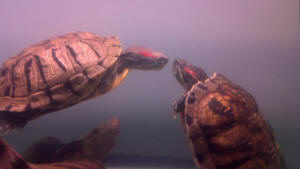 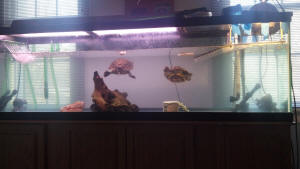
|
A Friend for my Slider?
3/21/12
Hi there.
<Hi Nicole, Sue here with you.>
I have been reading your site and would really appreciate if you could
offer me some personal advice. I have a RES hatchling that I purchased
about 7 mos. ago. When I bought my turtle, it was very small, only
about 1.5 inches in length. I'm not sure of sex, though front claws
are pretty small so it may be female.
<Too small yet to determine sex. Male and female claws look
very similar until they get beyond 3 inches long (straight length
across the top shell or carapace.>
I absolutely LOVE my turtle and want her to be happy. She lives
in a 10 gallon tank which seems to suit her for now
<That's a fine size to start with when they're
small.>
and has about 1/4 of her area dedicated for basking. In the 7 months
since I purchased her, she has grown considerably and is close to 2
inches long.
<You don’t want her growing too rapidly. What are you
feeding her? How much and how often are you feeding her?>
A friend called me yesterday to tell me that she had another RES that
needs a home and asked if I would like to take it. She sent me a
picture and it appears to be the same size as mine or maybe even
smaller. Is it a good idea to introduce this new turtle to mine, or
will she enjoy her life of solitude as it is now?
<Well first I'd like to say ‘Thank you’ on behalf of your
turtle for writing us BEFORE making this decision! Most of the time
people only write us with problems ‘after the fact’!>
<There are several factors to consider when deciding whether or not
to get a 2nd turtle-
• First is the question you raised about whether your turtle might
want a roommate! While turtles of the same or even similar species can
be compatible (though always exceptions to this rule!), if your turtle
got to vote on the matter, he’d most likely vote to be alone!
Turtles tend to view roommates less as ‘companions’ and more as
either 1) competitors for food and the prime basking spot, and/or 2)
potential mates.
• Though the two turtles might be the same size right now, turtles’
growth rates can vary considerably. One turtle typically becomes
the ‘dominant’ one and hogs most of the food. Also, females
are much larger than males when fully grown. This sometimes can
be an issue if the male matures before the female. He will pester
her and things can become dicey!
• Even if they get along now as babies, maturity sometimes results in
incompatible personalities.
• Consider the 'long range implications' of whether or not
you can properly meet their care needs once they’re fully
grown. The implications of 2 vs. 1 include things like whether or
not you’ll have the housing capacity for two, the time to keep their
habitat clean once they’ve reached adulthood, etc. Females can grow
to be as large as dinner plates and need a separate area for egg laying
once mature. Male sliders will grow to be at least 8”
long. This won’t happen for several years, but when it does,
you’ll need a sizeable enclosure for one turtle and an even a larger
one for two (ideally at minimum a 125 gallon tank or preferably small
pond) to house them. Also, clean-up will become significantly
more involved as they get older as the size of their waste grows right
along with them! And two turtles means double the waste and
clean-up effort!
• You’ll need to be prepared for the possibility of housing them in
two separate enclosures either now or later if they turn out to be
completely incompatible. There are, of course, several things you can
do to help stack the odds of compatibility in your/their favor such as
feeding them separately in a separate bin (this will help keep the
water clean, too); also arranging the plants and décor in a way that
allows them to each have their own space and be able to get away from
one another when they want (both physically and visually).
• Last, I’d also make absolutely sure the new turtle is completely
healthy so no diseases are inadvertently passed along. When
people buy dogs and cats they take them to a vet for a ‘well
check-up’ without a second thought, but unfortunately people don’t
always think to take this same step with turtles. A typical
‘well visit’ appointment at the very minimum will include a
physical exam, stool testing and a baseline weight.>
<I’ll also give you a link to some of the Q&A’s we’ve
received in the past about compatibility concerns. At the top of
the page you’ll see two other links as well:
http://www.wetwebmedia.com/FWSubWebIndex/TurtStkgCompSueF.htm
>
<Also because you’re a new 'turtle mom' and are already
considering a 2nd turtle, I’m going to give you a 2nd link to our
basic care article. Before adding any more turtles, make sure
you’re already providing everything mentioned in this article to the
one turtle you have now:
http://www.wetwebmedia.com/FWSubWebIndex/RESCareBarton.htm
>
<In particular read up on feeding to make sure you’re feeding him
the right food and not too much or too often so he's not growing
too fast. Also make sure you have the other key care items in
place: proper heat and lighting, basking and water temperatures,
and water filtration.>
Thanks for your help.
<You’re welcome Nicole; hope this was helpful in your decision
making. Feel free to write us again if you have any more concerns or
questions after reading through all this! ~ Sue >
Nicole
Re: A Friend for my Slider? 3/29/12
Thank you so much for the quick and thorough reply.
<You’re welcome, Nicole. I’m glad it helped!>
I have decided not to take in another turtle and instead found a nature
center that was willing to raise it and eventually move it to their
pond.
<That was a great idea to find a nature center. One of
their specialties is helping prepare creatures to return to their
natural habitat (or one that at least closely assimilates that) and
they have specially trained people there to do that. That’s
always the best choice whenever possible. Thanks so much for
letting us know what happened! We wish him the best in his new
home!! ~ Sue>
one res bigger than the other
2/5/12
whats cracken, i have 2 res that are 4 months old and one is growing
really fast and the other is the same size as when we got them,
<It's very common with two turtles living together that one
becomes more dominant and *steals* the larger share of food. What's
important is that the smaller one is getting enough food and is
growing. If you have any concerns about this, I'd suggest feeding
him separately from the other.>
<Equally important, though, is that the larger turtle isn't
eating too much and growing too quickly. This can lead to health
problems. Young or old, turtles should only be fed every other day as
much as they can eat in 5 minutes or so. No more.>
they are in a 50 gallon tank and the temp is around 80.... whats the
deal????
<What's 80 degrees? If it's the water, this is way too warm
and may be another reason your *dominant* turtle is growing so quickly.
Warm water increases their metabolism and appetite. Turtles are
completely dependent on their environment to regulate their internal
body temperature. Specifically, water is where they go when they want
to cool off after basking. It should only be in the 68-70 degree range,
even for young turtles. >
<Likewise, they leave the water for dry land to seek warmth and UVB.
If 80 degrees is the temperature of their basking spot, this is not
warm enough. That temperature needs to be 88-90 degrees or so. Their
basking spot needs both a heat lamp and UVB in order for them to
properly digest their food.>
<Here is a link to our care guide. Read it over carefully and make
sure you're providing them everything they need for their diet and
environment. ~ Sue
http://www.wetwebmedia.com/FWSubWebIndex/RESCareBarton.htm
>
Domineering sliders 11/11/11
Hi,
<Hiya - Darrel here>
I have two yellow bellied sliders. They are both 2 years old and have
lived with each other from birth. One is a male and the other a female
and they have always lived well together. Recently however the male has
started dominating and bullying the female. Is there a reason why this
would happen and what can I do to stop it?
<A lot depends on what you mean by dominating and bullying, Neil.
Males attain maturity when they reach a certain size at which time they
virtually stop growing. Females continue to grow for some years and
become formidable adversaries for any males that annoy them.>
<My first thought is to ask if it coincided with the change of
seasons? A change in temperature, daylight hours - anything like
that?>
<Next is enclosure size, etc. As they grow they become a bit
territorial and it could be as simple as them needing to reestablish
boundaries. Is there enough basking area for both? Swimming
area?>
<Lastly I'd bring this up - as they grow there are bound to be
small skirmishes and tiffs between them. What is important to them is
an arrangement so they can get away from each other - that is to say
out of their field of view so that they can have what is called VISUAL
PRIVACY.
When two animals can get away from each other's line of sight they
often find themselves easier to get along with when they are together.
If you put up some sort of physical barrier that one would have to
actually go AROUND in order to see the other, it might go a long way
toward calming them.>
Many thanks
My money's on the little guy... RES
incomp. 10/29/11
Hello,
<Hiya - Darrel here>
I've been reading your website, and it's been very helpful.
<Thank you>
But I was wondering if you could offer me some advice on our particular
circumstances.
<Sure - this is America and here, everyone is entitled to my
opinion!>
We've had a 6.5" male Red-Eared Slider for
about 6 months now, and today we adopted another one from an
uninterested family.
<For a second there, I read that you adopted one from an
UNINTERESTING family member and I was thinking - we must be
related!>
This new one is also male, but only 4". In order to make the
transition safer for the little one, we started off by putting both
into a long tub and seeing how they interacted. Everything looked fine
for a while, so we put the two of them into the proper 50-gallon tank
and kept an eye on them. As soon as they met in the water, the little
one charged with open mouth and wouldn't stop biting at the big
one's shell. He's been good at holding his ground, but after a
few minutes the little one has him fleeing all over the tank.
<Are you sure they're both males? Thick tails and longer
fingernail-like claws? Sounds like you have a male chasing a female, in
which case you will have that sort of behavior for weeks at a time.
Chasing, nipping, biting and even the occasional injury.>
This happens every time we take the little one out and try again. Our
hope was that they would fight it out equally for a while and then back
down from each other, but our big guy just isn't the fighting type,
and the little one doesn't seem to care that he's so much
smaller. Is there any chance we'll be able to give them their own
spaces in the same tank, or will they have to be housed separately?
<There is always a chance, Carly. The sliders and cooters aren't
exactly social animals, but they are colonial and usually get along
fine in groups. TWO is often a problematic number
��
but with that said it's never a reason to get yet another.>
<In your case, I'd go back to placing them in the long tub
together for a while longer. Keep them dry for a week, only getting a
daily bath (separately) and a small feeding. In unfamiliar and
challenging situations, aggression and dominance often fall by the
wayside in favor of survival. After that week, try again in the tank
for one day. Just one day. Then back in the tub for two days. Then
again for a day. Your play here is trying to make CHANGE such a
constant for them both for a while that they get used to each other
while coping with more immediate situations.>
<Failing that you may have to contact a turtle and tortoise club in
your area and inquire about an exchange -- try again with another new
guy>
Thanks for the input,
~ Carly
Red Eared Sliders, conspecific
comp.
Hello
<Hi William, Sue here with you.>
I have a question about my 2 four month old red eared sliders. Will
they fight with each other when they grow up even though they grew up
together?
<Yes,
it��s
possible this can happen. However, sliders are generally compatible
with each other assuming
they��re
both around the same size. But like everything else in life, there are
always exceptions! A larger space such as the one it appears
you��re
planning to build; especially one that allows them to each have their
own space and get out of each
other��s
sight when they want, will make this type of problem less likely to
occur.>
I��m
planning to have a lagoon built in my front yard. Will it be okay if I
let them stay there when they grow up?
<It depends, William.
I��d
need more information about your pond as well as your climate to be
able to really answer this question. However, three of the more
important considerations re: outdoor turtle ponds: 1) It should be
escape-proof (they
can��t
get out), 2) It should be predator-proof (nothing can come in), 3)
Unless
it��s
warm all year round where you are, we do not advise you to leave them
outside in the off-seasons.>
Thank You
<You��re
welcome, William. If you want to write back and give us more details,
we��d
be glad to help you out more.>
Adult Male Red Eared Slider ate tankmate
8/31/11
Dear Crew,
<Hiya - Darrel here>
I have had these two Red Eared Sliders for 5 yrs. One a male and one a
female. Usually the male is in a separate, very large tank right beside
the female. We do not want hatchlings at this time.
<Well, a lot of things have to happen besides a male and female
getting together before you'd get hatchlings. All you have to do,
really, is not incubate the eggs>
I was on vacation and when I came home I found the pet sitter had
placed both turtles in the same tank and the female was dead. She had
been cannibalized.
<Ouch! On behalf of Bob, Neale, Sue & the whole crew, we're
sorry for your loss, Belinda>
The sitter thought the turtles were lonely and then forgot they were
together.
<Some of the worst things that happen -- happen when good people
without special knowledge are genuinely trying to help>
Question: is the male a danger to a new turtle if I decide to get
one?
<I don't have nearly enough information to be able to answer
that definitively, Belinda>
<There are two issues: size and personality. I never house
hatchlings or juveniles with the adults. Red Eared Sliders (and their
family of turtles) are not specifically aggressive or cannibalistic. In
fact while they're happy to live alone they're also happy to
live in colonies --- but they can be snappy from time to time. What
I'm saying is that an aggressive moment from a large turtle can be
fatal to a much smaller one. And then yes, once one is dead the others
will feed on the remains. Assuming sizes are equal, all turtles can
handle the nips, cuts & scrape they'll get from occasional
roughness. The technique to housing them together is provide nooks,
crannies, corners and walls so that they can get away from each other
(visually) when they're not getting along.>
<That's thing 1. Thing 2 is simple a particularly nasty or
aggressive individual turtle. They DO come along from time to time:
Turtles that are just too dangerous to be put into the general
population. What you do with them is either house them alone or with
turtles SIGNIFICANTLY larger than they are. Sometimes being the
smallest kid on the block moderates their behavior.>
<My suggestion is to try to find another turtle that is at least 25%
larger than he is and then place them together in neutral territory
(bath tub or plastic storage container, etc.) under close observation
for a while>
new female/male turtle aggression
8/15/11
Hello,
<Hiya - Darrel here>
I have two Red-eared sliders, both males. We did
receive them as a Christmas present, and about two months after we got
them, they started having aggression issues and fighting. We did
separate them and the larger one is in a 90 gal aquarium and the
smaller is in a fifty gallon aquarium.
<That aggression can be permanent, but it can also be
temporary>
Recently, I had an acquaintance give me her female red-eared slider.
The larger male is about six inches long, the smaller boy is about four
inches long and the new female is about eight inches long. I had the
larger male and the female 'meet' in my tub so that they met in
a neutral place, and they seemed to be able to move around each other,
and didn't care about the other being there. After we put both of
them in the 90 gal aquarium, the male started trying to bite the
female.
<That's normal behavior for them>
We then switched it up and tried the female with the smaller male, and
after a few hours, he started to try to bite/intimidate her.
<She must be a cutie>
We truly would like to keep her, but don't have any room for more
aquariums. Have we missed any steps in how to add an additional turtle?
We want to make sure we exhaust all ideas before giving her back and
telling her owner that we cannot adopt her.
<Sometimes, when introducing a new animal into a collection,
it's helpful to rearrange the environment - move the rocks, plants,
basking areas, rocks, etc. so the tank appears "new" to both
of them.>
<In your case, however, what you have is normal male/female
aggression. The biting is their way of communicating. Females often
bite males, too. It even happens in the wild and even though it seems
like she's a victim, I can tell you that when she has had
'enough' she's well able to defend herself.>
<I would introduce the female to the smaller male and I'd
arrange their tank so that they can get visually away from each other
when needed -- adding a brick or additional log -- any sort of new
thing where they can be on opposite sides and not see each other. Give
them two weeks of this mayhem and after a while they will settle
down>
We appreciate any help or ideas.
Thank you so much!
<You're welcome>
<Also
��
when you find yourself in need of temporary housing, think past
aquariums!! I often use the plastic 18 & 28 gallon tubs that you
can buy inexpensively at hardware and building supply stores.
They're not pretty, of course
��
having one in the Living Room floor complete with lights clipped in the
sides and cords running on the floor will not win any beauty prizes,
but it's a quick & cheap way to create another, temporary
housing arrangement for little money and on short
notice.>
Re: new Slider female/male aggression 8/21/11
Thank you so much for the help!
<Happy to!>
One more question - on the aggression - how much is too much. At which
point should we separate them if they do 'attack' each
other?
<Arrrrgh!!! That's a tough one. For my, Sylvia
��
more often than not
��
it's when *I* have had enough! When I can't stand seeing it --
or sometimes when I can't be bothered intervening all the time.
When that happens, I separate them for a week, then back again and let
them work it out, then maybe another 6 days or so separated then back
together, etc. FINALLY
��
they almost always work it out>
~Sylvia
res question, incomp., sys... gen.
7/25/11
Hi guys!
<Hi Katie! Sue here with you.>
We have a RES
that��s
about 2.5 years old,
��she��s��
(Summer) about 4.5 inches long.
<From what you describe below, it sounds like your
��she��
might instead be a
��he��!>
We purchased a hatchling today, the woman at the pet store thought
they��d
be fine together.
<Not good advice; we advise against putting different size turtles
together
��
especially a hatchling in with a mature adult.>
They��re
in a 90 gallon tank with heaters, filter, basking area, and a log in
the water.
<By heater, do you mean water heater? If so, I'd take it out.
Their water should be kept on the cooler side, between 68-70 degrees
F).>
<You
didn��t
mention anything about lighting? Do you have a UVB light and also
either a heat lamp or regular light bulb above their basking area? If
not, these are both an absolute must.>
<Also, if the log is hollow, make sure to remove it when Summer
reaches the size where she might
��just��
fit inside of it, but then become stuck and unable to get out. Turtles
can drown if they get trapped under water.>
When we put the hatchling in the tank, Summer immediately started
fluttering
��her��
front nails on top of the
hatchling��s
shell. From reading all of the other posts,
what��s
been described as typical male courting behavior is exactly what
we��re
seeing, and is confirmed by his exhibition of his reproductive
organs.
<Yes, but this can also be a sign of aggression.>
While we
haven��t
seen any biting, he
hasn��t
left the baby alone (it's been about an hour and a half,
he��s
obviously very excited), and because of the size difference, is
flipping her and turning her in the water quite a bit. Also because of
the size difference
he��s
occasionally pushing the baby down and almost
holding��
her underwater for a couple seconds.
I��m
watching them pretty carefully, and it
doesn��t
seem like
he��s
preventing her from coming up to the top of the tank to get air. Should
I be concerned that the larger turtle could hurt the little one
inadvertently?
<In a word, YES
��
and maybe not inadvertently! Please separate these two immediately.
You��ll
either need a separate enclosure for the hatchling or a divider for
your aquarium. The good news is that since you have a 90 gallon, a
divider could work. That way, the two turtles could still share the
same filter and lighting.
You��d
just need to set up a separate basking area.>
Or will he eventually get tired and leave her alone?
<He might eventually, but the problem is that one day he wakes up in
a bad mood and decides to take a nip at him/her! A nip on a larger
turtle could be a small bite; a nip on a hatchling might be part of an
arm! Again,
I��d
separate the two of them ASAP.>
And can he tell the sex of the hatchling, or could she turn out to be a
male also?
<Turtles
don��t
develop outward sexual characteristics until they get to be around
3��
or so in length. Again, I think what
you��re
seeing here is aggression and territorial behavior rather than
flirtation.>
Thanks so much!
<You're welcome, Katie. I hope we got to you in time!>
Katie
Re: res question 7/28/11
Sue, thank you so much!
<You��re
welcome, Katie!>
We did separate the two of them, and are much more relaxed now (I think
both turtles are more relaxed too).
<I think so, too.>
We don't have a water heater, I was referring to the heat lamp
above the basking area, and we do have a UVB light as well.
<That��s
great; sounds like
you��ve
done your research!>
Thanks for the heads up about the log, he's still got quite a bit
of growing to do but we'll keep an eye on it. Just wondering how
big you'd advise we let the hatchling get before we put them back
together?
<Every
turtle��s
personality is individual and there are always exceptions, so your
��mileage��
may vary. But generally we recommend that turtles kept together be
close to the same size. The sex of the turtles is another consideration
(which you
won��t
know until your
hatchling��s
top shell, or carapace, reaches around
3��
or so in length). The link below lists some of our recommended
guidelines about housing multiple turtles together:
http://www.wetwebmedia.com/FWSubWebIndex/TurtStkgCompSueF.htm
>
Again, thanks a lot for your help, the pet stores around us can't
offer a lot of guidance about turtles, and your web-site has been
really helpful!
<Glad to hear that! The same is unfortunately true for the pet
stores in my area. Thankfully we have some great resources on the web;
the only catch is sorting through them all to figure out which of them
are accurate! It sounds like
you��ve
done a good job so far and have the key basics covered, but
here��s
a link to a care article written by one of our crew members that you
may also want to check out:
http://www.wetwebmedia.com/FWSubWebIndex/RESCareBarton.htm
>
<Good luck with your duo! Feel free to write us again if you have
any more questions or concerns.>
Katie
Red Ear Slider Turtle Question 6/7/11
Hello
<Hiya - Darrel here>
First let me say I've found your site very helpful,
<thanks! Some days I'm lucky I can find it AT All
��
so I'm glad to hear we're helping!>
-- and was hoping you could help me with a question I have about
Red Ear Slider's compatibility.
<Ask away>
2 years ago my brother brought home 6 baby Red eared slider turtles
from vacation.
<The turtles were on vacation?>
We own one as a pet once upon a time so we knew the basics. 2 of the
babies unfortunately died within the week and the remaining 4 were
split up between me and my brother.
Fast forward to today.
<OK>
Both turtle pairs seem to be doing great and appear healthy, but my
brother now has to move and cannot take his turtles with him. I can
look after them no problem but I'm somewhat hesitant about putting
all 4 turtles in one tank. Will placing them in one tank cause them to
fight?
<Probably not>
3 of the turtles are the same size (4 1/2 inches) with the last one
being a bit bigger (6 inches). In a bit of a twist the 3 smaller
turtles are all female with the larger 1 being the only male.
<We'll see how big he stays with 3 females asking him Where Is
This Relationship Headed? all the time>
If you foresee no problems,
<No, I don't. Sliders CAN be a bit nippy from time to time, but
unless you have one individual turtle that is just a bad dude, they
usually get over any aggression.>
What size tank would be best for 4 turtles? Currently each pair live in
55 gallon tanks, I know full well I'm not getting four of them in
one of those.
<Oddly enough, I'd add the other two to the same tank initially.
I'd change the rocks, basking area, even the lighting around a bit
so that none of the turtles see it as their traditional home, but
I'd keep all 4 in the 55 gallon - and here's why: crowded
conditions often suppress any natural territorial instincts in favor of
the common survival instinct.>
<This also give you time to shop for a bigger tank -- which does NOT
have to be an aquarium. Also, remember that while turtles seem to like
deep water, they prefer BIGGER water. So to the extent you can, get
them something longer and wider>
Thanks for the help!
<No Charge!>
Large male convict cichlids with 2 Red ear sliders
1/22/11
Dear Crew,
<Hiya - Darrel here>
Can I put a few Convicts with my two 7 inch turtles?
<No. I mean ... you CAN
��
but you shouldn't.>
There are many rocks and a large log that the turtles cannot fit in.
The convicts are 4-6 inches long and are extremely aggressive.
<Yes>
Would their aggressive behavior help them against the turtles?
<what you have are two animals that inhabit different eco-systems,
TJ. Because their eco-systems overlap, it's easy to think that they
are the same. Many issues to deal with: first, water quality of a
turtle tank is far lower than we'd normally give our fish. Convicts
are hardy animals, to be sure -- but as pet keepers we're not
supposed to see what environments that can tolerate, but rather the
best possible we can give them. Turtle tanks usually
don��t
have heaters - turtles have almost magical abilities to break glass and
even chew through wires. Water temp 68-71 degrees -- a large basking
area that heats to 88-93 degrees
��
all these things are not in a Convict's list of
requirements.>
<Then we get to basic compatibility. Live fish is not normally part
of the diet of most aquatic turtles. If you've ever seen their
almost comical attempts to catch a live fish, you'll see why
it's not a major part of their diet. However, a grown Slider will
happily take a chunk out of one of your convicts if it ever gets the
chance. Meanwhile I can see the convicts regularly nipping at the feet
of the turtles just because they are aggressive.>
<If you're asking if this is a good idea - the answer is
no>
Thank you!
RES Question; compatibility and growth rate
concerns 1/9/11
Hello,
<Hello Lauren, Sue here with you.>
I have three RES-two of them are 4 inches and the other one is approx.
2 inches. I got them at the same time, yet one is drastically smaller
than the other one.
<I assume you meant to say
��the
other
two��
instead of
��the
other
one��,
and that all 3 were the same size when you bought them?>
<Have you been keeping all three in the same tank together?>
<If
��Yes��
to both the above, the most likely reason one is so much smaller than
the other two is because when turtles are living together, one or two
almost always become the
��dominant��
ones and as a result, get most of the food, the better basking spots,
etc. The
��non-dominant��
ones get
what��s
left over. This can affect their growth, and growth rate.>
I feed them the same amount of food so I was wondering if there was
anything I could do for the smaller one to grow to be as big as my
other one?
<First thing is that turtles, like other species, all naturally grow
at different rates and grow to different sizes, so
it��s
unlikely
they��ll
all be the same size when they reach adulthood.>
<Second is that females are larger than males, so unless all 3 are
the same sex,
it��s
also unlikely
they��ll
all be the same size as adults.>
<Third is to also consider that rather than the issue being the much
slower growth rate of the smaller one,
it��s
possible that the issue instead might be too quick a growth rate of the
larger two
��
see more about this below.>
<Having said all this,
it��s
important to make sure that your smallest one is thriving. Here are
some things to consider/check:>
<Have you been feeding the three turtles altogether in the same
tank, or feeding them each one separately in a separate tank?>
<Are you sticking around to watch them while they eat or while
they��re
basking to see if your smallest one is getting the
��short
end of the
stick��
(meaning less food than the others, and/or not the prime basking spot
under the heat lamp)?>
<Are you providing a basking
��land��
area that is large enough to accommodate all 3 of your turtles?>
<Is the smallest one getting the same amount of basking time under
the heat and UVB lamps as the other two?>
<Are the bigger ones in any way intimidating, or otherwise acting
aggressively toward, the smaller one?>
<Has your smaller one been continuing to grow steadily over time, or
has he stopped growing while the others have continued growing?>
<If you know for sure your littlest guy is getting enough food
(which translates to eating steadily for at least 5-10 minutes per
feeding every other day), and continues to have a good appetite, then
he��s
likely getting all the food he needs.>
<However, even if you do determine that
he��s
getting enough food, heat and light, our recommendation is to keep
turtles of different sizes separate from each other in separate tanks.
Click here for more about this, and the reasons why:
http://www.wetwebmedia.com/FWSubWebIndex/TurtStkgCompSueF.htm
>
<Also, click here, scroll down the page to the heading called
��Turtles��,
and look for links to other FAQs about compatibility:
http://www.wetwebmedia.com/FWSubWebIndex/fwlvstkind2.htm
>
<Besides addressing feeding and compatibility concerns,
I��d
also suggest you read over the following care link, and check your care
against each of the items listed to make sure
you��re
providing all three of your turtles the right care:
http://www.wetwebmedia.com/FWSubWebIndex/RESCareBarton.htm
>
<In terms of general care, in particular given your
turtles��
very different growth rates, make sure:
1) Each of them eats only every other day, one feeding only on the days
you feed them, and for no more than 5-10 minutes for that feeding.
It��s
very important not to over-feed
��
��
Also, as noted earlier, consider whether the issue is that your
smallest one is getting too LITTLE food, or whether your larger two are
getting too MUCH food!)
2) That for their main diet
you��re
feeding them a good quality Koi or turtle pellet like ReptoMin. Also an
occasional earthworm for a treat (1-2 every couple of weeks or so).
Leafy greens (such as red leaf and curly green leaf lettuce) are also
good to offer them for some fiber. The greens also give them something
to munch on the days
you��re
not feeding them.
3) If you are able, try to feed them in the morning. This allows them
the remainder of the day to bask under the heat and UVB to digest their
food so it
doesn��t
rot in their stomach. Turtles do not digest food as fast as we do.
They, also unlike us, need heat from an outside source in order to be
able to properly digest their food.
4) All of them are getting to bask under both a heat AND UVB bulb for
several hours each day. (A separate UVB bulb plus a regular light bulb
for the heat source). Both types of lights are an absolute must.
5) That the temperature under the lights is between 85-90 degrees. This
is the temperature they need in order to be able to properly digest and
metabolize their food (mount a suction thermometer directly above the
basking land under the lights)
6) Their water temperature is on the cooler side (low
70��s
F; put a separate thermometer in the water also) so they feel cool
enough to be encouraged to get out of the cool water to bask (as well
as to have a place to cool off when they get too hot). Turtles cannot
self-regulate their body temperature like we can.
7) Their water is kept very clean (i.e.
��Net
up��
excess food right after they eat
��
don��t
let it sit all day; use a good filter to keep water circulating and to
provide some mechanical filtration; and do a 50% water change AT LEAST
once a week, more often if you see
it��s
needed. >
<Aside from the compatibility issues, all the items listed above are
THE most critical aspects of turtle care. Over feeding, not feeding the
right things, poor water quality, and lack of UVB and proper heat are
the most common causes of all turtle diseases and a significantly
shortened life. If
you��re
doing all of the above things and your turtles are all active, getting
along with each other, eating the right type and amount of food, and
all basking for several hours each day under a proper heat and UVB
source, then you
don��t
need to be concerned if
they��re
not all the same size
��
with the caveat of the compatibility issue. Keep your eye out for any
signs of aggression or intimidation by the larger two, and know that
you may need to put your smaller turtle in a separate container either
now or at some point in the future, for his overall health and for his
safety.>
Thank you in advance!
<Hope this helps!>
Sincerely,
Lauren
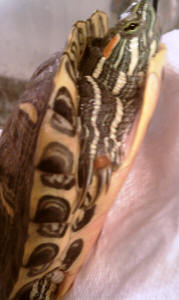
Red Eared Slider, double Dribble incomp.
��
11/07/10
Hey WWM
My name is Brenden,
<Hiya - I'm Darrel>
.. and let me give you some background on what's going on. I got my
first RES for my birthday about 8 years ago, her name is Dribble.
<Nice name>
She's about 6 inches in length and I've had her in a 20 gal
tank up until just recently. about a month or 2 ago me and my
girlfriend decided to get her a Red Eared Slider so we went to the pet
store, and got everything we needed, named the new turtle... turtle,
and mistakenly put them in the small 20 gal tank together. They seemed
just fine at first, then Dribble started nipping at the side of Turtles
shell.
<Sometimes, for their own turtle reasons, they just do that>
She has didn't do any damage, but I looked it up and decided to go
with a bigger tank. I now have a 55 gal tank. the nipping has slowed
down a lot! but it still happens now and again. They really seem like
best friends to me, while basking together Dribble will get on the
rock, and turtle will climb on top of Dribble and they will stay like
that till they're done basking I guess. But other then the
occasional nipping they get along just fine.
<Sounds pretty normal so far>
Dribble usually tries to take all of the food I give them, and because
of that I think I'm over feeding him because I'm trying to let
Turtle eat too.
<The solution there is to separate occasionally separate Dribble
��
into a separate tub, or maybe even into a dry bathtub for an hour or
two
��
and let turtle have some "alone" time and then you can feed
him separately.>
But tonight as I was getting ready for bed, I looked in the tank and
Dribble was flittering her nails in Turtles face. Now turtles too young
to mate anyways, and too young to tell if its male or female.
<Turtles reach sexual maturity by size, not by age. Six inches is a
little small for a female, but is normal for an adult male>
Dribble is older though, and has short nails like a female. so I guess
my first question would be can males have short nails, and if not,
would a female turtle be doing that to a younger turtle for dominance
and should I separate them?
<Dribble is showing a number of conflicting signs, Brenden.>
<Nipping behavior between any two is often related to establishing
dominance>
<Females normally nip at males if the male attempts courting
behavior and the female is not interested.>
<Males will occasionally flit their nails at another male as a
prelude to fighting>
<I've never seen a female flit her claws like the males do, but
that doesn't mean it doesn't happen>
<There are so many conflicting signs it's hard to make any sense
out of it at all -- just as if they were a married couple>
anything you can elaborate on would be great!
<Brenden, nothing you've said makes me really worried. Let them
have their little spats every so often. As long as Dribble is just
showing turtle who's the boss, don't sweat it. Just observe
Turtle every day to see that he doesn't have any deep wounds or
cuts, and just to be safe, feed him separately once or twice a week so
he can have a stress-free environment (Wait till you're married and
that last one will make a LOT more sense!)> thank you so much
WWM
<Yer welcome!>
Turtle Co-habitation - 11/2/10
Hello and thank you for your time.
<Hiya - Darrel here with al the time you need>
I've had Scooter, a female red eared slider, for about 7 or 8 years
now and have been thinking it would be nice to get her a friend.
<It certainly will change things, yes.>
She is in a well filtered and cared for 40gal tank, which seems like it
would have enough room for one more turtle.
<Maybe. Not a lot of extra room for two adult turtles, but certainly
manageable>
I would prefer not to get another Slider as it's so difficult to be
sure of the sex until they are older, and I do not want babies (as
adorable as the darn things are).>
<I feel the same way about my kids>
What do you suggest as an alternative breed/species that would
co-habitate well with my Red Eared Slider?>
<Well first things first. While many turtles do well in colonies,
they are not social animals. In other words they don't seem to have
a basic need to be around their own kind except for mating.>
<In this sense they are a lot like my brother in law.>
<What I mean by that is that science hasn't been able to
determine loneliness or any ill effects of being kept singly, so when
you do this, make sure you understand that it's for you>
Sidenecks are a species that I'm not too familiar with, but think
look fun.
<Side-necks are fun to look at but they tend to be on the aggressive
side. If you go with any of the Podocnemis you should make sure that
it's reasonably on the small side compared to Scooter>
Any suggestions are welcome.
<OK - well, here goes: Two ways to go here, one conventional and one
not. If Scooter is 7 to 8 years old she should be around 4-6 inches in
size. Any MALE Slider that size will be very clearly a male based on
nothing more than having long front fingernails (females have short,
ordinary claws) so it should be easy to find another female
Scooter's size. On the other hand, if you do get a male, mating is
common, but if she lays eggs in the water they won't hatch anyway.
What I mean is that in order to you to get baby turtles from a pair of
adults - you would have to take many positive steps toward that
outcome. Laying eggs on her basking area doesn't count. Just remove
them and destroy them, trust me, Scooter won't care. Any of the
Sliders, Cooters or Painted turtles of relatively equal size usually
get along just fine.>
<OK - that was the conventional suggestion *And Now For Something
Completely Different*>
<Expand Scooter's world, expand your horizons. Want a change?
Make a CHANGE! Figure out a way to expand Scooter's world from a 40
gallon tank to the same water area in a terrarium-sort of enclosure
with at least that much land area as well
��
and then add a juvenile Box Turtle (of the Terrapene carolina family).
You'd never have a more friendly and personable companion for
Scooter��.
And you both take another step into a bigger world. O.K. I warned you
it would be weird>
Thanks in advance for any information you may have! Have a great
day.
<Yer welcome, I will .. and You, too!>
~Jen
"Travel is fatal to prejudice, bigotry and narrow-mindedness...and
many of our people need it solely on these accounts." - Mark
Twain
<Fear naught! Live dangerously, all will be well - Churchill>
Red ear slider turtle with bitten off nose
10/19/10
Hi.
<Hello.>
I have a question.
<Fire away.>
I recently put a female red ear slider into the tank of my other female
slider.
<These are not social animals and can be aggressive.>
The newer turtle is smaller. They seemed to be getting along well
except at feeding time the larger turtle seemed to try to eat all of
the food before the newer turtle could get any.
<I see. Possibly bullying; are you sure the larger turtle is a
"she"?>
she got food anyway. They were fine even after I came home from work
until that evening when I went to check on them. The smaller turtle had
blood all over her head. When I finally was able to see what was going
on after all the blood was washed off, I realized the larger turtle
completely bit the smaller turtle nose off.
<Crikey!>
It is no longer bleeding but it seems as though when she puts her head
out of the water, she opens her mouth now for air and water shoots out
of her nose holes. I know she must be in pain.
<Yes.>
Being that its the weekend, the veterinarians who care for turtles
office is not open.
<Does need veterinarian help.>
Is there anything I should or can do?
<Needs a vet; at the very least, its nose will need to be patched up
a bit and the turtle treated with antibiotics to prevent infection.
Keeping the turtle out of the water will help. Provide drinking water,
but that's it; warm, damp conditions foster infections, while warm,
dry conditions will help the wound heal.>
Will she live?
<Potentially, yes.>
She seems as though she doesn't want to eat now as well.
<Eating is the least of her worries.>
Thank You
<You're welcome. My apologies about the reply being a bit late;
for some reason the turtle people didn't check in over the weekend,
so you've had to make do with me, a fish person! Cheers,
Neale.>
Turtle Biting Tail of Another 10/16/10
Dear Crew
<Hiya - Darrel here>
We found three very small red-ear sliders in our pool two years ago and
have since kept them in an aquarium and watched them grow.
<It's really fun, isn't it?>
One is much larger than the other two. Yesterday, the larger one bit
one of the smaller ones on the tail and wouldn't let go. There was
a lot of thrashing around in the water. I separated the larger one and
plan to let him go free in a local pond.
<You shouldn't do that >
The tail of the smaller one is shredded. Questions: What kind of
behavior was that?
<While some (most) turtles get along just fine in groups, some can
be just downright mean to smaller animals. Depending on size, it could
be one almost-mature male trying to drive off or destroy a younger
male. No real way to tell for sure>
Is it OK to let the larger one go in a pond?
<. No. NO. NO! No matter how logical it seems, we never EVER let
unwanted or unhoused pets back into the wild - even if it is within
their natural range.>
<If you look on the internet you'll find a turtle and tortoise
club in your area who I'm sure can find someone to take the
troublemaker>
What do I do with the tail of the smaller one?
<Dribble some iodine (Povodine/Betadine) on it once a day for a few
days
��
leave him out long enough to let it dry
��
beyond that, as long as he eats, is active & poops
��
nothing. It will heal to whatever extent it heals. If it begins to look
black and pus-filled, then you have a medical condition that must be
treated by a vet. Hopefully and usually, that won't be
necessary>
Thank you!
Shelley H. Corbett
Red Eared Slider Question, care, compatibility
9/25/10
Hello,
<Hi Helen, Sue here.>
I got two small red eared sliders about four months ago. They were
about 2 inches in length at the time, and only grew about half an inch
since then. Unfortunately, a few weeks ago one of them got sick, and
would not go into the water or eat, and died.
<I��m
sorry to hear.>
After this I got a better filtration system and a better water
heater
<Contrary to what you may read on many other websites, water should
not be heated. Their only heat source should be warm, dry land.>
<Warm, moist environments are the environments preferred by bacteria
that will seize any opportunity to take advantage of a debilitated
turtle.>
and basking light to make sure the temperature in the tank is warm
enough.
<Actually, what turtles need is a CONTRAST between cool water (70-72
degrees F
��
basically room temperature) and warm, dry land (88-90 degrees F). They
need to be given a clear choice between the two. Unlike humans, they
have to rely on the outside environment, not their own bodies, to
regulate their internal body temperature and control various functions
in their bodies such as the proper digestion of food. The sharp
contrast between the two temperature ranges is what encourages them to
move from one environment to the other
��
i.e., when too warm,
they��ll
jump in the water to cool off, and vice versa.>
<You
didn��t
mention whether or not you also have a UVB light. Turtles must have a
UVB light in addition to a heat or basking light for proper shell
health and growth. The bulb must specify UVB on the package otherwise
it��s
likely not a UVB bulb.>
The remaining turtle continued to flourish, but I was very sad over the
loss of his tank mate, so I bought a new turtle- a small yellow bellied
slider, about 2 inches in length. I have only had him for about five
days, but I noticed he too was staying on the basking area and avoiding
water. He will only eat when separated from the older turtle. This
morning, however, I witnessed my older turtle sneak up behind the
yellow
belly and CHOMP on his foot, and try to drag him underwater! Now I
think he was avoiding the water out of fear of my other turtle. I have
separated them, but I cannot really afford to buy ANOTHER set-up and
keep two separate tanks. Do you think the aggressive behavior of the
red eared is normal, and
will it continue? What should I do?
<First, before addressing the behavior/compatibility issue
��
because you had one turtle become sick and die after only having him
for a few months,
I��d
first suggest you read the following article below and compare the care
you��ve
been giving your turtles to
what��s
recommended in this guide and make changes where indicated (it also
discusses some options for lower cost alternatives!):
http://www.wetwebmedia.com/FWSubWebIndex/RESCareBarton.htm >
<Next, re: your question about aggressive behavior being normal or
not, the behavior of turtles, like humans, is very individual, but yes,
in general red eared sliders can be aggressive, especially when
they��re
confined together in close quarters. However,
it��s
always a risk whenever you put ANY two species of turtles together.
Sometimes
they��ll
get along just fine; other times one may seriously injure or even kill
the other. Sometimes
they��ll
get along great for years, then all of a sudden one starts attacking
the other.
That��s
why generally speaking, we recommend only one turtle per enclosure
unless
you��re
either keeping them in a very large enclosure or pond where they have
separate spaces to bask and escape out of sight from one another as
they would have in nature.>
<As far as what to do in your situation, I'd advise keeping them
separated from each other right now for a couple of reasons. Beside the
fact that one is acting aggressively toward the other, separating them
will also help you determine for sure why your yellow bellied
isn��t
going in the water. If you see him going in the water when
he��s
alone, then most likely he
didn��t
before because he was intimidated by your red eared slider. On the
other hand, if he still avoids the water, then
you��ll
know the reason is likely due to some other cause
��
such as the water temperature being too warm as mentioned above, or a
potential illness, etc.>
<The good news though, is that there ARE inexpensive ways to
separate them, and without necessarily having to duplicate everything
you have now! But first, in order to properly advise you,
I��d
need to have some additional information about your current set-up,
including
��
1) The size of your current enclosure (# of gallons and surface area
dimensions)
2) The size tank (total gallons) and the number of gallons per hour
(GPH) that your filter is rated for
3) What type of UVB light
you��re
currently using (i.e. a tube vs. compact fluorescent bulb)>
Thank you for your help,
Helen
<You��re
welcome, Helen. Write back with more detailed information about your
current set-up and
I��ll
be better able to tell you what some of your options might be.>
|
red ear slider turtles... sys., comp.
8/24/10
Hi,
<Hi, Michelle, Sue here with you.>
Today my husband brought home a baby slider turtle and a few
hours later our neighbor gave us their 2-3yr old slider (they
were bored with him :0(
<Ohhh, that is sad. I think turtles are one of the most unique
and interesting of pets. But then again, I guess
I'm
probably a bit biased!>
We have a 90 gallon fish tank with cichlids (tank has been
running for 5 years, two canister filters, cichlids run from
2" to 4" in size). I lowered the water level tank,
added a floating dock and a UVB light above the floating
dock.
<All sounds very good
��
except for the part about the cichlids. See end of this
note.>
The large slider quickly found the basking dock and has parked
himself on it.
<That��s
great!>
The little one (2" in length?) just swims around. We have
placed him on the dock but he just jumps back into the water. The
temperature of the water is 78 degrees and the basking dock
registers 88 degrees.
<Water temperature should only be 70-72 degrees. Ignore what
you might have read elsewhere about warmer water temperatures.
Turtles need/like to have a clear choice between cool water and
warm air. This is what entices them to get out to bask
��
which they need to do for a few hours each day in order to
properly digest their food so it
doesn��t
rot in their stomach. 88-90 degrees is a good basking temperature
range to aim for, so
you��re
fine here.>
I ordered two more basking docks hoping that having two distinct
basking docks will encourage the small one to get out of the
water. Should we be concerned about the little one or is he just
intimidated by the larger one?
<Any one (or all!) of three scenarios is likely here:
1. He is in fact intimidated by the larger turtle as you
suggest.
2. The water temperature is not low enough to motivate him to get
out of the water to bask.
3. You just got him and he is trying to get used to his new
environment; sometimes this can take a few days.>
Any advice would be appreciated.
<Sure!
I��m
almost never short of advice and/or opinions, no matter what the
topic! Hee, hee! Here are a few as they relate to
turtles:>
<Drop the water temperature to 70-72 (average room
temperature). Pull out the water heater if you have one. You
don��t
need it, even for the baby turtle.>
<Give your little guy a couple of days;
it��s
possible he just needs a little extra time to adjust to his new
surroundings.>
<Even though you have a nice size aquarium, I think it was
wise for you to get a 2nd basking platform. You
didn��t
mention just HOW much larger your larger one is, but
it��s
generally not a good idea to put different size turtles together.
The larger often becomes dominant and intimidates the smaller as
you noted. This can sometimes result in basking and/or feeding
issues, and sometimes even injuries to the less dominant turtle.
Having said that, the larger size of your aquarium does allow
each of them some space away from each other -- BUT,
I��d
still keep a close watch out for any signs of trouble between the
two of them.>
<You might also want to consider giving them some *visual*
privacy from each other by using some fake plants as a bit of a
divider.>
<Make sure your little guy
isn��t
getting short-changed during feeding time. If he is, try feeding
him in a separate container. Rule of thumb is to feed him no more
than he can eat every day in 5-10 minutes. For juvenile and adult
size turtles, only every other day. Make sure you
don��t
overfeed them.
It��s
one of the most common mistakes people make.>
<As you and your husband are new turtle owners, I would be
remiss in my *WWM duties* not to include this care guide link for
you! Please read it carefully, compare your care and feeding to
what��s
listed in this article, and make any necessary adjustments. This
will help to ensure that you get many years of enjoyment with
them!
http://www.wetwebmedia.com/FWSubWebIndex/RESCareBarton.htm
>
<NOW
��
one thing you
didn��t
mention in your note, but I want to mention here, is the
compatibility between your FISH and your new turtles!! There
really
isn��t
any situation where we recommend it in an aquarium. First, below
is a link to FAQs about general turtle and fish
compatibility:
http://www.wetwebmedia.com/fwsubwebindex/rescompfaqs.htm
>
<Next
��
Here��s
what our two other *resident turtle experts* had to say in prior
FAQs specifically on the topic of mixing cichlids with
turtles:>
<1.
Neale��s
advice
��
FAQ: RES... tankmates, diet mostly
��
1/11/10>
I was thinking about one of those blue crayfish or maybe some
African cichlids?
>No. Let me state again that as turtles get bigger, they
produce massive amounts of waste. It will not be possible to
maintain zero ammonia, zero nitrite, and sub-20 mg/l nitrate
levels in tanks with turtles. The turtles don't care so much,
but fish, because they have permeable skins, are far more exposed
to these toxins.<
<2.
Darrel��s
advice (his humor is no extra charge!!)
��
FAQ: Slider and Cichlid together
��
07/26/07>
Help Please!!!!!!!!!!
>That's what we do here!<
I have a Red Ear Slider named Dave. He's been alone in a 25
gallon tank for 2 1/2 yrs. I have never put anything else in
there with him, until now and except the little feeder fish he
eats.
>Turtles do well in groups, but they seem perfectly happy to
be alone as well.<
I recently purchased a Red Devil, without knowing it's
history.
>We here at WWM are assuming that you mean a Red Devil Cichlid
Fish (Cichlasoma labiatus) as opposed to something else,
right?<
She's very aggressive, do you think she'll survive? Or
will Dave eat her? Or I fear she'll eat him!!!!! What do you
think????????
>Well first, I think you should conserve on the use of
multiple exclamation points and question marks. You never know
when there will be a shortage of punctuation and you'll wish
you hadn't wasted them.<
>Seriously, it's best not to try to keep fish and turtles
together because their needs are quite different. While fish can
be part of a
turtle��s
diet, they are so BAD at catching fish that it's almost
comical. I tossed some feeder goldfish into my outside turtle
pond 8 years ago and they've grown to be almost the size of
small Koi and on the rare occasions that the turtles try to catch
them, they scoot away without even seeming concerned.<
>In your case, if it came down to it, I'd bet on Dave.
Turtles are tough little guys when it comes down to it. My main
concern is to see that Dave is so well fed that he just can't
be bothered going after Victoria (You didn't tell us your Red
Devil's name - so I just made that up). The same goes for
her. If she's otherwise well fed and well cared for,
she'll probably just think of Dave as an annoyance and
nothing more.<
>With that said, Diana, wild things are wild things and when
you keep them together you'll always run the risk of
something unexpected happening.<
Thank You
>I hope that helped. Here's a link for you to read -- the
first paragraph applies.
http://www.wetwebmedia.com/FWSubWebIndex/RESCareBarton.htm
<
-Michelle
<Michelle, you were one of the fortunate few to write in to
WWM and get advice from 3 crew members for the price of 1!! Ooops
-- I forgot,
we��re
free! Anyway, hope this helps you, your turtles (and your fish!)
Please write us back if you have any more questions or
concerns.>
red ear slider turtles
Michelle - just want to add another note here that besides what
Neale mentioned re: water quality concerns when mixing fish with
turtles, the water temperature needs/differences between turtles
and many fish is another reason why we recommend keeping them
separate.
-Sue
Re: red ear slider turtles, compatibility concerns
��
08/25/10
Thank you for your advice.
<You��re
welcome!>
I will remove the tank heater and drop the water temperature down
as you suggested.
<Very good.>
The other turtle is probably 5" long.
<This one is pushing *adulthood * if not already there,
depending on whether
it��s
a he or she. So, yes, this makes it a little more risky placing
him with your baby turtle.>
The little turtle started swimming around the tank and playing in
the water currents (he reminds us of Crush, the little sea turtle
from Nemo).
<Very funny. That was my
daughter��s
2nd choice pick for a name for one of our turtles. Instead, she
*got wise* and chose the alphabet to name them
��
*Shell*y(E); *Shel*by(B), etc. (no particular order!) She thinks
she might be able to get more turtles this way; however I told
her once
I��ve
had enough, the last one will be named *Shel*don (DONE)!>
He has also, as of this afternoon, acquired enough courage to
just crawl on top of the larger turtle to bask. He did eat a few
bites (very small bites) of turtle pellets for sliders.
<That��s
great! Possibly just a matter of him getting accustomed to,
comfortable in his new surroundings.>
The larger turtle has yet to enter the water (unless he is
falling off the dock) and has chosen not to eat. My neighbor came
by today and said "oh, he always basks and never swims, if
he is going to die we wanted him to die on your watch. And he is
'hibernating' right now and not eating".
<Nice neighbor! Actually, what she said is not quite true. If
he dies it technically would be on her watch. A turtle
doesn��t
die overnight. Their *dying process* often takes a good while,
and would be a direct result of what she did (or more likely
didn��t
do) for him. My heart sinks when I read things like this. More on
this below.>
I am not sure how this could be accurate as they kept his tank
next to a window and we live in Phoenix. It was 108 today and I
can't imagine that kind of temp, radiating through a window,
would cause a turtle to hibernate.
<It
can��t.
Also, placing an aquarium next to a window is a bad location in
any climate
��
either from risk of over-heating in hot weather or catching a
draft in cold weather and coming down with a respiratory
illness.>
Needless to say the comment through me for a loop.
<I��m
sure.>
Now I fear they have been depriving this turtle of UVB rays and a
proper diet. I understand through your many postings that turtles
that bask endlessly are usually sick.
<Often true, especially when combined with loss of
appetite.>
On another note, the links you provided were excellent resources.
I would be lying if I said I will now get a separate tank for the
turtles. Our 90 gallon tank takes up a tremendous amount of space
and I am not willing to get rid of my cichlids. So, in light of
the information I have gained from reading your linked articles,
I think we are going to give the big turtle back to our neighbor
and tell them to be responsible.
<I hope you
haven��t
already returned him to your neighbor. This would be a death
sentence for him. He likely has either a very serious infection
and/or metabolic bone disease and will likely not survive without
some medication, the care of a professional - either a vet
(preferably specialty vet) or other expert at this point.
Here��s
what I suggest you do
��
��
1st get him back from your neighbor if
you��ve
already returned him.
��
While
you��re
waiting to make other arrangements for him, place him in a warm
(85-87 degrees, possibly warmer if it turns out he in fact has a
bacterial infection), DRY place with a UVB bulb above him (or
bring him outside 3x/day for 10 minutes each time under the sun).
The place you keep him can be as simple, cheap as a plastic
storage container or corrugated cardboard box. Give him access to
a shallow container of water for only a few minutes a day to
allow him to eat (if he wants), drink and poop. See this link
below for exactly how to do all of this:
http://www.wetwebmedia.com/FWSubWebIndex/treating%20RES%20Dis%20DarrelB.htm
��
Start looking around, doing a Google search, etc. in your area,
state for either a reptile or specialty vet; a local Turtle and
Tortoise club where they might have an
��old
hand��
there who is willing to examine him; or some other reptile or
turtle rescue individual or group who would be willing to take
him and get the care for him that he needs. >
We will keep the little one in the tank. In a few years when he
is large and if the tank is showing signs of stress (or the
turtle/fish) then I will consider my options. With my Cascade
1500 and 1000 canisters I
can't see the tank becoming overly dirty any time soon.
However, I realize that everything you sent me says it will
happen. Anyhow, thank you for your advice. It is much appreciated
and greatly needed.
-Michelle
<You��re
welcome, Michelle. Please, if you can, get help for the bigger
one or find someone willing to rescue him and get him that help,
and let us know how it all turns out. Let me know if you have
trouble searching for, locating a place or person to help or take
your turtle. Sue>
Re: red ear slider turtles, compatibility concerns
��
08/25/10
Thank you for providing further insight to turtle/fish
compatibility. I am really doubting my decision to keep the
little one in the tank (see previous reply for further
explanation). Which means I have to give him away. :o( I think I
will test the "water" for a few weeks and see what
happens. I am sure in the end I will tell all of you that you
were right.
But just like a child, I have to try it myself first. :o)
<I understand you wanting to keep the little guy if you can.
They are pretty irresistible. And what we give you here are only
general guidelines, your individual *mileage* may vary!>
Thank you for time. If you want I can send you pictures of the
setup. Let me know.
<Sure! We love getting pics! Just make sure each one is no
more than a few hundred Kbytes.>
-Michelle
<Sue>
Re: red ear slider turtles, compatibility and health concerns
��
08/26/10
I am sorry to say that I did return the large turtle last night.
They subsequently "got rid of the turtle" by releasing
it into a pond in our area. Although the outcome is not a
positive outcome, I hope my questions and your answers will help
another turtle owner to "do the right thing".
<I hope so, too.>
Thank you again for all of your valuable information. Our family
is enjoying watching "Crush" swim about and he appears
to like his environment better now that the larger turtle is
gone. Here are a picture of the tank setup and of Crush in a
rock.
<You��re
welcome, Michelle, and thanks for sharing the pix. Crush is
adorable! And I like your *landscaping*! I'm glad Crush seems
to be happier now, too in his surroundings. Just be sure to check
for caves, other spots where Crush might *almost fit but not
quite* and get trapped. Most people
don��t
think about this when it comes to water turtles, but believe it
or not they actually can drown! Anyway, enjoy him and keep us
posted!>
-Michelle
<Sue>
|
 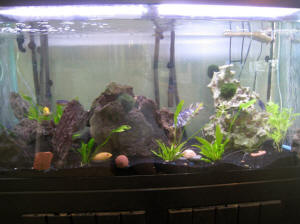 |
|
RES turtle compatibility and care questions
8/14/10
Hi this is Sonal from Mumbai...
<Hi Sonal,>
I have 2 res turtles now..{male-female pair}
about their age, both of them r less than a year.. she is younger
to him by 3 months..
my male turtle acts as if he wants to scratch the face out of my
female turtle..
She's larger than he is..he wiggles his finger nails towards
her cheeks(I mean the area near her eyes) with both his hands..
it looks as if she's getting hurt by this action.. she takes
her head inside her shell n closes her eyes in the beginning... n
later on she comes out n pushes him away..
but just a few days earlier found HER doing the same thing, the
same way he was doing... I don't understand what kind of
behavior is this n what for??
[are they getting matured or something..or is it related to the
mating thing!!]
I would really appreciate if you could tell me more about this
behavior..(so that I understand them better..)
also could u tell me about how to keep their shell clean,'coz
sometimes it really stinks..[I clean the tank everyday..]
Thanks a lot for your help..'coz every time I mail u,u ppl
always help..
<Sonal,
we��d
be happy to answer your questions, but can you first please write
us back and give us some additional information?>
<First, about your tank set-up and care? i.e.:
1) # gallons of your tank
2) what type of heating and lighting bulbs you are using
3) what, if anything,
you��re
providing for a basking platform
4) temperature of air above the basking platform
5) temperature of water
6) what, if any, type of filtration
you��re
using
7) what
you��re
feeding your turtles.>
<Next, sexual maturity is best determined by size, not actual
age. Can you measure the length of each of your turtles' top
shells? Hold a straight edge ruler above their top shell;
don't follow the curve of their shell.)
<Also, re: shell - Can you provide us more information about
your
turtle��s
shell? i.e. Are any parts of the shell soft, either underneath or
on top? Are there any whitish patches anywhere? Is it in any
other way discolored?>
<Also, when you write back, can you please also do us a favor
and replace your *txt* words with the proper full words and make
complete sentences (capitalize 1st letter of sentence, use a
period at end of sentences, spaces between sentences, etc.) We
ask this because these FAQs get stored and become part of the
website's *reference library*. Using properly spelled whole
words and complete sentences makes it easier for others to later
search for and find this information on our website, as people
typically use whole words and/or phrases to conduct their
searches.>
Thanks a ton..
<Thank you, Sonal. Please write back and give us more
specifics about your turtles, your care and your tank set up so
we can better help you and answer your questions.>
<Wet Web Media crew>
Re RES Turtle compatibility, shell concerns and
general care 8/18/10
Hi.. Sonal again..
<Hi, Sonal, this is Sue here with you.>
I am sending you photographs of my tank so that you get a better
idea about it. The first photograph shows the amount of water (I
don��t
know how to measure it in gallons!) & the other one shows the
basking area.
<Thanks for sending us photos, Sonal!
It��s
very helpful to have photos along with the description.>
Tank set-up and care:
<Thank you for also writing back with additional information
about your set-up. This really helps us to better advise you.
From your responses, I see what some of your problems might be.
I��ll
briefly comment on each of these items below in this email, and
then give you more complete feedback and recommendations in the
original email you sent which had your actual questions and
concerns.>
1) # gallons of your tank= approx 3 liters
<3 liters is approximately equivalent to under 1 (U.S.)
gallon. If this is true, Sonal, this is WAY too small a tank for
even ONE turtle.
It��s
one of, if not THE main reason why your two turtles are having
problems getting along.
It��s
also not good for other reasons. See more about this at the
end.>
2) What type of heating and lighting bulbs you are using = I
don��t
use any type of heating, direct sunlight from the window (but
since its rainy season here,
there��s
no sunlight).
<Neither of these are adequate. Turtles need basking heat for
their bodies to function properly, and they need regular,
consistent UVB light for their shell and bone health.
You��re
going to need to make some changes here right away.>
3) What, if anything,
you��re
providing for a basking platform = shown in the picture.
<A couple of questions for you here
��
can you write back and tell me
��
��
Can both of your turtles get up on this rock without any
difficulty?
��
How often do both of them bask on it? (i.e., every day, every
other day??)
��
How many hours each day are they out basking on it?>
4) Temperature of air above the basking platform = normal room
temperature about 25 degrees C (equivalent to 77 degrees F).
<Nowhere near warm enough. Turtles require much warmer basking
heat than 25 degrees C. Unlike us, their bodies/organs rely on
the external temperature of the air to function properly,
including properly digesting their food. See more about this
below.>
5) Temperature of water = normal room temperature (sometimes I
add lukewarm water, especially in the winters)
<Turtles like cool water (this is what encourages them to get
out to bask which they need to do), so this part is fine,
assuming your normal room temperature is around 20-22 degrees C
(68-72 degrees F). However,
I��m
concerned that your aquarium is located next to a window. More on
this at the end.>
6) What, if any, type of filtration
you��re
using = I clean the tank every day
��
no filtration.
<Depending on how/what
you��re
doing to keep the water clean, this may or may not be adequate
��
especially given how little water is in your tank. The less
amount of water there is, the more concentrated and toxic it
becomes from food, poop and other debris left in it until your
next cleaning.>
7) What
you��re
feeding your turtles = a little amount of the turtle food, dried
prawns and some small balls of wheat dough (its their favorite),
boiled egg white (another favorite), coriander leaves (only the
male turtle eats), cabbage leaves, sometimes boiled chicken or
fish pieces, and blood worms (very occasionally).
<This is not a healthy diet for your turtles, and likely
another part of the problem
you��re
having. If not already, they will become malnourished and ill if
you continue to give them this type of food. This also needs to
be corrected right away.>
size: male: 8cm (approx. 3 in.) in length and 6.5cm (approx. 2
Ã'½ in.) in breadth
female: 9 cm (approx. 3 Ã'½ in.) and
7.5cm (approx. 3 in.) respectively
<To your original question, neither are sexually mature yet.
Males typically start reaching sexual maturity when their top
shell (carapace) length is about
4��;
females start to reach maturity a little later than males, at
around
6��
long. See later on below how this relates to your question about
their behaviors toward each other.>
The female turtle's shell was a little soft (some parts); now
I think its fine, but still not as strong as that of my male
turtle. No other problems with the shell.
<A shell that has been, and still is, soft in spots is a sign
that your turtle has a metabolic illness, specifically a calcium
deficiency
that��s
causing her body to instead have to remove calcium
that��s
already stored in her shell and bones in order to perform its
other functions. The shells and bones then start to become soft
from the loss of calcium. This condition (as well as the
diet/environmental factors that caused it) needs to be addressed
right away, otherwise it can lead to much more serious illness
and even death.>
Thank you.
<Your welcome, Sonal. Please read my responses now to the
questions and concerns you sent us in your original
email.>
Hi this is Sonal from Mumbai...
I have 2 RES (red-eared slider) turtles now (male-female pair).
About their age, both of them are less than a year. She is
younger than him by 3 months. My male turtle acts as if he wants
to scratch the face out of my female turtle. She's larger
than he is. He wiggles his finger nails towards her cheeks (I
mean the area near her eyes) with both his hands. It looks as if
she��s
getting hurt by this action. She takes her head inside her shell
and closes her eyes in the beginning. And later on she comes out
and pushes him away. But just a few days earlier, I found HER
doing the same thing, the same way he was doing. I
don��t
understand what kind of behavior is this, and what for?? Are they
getting mature or something? Or is it related to the mating
thing!! I would really appreciate if you could tell me more about
this behavior (so that I understand them better).
<As I mentioned above, both of your turtles are still on the
small side to be displaying mating behaviors. And,
they��re
also still on the small side yet to know for sure what sex they
really are. From their tail sizes it does appear your larger one
might be a female, but it could also be the angle of your camera
so I
can��t
tell for sure. Also, the more accurate way to know is by looking
UNDER their tails. So
��
either one of two things are happening:
1. You DO in fact have a male and a female. If this is the case,
as you might expect with the male species (ha!), males sometimes
get an early start, and can exhibit this behavior toward females
before either one is sexually mature. What also happens sometimes
is that mating behavior leads to aggression. This typically
happens when either:
��
the male is trying to mate with an immature female (and the
female becomes agitated and aggressive in response) or
��
��
when the male gets more and more aggressive trying to *persuade*
the female, hoping that his repeated advances will eventually
work
��
again, not much different than in the human species! Normally, in
nature the male
wouldn��t
likely put this much *pressure* on one female, as he would have
other females to try to pursue.
2.
It��s
also possible that you actually have 2 males and
they��re
growing at different rates. It often happens that 1 turtle
becomes the dominant one, gets more of the food, and grows
faster. If this is the case, sometimes, for whatever reason, when
no female is around, males will exhibit this behavior with each
other. Because males often compete with one another, each of them
may also be trying to assert their dominance toward one another,
and becoming aggressive with each other, particularly since you
have them in such close confines with each other. Which leads me
to --- >
<What��s
even further adding to the problem of aggression in either case
above is that your tank is WAY too small.
It��s
even too small for just one of your turtles. And for 2 turtles,
it��s
not allowing them anywhere to go to hang out by themselves and
escape from one another as they would normally be able to do in
nature. Having to live/exist almost on top of each other as they
are now is causing both of them a LOT of stress
��
REGARDLESS of what sex they are. By nature, they prefer being
alone. They also like to be able to swim and move freely about,
not just sit in the water, especially right next to other
turtles.>
<So
��
you need to act on this now before one of them becomes seriously
injured. Especially given that one of your turtles is already
getting hurt by your other
turtle��s
actions. You have a couple of choices here. Either:
1. Separate them in two different tanks (that are both much
larger than the one you have now
��
see the end of this message for how to determine what size you
need). Keep in mind that if one of them is a female, you may need
to keep her in a separate tank until she is big enough/mature
enough to mate with him, which could be at least 2 or more years
away still!
2. Put them in an even LARGER enclosure with separate basking
areas and hidden areas to get away from, and out of sight of the
other. Some pet stores even sell partitions that you can place in
a tank. This option would be less expensive for you than buying 2
tanks and set-ups. But it DOES require you to get a much larger
tank than Option 1. And unless you do use a partition, this
option also may not work. If it
doesn��t,
you��ll
need to consider other options, including getting another
(mature) female turtle to take the *pressure* off the one (again,
if you DO in fact have a male and female right now), or to
separate the two of them into 2 tanks (back to the 1st
option).>
Also, could you tell me how to keep their shells clean, because
sometimes they really stink. I clean the tank everyday.
< A healthy shell should be hard and have no odor to it at
all. The odor is a sign that there might be some sort of
infection brewing. Fungus and bacteria often seize the
opportunity to take advantage of a shell
that��s
debilitated. You mentioned in your 2nd email above that one of
your
turtle��s
has had/still has some soft spots on it. Soft shell is one of the
conditions that can cause a shell to deteriorate and become more
susceptible to infection. And, as I noted above, soft shell in
and of itself, can lead to much more serious illness. So both of
these conditions need to be addressed immediately (as well as the
dietary and environmental factors that caused them).>
<Things that cause a
turtle��s
shell to slowly deteriorate and soften (otherwise known as *Soft
shell*), include improper diet/lack of calcium in the diet (as I
described above), and not enough UVA and UVB lighting (what you
get from the sun or from an artificial light source). UVA and UVB
light helps turtles make the vitamins they need for their shell
and bone health. Soft shell is also called Metabolic Bone Disease
and left untreated becomes 100% fatal.>
<Causes of shell rot/infections include inadequate diet,
improper lighting and heating temperatures (both basking and
water), and poor water quality.>
<So here is what you need to do right away:
1. Remove (and separate) both of your turtles from your tank and
place them each in a separate warm, dry container. Bacteria and
fungus thrive in warm, wet environments and will seize the
opportunity to take over and make an already debilitated turtle
even sicker. You MUST provide them with a heat source (to keep
air around 85-87 degrees F or about 30 degrees C), and you also
MUST provide them with both a UVA AND especially a UVB source.
They should remain in this environment around the clock except
for putting each of them in a shallow container of water each day
to eat, drink and poop. Below is a link to an article that
explains exactly how to do this.
http://www.wetwebmedia.com/FWSubWebIndex/treating%20RES%20Dis%20DarrelB.htm
2. Keep your turtles in this environment for the amount of time
specified under the
��Soft
Shell��
section of this guide, and until you make the needed changes to
their regular living environment.
3. In particular, carefully read over the sections of this
article describing Isolation, Soft Shell, and Notes 1 (about
proper diet) and Notes 2 (about proper lighting).
4. Follow the treatment steps listed under the Soft Shell section
of this same guide, which include isolation (in #1 above) and
calcium treatments. Ideally, it would be best if you could find a
herp or reptile vet to administer the calcium to your female
turtle in an injectible form. Failing this, besides the other
sources mentioned in the link above, I have had good success with
Rep-Cal Phosphorous-Free Calcium with Vitamin D. It comes in a
powder form. I add a pinch of it to pellets that have been
pre-softened in a small amount of water.
5. Read the following additional link, compare each step of your
care to the guidelines listed here, and make the necessary
adjustments.
http://www.wetwebmedia.com/FWSubWebIndex/RESCareBarton.htm
6. In particular, fix the things that are most likely causing
your turtles to have shell problems and calcium deficiencies:
1. Correct the diet
you��re
feeding them. This is going to come as bad news to your turtles,
but you need to stop feeding them wheat dough, boiled egg white,
dried prawns, chicken, etc.! None of these foods are part of
their natural diet, and
it��s
not providing them with the correct balance of vitamins and
nutrients they need. At least 50% of your
turtle��s
diet, even at this young age, should be vegetarian and greens
based; as adults that bumps up to 75%. The items listed below are
ALL you need to feed them! (The diet is actually the easiest
part!):
* A high quality pellet such as ReptoMin or a high quality Koi
pellet. Especially right now
I��d
recommend soaking them in water until they soften, then adding a
pinch of calcium powder as mentioned above and mix in well.
(Note: only feed them pellets once every OTHER day, and ONLY as
much as each of them will eat in 5-10 minutes. One of the most
common mistakes people make with turtles is to overfeed. This can
also lead to diseases).
* An earthworm (No bloodworms) every week or so for some
additional Vitamin A which they also need.
* If you want to add some fiber and give them something to munch
on in between feedings, rather than cabbage leaves or coriander;
substitute dandelion leaves (some grocery stores actually carry
this), red leaf and curly green leaf lettuces (no iceberg
lettuce, though). What I did was buy a clip with a suction cup
from my pet store to hold the greens in place so they stay in one
place and are easier to clean up. Just replace with fresh greens
as needed.
Now,
it��s
very possible your turtles are not going to be *thrilled* with
this change
��
as most anyone
wouldn��t
be on Day #1 of a *Diet*! So
don��t
get concerned if you
don��t
see them rushing to eat these things right away. Just give them
time,
they��ll
adjust. If
you��re
still having difficulty getting them to switch over in the next
couple of weeks, write back and I can give you some additional
tips. Just make sure they get the calcium they need right now,
though.
2. Provide correct basking temperature and basking conditions. It
is essential that your turtles spend several hours each day
basking
��
and in the right conditions. Your turtles need:
* Easy access to a basking area. If
they��re
having trouble climbing onto the basking area
you��re
providing,
you��ll
need to switch this with something else. The one I use and would
recommend is the Zoo Med floating turtle dock. It comes in
different sizes.
* Proper water and air temperatures: a CLEAR choice between cool
water and warm air. This is what encourages them to get out to
bask every day as they should. They should be spending several
hours each day out of the water completely drying off, heating
up, and soaking in the UVB rays.
* A heat bulb above their basking area. The air above your
turtles��
basking areas needs to be MUCH warmer than what
you��re
currently providing. It should be around 88-90 degrees F (31-32
degrees C). Unlike us, turtles need to get this heat from outside
their bodies to properly digest their food. Otherwise it will rot
in their stomach and eventually cause them to become seriously
ill.
* A UVB light bulb, also above their basking area (see
below).
3. Fix the lighting conditions: Sunlight through a window pane or
screen is not adequate for UVA/UVB. And direct sunlight into a
tank runs the risk of making the air too hot and baking them.
Given you live in a seasonal climate and
can��t
have them exposed to direct sunlight outside all year long,
either,
it��s
best then to provide them with a good quality artificial UVB
light that will give them a consistent source of UVA/UVB all year
long (UVB automatically provides UVA but not the other way
around). This light needs to be placed directly above their
basking area. More is written about this in the care link
above.
4. Fix any water quality issues. You
didnt
mention exactly how
youre
keeping the water clean, but here are some suggestions:
* Turtles are much messier than fish and require even better
filtration than they do. I would highly advise you to get a very
good mechanical filter that is rated several times more than the
amount of water in your tank.
* Water changes can be cut back to 50% water changes every week
once your filter gets established (after about a month or
so).
* Periodically test your water for ammonium and nitrite before
your water changes.
* Suction up/vacuum up food and poop immediately after
theyre
done;
dont
let it sit around until your water change.
* Until you get a filter, consider feeding your turtles in a
separate container of shallow water. This will help cut back on
the waste in the water.>
<Some other things I would strongly recommend:
* Do not place your
turtles��
tanks next to a window. Besides the concern about heat and
lighting fluctuations, there is also the risk in the wintertime
of your turtles getting exposed to drafts in the air. This is one
of the main causes of turtles coming down with respiratory
infections, which can also become serious and often fatal. I
would instead place their tanks in an interior part of the room
or some place where they
won��t
be exposed to cool air drafts.
* As I mentioned above, your current tank size is much too small,
even for just one turtle. Turtles like to have lots of room
(especially surface area more than depth) to swim about. As I
noted above, there are several problems with a small enclosure.
Small amounts of water fluctuate much more with outside air
temperatures, making it much harder to control, regulate, and
keep water temperature within a constant range. It also makes it
much harder to maintain good water quality because leftover food
and waste is much more toxic in smaller amounts of water. The
general rule on size of tanks for turtles is 10 gallons (38
liters) per 1 inch (2 Ã'½ cm.) of shell
length. Right now each of your turtles should be in approximately
a 30 gallon or 114 liter tank. Eventually, they will need a MUCH
larger tank. If in fact you do have a female, she can grow to as
much as 12 inches (30 cm.) long; males also can get large, up to
around 10 inches (25 cm.) The good news is that *larger*
doesn��t
have to mean expensive. The link above that I gave you to the
care guide describes other options for enclosures that
don��t
cost a lot of money.>
Thanks a lot for your help
��
because every time I mail you, you people always help.
<I hope we helped again this time, Sonal! Please write back
and let us know how things are going.>
Thanks a ton.
<You��re
welcome!>
|
[1]%20sonai.jpg) [1]%20sonai.jpg) |
I think this turtle is just plain mean!
��
8/3/10
I sent this question to you last year, here is a copy with the
response:
(Here's the current question )
<Hiya again>
Same pond, but I gave the one poor tormented female RES to a friend. So
everything is fine for a while. I noticed the male yellow belly trying
to mate with the big female RES this spring. She was, shall we say,
"not thrilled" but not mean. But as summer has progressed now
the tension has escalated again. The big female is continuously
tormenting the poor male to the point that he is always hiding. He
found him a nice pot under some plants and that is usually where he
hides to get away from her. And it's not just at feeding times. I
see his shell scaling sideways in the water trying to get away from her
at different times of the day! (No, I have never found him out of the
pond or in the pool!!) We also have a 2 yr old Western painted that we
attempted to put in the pond with them. The next day I found it in the
pond skimmer box, the only place the big one couldn't get into I
guess. Once I placed it back in the pond, the big RES immediately
started biting and chasing it. I had to get the poor thing out before
she killed it.
<Your female is indeed very territorial. It's not COMMON, but it
does occur>
Now, these turtles are very well fed, Koi food, turtle food, hyacinths,
my water lilies, Anacharis, hornwort, lettuce, strawberries, and the
occasional earthworm that the big RES will practically dance on two
legs to get! I even feed them on separate sides of the pond now.
The Big RES I guess thinks the WHOLE pond is hers!
��
8/3/10
<It would seem so>
Will I ever be able to put the younger painted in with them? Do I need
to rehome the big RES to have peace at the pond? She's such a
character I hate to have to do that...everything you read says they
should live peacefully together but apparently that ain't so.
Ideas??
<This is where you can spend the summer getting creative. I'd
find away to make my pond into two ponds by constructing a barrier of
some sort. A row of rocks perhaps, separating one "chamber"
from another? When raising alligators, one common thing we do is dig
the ponds into roughly a "Z" shape, where all three lengths
are equal -- that way the animals can retreat to an area that looks and
feels private. They establish their territories and even the bullies
act differently when they know they're not on "home"
ground>
<If you can make the pond look (from a turtle's eye view) as if
it was TWO ponds, then the BIG Slider can claim one as her
"territory" and maybe the others will just gravitate to the
other>
<That's the best you can do -- UNTIL -- just like the rest of us
.. you really do build TWO ponds. Then a third pre-formed pond on the
back porch. Then a fourth somewhere else. Then turn the swimming pool
into the fifth one and tell the kids that if they want to go swimming,
go find a river
��
then talk your best friend into building a pond .. and your next door
neighbor
��
>
<D>
Re: I think this turtle is just plain mean! 8/5/10
Thanks for the reply. I'm trying to figure out how I would make my
pond into two. It is currently a sort of "8" shape on the
outside. Would the rocks have to go ALL the way to the top? Or if not
about how far from the bottom.
I'm really concerned about decreasing the filtration and skimmer
effects if it has to go above the surface. (sure will make cleaning a
"bi--h"!!
<It was just an off-handed suggestion. When I've done something
like that, I've used large rocks (8-12 inches in size) to
"form" the barrier and then run a fence such as hardware
cloth along one side to actually BE the barrier (Turtles would just
climb over rocks anyway, but they nicely disguise the fencing). The
size of the rocks (Did you know any rock over 10 inches in diameter is,
technically, a boulder?) allows plenty of water flow and therefore
doesn't terrible affect filtration.>
<This whole idea may not be to your taste or even practical. another
idea is a preformed plastic pond set into the ground adjacent to the
main pond -- in a way that can take advantage of the vegetation and
decoration to disguise it. A fence 14 inches tall with a 3 inch inward
lip would keep her confined>
<When you have a long term friend that just can't get along with
newer friends, there really is not 'perfect' solution . just a
list of alternatives.>
<Hope some of these ideas help>
Red eared slider... Munching pond plants... what they do
��
07/17/10
Hey....
<Hey-there, hi-there, ho-there! Darrel here>
We have a small pond with a red eared slider turtle. Now we have no
plants in there... he eats them all.
<Yep>
What pond plants can survive living with a red eared slider??
<Plants with fences around them>
<Dave -- Sliders are not fond of eating reeds or reedy-type grasses,
so you might try that. What I do is construct barriers with rocks or
plastic fences to make little pools or backwater areas where I can grow
some water hyacinths. Beyond that, Sliders are omnivorous trending
toward herbivorous as they mature, so you're fighting a battle you
can't win. The only other tactic is simply to have enough plants
that one slider can't eat them all
��
but then (and I speak from experience here) that plants THEMSELVES
become a problem, since they have to have enough nutrition to survive
.. so you end up fertilizing the water to feed the plants, which starts
another whole bio-cycle explosion, etc.>
<I gave up long ago -- and just replace the hyacinths when they
disappear>
Need help... thanks!
David
Question on turtles, RES comp.
��
06/09/10
Hello my name is Markita
<Hi Markita! Sue here with you tonight.>
and I have two baby red ear slider turtles. I got the Dr. Turtle today
and put it in my tank, but now my biggest is starting to nibble on
it.
<You
didn��t
mention which Dr. Turtle product
you��re
using, but if
it��s
either the sulfa block or the calcium block, neither is necessary at
all in your aquarium.
They��re
of little to no value, primarily because when diluted in water, neither
product will ever reach the right amount of concentration needed to
treat an infection or a calcium deficiency. The best way to prevent
your turtles from acquiring any form of illness or dietary deficiency
is by providing them the essential things they need: proper lighting
(UVB) over the basking area; correct basking heat and water
temperatures (warm dry land; cool water) to encourage them to get out
of the water each day and bask; good water quality/filtration with
regular water changes; and a proper diet. And it just so happens one of
our more talented crew members has written a great article that covers
each of these things in detail! To be sure
you��re
doing all the right things to get your little guys off to a healthy
start in life, you should compare the care
you��re
providing in each of these areas to the guidelines listed in the link
below: >
http://www.wetwebmedia.com/fwsubwebindex/RESCareBarton.htm
<And if your turtles DO have some sort of infection on either their
shell or skin, you should refer to the link below for information about
the proper treatment: >
http://www.wetwebmedia.com/fwsubwebindex/treating%20RES%20Dis%20DarrelB.htm
Are they toxic to them or is this okay? I tried feeding her a little
more thinking she may just be hungry but she still is biting on the Dr.
Turtle.
<I��m
not aware of any toxicity with either of these two products. However,
if
it��s
calcium block your
turtle��s
trying to eat, this might be a sign that
she��s
either not getting enough calcium in her diet, or
isn��t
getting the proper UVB light necessary to help her body absorb calcium.
This is all covered in the care article above.>
<Hope this helps! Please write back if you have any more concerns,
or any questions about either of the two articles.>
Need Red Eared Slider help, please! Comp., Repro. -
5/23/10
Dear Crew
<Hiya - Darrel here>
We have 2 male Red Eared Sliders that are around 4 or 5 inches and have
been together in the same 75 gallon tank most of their lives.
<So far, so good. Just about the right size environment for
2>
About 6 weeks ago we were given a female slider that is around 8 inches
and have kept her in a kiddy pool for quarantine purposes.
<A big girl>
This afternoon we decided that it was time to finally put her in the
tank with the two males.
<Queue the menacing music
��..>
Everything was fine for the first half hour or so,
<Just like in the movies
��
things are quiet
��..
TOOOO quiet!>
then things went downhill fast and got really scary. As males will be
males (LOL) they were trying to "court" her to the point of
her needing a restraining order, LOL! She finally started biting at
them and even started chasing them around to bite them.
<yes>
It was when she got hold of one of their front feet and took it and her
head inside her shell that we grabbed her up and finally got her to
release his foot.
<Yeah - turtles play rough>
She is back in the kiddy pool, but to be quite honest, the kiddie pool
has got to go soon as we have a small house and it is taking up way too
much room. Not to mention the cat and two Labs that are just way too
interested in her.
<Between two Labs and a cat - my money is on the turtle.>
Is there ANY hope of them co-existing in the same tank at all???
<there is some, yes>
If so, how do we go about getting them there?
<What you've experienced is to some degree normal behavior for
Red Eared Sliders. At the size differential you've described she
has a clear advantage and when she gets snappy, the others are usually
wise enough to get out of her way. Usually this little bit of combat is
to establish limits and the bites aren't hard enough to break the
skin (sometimes the males will lose a fingernail or two). While sliders
do fine on their own, they also do just fine in colonies and other
large groups with little or no serious combat. There are two concerns
here. First, when we house groups of any kind of animals we should
always give them ways to get AWAY from each other. In aquariums we put
big rock formations in the middle to more or lass make a right &
left half. When we dig turtle or alligator ponds, we make them
"U" or even "Z" shaped, etc. That way, two animals
that aren't getting along can go to places that are out of visual
range of the other and both can feel like they've
"escaped." This is a bit hard to do in a 75 gallon turtle
tank, but see what you can do. The unknown here is the female. She may
settle down after everyone settles down, or she could be just mean. My
guess is the former and here's what I'd do>
<One at a time, while you have the time to baby-sit, take the males
out of the tank and put them in the pool with her. Let her learn to
tolerate them in her own territory - and just one of them. The pool is
likely not deep enough for her to drown the little one and there is
enough room for them to get away from each other. A couple hours of
that each day gets them accustomed to each other AND the disruption of
their routines tends to "reset" a lot of their territorial
and combative instincts. After they've all become bored with
fighting each other, you can try moving them to the tank again>
Thanks in advance.
<yer welcome>
RES Turtles. Comp. 5/11/10
Dear Crew
<Hiya Alix - Darrel here>
So I was wondering how my turtle would react if I got another one.
<The short answer, in your case, Alix - is no.>
<read on>
My friends gave me a red ear slider about a month ago. They rescued it
from the side of the road and she's gotten very big. She's
about 11 inches.
<That's big for a Red Eared Slider. Very big.>
She's never bitten us but she does love feeder fish. What would she
do if I put a baby in there? Oh. I have a 60 gallon tank.
<Sliders are not particularly social creatures, Alex - they seem to
do just fine in groups or colonies, but they don't have any NEED
for such social connections. They can be a little snappy toward each
other at times and this is where size comes in. In the wild, hatchlings
hide themselves in the weeds and floating grasses and don't even
approach the basking logs and stones that the larger animals share
until they reach approximately the same size. What I'm saying is
not that your big one is a cannibal
��
but she MIGHT see it as dinner
��
or in the normal course of interacting with a hatchling, one snap to
show it who's boss would spell the end of the little one.>
<If you have an 11 inch Slider, I wouldn't consider placing
another one with her that was less than 4 inches long. Also, 60 gallons
is a bit small for an animal that size - it sounds like she can barely
turn around. Finally
��
Feeder fish are NOT good for her and you should stop feeding them to
her. Beyond being basically bad nutrition they tend to carry parasites
that could have the effect of shortening her magnificent life. Here is
a link on basic care: http://www.wetwebmedia.com/FWSubWebIndex/RESCareBarton.htm
>
Turtles & tropical fish 4/6/10
I have an Oscar & 4 red ear sliders & 1 mud turtle in a 55
gallon aquarium together. Is it ok to mix the turtles & tropical
fish together?
<No. Your tank is massively overstocked and water quality likely
dire.
Mixing turtles and fish together is almost always a terrible idea
because the turtles produce so much waste that the fish quickly suffer
from ammonia and nitrite poisoning. Plus, most turtles will nip at
fish, making Finrot and fungal infections more likely. If you peruse
any fish or reptile book in your local bookstore, you will quickly
establish that not one serious author suggests mixing fish with
reptiles.>
Also my Oscar is showing signs of Ick. Is it safe to treat my tank with
the turtles in it?
<No.>
Can turtles get Ick?
<They can't be parasitised by Ick, but they can certainly carry
the free-living stages from one body of water to another.>
I have an under gravel filter & a Biowheel filter.
Thanks for any help,
Katina
<You need two tanks, and the Oscar needs rather better filtration
than an undergravel filter that will soon be short-circuited once the
Oscar decides to start digging. As you hopefully realise an undergravel
filter that doesn't have a uniform depth of gravel doesn't work
because all the water flows through the shallowest bit of the gravel
(water follows the line of least resistance). Cheers, Neale.>
Turtle/ fish compatibility 4/4/10
I have a red eared slider in a 55 gallon aquarium and I was wondering
if I could keep some native green sunfish with him.
<Mmm, you could... with some provisos>
My turtle is now has a 4in carapace length. I know that there is a risk
that they could be eaten so I am planning to get some that are the same
size as my turtle.
<You'll need to have good filtration, keep up with regular
maintenance (weekly partial water changes), be careful re not
over-feeding the turtle, but do feed the RES regularly so it won't
harass the Centrarchid unduly.
Bob Fenner>
Re: turtle/ fish compatibility
��
4/4/10
Thanks. Also, how can I make sure the sunfish get their share of food
or vice versa
<Sunfish are VERY tough. I'd be feeding a good pellet food as a
staple. Perhaps Spectrum brand. B>
|
Injuries on my RES's tail and legs... incomp. w/
their own kind of diff. size 2/9/10
Hi,
<Hiya - Darrel here>
I'm a Red Eared Slider lover from Singapore. I had two
sliders, one was about just 3/4 size of another and I placed them
together till today when I finally discovered something! Just few
days ago, my smaller RES could be found swimming frantically once
in a while, I really had no idea what was going on and I simply
ignored it. Just when I was feeding them, I noticed that the
smaller ones was just swimming with it's front legs and it
just withdrew it's both hind legs and tail. Then I finally
found out that it's tail and both legs were injured; it seems
to be bitten off a little on the legs while the tail.. I do not
know how to explain but I do have a few pictures.
<Sliders are strange that way. They can live in peace and
harmony for years and then one day get into nipping matches and
sometimes terrible fights. The size difference you mention -- one
is 3/4 the size of the other -- is right on the margin of
compatibility>
The injuries is around the end of it's tail while the
injuries on it's legs were at the hind toe nails.
<yes>
Currently, I have separated them and the injured ones are placed
in salt solution and I changed it twice. I could not afford for
veterinarian so hope to ask for your professional guidance.
<I have an article that will help you and as long as the feet
and tail don't get infected, you can treat them at home. Here
is the link:>
http://www.wetwebmedia.com/FWSubWebIndex/treating%20RES%20Dis%20DarrelB.htm
>
<The big concern is that, like the rest of us, you now have to
have multiple homes for your turtles -- or a big tank with a
partition.>
Thank You and pardon my grammar errors. :)
<You are welcome -- and your grammar is as good as mine! :)
>
|
 |
RES... tankmates, diet mostly 1/11/10
Hello,
I just have a few questions about my turtles. First of all here is my
setup: I have two red-eared sliders, one male and one female I believe,
they are both about 4-5 inches now.
<Getting to be sexually mature... do watch the male, can be snappy
towards other turtles.>
I also have a western painted that is about 3-4 inches that I believe
to be a male and a Pleco cleaner fish.
<Do not keep fish with turtles. That's the first rule of
turtle-keeping, and stated by every expert and turtle book out there.
For a start, a Plec won't "clean" anything, so that
aspect is a total delusion. Secondly, it's almost impossible for
casual pet owners with regular budgets to provide the space and water
filtration required for both fish and turtles in the same tank.>
They are all in a 75 gallon aquarium filled 2/3rd of the way with water
and I have created a custom basking area that has some smooth gravel
rocks and a 75 watt reptile lamp. I have a 305 Fluval canister filter
that has proven
to be a god send. I feed them turtle pellets for the most part and have
offered crickets as a treat from time to time. I have had them for
about 4 years now and they seem to be healthy. I do not offer any
calcium or vitamin supplements and was wondering how or if I should add
this into their diet.
<Yes. Their diet should be as varied and balanced as possible.
Turtle and Koi pellets make good staples, but augment with fresh plant
materials as well for vitamins and fibre.>
I am also wondering if there is any other creatures that I can add to
make the tank a little more interesting.
<Nothing safely.>
I was thinking about one of those blue crayfish or maybe some African
cichlids?
<No. Let me state again that as turtles get bigger, they produce
massive amounts of waste. It will not be possible to maintain zero
ammonia, zero nitrite, and sub-20 mg/l nitrate levels in tanks with
turtles. The turtles don't care so much, but fish, because they
have permeable skins, are far more exposed to these toxins.>
Thank you for your time and I look forward to hearing from you
soon.
Thanks,
Andi
<Cheers, Neale.>
Help with turtles my daughter brought home from school for
Christmas, RES comp.
��
01/03/10
<Hi
��
Darrel here>
I am hoping you can help. My daughter brought home 3 turtles from
school for Christmas break. Using your website I have determined they
are red eared sliders, one male, one female and one baby. I think they
were mating yesterday. The male turtle attacked the baby and bit its
tail.
<Bad news. Adult turtles can be aggressive and kill baby
turtles>
The tail was bleeding and "stuff" was hanging out. We
separated them.
<Good
��
too bad it
didn��t
happen earlier>
Today the "stuff" on the tail is black, he won't eat and
he just suns himself under the light. Being the holiday, I don't
know what to do. Any suggestions?
<Yes. The first suggestion is, obviously, veterinary attention. Most
areas have an Emergency Pet Clinic
that��s
open when the regular Veterinarians are closed. Unfortunately, they
tend to be expensive. What the baby needs is a tiny bit of surgery and
some antibiotics.>
<Home treatment is a poor second choice, but for many of us it is
sometimes our only option: 1) Keep him warm and dry. No water at all
except a few minutes a day in a shallow bowl of lukewarm tap water in
order to bathe and perhaps eat. 2) Dip the black area (which is, sadly,
dead or dying tissue) in iodine or even hydrogen peroxide in an effort
to keep an infection from starting or spreading. There is a section in
this article regarding Cuts, Bruises and Bites that describes the
treatment in detail.
http://www.wetwebmedia.com/FWSubWebIndex/treating%20RES%20Dis%20DarrelB.htm>
<Turtles have remarkable abilities to heal and to live complete
lives even after substantial damage, but the bad news is that if the
bite has damaged or killed important tissue of his internal organs,
then this treatment may not be enough. Best of luck to you>
RES Companions and other Questions 10/27/09
Hello there! First I would like to say that I am a little bit of a fan
of yours.
<Cool!>
While sometimes you guys can be complete jerks, personally, I find it
funny.
<Hmm... not sure why you think we're jerks. Blunt, sometimes,
and I'll admit to being a little unforgiving of willful ignorance,
but I don't actually set out to insult people. If people do get
insulted, I'm sorry about that, and if they tell me, I will usually
apologise.>
I think it's great the way you speak your minds.
<Indeed we do.>
I know that many people ask this question, and I have seen your
responses to this question, but I still am unsure if I should take the
plunge because of the mixed responses on the internet and even my own
forum. Here goes...
<Fire away.>
I have a 1 year old red eared slider (RES) he is healthy, and extremely
spoiled in his 210 gal aquarium. About 3 months after owning him I got
him a plecostomus, My turtle Bowser seemed to really enjoy this
companionship (not kidding).
<Unusual, but happens.>
While he ate the other fish that were in the aquarium, he did not eat
the Pleco.
<Do bear in mind live feeder fish are not a healthy diet for
Sliders. Even as occasional "treats" you run the risk of
introducing parasites, and used regularly, the fat and thiaminase
inside feeder fish (minnows and goldfish particularly) causes serious
health problems. An appropriate diet is based primarily on plant foods,
Darrel recommends Koi Carp pellets, but I prefer to go with cheap
aquarium plants (bunches of pondweed for example) and things like curly
lettuce, augmented with small amounts of seafood and white fish.
Whichever route you go, using a vitamin supplement designed for
reptiles is a good idea.>
In fact they would sleep together, eat together, hide out together. The
Pleco would even clean his shell - they were buddies. Well then, due to
some stupid errors in water quality which have been corrected, the
Pleco died. After he died bowser didn't eat him (pretty big deal if
you ask me), but then bowser got depressed (again, not kidding). Bowser
would swim to the glass whenever we came around, and he would just act
strange. Like he was lonely (still eats okay and doesn't have any
illnesses). I currently am a member of the All turtles forum
http://www.allturtles.com/msgboard/ and every time someone asks about
getting another turtle they say it is a terrible idea.
<Indeed, it usually is.>
The thing is that it is always the same (5) people saying this. I
really just need an expert's advice. Can I get a painted turtle to
be a companion for my RES?
<Do not bank on it. Sliders, particularly males, are aggressive
towards other turtles. Furthermore, while animals often tolerate other
animals already in their environment, if you add something new, that
newcomer isn't recognised, and territory-holding animals are much
more likely to view that newcomer as a threat. It's down to
something called "dear enemy" theory, where territory holders
learn to tolerate rivals in adjacent territories because there's
little advantage to fighting with them, while incoming rivals are seen
as much more threatening and there are tangible advantages to seeing
them off.>
I have seen that you guys have said yes to other people asking the same
question.
<Wouldn't have been me! While I have kept two different
terrapins (as we Brits call them) in one tank, a Red-ear and a
Yellow-ear, and the two largely got along. But only the Red-ear was the
male, and moreover, the two were reared together from babies. So while
it is certainly do-able, it's not something to undertake lightly,
and you really need a Plan B just in case things go wrong.>
So I feel like I've been getting mixed messages from my research.
Also If I do get one, should I wait until my turtle is older and
matures sexually? Or should I do it now so that they can have time to
bond before the sexual maturity happens?
<Reptiles don't form anything comparable to a pair bond, with
the exception of crocodilians, which do pair up in some species and
guard the nest together. In most cases, the males simply mate with
whoever they can, as often as they can. Conversely, keeping females
alone can cause problems with egg-binding if you don't understand
the problem and take the necessary steps to work around it. So it's
complicated. For most people, most of the time, a single male is the
easiest choice. In a big tank, one male and two females can work well.
Needless to say, introducing the animals to their new home as juveniles
is the best, so they can gradually build up the pecking order.>
I've heard that having males together can be a bad thing, but also
male and females together can be bad. While I know it is hard to
actually choose male or female at this young age is one or the other
better?
<Two males in a standard domestic aquarium can be bad. Males bite,
and if there isn't space for the males to separate, including space
above the waterline, you can have problems.>
I have heard that you can get your reptile neutered or spayed... Do you
know much about this?
<Nothing.>
do they offer spaying or neutering for turtles? is spaying or neutering
your turtle humane?
<I'm sure done by a licensed vet it's human. But is it
practical or even useful? That's a whole other topic. I'd
consult with a trained exotic animal vet before anything else.>
Also, would that potentially help keep the turtles from fighting?
<Likely, yes.>
I think I covered the bases for all the questions I should have about
that.
<Great.>
Since I'm asking questions I also have 2 more, do you think letting
turtles come out of their habitat to roam around the house (in areas
where they will not get hurt or crushed or anything of that nature) is
a good idea?
<Mine did from time to time. Confused our Siamese cats no end. Of
course, they did tend to defecate on the carpet, so putting some
newspaper down is wise. Even having an outdoor area is a possibility.
Because they're adapted to wet habitats, they can dehydrate quite
quickly, so unless they have access to water, it's a good idea to
limit these out-and-about perambulations to an hour or so. This is
especially true if you live in a dry climate (not something I had to
worry about here in England...).>
I do try to take my RES out frequently so that he can get any extra
exercise that he might not be getting, and also to dry out his shell in
case he has been a lazy basker. In the summer I take him to the yard
for
supervised visits so he can be in touch with his inner turtle. But
winter is way too cold for that here.
Also, I use ReptiSun bulbs to light the aquarium, how do I know when
these need to be replaced?
<Every year. Supposedly, the UV-B component drops off after that
time, and since you can't see UV-B, the difference isn't
noticeable. Even allowing for the tendency of manufacturers to
encourage replacement as often as they can get away with, I'd still
change them within 18 months.>
Thanks so much for all your help in advance!
Regards to you knowledgeable and funny people,
Natasha
<And my regards to you, too. Cheers, Neale.>
Re: RES Companions and other Questions
��
10/31/09
Neale,
<Natasha,>
Thank you so much for your advise, you went above and beyond what I
even asked.
<Happy to help.>
I especially like the information that you gave about the different
types of plants to put in the aquarium. I will be using some of those
for sure, Bowser seems to really enjoy the fake ones I have in their
now and the Plecostomus would like the plants too (new Plecostomus). I
know goldfish and feeder fish are bad, originally I had some of these
in the aquarium but after finding they were bad I was going to take
them out. Coincidentally my turtle went on a killing spree and they are
all dead now, so that was convenient.
<Indeed.>
Right now I have some Green Barbs and Bleeding Hearts in there. But
they are really not for food as my turtle would rather school with them
than eat them (I didn't know about the parasites fish can carry
though).
<Can be a very real problem, especially with wild-caught fish and
fish breed cheaply as feeders.>
I buy any fish I have from a very reputable specialty fish store (not a
pet store) so I doubt that they would have parasites, but that is good
to know.
<It's not necessarily the retailer. A species like Bleeding
Heart Tetras that are primarily wild-caught fish will have been exposed
to worms and other parasites in their native habitat. While these
parasites may or may not parasitise turtles, there *are* turtles in the
Amazon, and therefore the risk of a turtle-specific parasite is there.
As you perhaps know, many parasites need to pass through more than one
host to complete their life cycle, and those parasites that affect
reptiles often pass through a prey animal, like a small fish,
first.>
I usually feed my turtle Wardley's Turtle pellets Fortified with
Calcium, and I have a cuttlebone in there that he likes to eat too. If
I did do a vitamin supplement what kind would you personally
recommend?
<If you're feeding a good quality food together with fresh
greens, vitamin supplements shouldn't really be necessary. So
you're using a supplement more as an insurance policy than anything
else. So get whatever is cheap and available.>
Also Do you think I should ditch the turtle pellets?
<No; as I say, at the very least, they provide a good source of
useful vitamins and minerals. The main thing to remember is that once
they begin to turn stale, the vitamins will have broken down, so
they're less valuable. I like to freeze most of the dried foods I
buy, and only keep by the tank small tubs of the stuff, enough for a
few weeks at a time. That's an economical approach if you like to
buy turtle or fish food in bulk.
While freezing food doesn't keep the vitamins stable forever,
it's better than keeping them warm and moist by a fish tank, and
should keep the dried food good for six months.>
I know as my turtle gets older he will only want vegetables one day,
and I am prepared for that.
<Good. It isn't that they only eat vegetables, but as they get
bigger and heavier, turtles are less able to catch food, so they get
most of their calories from things that can't run away, like plants
and carrion. There's no reason at all to feed them just plant
foods, but certainly ensuring that their diet is rich with green foods
is a healthy approach.>
Based on the information you provided me I will make sure I have
another aquarium that I could set up as a home for the other turtle IF
I decided to get another turtle.
<Wise; or at least, be sure you can find another home for the second
turtle, should it be necessary.>
That way if they didn't get along I could separate them. In my
current aquarium, space is no problem, it's a very long and wide
210 gallon.
<That should be big enough for two turtles, indeed, I'd perhaps
go for three or four, one male, two or three females. That way the male
would be less likely to fight, and while he would certainly pursue the
females, he couldn't harass any one of them all the time. Building
more than one basking spot is also helpful.>
But I will make sure that the other aquarium is in place before I
decide to bring home a new turtle. Maybe I'll just get a tortoise
instead, I think my RES will be fine with the setup he has now.
<Ah, now tortoises really are fun. A close friend of mine has three
of them, though in England they're only out and about in the garden
for about 8 months, spending the rest of the year in hibernation. Kept
properly, these animals live a very long time, and it's great fun
to watch them chase each other across the lawn. They're like
animated garden ornaments!>
He seems to be infatuated with the new plecostomus that is in there
now, so there are no more loneliness issues.
<Good.>
On a more personal note, I was hoping that you would be the one to
answer my questions Neale. So I am very pleased.
<Cool.>
Can I ask what happened to the turtles and terrapins you had
before?
<When I left to go to university in Scotland, they were taken to a
tropical animal zoo called Tropiquaria in Somerset, a few miles from
where my grandparents lived. That was some 20 years ago, so I have no
idea if they're still alive, but I stopped by the Tropiquaria a
couple of months ago with my nieces, and spent some time talking with
the director of the zoo about the various reptiles they keep and breed.
So I'm sure they had good lives.>
Thank you for your advice again, and I believe you are correct,
"blunt" is a better word than "jerk" in describing
your approach to idiots.
<Well, that's sorted then.!>
Regards,
Natasha
<Cheers, Neale.>
Re: RES Companions and other Questions
��
11/1/09
Neale,
<Natasha,>
Thank you for the advice, I do plan on following all of your
suggestions, and very much appreciate your taking the time to answer my
questions. That is really cool that you took your turtles to the
tropical animal zoo. I'll bet they really did have a great
life.
<I think they did.>
I have one final question that I forgot to ask before... I went to the
plant store to buy plants to put in the aquarium after your advice, but
they didn't carry Pondweed.
<This is sold under multiple names: Elodea, Egeria, Canadian
Pondweed, etc.>
Do you have any other suggestions on plants I can buy for my
turtle?
<In terms of aquarium plants, Floating Indian Fern, Hornwort,
Frogbit, Cabomba will all be taken. Plants sold for human consumption
are often good as well. Curly lettuce and red lettuce are both good,
together with small amounts of things like cooked carrots, cooked peas,
and melon.>
Also, any plants that I should avoid?
<Among edible plants, things with strong flavours often have
chemicals that can harm turtles. Spinach and brassicas (cabbages, etc.)
are among the plants to be used sparingly.>
I like the idea of getting more female turtles, that's what I will
do if I decide to get more turtles. I like tortoises too, especially
the red-footed tortoises and the Sulcata tortoises, they are so
interesting. I heard that you can basically set them up a habitat in
your backyard and they will have their own little ecosystem back
there.
<Pretty much. They're good at digging though, and vulnerable to
predators including dogs, so a certain amount of planning is required.
If you live somewhere with cool winters, you will need to overwinter
them, either indoors in a heated vivarium or else let them hibernate.
The latter needs to be planned carefully if it is to be done safely,
requiring that the tortoises fatten up properly beforehand.>
I know a few people who have their tortoises set up this way. I
didn't know about them chasing each other though, I would like to
see that. Well I appreciate all of your advice so much Neale, I wish I
would have had the courage to ask my questions earlier. I feel like I
wasted a lot of time on indecisive answers.
<Ah, well.>
If we don't speak again, thank you for helping my family have a
happier and healthy life! I learned a lot just from scanning the pages
of this website that is for sure, but your answers helped the most.
<Kind of you to say so.>
Take Care!
Natasha
<And likewise, Natasha. Cheers, Neale.>
|
Red Eared Slider Aggression
��
10/9/09
Hi there,
<Hey there! Ho There!>
My roommate and I adopted a pair of young male red eared sliders
just yesterday from a rescue center. Their names are Timmy (6
inches, 2-5 years old) and Asim (4 inches, 0-2 years).
<I assume Asim's last name is not
"Metrical"?>
Their home is a 90 gallon tank filled 2/3 with water, with a
couple large rocks piled on one end for basking, and some
ornaments scattered about.
There is a fake, hollow log at the other end which I think Asim
slept in last night (Timmy doesn't fit). I've attached a
photo of the set up (without the log).
<That's a nice setup. You're doing well. Now get rid
of the log. It's a sad fact that turtles often do get caught
on things underwater & drown, so nothing they can get caught
under, over or around. Worst case scenario is that Asim BARELY
fits in when he goes to rest and barely DOESN'T fit when
trying to get out. Think like a turtle and check out the space.
>
<"NO CAPES!" -- Edna Mode>
<"NO LOGS!" -- Darrel>
When we put them in the tank they seemed to be getting along
fine; Asim followed Timmy everywhere he went. After a while,
Timmy climbed up on the basking rock, and Asim followed. Even
though they have more than enough room up there, Asim crawls onto
Timmy's back and stands there whenever they are on the rocks
at the same time. Sometimes Timmy stays put, and other times he
jumps into the water, sending Asim flying. When we feed them they
each seem to be eating the same amount of food.
<So far, you're describing normal turtle
relationships.>
Timmy has been eating the gravel incessantly, even though we have
provided him with more food than he can eat.
<Another easy fix. No Gravel Small Enough to Swallow. They can
eat enough that they get impacted and die. Change to small river
stones from your local building supply store.>
Today, we noticed that Timmy was acting strangely towards Asim.
He head-butted him once. On more than one occasion he put their
heads together and shook his front claws in front of Asim's
face. I noticed that someone reported this in an FAQ question
already, but the response was that it was a normal courtship
behavior for females, and for males it could signal an attack.
Not soon after, Timmy bit Asim's neck and refused to let go
for some time.
<Ouch!>
I had to intervene out of fear that Asim would be seriously
hurt.
<Wise move>
I held Timmy out of the tank until we could be sure that Asim was
okay.
Since Timmy has been back in the tank, Asim has been frantically
swimming at the front of the glass. Timmy was acting normally,
aside from some lightly aggressive lunges toward Asim. We have
taken Timmy out of the tank to try and give him more food
(thinking that hunger may have been the problem) but neither
turtle seems to like eating out of water.
<No, they don't. At best they grab food and drag in back
in>
<I assume that we've ruled out that Timmy has the long
front claws of a male and that perhaps he's trying to mate
with an immature female?>
Some advice on how to cope or fix the gravel-eating and
aggression would be greatly appreciated.
<What you've come across is just that particular set of
parameters that encourages aggression. It could easily be simply
the mix of those two turtles. Could be that Timmy is a whole new
person around a turtle his own size. Or not -- maybe Timmy is
just a jerk (don't laugh, it happens!)>
<What you should try first is just CHANGE things. Lower the
basking temperature a few degrees -or- lower the water temp
(obviously harder to do). Rearrange the entire tank (Basking
rocks in Right Front as opposed to Left Rear -- and remove all
decorations. Or add some. Mix things up and see what combinations
you can change that make Asim less frantic and/or Timmy less
aggressive. Add a third closer to turtle Timmy's size (a bit
more dicey, but worth a try). Build a partition, add a second
basking platform and give Asim his own room, so to speak.>
<As you can guess, *I* am guessing. As keepers we run into
this sort of thing from time to time and there's no one cure
for it. Do different things until you find something that
works!>
Thank you,
<No charge>
Michelle
<Darrel>
|
 |
Aggressive male RES to female 10/2/2009
Hello,
<Hello,>
Thank you for all of your information. I think I have found most of my
answers from piecing together different question FAQ's but i would
like to verify.
<Fire away.>
I have two RES 1 male 1 female and have had them for about 5 years. We
have been doing fine until recently. The male fans the female and
strangely the female fans him back but they get along fine. two days
ago the female was on the docking station and as she was sliding off
the male grab her by the neck in his mouth and they flipped under the
docking station but he would not let go. We finally got them separated
but she had some skin missing on her neck. She is bigger than he and
has always held her own in fact she was the dominant turtle until now.
If he comes up behind her and climbs up on his back we can see he is
stretching his neck to maybe bite again but she panics and drawing her
front feet in she spins until he falls off and then she faces him
backing up away from him still her front feet in the shell. She will
also bring her head in for protection. He has bitten at her a few more
times.
<What you describe is not all that uncommon. If the habitat is big
enough, adding another female or two will help, by dividing out the
amount of time the male can pester any one of them. But apart from
that, the only real solution is to keep the two turtles separately.
They aren't "social" animals as such, and don't get
lonely.>
We separated them for awhile and then got them some shrimp in a jar
because I had heard they will get aggressive when they need protein. We
normally feed them pellets and floating sticks. We were afraid to give
them much else because we had given them goldfish and they got worms
and the vet said $200.00 later, that if was from the fish.
<As you'll see on WWM, we do warn people about this. Feeder
Goldfish make pet animals sick. There's no excuse or reason to use
them. None. Nix. Nada. In the case of turtles, these animals are
herbivorous for the most part, so leaving them a bunch of cheap
aquarium plants (such as Elodea) or a few leaves of romaine lettuce is
fine. Sure, they might ignore it for a while, like fat kids brought up
on candy who've suddenly been presented with a salad. But you know
what? They'll get over. When they get hungry enough -- which may
take a few days -- they'll eat the green stuff you give
them.>
We tried giving them boiled chicken lettuce and carrots at the
vet's suggestion but they would only eat the pellets and floating
sticks.
<Chicken, and indeed any meat from a warm blooded animal, should be
avoided. The problem is this: any fats in warm blooded animals are
liquid at warm body temperature. But in a cold blooded animal, those
fats turn solid, and in doing so, clog up the blood vessels or wherever
else they are. In the long term, this can cause damage. So, when
feeding cold blooded animals, you generally stick with cold blooded
prey: small pieces of white fish, shrimp, earthworms, and so on. Cold
blooded animals adapted to eating warm blooded prey, such as venomous
snakes, are different of course, but your turtles would not fall into
this category. Their diet in the wild is largely plant material,
carrion, and various invertebrates such as snails, aquatic insects and
worms. Koi pellets -- not reptile pellets -- make the best staple,
augmented with fresh green foods, at around a 50/50 ratio. Meaty treats
like unshelled prawns, snails, and whole lancefish would be good
sources of calcium and could be offered once or twice a week.>
They don't seem to be eating anything for the last couple of days
since these attacks have occurred. I am believing it is because she
does not want his advances and he doesn't care so he is going to
grab her and force his way but just wondering if it could be something
else. I am going to remove her to a bucket to temporarily get her some
treatment and then swap them out taking turns on who gets the tank and
who gets the bucket.
<Don't really see how this is going to work in the long
term.>
I do not have any other way at this time. They are in a 100 gal tank
with a Fluval 450 filter and a good heater but I notice the filter does
not keep it that clean we need to clean at least once a week and
sometimes redo the water in just a few days could this be from not
eating their food?
<Do you mean a Fluval 405? Or a Fluval 4? I'm not aware of a
Fluval 450 and can't find it on Google. Anyway, a Fluval 4 (or
indeed any internal canister filter) would be hopelessly underpowered
for turtles. Been there, done that! When I started with turtles back in
the 80s, internal canisters were widely sold but I quickly learned they
were useless for such messy animals. The Fluval 405 is a big external
canister filter rated at about 340 gallons/hour. For a 100 gallon tank,
you'd need a turnover rate of 6 times the volume of the tank,
minimum, to keep the water acceptably clean, and realistically 8 to 10
times the volume of the tank. In other words, you'd be looking at
600 gallons/hour as a baseline, and anything up to 1000 gallons/hour
for crystal clear water. So the fact your water is murky and the filter
needs cleaning very frequently doesn't surprise me at all.>
Ok now that was a long paragraph but I have more. I have seen the
female lay her eggs in the water and I have tried to take them out
immediately to dispose of them (I do not want to hatch them) but she
will drop an egg and immediately spin around bite it and then the male
eats it. I never know when she is going to lay her eggs. I try to watch
her behavior but do not always catch it in time. How bad for them is
this behavior.
<It's harmless. In fact, if she wasn't laying eggs, that
would be worrying, because egg binding is a significant cause of
mortality when females are kept alone.>
She has done this every few months for the last 2 years. I thought
maybe he was waiting for her to lay some eggs because she is not
eating, lays on the bottom of the tank and basks a lot first thing in
the morning but I
have not seen her lay any eggs and thought maybe he was pushing to do
so and she won't?
<I wouldn't read too much into this.>
To reiterate: 1) What should I feed them on a daily basis. I have read
so many things I would just like one simple answer as to what would be
best and what to add to their diet periodically.
<Koi pellets and fresh green foods (most cheaply/easily, bunched of
Elodea pondweed left in the tank until it's all gone).>
2) What does this aggressive behavior seem like with all of the
different scenarios in place
<Males by their very nature want to mate as often as possible.
Females can only mate when they ovulate. So there's a tension
there. In the wild the female would be able to leave the male's
patch, or the male would wander off and find a more responsive female.
But in your terrarium, neither can happen. The easiest solution is to
add one or more females, so that he can't pester any one female all
the time. Alternatively, egg crate could be used to create a divider.
Provided there were two basking spots under UV-B light sources, this
would work fine. You can also lower the temperature in winter. Males
are friskier in spring, and become less interested in mating in winter.
So by introducing seasonality -- within reason, given the
tolerances of the species -- you might simulate this in
captivity.>
3) What should I do about her injuries
<Very minor wounds should heal by themselves. If the skin is damaged
such that the turtle is bleeding, apply Neosporin or similar topical
antiseptic daily and keep the turtle on land (warm, wrapped in a towel
to stop
wriggling) for, say, an hour to allow the medication to soak in. If
that doesn't help, you may need to have the vet take a
look.>
4) What should I do until she heals
<Ideally, keep the female away from the male.>
5) Should I try to reintroduce them after she is better if I have to
keep them separate
<Separation has advantages.>
6) What about the eggs as I do not want to keep them but are they
harmful to the adult turtles
<Not harmful.>
Anything else you can tell me considering all the scenarios going on
would be appreciated
Thank you
<Do review here:
http://www.wetwebmedia.com/FWsubwebindex/RESCareBarton.htm
http://www.wetwebmedia.com/FWsubwebindex/treating%20RES%20Dis%20DarrelB.htm
Re: RES turtle questions
ok.
thank you so much for your help.
( you all really have a great website!)
<Glad we could help. Cheers, Neale.>
Re: Aggressive male RES to female 10/4/09
Thank you, Thank you, Thank you. I appreciate your advice.
<Happy to help.>
I did want to make a correction from my original post. I actually have
a 50 gallon tank and a Fluval 405, not 100 gal and Fluval 450. So the
Fluval 405 should keep the 50 gal tank clean for at least a week but it
seems to get murky in about 2-3 days. What could I be doing wrong.
<There are two things to think about. Provided the ammonia level if
zero, you have enough *biological media* in the filter, and the water
isn't directly dangerous. But if the water is murky, that means you
haven't got enough *mechanical media* to trap silt, bits of dead
skin, faeces, uneaten food, and so on. If the filter you have
doesn't keep the water clean with weekly water changes, then a good
idea is to invest in another filter, and this time fill it exclusively
with mechanical media, such as filter floss or coarse sponges. Choose a
filter that's easy to clean, so you can rinse off the mechanical
media, or replace clogged media, as often as you need.
In practise, it's almost impossible to keep turtle aquaria clean
unless the tank is very large and the filter very powerful. It sounds
incredible perhaps, but a 50 gallon tank with a Fluval 405 will likely
just not be up to the job. Sure, the turtles are healthy, but the
quantity of water (likely half the volume of the tank, if you allow for
the basking spot) and the mechanical media capacity of the filter
won't be adequate. So there's a decision to make here. Do you
want a bigger tank and/or bigger filter to keep the water clearer, or
can you live with things as they are, and just siphon out whatever much
you can, as often as you can.>
Every week or 2 my son completely drains the tank, scrubs it down and
cleans out the Fluval and replaces all of the media.
<Do remember not to replace the *biological media* all at once,
otherwise ammonia levels will spike. If the media is just filthy black,
and totally covered with revolting goo, then the thing is that the
filter just isn't big enough. If the filter is the right size, the
mechanical media strains out the solid particles of waste, so that the
biological media in the next compartment along stays clean enough all
it needs is to be rinsed.>
The water is beautiful and then 3 days later we have to change out half
of the water. Also if I get test strips what should the ammonia content
and PH be and what else should I be testing.
<The ammonia should be zero; the pH anywhere between 6 and 8, but
ideally around 7.>
I also read that you are supposed to give them their food and whatever
they do not eat in 5 minutes take out. Is this correct?
<For dried or meaty foods, yes. Live Elodea plants can be left in
until they're gone, while fresh green foods from the grocery store,
like romaine lettuce leaves, can be left a day or two without
problems.>
We feed them turtle pellets and sticks twice a day just a small
handful.
<Too much of this type of food!>
Could this cause the murky water.
<Yes.>
If I change to the food you suggested (Koi pellets, plants, lettuce
shell fish etc) do I need to scoop out what they do not eat if so which
of the foods and what can stay?
<See above.>
How often and how much should I be feeding them?
<A good baseline is that 4 days of the week you let them eat the
green foods, and then the other three days you supplement this with Koi
pellets, small bits of shellfish, frozen lancefish, and so on.>
You mentioned that I could turn down the water temp to reenact the
winter and that may help calm the male down a bit. I have a heater that
is meant for water turtle tanks and it has a preset temp so I am not
sure how I can do this, however I do have another heater that I used
originally that is adjustable I can use. What I need to know is what is
the actual temperature for Red Eared Sliders?
<You shouldn't need to heat the water at all. The idea is that
your basking lamp warms up the turtle, and then when it dips into the
water, it cools down. In the wild, and in captivity, the optimal
conditions for these turtles are where they alternate between warmer
air and cooler water temperatures all through the day. The water
shouldn't be much cooler than, say, 18 C (68 F) but unless your
home gets very cold in winter, that
shouldn't be a problem.>
I have heard that it should be 78 degrees with a +/- 4 degrees and that
this was critical.
<It's critical they have access to a basking lamp that allows
them to warm up, yes. The idea they need heated water is old fashioned
and increasingly deprecated by reptile experts. Among other things,
they destroy glass heaters! (My specimens did this at least twice!) So,
you concentrate on the heating light and the UV-B light, and forget
about the glass heater. The T Rex Active Heat MVB lamp for example does
the heating and the UV-B, all in the same bulb. Other brands may be
available in your area. But note that UV-B isn't the same as UV-A,
and it's UV-B turtles need.>
I keep it around 77-80 all year long and have for the past 4 years. The
fact that the male is just now getting aggressive surprised me but
maybe she is just less approachable.
<What you're describing just isn't uncommon, and male
Red-ear Sliders often end up being kept either singly or in large
groups. They don't work well in "pairs" since they
don't form pairs in the wild.>
So how low of a temperature can I go to mimic the winter and what is
the absolute lowest to not cause harm to the turtles?
<In winter you might choose to have the heating lamp on a lower
setting or not on for so long, and you could use a standard wall socket
timer for this. Instead of being on for 10 or 12 hours, as in summer,
reset it for only 6 or 8 hours. A thermometer could be used to check
the air temperature, and so long as it wasn't much below 18 C (68
F), you'd be fine. In summer, an air temperature around 25 C (77 F)
is ideal. These reptiles come from the "Deep South" of the
US, so that's the kind of climate you're replicating.>
Thanks again your crew and information is fantastic
Charlene
<Cheers, Neale.>
RES with tail infection of some sort/compatibility with
Mississippi Map turtle 4/26/09
Hello, I'm Erin
<Hiya! Darrel here>
I'm in need of identifying/treating a skin infection that my Red
Eared Slider has on his tail. I've had him for about 6 years now,
and he is has been in good health for the majority of those years. I
acquired him as a hatchling from a flea market, so I expected him to
have issues when I first got him. At around 2 he began to.. expel..a
tapeworm, which as a whole was about a foot long. I got medicine to
kill it, and he was back to normal. At 5, I came home and noticed he
was missing the longest claw on his right front leg. He has not seemed
to be phased by this, as he has remained active as normal.
<You're very attentive. That's great>
Anyway, aside from past issues, a few months ago he began to develop
pinkish gray areas of skin that became bloated and very unhealthy
looking.
I limited time he was in water and after about a month of long hours of
basking, the infected areas cleared up and I placed him back in his
normal tank. Well, it seemed as if he was fine, still very active,
still eating, but within a few days back in water, the skin problem
reappeared on his tail, no where else though. I did not want to put him
back in a mainly dry environment again, as I'm sure that, despite
clearing up the skin issue, is not particularly good for him.
<Actually no -- it's just fine! With daily access to a shallow
bowl of water for just a few minutes to hydrate, eat and poop, he can
--and should--go indefinitely this way. Sunshine or UV basking in
important, as is dry skin. As you've already found, warm and wet is
a perfect place to grow a fungus>
He is currently in a 75 gallon long tank, and seems happier than ever.
I have researched the symptoms of his tail and have not come up with
anything. The end of his tail is bloated in two places and pinkish. The
very tip of his tail is nubbish now, rather than pointed and is very
pink and slightly yellow. Can you please identify this skin problem and
help me treat it? If you need a picture to identify the problem, I do
not have one at the moment, but can provide one if needed.
<A picture would be helpful. I'm leaning toward a fungal
infection but the yellowness is atypical -- and external infections
usually do not cause swelling, so I think there may be something else
going on here.>
<Obviously a trip to an experience herp Veterinarian would be in
order, but if you don't have access to one or the cost is
prohibitive the continue the "first aid" approach that worked
before. Three things: One is that you need to keep him out of water
longer. Two is to treat the affected area topically with an over the
counter anti-fungal cream from your local pharmacy. Lotrimin, Tinactin
or any of the generic products will be just fine. Hydrate him, let him
bathe, eat & poop, then take him out, allow him to dry off and then
apply the cream. Let's do this for 6 weeks.
Third, if you can, take this opportunity to break down the 75 gallon
setup and sterilize it. I use regular chlorine bleach when I do this,
but I do it IN PLACE ... which is to say that after evacuating the
desired living things, I pour in 3 cups of the bleach, leaving
everything else as is.
What I'm trying to do is get the oxidizer into the filter, through
the filter HOSES, into any gravel or substrate ... ALL the places that
harbor bacteria and fungi.>
<A Mushroom walks into a bar and tries to order a drink ... the
bartender says 'sorry pal, but we don't want you in here.'
The mushroom responds with "well, why not? I'm a
fungi!">
<After 24 hours, I dose again and then after another 24 I neutralize
with Novaqua (or similar) and then I rinse by draining and refilling 3
times.>
<That only makes sense if you pronounce Fungi as ...... FUN-GUY not
FUN-GEE>
<Doesn't make it FUNNIER though ......>
<As with all first aid approaches, what we're really doing is
merely affording the turtle an environment more appropriate for healing
itself and warm/DRY will do that far better than warm/wet. If the
swelling doesn't go down within a few days then it may be more than
a simple fungal infection and more serious medical treatment may be
required.>
Another thing I am worried about is that a juvenile Mississippi Map
turtle has been introduced into the environment. I do not know the
history of the turtle, but it looks and acts very healthy. I have only
had it a few days and it has already grown out of the initial
relocation stress and responds to me and eats well. So far, the two
turtles have gotten along well, aside form the larger RES frequently
performing that vibrating-claw ritual at it, which I expected. Even
though the map turtle is not as large, and (I'm assuming) is aware
it is not dominant, it has not shown any hostility to the RES, even
while feeding.
<Well, the vibrating-claw ritual is actual the male's attempt to
interest the female in a more serious relationship, if you get my
drift. He's over there going "Look! See? See how long my
fingernails are???? Meanwhile she's on the other side going
"Oh great! Look at him! I've been trying to grow a decent set
of nails all my adult life and they keep breaking and
spitting if I just LOOK at them funny .... so here NAIL-BOY goes
flaunting his in my face ..... and THEN HE WANTS A DATE ???????? AS
IF!!!!!!!>
However, my main concern with this new turtle is that from being
exposed to the RES's tail infection, that it may also develop the
same issue. Do you think that this is likely, and if so, should I
immediately separate the two? Also, should I treat both (that is if you
can provide me with a treatment plan/idea) even if the map turtle does
not show signs?
<The Graptemys (Map Turtles) have two things going against them
here. First, they don't have as much natural mucus layers as the
Pseudemys (Sliders) do, which can make them more susceptible to ANY
kind of infection, but second they usually spend far more time in the
water -- they bask less often and for less time ... both of which leave
them more susceptible to any opportunistic infection. The bottom line
on the Map Turtle is that water quality is a far more critical issue
than for the slider. For this reason I strongly suggest you take an
aggressive approach to sterilization and since the Map Turtle will not
have a home during this process, I suggest that you give it the same
hiatus as the Slider, just without the cream.>
One final concern I have with my turtles is that I am positive my Red
Eared Slider is a male, and I'm not sure, but I believe the map
turtle is female.
<That would be my guess too, the Slider is undoubtedly male, and we
can both assume that since he's asking the Map Turtle for a date,
we can assume she's female. Or at least really hot looking>
I know different species can mate and not reproduce. I was just
wondering if Sliders and Mississippi map turtles are unable to
successfully fertilize and reproduce.
<I don't think so. At least I've never heard of it. Sliders
WILL cross with Cooters and Painteds (Pseudemys and Chrysemys) but
I've never even seen discussion about Graptemys. And even if it
WERE possible ... it would be like a cat wearing a pair of roller
skates -- regardless of how it happened, you know it just wouldn't
end well.>
I will be overjoyed if you can provide me with solutions to these
problems.
I just want my turtles to live long, healthy, and happy lives.
<That's what we all want, Erin. The first thing is to treat the
supposed fungal infection and a cleaning of the environment. Next,
check your care and conditions against the suggestions in the link
below and correct any deficiencies and finally, get them into a really
good retirement savings account while they can still shell out the
dough.>
<I can't believe I went for that cheap a joke>
Thank you for your time.
<Yer welcome!>
< http://www.wetwebmedia.com/FWSubWebIndex/RESCareBarton.htm>
Sliders and Plecos 4/19/09
Hey,
<Howdy. Darrel here>
So I've had my yellow bellied slider (called Rambo)for about a year
now, he's(guessing its a he) been a happy little thing. He was
looked after by my younger sister for a while when I first went to
university and seemed a little depressed as he wasn't eating, so I
took him to university so I could care for him. That was at Christmas
time, and since then he's grown loads and eats a ton of food.
<It just goes to show you how easily turtles will thrive if given
the right kind of care!>
.About 3 weeks ago I brought a Pleco to keep him company, and thought
he's not to small for Rambo to want to eat it.
<Umm, not really. Turtles and fish don't mix that well.>
In the same week I got some locusts (I hadn't tried them before) he
loved them and seemed to give him a mass of energy and growth!!
<But they're LOADED with the wrong kinds of nutrients, fats
& things, Carrie. Sliders are omnivorous (as you discovered, but
primarily vegetarian. I grow mine from freshly hatched babies to grown,
breeding
adults on Koi pellets and an occasional (once a month or so)
earthworm.>
<Feeding the wrong type of food, or simply TOO MUCH food, will cause
growth to the point of obesity, but even before that shows on the
outside, fatty tissue diseases may take hold on inside.>
Last week I went away for the week but my boyfriend looked after them,
and because he works during the day Rambo wasn't getting his lunch
food and so he decided he would try and eat my Pleco!!
<Yeah, Turtles don't eat much fish because they can't catch
them well. In fact, it's comical and entertaining to see them
try... but every once in a while, base on sheer probability, the turtle
gets lucky and the fish gets
unlucky.>
Upon realizing this, my boyfriend put plenty of food in and Rambo
hasn't tried to eat the Pleco.
<Yes, but we could be over-feeding the Slider just to make him too
lazy to eat the Pleco.>
However the Pleco has lost half his tail fin, his top one, I think you
can see the bone of the fin and above his tail he has no fin and its
gone white around the areas The Pleco seems happy enough and keeps
clear of Rambo, but should I take the Pleco to the vet for a once
over?
<If it were me, no. Fish in general and Plecos particularly have a
tremendous ability to recover or compensate for physical damage as long
as their environmental conditions are pristine. So as long as your
water quality is excellent, the temperature is right and the food is
nutritious, the Pleco will likely recover. THAT SAID .... I'm not
sure the Pleco, who has an ideal range of 76-83F can survive long term
with a slider that should have water in the mid to low 70's. On
that same subject, it's hard to imagine keeping the water quality
of a turtle tank clean enough for fish to remain healthy.>
The Pleco has a hiding place so he can get away from Rambo. I'll
try and send a picture but I don't have a camera right now.
<Well, Carrie -- I think we've got the picture. What we COULD
use the next time around is a truckload of Capital I's, apostrophes
and other punctuation -- please remember that not all our readers are
keyboard kids who can read & write in TXT. (LOL)>
<Seriously, Turtles and Fish do not share an environment, Carrie --
they merely live on the outskirts of each other's worlds and share
seemingly similar needs. In the long term they will both be happier and
healthier
if they have separate homes.>
<Read this and check all your care against the suggestions
given:
http://www.wetwebmedia.com/FWSubWebIndex/RESCareBarton.htm>
Hope you can help!
<We hope we did!>
Thanks
Carrie
Wild and tame Red Eared Sliders 4/16/09
Dear Crew
<Hiya Kaleb -- Darrel here today>
I am about to receive a captive born and raised hatchling Red Eared
Slider turtle
<Congratulation, K -- of all my animals, I STILL regard my tiny
green sliders as special. I hope you do, too!>
I was wondering if a Red Eared Slider hatchling acquired from the wild,
like a local pond, would have any hope of compatibility
<In Sliders and their relatives, compatibility is mostly due to
size. If two Emydid turtles (Sliders, Cooters, painted, etc.) are
pretty much of the same size, any behavior problems usually get worked
out and everyone gets along fine.>
Would I have to worry about diseases being transferred from the wild
RES to the captive RES?
<Another stroke of luck Kaleb. Unlike so many of our more fishy
friends, our turtle cousins are generally much less susceptible to
induced pathogens (bugs & such). If the water is CLEAN and the care
is GOOD then whatever diseases a wild caught animal may be harboring
are unlikely to transfer to the captive raised .. and usually those
excellent conditions will help the wild turtle fight off the disease as
well!>
The plan is to raise them in the same tank that is big enough for
both
<Excellent Idea. Read the link below and compare your care to the
suggestions there. Write back and let us know how it works out>
<<Oops... forgot the link: RMF sent along: http://www.wetwebmedia.com/FWSubWebIndex/RESCareBarton.htm>>
Thanks,
Kaleb
More re: Wild and tame Red Eared Sliders
4/17/09
Thanks a lot for the info before,
I am preparing my tank now for the hatchling slider and was wondering
what plants (real or fake) will be best suited and the safest option
for my turtle.
Thanks, Kaleb
<Hello Kaleb. Most Sliders eat plants, and in the wild, some 75% of
their diet (when adults, at least) will be soft aquatic plants. So
anything you add will likely be viewed as dinner! Elodea for example is
a superb food for Sliders, and expert hobbyists add this stuff to the
tank, leaving their Sliders to eat this stuff several days of the week
rather than pellets or meaty food. If you want "permanent"
plants, your best bets are going to be plastic plants, though floating
plants can grow fast enough under bright lights that they provide both
shade and food without problems. Cheers, Neale.>
Separating Red Eared Sliders
7/17/2008Hello, <Ave,> I have been reading and scanning
your site for any information pertinent to my situation. I have 3 red
eared sliders, 2 females and 1 male. My male turtle is becoming
aggressive towards my 2 females, and from what I have read so far it
seems the wisest choice would to be to separate the male from the 2
females. <May well be if the habitat is too small. Sometimes a
bigger vivarium with at least two "islands" of land will mean
the females can rest away from the female easily enough. Most problems
happen when they are crammed into a too-small enclosure.> My concern
is, after doing a lot of reading, will the two females "miss"
the male or will the male "miss" the females? <They
won't miss him at all. Though do be aware that females can produce
(infertile) eggs away from the male, and this can lead to "egg
binding" if they can't lay them, a potentially fatal
situation. http://redearslider.com/reproduction.html Obviously this
causes a great deal of pain to the reptile, so you should be aware of
the symptoms and prepared to fix things should the worst happen.> Is
there such thing as turtle depression? <If there is, it isn't
something known to science.> I got them as babies 4 and 1/2 years
ago and they have never been separated since, and I don't want them
to feel insecure or lonely by me separating them. <Reptiles are
generally pretty phlegmatic animals and Red-ear Sliders at least
aren't social animals in the wild.> Also, I have read that
female red eared sliders are more aggressive than males. <Not heard
of this.> Would leaving the 2 females together be a recipe for
disaster? <Nope, assuming the habitat is big enough for two
dinner-plate sized animals.> They have not had a problem with each
other at all so far, only with the male. It seems that it would be ok
to leave the 2 females together as long as they don't fight. Any
advice and suggestions would be greatly appreciated! Thank you so much
for your time! <Hope this helps, Neale.>
One turtle biting the other turtle
06/26/08 Hi Neale, I have two red ear sliders. I got them when they
were about the size of a quarter, that was last August. They are now
about 3 1/2 to 4 inches long. One of the turtles has long claws in the
front and the other one has short nails. Under there shell they are
also different. So I am thinking one is a male and one is a female. The
one with the longer claws also has a bigger tale. I upgraded my tank to
a 75 gallon with two eheim filters, a 75 UVA light and a 5.0 UVB light.
Things were going great. I noticed that they were doing that fluttering
thing a couple of weeks ago. I thought that they were to young to mate.
Now I also noticed that the one with the longer claws will not leave
the one with shorter claws alone. It is always going after her and
trying to bite her right foot. I feel bad for her. She has always go
hide in the turtle log that is in the tank. Do you thing it best that I
put a divider in the tank. I didn't want to have to because the 75
gallon tank was suppose to be for them to roam. Will this pass. Do you
have any suggestions. Thanks Christine <Hi Christine. Almost
certainly mating behaviour, though whether or not the female accepts
the male is another issue. The nipping of the flippers is normal, and
provided the skin isn't broken, is not really a problem. Isolating
the female might help, as would adding another female to alter the
social dynamic. Providing multiple resting sites above water can help.
Turtles aren't social, so if worst comes to the worst, you can
always get rid of the male. Keeping a big mature female with a smaller
male is often a better way forward; when they're the same size, the
male gets away with being "pushy". Cheers, Neale.>
RES in pond -04/11/08 Getting Rid Of
Two Turtles Hi, I have two red eared sliders that I have owned for
about 10 years now, that are quite healthy and large. However, at the
end of this month I have to move and can no longer have them in my new
home. My aunt has a home made pond in her yard which is quite large and
has some fish and frogs and so forth, but does not have any other
turtles, it's mainly for her garden. I was wondering if it would be
a bad idea to let them stay in there, as it will probably get to cold
for them in the colder months (we live in southern Ontario Canada)?
They also have never hibernated. The pond is roughly 800galons and
about 2 ft deep, it have some water plants in it and leaves and things
tend to fall on its surface, and quite a bit of mud on the bottom of
the pond. My aunt offered to feed them over the warmer months as well,
and I don't think it will come into contact with any of the natural
wildlife as there really aren't any other turtle in this pond. Let
me know what you think. My other option is to follow up with the
reptile rescue and have them put the turtles up for adoption. Thank you
for your time. < During the warmer months they would create lots of
trouble nipping at the others in the pond. During the cold winters they
would probably not survive. I would recommend the reptile
rescue.-Chuck>
Red ear slider questions. 3-24-08 Matching Up a Red
Eared Slider Hello, After reading your pages, I have found it very
informative. We still have a few of the questions though. We have a
female who we have had for about three years and her shell is about ten
inches long now and was about 4 inches when we got her. She lives in an
80 gallon tank, kept about 76 degrees, with a heat lamp and a place to
haul out of the water, and with a few minnows who have stayed clear of
her and one large plecostomus in the tank. We were thinking about
getting her a companion, but have heard conflicting opinions. Is the
tank too small for two turtles? < Two turtles can physically get
around in an 80 gallon tank. The tank will foul twice as fast so you
will have to clean it twice as often. If the turtles get very hungry
they may fight over food. A male turtle will try and mate with her
during the warmer months. If she is not ready them she may bite
him.> Will she be fine by herself because she has been for so long
now? < I personally recommend keeping a single turtle by itself. Two
turtles may get along with an occasional nip of the tail or a foot.
These nips heal but do not grow back leaving a slightly imperfect
animal for you to care for.> She has a very timid personality and
likes to hide in the little underwater cave whenever someone is moving
around the room (unless she wants food, then she is right at the edge
of the tank). Also her diet is in question, she only ever eats the
turtle pellets (the ZooMed, and the floating turtle sticks). We have
tried lettuce and various aquatic live plants and she seems not to be
interested. Only the few fish who are not smart enough to evade her
live and the few small snails that were place in the tank were ever
eaten other then the food pellets. Is this an diet ok for her, it has
worked so far, but would could be done better? <The ZooMed diet is
very complete. Look at her shell. It should be round and smooth.
Turtles with too much protein in their diet tend to have very bumpy
shells. I would still offer some Anacharis since it will absorb some
waste from the water until it is eaten. I would recommend that you
change the fluorescent light bulbs every 12 to 18 months. They weaken
over time.> We are also wondering if there is anything else we
should do to keep her healthy and happy. Also what kind of fish would
you recommend for the tank for her to chase and eat in her leisure
time. < Fast moving fish like the shiners or local bait fish should
be OK. Stay away from stiff spined species like sunfish.-Chuck>
Thank you for any information
Slider and map turtle relationship... comp.
03/18/08 Hello, <Hi there> I have two young turtles (sex
unknown): one yellow bellied slider, and one Mississippi map turtle.
They're just over a year old (i bought them a year ago, when they
were very small but i don't know how old exactly they were then).
The slider is about a centimeter bigger than the map turtle, when
measuring across or down the shell, but this is because last autumn the
map turtle didn't want to eat for a while (the heater had stopped
working as well as it had been and the slight drop in temperature made
him stop. As soon as we got a new heater he was back to his old self
again). They are about 7cm (slider) and 6cm (map) across the shell.
They are both active and energetic, swimming and basking, and seem to
be in generally good health. They have plenty of space to swim and bask
separately. <Good> After a few months of having them there were a
couple of small fights over food, both times with the slider attacking
the map turtle (he is the more aggressive, and more hungry one). I now
feed them separately, which has been working well, and i have had no
more problems. When they were younger they used to just ignore one
another, swimming and basking on different sides of the tank, <Mmm,
how big is this tank/world?> but now they seem to have become
friends, but i don't know if this is just to my uneducated eye. If
one is on a rock, the other will come and sit next to it, and they will
bask together, sometime posing with their necks slightly outstretched,
crossing each other, as if hugging. They will often bask one on top of
the other as well. Now sometimes when they are sitting together in the
water, or hanging onto the side of a rock together, they will look at
each, and the slider will stretch out his neck to reach the other one,
and they'll just touch faces then just look away. When i first saw
this i thought he was going to take a bite at the other but he never
does. I have even seen them taking little gentle nibbles at each other
when the other is shedding slightly - never actual bites, just taking
the loose skin off - again, at first this really alarmed me. I'm
just worried that all this 'friendliness' isn't friendly
after all, and is maybe territorial or something else, and could lead
to fighting. <Me too> I would say the slider is the more dominant
one, but not excessively - barely noticeable really. From the sounds of
it, do you think these turtles are happy to be living with on another
and are they actually getting along? <Mmm, most of the common
aquatic turtles used as pets (including these two species) "get
along" well enough by default of being placed together... esp. as
small individuals... However, they do need room... psychologically... I
think the root problem with these two is too little space.> Is this
normal turtle behavior? Thank you for reading all this - I am sorry if
its a silly question, but i just want them to have the best lives i can
give them. Thank you again, Leanne <Then please read here:
http://wetwebmedia.com/FWSubWebIndex/RESCareBarton.htm and the linked
files above. Bob Fenner>
Turtle with Baby Fish 1/28/08 I have a Mickey
Mouse Platy and 16 baby Platies. I purchased a two way breeder to
protect the babies but I also have a small red eared slider turtle in
the same aquarium. My question is, Will the turtle eat the baby fish?
Please let me know ASAP! Thanks, <Yes, the turtle will eat the baby
fish. Turtles and fish should not be kept in the same quarters for lots
of reasons, the least of which are these: Firstly, turtles need a land
area under a UV-B lamp for basking, which is not really compatible with
a fish tank. Secondly, turtles produce a LOT of waste, and this will
overwhelm most filter systems, meaning that there'll be ammonia in
the water, and this will lead to Finrot or worse. So, your next step is
separating the fishes from the reptile. Cheers, Neale.>
Invite a frog home for the holidays! Sys...
12/24/07 Hello, <Hiya right back!> I really hope you can
help me out. <We'll try> A very generous friend of mine just
gave me three red eared sliders, the aquarium, food, filters, all the
trimmings. <A nice friend!> I've read a lot of information
about these turtles on the internet, and I feel pretty comfortable
caring for them. <I'll also give you a link below just for more
reference> However, my ecology teacher begged me yesterday to take
home her albino African clawed frog over winter break. She keeps her
frog with two turtles at school, so I figured it would be okay to put
Albie, as I began to call the frog, in with the turtles for the ten day
break. I worry, however, that the bright heat lamps that the turtles
need may hurt Albie's eyes, and that the rather noisy cascade type
filter might be bothering his sensitive ears. Please supply me with
peace of mind, and let me know if this living arrangement is okay for
the frog and the turtles. <It's nice to hear that you care
enough to worry. Here are my initial concerns for Ablie 1) She needs a
tight fitting top to keep her from deciding to go exploring 2) Unlike a
turtle, a frog should have a hiding place where it can get out of sight
and feel secure (it's called 'visual privacy') and if you
can accomplish this it takes the worry out of the bright light issue
with the turtles. 3) Lastly, and this is the big issue - just because
Albie is kept with two other turtles doesn't mean that YOUR three
turtles would look at Albie and think "Hey Scabber!!!! Look!
Cuisses de Grenouille!"> <But there is good news. First,
Albie and her brethren (African Clawed Frogs) are pretty hardy as frogs
go and unless stepped on, run over or eaten Albie will make it through
these 10 days just fine and return to class with a story to tell!> I
just can't take seeing Albie kept in the tiny carrying case my
teacher supplied me with to bring him home for the entire duration of
the break. <My suggestion is that you split the difference -- Let
Albie spend time in the aquarium when you are there to be a referee but
put her somewhere else when you're not. I've rigged many a
temporary home for all kinds of reptiles and amphibians from a
cardboard box with a water bowl sitting on top of an ordinary heating
pad set on 'low heat'> Thank you for any help you can give
me. and have a great holiday. :) <Thank you Amanda - may your wishes
come true> <http://www.wetwebmedia.com/FWSubWebIndex/RESCareBarton.htm>
Can I mix together with ? 12/15/2007 Hello , <Hi!> I'm
19 , male , Yangon (Myanmar). <I'm male, VERY old .... Southern
California, USA> I would like to some question to you Sir. I have 4
ghost fishes and 4 red ear slider turtles. I would like to mix together
with the same tank. Could I do ? <I do not think that is wise. Fish
and turtles live in water worlds but have very different needs. What is
best for Ghost and Knife fishes is not the best for Sliders. If you
compromise to accommodate both, neither will be happy or healthy. The
link below points to an article that has man suggestions on inexpensive
ways to house turtles.> Thank for reading my mail. <I enjoyed it
very much> God bless you <Thanks - I need all the help I can
get> From Ichiko <Darrel> < http://www.wetwebmedia.com/FWSubWebIndex/RESCareBarton.htm>
RES aggressive females 11/8/07 I
have 2 RES females and one is slightly larger than the other. I have
had both of them for about 4 1/2 to 5 years now. the slightly larger
turtle has attacked the other in the past and bitten her foot, I went
into the room that I keep my tank and saw them fighting again. This
time she looked as if she was biting the smaller RES in the head. why
would two females fight like this. thanks for any help you can give me
<Sadly this sometimes happen. Red-ear Sliders aren't really
sociable in confined quarters. Your best bet is to separate them, or
failing that at least make sure the vivarium is arranged so there are
two separate land areas. Most of their fighting seems to be on land, so
if they can bask under separate lamps on separate rocks, so much the
better. Cheers, Neale>
Red ear slider and catfish
10/16/07 I recently set up a turtle tank for 2 Red Eared Sliders.
They were babies and one died about a week and half after arrival.
<Sorry for your loss> I also have in the tank a small catfish I
purchased from Wal-Mart since the guy at the pet store told me that it
would not hurt. However, since the fish has been in the tank the
remaining turtle just does not seem as interested in hanging out in the
water like he used to. I am thinking that maybe it's coincidental
that when I check on it he's always basking. Although usually in a
different position so I worry less when I see this. Last time I changed
the tank and took the fish out, Speedy (RES) instantly became more
active. I don't know if it was the excitement of the new water or
the absence of the fish. I have only had him for just a little more
than a couple of weeks so I don't have much behavior history to go
on. While at work I ask my husband to check on him and he tells me
Speedy is swimming. I know he eats. I have witnessed it. What is your
opinion on this situation? I feel so paranoid since the loss of the
other turtle. I love this little guy. I never realized just how much
personality turtles had until I was able to sit and really watch one!
<Yes, I agree with you. Many turtles MORE than make up for their
lack of conversation with tons of personality and for as many different
kinds of wet, scaled and shelled creatures are around me, I always am
drawn back to the little green Red Eared's of my youth.>
<Ahem. Now down to cases. My standard advice is to resist the urge
to mix fish and turtles. As much as it may SEEM that they occupy the
same environment, they really don't and their needs are quite
different. In your case, I have no doubt that Speedy would rather bask
than share the water with a catfish. Catfish are often the Disgruntled
Postal Workers of the freshwater fish community -- a short temper, a
scavenger's "eat whatever and whenever I can" mentality
AND .... and this is the most concerning .... they're not very
fearful. Most small fish would see a large (to them) green scaly thing
with feet and claws & stuff and simply decide to move to the left,
at least until they're large enough to see things differently. But
the smallest catfish can look at a full grown turtle and try to see if
it's for dinner. So I think you're on the right track. Find a
new home for the catfish so you & Speedy can spend quality time
together.> <regards, Darrel>
Re: red ear slider and catfish
10/16/07 I want to thank-you for your response. <You're
welcome! We all truly enjoy helping> Since sending you my letter, I
did some MORE online reading and realized (and how obvious) how
beneficial it is to feed your RES outside of it's tank in another
container. <You'll read many different opinions on this. On one
hand it's a nice way to keep the tank clean, on the other if
feeding becomes a hygiene issue in the main tank it means that
you're over feeding her and how soon the tank needs cleaning is a
good indicator of how well she's being kept.> I decided to do
this every evening when I get home from work now. Speedy goes in a
special bowl for a private swim and dinner. She loves it! (I think she
is a she the bottom of her shell is caved in) Also, now, since I
started this Speedy has become more active in her regular tank. <All
sounds well!> Another question I now have is that she seems to
REALLY like a picture of other RES on a box from her floating dock. Is
this a good thing for her? I have heard in the past that sometimes this
isn't good for birds because then they get depressed realizing
it's not real. Could this be true for turtles as well? If not then
do you suppose it would be ok to put up more pictures? <Turtles
don't get depressed that way, so I don't think that will be an
issue. As far as more pictures are concerned keep in mind that Speedy
would be most 'at home' in a tank that was like her natural
home> As far as the catfish goes I have not relocated it yet,
however, since Speedy has been getting some "free time" in
her special bowl she now swims right along w/ that catfish and she is
sooooo.... very attentive to anything that moves. Even the cat watching
her! (of course I have a secure lid on things) <As long as Speedy
and Doinkus (I just made up a name for the catfish) are happy and
you're happy, then all is good> Thank-you again for your input!
I think I might be at a turtle owning point now that a discussion board
might be good for me! <There are many good ones to choose from -- a
surprisingly common hobby> My sons birthday gift has turned into a
new love for myself! Who ever would have thought! <A lot of us think
that! http://www.lantera.com/wwm/ > <best wishes to you and ...
keep in touch> <Darrel>
Baby Map Turtle and Juvenile RES in
Same Tank? 8/23/07 Hello? <Hello?> We have juvenile RES
(about 1 Ã'½ yrs) in a tank. We have purchased
a Mississippi Map turtle that is a baby and would like to put them in
the same tank. Do you think this would be a problem? The RES is about 5
inches from the top to bottom of shell and the Map turtle is about 2
inches. Thanks! Hope <It is generally recommended that you don't
mix species for a number of reasons. One big difference between them is
that the Mississippi Map turtle (Graptemys sp.) is much more aquatic
than the Slider (Trachemys scripta elegans) and consequently much more
sensitive to poor water quality. Things that don't really bother
Sliders, such as small mounts of ammonia in the water, can prove fatal
to Map turtles by promoting bacterial infections. So you need to make
sure the water in its vivarium is very well filtered and changed
regularly (I'd suggest 100% weekly). Your other big problem is that
the two species have entirely different diets. Sliders are omnivores
when young and almost entirely herbivores when adult, so juveniles need
50% green foods when young to 90% green foods when mature. Map turtles,
on the other hand, are specialist predators that feed on snails,
crayfish etc. Finally, there are differences in temperament. Map
turtles are pretty snappy, while Sliders are more laid back. If you
have a really big vivarium you might choose to give it a go anyway and
see what happens, but otherwise best keep them separated. Good luck,
Neale>
Question... Can two fire belly toads
and a red eared slider turtle live together in the same aquarium?
8/10/07 I think the tank is 20gals and is a terrarium. we have a
filter, heater and a filter/water circulator. I have had some bad
experience with previous turtles and don't want the same to happen.
A few years ago two of my turtles that I had for approximately 2 years
were eaten by a craw fish that was supposed to be a treat for my
painted turtles. the crawfish was living under a rock eating the
turtles fish and other food sources for a couple months, ate one turtle
then a few days later the other. It was a big surprise when I drained
the tank and found a crawfish about three times the size it was when we
bought it. Especially since I thought it was already eaten because I
didn't see it for two months. Anyway if I put the two toads in the
same tank as the turtle which is about 2 and a half inches will they
stay away from each other and be able to live healthy? I know the kinds
of environments they both need and am just wondering about having a
variety of species living together. Is there any species that can
coexist with a red eared slider? <Greetings. No, you must not mix
frogs/toads with your sliders or for that matter crayfish. Sliders are
largely herbivores and 75%+ of their diet should be plant food,
particularly when they are adult. But that doesn't mean they
aren't opportunists, and in the confines of an aquarium they will
catch and eat anything. Even if they don't manage to kill the
toads, their nipping are likely to damage them and let fungus or some
other infection set in. Furthermore, your terrapins are very messy
animals and pollute the water heavily; the toads, by contrast, are
largely aquatic and require good, clean water. Bottom line, you
can't mix them. Now, you're mentioning feeder fish, and I'm
just going to remind you that [a] sliders don't need to eat live
fish; [b] live goldfish and minnows especially are a source of
thiaminase, a substance known to harm reptiles in the long term; and
[c] your terrapins should be mostly eating greens anyway. I mention all
of this because of your story with the crayfish; if I'm feeling
charitable I'd suggest you hadn't done your homework on how to
keep terrapins in captivity. Crayfish don't mix with anything,
period. Not even each other. Terrapins and turtles cannot be mixed with
anything but other terrapins and turtles of comparable size. Please
understand a red-ear slider get to the size of a dinner plate, so
before adding "tankmates", consider whether you have space
enough already for the ones you have. Realistically, you're after
something around 55 gallons for one or two specimens. So, be sure and
read the articles here at WWM about keeping red-ear sliders; there are
several of them, all good, and brim full of useful information. Cheers,
Neale
Red Eared Slider and a Fiddler Crab
8/2/07 Can a small fiddler crab survive in the same tank as a small
red eared slider. We purchased the fiddler crab today and wanted to
know if they would both survive in the same tank before we try to
combine them. Thanks in advance for any knowledge you may lend us.
Sonia <Hello Sonia. No, fiddlers and red ear sliders cannot coexist.
Fiddler crabs require brackish water conditions to live for any length
of time. In freshwater vivaria, they die after a few weeks or months.
They need something like 25-50% seawater to do well (SG 1.005-1.010),
and that water needs to be made up with marine salt mix, not
"tonic salt". Too many people try to keep them in freshwater
set-ups, and they're disappointed when they die. If you want
companions for fiddler crabs, the best choices are salt-tolerant or
brackish water fishes that are too small to cause them harm. Guppies
and mollies are ideal, but small gobies work well, too. Fiddler crabs
are sometimes mixed with mudskippers, though this tends to have
inconsistent results, the mudskippers sometimes bullying the poor
crabs. Red ear sliders are sometimes found in (low salinity) brackish
water in the wild, but like many opportunistically brackish water
reptiles they will regularly make use of freshwater for drinking and so
cannot be safely confined to a brackish water vivarium unless there
way, perhaps, a brackish water pool at one end and a freshwater pool at
the other. Bottom line, no, you can't mix them. Please do enjoy
your fiddler crab in its own vivarium. Kept in groups they are lively
and fun animals. Not difficult to keep, though many people mess up by
not giving them the conditions or food they require. Cheers,
Neale.>
Slider and Cichlid together
07/26/07 Help Please!!!!!!!!!! <That's what we do here!>
I have a Red Ear Slider named Dave. He's been alone in a 25 gallon
tank for 2 1/2 yrs. I have never put anything else in there with him,
until now and except the little feeder fish he eats. <Turtles do
well in groups, but they seem perfectly happy to be alone as well.>
I recently purchased a Red Devil, without knowing it's history.
<We here at WWM are assuming that you mean a Red Devil Cichlid Fish
(Cichlasoma labiatus) as opposed to something else, right?>
She's very aggressive, do you think she'll survive? Or will
Dave eat her? Or I fear she'll eat him!!!!! What do you
think???????? <Well first, I think you should conserve on the use of
multiple exclamation points and question marks. You never know when
there will be a shortage of punctuation and you'll wish you
hadn't wasted them.> <Seriously, it's best not to try to
keep fish and turtles together because their needs are quite different.
While fish can be part of a turtle's diet, they are so BAD at
catching fish that it's almost comical. I tossed some feeder
goldfish into my outside turtle pond 8 years ago and they've grown
to be almost the size of small Koi and on the rare occasions that the
turtles try to catch them, they scoot away without even seeming
concerned.> <In your case, if it came down to it, I'd bet on
Dave. Turtles are tough little guys when it comes down to it. My main
concern is to see that Dave is so well fed that he just can't be
bothered going after Victoria (You didn't tell us your Red
Devil's name - so I just made that up). The same goes for her. If
she's otherwise well fed and well cared for, she'll probably
just think of Dave as an annoyance and nothing more.> <With that
said, Diana, wild things are wild things and when you keep them
together you'll always run the risk of something unexpected
happening.> Thank You <I hope that helped. Here's a link for
you to read -- the first paragraph applies.
http://www.wetwebmedia.com/FWSubWebIndex/RESCareBarton.htm> Diana
<Darrel>
Good Plant - bad pun, turtles eat
plants... 7/13/07 Dear Crew, <HYA Susan (The pun will become
evident in a second here)> My red eared slider is eating my water
Hyacinth. <Get it? HYAcinth?> I feed him pellets and fresh fruit
daily. Am I using the wrong plants in my pond?? Thanks, Susan <Not
at all, Susan -- they love to eat the Hyacinth the same as Koi do.
It's a problem for keeping the plants though. I finally gave up and
made a small pond adjoining my waterfall so I could have these
beautiful plants ... but it's not unhealthy for the slider in any
way.> <regards, Darrel>
Mixing turtles 6-29-07 Hello,
Crew <Hello Pat -- Darrel here today> I have owned Box turtles
for at least 6 years now. I have added 3 Red Eared Sliders to the large
outdoor pen. So far so good, they all get along fine. Should I be
expecting some change? <Not really. I have a large pen that's
half pond & half land and I keep my water turtles, box turtles and
Russian Tortoise together without problems. Two things to keep in mind
(1) Their dietary issues are very different and (2) even though the
SPECIES are compatible, that doesn't always mean that individuals
are -- many years ago I have a big, belligerent male box turtle that
tried to attack and kill all the other MALE turtles (Box and water
turtles alike) so keep in mind that these are, after all, wild animals
and strange things happen> I also have a 20-gallon tank which holds
1 Red Eared Slider and 1 Box. They are both a couple months old. I put
them together this morning. Was this a good choice <Not really a
good choice, no. At this point the Slider is primarily aquatic and
needs just a basking area, while the baby box is terrestrial and needs
room to roam. The footprint of a 20 gallon tank would be the minimum
size of a small box turtle's roaming area.> and what do I feed
them? The Red Eared Slider eats feeder fish and the Box eats banana
right now. Should I change their diet? <Yes. Please do. The Red
Eared Slider (actually, ALL of your sliders big and small) needs a good
basic food such as Koi Pellets or Repto-Min (by Tetra) with an
occasional treat of night crawler (earth worms) -- All three available
at your local pet shop. Feeder fish are not nearly as much of their
natural diet as you think and aren't really all that good for them.
The BOX Turtle, on the other hand, needs a VERY mixed diet. Bananas
aren't a good source of nutrition and they can very easily fixate
on only one food (like Strawberries or Bananas) to the exclusion of all
else and then you have a real problem. Strawberries, Bananas, melon,
collards, carrots, green peas should be offered either in mixture or in
rotation and then .. as a REAL TREAT ... some of the same night
crawlers you feed the Sliders.>
Regarding some turtle question, RES
fdg., comp.
5/13/07 Dear crew, I have several questions and I hope you can help
me. Recently I tried feeding my red ear slider with new food, dried Red
Shrimps, or at least that's what the bottle said. Anyway, after I
fed the turtle with it , it appears that it refuse to eat the usual
turtle pellets. My turtle will only eat those pellets if I haven't
fed them for some period. If I throw in some shrimps , they ignore the
pellets, is it normal ? < Your turtles are actually quite fond of
the shrimp. It is in their best interest to feed them the pellets
first. As they start to slow down you can add a couple of shrimp. An
all shrimp diet is not good for your turtles overall health.> Could
I introduce a new turtle or different species to my turtle? Is there
anyway I could do it safely , assuming their size varies greatly?
Thanks for ur time and reply < I would recommend one turtle per
container. RES's are very aggressive turtles and see other turtles
as competition. Smaller weaker turtles would be hiding from the
established turtle and not be getting enough food.-Chuck>
Comments & Questions, Turtle/RES
comp. 5/15/07 Good Morning Gentlemen & Ladies And ... as always
... many thanks. <As many welcomes> First a comment about Red
Eared Sliders. I've been raising them and breeding them for almost
all my adult life and I can tell you that all types of sliders, cooters
that you're liable to run into in the local pet store will live
together famously if they have enough sun, enough food and enough clean
water. Although I wouldn't normally put hatchlings in with adults,
eggs that I missed collecting have hatched out and the babies spent as
long as a month with the adults with no ill effects as long as the
adults are happily fed. Heat 'em, Feed 'em & Clean em. As
far as food goes -- forget the packaged turtle foods in the cans and
remember two words: "Koi Pellets." From hatchlings that have
to take several runs at even a small one to adults that can eat a dozen
in one gulp ... they'll live, thrive, grow and reproduce on that
one staple. Softshells & Mud/Musk turtles, too. Once in a while
when I'm at a pet store I'll buy a container of night crawlers
(worms) and toss some around and they seem to like the treat and it
rarely affects their basic appetite. Once in a while they get finicky,
but after a week or three they'll give in and eat again. Box
turtles are another story -- I've seen them 'fixate' on
something like strawberries and go as long as a YEAR refusing any food
at all if they can't have their favorite. <Thank you for this
input... Please do consider joining us if you have time, interest... if
for nothing else to help with such captive Chelonian questions>
Darrel <Thank you for writing, sharing. Bob Fenner>
Turtle's Shell Is Bitten And
Damaged
4/13/07 Hi. I bought two red eared sliders about 2 years ago and
for about the past 8 months I've had them in a pretty large tank
with two fish that I got from my brother. The turtles and the fish get
along fine and I've never had a problem with them so when I
realized that my sister's baby turtles were not happy in their
small place I volunteered to bring them to my tank for a while. Well,
it was a big mistake. I left for work one day and when I returned both
baby turtles had pieces of their shells bitten off. I separated them
immediately, but I'm wondering what I should do to care for the
turtles. I later found out that the area that was bitten off is called
the bridge (between the carapace and the bottom portion of the shell).
Does it hurt them? Or is it like nails, that cause no pain when they
are cut off? Will it grow back? I will keep them separated from now on,
but when they get bigger, can I put them back in the tank with the
other turtles? Thank you very much for your time. <The bigger
turtles took the smaller turtles for pieces of food. Depending how deep
the bites went there could be blood flow to the damaged areas. Keep the
areas clean and watch for fungus. Keep the tank clean until they shed a
couple of times and then the area should be healed over. It is best to
keep one turtle per container. They don't get lonely and in fact
view each other as competition. When the turtles get older and close to
being the same size you can try to put them together but I think there
will be problems.-Chuck.>
Mixing Turtles 3/31/07 Right
now, we have 2 hatchling red eared sliders, and a baby yellow bellied
slider. Is it ok for them to be in the same tank for a couple of days?
Will the bigger yellow belly and the small red ear get into a fight?
And when I separate them, will the yellow belly be lonely or depressed
when the red ears are gone? Thanks, Emily < As long as the turtles
are well fed they should be OK for a couple of days. Turtles don't
get depressed so the yellow belly will be fine.-Chuck>
Turtles Don't Get Along
11/21/06 I have a male/female pair RES and they are about 4 years
old. she is very large ,he is small, bit are healthy. They began
together as a fifty cent size babies. He began biting her tail about a
year ago and I separated them. Now I have a 135 gal tank with a beach
and it is the BOMB, and I put them together finally and all hell breaks
loose. First, they mate. Then he gets himself REALLY beat up and she is
not quitting, fighting and biting. I am feeling worried they will not
be able to make it in the new tank and that's a shame. what are
your thoughts? Is this a scary thing, or a territory thing or a sex
thing? EEEK! <Your red eared sliders are actually one of the most
aggressive water turtles in the pet market. When turned loose they
actually displace and out compete native turtles. In the wild the only
time they get along is in the spring to mate. At all other times they
are looked at as competition and they fight over territory. The romance
is over and they are now fighting over the new beach. The fighting may
subside after awhile but one will become dominant and bully the other
around. One per tank is best.-Chuck>
Is my red eared slider lonely ...
Nope . Is your English bunk? Yep 7/27/06 I had two red eared
sliders, we got them when they were little and they been together for
about 4 years, recently my other turtle wondered <And wandered?>
off when she/he was in the yard and I haven't been able to find it,
I need to no <Doctor?> if it would be a good idea to get another
slider because my other turtle is not eating like he use to and he
spends most of his time in the corner of his tank. Would a Western
Painted turtle and a Red Eared slider turtle get along in the same tank
<Mmm, about as well as a conspecific> and if so if one is bigger
or smaller then the other would that be a problem. <... about the
same size is a good match. Please read here: http://wetwebmedia.com/FWSubWebIndex/rescompfaqs.htm
and the linked files above.> BobF>
Tankmates For Turtles 07/02/06
Hello, I had a question about my 2 Red Eared Sliders. I know its not a
good idea to put fish in the tank with them but I was wondering if
there is anything else I can put in the tank with them like crabs or
little frogs or anything like that. Please help. Thank you <
Unfortunately they will eat all the little critters you have mentioned.
Anything in their tank becomes a potential meal.-Chuck>
Two Turtles With One
Problem-Can't Get Along 6/29/06 Hi. I have 2 RES. They are
siblings and have been together all of their 1 year long life. One of
the turtles has grown much larger than the other. I would assume that
it is a female and such is life except both turtles have basically the
same size tail and claw length. The problem is that the larger turtle,
Maggie, who is around 5 inches in length from shell behind her neck to
end of shell at her tail, bullies the smaller turtle, Jack (3.5
inches), to the point that he swims away when she comes near him. She
will even try to remove food from his mouth with her mouth and bites
his feet instead of just getting another piece of food that is
available. I am wondering is it possible that a female would be
bullying a male in such a way? Should I remove Jack from the tank? How
large should a tank for the 2 of them be? They are currently in a 20
gallon. Maggie, the bully, is very interested in whatever is going on
around her and will bask even when you are walking near her. Jack seems
to be very nervous and jumps back into the water when you even enter
the room. I am wondering would they be happier together or apart?
Thanks so much for your help. <If you had searched the WWM site you
will find that I never recommend more than one turtle per container.
These are aggressive turtles view each other as competition. I am not
so sure that the size differences is because of the different sexes. I
would separate them into their own tank. Each tank should be 5 times
the length of the turtle. So a 4 inch turtle should have his own tank
and it should be at least 20 inches long.-Chuck>
RES After New RES's 6/26/06
We have had our Red-eared Slider for about 4 months and she has grown
quite nicely. We had hoped to add another RES to our family but never
got around to it until now. We went ahead and purchased a much larger
custom made tank with plenty of basking space, and hiding spots for
them to explore. Our new arrivals (the g.f. decided to get 3 new
additions instead of the one we had planned) have come before the new
tank is ready for use. So we decided to add the new babies to the
existing tank for the time being. The problem we are seeing is that our
existing RES is bullying the much smaller new kids on the block. Her
behaviour includes putting her front legs together and vibrating or
fluttering them very quickly at the tail end of the newbies, chasing
after them from behind,(the newbies do not even know they are being
followed and do not pay any attention to their stalker) and even
pulling them off the floating basking dock when they attempt to climb
aboard. We have even witnessed the old lady attempt to take a bite out
of one of the newbies but was surprised when the newbie snapped at her
1st. Do we have any need to fear that the existing turtle will kill, or
severely injure any of our new additions, and do RES become
cannibalistic? The existing RES is well fed, actually spoiled, and very
much larger than her new tank mates. Any answers would be of great
help. < If you read any of the past FAQ's about turtles you will
find that I always recommend only one turtle per container. Turtles
view other turtles as competition. The only time they want nother
turtle around is for mating. The front claw fluttering is usually
associated with male turtles attempting to get the attention of a
female. Hopefully things will settle down over time and the new turtles
won't have any bites taken out of them. In the meantime I would
prepare to separate the turtles before it is too late. Your older
bigger turtle will kill and eat a smaller turtle. RES's are
actually very aggressive turtles.-Chuck.
"Snapping" Sliders! 5/31/06 Hello, <Hi,
Pufferpunk here.> I have two RES I believe one is a male one is a
female, they seem pretty healthy and happy: energetic and still eating
and basking etc. The smaller male however bites the larger female, this
has happened before but I thought it was an accident. Reading your
website I see that it is something that they do, however is it common
for the males to attack females? (assuming I am correct about the
sexes). Should I separate them in spring? My real concern is that the
wound caused by the last bite is white and bleeds. Is there something I
can do to help her heal, some sort of cream or salve? The bite
doesn't seem to inhibit her in her daily activities but she's
my little sweetheart and I just want to make sure she is healthy and in
no pain). <Are you positive they are a M & F? Sounds like they
could be 2 males. Males have concave bellies & short tails, females
have flat bellies (sometimes convex) & longer tails. How big is the
tank? How big are the turtles? Any animal can become territorial if not
given enough room. If this continues, you can try separating them &
then reintroduction after a few weeks or so. Make sure both of them
have enough water space & land space to hang out in. At LEAST a 55g
tank (larger would be better for 2 turtles 5" or over. For the
bite, keep clean (lots of water changes). Add Melafix to the water
(found in the fish dept of the pet shop). A few drops on the wound will
help too. If it looks a little infected, you can swab mercurochrome on
it or an antibiotic ointment. If it looks a lot infected, it will need
a vet's attention. ~PP> Thank you-AK Too Many Turtles - 05/29/06 WWM Crew: I have a male slider,
that I raised in a tank by himself. He is very friendly and will take
food from your hands and will stretch his neck so you can scratch under
his neck. Recently friends gave us smaller quarter size sliders, now
when we feed the larger turtle goes after the male by holding his claws
in front of his head and mouth open, the smaller turtles swim fast and
even turn sideways in the water to get away, our pond has a lip on it
and the smaller turtles can escape, but were wondering if the larger
male will kill the smaller turtles, also we have fish in the pond which
is about 300 gals. Is it possible that the pond is over populated
(there are about 2 dozen fish and 3 turtles). Thanks Chris < Turtles
see each other as competition unless they are looking to mate. Larger
turtles will always try and intimidate smaller turtles by biting and
nipping at their shell. It the size difference is great they larger
turtle can definitely kill the smaller turtles.-Chuck>
Mean RES 5/14/06 Okay I have two red eared sliders. Both of them
are the same age. I recently got another red eared slider the same age
because it came from the same nest. My friend gave it to me. The two
turtles I have are real nice but, the third one I got is always trying
to bite the other two. I have them separated now, but what should I do.
They are in a 35 gallon aquarium. Help Please!!!! Thank you <
RES's are actually pretty aggressive turtles. The newer one is
trying to establish a pecking order. Keep them separated or get a
bigger tank in which the others can get away. Older turtles seem to get
worse as time goes by.-Chuck Aggressive RES - 05/13/2006
Hi my husband and I have 2 male red eared sliders who are about 2 years
old. The one is slightly bigger than the other one. The smaller one
keeps biting the bigger ones feet. The smaller one is not aggressive or
mean towards us (They had a brother that we had to get rid of because
he got mean both to us and the other turtles) but he won't leave
the other alone. Is there anything we can do to stop this behavior? We
tried feeding him everyday instead of every other day and that
doesn't seem to be helping. We love them both and want to see then
get along. Any help would be greatly appreciated. Lisa Edwards <
RES's are actually very aggressive turtles. This is why I often
only recommend one per container. There is a constant competition for
food. That is why one is smaller than the other. Now the smaller one
needs to intimidate the larger one to get more food. I would recommend
separating them.-Chuck>
Keeping Turtles Together - 04/19/2006 I had a
slider named Titus who turned out to be female when she was 25. After
she started laying eggs she got more wild. One day in June when I was
cleaning my house she ran out the door & went to live in the pond
next door. Even though it was mating season, I used to think she was
lonely sometimes because she was alone with no one else in the house a
lot. I got her a male, Trajan, about 12, who didn't seem to think
the pond was his thing last year, but this year made a bee line for it
on the first warm day. That was why I thought 2 turtles, either 2
females or a male & female might work better. Due to Titus'
size I have an extra large kiddy pond (maybe 600 gallons) with a ramp
so they can run around the house if they want to. What is the problem
with more than 1 turtle? Thanks, Stephanie < Many times pet owners
give human traits to animals. Turtles really don't require the
companionship of fellow turtles unless they are ready to mate. As you
have found out that the turtle's drive to mate can be very strong,
but over a few weeks the drive will subside and the turtles will look
at each other as competition. Over 90% of the turtle questions we get
are dealing with younger turtles in a small aquarium condition. In this
instance I still recommend a single turtle per container.-Chuck>
Turtles and Fish 2/5/06 I have two RES and I was wondering if
I can maybe get an algae eater to help me out in between cleaning. If I
can't then what kind of fish can I put in there if you can tell me
everything I need to know PLEASE!!!!!!!! <Hi, I would not recommend
any fish for your Turtle tank. Turtles are dirty and foul the water too
quickly in average sized aquariums; this creates poor living conditions
for your fish. The turtles will also try to eat whatever fish you keep
with them. For cleaning the tank I would recommend a magnetic algae
scrubber, the kind that float, it will do a much better job than any
fish would. Please see the link below and related links at the top of
the page for more information on Red Eared Sliders. Best Regards, Gage
http://www.wetwebmedia.com/FWSubWebIndex/redearsliders.htm
> Turtle Will Eat Fish 1/1/06 Hi, my family got a Red-Eared
Slider Turtle and we also own a Chinese Fighting Fish. My family was
wondering if it would be wise to put them in the same tank. I don't
think it is a good idea but they are persistent to find the truth.
Would my turtle eat my fish? < In a heartbeat.-Chuck> Fish
Compatibility with RES I was just wondering if there is any kind of
fish that would be okay to put in the tank with my res turtle. <Hmm,
you will want to choose a fish that you will not get too attached to,
incase it gets munched by the turtle, also, something that is forgiving
to poor water quality, turtles are messy. I kept some Giant Zebra
Danios with a RES for years. The second time I attempted the
combination all the Danios ended up as food. I think if I were to try
it again I would try Rosy Barbs, they are active and colorful but I am
not sure how good they are at dodging turtles though. So my official
answer is no, it is not a good environment for the fish, and there is a
great chance they will be eaten. If I were to try it, I would pick
something from the fish store that is very common, very cheap, and a
fast swimmer. Best of luck, Gage.>
Mixing Sliders I have had a male red ear slider for 5 years
(he's 7 now) and he's around 7 inches long, today I was given 2
quarter sized red ear babies, I assume its not a good idea but wanted
to ask someone else if they could all live together? <I would not
mix them just yet, there is a good chance that the little ones will get
injured by the larger one.> If yes, how big do the babies need to be
to be safe, and will my 7 incher not like having company now since
he's gone all his life alone? Please let me know. Thank you <I
would wait until they are around 4 or 5 inches, I am not sure of the
size of your tank, but it will need to be large to house 3 adult
sliders. Best Regards, Gage>
Slider Company Thank you for the reply. I figured that they
were to little now but knew it would be a very long time before they
were all equal in size and wanted to eventually put them in one tank. I
am trying to get a used 100 gallon but know that for 3 that still
isn't probably big enough. Do you know if these guys enjoy having
the company of another turtle or because my adult has always been alone
will he be bothered by sharing his tank in a few years? Thanks again,
J.G. <A 100gal tank is a great start, that is for sure. I am not
sure if the turtles will actually enjoy each others company, but I
would try it when they get big enough, just watch out for aggression
from the larger one, he may pick on them, which is fine as long as no
serious damage is inflicted. Best Regards, Gage>
Red Eared Slider Aggression <Hi, MikeD here> I have
three red eared slider turtles and noticed that the two of them have
been showing what I think are signs of aggression. They take both of
their front feet and vibrate them in front of their face while at the
same time, aim for one another. A friend of mine was wondering if this
was a sign of courtship?<It sure is! Males have very long
claws/toenails on the front feet and they "flirt" with
females by placing their paws in front of their face and doing just
exactly what you are describing. Males MAY do this as a sort of
"hand jive" with other males as a stylized form of a dance in
lieu of real and possibly fatal attacks. You might also want to
consider giving the female access to some dry ground for egg laying,
where they dig a pit similar to those excavated by their larger, more
famous marine relatives!> Thanks! <You're welcome> Slider
Fanatic
Turtles and Fish <Hi, MikeD here> Please help...I was
given (by a pet store) a RES about 12" long<It took me a
considerable amount of time to deduce what a RES was, aka Red-Eared
Slider. That borders on cruelty to ME, you know! **grin**>. About a
week later ALL of my Koi (15 large) died. I did not realize I needed to
treat the water with antibiotic before I introduced the turtle<You
don't. Who told you that?>. Anyway, I also think the turtle has
a bit of ROT<OK, I'll bite, is this just rot, as in an infection
or is it another acronym?>. About 2" long diamond shape, whit
sot<White spot?> on the shell. Also, shell peeling around the
area <I'd use either Iodine or Mercurochrome on the spot
initially, drying it with a paper towel after it soaks in, then return
the turtle to the pond. Also, make sure the turtle has plenty of room
to get completely out of the water. If this basking spot is not in
sunlight, then you'll need to get a full spectrum light bulb to
train on this spot. Sunlight is Mother Nature's first line of
defense>. My question...is this ROT toxic to fish?<NO> I am
wanting to re-introduce Koi as I have treated the pond with medication
for 10 days.<Introducing the turtle should have had no ill effect on
the fish, and I've never heard of adding antibiotics for this
purpose. I'd seriously have to re-think taking advice from them if
this is what they are telling you.> Thank you!<You're very
welcome>
Question about baby red -eared sliders Hello, Hello my name
is mike, I have 2 red eared sliders that I bought in May, and they have
gotten bigger since. One is about 4-5 inches and the other 4 inches.
And just recently I bought two more babies (red eared sliders). I was
wondering if it is ok to put them with the bigger ones. Thank you for
taking my question. < Turtles should all be close to the same size.
They are incredible eaters and the larger ones would eventually pick on
the smaller ones as food items when they got hungry and you weren't
around. They may not be able to kill the smaller ones but the could
bite off a leg and then you will be taking care of a imperfect turtle
for the next 15+ years.-Chuck> greatly appreciated, Mike D
TURTLES WITH FISH Hello. I was wanting to know if there are
any kind of fish I can put with my red- eared slider? Another question
was that I was reading your info on red-eared sliders and the staff
said not to feed them feeder goldfish, which I did for the first time
last night is this bad for them? < Large active fish that stay off
the bottom work best with turtles. They will eat anything that they can
catch. Fish are part of a turtle's natural diet but it should have
other things in it too. Too much protein forces the turtle's shell
to grow at a different rate than the rest of the turtles body.
Earthworms, crickets, mealworms, kingworms and commercial aquatic
turtle food make for a well rounded diet.-Chuck>
Red- ear slider My Uncle works for the water dept and last
year brought a turtle to me and asked to put it in my 500 gal pond. It
appears to be a male, long tail short claws. He just found another one
in the street and brought it over, I think it is a younger female, long
claws, shorter tail, will they get along? I have several koi and about
6 smaller goldfish, my original turtle never bothered them and I'm
hoping they will all get along. Any problems with this situation?
<Shouldn't be - though you may want to feed them from time to
time with prepared foods, or they may snack on your goldfish if they
can catch them (which isn't too likely). M. Maddox>
Red- ear slider - part deux Thanks for the quick response,
but I went this morning and checked on everyone and my larger turtle
has the little one cornered and is biting at its head, feet, tail
whatever he can get a hold of...I got worried for the little ones
safety and took her out. Is this a mating thing or is he that
aggressive?? <Hmm, no luck with them together I guess...if he
doesn't like her, I would wait until spring to re-introduce her and
see how it goes. Good luck! M. Maddox>
Red-Eared Turtle with Catfish I have a 75 gal. plastic pond
in my backyard, is it possible for my red ear slider turtle to live
with my catfish? < Your turtle will probably constantly be taking
nips and bites out of your catfish. It may not kill it but it may
damage the catfish enough so that it gets sick and dies.-Chuck>
Aggressive Turtle I have two Red Ear Slider turtles. One has
red markings and the other has yellow markings. I have raised them for
approximately 3 1/2 years, since they were babies, both probably the
size of a silver dollar when I got them. They started in a 10-gallon
tank with a wooden stand to sun themselves on. As they grew, I slowly
upgraded the tanks, and now have a 60-gallon tank with a custom built 6
x 6 inch platform. The yellow ear has grown to approx 5 inches long and
the red ear has grown to approx 4 1/2 inches. For as long as I have
raised them they have been healthy and happy and cohabitated
beautifully. I have over time vacillated about their sex, however I
believe them both to be males. They both have very long front nails,
and long tails. Additionally, over the last couple years they both have
performed what your site refers to as the male mating ritual, i.e. the
wiggling of the nails in front of the other's face. From my
reading, it appears only male turtles do that....I think? < Yes>
Anyway, now that you have sufficient background of my turtles and their
setup, I am hoping you will be able to diagnose the problem.
Specifically, the red ear (slightly larger turtle) has in the last 6
months become extremely aggressive. He will approach the yellow ear as
if he were about to do his mating routine and then bite the back of the
yellow ear's neck and hold on to the point that I must physically
separate them. Over time he actually drew blood. Thus, I bought a
separator and kept them apart for about two months thinking he would
grow out of it and allowing the yellow ear to heal completely.
Unfortunately, although the yellow ear has completely healed, the red
ear has not grown out of the behavior, and the second I take down the
barricade, he immediately goes after the yellow ear. It is odd, both
are very friendly to me. I feed them by hand often and they are very
gentle, and the red ear even pretty much leaves the fish in the tank
alone. Nonetheless, I can not leave the tank separated permanently and
am now pondering giving the red ear away. Please advise. Is there
something else I can do? Is there something wrong with the red ear? If
they are both males, is that the problem? Any help would be very much
appreciated. Thank you. < You are treating you turtle well and they
are indeed displaying a breeding behavior. It is springtime and males
are looking to court females and drive other males away. You could
separate them for a few months and then try and put them back together
again but I am afraid you will have the same problem every spring. For
a long term solution I would cut back to one turtle.-Chuck>
Aggressive Turtle - II Thank you Chuck for your help. I
contacted a local Pet Store and they have agreed to adopt the red-ear.
Hopefully he will find a good home with someone eventually. I know he
can be a good pet, especially if he has a tank for himself. < Sounds
like a win/win situation for all.-Chuck>
| Two Turtles One Problem 12/5/05 I purchased
2 red ear sliders in July. Both were approximately 1.5 inch in
diameter and looked identical. The photo attached is of the
turtles. The question is that one is doing very well, and has grown
larger while the other has not grown at all. I have not observed it
feeding, its eyes seem to be closed most of the time, It remains on
the rocks, is very inactive, and when put in the water, it swims
franticly to get back out of the water. Could there be something
wrong with the turtle? I've been waiting to see if something
would change, but since over 4 months have passed, I'm guessing
the turtle will not recover. Any suggestions. Thanks, Jason <
The bigger turtle is dominating the tank. The smaller turtle is
getting less food, fewer vitamins and is intimidated by the larger
turtle to a point in which it is stressed and probably sick. I
would put the smaller turtle in his own set up. Make sure the
basking spot gets up to at least 85 F. Give it vitamin drops and
place some Repti Turtle eye Drops by ZooMed in his eyes to get him
seeing and eating again.-Chuck> |
|
Both turtles here are exactly the same
age.
|
|
|

