FAQs About Soft/Shell Rot, Conditions In
Turtles 3
Related Articles: Shell Rot in Turtles, Treating Common Illnesses of
the Red Ear Slider (& other Emydid Turtles) by Darrel
Barton,
The
Care and Keeping of the Red Eared Slider,
Trachemys scripta
elegans by Darrel Barton,
Red Ear Sliders, Turtles, Amphibians, Red Eared Slider Care,
Related FAQs: Shell Rot 1, Shell Rot 2, Shell Rot 4, Shell Conditions 5, Shell Conditions 6, Shell Conditions 7,
Shell Conditions 8 , Shell Conditions 9, Shell Conditions 11, Shell Conditions 12, Shell Conditions 13,
Shell
Conditions 14,
Shell Conditions 15,
Shell Conditions 16,
Shell Conditions 17,
& Turtles, Turtles 2, Turtle
Identification, Turtle
Behavior, Turtle
Compatibility, Turtle
Selection, Turtle Systems,
Turtle Feeding, Turtle Disease, Turtle Disease 2, Turtle Disease 3, Turtle Reproduction, Amphibians, Other Reptiles,
|
|
Something's rotten-smelling in SHELL-ville
11/16/07 My name is Russell. <Hiya Russell, mine's
Darrel> I have a female red eared slider. She is about 5 3/4 to 6
inches long. I have had her for about 2 months. But just recently I
noticed she has 3 or 4 white spots on her shell. They smell really bad,
but the spots are not soft. Also her shell both top and bottom are
peeling and flaking. can her illness spread to my other Red eared
slider with her in the tank? He still looks and seems healthy. Should I
separate them? What do I do about the white spots and flaking on her
shell? Should I take her to the vet? I am not a experienced turtle
keeper, I just started keeping turtles. thanks for your help. <Russ
-- it sounds like a typical fungus. Not a major problem, we just need
to treat it -- and fix the condition that caused it. There are a number
of ways that you can treat it -- first try taking her out of her tank
or enclosure and getting her dry. The Fungus grows in warm, moist
environments. For a few days at least, keep her out of the water except
for a few minutes each day to bathe, drink and perhaps eat. When
she's thoroughly dry, swab the affected areas household vinegar or
any of the topical creams for athlete's foot that contain Tonaflate
or Miconazole or similar chemicals. Repeat this every day for a week
and let's see how she's doing.> <The flaking on her shell
sound like normal growth, so let's not worry about that right
now> <Meanwhile, fungus doesn't easily spread from one
reptile to another .. EXCEPT that the conditions that allowed the
fungus to take hold on one turtle probably exist for the other turtle.
Make sure their water is clean. CLEAN and cool (not heated) .. say ...
around 70-73 degrees. Make sure they have a place where they can warm
up under a heat source that's around 90-95 degrees and where they
can get COMPLETELY out of the water and dry. Here's a link that
covers basic care> <
http://www.wetwebmedia.com/FWSubWebIndex/RESCareBarton.htm> If you
pay close attention to the conditions and correct any problems with
their environment, you can clear up this one turtle's fungus
without a trip to the vet and prevent the other guy from getting
it.>
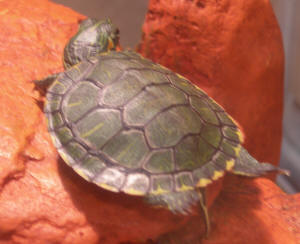
| Thor the Thunder Turtle
11/06/07 Hello Crew, <Hiya, Howdy & Hello there!> My
Red Eared Slider has a healthy appetite, plenty of energy, and
seems to be growing. He also has white patches on his shell that
don't wipe off. If I pick at the spot, a small transparent part
raises, like a small flake- which I haven't peeled off. I
don't know if that is part of the natural growth of his shell,
or if it's something I should take off. The whiteness is on the
edge of one side of his shell and continues on the grooves on the
pattern of his shell. Because he doesn't have any other
symptoms- his poop seems normal, his eyes are clear and open, he
has energy- I'm inclined to think the discoloration is from
natural shell growth and/or chemicals/minerals in the water. <Ah
... normal poop. A satisfying thing that's hard to explain to
people not into reptiles... but a good sign> I use tap water
mixed with Zoo Med's "Instant Terrarium Water
Conditioner," adding some water daily and cleaning out the
tank every week. <Sounds like really good hygiene and care.
You're being a good turtle mom!> Should I be worried?
<Not until you're alone in the house and the scary music
starts in the background!> And should I be doing something
differently? <My guess is that you're on the money -- water
spots/mineral deposits underneath the shedding scutes as they grow.
You don't mention anything about her skin and with bacteria or
fungus you'll see tiny, loose patches hanging from the limbs as
well. Here's the test: Swab the area with household vinegar
every day for a week, allowing a good 15 minutes drying time after
swabbing. Then a tiny swabbing of iodine (Betadine/Povodine) and
another few minutes to dry. If it's any early form of fungus or
bacteria, you'll knock it out in a week. But my guess is that
it's water spots on normal growth)> Thank you so much for
your time. <Our time is your time!> I attached 2 pics to
help- the problem is on the left side. <Darrel> |
|
|
Semi-question... RES shell
hardness, fdg. 10/3/07
<Two different emails & not a
question to be found> Hey, <Hiya, Chris> Sorry to bother you.
I was just wondering is it normal for an Red Eared Slider' back
shell near the tail) however the rest of the shell is hard. He has an
appetite and seems to be very active. Thanks for your help.
<Answering the question is never a bother, Chris ... FINDING the
question sometimes is .... in this case, I think you missed part of a
sentence> * <If you're asking about the shell being SOFT ...
then .. no. The shell is usually uniformly firm. Perhaps a tiny, TINY
bit weaker in that area, but if it's so much weaker that you can
really feel it, up the UV lighting and check the diet> * <Email
#2> I wanted to know if it was also okay to feed koi pellets to a
baby red eared slider all the time until they are a juvenile
<It's not only OKAY ... it's great! It's a perfectly
balanced, heavily vegetarian diet for their entire lives. You just may
have to buy smaller pellets for the babies, although I usually
don't -- they seem to go at the big pellets and take them in
chunks.> <regards,
Darrel>
http://www.wetwebmedia.com/FWSubWebIndex/RESCareBarton.htm
| Eastern Box with fungus?
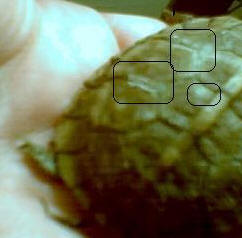
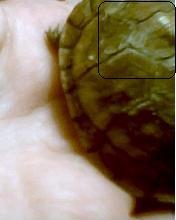
8/13/07 Hi, I've read a lot about shell fungus, but cannot
find any pictures of early stage fungus. My eastern box baby, Yurtle, has some white between his scutes. This just developed in
the past 2 weeks. The white is dry and powdery, but doesn't rub
off when I gently rub his shell with my fingers. It looks nothing
like the fungus pictures I've seen where whole scutes are
coming off, but I can't find any normal eastern box
peeling/shell shedding pictures to compare him with, either.
<The little bit of white at the seams can be so many things -- a
fungus, the beginning of a fungus, possibly bacterial but, believe
it or not, I've seen this under the scute edge turn out to be
nothing but a water spot. Terrapenes are not overly susceptible to
fungus by the way -- it's unusual to find anything but a very
superficial case.> I was going to get him some sulfa solution at
the pet store and dip him as a preventative, but I read online that
it is dangerous to dip a young turtle. I've also found
conflicting information online, one site said that land turtles
rarely if ever noticeably peel, but another said young box turtles
noticeably peel. I believe he (or possibly she) is 12-18 months
old. <And I'm not a fan of over-the-counter pet store
dip/remedies, either. In most cases it requires HUGE amounts of the
remedy to even approach a therapeutic dose, so let's start
simple: Try swabbing it with Vinegar, allowing the vinegar to soak
in for about 60 seconds and then rinse & dry it. If it's a
topical fungus you'll see a change for the better in about
three days. Search this site (Google box below - click
www.wetwebmedia.com) and search "Darrel" and
"fungus" and you'll find plenty of good advice.
Apparently I talk about fungus a lot. Could explain my social life.
Hydrogen Peroxide and Betadine are all simple & cheap
treatments you can try for a few days each to knock back most
potential problems.> He lives indoors in a 20 long terrarium
filled with moss substrate and a small rock drinking and swimming
container, plus a UV light and basking light that are on 12 hours a
day. He is kept 67-70 degrees F at night and 85-90 degrees during
the day. <Sounds like great care, Christina> Does he have a
fungus, is he peeling, or is something else going on? Does he need
to go to a vet? I've attached pictures, I apologize for the
poor quality, my camera is not the best. <Fungus & bacteria
is a hard thing to "see" in a picture, even a hi-res one,
so I wouldn't worry. Try the home remedies for a few days and
let's see what happens meanwhile, if it is a peel, that will
make itself apparent to us in that same time. Failing these having
an effect then I would say that a quick trip to a qualified Herp
Vet would ease your concerns.> <Darrel> |
|
|
Turtle
infection sounds serious 08/02/07
Hello again, <hello, Pat> I
am writing to you again about my 5-year old female painted turtle with
the shell infection. The infection is on her plastron. It is yellow and
red. When I touch it, it feels very soft. <Not a good sign> Right
now she is in a dry utility tub and is put in water with ZooMed Turtle
Sulfa Dip every day for 2 hours. She is being fed red peppers,
nightcrawlers, cherries, and a calcium supplement. She is active and
has a healthy appetite. What should I change! Her condition is getting
worse! <Keeping her dry is a good first step. The next thing to do
is to clean the infected area with hydrogen peroxide and investigate
it. This is hard to explain in this format, but we need to get an idea
of how deep the damage runs and if we can wipe, rub or even scrape off
as much of it as possible without damaging the deeper tissue. What I
have done is use an Exacto Knife that has been dipped in Betadine
(iodine/povidone -- any type or brand) to scrape and even cut away as
much of the infected or damage tissue as possible and then trying to
clean out the remaining wound. After that, coat the area in more
Betadine. If there's a little blood oozing out, you can pack it off
with gauze or even paper towels. Every day, clean the area with
Peroxide and then coat with Betadine. She'll need to stay dry
during this time, which means it's unlikely she'll eat, but if
she's otherwise healthy this won't be a problem.> <In
reality, Pat, if the infection is deeper than the surface, it may be
past time for home treatment and a trip to an experienced Herp Vet is
in order and possible a course of treatment with Baytril.> <Best
wishes>
<Darrel>
|
Turtle Shell Question 07/24/07
Dear Crew, <Hiya -- Darrel here> I have had my baby red
eared slider for over a year (Fred, given to me by a friend), and
he seems to be quite happy and well-adjusted. <Red Eared
Sliders are generally happy, easy turtles.> I keep him in a
well-lit 10 gallon tank, with water temperatures usually at 78-80
degrees. Once a day, I feed Fred ZooMed hatchling pellets or
Tetrafauna mini sticks. At every tank cleaning and water change,
I make sure to use the appropriate amount of water purifier and
add a D3 supplement. In addition to this tank, I have recently
set up another 10 gal placed directly in front of a window to
provide him with actual sunlight. According to the research I
have done, my setup should be enough to keep him healthy and
happy. If there are any changes you think I need to make, I would
love to hear them. <Just a very few things: His water temp is
a little high (70-75 would be better) and then he can get heat
from hauling out of the water and basking. Your feeding is good,
water purifier, if you mean like dechlorinator, isn't
necessary so you can save your money on that.> <The One
thing I'd really mention is that glass filters out a good
deal of the beneficial UV rays from the sun, so make sure the
sunlight he gets is DIRECT somehow. Check the care link below and
read about light sources> When I first got him he had a red
spot on the outer edge of his shell (I assume due to poor
previous treatment), but within two months it had gone and left a
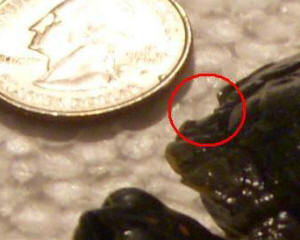
missing chunk. He doesn't seem to notice it, and I don't
believe its gotten larger, so I wasn't sure about how worried
I should be. <You shouldn't be worried at all! As long as
it's an old condition (and many of them lose small pieces of
shell) it's just no problem at all. -- But with that said ...
and looking at the pics you sent .... I'd have named him
....... NICK! Bwahahahahahahahahahahaha! Get it? Nick? As in
"a nick in the shell?" heh heh heh> I'm only 17,
and my mom doesn't think it would be worth looking into
further, so this is my only real option. Mostly I would just like
to know what caused this problem and whether or not it could hurt
him in the future. Thank you in advance for your help, and I
apologize if there was already information on your site that I
somehow overlooked. <No apologies necessary, Laura. I gave me
the first opportunity this week to make a bad joke (I'm still
chuckling over it) seriously, the nick in the shell is no biggie
-- he looks fine and you're taking good care of him, so I say
just keep up the good work. You've already covered the basics
very well, but here's a recap for you:
http://www.wetwebmedia.com/FWSubWebIndex/RESCareBarton.htm >
Laura
|
|
|
|
Texas Map Turtles and stress
07/24/07 Hi, <Hi right back> It's again with
another question about my two little turtles. I was going to
treat the little spots with vinegar first, since I have that
readily available. Well, I put them in two separate containers
that are deep enough for them not to climb out, but still gives
them enough room to at least move around. I put a piece of paper
towel in the bottom as the container is some type of plastic and
I thought that might make them more comfortable. <very
thoughtful of you> Well, they hated it. They panicked and
started running (yes, aquatic turtles know how to haul it when
they need to; Whoever said turtles were slow never met these
two:) <No question! All it takes is to look away for a second
and they can be down the hall, out the door and into the next
block.> Anyways, they even flipped themselves over a couple of
times and just seemed too stressed for me to keep them in that
situation. I did get a chance to brush some vinegar on them and
let it soak in just for a few minutes before I put them back. Is
there something else that I should put them in so that they
can't flip themselves over? Is there something I can do to
make them less stressed? I normally feed them in a similar
container that is a lot smaller, should I put them in that?
<You can certainly try that, but in the end it doesn't
make that much difference. They may seem stressed, and I'm
sure they are in their own little turtle ways ... but it's
not the kind of stress that will harm them. It's just
different. My advice is to keep doing what you're doing, try
a different container or different technique, but don't let
it stress YOU out! THEY ..... lead very cushy and cared-for
little lives and if the worst that happens to them is they flip
themselves over .... well .... let's just say that it's
better for them than to have been eaten by a bass. So do what you
do and don't let them get to ya!> <Darrel>
|
|
|
Baby
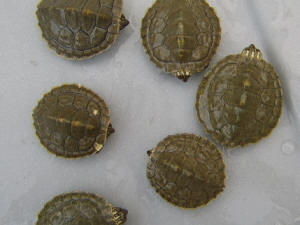
turtle identification & care 07/24/07 Hello, <Hi there --
Darrel here> Well my aunt got me a turtle while going fishing.
<I'll take that to mean she brought BACK a turtle from her
fishing trip> It's very small. I think it's a baby or
that's just how there species look, but to the point it just
started eating its food today and it's been having this clear
floating stuff on it, and it wont come off. <Sounds like it might be
a fungus, but 'clear floating stuff' is a little vague. Is it
soft, like dead skin or hard, like a film on the shell? Please write
back with a more detailed description> And what type of items am I
suppose to put in there with it? I just don't know what to do.
<Try this link to get an idea of basic care:
http://www.wetwebmedia.com/FWSubWebIndex/RESCareBarton.htm and try this
link to see if you can identify what it looks like:
http://www.xupstart.com/wwm/ Hope this helps>
|
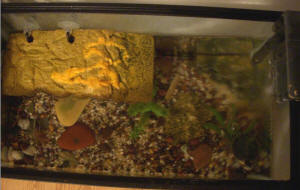
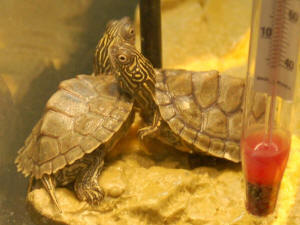
Texas Map Turtle Questions 7/19/07 Hi,
<Hiya right back> First, I just want to thank you all for
your site. I wish I had found it before I got these two, but now
that I know you are our there, I will definitely come back
whenever questions arise. <Thank you -- we're freeway
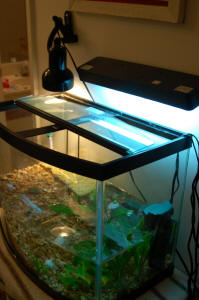
close & open 24 hours!> I am having a few problems. I got
two male Texas Map turtles from a breeder. I had done a lot of
research into their needs prior to getting them, and you can see
their current habitat in one of the pictures. I chose this type
as they are the smallest of the map turtles (males only reach
between 2-4 inches) and are known for their shy disposition.
Well, the breeder had sent me pictures of the remaining males he
had left, and I picked out the two I liked. I was hesitant at
first because the one that seemed very active and walking all
around had a spot on his shell, but the breeder reassured me that
he was just shedding. And sure enough, I discovered that young
turtles shed fairly frequently. So I chose that one and the other
one that was of about equal size. They were slightly larger than
a quarter, and have grown a little in the month since I have
gotten them. They were 3-3 1/2 months when I got them, so now
they are 4-4 1/2 months. <Those are a couple of nice looking
turtles! Did the breeder tell you how he was differentiating the
sex of hatchlings?> I set their habitat up in a 28 gallon
elliptical aquarium. It has a basking spot on a turtle dock that
gets up to 84 degrees. There is a Reptofilter that I change
frequently and an underwater heater that maintains the water
between 75-78 degrees. The gravel is also sloped so that they can
get partially out. I also put many aquatic plants in there, which
I know may be devoured, but so far they rarely eat them and
prefer to just hang out on them. I also have a light that
provides UVB 7% stationed above the portion of their aquarium
that is not covered by glass as I know those rays won't
penetrate through them. Their basking spot is on a timer because
I am afraid the lamp itself will get too hot; they're used to
it and I keep it on for at least a 1/2 hour after they've
eaten if it's on off at that time. The UVB light stays on for
about 12 hours a day. <That's admirable attention to their
needs and nothing cries out for change here. The only things
I'd consider are this: Map turtles generally don't walk
around on land the way Sliders, Cooters and others sometimes do
-- they're far more likely to just bask on logs or rocks than
to climb out on a bank, so the next time you rearrange things for
whatever reason, creating a log-like structure that arcs out of
and back into the water might be a bit more natural for them.
Second, I'd lower the water temp about 5 degrees.> I feed
them a large variety. I hand feed them around 3-4 Reptomin baby
pellets mixed with calcium powder at least once a day. I normally
feed them twice a day, which I will reduce once they get bigger
and then feed them every other day. They also get live ghost
shrimp, Tucker eats live snails (Peek-a-boo won't touch
them), sometime feeder guppies, crickets dusted with calcium
powder. I have tried many different types of fruits/vegetables
but they don't eat them. I have read that as they grow older
they will want more plant matter, but right now they occasionally
munch on the plants, but very rarely. <They may or may not
change -- turtles have a funny way of deciding on their own what
they will and won't do as they grow up. I'd reduce the
feedings sooner, though. Remember these little guys have a very
easy life -- YOU do all the work, so over feeding, growing too
fast and being obese is a major health consideration.> Now to
the problems they are having. They love me and always come up to
the glass when I walk by and we play the "chase my finger
around in the water and then get held" game. However, they
seemed to fight and nip at each other when I am around, like
trying to get attention. Now I normally stick both hands in, one
for each turtle. However, I noticed today and yesterday that they
seem to fight even when I am not where they can see me. They
chase each other and bite at each others shells and head. I am
just concerned that one of them is going to get hurt. I don't
have room to separate them by getting a whole other set-up and
although I was planning on getting them a larger tank once they
were larger, I would prefer to wait on that as well. Is there
something that I can do to alleviate this situation? They never
seem to have marks or be hurt from this. I just want to make sure
that doesn't happen. <I've never known what goes on in
their little turtle brains while swimming around thinking their
turtle thoughts. It's unlikely territorial, since they're
often found in groups in the wild (not gangs -- just many turtles
inhabiting the same area). To my knowledge there haven't been
studies on social structures of water turtles, but I've
always guessed that it's some sort of instinctive behavior --
they seem to do it in phases and they survive. I wouldn't
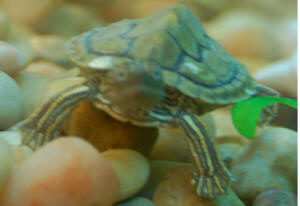
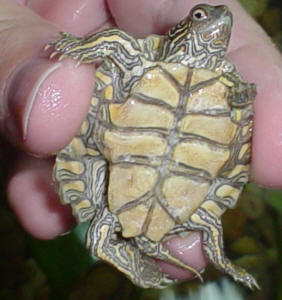
worry about it unless you see some damage.> Second problem, as
you can see from the pictures, they have white spots on their
shells. I was told this was shedding, but the scutes don't
seem to be falling off. These spots are not soft, so I don't
think it is fungus. I did put in a sulfa block just to make sure
they don't get an infection. I just wanted reassurance that
this is normal looking because I really feel that these spots
should have gone away by now (I got them about a month ago.)
<My guess would be fungus -- keep in mind that the shells are
porous under a microscope and the fungus gets down in those
pores, so it looks and feels solid to our eyes. I personally have
no faith in the sulfa - water treatments. The concentration would
have to be very, very high to be effective. Here's a link to
a previously described treatment for suspected bacteria or
fungus.
http://www.wetwebmedia.com/FWSubWebIndex/turtshelrotfaq2.htm>
Also, the dark area in between the scutes is increasing. Is that
because they are growing? Around the edge of their shells, it is
lighter in color. Is that normal? There shell is hard, yet on the
edges can bend slightly, is that because it is just thin from
being so young? <Yes and Yes. Everything here is just
fine.> I heard it would be a good idea to let them be outside
(supervised of course) for a couple hours a day. Is that true and
what would I put them in? Would they need like a bowl with water
and a rock to get out on? <Sunlight is an amazing benefit.
Your care and attention so far is exemplary, but read this
article and read the comments about sunlight, filtering and water
temp.
http://www.wetwebmedia.com/FWSubWebIndex/RESCareBarton.htm> I
know I am asking a lot of questions, but I would rather ask and
find out what needs to be done to help them, than end up with
even bigger problems down the road. If there is anything else you
recommend for me setup, please let me know. I want these two to
have the best possible life I can give them. <Right you are.
Reptiles, like fish, are very stoic. A sick animal often shows no
outward signs at all until they very suddenly appear SO sick that
saving them is practically impossible. Fish and reptiles are all
about that proverbial "ounce of prevention" being worth
a "pound of cure." So keep asking and keep up the good
work!> Thanks again in advance. Sincerely, Sara <Happy to
be of service - Darrel>
Re: Texas Map Turtle Questions
07/19/07 Hi, <Hiya Sara. Thanks for the quick reply, I
will try to do something for the white spots. However, I see many
different responses on the link you provided. One recommended
vinegar, another a type of athlete's foot cream, an another
iodine. Which do you suggest I start with? <They're all
valid -- I often start with vinegar because I can bet that most
people have that, whereas a trip to the store is a bit harder.
Sometimes we're responding to kids who likely don't have
the resources to run to a store or make a trip to the vet, etc.
so that's why you'll see a wide variety of options. Me?
I'd run to the drug store for miconazole or such> Also,
this part of my question, was not replied to, possibly because it
is just the same as the white spots on the carapace. If it is,
please forgive me for resending it. <quite right. From here,
using pics, white spots look like white spots, so I deleted that
paragraph as redundant to our general readership -- I shoulda
notated as such, sorry.> <Darrel>
|
|
|
|
|
|
|

