|
|
FAQs about Acroporid Coral Disease/Health, Parasites, Pests 7
Related Articles:
Coral Pests and Disease; pests, predators, diseases and conditions
by Sara Mavinkurve, Acroporids,
SPS Corals, Related FAQs:
Acroporid Disease 1, Acroporid Disease
2, Acroporid Disease 3,
Acroporid Disease 4, Acroporid
Health 5, Acroporid Health 6,
Red/Black "Bugs" Acropora Munching Copepods,
Montipora Munching Nudibranchs, &
Acroporids 1, Acroporids 2,
Acroporid Identification, Acroporid
Behavior, Acroporid Selection,
Acroporid Compatibility, Acroporid
Feeding, Acroporid Systems,
Acroporid Reproduction, Stony/True Coral,
Coral System Set-Up, Coral System
Lighting, Stony Coral Identification,
Stony Coral Selection, Coral Placement,
Foods/Feeding/Nutrition,
Disease/Health, Propagation,
Growing Reef Corals, Stony
Coral Behavior, | 
|
Live Rock - Montipora Digitata 9/16/09
Hi crew,
<Henk>
I am just starting up my first marine system, and the live rock has been
placed in the system about two weeks. Since the tank is cycling with
normal lighting cycle I am experiencing quite some algae growth. Mainly
some fine Green Hair Algae but also some Bryopsis. The live rock was
collected from the coast in south China and shipped by air directly to
me (in Beijing). I washed the live rock before placing it in the tank,
but did not brush aggressively, merely shake and blow of detritus with a
powerhead. Two large
pieces of live rock are apparently dead pieces of Montipora Digitata,
with three or four tips of about 0.5 to 1 inch of live coral, colored
blue-brown and with polyp extension. My question is: do I need to do
anything if I would like to keep this coral alive, or will the fact that
it is connected to the dead coral (partly overgrown with algae
currently) not affect its chances or survival?
<Possibly either way...>
The tank is still cycling. This is a system of 150 gallon with two metal
halides of 250W as lighting. During the cycling, I am doing water
changes weekly of about 10%. The skimmer is a Bubble Magus 200E2 (local
Chinese brand, rated for systems up to 390 gallon) with Eheim Pump 1264
and circulation is provided with an Atman return pump of 5000L/H and 2
Tunze 6105 pumps on a multicontroller. I have not tested the water yet
since I suppose the tank is still cycling, but will do so soon.
<I would... Likely you could use some chemical filtration, and possibly
larger water change outs, some supplementation for biominerals and
alkalinity for sure>
Any advise would be appreciated. I have been reading for a long time on
your site before setting up this tank, and have found it to be of great
help, and my first and major reference for any question regarding marine
or freshwater systems.
Regards,
Henk Naert
<Do search on WWM for the terms mentioned for more background,
direction.
Bob Fenner>
|
Reef Tank: Need an ID weird tube structure
8/29/2009
Hey guys I keep getting this tube like formation around my Montiporas.
It has a consistency of super glue, mixed with sand. I tear it apart in
hopes of catching something inside but to no avail. Any chance you guys
know what it is and how to catch it?
<I suspect this is a type of tumour caused by pathogenic bacteria...>
It's annoying, it eats/erodes the side of the Montipora it attaches to
build its tube structure.
Also the structure is built on the live rock. I attached some photos to
see if you can ID it.
Thanks,
Mark
<Please read here:
http://www.coremoc.go.jp/english/pub/coralreefjapan/0203_coral_diseases.pdf
Bob Fenner>
|
 |
|
Struggling with SPS
7/21/2009
I am a long time SPS keeper and have a great deal of success over the
years
- until now. I setup a 1000L tank approximately 9 months ago (from the
stock
in my 4x2x2) and have seen a progressive slide in the health of my
corals over recent months. I have provided my tank details at the bottom
of the message and also attached a photo showing one of my corals. It is
hard to describe but the corals are showing signs of mucus production,
minor recession of the tissue, a mould/fungus like covering. This
appears to be affecting older parts of the colonies more than new
growth. None of my LPS are showing any signs of stress in fact a recent
bit of damage to an elegance healed up nicely in two weeks without an
issue.
<Perhaps a clue>
I am at a loss. I thought I had a fairly well setup tank but I am now
considering pulling it down as I cant get on top of the issue. Thank you
for any help you can provide.
http://i88.photobucket.com/albums/k179/kirsto71/New%20Tank/P5100027.jpg
System Type: Mixed Reef
Display System:
Strike up Date: Oct 2008
Display Tank: 6 x 3 x 26inch. Cross braced and euro braced
Display Lighting: 3 x 250w MH. IceCap Electronic ballasts and Lumen
Bright reflectors 20k bulbs
Stand: 50x50 Galv Steel
Hood: 50x50 RHS
Sump: 110x60x45 cm Sump
Refugium: Compartmentalized in sump
Refugium Lighting: 2 x Double HO-T5's 10k bulbs
Support systems:
System Water: NSW
<Another set of possibilities>
Display Water circulation: 2 x Iwaki MD70's driving eductors in closed
loop format, 1 x 15000 LPH closed loop pump through base of tank, Tunze
wavebox, 2 x 6000 LPH Koralia copies plus waiting to order a Vortech
Return Pump: Laguna 11000 LPH
Skimmer: Turbo 1200mm Tall Recirculating Beckett Skimmer driven by a
7200
LPH pump
Evaporation Top Up: Iwaki dosing pump controlled by Aquatronica
System Control: Aquatronica. Controls:
Auto water change (15 L per day)
Metal halides
HO-T5 lighting
Calcium reactor
Top Off
Water leak sensor
Chiller
Monitors - Redox and pH
Chemical Support:
Calcium Addition: Turbo Single Stage Calcium Reactor
Alkalinity Addition: Turbo Single Stage Calcium Reactor
Other Chemical Maintenance: Minor additions for calcium and Alk where
there is an imbalance
Current Water Chemistry: Stable, very little variation
pH: 8:00 - 8.3
Alk: 8.5 - 9 dKH
Nitrates/Nitrites: 0
Calcium: 425 - 440ppm
Magnesium: 1200 - 1300ppm
Phosphates: <0.03
Temp: 26 degrees C
<Nothing "jumps out" on your list of gear, measures... The best guess,
and this has no real level of confidence, is maybe some sort of "cascade
event" from/twixt your Cnidarians... Read here:
http://wetwebmedia.com/cnidcompppt.htm
and the linked files above. Bob Fenner>
|
 |
Bleaching Acropora Troubles – 06/10/09
Hello Crew,
<<Greetings Dave>>
I am in need of some trouble shooting assistance.
<<Okay>>
Over the past several weeks I have had several of my Acropora corals
bleaching at the base of the coral.
<<Mmm…>>
On most, the tops of the corals still appear to be showing new growth.
<<Several possibilities... An Acro predator maybe…aggressive stinging
corals (sweeper tentacles) positioned too closely…or maybe lighting,
etc.>>
I have lost a small blue Acropora and another small frag of Montipora
appears to be almost completely bleached. I have had most of these
Acropora for about a year.
<<Hmm… Perhaps you have inadvertently introduced a problem organism. Or
maybe this is the culmination of a building problem (e.g. –
allelopathy)>>
I propagated the colony of Acropora that had the most damage a few weeks
ago and they seemed fine for about two weeks. Then the tissue at the
base started to recede again.
<<Not uncommon in my experience… It can be difficult to save such
colonies that have begun to decline>>
The bleaching appears to be spreading to other SPS corals now such as my
green and pink birds nest. Please advise, I don't want to lose all of my
SPS!
<<Mmm… If not a predator (e.g. – fish, Nudibranch, crustacean) then
perhaps this is a bacterial/microbial complaint. A prophylactic dip and
movement to a quarantine tank may be in order>>
I have looked for some type of predator and have not seen any red bugs,
flat worms, etc. There is also no brown slime from any of the effected
corals.
<<A predator can be difficult to espy…especially if nocturnal>>
I am puzzled because I have not changed my weekly husbandry of the tank
and the colony that has the worst bleaching, has actually grown onto the
glass.
<<But have you tested your water param.s to exclude a buildup of
nitrogenous compounds as the culprit?>>
I have several large LPS corals including a seven inch maze brain that
have been in my tank for over 7 years with no problems.
<<Unfortunately with this hobby, sooner or later something begins to
tip/upset the “balance.” Obviously “something” is different/has changes
in your system>>
I also have two healthy clams, Whisker, Trumpet, Frog Spawn, Acan,
Bubble, Favia, Scolymia, and Dendrophyllia corals that are doing great
<<Bacterial infestations among corals can often be Family/Genus/Species
specific…as are many coral predators>>
I hand feed most of the LPS corals and have been using Oyster Eggs the
last few days to see if it helps with the SPS bleaching. My 125 gallon
reef has been established for nine years now.
<<Ah, excellent…and congrats!>>
I have 6 six-foot VHO bulbs, three Actinic (454 bulbs) and three
AquaSun.
<<This likely isn’t the issue…and a change isn’t going to save your
corals at this point…but I think your “shallower” species of coral would
benefit from change to a 2 – 4 ratio respectively here, to increase the
amount of “usable” light>>
The actinic lights come on an hour before and after the main lights.
Temp is between 78
- 80 degrees. Water flow is handled by two main pumps 1800 and 1200 GPH.
They are controlled via two SCWDs and four returns. I also have two
other powerheads for dead spots, 800 GPH and 300 GPH. I don't think
water flow is an issue here.
<<Does not seem so, no>>
I have a 45 gallon ADHI refugium with some Chaeto and Halimeda algae and
a Red Mangrove plant. 30 gallon water changes are done weekly. I am
using an Aqua FX RO/DI system for RO water.
<<Have you tested the output lately? Perhaps a pre-filter/membrane/DI
resin change is in order>>
I always premix and pre heat the saltwater days in advance.
<<Very good>>
Salinity level is at 1.025; pH 7.8;
<<Not “bad”…but I would increase this above 8.0 for some added “wiggle
room.” Any drop from this point would be dangerous…and could be
happening at night when the lights are off, even with the refugium>>
Nitrates and Nitrites are at 0.
<<Ammonia? And…have you validated/used fresh test kits?>>
Alkalinity is a little on the low side. I have been using baking soda to
bring it up by adding to a high flow area in the sump.
<<Okay>>
I am also using activated carbon via a Magnum filter and use a Berlin XL
skimmer.
<<I would suggest the addition (at least for a while) of some
Poly-Filter to the Magnum>>
I also have automatic fresh water top off for evaporation.
<<Do check that RO/DI filter>>
The only change I can think of is that I replaced my bulbs about three
months ago. I changed the actinic lighting from super actinic to the 454
actinic which has a more blue spectrum rather than purple.
<<I don’t think this is an issue… The Actinic lighting is more for
you/you sense of aesthetics anyway. Any good full-spectrum or Daylight
or 10,000K bulb will provide plenty of short-wave lighting for the
corals needs. Utilizing Actinic lighting is not a problem…just be sure
to provide enough full-spectrum light. Hence my suggestion to increase
the number of AquaSun bulbs vs. Actinic bulbs here>>
Should I try to cut back on the lighting?
<<if you are thinking photo-shock could be the problem…I think it is a
moot point after three months. Keep providing 12-14 hours of light per
day>>
Other than that, I have been doing my weekly maintenance as always.
<<If an imbalance of the system is not the issue, then you have likely
“introduced” a pathogen or predator>>
Water change, clean pre filters, change carbon and trim up the Chaeto
algae in the refugium when needed. Please let me know if there is
something I am missing or should try. Your time is always appreciated.
<<You sound like you have a handle on the maintenance, and are very
familiar with your system (should be after nine years, eh). I’m afraid,
I don’t have a silver-bullet for you here. These issues do just turn up
sometimes. A small change/imbalance may have tipped the scale in a
pathogens’ favor…and they are usually swift and severe with often little
to be done other than watch and wait. If the affected corals are small
enough and/or not encrusted on large rocks you might be able to save
some with a proprietary coral dip (Tropic Marin has a pretty good one)
or maybe just an iodine dip...along with a move to a clean quarantine
system>>
Thanks,
Dave
<<Happy to share… EricR>
Re: Bleaching Acropora Troubles (More than Acro woes now) –
07/27/09
Hello Again Crew,
<<Hi Dave…Eric here again>>
It appears that the dying coral issue is a pathogen.
<<And how have you determined this?>>
The issue has now affected just about every coral in my tank.
<<Mmm>>
Just about all of my Zoanthids are closed up and shrinking off the live
rock, including some species that were spreading across the rock at a
very fast rate. My Lobophyllia has receded along with my Scolymia. The
two types of branching Hammer coral are also closed up. Every coral in
the tank looks as if it has lost significant color and the tissue is
flat instead of raised and meaty. Before the corals die, they all seem
to start off with a thin brown diatom looking film on a small part of
the coral and then spreads till it eventually kills the corals. The fish
seem to be unaffected and healthy. I have tried surfing the web for info
on tank wipeout, but they all seem to reference the fish all dying and
not the corals.
<<I suppose it possible that a very high concentration of some type of
bacterium could be the problem. Though I’m not sure I’m convinced that
this is a pathogen…affecting ALL your different coral species but not
your fishes. The “film” you mention may also simply be an opportunistic
organism/alga that is feeding/replacing necrotic tissue caused by some
Allelopathic/water quality issue(s)>>
In my 12 years of reef keeping, I have never seen anything like this.
<<Indeed… Most diseases complaints are specific to a genus/species…in my
experience>>
I have corals in the tank that I have had for over 7 years. I'm at a
loss here.
<<Perhaps that maturity/growth among a mix of noxious species is what is
at play here>>
I have checked every water parameter that I can think of; ammonia,
nitrate, nitrite, pH, ALK, phosphate, TDS...none of which are out of
range.
<<There are many aspects of water quality we don’t, as hobbyists, have
the ability to test>>
The tank, make up, and fresh water top off are all well within range. I
have been doing 40 gallon water changes weekly and have even done a 70
gallon change last week, none of which help the matter.
<<I wonder if something has changed with your source water that you are
not aware of. A couple decades ago I lived in the UK for a few years. I
experienced a couple of whole-tank wipeouts with my budding reef system.
Come to find out the local council was treating the tap water every few
months with a compound (supposedly non-toxic to humans) to kill
freshwater shrimp living/breeding in the water lines (yeah…taught me to
filter my source water). I’m not saying someone is poisoning your
water…just pointed out that you don’t/can’t always know what is or is
not in it>>
I have replaced all the RO filters except the membrane.
<<I think this too may be warranted/worth a try here. If this is a
bacterium issue, it could well be growing on/introduced via the
membrane>>
The digital TDS meter on the RO system showed zero before and after I
swapped the filters.
<<Remember, such readings are only a general guide>>
I have been cleaning the skimmer daily and swapping out the carbon
weekly with no help either. I have not strayed from my weekly regimen
that I have been doing for 9 years now. Is there anything I can do here?
<<Short of removing, dipping, and placing the corals in a new/fresh
environment…likely very little. You could consider Iodine dosing
(Lugol’s Solution) as an attempt to hinder the pathogen, though used in
this manner it may have little to no effect t be honest…and has its own
dangers if mis-applied/abused>>
At this point I can't afford to lose all my corals.
<<I do sympathize>>
The quarantine tank is only ten gallons and will not hold a third of my
corals. If I need to setup a new tank to save them, I will... please
advise.
<<Perhaps you need to weigh the cost of the corals (replacement) versus
the cost of a large enough quarantine system. Do also be aware… If this
is indeed an incidental introduction of a virulent pathogen, just
removing (temporarily) and treating the livestock may not be enough…you
may be faced with breaking down the display, discarding sand and rock,
and cleaning/sterilizing tank and equipment. Drastic measures for sure…
And I will ask Bob if he sees this to add his take here>>
If the issue is a pathogen, where does the pathogen reside?...in the
water, on the rock, on the coral itself, in the sand?
<<Maybe all the above>>
I don't believe that it resides in the water judging by the water
changes I have been doing.
<<What leads you to this conclusion I wonder… You are not changing out
“all” the water at once (and even if you did, bacteria would still be
present), and if the source of the contamination (again, if indeed this
is the issue) is your source water or storage vessel…well then…>>
I also have an outbreak of Asterina star fish that has gotten out of
control.
<<Hmm…perhaps a clue here>>
If I have to break the tank down, I would like to get rid of these hitch
hikers at that time. Their numbers are far too great for manual
extraction. I have been pulling them out with tweezers for months. I
have found that could tap water seems to kill them within a few minutes.
<<As it would most any marine invertebrate>>
If I had to break down the reef, my plan of action would be to relocate
the original tank to another room first. Then set up the new tank in its
place. I would then give all live rock a cold fresh water dip to
hopefully rid the rock of the star fish and any pathogens.
<<If a pathogen is involved…this may not be enough to kill it. It’s up
to you to decide how much of a gamble you’re willing to take, but in
such an instance I would be incline to “replace” the rock/substrate with
new>>
I also realize that I would lose most, if not all beneficial bacteria as
well, but I cannot afford a repeat of the same problem.
<<Then reference my previous statement>>
I would let the rock cycle in the old tank
<<To be reinfected?>>
and put the corals in the new tank after an iodine dip with just a glass
bottom for the time being. My question to you is, can I use all new
makeup water and none of the original tank water?
<<Not without maturing/seeding heavily from another “healthy” system>>
I don't want to use the old water for fear of contamination.
<<Agreed>>
I wanted to add my existing 45 gallon refugium to the new tank...will
there be enough biological matter from the refugium to avoid the new
tank cycling?
<<If a pathogen is present then this too is contaminated. Everything
must be either thoroughly cleaned, treated and quarantined (as in the
coral dips), or discarded…no exceptions>>
The current tank is a 125 and I was looking at a 210 gallon.
<<A nice upgrade…and the 125 would make an excellent sump or refugium
re…once all cleaned up>>
Please let me know what the best plan of action would be to setup a new
tank and if you think I should salvage the old tank, or setup a new one.
<<The old system “is” salvageable as discussed re cleaning (with bleach)
and replacement of rock and substrate, macroalgae, etc. (based on the
assumption of a pathogenic complaint)… A “new” system may seem like the
best way to go, but it will still need to be cycled…something that can
be done while the livestock is in quarantine for observation of the
problem’s continuance>>
Thanks,
Dave
<<Happy to share… Good luck, and please do keep me posted of the
outcome. EricR>>
R2: Bleaching Acropora Troubles (More than Acro woes now) –
07/28/09
Hi Eric,
<<Hiya Dave>>
Just a few more questions.
<<Sure>>
I most likely will upgrade to a newer tank if going to all the trouble
of breaking it down and cleaning it.
<<I see>>
The word "bleach", when associated with a reef tank scares me =)
<<A normal reaction… Just be sure to use "pure” bleach…as in without
added scents or other modifiers. Rinse everything with copious amounts
of clean water. And where possible, soak bleached gear in a container of
water and add a dechlorinator like Sodium thiosulfate, then rinse again
afterwards>>
You mentioned to discard the sand and rock...can the rock be
bleached/disinfected and reused?
<<As a last ditch effort, perhaps…but better to just let it dry
“completely” if you are determined to reuse it>>
...or even left out in the sun?
<<Better>>
I have about 200 pounds of live rock and some really nice pieces that I
would like to keep if possible.
<<Final decision is up to you>>
Also, will the snails and crabs I have in there be an issue?
<<A good question… I suppose they could be carriers/transporters of
bacteria just like anything else>>
...should I iodine dip them and quarantine as well?
<<A short dip in a mild Iodine solution may work…be sure to use clean
saltwater rather than freshwater here…else they likely won’t survive the
dip for sure>>
Lastly, if I place the existing corals in a quarantine tank with all new
makeup water, will this have an ill effect on the corals?
<<As in fresh from the make-up barrel? Indeed it can… Fresh-made
seawater is very aggressive and still chemically active. Give it a day
(good) or two (better) to mature a bit…also, adding some “seed water”
from a “good” established system can give it a bit of a jump-start>>
As far as the water source goes, I have well water and don't think the
parameters would fluctuate like public water.
<<Ah but I beg to differ… Something as seemingly harmless and beneficial
as a heavy rainfall can indeed affect the quality of your well water
depending on the activities/industries around your area. If you’re not
doing so already, I urge you to add deionization as a last stage to the
RO filter you use to filter water for your reef system>>
I had it tested last year for everything they could test for and all was
well.
<<That was then… Do consider the problems you are experiencing with your
reef may stem from your well water if your water treatment
equipment/protocol is not up to snuff>>
The Aqua FX RO system is not even a year old yet, but I will replace the
membrane on the RO system for arguments sake.
<<On most municipally treated water systems a good RO membrane (if
flushed periodically) should indeed last for years. But on a well system
this can be more variable and harder to judge. The TDS meter is a good
“guide” for this, but only measures the amount of solids…not the
composition. There may also be compounds present that don’t register on
the meter. If/when in doubt…replace the membrane>>
I'm just trying to figure out the best way to go about the move. If I
setup the new tank with new live rock and sand in the display as well as
the refugium, this will take a few weeks to cycle.
<<Yes>>
Mean while, I would discard or bleach the rock and place the corals in a
quarantine tank with all new makeup water.
<<Yes>>
When the new tank is finished cycling, I would then put the corals back
in as long as they appear healthy. Does this seem to be a feasible plan
to you?
<<It does>>
Thanks again for all your help!
Dave
<<Happy to assist… Good luck mate, EricR>>
|
Cyanobacteria 5/25/09
Dear Bob, Mr. Calfo,
<Hello, Scott V. with you today.>
I have big problem with Cyanobacteria which has spread out on my
Acropora on peaks, I am trying to blow them with turkey baster everyday,
but it seems it will not want to leave. When I am blowing Acropora's
peaks-end also some part of tissue is damaged and coral is losing
zooxanthellae. I have tried to bath coral in tropic Marin pro cure but
Cyano is retrieving back.
<This will not do it.>
Cyano was caused by my mistake that I have put china MH bulbs instead
good ones. Please help!
<Well, in the end there are other fueling factors behind the BGA besides
the light, see: http://www.wetwebmedia.com/bluegralgae.htm
There are other factors at play. As for your corals, you will need to
figure out what is causing the BGA to be so competitive. Until then keep
blowing off what you can.>
Re: Cyanobacteria 5/26/09
Ok, thank you so much, I will keep trying.
<Welcome, this battle can be won! This is a mild case, you have caught
it early. Scott V.>
|
 |
|
Pistol Shrimp Hitchhiker: Coral
Commensal – Coralliocaris spp. 5/24/09
Hi Guys, Janet here.
<Hi Janet, Lynn here today>
I bought a colony of Acropora last week and have found 2 hitchhikers in it.
<Neat!>
I know that Acropora generally will come with an Acro crab, but these little
guys are shrimps.
<They sure are. They’re small coral commensals, in the genus Coralliocaris
(only around 8-9 species recognized at this time). Unfortunately, I was
unable to find photos of each species for comparison, but I did find one
that looks similar enough to be a definite possibility. This species,
Coralliocaris graminea, varies in color, but has the same thin, longitudinal
lines on the body, as well as orange-ish tipped legs and claws. Please see
the following links for comparison/more info:
http://tolweb.org/onlinecontributors/app?page=ViewImageData&service=external&sp=26879
http://www.vanaqua.org/aquanews/field/images/yaqara.htm
http://www.seadb.univpm.it/en_Green-Acropora-commensal-shrimp-Coralliocaris-graminea_587.htm
Also, if you happen to have Helmut Debelius’ book, Crustacea Guide Of The
World (2nd edition), see page 189. Reportedly, this Acropora commensal
reaches about 1cm in length and is indigenous to the Indo-West Pacific
region.>
They were inside the Acropora colony, and I managed to "spook" them out and
get them into a container for a picture and to make sure they were reef safe
etc. I am attaching a picture of one of the two.
<Super, thanks>
The other one has no claws, but is identical other than that. The 2 of them
must have had a tussle and one ended up with no claws out of the deal?
<Perhaps yes, or it could have been due to rough transit/handling when
collected, shipped, etc.>
I currently have them in a 10g emergency tank. Do these guys eat Acro?
<Not according to what I’ve read. They’re commensals that likely have little
negative impact on the colony.>
It is even a pistol shrimp?
<No. Although these shrimps do use their claws to make clicking/snapping
noises, they’re not actually what we consider pistol shrimps (family
Alpheidae). They belong to another family: Palaemonidae, subfamily
Pontoniidae. This group of shrimps doesn’t have the same formidable snapping
ability of the Alpheids. Also of note is that the claws of Coralliocaris
species are matched in size, whereas those of the Alpheids are markedly
different. For more in-depth info on snapping claws, please see this pdf
file: http://decapoda.nhm.org/pdfs/27238/27238.pdf . It’s probably more than
you ever wanted to know, but it’s interesting!>
The Acro colony has had some die off which occurred after getting it home a
few days later.
<Can happen sometimes>
I have another smaller colony of Acropora, but this piece is fine.
<Excellent>
Because of the die off I started taking a look at the colony to see if I
could determine what may be happening to it. This is when I noticed these
little guys. I actually managed to nab both of them in my 75 gallon tank
without losing them and then moved them to the 10 gallon tank. As you can
see by the picture of the shrimp in my hand, they are very tiny.
<Yep, that’s typical for these guys. The genus as a whole generally ranges
in size from 1-2cm.>
This is a picture of the larger one too. Can you provide any information as
to what they are, and if they are reef safe or not. Do they prey on Acropora
only or any sps coral?
<I haven’t come across anything indicating that they’re parasitic, or
harmful to corals at all, so you should be okay.>
Thanks, Janet
<You’re very welcome. Take care, LynnZ>
|
 |
|
Re: Pistol Shrimp Hitchhiker:
Coral Commensal – Coralliocaris spp. 5/25/09
<Hi Janet>
Well, thanks for the great info on my little shrimps.
<You’re very welcome.>
I have left them in the 10 gallon as I don't think they will keep up
with my 75 gallon crew of fish and crustaceans. I have a maroon clown,
with a rose bubble anemone and she is rather a misery and huge! I love
her though and would not part with her.
<I can sure understand. I used to have a tomato clown with all the charm
of a rabid wolverine but I loved her anyway.>
Also a Yellow Tang, tiny Hippo Tang, 1 Coral Perch and 2 Chromis, 2
blood shrimp, 1 coral banded,
<Watch out for this guy. They’ve been known to kill other shrimps,
hermits and the like.>
..and 1 cleaner shrimp as well as the regular snails, hermits, serpent
stars (also finding baby serpent stars by the dozen, and also moving
them too), and last, 2 sand sifting stars.
<These are neat creatures, but don’t do well in most systems.
Unfortunately, they wipe out the sandbed fauna then starve.>
I also have a Yellow Watchman Goby, and he is paired with a tiger pistol
shrimp.
<Love this combination>
That's another reason why I questioned if these 2 were in fact pistol
shrimps. I did notice that the little guys’ claws were the same size
each, but had what looks like the little snapper.
<Yep, the claws look just like a pistol shrimp’s.>
I don't think that whoever shipped this colony of Acropora would have
known they were in there do you think?
<I seriously doubt it. Those shrimps are small, cryptically colored, and
know how to hide within the coral’s branches.>
Sadly there has been more die off and I don't see the Acropora crab in
there anymore.
<Oh? I didn’t realize you had a crab hitchhiker as well - neat.>
Do the Acropora crabs leave the colony if it's not doing well, or do
they die?
<I imagine they stick with the coral until it’s pretty well dead, then
move on to another.>
This particular piece was large and nice. It may have been in rough
shape when I bought it, hence the "sale" price.
<Yep, that’s usually a clue that’s something’s not quite right.>
I may be able to salvage some by fragging it. Does this make sense
<Yes, that is if you can’t return it for a refund/credit. Be sure to
look over the "Coral Pests and Disease" page (link below) so you can get
a better idea of what’s going on with the coral. If it’s rapidly turning
white/losing tissue, it could be RTN (rapid tissue necrosis) or “white
band disease”. If that’s the case, you’ll want to remove the coral and
frag it immediately. In the case of pests, follow the instructions given
for each: http://www.wetwebmedia.com/corldisart.html
More info on Acropora selection, issues, here:
http://www.wetwebmedia.com/acropt3.htm
Good site with a key for diagnosing coral disease:
http://ourworld.compuserve.com/homepages/mccarty_and_peters/coral/Stonyq0.htm
>
..and how should I frag it?
<If it’s RTN/WBD, break off healthy pieces well away from any white
areas.>
I have a 30 gallon tall seahorse tank too, but there is also a blue
pistol shrimp in with them. What is your suggestion about where I could
keep these guys?
<Optimally, I’d recommend keeping them with an Acropora colony. I wasn’t
able to find any information regarding the exact diet of these shrimps.
They may be like some commensal crabs in that they feed, at least
partially, on the mucus produced by the coral. I honestly just don’t
know.>
What about feeding?
<I would try offering a variety of foods and see what they like,
including small meaty bits of marine origin (Mysis shrimp, silverside,
etc), along with some good quality sinking pellets or even flake food.>
I can just leave them in the 10 gallon as there is nothing detrimental
to them in there. If they are fine in the tank I don't want to part with
them. Did I end up with a rare find!!???
<Well, it’s not something you see every day, but I have run across other
reports of hobbyists finding these shrimps within their corals. I do
believe however, that this is the first time we’ve ID’d them here at
WWM!>
If the Acropora doesn't make it should I give the skeleton to them for
cover?
<Sure, as long as there’s no lingering disease or pests that might be
introduced to any other resident corals.>
It would be a shame to have the entire colony die, I hope to salvage
what I can.
<I sure hope you can too.>
You see when I got it home from the store, I obviously dripped it and
then added it to the large tank. Sometimes I take a turkey baster and
clean the rock of detritus and such. When I did this around that colony,
a lot of the "flesh" pretty much just blew away exposing the white
skeleton.
<Ouch, not good>
I'd only had it a few days. I have a T5 HO lighting system. Are these
sufficient for this type of coral,
<Given enough bulbs and good placement, sure.>
..because I don't want to buy something that won't survive in my tank,
until I can change the lighting system if required.
<Good thinking. For more information on SPS system requirements, please
see this link: http://www.wetwebmedia.com/acropt3.htm >
This is a great site! And thank you so much for the extremely quick
response.
Thanks LynnZ
<You’re very welcome. It’s always nice to chat with fellow hobbyists
about such neat little creatures! Take care, LynnZ>
|
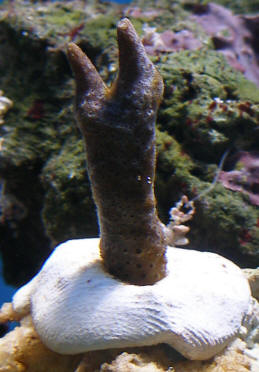
New to SPS – 05/22/09
Hello crew, Henry here.
<<Hiya Henry, Eric here>>
I have a 72g bow front with a 15g sump, Mag-12 return pump and 2 Koralia 4's,
AquaC Urchin Pro skimmer, 85#'s live rock, 2" sand bed. In the sump I have
Chaeto, carbon, and 50mg PhosBan. Tank has been up for 2 1/2 yrs, I have some
fish and soft corals. Decided to try SPS corals, I got 2 150W MH w/Actinics. Did
light acclimation, then I got a Montipora digitata. Put him high up in tank. I
have had it for a couple of weeks now and have not seen any polyps?
<<Odd… If happy/conditions are good, this coral usually “polyps out” quite
readily when the lights are on>>
I will attach a photo and also water specs. Please tell me, is it OK? Is there
something I can do?
Water Specs: Temp - 78-80
SG - 1.023
pH - 8.4
CA - 500
PO - 0
NO - (honestly) 15 - 20
Thank You.
<<Well Henry, the picture is a bit dark to see much detail but this digitata
specimen certainly does not look happy. There’s a couple things I notice about
your water specs that may be the issue here…most importantly the Nitrate level.
Nitrate is important to a system, but if your readings are accurate the level is
too high. Strive to bring it down to the 3-5 ppm range. You don’t give an
Alkalinity reading but your Calcium level of 500 seems a tad bit high…might want
to let this fall to about 400 or so. Also, I prefer a more “natural” Salinity
level of 1.025-1.026. Another consideration is the PhosBan… Though I have used
it myself on a punctuated basis when battling nuisance algae, there are those
that believe it is actually detrimental to a system when utilized
continuously…something for you to think about. As for lighting, if you
acclimated the digi correctly, and especially if this is a “green” variety,
being up high in the tank should be fine…but…you might try lowering it in the
tank for a bit and see what transpires. Regards, EricR>> |
 |
|
SPS Burnt Tip Question
4/26/09
Hi Guys,
<Mark>
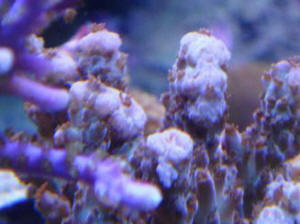
Can you tell me if the images in link indicate burnt tips?
If not, what could it be?
Tips are bubbling and are soft. Color and Polyp extension look OK.
Acro:
http://picasaweb.google.com/reef58/4252009?authkey=Gv1sRgCOLm0O2t-9Ckfg#5328
689118933044738
<Does appear to be "burnt">
Monti:
http://picasaweb.google.com/reef58/4252009?authkey=Gv1sRgCOLm0O2t-9Ckfg#5328
686454499852290
Tank Parameters:
Calc 385
Alk 9.5 dKH
Mag 1400
Lighting is 54 watt T-5 bulbs overdriven with IceCap Ballast.
Not all corals are affected.
Thanks
Mark
<Mmm... the one likely possibility is allelopathy... Please read here:
http://wetwebmedia.com/cnidcompppt.htm
and the linked files above. Bob Fenner>
|
 |
|
Re: SPS Burnt Tip
Question 4/26/09
Hi Bob,
<Hey Mark>
Chemical warfare, I'll look into it.
<Is one of a few possible guesses at this juncture>
All other corals seem to be fine at the moment.
I also posted on Reef Central SPS forum. Some fellow reefers experienced the
same thing. Nobody has an idea what to label it.
Consensus was, it's not "Burnt Tips" or RTN/ STN.
A few suggested lowering ALK to around 8?
<Mmm, a good idea... more to the point is the question of how or what caused
your Alkalinity to become so high?>
Thanks for your help.
Mark
<Welcome. BobF>
|
Montipora capricornis, hlth., reading 3/1/09
I added a Montipora capricornis to my 55 gallon tank 3 months ago. It
was a three inch frag and had been growing and doing well until last
week overnight it developed two white spots about the size of a pea
towards the center away from the edges. The spots appear to be exposed
skeleton. One day after the first spots appeared 1 more appeared. Now
three days later they remain the same size and the rest of the coral
looks healthy with polyps extended and a dark orange color. What do you
suggest as a coarse <course> of action. I have some reef dip but
didn't know if this would help. <Mmm... what are the ingredients?
Likely some general I2 et al. materials would not hurt... The "dots"
could be due to physical trauma (something eating, walking on the
colony), or interaction with other life there (what other "corals" are
nearby... within a foot?), even just chemical imbalance issues...> If
I leave it alone will the flesh possibly grow back or should I just frag
it and hope it doesn't happen again. <I'd leave all as is> My Ca.
is 430, Alk. 3.31 meg., Ph 8.2, <Mg? W/in 3X or so conc. range?>
Ammonia, Nitrite, nitrate all 0. <Need to have some NO3, HPO4...>
I have 4 65 watt power compact bulbs, 2 1200 maxi jets and 2 600
Maxijets. Any suggestions? Thanks, Greg <As usual, reading:
http://wetwebmedia.com/acrodis4.htm and the linked files above,
and/or the use of the WWM search tool... Bob Fenner>
Montipora-Eating Nudibranch Question – 02/21/09 Hello,
<<Hi Jeremy>> I unfortunately have Montipora eating Nudibranchs.
<<Ugh… I have dealt with these pests in the past…very destructive and
not easy to eradicate>> I have some encrusted Montipora that I won't
be able to completely remove from my tank. <<Then sadly, these will
likely be lost. Though you could, as I’m sure you are aware, frag them
up and remove to quarantine for inspection/treatment>> I have set up
a QT tank and my plan is to remove the Montipora that I can and frag the
ones that I can't remove and move them to my QT tank. <<Ah! Yes>>
I will dip them in Revive every couple days to try to kill the
Nudibranchs. I understand the dip won't kill the eggs but I am thinking
if I dip every couple days for an extended period of time I will get
them all. <<Maybe so… But do also inspect the undersides of the
corals daily and remove adults/eggs as you find them>> I am sadly
going to have to let nature run it coarse on the Montipora I can't get
out of my tank and hopefully starve the Nudibranchs. I have read that
these pests can live two months without food. <<I too have heard they
can/will enter a dormant stage…but I can also attest that without a food
source they will decline/cease to be>> I have two questions, how long
should I keep my Montipora in the QT tank and is Revive an effective dip
for the pests? <<I would give the system a good two weeks after the
last of the remaining Montipora is gone from the display. Then I would
add a sizeable frag of Montipora (choose a species the Nudibranchs
“especially” liked if possible) to the display and inspect this frag
daily for re-infestation. If in another two weeks the Nudibranchs don’t
show up on this frag, then it’s likely you can return all your Montipora
to the display without fear. As for the dip… The Revive is probably
fine, nothing is likely to get everything as you stated…but I would also
try Tropic Marin’s Pro-Coral Cure as this iodine-based product may well
act differently/more effectively on the Nudibranchs than the plant-based
Revive. But only one way to find out…>> Thanks for your help!
Jeremy <<Happy to share. EricR>>
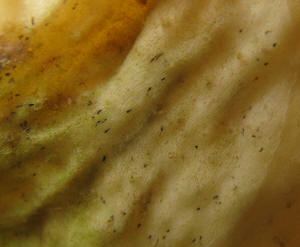
Coral Disease 01/06/09 Dear Crew: Happy New Year!
<To you and yours tambien!> I hope all is well on your end.
Attached, please find two photographs of diseased corals. One is a
Montipora Digitata and the other a Montipora Capricornis. Both have
been doing well, for three years without incident. <Wow, well
done.> This disease is spreading and from the photographs, you
can possibly see some black specs forming in the area of dead coral.
Do you have any ideas on what this is and how to combat it? <Can
you look closer at these black specs and see if they are moving? Are
they mobile things? To me, they look a bit like algae growing on
dead coral right now... but I can't tell from the photos. I have
heard "rumors" of something like "black red bugs"- parasitic
copepods that are black, rather than red. But I don't know what they
are or even if that's what's going on here.> No new specimens
have been added to this tank for several years now. <Very
strange. Have you changed anything at all with the system? New
lights? New supplements? Anything?> Thank you for taking the time
to look. Best regards, Brad in Basalt <Best, Sara M.> |
 |
ID help
01/06/09 These are pictures I
took, I’m being told they are not redbugs. But from what I can find they
appear to be to me. So I’m turning to a pro. I apologize for picture
quality but it’s the clearest I could get. Thx. Paul <... could be
Tegastes... can't tell from these images. Bob Fenner> <<Bob... should
have referred the querior to more... at least the newly placed pitch for
some of my pet-fish presentations... the next one coming up this
month... re Hitchhiker Pros/Cons... will do so here:
http://wetwebmedia.com/LR,LS/HH%20PPT%20Pitch%20Cells/HHProsConsart.htm>> |
 |
Receding Montipora 10/7/08 ??? Hello everyone,
<Hi Jason - Brian here> I trust you are all doing well this morning!
I am sorry to have to bombard you with more questions, but here we go...
Here are the general details of my set up: 72 gal bow front 2x250
metal halide bulbs (12 inches above glass cover) (10.5 hours per day on
timer) 4 fluorescent bulbs in unit also (14 hours per day on timer)
1502 calcium reactor Ozonator running off my skimmer (Coralife
skimmer) 80 or 90 lbs of live rock 2-3 inches of sand I keep a
log of my water tests, which I do 2 times per week. My results average
at the following: SG. 1.023 temp 80-82F ammonia 0 nitrite .1
nitrate 0-2.5 calcium 420-460 ph 8.4 Alk 10-11dkh I am
moving the tank volume at least 10 times per hour through the sump (I
also have 3 power heads running in the tank) I supplement with iodide
once per week (half the recommended dose). Water changes are 15
percent every week or so. <First I want to applaud you for the
description or your tank and it's conditions. It makes it much easier
for us to help when done as you have done. Secondly, your caretaking
disciplines are outstanding, way to go Jason!! The one thing that jumped
out at me is that your nitrites are not 0,they should be, based on your
other results, I’d bet they are 0, maybe re-test.> So... I purchased
a few sps (over a couple weeks) about 5 weeks ago. (6 Acropora, and
1 Montipora) they all seem to be doing fine until yesterday I noticed
the Montipora receding a bit. After discovering this, I promptly went on
to your forum and found several posts on this subject. I think I have a
stock problem as I have quite a mixture. I have several mushrooms, 4
leathers, hammer, star polyp, xenia, torch, elegance, flower pot, long
tentacle anemone, rose anemone, sea mat, as well as an assortment of
button polyps. I keep the stony's located high in the tank, and as
isolated from the other corals the best I can. I also try to keep the
leathers low in the water column to minimize the chemical issues; as
well I use activated carbon in direct flow in my sump. <I looked at
your pictures very carefully and don't see the receding that you are
talking about. I do see a lot of growth (white along the edges) and what
appears to be a very happy Montipora capricornis.> After reading the
FAQs, it seemed like my first option was to try and move the Montipora,
however, it has calcified to the live rock and doesn’t seem to want to
let go (I didn’t pull too hard, but it seems pretty intent on staying
where it is!) <This is a good sign, it has grown and attached to the
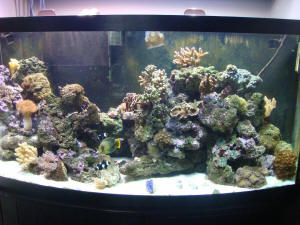
rock.> I have attached a couple of low rez pics to give you an idea
of the placement, and the inflicted area of the coral. Can you please
advise? Thanks so much for your dedication to the hobby! <I think
that you have laid out the tank in an excellent way; you appear to being
doing what you need to do and in the right manner. Maybe a better
picture would change my opinion, but until then, don’t worry too much,
give it some time and good luck!! BrianG> Jason |
 |
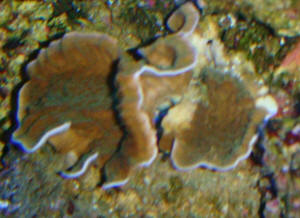
Re: receding Montipora 8/18/08 Hi Brian, <Hi Jason!>
I wanted to resend you some new photos. I think these pictures help
show what I was concerned about a lot better. On the right side
plate of the coral you can notice that the color is turning white
(particularly where the plates seem to join in the middle.) It seems
to do this on most of the edges, some spots worse than others. Is
this growth or illness? Thanks again for your time. <Definitely
growth!!! You have a happy coral that is growing. This coral is
known for it's rapid growth so expect to see this most of the time.
> Jason <Take Care!! BrianG> |  | |
Re: receding Montipora Thank you Brian. <Thank you for
writing us Jason>I think my test kit for no2 might be faulty. I have
never had a reading below this number... I have however had a higher
number when I cycled my hospital tank, but never lower. Its almost
all gone I suppose I should just get a new test kit. <It's
important to remember that with an established tank such as yours,
Nitrites should always be zero. If they aren't it should be a red
flag due to improper testing, another cycle or a stale test kit.> |
|
Question For the WWM Team. SPS RTN and Diatom growth... cause/s?
Allowance/s? 6/11/08 Dear WWM Staff, <Justin>
Your website has been a great resource too me and would like to thank
you for your contribution to the hobby through this website, it is
invaluable. <Glad you find it useful> I started in the hobby one
and a half ago with a 12 gallon nano that was very successful. Six
months into it I did my research and upgraded to a 70 gallon system. My
current system setup is as follows: Equipment 50g Clear for life
pentagon corner acrylic tank with a back corner overflow box. The top
front corners are drilled for the two returns, which is powered buy an
in sump Eheim 1260 generating a 10x. I installed a closed loop by
drilled the bottom right hand side of the tank for intake and the bottom
right for the split returns. (see attached illustration 1). <None of
these came through. Must be attached...> An external Poseidon PS3,
generating an estimated 18x turnover, powers the closed loop creating a
circular closed loop flow. I run a VorTech pump in an opposite position
to the closed loop at half speed in reef crest mode creating turbulence
and an additional 35x. I have a JBJ 1/10th Titanium chiller running in
the well ventilated attic directly above the tank that is powered by an
external Poseidon PS1, generating an estimated 8x turnover, and returns
to the main tank. The lighting is a PFO mini pendant 250 MH running a
14,000K phoenix bulb, replaced last month. I run a 24” 65W, retro fit
SunPaq PC actinic bulb and a set of two Current USA moon lights. I
recently switched from an ASM G1 skimmer to a Tunze 9010. My sump is a
custom built 20 gallon with a built in 3g refuge where I keep 5 lbs of
miracle mud and Chaeto under a low watt bulb 24/7. <Stop! I would not
have the lighting on continuously here. Chaetomorpha needs a dark
phase... I'd arrange the light to overlap, be on when the main display
lighting is cycled off> The overflow splits into two where 75% of the
flow ends up in the skimmer side of the sump and 25% ends up in the
refuge. I run a PhosBan reactor with Eco-Phos connected to a Maxijet 400
that pulls from the skimmer side of the sump and returns to the return
side of the sump. I do not run a heater as the house is maintained at
74º and in combination with the MH I have been very successful in
maintaining a stable temp of 77º. Current Parameters – Very stable.
Temp 77º Salinity 1.025 pH 8.3 Calcium 450 Alkalinity 10
Magnesium 1350 Nitrates 0 Nitrites 0 Phosphates 0 <Mmm...
I'd read a bit re the need for soluble phosphate... your system, with
the reactor, may be too "clean" for the livestock's good> Ammonia 0
Maintenance Schedule I change 10% weekly using Reef Crystals, but
recently switched to Reefer’s Best. <The ZEOvit product> All
sponges are removed from the skimmer, pumps, PhosBan reactors and
cleaned out, to ensure no phosphate built up. I dose B-Ionic and or DT’s
new CA/Alk/Mag chemical additives. I dose a little Potassium
(explanation later on) and Eco-Systems trace minerals. I run carbon for
5 days a month. I test all water parameters every Sunday at 8pm using
Salifert test kits. Feeding Schedule I feed sparingly once a day
and or every other day. I feed with Rod’s Food
(http://www.rodsfood.com/). Bio Load 1 Med. Yellow Tang 1 Dusky
Jaw 1 Blue Chromis 2 small Clown fish 1 Royal Blue Tang 1
Small Six-line Wrasse 1 Peppermint Shrimp 1 Emerald crab Large
cleanup crew (no stars), snails, (Hawaiian Trochus Grazers, Hawaiian
Turbo Grazer, Micro Hermits, Blue hermits, Strombus Grazers conch,
ninja, Pinky Cuke, Hawaiian Littorinid Grazers, Astraea, Nassarius)
Natural Filtration I have about 50 lbs of live rock and 30lbs of live
sand. Light Cycle Moonlights off 7am Actinic on 11am MH on
noon MH off 9 pm Actinic off 10 pm Moonlights on 11pm Issues
I have two ongoing issues that I cannot seem to resolve. 1) Diatoms –
(one year later) 2) SPS RTN/STN <This both may well be due to the
lack/absence of HP04...> I went through a very patient cycle and
waited and waited. However I still to this day suffer from Diatoms. I
have done everything listed on WWM site and more I have done two days of
darkness, however they always return and are very prominent on the sand
bed. They are densest by my Dusky Jaw, as assume it’s because the snails
get used in the construction of his burrow and hence they stay away from
him and the sand does not get mixed up in that area, however the rest of
tank still suffers from bad diatom blooms. I can keep pink and green
Birdsnest that grow thick branches and have wonderful plop extension and
color. However, I cannot keep any other SPS. Monti’s die by STN/RTN
within weeks and never show signs of growth. I started adding potassium
as the ZEOvit system promotes it and I had run out of options. I
acclimate slowly via the drip method and place the coral low in the tank
and slowly raise up towards the light as to not light shock the coral.
All other forms of corals start to loose their tissue and then the
diatoms start to attach and I inevitably loose the coral. (See
illustration 2) I have recently increased the weekly water changes to
15% and switched salts from reef crystals to Reefer’s Best to address
the low potassium issue as tested by a ZEOvit user. <K
presence/concentration is rarely a rate limiting factor> Other Info
The only piece of equipment that I did not buy new was the tank and it
was used as a freshwater system. My build thread on sdreefs :
http://www.sdreefs.com/forums/showthread.php?t=25429&highlight=50g+build
Illustration 1 Illustration 2 Illustration 3 <Again, these
graphics didn't make it> Kind regards, -- Justin A. Hai <I'd
pull the Phosban out... run this system for a few weeks... see what
happens. Bob Fenner>
Re: Question For the WWM Team. SPS RTN and Diatom growth...
6/12/08 Bob, <Justin> Thank you for your email... I do have
a follow up comment to your "system is too clean" suggestion. <Ok>
I ran Carbon in the Phosban reactor 24/7 prior to MAX in Orange County.
I met Mike Paletta who suggested that I run carbon 5 days a month and
run Eco-Phos in the reactor instead. The point here is that I was not
using a phosphate remover prior to MAX (April 5th 2008) and the issues
where the same before installation of the Eco-Phos in terms of diatoms
and SPS RTN. <I see> Is it feasible that it could be the opposite
in terms of high organics in the tank (except when the corals are dying
fast, in which case I'd suspect acclimation, toxins in the water or some
other acute problem, but I think we can rule that out). Keeping in mind
that the test kits we all use don't detect all phosphates and don't
detect bacteria levels at all - Salifert = 0, Hanna = 0.13 Kind
regards, -- Justin A. Hai <Mmm... am on to my default general
resp.: Perhaps allelopathy... Please read here:
http://wetwebmedia.com/cnidcompppt.htm and the linked files above.
Bob Fenner>
Algae growing on SPS tissue, no data or reading
6/10/08 Hello Reef Central Gurus, <Okay... forgot to edit
your broadcast message...> Once again I must turn to your expert
knowledge! I have had this particular SPS for some months now and
it has been sitting on a frag rack since acclimation. All my levels
are fine, however, I have been noticing some algae growth on certain
areas where it appears the tissue will die/is dead. As you can see
from the picture, the large spot on the right is where some tissue
has died, and the other branches are showing a small amount of
growth on top of the tissues. <Yes...> I have moved it to an
area of greater flow, and am seeing no change, whether it be slowing
or speeding up the algae growth. Please let me know how to treat
this as it is one of my favorite SPS in the tank. Sincerely,
Paul Cheng <... Could be a number of influences... this colony
looks to be in bad shape overall... light, nutrient, some aspect of
too much/too little (limiting) chemical/physical factor... all
levels are "fine"... Read here:
http://wetwebmedia.com/CnidIndex2.htm scroll down to SPS,
Acroporid Culture... Bob Fenner> | 
|
|
|