|
Related FAQs: Acroporid, Acroporids
2, Acroporid Identification,
Acroporid Behavior, Acroporid Selection, Acroporid Compatibility, Acroporid Systems, Acroporid Feeding, Acroporid Disease, Acroporid Disease 2, Acroporid Disease 3, Acroporid Disease 4, Acroporid Health 5, Acroporid Health 6, Acroporid Health 7, Red/Black "Bugs" Acropora Munching
Copepods, Montipora Munching
Nudibranchs, & Acroporid
Reproduction, SPS Corals, Coral System Set-Up, Coral System Lighting, Stony Coral Identification, Stony Coral Selection, Coral Placement, Foods/Feeding/Nutrition, Disease/Health, Propagation, Growing Reef Corals, Stony Coral Behavior, SPS Identification, SPS Behavior, SPS
Compatibility, SPS Selection,
SPS Systems, SPS Feeding, SPS
Disease, SPS
Reproduction,
More Pix:
Montiporas,
Related Articles: True or
Stony Corals, Order Scleractinia, Dyed Corals,
/The Best Livestock For Your Reef Aquarium:
Quintessential Small Polyped Stony
Corals, the Staghorns, Family Acroporidae, pt. 1
To: Part
2, Part 3
|
|
|
By Bob Fenner
|
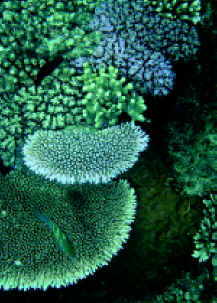
Fiji Acroporids. The family Acroporidae make
up most of the species and most of the biomass of the world's
reefs.
|
There is an artificial, albeit useful, convention amongst hobbyists
distinguishing hard or stony corals (Order Scleractinia) on the basis
of their apparent individual polyp size: Large and Small. Small Polyp
Stony corals are made up of miniscule polyps generally borne on
branching, encrusting or plate-like skeletons.
The artificiality of this arrangement is borne out in the membership
of both SPS (Small Polyp Stony) corals and LPS (Large Polyp Stony)
corals existence within the same families, sometimes genera. However
arbitrary the division, there is general utility in the visual
distinction of Small versus large Polyp corals. In a few words,
SPS' prove harder to keep than LPS'. This is often cited as
being due to the greater cleanliness and stability of environmental
conditions where SPS' are found.
|
|
|
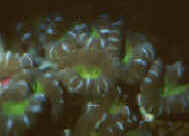
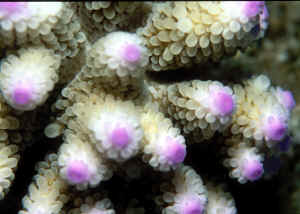
(Images #2,3: A
LPS coral, Caulastrea furcata, Family Faviidae and a member of our
family of SPS', Acropora cerealis. LPS' polyps are, well,
larger than SPS') |
(Images #2,3: A LPS coral, Caulastrea furcata, Family Faviidae and a
member of our family of SPS', Acropora cerealis. LPS' polyps
are, well, larger than SPS')
Indeed, as many of the popular LPS' are collected in shallow
back reef areas, the majority of SPS' hale from reef flats to
deeper offshore environs where there is definitely less silt, and more
homogeneous light and brisk circulation conditions.
For the hobbyist there are obvious practical implications. SPS
require more stable and optimized environmental conditions; strong
lighting, high water quality and even temperatures. Nonetheless the
smaller polyped scleractinians have many endearing qualities; subtle to
brilliant colors, fast growth and a propensity for culture through
fragmentation that endear themselves to advanced reef hobbyists.
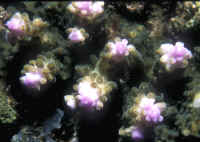
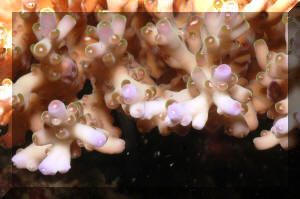
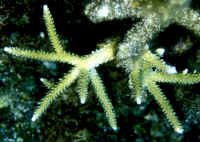
| Growing tips (colored) of a wild Acropora
(cerealis?) in N. Sulawesi. |
|
Amongst the stony corals, large, medium or small polyped, there are
none larger, literally and figuratively than the Staghorns, Family
Acroporidae ("Ackro-pore-id-ee"). This family contains the
true corals number one and two most speciose genera (Acropora,
Montipora). As reef builders the family rules supreme; their
hermatypic colonies are the most important worldwide in terms of mass
and volume.
Family Acroporidae, Classification:
Staghorn corals come in many shapes and all colors... and these
traits can be highly variable per species. Most are typically branched,
table-top shaped, or encrusting per type, but colors often ran the
gamut of browns, whites to pinks, blues, yellows, greens, even purple,
depending on growing conditions. As with other true or stony corals
(Order Scleractinia) real determination to the species level rests on
close examination of corallites (individual polyp skeletons),
biochemical and genetic study. For aquarium identification, they are
best labeled down to the genus ranking. All identifications here are
tentative.
Bigger PIX:
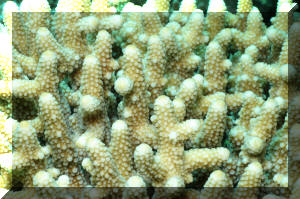
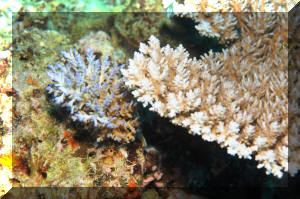
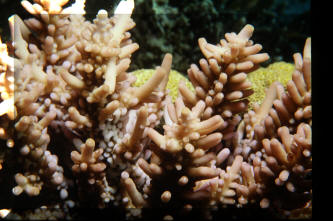
The images in this table are linked
to large (desktop size) copies. Click on "framed" images
to go to the larger size. |
.JPG)
.JPG)
.JPG)
.JPG)
.JPG)
.JPG)
.JPG)
.JPG)
.JPG)
.JPG)
MD.JPG) MD.JPG)
%20MD.JPG)
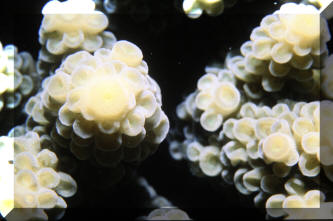
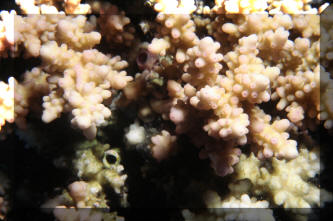
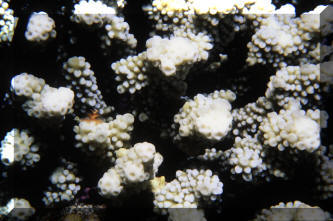
|
Genera, Species of Aquarium Interest: (To Do: Need to
insert species by genera and images, links per Bklet section BLR)
All told the family Acroporidae contains four extant genera and
several hundred species, of which dozens make their way into the
aquarium interest.
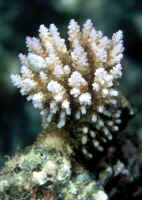
Genus Acropora, identified readily
with their one apical "growing tip", many radial corallites. With a hundred and
thirteen scientifically described species of many colony morphologies. These are
what most people picture when they hear the word "coral". Most are branched
tree-like or interwoven, with fast growing and often differently colored apical
corallites (growing tips). These are the mass spawners, with their axial
corallites releasing sex cells seasonally. Due to their fast growth (sometimes
more than an inch a month), mix of available species and colors, this is a
favorite genus of advanced reef aquarists. This genus is divided into fifteen
'groups' on the basis of gross physical appearance (See Fossa & Nilsen, Veron)
with some correlation with aquarium survivability.
|
|
|
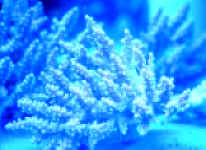
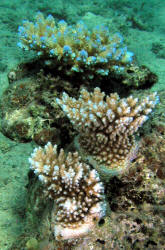
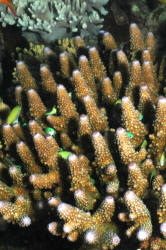
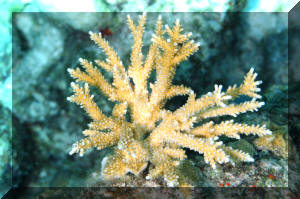
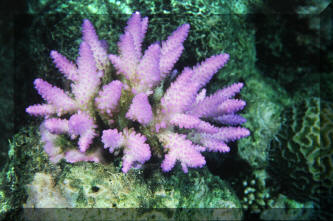
Branching Acropora, field identified
as A. cerealis
And wholesale labeled and cultured as A. cerealis.
Commonly called
"Purple Tip Acropora"
|
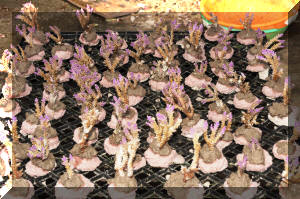 |
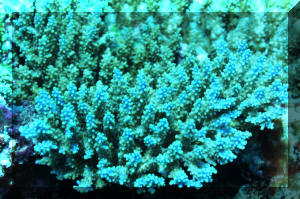
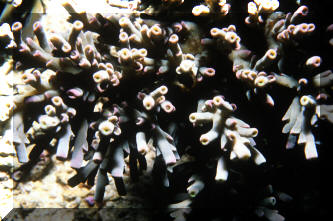
Acropora caroliniana, Mabul, Malaysia
|
 |
|
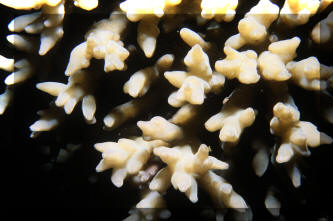
Acropora echinata, Mabul, Malaysia |
 |
|
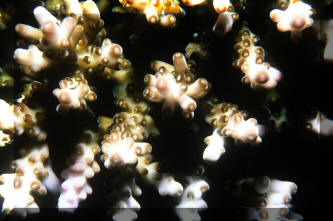
Acropora granulosa, Mabul, Saba, Malaysia
|
 |
|
|
|
Acropora formosa, here are
young, open colonies that will become more interwoven with growth.
A hardy species sold by wholesalers and culturists everywhere. |
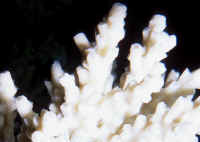
| Acropora haimei
(Milne Edwards and Haime 1860). Colonies of short, upright,
tapering branches, with axial corallites which are exsert, tubular
and upwardly projecting. Radial corallites similar with sharp-edged
lips. Red Sea image. |
|
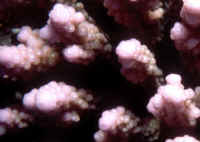
| Acropora hemprichii
(Ehrenberg 1834). Irregularly branched with radial corallites as
open thickets, large, round, upright, conical. Axial corallites
common, prostate, of thick smooth walls. Most are brown to pink in
color. Red Sea images. |
|
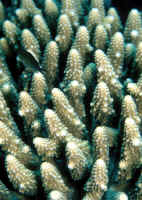
| Acropora humilis
(Dana 1846). Finger like colonies whose branches are thick, tapering to a
dome. Larger branches intermingled with smaller. Radial corallites of two
sizes; larger ones in rows slightly enlarged toward base. /COTW
Characters: Colonies
are digitate. Branches are thick, gradually tapering to large dome-shaped
axial corallites. Small branchlets or incipient axial corallites usually
occur at the base of main branches. Radial corallites are of two sizes, the
larger are usually in rows, have thick walls and only increase slightly down
the sides of branches.
Colour: Many
colours, but most usually cream, brown, purple or blue (which may photograph
purple) with blue or cream tips.
Similar Species: Acropora
gemmifera, which has small axial corallites and radial corallites
increasing in length down branches. See also A.
monticulosa and A.
torresiana.
Habitat: Exposed
upper reef slopes and reef flats.
Abundance: Usually
common, and sometimes a dominant species.
Red Sea images. |
|
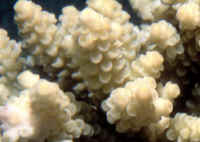
| Acropora hyacinthus
(Dana 1846). Colonies as wide, flat plates, possibly tiered.
Branches fine in low wave action environments, fused in brisk ones.
Branchlets are fine, upward facing. Axial corallites not exsert,
but distinct; radial corallites are cup-shaped. Red Sea
images. /COTW
Characters: Colonies
are wide flat plates and tables or tiered aggregations of small plates.
Branchlets are thin and finely structured except where exposed to wave
action, when they become closely fused. Branchlets are fine and
upward-projecting. Axial corallites are distinct but not exsert. Radial
corallites are cup-shaped and form rosettes.
Colour: Uniform
cream, brown, grey or green with or without blue (which may photograph pink)
growing margins.
Similar Species: See Acropora
cytherea, A.
tanegashimensis and A.
spicifera.
Habitat: Upper
reef slopes and outer reef flats.
Abundance: One
of the most abundant corals of exposed outer reef slopes of much of the
western Pacific.
|
|
Bigger PIX:
The images in this table are linked
to large (desktop size) copies. Click on "framed" images
to go to the larger size. |
|
%20MD.JPG)
|
To: Part
2, Part
3
|
|


%20vert.JPG)
.JPG)
%20MD.JPG)
MD.JPG)
MD.JPG)
MD.JPG)
%20MD.JPG)
%20MD.JPG)
%20MD.JPG)