 |
|
| Home | Marine Aquariums |
Freshwater Aquariums |
Planted Aquariums |
Brackish Systems |
Ponds,
lakes & fountains |
Turtles & Amphibians |
Aquatic Business |
Aquatic Science |
Ask the WWM Crew a Question |
| Please visit our Sponsors | ||||
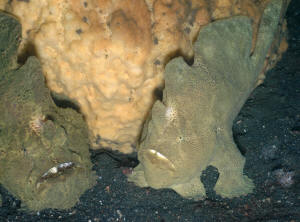
Angler Fish ; stkg., sm. sys. period 12/16/14Afternoon I'm rethinking my refugium/seahorse idea. My thoughts are now to either put a few mangroves <See WWM re... most get too large, are not easily kept> in with some xenia or possibly a sole angler fish <? Will inhale seahorses> possibly a small A. Maculatus. <Oh, this one stays small> The HOB is only 4 gallons with the dimension being 19" x 4" x 12"h and is plumbed into a sump on my 155 gallon tank. Will this work or is it too small. Let me know your thoughts..thx Chris <Might. Bob Fenner> Re: Angler Fish 12/16/14 The Angler would be all by himself. I can't think of a more unique fish that could live in such a small environment. Thanks for the feedback..cheers Chris Chris Bourgeois Lynden Canada Co <Ahh, see the coverage of stocking small systems on WWM; or my eBook on Amazon re, or the collection/series of articles on TFH and Ultramarine re. Bob Fenner> Biocube 29. Seahorses or Angler?
Sel./stkg. 5/18/11 Re: Frogfish and cleaning crew 11/21/08 Thanks again for all your help, when all is said and done I think this will be a pretty neat tank as well. I have what I believe to be a very reputable LFS, they specialize only in saltwater aquariums and the owner is very forward about how people have there tank set up and what type of residents are in it. So much in fact that I have seen him refuse to sell a fish to someone because they did not have the proper set up, needless to say I kept my mouth shut about my trigger in a 30 to avoid the wrath! In your opinion, what would be the best way to obtain this frogfish, my original plan was to have the LFS order it in, that way they would watch it for a while to be sure it was healthy. Also, it there some sort of catching technique or area that has better quality specimens? I guess I'm really asking, if you were buying one, how would you go about it? Thanks. Chris <Word on the "street" is that a store called "The Shark Reef" is one of the best places to get them: http://www.thesharkreef.net/ BUT... if you trust your LFS, this is probably the best, most convenient route to go. Because, as you noted, they can hold the fish for you and you can watch it for awhile before you take it home. Best, Sara M.> Frogfishes / anglerfishes... Sel., beh., hlth. gen. -11/18/07 Hi people - <Rachel> I was reading over your Q&A page for frogfishes (aka anglerfishes, but this common name is usually reserved for the entire order, Lophiiformes). <Ahh! Yes> I think your website is wonderful and a joy to read. If I may, I would just like to comment a little on the Q&A for frogfishes. <Please do> The inside of the mouth of a frogfish is quite varied; it can be the normal pale color you might expect, or the tissue could be differently colored and look like algae (many times black and white!) - all part of the fish's camouflage <And lure strategy> (can't have that prey item scared away at the gaping mouth of the frogfish, since they rarely close it all the way in order to keep water circulating over their gills). Lumpy frogfish - consider that A. maculatus (the clown or Wartskin frogfish) is, well, many times warty. So if your readers have purchased A. maculatus and are perplexed by its cancerous tumors filled with skin parasites, please assure them that this is perfectly natural. Another side note being that most frogfishes have a small bump on their lower lip right smack dab in the center. This shouldn't be abnormally huge (such as the size of a pea), but it is noticeable. It can also get pink and inflamed if they're constantly hitting up against the glass of the aquarium. <Well-stated> Air bubbles beneath the surface - this does seem to be a problem, albeit rare, in most frogfishes. I would venture to say that it is more common in the pygmy frogfishes (Antennatus - note that this is different from the genus Antennarius :) ) often collected from Hawaii. Hearing about gas bubbles problems in fishes that have been well-established in their tanks makes me wonder if they're more prone to the 'gas bubble disease' as it is called in sea horses. Most are rather shallow (<90m), but they aren't built to go up and down in the water column, and their natural habitat is hidden within the benthic fauna (exception being H. histrio...perhaps this is the reason why H. histrio does exceptionally well in the aquarium comparatively). <Interesting speculation. I agree> Air bladders - most genera in Antennariidae have air bladders, but some do not. The ones people are usually concerned with in the aquarium hobby do have them. <Although diminished in relative size> Swallowing water/air - I know it happens, but that fish has got to under quite a bit of stress/sick/dying. I've pulled frogfishes out of the water, clipped a tiny bit of one of their fins (DNA), and put them back in without ever having a frogfish do this to me. Hardy fish - for up to a year, generally (depending on the species...certainly not Antennatus, which is lucky to make it past 30 days). Many people can't get them past this point and there appears to be no apparent reason why currently. They are not known to be ich prone (except Antennatus), but if the tank or tankmates are infected you can probably bet it'll become infected as well. Frogfish 'yawn' from time to time - nobody knows why. <I do think this is very much "stress related"... see them "yawn" more the closer and longer they're approached underwater> When purchasing a frogfish - if your readers get anything from this message - avoid Antennatus at all costs. It's probably the cutest little one of all the frogfishes, but it has major issues with longevity in captivity, if it even makes it that far. Unfortunately, I've never seen a frogfish labeled as anything but Antennarius, since it's the most common, so if you're going to purchase one try to identify it at least to genus. Antennarius and Lophiocharon are pretty much the only genera you're going to find in the U.S. that are suitable for aquariums. Cheers <Thank you very much for this valuable input. Will post/share. Bob Fenner> Re: Stonefish- S. Verrucosa, S. Horrida 5/2/08 Dear Mr. Fenner, Thank you for the advice. I will contact the LFS you mentioned and try to obtain a stonefish. I will keep you all posted on the hunt. <Thank you for this> And if I do obtain one from the source you mentioned, please feel free to contact me whenever you're in the area and I will personally treat you to a nice dinner! Cheers- Al Eng <Oh! I'll be in the windy city for the IMAC (http://www.theimac.org/) do later this month into next! Hope to see you there. BobF> Twinspot frogfish/ BRACKISH WATER (Antennarius biocellatus) I am looking for a couple of the rare creatures. Do you know where I might be able to purchase like 3 or 4 of these guys? Do you know if they live in brackish to freshwater their entire lives? Please let me know if you know anybody that can get these. <Likely the big mail order etailers can get you these (if anyone can). MarineDepot, MarineCenter. Drs. Foster and Smith (.coms). Oh, and can live in brackish continuously. See fishbase.org here: Twinspot Frogfish Bob Fenner> |
|

|
Features: |
|
| Featured Sponsors: |