|
Related FAQs: Anglerfishes, Anglers 2, Angler ID, Angler Behavior, Angler Compatibility, Angler Selection, Angler Systems, Angler Feeding, Angler Disease, Angler Reproduction, Related Articles: Batfishes, family Ogcocephalidae, Indonesian Angler/Frogfishes, /The Conscientious Marine Aquarist The Bizarre Frogfishes, Anglerfishes, Order Lophiiformes/Antennariiformes | 
| By Bob Fenner | Michael Krechmer photo of A. commerson |
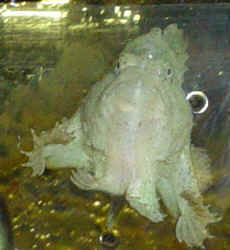
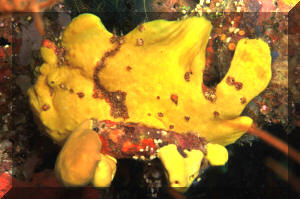
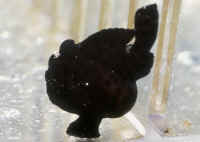
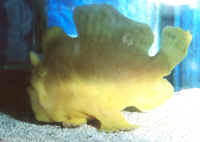
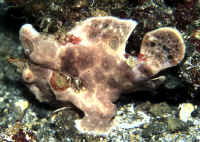
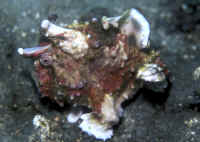
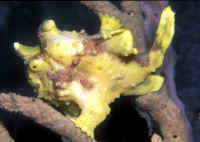
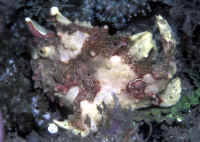
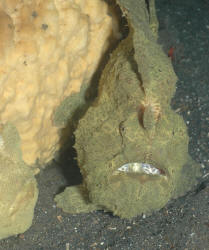
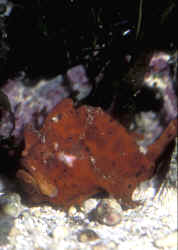
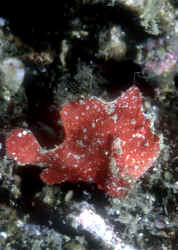
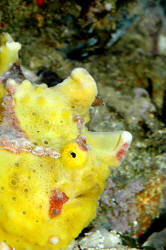
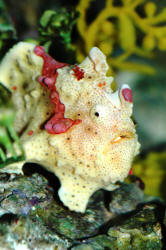
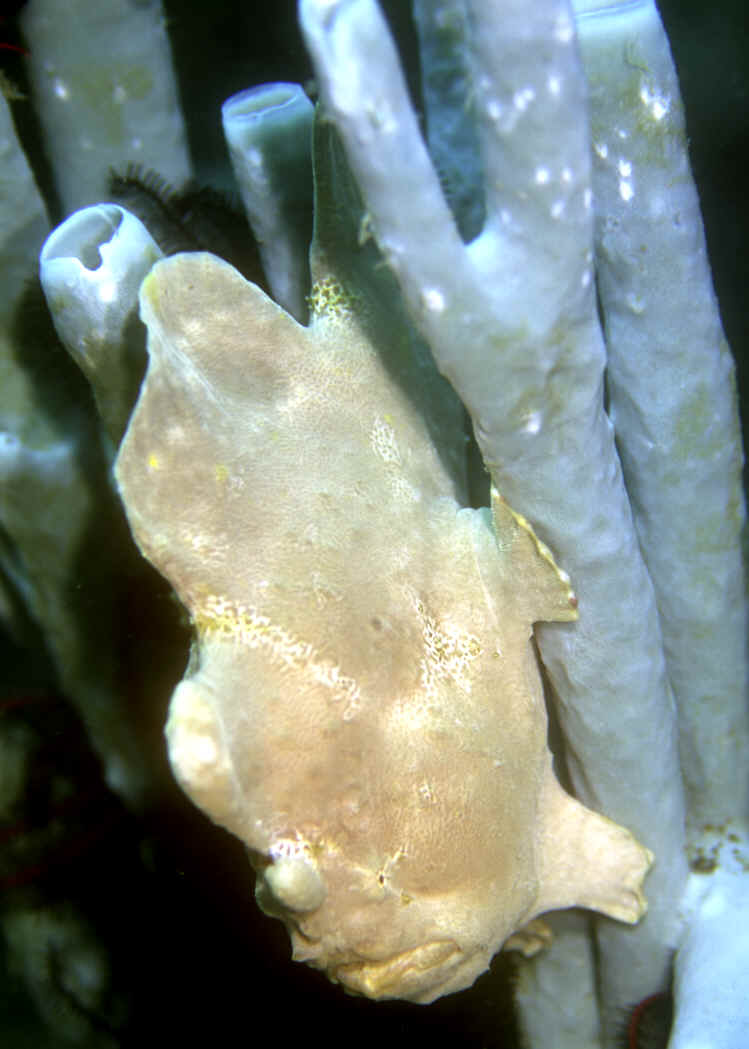
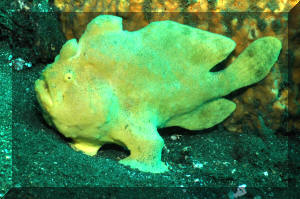
You know these fishes, if you can just find them in a tank or even harder, hidden amongst rubble and coral on a reef. They come with their own "fishing apparatus", an illicium (line) and esca (lure) for luring unsuspecting prey to their capacious maws. If they have pelvic fins on their girthy bodies, these are located ahead of their pectoral fins, and often used to "walk" their owner about. The group includes many suborders (five in the present, presented scheme) and sixteen (to eighteen) families, about 65 genera and three hundred species... some are dominant forms in the abyssal depths, others lurk just under the substrate... all are cryptic and unseemly in appearance (at least to me...), though of course, "beautiful" in their own rights. A few species make their way into pet-fish markets... the most important element to keep in mind in their captive husbandry is their penchant for swallowing their tankmates... and the fact that they either must have live foods regularly supplied or be trained to take fresh/dead foodstuffs from a wiggled feeding stick. Species of Interest: | Antennarius commerson (Latreille 1804), the Giant or Commerson's Anglerfish. At right a ten incher in N. Sulawesi. Below (black) one incher, caught in Hawai'i. A yellow one at Elmer's in Pittsburgh, PA. Others from N. Sulawesi To 13 inches in length. Widespread in the Indo-Pacific; Red Sea to Hawai'i. Occurs in nearly all colors, patterns (w/ the exception of blue!) matching sponges they're found in association with. Also often identified under the pseudonym A. moluccensis. Distinguished from other similar looking Anglers (e.g. A. pictus) by having a greater number of fin rays: anal (typically 8), dorsal (13), and pectoral (11),
and shorter "fishing rod". |

|
| Bigger PIX: The images in this table are linked to large (desktop size) copies. Click on "framed" images to go to the larger size. |
 %20MD.jpg)
MD.jpg)
MD.JPG) |
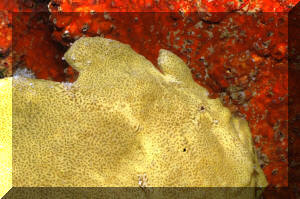
| Antennarius hispidus (Bloch & Schneider 1801), the Hairy or Shaggy Anglerfish. Indo-Pacific; particularly Malaysia, Indonesia. To eight inches in length. Coastal bays near camouflaging sponges. Occur in oranges, tans, yellows, and apparently black. N. Sulawesi images. You can tell this species apart from the similar A. striatus by its pom-pom like esca. | 

|
| Bigger PIX: The images in this table are linked to large (desktop size) copies. Click on "framed" images to go to the larger size. |
MD.jpg) |
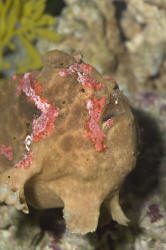
| Antennarius maculatus (Desjardin's 1840), the Clown Anglerfish. Indo-Pacific. To four inches in length. Often seen out in the open, especially when small, apparently mimicking toxic nudibranchs. Most are white with orange or red mottling, but many colors exist. Have prominent illicia ("fishing poles") that resemble small fishes. N. Sulawesi pix of half, full and one and a half inch individuals. | 
|
| Bigger PIX: The images in this table are linked to large (desktop size) copies. Click on "framed" images to go to the larger size. |
.JPG) |
| Antennarius multiocellatus (Valenciennes 1837), the Long-lure Anglerfish. Tropical West Atlantic; Florida to northern South America. Most common frogfish in the TWA, found disguised around sponges. Fishing rod (illicium) about twice the length of first dorsal spine. Feed on fishes and crustaceans. Eggs laid in ribbon like masses. Here are two colored varieties in Bonaire. |
Bigger PIX:
The images in this table are
linked to large (desktop size) copies. Click on "framed" images to go to
the larger size. |
|
%20MD.jpg) |
| Antennarius nummifer, Spotfin Frogfish. Short rod for fishing... spot on rear/base of soft dorsal. Indo-Pacific. E. Africa and Red Sea to E. Pacific. PNG pic by PhilS. | 
|
|
Antennarius pictus (Shaw & Nodder 1794), the Painted Anglerfish.
Indo-Pacific. Principally imported from Indonesia and the Philippines.
To 16 cm. overall length. Comes in all colors, and mottled, matching
with local decor. Typically found amongst sponges, rock near the bottom
or on the mud/muck. Below, N. Sulawesi images of some of the many color
and marking varieties of this species (or multi-species
complex). Distinguished by bony part of "fishing rod" being about twice
the length of second dorsal spine and "lure" being an elongated and flat
tuft. |
| Bigger PIX: The images in this table are linked to large (desktop size) copies. Click on "framed" images to go to the larger size. |
.JPG)
%20MD.JPG)
MD.JPG) |
| Antennarius sanguineus Gill, 1863, the Bloody Frogfish. Eastern Pacific; Sea of Cortez to Peru, including Cocos and Galapagos Islands. To 8.2 cm., or about three inches long. Found tucked into rocky crevices on walls, resembling and found around sponges of varying colors. Galapagos pix. | 

|
| Antennarius striatus, Striated Frogfish. Tropical West Atlantic and Indo-Pacific; South Africa to Japan and New Zealand, in mud or sand bottoms, often associated with sponges. To seven inches. Aquarium and N. Sulawesi photos. Distinguished from the similar appearing A. hispidus by its worm-like esca. Many pseudonyms (28) exist for this species, including A. scaber. Males with more tufts/camouflage than females. | 

|
| Histrio histrio (Linnaeus 1758), the Sargassum Anglerfish, or if it were up to me, "The Incredible Eater Upper"... To only 13 cm. but able to eat most any animal near its length. Known from all tropical oceans, typically found "floating" in kelp canopies or bits that are broken off. Aquarium photos, first by RMF, second by Mike Giangrasso. |  
|
A deep water angler brought up in a scientific trawl. The SIO fish collection got an early Christmas present this week when a gentleman called from Carlsbad to say that he had found a most peculiar fish washed up on the beach in Del Mar. When we went up to pick it up we found that it was a very large deep-sea anglerfish. Back at the lab we identified it as Himantolophus danae, a species described in 1928, heretofore known only from a single 38mm specimen from the South China Sea. Deep sea anglers are characterized by an angling apparatus on the snout, with a luminous bait at the end. The bait, which contains luminous bacteria, may be variously elaborated, as in this species. This individual is a female; all male anglerfish are very small. In this species the males are free-living. The photograph was taken by Phil Hastings (the ruler is 15cm long). Richard Rosenblatt Scripps Institution of Oceanography 9500 Gilman Drive La Jolla CA | 
|
Bibliography/Further Reading: http://www.starfish.ch/frogfish/Anglerfish.html Bavendam, Fred. 1998. Lure of the frogfish. National Geographic 7/98. Emmens, C. W. 1985. Anglerfishes. TFH 10/85. Freise, U. Erich. 1973. Anglerfishes. Marine Aquarist 4(5):73. Goldstein, Robert J. 1987. The Frogfishes. With care, these are excellent tank fish. Pet Age 11/87. Michael, Scott W. 1991. Commerson's Frogfish, Antennarius commersoni (Latrelle). FAMA 11/91. Michael, Scott W. 1994. Anglin' fish. Fish that lure in their prey. AFM 9/94. Michael, Scott W. 1995. Frogfishes: anglers of the reef. AFM 11/95. Michael, Scott W. 1995. The frogfishes: species in the marine trade. AFM 12/95.
Michael, Scott W. 2004. The warty angler (Antennarius maculatus)
(Desjardins 1844. Coral Magazine 2004, v. 2 Molter, Ted. 1983. Antennarius scaber Cuvier. FAMA 1/83. Pietsch, Theodore W. & David B. Grobecker. 1985. Frogfishes: aggressive mimics of the reef. FAMA 4/85. Pietsch, Theodore W. & David B. Grobecker. 1987. Frogfishes of the World. Systematics, zoogeography, and behavioral ecology. Stanford Press. 420pp. Severin, Kurt. 1960. The Angler among the fishes. TFH 1/60.
|
|