|
FAQs on Dips/Baths
Additives
Related Articles: Dips/Baths, Methylene Blue, Formalin/Formaldehyde, Quarantine, Tank Troubleshooting, Toxic Tank Conditions, Environmental Disease (incl. Lymphocystis), Nutritional Disease, Infectious Diseases, Parasitic Diseases, Wound
Management (/aquarists), A Livestock
Treatment System,
Related FAQs: Dips/Baths
1, Dips/Baths 2, Dips/Baths 3, & FAQs on Dip/Bath: Rationale/Use, Methods, Tools,
Adjusting pH, Iodine/ide/ate, Lugol's Use, Methylene Blue, Formalin/Formaldehyde, Dangers Will Robinson, Products, & Best Quarantine
FAQs, Quarantine,
Acclimation 1, Acclimating Invertebrates, Acclimation
of Livestock in the Business,
|
Mmm, from nothing to iodine in many formats,
formalin, Methylene Blue... many others... though generally not
Organophosphates, Malachite Green, antimicrobials, antibiotics,
copper compounds...
|
Methylene blue necessary for acclimation?
10/10/15
Hi your websites great, so much useful info.
<We try!>
I've been reading your guide to acclimatizing new imports, everything makes
sense and i am ready to trial your recommended method. The problem I have is I'm
based in the UK and I can't seem to purchase Methylene blue to add
to the freshwater dip, is it essential to add the Methylene blue?
<Not required, but helpful. Ph and temperature adjusted freshwater is fine.>
Is there any other treatment that is available in the UK that I could use in
place of the Methylene blue.
<Personally I believe in watching the animal at a dealer's for a week or so,
making sure it's healthy insofar as you can
observe, with a deposit to hold onto the fish if needed. My favorite local
retailer dips them as he receives them and again before he sells them to me, may
want to ask for this service, which they should be happy/wise to provide.
Chemical dips are possibly stressful and I consider them more of a prophylactic
for suspect animals than a requirement.>
Thanks Chris
<Glad to be of use, please follow up with your results for others' edification
and also read WWM's section on dips, it's pretty thorough. -EC3>
How to freshwater dip
5/28/13
Hi Bob,
<Hey Pete>
I am just setting my first marine reef, and first tank in many years. My
34 gallon display tank is all setup, cycled and now into its 5th week
with all parameters showing at 0 with the exception of NO3, which is
sitting around 5ppm after each weekly water change.
<Patience>
My CUC is in and doing its job nicely and I have my LFS holding a Purple
Firefish aside for me as I set up my quarantine system.
<Ok>
I intend to treat in quarantine with PraziPro followed by Cupramine (not
together) as prophylaxis, but my real question revolves around an
initial freshwater dip.
Having already researched the topic ad nauseam, I cannot seem to find
recent information, or consensus for that matter, regarding formalin
and/or malachite green for freshwater dips prior to quarantine.
<I'd only use the formalin, along w/ maybe Methylene Blue, but not
Malachite... too harsh>
Is freshwater dipping still recommended, and if so, is the use of
formalin and/or malachite green (or the available combined aquarium
solutions, such as Rid-Ich+) still recommended?
<As stated, and posted on WWM>
I've heard about people using quinines, with which I have no experience
at all - are these the correct alternatives to the old methods?
<The Quinines, not for dips/baths>
Will quinines be an effective treatment for Brooklynella (I do intend to
eventually keep Clowns).
<Are good. I'd use Chloroquine (di) Phosphate>
On that last topic, in the past, all Clowns were prophylactically
treated for Brooklynella - but should other species also be treated to
avoid illness in other species and/or communicating the disease?
<Some folks believe so... I'm a very strong believer in such dips/baths
enroute... some species, esp. coming from certain geographies,
seasonally... have internal/luminal worm, ext. fluke, and all sorts of
protozoan issues that I would treat with Metronidazole,
Anthelminthics... but no less than some 100k words on this would begin
to detail>
Thank you in advance,
Peter
<Welcome, Bob Fenner>
Re: How to freshwater dip
5/28/13
Thank you got the rapid response.
<Ah welcome>
Should I treat with Metro in quarantine? In conjunction with Prazi?
<You could... again, there are trade-offs here... if there is no
perceived need, there's not too much trouble treating later...I would
leave off with medicating... Though I do so wish the trade in general
(collectors to wholesalers) utilized dips/baths and routinely
prophylactically treated fishes (fresh and marine) via foods for now
(vaccines and more in future years)>
Cheers!
<And you Peter. BobF>
Re: How to freshwater dip 5/29/13
Hello again,
<Petra>
I am sorry if this has already been answered and I am just dense in not
finding the answer...
Is the formalin dip done in freshwater or saltwater, or should it be
freshwater followed by formalin, or simply one or the other.
<Ahh, together. Please see here:
http://www.wetwebmedia.com/mardisindex.htm
The first tray, under "Dips/Baths">
My Google skills are escaping me it seems...
<Mine are exceedingly poor. BobF>
-Peter
Re: How to freshwater dip 5/29/13
Oh - I wanted to note a little conflict... in your initial response you
mention that Malachite is too harsh, but looking at the following link:
http://www.wetwebmedia.com/formalinart.htm
"Hobbyists are encouraged to buy stock Formalin/Malachite solutions
(e.g. Aquarium Product's "Quick Cure", Kordon Corps. "Rid-Ich+")"
<Ah yes; IF using together... otherwise... B>
Panagiotis (Peter)
Re: How to freshwater dip 5/29/13
Ok, I promise, last question (until my next dilemma) :)
I found what I was looking for here:
http://www.wetwebmedia.com/acclimat.htm
"We prepare freshwater from an ongoing system or dechloraminate tap in a
bucket (with the pH buffered upward with bicarbonate) with an ounce of
37% food grade formaldehyde per five gallons of dip and lower the net
with the fishes in it into the bath."
If the recommended dose for a FW/Formalin dip is ~30ml / 5 gallons @ 37%
formaldehyde, if I only have access to a 3% solution (Hikari Ich-X, for
example), if my math is correct, would that be ~365ml / 5 gallons?
<Closer to 370 ml.s>
I'm doubting myself only because the manufacturer is recommending 10ml /
5 gallons, but I was thinking that was maybe for a bath versus a dip.
<Mmm, maybe>
Thank you for your help and patient mentoring (of countless no doubt).
-Peter
<No worries. Cheers, BobF>
After Ich outbreak
1/21/13
hello
first please let me state one more time just how important your site is,
especially for someone living in Romania where the
closest LFS is 5 hours away by car and it might just be the only serious
one in the country ( at least for marine aquariums) and the ocean
is even further away.
<Aye ya. You're a brave aquarist>
So, I am 8 months in the hobby, set up a 250 gallons ( 1000 litres) tank
with 80 gallons sump. The idea was a mix reef tank and I was in heaven:
corals ( no SPS for now but the coraline is growing..) thriving, and
fishes all the way from a beautiful Achilles to a mated pair of
Auromarginatus triggers, Zebrasomas and Naso tang. All eating and doing
great. Then, the disaster: the guy from the far away LFS that installed
everything and brought the fishes forgot to instruct me on one tiny
detail: quarantine.
The Ich outbraked, the guy recommended me some "reef safe " product that
of course did nothing and I spent my holydays watching my fishes die.
<Frustrating for sure. Yes, there are no such things as "reef
safe" antiprotozoal agents... why would they just select parasites?>
My 2 problems now : I manages to save one Xanthurum and one Veliferum
Zebrasomas that are in a hospital 25 gallons tank with hyposalinity now.
It has been 21 days with no sign of Ich but I cannot keep the water
quality right. I change 50% of water every day but still the nitrates
readings are horrible. I don`t even compare them on the chart anymore,
they are ruby red.. At the beginning I introduced a sponge filter that
was in my sump for months, I also introduced filter media already
cycled, I am putting in bottled bacterias, but nothing.. The fishes are
eating, but I don`t know how long will they survive in there. What
should I do?
<I'd pH adjusted freshwater bath them, w/ formalin if you can get it...
and move back/forth twixt these tanks for a few days... w/ dumping,
bleaching, rinsing and refilling in-between, to break the cycle. Please
read here:
http://wetwebmedia.com/dips_baths.htm
and the linked files above for areas where you need further information>
Maybe the hypo is causing the bacterias to not develop, after 21 days
should I increase the salinity slowly and introduce them to a empty but
cycled tank that I was preparing for the Quarantine of my future fishes
( lesson learned !!!! ) ?
Second problem : in my display tank with all the rock and the corals,
anemones, shrimps, cleaning crew, etc which I still love to admire and
dream about the fishes there are still 3 Firefish gobies left... They
have absolutely no sign of Ich, I have bought a fish trap and not feed
them for 5 days hopping I would catch them, I have tried even the
smallest hook I could find with Mysis in it, nothing... They can
disappear under the rocks for 2 days and then appear again. What should
I do?
<I would (risk) leave/ing them there... and hope to have the Crypt
infestation lose its pathogenicity. Please read here re:
http://wetwebmedia.com/reefparfaq2.htm
Taking down all the rock and corals to catch them is like a nightmare. Are
there any chances they being resistant to the parasite that would be
like not being there? ( I think I know the answer but I am throwing a
desperate line here..) If I put back the 2 Zebrasomas that probably are
immune now is there a period in which the Ich wears itself out?
<Of a kind, yes... loses virulence>
Sorry for the long email, and I know that this is not the first time you
answer to these questions, but I am alone here on this one and quite
disappointed. I knew what amount of time and energy will this activity
consume, and I am ready to commit, we ( my wife and our 2 children) all
enjoyed it, but now these are rough times aquarium wise for me.
thank you, Andrei
<You're welcome Andrei. Please do write us back re your further efforts,
results. Bob Fenner>
Re: after Ich outbreak
1/21/13
hello again,
thank you for the quick answer.
ok, now is time for less writing and more action. Just some quick
clarifications:
1) I will try the freshwater bath, but what concentration of blue
Methylene,
<Archived/posted on the site... very non-toxic... I add till the water
is very blue>
and also, the tanks they will move in will have normal salinity or hypo?
<... this is also gone over and over on WWM>
If normal, how do I get there, progressively or not? In the meantime can
I use with success Seachem Prime to take down the nitrites?
<Not really; no... Only good for spot/immediate treatment>
2) After the days, you suggest to move them into the DT?
<Up to you. I would>
3) If I somehow manage to get the 3 remaining Firefishes out of the
display tank, then it`s better to leave the tank fallow and wait with
the other Zebrasomas in a quarantine of some sort with normal salinity?
For 6-8 weeks?
<The tangs will more likely perish in quarantine if kept there this
long>
4) Last one: I begin to get the crazy idea that it is probable that I
will never get rid of Ich completely even if I follow the procedures, so
I will have to "live with it" ??!
<Yes>
How can I do that when I plan to introduce Acanthurus Japonicus and maybe
other very susceptible fishes, when this outbreak, ( that I have tried
to live with ... ) killed all my fishes ?
<... please read where you've been referred to... I/we can't help you
unless you are willing to follow directions>
The only "good" thing out of this is that now I can plan my own
researched livestock, not what the fish store sold me, that guy put
inside my tank Acanthurus Leucosternon, Achilles, Lineatus,
<... these three are very poor choices>
Triostegus, Vroliiki, Naso, Centropyge Loricula, Bicolor, a pair of
Auromarginatus triggers, 10-15 gobies and wrasses, Chelmon
Rostratus and more. I would say it was a little crowded, and not
totally compatible. I have a general idea of what I want, but I will ask
advice on this matter when the time will come.
thank you for now
Andrei
<Cheers, Bob Fenner>
Re: after Ich outbreak - 1/25/13
Hello,
Thank you, you are right, I will have to read more.
But I encountered another problem: I set up a new tank with 100% new
water, 1.009 salinity, ph buffered with Baking soda, temperature ok, and
prepared the dip: RO water, baking soda, Methylene blue, the temperature
2-3 degrees higher than the source tank and begin. In the instant that I
introduced the Xanthurum it froze and turned upside down. So after 3-5
seconds I took it out and put it in the new tank. For some seconds it
hit his head on the glass than regain normality. Same thing with the
Veliferum.
What has happened ? What did I do wrong?
<Mmm, maybe the baking soda wasn't completely dissolved... burning the
fishes>
Before asking I have searched WWM but didn't find any similar
situations.
Thank you in advance,
Andrei
<Welcome. BobF>
Re: after Ich outbreak -update - 1/25/13
After 2 hours all the fishes have died after the 5 seconds dip. I really
don't understand what happened ! But I would like to know for the
future.
Andrei
<Please see WWM re dips/baths... the associated FAQs files; am out of
the country and can't load the site, find references for others. BobF>
|
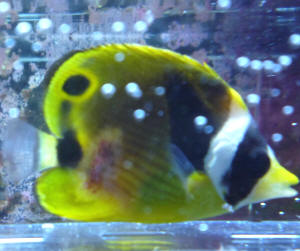
Urgent - Raccoon Butterfly disease ID
11/24/10
Dear Crew:
<... four megs for one pic?>
I would like to ask your help identifying this disease (please
see attached picture).
<Very bad news... extremely poor prognosis...>
I bought this Raccoon Butterfly 5 days ago. It started as a small
spot on the scales towards the tail and I thought that he just
scratched himself on the live rock but the spot is growing (it is
about 3/4 of an inch
by 1/4 of an inch as of now) and it appears that he is losing
scales where it's pinkish so I guess it's not just a
scratch. Last night I put him in the plastic container floating
in the main tank and applied Bio-Bandage Powder by Aquarium
Solutions (active ingredients: neomycin sulfate, cyanocobalamin
(vitamin B12), binders and adhesion agents). It did not seem to
get better overnight so I applied Bio-Bandage again this morning.
Can you please let me know how often should I apply this
medication for this type of wound?
<Have had very little success with these sort of bacterial
breakdown syndromes... Culture work will likely find a number of
gram-negatives... In the trade, extensive, high concentration
"Furan" (cpd.) baths are at times efficacious... But
almost all fishes at the shown stage perish>
Is there anything else I can do to help him heal?
<Not likely unfortunately>
Thank you very much for your help!!!
Sincerely,
Peter
<I do wish I could give better news. Please read here:
http://wetwebmedia.com/infectio.htm
the linked files above. Bob Fenner>
Re: Urgent - Raccoon Butterfly disease
ID 11/24/10
Dear Mr. Fenner:
<Peter>
Thank you for your prompt reply! I called a couple of LFS trying
to find "Furan" but they do not carry it and seem to
have no idea of what it is.
<Ahh, Nitrofuranace is the more common/available of
"Furan Compounds".
Sorry for the lack of clarity>
Is it sold under a different name or should I contact local
pharmacies rather than LFS? I do have
Metronidazole at hand. Do you think there is a point in trying to
use it if I cannot get Furan ASAP?
<There is not... this is an antiprotozoal...>
If so, what concentration should I use and how often/how long a
bath should I give the poor fish?
Once again, I greatly appreciate your help!
Peter
<Please use the search tool here: http://wetwebmedia.com/Googlesearch.htm
re Furanace, baths... BobF>
|
 |
Re: Urgent - Raccoon Butterfly
disease ID 11/24/10
Dear Mr. Fenner:
<Just "Bob" will do Peter>
I was able to find it but, unfortunately, it was too late.
<Ahh... as usual>
By the time I got home he was breathing but already laying on his
side. I proceeded with the bath but it did not help - to my deepest
regret he perished a few minutes ago. Should I be concerned with my
other fish catching this disease?
<Mmm, not so much... the etiology of this involvement is quite
often "subject specific", or if a given species is
crowded in poor conditions, already challenged health,
species-specific>
The tank is an established (1 year +) FOWLR and all water
parameters are good.
I never had any problems in this tank before but the perished fish
was in the tank when I noticed the appearance of the spot and the
plastic container that I put him in had tiny holes in it to allow
for water flow between the container and the tank. Thank you very
much for your advice.
Peter
<Welcome. BobF> |
Double-checking on FW dip procedure:
Dips\Baths 7/13/2010
Hi Crew, hope you're done well. :)
<Hi Chris, fine thanks.>
I'm preparing to buy a goby tomorrow. After catching and treating
ich (successfully, thanks to you guys) in my quarantine tank with my
last new batch of fish, I want to do a freshwater dip this time to
avoid that long, drawn-out process.
<Good.>
I've read a lot on your site, and my mind is still processing all
the information. I just want to confirm that this is the proper
procedure - this might be helpful for other people who are trying to
figure out the step-by-step process, also.
<Sure.>
1) Use R/O water. Add methylene blue and aerate the water for a few
hours prior to the beginning of the dip.
<Methylene Blue or Formalin Either will work, but Formalin is a bit
more effective in my opinion.>
2) Adjust the temperature to match the quarantine tank.
3) Adjust the pH with baking soda to match the tank's pH.
4) Drip acclimate the fish in his LFS bag to the QT water, like
usual.
5) After the SW acclimation process is complete, put the fish into the
freshwater dip for 2-10 minutes, or until he starts to show stress.
<2 - 20 minutes - the longer the better, provided the fish does not
show stress. My Coral Beauty happily swam in his FW dip tank for 45
minutes>
6) After that, put him right into the QT.
<Yes.>
Is all that correct and in the right order? I think I know what I'm
doing, but I just want to make sure I do more good than harm!
<That all sounds fine.>
Thanks a bunch! You guys literally saved my fishes' lives last time
I talked to you, and I'm very grateful.
<Glad you find all the information helpful.>
Chris
<MikeV>
PS: Since this will be some species of sand-shifting goby (don't
know for sure yet), I also want to put some gravel in with him. Is that
advisable?
Should I use sand coated with algae from my DT, or can I just use
fresh, washed gravel?
<Adding sand does help calm the fish down, just realize that should
you get a case of ich, you need to remove the sand for
treatment..>
Re Quarantine 5/3/10 - 5/4/10
THANKS.
<You're welcome.>
If I want to try the fresh water bath, how do I "adjust the pH to
match that in the isolation tank?
<Best to read here. http://www.wetwebmedia.com/dips_baths.htm>
And how is the Methylene blue used?? which diseases are these expected
to kill?
<All found by searching. Read here.
http://www.wetwebmedia.com/methblueart.htm
James (Salty Dog)>
Re Quarantine 5/3/10 - 5/4/10
I will plan on doing the isolation tank. actually already set up now
for a couple of days.
<Good.>
I have found two old meds in my fish medicine cabinet,
unopened-Greenex- by Aquatronics, containing mal green and quinine HCl-
says safe for invertebrates.
<<Is NOT! RMF>>
and Rid.Ich + , made by Kordon, containing malachite green and
formalin.
Would you recommend using either of these in the iso tank??
<I would not medicate unless it becomes necessary. As to the
medications, do read here, much more info than I can say here.
http://www.wetwebmedia.com/malachitegreen.htm
http://www.wetwebmedia.com/ichartmar.htm>
How about adding garlic to the food /or tank water?
<Can be beneficial, I'd add to the food. James (Salty
Dog)>
jay
Re: No clowning around (like I'm sure
I'm the first to come up with that), Dimilin in dips --
04/1/08 I had looked at that link (many times), couldn't make
any inferences. Unfortunately the clown died the day before yesterday.
He had no tail left, think he suffered too long and was beyond return.
<Agreed> Just before he died I dosed the QT with Jungle Parasite
clear (Praziquantel, Dimilin, Metronidazole, Acriflavine). I really
wanted just Metronidazole but I couldn't get any at the time and
picked up the mentioned out of desperation. Which leads me to my
question. In the dip/baths section, Bob is completely against using
Dimilin in marine systems. <Mmm, not efficacious as a dip
ingredient> Why is this so (especially if there are no inverts ie..
QT. I figure its just as bad as Cu++ meds, formalin...etc.)? <...
bad? No... just that acetylcholinesterase inhibitors in low
concentration don't do any good in short exposure> I could have
sworn I also saw a post with Bob recommending it for marine (although I
can't find it anymore). Could you explain the contradiction (that
is if there was, did his opinion change over time?). <Not w/o ref.
to where this is stated, no> Lastly, I assumed I had a parasitic
infection as upon dosing the QT, the clown moved erratically.
Presumably because the parasites were affected. <... what parasites?
Do you have microscopic evidence?> It could have been just from the
clown reacting to the meds but something (which I can't
articulate...you had to see the clown) seemed the parasites were moving
to get away and burrowing in him further. Thanks <...
BobF>
Re: No clowning around (like I'm sure
I'm the first to come up with that) -- 04/02/08 I do not have
microscopic evidence. It was just an inference on an observation with
out proof - merely a feeling (true, not scientific at all). <I
see... do know this sort of guessing is not altogether accurate. There
are symptoms that "mimic" pathological disease... with
non-infectious/parasitic etiologies... Too often "marks",
abrasions, "odd" behavior are rooted in social,
environmental, nutritional, genetic... causes> I just like to know
if you would recommend/use Dimilin in marine QT (not dip but in the QT)
and under what circumstance? If not, why? Thanks <I have used, and
suggested such use for arthropod zoonoses... on bony fishes (not
cartilaginous). IF one was sure of a copepod infestation let's say,
Dimilin might be a good choice. BobF>
DTHP use, marine, dips 7/7/05 Hello, Crew,
It's me, dum-dum, again. Okay, so I was reading about DTHP for the
treatment of various and sundry parasites and other general nastiness.
Recalling what I'd read already about QT, freshwater dips,
Methylene blue, and so forth, I was wondering if anyone had ever
established a protocol of a DTHP dip as a precautionary step prior to
introducing species to the main tank. Perhaps during the last four or
so days of QT? <Some wholesale outfits have used this, other
organophosphates to rid fishes of "worms" and crustacean
fauna (parasitic and otherwise) en-route... I would not, do not
encourage home-hobbyists to do this. Too much likelihood of damage,
toxicity to the livestock and themselves. Bob Fenner> Joe Kraska
Going For A Little Dip What would be your preferred FW dip
additive. Setting up a QT and Dip station and wanted to know
your thought on which one was more effective and or harmful to fish.
Thanks, Matt <Well, Matt- I'm a big fan of freshwater with
Methylene blue. It's gentle to just about every fish, and is really
easy to use. Administer enough MB to color the water a nice deep blue
color, and that should do the trick! See this FAQ for more information:
www.wetwebmedia.com/dips_baths.htm
Hope this helps! Regards, Scott F>
Dip question Hi Bob, In reading over the Saltwater
acclimation (the dips/baths portion) here on WWM, I see that you
recommend using Methylene blue, Maracide and Saltwater Maracyn in the
dip/bath water. Is this still accurate? I just wanted to be sure that
the procedure discussed was still your preferred method of doing a
dip/bath. Thanks once again for you ever helpful insights. - Ken
<Thanks for asking... because as you know... time marches on... but
archives always lag... Yes to these being the most appropriate, best
available technologies currently... You bring up other good points. I
look forward (not static!) to the times when sites like WWM's
offerings can be "updated" by the general readership. Bob
Fenner>
Medicated Dips Thanks for all the information you have given
me. I still have more questions though: I read the link you gave me
about iodine dips and was wondering which solution you recommended for
preventative coral dips. Do you recommend the iodine solution (2%
iodine, 2.4% KI), the strong iodine (5% iodine, 10% KI), or another
solution? <Either will do... as you will/would be diluting either...
about a "drop per gallon" of the 2% or 2 drops per five
gallons of the 5%, for five, ten minutes... some species of real
(scleractinian) corals I double the dosage on (Euphylliids, Veron 2000,
or Caryophyllids in previous taxonomies), Trachyphyllia, others if
they're obviously damaged) with lowered spg... a few
thousandths.> I¹m not completely sure how to calculate
the amount of Copper (II) sulfate pentahydrate to add to my solution.
<What? No memory of stoichiometry? Look up the atomic weights of
copper, Sulphur, oxygen... and hydrogen (for the five waters)... Come
on.> I think the problem is that I don¹t know the safe
copper level for fish. What is this level (in a freshwater dip/bath not
extended treatment)? <Resting concentrations of 0.20 ppm, dip levels
of twice that> On a side note, I have a mixture of snails in my
aquarium but the snails seem to prefer to spend more time on the rocks
than on the glass. Is this normal? (Is it because my rocks must have
³better² algae on them than the glass?)
That¹s all for now (more will certainly come later), Kevin
<Study my friend. When you get to St. Peter's Gate, there's
no easy internet access to query what to do... Bob Fenner>
Wow, dips over copper huh ? <categorically more
effective over a wider range... copper is really best for Crypt... not
a whole lot else. The problem with the other/deeper
parasites/protozoans is that they bury so deep into the flesh that you
will poison the fish with copper before the copper penetrates deep
enough to kill the pathogen. Osmosis from FW however can penetrate far
deeper and more safely in the big picture> Not sure I'm willing
to remove the copper at times over dipping. <experience is a
great teacher... try and you'll believe too> I know FW is
effective against gill flukes and crypto, but does it have any effect
against Amyloodinium/velvet or Brooklynella. I was under the impression
that one required copper and the other formalin. <I'll agree
that Brooklynella will "require" formalin as part of the
treatment (with FW dips, meds, etc)> 0.4 would normally be quite bad
for copper sulfate, but with Cupramine, you really need at least
0.25-0.3.0 minimum for any effectiveness against crypto as its a bit
weaker that a copper citrate/sulfate, but it appears to be better taken
by more species than other copper solutions. <there is just so
much debate on this topic> They actually recommend 0.5, but I
usually have good luck with it at 0.4. Ed <For what its worth,
bud... I'm basing my advice not only on a decade of handling sick
and stressed (shipped) animals commercially... but early on I took an
intensive Fish Pathology course under Gratzek and Blasiola (two of the
worlds leading authorities on piscine pathology). My/their
recommendations are certainly not written in stone... but they are very
well founded on handling many thousands of fishes over many accumulated
decades between us. Best regards, Anthony>

