|
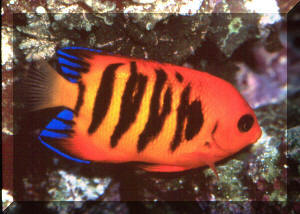
FAQs about the Flame Angel
Selection
Related Articles: Marine Angelfishes, Flame
Angels,
Related FAQs: Flame Angels
1, Flame Angels 2, Flame Angel Identification, Flame Angel Behavior, Flame Angel Compatibility, Flame Angel Systems, Flame Angel Feeding, Flame Angel Disease, Flame Angel Reproduction, Best FAQs on Centropyge, Dwarf (Centropyge)
Angels, Dwarf Angel
Identification, Dwarf Angel
Selection, Dwarf Angel
Compatibility, Dwarf Angel
Systems, Dwarf Angel Feeding,
Dwarf Angel Disease, Dwarf Angel Reproduction, Marine Angelfishes In
General, Selection, Behavior,
Compatibility, Systems,
Health, Feeding, Disease,
|
|
Angelfishes for Marine Aquariums
Diversity, Selection & Care
New eBook on Amazon: Available
here
New Print Book on Create Space: Available
here
by Robert (Bob) Fenner |
 |
Captive bred flame angel compatibility
8/26/16
Hi Bob and Crew, hope your all well, you were a great help answering
several questions for me when I had my old tank a good 10 years ago and
I was hoping I could pick your brains once more.
<Not much left; but let's see>
I was wondering if you have any experience with captive bred Centropyge
loricula, or other Centropyge species and can offer me some insight in
to how, if at all they differ behaviourally from their wild caught
counterparts.
<Actually; I do have some first hand and quite a bit second. Know of
Frank Baensch' work on the Flame, and the folks next door to Ocean Rider
on Kona... have penned a book on Pomacanthids, use in captivity....>
I am currently working on importing some captive bred flames into the UK
from Hawaii. I was originally going to get 1 for my 90g soft coral tank
(48x24x18 plus 20g sump) and 1 for a friends tank however as you are no
doubt aware by the time I have paid all the various import/health check
fee’s etc it actually makes little difference to the overall cost if I
order more. That got me thinking that I may get a pair, or even a trio
of juveniles with a view to one individual becoming the male but I’m a
bit concerned that 2 or 3 may be too much for a 90g?
<About the right size; with plenty of decor>
I understand from the breeder that they are raised in high densities so
am hoping that some of their territorial aggression may be curbed?
<Starting small, and from captive bred stock, not likely an issue, and
yes to one developing into a male for sure>
As a bit of background the tank has been running around 4 months and
there are currently no other fish, just corals and CUC. Prior to the
flame pair/harem idea I was planning on adding a pair of common clowns
and a captive bred orchid Dottyback, I would however happily change
these plans to accommodate the angels based upon your feedback. I also
do not have live rock opting instead for CaribSea's ‘Life Rock’ as a
more sustainable alternative, I’m aware this may play a factor in the
suitability of my setup, reduced foraging opportunities etc but am
hoping that by feeding a varied diet and seeding the tank with copepods
I can compensate for this.
<All fine>
I have also read that captive bred Centropyge are less inclined to pick
at corals having never encountered them before.
<Yes>
I find it a little hard to believe that this would be bred out of them
given their inquisitive nature and I guess, like anything with fish it
all comes down to the individual but do you have any experience of this?
<I do (second hand) and as you state, much less picky; more inclined to
accept prepared foods BY FAR>
Apologies for the long email! Thanks in advance
<No worries; thank you for sharing. Please do make it known how your
plans unfold. Bob Fenner>
Nick
Flame Angel.... Dying... soft corals? 6/27/16
Hi there! I have a Innovative Marine SR 80 (80 gallon) aquarium. 100 pounds of
live rock. IM Ghost protein skimmer. Nitrates 20ppm, ammonia 0, nitrites 0, PH
8.3, and salinity 1.025. It is a reef tank set up...with all soft corals...not a
lot though. I have had this tank set up for 3 years. I have no dwarf angels
currently. I have tried to keep the beautiful Flame Angel several times in the
past and the longest I could get one to live was 2 weeks! So I gave up. I have
your Angelfish book and your other book the Conscientious Marine Aquarist. I saw
in there you rated the Flame as a "1". I am not sure what I am doing wrong.
I would like to try again...but I am a little stand offish. Do you have any
suggestions or ideas for me? Any help or advice is greatly appreciated.
<I would place/keep the new Flame (actually all incoming organisms) in a
separate system for a few weeks, and after this period, trade a cup or two of
water twixt this system and the main/display. Am wondering if the soft corals
(likely more than Alcyonaceans here right... hobbyists often list Corallimorphs,
Zoanthids and more as such) are poisoning the Angels.
I might also add a unit of Chemipure and Polyfilter in your filter flow path
ahead of introducing the new Angel. See WWM for the general term "allelopathy".
Bob Fenner>
Dwarf Angelfish help
6/27/16
Hi there! I have read book after book and all the info I can read on the web
about dwarf angels. I have a 80 gallon aquarium, shallow reef tank, with soft
corals, and 100 pounds of live rock. It has been up and running for 3 years. My
issue is I have tried to keep Coral Beauties, Flame Angels, Cherub
Angels, and a multi colored Angel. All with no success. I have tried
different sources as far as LFS go. I have currently a Midas Blenny,
Fairy Wrasse, 2 common blood orange clownfish, and a Vermiculated Leopard
Wrasse. For my last fish I would like to add a dwarf angel. I am very
discouraged. Will my tank not support a dwarf angel?
<It should... some of the fishes you list... the Macropharyngodon; are much more
"touchy">
Is there something I am doing wrong? I make sure they are eating at the store
first. Each one did well for the first few days, eating, eating seaweed off of
the seaweed clips, and then within a week I would wake up in the morning to a
dead fish. No trauma, not being harassed by another fish, eating good the night
before. I am at a loss. Nitrates 20ppm, Nitrites 0, Ammonia 0, PH 8.3, and
salinity 1.025. Please give me any thoughts or ideas. I will appreciate any and
all advice. Thanks so much!
<Again; I fully suspect allelopathy is at play here; and if you can acclimate
both parties to each other, the Angel should do fine here. Bob Fenner>
Re: Flame Angel 8/28/16
That sounds like a great plan! Thank you so much for your quick
response! I value your advice!
<Glad to assist your efforts. Please keep us informed of your results.
BobF>
Re: Captive bred flame angel compatibility
8/28/16
Thanks for your help, the Conscientious Marine Aquarist was the first
book I read when getting into the hobby but I hadn't spotted your book
on angelfish, have just ordered the latter from Amazon which I'm sure
will prove just as enlightening.
<And hopefully informative>
That's great I will definitely try a trio, the tank has 100lb's of rock
and I have a few gaps to fill so may add another 20lb, the rockwork is
nice and porous with many little caves so will hopefully make them feel
right at home. I am in contact with the breeder directly (Syd Kraul at
Pacific Planktonics) and am currently trying the wholesaler route but
have also got the research ball rolling on importing them myself so I'm
hopeful that one way or another my plans will come to fruition.
Since my last email my constant hounding of various fish stores
throughout the country and emails to breeders in the USA has bore more
fruit and I now have access to captive bred Assessor randalli and
Meiacanthus oualanensis, both species not commonly available as captive
bred in the UK. I was hoping you could advise me on compatibility of
these with the angels.
<Can, will bite if crowded; as all Fangblenny spp.>
I would still plan to add a pair of ocellaris clowns but would switch
the orchid dotty for either the assessor or blenny. I understand the
blenny could probably handle itself but was thinking the assessor may be
a little too timid to keep with a trio of boisterous angelfish?
<I'd stop stocking w/ the Angels; and you'll likely need more space as
the loricula grow>
In terms of a stocking plan, I guess in an ideal world the angels would
be the last in but do you think there would be any danger if I were to
add either the clowns or the blenny/dotty after them?
<Yes>
Thanks again and I will for sure keep you posted on how things progress.
Nick
<I thank you. Bob Fenner>
|
Hi Bob,
I really like the flame angelfish
(Centropyge loriculus) but from my observations I have
only ever seen them as a single specimens in local shops and in
aquariums I've seen in books and magazines. If I got a
suitably large tank would it be possible to keep more than one
together? I was thinking about a hole in the wall aquarium that
would be about 130 to 140 gal and about 5 feet in length. I
thought this might be suitable for up to 4 flame angels as the
focal point of the aquarium, I would put in a lot of rockwork and
with some creative aqua-scaping I think I could minimise any
potential problems. What do you think?
I look forward to your
reply.
Many Thanks
Peter, W. Yorks
Well Peter, the Flame Angel does
indeed live in a grouping, often termed a harem, in the wild,
with one dominant/alpha male and a gathering of a few to several
females, and possibly a subdominant in-between, not-quite-male
individual about (Centropyge angels are protogynic synchronous
hermaphrodites, sexually undifferentiated as young, becoming
females, and males in turn if conditions, including the absence
of a more aggressive male allowing). In a volume and shaped
system (both important) you'd do well to limit your numbers
of this species to maybe three individuals, and whatever number
you settle on, to keep a keen eye on them to discern if the least
dominant specimen is receiving sufficient food and not too much
bullying. I do applaud your mention of appropriate rockwork.
Upright 'bommies' of drilled/supported stacks versus a
wall of sorts will go a long way to prevent aggression amongst
these fish, by blocking clear view in line of sight amongst
them.
|
|
3 flame angels? 8/27/13
Hi Bob
Would 3 flame angels kill each other in a tank of 42x29x18 (L x W x
H)
They would be the only fish in the tank.
<Mmm, well, not a good/great gamble... IF all very small (an inch or two
overall length) OR well-known (all caught together), one male, the others
female... likely would do "well enough"; otherwise... I'd definitely be
watchful (continuously) and have another system to move one to... in case.
BTW, such "harems" of Centropyge (et al.) species ARE kept together (mainly
for breeding) in larger volumes>
Acropora of 2 kinds (table and branching) would be the corals.
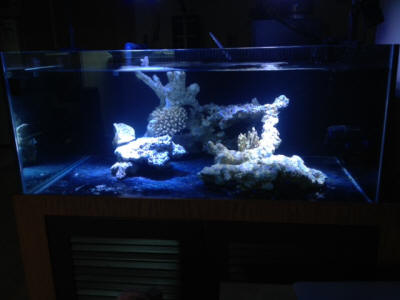
Aquascape is as attached.
<Ah yes; I see this. I'd provide some vigorous live rock as well>
Cheers
Ranjith
<And you, Bob Fenner>
|
 |
|
Re: 3 flame angels?
8/28/13
Thank you Bob
What do you mean by vigorous live rock?
<Healthy; with diverse life on/in it>
Circulation is 2 EcoTech MP40
The scape is made from live rock but dried and cured in fresh water to
avoid pests like Aiptasia.
<I'd risk having some new/live>
Cheers
Ranjith
<And you; B>
|
Angel Fish Questions... stkg./sel. and by species
5/7/13
Hello WWM Crew,
<Howdy>
I have a 210 gallon reef with 9 damsels, 1 Flame angel,
1 Hippo Tang, 1 Purple tang, 1 Fox Face and 1 Mandarin fish. Last
weekend I added some angel fish and I would like to know if it is a
disaster waiting to happen. I added 2 Flame angels, one Lemon peel and a
4" Majestic.
<Yikes! Well, the system is perhaps large enough to accommodate
the Flame trio... if they're all small size (a few inches) now... The
Majestic is hard to keep from most collecting areas... the better hail
from Bali... Do make sure yours is getting food>
I was told the last one was reef safe.
<Mmm, not really; unless the system is huge>
The first day, all the flames start fighting but now after 3 days they
seem to co-exist with each other well. They learn to stay away from each
other and I rarely see any fighting other than some mild chasings every
now and then. The Majestic is really shy and comes out every now and
then. I am not sure if it is eating or not. My tank has clams,
hammerheads, frog spawn, toadstool, Galaxea, flowerpot, mushrooms, and
few hard corals. Do you think eventually the Majestic will come out and
mingle with the rest?
<It most likely will perish. See WWM re the genus, species>
Did I make a mistake in my stocking?
<Again; likely so>
The water chemistry is always within normal limits. I thank you for your
reply.
<Read on! Bob Fenner>
Re: Angel Fish Questions
Thank you for your replies. I at times wonder why retailers keep selling
these expensive fish with dismay records.
<Good question; and one I've pondered long and hard.... Tis number one
because they sell... other elements; their beauty and grace, that these
are historically, perpetually species collected (yes); their relative
abundance, ease of capture... Still, as you hint/suggest... On the plus
side is the idea that folks WILL learn how to successfully husband them>
I wish I have done better research before I plucked down 150 bucks for the
Majestic. I however keep seeing Majestic thriving on YouTube videos so
maybe there is hope??? Thank you and I am a fan of your book!!!
<Ahh! There is always hope. Thank you, BobF>
Re: Royal Gramma Question, Flame angel sel. f' --
7/14/10
Thanks! I will do just as you advised. That's what I was leaning
towards doing. I'm so pleased with the flame angel I received.
I'd seen several in stores, and either the store wouldn't feed
them, or the one store that was willing to feed in front of me, the
fish wasn't interested in eating.
<I do know what you mean... this species used to be "hard as
nails"... like the Coral Beauty in the eighties, the
Oriole/Bicolor in the sixties... All are now quite "dicey"
selection wise>
So I was worried about ordering one online and having it starve but
this one is a great eater!
Thanks again, Pam
<Welcome again, BobF>
Stocking Plan 12/7/09
Happy Holidays Crew,
<And to you, Ryan>
I just finished reading the Flame Angel forum as I am planning on
making one my last addition to my 55g FOWLR. After my research I am
starting to have mixed feelings about placing one in the environment I
can currently provide. I understand that in my aquarium I can only
house one dwarf angel and it should be the last addition. So far so
good. My current tank stock is: 1 Brown Scopas Tang (reef boss), a
mated pair of Fire Dart Fish, 1 T.P. Clown, and 1 Yellow Watchman Goby.
I have been using the "inches of fish per surface area of
water" to calculate total fish volume.
<This isn't necessarily gospel, the girth, eating habits, adult
size, etc. of the fish has to be considered also.>
So far I am at about nine total inches of fish with about thirteen to
work with. My invert package is 2 cleaner shrimp, 4 turbo snails, 8 or
so blue leg hermits and a sand sifting star. In regards to the star I
know ideally he should have more room but I promise you he is happy as
can be. He receives his fair share of supplemental feedings and is well
cared for. Water is as follows:
Ammonia, Nitrite, Nitrate, and Phosphate all 0 mg/L. Temp 80.0-80.5
F.
S.G. 1.022. Calcium 420 ppm. pH of 8.1 and alkalinity 9 dKH. Tank has
been established for 3 years but was empty for about 6 months due to a
crypto outbreak a little over a year ago. Since taking the advice of a
LFS
that wants nothing more than a sale is as risky as navigating the
Amazon River in a chicken wire canoe, do you feel as though the
environment would support a Flame Angel.
<With your present fish load I would not do this. Depending on the
present size of the Scopas Tang, and
realizing future growth, it will require more room than what you now
have.>
I understand that there is always a risk with any fish not doing well.
However if my chances of a successful introduction are not high I will
postpone the purchase of this specimen until I convince my other half
that a 120g would look great where the old couch is now.
<I would be finding a home for the "old couch".>
I have a 15g QT set up already that I have used for my other fish. It
is bare bottom but I have put a piece of LR from my display tank in it
as preparation for the Flame Angel. If a Flame Angel is worth a shot,
what foods, besides the standard array of food I already feed, should I
offer?
I plan to get Angel Formula, Formula II, and since reading your forum,
some Life Spectrum Pellets that Bob had recommended to another poster.
In your opinion does anything jump out at you as a definite deal
breaker for the
introduction of this fish?
<Yes, the size of your present tank. That 120 is going to look much
better in your home than an old couch. Has anyone every commented on
how nice the couch looks?>
Thanks for all of your efforts!
<You're welcome. James (Salty Dog)>
Ryan
Stocking/Flame Angel 7/22/06
Hi All, <Hello Amanda> WWM is the first place I go for all my
questions, but after doing the requisite reading on your site, others,
and the books I've got (love 'The Conscientious Marine
Aquarist'!), I don't feel quite comfortable making this
decision. My 50 gallon tank is currently stocked with 2 perculas, 1
yellow watchman goby, 2 cleaner shrimp, and lots of various hermits and
snails. I've also got a happy healthy brain, torch, and hammer
corals spread out in the tank, but that's it for corals, besides
the copious mushroom population which has been expanding lately.
Everyone is living peacefully, which is my goal - fairly light stocking
of a happy tank. The cleaner shrimp regularly groom the clowns and
release their fry like clockwork for the rest of the tank to snack on.
Here's the question; a friend of mine is leaving the country and so
is looking to give away his fish. I've always thought the tank
would be complete with a Flame Angel, and he just so happens to have
one that he's offering up free. I've been trying to decide if
the tank is big enough to give him swimming room, and if my fairly
territorial goby will leave his potential new tankmate alone. He's
fine with the clowns, but they stay away from his cave since he'll
chase them out if they don't. This Flame lived in a tank with a
hammer before and 'pretty much' left it alone, so I'm not
terribly concerned about that, but I am concerned he won't have
room to swim and be happy. His first home was a 10g nano for about 4
months when he was first received, but he's been in a 150 for the
last few months. I'd love this fish to complete the tank, but
I'm not sure if he'll do well. Any advice you can offer would
be appreciated! <Your new Flame Angel will be just fine in that
environment. He too, will learn to stay away from the
cave. James (Salty Dog)> Thanks as always, <You're
welcome.> Amanda
Stocking a 55g Saltwater Tank - II Flame
Angel sel. - 06/02/2006 Sabrina, Hate to burst your bubble
<It's happened before, no worries.> but they do sell
tank-bred flame angelfish at LiveAquaria.com. If you don't trust me
visit this site at http://liveaquaria.com/product/prod_display.cfm?pcatid=1644&N=0.
<Yup, Bob corrected me on this as well. All the same, do
please consider a Flameback or cherub.... A flame, tank bred
or otherwise, will ultimately not do so well in a 55.> Next time you
tell someone that something doesn't exist, make sure you have
proof!!! <Mm, not logical to do so.... good examples
being deities and imaginary heroes like Santa Claus.... More
accurately, when you tell someone that something doesn't exist,
make sure THEY don't have proof of the opposite (grin).> Oh and
yes aquacon.com doesn't have tank-bred hippo tangs, they have
tank-raised ones. You're finally right for ONCE! <Not the first
time, nor the last time, that I will be wrong (or right) on something,
I assure you.> LOL! No hard feelings. Jeff R. <-Sabrina>
Stocking/Compatibility...55 Gallon Tank - 05/19/2006 I
am planning a 55 gallon aquarium and I want to have 2 tank-bred
ocellaris clowns, 1 royal Gramma, 1 yellow tang, and 1 flame angelfish.
<These fish do not acclimate well in new systems. Do wait
four or five months before considering the Flame Angel. The
other option would be to purchase a tank raised Flame Angel which will
do much better, but their high cost ($90.00) may be an issue with
you.> I also want to have 2 feather dusters, 1 bubble tip anemone,
<Anemones not recommended with non-immune fish> 2 scarlet skunk
cleaner shrimp, and 30 super Tongan Nassarius snails. Do I have too
many snails or do I need more? <I think 20 would be plenty.>
Please give me an exact number I need. Will my fish get together well?
<Tank will be too small for the tang and do not recommend purchasing
tangs this small (one inch, as you mention later)...can be difficult to
acclimate.> Am I planning for disaster? All fish when bought will be
1 inch in length and QTed. There will also be 100 pounds of live sand
and 50 pounds of live rock. My 55 will also have a bio-wheel (400gph),
3 power heads (each 270gph), a protein skimmer filtering up to a 100
gallon, a 260 watt power compact light, and a 200 watt heater.
<Other than the above, all looks well.> Thanks for answering all
my questions, <You're welcome. James (Salty Dog)>
Aqua Man
A Gathering of Angels (Flame Angel Group)
8/3/05 I'm planning to remove all of my present fish and run my
tank fishless for 1 week. <I'd go for a longer
"fallow" period; more like 3-4 weeks, just to make sure that
any possible diseases are eliminated as much as possible..> After, I
will buy 5 small Flame Angel juveniles and introduce them all at once.
Do you think it will work? <Well, a 100 gallon tank might be a bit
smaller than you'd want for a group of this size. I think a trio
might be better. even though these are juveniles that you are talking
about, they still will require space and territory.> You must be
think that I'm crazy don't you Thanks Ignatio <Actually- I
admire your experimental spirit! I hope that you are successful! Just
think of the long-term requirements of the fish, and I'm sure that
you'll be successful! Good luck! Regards, Scott F.>
A Gathering of Angels (Pt. 2) 8/6/05 Dear Scott (sorry I just
begin online by today because my server was damaged for 2 days) <Hi
there!> I'm intending to breed the Flame Angel, so do you think
only 3 of them can spawn? <Yes...you can end up with a breeding
situation with three specimens. They are protogynous hermaphrodites,
which simply means that all of the ones who become males started life
as females! In a group of Centropyge, once a dominant male arises, the
remaining fishes will generally stay females!> One thing again, I
have read "The Conscientious Marine Aquarist" which mentioned
that the brine shrimp can be a host for the Cryptocaryon irritans
parasite. I cultured them and feed my Sea lilies with that! Is it
true?? <Brine shrimp can harbor parasites which can affect marine
fishes...> Warm regards and thanks for your reply Ignatio <Best
of luck to you on your efforts, Ignatio! Regards, Scott F.>
Re: Flame angel 8/20/05 Hi Mr. Scott, thanks for
always replying so far. A few days ago I found a fry (actually I
don't know what was it), I don't know where does it come from
around 6 (the color is black with head is bigger than tail just like
baby frog before metamorphosis, around 7 mm) and around 3 with the
white color/no color 3mm. Now they are hiding in my PVC pipe in the
left side of my refugium. I know it is hard for you to imagine but I
don't think it is a plankton, or baby shrimp, or baby brine shrimp.
What do you think it is?? and where does it come from?? If it is a fish
fry, should I take it out and put it in the center of my refugium
because I have a full of plankton and Caulerpa in the center of
refugium for them to feed. Well I'm not expecting too much on that
actually, I read in Reef Culture Technology Hawaii and it is very
difficult to raise the fry to become a fish. Note: my flame are fine,
the conflict is small (I arrange a rock decor with plenty of cave to
hide) and they want to eat after all. Thank you Mr. Scott Best regards
Ignatio
Tank Raised Flame Angels Hello Bob, <Rich> I only but
tank raised livestock mostly because I dive and really hate
the thought of yanking these animals out of there natural
environment for my hobby. That being said I love having a
aquarium and putting as much color and variety as possible
with farm raised fish. I was very excited about
tank raised Flame Angels. My question is what
happened to them??? They where around for a
brief time (I believe raised in Hawaii) and then puff,
gone. My searches have found
nothing. I would appreciate any info. Thanks.
Cheers, Rich <Two things actually... the fellow producing them
(Frank Baensch, in Hawai'i) likely found that other species were
more profitable (e.g. interruptus), and secondly, the market just
wasn't there for loriculas... due to their small size and high
prices... Someday... Bob Fenner>
Fishy Prices, Greetings! I
truly enjoy your web site and the wealth of knowledge available. I only
wish my brain could retain more. I was at the LFS perusing the stock
and came across a Flame Angel (from Fr. Polynesia) that I was
interested in until I saw the price. It was double of what of I had
thought it should be. The owner said that prices on some fish are up
due to the tsunami. I was wondering if you have any insight to the
wholesale prices being affected by the tsunami or if the LFS is trying
to fleece me. Thank you for sharing your expertise and your time.
<Well I can tell you this, my LFS sells Flames at 39.00-49.00
depending on their origin. James (Salty Dog)>
What do you think? (Flame Angel, Cooks, Chip) Hi Mr. Fenner
Once again I write you for your opinion. I read in your FAQs about
flame angels, not being great from the Christmas islands, and Marshall
islands in the last little while. But what about the Cook islands, My
LFS had three, and now has one left from there at the moment. It's
been at the store now for about three weeks, and is in great shape, and
active. <A great source location... only one source there...
Chip and Claire Boyle... very qualified collectors, shippers...
excellent quality> I 've stopped by a few times to see how the
little guy is doing, and he's always been very active, in great
looking shape, and very attentive to his surroundings. I, like you, am
in love with this particular fish, and want one a lot, but I'm
worried because I've had one once before, and he didn't last
more than two weeks after I got him home. (Got a very bad case of Ick,
and didn't quite pull through the treatment), So I've been
hesitant, and just keeping an eye on this guy for a little while.
I've gone over all of what you've written on your site about
the upkeep of these little beauties, and can't really think of
anything I did wrong with the last guy. I'm hesitant because they
aren't the cheapest, and also, and most important, I don't want
to be the cause of his demise. But as I said, I think they are just
gorgeous little fishes, and would really like to have one. <I would
buy a C. loricula from the Cooks w/o worry. Bob Fenner>
Recent flame angels Hello. I have been hearing quite a few
things about flame angels recently. Especially ones from the Christmas
Islands. My friend has a flame that he has had for about a month, and
it has been eating good and is quite robust and healthy. I forgot to
ask him where he got it from. Regardless of that however, is the 1
month in captivity in good health a good indicator of a good
specimen, <not out of the woods for certain but an excellent
and reassuring sign> even if it was collected from such places as
the Christmas islands? I was wondering this because I hear some
specimens from the x-mas islands can be vary from good to bad. Thanks.
<all really an artifact of good versus bad handling in holding and
transit. Do read about playing the "deposit" game with
retailers here on WWM or in Bob's book The Conscientious Marine
Aquarist. Do arrange to have a dealer hold a prospective fish
(prepaid/deposit as necessary) for weeks if possible. This will
dramatically improve you chance of success with this and any fish. You
still must run a full QT period at home though (4 weeks recommended).
Best regards, Anthony>
"A flame by any other name... would smell.... er, just
smell." I was thinking about purchasing a flame angel from
LiveAquaria.com but I can't decide on where I want the specimen
from. They have a choice from either Marshall Islands, Christmas
Islands, or Cook Islands. I want a healthy specimen obviously, but I
also want one that will be very vibrant in color and stand out. Which
specimen would have the most vibrant coloration? One more question,
I've heard that the Cook Islands only have once source of
collectors (I forget the name) but now that LiveAquaria.com is getting
them in from the Cook Islands could it still be possible that the same
couple who collected those flame angels are still the only ones doing
it? Because I read that there's only one source in the Cook Islands
and they are qualified collectors, shippers and have excellent quality
stock...Thanks! Steve <The non-Hawaiian flame angels tend to be less
red, more orange. Some have more purple. I personally prefer the
Hawaiian flame angels to exclusion and have not preference on the other
three locales re: coloration/morphs. The Hawaiian ones also ship better
(handled well and shorter transit to California). If you are looking
for "vibrant"... seek a Hawaiian flame :) Best regards,
Anthony>
Question about Flame Angels Date: Fri, 05 Sep 2003 Dear
Bob, <Hello Mary> Hello! Hope you've had a great summer.
Business is finally starting to pick up again, and I'm hoping for a
very busy "busy season". <Yay! Good riddance to the summer
doldrums days, weeks, months of marine aquaria> I have a question
for you. In my never-ending battle to educate the public on cyanide,
there is a person who is claiming that Flame angels are cyanide caught
because you include the Philippines as part of their natural range in
this article
http://www.wetwebmedia.com/marine/fishes/angels/centropyge/loricula.htm
<Unusual (as in rare), but so from the region. As you know, most
loricula are collected from the Marshall's.... though the species
is found (inconsistently) from Australia to Hawai'i (the little
male on the cover of CMA is a shot by Fred Bavendam in Hawaii...> I
have told them that Flames are rarely, if ever, exported from the
Philippines (I've never seen them on a list) and that just because
something has a "range" there that doesn't necessarily
mean it is collected for the aquarium trade. <Well-stated, and
agreed> I've told them that flames are generally exported from
Christmas, Cooks, Vanuatu, and sometimes Hawaii. Could you send me an
email clarifying this so I can respond to Mr. Everything is Caught with
Cyanide properly? <I am in concurrence with your view, observation.
Flames are rare in the P.I. I also have never seen them on a
"list" of animals from the area. I will post this message
with our loricula information. Thank you, Bob Fenner> Thanks, Mary
Middlebrook
Farm-Raised Centropyge loricula 9/10/03 Bob: Since you have a
place in Hawaii, I figured I would address this question directly to
you. Do you or anyone you know have any experience with the
tank-raised C. loricula out of Hawaii? I was wondering if
anyone has seen what these specimens are looking like. Do
you know how long this species has been tank-raised? Is it
better to wait a longer time for numerous generations before acquiring
one? Any information is greatly
appreciated. Thanks, Rich <Have not seen any cultured
Flames for sale as of yet... Think this is a U. of HI project still at
this point (i.e. not commercial). Will take a while to grow out ( a few
to several months) the young to be anywhere near saleable size. Bob
Fenner>
Re: Farm-Raised Centropyge loricula 9/10/03 Bob: Thanks for
the blazing fast reply. Actually, one of your sponsors is
claiming to sell these:
http://www.liveaquaria.com/product/prod_Display.cfm?siteid=21&pCatId=1644
and I was hoping you had some more info. This is the
first place I come to (and buy books from) for advice. Rich
<Ahh! Thank you for this notice... eighty dollars for 3/4 to 1
1/4".... Yikes! Dr.s Fosters and Smith, good for them and the
interest.> Ps: Hey, when are you coming back to the Northeast?
<Mmm, no plans right now... Will be at the next IMAC and MACNA's
though. Be seeing you, Bob Fenner>
Re: Farm-Raised Fish 10/29/03 Bob: A brief
review. I notified you of a mail order company selling a
farm-raised Centropyge loricula. The company is
unimportant to my question, so I will leave them nameless here (you can
read in past email below). First, about your response:
"eighty dollars for 3/4" to 1-1/4".... Yikes!...good for
them and the industry". 1) Is "yikes" in
regards to (a) size, (b) price or (c) size/price ratio?
<Yes... just a bit of (to be expected) "sticker-shock" at
the price of small specimens (compared to the current transit and
net-landed-cost for adults procured from the wild> 2) If it has to
do with size, is there a general minimum (not that again!) for farmed
fish? <In general, yes. There is tremendous resistance from
consumers (oftener than not) for "too-small" specimens,
particularly in the face of available, larger, less-expensive
wild-caught individuals of the same species> 3) Are wild specimens
of this fish a lot cheaper out West? <Flames "land" on the
west coast for something in the "teens" of dollars to
wholesalers... generally retail for 50-75> 4) If yes, is it because
of the shorter travel time from their collection sites? <Mostly
yes... due to less re-bagging, shipping time... another important
factor is that many markets (towns) shops sell livestock for scant
mark-up> My LFS always has a good supply of larger (3"+)
wild-caught specimens at a steady $60. So, I thought a 33%
markup would be a worth it to be able to leave one in the ocean (I like
to think of it that way). Also, I like the idea of having a
smaller guy to watch grow up. <I agree with your
orientation> 5) As far as your 5" maximum statement, how long
would you say it takes for this species to reach this size?
<A few years (2,3) in a large, uncrowded, well-fed setting> 6)
Can I reliably approximate an age for this fish at 2", 3" and
4"? <Perhaps 2, 3 and four years respectively, plus or minus an
inch or year> 7) With any "newly" farm-raised livestock,
is it best to wait a few generations? 8) If yes, why? <Not
necessarily... it "took" a couple of decades to work out the
bugs, get as hardy, colorful, well-marked generations of Amphiprionines
captive-produced as wild, but the Centropyges, other angels...
Gobiosoma, Pseudochromids and others are hardier than wild-caught from
the get-go nowadays> 9) How long (ballpark) would a few generations
take? <five, ten years, depending on species characteristics,
difficulties to work out in the breeding, rearing protocols> 10) Can
you breed out the "wild" in a species? <Yes,
definitely> Sorry, I think I got carried away, but I just wanted to
cover everything. My main concern is buying a large specimen
that is already 5 years old/possibly at middle-age, since this fish
will be my crown jewel. Regards, Rich. <No worries. Good
questions, valid concerns. Bob Fenner>
Angelfishes for Marine Aquariums
Diversity, Selection & Care
New eBook on Amazon: Available
here
New Print Book on Create Space: Available
here
by Robert (Bob) Fenner |
|