|
FAQs about Fluorescent Light and Lighting for
Marine Systems, Power Consumption & Heat Production
Related FAQs: Fluorescent Light 1,
Fluorescent Light 2, Fluorescent Light 3, Normal Output (NO), High
Output (HO), Very High Output
(VHO), Compact
Fluorescents (CFs, PCs), Compact Fluorescents 2, T5, TN Fluorescent Lighting, & FAQs on
Fluorescent: Fixture Selection,
End Caps, Ballasts, Regular and High-Output Lamp Selection,
PC Lamp Selection, T-5 Lamp Selection, Lamp
Life-Span Issues, Installation-Wiring, Troubleshooting/Repairing, By Make/Model/Manufacturer: & Metal Halide Lighting, Lighting Marine
Invertebrates, LR
Lighting, Tridacnid
Lighting, Small System Lighting,
Related Articles: Fluorescent Light
& Lighting, Spectral
Quality of Various Fluorescent Lamps by Dana Riddle, T5 Fluorescent Lighting, Coral System Lighting,
|
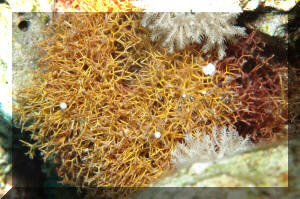 Galaxaura sp. Red Sea
08. Galaxaura sp. Red Sea
08.
|
Euro Braced Acrylic Tank and T5HO…Too Much Heat? <Nope> - 09/18/14
9/19/14
Hello,
<<Hi there>>
In your experience does hanging a T5HO 4 bulb (4x54 watt) fixture about 6 inches
above an acrylic tank cause any issues from heat or discoloration to the plastic
over time?
<<Not at all…I am utilizing LED lighting over my acrylic display tank now, but
ran much hotter Metal Halides over the tank for quite a few years without
issue>>
I am mostly concerned with top seams getting weak on the tank. The brand of the
fixture is Hydrofarm EnviroGro and it is 4 feet long. I ran it for a bit and the
plastic was warm not hot, but I am really not sure how much heat is safe for
acrylic?
<<Not accounting for flaws in materials/workmanship, as long as the heat is not
enough to soften or otherwise distort the acrylic you’ll be fine>>
The tank is 90 gallons and just has the two cut out openings in the top.
Thanks for the assistance!
<<Happy to share! EricR>>
Low Output Ballasts?/Lighting 8/18/09
Hello everyone,
<Hi Mark>
I recently purchased a VHO ballast and VHO bulbs for a frag tank which
I grow corals in to sell to the LFS to help finance my addiction to the
hobby. The output of the new bulbs didn't appear any different than
the standard 40 watt ones I was using before, so I checked the wattage
with a meter I own. It is one of those that just plugs inline on the
power cord.
It is dead on when I check my metal halides or T-5's on my main
tank. It says the ballast is only putting out around 90 watts total (45
per bulb), far below the 220 advertised. It also tests for amperage and
it is down considerably as well. They are definitely wired correctly as
they were bought as a retro-fit kit from Hello Lights. They are
clueless about what the problem could be and said if they light up
there is nothing wrong with them. I disagree.
<What you are reading on the primary side of the ballast isn't
indicative of the power the ballast is supplying to the lamp
itself.
A magnetic ballast works something like an inductor, a coil of wire in
a circuit which may be wound around a piece of metal (core). When
current flows through the wire, it generates a magnetic field.
Positioning the wire in concentric loops amplifies this field, and the
ballast in tandem with a transformer controls the amount of current
going to the lamps. Newer ballast designs such as ARO's, use
advanced electronics to more precisely regulate the current flowing
through the electrical circuit. Since they use a higher cycle rate, you
don't generally notice a flicker or humming noise coming from an
electronic ballast. Do not compare your current readings to MH and T-5
lighting. Different lamps require specialized ballasts designed to
maintain the specific voltage and current levels needed for a
particular lamp. If the ballast were defective, you would likely see
flickering, or no light at all.>
Is it possible they are selling cheap ballasts not really putting out
what they claim on the packaging?
<ARO is a reputable brand of ballast, the 220 watts/1.82 amps,
strictly refers to the maximum power/current the ballast is capable of
handling.>
I always had decent luck in the past with them so I'm not
criticizing, just wondering if ballast brands could make that much of a
difference.
<Unlikely.>
The brands and specs are as follows: ARO electronic ballasts model
AS-220 and URI T-12 48" VHO bulbs (110 watt each). Have you heard
anything negative about either of these brands?
<No.>
Any advice you can give to what may be the problem would be greatly
appreciated. Your site is a huge benefit to the hobby.
<As above.>
Thanks again.
<You're welcome. James (Salty Dog)>
Mark
Wattage measurement 11/20/08 Hello
<Ed> I was always under the assumption that the wattage
measurement on an aquarium was an accumulative value of all the bulbs
above the tank. <Tis.> I was recently informed that is not
correct. Two 96 watt CF bulbs are only putting out 96 watts, not 192.
Is there any truth to this? <If you mean one bulb that has twin
tubes, yes. Many of the CF bulbs have multiple tubes connected at the
plug-in.> Ed Raasch
Re: Wattage measurement 11/20/08
Thank you <Welcome.> Glad to know I'm not completely stupid.
edr <Heee, we all have those moments! Scott V.>

