|
|
| Home | Marine Aquariums |
Freshwater Aquariums |
Planted Aquariums |
Brackish Systems |
Ponds,
lakes & fountains |
Turtles & Amphibians |
Aquatic Business |
Aquatic Science |
Ask the WWM Crew a Question |
| Please visit our Sponsors | ||||
|
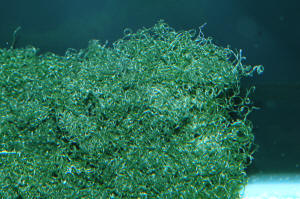
Green Balls? Valonia... Bob, I have written you in the past with some different questions and would like to say thank you again for your past advice. I have some new things that I would appreciate your advice on. A real quick low-down on my system is 125 gallon aquarium with a Sea Clone protein skimmer (I know that I could do better here), two Emperor filters, VHO lighting, 1 inch of live sand and roughly 70 pounds of live rock. I currently have two green dragon wrasses, a six line wrasse, a Foxface, and two orange diamond gobies. I have two toadstool leather corals, some green button polyps, and a couple of mushroom anemones. My aquarium was having some problems in the beginning and I suffered a few losses before realizing that the well water that I was using was using me to have high phosphates. I proceeded to purchase a RO Filter and have made quite a few big water changes, even more small water changes, and am continually topping off the water with the new water that I am making. My phosphate levels have dropped slightly but for some reason I cannot get rid of them completely. <Good progress so far... the phosphates are "cycling" in your system... and re-cycling...> They are currently measuring at 2.0 ppm. <Yikes... I'd grow and toss some Caulerpa algae here... sort of like the use of biomass accumulators (e.g. Hyacinths and wastewater) to gather and remove nutrients from solutions> I don't over feed so I don't think that this is the problem. Before purchasing the RO Filter my leather corals would hardly open up. Since purchasing the RO Filter, my leather corals are almost always open and seem to be growing. I am happy for this but have had some bad luck with trying to add any new inhabitants. In the past few months I have tried adding a Naso tang, yellow tang, Kole tang, and lastly an Emperor angel all at different times and have watched each one get sick and die in a week or so. <As an indicator, wait on any new livestock till the phosphates are below 1.0ppm, better 0.5ppm...> I think what that died from was ich or velvet. I have done all the environmental manipulation that you suggested but wasn't able to save any one of them. The loss of my emperor angel really bothered me because it was my favorite fish. It used to eat right out of my hand but for some reason I could not keep it from getting sick. I was able to treat in a hospital tank a couple of times but each time I put it back in the main tank it would eventually get sick again and eventually died. My original fish are still alive and don't show any signs of anything. For this reason I don't think that I have a parasite problem so much as that the water quality wasn't good enough to keep these more delicate species alive. <Hmm, no... more likely you have a "toxic tank problem"... that you are salvaging bit by bit...> One thing that I do have in my tank seems to be some uncontrollable green algae. For some reason I can't keep this under control and I think these little green balls that came with my live rock may be causing it. Originally there were only a few little green balls on some pieces of live rock but have recently noticed that they have spread to many other rocks. <Yes... likely Valonia... see the "Algae", "Green Algae", "Pest Algae Control" sections and associated FAQs pages archived on our site: www.WetWebMedia.com> They have almost encrusted this one rock. Finally, here are my questions. What are these little green balls and are they the cause of my green algae problem? Does the presence of the green algae contribute to the high phosphates and do you think this may be the reason why I haven't been able to keep some of the more delicate fish? Again, I want to thank you for any insight you may offer. Gianluca <Green algae group, Valoniaceae... not a direct contributor, but a recipient, user of nutrients... not toxic per se... read the many related sections on the WWM site. Bob Fenner> Halimeda and Calcium Happy Holidays! Through help from your website I feel I have made great progress in understanding the chemistry of my tank. Lately I have been trying to get a grip on the CO2, bicarbonate, buffering action which is a very interesting dance. <Well put> I purchased alkalinity and Ca test kits to see where the tank is situated in the continuum. <Ah, even better> My alkalinity was a paltry 80 which I subsequently boosted to 180ish with NA bicarb. The Ca was dreadfully low too at about 150 ppm. Subsequently I purchased ESV 2 part solutions to try and boost the Ca. I add it in the mornings as directed. It has been about 3 weeks and the concentration hasn't budged. I believe the reason is the calcareous algae. <Likely> I have a 100gal tank with a generous (2-3 cu ft volume) amount of Halimeda. I believe it is absorbing it soon after it becomes available. I don't believe it's precipitating but my pH does reach 8.4-8.6 by the end of the day. How would one know if it's precipitating? <Mmm, you would likely see (yes, that much) the "powder" on the surface of your substrate, rock...> Short of buying a coral dissolver (Ca reactor) I believe my best courses of action would be to cut back the Halimeda and/or increase the supplement and watch the parameters. <Yes... I would try a bit of both> I'd prefer the former over the latter. What would you suggest? The only other consumer of Ca is a Trachyphyllia geoffroyi. It's been in the tank 2 months and seems content. Should I be concerned about its well-being under chronically low Ca concentrations? <Not so much... it has adapted well-enough to your conditions... and has other mechanisms for utilizing food, alkaline and biomineral sources (the last two from other than the water)> P.S. I've gone night diving in my tank! I mean after the lights have gone off and I am feeding the Trachyphyllia geoffroyi the night critters come out. It's a whole different perspective that I recommend others to try. Thanks again and Happy New Year!! <Yes! Be chatting my friend. Bob Fenner> David A. Bidwell |
|

|
Features: |
|
| Featured Sponsors: |