|
FAQs on Magnificent/Ritteri
Anemone Health/Disease
FAQs on Magnificent Anemone Disease by Category:
Diagnosing,
Environmental (Pollution/Poisoning, Lighting...),
Nutritional,
Social (Allelopathy),
Trauma,
Pathogenic (Infectious, Parasitic, Viral)
Predatory/Pest,
Treatments
Related Articles: Magnificent
Anemones, Bubble
Tip Anemones, Anemones,
Cnidarians, Colored/Dyed
Anemones,
Related FAQs: Magnificent
Anemones, Magnificent Anemone
Identification, Magnificent
Anemone Behavior, Magnificent
Anemone Compatibility, Magnificent Anemone Selection, Magnificent Anemone Systems, Magnificent Anemone Feeding, Magnificent Anemone
Reproduction/Propagation,
|
|
 |
New Print and
eBook on Amazon:
Anemone Success
Doing what it takes to keep Anemones healthy long-term
by Robert (Bob) Fenner
|
|
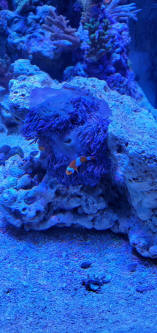
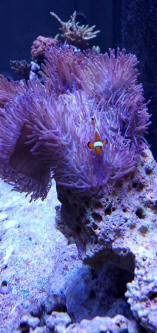
I need your expertise; Heteractis magnifica
4/8/20
Hello team! I have been a frequent visitor of your site for years and truly
enjoy your articles and books. I have had reef aquariums off and on well
over 10 years. I’m fascinated by the clown fish and anemone relationship,
and I have successful kept bubble tips anemone for years and have ventured
into the infamous Magnificent Sea Anemone. I know they don’t ship well and
the one I received had to be treated, which I believe I have done
successfully. My questions are:
1. How will I know if and when the animal has settled? (It hasn’t moved
since it was placed in the tank where it receives average par of 380 -400
with peaks of 450. ( 240 gallon display tank lit by 4 Orphek Alantik V4 gen
2 and two Kessil A360X)
<Not moving is a good sign for this and other anemone species; and the
clownfish settling in (not avoiding) the host>
2. It has lost a little of its color since its Cipro treatment, how long
does it take to get that back? (Pix attached)
<Hopefully within a few weeks... I might (over)dose your supplementing of
iodide/ate... with testing.>
3. Should I feed it at this time? I know when I have fed it in the past its
tentacles deflate for a few hours? Not sure if this is normal or a bad sign?
(In contrast my bubble tip anemones appear to get bigger after feeding)
<Yes; I would feed two, three times per week... "test" some food and if it
is sticking, go forward with more>
4. Finally the mag has been in my tank since 03/17/2020. I receive it on
03/7, it started treatment on 03/08 (Went through cycles of deflating and
inflating) and back in the aquarium 03/17 (No longer does it deflate or
flatten out, however it does appear to shrink a little at night?)
<Yes; this is natural. Not to worry>
Thanks for your time, I look forward to your response.
Video <https://photos.app.goo.gl/5cAJkD4JJHdCoqD4A
> of aquarium mag is on the right
<Thank you for sharing. Bob Fenner>
|
  |
|
Ritteri Anemone twisted 11/28/16
Hello!
<Jackie>
Your site is amazing, but I can't seem to find an answer to my dilemma.
<Thanks for using WetWeb, and I'm sure I can help>
I purchased a Ritteri anemone 8 days ago.
<Yikes... I hope you're familiar with the husbandry for these animals. They
are too commonly bought by clueless individuals and end up dead in a matter
of days>
For the first few days, it basically just wandered around and when I saw it
getting to my coral or too close to a powerhead, I would manually move it
with my hands.
<Be careful doing this. Wear some sort of gloves, as this species is very
delicate>
It has since settled in the bottom of the tank on a rock, and is hosting my
two clowns greatly.
<This is good to hear. It's always nice to hear that clowns have discovered
a new home>
My problem, however, is that the anemone looks twisted around itself.
<Could you send pictures? Hard to picture what you mean exactly. Larger
specimens can get sort of balled up and lay on top of themselves. This makes
it appear to have wrinkles or folds>
It's a good 8", maybe, stretched all the way out, but for two days, it's
been on this rock with both sides of its foot pretty much attached to
itself. I'm afraid to move it anymore fearing it may perish.
<Leave it alone. It's always best to let an anemone find its home by itself.
Unless it is near a powerhead, let it be. If it moves toward a coral, move
the coral, NOT the anemone.>
It's partially deflated (less than half its tentacles), but plumps up when
the lights are on. I have not noticed it balling up like bubble tips do.
It's also had its mouth open all of the 8 days. I don't see it losing flesh,
and otherwise seems healthy. My clowns went right to it, we're talking 5
minutes or less.
<This also could be stressing it out a bit. When an anemone is first
introduced to a tank, a bunch of animals diving in and out of it can be
stressful, as I'm sure you could imagine>
I've read they're hard to keep.
<I hope you've done a TON of reading. They are extremely difficult to keep.
This is one of the few animals I believe should be kept in the ocean, no
matter how experienced the aquarist in question is>
I've had 3 Rose Bubble Tipped anemones for going on a year. All three are
perfectly healthy, even without regular feedings. I've tried to feed it a
piece of shrimp and it refused the food.
<Not uncommon when first introduced to a tank, and because partially they
use the light for food>
This was only about two or three days ago before it made its home in the
bottom of the tank. It has major flow, good lighting, and water parameters
are perfect.
<Please define "good" and "perfect". Let us know the flow rate and the
lighting spectrum/PAR, and the exact water conditions>
I don't want this thing to die in my tank. I'll trade it in before I
willingly let something die in my tank.
<If you can trade it in, do it>
Upon reading up on them, I've learned that these anemones are so much
different than the "regular" more easily kept anemone such as the bubble
tips.
<You should've done more reading>
Any advice would be greatly appreciated! (I'm not requiring this for help,
but I do have an instagram profile that documents my reef journey. You can
see pictures there, ( account name is Owens.Reef ) or I can send you
pictures upon request. I also think I should add that this is how the
anemone has been the whole time it's been in the display. Acclimation was
floating (for light), then a slow drip acclimation (for temp and water).
A little about my tank: 110 gallon mixed reef. Livestock includes: Diamond
Goby, Mandarin Dragonette, Purple Tang, Yellow Tang, Blue Tang, Ocellaris
clown, snowflake clown, Copperband butterfly, coral beauty angel, six line
wrasse, 2 emerald crabs, hermit crabs, several types of snails, 9" clam, 2
peppermint shrimp, 2 pistol shrimp, fire shrimp, cleaner shrimp, nearly all
types of coral.
Thanks in Advance,
Jackie Owens
<Jackie, I would trade this specimen in for something you can easily keep.
If you truly decide to keep it, you need to do a lot more reading. Search
WetWeb re Ritteri anemones. Send pictures as well. Cheers, Gabe>
Re: Ritteri Anemone twisted 11/28/16
Hey, Gabe!
<Jackie>
I am very familiar with this anemone and it's requirements.
<Phew... Glad to hear this wasn't an "Oh look an anemone" type of purchase>
I'm one of the lucky few reefers who have a local fish store that won't sell
you an animal without a good running tank and good tank mates/water.
<This is good to know. Too many stores will sell you anything as long as
they're getting paid>
Anyway, my tank is a 48"x18"x30". I have a 1600GPH return flow, along with a
submersible pond pump running 1000GPH behind the rocks that stack all up the
back side of my glass and almost all the way forward, expanding in
width on the way down (done this for pod population and Mysid shrimp
reproduction). I also have a 1650GPH Hydor powerhead and a small twin
powerhead running 1200GPH turnover.
<Did you want some aquarium with that water flow? :)>
My lights are 2 150x3 CREE LED hanging fixtures.
<Good>
My parameters are as follows: Ammonia 0, Nitrates 0, Nitrites 0, Phosphate
undetectable, pH 8.3, Calcium 440, dKH 11, temperature 78, SG 1.025.
<Good as well>
It seems to be moving some, and I've researched more hours than I've had it,
I believe.
<Thanks for the relief. This is a hard species to keep, and that reading
will pay off if you keep the specimen>
Haha. I know they're nearly impossible to keep, as anemones are in general
to some reef keepers, however, I feel (as well as our friends who own their
own saltwater store) that this beast will flourish in our display. I'm
concerned because I know how different they can be, along with their
temperamental ways and sensitivity in the home aquarium. Thank you for
getting back to me so soon! Can't wait to hear back.
Thanks,
Jackie.
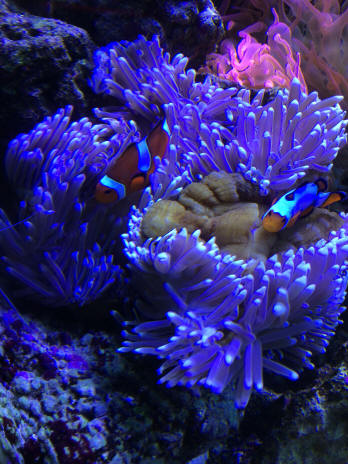
<Jackie, to be honest, I think you'll be fine. Based on the
pictures, it looks like the anemone is just so big that it needs to
fold on top of it self to fit where it wants to mount itself. It appears
very healthy and should be fine as long as the parameters stay where they
are. Good luck with your magnificently temperamental, Magnificent/Ritteri
anemone. Keep us posted in the future, and as always, thanks for choosing
WetWeb. Cheers, Gabe.>
|
|
Re: Ritteri Anemone twisted
12/8/16
Good morning, Gabe!
<And a happy 5 AM to you too, Jackie>
I just wanted to update you!
<Okie-dokie>
The Ritteri is doing great. As far as it's inflation issue, we're still
having it, but I figured out what was causing it and I am in the process of
nursing it back to health. It was hungry!
<A-ha! Glad to hear it is doing well>
Apparently, it requires a lot of food to start thriving, or it wasn't fed
well before (more likely).
<Since they are highly dependent on light, they don't need as much as a
different species would when it comes to food. Still , regular feeding is
smart, but make sure no to overfeed, and also make sure you are feeding a
varied diet>
I have been cutting up raw shrimp into small 1/2" pieces and hand feeding
it.
<Be careful hand feeding, and feeding at all with any instruments. Ritter's
are a very delicate species and you can easily damage their tissue and cause
their death without even noticing you touched it>
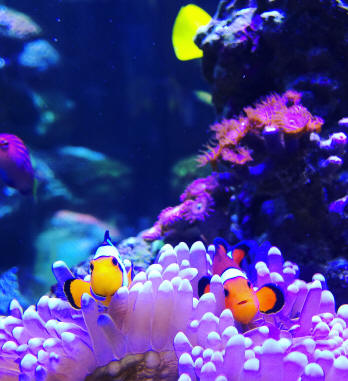
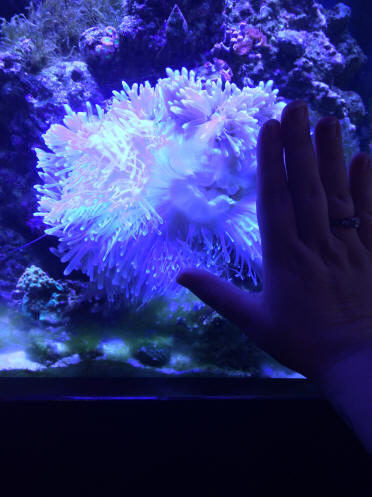
It looks healthier every day. After it gets enough to eat, it inflates and
looks better than ever. One day at a time for now. In the mean time, here's
a picture of my recovering monster!
<Wow! That's a great looking specimen, Jackie>
Thanks so much for all of you help! Oh, and you were right. It's so big, it
was just folding over itself, but it's moving around a little now trying to
find that perfect spot.
<Glad I could enlighten you with that knowledge>
Hopefully it stays away from my corals,
<Might want to rephrase that to "hope I can keep my corals away from it" :)
>
but I just want it at it's full potential and happy in our piece of the
ocean!
<I am happy to hear that things are going well with your anemonemone (as
Nemo would say)! As always, feel free to contact us at any time in the
future. Cheers, Gabe>
|
 |
|
|
EMERGENCY: Ritteri Anemone
8/31/16
Hello Crew-
<Gabe>
I went and bought a Ritteri Anemone recently.
<Hope you studied....>
I put it in the tank, and it immediately adjusted to the new
environment.
No problems at all. It eventually adhered itself to the glass of the
tank.
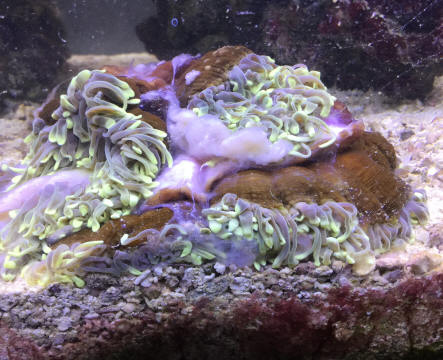
That's when I noticed that the foot was damaged
<Very common problem leading to death>
and it's insides were showing. That white stringy stuff?
<Mesenterial this and that>
Anyway, it kept getting worse, and the half of the anemone was deflated.
Now, as I am getting home from school, I notice that it is no longer on
the glass, but on the sand in a pile. Not inflated at all now. I triple
tested my water, and it all looks fine.
<Not for long>
Everything else in the tank is thriving. I don't think the anemone is
going to make it,
<Agreed>
and I am going to pull it out as soon as it starts to smell and decay.
<I'd do that now>
If you have any suggestions on what to do with the anemone, please let
me know ASAP. I need to know how to proceed. Photo is attached.
Yours-
Gabriel
Gabe Walsh
<The aforementioned reading re the species on WWM:
http://www.wetwebmedia.com/marine/inverts/cnidaria/anthozoa/hetmagnifica.htm
and the linked files above; or my book (see Amazon) on Anemones and
their use in aquariums. Bob Fenner>
|
 |
|
Anemone help from South Africa. Anem. incomp. 7/31/16
Hi all
I have a 250l Red Sea Max, that is matured.
I added a bta to my current setup which has 2 magnificent anemones
<Yikes... not good to mix large Actinarian spp.>
yesterday (clones). I do not have a qt at the moment.
This morning the bta and smaller magnificent were touching. I then separated the
bta this morning and put him in a basket, still in the main tank
The 2 magnificents are sulking and have turned a very dark cokour compared to
normal. I think this might be due to toxin from the bta. The bta was completely
open.
<The winner>
I have removed the bta and put him in a bucket with a pump and airstone to
separate from main tank.
<Good move>
I am running some extra carbon Brightwell carbonit x3 and want to do a 30% water
change tomorrow morning when I can create enough water and prep it sufficiently.
Any other advice,?
<Yes, a treble dose of iodide-ate; a double dose tomorrow... and some (a tsp. or
so) of simple hexose sugar if you can find it (just one level for the whole
tank, dissolved in system water); glucose preferred>
Your response is appreciated
Regards
Yusuf
<And you; Bob Fenner>
re: Anemone help from South Africa
7/31/16
Thank you for the response,
<Welcome>
I'm not sure what iodide-ate is and I don't think get it in
over here.
<Mmm; yes you can. Look for SeaChem's line>
For sugar can I use plain brown sugar or glucose syrup ?
<The latter>
Once again thank you
<Welcome. BobF>
Regards
Yusuf
re: Anemone help from South Africa
7/31/16
Hi Bob.
<Yusuf>
Thank you for all the help and prompt response. Will pick up the iodide today
and the glucose syrup.
<Good>
Will do a 30% or so water change.
<And this>
The magnificents are already looking better.
<Ahh!>
We give the iodine to allow for an immune booster? And the glucose for energy?
<Yes>
Regards
Yusuf
<Cheers, Bob Fenner>
Re: Anemone help from South Africa
8/1/16
I did the water change now just waiting for everything to settle.
<Very well>
Thanks once again for the advice.
<Welcome>
Il let you know if everything is ok.
<Please do>
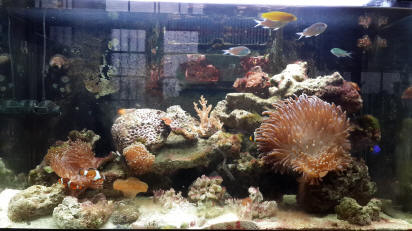
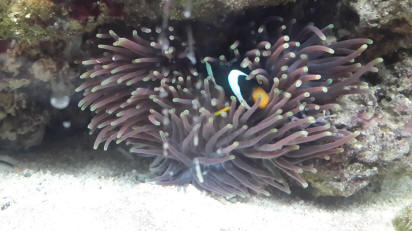
Please see pics of the magnificents before and after
<Looking better. BobF>
Regards
Yusuf
|
 |
|
Magnificent Anemones. Using WWM - 1/25/13
Hi Crew,
<Aaron>
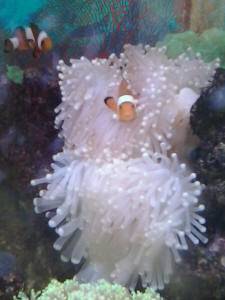
I recently purchased an anemone which is creamy coloured with whiter
tips.
<Very badly bleached... complete loss of Zooxanthellae... can
reincorporate>
It is not that large about 12-14cms across. My two Ocellaris clowns
which have been without an anemone for seven months ignored it for the
first day but on the second day were both in it and never really leave
it, only for food. I wondered if they need to secrete more mucus over
their bodies before they can go inside one having been without an
anemone for so long.
<Sometimes communication takes a while. Sometimes it never occurs>
This is great as it give me so much pleasure to see them rubbing their
bellies on the tentacles. This leads me to believe that clownfish should
only really be kept with the appropriate anemone as I don't think they
will be complete without one. I have dived all over the worked and never
seen a clownfish in the sea without an anemone.
<They (Amphiprionines) always live in mutual symbiosis w/ one of a few
species of Actinarians>
I have a couple of questions, all may water params are good
except......my phosphates were about 0.3 so I have added Seachem's
Phosguard in a pouch which I hope will reduce the phosphate to
negligible levels within 2-3 days.
<I wouldn't do this... see WWM re>
How sensitive are they to Phosphates?
<Not very... and do need soluble HPO4>
Also my temperature is a little high, I live in the tropics and my
chiller is set for 30C Why 30C well with the aircon on during the day it
hardly has to reduce the temperature, lower temps and it is on much more
often and makes a noise and uses about 1amp. The anemone looks in good
order, but when I drop New Life Spectrum small pellets on it it does not
seem to respond.
<Needs meatier fare>
I noticed the anemone is sticky but looking at your site where I saw
"There are no naturally white-colored Magnificent Anemones...
<This is correct. Do occur in quite a few other colors though>
and it's rare for ones that are badly bleached to recover" do
you think it could be another species or is it doomed?
<Most likely the latter, but is also likely Heteractis magnifica... see
WWM re ID... the petechia on the column, its color>
Should I try another food?
<... yes>
I placed it about 15 cm.s below the water level between two rocks and it
has not moved in four days so I hope it is happy. It looks great. Please
find a picture attached. It is very close to a Goniopora, if they touch
will either be hurt?
<Oh yes. Bob Fenner, out diving in the Philippines>
Thank you in advance, Adam.
|
 |
Re: Magnificent Anemones.
Bob, Wow enjoy the diving, so you think it can regenerate Zooxanthellae and
should live?
<Yes; didn't I already state this? Can, not should. B>
Re: Magnificent Anemones.
Yes but opposite to what I captioned and sent to you from your site, perhaps
new info. Please update to avoid confusion. So the purple base will return
with green tentacles?
<... not necessarily these colours and not w/o good care... Please read
where you've been referred to... B>
Re: Magnificent Anemones.
- 1/25/13
Hi Crew, I have a system with some delicate fish, Majestic Angel etc two
pieces of Goniopora and I added the Magnificent anemone
<? Angels eat anemones>
only a week ago and it died today.
<... very typical>
My params are all good, slight phosphate 0.05, Nitrate a little high at 10,
the fish and the Goniopora are all fine. The temperature could be a problem
running between 30 and 31. The anemone was bleached but as previously
discussed this should not be an issue.
<? Of course it is>
Do you think it is possible it was already "dead" but did not show signs
or are they that sensitive to temp. I am upset as my Nemos loved it. Any
advice would be great I have read they are very difficult to keep. Regards,
Adam.
<Am done telling you to read on WWM. Go elsewhere. B>
Re: Magnificent Anemones.
- 1/25/13
How rude as clearly mentioned previously I had read part of your site and it
conflicts what you now say in regards to bleaching. Also in regards to your
suggestion that the Magnificent Anemone needs Phosphates that are detectable
I find that hard to believe as I live by the Indian Ocean where the
Phosphate reading is Zero.
<...> |
Heteractis Magnifica Anemone - Care and Medication Question
11/5/12
Hello! And thank you for your time.
<Welcome Brad>
First, some background. My tank is a 210g with a 40g sump. It has been
running and healthy for just over 14 months. I myself have been in the
hobby for almost 4 years. In that time I have taken a strong liking to
anemones, and have had a great amount of success with them as a result
of learning from sites like yours. In my current setup I have many
corals, fish, and anemones that are all living peacefully due to careful
placement and purchasing.
<Okay! Am sure you know of the dangers of mixing Actinarians, and doing
so w/ other Cnidarian groups>
Five months ago I purchased a Magnifica anemone at a LFS. It did not
immediately take to my system due to a low alkalinity, but was recovered
and settled after about 2 weeks once I fixed that. About four months
ago, I added a second Magnifica from the same LFS. This one never had
any trouble, but for a few weeks fought with the old one for his spot
and finally won. The first one moved to a different spot and settled a
little higher, closer to the lights. Fast forward to 3 weeks ago. I sold
the first Magnifica to a fellow reefer, and it is doing well. I did this
to make room for a new Magnifica of a more preferred color, which I
purchased from a reputable online seller. My question is in regard to
this "third" magnifica.
<All right>
For the first 2 weeks it did well, and ate every other day with no
issue.
About a week ago it suddenly spit out it's meal after dark on feeding
day, and ever since then it has deflated and inflated repeatedly in a
cycle of about every 8-12 hours.
<Mmm, doesn't like something here>
It does not appear to be timed to the light cycle at all. When it is
inflated, the mouth does not completely close, and when it deflates, it
has a badly gaped mouth.
<Also "bad signs">
I have heard some people suggest
that it may be trying to fight a bacterial infection. What are your
thoughts on my situation?
<Far more likely something, someone else in this system it doesn't
"like">
The first Magnifica is still well, as is the second one, which is in the
same tank, under the same light and flow as the new one. I have also
done 3 water changes this week, as well as change out
the carbon. All of my parameters are good (SG is 1.025, no PO4 or NO3,
<Mmm, photosynthates need some (measurable) phosphate and nitrate...
sigh>
Alk is 11, pH is 8.0). I am considering transferring the sick anemone to
a QT and treating it,
<Just moving it will likely help>
but I would like to know what you can share regarding treating these
anemones. I have heard suggestions of using Tetracycline,
Doxycycline, and Cyprofloxacin, with Cipro supposedly showing the best
results, but no studies have been done that I know of. Any input would
be appreciated.
Thanks again!
Brad
<I don't suggest exposing this anemone to an anti-microbial. Not of much
probable value, and considerable potential downside. Bob Fenner>
|
bubble anemone shrinking tentacles... Nope... sent
secondarily 4/24/2009
Hi Crew. Thanks in advance for your help. I am needing some help
with my bubble tip anemone.
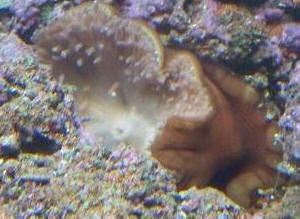
<Not... see here:
http://wetwebmedia.com/marine/inverts/cnidaria/anthozoa/anemones.htm
Can't be sure from your image, but from the color of the
pedicle, the verrucae... this looks like a Heteractis
magnifica>
I purchased him at my LFS about 2 months ago. I am in the process
of trying to correctly identify him using your web site, but when
I got him he had beautiful frosty bulbs with purple on the
tips.
<Mmmm?>
He was fine, behaving and eating as I would expect based on the
research I've done about them. About a month ago we replaced
the bulbs in our aquarium. Compact fluorescents 2 each of 65w
dual actinics and 2 each of 10,000K dual daylights.
<How far away...?>
Our tank is a 90 gallon with a 15 gallon sump. No mechanical
filtration. 6 inches live sand, 110 lbs live rock, a pro clear
aquatics 150 protein skimmer in the sump, and a pacific coast
imports chiller that keeps the
temperature at a constant 78. specific gravity is always 1.024
with water that has evaporated replaced each day with RO water
from a Kent RO unit. We do weekly 10% water changes. Calcium is
about 400, PH is 8.2-8.3. no ammonia etc. alkalinity is on the
high side of normal according to my test kit. The aquarium has
been set up for over 3 years. This is the first time adding a
BTA. Also I change a carbon pillow monthly in the sump. We have
four ocellaris clowns, one desjardinii tang, one regal tang, one
yellow tang, a coral beauty, and a male and female mandarin
dragonet. Also a lot of snails, some hermit crabs a couple
cucumbers a skunk cleaner shrimp and two red fire cleaner
shrimp.
Anyway, since we replaced the light bulbs, our BTA has not been
well. His color on his body is still the same, brown, but his
tentacles have shrunken more and more until they are almost gone.
He still eats and excretes waste. I feed PE mysis shrimp mixed
with Cyclopeeze and formula two flakes daily to all tank
inhabitants, and I feed small chunks of shrimp and scallops from
my local grocery store to the BTA every few days. Usually he
takes it.
Occasionally he lets it go. Are the lights the problem?
<Perhaps a contributing factor... This amount (intensity) of
light is insufficient for either Entacmaea or a
Magnificent...>
Should I move him?
<I would try this>
He is attached to a large rock that can be moved lower in the
tank. I am attaching a photo that I took of him this morning. At
night when the lights are out his disk expands like a big soft
pillow full of water, about 4 or 5 inches across, but the bulbs
still stay shrunken. His mouth is tight and smooth. Can you
guys(and or girls) help? Thank you so much. I love your site!
<Please use it. Bob Fenner>
|
 Re: BTA shrinking tentacles more info... Allelopathy
4/24/2009
Hi I sent you guys a question earlier this morning about my bubble tip
anemone problems. I sent a picture of him, and listed all water and
lighting other livestock etc. I did not mention the other corals in my
tank. I have been reading on your site all day and I'm wondering if
the brown, gold, and green Zoanthids in my tank could be the
problem.
<Mmm, yes>
I thought it was the new light bulbs. I will continue researching on
your site, but wanted to add to my earlier e mail that there are a lot
of Zoanthids in my tank, also some metallic green star polyps, a toad
stool,
and a mushroom.
<All these can be toxic to other Cnidarians... most so the
Zoanthids>
If the Zoanthids are the problem, should I get rid of them. Our tank
has been set up for a long time and they have multiplied a lot. Will my
BTA survive? What's the easiest way to get rid of them? Thanks.
Dawn D.
<Mmm, best for you to read:
http://wetwebmedia.com/cnidcompppt.htm
and the linked files above... till you understand your situation,
options, consequences. Bob Fenner>
|
Sick Ritteri... many issues... A jokester?
12/27/08 Hello, We have had a Ritteri for about 15yrs. We had
him in a 50 gallon tank for many of those years, along with the rest of
our reef inhabitants. At one point several years ago we remodeled our
room and we changed to a 75 gal. tank. For a year or so all was fine
and then we had a water problem of some sort and he started shriveling
up so we tried to fix the water problem and put in Nitrate sponges and
phosphate sponges, we made sure our sump was working properly, and that
our protein skimmer was working properly...Everyone else in the tank
was very happy except him... In an last ditch effort to save him we put
him in our 15 gallon show tank [taller than most 15 gal tanks]. We
have
mushrooms and polyps on rocks <Not likely compatible with the
Magnificent anemone> in there and they are doing beautifully. He
attached himself and for the last several years along with "Coral
and Marlin" the two clown fish that have been with him since we
got them, They have been happy. About a month or two ago we started
having a green water problem and the Ritteri is shriveling up and
closing up, and spitting out his stomach, and is almost flat.... we
have taken every test available to us. Salinity is 23, <Mmm, better
to be near seawater strength/concentration: 1.025> Nitrate was 0,
<Is an essential nutrient> Phosphate was less than 0.05 ,
Hardness [which is too hard] 14... the Calcium is 540 <... Way too
high... and your Magnesium?> .....We did an almost 90 % water
change. We used the Reef water since it has no issues...about 60% of
the tank, 10 gals or so. and the rest, new salt water from our barrel.
but the Ritteri wouldn't perk up. Our little tank is green again,
and we have ordered Algone for the tank but it hasn't arrived yet.
<I would not use an Algicide...> So we put the Ritteri in the
reef on the bottom...... We are watching him , he is stuck to the
bottom , but he's spitting up all this fluffy looking stuff and all
his tentacles are laying like a flat mum (the flower)... <Bad>
but he does not smell and none of the cleaning crew are trying to eat
him...What do we do? Thank you so much, Susan and Bobert Arnett
<Please read here:
http://wetwebmedia.com/marine/inverts/cnidaria/anthozoa/hetmagnifica.htm and the linked files above. Bob Fenner.
Anemone problems, Ritter's 11/25/08
Hi there, you have helped me out in the past, and I am back again. I
just acquired a Ritteri anemone, about 4" in diameter, <Mmm...
"squeezed down" for shipping likely... Heteractis magnifica
in the wild are almost always much larger than this> came shipped,
arrived in good condition. I have tons of live rock, checked up on your
website, placed him high in the tank. Cut back the water flow for now,
he rolled around a lot and now is where i think he wants to be, however
my maroon clown has taken interest in him and now is trying to move
him. The anemone isn't attached yet and it has been a few days.
What should i do?? Thanks for all your help. <Mmm... I'd remove
the Clownfish for sure... temporarily... to see if this
"helps" the anemone to settle... H. magnifica/Ritter's do
"go floating about" much more than any other symbiotic
Actinarian species... Do make sure pump intakes and overflows are
effectively screened... heaters as well. You have read my piece on this
species care on WWM:
http://wetwebmedia.com/marine/inverts/cnidaria/anthozoa/hetmagnifica.htm
and the linked files above? This is not an easily kept animal... Bob
Fenner>
|
Injured H. magnifica 3-10-08 I purchased a
magnifica today, in the shop he was quite reluctant to leave his
rock, thought taking the rock was not a viable option as it was
very large and covered in e.quads. Anyway, he/she suffered a
pretty bad tear during removal, it is now in my tank (I
wasn't sure what to do, I have 2 ocellaris clowns in my
quarantine and I didn't want them harassing it). The tear
runs right through its body and foot, almost to it's mouth
but not quite. most if its foot still seems functional and it is
expanding slowly (although it is looking like a BTA as it
expands.. I hope I got the right one =\). Is there anything I can
do to help it recover? I feel pretty bad as it is, and to top it
off the aquarium is 2 1/2 hours away so replacement is not viable
for a while. I appreciate any help you guys can give, (btw, PH =
8.3, ammo = 0, nitrate = 0, nitrite = 0). <Leave the anemone
alone for 24 hours, then attempt to feed with minced meaty foods
and Selcon. Tearing this anemone during removal was irresponsible
- more care should have been taken. It is possible and relatively
straightforward to extricate an anemone with some patience, a
credit card, and some ice> Thanks, Oscar. <Anytime - M.
Maddox>
Re: Injured H. magnifica 3-10-08 I am aware
it was irresponsible, unfortunately it was out of my control as
it was not me removing the creature.. <I would have
complained, and not purchased the animal after that abuse>
Thanks for the help though. should it still be able to eat if the
tear extends to it's mouth? <Maybe, maybe not - worth a
try, with finely minced meaty foods, or a turkey baster and
Cyclop-eeze. Good luck, and avoid that store from now on! M.
Maddox>
|
Failing Ritteri Anemone, Heteractis magnifica --
1/18/08 Crew, <Hello Craig, Brenda here!> Some background
info about my situation: I have a 92 corner bow front and a 40G
sump that was moved in October, originally set up last July. I
moved 30 miles and switched from using tap water to RO water at
that time, since my local water didn't want to mix with salt or
Kalk very easily. The 92 that was set up back in July was filled
with sand, rock, and livestock from a 54 corner bow front that had
been set up for 2 years. The 54 and 92 housed the same mix of
corals and fish until recently, when I sold my Ritteri and pair of perculas. <Anemones should never be kept in a system using tap
water.> The tank has the following mix of species, and this mix
has remained relatively unchanged for about 12 months, other than
switching out one Ritteri for two new ones and two Perculas for
three Ocellaris. <How long ago were the new anemones added? Why
is the water cloudy looking? Did you replace the sand bed, or rinse
it?> It is important to remember these animals have always been
in the tank with my old Ritteri and now with my new Ritteri as
well. <The old anemone made the move with the tank?> I know
how Bob expounds without end the risks of keeping a mixed reef, but
all my animals are no less than 6" away from one another and I
have not had problems with chemical aggression. <Unfortunately,
chemical warfare is not always visible until late stages. I agree
with Bob on this. Do you run fresh carbon in your reef tank? How
often are you replacing it?> * Two Ritteri anemones * LPS - 10
head green branching hammer, 2 head yellow frogspawn * SPS - 6
4-6" Acro, Monti, and Staghorn * Clavularia - Daisy, Star
polyps, and 2-3 other types I can't ID......prolific on my
rock, covering all told 30-40 square inches * Pipe organ - 6"
* Various Ricordea - 10-12 Actinodiscus, which are not
"hairy" or "knobby" * Juvenile Emperor
(3") when he gets bigger so will his accommodations * Black
Ocellaris - three that are 2-3" * Longnose Hawkfish - 3"
* Snails, crabs, what not cleaners The salinity was usually kept
around 1.028-29 with the old Ritteri, which was high, but the old
Ritteri definitely preferred these higher salinity ranges by
demonstrating positive behavior (not moving, remaining inflated) so
I let the livestock dictate the parameters and not the books and
instruments. Now I have two new Ritteri, an additional one was
given to me since an extra one was shipped in my order.
<Shipping anemones is also very stressful on anemones. This is
no doubt adding to the poor health of the anemone.> For the
first month I only had the first anemone, but after the LFS
couldn't sell and couldn't provide enough light, it came
home with me. Given these anemones are often found in huge
associations in the wild, is it a problem to keep more than one in
my tank for now (yes, a fraction of the water volume...but they are
only about 6-8" inflated)? <It can cause problems.> The
LFS kept the anemones at 1.025 and the anemones seemed more
inflated there than in my tank, but that would be a very imprecise
appraisal. It is worth noting the LFS had dozens of 20G tanks
plumbed together with zooanthids, tons of Ricordea, polyps, and all
manner of actinarians: BTAs, LTAs, Condys, Sebaes, etc. <Ouch!
This is definitely not the best environment.> Here is the issue:
as you can see, both anemones don't seem to want to fully
inflate. 1/4 of the tentacles somewhere on the anemones are
deflated at seemingly all times. So I know that all animals within
a species are individuals and behave uniquely, and also these new
Ritteri are likely from a different location, since they have a
purple mesentery and my old Ritteri had a yellow body and thus they
could be from the Red Sea and prefer higher SG (like my old
Ritteri). Even when I had only the one newer anemone I noted this
behavior, so the presence of the second anemone is out of the
question (they are also about 3 feet apart). The deflated areas
change throughout the day, so tissue damage is out of the question.
Both anemones have eaten under my care (they both prefer only
tilapia...same as my old Ritteri) so failure to feed is out. They
are under 400W of halides at 14000K, and do not move around (which
of course is atypical for this species). I have a Hydor 3
circulation pump (1200gph), two Rio 1200 with rotating deflectors
(600gph) and a Mag 24 return pump with central diffuser (~1800gph)
so I don't think a lack of circulation is an issue. <It
doesn't sound like it. However, if you don't protect the
intakes of those pumps soon, you may have a bigger problem if your
anemone decides to roam.> I have even tried turning down/off
some of the pumps in case too much circulation was an issue (though
I have heard Bob admonish this is almost never possible with
non-laminar currents). I do run an Octopus NW200 skimmer for tanks
up to 200G. Nitrate is around 5-10ppm. <It needs to be zero.><<No!>>
Nitrite is 0, ammonia is 0, and phosphate is 0. Salinity is 1.027.
Temperature is 80F. pH is 8.2. Basically, all the parameters are
the same as they were with the old anemone, but these anemones do
not seem to be altogether comfortable. <The anemones are also a
bit bleached.> I have experienced in the past when an anemone
remains less than fully inflated for extended periods of time, it
is not long for this world. I know reef animals need stability more
than anything else, so if I am going to change one thing (other
than livestock, which is the last resort) it is going to be the
specific gravity of the tank. Being osmotic conformers, can anyone
verify my hunches regarding the osmoregulation feedback loop of
anemones? So if the SG in the surrounding water is lower than what
the anemone wants, would it deflate to attempt to raise the
concentration of salts within its tissues? Or is it the opposite?
Do anemones have some sort of mechanical automatic response when SG
is changed? <Anemones don't do well with abrupt changes.
Anemones do deflate to exchange water, and to expel waste. However,
I do not believe the anemone is deflating because of a salinity
issue.> I have observed changes in inflation whether increasing
or decreasing SG by .001 over the course of an hour (always keeping
it between 1.025-1.029). <A range of 1.025 -- 1.029 is much too
large. When you increase or decrease by .001 over an hour, what you
are seeing is the anemone acclimate it self to the change in
chemistry.> Then they seem to go back to their initial state of
inflation. I don't want to play guessing games with the SG of
the tank and end up killing the anemone, so before I take the step
of removing all other inverts, could you give me some perspective
on how to feel about this lack of inflation? I understand it's
a common problem people experience when new to keeping anemones,
but I have been at this a while and the answer evades me. I have
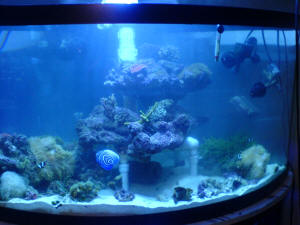
attached three photos (glass is a little foggy...water is clear).
<Good!> There is one of each anemone and one photo of the
setup as whole, for you to see the spacing of the animals. Sorry
for the marathon email, you guys <and Gals> are the ONLY
reason I have had ANY success in this hobby. <Glad you find us
helpful.> You are also the ONLY reason I have such an
appreciation for these animals and their natural environs.
<Craig, I believe you have a couple of things going on that are
causing the poor health of the anemones. First, the tank was moved
in October, this is too new of a set up for anemones. I'm a bit
confused on how this transfer was done. Did you replace the sand
bed, or rinse? Anemones need established environments. I'm not
seeing an established sand bed. Second, both of your anemones have
likely recently been shipped, and likely both recently collected
before they were shipped. Wild collection and shipping is
incredibly stressful and many times deadly to anemones. Your
fluctuating of salinity is also not doing the anemones any favors.
I typically recommend 1.026 for anemones. This species is known to
do well in captivity at this level. However, I would not say that
1.027 is necessarily bad for this creature. Stability plays an
important role here. The mix of corals you have could also be
harming the anemone. Running fresh carbon may help this issue.>
Regards,
Craig
<Hope this helps! Brenda> |
|
 .JPG)
.JPG)
|
Anemone problem I have looked at a very large amount of
anemone websites on the internet and I believe that you site is ranked
as one of the most informative in my opinion. <thank you... as
it is intended. I for one feel that most anemones should not be
collected and that most aquarists should not buy/keep them. We could
talk for hours about the reasons why. Simply know that for starters
that they are likely doomed to fail (assuming you can even get a
healthy undamaged one) if they are not kept in a species tank: no other
cnidarians! No coral and no other anemones> I have kept many
anemones with not much luck. They just all seem to slowly die. I hate
that. <don't keep buying them my friend> I currently
had a big beautiful ritteri anemone. <perhaps the most
difficult of them all. They need full reef lighting... more than most
coral. How many aquarists are willing to spend $1000 on a hefty halide
lighting system just to keep a single anemone. This... most climb the
walls starving for light and die without it or get torn/killed in a
pump or overflow intake in their search. Tragic> It seems to be big
in the morning but as the day progresses it just seems to get much
smaller and tentacles begin to deflate. It has plenty of light
<250-400 watt metal halides?> and a moderate amount of water
movement. <very strong water movement needed here too> The
thing with all my anemones is when the begin to die, they look like
they begin to expel some sort of a smoky substance. Can you tell me
what that is? <one possibility is the expulsion of zooxanthellae under duress> And is there anything I can do to help
my anemone? <natural sunlight supplemented with big halides, no
unguarded pump intakes, heavy feedings of micro sized ocean meats,
weekly water changes... essentially a species tank> thanks, Chris
<best regards, Anthony>
Heteractis magnifica health 12/12/03 Guys, <Adam here this
evening> I have had a magnifica for about 8 months (previous owner
had it for 2years) <congrats on your success with this difficult
animal!> and all of the sudden the mouth has protruded outward and
it has not decreased in size. At night the mouth comes out even
further. <I have seen this behavior in other species of anemones,
and have always seen it pass in otherwise healthy specimens> The
anemone has not lost its color or its ability to hold onto food (it
does not eat food but holds onto it for about 10 min. and then lets it
go) <Good signs that the stress it is experiencing is probably mild
and still reversible.> It is about 12 inches wide and 2 clownfish
host it one 3 inches long and one 1inch long. I have metal halides and
bombard it with current. <You obviously are aware of this animals
requirements in this regard. If it has been healthy for 8
months in your care, I suspect that you are meeting light and current
needs. My next thought goes toward water
quality. Even if all of the parameters you test for seem to
be within acceptable limits, there may be a water quality issue outside
of the things we normally test for. If this aquarium also
houses corals, I would be suspicious or allelopathy. If not,
I would still recommend a couple of significant water changes.> I
use to feed it 3 times a week but for about 2 weeks I have not fed it
at all. Let me know what I can do to remedy the situation. <I would
verify that all measurable water quality parameters are acceptable, and
proceed with a couple of water changes regardless of the
results. If any large corals are present, I would consider
moving them to another tank. In the mean time, I would limit
feeding attempts to only enough food to see if the animal resumes
eating. When it does, you can increase the
amount. If you don't ever vary the food, you may try
that also.> Thank you for your input <Always a
pleasure! Please do keep us updated. Adam> Alexander
Blanco
Ritteri blues Good Morning, <hello> I have a 50 Gal.
tank that is 36"L X 18"W X 20"D, with 2 175 Watt Metal
Halides and 2 65 Watt power compact actinic blue lights. My tank is
completely cycled for almost a year now, and my water quality is
exceptional ( I do a 30% water change every two weeks, sometimes more
often), and I have a motion full tank with alternating wave
action. My question is I have purchased a 8"-9"
Ritteri Magnifica about 6 weeks ago, I did the acclimation properly for
a week, and he was in good health when I bought him. For about the lst
4 weeks he deflates himself for several hours a day several times a day
( at no specific time period for any amount of time) and he looks like
a blob, but he isn't deteriorating, and then reinflates himself for
several hours again. I filter feed him only twice a week,
and he is hosting a percula clown, he hasn't moved since the first
day he was in my tank so I don't know if he is happy or
not. I also have a carpet anemone in my tank, but he is all
the way in the other corner of my tank, and he hasn't moved for 6
months. I am beginning to wonder if I am pushing to<o> much
light or not enough, could you help me please. < no you are not
pushing too much light. This is most of the time normal. they expel
water and take in new. this is one of the most hardest anemones to
keep. the best way I have found to keep them is by making a raised
platform near the top of the surface and place them there. turn off
pumps for 10 minutes and he will stick if healthy). they love light and
also love to get hit with a lot of random current. your should also try
feeding him cocktail shrimp uncooked). Last it could be the clown is
harming the anemone. If the anemone is small and the clown is big it
can damage the anemone. the anemone should be at least 5 times the size
of the clown. hope good luck Mike H> Thanks, Michael C.
Arnold
Re: Questions about my Ritteri Thank You for your response,
<welcome> I have a wave maker in my aquarium that is set on
rolling action. My clown is about 1" in length and my
Ritteri is about 8"-9", so I doubt it is the clown <I
doubt it too> Should I keep my lights on little longer, right now
they are on 10 hours a day? <10 hours a day is good I would not go
any longer than that Mike H> Thanks,
Ritteri Anemone 5/21/04 Hello Anthony <cheers Drew>
Recently bought a nice Ritteri Anemone from my LFS and was wondering
about some strange things its does, <this is such a beautiful
anemone, but one of the most challenging cnidarians (among all corals
and anemones) to keep in captivity. They require an extraordinary
amount of light (halides ideally over 5 watts per gallon) and powerful
water flow with target feedings several times weekly (finely minced
meats only... no nig chunks) in a species specific tank (no other
cnidarians). Most become a statistic within a year, sad to say. Please
do take this advice to heart. I hope this works out for you!> every
night and hour before the lights go out it will lean almost lay down
into the current? seems odd to me but I can not find anything on habits
of an anemone other then they will wander. <yikes... there is lots
of info abroad (mostly negative) on the keeping of this anemone. Dig
deeper my friend> tonight he was leaning over and just fell off the
rock? SPG is 1.0235 ph is 8.3 - 8.4 temp is 78 water flow is approx
1300 GPH 90 Gallon aquarium. for lighting I just installed prior to
buying him, 4 VHO bulbs all are 110 watts 2 Super actinic 2 Aquasun.
<the water flow is good.... but the lighting is not even close to
par. The actinics are just for aesthetics and offer little to no help
here (I still like them too though <G>). In essence, you have 220
watts (just over 2 watts per gallon) to keep this anemone with only two
white bulbs... and worse still.... its VHO which is very attractive in
my opinion, but only penetrates weakly into the water column. Unless
the anemone sits in the top 8-10" of the surface, It is not
getting enough light to even survive the next couple of months. My
advice is to switch to four 7k - 10k K bulbs and force the anemone to
stay near the surface (top 10"), unless a halide fixture is a
possibility> also like to mention that two True Perculas have taken
to him only a few days after he was put in the tank. During the day he
seems fine he is on a high point where he will receive lots of light
and current but on a separate pile from the main rock work to deter
wandering. sorry for the lengthy email just thought to pass on info I
thought that may help. Thanks. Drew <no worries... you are on the
right track. I wish you the best of luck!> ps. plan on buying your
book I found an autographed copy at my LFS and will be picking it up
shortly. <ah, thanks kindly :) Anthony>
Ritteri shock? Hello Crew, <Graham at your service.>
Sent an email about my ritteri falling off his rock, but received no
response. one thing i did notice though is its every night when i shut
off the lights it falls off and rolls across the bottom of the tank, I
have left it and it looks most unhappy so i always put it back on its
rock where it seems fine till the next night. <It's completely
normal.> Guess my question is, will the sudden change in light cause
my ritteri to release from his rock thus being blown off from the
current? <No. As you probably know, anemones have no central brain
-- thus why they cannot adapt to a certain environment. If your
aquarium isn't fitting the exact needs the anemone would encounter
in the wild, the anemone will move to find a suitable location. This
move is commonly done during the night. With that said, leave your
anemone and let it roam around the tank where it wants -- just make
sure it cannot be sucked into a powerhead or filter.> if so what can
i do to prevent this with having to spend extra money for a dimmer.
<See above.> am running a icecap 660 with 4 110 Watt VHO lights 2
super actinic to Aquasun. Thanks as always <Good luck! The Ritteri
is a very difficult anemone to successfully keep. It's important to
maintain excellent water quality and give the anemone ample amounts of
lighting. You may also want to feed the anemone foods such as krill,
squid, silversides, lancefish, etc. 3x weekly to give the anemone added
nutrition. Take Care, Graham!> Drew
Ritteri Anemone Trouble Hello, I have a question, I have a
Ritteri anemone, for about 3 Months it has been doing good until the
past few days. It had moved to the top of the tank and stayed there. I
notice the bottom of the anemone is falling apart (Dying) but the top
looks excellent. The mouth is in good shape too. I assume that maybe
this is a light issue. It is a 29 gal. tank with power compacts 100
watts,<I believe the light should be adequate provided of course the
tubes are changed yearly and one should be an actinic.>
<<No... RMF>> 10x on the water flow ( Which it moved it
self right in the path of) 0 ammonia, 0 nitrite, ph 8.2, nitrate 20ppm
Only thing in this tank is a pair of maroon clowns, and some live rock.
Is there any saving this anemone? As I said the top looks great!. Is
there anything I could or should do, or is it too late. I would start
by doing a 20% water change with an enriched salt such as Reef
Crystals. Secondly, do a 10% change weekly, not just till things get
better. Are you using a protein skimmer? Do you
feed your anemone? Please respond for a more detailed
answer. James (Salty Dog) Thanks, WWM Fan!
Ritteri Anemone Trouble Yes I was feeding it 3 times a week,
The lights were new, 1 Antic. I pulled it out the mouth was did not
look good and it was fouling the tank. It was Gone and nothing I could
do. I just do not know what happened to it. I do use a protein skimmer
and getting good stuff out of it. and in All my tanks I faithfully do
20% a week, including my 180, and my 300. I haven't missed a water
change in 2 years. I always add my supplements. The food was Chopped up
krill, with chopped silversides and other mix. Thanks for your help,
but I do not think it was meant to be. The Maroons look lost. I think
they were wild caught. I have had them a year. they lay eggs, they
hatched a few times but did not live. I just do know what kind of
anemone to get them anymore. I had a nice bubble tip In there with
them, but It was too small. They beat the heck out of it, It almost
died but I moved it to another tank and it is doing really well. The
problem is the female is about 7" and very aggressive and
protective of her anemone. I barely could stick my hands in the tank to
clean it. Thank you for your time.<Hello Mr. Zielgler. One thing to keep in mind. Anemones are
not easy to keep. First of all, they don't ship well and
that adds to problems from the start. You must have done
your homework on anemone/clown relationship since the Ritteri is the
anemone of choice for the Maroon Clown with the bubble tip being second
and long tentacle anemone (Macrodactyla doreensis) being runner up. The
use of metal halide lighting is preferable for the
ritteri. PC lighting is acceptable for the bubble tip
providing your tank is not deep. You certainly are doing things right
but you are just experiencing what many of us have and that is
realizing most anemones can't be kept in a closed system for any
long term duration. Every now and then a lucky aquarist will get one
that does exceptionally well under proper conditions. James (Salty Dog)
Scott
|
|

